All about dinosaurs, fossils and prehistoric animals by Everything Dinosaur team members.
2 08, 2007

Did the Birds wipe out the Pterosaurs?

By |2023-02-14T08:05:17+00:00August 2nd, 2007|Categories: Dinosaur and Prehistoric Animal News Stories, Main Page|1 Comment

Did Birds out compete the Pterosaurs and force them to Extinction?

We have been recently reviewing some papers on Late Cretaceous pterosaurs written by Phil Currie and Stephen Godfrey.  The papers refer to the examination of flying reptile finds in the Dinosaur Park Formation (DPF) of Alberta, Canada.  Phil is the curator of Dinosaurs at the nearby Royal Tyrrell museum and Stephen works in the department of Palaeontology at the Calvert Marine museum.  Much of these authors work has been condensed and reproduced in the excellent volume “Dinosaur Provincial Park”.  This provides a review of the finds from this area and attempts to reconstruct the ecosystem that existed in this part of the world during the Campanian (rocks aged between 76.5 mya and 74.8 mya in the DPF).

Pterosaurs

Despite this being an area rich in fossils, there are very few remains of pterosaurs. Pterosaur bones are thin-walled and full of air cavities. This makes them light, ideal for flying creatures, however, they do not preserve very well.   The fossil record for pterosaurs from this region is poor and only a few isolated large bones such as femurs, tibias (leg bones); and an ulna (arm bone) have been found, plus some phalanxes.  The phalanx bones are the digits and in the case of flying reptiles these formed the wings.

From the limited evidence the scientists have been able to note that the vast majority of the remains seem to belong to a group of pterosaurs called azhdarchids.  These were the extremely large flying reptiles, with long necks, rounded neck vertebrae and relatively long skulls.  The largest flying reptile known – Quetzalcoatlus belonged to this family – the Azhdarchidae.

For a scale model of Quetzalcoatlus, the largest flying reptile yet described:

Pterosaur Models etc: Dinosaur and Prehistoric Animal Models.

End of the Cretaceous Flying Reptiles

It seems that the only flying reptiles left at the end of the Cretaceous were the extremely large, soaring types.  We still don’t know how these animals lived, perhaps since many of the fossils have been found in marine sediments they were ocean going fish eaters that roosted on the tops of cliffs, like modern day gannets.  It has even been suggested that Quetzalcoatlus was a specialist; feeding on crabs and other burrowing shellfish, using its long-snout to probe in the mud a bit like an oyster-catcher.

No skulls are known from the DPF so identification is difficult but it has been speculated that some of the remains belonged to Quetzalcoatlus northropi, the biggest pterosaur so far described.  This would extend this animal’s range from Texas right up to northern Canada.

A Scale Drawing of Quetzalcoatlus northropi
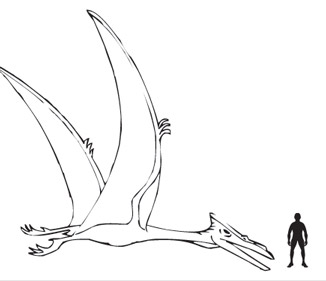
Drawing courtesy of Everything Dinosaur

The Dinosaur Park Formation (DPF)

The DPF has also provided evidence of birds, although once again the fossil record is poor.  Post cranial bones indicate that there might have been birds as big as modern hawks present in the Park area at the end of the Cretaceous.  At least three types of neornithine birds have been reported.  Neornithines have saddle shaped, articulating faces on their neck vertebra and usually lack teeth.  These are effectively modern birds.  As feathers tend to function better than flaps of skin, perhaps the birds dominated all the other aerial niches in the ecosystem and only the large soaring pterosaurs were left.

Birds do seem to have diversified very rapidly during the Cretaceous many modern genera that we would easily recognise were around in the last years of the dinosaurs.  Evidence has been uncovered for owls, rails, cormorants and tern-like sea birds.  Perhaps the rapidly expanding and diverse bird population led to the demise of the smaller pterosaurs.

To read an article from 2019 about a huge azhdarchid pterosaur discovered in Canada: The First Pterosaur Unique to Canada.
1 08, 2007

Happy Birthday Everything Dinosaur – the origins of Cotton

By |2023-02-13T08:06:07+00:00August 1st, 2007|Categories: Everything Dinosaur News and Updates, Main Page|0 Comments

Everything Dinosaur’s Second Anniversary – How old is Cotton?

Time flies when you are having fun.  Today, August 1st marks the second anniversary of the formal setting up of Everything Dinosaur.  The company had been around for sometime prior to this but we had to provide a a formal date of start-up for our accountants and August 1st seemed to be as good a day as any.

The last two years have really flown by, the business had taken nearly 5 years to plan and now that we are into our third year it is hard to believe how far we have come.  We are lucky, as collectively the Everything Dinosaur team members have a lot of experience in dinosaur research and information, as well as the all important knowledge of retail and customer service.

The Everything Dinosaur Logo

Everything Dinosaur

Everything Dinosaur logo.

Picture credit: Everything Dinosaur

Traditionally, in occidental countries, the second anniversary is associated with cotton.  Marking the second anniversary of a dinosaur company’s formal establishment with cotton is very appropriate.  Cotton is one of the most important crops grown and it has been associated with clothing our species for thousands of years and with Everything Dinosaur’s range of dinosaur themed clothing, it seems a good subject to discuss on our second anniversary.  Palaeontologists and archaeologists excavating Bronze Age settlements in Mexico dated from 5,000 BC have found evidence of cotton fibres in ancients furs.  Perhaps our ancestors were wearing cotton as early as 7,000 years ago.

The family that the cotton plants belong to Malvaceae, this is a very ancient group of angiosperms (flowering plants) and cotton may date back to the age of Dinosaurs.  So it is apt to celebrate our second anniversary with an article on this fascinating plant.  Cotton belongs to a sub-division of the Malvaceae called Gossypieae and there are a number of different species of cotton plant.  The great diversity of cotton species has led some scientists to speculate that this family must be very ancient and perhaps it dates back to the later part of the Mesozoic, the time of the dinosaurs.

Cotton is also native to both the Old World (Asia) and the New World (America).  Scientists have used this fact to speculate that the ancestors of modern cotton must have been around before the break up of the super-continent Gondwanaland – again this evidence points to early cotton plants being around during the Cretaceous.  Who knows, early cotton shrubs could have been grazed upon by long-necked Sauropods or Iguanodontids.

The fossil record does not quite support these theories.  To the best of our knowledge no pollen associated with early types of Gossypieae have been discovered in Cretaceous sediments.  The micro-fossil evidence we have for cotton plants is extremely poor.  The earliest pollen remains date back to approximately 40 mya (Eocene epoch).  Fossilised impressions of the actual plants are even rarer.

The lack of fossil evidence does not disprove the theory that herbivorous dinosaurs could well have grazed on ancient cottons.  Cotton is a shrub and it is native to tropical and sub-tropical forests.  Forest habitats do not lend themselves to the process of fossilisation.  If cotton’s ancient ancestors also lived in forests then the conditions to allow preservation to occur would only happen very rarely – perhaps this explains the lack of evidence.

Our best hope to prove that cotton was around in the Cretaceous is to look at the micro-fossils, perhaps some keen, bright eyed, young palaeontologist is about to make an amazing discovery…

Even something as everyday as cotton, a substance we all take for granted is capable of confusing palaeontologists.

To mark our second anniversary Everything Dinosaur has added a new range of 100% cotton dinosaur T-shirts to our clothing range.  They come in a range of sizes from 3 years to 8 years and lots of bright colours.

Our new T-shirts feature animals like Diplodocus and T. rex, we even have a dinosaur ABC.  Sales of these items help support real palaeontologists and researchers at the Natural History museum London.

Everything Dinosaur’s website for clothing and dinosaur themed models and toys: Everything Dinosaur – Dinosaur Toys, Models and Gifts.

It is hard to believe but the great, great, great etc. grandparent of the cotton plant that produced the fibre which went to make that T-shirt you are wearing could well have been munched on by a hungry dinosaur.

31 07, 2007

Amazing Monster Show Rocks America

By |2024-04-01T09:33:58+01:00July 31st, 2007|Categories: Everything Dinosaur News and Updates, Main Page|0 Comments

Monster Show Rocks America

The Walking with Dinosaurs inspired stage show is wowing young dinosaur fans as it starts the American leg of its world tour.   The stage show that features realistic, life-size animatronic dinosaurs has opened in the US to rave reviews.  The monsters, including a 45 foot tall Brachiosaurus and a slightly over sized T. rex and baby are operated by three controllers.  One inside the armature and two others co-ordinating dinosaur movements using a special effects rig attached to their arms.

Monster Show

The show was devised by Australian investors and although employs 150 people and has cost something like £10 million to set up.  It has already recouped all the initial investment during the tour of Australia where 300,000 people flocked to see the spectacular performance as a palaeontologist introduces the likes of Stegosaurus, Ankylosaurus and Allosaurus on stage.

The 90 minute show certainly thrills young and old alike, although much of the behaviour shown is based on speculation, as is the colouration and many of the skin patterns.  However, it goes to show how far we have come in our understanding of these amazing creatures as well as how far we have advanced in dinosaur special effects.  Not too many years ago if you wanted to create the impression of a dinosaur you hired a really tall guy in a monster suit.

Walking with Dinosaurs

The real winners in this venture are the BBC who own the rights to the Walking with Dinosaur franchise.  When this six part series, the brainchild of Tim Haines was first aired it caused a sensation and sales of DVDs and other merchandise have almost single-handedly changed the fortunes of the British  Broadcasting Company (BBC).

Walking with Dinosaurs Live hits Europe next year – expect an impact about the size of an asteroid… you have been warned!

For models and figures of many of the dinosaurs that are featured in this show: PNSO Age of Dinosaurs Replicas.

30 07, 2007

Dinosaur Bidding Wars – A New Perspective!

By |2024-04-01T09:34:56+01:00July 30th, 2007|Categories: Dinosaur and Prehistoric Animal News Stories, Dinosaur Fans, Main Page|0 Comments

Celebrities Bid up Price of Fossils

They stopped making them 66 million years ago and now dinosaur fossils have become the latest status symbol for Hollywood “A” listers.  Nicholas Cage and Leonardo DiCaprio were in a bidding war for a Tarbosaurus skull (an Asian relative of Tyrannosaurus rex) at a recent Beverley Hills auction.  It seems that a number of celebrities as well as big businessmen and even royalty have taken to collecting rare fossils.  This phenomenon, a dinosaur bidding war is not new, wealthy patrons have always helped fund fossil collecting and sponsored expeditions as well as permanent exhibits.  Mary Anning, the pioneering English fossil collector, sold many of her Lyme Regis finds to private collectors.

The Church cliffs at Lyme Regis.

Fossil hunting can be fun but beware of the cliffs.  A place where many important fossils have been found.

Dinosaur Bidding War

Had Gideon Mantell been able to secure the support and patronage of the newly crowned King William IV when the royal party visited Lewes on October 22nd 1830, the science of palaeontology could well have taken a different route.  However, the luckless Mantell missed out and one of the most distinguished and important early pioneers of dinosaur study was doomed to be squeezed out by the better connected Sir Richard Owen.

Private Fossil Collections

For the world’s wealthy having your very own private collection of fossils and other antiquities is becoming an important status symbol.  DiCaprio may have lost out to Nicholas Cage when it came to bidding for the tyrannosaur skull, but no doubt other batches of rare and unique specimens will be auctioned in California shortly and he will have another chance.

Fossil sales are big business, many scientific bodies and museums cannot compete and as a result palaeontologists are unable to study rare specimens and important specimens.  The rising prices has led to increased trade in illegal fossils (remains removed without permission) and counterfeit specimens, so well made that they can even fool professional palaeontologists.

For inexpensive dinosaur themed toys and gifts, that will not break the bank: Visit Everything Dinosaur.

29 07, 2007

The link between T. rex Bacterial Bite and Sense of Smell

By |2023-02-13T20:54:32+00:00July 29th, 2007|Categories: Dinosaur and Prehistoric Animal News Stories, Dinosaur Fans, Main Page, Palaeontological articles|0 Comments

Is T. rex sense of Smell proof of a Bacterial Bite?

By measuring the volume of the brain case of dinosaurs we can estimate the size of their brains.  A Tyrannosaurus rex specimen such as BHI3033, “Stan” the nearly complete gracile Tyrannosaurus rex discovered by Stan Sacrison in 1992, had a brain case with a volume of approximately 1,000 cubic centimetres.  In contrast, human being’s brains take up a volume of up to 1,800 cubic centimetres.  But brain size is not the be all and end all. 

Tyrannosaurus rex

Firstly, not all of the brain case volume was made up of brain, there are variations in the percentage of the brain case volume that the actual brain filled.  Also, different parts of the brain are responsible for different functions. With T. rex the cerebrum area (the part of the brain dedicated to thinking and problem solving) was very small.  In us, this part of the brain makes up by far the largest proportion of brain volume.  By looking at the brain case and studying the holes in the skull that carried nerves back and forth we can assess how intelligent a dinosaur was and how much of the brain was dedicated to functions such as sight, thinking, smell, balance and so on.

Powerful Sense of Smell

Scientists have estimated that about 50% of T. rex’s brain was dedicated to sense of smell (olfactory bulb), so it is fair to assume that the sense of smell was very important to Tyrannosaurus rex.  Perhaps this helps reinforce the “bacterial bite” theory.

T. rex could ambush an unsuspecting hadrosaur, inflict a wound with its massive jaws and then use its sense of smell to track down its victim.  The T. rex could follow the duck-billed dinosaur for several days, slowly but surely loss of blood and the inflected wound would weaken the animal and then T. rex could step in to finish it off.

A Tyrannosaurus rex Replica

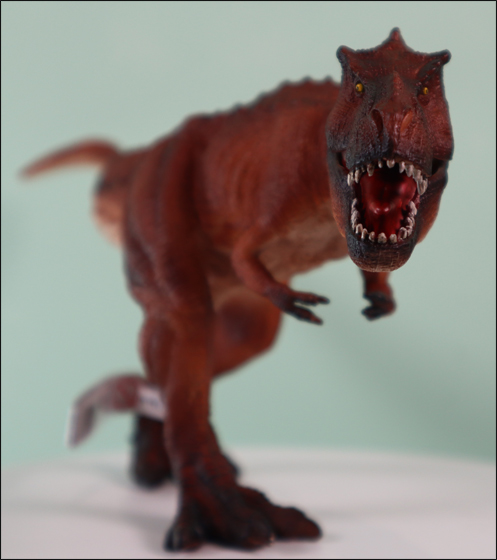
The Mojo Fun T. rex Deluxe dinosaur model approaches.

The Mojo Tyrannosaurus rex deluxe figure demonstrates stereoscopic vision and it is known that this dinosaur had a powerful sense of smell.  Picture credit: Everything Dinosaur.

Picture credit: Everything Dinosaur

Perhaps the large part of the brain dedicated to sense of smell is evidence of a bacterial bite in tyrannosaurs.

Everything Dinosaur supplies a T. rex skull kit that permits you to assemble your very own life-like tyrannosaur skull.

Dinosaur Crafts for Kids: Visit Everything Dinosaur.

28 07, 2007

Cast of a Tyrannosaurus rex Tooth For Sale

By |2023-02-13T10:55:20+00:00July 28th, 2007|Categories: Everything Dinosaur Products, Photos/Pictures of Fossils|1 Comment

Cast of T. rex Tooth for Sale

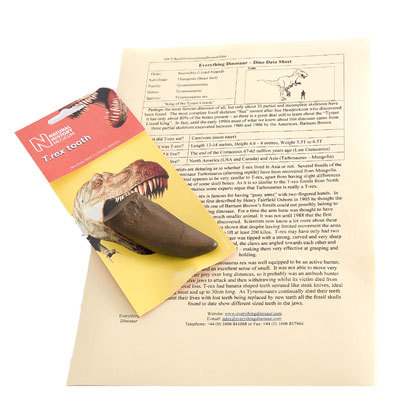
A picture of the cast of the Tyrannosaurus rex which is a replica of real fossil material, available for sale from Everything Dinosaur.  A cast of a T. rex dinosaur tooth available to buy from Everything Dinosaur.

The Tyrannosaurus rex Tooth Cast

A wonderful dinosaur tooth!  A replica of a Tyrannosaurus rex tooth and a fact sheet from Everything Dinosaur.

Picture Credit: Everything Dinosaur

A photograph of a Tyrannosaurus rex tooth along with the accompanying Everything Dinosaur T. rex fact sheet as written and researched by our very own dinosaur experts.  A very good quality replica of a Theropod tooth.  The classic profile and the “D-shaped” cross section of a typical Tyrannosaur tooth can clearly be seen in this museum quality replica.

Visit Everything Dinosaur’s website: Visit the Everything Dinosaur Website.

28 07, 2007

How did Tyrannosaurus rex clean its Teeth?

By |2022-10-29T20:36:04+01:00July 28th, 2007|Categories: Everything Dinosaur Products, Main Page|0 Comments

Did Tyrannosaurus rex use a Tooth brush?

Developing the line of thought regarding the possibility of large Theropod dinosaurs having bacterial bites (see previous posting – Tyrannosaurus rex causes Chinese Takeaway), the question of how did the big meat-eaters like T. rex clean their teeth.

Information on tyrannosaur bacterial bite here.

In the case of most tyrannosaurs, their forelimbs were too small to reach their mouths so the could not have used their claws as tooth picks.  The truth is that T. rex probably did not have to clean its teeth, like most reptiles they have a considerable advantage over the mammals when it comes to dentition.  Dinosaurs constantly shed their teeth, with new ones growing up from the jawbone to replace old, damaged or wore teeth.  This is why when you look at a skull of a T. rex in a museum all the teeth in the jaw are different sizes. The teeth of a T. rex were shaped slightly differently depending on which part of the mouth they come from but the different sizes are due to some teeth being older than others, smaller younger teeth erupting through the jaw.

Larger crocodile species such as the Nile crocodile (Crocodylus niloticus) can have up to 40 sets of teeth in a lifetime.  There teeth are conical and not serrated like tyrannosaurs teeth, the lack of serrations (palaeontologists call these serrations denticles) would make them slightly less likely to have pieces of their last meal stuck to them and therefore less likely to harbour bacteria.  As crocodiles gape their teeth are exposed to sunlight and this helps to bleach the teeth and clean them.  It is also believed that small birds such as the Nile Plover (Pluvianus aegyptius) may have a symbiotic relationship with the crocodiles. These small birds may give crocs a grooming service – picking off skin parasites and removing pieces of food stuck in the crocodiles jaws.

T. rex lived at a time when the birds had become very well established.  There were lots of species of birds around at the end of Cretaceous that are familiar today.  Perhaps tyrannosaurs actively sought out colonies of small birds and gaped with their jaws wide open attracting birds to come over and give them a grooming.  Maybe these birds (the brave ones at least), would enter the beast’s huge mouth and remove the shreds of meat left behind from animal’s last meal.  This is pure speculation of course, behaviour like this is unlikely to be recorded in the fossil record, but if other animals can develop mutually beneficial relationships – why not dinosaurs as well?

As Everything Dinosaur has links with a number of Natural History museums we are able to get access to real T. rex teeth to study them and make casts.

Genuine museum quality replica T. rex tooth and other fossil casts and models are available from our website.

Dinosaur Crafts for Kids: Visit Everything Dinosaur.

We can even sell casts of real fossils (resin replicas) so you too can get hold of things like a Velociraptor killing claw and your very own T. rex tooth.  The tooth we sell is a resin replica of a tooth from the right lower jaw of a T. rex specimen discovered by the American palaeontologist Barnum Brown in 1900.  It was from these remains that T. rex was named and described.  The specimen code for this discovery is BM-R7995 and it is stored at the Natural History museum in London.  As only about 13% of the skeleton was recovered at the time, this T. rex has been removed from display.  The lack of bones meant that there were few options open to the curators as to how they could exhibit this specimen.  It was secured to a huge board representing a backdrop diorama of the Cretaceous and the missing elements were filled in with casts and copies.  Unfortunately, this specimen was mounted in the “kangaroo style” with the tail resting on the ground, so it was not anatomically correct.  The remains of the first proper T. rex skeleton to be discovered are now locked away in the vast vaults of the Natural History museum, however at least you can obtain your own piece of prehistoric history with a replica tooth.  You too can own replica Tyrannosaurus rex teeth!

27 07, 2007

Tyrannosaurus rex causes Remarkable Chinese Takeaway

By |2024-04-01T09:35:38+01:00July 27th, 2007|Categories: Dinosaur and Prehistoric Animal News Stories, Main Page|0 Comments

Tyrannosaurus rex is still Scary say Chinese Youngsters

Young residents of Shanghai have been given a scare by a Tyrannosaurus rex that has taken up residence in the city.  It may be rather surprising to find a T. rex in Shanghai, after all as far as palaeontologists know Tyrannosaurus rex lived in North America and it never got as far as eastern China.  Asia was the domain of an equally fierce Tyrannosaur called Tarbosaurus “alarming reptile” a close cousin of the more famous T. rex.

However, a local company wanting to commemorate the opening of new premises commissioned a 5 metre long statue of T. rex and placed it on their rooftop.  Local residents have objected claiming that the statue of T. rex in a typical pose (mouth open, showing huge teeth), frightens children.

Reluctantly, the company has agreed to remove the statue, but it has been given a stay of execution by the civic authorities, permitting T. rex to continue to look down on the locals – at least until the new premises are officially opened on August 8th.

After this date, either the statue will find a new home, or once again Tyrannosaurus rex will face extinction.

In reality, Tyrannosaurs could hardly be described as obvious candidates to have their features immortalised in a sculpture.  These animals (like most super-predators today) lived short, violent lives.  Tyrannosaurs would have been extremely unpleasant creatures to come across.  As well as the prospect of being treated like a mid-morning snack, the smell from a recent kill would probably still hang around them and if you got close enough to smell the breath of a T. rex (something we would not recommend), the stench would be most unpleasant.  T. rex most probably had a bacterial bite, meat would remain in the jaws and attract bacteria and other unpleasant pathogens.  When T. rex bit into an animal, the bite may not prove fatal but the injection of all the nasty little bugs and diseases into the unfortunate animal could well have weakened it to the point where it would eventually collapse.  Leaving the Tyrannosaur to simply follow its victim until it finally went down.  Komodo dragons have a similar hunting strategy, although recent research has shown that these giant monitor lizards are actually venomous.

Evidence from the fossils indicate that Tyrannosaurus would carry a number of injuries and would most certainly have been scarred, so they would not have been pleasant to look at.

“Stan” the gracile T. rex discovered in 1992 shows evidence of a number of serious injuries, which would not have given this particular dinosaur much chance of winning a beauty pageant.  For example, part of the postorbital and squamosal region of the skull (the back of the head) had been bitten off.  Remarkably, as there are signs of healing revealed in close analysis of the fossil bones, “Stan” survived this traumatic injury.

Slightly concerning is that Stan was about 40 feet long and weighed in around 5 Tonnes.  What kind of animal could have inflicted this sort of damage on a 40 foot Tyrannosaur?

Scientists know of only one animal capable of biting out chunks like this – another probably larger T. rex!

Evidence from their fossils, show that these animals lived short and violent lives.  Fighting prey and fighting rival Tyrannosaurs possibly over food, territory and mates.  For sure the big theropods may not have been much in the good looks stakes but they certainly still hold our fascination.  Long after the likes of Marilyn Monroe have faded from our collective memory people will still queue to catch a glimpse into the lives of these ancient reptiles.

Typical model of Tyrannosaurus rex in aggressive pose:

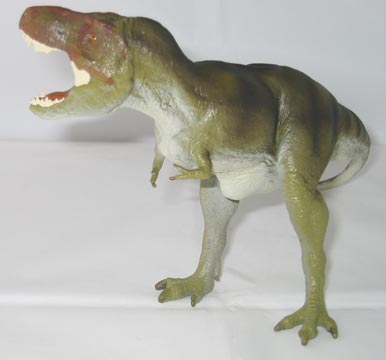
A T. rex Dinosaur Model

Fearsome dinosaur 1:40 scale figure.

Fearsome dinosaur 1:40 scale figure.

Dinosaur Toys for Boys and Girls: Dinosaur and Prehistoric Animal Models.

26 07, 2007

Exciting Dinosaurs for Girls – Part 2

By |2024-04-01T09:36:19+01:00July 26th, 2007|Categories: Dinosaur Fans, Everything Dinosaur News and Updates, Main Page|0 Comments

Dinosaurs for Girls (part 2)

Women palaeontologists continue to make their mark on the science of studying ancient life.  Indeed, many of the most important discoveries of recent years have been made by women.  For example, the most complete fossil Tyrannosaurus rex yet found was discovered by Sue Hendrickson in 1990 as she explored an area northeast of Ruth Mason Quarry in South Dakota.

Not only are women finding new specimens but they are having an impact on the science of palaeontology in more subtle ways.  Polish palaeontologist Teresa Maryanska discovered a new genus of armoured dinosaur whilst on a scientific expedition to Mongolia.  In a departure from standard scientific practice, when it came to naming this new animal, Teresa chose not to use a Greek or Latin term.

Instead she named the animal Saichania, it means “beautiful” in the local Mongolian dialect.  The fossil remains of this Ankylosaur were certainly beautifully preserved and the specimen was almost complete so perhaps the word “beautiful” is appropriate.

This herbivore lived at the end of the Cretaceous period, around 80 million years ago (Campanian).  A fully grown adult is estimated to have been up to 20 feet long and it may have weighed as much as 3 Tonnes.

A model of Saichania (is beauty in the eye of the beholder);

Click here to view armoured dinosaur models: Dinosaur and Prehistoric Animal Models.

Many other palaeontologists have broken with the convention of using Latin or Greek to name their discoveries.  Mary and her team have paved the way for Chinese scientists to name their discoveries using their own language and not the classical languages of the Western world.  We even have some “beautiful” Chinese specimens rivalling Saichania.

An example would be Sinocalliopteryx a fleet footed member of the Compsognathidae group.  It is certainly beautifully preserved and represents another of the feathered wonders being unearthed from China.

25 07, 2007

Everything Dinosaur’s Unique Dinosaur Model Collection

By |2024-04-01T09:37:06+01:00July 25th, 2007|Categories: Everything Dinosaur Products, Photos of Everything Dinosaur Products|0 Comments

A Set of Dinosaur Models (Prehistoric Animal Models)

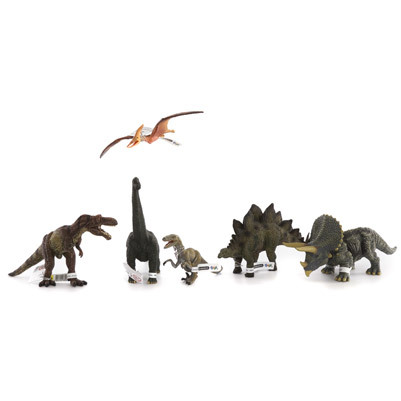
Some of the most popular prehistoric animal models including T. rex, Triceratops and Stegosaurus from the CollectA dinosaurs model range have been put together into this six figure dinosaur model set by team members at Everything Dinosaur.

A Set of Six Prehistoric Animal Models (CollectA Dinosaurs)

Six different dinosaur models to collect!

Picture credit: Everything Dinosaur

Part of the Everything Dinosaur CollectA range of dinosaur models, a set of six prehistoric animal models to collect. There is a Tyrannosaurus rex, Triceratops, Stegosaurus, Velociraptor, Brachiosaurus and the pterosaur Pteranodon (P. longiceps).  A popular set with dinosaur fans and serious dinosaur model collectors.

To view the extensive range of dinosaur and prehistoric animal scale models and replicas in stock at Everything Dinosaur: Dinosaur and Prehistoric Animal Models.

Go to Top