As Everything Dinosaur team members have written quite a lot about staying safe when visiting the beaches around Lyme Regis on the famous Jurassic Coast of southern England, we are now receiving emails from first time visitors to Dorset asking for our advice.
Our dedicated team members are happy to provide assistance and to direct these enquiries to the local tourist information office and various visitor centres.
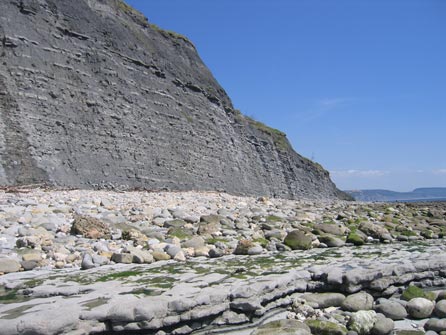
Some of the recently built sea defences around Lyme Regis. Stonebarrow and Golden Cap can be seen in the background. The stunning and very beautiful part of the UNESCO World Heritage site around the picturesque town of Lyme Regis (Dorset) – the “Jurassic Coast”. Picture credit: Everything Dinosaur.
Picture credit: Everything Dinosaur
Our Advice
As the school holidays approach many families are wanting to have a vacation in the UK rather than travel abroad. The Dorset coast is a popular destination and first-time visitors have turned to Everything Dinosaur for advice on staying safe when visiting the beaches. Whilst team members can provide general information and guidance it is important that visitors obey any local notices that have been posted up.
Avoid the cliffs, don’t go near them and whatever you do please do not attempt to climb them. For further information about visiting the beaches around Lyme Regis: Visiting Lyme Regis in Summer. If you are at Charmouth, pop into the local Heritage Centre and ask their advice, you may also be able to book a fossil walk or at least enquire about availability.
Supervised fossil walks are always a good idea, most are now fully booked but it might be worthwhile emailing local guides and enquiring. Brandon Lennon is one of the most respected in the area, he can be contacted here: Lyme Regis Fossil Walks.
For further advice you can visit the local Lyme Regis Tourist Information centre located in the town centre of Lyme Regis – 62, Church Street, Lyme Regis DT7 3BS. Local knowledge can be invaluable.
Visiting Lym Regis
If you want specific information about tides and beach safety, you can enquire at the lifeboat station down on the Cobb at Lyme Regis. Alternatively, there are a number of websites that provide information about high and low tides on this part of the coast, or for a small fee, an annual tide timetable can be purchased.
It is a good idea to go fossil collecting on a falling tide and to keep away from the steep cliffs. Everything Dinosaur team members provide general advice and guidance to visitors to Lyme Regis and Charmouth. Picture credit: Everything Dinosaur.
Picture credit: Everything Dinosaur
Visit the award-winning and customer friendly website of Everything Dinosaur: Dinosaur Models and Toys.
The results of the independent tests undertaken by Eurofins on the YvY Figures Dino Hazard 1:20 scale Irritator challengeri dinosaur model have arrived. In Everything Dinosaur’s next YouTube video, we will announce the results and explain a little more about the steps required in order to allow Everything Dinosaur to bring this replica into the company’s UK warehouse.
The independent product safety test under the General Product Safety Directive for the YvY Figures Dino Hazard Irritator challengeri 1:20 scale dinosaur model. Picture credit: Everything Dinosaur.
Once a sample of the Dino Hazard Irritator challengeri figure had been received, Everything Dinosaur set about commissioning independent product safety tests under the General Product Safety Directive. Eurofins was the testing company that Everything Dinosaur sent this dinosaur model to so that an assessment could be carried out.
Eurofins is one of the largest and most respected testing companies in the world. It employs over 50,000 staff across a network of more than 900 independent companies and it has more than 800 laboratories located in 50 countries. The Eurofins Group is committed to providing the highest quality services, accurate results and expert advice from its highly qualified staff. The reliability and accuracy of their analytical services help customers like Everything Dinosaur make decisions about which dinosaur models to bring into the UK and then sell around the world.
An Everything Dinosaur team member holds the Dino Hazard Irritator challengeri dinosaur model, which in turn is holding in its claws the replica of a lungfish (Equinoxiodus alcantarensis) which is supplied as an accessory with this dinosaur figure. The independent test results for this 1:20 scale dinosaur model are in and Everything Dinosaur’s next YouTube video will discuss them. Picture credit: Everything Dinosaur.
Picture credit: Everything Dinosaur
Subscribe to Everything Dinosaur on YouTube
In a few days, Everything Dinosaur will post up a short video on the company’s YouTube channel discussing the Eurofins assessment and the next steps that the UK-based company needs to take in order to bring this exciting dinosaur model out of China.
The Everything Dinosaur YouTube channel is packed with lots of prehistoric animal model reviews, collecting hints and tips and lots of helpful information. There are over 170 videos on the channel, we recommend that you subscribe to Everything Dinosaur on YouTube: Everything Dinosaur on YouTube.
A new species of dinosaur has been named and described from a jawbone found in Castellón, Spain. The dinosaur has been named Portellsaurus sosbaynati and it has been classified as a member of the Ornithopoda subgroup Styracosterna. Its discovery could help shed light on the evolution of the Hadrosauroidea – the duck-billed dinosaurs, from other large-bodied dinosaurs more closely related to the iguanodontids.
A life reconstruction of the newly described Spanish styracosternan hadrosauroid named Portellsaurus sosbaynati. Picture credit: Universitat Jaume I.
Portellsaurus sosbaynati
The fossil material, consisting of a right dentary (lower jawbone), specimen number MQ98-II-1, comes from Mirambell Formation exposures at a site near Mas de Curolles, Portell, Castellón (Spain). The fossil is around 129-130 million years old (Barremian faunal stage of the Early Cretaceous). The strata represent a shallow lagoon and although no other fossil material has been described, unique characteristics associated with the dentary combined with the fossil’s geological age, permitted the research team to erect a new genus of herbivorous dinosaur.
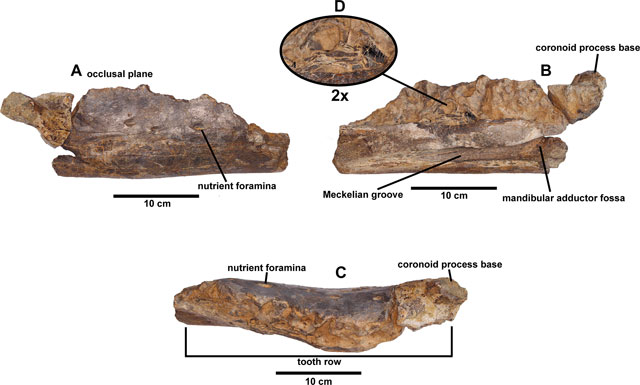
View of the right dentary (MQ98-II-1) of Portellsaurus sosbaynati. Labial (A), lingual (B), and occlusal (C) views. (D) Enlargement (2x) of a dental crown fragment at the tooth row. Note scale bar = 10 cm. A new dinosaur described from a fossil jawbone. Picture credit: Santos-Cubedo et al.
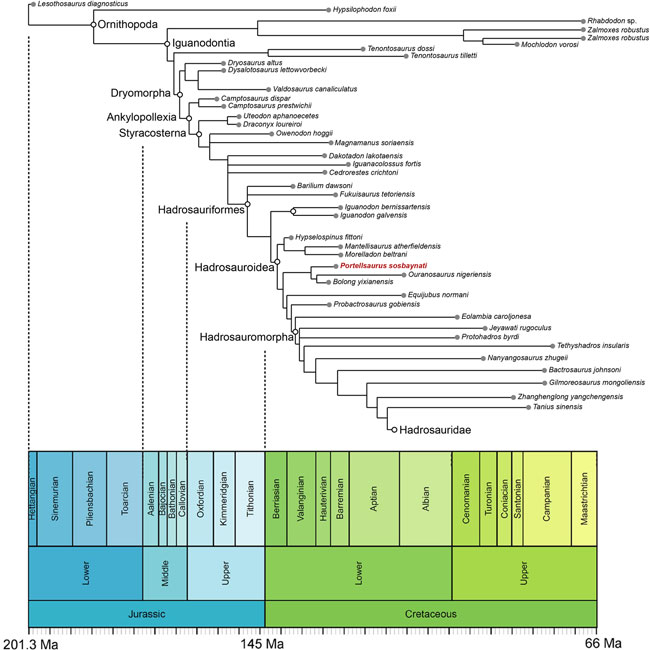
Writing in the on-line academic journal PLoS One, the researchers from Universitat Jaume I, Grup Guix and Valencia University, conclude that Portellsaurus is closely related to Ouranosaurus (O. nigeriensis) from Africa and Bolong (B. yixianensis) from north-eastern China.
Based on comparisons with other fossil material from other better-known iguanodontids and hadrosauroids, the scientists estimate that Portellsaurus could have been up to 8 metres long. The genus name for this new Spanish dinosaur honours the town of Portell, whilst the trivial name honours Vicente Sos Baynat, a Spanish geologist born in Castelló de la Plana and the first scientist to be awarded the accolade of honorary doctorate by the Universitat Jaume I.
Time-calibrated phylogeny of Portellsaurus sosbaynati. This analysis suggests that this Spanish styracosternan hadrosauroid was closely related to Ouranosaurus from Africa and Bolong from China. Picture credit: Santos-Cubedo et al.
Not Closely Related to Other Large-bodied Iberian Ornithopods
In addition, the scientists including corresponding author Andrés Santos-Cubedo (Universitat Jaume I), conclude that Portellsaurus sosbaynati is less closely related to other Iberian taxa such as Iguanodon bernissartensis and Proa valdearinnoensis than it is to the other Early Cretaceous Iberian styracosternans Mantellisaurus atherfieldensis and Morelladon beltrani, although Portellsaurus is geologically several million years older than both Mantellisaurus and Morelladon.
The scientific paper: “A new styracosternan hadrosauroid (Dinosauria: Ornithischia) from the Early Cretaceous of Portell, Spain” by Andrés Santos-Cubedo, Carlos de Santisteban, Begoña Poza and Sergi Meseguer published in PLoS One.
Editor Mike Fredericks kindly sent Everything Dinosaur a preview image of the forthcoming summer edition of “Prehistoric Times” magazine. This quarterly magazine is aimed at prehistoric animal enthusiasts and collectors of dinosaur models. Each edition is packed with amazing articles, reviews of the latest models and interviews with leading artists and Earth scientists.
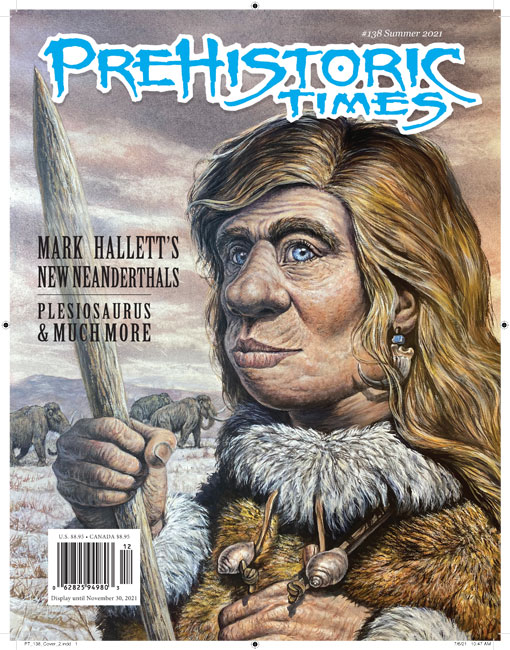
Issue 138 (summer 2021), features the stunning artwork of renowned American palaeoartist Mark Hallett.
Oregon-based Mark was working on a book describing the evolution of the horse, to be published by Columbia University Press. He had been busy preparing illustrations for “The Horse: A Natural History”, however, he has found time to produce some stunning artwork reflecting current thinking about our close cousins the Neanderthals.
The front cover of “Prehistoric Times” magazine edition 138 (summer 2021).
Neanderthals Revisited
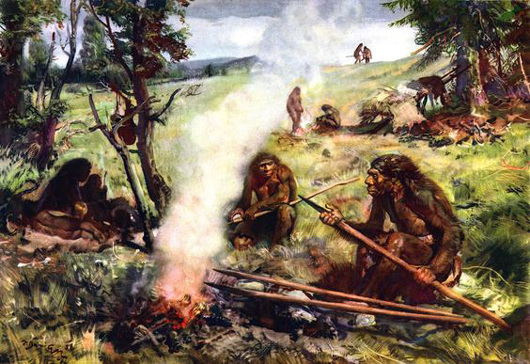
Our views of the hominin Homo neanderthalensis have changed dramatically over the last three decades or so. Early perceptions about Neanderthals being brutish ape-like creatures have largely been replaced with a very different view. They made a variety of sophisticated tools, cooked using fire, lived in shelters and made and wore clothing. Neanderthals were very capable hunters of large game, hence the herd of mammoths in the background of Mark Hallett’s front cover art as a wooden spear wielding female Neanderthal looks on.
Neanderthals depicted as quite primitive “ape-men”. A 20th century illustration of Neanderthals by Zdenek Burian.
Neanderthals Made Jewellery
Evidence has emerged that Neanderthals deliberately buried their dead and in some instances marked the graves and provided grave goods and offerings such as shells and flowers. They probably had language skills and they made jewellery. Artefacts found in the Iberian Peninsula and dated to around 40,000 years ago prove that Neanderthals used eagle talons as necklace pendants. The female in the Mark Hallett illustration is wearing a shell necklace and has a very fetching eagle talon earring. Only two species of hominins are known to have demonstrated such sophisticated behaviour, the Neanderthals and our own species Homo sapiens.
We look forward to reading the article about Mark Hallett’s work in the forthcoming edition of the magazine.
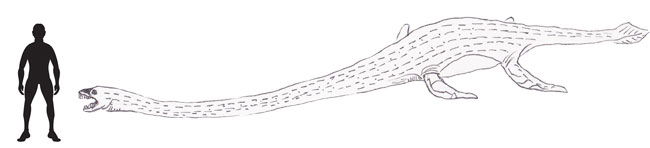
We are expecting the rest of the new for 2021 CollectA prehistoric animal models to be in stock in a few weeks’ time. As team members at Everything Dinosaur prepare for their arrival, we have been updating our illustration of Elasmosaurus on our Elasmosaurus fact sheet.
Everything Dinosaur commissions illustrations of prehistoric animals – just one of the many ways in which we support the palaeoart community.
The Elasmosaurus scale drawing commissioned by Everything Dinosaur as the company’s fact sheet is updated. Picture credit: Everything Dinosaur.
Picture credit: Everything Dinosaur
A Change in the Tail
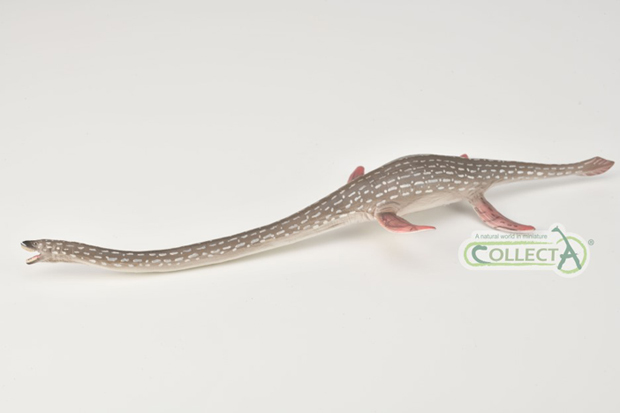
Observant readers will spot that the tail of our Elasmosaurus has been given a fin. This reflects some of the latest research into this Late Cretaceous, long-necked member of the Plesiosauria. The CollectA Elasmosaurus has also been given a tail fluke. Back in November 2020, when we announced the new for 2021 CollectA figures we created a short video highlighting the fossil evidence that supports the presence of a caudal fluke in members of the Plesiosauria.
CollectA Elasmosaurus marine reptile model. A new for 2021 marine reptile model from CollectA.
Everything Dinosaur Fact Sheets
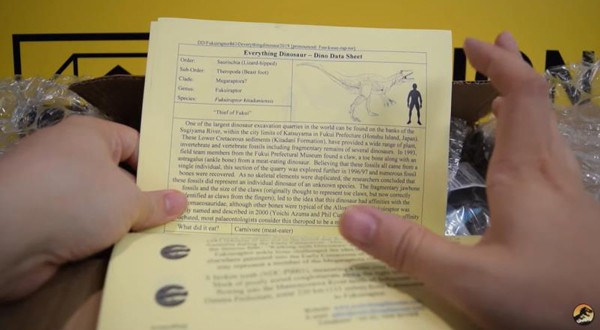
For virtually every named prehistoric animal model we supply, Everything Dinosaur researches and writes a fact sheet on that creature. These fact sheets are then sent out free to our customers with their model purchases. This is one of the ways in which team members help to inform and educate the public about the amazing animals that once existed on our planet.
The unboxing video features some Everything Dinosaur fact sheets. Dinosaur fans and model collectors appreciate the free fact sheets that we supply. Picture credit: JurassicCollectables.
CollectA Age of Dinosaurs Model Range
The CollectA Age of Dinosaurs model range contains a wide variety of prehistoric creatures including lots of marine reptile models including the elasmosaurid Hydrotherosaurus. Team members are looking forward to the arrival of the new CollectA Age of Dinosaurs Elasmosaurus replica and sending out free fact sheets with purchases.
Team members at Everything Dinosaur do all they can to respond to customer queries and questions. We appreciate how busy all our lives are and our hard-working staff are on standby to answer emails and to do all they can to help customers.
Take for example, an email we received from Sammy, who wanted to know about the dinosaur themed water bottle that we sell. Sammy asked:
“Is this dinosaur water bottle BPA free?”
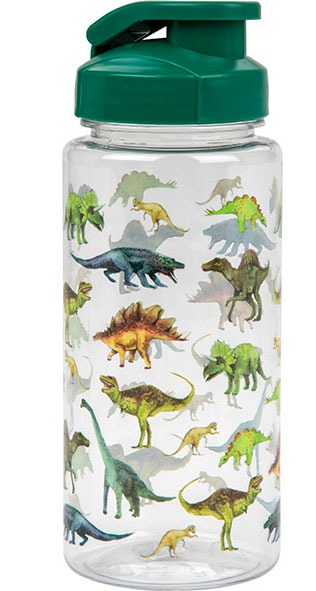
The dinosaur and prehistoric animal themed water bottle available from Everything Dinosaur. The bottle holds 500 ml and the plastic that it is made from is BPA free.
BPA Free Dinosaur Water Bottle
This colourful dinosaur and prehistoric animal themed water bottle is indeed BPA free.
BPA (Bisphenol A), is a chemical used to make some plastics, including food storage containers and refillable drinks bottles. Microscopic amounts of this chemical can be transferred from packaging into the food and drinks that we consume, however the level of BPA found in food is not considered to be harmful.
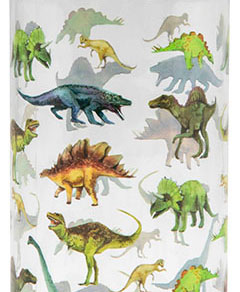
The colourful prehistoric animal themed design on the 500 ml drinking bottle. Ideal for school or picnics, this water bottle is BPA free. Can you name all the prehistoric animals featured?
BPA (Bisphenol A) Safety Assessments
Some people are concerned about BPA because it’s one of a large number of substances that could possibly interfere with human hormone systems. Extensive assessments have been carried out on BPA by the UK Food Standards Agency. Their current full assessment has found that dietary exposure to BPA is not a health concern for any age group.
However, Everything Dinosaur are pleased to confirm that this water bottle that we supply is BPA free.
To view the range of dinosaur and prehistoric themed merchandise available from Everything Dinosaur: Visit Everything Dinosaur.
Analysis of sediments taken from the famous Prince Creek Formation of northern Alaska has revealed tiny, fossilised bones and teeth representing perinatal dinosaurs – either embryonic (just about to hatch) or dinosaurs that have recently hatched. Several different types of dinosaurs are represented, which means that high latitudes in the Northern Hemisphere were probably the dinosaur’s permanent home and that they nested there.
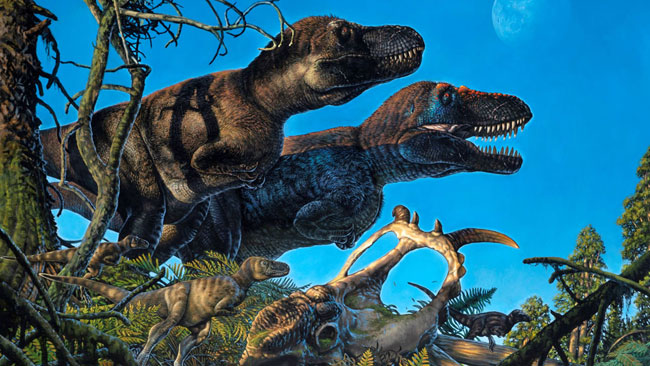
The discovery of tiny teeth and bones from perinatal dinosaurs provides strong evidence for dinosaurs nesting in the Arctic. This in turn suggests that many different dinosaurs were year-round residents and supports the hypothesis that most theropod and ornithischian dinosaurs were endothermic (warm-blooded). Picture credit: James Havens.
A Dinosaur Nursery
Researchers from the University of Alaska Museum, the Royal Tyrrell Museum, Florida State University and the University of Colorado writing in the academic journal “Current Biology”, report the discovery of tiny teeth — some less than 2 mm in length along with bones from seven species of perinatal dinosaurs. These tiny fossils were found after conducting a microscopic analysis of sediments from the bluffs that can be found along the shores of the Coleville River. These sediments are from the Prince Creek Formation and represent deposition that took place around 70 million years ago,
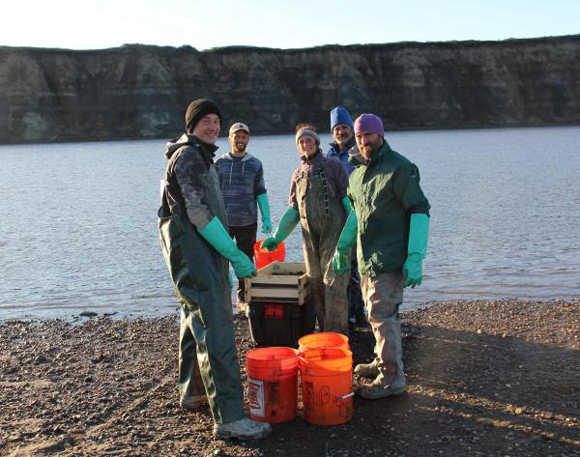
The field season is very short at such a high latitude. In the three weeks of field work that are possible, the team removed hundreds of kilograms of sediment from the face of the bluffs. The buckets of sediment are hauled down to the river’s edge, where team members wash the material through smaller and smaller screens until they have removed any large rocks and soil.
Field team members pose for a photograph next to buckets of sediment that they will sift through to search for tiny mammalian teeth end evidence of perinatal dinosaurs. Picture credit: Jaelyn Eberle.
Once back at the lab, researchers run the material through more screens to remove all the clay, until all that’s left is sandy particles. Then, teaspoon by teaspoon, the team, including graduate and undergraduate students examine the sand under microscopes to find the tiny bones and teeth. This work has revealed tiny teeth of mammals, but in addition, tiny teeth and bones of dinosaurs have been discovered.
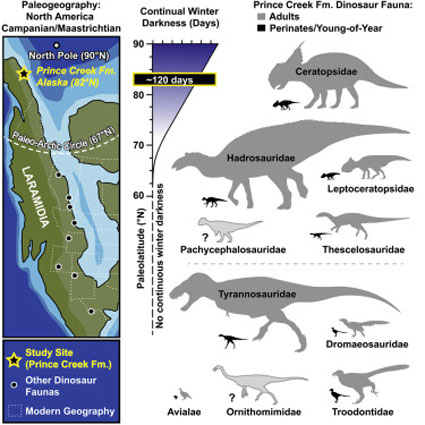
A map of Laramidia in the Late Cretaceous showing the position of the Prince Creek Formation in relation to other deposits where Late Cretaceous dinosaur fossils have been found. At this latitude, around 120 days each year were in total darkness. The scientists have found perinatal bones and teeth representing a wide variety of dinosaurs. Picture credit: Druckenmiller et al
Endothermic Dinosaurs
Although not as cold as today, conditions in this part of northern Laramidia during the Late Cretaceous were extremely challenging. For around 120 days each year there was total darkness and it has been calculated that the mean average temperature was just 6.3°C ± 2.2°C (43.3°F ± 4.0°F). The Eumeralla and Wonthaggi Formations of Australia at a palaeolatitude of about 70° south, have also provided evidence of recently hatched dinosaurs and yearlings.
However, the Prince Creek Formation at a latitude of 80°– 85° north represents the most extreme environment yet described for the Dinosauria. Intriguingly, whilst dinosaurs living in southern Gondwana (Eumeralla and Wonthaggi Formation fossil remains), would have experienced around 45 days of total darkness each year, this palaeoenvironment was still warm enough for ectothermic animals such as crocodilians and amphibians to thrive. However, no such “cold-blooded” animals are found in association with Prince Creek Formation sediments.
To survive such harsh conditions, the researchers conclude that the dinosaurs of Prince Creek Formation were endothermic, just like modern mammals and birds.
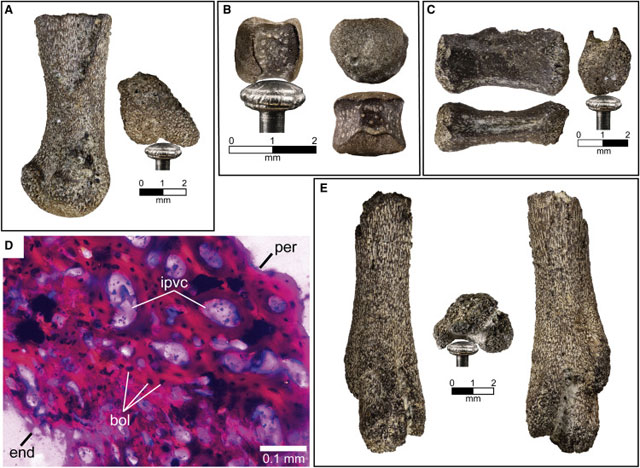
Perinatal skeletal elements of Prince Creek Formation dinosaurs. Insert (A) medial and distal views of distal femur(?), Ornithischia indet. (UAMES 41721). (B) Lateral, articular, and ventral views of caudal centrum, Ornithischia indet. (UAMES 41633). (C) Lateral, ventral, and articular views of caudal centrum, Theropoda indet. (UAMES 51934). (D) Transverse thin section of Ornithischia indet. long bone (UAMES 52384) showing the extreme porosity attributable to large, irregularly shaped vascular canals and the incompletely formed primary vascular canals on both the endosteal and periosteal surfaces. (E) Extensor, distal, and flexor views of distal tarsometatarsus, Avialae indet. (UAMES 41722). bol, bulbous osteocyte lacunae; end, endosteal surface; ipvc, incipient primary vascular canals; per, periosteal surface.
Lead author of the research Patrick Druckenmiller (University of Alaska Museum) commented:
“Recovering these tiny fossils is like panning for gold. It requires a great amount of time and effort to sort through tonnes of sediment grain-by-grain under a microscope. The fossils we found are rare but are scientifically rich in information”.
Dinosaurs were Year-round Residents of Northern Alaska
The presence of such young dinosaurs, who were not capable of making long, seasonal migrations is strong evidence to suggest that the dinosaur biota was present all year. The palaeoenvironment was extreme but numerous different types of dinosaur were able to thrive in this harsh habitat.
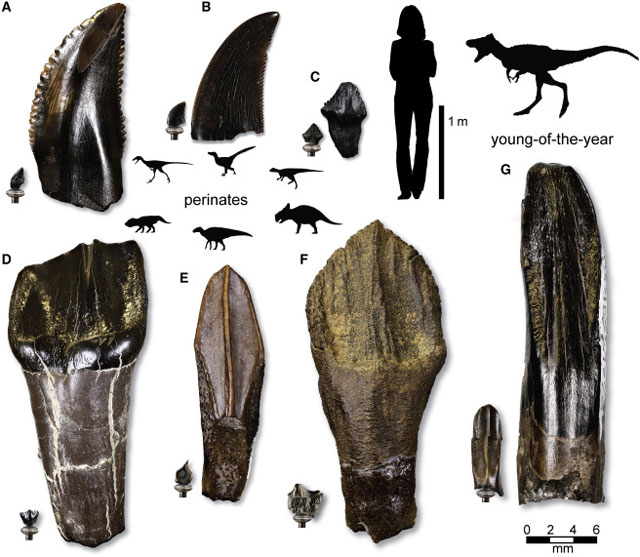
Comparative sizes of immature and mature teeth from Prince Creek Formation dinosaurs. A) Troodontidae indet. (UAMES 52268, UAMES 51652). (B) Saurornitholestinae indet. (UAMES 52292, UAMES 29574). (C) Thescelosauridae indet. cheek teeth (UAMES 52230, UAMES 52272) (D) Leptoceratopsidae indet. (UAMES 42720, UAMES 39298). (E) Hadrosauridae (cf. Ugrunaaluk) (UAMES 42739, UAMES 12491). (F) Ceratopsidae (cf. Pachyrhinosaurus) (UAMES 52467, UAMES 29413). (G), Tyrannosauridae (cf. Nanuqsaurus) premaxillary teeth, Picture credit: Druckenmiller et al.
This discovery demonstrates just how adaptable members of the Dinosauria were and hints at a diverse and rich dinosaur dominated ecosystem hundreds of miles inside the Palaeo-Arctic Circle.
The scientific paper: “Nesting at extreme polar latitudes by non-avian dinosaurs” by Patrick S. Druckenmiller, Gregory M. Erickson, Donald Brinkman, Caleb M. Brown and Jaelyn J. Eberle published in Current Biology.
A new species of ancient beetle has been named and described based on preserved remains found in the poo (coprolite) of an ancestor of the dinosaurs. The beetle named Triamyxa coprolithica, is the first insect to be scientifically described from coprolite and this research, suggests that coprolite remains could become as important as insects preserved in amber when it comes to identifying new species.
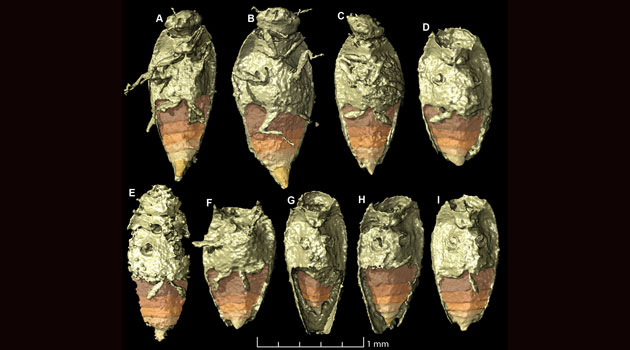
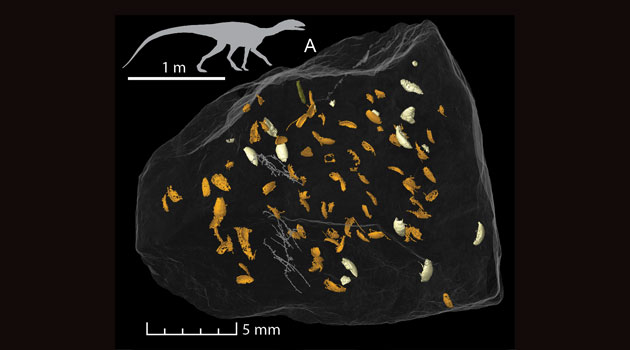
Images of the newly described Triassic beetle Triamyxa coprolithica, the first insect to be named and described from a coprolite. Picture credit: Qvarnström et al.
Published in Current Biology
The researchers from Uppsala University (Sweden), in collaboration with entomologists from Sun Yat-sen National University (Taiwan), Jena University (Germany) and Guadalajara University in Mexico used synchrotron microtomography to examine the coprolite’s contents and sophisticated computer software to rebuild the tiny insects so that they could be studied. The coprolite contained numerous insect remains preserved in three-dimensions. Most insect fossils are squashed so flat that deciphering them is extremely difficult.
The researchers conclude that coprolites may prove to be an important source of information for exploring insect evolution. Their paper is published this week in “Current Biology”.
Using synchrotron microtomography, the beetle fossil was virtually reconstructed while still remaining in the coprolite. Picture credit: Qvarnström et al
Silesaurus opolensis
Although the scientists cannot be certain, they speculate that the coprolite represents the scat from a relative of the dinosaurs called Silesaurus opolensis, which is known from the same Polish deposits associated with the coprolite. An animal (probably S. opolensis), swallowed a large number of these tiny insects 230 million years ago, the greedy reptile inadvertently giving palaeontologists a rare opportunity to study a beetle, at a time (the Triassic), when many different types of insect were evolving and diversifying.
Phylogenetic analysis suggests that T. coprolithica is a member of Myxophaga (fungal beetles), a small suborder of beetles with a sparse fossil record whose extant representatives are small and often associated with wet environments.
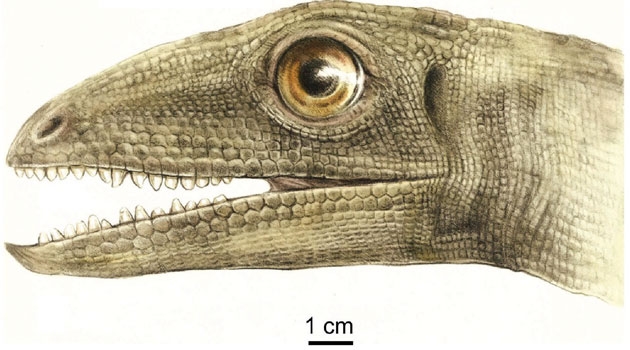
An illustration of the Triassic dinosauriform Silesaurus opolensis, the coprolite has been putatively assigned to this reptile. Picture credit: Małgorzata Czaja
Complete Specimens Preserved
Some of the beetles were almost complete with even their antennae and thin legs intact and attached to the body.
Commenting on the significance of this research, lead author of the scientific paper, Martin Qvarnström, (Uppsala University), remarked:
“We were very positively surprised by how many beetle remains there were in the coprolite and above all how well preserved they were. We really have to thank Silesaurus, who was probably the animal that helped us collect and preserve the beetles”.
The labrador-sized Silesaurus did not usually dine on such small insects, it probably was a generalist eating a wide variety of prey. It had a beak that was possibly used to bite insects just like today’s living dinosaurs – the birds. Despite the fact that Silesaurus ingested lots of individuals of Triamyxa coprolithica, these small beetles probably did not constitute its main food. Triamyxa lived in the same environments as larger insects and it was these insects as well as small vertebrates that probably made up the majority of the diet of this fast running, agile reptile.
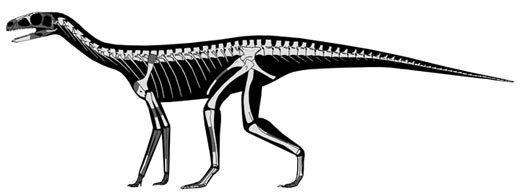
A skeletal reconstruction of the Late Triassic dinosauriform Silesaurus.
The beetle fossils are reminiscent of other beetle remains associated with amber. Both coprolites and amber are capable of preserving insects in three-dimensions and this study suggests coprolites can be extremely valuable for studying early insect evolution and extinct animal food chains at the same time.
The scientific paper: “Exceptionally preserved beetles in a Triassic coprolite of putative dinosauriform origin” by Martin Qvarnström, Martin Fikáček, Joel Vikberg Wernström, Emmanuel Arriaga-Varela, Per E. Ahlberg and Grzegorz Niedźwiedzki published in Current Biology.
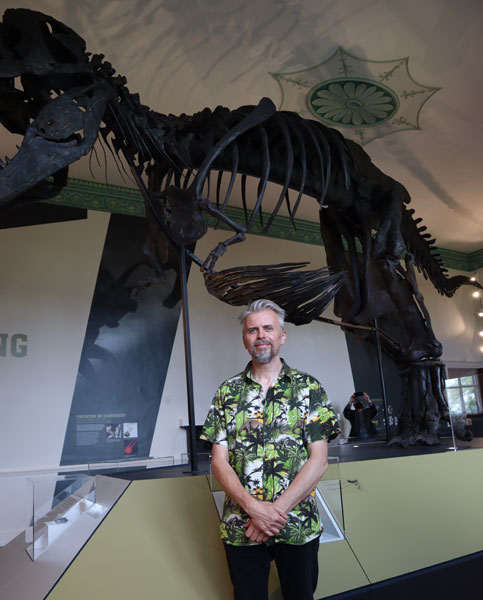
Team members from Everything Dinosaur were lucky enough to get a preview of the new “Titus T. rex is King” exhibition at Wollaton Hall (Nottinghamshire), the first time that actual Tyrannosaurus rex fossils have been exhibited in England for more than a century.
The spectacular Titus the T. rex exhibit at Wollaton Hall. Picture credit: Everything Dinosaur.
Picture credit: Everything Dinosaur
The exhibition entitled “Titus: T. rex is King” opens on Sunday 4th July 2021 and will run until August 2022, giving visitors the opportunity to view a real Tyrannosaurus rex specimen, the actual fossilised bones and teeth of arguably, the most famous dinosaur of all.
Titus the T. rex Exhibition
The stunning T. rex mount has been created by talented conservator Nigel Larkin who has over 30 years’ experience of conservation and curation. His expertise in skeletal reconstruction enabled this Late Cretaceous apex predator to be exhibited, the actual fossil bones of a T. rex combined with casts from a second specimen and then skilfully painted and mounted to provide a stunning display.
Conservator Nigel Larkin who was tasked with creating the Titus the T. rex specimen combining the actual T. rex fossil bones with casts from “Stan” the T. rex specimen STAN-BHI3033. Picture credit: Everything Dinosaur.
Picture credit: Everything Dinosaur
A Titan from the Hell Creek Formation
This T. rex specimen comes from Montana (Hell Creek Formation). In September 2014 palaeontologist Craig Pfister found a handful of fragmentary T. rex bones. Working in the extremely harsh conditions of the “Badlands”, Craig was able to recover around 20% of the skeleton of a Tyrannosaurus rex. Skilled conservator Nigel Larkin was given the task of combining these real fossil bones with casts from another similar sized T. rex specimen to create this spectacular display which is over 12 metres in length.
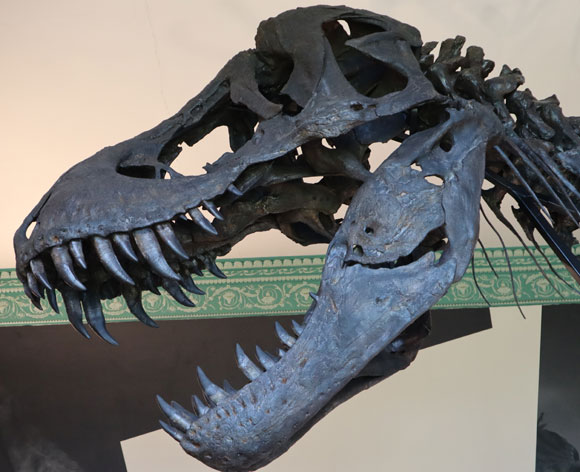
When entering the room in which this dinosaur is exhibited, visitors immediately get a sense of just how big and powerful this dinosaur was. The jaws of this huge predator loom over you as if you are about to become a snack for this formidable monster. Nigel Larkin was able to utilise his three decades of experience of working with dinosaur fossils to design and build the metal armature that enables Titus to be shown in such a dynamic pose.
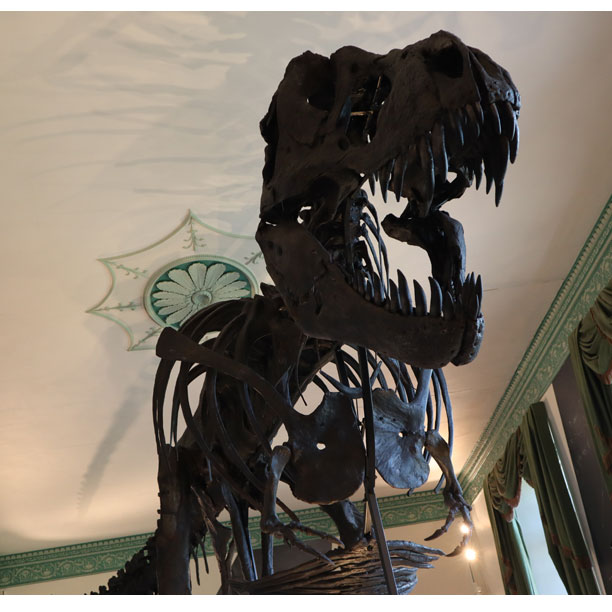
The skull of the T. rex exhibit on display at Wollaton Hall until August 2022. Picture credit: Everything Dinosaur.
Picture credit: Everything Dinosaur
Interactive Virtual Media Displays
Visitors will have the opportunity to explore the life and habitat of Tyrannosaurus rex using digital and interactive virtual media displays that tell the tale of the dinosaur’s discovery, the excavation work, the painstaking and time-consuming process of piecing together the life story of an enormous predator.
Team members at Everything Dinosaur were fortunate to meet Simon Wallett of Hot Knife Digital Media, who was responsible for creating the interactive digital displays. Those lucky enough to get tickets for the exhibition will be able to excavate key bones from the dig site, identify where they fit on the skeleton and to discover some of the secrets that the bones reveal. In addition, visitors will be able to reconstruct their own Tyrannosaurus rex decide whether to add feathers or scales and to transport their digital creation back to a Cretaceous landscape.
Remarkably, all the displays designed by Hot Knife Digital Media operate without the need to be touched. Clever software interprets the movements of your fingers enabling you to try your hand at palaeontology without the need to touch anything. A very smart solution, permitting participation at an event where COVID-19 safety precautions are meticulously complied with.
Simon Wallett of Hot Knife Digital Media demonstrates one of the clever interactive displays. The innovative design of these machines enables visitors to operate them without the need to actually touch them. It’s a tactile, immersive experience without the need to touch! Picture credit: Everything Dinosaur.
Picture credit: Everything Dinosaur
Telling the Tale of a Tyrant
Prominent and informative display panels help visitors to understand what these fossilised bones of T. rex have revealed. They help to tell the tale of a tyrant that had a tough life. For example, disease identified in a toe bone represents the first time this specific pathology has been found in a dinosaur.
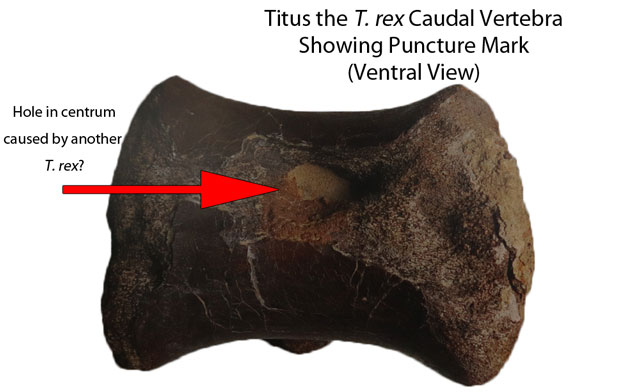
A deep puncture in the underside of a bone in the tail, suggests that Titus battled other tyrannosaurs. The wound in the tail shows signs of healing, so this traumatic injury is unlikely to have been the cause of this titan’s ultimate demise.
The single tail bone of the T. rex showing the deep puncture mark which was probably inflicted during intraspecific combat (a fight with another T. rex).
Sue Judd from Everything Dinosaur commented:
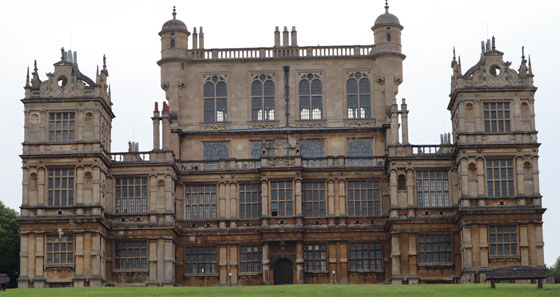
“Visitors to the Titus T. rex is King exhibition will be able to view real Tyrannosaurus rex fossils, the first time in more than a century fossils like these have been on display in England. We are sure this magnificent dinosaur will feel very much at home at the majestic Wollaton Hall. This wonderful building surrounded by fantastic parkland houses an amazing natural history collection – a fitting home for the king of the tyrant lizards.”
On Thursday, July 1st new VAT rules for sales into the European Union come into force. Everything Dinosaur has registered for Import One Stop Shop (IOSS) enabling this UK-based company to comply with their VAT e-commerce obligations on distance sales of imported goods.
Everything Dinosaur is ready for the start of Import One Stop Shop (IOSS). The thousands of Everything Dinosaur customers in the European Union can continue to rely on them for easy and straightforward deliveries to the EU. Picture credit: Everything Dinosaur.
Picture credit: Everything Dinosaur
What is Import One Stop Shop (IOSS)?
IOSS facilitates the collection, declaration and payment of VAT for sellers that are making distance sales of imported goods to buyers in the 27 countries that make up the European Union. Everything Dinosaur customers based in the European Union will find very little change in the way that Everything Dinosaur handles their purchase, team members had already ensured that parcels could be despatched delivery duty paid (DDP) from the beginning of 2021 and they will continue to do so.
The subsidised fully tracked parcel delivery service to customers in the European Union will continue as before.
IOSS will simplify VAT collection rules across the European Union. It also means that the exemption status for parcels valued at less than 22 euros excluding shipping will be removed.
Benefits for the Buyer
Import One Stop Shop makes the process of placing an order even easier for the buyer. Everything Dinosaur will only charge the customer at the time of purchase. There are no hidden or surprise fees when the goods are delivered to the customer in Europe.
If the retailer is not registered under IOSS, then the buyer will have to pay VAT and usually an administration/customs clearance fee charged by the delivery company.
Such fees and payments will have to be made in full before the parcel can be handed over.
What Parcels Does IOSS Cover?
The Import One Stop Shop covers the sale of goods from a distance that are:
dispatched or transported from outside of the EU at the time they are sold – so parcels sent from Everything Dinosaur’s UK warehouse need to comply (UK designated a third country).
dispatched or transported in consignments with a value not exceeding a total of 150 euros even if the order contains several items.
not subject to excise duties (typically applied to tobacco or alcohol products).
The End of the VAT Exemption for Parcels under 22 Euros in Value
From July 1st 2021, the VAT exemption for the importation of goods with a value less than or equal to 22 euros will be removed. As a result, all Everything Dinosaur sales to the European Union that are less than 150 euros in value will be subject to VAT. The amount of VAT for each transaction will be clearly stated at the checkout and shown on the invoice – all part of Everything Dinosaur’s policy on being transparent with its pricing.
Everything Dinosaur will be IOSS compliant.
If the retailer is not registered in the IOSS, the buyer has to pay the VAT and usually a customs clearance fee charged by the transporter.
Some Temporary Disruption to European Deliveries
As these new procedures are implemented, customers in the European Union might experience a short delay in the delivery of their parcel. Delays can be expected as couriers and national postal companies get used to these new regulations.
A spokesperson from Everything Dinosaur commented:
“Team members have done all they can to prepare for the beginning of IOSS. We have been registered and we are ready to operate under these new VAT simplification rules. However, we do anticipate that there will be some delays in the system. These delays will in part be caused by other companies not recognising what they must do in order to meet these new requirements. We apologise to our customers in the EU for any inconvenience caused.”