All about dinosaurs, fossils and prehistoric animals by Everything Dinosaur team members.

Pictures of fossils, fossil hunting trips, fossil sites and photographs relating to fossil hunting and fossil finds.

22 11, 2018

How Did Some Dinosaur Get Their Long Necks?

By |2023-11-11T12:16:43+00:00November 22nd, 2018|Categories: Dinosaur and Prehistoric Animal News Stories, Dinosaur Fans, Main Page, Photos/Pictures of Fossils|0 Comments

Macrocollum itaquii – Oldest Long-necked Sauropodomorph is Described

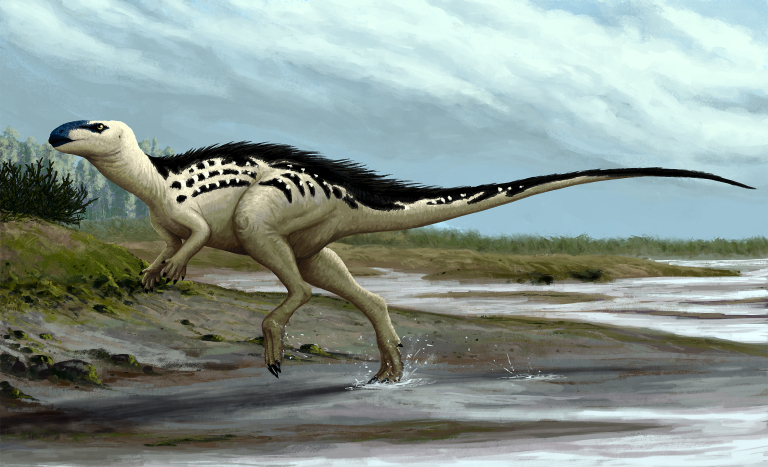
A team of scientists based in Brazil have described the fossilised remains of three Triassic dinosaurs that lived some 225 million years ago that shed light on the evolution of long-necks in plant-eating dinosaurs.  The new species, a member of the Sauropodomorpha, has been named Macrocollum itaquii, the genus name comes from the Greek for “long neck”, an appropriate moniker for a prehistoric animal that is helping to unravel the developmental history of the long-necked dinosaurs bauplan.

Macrocollum itaquii

Although Macrocollum is estimated to have measured about four metres in length and weighed approximately 100 kilograms, a lot smaller than later sauropods, some of which were the largest terrestrial animals to have ever lived, it is considerably bigger than older dinosaur fossil specimens found in South America, some of the earliest dinosaurs known, that lived around ten million years earlier and represent some of the very first dinosaurs to evolve.

A Life Reconstruction of Macrocollum itaquii
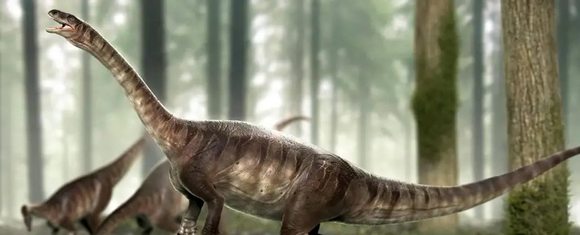
Macrocollum life reconstruction.
A life reconstruction of the newly described Macrocollum itaquii from southern Brazil.

Picture credit: SWNS

The Rise of the Sauropodomorpha

Despite a number of recent fossil discoveries, palaeontologists have a relatively poor understanding of the rise of the sauropodomorphs, a group that includes some of the most famous of all the dinosaurs, giants such as Diplodocus and Brachiosaurus.

The fossil material, representing three individuals, was collected from the upper portion of the  Candelária Sequence of the Paraná Basin, from a site in Agudo, Rio Grande do Sul (southern Brazil).  Nearby strata have been dated to the Norian faunal stage of the Late Triassic.  Writing in the academic journal “Biology Letters”, the researchers, which included biologist Rodrigo Müller from the Federal University of Santa Maria (Brazil), conclude that these three animals died together and therefore provide the oldest evidence of herding behaviour in sauropodomorphs described to date.

The proposal that the three individuals died together and as such, indicate gregarious behaviour, has been challenged by a number of academics.  It is possible that these three herbivores died at different times and the carcases just happened to be transported and ended up in association.

Commenting upon this, Rodrigo Müller explained:

“There are three articulated skeletons in five tons of rock.  This is unique.  It suggests these animals probably died together, as they share the same degree of disarticulation.  So, if they died together, these dinosaurs probably lived together.”

Long Necks and Long Thigh Bones

Two of the specimens include skull material, the holotype (CAPPA/UFSM (Centro de Apoio à Pesquisa Paleontológica da Quarta Colônia) 0001a), is virtually complete and articulated.  It is one of the best preserved Triassic dinosaur skeletons ever found.  With such exceptionally well-preserved specimens the scientists have been able to conduct an analysis looking at how the long-neck of these types of dinosaurs evolved and study the femur (thigh bone), length to give an indication in the change of body size since the first plant-eating dinosaurs evolved.  In addition, these fossils have shed light on how these animals adapted to a fully herbivorous diet.

Macrocollum Fossil Material Has Helped Shed Light on Important Evolutionary Developments within the Sauropodomorpha

Macrocollum itaquii phylogeny.
Mapping the phylogeny of Macrocollum itaquii.

Picture credit: R T Müller et al in Biology Letters

The table above shows the phylogenetic position attributed to the newly described M. itaquii.  Based on this assessment it has been assigned to the Unaysauridae family, basal members of the Sauropoda, that are known from Triassic-aged rocks from the Southern Hemisphere (India and South America).  The discovery of Macrocollum has helped palaeontologists to gain a better understanding of the evolution of the long-neck of sauropods.  The cervical vertebrae (neck bones) of M. itaquii are already much more elongated than seen in earlier representatives of the Sauropodomorpha known from around 233 million years ago.  The teeth are more spatulate in shape, indicating an adaptation to a plant-eating diet and over this 8 million year period (233-225 million years ago), femora measurements demonstrate that sauropodomorphs increased in size by 230%.

Views of Skull Material Associated with M. itaquii
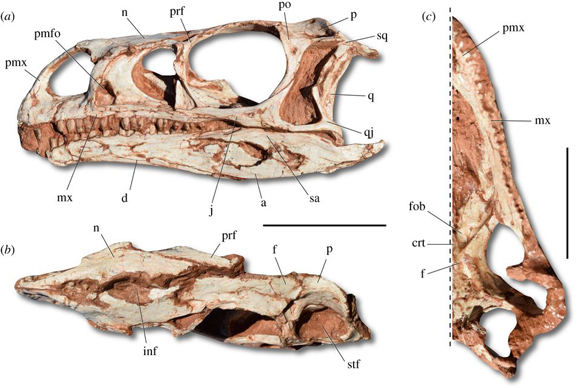
View of skull material associated with Macrocollum itaquii.
(a) Skull in left lateral view (CAPPA/UFSM 0001a – holotype), (b) Skull in dorsal view (CAPPA/UFSM 0001a – holotype) and (c) part of a skull in ventral view (CAPPA/UFSM 0001b).

Picture credit: R T Müller et al in Biology Letters

The typical long neck was also established,  becoming proportionally twice as long than those necks of basal taxa.  Indeed, the new dinosaur is the oldest-known sauropodomorph with such an elongated neck, suggesting that the ability to feed on high vegetation was a key trait achieved along the early Norian.

Skeletal Reconstruction and Significant Bones Including Elongated Cervical Vertebrae
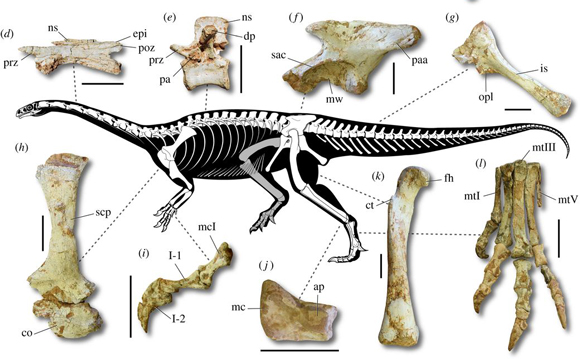
Macrocollum itaquii - skeletal reconstruction.
Skeletal reconstruction of Macrocollum itaquii.  Known fossil material shaded white, scale bar = 5 cm.  The elongated neck bone is (d).

Picture credit: R T Müller et al in Biology Letters

The species name honours Mr José Jerundino Machado Itaqui, one of the main drivers behind the creation of the Centro de Apoio à Pesquisa Paleontológica da Quarta Colônia and the Federal University of Santa Maria.

To read about the recent discovery of an Early Jurassic sauropod from China (Yizhousaurus sunae), that is helping palaeontologists to learn more about how some types of dinosaur were able to evolve into giants: Helping to Give Sauropod Evolution a Head Start.

To read about a giant Late Triassic sauropodomorph (Ingentia prima): Triassic Dinosaur Just Got a Lot Bigger.

The scientific paper: “An Exceptionally Preserved Association of Complete Dinosaur Skeletons Reveals the Oldest Long-necked Sauropodomorphs” by Rodrigo Temp Müller, Max Cardoso Langer and Sérgio Dias-da-Silva published in Biology Letters.

Visit the Everything Dinosaur website: Everything Dinosaur.
18 11, 2018

Very Rare Dinosaur Fossil Find in Oregon

By |2023-11-11T11:14:12+00:00November 18th, 2018|Categories: Dinosaur and Prehistoric Animal News Stories, Dinosaur Fans, Main Page, Photos/Pictures of Fossils|2 Comments

An Oregon Ornithopod

There may be many famous dinosaurs known from the United States of America, after all, when it comes to naming dinosaurs, Tyrannosaurus rex, Stegosaurus and Triceratops tend to trip off the tongue, but America’s dinosaur fossil heritage is not uniform across the whole country.  Several parts of the U.S. have no record of dinosaur discoveries, and numerous others have a very fragmentary record when it comes to the preserved remains of Dinosauria.  Oregon, the ninth largest State in terms of area, has a very poor dinosaur fossil record, however, a newly described fossil discovery made in the eastern part of the “Beaver State”, has got palaeontologists quite excited about the prospect of more dinosaur fossil finds being made.

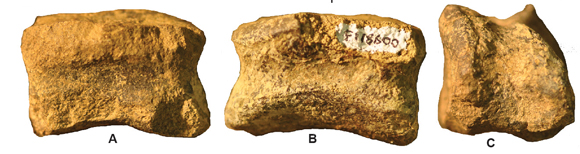
The Toe Bone from a Dinosaur (Ornithopoda)

Writing in the “Journal of Vertebrate Palaeontology”, scientists from the University of Oregon in collaboration with the University of Calgary (Canada), have published a paper on the discovery of a single toe bone from a plant-eating dinosaur – an extremely rare find considering that this part of north-western North America was underwater throughout most of the Mesozoic Era.

Various Views of the Single Dinosaur Toe Bone (Pedal Phalanx)

Indeterminate pedal phalanx (Oregon dinosaur).
Views of the single dinosaur toe bone discovered in eastern Oregon.

Picture credit: University of Oregon

The fossil bone was found by University of Oregon Earth Sciences Professor Greg Retallack during field work in 2015, near the town of Mitchell (Wheeler County, eastern Oregon).  The single bone was spotted amongst mollusc fossils exposed on a slope consisting of marine shale.  The fossil dates from the Albian fauna stage of the Cretaceous and is the first ever Oregon dinosaur fossil to be the subject of a paper in a peer-reviewed scientific journal.  Furthermore, it represents the first dinosaur fossil find from Oregon from strata not regarded as Upper Cretaceous.

Oregon might be bigger than the whole of the United Kingdom, but the Mesozoic-aged exposures represent marine sediments, that harbour very few remains of ancient terrestrial animals.

Greg Retallack stated:

“Oregon landscapes are rich with Cretaceous rocks, but they rarely contain the kinds of dinosaur remains we see elsewhere in the United States.  The rocks here are the right age but are mostly from under the sea where dinosaurs did not live or from swamps where dinosaur bones are seldom preserved.”

Not Able to Assign a Genus

Although, identified as a dinosaur bone (pedal phalanx), it is not possible to assign it to a specific species or genus, although the research team are confident that it came from a plant-eating ornithopod dinosaur.

An Illustration of a Typical Ornithopod Dinosaur

Burianosaurus augustai illustrated.
An illustration of a typical member of the Ornithopoda – the basal ornithopod from the Czech Republic – Burianosaurus augustai.

Picture credit: Edyta Felcyn

Co-author of the paper, Edward Davis (University of Oregon), explained that the remains of a terrestrial animal ended up in the mollusc bed, after having been swept out to sea.

He explained:

“It’s a phenomenon we sometimes call “bloat and float”.  That is, the animal died on shore in its terrestrial habitat, then was washed out to sea, where it floated while bloated with decomposition gasses.  Eventually it burst, and only this toe bone was entombed and became a fossil.”

A Sizeable Plant-eating Dinosaur

Although very little taxonomic information can be gained from a single, isolated toe bone, a size comparison with much more complete and better known Cretaceous ornithopods such as Tenontosaurus, suggests that this dinosaur may have been about six to seven metres long and weighed around a tonne.

A spokesperson from Everything Dinosaur commented:

“Although such a fossil find in marine sediments is exceptionally rare, it just goes to show that dinosaurs fossils can be found and if there is one, then there may be more. Many of the Mesozoic-aged rocks in this part of Oregon represent near coastal marine deposits.  Given that dinosaurs would have roamed the land close to the sea for millions of years it is possible that more dinosaur remains might be found.”

To read an article published by Everything Dinosaur in 2015, which looks at which part of the United States are not associated with dinosaur fossils: Washington State the 37th U.S. State with a Dinosaur.

Visit the Everything Dinosaur website: Everything Dinosaur.
14 11, 2018

Fossil Bird from Late Cretaceous Utah – Deepens a Mystery

By |2023-11-11T08:17:50+00:00November 14th, 2018|Categories: Dinosaur and Prehistoric Animal News Stories, Dinosaur Fans, Main Page, Palaeontological articles, Photos/Pictures of Fossils|0 Comments

Mirarce eatoni – Deepens the Mystery Over Late Cretaceous Avian Extinctions

All living birds from Albatrosses to Zebra finches belong to one group of avians – the Neornithes.  Our feathered friends share a number of key anatomical traits that defines them as a group from the smallest such as the Bee Hummingbird to the largest living bird, the Ostrich.  However, back in the Cretaceous, things were very different.  There were several different taxa of birds including the very diverse and highly successful enantiornithines that shared the skies with early members of the neornithines, but only the ancestors of today’s extant birds survived the end-Cretaceous extinction event and that’s a puzzle for palaeontologists.

The puzzle has just become a little more complex with the publication of a scientific paper in the on-line, open access journal “PeerJ”.  This paper describes the fossilised remains of an enantiornithine that lived around 75 million years ago, in Utah (USA).  This prehistoric bird, about the size of a Raven, has been named Mirarce eatoni and its fossils show that it was probably a match for most modern birds in terms of its aerial abilities.

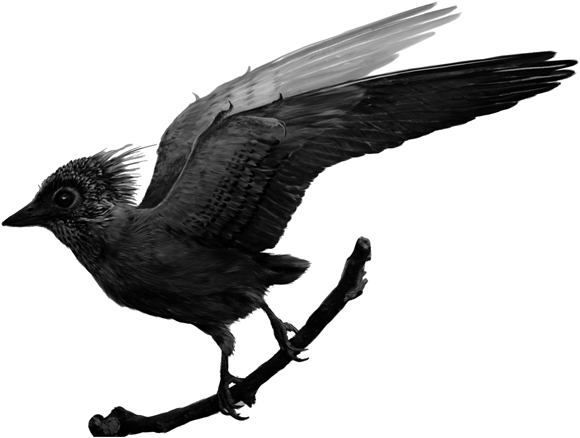
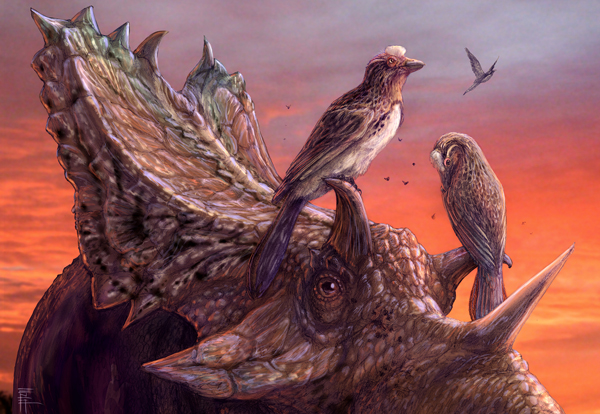
Perched on the Horns of a Utahceratops (Mirarce eatoni)

Mirarce eatoni - life reconstruction.
An illustration of the Late Cretaceous enantiornithine Mirarce eatoni.

Picture credit: Brian Engh

This leads to one very intriguing question, if enantiornithines like Mirarce were so advanced, then why after the Cretaceous-Palaeogene mass extinction event did only one group of birds survive?

A Complete Anatomical Description

The fossil material consists of several neck bones (cervical vertebrae), back bones (dorsal vertebrae), the fused caudal vertebrae making up the pygostyle, elements from the limbs, parts of the hips, a partial scapula, coracoid, the furcula (wishbone) and several other fragmentary elements including the radius and ulna.

This represents a veritable treasure trove of North American enantiornithine fossils for palaeontologists to study, most North American members of this taxon are known from very scrappy fossil remains, mostly consisting of isolated fused leg bones and toes.  All in all, about 30% of the total skeleton is known and crucially, unlike most of the more complete enantiornithine specimens from the Lower Cretaceous deposits of China, this specimen, is preserved in three-dimensions, it has not been crushed as flat as a pancake.  The excellent state of preservation and the number of fossil bones has permitted the researchers to undertake a complete anatomical description.

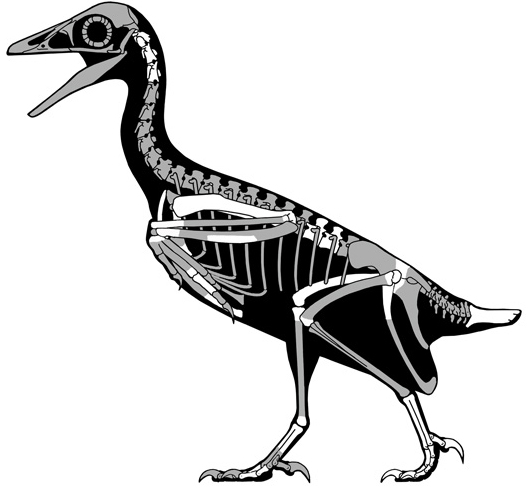
A Skeletal Reconstruction of the Newly Described North American Enantiornithine Mirarce eatoni

Mirarce eatoni skeletal reconstruction.
A skeletal reconstruction of the Enantiornithine Mirarce eatoni from Late Cretaceous Utah.  The bones shaded white represent known fossil material.  Note, cranial material is not known.

Picture credit: Scott Hartman

The “Kaiparowits Avisaurid”

The specimen was originally discovered back in 1992, by University of California, Berkeley palaeontologist Howard Hutchinson, whilst he was exploring Kaiparowits Formation deposits for evidence of turtles.

It was quickly identified as an enantiornithine and ascribed to the Avisauridae family, a family of prehistoric birds known from South America, North America, parts of Europe, Siberia and the Middle East (Lebanon).  The partial skeleton (UCMP 139500), was nicknamed the “Kaiparowits avisaurid”.   Although, its significance was noted, after all, the fossils represent the most complete example of an enantiornithine ever found in North America, it remained undescribed.  All that changed when PhD student Jessie Atterholt (University of California, Berkeley), was given the opportunity to provide a formal scientific description.

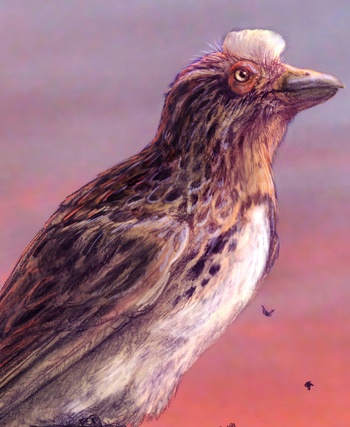
Research Suggests that Mirarce eatoni was a Strong Flier and Well-Adapted to Life in the Late Cretaceous

Mirarce eatoni - life reconstruction.
A close-up view of the newly described Late Cretaceous bird Mirarce eatoni (colouration and plumage speculative).

Picture eredit: Brian Engh

A Strong and Capable Flier

In collaboration with her colleague Howard Hutchinson and with the support of Jingmai O’Connor, from the Chinese Academy of Sciences and an authority on Cretaceous fossil birds, a complete analysis of the fossil bones was undertaken.  This study revealed that M. eatoni possessed several of the same physical adaptations for highly refined powered flight that modern birds (Neornithines) have.

Fossils of Enantiornithines from the Lower Cretaceous of China, birds such as Confuciusornis sanctus show a mix of basal and more advanced anatomical traits.  For example, the breast bone (sternum), of C. sanctus, is relatively small.  Modern birds have a deeply keeled sternum, this allows the attachment of large muscles to aid powered flight.  The wishbone (furcula) of Confuciusornis and most other Early Cretaceous enantiornithines, is little more than a curved bar.  However, the furcula of M. eatoni is shaped much more like the “V-shaped” wishbones of modern birds.  The furcula of Mirarce would have been able to flex and to store energy released during the flapping of the wings.

Commenting on the significance of these anatomical characteristics, Atterholt stated:

“We know that birds in the early Cretaceous, about 115 to 130 million years ago, were capable of flight but probably not as well adapted for it as modern birds.  What this new fossil shows is that enantiornithines, though totally separate from modern birds, evolved some of the same adaptations for highly refined, advanced flight styles.”

The Furcula (Wishbone) of Mirarce eatoni

The furcula of Mirarce eatoni.
Two views of the wishbone (furcula) of Mirarce eatoni (A) dorsal and (B) ventral with line drawings.  Scale bar = 1 cm.

Picture credit: PeerJ

Quill Knobs?

A close examination of the right ulna (lower arm bone), revealed evidence of two roughened patches preserved on the shaft of the bone.  These rough patches were interpreted as being attachment sites for quill knobs, that anchor the wing feathers to the skeleton and to help strengthen the wings for use in active, prolonged, powered flight.  Quill knobs are found in living birds.  This is the first time that such a feature has been seen in an enantiornithine and indicates that Mirarce was, very probably, a strong flier.

Potential Quill Knobs Identified in an Enantiornithine (M. eatoni)

Quill knobs on an Enantiornithine.
Roughed structures on the ulna of Mirarce compared to the quill knobs found on the ulna of a Pelican.

Picture eredit: PeerJ

If these structures are quill knobs, then this suggests that this anatomical trait evolved in parallel with members of the Dinosauria (dromaeosaurids and other maniraptorans along with the ornithomimids) and in parallel with a number of types of prehistoric bird.

How Did Mirarce eatoni Get its Name?

The genus name reflects that fantastic state of preservation of the fossil material (Latin “mirus” for wonderful) and after Arce, the winged messenger of the Titans in Greek mythology.  The trivial name honours Dr Jeffrey Eaton, in recognition of his work studying the vertebrates of the Kaiparowits Formation.  A spokesperson from Everything Dinosaur commented that this prehistoric bird’s name was pronounced “mere-ark-ee ee-tow-eye”.

But Why Did These Advanced Enantiornithines Die Out?

If Late Cretaceous enantiornithines were just as advanced as modern birds, then, why did they die out with the non-avian dinosaurs while the ancestors of modern birds survived the extinction event?

Atterholt, who has moved onto a position of Assistant Professor and human anatomy instructor at the Western University of Health Sciences in Pomona (California), added:

“This particular bird is about 75 million years old, about 10 million years before the die-off.  One of the really interesting and mysterious things about enantiornithines is that we find them throughout the Cretaceous, for roughly 100 million years of existence and they were very successful.  We find their fossils on every continent, all over the world, and their fossils are very, very common, in a lot of areas more common than the group that led to modern birds.  Yet modern birds survived the extinction while enantiornithines go extinct.”

Forest Dwellers Versus Seed Eaters

A number of ideas have been put forward to help explain why some types of birds survived the end-Cretaceous mass extinction event whilst others did not.  For example, one hypothesis proposes that enantiornithines were forest dwellers and when the asteroid strike/volcanism resulted in a dramatic loss of woodland habitats, these types of birds suffered more than other birds that lived in different environments.

The absence of cranial material prevents the researchers from investigating what Mirarce might have eaten.  Most known members of the Enantiornithes had teeth in their beaks and Mirarce supports the idea that these types of birds gradually got larger over time, but what this bird ate remains a mystery.  If it had been a predator of small vertebrates and insects, any major disruption to the food chain could have led to extinction.  However, a paper published in 2016 proposed that birds with toothless beaks such as the early neornithines could have survived the extinction event by eating seeds that persisted in the soil.

To read more about this paper: Seed Eating May Have Helped the Birds Survive.

The scientific paper: “The Most Complete Enantiornithine from North America and a Phylogenetic Analysis of the Avisauridae” by Jessie Atterholt, J. Howard Hutchinson and Jingmai K. O’Connor published in PeerJ.

Visit the award-winning Everything Dinosaur website: Everything Dinosaur.
4 11, 2018

A New Species of Rebbachisaurid is Named

By |2023-11-06T09:12:22+00:00November 4th, 2018|Categories: Dinosaur and Prehistoric Animal News Stories, Dinosaur Fans, Main Page, Photos/Pictures of Fossils|2 Comments

Lavocatisaurus agrioensis – A New Long-Necked Dinosaur from Argentina

A team of palaeontologists from Argentina and Spain have announced the discovery of a new species of long-necked dinosaur from the Early Cretaceous of Argentina.  The dinosaur, represented by a set of bones that indicate the remains of at least three individuals, has been named Lavocatisaurus agrioensis and it will help to shed more light on a rare and enigmatic group of sauropods known as the rebbachisaurids.

A Skeletal Reconstruction and Photographs of Key Fossils from L. agrioensis

Skeletal reconstruction and fossil bones attributed to Lavocatisaurus agrioensis.
Skeletal reconstruction based on the holotype and paratype specimens of Lavocatisaurus agrioensis.  Scale bars = 10 cm.

Picture credit: AFP/Agencia CTYS

The picture above shows the skeletal drawing of the adult dinosaur with illustrations of key bones from the excavation.  Most of the neck and the skull has been recovered.  Cranial fossils associated with the Rebbachisauridae are rare, the discovery of these specimens from Agrio del Medio (Neuquén Province, Argentina) will help scientists to better understand taxonomic relationships amongst members of this sauropod family, largely associated with Gondwanaland fossil deposits.

Fossils of a Family Group?

Writing in the journal “Acta Palaeontologica Polonica”, the scientists report the discovery of one large, presumably adult animal with two smaller sub-adults found in association.  The fossil material come from terrestrial sandstone deposits laid down around 110 million years ago (Aptian to Albian faunal stage of the Early Cretaceous), in an arid environment with isolated oasis and other water sources (Rayoso Formation).

One of the authors of the scientific paper, José Luis Carballido, of the Egidio Feruglio Museum (Argentina), stated:

“We found most of the cranial bones: the snout, the jaws, a lot of teeth, also the bones that define the eye sockets for example and in that way, we were able to create an almost complete reconstruction.  Not only is this the discovery of a new species in an area where you wouldn’t expect to find fossils, but the skull is almost complete.”

Lavocatisaurus agrioensis

The fossils represent one large dinosaur estimated to be around twelve metres in length and two smaller animals around six to seven metres in length.  The research team postulate that this could represent a family group that lived together and perished together, perhaps unable to find a water source in a time of drought.

Preparing to Move Some of the Fossil Material (Lavocatisaurus)

Fossils of Lavocatisaurus are prepared for removal.
The jacketed remains of one of the Lavocatisaurus specimens is prepared for transport away from the dig site.

Picture credit: AFP/Agencia CTYS

Lead author of the paper, José Ignacio Canudo (Zaragoza University, Spain) added:

“This discovery of an adult and two juveniles also signifies the first record of a group displacement among the Rebbachisaurus dinosaurs.”

The Rebbachisauridae Family

The Rebbachisauridae family of sauropods are a group of basal members of the Diplodocimorpha clade that includes more famous Late Jurassic dinosaurs such as Diplodocus, Apatosaurus and Brontosaurus.  The rebbachisaurids are known from both Lower Cretaceous and Upper Cretaceous strata and had a wide geographical distribution throughout Gondwana and southern Laurasia with fossils reported from north and central Africa as well as South America and Europe (Spain).

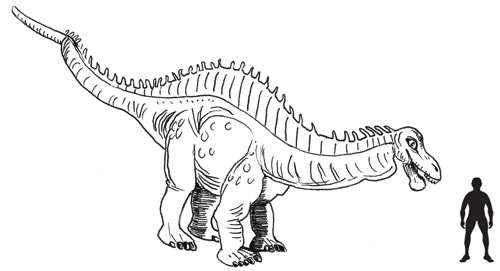
An Illustration of a Typical Rebbachisaurid Dinosaur (R. garasbae)

Rebbachisaurus scale drawing.
Scale drawing of Rebbachisaurus (R. garasbae). Picture credit: Everything Dinosaur.

Picture credit: Everything Dinosaur

Visit the Everything Dinosaur website: Everything Dinosaur.
3 11, 2018

Elaborate Plumage in Confuciusornis Described in New Paper

By |2024-05-11T06:34:18+01:00November 3rd, 2018|Categories: Dinosaur and Prehistoric Animal News Stories, Dinosaur Fans, Main Page, Palaeontological articles, Photos/Pictures of Fossils|0 Comments

Patterns on the Feathers of Confuciusornis as Complex as Modern Birds

A team of international scientists, including researchers from the China University of Geosciences (Beijing), the University of Ghent (Belgium) and the University of Texas at Austin (United States), have discovered that the patterns on the feathers of an Early Cretaceous bird may have been very similar to and as complex as the patterns seen on the feathers of extant Aves.  Writing in the academic, on-line journal “PeerJ”, the researchers conclude that the patterning of Confuciusornis feathers probably performed similar functions to the patterning on modern bird’s feathery coats, that is, they provided camouflage and also played a role in display.

Confuciusornis Integumentary Covering – Elaborate Plumage

Study suggests Confuciusornis had elaborate plumage.
Reconstruction of the plumage of Confuciusornis (specimen number CUGB P140).

Picture credit: Li et al (PeerJ)

Complex Patterning Detected by Sophisticated Chemical Analysis

The specimen studied consists of a slab and counter slab of a single, individual bird from Early Cretaceous deposits in Fengning County, Hebei Province (north-central China).  The fossils are from the vertebrate collection of the China University of Geosciences and represent an example of Confuciusornis sanctus.

The research team identified exceptional feather preservation but poor preservation of the bones, the unusual state of preservation permitted the scientists to identify melanin signals in the fossilised feathers indicating a complex patterning of spots on the wings, throat and on the tuft of feathers at the back of the head forming a small crest.  The shape of the structures that form these patterns in conjunction with chemical analysis confirmed the diagnosis of the pigment melanin.  However, specific colouration associated with the patterns could not be discerned.

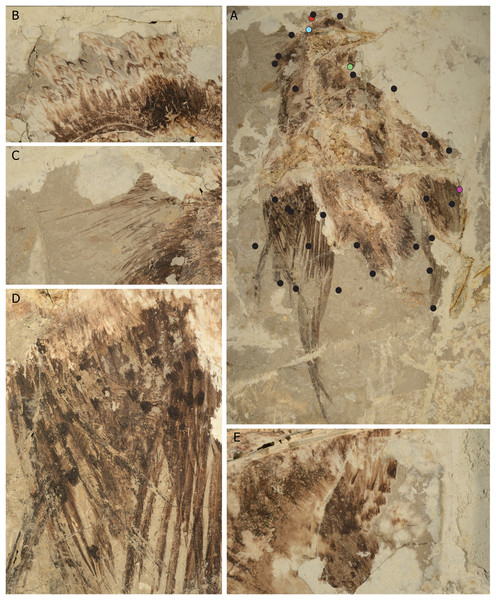
The Slab and Counter Slab or a C. sanctus Specimen Reveals Complex Patterning on the Plumage

Evidence of Confuciusornis plumage.
Evidence of plumage diversity in the Confuciusornithidae from the new specimen (CUGB P1401).

Picture credit: Li et al (PeerJ)

The photograph (above) shows various views of the main slab of the fossil specimen showing details of the plumage.  The dots in (A) indicate places that were subjected to sampling, whereas B and C reveal the crest located on the back of the head.  Parts D and E show elements of the integumentary covering in close detail.

A Range of Analytical Techniques Used to Study Confuciusornis

Using a range of analytical techniques including scanning electron microscopy and ion mass spectrometry (ToF-SIMS) the researchers concluded that the elaborate spotting on this specimen exceeds that found in exceptionally-preserved troodontids and compsognathids and rivals that in modern birds, suggesting that plumage patterns evolved greater complexity through avian evolution.

The exact age of the strata is uncertain, although it is believed that the deposits from Fengning County are approximately equivalent in age with the Dawangzhangzi Member of the Yixian Formation, around 122-123 million years old (Aptian faunal stage of the Early Cretaceous).  The data from this study suggests that Confuciusornis had more complex patterning than the patterning identified in Achiornis or in the stripes of the compsognathid Sinosauropteryx.  The research team conclude that this specimen of a primitive bird provides evidence to support the idea that complex patterning of feathers evolved at a relatively early stage in avian evolution.

The Chinese manufacturer PNSO have produced a model of Confuciusornis.

To view the PNSO model range: PNSO Age of Dinosaurs Replicas and Models.

The Link to Barn Owls

Integumentary patterns and colours play a variety of roles in living birds.  Such patterning in fossil specimens probably performed the same sort of functions and in addition, they can help to inform on the habitat in which the extinct creature lived.  In some modern bird groups, barn owls for example (Strigiformes), it has been observed that the size and placement of the spots on the feathers play a role in mate selection.  Male barn owls tend to prefer females with larger spots.  The patterning identified on this C. sanctus specimen leads to the intriguing idea that for confuciusornithids, just like barn owls, the location and the size of the spots on the plumage played a role in choosing a mate.

The scientific paper: “Elaborate Plumage Patterning in a Cretaceous Bird” by Quango Li, Julia A. Clarke, Ke-Qin Gao, Jennifer A. Peteya and Matthew D. Shawkey published in PeerJ.

Visit the Everything Dinosaur website: Everything Dinosaur.
30 10, 2018

A New Azhdarchid Pterosaur from France

By |2023-11-04T11:45:16+00:00October 30th, 2018|Categories: Dinosaur and Prehistoric Animal News Stories, Dinosaur Fans, Main Page, Photos/Pictures of Fossils|0 Comments

Mistralazhdarcho maggii – From the Upper Cretaceous of France

A team of scientists based in France and Belgium have announced the discovery of a new species of pterosaur from Upper Cretaceous rocks in south-eastern France (Bouches-du-Rhône).  The fragmentary bones have been assigned to the Azhdarchidae family of pterosaurs, one of the last groups of flying reptiles to exist and a family that contains giants such as Quetzalcoatlus and Hatzegopteryx.  With a wingspan estimated to be around 4.5 metres, the specimen, believed to be a juvenile, provides evidence of a third azhdarchid pterosaur size class from the cluster of islands that represented continental Europe towards the end of the Mesozoic.

The pterosaur has been named Mistralazhdarcho maggii pronounced (miss-tral-ads-dar-cho may-gee).

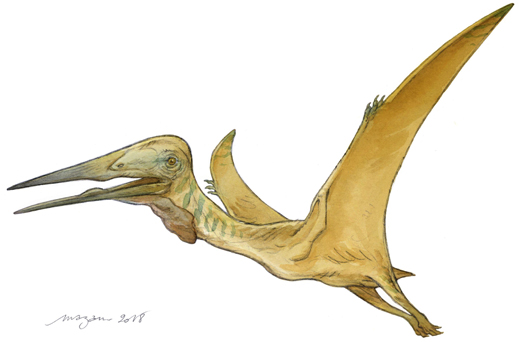
A Life Reconstruction of the Newly Described French Azhdarchid Pterosaur – Mistralazhdarcho maggii

Life reconstruction of the pterosaur Mistralazhdarcho maggii.
An illustration of the newly described (2018) azhdarchid pterosaur from France Mistralazhdarcho maggii.

Picture credit: Pierre Lavaud

One of the Most Complete Pterosaur Fossils Known from Late Cretaceous Europe

Writing in the academic publication the “Journal of Vertebrate Paleontology”, the researchers describe the finding of part of a lower jaw, a neck bone and several other postcranial bones in 2009.  The bones were found in association with each other and therefore, probably represent the fossilised remains of a single pterosaur.  The material comes from the excavation site of Velaux, near Aix-en-Provence and from strata that dates to the Campanian faunal stage of the Late Cretaceous.

Views of the Fossil Material Ascribed to the New Pterosaur Mistralazhdarcho maggii

Mistralazhdarcho maggii fossil material.
Fossil material associated with the newly described French pterosaur Mistralazhdarcho maggii.

Picture credit: Royal Belgian Institute of Natural Sciences

The photograph (above), shows a part mandible (a) with a distinctive ridge (mandibular symphysis).  A cervical vertebra (b), left humerus (c), left radius (d) and two bones from the hand – metacarpal IV (e) and a finger bone (f).

Although the fossil material is fragmentary, such is the poor fossil record of Late Cretaceous pterosaurs from Europe that these few bones make Mistralazhdarcho one of the most complete European azhdarchids described to date.  In addition, Mistralazhdarcho is the first partial skeleton of a flying reptile excavated from Upper Cretaceous deposits of western Europe.

Related to a North African Pterosaur?

The scientists, which included researchers from the University of Rennes, the Royal Belgian Institute for Natural Sciences and Poitiers University, conclude that Mistralazhdarcho was related to an earlier pterosaur called Alanqa (A. saharica), which lived in North Africa around 95 million years ago.  When Alanqa was first described, back in 2010, it was assigned to the Azhdarchidae, but more recent studies incorporating skull material discovered in 2015, have cast doubt on the taxonomic position of Alanqa.

To read about the discovery of Alanqa saharicaDublin Team Announce the Discovery of a New Pterosaur.

An Adult Probably Had a Wingspan of Around 5-6 metres

Examination of the fossil bones suggest that they were not fully ossified and that this was a sub-adult.  The researchers speculate that a fully-grown Mistralazhdarcho would have had a wingspan of around 5 to 6 metres, possibly even bigger.  This size estimate is in between the size estimates given for the two azhdarchids from the Maastrichtian of Romania (Hateg Formation), which also represents the European Late Cretaceous archipelago environment.

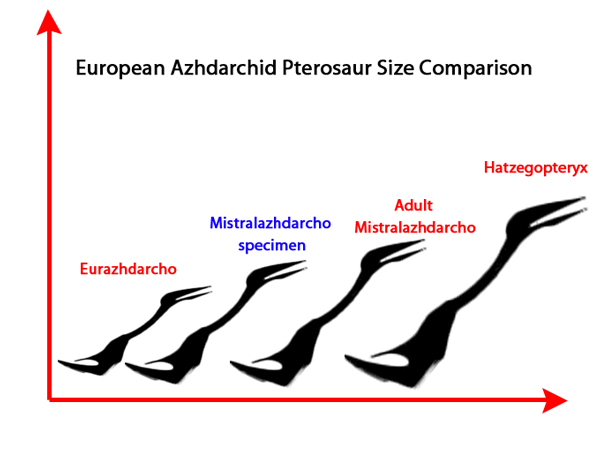
A Size Comparison of European Azhdarchid Pterosaurs

European azhdarchid pterosaur comparison.
A comparison of European azhdarchid pterosaurs.  Picture credit: Everything Dinosaur.

Picture credit: Everything Dinosaur

Mistralazhdarcho is estimated to be intermediate in size between the medium-sized genus Eurazhdarcho (wingspan of 3 metres) and the enormous Hatzegopteryx (estimated wingspan of 10 metres or more), the two other azhdarchids associated with the island ecosystem of the latest Cretaceous European archipelago.  The different sized pterosaurs might reflect a form of niche partitioning, whereby, different sized animals did not directly compete with each other for resources.

The flying reptile’s genus name is from the “mistral”, a strong, north-westerly wind associated with southern France.  The species name honours the former mayor of Velaux, Jean-Pierre Maggi, without whom, the excavation of the fossil material would not have been possible.

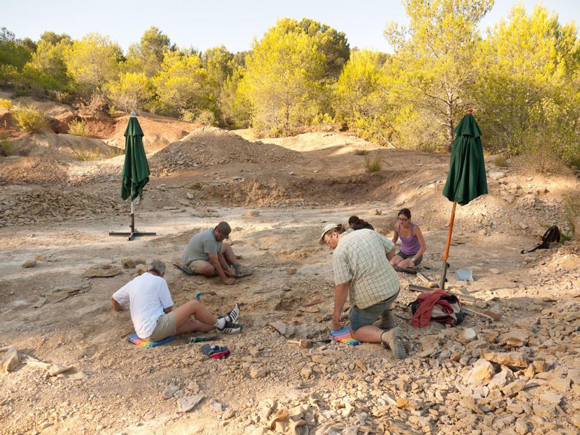
Field Team Members Working at the Velaux Excavation Site

Looking for pterosaur fossils (south-eastern France).
Fossil excavation work at one of the dig sites at Velaux (south-eastern France).

Picture credit: Royal Belgian Institute of Natural Sciences

The scientific paper: “Mistralazhdarcho maggii, gen. et sp. nov., a New Azhdarchid Pterosaur from the Upper Cretaceous of south-eastern France” by Romain Vullo, Géraldine Garcia, Pascal Godefroit, Aude Cincotta and Xavier Valentin published in the Journal of Vertebrate Paleontology.

Visit the Everything Dinosaur website: Everything Dinosaur.
29 10, 2018

A Second Mamenchisaurid Dinosaur from Anhui Province is Described

By |2023-10-30T12:34:54+00:00October 29th, 2018|Categories: Dinosaur and Prehistoric Animal News Stories, Dinosaur Fans, Main Page, Photos/Pictures of Fossils|0 Comments

Anhuilong diboensis – From the Middle Jurassic of Anhui Province

Chinese scientists have published details of a new species of long-necked dinosaur from eastern China.  The fossilised remains, although fragmentary, have permitted the researchers to confidently assign the specimen (AGB 5822), to the Mamenchisauridae family of sauropods.  The dinosaur has been named Anhuilong diboensis and it suggests that by the Middle Jurassic, mamenchisaurids were already a diverse family.  It is likely that the sandstones and mudstones that form the majority of the fossil bearing, Middle Jurassic-aged strata near Huangshan (Anhui Province), will yield more dinosaur fossils.

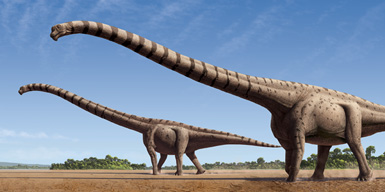
A Life Reconstruction of a Typical Mamenchisaurid Dinosaur

Old Long-neck takes a walk
A typical member of the Mamenchisauridae family (Mamenchisaurus).

Picture credit: Julius Csotonyi/Natural History Museum of Los Angeles County

The Second Member of the Mamenchisauridae from Anhui Province

The fossil material, consisting of the remains of a single forelimb, representing one individual dinosaur (humerus, ulna and radius bones), was distinct enough to permit the scientists, which included researchers from the Chinese Academy of Sciences and the Anhui Geological Museum, to establish a new genus.

Anhuilong diboensis

Anhuilong diboensis is the second mamenchisaurid to be identified from the Middle Jurassic Hongqin Formation of Shexian, Huangshan (Anhui Province, eastern China).  The first mamenchisaurid from this locality, Huangshanlong anhuiensis, was named and described in 2014.  The authors of the scientific paper describing A. diboensis were also responsible for the earlier study of H. anhuiensis.  A phylogenetic analysis of the limb bones from these two specimens suggest that Anhuilong is the sister taxon of Huangshanlong and with Omeisaurus from Sichuan Province, they together form a sister clade to all other members of Mamenchisauridae.

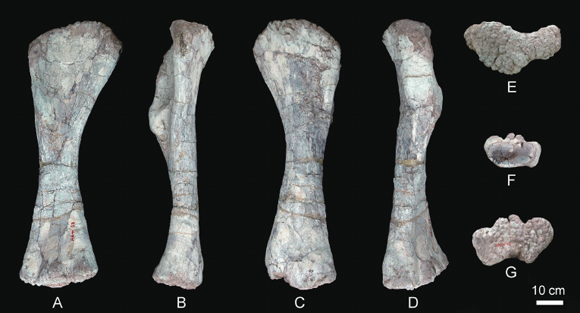
Views of the Right Humerus of Huangshanlong anhuiensis

Various views of the humerus of the mamenchisaurid Huangshanlong anhuiensis.
Huangshanlong anhuiensis – views of the humerus of a typical mamenchisaurid dinosaur.

Picture credit: Vertebrata PalAsiatica/Jian-Dong Huang et al

The picture above shows various views of the right humerus (upper arm bone) of H. anhuiensis.  The morphology of limb bones and how they compare to each other (total length of the ulna to the humerus and the total length of the radius to the humerus), are distinct enough for palaeontologists to ascribe them to the Mamenchisauridae and to erect a new genus.

Key

A = humerus viewed from the front.

B = humerus viewed from one side (medial view).

C = humerus viewed from the back.

D = humerus viewed from the other side (lateral view).

E = viewed from the top down (cranial margin pointing upwards)

F = view of a cross section, near the narrowest part of the bone.

G = viewed from underneath (distal view).

The Spread of the Sauropoda

Until recently, palaeontologists had thought that although the Sauropoda were geographically widespread by the Middle Jurassic, sub-groups such as the Mamenchisauridae family and the Diplodocidae had restricted geographical ranges.  However, earlier this year, a diplodocid dinosaur was described from northern China, proving that these long-necked dinosaurs were present in Asia during the Middle Jurassic.  The fossil record for the Mamenchisauridae indicates that these types of Sauropods were restricted to China.

To read the article describing the diplodocid dinosaur (Lingwulong shenqi) from northern China: The First Diplodocid Dinosaur Described from China and the Earliest Known Member of the Diplodocidae.

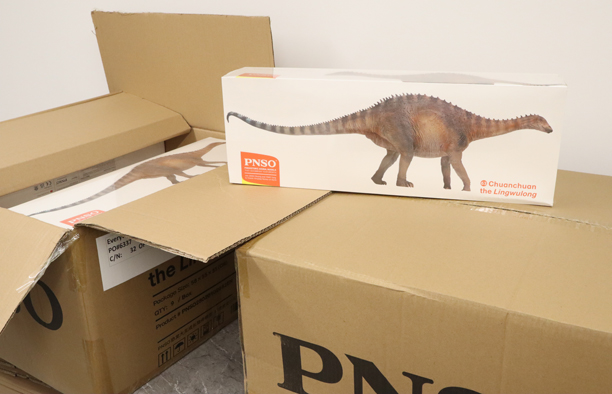
PNSO Chuanchuan the Lingwulong in stock at Everything Dinosaur.
The PNSO Chuanchuan the Lingwulong dinosaur model has arrived at Everything Dinosaur. Team members inspect boxes and check contents prior to booking this new for 2022 sauropod figure into stock. Picture credit: Everything Dinosaur.

Picture credit: Everything Dinosaur

The picture (above) shows Lingwulong dinosaur models arriving at Everything Dinosaur’s warehouse. These are PNSO figures.

To view the PNSO prehistoric animal model range: PNSO Age of Dinosaurs Models.

27 10, 2018

Pachycephalosaurus – Was It Carnivorous? That’s a Great Question!

By |2024-05-11T06:42:44+01:00October 27th, 2018|Categories: Dinosaur and Prehistoric Animal News Stories, Dinosaur Fans, Main Page, Palaeontological articles, Photos/Pictures of Fossils|0 Comments

Theropod-like Front Teeth Identified in a Pachycephalosaur

Pachycephalosaurus, that dome-headed dinosaur that lived alongside such famous prehistoric animals as T. rex and Triceratops, in the Late Cretaceous of Montana, has always been a bit-player when it comes to depicting life in the very last couple of million years before the extinction of the non-avian dinosaurs.  Its more illustrious contemporaries tend to hog the limelight somewhat.

However, the scientific description of a nearly complete skull and jaws of what has been identified as a juvenile Pachycephalosaurus, might just have revealed a surprising side to this peaceful plant-eater.  The teeth in the front of jaws are triangular and pointed, reminiscent of the dentition of a meat-eating dinosaur.  Could palaeontologists have got Pachycephalosaurus wrong?

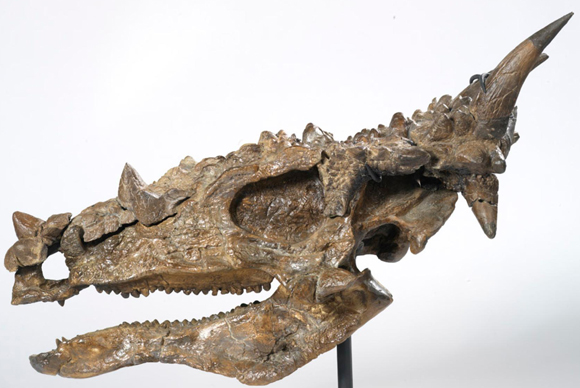
A Reconstruction of the Juvenile Pachycephalosaurus Skull and Jaws

Reconstruction of a Juvenile Pachycephalosaurus skull.
A reconstruction of the fossil skull of the juvenile Pachycephalosaurus that has theropod-like teeth in the front of the jaws.

Picture credit: Brian Boyle (Royal Ontario Museum)

Front Portion of the Jaws Suggests Omnivory in Certain Pachycephalosaurs

In a presentation made at the annual meeting of the Society of Vertebrate Palaeontology held in Albuquerque, New Mexico, Mark Goodwin (University of California Museum of Palaeontology) and David Evans (Royal Ontario Museum), described a near complete juvenile pachycephalosaur skull from eastern Montana.  The back of the jaws contained the broad, leaf-shaped teeth which seem well suited to herbivory.  It had been assumed that the teeth in the front of the jaws (premaxilla and the anterior portion of the dentary, immediately behind the predentary), were the same shape.  However, until this fossil specimen was found, no record of the front teeth of these dinosaurs existed.

Palaeontologists may have to re-think their views on the diet of this member of the Hell Creek Formation biota.  The sharp, blade-like triangular teeth located at the front of the mouth seem adapted to ripping and tearing flesh.

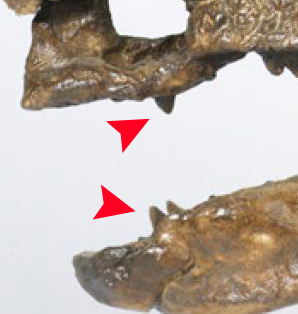
The Teeth at the Front of the Jaws are Typical of a Meat-eating Theropod Dinosaur

Pachycephalosaurus Theropod-like teeth.
A close-up view of the teeth in the premaxilla (upper jaw) and the anterior portion of the dentary (lower jaw). Triangular theropod-like teeth have been identified in a juvenile Pachycephalosaurus.

Picture credit: Brian Boyle (Royal Ontario Museum) with additional annotation by Everything Dinosaur

Confusing Pachycephalosaurs

Pachycephalosaurus is the largest member of the Pachycephalosauridae family to have been scientifically described and notwithstanding a cameo appearance of a jail-breaking Stygimoloch in the recent “Jurassic World – Fallen Kingdom” movie, perhaps the most famous.  However, not a great deal is known about Pachycephalosaurus and other bone-headed dinosaurs.  Fossil remains tend to be very fragmentary and most species have been named from quite scrappy remains and then you have those amazing skulls to consider.

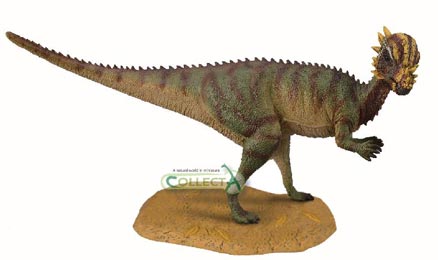
The CollectA Pachycephalosaurus Dinosaur Model

CollectA Pachycephalosaurus model.
A lithe Pachycephalosaurus dinosaur model.  Pachycephalosaurus (P. wyomingensis) is the largest known member of the Pachycephalosauridae with an estimated body length of 4.6 metres.

The model (above) is from the CollectA Prehistoric Life range.

To view this range: CollectA Prehistoric Life Models.

Several species have been named based on the shape and cranial ornamentation associated with those thickened skulls.  The thick bone may resist erosion and provide palaeontologists with some fossil bone to study, but it has been suggested that the skulls of these dinosaurs changed dramatically as the animal grew.  So much so in fact, that a number of academics, including Mark Goodwin, have published scientific papers that cast doubt on the validity of many pachycephalosaur species.  For example, palaeontologists such as Goodwin have put forward evidence to suggest that both Dracorex and Stygimoloch are not distinctive species, the fossils ascribed to these two genera could represent juvenile Pachycephalosaurus specimens.

It seems, just like many other types of Late Cretaceous ornithischian dinosaur, the pachycephalosaurs underwent extreme changes to the shape of their heads as they grew up.  Such changes in cranial morphology have resulted in the establishment of several species that may actually just represent examples of the same species but at different growth stages.

Some Palaeontologists Suggest that Radical Changes in Skull Shape and Ornamentation Do Not Indicate Different Species but Different Growth Stages

Different skull shapes and ornamentation linked to different growth stages.
It has been proposed that the cranial ornamentation and skull shape of Pachycephalosaurs changed as these animals grew and matured. This can cause confusion when trying to identify species.

Picture credit: Kari Scannella with additional annotation by Everything Dinosaur

To complicate matters, pachycephalosaur fossil material covers a period of approximately 2 million years.  Over this timescale, these animals evolved and their skull morphology changed, thus, further blurring the lines between different species and fossils of the same species but at different levels of maturation.

Confirming the Likely Diet of Pachycephalosaurus

It would be difficult to confirm that Pachycephalosaurus also ate other animals as well as plants, but not impossible.  Only one jaw fossil with the front teeth in situ has been found, so scientists don’t know whether the diets of these dinosaurs changed as they grew.  Perhaps, young pachycephalosaurs were omnivorous, whilst when fully grown, adults tended to consume plants rather than other animals.  The rib cages of those genera which have a more complete fossil record, suggest that these bipeds had large guts, this would indicate a digestive system adapted to processing vegetation.

Professor Philip Currie (University of Alberta), who also attended the Society of Vertebrate Palaeontology meeting, has proposed that studying carbon isotopes preserved in the tooth enamel might provide further evidence relating to diet.  In addition, the many hundreds of examples of isolated, broken teeth from the Hell Creek Formation could be re-examined and checked for any potential affinities with the Pachycephalosauridae.  Feeding traces from fossil bone could also yield more data in support of the idea that bone-headed dinosaurs ate meat.

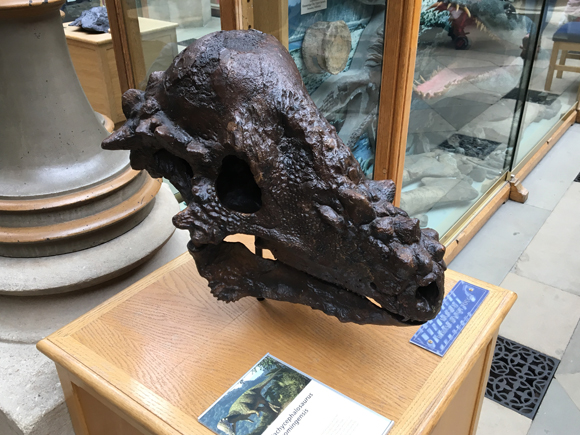
A Reconstruction of the Skull of an Adult Pachycephalosaurus

A replica skull of Pachycephalosaurus wyomingensis.
Pachycephalosaurus wyomingensis replica skull. Picture credit: Everything Dinosaur.

Picture credit: Everything Dinosaur

A spokesperson from Everything Dinosaur commented:

“It is likely that there are many more examples of pachycephalosaurs to be found in Upper Cretaceous rocks, hopefully, if more fossil material can be discovered, then palaeontologists will be able to piece together a more complete phylogeny of these strange dinosaurs.  Furthermore, if more examples of their dentition [teeth] come to light, then we might be able to gain a better understanding of their diets. “

Visit the Everything Dinosaur website: Everything Dinosaur.
26 10, 2018

Preparing for the Arrival of “Funeral Pyre Lord” – Citipati

By |2023-11-04T11:05:47+00:00October 26th, 2018|Categories: Dinosaur Fans, Everything Dinosaur News and Updates, Everything Dinosaur Products, Main Page, Photos of Everything Dinosaur Products, Photos/Pictures of Fossils, Press Releases|0 Comments

Finalising the Citipati Fact Sheet

In the new for 2019 Wild Safari Prehistoric World (Safari Ltd) model range, there is going to be a model of an oviraptorid – Citipati (C. osmolskae).  As a result, team members at Everything Dinosaur have been busy preparing for the arrival of these models by finalising the fact sheet that will accompany sales of this colourful dinosaur model.  The fact sheet has just about been completed, it needs only to have the scale drawing added to it.

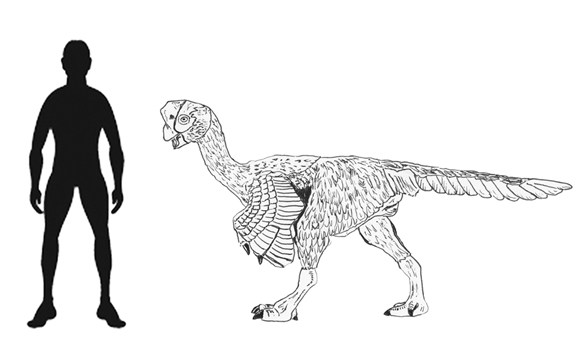
Everything Dinosaur’s Scale Drawing of the Mongolian Oviraptorid Citipati osmolskae

Citpati scale drawing.
Everything Dinosaur’s scale drawing of the oviraptorid Citipati (C. osmolskae). Picture credit: Everything Dinosaur.

Picture credit: Everything Dinosaur

Citipati osmolskae – “Funeral Pyre Lord”

Our scale drawing is an approximation, the true size of this dinosaur is not known.  It may have measured more than three metres long, although a body length of 2.5 metres is also possible.  In the late spring (2018), a scientific paper was published that reported upon the finding of another oviraptorid specimen discovered in association with a nest.

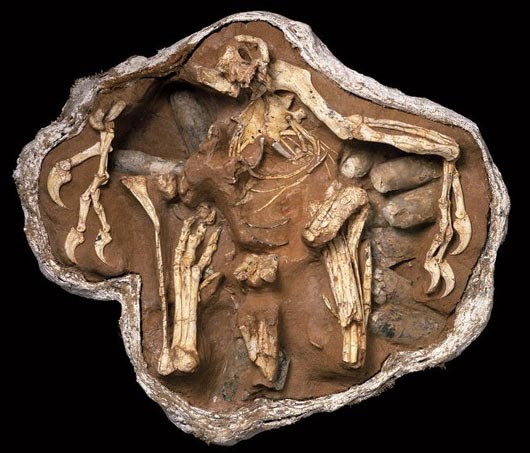
This specimen has been assigned to the Citipati osmolskae taxon, after all, fossils of this dinosaur are relatively common in the Ukhaa Tolgod region of Mongolia, where this new specimen was discovered.  Intriguingly, a comparison of the upper arm bones indicates that this new example of dinosaur nesting behaviour represents an adult animal more than 10% bigger than the original Ukhaa Tolgod nesting Citipati osmolskae specimen (IGM 100/979).  Estimating size for this member of the Dinosauria is therefore somewhat difficult.

Although several examples of nesting/brooding behaviour have now been described (we think the total to date is five), no evidence for colonial breeding for these dinosaurs has ever been discovered.

An Example of a C. osmolskae Fossil Found in Association with a Nest

Citipati osmolskae fossil.
The Citipati fossil sitting on a nest.  The fossil has been nick-named “Big Mamma”.

Picture credit: The American Museum of Natural History (New York)

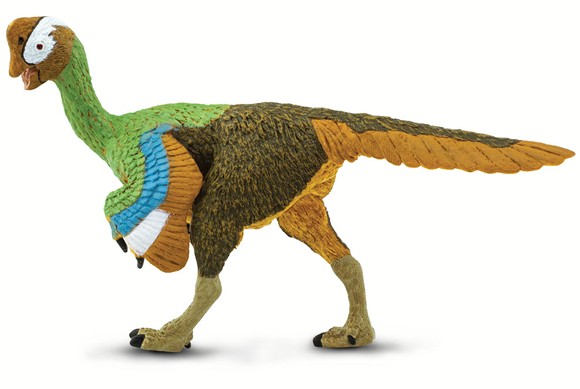
The Wild Safari Prehistoric World Citipati replica is one of several new models in this range. Everything Dinosaur is hoping to have the first of the new for 2019 introductions, including the colourful Citipati replica, in their warehouse and available to purchase in December (2018).

To view the range of Wild Safari Prehistoric World models and the last of the now retired and out of production, Carnegie Collectibles: Wild Safari Prehistoric World and Carnegie Collectibles.

The Wild Safari Prehistoric World Citipati (C. osmolskae) Model

The Wild Safari Prehistoric World Citipati dinosaur figure.
The Wild Safari Prehistoric World Citipati dinosaur model.

Honouring the Polish Palaeontologist Halszka Osmólska

The genus name for this oviraptorid comes from the Sanskrit for “funeral pyre lord”, a reference to a story from Buddhist folklore about two monks that were beheaded by a thief.  These monks are frequently depicted as a pair of dancing skeletons surrounded by fire.  The beautifully preserved Citipati specimens excavated from the red sandstones of the Djadokhta Formation, reminded the research team responsible for their study (Clark, Norell et al), of the dancing monks. 

The species name honours the Polish palaeontologist Halszka Osmólska (1930 – 2008), who pioneered research into Mongolian dinosaurs and made a substantial contribution to our understanding of Theropoda from the Upper Cretaceous deposits of Mongolia.

Visit the Everything Dinosaur website: Everything Dinosaur.
25 10, 2018

Remarkable Giant Flying Squirrel Redraws Family Tree

By |2024-05-11T06:43:06+01:00October 25th, 2018|Categories: Dinosaur and Prehistoric Animal News Stories, Main Page, Photos/Pictures of Fossils|0 Comments

Flying Squirrel Fossil Sorts Phylogeny

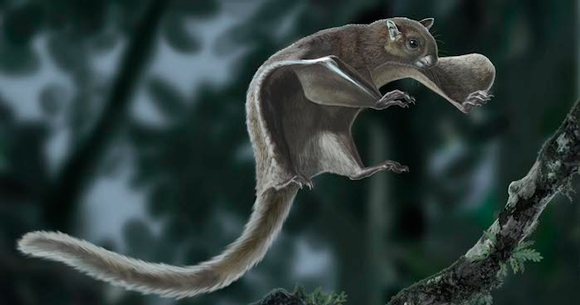
The fossilised remains of a large flying squirrel unearthed at a landfill site in north-eastern Spain (Catalonia), has helped researchers to re-write the family tree of the Sciuridae family.  Estimated to have been around one metre in length (including tail) and weighing up to 1.6 kilograms, the newly described squirrel species named Miopetaurista neogrivensis is around the size of the largest flying squirrels today, the Chinese giant flying squirrel (Petaurista alborufus).  Its fossils show that the flying squirrel body plan has not changed for millions of years.

A Life Reconstruction of the Newly Described Miopetaurista neogrivensis (Middle-Late Miocene of Europe)

Miopetaurista neogrivensis illustrated.
A life reconstruction of the giant prehistoric squirrel Miopetaurista neogrivensis.

Picture credit: Óscar Sanisidro

Mistaken for a Primate

The fossils, including most of the skull and jaws from a single individual, were discovered in 2002, when alterations were being made to the landfill site.  At first, it was thought that the long, thin bones represented a primate, as simian fossils are known from these Miocene-aged deposits.

One of the authors of the scientific paper, published in the journal eLife, Óscar Sanisidro (University of Kansas Biodiversity Institute and Natural History Museum), takes up the story:

“That area is very rich in fossils.  The recovered specimen was unearthed by an excavator machine while digging up a sector of the landfill.  They could only see a couple of bones poking out from the debris.  They thought it might be a species of primate because of its limb proportions, maybe Pliopithecus, a small monkey found in the area.  Additionally, the presence of a lot of early hominoids in the nearby deposits posed it as an excellent place to look for those animals.”

A Giant Flying Squirrel

Once the block of stone containing the fossil material had been removed and work had started to clean and prepare the bones, it soon became clear that the fossils represented a super-sized rodent.  The key to identifying the specimen as a flying squirrel came in the discovery of the specialised wrist bones (pisiforms) which are unique to flying squirrels.  These bones attach to a spur of cartilage that supports the skin membrane (patagium), that allows these arboreal specialists to glide.  Once a pisiform bone had been identified in the specimen, it became clear to the research team that these fossils represented a flying squirrel.

The fossils, dated to approximately 11.6 million years ago (Serravallian to Tortonian faunal stage of the Middle to Late Miocene), are very similar to the skeletons of living flying squirrels.  Miopetaurista neogrivensis, is the oldest flying squirrel fossil found to date that has a modern-looking anatomy and it shows that these mammals have remained almost unchanged for nearly 12 million years.

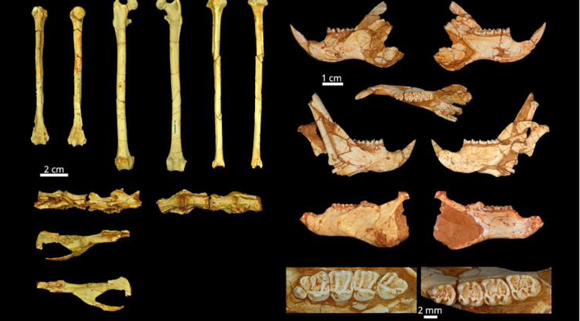
Views of the Fossilised Bones and Teeth of the Newly Described Miocene Flying Squirrel M. neogrivensis

Miopetaurista fossils.
The fossilised bones and teeth of the Miocene flying squirrel Miopetaurista.

Picture credit: Óscar Sanisidro

Redrawing the Evolutionary Family Tree of the Sciuridae

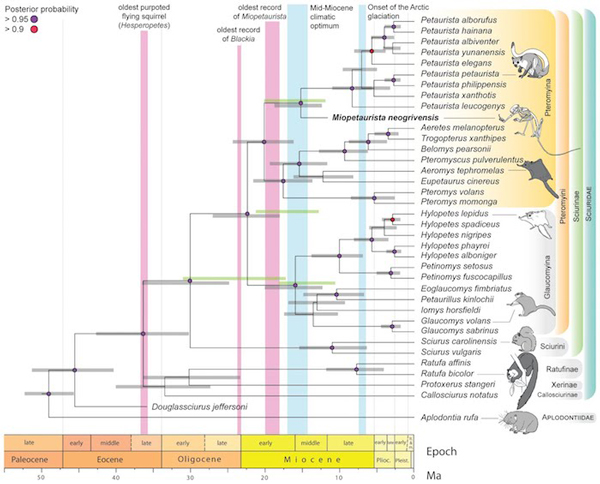
This Spanish fossil discovery has helped palaeontologists to redraw the evolutionary tree of the squirrel family.  That branch of the Sciuridae that led to modern flying squirrels must have diverged many millions of years earlier than previously thought.  This spilt is now believed to have occurred sometime between 31 and 25 million years ago.

The Phylogeny of the Flying Squirrels – M. neogrivensis Helps to Redraw the Squirrel Family Tree

Flying squirrel phylogeny.
The phylogeny of the flying squirrels has been revised after the description of Miopetaurista neogrivensis.

Picture credit: eLife

The researchers identified Miopetaurista neogrivensis as sister taxon of the living Petaurista taxon following an in-depth Bayesian statistical analysis that looked at over 100 anatomical characteristics in 38 taxa.  The team were also able to plot key periods in the evolution of these mammals and link them to incidences of environment and climate change such as the mid-Miocene climate optimum (global warming) and the onset of Arctic glaciation (global cooling).

Commenting on the significance of the fossils and their impact on squirrel phylogeny,  Óscar Sanisidro stated:

“When working with tree squirrels and flying squirrels, some of the features we thought were unique to flying squirrels have been found by our team in some non-flying squirrels.  Right now, we don’t have features unique to flying squirrels except for the wrist.  With fossils of micromammals, ninety-nine percent of the time you’re working with teeth.  Wrist bones are extremely rare.  But now we can link those traits to the postcranial skeleton.  Some of the flying squirrels found in the past might not be flying squirrels because they might have had features common to other groups.”

Well-adapted to a Forest Environment

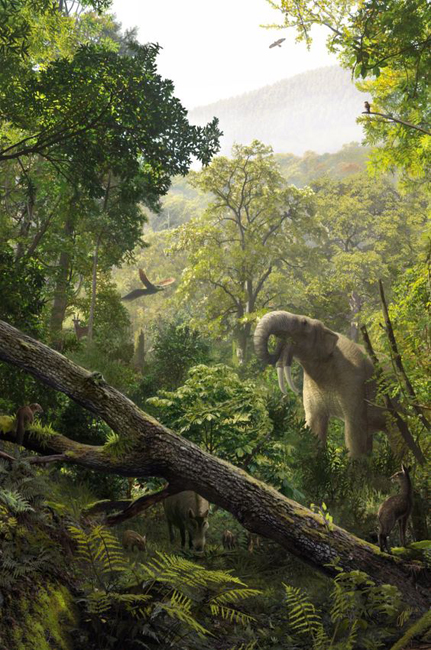
Flying squirrels today are globally distributed, but most species are found in Asia.  It is likely that, just like its extant descendants, Miopetaurista neogrivensis was probably nocturnal and very much at home in its sub-tropical forest environment.  It is not known what this ancient flying squirrel ate, today’s flying squirrels have a variety of feeding behaviours, however, Miopetaurista was probably omnivorous, feeding on nuts, fruit and insects.

Spain in the Mid Miocene – A Sub-tropical Forest Environment

The Middle Miocene - sub-tropical forests across much of Europe.
Spain in the Middle Miocene.

Picture credit: Óscar Sanisidro

Visit the Everything Dinosaur website: Everything Dinosaur.
Go to Top