All about dinosaurs, fossils and prehistoric animals by Everything Dinosaur team members.

Pictures of fossils, fossil hunting trips, fossil sites and photographs relating to fossil hunting and fossil finds.

23 10, 2018

Breathing Life into the Bird Lungs Debate

By |2023-11-04T09:26:09+00:00October 23rd, 2018|Categories: Dinosaur and Prehistoric Animal News Stories, Dinosaur Fans, Main Page, Photos/Pictures of Fossils|0 Comments

Archaeorhynchus spathula – Lungs in an Ancient Bird Fossil?

Modern birds have a very efficient respiratory system.  Their lungs are much more efficacious than those of mammals.  However, scientists are not sure when and how this breathing system evolved.  It has been suggested that the origins of the bird’s respiratory system, complete with air sacs and the ability to stop de-oxygenated air mixing with oxygenated air as it is expelled from the lungs, is one anatomical trait inherited from their dinosaur ancestors.

Writing in the academic journal the “Proceedings of the National Academy of Sciences”, a group of international scientists claim that the fossilised remains of an Early Cretaceous bird breathes new life into the evolution of the bird lungs debate.

The Main Slab Showing the Archaeorhynchus spathula Specimen
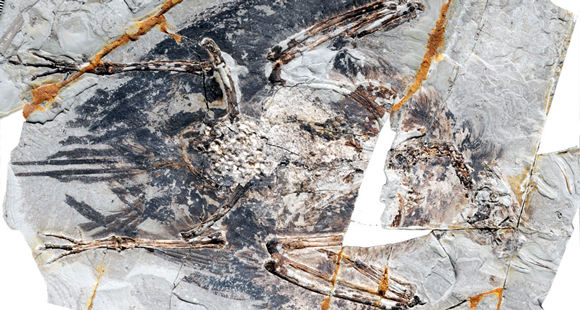
Archaeorhynchus spathula fossil (main slab).
The main slab showing the fifth specimen of Archaeorhynchus spathula to have been described. Palaeontologists have identified what might be evidence for avian lungs as well as a pintail on this ancient bird.

Picture credit: J. Zhang/Institute of Vertebrate Palaeontology and Palaeoanthropology (IVPP)

The Fifth Specimen of Archaeorhynchus spathula to be Described

A study of the slab and counter slab representing the fossilised remains of a prehistoric bird (Archaeorhynchus spathula), suggests that, in this remarkably complete specimen, remnants of the animal’s soft tissues including internal organs such as the lungs could have been preserved.  Using scanning electron microscopy, the research team, including members of the Beijing based, Institute of Vertebrate Palaeontology and Palaeoanthropology (IVPP), identified what could be evidence of paired lungs.

The structures identified by the team suggest that Archaeorhynchus had a respiratory system capable of handling the large amount of oxygen required to sustain powered flight.  Although, the conclusions drawn in the scientific paper have been questioned by several academics, if these are lungs, then it indicates that physiological adaptations in Aves came before changes in their skeleton during the evolution of anatomically modern birds.

The Scientists Identified What Could be Paired Lungs on the Counter Slab of the Fossil Specimen
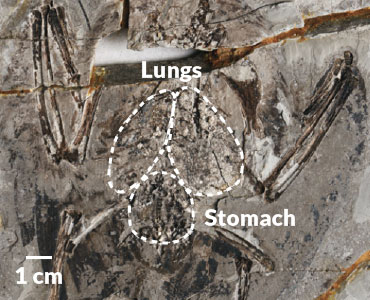
Archaeorhynchus spathula counter slab with possible lung preservation.
Counter slab of Archaeorhynchus spathula specimen interpreted as having lung preservation.  The dotted outlines mark the location of organs (paired lungs and the stomach).

Picture credit: X Wang et al (PNAS)

The Significance of this Research

Archaeorhynchus spathula is one of a number of bird genera known from the Lower Cretaceous Jiufotang Formation (China).  Copious amounts of gizzard stones associated with this and the previous specimens suggest that these primitive birds were probably vegetarian.  They form part of a rich prehistoric fauna known as the Jehol Biota.  In total, five specimens have been described to date but this fossil, consisting of a crushed specimen represented by a slab and counter slab, is the most complete.

Numerous feathers and traces of plumage can be made out and the researchers report that Archaeorhynchus had a pintail, a feature previously not seen in Mesozoic birds.  A. spathula has been classified as a basal member of the Ornithuromorpha, a group distantly related to today’s birds and one that possessed a mix of ancient and more modern anatomical features.

This fascinating fossil described as looking something like “road kill” by one observer, might have allowed palaeontologists to catch a glimpse of a stage of bird evolution where an advanced pulmonary system had evolved yet the skeleton lacked the adaptations seen in extant birds to permit efficient powered flight.

For an article published in 2007 that examined the respiration of dinosaurs: Study Indicates that Dinosaurs were Super-efficient Breathers.
21 10, 2018

Flea Bites and Dermal Infections in Glyptodonts

By |2023-11-04T09:04:29+00:00October 21st, 2018|Categories: Dinosaur and Prehistoric Animal News Stories, Main Page, Palaeontological articles, Photos/Pictures of Fossils|2 Comments

Fleas on Glyptodonts

A new study examining one of the more bizarre types of megafauna from prehistoric South America has revealed that glyptodonts and their relatives suffered from fleas and dermal infections.  It seems that the hard, bony armour of some of these car-sized giants was no defence against flea bites.  Brazilian-based scientists writing in the open access, on-line journal “PLOS One”, have studied hundreds of pieces of glyptodont armour and discovered evidence of infections caused by fleas.

Such armour might have deterred a sabre-toothed cat from attacking, but the osteoderms and armoured tails were no defence against parasites.

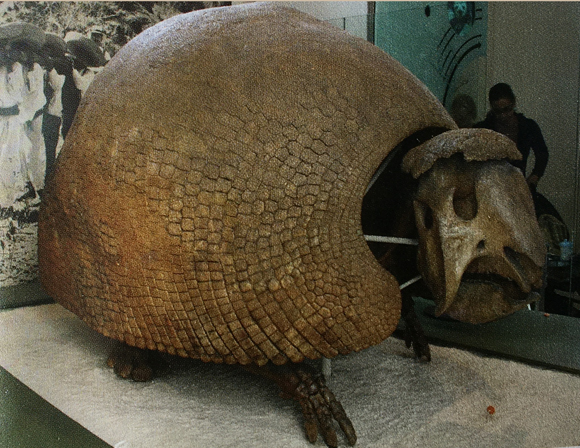
A Skeleton of the Giant Glyptodont Panochthus spp.

Fossil glyptodont Panochthus.
A glyptodont fossil (Panochthus frenzelianus).  Researchers studied the tiles of bone (osteoderms) that formed the protective bony exoskeletons of extinct types of armadillo and determined that these armoured giants suffered from parasites and skin infections.

Picture credit: R. Somma/Wikimedia Commons

Extinct Members of the Order Cingulata Studied

The scientists from Universidade Federal Rural do Semi-Árido, Mossoró (Brazil), studied the osteoderms that make up the exoskeleton of two extinct genera of glyptodonts Panochthus (pictured above) and Glyptotherium.  In addition, the research team examined the fossilised armour of another extinct armadillo-like creature Pachyarmatherium.

All these mammals belong to the Order Cingulata (armadillos and their relatives).  Damaged osteoderms were noted in all three genera and attributed to attacks by fleas and infections.  The scientists were able to identify the flea bites as coming from one particular genus  – Tunga.  The Tunga flea, sometimes referred to as the “jigger flea”, is native to South and Central America and is known to parasitise a number of large mammals including humans.  The bites cause well-defined circular lesions and perforations.  Such patterning was identified in a number of fossilised pieces of dermal armour.

Flea bites permitted secondary damage to be caused by the invasion of pathogenic microorganisms such as bacteria and fungi.

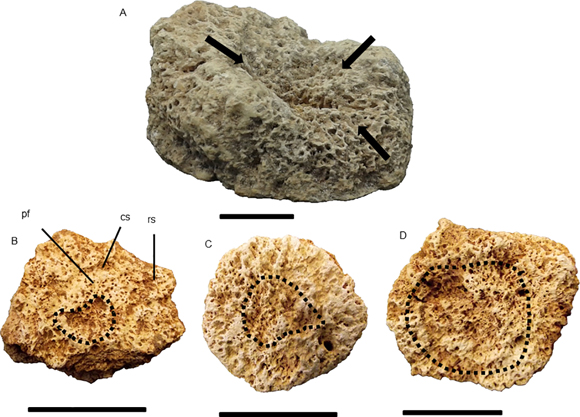
The External Surface of Osteoderms from the Glyptodont Glyptotherium Showing Pitting and Damage

Cingulata osteoderm parasite infection.
Osteoderms of the Brazilian glyptodont Glyptotherium showing damage from flea bites.

Picture credit: PLOS One

The picture (above) shows severe pitting (black arrows) in (A) and three other osteoderms attributed to Glyptotherium which show stages of damage from (B), slight, through to (D) advanced pitting and the response to the damage by the deposition of more bone (calcium deposition).  The scale bar in A = 3 cm, whereas, the scale bar in B-D is 4 cm.

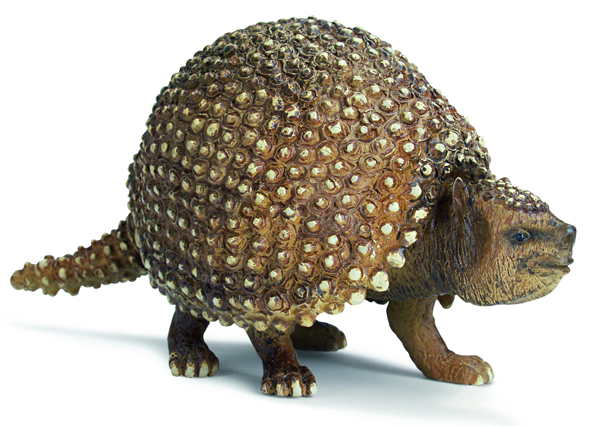
A Life Reconstruction of a Glyptodont

Schleich Glyptodon model.
The Schleich Glyptodon figure.

The bone alteration and re-growth identified in this study represent the first record of flea attack and pitting in two genera of large glyptodonts Panochthus and Glyptotherium and in a non-glyptodontid, large cingulate (Pachyarmatherium), from the Quaternary of the Brazilian Intertropical Region.  These newly identified flea bite occurrences and subsequent infections widen the geographic distribution of those diseases during the Cenozoic and provide more evidence for the co-evolution of parasites such as the Tunga flea and South American megafauna.

The scientific paper: “Ectoparasitism and Infections in the Exoskeleton of Large Fossil Cingulates” by Fábio Cunha Guimarães de Lima, Kleberson de Oliveira Porpino published in PLOS One.

Visit the Everything Dinosaur: Everything Dinosaur.

19 10, 2018

Feeding Traces on the Frill of a Young Centrosaurus

By |2023-11-02T13:03:29+00:00October 19th, 2018|Categories: Dinosaur and Prehistoric Animal News Stories, Dinosaur Fans, Main Page, Palaeontological articles, Photos/Pictures of Fossils|0 Comments

Bite Marks Found on the Frill of a Young Centrosaurus

The movies and television documentaries featuring dinosaurs are stuffed full of them, but the fossil record tells a different story.  What are we referring to?  Dinosaurs hunting, attacking and fighting other dinosaurs.  Rarely has a programme or film been produced about the Dinosauria that does not feature some gory scenes of a bloody battle or a fearsome theropod feasting on some poor, unfortunate plant-eating victim.  However, although such interactions obviously took place, the fossil record demonstrating such behaviour is extremely sparse.  A new paper, published in the open access journal “PeerJ”, reports on the discovery of bite marks preserved on the frill of a young Centrosaurus.

This raises two intriguing questions:

  • Which meat-eating dinosaur made the bite marks?
  • Is this evidence of predation or scavenging a carcass?

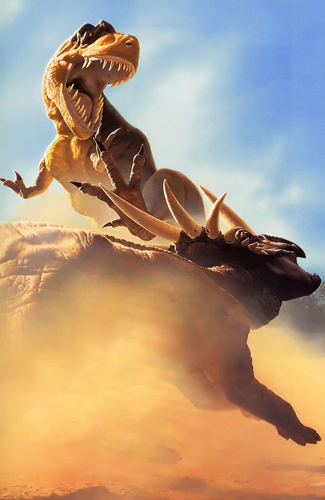
Dinosaurs Fighting – A Tyrannosaur Attacks a Horned Dinosaur (Styracosaurus)

Daspletosaurus fighting a horned dinosaur.
Tyrannosaur fighting a horned dinosaur.

Picture credit: John Gurche

Bite Marks – Tell-Tale Signs of Predator/Prey Interaction

Bite marks on fossil bones can provide valuable information about interactions between carnivorous dinosaurs and the animals that they attacked.  It is not always possible to distinguish whether the trace fossils represent wounds inflicted on an animal during a fight, or whether these marks represent post-mortem feeding, such as consumption of the victim.  If there are signs of healing and bone growth, palaeontologists can be confident that the bite marks in that instance represent a lucky escape for the intended victim.

The key thing to note, is that the more data about bite marks that can be collected, the better the dataset that palaeontologists have to compare potential bite mark injuries against.

Part of the Skull of a Juvenile Centrosaurus With Tooth-marks

Ironically, quite a large proportion of the tooth-mark fossils associated with dinosaurs come from those deposits that are associated with the remains of large-bodied tyrannosaurids.  In this newly published paper, the scientists from Queen Mary University London and the Royal Tyrrell Museum (Alberta, Canada), report on the discovery of a portion of the skull from a juvenile horned dinosaur.  The bone, a fragment of the squamosal, which makes up part of the frill, was found on the surface of a dinosaur bonebed in the Dinosaur Provincial Park Formation.  The fossil is approximately 76.3 to 75.6 million years old and has been assigned to the horned dinosaur species Centrosaurus apertus.

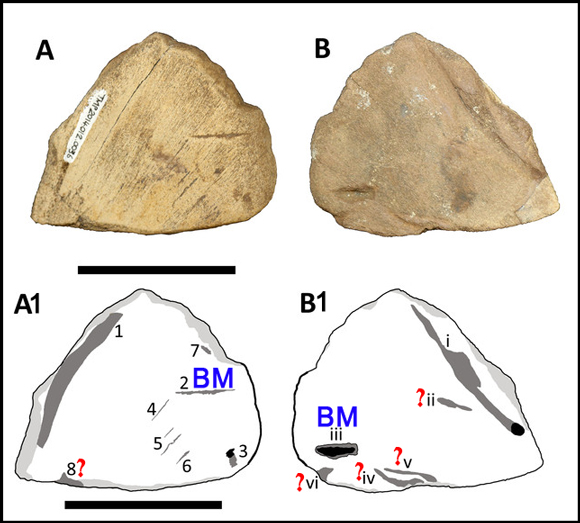
Views of the Fragment of the Squamosal Bone (Centrosaurus apertus) and Line Drawings

Identifying potential bite marks in a bone from a juvenile Centosaurus.
The two sides of the partial squamosal bone from a juvenile Centrosaurus showing signs of damage/wear/bite marks. Actual fossil (A and B), interpretive line drawings (A1 and B1).

Picture credit: PeerJ with additional annotation by Everything Dinosaur

Key

BM = Probable bite marks

? = Possible bite marks

Feeding on a Young Centrosaurus

Analysis of the fossil found numerous marks and gouges on both sides of the fossil bone.  Some of these marks could have resulted from damage due to transportation prior to burial.  Other marks could reflect effects caused by chemical erosion or the presence of vascular grooves.  However, the scientists were able to propose that at least some of the marks were due to teeth coming into contact with the bone.

The Position of the Partial Squamosal on the Skull of a Juvenile Centrosaurus and an Adult Skull Shown for Comparison

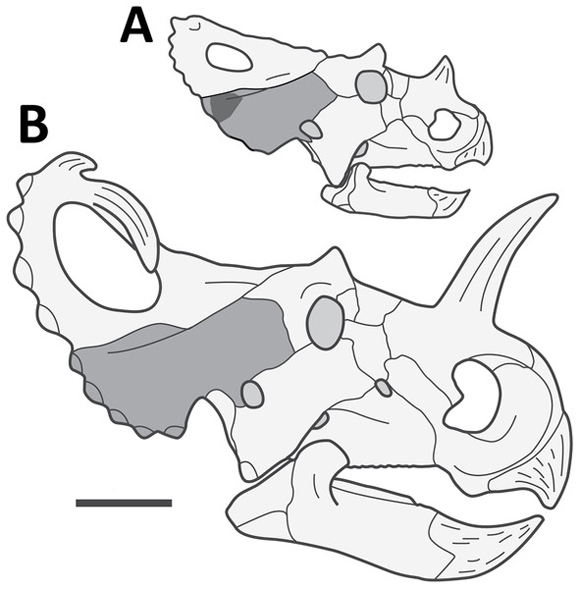
Juvenile (A) and adult (B) Centrosaurus skulls.
A comparison of Centrosaurus skulls (C. apertus) Juvenile (A) and adult (B).  The squamosal bone that makes up part of the frill is shaded grey, whilst the portion of bone in the study is shaded dark grey.

Picture credit: PeerJ

Although it is difficult to assess the size of the horned dinosaur based on such a small fragment of bone, the scientists suggest that based on comparisons with squamosal bones from adults, the juvenile Centrosaurus was perhaps about a third the size of a fully grown Centrosaurus.

Which Dinosaur Made the Feeding Traces?

The researchers ruled out crocodiles, other reptiles and mammals when it came to identifying what creature made the bite marks.  This left the team with three types of theropod dinosaur to investigate.  troodontids, dromaeosaurs and tyrannosaurs are known from the Dinosaur Provincial Park Formation.  There is also the genus Richardoestesia to consider, its affinity within the Theropoda is uncertain.  The bite marks are too small to have been made by a large tyrannosaur, but a juvenile tyrannosaur might have scavenged the carcass.

It is also possible that a dromaeosaurid may have fed on the remains as well.  It is possible that both the dromaeosaurid and a young tyrannosaur fed on the carcass, after all, modern carcasses may be fed on by multiple species (lions may kill a zebra but hyenas may chase them off the kill and rob them of the carcass – kleptoparasitism).

To read an article from Everything Dinosaur published in 2015 that looks at the structure of the teeth of different Theropod dinosaurs: Research to get your Teeth Into.

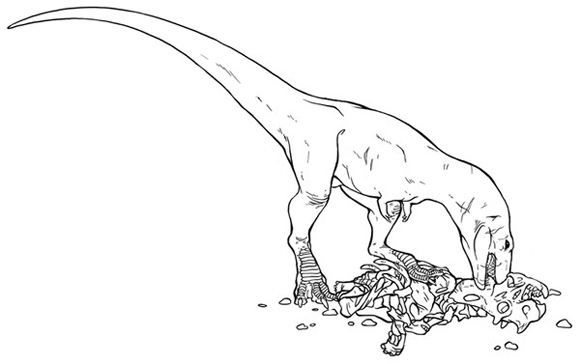
A Hypothesised Reconstruction of a Juvenile Gorgosaurus Feeding on the Carcass of a Juvenile Centrosaurus

A speculative illustration of a young Gorgosaurus feeding on the carcass of a juvenile Centrosaurus.
A young tyrannosaur (Gorgosaurus) scavenging the carcass of the juvenile Centrosaurus.

Picture credit: Marie-Hélène Trudel-Aubry/PeerJ

Slim Pickings

The marks on the squamosal fragment represent the first documented case of a carnivore consuming a juvenile ceratopsid, but the trace fossils may represent scavenging a corpse rather than predation.  However, there is not a lot of meat on a squamosal bone.  The scientists suggest that the feeding marks represent late stage consumption, as the most nutritious parts of the young Centrosaurus had already been eaten.  It is possible that a large tyrannosaur made the kill, fed and then abandoned the carcase which was later picked over by other theropods.

Despite the apparent preferences for feeding on juvenile dinosaurs, most feeding traces described to date are on the bones of adults which may have resisted being consumed and destroyed (even by large tyrannosaurs).  Feeding traces on a juvenile dinosaur remain unusual and exceptionally rare.  Perhaps the size and shape of ceratopsian skulls, even in juveniles, made them difficult to process or required an excess of handling effort for a relatively little reward in terms of food.

The scientific paper: “Bite Marks on the Frill of a Juvenile Centrosaurus from the Late Cretaceous Dinosaur Provincial Park Formation, Alberta, Canada” by David W.E. Hone, Darren H. Tanke and Caleb M. Brown published in PeerJ.

Visit the Everything Dinosaur website: Everything Dinosaur.

16 10, 2018

Spitsbergen Ichthyosaurs – Newly Described Fossils Open Up the Ophthalmosaurids

By |2023-11-02T12:26:14+00:00October 16th, 2018|Categories: Adobe CS5, Dinosaur and Prehistoric Animal News Stories, Dinosaur Fans, Main Page, Photos/Pictures of Fossils|0 Comments

Learning More About Palvennia hoybergeti

The Svalbard archipelago located off the coast of northern Norway, has attracted the attention of palaeontologists for several decades.  Some of the marine strata exposed on these islands date from the Late Jurassic and Early Cretaceous, the remote location and inaccessibility has not prevented hardy scientists from exploring these deposits and over the years, a huge number of invertebrate and vertebrate fossils have been collected.  Writing in the on-line, open access journal “PeerJ”, researchers from the University of Oslo, the London Natural History Museum, the University of Alaska and the University of Alaska Natural History Museum, have described a number of new ichthyosaur specimens that have been excavated from Spitsbergen, the largest island in the group.

Four Ophthalmosaurid Ichthyosaur Specimens

To date, four different types of ophthalmosaurid ichthyosaur are known from these rocks (the Slottsmøya Member of the Agardhfjellet Formation).  Several specimens are described in the newly published paper, including a disarticulated but relatively complete fossil of Palvennia hoybergeti.  P. hoybergeti is a Late Jurassic ophthalmosaurid marine reptile, that had been described back in 2012, from a single and very incomplete skull.  This new specimen (museum number PMO 222.669), has a mostly complete skull and reveals important new information about this short-snouted ichthyosaur species.

A Skeletal Drawing of the New P. hoybergeti Specimen PMO 222.669

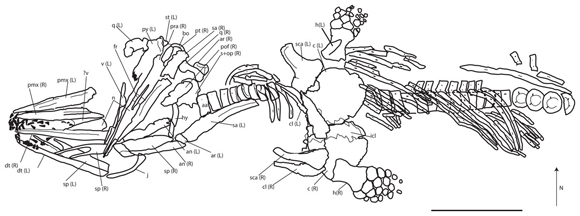
Skeletal drawing of the newly described Palvennia hoybergeti Ichthyosaur specimen.
A line drawing of the fossilised skeleton of the newly described specimen of Palvennia hoybergeti. Viewed from underneath (ventral view), note scale bar = 50 cm.

Picture credit: PeerJ

A Short-snouted Ichthyosaur

The fossil specimen (PMO 222.669) has provided the researchers with new information on the skull morphology of Palvennia hoybergeti.  It has a much reduced snout, superficially similar to the Early Jurassic ichthyosaur Ichthyosaurus breviceps, although the two genera are not closely related and they lived tens of millions of years apart.

The Rostrum and Teeth of Specimen Number PMO 222.669

Rostrum and isolated teeth with line drawing P. hoybergeti.
Rostrum and teeth of PMO 222.669, referred specimen of P. hoybergeti.
(A), photograph and (B), interpretation of the rostrum from the surface stratigraphically down.  Disarticulated teeth in (C), and (D), different views of the same tooth and (E), and (F), different views of a second tooth.  The scale bar (A-B) is 10 cm, whilst the scale bar (C-F) is 1 cm.

Picture credit: PeerJ

The relatively robust, short snout (rostrum) and the broad teeth may represent adaptations to feeding on other types of prey compared to other members of the Thunnosauria clade.  It could be speculated that Palvennia hoybergeti may have been less of a specialist cephalopod or fish hunter, perhaps preying on larger animals such as other ichthyosaurs.

A View of the Top of the Skull of the Newly Described Palvennia hoybergeti Specimen

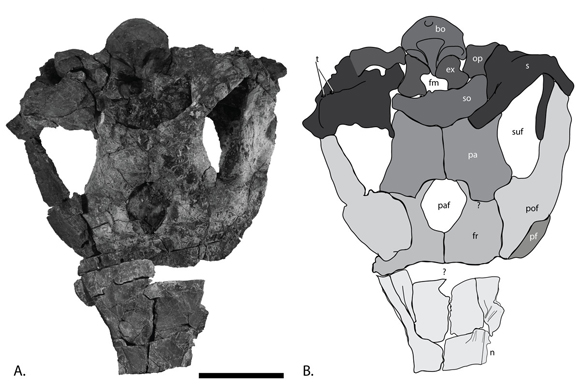
Skull roof of Palvennia hoybergeti with line drawing.
Photograph of the skull of P. hoybergeti (dorsal view) with an accompanying line drawing. Scale bar = 10 cm.

Picture credit: PeerJ

Confusing Pectoral Girdles

The researchers conclude that the more complete specimen that they have described greatly adds to our knowledge of this taxon.  Furthermore, two additional, newly discovered ophthalmosaurid specimens with pectoral girdles were also described in the paper.  The shape of the bones in the pectoral girdle, (the shoulders and associated bones for attaching the forelimbs), had thought to be quite useful diagnostic tools when assessing these types of ichthyosaur. However, although the shape of the coracoids may provide some guidance as to taxonomy, the scientists noted that the fossils from the Slottsmøya Member show a degree of individual variation which might compound the issue of identifying unique anatomical characteristics to help define a genus.

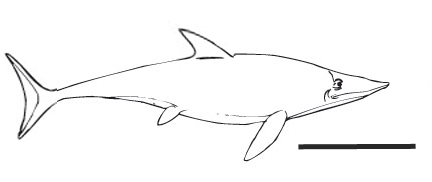
An Illustration of the Ophthalmosaurid Palvennia hoybergeti

Palvennia hoybergeti illustrated
An illustration of the ophthalmosaurid Ichthyosaur Palvennia hoybergeti. Scale bar = 1 metre. Picture credit: Everything Dinosaur.

Picture credit: Everything Dinosaur

For models and replicas of marine reptiles and other prehistoric animals: PNSO Age of Dinosaurs Models.

A Substantial Temporal Range

The ichthyosaur specimens from Spitsbergen span quite a substantial temporal range.  Fossils of these marine reptiles have been found in strata dating from the Early Tithonian of the Late Jurassic, whilst some specimens have been located in Early Berriasian deposits (Early Cretaceous).

It is proposed that future studies should aim to include a large number of specimens and use quantitative approaches to reveal phylogenetic and evolutionary patterns.  As the temporal range of these fossils covers some six million years (around 150 million years ago to 144 million years ago), the fossils from this part of the Svalbard archipelago may prove valuable in helping to determine the evolution of the Ichthyosauria at a time when a number of ecosystems were suffering from extinction events.

The scientific paper: “A New Specimen of Palvennia hoybergeti: Implications for Cranial and Pectoral Girdle Anatomy in Ophthalmosaurid Ichthyosaurs” by Lene Liebe Delsett​, Patrick Scott Druckenmiller, Aubrey Jane Roberts, Jørn Harald Hurum and published in PeerJ.

Visit the Everything Dinosaur website: Everything Dinosaur.

15 10, 2018

Baby Tylosaurus Provides Clues to How Marine Reptiles Hunted

By |2023-11-02T09:45:37+00:00October 15th, 2018|Categories: Dinosaur and Prehistoric Animal News Stories, Dinosaur Fans, Main Page, Photos/Pictures of Fossils|0 Comments

Baby Tylosaurus Fossils Shed Light on Tylosaurus Hunting Strategy

The fragmentary remains of a baby Tylosaurus may have provided palaeontologists with an insight into how the giant and powerful marine predator Tylosaurus hunted.  Analysis of the front portion of the jaw shows that this tiny terror lacked a deep rostrum, whilst older, larger specimens and the adults all had these bony protrusions.  Scientists writing in the “Journal of Vertebrate Paleonotology” hypothesise that Tylosaurus rammed its victims with its snout in a similar fashion to a hunting method observed in extant Orcas.

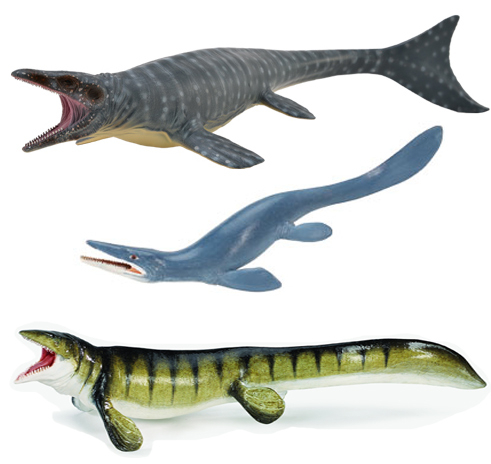
Fearsome Mosasaurs – How Did These Predators Subdue Their Prey?

Different Mosasaurs
Comparing different models of mosasaurs.  Fossil teeth and bones indicate that several types of mosasaur were apex predators but how did these animals subdue their prey? Picture credit: Everything Dinosaur.

Picture credit: Everything Dinosaur

Baby Tylosaurus Fossil

Scientists are aware that pods of Orcas (Orcinus orca), tend to specialise in different types of prey, some hunt fish, others specialise in hunting other marine mammals whilst others are generalists, however, it is known that Orcas tend to stun prey such as seals and dolphins by ramming them with their snouts.  A study of the smallest Tylosaurus skull fossils found to date, suggest that as these animal’s grew their snouts (rostrums) became elongated and more robust.  It is suggested that these predators rammed their victims in the same way that some living Killer Whales do.

Little Killer/Tiny Tylosaurus

Lead author of the scientific paper, Professor Takuya Konishi, explained that he examined fossils of a very young Tylosaurus whilst working on his master’s degree in 2004.  The fossils came from an animal with a skull length of around thirty centimetres, approximately 1/6th the size of an adult Tylosaurus skull.

The fossils come from the Smoky Hill Chalk Member of the Niobrara Chalk of western Kansas, deposits that were laid done in the shallow Western Interior Seaway.  The baby Tylosaurus is estimated to have lived around 85 million years ago.  The fossils had been originally found in 1991, by palaeontologist Michael Everhart (Sternberg Museum of Natural History), the small size and fragmentary nature made initial identification difficult and the fossils has been assigned to another type of mosasaur, a Platecarpus, remains of which are relatively common in the Smoky Hill Chalk Member.

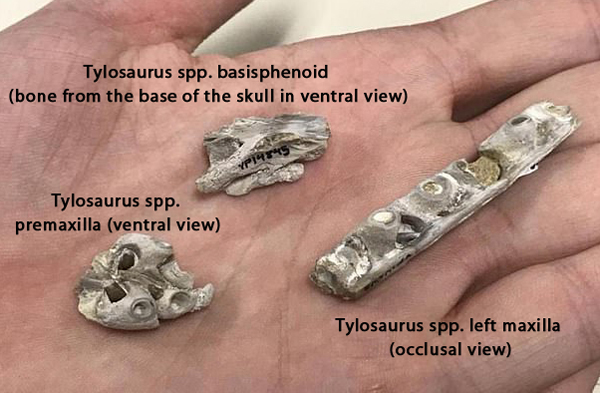
Tiny Fossil Fragments Identified as Neonate Tylosaurus

Baby Tylosaurus skull and jaw fossil bones.
Pieces of the skull and jaw of the baby Tylosaurus.  Specimen number FHSM VP-14845.

Picture credit: Christina Byrd/Sternberg Museum of Natural History with additional annotation by Everything Dinosaur

Lack of a Prominent Snout

The lack of a snout puzzled the scientists who were unable to tie this material to other Tylosaurine remains.  The Platecarpus assignment seemed the best fit, then Professor Konishi had his “eureka” moment.  The elongated rostrum of Tylosaurus might develop as the animal grew, this anatomical feature might not be present in very young examples of this genus.  While Platecarpus and other members of the Mosasauridae have teeth that begin virtually at the tip of their snouts, mature Tylosaurus possess a bony protrusion called a rostrum that extends out from its face, a similar feature is found in Orcas.

The research team speculate that this rostrum might have served as a battering ram and protected the marine reptile’s teeth as it slammed into its prey.

Professor Konishi takes up the story:

“Having looked at the specimen in 2004 for the first time myself, it too took me nearly ten years to think out of that box and realise what it really was,  a baby Tylosaurus yet to develop such a snout.”

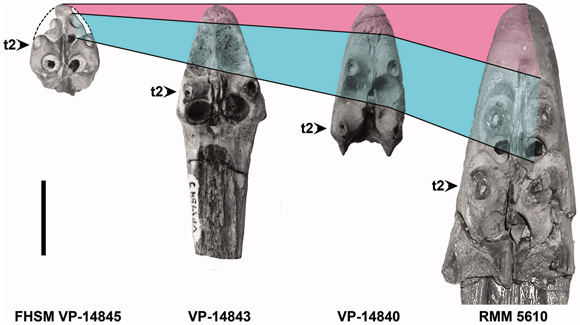
The Ontogeny of Tylosaurus

Tylosaurus ontogeny - as these reptiles grew their rostrums become elongated and more robust.
Elongation and development of the rostrum in Tylosaurus.  Scale bar equals 2 cm.

Picture credit: Journal of Vertebrate Paleontology

Specimen Number FHSM VP-14845

The picture (above) shows various Tylosaurus fossil specimens.  Specimen number FHSM VP-14845 is from the neonate Tylosaurus (left) and moving towards the right, the rostrums denote progressively older, larger Tylosaurus specimens.  The researchers identified greater anteroposterior alignment of two pairs of premaxillary teeth in association with alveolar elongation (tooth socket spacing).  The abbreviation t2  denotes the second premaxillary tooth, this alveolar elongation slows down as the Tylosaurus ages, as seen here between specimens FHSM VP-14840 and RMM 5610.  In contrast, the rostrum continues to grow and to become deeper and more robust.

Professor Konishi and His Co-workers Suggest Tylosaurus Used Its Snout to Ram Prey

Takuya Konishi (Cincinnati University) with a Mosasaur skull cast.
University of Cincinnati Biology Professor Takuya Konishi points out the rostrum on a mosasaur skull.

Picture credit: Joseph Fuqua II/University of Cincinnati Creative Services

The Possibility of Misidentified Fossil Material

The scientists suggest that, as Tylosaurus developed its “tell-tale” snout as it grew, then this could mean that other fossil specimens of mosasaurs from the Western Interior Seaway may have been mistakenly classified as other types of mosasaur.

For models and replicas of Tylosaurus and other marine reptiles: CollectA Prehistoric Life Figures.

A spokesperson from Everything Dinosaur commented:

“What was once thought to be a diagnostic feature of Tylosaurus, a robust and elongated snout, might not be as diagnostic as previously thought.  This means that short-snouted fossil remains assigned to other types of mosasaur could, actually represent juvenile Tylosaurus specimens.”

The scientific paper: “The Smallest Known Neonate Individual of Tylosaurus (Mosasauridae, Tylosaurinae) Sheds New Light on the Tylosaurine Rostrum and Heterochrony” by Takuya Konishi, Paulina Jiménez-Huidobro and Michael W. Caldwell published in the Journal of Vertebrate Paleontology.

Visit the Everything Dinosaur website: Everything Dinosaur.

13 10, 2018

New Research Suggests the Ancestors of Sarahsaurus Probably Did Not Originate in North America

By |2024-05-11T08:06:22+01:00October 13th, 2018|Categories: Dinosaur and Prehistoric Animal News Stories, Dinosaur Fans, Main Page, Palaeontological articles, Photos/Pictures of Fossils|0 Comments

Early Jurassic North American Sauropodomorphs were Migrants

The sauropodomorph dinosaur called Sarahsaurus was a migrant into North America just like the other North American sauropodomorphs that have been described to date.  That is the conclusion made by researchers from the University of Texas Austin, in a scientific paper published this week.

Recently, Everything Dinosaur has covered a number of technical papers that have featured the Suborder Sauropodomorpha (the sauropods and their direct ancestors).  The United States might be famous for dinosaurs such as Brontosaurus, Camarasaurus and Diplodocus, but surprisingly not much is known about the ancestors of these iconic, long-necked dinosaurs.

Studying Sarahsaurus

Writing in the open access journal PLOS One, the researchers from the University’s Jackson School of Geosciences, conclude that the handful of sauropodomorphs known from the Lower Jurassic of North America are not that closely related and they represent successive immigration waves into that part of the super-continent Pangaea.

Sarahsaurus and Other North American Early Jurassic Sauropodomorphs Do Not Form a Unique Clade

Sarahsaurus (North American dinosaur).
A life reconstruction of the North American sauropodomorph Sarahsaurus.

Picture credit: Brian Engh

CT Scans and Phylogenetic Analyses

The researchers conducted the first detailed analysis of the fossils ascribed to the genus Sarahsaurus (Sarahsaurus aurifontanalis).  This dinosaur had been named back in 2010, from fossil material excavated from the Lower Jurassic Kayenta Formation exposed in north-eastern Arizona.  In total, three specimens, including the holotype were studied and subjected to computed tomographic imaging.

With more anatomical data, the scientists then conducted a series of phylogenetic assessments to see where within the Sauropodomorpha Sarahsaurus should be nested and importantly, how the other sauropodomorphs from North America such as Anchisaurus (A. polyzelus) and Seitaad (S. ruessi) were related to Sarahsaurus.

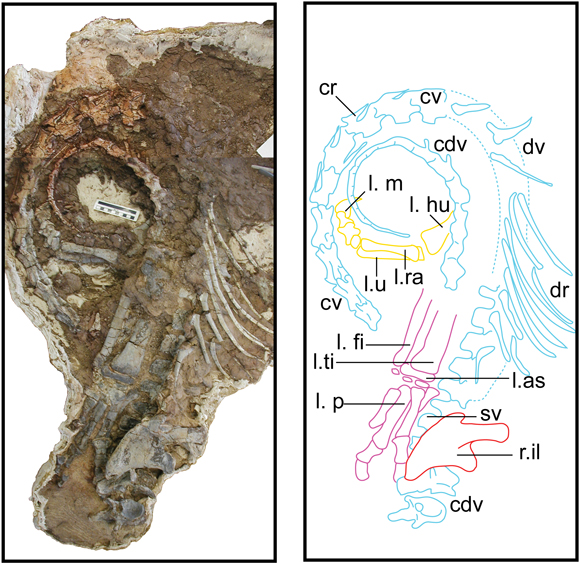
The Main Fossil Block Associated with Sarahsaurus and a Line Drawing Showing a Layout of the Fossil Material

Sarahsaurus holotype.
The main block containing much of the holotype specimen of Sarahsaurus aurifontanalis.

Picture credit: PLOS One

Sarahsaurus aurifontanalis

All of the Sarahsaurus specimens referred to in this study came from siltstone deposits.  Manual preparation of the fossils was extremely laborious and time consuming.  Many of the bones were encrusted with an extremely hard purple-black oxide coating, hence the use of high-resolution X-ray CT scans to provide more information about the finer details preserved on the fossil material.

In addition, conducting the phylogenetic analysis was made even more problematic than usual as the material used to establish unique characteristics of Sarahsaurus which could then be used to compare with other sauropodomorphs, provided numerous obstacles for the scientists to overcome.

Firstly, a skull used in this study probably came from a much younger individual than the other Sarahsaurus specimens analysed.  Furthermore, not all the specimens shared the same bones so making direct comparisons to establish a unique set of features for Sarahsaurus was challenging.

The Massospondylidae Family

These factors coupled with some mixing and redistribution of the holotype material in the sediment and the crushed nature of many of the fossil bones made the phylogenetic assessment very tricky, but the researchers were able to conclude that Sarahsaurus aurifontanalis is probably a member of the Massospondylidae family, which means that this dinosaur is not closely related to the other North American Sauropodomorpha and is more closely related to dinosaurs known primarily from the Southern Hemisphere (Gondwana).

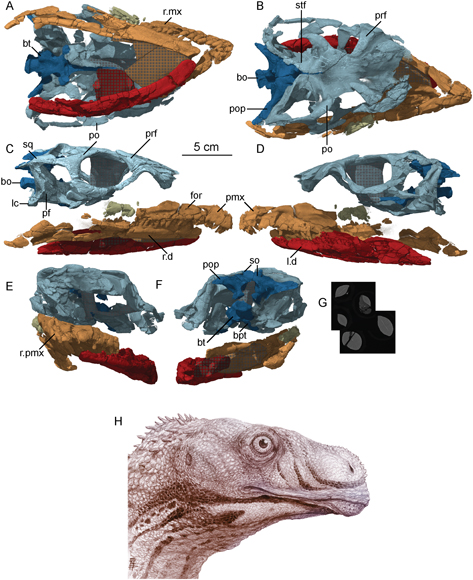
CT Scans of a Skull Specimen Provisionally Assigned to Sarahsaurus

CT scans help to plot the shape of the fossil skull provisionally assigned to Sarahsaurus.
Skull (MCZ 8893) provisionally referred to Sarahsaurus aurifontanalis, reconstructed from CT data.  Life reconstruction (H) by Brian Engh.

Picture credit: PLOS One/Brian Engh

Waves of Dinosaur Migration into North America Following the End Triassic Extinction Event

If the three known North American sauropodomorphs are not that closely related and the likes of Sarahsaurus is classified as a member of the Massospondylidae, then this suggests that rather than evolving in North America, these dinosaurs arrived on that part of the super-continent of Pangaea as a result of a number of migrations that took place during the Early Jurassic.  This links with other research that suggests that although theropods were present in North America during the Triassic transition to the Jurassic, other types of dinosaurs such as the Sauropoda and the ornithischians populated this part of the world later.

The dinosaurs may not have been the super evolved terrestrial animals that simply outcompeted all the other tetrapods in the world driving the majority to extinction.  Instead, the Dinosauria may have been opportunists, migrating into areas after the former occupants of key niches in the ecosystem had already died out.

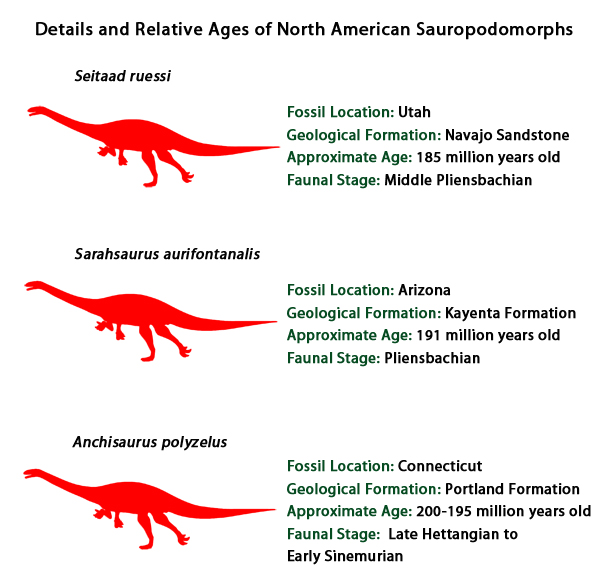
Research Suggests that there were Several Migration Waves into North America During the Early Jurassic

Comparing three North American members of the Sauropodomorpha.
Relative ages of North American sauropodomorphs.

Picture credit: Everything Dinosaur

To read Everything Dinosaur’s article on the discovery of Seitaad ruessiDinosaur Buried Alive is a New Species from Utah.

The scientific paper: “Anatomy and Systematics of the Sauropodomorph Sarahsaurus aurifontanalis from the Early Jurassic Kayenta Formation” by Adam D. Marsh and Timothy B. Rowe published in the open access journal PLOS One.

Visit the Everything Dinosaur website: Everything Dinosaur.

11 10, 2018

Smallest Diplodocid Skull Shedding Light on the Family Life of Diplodocus

By |2023-11-02T07:14:30+00:00October 11th, 2018|Categories: Dinosaur and Prehistoric Animal News Stories, Dinosaur Fans, Main Page, Photos/Pictures of Fossils|0 Comments

Baby Diplodocid Skull Could Provide Fresh Insight into the Life of Diplodocus

A team of international researchers writing in the academic journal “Scientific Reports”, have described a partial skull of a diplodocid dinosaur.  The skull, measuring just 24 centimetres long, is the smallest diplodocid skull described to date and it is helping to provide information on how long-necked dinosaurs such as Diplodocus changed as they grew.

Studying Diplodocus

The fossil (CMC VP14128), was collected back in 2010 from south, central Montana (Mother’s Day Quarry). The site contains the fossilised remains of at least sixteen immature diplodocids, that may have perished having been caught up in a turbulent mudflow.  The skull, which consists of four large segments plus additional fragments, reveals that the heads of diplodocid dinosaurs changed as they got older and suggests that immature individuals fed on different types of vegetation (dietary partitioning relative to age).  Groups of young animals may have stayed together in a creche, living apart from the adults, even occupying a different habitat.

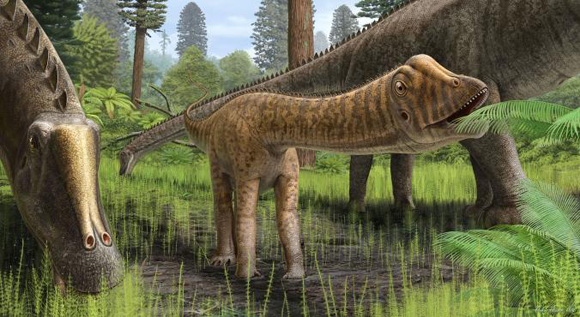
The Fossilised Skull of a Young Diplodocid Hints at Dietary Partitioning

Dietary partitioning amongst diplodocids.
A newly published study of a small long-necked dinosaur skull suggests dietary partitioning within diplodocids.

Picture credit: Andrey Atuchin

“Andrew” the Diplodocus

The specimen (CMC VP14128), also includes a rudimentary bone that links the skull to the cervical column (the proatlas) and four neck bones from the front part of the neck, closest to the skull.  The fossil material has been assigned to the diplodocid species Diplodocus carnegii and the skull was nicknamed “Andrew” in honour of Andrew Carnegie, the Scottish-American industrialist and philanthropist, who did much to support the nascent science of palaeontology in the United States.  The species D. carnegii is named after him in recognition of his financial support for expeditions to excavate fossils from the Morrison Formation.

The Immature Diplodocid Compared to an Adult and Andrew Carnegie (1.6 m tall) with Skull Views and Accompanying Line Drawings

Immature diplodcid skull.
The juvenile diplodocid with Andrew Carnegie and an adult Diplodocus for scale. Along with right and left lateral views of the skull and line drawings.

Picture credit: Scientific Reports

The picture above shows a skeletal reconstruction of “Andrew” compared to Andrew Carnegie and an adult D. carnegii (A), the bones in the skeleton in white represent the fossil material (CMC VP14128).  Right lateral view of the skull (B), with an accompanying line drawing and (C), a left lateral view of the skull with a line drawing.  The four segments of the skull are numbered in the line drawings and the scale bar in (B) and (C) is ten centimetres.

Differences in the Shape of the Head of Young and Fully Grown Dinosaurs

Although the skull fossil has been crushed, the researchers, which included lead author Cary Woodruff (University of Toronto) and Glenn Storrs (Cincinnati Museum Centre), conclude that the juvenile, which was perhaps around 5 years of age and 5 metres long when it died, had a much narrower snout compared to the broad, wide snout of an adult.  In addition, “Andrew” possessed thirteen teeth on each side of its lower jaw, some of which had spatulate, spoon-like edges to slice through tough vegetation.  In contrast, fully-grown Diplodocus lower jaws had eleven teeth on each side and these were much more peg-like and were probably used to “comb” food in to the mouth.

This indicates that juveniles had different skull morphologies and dentition when compared to older, more mature animals and suggests resource partitioning between juveniles and adults.  In short, juvenile Diplodocus probably fed on different plants compared to the grown-ups.

For models and replicas of Diplodocus and other dinosaurs: Rebor Dinosaur and Prehistoric Animal Models.

An Adult Diplodocus had a Differently Shaped Head and Snout Compared to a Juvenile

Adult Diplodocus compared to a juvenile.
Adult animals had broader snouts whilst the juveniles and much narrower snouts with more teeth which were shaped differently.

Picture credit: Andrey Atuchin

This research is consistent with the theory that immature diplodocids adopted a different feeding strategy, grazing on a greater variety of plants, whilst the adults were predominantly ground-level browsers.

To read an article from 2010 that hypothesised that baby dinosaurs had different skull morphologies and facial features when compared to adults: Juvenile Diplodocus Skull Study Suggests Baby Dinosaurs Had Different Shaped Skulls Compared to the Adults.

Commenting on the significance of this research, lead author Cary Woodruff, stated”

“Because they have [Diplodocus juveniles] got these different tooth types, it’s kind of like of a Swiss army knife in their mouth, right?  They can pick and eat every plant they want to.  They had free rein at the salad bar.”

Young Diplodocids Living in Woodland Habitats

The skull and tooth morphology of Diplodocus suggests that these animals transitioned through distinct feeding roles over their lifespan and vindicates the dramatised life story of a Diplodocus in the ground-breaking BBC television documentary series “Walking with Dinosaurs”.  In episode two “Time of the Titans”, the story of a Diplodocus from hatching to reaching adulthood was told and juveniles were depicted as living in groups within the forests, only joining the adults on the open plains when they were much larger, too large for most predators to tackle.

The different skull shapes and dentition suggest that juvenile diplodocids lived in more forested environments than the adults that (restricted and protected by their size), were most likely browsing in more open habitats.

For an article published in 2012 on Diplodocus feeding strategies: Diplodocus Feeding Frenzy – A Biter or a Comber?

Lead Author of the Study Cary Woodruff Holds the Skull of a Juvenile Diplodocid

Holding the skull of a juvenile diplodocid.
Cary Woodruff (University of Toronto), holding the skull of a juvenile diplodocid.

Picture credit: John P Wilson

The scientific paper: “The Smallest Diplodocid Skull Reveals Cranial Ontogeny and Growth-Related Dietary Changes in the Largest Dinosaurs” by D. Cary Woodruff, Thomas D. Carr, Glenn W. Storrs, Katja Waskow, John B. Scannella, Klara K. Nordén and John P. Wilson published in Scientific Reports.

Visit the Everything Dinosaur website: Everything Dinosaur.

9 10, 2018

“Powerful Terror Ruler” – Dynamoterror dynastes

By |2023-11-02T06:57:36+00:00October 9th, 2018|Categories: Dinosaur and Prehistoric Animal News Stories, Dinosaur Fans, Main Page, Palaeontological articles, Photos/Pictures of Fossils|0 Comments

“Powerful Terror Ruler” – Dynamoterror dynastes

A new species of North American tyrannosaur has been scientifically named.  The newly described “tyrant lizard” joins a plethora of tyrannosaurids known from the Late Cretaceous of Laramidia, but Dynamoterror dynastes stands out from the majority of these fearsome theropods for some very important reasons.

Firstly, it is quite geologically old for a Late Cretaceous large-bodied tyrannosaur, its discovery has implications for our understanding of tyrannosaur evolution.  In addition, its the frontal bones that help make this dinosaur stand out and besides, its scientific name, which means “powerful terror ruler”, is a nod in the direction of the most famous dinosaur of all – Tyrannosaurus rex.

A Life Reconstruction of Dynamoterror dynastes Attacking the Recently Described Invictarx zephyri

The newly described Tyrannosaur Dynamoterror attacks Invictarx

Dynamoterror ambushes the armoured dinosaur Invictarx zephyri.

Picture credit: Brian Engh

The Geological Age – Early Campanian

The fossil bones, representing a single, individual animal were collected in 2012.  They herald from San Juan County, New Mexico, specifically the upper part of the Allison Member of the Menefee Formation.  Although fragmentary, the fossil material consists of asociated bones including left and right frontals (bones from the top of the skull over the eye socket), a right metacarpal (bone from the hand), four broken pieces from the backbone, pieces of rib, a portion of the right ilium and some toe bones, plus several unidenfiable slithers of bone.

It might not sound like much, but this is the first associated tyrannosaurid skeleton reported from the Menefee Formation.  Isolated teeth had been found in this locality before suggesting the presence of tyrannosaurids, but Dynamoterror dynastes is the first to be named and described.  It was probably the dominant predator in the lush, tropical, coastal swamps that covered this part of the southern United States some 80 million years ago.

During the Late Cretaceous, North America was essentially split into two by a wide seaway, the Western Interior Seaway.  To the east lay Appalachia and tyrannosaurs are known from here, but not many, only two genera have been named to date – Appalachiosaurus montgomeriensis and Dryptosaurus aquilunguis and both of these are only known from a single, partial, associated skeleton.

Dynamoterror dynastes

In the Upper Cretaceous strata to the west that formed the landmass called Laramidia, lots of tyrannosaurs have been named and described.  However, the tyrannosaurid record for Laramidia is restricted to a period from about 77 million years ago to the K-Pg extinction event some 66 million years ago.  Dynamoterror comes from rocks which are around 3 million years older.  It provides the first fossil record of a Laramidian tyrannosaurid from the Early Campanian of 80 million years ago and, as a result, will help palaeontologists to better understand tyrannosaurid evolution.

The Cool Thing About Frontals

Less than one percent of the skeleton may have been found (field teams were despatched in 2013 and again this year to try and find more remains but without luck), but when it comes to describing a new genus, it is often quality that triumphs over quantity.  The frontal bones, their shape, the groves that they possess and other features including how they knit together with other skull bones, can prove extremely helpful when it comes to identifying a new dinosaur species.  The researchers which included Dr Andrew McDonald (Curator, of the Western Science Centre, California), identified some unique characteristics in the frontal bones, hence the establishment of a new genus.

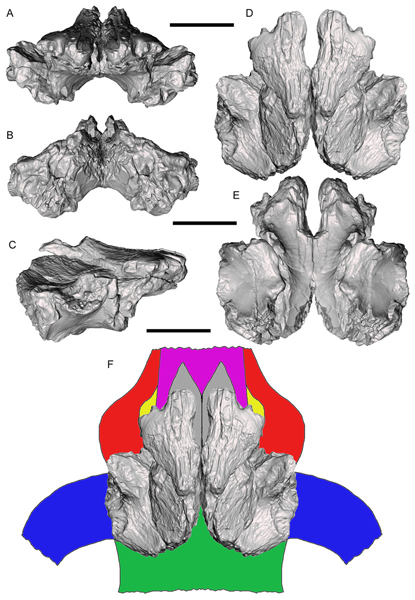
Photographs and Computer-generated Three-dimensional Models of the Left and Right Frontals of D. dynastes

The frontal bones of Dynamoterror dynastes.

Photographs and three-dimensional, computer-generated models of the right frontal (A, B) and the left frontal (C, D) of Dynamoterror dynastes (rostal view – viewed from the front of the brain).  Scale bar = 5  centimetres.

Picture credit: PeerJ/Western Science Centre

Dynamoterror dynastes A Large Bodied Tyrannosaur

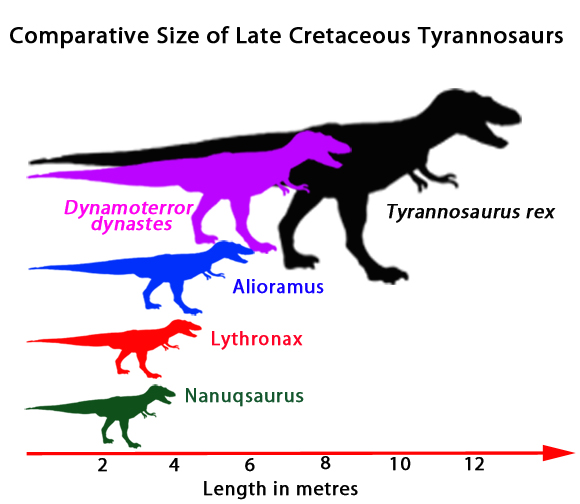
The researchers cannot be certain whether their fossil discovery represents a fully grown animal or a sub-adult.  However, when the frontal bones of D. dynastes were compared to those of Tyrannosaurus rex, the scientists concluded that Dynamoterror was at least nine metres long.  The armoured dinosaur that features in the illustration (above), Invictarx, was also named and described by Dr McDonald, along with Mr Doug Wolfe (Zuni Dinosaur Institute for Geosciences) who worked together on this tyrannosaur.  It is likely that more dinosaurs will be described based on fossil discoveries from within the Menefee Formation.  Alton C. Dooley Jr also collaborated in the study of Dynamoterror.

To read about the discovery of the nodosaurid Invictarx: A New Nodosaur from New Mexico.

Size Comparison of Selected Late Cretaceous Tyrannosaurs

Comparing the size of selected Late Cretaceous Tyrannosaurs.

Size comparison between selected Late Cretaceous tyrannosaurs. Picture credit: Everything Dinosaur.

Picture credit: Everything Dinosaur

What’s in a Name?

This new taxon provides further, significant insight into the morphology and diversity of tyrannosaurids from the Early Campanian of Laramidia and it’s name is pretty cool too.  The genus name is taken from the Greek word “dynamis” which means “power” and the Latin word “terror”.  The trivial or specific name, is from the Latin word “dynastes” meaning “ruler”.  Hence, the binomial scientific name Dynamoterror dynastes translates to “powerful terrror ruler”, however, the scientific paper also states that this epithet honours the name “Dynamosaurus imperiosus“, from Henry Fairfield Osborn, the American palaeontologist who referred to fossil material later assigned to Tyrannosaurus rex as Dynamosaurus imperiosus in scientific papers published in the early years of the 20th century.

The Reconstructed Frontal Complex of Dynamoterror dynastes

Life restoration of the frontals of Dynamoterror dynastes.

The reconstructed frontals of D. dynastes.

Picture credit: PeerJ/Western Science Centre

Analysing the Frontals

In the picture above, the left and right frontals have been articulated together to show how they would sit at the top of the skull, in (A) rostral; (B) caudal; (C) right lateral; (D) dorsal; and (E) ventral views.   The illustration (F), shows a view of the reconstructed skull in dorsal view.  Individual bone elements of the skull are colour-coded to show how the top of the skull knitted together: frontals (grey); fused nasals (violet); prefrontals (yellow); lacrimals (red); postorbitals (blue); and parietal (green).

The scale bars represent 5 centimetres and the missing skull bones have been based on the related tyrannosaurid Teratophoneus curriei, a geologically younger tyrannosaur from the Upper Campanian of southern Utah (Kaiparowits Formation).  T. curriei roamed Laramidia around 76 million years ago, some 4 million years after Dynamoterror dynastes.

The scientific paper: “A New Tyrannosaurid (Dinosauria: Theropoda) from the Upper Cretaceous Menefee Formation of New Mexico” by Andrew T. McDonald, Douglas G. Wolfe and Alton C. Dooley published in PeerJ.

Visit the Everything Dinosaur website: Everything Dinosaur.

8 10, 2018

Baby Mammoth Lyuba Not Visiting the UK

By |2023-11-02T06:56:01+00:00October 8th, 2018|Categories: Dinosaur and Prehistoric Animal News Stories, Main Page, Photos/Pictures of Fossils|0 Comments

Baby Mammoth Lyuba Not Visiting the UK

Everything Dinosaur has received a number of enquiries asking whether the beautifully preserved baby Woolly Mammoth known as Lyuba will be visiting the UK in 2019.  As far as we know, there are no plans for any museum in the United Kingdom to exhibit this amazing specimen next year.

Lyuba Not Coming to the UK Anytime Soon

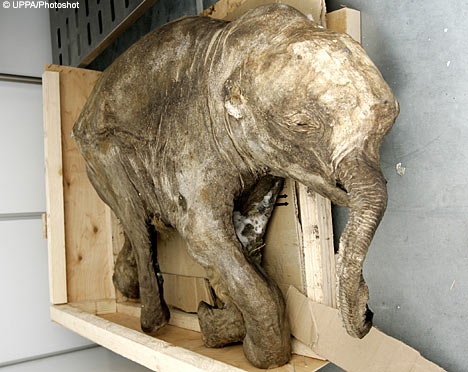
The baby Woolly Mammoth known as Lyuba.
The 40,000-year-old baby mammoth Lyuba.

Picture credit: Uppa Photoshot (Daily Telegraph News)

Woolly Mammoth Drowned in a Muddy Pool 40,000 Years Ago

The almost perfectly preserved frozen carcass of a four-week-old, female Woolly Mammoth calf was discovered in the Yamal-Nenets region of Siberia eleven years ago.  The baby Mammoth was named Lyuba, after the wife of the reindeer herder who found her.  The specimen is part of the Shemanovskiy Museum and Exhibition Centre collection in Salekhard (Russia), but in death she has travelled far further than she did in her short life.  Lyuba was part of a special exhibition focusing on Mammoths and Mastodons that toured the world back starting in 2010/11 “Mammoths and Mastodons: Titans of the Ice Age”.  The last stop on that extensive tour was London, where Lyuba was exhibited at the Natural History Museum in 2014.

For models and replicas of Woolly Mammoths and other Ice Age creatures: Safari Ltd. Prehistoric World Models.

Extensive precautions have to be taken to protect this remarkable specimen, described by many palaeontologists as the “best preserved baby Woolly Mammoth ever found”.  In addition, back in 2009, this exhibit was insured for a “Mammoth” 1.1 million euros prior to the world tour.  Such high insurance costs act as a disincentive to all but the largest museums when it comes to funding an exhibition of this sort.  As far as team members at Everything Dinosaur are aware, there are no plans to exhibit Lyuba in the UK anytime in the near future.

Visit the Everything Dinosaur website: Everything Dinosaur.

1 10, 2018

In the Age of Dinosaurs the Trees were Giants Too

By |2023-11-11T13:18:11+00:00October 1st, 2018|Categories: Dinosaur and Prehistoric Animal News Stories, Dinosaur Fans, Main Page, Photos/Pictures of Fossils|3 Comments

Giant Flowering Trees Some Fifteen Million Years Earlier Than Previously Thought

A team of international scientists writing in the open-access, on-line journal “Science Advances”, have published a paper detailing a new fossil assemblage that provides fresh insight into the prehistoric life of southern North America around ninety-two million years ago.  The fossils, which have been collected from several sites in Utah, come from exposures associated with the Upper Cretaceous Ferron Sandstone Member of the Mancos Shale Formation and they reveal a rich and diverse fauna and flora, including giant flowering trees (angiosperms).

Giant Flowering Plants (Angiosperms)

The fossils represent animals and plants that lived on a large, flat river delta close to the coast.  The fossil material associated with these strata represent terrestrial life such as dinosaurs, crocodiles and pterosaurs, plus the plants that made up the forests nearby.  In addition, some isolated sharks teeth have been found and other vertebrate remains in those rock units representing areas of the delta that were brackish and therefore closer to the sea.

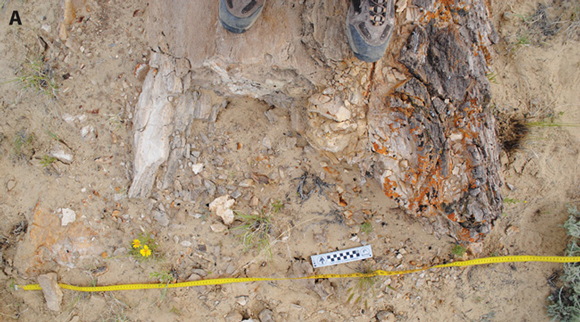
The most significant find is also the largest specimen, a giant, petrified log that was approximately 1.8 metres in diameter and around 11 metres in length.  The researchers conclude that the log represents part of the trunk of a tree that may have been over 50 metres in height, making this Cretaceous giant, roughly the same height as Nelson’s Column in Trafalgar Square, London.

Part of the Giant Angiosperm Log – The Field Team Member’s Boots Provide a Handy Scale

Giant Angiosperm tree fossil.
Giant fossil log from the Late Cretaceous (Paraphyllanthoxylon).

Picture credit: Science Advances

Assigned to the Paraphyllanthoxylon Genus

The log was very probably transported some distance via the river before finally being deposited on the delta, where it became preserved as a fossil.  It is the largest known pre-Campanian angiosperm and the earliest documented occurrence of a flowering tree more than one metre in diameter.  Leaf fossils and fossilised spore samples indicate a wide range of flora within the locality.  This ancient giant probably formed part of a forest canopy, beneath which, conifers, ginkgo trees and ferns along with other flowering plants thrived.  The fossil has been assigned to the  Paraphyllanthoxylon genus, as such, it is distantly related to numerous types of tropical flowering tree found today.

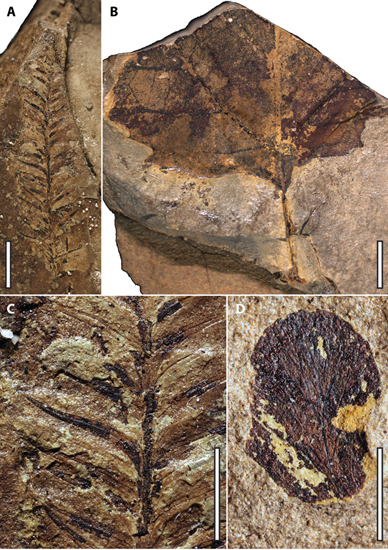
A Variety of Plant Fossils Have Been Found

Plant fossils (Ferron sandstone) Utah.
Various plant fossils have been found indicating a mixed woodland habitat.

Picture credit: Science Advances/N. A. Jud, University of Florida

Plant Fossils

Several other plant fossils have been found from rocks associated with the Ferron sandstones, these fossils indicate the presence of a mixed woodland habitat.

The photograph (above) shows different types of fossil plant associated with the strata – (A) a leafy shoot identified as Elatides curvivolia (conifer), (B) the broad leaf of an indeterminate angiosperm, (C) shows a close up of the E. curvivolia fossil.  Picture (D) shows an isolated fern pinnule.

Scale bars:

(A to C) = 5 mm

(D) = 3 mm

The Vertebrate Fossil Assemblage

Although only a few vertebrate fossils have been found, they hint at a rich and diverse biota.  Fossils of therizinosaurs are known from Utah (Nothronychus spp.) and a partial, indeterminate, poorly preserved  ornithopod sacrum was discovered along with isolated shark and crocodile teeth and a fragment from a turtle’s shell.

The rocks record life during the Turonian faunal stage of the Late Cretaceous.  Few Turonian-aged deposits are known from North America, it is known that there were exceedingly diverse regional faunas during the later Campanian and Maastrichtian faunal stages and it is hoped that by studying fossils from earlier, some insight into how these diverse communities came about could be gleaned from the information.  This newly described fossil assemblage from Utah will help to fill the gap in our knowledge of early Late Cretaceous terrestrial communities in North America.

Examples of Vertebrate Fossils from the Ferron Sandstone Member

Vertebrates of the Turonian faunal stage.
Examples of vertebrate fossils from the Ferron sandstone deposits of Utah.

Picture credit: Science Advances/S. A. Williams, Burpee Museum of Natural History

The picture above shows (A), views of an isolated shark tooth assigned to Cretodus crassidens, a common lamniform shark known from Turonian Western Interior Seaway deposits.  Figure (B) shows isolated crocodylian teeth and (C) shows a large turtle scute.  Picture (D) shows various views of the poorly-preserved ornithopod sacrum that was also found.

The scientific paper: “A New Fossil Assemblage Shows that Large Angiosperm Trees Grew in North America by the Turonian (Late Cretaceous)” by Nathan A. Jud, Michael D. D’Emic, Scott A. Williams, Josh C. Mathews, Katie M. Tremaine and Janok Bhattacharya and published in the open-access journal Science Advances.

Visit the Everything Dinosaur website: Everything Dinosaur.

Go to Top