All about dinosaurs, fossils and prehistoric animals by Everything Dinosaur team members.

Pictures of fossils, fossil hunting trips, fossil sites and photographs relating to fossil hunting and fossil finds.

13 05, 2019

New Triassic Marine Phytosaur Described

By |2023-12-17T17:56:14+00:00May 13th, 2019|Categories: Dinosaur and Prehistoric Animal News Stories, Dinosaur Fans, Main Page, Photos/Pictures of Fossils|0 Comments

Austrian Phytosaur Fossils Point to Phytosaurs in Marine Environments

Look at most books that feature an illustration of the fauna of the Triassic and it is likely that squeezed into the colourful but so spurious illustration of early dinosaurs, beaked rhynchosaurs and cynodonts all going about their business but effectively ignoring each other, you will spot a phytosaur.  Phytosaurs, the long-snouted, semi-aquatic carnivores that resembled crocodiles but were certainly not crocodilian, were widely distributed during the Triassic.  However, very little evidence had emerged that linked these predators with marine ecosystems.

It had been thought phytosaurs were confirmed to freshwater or brackish environments.  The publication of a new scientific paper, reporting on the discovery of the remains of at least four individuals from an ancient lagoon, represents the best evidence yet that these formidable predators also inhabited the sea.

Phytosaurs in Marine Ecosystems
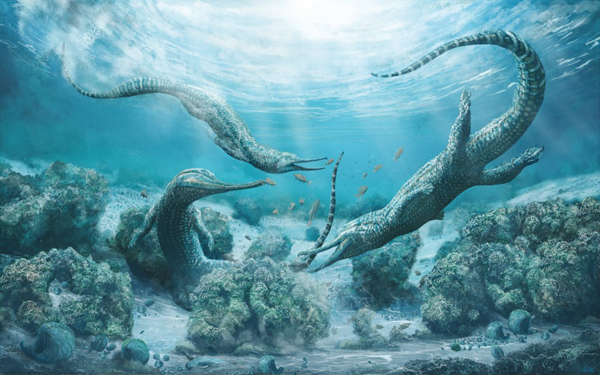
Mystriosuchus steinbergeri life reconstruction.
A newly described species of Austrian phytosaur provides evidence of a marine existence.  Mystriosuchus steinbergeri life reconstruction.

Picture credit: Mark Witton (© 2019 The Linnean Society of London, Zoological Journal of the Linnean Society)

Mystriosuchus steinbergeri

Although the fossil remains were laid down in a coastal, lagoonal environment, these days, thanks to plate tectonics, the quarry site is two kilometres above sea level in a remote part of the Austrian Alps.  The fossils were found in 1980 by Sepp Steinberger, a member of a local caving club.  The species name (Mystriosuchus steinbergeri), was erected in his honour.  One of the reasons cited for the amount of time it has taken to fully study these fossils is that despite the relative abundance of phytosaur fossils compared to other Triassic vertebrates, there are not that many vertebrate palaeontologists that specialise in studying the Phytosauria.

Phylogenetic analysis positions this newly described species as the sister taxon to a clade comprising Mystriosuchus planirostris and Mystriosuchus westphali.  A study of the fossil bones indicates that the Austrian phytosaur specimens represent individuals that were at least eight years of age at the time of their death.  The palaeoenvironmental data recovered suggests that these archosaurian reptiles were living in a marine lagoon.  This provides strong evidence to support the idea that some phytosaurs may have adapted to living in saltwater as well as freshwater environments.

A Classic Triassic Diorama Depicting a Phytosaur
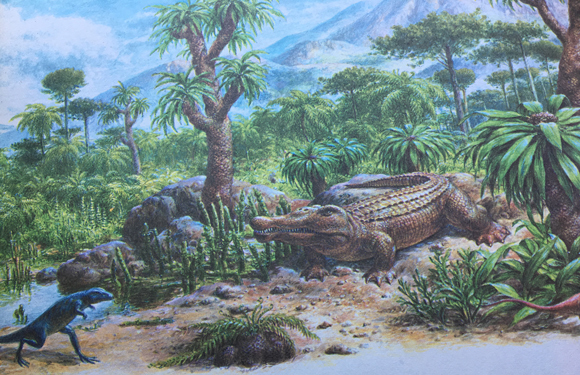
A phytosaur in a Triassic diorama.
A beautifully painted Triassic scene (Rudolph Zallinger).  A newly published scientific paper provides strong evidence for marine adaptations in the Phytosauria.

Picture credit: Rudolph Zallinger

How Did They Die?

Everything Dinosaur contacted one of the authors of the scientific paper, Richard Butler (School of Geography, Earth and Environmental Sciences, University of Birmingham), enquiring about the discovery of four individuals, all roughly the same age and the same size (approximately 4 metres in length), being found together.

Professor Butler commented:

“As to how these animals died and were buried together, your guess is as good as mine!  It’s a puzzle, and I don’t have an answer.  However, I think it’s very unlikely that they died together on land and were somehow washed out tens of kilometres and buried together.  I think it’s more likely that they were living in the lagoon and died near to where they were buried.  Interestingly, the fact that there are multiple individuals all of a similar size might suggest some social/group behaviour, although again it’s quite speculative.”

When asked to put into context the significance of this evidence supporting the idea of some members of the Phytosauria adapting to marine environments, Professor Butler explained that there have been a handful of occurrences of the species Mystriosuchus planirostris recorded in marine sediments in northern Italy, and the basal phytosaur Diandongosuchus was also found in a marine deposit.

Associated with Marine Deposits

These fossil discoveries have led to speculation that both these species were possibly marine animals.  However, they’ve all been isolated specimens, and in the northern Italian sequences, for example, there is evidence to indicate that fully terrestrial animals had been washed into these marine deposits.  So, in the case of these fossils,  it is plausible that rather than being examples of marine phytosaurs, these are terrestrial phytosaurs that died on land and were washed out to sea.

The Austrian phytosaur material ascribed to Mystriosuchus steinbergeri might not be the first evidence found to support a marine environment hypothesis but it does probably represent the strongest evidence found to date.

The professor concluded that if he and his fellow authors are correct, then the phytosaurs represent yet another group of tetrapods that independently invaded marine environments.

The scientific paper: “Description and Phylogenetic Placement of a New Marine Species of Phytosaur (Archosauriformes: Phytosauria) from the Late Triassic of Austria” by Richard J Butler, Andrew S Jones, Eric Buffetaut, Gerhard W Mandl, Torsten M Scheyer and Ortwin Schultz published in the Zoological Journal of the Linnean Society.

Visit the Everything Dinosaur website: Everything Dinosaur.
8 05, 2019

A New Jurassic Scansoriopterygid Dinosaur – Ambopteryx

By |2023-12-13T08:10:40+00:00May 8th, 2019|Categories: Dinosaur and Prehistoric Animal News Stories, Dinosaur Fans, Main Page, Palaeontological articles, Photos/Pictures of Fossils|0 Comments

Ambopteryx longibrachium – A New Bat-winged Dinosaur

Scientists from the Institute of Vertebrate Paleontology and Paleoanthropology (IVPP), have identified a new species of flying dinosaur from Jurassic-aged strata in north-eastern China.  This dinosaur has been identified as a member of the Scansoriopterygidae dinosaur family and it had bat-like, membranous wings just like the related Yi qi, that was named and described back in 2015.  The little dinosaur, not much bigger than a starling, had a flap of skin from its arms to its torso, in essence a wing.  It has been named Ambopteryx longibrachium and this discovery supports the idea that within the forests of northern China during the Middle to the Late Jurassic, dinosaurs were experimenting with several different methods of gliding and powered flight.

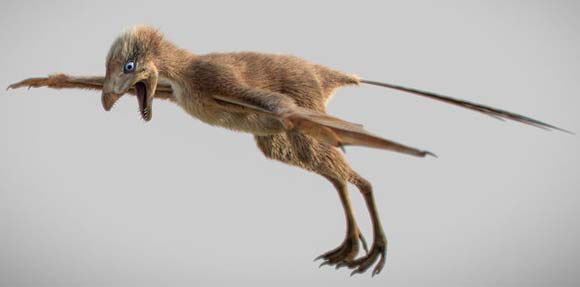
A Life Reconstruction of the Newly Described Scansoriopterygid Dinosaur Ambopteryx longibrachium

Ambopteryx longibrachium life reconstruction.
A life illustration of Ambopteryx longibrachium.

Picture credit: IVPP (Chinese Academy of Sciences)

Ambopteryx longibrachium – Bizarre and Buck-toothed Little Flying Dinosaur

The fossil specimen was found by a local farmer who supplements his income like many folk in Liaoning Province by searching for fossils in the fine-grained sediments.  It is beautifully preserved and dates to around 163 million years ago, commenting on the discovery, one of the co-authors of the scientific paper, published this week in the journal “Nature”, Jingmai O’Connor of the IVPP stated:

“It would have been this tiny, bizarre-looking, buck-toothed thing like nothing alive today.”

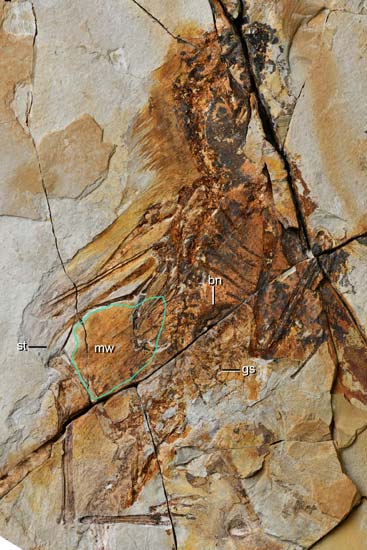
The Beautifully Preserved Fossil Specimen (Ambopteryx longibrachium)

Ambopteryx fossil specimen.
Ambopteryx longibrachium fossil.

Picture credit: Min Wang IVPP (Chinese Academy of Sciences)

A Secondary Form of Flight That Does Not Involve Feathers

Close to the origins of flight, dinosaurs closely related to birds were experimenting with a range of different wing structures.  One of the most bizarre of these is the scansoriopterygid named Yi qi, (pronounced: Ee-chee), which was described and named in 2015.  This little dinosaur had membranous wings, supported by a curved, rod-like bone (styliform), attached to the wrist.

Soft tissue proximal to the arm bones was interpreted as bat-like wings, although this interpretation was not widely accepted by the scientific community.  However, the discovery of another type of scansoriopterygid dinosaur with the same type of wings demonstrates that members of the Scansoriopterygidae were indeed taking to the air.

The new dinosaur, Ambopteryx longibrachium (meaning “both-wing” and “long arm,” a reference to this second method of dinosaur flight, one that does not involve feathered wings), provides confirmatory evidence of the evolution of dinosaurs with bat-like, membranous wings.

Palaeontologist Steve Brusatte, (University of Edinburgh), when asked to reflect on the significance of this newly published scientific paper commented:

“This fossil seals the deal, there really were bat-winged dinosaurs.”

Ambopteryx longibrachium – Takes to the Air

A gliding Ambopteryx longibrachium (dorsal view).
Ambopteryx longibrachium (dorsal view).  The speculated flying pose of this new Chinese dinosaur.

Picture credit: Min Wang IVPP (Chinese Academy of Sciences)

An Evolutionary Dead End

The researchers conclude that marked changes in wing design evolved near the split between the Scansoriopterygidae and the avian lineage, the two clades took very different routes to becoming volant.  Furthermore, the scientists determine that the membranous wings supported by elongate forelimbs present in scansoriopterygids such as Yi and Ambopteryx was a short-lived evolutionary experiment and that the feathered, winged dinosaurs ultimately proved to be the more successful leading to the eventual evolution of the Aves.

The likes of Yi qi and Ambopteryx longibrachium were evolutionary dead ends.  Whether Ambopteryx was capable of sustained powered flight, or whether it moved from tree to tree entirely by passive gliding remains unknown.

Coming in to Land – Ambopteryx longibrachium

At home amongst the trees Ambopteryx longibrachium.
Coming into land, a gliding Ambopteryx moving effortlessly from tree to tree.

Video Image credit: Min Wang IVPP (Chinese Academy of Sciences)

Stomach Contents Preserved

The stomach contents of the little dinosaur have been preserved.  The Chinese scientists recovered pieces of bone and small stones (gastroliths), which modern birds use to grind plant material, indicating Ambopteryx may have been omnivorous.  It may have lacked pinnate feathers, but the body was covered by a downy fuzz to help this small dinosaur keep warm.  Jingmai O’Connor speculates that male Ambopteryx may have sported long, ornamental tail feathers, as seen in other scansoriopterygids such as Epidexipteryx (E. hui).

The scientific paper examines the anatomical traits that enabled a mode of flight.  The wings of Ambopteryx were formed by elongated arm bones (humerus and ulna).  Aves (birds), have elongated finger bones (metacarpals), in effect, different solutions found in nature to achieve the same aim – volant activity.

Professor O’Connor added:

“The main lift-generating surface of bird’s wings is formed by the feathers.  In bats, pterosaurs and now scansoriopterygids, you have instead flaps of skin that are stretched out in between skeletal elements.”

Yi qi was Not Alone

It seems likely therefore, that with the discovery of a second bat-winged scansoriopterygid, there may be numerous other fossils of bizarre dinosaurs that were adapted to a life in the trees awaiting discovery in Liaoning Province.

It now seems that flight evolved more than once in the Dinosauria, Yi qi was not alone and the scientific community will provide further insight in the near future with regards to the remarkable and arguably the strangest of all the dinosaurs the Scansoriopterygidae.  Such research might be hindered by the small body-size of these creatures, the Ambopteryx specimen represents a sub-adult animal, it would have measured in life around 32 cm in length and weighed just a few hundred grammes.

Epidexipteryx and Yi qi were also small, E. hui has been estimated to have measured 30 cm long and weighed less than 200 grammes, whilst Yi qi is estimated to have had a wingspan of less than 60 cm and it would have been not much heavier.  The fact that any specimens of these tiny arboreal dinosaurs have survived at all is remarkable in itself.

A spokesperson from Everything Dinosaur commented:

“Much of our knowledge about these tree-dwelling dinosaurs has been derived from fossils discovered in the last twelve years or so.  Our blog was started back in 2007 and over the course of the life of our blog we have charted the rise in the knowledge and awareness surrounding the curious Scansoriopterygidae.  There has even been a model of scansoriopterygid produced by a mainstream manufacturer.  PNSO introduced a model of Yi qi this year.  Who knows what other remarkable dinosaurs are awaiting discovery?”

The PNSO Yi qi Dinosaur Model

Yi qi dinosaur model (PNSO).
PNSO Yi qi dinosaur model.

To read about the discovery of Epidexipteryx: Is it a Bird? Is it a Plane? No, it’s Epidexipteryx!

To read about the discovery of Yi qiYi qi The Dinosaur that Thought it was a Bat.

To view the Yi qi dinosaur model and the other figures in the PNSO model range: PNSO Age of Dinosaurs.

6 05, 2019

Suskityrannus – A New, Early Late Cretaceous Tyrannosauroid

By |2023-12-05T11:26:40+00:00May 6th, 2019|Categories: Dinosaur and Prehistoric Animal News Stories, Dinosaur Fans, Main Page, Palaeontological articles, Photos/Pictures of Fossils|0 Comments

Suskityrannus hazelae – The Shape of Things To Come

The first of what will probably turn out to be numerous new theropod dinosaurs from southern Laramidia has been announced today.  Writing in the academic journal “Nature: Ecology & Evolution”, a team of international scientists have described a new species of relatively small-bodied tyrannosauroid that helps to fill a gap in the evolution of the tyrannosaur family.  Significantly, the new dinosaur, named Suskityrannus hazelae, has the same general body shape and feet adapted to running (arctometatarsalian feet), as the later, much larger tyrannosaurs such as Albertosaurus, Gorgosaurus and T. rex.  This suggests that tyrannosaurs evolved many of their characteristic features whilst they were relatively small, secondary predators.

When Suskityrannus roamed western North America some 92 million years ago (Middle Turonian faunal stage), this little theropod was the shape of things to come.

A Life Reconstruction of Suskityrannus hazelae

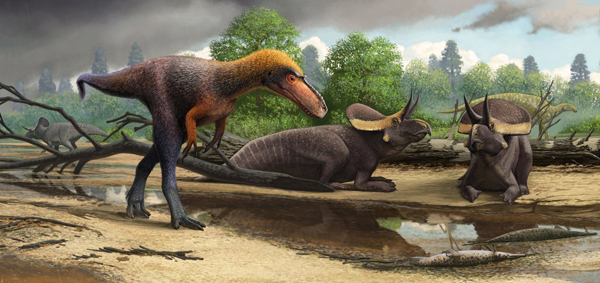
Suskityrannus hazelae life reconstruction.
The newly described Suskityrannus walks past two unconcerned Zuniceratops.

Picture credit: Andrey Atuchin

The Moreno Hill Dinosaur Assemblage

Suskityrannus heralds from the Zuni Basin of New Mexico, specifically the Moreno Hill Formation and it has been described based on two associated but fragmentary skeletons.  Even so, these fossils represent the most complete examples of early Late Cretaceous tryannosauroids described to date.

Dinosaur fossils from the Turonian faunal stage are exceptionally rare, the fossils from the Moreno Hill Formation have provided palaeontologists with an insight into the types of dinosaur that were the forerunners of the key groups of dinosaur that were to dominate the terrestrial ecosystems of North America towards the end of the Cretaceous.

For example, the beautiful life reconstruction of Suskityrannus by Andrey Atuchin (above),  shows a three-metre long theropod about to feed on some garfish that have become stranded as a result of a flood.  The pair of Zuniceratops are unconcerned about the proximity of the meat-eater, they are many times heavier and have nothing to fear from the fleet-footed tyrannosauroid.  In the background, to the right of the image a large ornithopod dinosaur can be seen, we think this is probably a life reconstruction of the basal hadrosauroid Jeyawati.

In essence, that is what makes the dinosaurs from the Moreno Hill Formation so significant.  These sediments were laid down before the diversification of the tyrannosaurids, hardrosaurids and ceratopsids, all key components in later Cretaceous dinosaur assemblages from North America.

A Powerful Bite

Named Suskityrannus hazelae, (pronounced Sus-key-tie-ran-us haze-ah-lie), analysis of the jaw bone indicates that this dinosaur had an elongated skull measuring between 25 and 32 cm in length.  Despite its small size, less than 3 metres long, with a hip height of around 1 metre, Suskityrannus had a powerful bite, foretelling the evolutionary direction of later tyrannosaurs which were to evolve massive skulls with bone crushing bite forces.

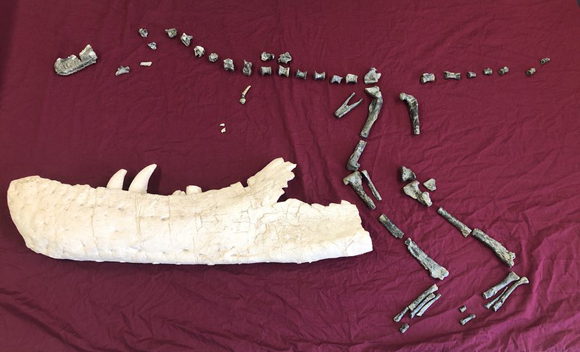
The Fossil Skeleton of S. hazelae Compared to the Dentary (Lower Jaw) of Tyrannosaurus rex

Suskityrannus compared to the jaw bone of a T. rex.
The fossil remains of Suskityrannus compared to a lower jaw from a Tyrannosaurus rex.

Picture credit: Virginia Tech

It is thought that the skeletal fossil material associated with Suskityrannus represent juveniles.

Suskityrannus hazelae What’s in a Name?

The name Suskityrannus hazelae is derived from “Suski,” the Zuni Native American tribe word for “coyote,” reflecting this tyrannosauroid’s position in the ecosystem as a secondary predator.  The species name honours Hazel Wolfe whose support made possible many expeditions to the Zuni Basin of New Mexico.

The first evidence, including a partial skull was found in 1997 by co-author Robert Denton (GeoConcepts Engineering).  The second, more complete specimen was found in 1998 by Sterling Nesbitt, a high school student at the time, but now based at the Department of GeoSciences (Virginia Tech).  Dr Nesbitt is the corresponding author for the scientific paper.  The fossils were housed at the Arizona Museum of Natural History for many years before they were formally studied.

Co-author, Steve Brusatte (School of GeoSciences, University of Edinburgh) commented:

“Suskityrannus is a key link between the enormous bone-crunching dinosaurs like T. rex and the smaller species they evolved from.  The new species shows that tyrannosaurs developed many of their signature features like a muscular skull, broad mouth, and a shock-absorbing foot when they were still small, maybe as adaptations for living in the shadows.”

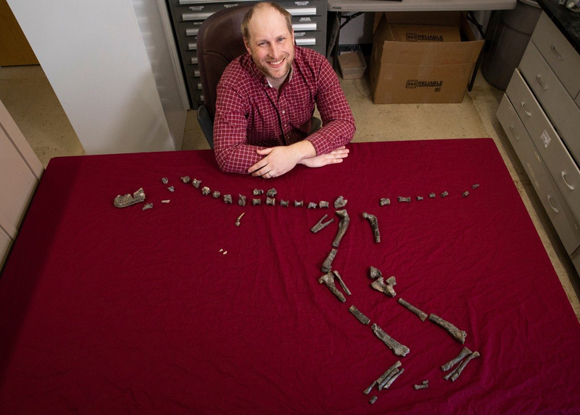
Dr Sterling Nesbitt and Suskityrannus hazelae

Co-author Sterling Nesbitt and fossil remains of Suskityrannus.
Corresponding author Sterling Nesbitt, with the fossilised remains of Suskityrannus laid out in their anatomical position.

Picture credit: Virginia Tech

The Moreno Hill and the Bissekty Formations

The Moreno Hill Formation is analogous to the Bissekty Formation of Uzbekistan.  Within the Northern Hemisphere, dinosaur fossils from the Turonian faunal stage are exceptionally rare, although thousands of miles apart, the strata are approximately the same age (around 90 million-years-old) and the dinosaur specimens found provide evidence of similar faunas.

The tyrannosauroid Timurlengia was named and described from fragmentary remains from the Bissekty Formation in 2016, the publication of a scientific paper on Suskityrannus will help palaeontologists to better understand how relatively small-bodied tyrannosauroids evolved into giant apex predators some twenty million years later.

To read about the discover of Timurlengia: Fossil Study Suggests How Tyrannosaurs Got Big.

How Big Were the Arms of Suskityrannus?

As for that other famous Late Cretaceous tyrannosaur body trait, the much reduced arms, scientists are very much in the dark about how big the forelimbs of Suskityrannus were.  Very little forelimb fossil material has been recovered.  Scientists can’t even say with any certainty whether Suskityrannus had two-fingered or three-fingered hands.  Cross-sectional analysis of slices of bone indicate that both known specimens were juveniles.

The fossils are providing further information on tyrannosauroid ontogeny.  Despite not being fully-grown, the authors are confident that Suskityrannus was not as big as its descendants, the famous apex predators of the Campanian and Maastrichtian faunal stages of the Cretaceous.

Commenting on the discovery a spokesperson from Everything Dinosaur stated:

“When we made our palaeontology predictions for 2019, the last prediction we made was that more tyrannosaurids would be named and described from fossil material associated with southern Laramidia.  We suggested that two new species would be named.  Suskityrannus hazelae has helped us to confirm our prediction made earlier this year, at least in part.  We are expecting more theropod news to come out of the southern United States over the next few months.  These are exciting times for anyone studying the Tyrannosauroidea.”

To read about the discovery of a tyrannosauroid from central Utah that lived approximately four million years before Suskityrannus: Fleet-footed Dinosaur Leaps 70-million-year Gap.

For a model of Suskityrannus, (whilst stocks last): Beasts of the Mesozoic Models.

1 05, 2019

Denisovans Lived on the “Roof of the World”

By |2023-12-06T07:25:08+00:00May 1st, 2019|Categories: Dinosaur and Prehistoric Animal News Stories, Main Page, Palaeontological articles, Photos/Pictures of Fossils|0 Comments

Jaw Fossil Indicates Denisovans Occupied the Tibetan Plateau

Denisovans, occupied the Tibetan Plateau long before Homo sapiens arrived in the region.  Furthermore, the ability to cope with less oxygen at high altitudes may have been passed onto our species when ancient members of Homo sapiens, bred with Denisovans.  The analysis of a fragmentary lower jaw bone reveals the presence of Denisovans at least 160,000 years ago at the Baishiya Karst Cave complex in Xiahe, China.

The ability to survive in such extreme climates had been thought to be a unique trait of H. sapiens, that is now not the case and what is more, the enigmatic and poorly known Denisovans seem to have passed on a gene that helps modern people cope with living at high elevations.

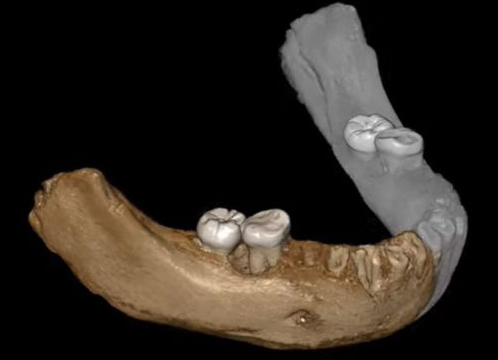
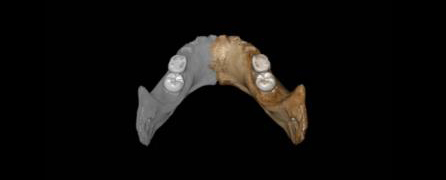
A Digital Reconstruction of the Fossil Mandible

A digital reconstruction of the Xiahe mandible identified as Denisovan.
View of the virtual reconstruction of the Xiahe mandible after digital removal of the adhering carbonate crust.  The mandible is so well preserved that it allows for a virtual reconstruction of the two sides of the mandible.  Mirrored parts are in grey.

Picture credit: Jean-Jacques Hublin (MPI-EVA)

The Enigmatic Denisovan People

The study, undertaken by a team of international researchers including Shara Bailey (New York University), as well as scientists from the Institute of Tibetan Plateau Research, the Chinese Academy of Sciences, Lanzhou University, and the Max Planck Institute for Evolutionary Anthropology, has been published in the journal “Nature”.

Using a technique known as ancient protein analysis, the researchers found that the mandible’s (lower jaw) owner belonged to a Denisovan population from Siberia.  This population occupied the Tibetan Plateau, regarded as the “Roof of the World” because it rises three miles (five kilometres), above sea level.  This suggests that the enigmatic Denisovans were adapted to a low oxygen environment.

In contrast, evidence of Neanderthals is rarely found above 2,000 metres and what evidence there is, probably indicates that Homo neanderthalensis populations only occasionally climbed to such heights, perhaps for the purpose of a special hunt or ceremony.  They do not seem to have persisted at high altitude.

The research team state that Denisovans had already adapted to living in this high-altitude setting significantly prior to the appearance of Homo sapiens.  Previous genetic studies found present-day Himalayan populations carry the EPAS1 allele in their genome, passed on to them by Denisovans, which helps with adaptation to their specific and demanding environment.

A Posterior View of the Fossil Mandible

Digital reconstruction of the Denisovan jaw bone from China.
Digital reconstruction of the Denisovan jaw bone.  Reconstructed area is shaded grey.

Picture credit: Jean-Jacques Hublin (MPI-EVA)

Who Were the Denisovans?

Denisovans are members of a hominin group currently only known directly from fragmentary fossils, the genomes of which have been studied from a single site, Denisova Cave in Siberia.  They are also known indirectly from their genetic legacy through gene flow into several low-altitude East Asian populations and high-altitude modern Tibetans.  The presence of a new species of ancient human was confirmed when a research team led by Svante Pääbo from the Max Planck Institute for Evolutionary Anthropology (MPI-EVA), conducted a genetic study on a single fossil finger bone from the Denisova Cave site.

To read an article from 2010 that summarises the Max Planck Institute for Evolutionary Anthropology research: Finger Bone Hints at New Species of Hominin.

Commenting on the significance of linking a fossil to the Tibetan Plateau, one of the paper’s co-authors Jean-Jacques Hublin (MPI-EVA), stated:

“Traces of Denisovan DNA are found in present-day Asian, Australian, and Melanesian populations, suggesting that these ancient hominins may have once been widespread.  Yet, so far, the only fossils representing this ancient hominin group were identified at the Denisova Cave.”

Indeed, Everything Dinosaur published a report back in 2016 that linked the Inuit people of the Arctic to a Denisovan ancestry: Extinct Human Cousin Helped the Inuit Survive.

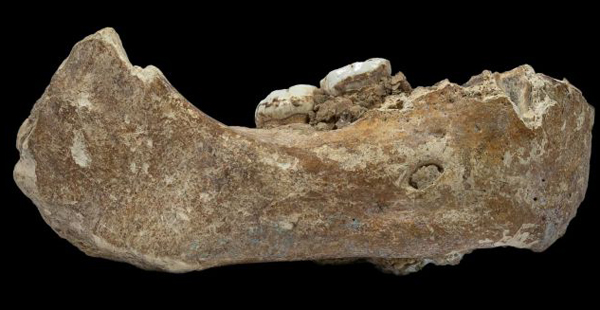
A Photograph of the Actual Fossil Jaw Bone (Lateral View)

Denisovan fossil jaw bone ( Baishiya Karst Cave).
Xiahe Denisovan jaw bone from the Baishiya Karst Cave (Gansu Province, China).

Picture credit: Dongju Zhang (Lanzhou University)

Discovered by a Monk

In this newly published paper, the researchers describe a hominin lower mandible that was found on the Tibetan Plateau in the Baishiya Karst Cave in Xiahe, Gansu Province, China.  The fossil was originally discovered in 1980 by a local monk who donated it to the 6th Gung-Thang Living Buddha who then passed it on to Lanzhou University.

Since 2010, researchers Fahu Chen and Dongju Zhang from Lanzhou University have been studying the cave site from where the mandible originated in a bid to find more human remains.  In 2016, a collaboration began with the Department of Human Evolution at the Max Planck Institute for Evolutionary Anthropology and although no DNA has been recovered, the team did manage to extract proteins from one of the large molars within the jaw.  These proteins were then categorised using a technique called ancient protein analysis.

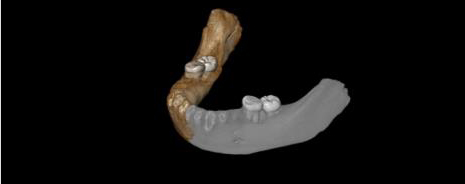
The Reconstructed Denisovan Jaw Bone

Denisovan jaw bone identified on the Tibetan Plateau (digital reconstruction).
A view of the Denisovan jaw bone from China. The grey area represents reconstructed elements.

Picture credit: Jean-Jacques Hublin (MPI-EVA)

Piecing Together the Face of a Denisovan

The fossil record of the Denisovans is particularly sparse, it is limited to just some teeth and part of a finger.  This is the first fossil of its kind to be found and perhaps, if more Denisovan fossils can be discovered, then it hints at the possibility that anthropologists might be able to reconstruct the skull.

Co-author Shara Bailey explained:

“Although we still do not know the shape and size of the Denisovan skull, now with a lower jaw we can start to piece together the puzzle of what they actually looked like”.

Everything Dinosaur acknowledges the assistance of a press release from New York University in the compilation of this article.

Visit the Everything Dinosaur website: Everything Dinosaur.
29 04, 2019

New Study of Cretaceous Crabs Ruffles Feathers

By |2023-12-05T09:59:45+00:00April 29th, 2019|Categories: Dinosaur and Prehistoric Animal News Stories, Main Page, Palaeontological articles, Photos/Pictures of Fossils|0 Comments

Callichimaera perplexa et al Challenging the Definition of a Crab

An international team of scientists reported the discovery of a variety of Late Cretaceous marine crustacea that have challenged the current definitions of what makes a crab.  It is a case of a Cretaceous crab ruffling a few scientific feathers.

Writing in the academic journal “Science Advances”, the researchers from the University of Alberta, Kent State University, the University of Montreal, the Smithsonian Tropical Research Institute in Panama, the Canadian Parks and Wilderness Society, the National Autonomous University of Mexico, the University of Nevada, and the College of Communication and Design in Boca Raton, Florida, as well as Yale University , describe the discovery of hundreds of beautifully-preserved specimens from the USA and Colombia.

A Life Reconstruction of the Cretaceous Crab  Callichimaera perplexa

Callichimaera perplexa life reconstruction.
A life reconstruction of Callichimaera perplexa.

Picture credit: Elissa Martin, (Yale Peabody Museum of Natural History)

The preserved remains include hundreds of tiny shrimp fossils and an entirely new branch of the evolutionary tree for crabs (Order Decapoda).

A Very “Goofy-looking” Crab – Callichimaera perplexa

According to lead researcher, Yale University palaeontologist Javier Luque, the most significant fossil discovery is Callichimaera perplexa, which at around 95-million-years-old, is the earliest example of a swimming arthropod with paddle-like legs since the eurypterids (sea scorpions), that are believed to have died out in the Permian.  The genus name derives from the mythical creature called a chimera, which was formed from the body parts of a variety of different animals.  In a press release from Yale University, it is stated that the binomial scientific name translates as “perplexing beautiful chimera.”

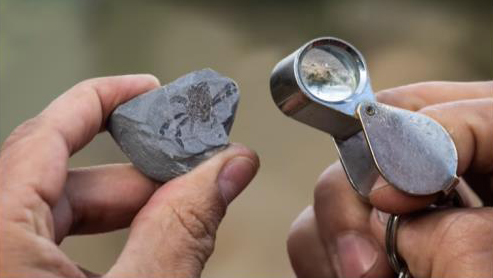
Examining a Fossil Specimen (Callichimaera perplexa)

Callichimaera perplexa fossil specimen.
Examining a Callichimaera perplexa fossil.

Picture credit: Yale University

A Unique and Very Strange Cretaceous Nektonic Crab

Measuring around 2-3 centimetres in diameter, Callichimaera is described as looking very strange with large, unprotected compound eyes with no sockets, bent claws, leg-like mouth parts, a long body and an exposed tail.  It was nektonic (an active swimmer), as an adult it resembled typical crab larval stages.  This suggests that some ancient crabs may have retained a few of their larval traits into adulthood, amplified them, and developed a new body architecture.  This is an evolutionary process called “heterochrony” – a change to the timing or rate of development relative to the ancestor.

The Diverse Body Plans of Swimming Crabs and other Nektonic Arthropods

The huge variations in the Arthropoda body plan.
The diverse body plans of selected arthropods.

Picture credit: Yale University

Luque commented:

“Callichimaera perplexa is so unique and strange that it can be considered the platypus of the crab world.  It hints at how novel forms evolve and become so disparate through time.  Usually we think of crabs as big animals with broad carapaces, strong claws, small eyes in long eyestalks, and a small tail tucked under the body.  Well, Callichimaera defies all of these ‘crabby’ features and forces a re-think of our definition of what makes a crab a crab.”

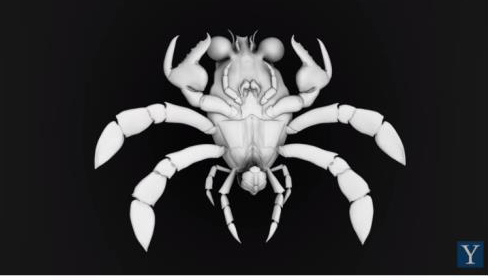
A Computer-generated Image Showing the Underside of Callichimaera perplexa

Digital reconstruction of Callichimaera (ventral view),
A view of the ventral side (underside of the body) of Callichimaera.

Picture credit: Yale University

The scientific paper: “Exceptional Preservation of mid-Cretaceous Marine Arthropods and the Evolution of Novel Forms via Heterochrony” by J. Luque1, R. M. Feldmann, O. Vernygora, C. E. Schweitzer, C. B. Cameron, K. A. Kerr, F. J. Vega, A. Duque, M. Strange, A. R. Palmer and C. Jaramillo published in the journal Science Advances.

Everything acknowledges the assistance of a press release from Yale University in the compilation of this article.

Visit the user-friendly, award-winning Everything Dinosaur website: Everything Dinosaur.

28 04, 2019

A New Hadrosauroid Dinosaur from Mongolia

By |2023-12-05T09:53:58+00:00April 28th, 2019|Categories: Dinosaur and Prehistoric Animal News Stories, Dinosaur Fans, Main Page, Photos/Pictures of Fossils|0 Comments

Gobihadros mongoliensis – A Newly Described Hadrosauroid from Mongolia

Scientists have described a new species of basal hadrosauroid from the Baynshire Formation of the central and eastern Gobi Desert (Mongolia).  It has been named Gobihadros mongoliensis.  At approximately three metres long, this cow-sized, ornithischian may not be the most impressive dinosaur to have been found, but its discovery is significant for vertebrate palaeontologists.  G. mongoliensis is the first non-hadrosaurid hadrosauroid from the Late Cretaceous of central Asia known from an almost complete, articulated skull and postcranial material.

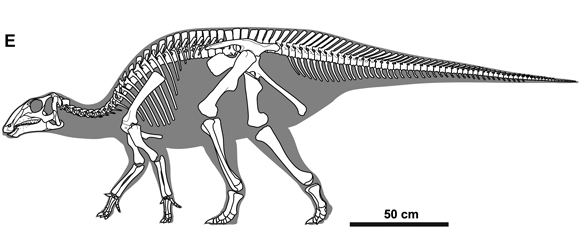
A Skeletal Reconstruction of Gobihadros mongoliensis

Gobihadros mongoliensis skeletal reconstruction.
A skeletal reconstruction of the basal hadrosauroid Gobihadros mongoliensis.

Picture credit: PLOS One

Writing in the on-line academic journal “PLOS One”, the researchers David Evans (Royal Ontario Museum, Ontario, Canada), Khishigjav Tsogtbaatar (Mongolian Academy of Sciences), David Weishampel (John Hopkins University, Maryland, USA) and Mahito Watabe (Osaka City University, Japan), have concluded that Gobihadros is similar to Bactrosaurus johnsoni from eastern China and Gilmoreosaurus mongoliensis from the Iren Nor region of Inner Mongolia.

Outside of the Hadrosauridae Family

A phylogenetic assessment places Gobihadros outside of the Hadrosauridae, the family of dinosaurs commonly referred to as the duck-billed dinosaurs.  Gobihadros most certainly had a broad beak, very typical of a duck-billed dinosaur, but it has been classified as a basal member of the Hadrosauroidea, essentially the next classification bracket up from the Hadrosauridae, encompassing all the duck-billed dinosaurs and all dinosaurs more closely related to them than to Iguanodon.

Views of the Skull and Jaw Bones of Gobihadros mongoliensis

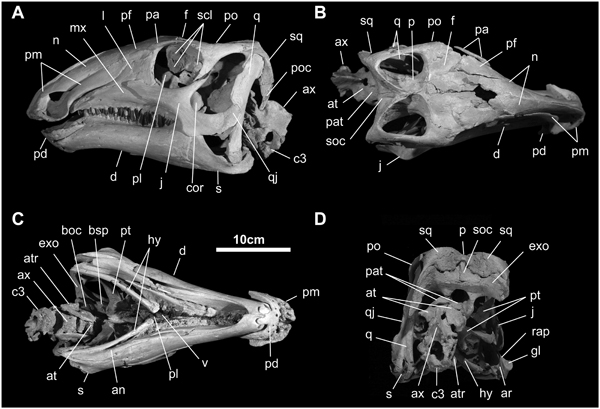
Views of the skull and mandible of Gobihadros mongoliensis.
Skull and mandible (MPC-D100/763) of Gobihadros mongoliensis in left lateral (A), dorsal (B), ventral (C), and posterior (D) views.

Picture credit: PLOS One

Gobihadros mongoliensis from the Baynshire Formation

The fossil material was collected over a period of several years from the sandstone and mudstone deposits from a number of sites associated with the Baynshire Formation.  The dinosaur was described from two superbly preserved specimens, a complete and uncrushed skull (MPC-D100/763) and the holotype, which consists of an almost complete skull and postcranial skeleton found largely in an articulated state.  Although, the exact date of the Baynshire Formation remains open to debate, recent studies place the sediments in the early Late Cretaceous (Cenomanian-Santonian faunal stages).

Line Drawings of the Skull and Jaws of G. mongoliensis

Line drawings of the skull of Gobihadros mongoliensis.
Skull (MPC-D100/763) of Gobihadros mongoliensis in left lateral (A), anterior (B), dorsal (C), and posterior (D) views.

Picture credit: PLOS One

Helping Scientists to Understand an Evolutionary Transition

The exquisite nature of the fossil preservation and its completeness has provided palaeontologists with one of the most detailed anatomical records of a hadrosauroid.  New information has been compiled documenting the evolutionary transition of the Hadrosauroidea towards the Hadrosauridae.  In addition, comparison with the fossil remains of much younger hadrosaurids from the Late Cretaceous of Asia (Maastrichtian faunal stage), such as Saurolophus angustirostris, Kerberosaurus manakini, Wulagasaurus dongi and Kundurosaurus nagornyi suggests that later Asian hadrosaurids migrated into Asia from North America, rather than sharing a common Asian ancestor with Gobihadros mongoliensis.

The scientific paper: “A New Hadrosauroid (Dinosauria: Ornithopoda) from the Late Cretaceous Baynshire Formation of the Gobi Desert (Mongolia)” by Khishigjav Tsogtbaatar, David B. Weishampel, David C. Evans and Mahito Watabe published in PLOS One.

Visit the Everything Dinosaur website: Everything Dinosaur.
26 04, 2019

A New Abelisaurid from the Kem Kem Beds of Morocco

By |2023-12-05T09:42:52+00:00April 26th, 2019|Categories: Dinosaur and Prehistoric Animal News Stories, Dinosaur Fans, Main Page, Palaeontological articles, Photos/Pictures of Fossils|0 Comments

Just How Successful were the Abelisaurs in Africa?

A partial ilium collected from the famous Kem Kem Beds of eastern Morocco hints that those enigmatic abelisaurids may have been widely distributed (both geographically and temporally) in Africa.  Writing in the on-line academic journal “PLOS One” scientists including researchers from the University of Southampton, Muséum d’Histoire Naturelle de Marrakech (Morocco), the University of Debrecen (Hungary) and the Natural History Museum (Paris), report on a fragmentary ilium bone, collected in 2007 and sourced via the fossil dealer network that indicates that abelisaurids were present in Morocco around 100 million years ago.

This fossil find adds to the growing evidence to suggest that abelisaurids were the dominant predators in Africa in the Late Cretaceous.

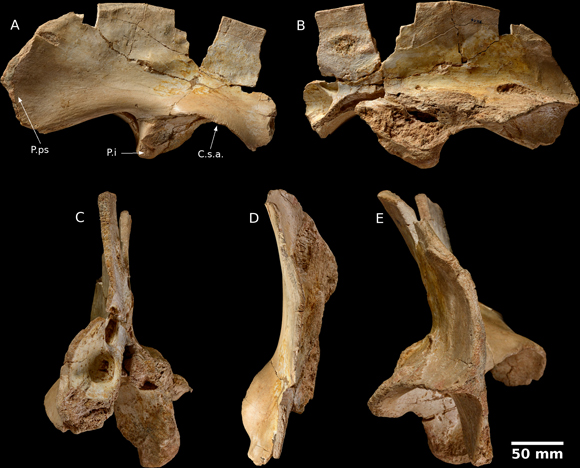
The Fragmentary Ilium – Abelisaurid Fossil Remains

Abelisaurid ilium (Kem Kem Beds - Morocco).
Views of the fragmentary right ilium bone, assigned to an indeterminate abelisaurid dinosaur.

Picture credit: PLOS One

Abelisaurid Fossil Specimen (MHNM KK 04)

The picture (above), shows various views of the ilium fossil.  The pieces have been prepared and assembled and now form part of the collection of the Natural History Museum of Marrakech.  The ilium is shown in (A) lateral view, (B) medial view, (C) anterior view, (D) dorsal view and posterior view (E).  In the photograph the scale bar is given as 50 mm, however, in the accompanying notes, the scale is reported as 10 cm, it is therefore difficult to estimate the size of the individual theropod without confirmation of the size of the fossils.

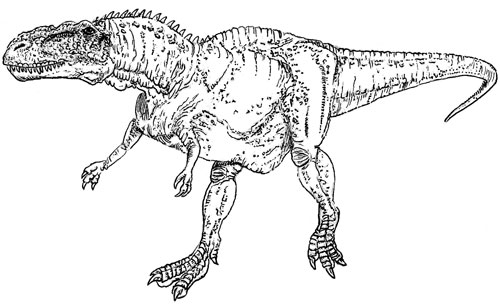
An Illustration of a Typical Theropod Dinosaur (Abelisauridae)

A drawing of a dinosaur (Abelisaurus).
A typical member of the Abelisauridae. Picture credit: Everything Dinosaur.

Picture credit: Everything Dinosaur

From the Aferdou Region of Morocco

The fossils are believed to come from the Aferdou region, near the locality of Gara Sbaâ (eastern Morocco), based on biostratigraphical analysis, the terrestrial sandstones in this region are thought to date from the Lower Cenomanian faunal stage of the Upper Cretaceous.  Dinosaur fossils from the Kem Kem Beds represent either theropods (most numerous), or sauropods.

In the research paper, the authors state that no ornithischian body fossils are known from the Kem Kem Beds.  However, most of the material is fragmentary, represents deposits that have been reworked and the thriving fossil trade is now playing a significant role in the local economy.  Commercial fossil hunters are affecting the quality of the research that can be carried out on the fossil bearing strata.

The scientists conclude that the ilium is likely to represent an abelisaurid, but no genera has been specified and no new species named.  Based on the shape of the bone, the specimen (MHNM KK04), is assigned to the clade Abelisauria.

Abelisaurid Apex Predators

This adds to the growing evidence to indicate that abelisaurids may have been the dominant land predators in Late Cretaceous Africa.  In 2017, Everything Dinosaur reported on the discovery of a fragment of jaw bone found in a Moroccan phosphate mine that led to the naming of a new species of abelisaurid – Chenanisaurus barbaricusC. barbaricus may belong to an as-yet undescribed family of abelisaurs unique to Africa and its fossils are around thirty million years younger than the ilium bone from the Aferdou region.

To read about Chenanisaurus barbaricusThe Last Dinosaur in Africa.

For an article that looks at why the Late Cretaceous of Africa might have been home to such a large number of predators: Why So Many Large Predators in Cretaceous Africa?

The scientific paper: “An abelisaurid (Dinosauria: Theropoda Ilium from the Upper Cretaceous (Cenomanian) of the Kem Kem Beds, Morocco” by Slimane Zitouni, Christian Laurent , Gareth Dyke and Nour-Eddine Jalil published in PLOS One.

Visit the Everything Dinosaur website: Visit Everything Dinosaur.

18 04, 2019

New Species of Giant Hyaenodont Bigger than a Polar Bear

By |2023-12-05T07:15:38+00:00April 18th, 2019|Categories: Dinosaur and Prehistoric Animal News Stories, Main Page, Palaeontological articles, Photos/Pictures of Fossils|0 Comments

Simbakubwa kutokaafrika – Giant African Hyaenodont

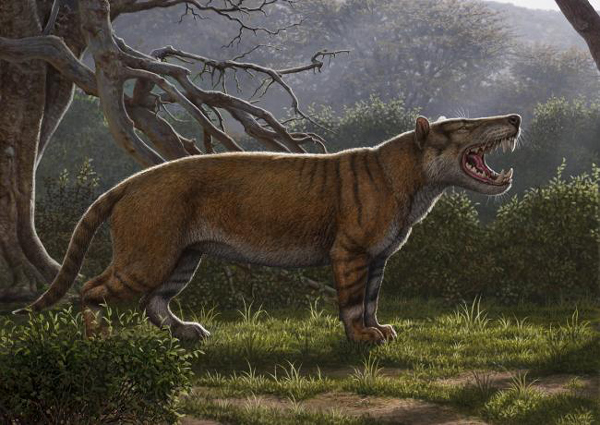
Scientists writing in the “Journal of Vertebrate Paleontology” have described a new species of giant hyaenodont from sub-Saharan Africa that was bigger than a polar bear.  The giant carnivore, most likely the apex predator in its Early Miocene ecosystem, has been named Simbakubwa kutokaafrika and this fearsome beast with its huge teeth is the stuff of nightmares.

A Life Reconstruction of the Newly Described Giant Hyaenodont Simbakubwa kutokaafrika

Simbakubwa kutokaafrika life reconstruction.
A life reconstruction of the newly described giant hyaenodont Simbakubwa kutokaafrika.

Picture credit: Mauricio Anton

Simbakubwa kutokaafrika – A Chance Discovery

Co-author of the scientific paper Matthew Borths (Duke University, North Carolina), was visiting the Nairobi National Museum in Kenya in 2013  to view some specimens.  He asked to view the contents of a collection labelled as “hyaenas” and he discovered a gigantic lower jaw bone more than forty centimetres in length.   The bones and teeth had been placed in a drawer after a dig in western Kenya in the late 1970s and had remained there ever since.

The genus name, Simbakubwa is from Swahili “simba” meaning “lion” and “kubwa” meaning “big”, big this animal certainly was, its body weight has been estimated at over 1,500 kilograms making S. kutokaafrika heavier than the largest land carnivore alive today, the polar bear (Ursus maritimus).  The species name kutokaafrika, is also from Swahili, it means “from Africa”.

The Lower Jaw of S. kutokaafrika Compared to the Jaw of a Modern Lion (Panthero leo)

Simbakubwa jaw compared to the jaw of a lion.
Simbakubwa kutokaafrika mandible, with Panthera leo mandible for comparison.

Picture credit: Journal of Vertebrate Paleontology

The picture (above), shows the holotype left dentary (KNM-ME 20A), in (A) lingual, (B) buccal and (C) occlusal views.  It is compared in size to the lower jaw of a modern lion (Panthero leo), photograph (D).  Note the scale bar is 5 cm.

Classified as a Member of the Hyaenodonta (Hyainailourinae)

The carnivore has been classified as a member of the Hyaenodonta (Hyainailourinae), a large and diverse group of creodonts that may have evolved in Africa.  These animals dominated predatory niches in ecosystems until the emergence of the modern Carnivora.  As such, Simbakubwa is only very distantly related to today’s big cats the Felidae.

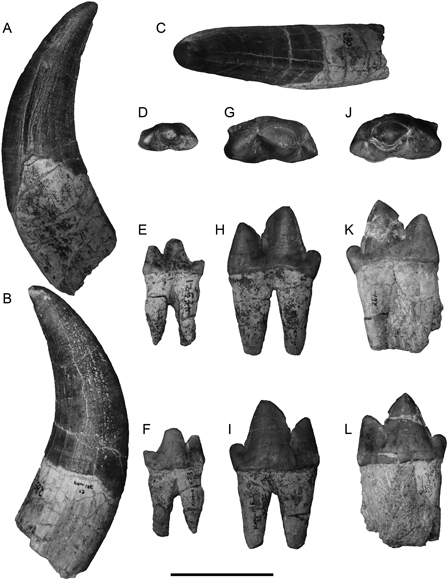
The Giant Teeth of a Giant Prehistoric Predator

Views of the teeth of Simbakubwa kutoaafrika.
What big teeth you have – Simbakubwa kutokaafrika.

Picture credit: Journal of Vertebrate Palaeontology

The photograph (above), shows isolated teeth associated with the lower jaw.  Pictures (A, B and C) show a right lower canine in lingual, buccal and occlusal views.  A right molar (m1), is shown in (D) occlusal, (E) lingual and (F) buccal views and the second right molar (m2), is shown in (G) occlusal, (H) lingual and (I) buccal views, whilst a left molar (m2), is show in (J) occlusal, (K) lingual and (L) buccal views.  Note the scale bar equals 5 cm.

A Widely Dispersed Clade of Super-sized Mammalian Predators

The hyainailourine hyaenodonts are among the biggest land mammalian carnivores known to science.  The group is temporally and geographically widely dispersed with fossil finds in Europe, Asia, North America, Arabia as well as Africa.  The fossil material assigned to the Simbakubwa genus represent the most complete hyainailourine known from sub-Saharan Africa.  The researchers conclude that the fossils represent a relatively young adult animal and the material was collected at the Meswa Bridge site (western Kenya).

Bayesian ancestral state reconstruction supports an Afro-Arabian origin for Hyainailourinae with subsequent dispersal to Europe and Asia.  A regression analysis conducted by the authors of the paper, based on carnassial size suggests that Simbakubwa could have weighed around 1,500 kilogrammes, more than four times the weight of a modern African lion.   The evolution and extinction of Hyainailourinae offers important insights for interpreting ecological transitions from Paleogene to Neogene faunas in Afro-Arabia and Eurasia.

The scientific paper: “Simbakubwa kutokaafrika, gen. et sp. nov. (Hyainailourinae, Hyaenodonta, ‘Creodonta,’ Mammalia), a gigantic carnivore from the earliest Miocene of Kenya” by Matthew R. Borths and Nancy J. Stevens published in the Journal of Vertebrate Paleontology.

For models and replicas of prehistoric animals: The Everything Dinosaur Website.

15 04, 2019

Scientists Identify Ancient “Monster” from the Deep

By |2023-12-03T08:38:59+00:00April 15th, 2019|Categories: Dinosaur and Prehistoric Animal News Stories, Main Page, Palaeontological articles, Photos/Pictures of Fossils|0 Comments

Tentacled “Cthulhu” Fossil Reveals Relative of Modern Sea Cucumbers

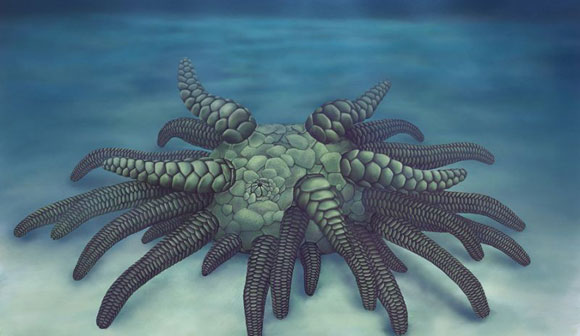
The remarkable Silurian-aged deposits located at a secret site in Herefordshire (England), have provided scientists with a unique look at the early evolution of sea cucumbers and their relatives.  The rocks at this location are comprised of very fine grained volcanic ash that settled on the seafloor some 430 to 425 million years ago.  These deposits have preserved in fantastic detail the remains of the marine biota.  The latest new species to be named from this location is Sollasina cthulhu, a multi-tentacled, benthic animal that was a ferocious predator.

The prehistoric sea cucumber’s trivial name honours the “Cthulhu” universe, as it resembles some of the monsters created by the American, 20th century science-fiction writer H. P. Lovecraft.  At only three centimetres across, it might not look very formidable to us, but its numerous tentacles, (actually tube feet), would have been used to terrorise and capture other animals as it roamed across the seafloor.

A Life Reconstruction of the Newly Described Sollasina cthulhu

Life reconstruction of the Silurian ancestral sea cucumber Sollasina cthulhu.
Sollasina cthulhu life reconstruction.

Picture credit: Elissa Martin, (Yale Peabody Museum of Natural History)

Writing in the academic journal the “Proceedings of the Royal Society B (Biology)”, palaeontologists from the USA and the UK were able to create an accurate, three-dimensional digital reconstruction of the 430-million-year-old fossil.  The exceptionally preserved fossil, once analysed using this three-dimensional computer modelling technique, revealed details of internal soft tissues previously not seen in a fossil like this.

Sollasina cthulhu

Like other fossils from the secret Herefordshire “Lagerstätte”, Sollasina cthulhu was examined using a method that involved grinding it away, layer-by-layer, with a photograph taken at each stage.  This led to hundreds of images being produced which were then combined in a special computer programme to create an exact 3-D image, a “virtual fossil”.

The scientists, which included researchers from the Oxford Museum of Natural History, Leicester University, Imperial College London, Yale University and the University of Southern California, were able to make out an internal ring, which is believed to be part of the organism’s water vascular system.  The water vascular system is the system of fluid-filled canals used for feeding and movement in living sea cucumbers and their relatives.

Dr Imran Rahman (Deputy Head of Research at Oxford University Museum of Natural History) and lead author of the paper stated:

“Sollasina belongs to an extinct group called the ophiocistioids, and this new material provides the first information on the group’s internal structures.  This includes an inner ring-like form that has never been described in the group before.  We interpret this as the first evidence of the soft parts of the water vascular system in ophiocistioids.”

Computer-based Analysis

This new fossil was subjected to a phylogenetic analysis to assess the evolutionary relationships between fossil sea cucumbers and sea urchins (members of the Echinodermata Phylum).  The results showed that Sollasina and its relatives are more closely related to sea cucumbers than they are to sea urchins.  This has provided a new insight into the evolution of this very important group of invertebrates.

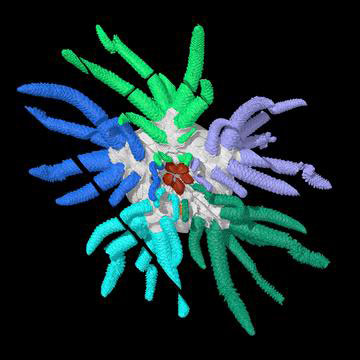
A Computer-generated Three-dimensional Image of Sollasina cthulhu

3-D computer generated image of S. cthulhu (tube feet shown in different colours).
Three-dimensional reconstruction of Sollasina cthulhu using the computer programme.  Tube feet shown in different colours.

Picture credit: Dr Imran Rahman (Oxford University Museum of Natural History)

Dr Jeffrey Thompson (University of Southern California) and a co-author of the paper commented:

“We carried out a number of analyses to work out whether Sollasina was more closely related to sea cucumbers or sea urchins.  To our surprise, the results suggest it was an
ancient sea cucumber.  This helps us understand the changes that occurred during the early evolution of the group, which ultimately gave rise to the slug-like forms we see today.”

The Herefordshire site has provided palaeontologists with some remarkable fossils to study:

An ancient Silurian ostracod: An Ancient Ostracod from Herefordshire.

A rare Silurian marine worm: Rare Silurian Fossil Worm from a Herefordshire “Hotspot”.

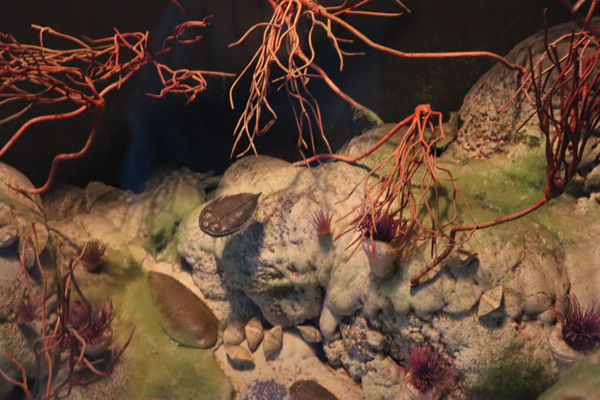
A Prehistoric Scene – Life in the Silurian Seas

On the cusp of the Phanerozoic.
A marine environment from the early Phanerozoic Eon (Silurian). Picture credit: Everything Dinosaur.

Picture credit: Everything Dinosaur

Everything Dinosaur acknowledges the assistance of a press release from the Oxford University Museum of Natural History in the compilation of this article.

The scientific paper: “A New Ophiocistioid with Soft-tissue Preservation from the Silurian Herefordshire Lagerstätte, and the Evolution of the Holothurian Body Plan” by Imran A. Rahman, Jeffrey R. Thompson, Derek E. G. Briggs, David J. Siveter, Derek J. Siveter and Mark D. Sutton published in the Proceedings of the Royal Society B.

Visit the Everything Dinosaur website: Everything Dinosaur.
12 04, 2019

A New Species of Therizinosaur from China

By |2023-12-03T07:50:07+00:00April 12th, 2019|Categories: Dinosaur and Prehistoric Animal News Stories, Dinosaur Fans, Main Page, Photos/Pictures of Fossils|0 Comments

Lingyuanosaurus sihedangensis – A New Species of Therizinosaur is Announced

Scientists from the Chinese Academy of Sciences in collaboration with the University of Alberta, have announced the discovery of a new therizinosaur based on fragmentary fossils from the Lower Cretaceous Jehol Group of Liaoning Province (north-eastern China).   This is the third therizinosaur to have been named from the Jehol Group, joining Jianchangosaurus and Beipiaosaurus.  These dinosaurs are approximately the same size, the researchers have put forward a number of theories to help explain why three similar-sized members of the Therizinosauridae could have potentially co-existed without directly competing.

The dinosaur has been named Lingyuanosaurus sihedangensis (pronounced: ling-you-an-oh-sore-us), the genus name honours the city of Lingyuan, whilst the trivial epithet refers to the town of Sihedang where the fossils were discovered.

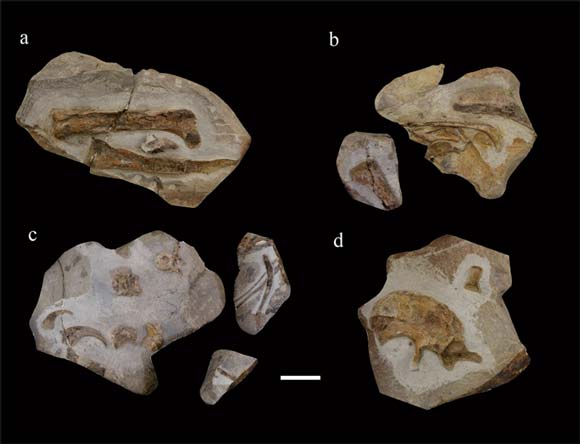
Fossil Material Ascribed to Lingyuanosaurus sihedangensis Prior to Complete Preparation

Lingyuanosaurus fossils.
Lingyuanosaurus fossil material.

Picture credit: Scientific Reports

The picture above shows some of the fossils used to name and describe this new species of dinosaur.  Top left (a), limb bones consisting of a right femur and left tibia, whereas, (b) contains ribs, part of the right humerus and the ischium.  Slab (c) consists of claw bones (manual unguals) and ribs, whilst (d), shows the right ankle bone (astragalus) and the left ilium.  Note the scale bar equals 5 cm.

An Intermediate Position within the Therizinosauria

Described from a single, disarticulated but associated partial skeleton, the exact age of the fossils is disputed.  The fossil-bearing strata at Sihedang have been assigned to the Yixian Formation in some studies but to the younger Jiufotang Formation in others.  A phylogenetic analysis carried out by the authors places Lingyuanosaurus in an intermediate position within Therizinosauria.  It has been placed between the early-branching therizinosaurs such as Falcarius, Jianchangosaurus, and Beipiaosaurus and the late-branching ones such as Alxasaurus and Therizinosaurus.  Lingyuanosaurus sheds additional light on the evolution of major therizinosaurian characteristics, including the distinctive pelvic girdle and hindlimb morphology seen in this group.

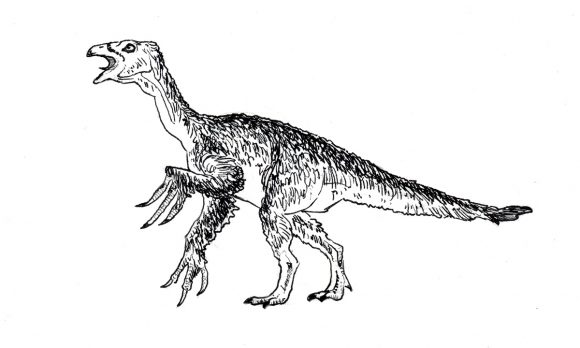
A Drawing of a Typical Therizinosaur

Drawing of a typical Therizinosaurus.
A drawing of a typical therizinosaur. Picture credit: Everything Dinosaur.
Picture credit: Everything Dinosaur

Where Did Lingyuanosaurus Fit into the Jehol Biota?

Measuring around two metres in length, this is the third similar-sized therizinosaur to be assigned to this Early Cretaceous biota of northern China.  The presence of three very similar types of dinosaur in the Jehol Group is unusual.  Unless the region was particularly rich in resources, these dinosaurs could have been in direct competition with each other.  The researchers put forward several possible explanations as to why three similar therizinosaurs have been identified.

  • Firstly, the beds in which these therizinosaurs (Jianchangosaurus, Lingyuanosaurus and Beipiaosaurus), have been found are not precisely dated.  The Yixian and the Jiufotang Formations were deposited over a span of at least 8 million years.  It is possibly that these three dinosaurs could have been separated from each other by a considerable period of time, hundreds of thousands or even millions of years.
  • Secondly, these three species are known from different parts of Liaoning Province.  Whereas, Jianchangosaurus and Lingyuanosaurus were found at sites just a few miles apart, Beipiaosaurus heralds from more than 200 miles further north.   There is some, albeit limited, evidence to suggest that during the Early Cretaceous the deposition of the Jehol Group occurred in multiple small basins, suggesting that the three Jehol therizinosaurs might have been separated by geographic barriers even if they were mutually contemporaneous.
  • Thirdly, if these three therizinosaurs did live at the same time, in the same habitat, they might have occupied different niches in the ecosystem.  The teeth of Jianchangosaurus are different (although the holotype represents a juvenile, so comparison with fully grown animals can be problematic), this suggests that Jianchangosaurus might have fed on different types of vegetation compared to Lingyuanosaurus and Beipiaosaurus.  In addition, the ratio of limb bones in Beipiaosaurus is different to the other two dinosaurs, it might have been relatively slow in comparison with Jianchangosaurus and Lingyuanosaurus and therefore it could have had a more limited range.

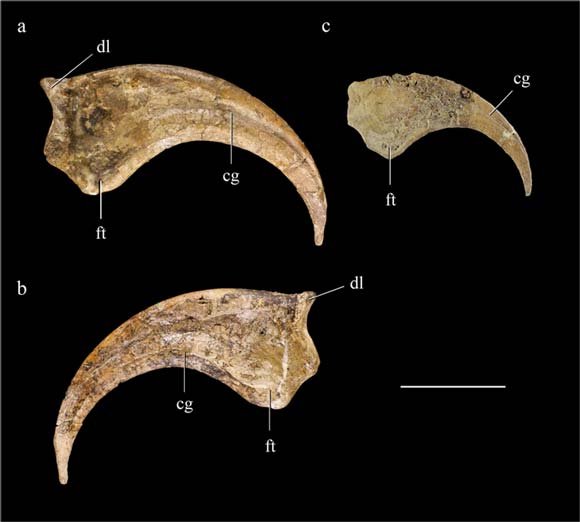
Claw Fossils (Manual Unguals) – Lingyuanosaurus sihedangensis

Manual unguals (Lingyuanosaurus).
Claw fossils of Lingyuanosaurus (manual unguals).

Picture credit: Scientific Reports

The scientific paper: “A New Transitional Therizinosaurian Theropod from the Early Cretaceous Jehol Biota of China” by Xi Yao, Chun-Chi Liao, Corwin Sullivan and Xing Xu published in Scientific Reports.

Visit the Everything Dinosaur website: The Everything Dinosaur Website.

Go to Top