All about dinosaurs, fossils and prehistoric animals by Everything Dinosaur team members.

Pictures of fossils, fossil hunting trips, fossil sites and photographs relating to fossil hunting and fossil finds.

30 05, 2019

Two New Theropod Dinosaurs from Thailand

By |2023-12-22T13:47:58+00:00May 30th, 2019|Categories: Dinosaur and Prehistoric Animal News Stories, Dinosaur Fans, Main Page, Palaeontological articles, Photos/Pictures of Fossils|0 Comments

Phuwiangvenator yaemniyomi and Vayuraptor nongbualamphuensis

Two new species of theropod dinosaur have been described from partial fossil remains excavated from strata associated with the Sao Khua Formation of north-eastern Thailand.  It is likely that both these meat-eating dinosaurs have affinities with the Megaraptora and their discovery lends weight to the idea that the Megaraptoridae and their near relatives probably originated in Asia.

The dinosaurs have been named Phuwiangvenator yaemniyomi and Vayuraptor nongbualamphuensis, Phuwiangvenator has been described as a megaraptoran whilst the exact taxonomic position of Vayuraptor remains uncertain, although the authors of the scientific paper suggest that it too was a member of the clade of dinosaurs with long-snouts, highly pneumatised skeletons and with large claws.

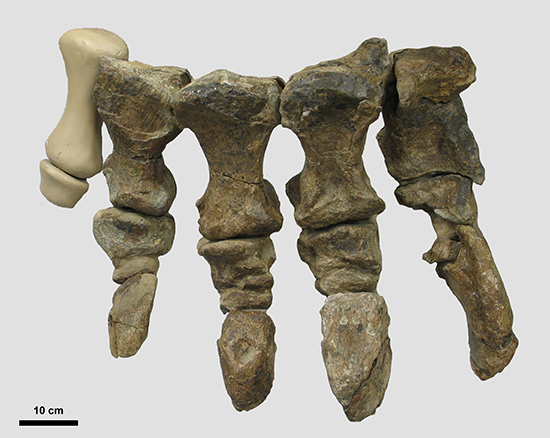
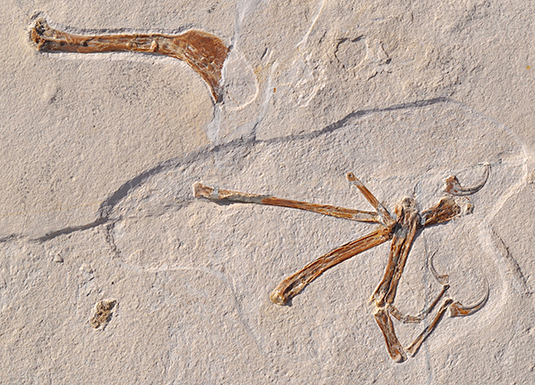
Bones in Approximate Life Position from the Right Foot of P. yaemniyomi

Bones from the foot of Phuwiangvenator yaemniyomi.
Bones and claws from the right foot of Phuwiangvenator yaemniyomi with an accompanying line drawing.

Picture credit: Samathi et al

Lower Cretaceous Theropod Dinosaurs

The fossils were found nearly twenty-five miles apart, but the strata in which the fragmentary fossil material was found is contemporaneous and dated to the upper Barremian stage of the Lower
Cretaceous.

The first identified specimens of P. yaemniyomi were found by Preecha Sainongkham, a team member at the Phu Wiang Fossil Research Centre and Dinosaur Museum back in 1993.  The Phu Wiang Mountain region is highly fossiliferous and numerous vertebrate fossils representing the fauna of a low-lying, inland, lacustrine environment have been discovered over the years.  The first dinosaur bone known from Thailand was found in 1976, a scrappy bone fragment that was assigned to the Sauropoda.  This fossil was found by Sudham Yaemniyom, who was at the time a geologist with the country’s Department of Mineral Resources, Bangkok.  The species name of Phuwiangvenator yaemniyomi honours his contribution to the geology and palaeontology of Thailand.

Phuwiangvenator is the larger of the two theropods, it is believed to have measured around 5.5 to 6 metres in length.  It is known from dorsal and sacral vertebrae plus elements of the hind limbs and feet.  All the fossil material was found within the same bedding plane and within an area of just 5 square metres.

Views of the Right Tibia (A1 – A6) and a Proximal View of the Left Tibia (P. yaemniyomi)
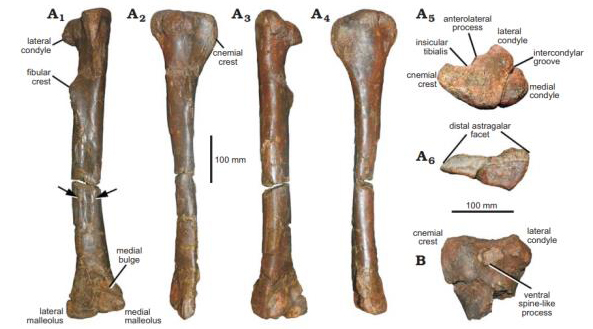
Phuwiangvenator yaemniyomi bones from the lower leg.
Right tibia (A) in various views with a proximal view (B) of the left tibia – Phuwiangvenator yaemniyomi.

Picture credit: Samathi et al

Vayuraptor nongbualamphuensis – Raptor of the Wind God

The fossils associated with Vayuraptor were found in 1988.  It is known from a left tibia and ankle bones.  The genus name is from the Sanskrit for “Vayu”, a God of the Wind and the Latin term “raptor”, which means thief.  Analysis of the single lower leg bone indicates that like Phuwiangvenator, this dinosaur was a fast-running, cursorial predator.  The fossils of both dinosaurs are now part of the extensive dinosaur fossil collection at the Sirindhorn Museum in Kalasin Province.  This museum houses the largest collection of dinosaur fossil bones in north-eastern Thailand.

Analysis of the Tibia Suggests that Vayuraptor was a Fast Runner
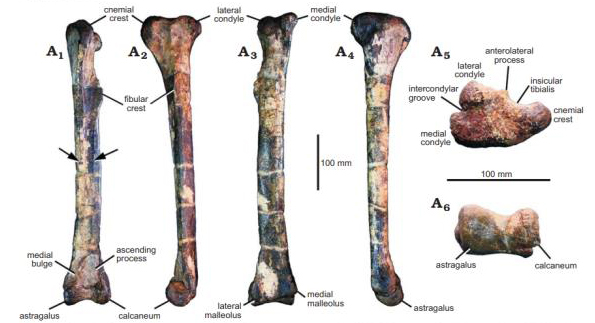
Ankle and lower leg bone Vayuraptor.
Vayuraptor nongbualamphuensis views of the left tibia and ankle (A5 and A6).

Picture credit: Samathi et al

Megaraptora Originated in Asia

The establishing of at least one of these dinosaurs as a member of the Megaraptora clade, possibly both, helps to support the hypothesis that in south-eastern Asia during the Early Cretaceous, it was the Megaraptora that were diverse and playing the role of apex predators.  This is in contrast to other ecosystems elsewhere in the world, that were dominated by different kinds of theropod dinosaur.  A basal member of the Megaraptora, Fukuiraptor kitadaniensis is known from the Lower Cretaceous (Barremian) of Japan, these two dinosaurs are also (most likely), from the Barremian.  Their identification supports the idea that these fast running, lightly built predators evolved in Asia.

A Model of the Basal Megaraptoran  Clade – Fukuiraptor
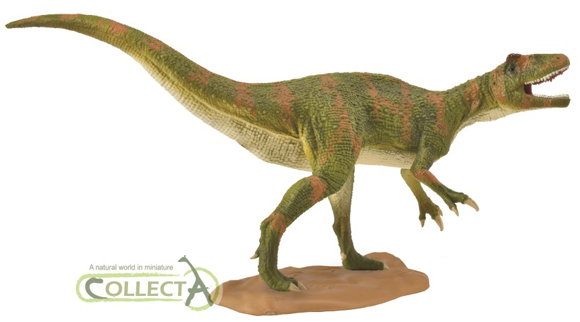
CollectA Fukuiraptor dinosaur model.
CollectA Fukuiraptor model.  It is likely that Phuwiangvenator yaemniyomi and Vayuraptor nongbualamphuensis were similar to Fukuiraptor kitadaniensis.

The picture (above) features a CollectA Fukuiraptor model.

To view the range of not-to-scale CollectA prehistoric animals: CollectA Prehistoric Life Models and Figures.

An Early Cretaceous Heyday for the Megaraptorans

Fossils of this type of meat-eating dinosaur have been reported from the Barremian to the Aptian faunal stage of the Early Cretaceous.  The authors of the scientific paper, published in the scientific journal “Acta Palaeontologica Polonica”, note that several specimens of megaraptoran dinosaurs have been recorded from the Aptian of Australia and one reported from the later Albian faunal stage of South America.  Megaraptorans are known from the Late Cretaceous but seem to indicate that by around 90 million years ago, “megaraptors” had a more limited range and seem to have been confined mostly to South America.

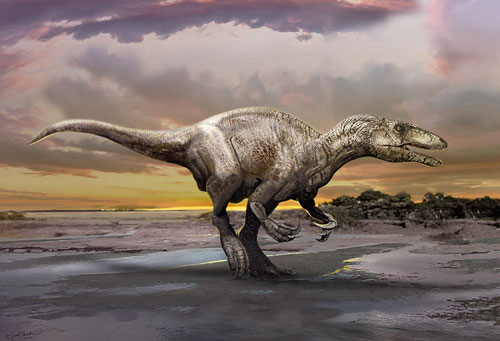
A Typical Illustration of a Member of the Megaraptoridae Family of Theropod Dinosaurs
Roaming Patagonia 80 million years ago
A leggy, Late Cretaceous carnivore (Murusraptor).  Roaming Patagonia around 80 million years ago.  By the Late Cretaceous the Megaraptoridae may have been less widespread and more provincial.

Picture credit: Jan Sovak (University of Alberta)

Commenting Upon the Theropod Dinosaurs

A spokesperson from Everything Dinosaur commented:

“The identification of these theropod remains that had been known about for more than twenty-five years, has been partially resolved.  Hopefully, more fossil material associated with the Vayuraptor genus will be found in Thailand so that it too can be more definitively placed within the Megaraptora clade.  Given the extent of the fossil discoveries made from the Phu Wiang Mountain region thus far, it is highly likely that more new dinosaurs will be named and described from Thailand in the future.”

To read an article about a Late Cretaceous member of the Megaraptoridae family from South America that was reported upon in 2018: A New Member of the Megaraptoridae from the Late Cretaceous of South America (Tratayenia rosalesi).

The scientific paper: “Two new basal coelurosaurian theropod dinosaurs from the Lower Cretaceous Sao Khua Formation of Thailand” by A. Samathi, P. Chanthasit and P. Martin Sander published in  Acta Palaeontologica Polonica.

Visit the Everything Dinosaur website: Everything Dinosaur.
29 05, 2019

Wonderful Wolves Two Megaloceros One

By |2024-05-11T17:08:25+01:00May 29th, 2019|Categories: Adobe CS5, Main Page, Photos/Pictures of Fossils|0 Comments

Wolves Two Megaloceros One

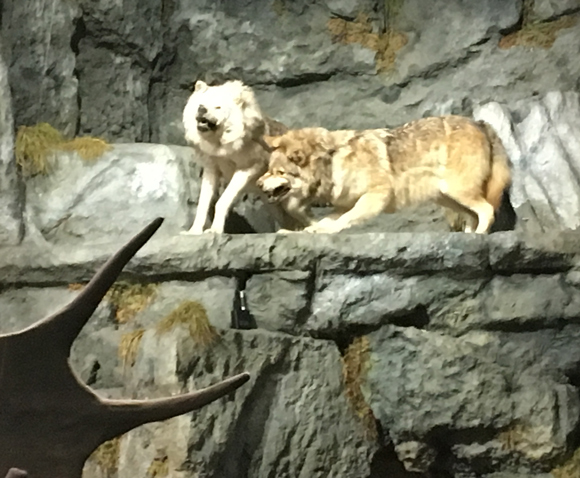
One of the joys of exploring natural history galleries is spotting some of the exhibits that are hiding in plain sight.  Whilst on a visit to South Wales we took the opportunity to visit the National Museum Cardiff and to take a journey through space and time in the Evolution of Wales gallery.  Towards the end of the exhibit, there is a display dedicated to animals of the Ice Age and evidence of early settlement in Wales.  Tucked up high on a ledge over hanging the entrance, one of our team members spotted a pair of wolves. The wolves were about to attack a Megaloceros.

Hiding in Plain Sight – A Pair of Wolves Ready to Pounce

A pair of wolves on display at a museum.
Ice Age wolves on display.  Although much of the megafauna of the Ice Age is extinct some animals alive today also, just like our species, lived through the last Ice Age.  The Museum of Cardiff exhibit had wolves and an American bison on display as well as examples of extinct animals such as the Megaloceros and the Woolly Mammoth.

Picture credit: Everything Dinosaur

We suspect that most of the visitors will miss these wolves lurking above them.  One of the pleasures of having time to really explore a gallery is spotting features that most visitors would probably miss.

The Giant Irish Elk – Megaloceros

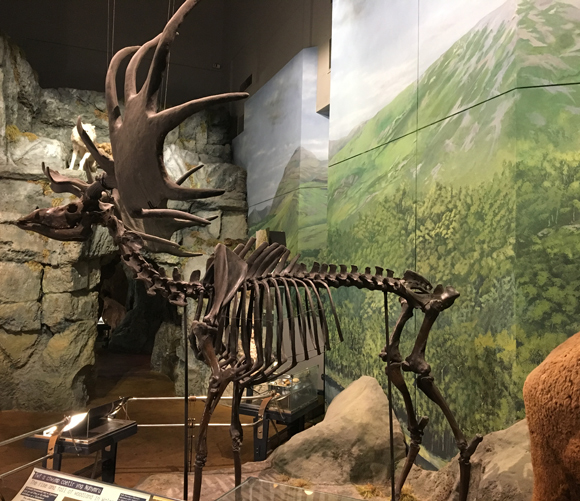
When you enter the gallery, you are met by the imposing cast of a giant Irish Elk (Megaloceros giganteus).  The magnificent antlers certainly draw the eye.  This extinct species of giant deer was geographically very widespread from Ireland to as far east as parts of China during the latter stages of the Pleistocene.

The Megaloceros Exhibit (Part of the Evolution of Wales Gallery)

Megaloceros skeleton on display/
A cast of a Megaloceros skeleton on display. Picture credit: Everything Dinosaur.

Picture credit: Everything Dinosaur

Papo of France included a Megaloceros model in their prehistoric animal range: Papo Prehistoric Animal Models and Figures.

A Photo Opportunity

A number of museums in Europe have fossils of Megaloceros within their collection, the mounted exhibits prove to be very popular with visitors who like to try to take a picture of themselves with the giant antlers, the aim in many cases, is to take a photograph in such a way that the antlers seem to be growing out of the side of your own head.  In contrast, we are just happy to view the various exhibits and to read the informative display boards.

Megaloceros on Display (National Museum of Scotland – Edinburgh)

A giant Irish Elk on display.
A Megaloceros skeleton on display. Picture credit: Everything Dinosaur.

Picture credit: Everything Dinosaur

Visit the Everything Dinosaur website: Everything Dinosaur.
27 05, 2019

Beautiful Postcards of Ichthyosaurs

By |2023-12-22T13:23:39+00:00May 27th, 2019|Categories: Adobe CS5, Dinosaur Fans, Main Page, Photos/Pictures of Fossils|0 Comments

Postcards of Ichthyosaurs

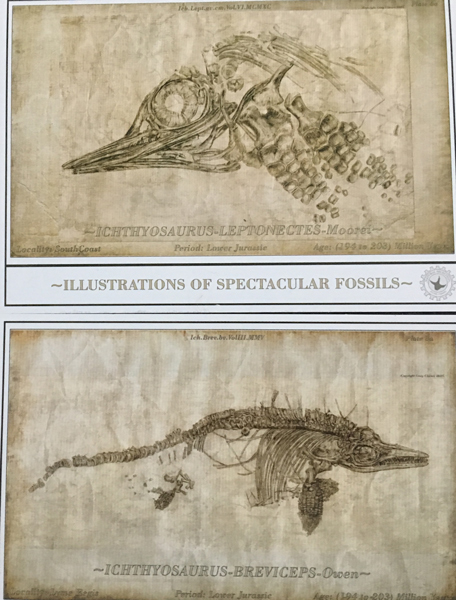
A team member at Everything Dinosaur found some beautiful postcards that feature spectacular British fossils, in this case ichthyosaurs, in one of our offices the other day.  We thought we would share a picture of the prehistoric themed postcards on our blog.

A Pair of Prehistoric Postcards Featuring Different Species of Ichthyosaur

Postcards showing Ichthyosaurs.
Postcards that illustrate spectacular British fossils – Ichthyosaurus.

Picture credit: Everything Dinosaur

The postcards come from a range of “natural selection prints”, illustrations of spectacular fossils from the UK.  They depict scientific illustrations that we think accompanied the description of the species when it was erected.

Ichthyosaurus moorei (Leptonectes moorei)

The postcard (top) shows a plate from the scientific paper that led to the erection of the species Ichthyosaurus moorei.  The holotype material associated with this animal comes from Seatown on the Dorset coast (Jurassic Coast).  However, as our knowledge of the Ichthyosauria as improved, so fossils associated with I. moorei have been reassigned and placed outside the Ichthyosaurus genus.  There are enough distinctive characteristics (autapomorphies), to permit an erection of a separate genus.  The genus Leptonectes moorei was established in 1999.

Ichthyosaurus breviceps

I. breviceps is another species of marine reptile, despite being named a long time ago, in 1881 by Richard Owen (later Sir Richard Owen), it has remained a member of the Ichthyosaurus genus.  This type of Ichthyosaurus is also associated with the Jurassic Coast of Dorset.  Its fossils are relatively rare when compared to the contemporaneous I. communis.  It is characterised by its relatively short, but robust snout.  The shape of the jaw suggests that this marine reptile may have fed on different kinds of food compared to other “fish lizards”, it may have been more of a generalist eating a wider variety of prey, an example of niche partitioning within the biota associated with the Lower Jurassic.

An Illustration of a Typical Ichthyosaur – W. massarae

Wahlisaurus massarae illustrated
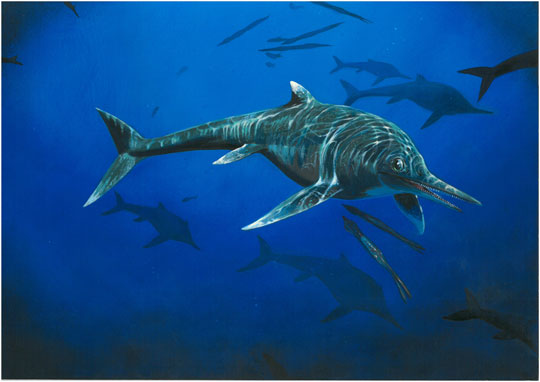
An illustration of the ichthyosaur known as Wahlisaurus massarae, which was named and described back in 2016.  Research into the Ichthyosauria is on-going and existing specimens can be reassigned to different species or even different genera as more data becomes available.

Picture credit: James McKay

To view models of prehistoric animals including marine reptiles: Wild Safari Prehistoric World Models.

26 05, 2019

New Research into Baby Dinosaurs

By |2023-12-22T13:09:23+00:00May 26th, 2019|Categories: Dinosaur and Prehistoric Animal News Stories, Dinosaur Fans, Main Page, Palaeontological articles, Photos/Pictures of Fossils|0 Comments

Mussaurus Switched from Four Legs to Two

A team of scientists, including researchers from the Royal Veterinary College based in London and Museo de La Plata and National Scientific and Technical Research Council (CONICET) located in Argentina, have collaborated to produce a report on how a Late Triassic sauropodomorph changed as it grew up.

The dinosaur in question Mussaurus patagonicus is an ideal candidate for dinosaur growth studies as it is known from numerous partial to nearly complete skeletons from hatchlings to fully grown adults.  Writing in the academic journal the researchers conclude that Mussaurus could only move on four limbs once born but switched to two legs as it grew up, just as our species switches from all fours to bipedal walking as we grow.

Scientists Looked at How the Centre of Mass Changed in the Body of Mussaurus to Work Out How it Walked

Plotting changes in Mussaurus as it grew.
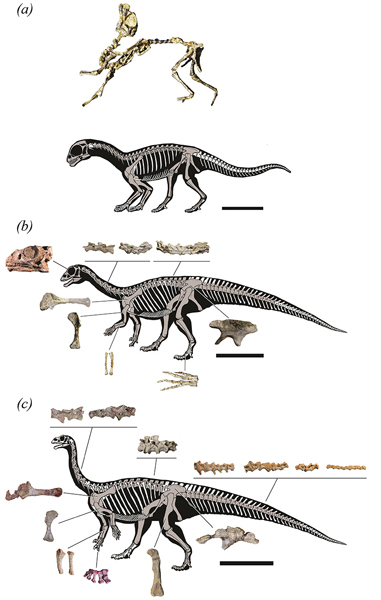
Mussaurus specimens. (a, b) hatchling, (c) yearling and (bottom) adult.  Scale bars represent 5 cm (a), (b) 15 cm (c) and 100 cm in the adult animal representation.

Picture credit: Scientific Reports

An Argentinian Sauropodomorph

Fossils of Mussaurus come from southern Argentina, at birth this dinosaur was only a few centimetres in length, but it reached its adult size in around eight years.  Essentially, this dinosaur went from weighing about 60 grams to weighing an estimated 1,300 kilograms with a body length of approximately 8 metres.  The research team conclude that it might have barely been able to walk or run on two legs at the age of one, but would have only committed to being bipedal once it reached adulthood.

This study has implications for the largest terrestrial vertebrates that ever lived as Mussaurus is regarded as an ancestral form of the later sauropods, giants like Apatosaurus, Mamenchisaurus and Giraffatitan, that were to evolve in the Jurassic.

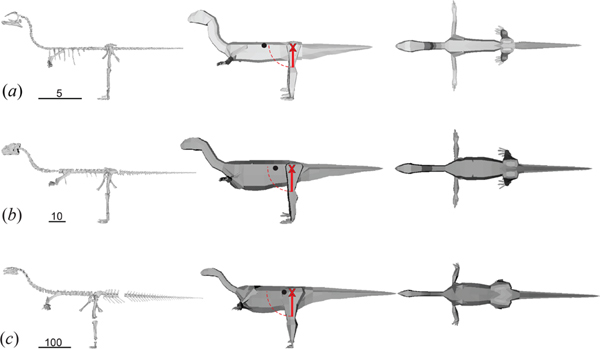
The team scanned key fossils of Mussaurus into three-dimensional models, connected the bones into digital skeletons, and added soft tissue to estimate the shape of the body and its major segments such as head, neck, torso, tail and limbs.  These computer models were then used to estimate the location of the animal’s centre of mass, the point at which all weight can be assumed to act through.  This estimate enabled the scientists to then test whether different models representing different growth stages of Mussaurus patagonicus could have stood on two legs or not, because the centre of mass must be placed under the feet in such poses.

Identifying the Centre of Mass as Mussaurus Grew Up

Mussaurus Locomotion Study
Plotting the ontogeny of Mussaurus (a) hatchling, (b) yearling and (c) adult animal and the subsequent effect on centre of mass and locomotion.

Picture credit: Scientific Reports

Baby Dinosaurs – From Four Legs to Two

One of the authors of the scientific paper, Dr Alejandro Otero (CONICET) stated:

“Mussaurus switched from four legs as a baby to two legs by adulthood, much as humans do.  It is important to notice that such locomotor switching is rare in nature and the fact that we were able to recognise it in extinct forms like dinosaurs highlights the importance of our exciting findings.”

Professor John Hutchinson of the Royal Veterinary College, an expert in animal locomotion and co-author of the paper commented:

“We created the first 3-D representation of the major changes of body form and function across the growth of a dinosaur.  And we were surprised to learn that enlargement of the tail and reduction of the neck had more of an effect on how Mussaurus stood than how long its forelimbs were, which is what people used to think.”

Implications for Giant Dinosaurs

At around eight metres in length, Mussaurus was one of the largest dinosaurs in southern South America during the Late Triassic (estimated to be Norian faunal stage), however, during the Jurassic and Cretaceous much larger lizard-hipped dinosaurs would evolve from this lineage.  By improving our understanding about how some of the sauropodomorphs moved this type of research can provide insights into how much bigger plant-eating, long-necked giants walked.  When adult, dinosaurs such as Diplodocus and Brachiosaurus were very much quadrupedal, although it has been suggested that when very young some of these dinosaurs might have been able to rear up onto their hind legs to escape danger.*

Mussaurus Scale Comparison

Mussasaurus scale comparison.
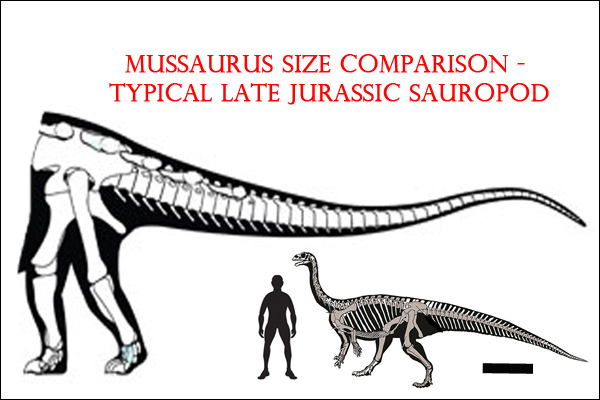
Mussaurus scale drawing compared to an adult human and the skeleton of a typical Late Jurassic sauropod.

Picture credit: Scientific Reports with additional annotation and information from Everything Dinosaur

* To read an article from 2011 that looked at the research into trace fossils from the western United States that hinted that some very young sauropods may have been able to run on just their hind legs: Facultative Bipedalism in Sauropods.

The research team hope to build on this work as they plan to use computer models to replicate in greater detail how Mussaurus may have actually moved, such as how fast it could walk or run.

Everything Dinosaur acknowledges the assistance of a press release from the Royal Veterinary College (London) in the compilation of this article.

The scientific paper: “Ontogenetic changes in the body plan of the sauropodomorph dinosaur Mussaurus patagonicus reveal shifts of locomotor stance during growth” by Alejandro Otero, Andrew R. Cuff, Vivian Allen, Lauren Sumner-Rooney, Diego Pol and John R. Hutchinson published in Scientific Reports.

Visit the Everything Dinosaur website: Everything Dinosaur.

23 05, 2019

Ammonite Shell Preserved in Amber from Myanmar

By |2023-12-20T06:42:51+00:00May 23rd, 2019|Categories: Dinosaur and Prehistoric Animal News Stories, Main Page, Palaeontological articles, Photos/Pictures of Fossils|0 Comments

Ammonite Trapped in Nodule Helps to Date Myanmar Amber Fossils

This month has seen the publication of yet another remarkable paper detailing fossil discoveries found within amber nodules from northern Myanmar.  Writing an open article in the PNAS (Proceedings of the National Academy of Sciences of the United States of America), the researchers document a variety of terrestrial and marine invertebrates consisting of molluscs, insects, spiders and mites that have been preserved trapped in a piece of fossilised tree resin that dates from around 99 million years ago.

The organic remains consist of a mixed assemblage of intertidal and terrestrial floor organisms and suggests that the Cretaceous Myanmar forest was adjacent to a shifting and dynamic coastal environment.  The identification of the ammonite at the genus level has permitted the researchers to provide supporting evidence as to the age of the amber.

The ammonite shell is a juvenile Puzosia and its discovery adds weight to those academics proposing the dating of the amber to Late Albian–Early Cenomanian.

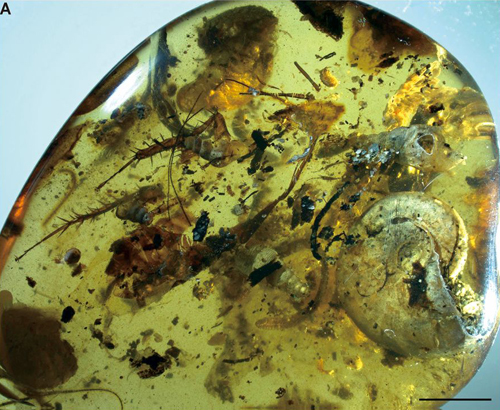
The Amber Nodule (Myanmar) with the Preserved Invertebrate Remains

Amber nodule preserves both terrestrial and marine organisms.
The amber nodule from Myanmar with a wide variety of both marine and terrestrial elements preserved within it.  The ammonite can be seen on the right of the picture, one of the gastropods is directly above it.

Picture credit: PNAS

This is a rare example of a marine organisms associated with tree resin and also represents a rare instance of the dating of fossil tree resin using the remains of organisms trapped within an amber nodule.

X-ray-microcomputed Tomography (CT) Scans

The amber from northern Myanmar has provided palaeontologists with some fascinating fossils to study, including feathers, baby birds and even the partial tail of a feathered dinosaur.  The amber nodule in this study (BA18100), was obtained from an amber mine close to Noije Bum Village, Tanaing Town and it weighs a fraction over six grams.  Measuring 33 mm long, 9.5 mm wide and 29 mm high, it contains a diverse assemblage of at least forty individuals.  X-ray-microcomputed tomography (CT) scans was employed to help identify the fossil material.

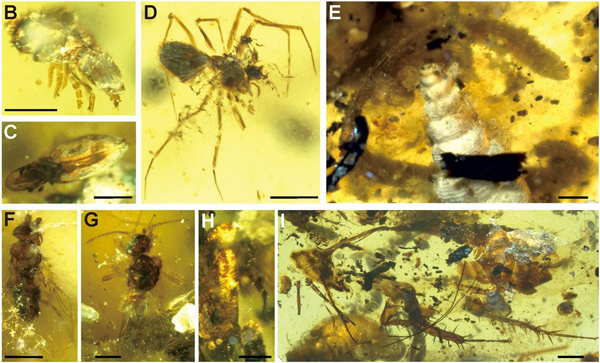
Specimens from the Amber Nodule (BA18100)

A variety of invertebrates preserved in the amber nodule.
Mites, insects including flies and cockroaches and a spider preserved in the amber nodule.

Picture credit: PNAS

The Ammonite Shell Remains

The ammonite appears to be a juvenile and from a review of the septa (the complex boundary lines outlining the chambers), it has been identified as a member of the Puzosia genus.  This type of ammonite is known from the Cretaceous of the western Tethys Ocean, these fossils help to support the fossil record for this genus from the eastern Tethys region.

The ammonite has a diameter of around 12 mm and it appears to retain its original aragonite shell, that is the shell has not undergone any mineral replacement as expected during fossilisation.  The shell is almost complete, only the final body chamber is damaged as part of the umbilical wall extends beyond the fragmentary last part of the shell.

Views of the Ammonite Preserved within the Amber

Ammonite shell preserved in amber.
The juvenile ammonite has been identified as being from the Puzosia genus, it helps to date the amber nodule.  Scale bars equal 2 mm.

Picture credit: PNAS

Marine Snail Shells (Gastropods)

The amber also contains the remains of marine snails.  Two of the gastropods have been identified as the genus Mathilda.  This type of marine snail is known from the western Tethys Ocean, but this is the first time that this marine snail genus has been recorded from the eastern Tethys.  The incomplete preservation and lack of soft body of the ammonite and marine gastropods suggest that they were dead and underwent abrasion on the seashore before entombment within the tree resin.

Views of the Marine Snail Shells (Gastropods)

Marine gastropods preserved in an amber nodule.
Four marine snails (gastropods) preserved in the amber of which two definitely represent the genus Mathilda.  Scale bars equal 1 mm.

Picture credit: PNAS

Isopods Along with an Ammonite Shell

At least four isopods are also present.  Isopods are crustaceans and these creatures are known from terrestrial, brackish, freshwater as well as marine environments.  Unfortunately, the researchers were not able to identify the remains to the extent whereby it could be determined whether the preserved individuals came from the land or were aquatic.

Isopods Preserved within Amber

Isopods preserved in amber from Myanmar.
Four isopods and possibly three other specimens preserved in the amber that could be isopods but they are too badly damaged to be certain.  It is also not certain whether the isopods represent terrestrial, intertidal or marine forms.  Scale bars, 1 mm in A and C.  Scale bar, 0.5 mm in B and D.

Picture credit: PNAS

How Did the Marine Assemblage End Up in the Tree Resin?

The scientists conclude that the tree resin fell onto the beach from coastal trees, for example araucarian conifers could have been growing close to the shore and the resin originated from one of these trees.  As it slid down the tree trunk it picked up terrestrial creatures and under gravity is moved across the sand picking up the shells on the beach.  It is remarkable that the tree resin survived the high-energy shore environment before being preserved as amber. 

The authors, which include scientists from the Chinese Academy of Sciences suggest that resin ending up on the beach due to the proximity of the conifers could have been a relatively common event.  However, since this is the first time that an ammonite shell has been discovered entombed, the odds of fossilisation occurring and the material surviving long enough to turn into amber marks an exceptionally rare occurrence.

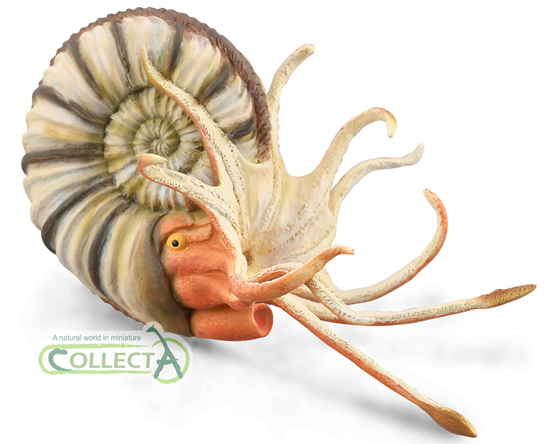
A Model of an Ammonite

CollectA Pleuroceras ammonite model.
CollectA Age of Dinosaurs Popular Size Pleuroceras ammonite model.

The image (above) shows a model of an ammonite from the CollectA Age of Dinosaurs range.

To view this range of prehistoric animal figures: CollectA Age of Dinosaurs/Prehistoric Life.

The dating of amber can be extremely difficult as these pieces can be reworked and redeposited.  The finding of an ammonite within a nodule, provides biostratigraphical dating support attesting to the 99-100 million-year-old estimate for these types of ancient tree resin from northern Myanmar.

The scientific paper: “An ammonite trapped in Burmese amber” by Tingting Yu, Richard Kelly, Lin Mu, Andrew Ross, Jim Kennedy, Pierre Broly, Fangyuan Xia, Haichun Zhang, Bo Wang, and David Dilcher published in the “Proceedings of the National Academy of Sciences of the United States of America.

Visit the award-winning Everything Dinosaur website: Everything Dinosaur.
22 05, 2019

Fossilised Mouse Reveals Evolutionary Secrets of Colour

By |2023-12-19T14:56:12+00:00May 22nd, 2019|Categories: Dinosaur and Prehistoric Animal News Stories, Dinosaur Fans, Main Page, Palaeontological articles, Photos/Pictures of Fossils|0 Comments

Ancient Mouse Reveals a Colourful Mammalian Heritage

Many mammals are brightly coloured, we have golden marmosets, red pandas and of course, black and white zebras.  The evolutionary use of colour within the Kingdom Animalia has long held the fascination of scientists, academics and philosophers.  This week, an international team of researchers led by members of The University of Manchester have published a new study revealing the evidence of colourful pigments in the remains of an ancient mouse.

The Fossilised Remains of a Prehistoric Mouse

The fossilised remains of a mouse.
The well-preserved remains of a Pliocene mouse used in the study.

Picture credit: The University of Manchester

Establishing the Colouration of Extinct Animals

Writing in the journal “Nature Communications”, this work marks a major breakthrough in our ability to define colour pigments within the fossilised remains of long extinct animals and emphasises the role colour plays in the evolution of life on our planet.  The paper entitled “Pheomelanin pigment remnants mapped in fossils of an extinct mammal”, outlines the use of X-ray imaging on the 3 million-year-old fossils in order to unravel the story of key pigments in ancient creatures and demonstrates how we might recognise the chemical signatures of specific red pigments in extinct animals to determine how they evolved.

Professor Phil Manning, (University of Manchester), the lead palaeontologist involved in this study explained:

“The fossils we have studied have the vast potential to unlock many secrets of the original organism.  We can reconstruct key facets from life, death and the subsequent events impacting preservation before and after burial.  To unpick this complicated fossil chemical archive requires an interdisciplinary team to combine their efforts to crack this problem.  In doing this, we unlock much more than just palaeontological information.”

Co-author, Professor Roy Wogelius, from the University’s School of Earth and Environmental Sciences, added:

“This was a painstaking effort involving physics, palaeontology, organic chemistry, and geochemistry.  By working as a team, we were able, for the first time, to discover chemical traces of red pigment in fossil animal material.  We understand now what to look for in the future and our hope is that these results will mean that we can become more confident in reconstructing extinct animals and thereby add another dimension to the study of evolution.”

This exciting, collaborative effort from numerous scientific disciplines reveals that within fossils with exceptionally preserved soft tissues, evidence of black pigmentation can be identified, but furthermore, traces of the much more elusive red animal pigment may be found.  The chemical residue of black pigment, which colours such animals as crows, was first resolved by this team in a previous study nearly ten years ago.  However, the red pigment, characteristic of animals such as foxes and red pandas, is far less stable over geological time and proved much more difficult to detect.

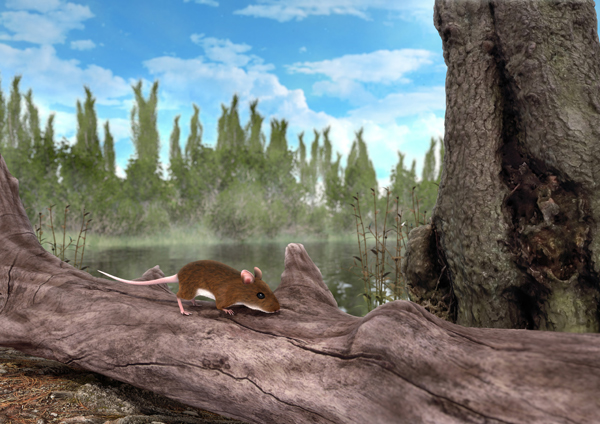
Apodemus atavus Life Reconstruction

Apodemus atavus - mouse from the Pliocene helps reveal the evolution of pigmentation.
A life reconstruction of the mouse from the Pliocene – Apodemus atavus.

Picture credit: The University of Manchester

Professor Wogelius went on to say:

“We had data which suggested red pigment residue was present in several fossils, but there was no useful data available to compare this to pigmentation in modern organisms.  So, we needed to devote several years to analysing modern tissue before we could go back and review our results from some amazing fossil specimens.  In the end, we were able to prove that detailed chemical analysis can resolve such pigment residue, but along the way we learned so much more about the chemistry of pigmentation throughout the animal kingdom.”

Shining a Light on Pigmentation Thanks to the Stanford Synchrotron Radiation Lightsource

To unlock the hidden data within the ancient mouse fossil material, the Manchester-based scientists collaborated with researchers at some of the brightest sources of light on the planet, using synchrotron radiation at the Stanford Synchrotron Radiation Lightsource (USA), and also at the Diamond Light Source (located in Oxfordshire), to bombard the fossils with intense X-rays.  It is the interaction of these X-rays with the chemistry of these fossils that enabled the team to be the first to recognise the chemistry of red pigmentation (pheomelanin), in fur from the exceptionally well-preserved remains of a mouse that scuttled about in the Pliocene Epoch (Apodemus atavus).

The key to the study was identifying trace metals incorporated by ancient organisms into their soft tissues and comparing these to the modes of incorporation into living species.  The chemistry shows that the trace metals in the mouse fur are bonded to organic chemicals in exactly the same way that these metals are bonded to organic pigments in animals with high concentrations of red pigment in their tissue.

In order to confirm the team’s findings, modern comparison standards were analysed by synchrotron radiation and by specialists in pigment chemistry based at the Fujita Health University in Japan.

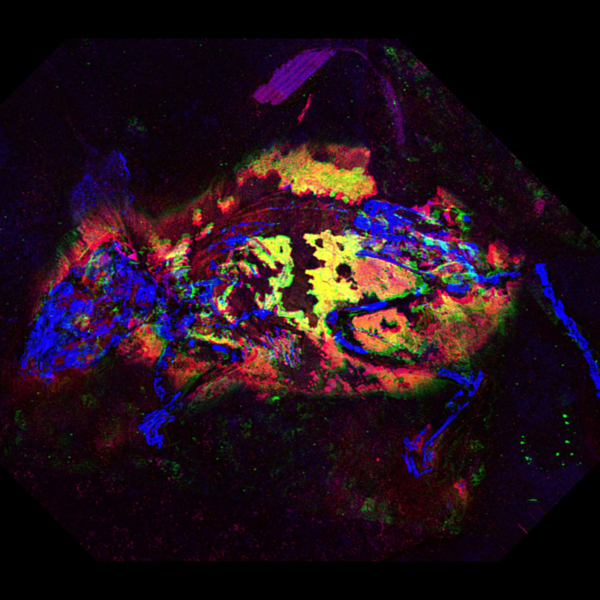
A False Colour Image of the Fossilised Mouse

A false colour image of the fossil mouse.
A false colour image of the 3 million-year-old fossil mouse used in the red pigment study.

Picture credit: The University of Manchester

Ancient Mouse Provides Insights into Many Scientific Disciplines

Summarising the significance of this research Professor Manning stated:

“Palaeontology offers research that is more than relevant to our everyday life.  Information gleaned from the fossil record is influencing multiple fields, including; climate research, the burial of biowaste and radwaste, the measure of environmental impact of oil spills on living species with techniques developed on fossil organisms.  Whilst our research is firmly anchored in the past, we set our sights on its application to the future.”

The scientific paper: “Pheomelanin pigment remnants mapped in fossils of an extinct mammal” by Phillip L. Manning, Nicholas P. Edwards, Uwe Bergmann, Jennifer Anné, William I. Sellers, Arjen van Veelen, Dimosthenis Sokaras, Victoria M. Egerton, Roberto Alonso-Mori, Konstantin Ignatyev, Bart E. van Dongen, Kazumasa Wakamatsu, Shosuke Ito, Fabien Knoll & Roy A. Wogelius and published in Nature Communications

Everything Dinosaur acknowledges the assistance of a press release from Manchester University in the compilation of this article.

Visit the Everything Dinosaur website: Everything Dinosaur.
20 05, 2019

Sorting out Tiny Fossil Flies

By |2023-12-19T14:35:10+00:00May 20th, 2019|Categories: Dinosaur Fans, Main Page, Palaeontological articles, Photos/Pictures of Fossils|0 Comments

Phylogeny of Fungi-loving Flies Being Sorted

The fossils of dinosaurs and other huge vertebrates might grab the headlines but there is an enormous volume of research dedicated to examining the fossil record of some of the less high profile, but arguably more significant prehistoric creatures.  Take for example, the recent paper put together by researchers from the National Museums of Scotland and the Smithsonian Institution that helped resolve part of the family tree of the Diptera, essentially this is the Order of flies, part of a group of winged insects that could lay claim to being amongst the most successful animals to have ever existed.

The research focused on the fossils associated with one family of flies, the Bolitophilidae.  They are tiny and common in temperate forests across the Northern Hemisphere and their larvae feed almost exclusively on mushrooms.  These little flies may not be very big, but the play a huge role in ensuring a balanced, healthy ecosystem.

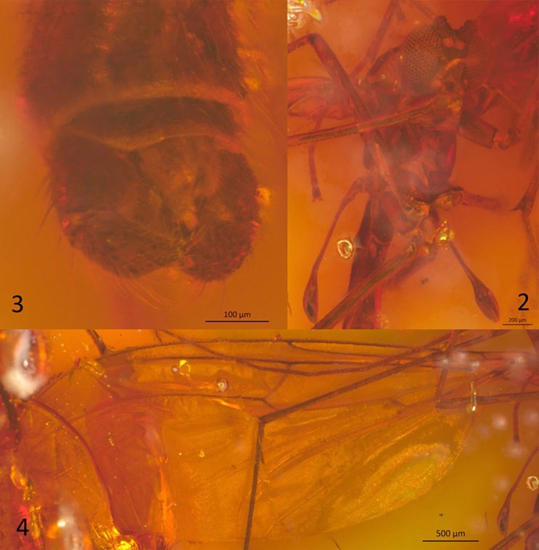
A New Species of Eocene Fly Has Been Identified from Baltic Amber (Bolitophila rohdendorfi)

Eocene gnat fly preserved in Baltic amber (Bolitophila rohdendorfi)
Bolitophila rohdendorfi – new species of gnat fly identified from Baltic amber.

Picture credit: National Museums of Scotland

Little Prehistoric Animals Preserved in Baltic Amber

The earliest fossil material associated with bolitophilids comes from Baltic amber and from contemporaneous amber found in Montana (Kishenehn Formation).  The fossilised tree resin has preserved the remains of individuals that had become trapped in sticky tree resin.  These fossils date from approximately 46 million years ago (Lutetian stage of the Eocene Epoch).  The fossilised flies look remarkably like their extant relatives. They look like small crane flies but they are, in truth a form of gnat.  The remarkable specimens entombed in the amber have allowed the scientists to make detailed observations helping to clarify the taxonomy and evolutionary history of this fly family.

Two New Species of Bolitophilid Fly Erected

These well-preserved fossils have allowed the scientists to erect two new species within the Bolitophilidae family.  The specimens from Montana have been named Bolitophila warreni and the Baltic amber fossils represent Bolitophila rohdendorfi.  Perhaps more significantly, these Eocene gnats have permitted scientists to revise the phylogeny of other ancient flies.  Fossils from the Lower Cretaceous of Mongolia and Transbaikalia had been placed in the Bolitophilidae family (subfamily Mangasinae) but their taxonomic position was controversial.

Thanks to this new research, the affinity of the Mangasinae within the Bolitophilidae has been confirmed.  In addition, a review of the fossil material has enabled a further two species of the fly genus Mangas to be erected, namely Mangas kovalevi and Mangas brevisubcosta both of which originate from the Lower Cretaceous of Khasurty in Western Transbaikalia.

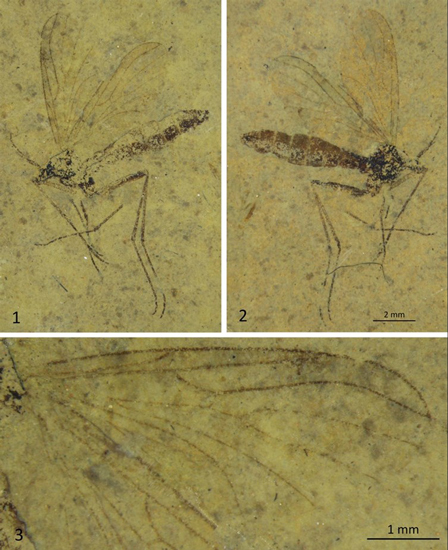
Beautifully Preserved Lower Cretaceous Fly (Mangas kovalevi)

Mangas kovalevi fossils.
Mangas kovalevi, new species of gnat fly from Cretaceous of Transbaikalia.

Picture credit: National Museums of Scotland

Linking Lower Cretaceous Flies to Upper Cretaceous Dromaeosaurs

Dinosaurs and other prehistoric animals were plagued by flies, just like animals today. Although members of the Bolitophilidae family would have been more interested in fungi than flesh.  However, there is a further link between these flies and a member of the Dinosauria.  The dromaeosaurid named Tsaagan mangas, which was scientifically described in 2006, its trivial name was also inspired by a legendary Mongolian monster, the same legendary beast that was the inspiration behind the name of the bolitophilid subfamily, the Mangasinae and the erection of the Mangas genus.

Everything Dinosaur acknowledges the assistance of a press release from the National Museums of Scotland in the compilation of this article.

The scientific paper: “Review of the Fossil Record of Bolitophilidae, with Description of new Taxa and Discussion of Position of Mangas kovalev (Diptera: Sciaroidea)” by Dale E. Greenwalt and Vladimir A. Blagoderov published in the journal Zoo Taxa.

Visit the award-winning Everything Dinosaur website, there are no flies on us: Everything Dinosaur.

18 05, 2019

Walking with Dinosaurs – How? New Research Finds Answers

By |2023-12-17T20:49:52+00:00May 18th, 2019|Categories: Dinosaur Fans, Main Page, Palaeontological articles, Photos/Pictures of Fossils|2 Comments

Sauropods Had Fleshy Pads on Their Feet

A team of scientists led by researchers from the University of Queensland have concluded that giant, long-necked dinosaurs (Sauropoda), probably walked in a “high-heeled fashion”.  Their great weight was supported by a fleshy pad at the base of the foot, effectively cushioning the heel and helping to support their enormous weight.  Elephants also have a fleshy pad on their feet, it seems that these two types of terrestrial, giant tetrapods, although not closely related, evolved the same type of soft tissue pad supporting the elevated metatarsus, an example of convergent evolution.

An Anatomical Reconstruction of the Right Hind Foot of a Sauropod (Rhoetosaurus brownei)

The right hind foot of Rhoetosaurus brownei.
The right hind foot of Rhoetosaurus brownei in dorsal view.  The first four digits have been preserved although the fifth is missing (replaced by a cast).

Picture credit: Jay P. Nair and Andréas Jannel (University of Queensland)

Sauropod Locomotion – The Biomechanics

How the sauropod foot worked is very poorly understood.  This is partly because there are not that many complete foot fossils to study (manus and pes in these quadrupeds), especially amongst early members of the group and there is no living equivalent of these long-necked giants around today, to provide scientists with anatomical comparisons.  The researchers from the University of Queensland in collaboration with colleagues from Monash University (Victoria), examined the foot and toe bones of Rhoetosaurus brownei in a bid to plot the biomechanics of sauropod locomotion.

At around twenty tonnes and with a body length in excess of fourteen metres, Rhoetosaurus was a very sizeable animal, but certainly not the biggest of the Sauropoda.  However, it is known from eastern Australia so its fossils were easy to access for the researchers and it is the earliest representative of sauropods known from Australia.  In fact, according to the press release from the University of Queensland, it is the only named Australian sauropod that dates from the Jurassic.  Conveniently, it is the only one from the Gondwanan Middle Jurassic that preserves an articulated foot.

A Model of Rhoetosaurus (R. brownei)

CollectA Rhoetosaurus model.
A model of the Middle Jurassic sauropod Rhoetosaurus brownei.  Whether this dinosaur could rear up onto its hind legs is speculative.

Three-dimensional Modelling of a Dinosaur’s Foot

The scientists carefully analysed the foot bones and compared them to the foot bones of an African elephant (Loxodonta).   Lead author of the research, PhD student Andréas Jannel (University of Queensland), explained:

“Looking at the bones of the foot, it was clear that Rhoetosaurus walked with an elevated heel, raising the question: how was its foot able to support the immense mass of this animal, up to 40 tonnes?  Our research suggests that even though Rhoetosaurus stood on its tiptoes, the heel was cushioned by a fleshy pad.  We see a similar thing in elephant feet, but this dinosaur was at least five times as heavy as an elephant, so the forces involved are much greater.”

The researchers used physical models and computer simulations to map the posture and the range of motion of the foot bones.  The results generated permitted the team to model all the foot bone postures and from this it was deduced that some of these movements would have been restricted by soft tissue in life, but this soft tissue would have helped to support the animal’s great weight.

Studying the Sauropod Pes

The team concluded that the in‐life plantar surface of the sauropod pes is inferred to extend caudally from the digits, with a soft tissue pad supporting the elevated foot bones, in essence, these terrestrial giants walked in a “high-heeled fashion”.  Furthermore, the plantar pad is inferred to play a role in the reduction of biomechanical stresses, and to aid in support and locomotion.

A foot pad may have been a key biomechanical innovation in early sauropods, ultimately resulting in a functionally plantigrade foot, which may have arisen during the Early to Middle Jurassic.  Although, these dinosaurs, like all other dinosaurs had a digitigrade or semi-digitigrade stance, the soft tissue pad changed their feet morphologically, so, these dinosaurs had a more plantigrade stance (not just walking on their toes).

This research into the locomotion of the biggest land vertebrates that ever lived has provided some intriguing insights, but the authors of the scientific paper admit that further mechanical studies are ultimately required to permit a more complete understanding of how these giants moved about.

Studies of Sauropod Tracks and Trackways Lend Support to Idea that these Animals Walked on Pads of Soft Tissue

The fossilised footprint of a Late Cretaceous Titanosaur.
Professor Shinobu Ishigaki (Okayama University of Science) provides the scale for the dinosaur print.  The track of a titanosaur (Sauropoda).

Picture credit: Okayama University of Science

The scientific paper: “Keep your Feet on the Ground”: Simulated Range of Motion and Hind Foot Posture of the Middle Jurassic Sauropod Rhoetosaurus brownei and its Implications for Sauropod Biology by Andréas Jannel, Jay P. Nair, Olga Panagiotopoulou, Anthony Romilio and Steven W. Salisbury published in the Journal of Morphology.

Visit the Everything Dinosaur website: Everything Dinosaur.
15 05, 2019

New Technology and Fossil Hunting on Mars?

By |2023-12-17T18:07:59+00:00May 15th, 2019|Categories: Geology, Main Page, Palaeontological articles, Photos/Pictures of Fossils|0 Comments

Fossil Hunting on Mars – Where to Look?

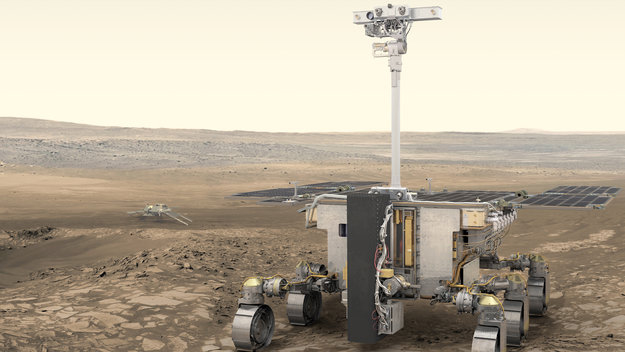
The second stage of the joint European and Russian ExoMars project is due to launch in 2020.  The first part of the mission involved an atmospheric probe designed to search for trace amounts of methane and other gases in the thin Martian atmosphere – evidence of there having been life on the planet in the past.  The results so far have been a little disappointing but, part two will continue the main aim of this programme, addressing the question as to whether or not we are alone in the universe.

A rover will explore the surface and crucially, it will collect samples with a drill down to a depth of two metres and analyse them onboard using sophisticated instrumentation.  Samples from beneath the surface of Mars are more likely to include biomarkers, as the thin atmosphere provides little protection from radiation and photochemistry, but could ExoMars be looking for evidence of life in the wrong place?

An Artist’s View of the ExoMars Rover on the Martian Surface

ExoMars Rover (2020)
Set to launch in 2020 the ExoMars expedition will include a sophisticated rover that will drill into the soil to test for past life.

Picture credit: European Space Agency (ESA)

An Atlas of Volcanic Rock – On the Hunt for Extremophiles

Researchers at the Swedish Museum of Natural History (Stockholm),  have begun compiling an atlas of fossils in volcanic rock, to guide where and what to look for in the search for Martian life.  Most fossils are associated with sedimentary rocks and there are sedimentary rocks on the red planet (deposits formed in layers), either through the transport of material via water, with the assumption that in the ancient past, liquid water existed on the Martian surface, or via wind (aeolian) deposition.

However, igneous rocks dominate the geology of Mars and writing in the academic journal “Frontiers in Earth Science”, the scientists suggest that it is these igneous rocks that may harbour evidence of life.  Producing a guide to the microbial fossils found in volcanic rocks on Earth, can then assist the Mars exploration team in identifying suitable sites to hunt for Martian microbial fossils.

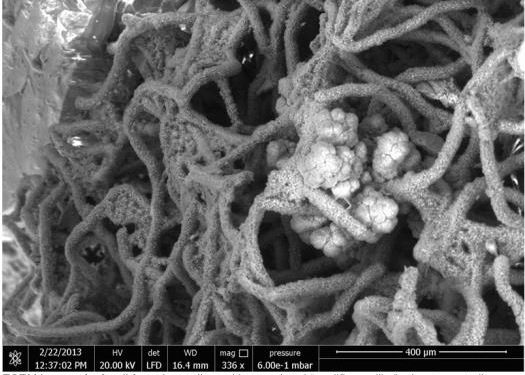
An Environmental Scanning Electron Microscope Image of Fossilised Fungi

Fossil fungal mycelium.
ESEM image of a fossil fungal mycelium with associated “cauliflower-like” microstromatolite formed by iron-oxidizing bacteria. From Koko Seamount, Pacific Ocean, 43 million years old.

Picture credit: Frontiers Press

Lead author of the paper, Dr Magnus Ivarsson explained:

“We propose a “volcanic microfossil atlas” to help select target sites for missions seeking evidence of extraterrestrial life, such as the NASA Mars mission 2020 and ExoMars.  The atlas could also help us to recognise what Mars microfossils might look like, by identifying biosignatures associated with different types of fossilised microbes.”

Microfossils Buried in Deep Rock and in Deep Geological Time

Dr Ivarsson and his colleagues study life buried in deep rock and deep geological time.  Looking for the fossilised remains of ancient microbes, that have lived up to one thousand metres below the deepest ocean floors and may have originated more than 3.5 billion years ago.

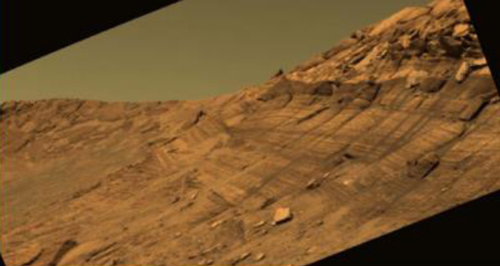
The Martian Surface But Could the Subsurface Harbour Evidence of Ancient Life?

The surface of Mars.
Evidence of ancient life such as microfossils could be preserved beneath the surface of Mars.

Picture credit: Frontiers Press

Dr Ivarsson added:

“The majority of the microorganisms on Earth are believed to exist in the deep biosphere of the ocean and continental crust.  Yet we are just now beginning to explore, through deep drilling projects, this hidden biosphere.”

In a saline, water world of extreme pressure, that is in perpetual darkness, fungi, bacteria and other microbes have adapted to feed on the igneous rock that surrounds them.  There are even predator/prey relationships.  These organisms spread through microscopic fractures and cavities forming complex ecosystems.  When these lifeforms die, they can become microfossils, providing a history of their existence.

Fossilised Fungal Mycelia

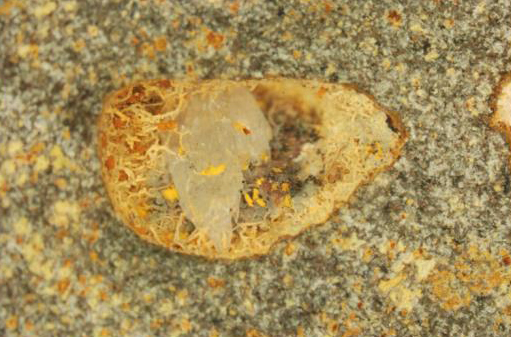
Fossilised fungal mycelia in a subseafloor basalt.
An image by optical microscopy of an open vesicle in subseafloor basalt from Koko Seamount.  Fossilised fungal mycelia protrude from the vesicle wall, yellow and brownish microstromatolites grow on the hyphae and large calcite crystal occur in the middle of the vesicle.

Picture credit: Frontiers Press

An Atlas of Microfossils from Igneous Rocks

Scientists are aware that the rocky planets Mars and Earth are very similar geochemically, so by looking at igneous rocks on Earth, this should help guide the search for life on Mars.

Ivarsson explained:

“Our aim is to be able to use the oceanic crust microfossil record as a model system to guide Martian exploration.  Our review of existing knowledge is an important first step, but a more comprehensive understanding of the deep life is needed to show where and what to search for.”

The microfossil atlas would also help to determine which samples should be targeted for return to Earth for further analysis, given the limited payload of the Mars missions.  Perhaps, within two years of this article having been written, we will know the answer to the question about whether or not we are alone in this universe, that there was once, perhaps there still is, microbial life deep underground on Mars.

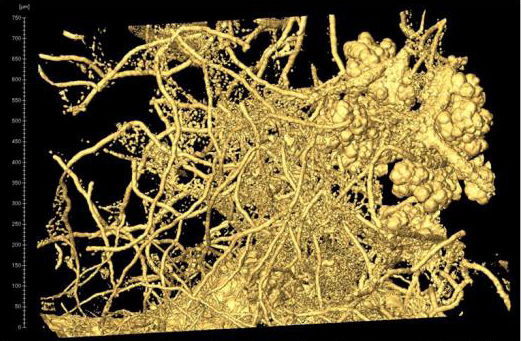
Could Evidence of  Ancient Life on Mars be Discovered within the Next Two Years?

Synchrotron-based X-ray tomography - an image of fungi and prokaryotic cell-like structures.
Three-dimensional reconstruction made by synchrotron-based X-ray tomography (srxtm).  Fungal mycelium with microstromatolitic structures and remains of prokaryotic cell-like structures in between the fungal hyphae.

Picture credit: Frontiers Press

The scientific paper can be found here: NASA May Have to Look in Igneous Rocks to Detect Ancient Life on Mars.

Visit the Everything Dinosaur website: Everything Dinosaur.
14 05, 2019

A New Jurassic Early Bird Fossil to Rival Archaeopteryx

By |2023-12-17T17:57:50+00:00May 14th, 2019|Categories: Dinosaur and Prehistoric Animal News Stories, Dinosaur Fans, Main Page, Photos/Pictures of Fossils|0 Comments

Alcmonavis poeschli – Another Late Jurassic “Early Bird”

Scientists have identified a new species of “proto-bird” which was contemporaneous with Archaeopteryx (A. lithographica).  Known from a single, fragmentary fossil, excavated from the Lower Tithonian Mörnsheim Formation of the Solnhofen Archipelago, the species has been named Alcmonavis poeschli.  Its discovery supports the hypothesis that there were numerous bird-like dinosaurs in the Late Jurassic.

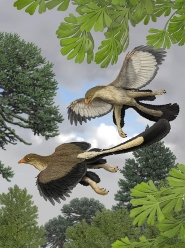
The Late Jurassic of Europe Could Have Been Home to Numerous “Proto-birds”

Archaeopteryx could have been one of numerous bird-like dinosaurs from the Solnhofen Archipelago.

Picture credit: Carl Buell

A Right Wing from a Volant Animal

A. poeschli is represented by a right wing (specimen number: SNSB-BSPG 2017 I 133).  The bones are partially dislocated but lying in proximal association, the fossils consist of the humerus, radius, ulna, the hand and finger bones with claws.  Although there are only a handful of bones to study, they show a number of derived characters such as a pronounced attachment area for the pectoralis muscle and a robust second finger.  These traits indicate that Alcmonavis is a more derived avialan than Archaeopteryx.

A Photograph Showing the Holotype Fossil of Alcmonavis poeschli

Alcmonavis poeschli holotype fossil material.
Alcmonavis poeschli holotype.

Picture credit: Bayerische Staatssammlung für Paläontologie und Geologie/AFP

The photograph (above), shows the wing of Alcmonavis poeschli as it was found in the limestone slab.  Alcmonavis poeschli is another example of a volant bird from the Jurassic period.  It may have been a more capable flyer than the urvogel (Archaeopteryx).  Scars on the wing bones suggest the placement of sizeable muscles, indicating that the raven-sized Alcmonavis was capable of flapping its wings with some force.

Alcmonavis poeschli

One of the authors of the scientific paper, published this week in the academic journal “eLife”, Oliver Rauhut of the Bayerische Staatssammlung für Paläontologie und Geologie (Bavarian State Collection of Palaeontology and Geology) stated:

“At first, we assumed that this was another specimen of Archaeopteryx.  There are similarities, but after detailed comparisons with Archaeopteryx and other, geologically younger birds, its fossil remains suggested that we were dealing with a somewhat more derived bird.  The wing muscles indicate a greater capacity for flying.”

This discovery indicates higher avialan diversity in the Late Jurassic than previously recognized.

Named after the Altmühl River

The genus name is derived from the old Celtic name for the Altmühl River which flows through the Solnhofen limestone region and from the Greek “avis” for bird.  The species name honours Roland Pöschl who leads fossil hunting expeditions to the Old Schöpfel Quarry, where the fossilised wing was discovered.

To read an article published in 2017 about another feathered dinosaur from Solnhofen: The Archaeopteryx That Wasn’t.

To read an article from February 2019, that explains how the iconic Archaeopteryx feather fossil was reclassified: Iconic “Archaeopteryx” Feather Not From Archaeopteryx.

Visit the Everything Dinosaur website: Everything Dinosaur.
Go to Top