All about dinosaurs, fossils and prehistoric animals by Everything Dinosaur team members.

Pictures of fossils, fossil hunting trips, fossil sites and photographs relating to fossil hunting and fossil finds.

14 06, 2023

Unique Ubirajara Fossil Specimen Returned to Brazil

By |2024-01-02T20:30:47+00:00June 14th, 2023|Categories: Dinosaur and Prehistoric Animal News Stories, Dinosaur Fans, Main Page, Palaeontological articles, Photos/Pictures of Fossils|0 Comments

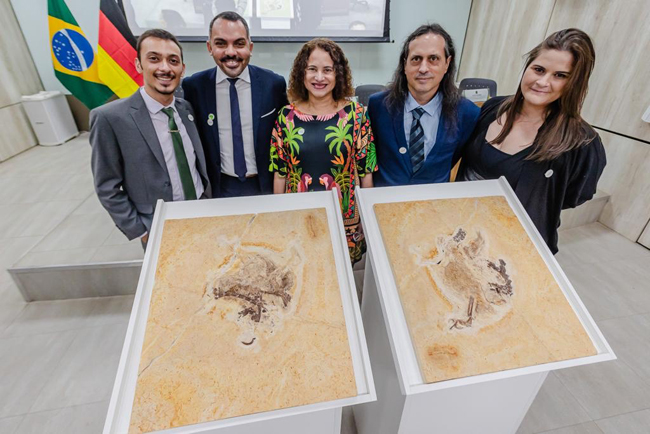
The fossils representing the first, non-avian dinosaur with feather-like structures found in South America has been returned to Brazil. The Ubirajara fossil specimen has been repatriated from Germany. This prized but controversial fossil, was named and described in 2020 (Ubirajara jubatus).

Since the scientific publication, campaigners, including many prominent Brazilian scientists, had requested that this dinosaur be returned home. One of the leading advocates for the repatriation was Professor Aline Ghilardi of the Federal University of Rio Grande do Norte (UFRN).

Ubirajara fossil specimen returned to Brazil.
Professor Aline Ghilardi, right, next to Professor Juan Cisnero (UFPI) and the minister of MCTI, Luciana Santos (centre). The Ubirajara fossil specimen is returned to Brazil. Picture credit: Luara Baggi – Ascom/MCTI.

To read the Everything Dinosaur blog post about the formal scientific description of Ubirajara: One Very Flashy New Dinosaur Ubirajara jubatus.

The Return of Ubirajara jubatus

The excitement in Brazil sparked by the scientific publication turned to dismay when it was realised that the fossil had been removed from the country. The materials and methods section of the paper stated that the specimen had been taken out of Brazil in 1995.

The first Brazilian law dealing with the protection of fossils was created in 1942. The legislation permitted fossils to leave the country, but authorisation was required. Subsequently, the law was strengthened, and it outlined how fossils should be collected, exported and insisted that Brazilian scientists should be involved in the study of such artifacts.

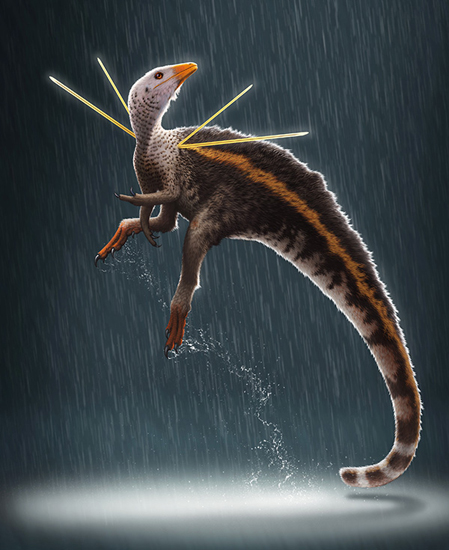
Ubirajara jubatus life reconstruction.
Ubirajara jubatus life reconstruction by the very talented palaeoartist Bob Nicholls.

Following a campaign, the paper describing U. jubatus, the first non-avian dinosaur to be found in the Southern Hemisphere with feather-like filaments was withdrawn.

After the allegations of illegal smuggling, it was agreed to return the specimen to Brazil. The scientific name Ubirajara jubatus was removed from the International Commission on Zoological Nomenclature (ICZN) registry. The dinosaur’s name currently is regarded as invalid. Whether the scientific name for this little theropod is to be retained has yet to be decided.

UbirajaraBelongstoBR

The repatriation was assisted by a highly successful social media campaign using the hashtag UbirajaraBelongstoBR.

An investigation was launched in Germany. This culminated in the recognition of the misconduct and unethical behaviour of the researchers involved. With that, finally, it was decided to return the dinosaur home in July 2022.

To read more about this decision: Unique Dinosaur Fossil to be Returned to Brazil.

Fossils and Colonialism

The controversy surrounding Ubirajara highlights a growing trend within palaeontology for assessing the impact of colonialism and the removal of fossil material from countries to America and Europe.

Professor Aline explained:

“Colonialist attitudes influence our science and make it a worse science and the results biased.”

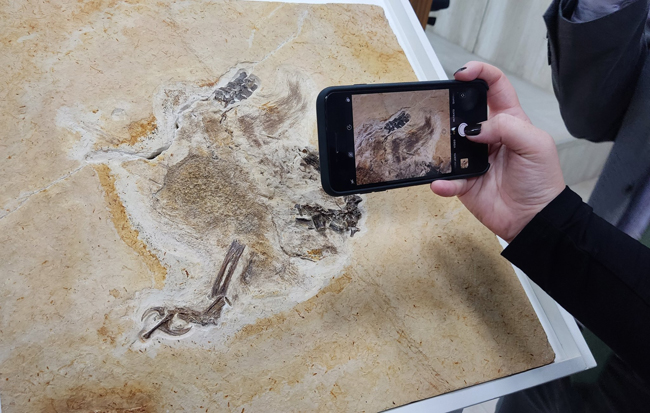
Photographing the Ubirajara fossil specimen (counter slab).
Taking photographs of the Ubirajara fossil (counter slab). Picture credit: Juan Cisneros.

The Return of the Ubirajara Fossil Specimen

The social media campaign played a significant role in the successful repatriation. The return of the Ubirajara fossil specimen was achieved through a collaboration with the public, governments and palaeontologists.

A spokesperson commented that this campaign highlights how the public wants to engage and participate with scientific debate. The return of Ubirajara will hopefully inspire other scientists to engage in such campaigns, helping to improve palaeontology by making it more inclusive, fair and ethical.

Everything Dinosaur acknowledges the assistance of a media release from the Federal University of Rio Grande do Norte in the compilation of this article.

Visit Everything Dinosaur’s website: Everything Dinosaur.

13 06, 2023

A Heteromorph Ammonite Fossil on Display

By |2023-06-13T21:55:52+01:00June 13th, 2023|Categories: Dinosaur Fans, Everything Dinosaur Products, Geology, Main Page, Photos/Pictures of Fossils|0 Comments

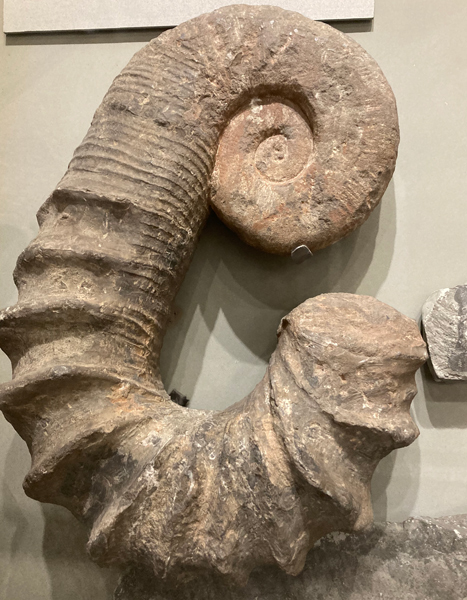
Most ammonites had planispiral shells. However, throughout the course of the long evolutionary history of these remarkable and diverse cephalopods a huge variety of shell forms evolved. Everything Dinosaur team members spotted a stunning example of a heteromorph ammonite on display in the fossils gallery at the Manchester Museum.

Heteromorph ammonite.
A heteromorph ammonite fossil part of an exhibit showing the huge variety of ammonite fossil shells at the Manchester Museum. Most heteromorph ammonites evolved in the Cretaceous. Picture credit: Everything Dinosaur.

Picture credit: Everything Dinosaur

Heteromorph Ammonites

If asked to draw an ammonite shell, most people would sketch a tightly coiled shell, in a single plane with the diameter of each successive whorl getting bigger. This is a description of a typical ammonite planispiral shell. This would be an example of a homomorph shell. During the Late Jurassic, several new types of ammonite began to appear with varying degrees of uncoiled shells.

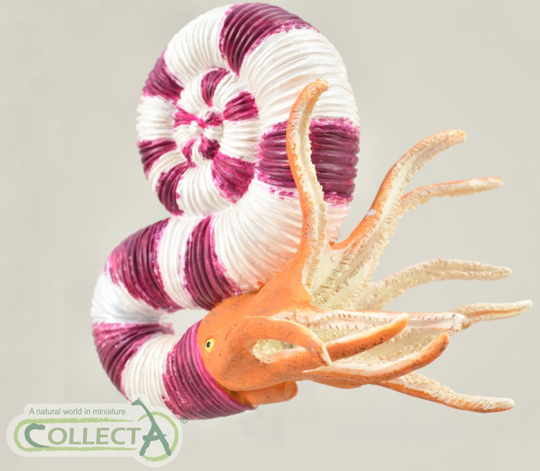
CollectA Pravitoceras model.
The colourful heteromorph ammonoid model – CollectA Pravitoceras. This model was introduced by CollectA in 2021.

The picture (above) shows the colourful CollectA Pravitoceras ammonite model. This figure was added to the CollectA model range in 2021. The CollectA Age of Dinosaurs series includes numerous extinct invertebrates. Trilobites, nautiloids, belemnites and ammonites are included in this substantial range.

To view the range of CollectA not-to-scale figures: CollectA Age of Dinosaurs Popular Models.

These types of ammonites (heteromorph ammonites), became increasingly abundant during the Cretaceous and by the Late Cretaceous they were widespread and extremely diverse with a myriad of different types occupying marine environments.

Important Zonal Fossils (Heteromorph Ammonite Types)

Heteromorph ammonites were extremely numerous by the end of the Cretaceous. Many genera have become important zonal fossils. Both homomorph and heteromorph ammonites are used extensively by geologists for zoning strata and for relative dating of rock formations.

Visit Everything Dinosaur’s award-winning website: Everything Dinosaur.

9 06, 2023

Everything Dinosaur Features in Special Blog Post

By |2024-01-02T20:34:38+00:00June 9th, 2023|Categories: Dinosaur Fans, Everything Dinosaur Products, Main Page, Photos of Everything Dinosaur Products, Photos/Pictures of Fossils, Press Releases|0 Comments

Everything Dinosaur team members have been featured in a blog article posted by a fossil collector and organiser of guided fossil walks at Lyme Regis. Brandon Lennon wrote about the ammonite figures that we supplied him. These models make excellent teaching resources when explaining about the creatures that the Lyme Regis ammonite fossils represent.

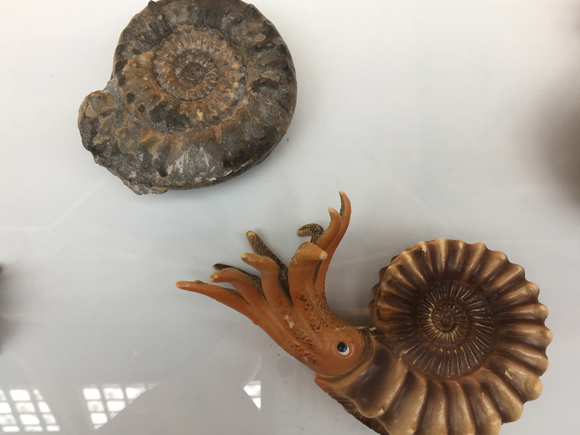
We spotted a Bullyland ammonite model being used to help illustrate a display of ammonite fossils. Ammonite replicas are often purchased by fossil hunters.
A Bullyland ammonite model is used to help illustrate a display of ammonite fossils. Picture credit: Everything Dinosaur.

Picture credit: Everything Dinosaur

Ammonite Models

Ammonite models supplied by Everything Dinosaur can be spotted in museums. Palaeontologists use them in their science outreach work. Fossil collectors like to display the models next to ammonite fossils.

The Bullyland, large ammonite model is a popular choice amongst palaeontologists and fossil collectors.

To view the Bullyland range of prehistoric animal figures: Bullyland Prehistoric Animal Figures and Models.

Brandon Lennon leads guided fossil walks in the Lyme Regis and Charmouth areas. These walks are extremely well attended, and Brandon uses the ammonite figures to help explain a little about these enigmatic cephalopods.

The blog article states:

“Thanks to Mike and Sue at Everything Dinosaur! I received a great parcel from them that will help me no end on the Jurassic Coast fossil walks! They have provided some ammonite models to show the morphology of an ammonite with! The Bullyland ammonite proves helpful when it comes to explaining how fossils are interpreted and a “living” animal reconstructed. See everythingdinosaur1 for its amazing array of educational models they are on Instagram. See the ammonite models on their Instagram page and much, much more!”

To view the website of Brandon Lennon and perhaps, pick up a fantastic fossil or two: Lyme Regis Fossils for Sale.

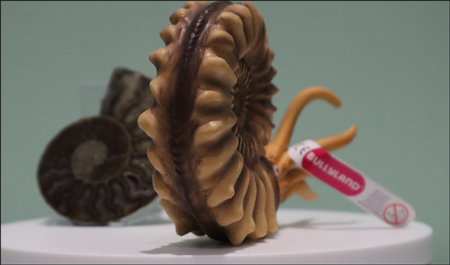
Ammonite model next to a fossil specimen.
The strongly ribbed shell and the obvious keel of the ammonite replica. Picture credit: Everything Dinosaur.

Picture credit: Everything Dinosaur

Thanks from Everything Dinosaur

The Everything Dinosaur spokesperson, thanked Brandon for his blog post. We wish Brandon every success with this season’s guided fossil walks. Perhaps, one lucky participant will find some ichthyosaur bones!

Visit Everything Dinosaur’s award-winning website: Everything Dinosaur.

6 06, 2023

Several Different Spinosaurs in the Wealden Supergroup

By |2023-06-09T08:34:21+01:00June 6th, 2023|Categories: Adobe CS5, Dinosaur Fans, Main Page, Palaeontological articles, Photos/Pictures of Fossils|0 Comments

Researchers from the University of Southampton studying a partial spinosaurid tooth have concluded that several different spinosaurs inhabited southern England during the Early Cretaceous. The tooth consisting of a crown with a partial root is reputed to have come from East Sussex, most probably from Lower Cretaceous (Valanginian) exposures of the Hastings Group (part of the Wealden Supergroup). If this is the case, then this tooth is amongst the oldest spinosaurid fossils known from the UK.

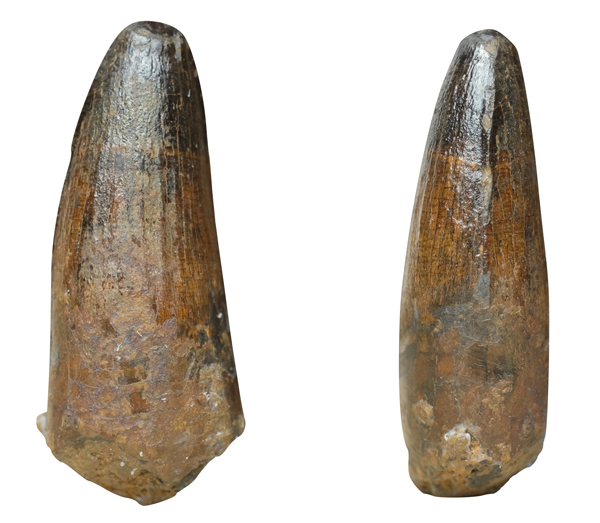
Spinosaurid tooth.
The spinosaurid tooth (specimen number HASMG G369a) shown in lingual view (left) and mesial view (right). Picture credit: University of Southampton.

Sorting the Stratigraphy

In common with many other isolated teeth found in strata associated with the Wealden Supergroup, it had been suggested that this tooth represented Baryonyx (B. walkeri). However, The Hastings Group underlies the Weald Clay Group from where the famous Baryonyx walkeri fossil material (NHMUK PV R9951) originates. Therefore, this fossil tooth is much older than the Baryonyx holotype material.

The fossil tooth could be around 138 million years old, much older than Baryonyx walkeri and therefore probably a different spinosaurid genus.

The Southampton University EvoPalaeoLab team carried out a series of tests on the isolated tooth. A statistical analysis confirmed that whilst the tooth was spinosaurid, it did not match any already described spinosaur species.

Project supervisor and co-author of the paper Dr Neil Gostling (University of Southampton explained:

“While we can’t formally identify a new species from one tooth, we can say this spinosaur tooth doesn’t match any of the existing species we know about. Given how many individual teeth exist in collections, this could be just the tip of the iceberg and it’s quite possible that Britain may have once teemed with a diverse range of these semi-aquatic, fish-eating dinosaurs.”

Many Different Spinosaurs

The Wealden Supergroup is famous for its dinosaur fossils. Baryonyx was discovered in a Surrey clay pit in 1983. Since then, isolated teeth from spinosaurids have tended to be assigned to this genus. Spinosaurids are a highly derived group of theropods. They evolved into piscivores and specialised in hunting and eating fish. Their jaws became elongated and crocodile-like and spinosaurids may have had their evolutionary origins in Europe.

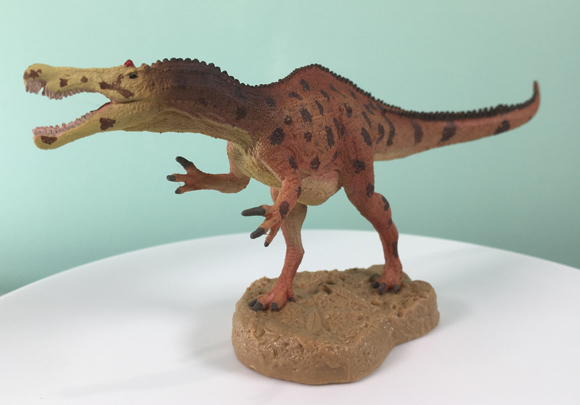
CollectA Baryonyx dinosaur model.
The CollectA new for 2020 Prehistoric Life Baryonyx dinosaur model. Picture credit: Everything Dinosaur.

Picture credit: Everything Dinosaur

The model (above) is a CollectA Prehistoric Life Baryonyx figure.

To view this model range: CollectA Prehistoric Life Models and Figures.

Different Spinosaurs Represented by Fossils

Palaeontologists had suspected that there were several spinosaurid taxa represented by the Wealden Supergroup material. Spinosaurid teeth are known from formations that span much of the circa 25-million-year depositional history of the Wealden Supergroup, and recent works suggest that British spinosaurids were more taxonomically diverse than previously thought.

To read about two recently described, geologically younger spinosaurids from the Isle of Wight: Two New Spinosaurids from the Isle of Wight.

Lead author of the study, Chris Barker commented:

“We used a variety of techniques to identify this specimen, in order to test whether isolated spinosaur teeth could be referred to Baryonyx. The tooth did not group with Baryonyx in any of our data runs. It must belong to a different type of spinosaur.”

Distinct and Distantly Related Spinosaurids Lived in Southern England

The results demonstrate that distinct and distantly related spinosaur types lived in the region during the Early Cretaceous. This backs up research by the EvoPalaeoLab team, who argued in previous studies that the spinosaurs of southern England are more diverse than previously thought.

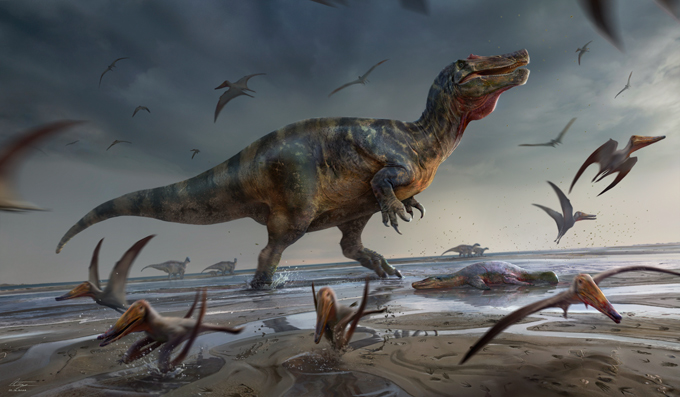
To read about the “White Rock” spinosaur announced in 2022, possibly one of the biggest theropods known from Europe: Super-sized Carnivorous Dinosaur from the Isle of Wight.

Illustration of White Rock spinosaurid.
Illustration of White Rock spinosaurid. Picture credit: University of Southampton/Anthony Hutchings.

The Importance of Museum Collections

The study was able to take place as the researchers had access to a wealth of data as well as the fossil specimens themselves. It demonstrates the importance of maintaining access to fossil material for research purposes.

Dr Gostling explained:

“What this work highlights is the importance of keeping collections alive, and developing our understanding of them. Curators are essential to help us navigate the cupboards and displays, helping us to unpick the often-incomplete records – either never fully recorded, or lost to time. The diversity of palaeoenvironments is not always hidden in rocks, it is often waiting in a museum, its importance waiting to be rediscovered!”

Co-author Darren Naish added:

“Dinosaur teeth preserve numerous anatomical details, and we can use various analytical techniques to see how similar, or different, they are to other teeth. Our new study shows that previously unrecognised spinosaur species exist in poorly known sections of the Wealden’s history, and we hope that better remains will be discovered that improves our knowledge. Here’s another reminder that even well-studied places like southern England have the potential to yield new dinosaur species.”

Everything Dinosaur acknowledges the assistance of a media release from the University of Southampton in the compilation of this article.

The scientific paper: “Isolated tooth reveals hidden spinosaurid dinosaur diversity in the British Wealden Supergroup (Lower Cretaceous)” by Chris T. Barker, Darren Naish and Neil J. Gostling published in PeerJ.

Visit Everything Dinosaur’s award-winning website: Everything Dinosaur.

1 06, 2023

Amazing Tenontosaurus Gastroliths on Display

By |2024-01-02T20:32:47+00:00June 1st, 2023|Categories: Dinosaur and Prehistoric Animal Drawings, Dinosaur Fans, Main Page, Photos/Pictures of Fossils|0 Comments

A return visit to the Manchester Museum permitted Everything Dinosaur team members to take a photograph of the Tenontosaurus gastroliths that form part of a new dinosaur exhibit at the Museum. The gastroliths (stomach stones) were found in the body cavity of a Tenontosaurus tilletti specimen discovered in Montana in 1994.

Tenontosaurus gastroliths.
The gastroliths associated with “April” the Tenontosaurus specimen on display at the Manchester Museum. Picture credit: Everything Dinosaur.

Picture credit: Everything Dinosaur

The specimen (MANCH LL.12275) was acquired by the Manchester Museum in 1999 and a recently opened exhibit has permitted the fossil bones of this dinosaur to be displayed. The fossil material represents one of the best-preserved and most complete examples of Tenontosaurus tilletti known to science.

Everything Dinosaur's illustration of "Sinew Lizard"
Tenontosaurus drawing. An illustration of the Early Cretaceous iguanodontid Tenontosaurus tilletti. Picture credit: Everything Dinosaur

Picture credit: Everything Dinosaur

The Tenontosaurus illustration (above) is based on the CollectA Age of Dinosaurs Popular Tenontosaurus model.

To view this extensive range of prehistoric animal figures: CollectA Prehistoric Life Models.

Tenontosaurus Gastroliths

This amazing dinosaur fossil was nicknamed “April” after the wife of Barry James who cleaned and prepared the fossils for exhibition. Gastroliths (stomach stones) were found in the body cavity of this dinosaur. Some dinosaurs swallowed stones to help them grind up tough plants and aid digestion. These stones were held in a gizzard and helped to break down plant-material and assisted in the extraction of nutrients.

Only a handful of examples of stomach stones associated with ornithopods have been recorded. “April” the Tenontosaurus is the largest ornithopod dinosaur known to science associated with gastroliths.

Tenontosaurus dinosaur fossil on display at the Manchester Museum.
“April” the Tenontosaurus on display at the Manchester Museum. Picture credit: Everything Dinosaur.

Picture credit: Everything Dinosaur

“April” the Tenontosaurus is part of a new, permanent display highlighting research conducted by Manchester University scientists into the Dinosauria.

Visit Everything Dinosaur’s award-winning website: Everything Dinosaur.

31 05, 2023

A Classic Victorian Stegosaur Model

By |2024-01-02T20:10:06+00:00May 31st, 2023|Categories: Dinosaur Fans, Main Page, Photos, Photos/Pictures of Fossils|0 Comments

A team member from Everything Dinosaur spotted an unusual stegosaur replica on display at the Manchester Museum. The label next to the armoured dinosaur figure stated that this was a Victorian stegosaur model. The model must indeed be old, as stegosaurs such as Stegosaurus stenops are viewed very differently by palaeontologists today.

Victorian Stegosaurus Model
A model of a stegosaur in a display cabinet in the fossils and dinosaurs gallery at the Manchester Museum. Picture credit: Everything Dinosaur.

Picture credit: Everything Dinosaur

Stegosaurus stenops

The fossilised remains of an immature Stegosaurus stenops is on display at the Natural History Museum in London. The dinosaur, nicknamed Sophie comes from Wyoming and the fossil material represents one of the most complete stegosaur fossils known to science. The skeleton consists of more than three hundred bones.

The London Natural History Museum exhibit shows a modern interpretation of this iconic herbivorous dinosaur.

Everything Dinosaur stocks a large number of armoured dinosaur figures and models.

To view the models of prehistoric animals including armoured dinosaurs available from Everything Dinosaur: Dinosaur and Prehistoric Animal Figures.

Sophie the Stegosaurus at the London Natural History Museum
Sophie the Stegosaurus (S. stenops), a star exhibit at the London Natural History Museum. This is a modern interpretation of this iconic armoured dinosaur. Picture credit: Everything Dinosaur.

The Victorian Stegosaur Model

The Victorian stegosaur model provides a reminder to visitors about how are views of the Dinosauria have changed. The side of the figure facing the public has been fleshed out, whilst the side which is not visible shows the animal’s skeleton. Note the bones of the lower portions of the limbs on the right side which are visible in the photograph.

A spokesperson from Everything Dinosaur commented:

“This Victorian dinosaur model is not an accurate representation of a Stegosaurus. However, it does remind us how dinosaurs used to be depicted. It acts as bellwether informing visitors about how our views regarding dinosaurs such as Stegosaurus have changed over time.”

Visit the award-winning Everything Dinosaur website: Everything Dinosaur.

25 05, 2023

Rare Diprotodon Fossils on Display

By |2024-01-02T20:15:32+00:00May 25th, 2023|Categories: Adobe CS5, Main Page, Photos/Pictures of Fossils|0 Comments

Whilst on a short visit to the London Natural History Museum Everything Dinosaur team members took some photographs of the Diprotodon fossils on display. Diprotodon (D. optatum) is the largest marsupial known to science. Males measured around 1.8 metres high at the shoulder. Their body length was approximately 4 metres, and the largest specimens are thought to have weighed up to 3,500 kilograms. Females were smaller than males.

Diprotodon fossils - the skeleton.
An extinct giant. The fossil skeleton of Diprotodon the largest marsupial known to science. Picture credit: Everything Dinosaur.

Picture credit: Everything Dinosaur

Diprotodon Fossils

Diprotodon (pronounced dip-pro-toe-don) was part of the Australian “megafauna” of the Pleistocene. The genus name is from the ancient Greek meaning “two protruding front teeth”. It is thought that this rhino-sized marsupial became extinct 40,000 years ago. At this time, Australia’s climate changed. It became much more arid. This climate change is thought to have been the main cause for their extinction. However, hunting from the first Aboriginal Australians cannot be ruled out.

Diprotodon replica.
A replica of the largest marsupial known to science Diprotodon on display at the London Natural History Museum. Picture credit: Everything Dinosaur.

Picture credit: Everything Dinosaur

The picture (above) shows a replica of Diprotodon on display alongside Diprotodon fossils at the London Natural History Museum. There are very few Diprotodon models/toys available. It is rare for examples of ancient marsupials to made into replicas by mainstream model manufacturers.

To view a range of prehistoric animal figures that does include replicas of prehistoric mammals: CollectA Deluxe Scale Prehistoric Animal Models.

Syndactylous Feet

Diprotodon is part of the Order Diprotodontia, which includes, wombats, kangaroos, koalas and possums. Syndactylous feet are a trait of the extant Diprotodontia and also assumed to be present in Diprotodon. The second and third toes are fused together. It is thought that Diprotodon also had fused second and third toes.

Diprotodon fossils - the hind feet.
The toes on the robust feet of Diprotodon curve inwards. This is thought to have been an evolutionary trait passed onto these huge animals from their fossorial ancestors. The second and third toes were probably fused (syndactylous feet). Picture credit: Everything Dinosaur.

Picture credit: Everything Dinosaur

Visit the award-winning Everything Dinosaur website: Visit the Everything Dinosaur website.

20 05, 2023

“April” the Tenontosaurus Dinosaur Fossil on Display

By |2023-05-28T06:52:42+01:00May 20th, 2023|Categories: Dinosaur Fans, Main Page, Photos/Pictures of Fossils|0 Comments

Everything Dinosaur took a break from picking and packing orders to visit the recently refurbished Manchester Museum. One of the new exhibits is “April” the Tenontosaurus dinosaur fossil. The display includes actual fossil bones of a Tenontosaurus, and the exhibit depicts this ornithischian dinosaur as a quadruped.

Tenontosaurus dinosaur fossil on display at the Manchester Museum.
“April” the Tenontosaurus on display at the Manchester Museum. Picture credit: Everything Dinosaur.

Picture credit: Everything Dinosaur

An Important Dinosaur Fossil Specimen

The fossils were discovered on private land in Montana, USA back in 1994 and acquired by the University of Manchester in 1999. The fossils (specimen number MANCH LL.12275) represent one of the best-preserved and most complete Tenontosaurus tilletti known to science. The specimen was originally displayed as a biped. The dinosaur was posed rearing up on its hind legs. During the conservation work to prepare the fossils for display, researchers demonstrated that this dinosaur spent most of its time walking on all fours.

It was named “April” after the wife of Barry James who originally prepared this stunning fossil dinosaur for exhibition.

CollectA Tenontosaurus model.
The CollectA Age of Dinosaurs Tenontosaurus model.

The picture (above) shows a CollectA Tenontosaurus dinosaur model. To view the range of CollectA not-to-scale prehistoric animal models: CollectA Prehistoric Life Models.

Gastroliths

Gastroliths (stomach stones) were found in the body cavity of this dinosaur. Some types of dinosaur swallowed stones to help them grind up tough plants and aid digestion. These stones were held in a gizzard and helped to break down plant-material and assisted in the extraction of nutrients.

Only a handful of examples of gastroliths being associated with ornithopods have been reported. “April” the Tenontosaurus is the largest ornithopod dinosaur known to science associated with gastroliths.

To read about recent research on this important iguanodontian specimen: “April” the Tenontosaurus Reveals Her Secrets.

Tenontosaurus Dinosaur Fossil

“April” the Tenontosaurus dinosaur fossil has been granted her own special display area. There are plenty of information panels informing visitors about the dinosaur and highlighting important areas of research. The gastroliths are on display too. It is only when visitors get close to the fossils that they can appreciate the impressive length of the dinosaur’s tail.

Whilst the dinosaur might be nicknamed “April”, Everything Dinosaur team members are uncertain as to whether there has been any research to identify whether the bones do indeed represent a female.

A Tenontosaurus dinosaur fossil on display.
The length of the tail of Tenontosaurus can be appreciated. The Tenontosaurus known as “April” exhibited at the Manchester Museum. Picture credit: Everything Dinosaur.

Picture credit: Everything Dinosaur

A spokesperson from Everything Dinosaur praised the Manchester Museum for its excellent Tenontosaurus dinosaur fossil display and commented on the friendliness of the staff.

Visit Everything Dinosaur’s award-winning website: Everything Dinosaur.

16 05, 2023

A Spectacular Tyrannosaur Dentary

By |2024-01-02T20:18:37+00:00May 16th, 2023|Categories: Adobe CS5, Dinosaur Fans, Main Page, Photos/Pictures of Fossils|0 Comments

Dinosaur fans will know that there were many different tyrannosaur taxa. Whilst on a visit to a museum, an Everything Dinosaur team member spotted a tyrannosaur dentary. The theropod jawbone was located away from the Tyrannosaurus rex exhibit. The fossil represents a member of the Tyrannosauridae family. The fossil is from a Daspletosaurus. The accompanying information did not state the species.

Daspletosaurus dentary.
A Daspletosaurus dentary on display at a museum (Natural History Museum London). Picture credit: Everything Dinosaur.

Daspletosaurus

Daspletosaurus roamed western North America (Laramidia) during the Late Cretaceous (Campanian faunal stage). Several species have been assigned to this genus. The genus was erected in 1970 (D. torosus). Subsequently, other species have been assigned including Daspletosaurus horneri in 2017 and Daspletosaurus wilsoni (2022).

To read about the naming of Daspletosaurus horneri: New Species of Daspletosaurus Announced.

For an article on the recently described: Daspletosaurus wilsoni: New Daspletosaurus Species Named.

There remains some uncertainty as to the taxonomic position of several tyrannosaur specimens known from the Late Cretaceous of North America.

Drawing of Daspletosaurus.
Larger tyrannosaur present in the Late Cretaceous ecosystem. An illustration of Daspletosaurus. Picture credit: Everything Dinosaur.

Picture credit: Everything Dinosaur

The picture (above) depicts a Daspletosaurus based on the CollectA model. To view this range of models and figures: CollectA Age of Dinosaurs Prehistoric Animal Models.

The Tyrannosaur Dentary

The tyrannosaur jawbone (right dentary) depicts the typical D-shaped crowns associated with these theropods. A total of ten teeth can be viewed in the jawbone (buccal view). The buccal view shows the side of the jaw that is adjacent to the cheek.

Although Daspletosaurus was a large and powerful hunter, the lower jaw is less robust than the fossils associated with Tyrannosaurus rex.

A spokesperson from Everything Dinosaur commented:

“The dentary is in an exceptional state of preservation. Museum visitors could easily overlook this excellent tyrannosaur dentary. However, fossils such as these can tell palaeontologists a lot about the Daspletosaurus genus and theropod dinosaurs in general.”

Visit Everything Dinosaur’s award-winning website: Everything Dinosaur.

6 05, 2023

Rare Fossil Sturgeon Scute Discovered in Morocco

By |2024-01-02T20:22:49+00:00May 6th, 2023|Categories: Adobe CS5, Dinosaur and Prehistoric Animal News Stories, Geology, Main Page, Palaeontological articles, Photos/Pictures of Fossils|0 Comments

The discovery of a fossil sturgeon scute demonstrates that these “royal fish” were present in North Africa during the Late Cretaceous. The single, fossil scute is the first ever sturgeon fossil to have been found in Africa. The scute is a bony plate embedded into the sturgeon’s skin. Scutes provided a form of dermal armour that evolved to help protect these very ancient fish.

Sturgeon fossil scute.
A digital photo of the sturgeon scute (also called buckler) specimen. Picture credit: University of Portsmouth.

A Significant Fossil Discovery

The sturgeon (there are more than two dozen extant species), belongs to the Acipenseriformes Order, which probably originated in the Late Triassic. Sturgeon fossils which are very similar to extant species, are known from Upper Cretaceous strata. Historically, they are associated with cooler waters of the Northern Hemisphere. The specimen was discovered by Professor David Martill (University of Portsmouth). It proves that these magnificent fish were present in Africa.

Sturgeons were more widespread in the Cretaceous than previously thought.

A European sturgeon.
An extant European sturgeon. Picture credit: University of Portsmouth.

Professor Martill was exploring a well-known Moroccan fossil site during a field trip last November. He spotted a row of bony plates (bucklers) on a piece of rock and instinctively recognised the fossils represented the scutes from a sturgeon.

Discussing this significant fossil find, the Professor commented:

“It was a surprising discovery because all sturgeon species have been exclusively found in the Northern Hemisphere in the past. They’ve been located in North America, Europe, Russian Asia, Chinese Asia, but never in South America, Australia, Africa or India, which are the land masses that made up Gondwana, a supercontinent that existed around 336 million years ago and began breaking up around 150 million years ago.”

Extant sturgeon diagram.
A drawing showing an extant sturgeon in lateral view. The different scutes are highlighted. Picture credit: University of Portsmouth.

A “Royal Fish”

The sturgeon has long been prized for its meat and for its roe (eggs). The roe is commonly referred to as caviar. King Edward II of England declared that all sturgeon from the waters of Wales and England belong to the monarch. This declaration was made in the early 14th century. Since then, these fish have been regarded as “royal fish”.

Sadly, due to overfishing and pollution, many species of extant sturgeon are close to extinction.

Commenting on his African fossil discovery Professor Martill stated:

“Russian beluga caviar is one of the most expensive in the world. Little did we know that at one time an extremely rare African sturgeon could have been a source of this delicacy!”

Sturgeon fossil scute.
A digital photo of the dorsal surface of the fossil. Note the scale bar of 20 mm. Picture credit: University of Portsmouth.

Fossil Sturgeon Scute

Sturgeon are thought of as being “living fossils”, for they seem to have remained relatively unchanged since the time of Tyrannosaurus rex and Triceratops. Records from the 18th and 19th centuries indicate specimens reaching more than seven metres in length and weighing over 1.5 tonnes, but fish of this size are exceedingly rare today.

Professor Martill added:

“The very first sturgeons appear in the fossil record in the Late Triassic period in China. But the oldest true sturgeon ever discovered is probably a specimen in the Steve Etches collection from Dorset’s Jurassic Coast in England, which is mentioned in a book Steve and I wrote about fossils in the Kimmeridge Clay Formation.”

The discovery of a sturgeon fossil in Morocco complicates models of the geographical distribution of these fish during the Late Cretaceous.

A fossil sturgeon scute indicates that these ancient fish lived in Africa.
A map of the continents at the end of the Cretaceous (66 million years ago). Sturgeon fossil localities are marked by solid black circles. Picture credit: University of Portsmouth

The fossil specimen is now in the collection of the University King Hassan II, Casablanca.

Everything Dinosaur acknowledges the assistance of a media release from the University of Portsmouth in the compilation of this article.

The scientific paper: “A sturgeon (Actinopterygii, Acipenseriformes) from the Upper Cretaceous of Africa” by David M. Martill published in Cretaceous Research.

Visit Everything Dinosaur’s award-winning website: Everything Dinosaur.

Go to Top