All about dinosaurs, fossils and prehistoric animals by Everything Dinosaur team members.
15 02, 2008

Rare Ancient Carnivores Uncovered In Niger – Paul Sereno Strikes Again!

By |2024-04-11T10:35:59+01:00February 15th, 2008|Categories: Dinosaur and Prehistoric Animal News Stories, Main Page|0 Comments

Ancient Carnivores of Gondwanaland – Ancestors of the Biggest Meat-eaters of All

A team of palaeontologists from the University of Chicago led by Paul Sereno have published papers on two new carnivores from Gondwanaland, the ancestors of the biggest dinosaur meat-eaters of all.

These two dinosaurs date from the Albian fauna stage of the Lower Cretaceous (approximately 110 million years ago), one was possibly a specialist scavenger, the other a fierce predator, with teeth designed to tackle live prey.  The University of Chicago team have had their work published in the scientific journal Acta Palaeontologica Polonica. The paper has been co-authored by Paul Sereno and Stephen Brusatte.  Stephen, who worked with Dr Sereno as an undergraduate at the University of Chicago and is now based in Britain, commented on the importance of these two finds.   He stated that the different dentition and shape of the skulls gave the scientists an insight into the type of food these animals ate, comparing the 110 million year old fossils to the type of ecosystem found on the Masai Mara with Hyenas and Lions.

The partial, incomplete fossil skeletons were first unearthed in 2000, in the African country of Niger.  Niger has proved to be a lucrative hunting ground for the University of Chicago with Dr Sereno being responsible for a number of prehistoric animal discoveries.

The dinosaurs have been named Kryptops palaios (means old hidden face) and Eocarcharia dinops (means fierce-eyed dawn shark).  Kryptops had a horny ridge covering much of its snout, the blunt muzzle and the relatively small but sharp teeth indicate that this animal may have specialised in scavenging the kills of other predators.  Eocarcharia was about the same size as Kryptops at about 8 metres long and standing 2.2 metres at the hips, it also had a bony brow, typical of the Allosauroidea family.  The re-curved and very sharp teeth of Eocarcharia indicate that this animal was a predator, tackling live prey.  Perhaps Eocarcharia hunted Nigersaurus, the strange long-necked herbivore that may have grazed like a cow.  Nigersaurus has also been researched by Paul Sereno and other scientists from the University of Chicago.

To read more about the peculiar dinosaur Nigersaurus: Nigersaurus – the Dinosaur that grazed like a Cow

The 2000 expedition turned out to be a triumph for the University. Their team found bones from about a dozen new species of prehistoric animals and for good measure the University staff also uncovered one of the richest archaeological sites that has been found in the area.

Dr Sereno is hoping that the Niger Government will build a museum to house some of his discoveries from the area, an important ecosystem during the early Cretaceous, as this part of Gondwanaland was close to the location of the the rift in the southern super-continent that led to the formation of the Atlantic ocean.

Kryptops palaios is depicted as a potential member of the abelisaurs, this dinosaur is shown as having tiny forelimbs, proportionately even smaller than Tyrannosaurus rex.  The four-fingered hands are so small, scientists are unsure what use they would have been to this animal, perhaps like the tyrannosaurs of the northern landmasses the abelisaurs evolved fore-shortened limbs to counterbalance the weight of their large skulls.

Abelisaurs are predominately associated with Gondwanaland.  These large theropods had deep skulls but relatively light lower jaws and the teeth may have been better suited to gnawing and raking flesh from a carcase than attacking other animals.  Perhaps abelisaurs had their own peculiar hunting strategies which scientists have not worked out yet.

The best known abelisaur is probably Carnotaurus (means “meat-eating bull”), which again dates from the Albian faunal stage of the Cretaceous (110 million years ago).  Unlike Kryptops, Carnotaurus heralds from the land that was to become Argentina, its fossils have been found in South America, so it lived on the other side of the geological rift that was opening up to form the Atlantic.

Carnotaurus Model (Natural History Museum)

Abelisaurid Carnotaurus dinosaur model.

Picture credit: Everything Dinosaur

To view a model of Carnotaurus and other dinosaurs:  Dinosaurs and Prehistoric Animal Models.

Eocarcharia may well turn out to be a member of the allosaur family.  Allosaurs died out as the Cretaceous progressed, gradually being replaced by the abelisaurs and tyrannosaurs although a number of different Allosaurs survived as “living fossils” on the southern landmasses.  The allosaur group may have given rise to the largest meat-eating land animals ever, animals such as Carcharodontosaurus (means “shark-toothed lizard”) and Giganotosaurus.  These giant theropods from Gondwanaland may have grown to lengths of more than 45 feet and weighed 8 Tonnes, making them bigger than Tyrannosaurus rex.  Eocarcharia might be an ancestor of these animals.

Eocarcharia shows typical allosaur-like features with grasping three-fingered hands, an “S” shaped neck and powerful hind legs.  The mighty Giganotosaurus may well have evolved from animals similar to Eocarcharia, so this 8 metre theropod could claim to have a direct link to the largest meat-eating dinosaurs known to date.

Giganotosaurus was a massive animal, capable of picking up a medium sized iguanodontid in its huge jaws.  Its skull was twice the size of the North America Allosaurus from the famous Morrison Formation of the Upper Jurassic of Utah.

To see dinosaur toys and other prehistoric animal themed items: Visit Everyything Dinosaur.

Giganotosaurus means “Giant Southern Lizard” and along with other giants such as Mapusaurus it must have terrorised the other animals around at the time.

Chicago Field Museum dinosaur curator Peter Makovicky commented that the discoveries provided scientists with information on how the break up of Gondwanaland may have affected ecosystems and shed more light on continental drift.

“A lot of people think it’s T. rex, it’s Stegosaurus, it’s Triceratops,’’ he said, but it’s much more than that. “Dinosaurs roamed the earth for 100 million years. We are continuously finding more and more and learning more and more from them.’’

Certainly for Paul Sereno and his team, Niger has proved to be a great place to look for new dinosaurs.
14 02, 2008

Viva Mexico – New Duck Billed Dinosaur Discovered “South of the Border”

By |2023-02-24T22:11:06+00:00February 14th, 2008|Categories: Dinosaur and Prehistoric Animal News Stories, Main Page|0 Comments

New Cretaceous Duck-Billed Dinosaur – Was it a Trumpeter?

A multi-national team of scientists from the University of Utah, the Museo del Desierto in Saltillo in Mexico and the Royal Tyrrell Museum from Alberta, Canada have published a description of a new dinosaur species, the first, truly “Mexican Dinosaur” to be described,  in the Journal of Vertebrate Paleontology.

Velafrons coahuilensis

This new dinosaur has been named Velafrons coahuilensis, a hadrosaur and a probable member of the lambeosaurine group of crested duck-bills.  The very long, extended nasal passages have led scientists to speculate that this animal could have made loud, trumpeting calls.  Much work has already been carried out on the complex nasal passages of lambeosaurine hadrosaurs, the ones with the flamboyant crests.

These large herbivorous dinosaurs may have lived in vast herds and the crests could have been used to distinguish males from females, identify social status in the herd and for display by males (scientists believe the males of many lambeosaurines like Parasaurolophus and Corythosaurus had bigger crests than females).

Duck-billed Dinosaur

The new dinosaur dates from around 72 million years ago (Maastrichtian faunal stage) and although much is known about the dinosaur based ecosystems of parts of the Americas from this time, little is known about the flora and fauna of Mexico.  Sea levels were high during the Late Cretaceous and the sea flooded much of north America from the Gulf of Mexico to the Arctic circle.  Much of the continent of north America we know today was covered by a warm, shallow sea.  The sea separated two areas of land, a narrow strip to the west called Laramidia  and the larger area of land to the east known as Appalachia.

This new specimen has been removed from sediments that were formed where an estuary washed material out into a shallow bay.  It is hoped that many more dinosaur fossils will be found in the locality.

Had flood events occurred there may be a number of dinosaur bone beds waiting to be discovered, providing more information on Velafrons plus the other animals that shared its habitat at the end of the Cretaceous.  Velafrons means “sailed forehead”, this dinosaur has been named after the unique crest on the beautifully reconstructed skull, that took volunteer Jerry Golden of the University of Utah, two years to piece together from the remains extracted from the extremely hard matrix.

Scientists were struck by this dinosaur’s amazing crest, believing it exemplifies a radical evolutionary departure in the geometry of dinosaur heads. The nose bone moved to the top of the head, extending the nasal passage up the face an emerging above the eyes.  It is the arrangement of the naris and nasal passages that has caused scientists to speculate that this dinosaur could trumpet!

A Juvenile Specimen

The specimen is a 8-metre-long juvenile, so perhaps the skull crest was even more spectacular in fully grown adults, which palaeontologists have estimated could reach lengths of 11 metres or more.

More research is required on the specimen but the quantity of the bones recovered makes scientists confident that they can learn a lot from this dinosaur, that resembled a Corythosaurus “helmet lizard”.

To see a model of Corythosaurus and other dinosaurs: Dinosaur and Prehistoric Animal Models.

Palaeontologist Martha Carolina Aguillon made the initial discovery in 1995 in the quarries 27 miles west of Saltillo in north-central Mexico. Like many famous dinosaur finds, she stumbled upon the fossil by accident, noticing tail vertebrae sticking out of the ground as she picked up litter after the visit of a school party.

The hard rock proved difficult to shift, much of the fossil was buried under 3-4 metres of sedimentary rocks, but slowly and surely the fossil was extracted and taken to the University of Utah for further study and restoration.

The team’s efforts were well worthwhile as they have managed to recover 75% of the skeleton.  It is hoped future joint expeditions will be sent to this area in order to explore these sediments and hopefully shed more light on Mexico’s Dinosaurs.  One thing is for certain, if there are as beautiful as Velafrons the scientists will not be disappointed.

13 02, 2008

The Important Scientific Classification of Fossils – What’s in a Name (please no more T. Rex)

By |2024-04-11T10:35:09+01:00February 13th, 2008|Categories: Main Page, Palaeontological articles|2 Comments

The Classification and Naming of Fossils – Tyrannosaurus rex

Animals, fungi and plants are arranged by scientists into various groupings to assist with the classification of the vast amount of life on this planet.  Extinct organisms are treated in the same way as extant organisms (those which are around today).  All life on Earth belongs to one of three Kingdoms  Animalia, Plantae and another Kingdom for the Fungi, this is the largest grouping of organisms.  Scientists then further sub-divide organisms into other categories, organising creatures, plants and fungi in such a way that common features lead to organisms being associated together until an individual species is defined.  This is the accepted method of classifying life (although cladistics has added a new dimension or two), the principles of this form of classification were laid down by the Swedish botanist Carolus Linnaeus in the 18th century.

The categories of classification from Kingdom down to the species level is referred to as a taxonomic hierarchy.  Organisms should be classified to reflect evolutionary relationships, with each taxon representing organisms that share a common ancestor, very similar to the “Tree of Life” analogy.

A Table Showing the Taxonomy of Tyrannosaurus rex

Taxonomic Hierarchy of Tyrannosaurus rex
Category Taxon Contents of Taxon
Kingdom Animalia All animals
Phylum Chordata All vertebrates (plus some minor groups)
Class Reptilia All reptiles
Order Saurischia All lizard-hipped dinosaurs
Sub-Order Theropoda The “beast footed” dinosaurs mainly carnivores
Family Tyrannosauroidea All Tyrannosaurs and close relatives of Tyrannosaurs
Genus Tyrannosaurus The closest relatives of all to Tyrannosaurus rex
Species Tyrannosaurus rex The individual species known as T. rex

Source: Everything Dinosaur

To be absolutely correct the name of all taxa (the plural for taxon) should begin with a capital letter, except for the individual species name which should always begin with a lower-case letter.  The scientific name for a particular organism consists of two Latin or Latinised words that are always the genus followed by the species classification.  This is termed the binomial.  It ensures that scientists from all over the world can communicate effectively between them when it comes to describing the characteristics of an individual organism.  The genus, such as Tyrannosaurus can be used on its own but the species name i.e. rex without the genus associated with it has no meaning, as some species names apply to more than one genus.  Formerly they should be typed in italics such as Tyrannosaurus rex and indeed this is the method chosen by members of Everything Dinosaur if they were to publish formal papers.  If it is not possible to put the genus and the species in italics (such as in a handwritten report), it is the convention to underline, for example Tyrannosaurus rex.

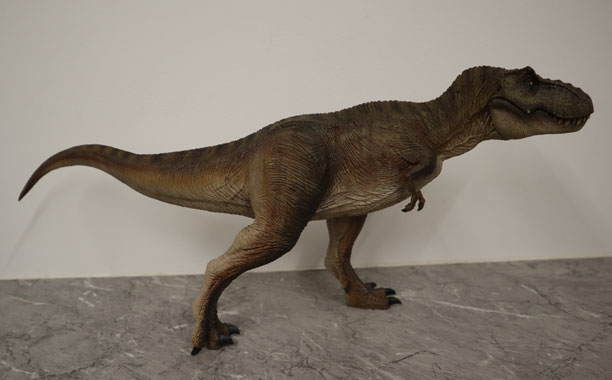
An Example of a Typical Tyrannosaurus rex Model

Nanmu Studio Alpha Tyrannosaurus rex brown in lateral view.

Nanmu Studio Alpha T. rex brown in lateral view.  An example of a typical Tyrannosaurus rex model.

Picture credit: Everything Dinosaur

Everything Dinosaur stocks a huge range of tyrannosaur models and figures including CollectA replicas: CollectA Deluxe Prehistoric Animal Models.

In this way, all scientists, including palaeontologists have a classification framework to use.  However, there are one or two more conventions to consider when classifying and naming animals such as dinosaurs, (or indeed all organisms for that matter).  If a dispute arises as to the naming of an organism then it is convention for the earliest name, the first description, to take precedence.  In this way, the name Brontosaurus was replaced by Apatosaurus.  There have been some notable exceptions to this and T. rex is one of them.

Tyrannosaurus rex

In the late 19th century a good few years before T. rex was named and described by Osborn (1905), the notable American palaeontologist, Edward Drinker Cope described two badly eroded vertebrae as Manospondylus gigas.  This strange honey-combed back bone was different to any other dinosaur fossils found and it was given this name.  One of these bones has since been lost, however, the name stood and if scientific nomenclature was followed, as this bone is believed to represent a Tyrannosaurus rex then T. rex, the “Tyrant Lizard King” should be renamed Manospondylus gigas “Giant Thin Vertebrae” – not quite such an exciting name, I think you will agree.

The debate as to the true name of Tyrannosaurus rex was brought to wider public attention when in 2000 a team from the renowned Black Hills Institute of Geological Research (Pete Larson et al), claimed they had found the original site where Cope had unearthed the weathered fossil bones described as Manospondylus.  Fossils found on this site, presumably from the same specimen that Cope studied almost a Century before turned out to be T. rex so Tyrannosaurus rex should have been renamed based on this evidence.  The International Code of Zoological Nomenclature (ICZN) states that if further remains are found and these are identical to the those of the earlier discovery then the earlier name and description should be used.

This led to much consternation amongst scientists (and amongst Hollywood directors, as Manospondylus sounded nowhere near as cool as Tyrannosaurus rex).  However, in 2000 the ICZN ruled (fourth edition); that T. rex should stay, as the name had been cited in numerous works by many authors and the case of mistaken identity was more than fifty years old.

So it looks like T. rex is going to be able to stay as T. rex.  Now all we have to do is to convince the many authors, designers, artists and manufacturers we work with to use the appropriate scientific guide for stating this animal’s name, stating the species in lower case.  I know we can occasionally have a lapse but really there is no excuse when designing hang tags or packaging of models and other toys.  However, despite our best efforts we will still see Tyrannosaurus Rex printed and written down, when the it is only the genus part of the binomial that should be given a capital letter.

12 02, 2008

New Soft-Touch Giant Pteranodon

By |2022-11-09T11:59:40+00:00February 12th, 2008|Categories: Everything Dinosaur News and Updates, Everything Dinosaur Products, Main Page, Press Releases|0 Comments

New Soft-Touch Pteranodon (Flying Reptile)

Flying reptiles, more correctly termed pterosaurs are very popular with young dinosaur fans and budding palaeontologists.  Although not dinosaurs, these flying reptiles did evolve from archosaurs so they share a common ancestor with the dinosaurs.  Appearing some time in the Triassic, the pterosaurs were the first group of back-boned animals to develop powered flight and they dominated the skies for over 100 million years evolving into all shapes and sizes until the emergence of the birds hastened their decline.

Towards the very end of the Age of Reptiles, the last pterosaurs evolved into giant gliding forms, some with wingspans bigger than a small plane.  Perhaps, the best known of these flying reptiles was Pteranodon, with its toothless beak (the name means toothless flyer) and bizarre bony crest.  Remains of Pteranodon have been found all over the world in North America, England and Asia.  Some species of Pteranodon had wingspans in excess of 9 metres.

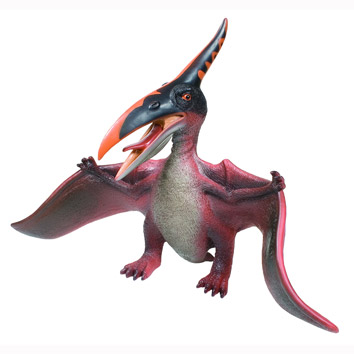
Giant Pteranodon Model

Team members at Everything Dinosaur have been searching for a reasonably accurate model of Pteranodon, this new model, just added to our range is very nicely painted and very detailed.  For example the crest is a bright colour and patterned.  Palaeontologists believe that Pteranodon may have used its crest not only in flight to stabilise it, but also in displays to put off rivals and attract a mate.

The New, Large Pteranodon Figure from Everything Dinosaur

Picture credit: Everything Dinosaur

This figure is moulded in soft-touch plastic, it is easy for a youngster to carry around, soft and squeezy and makes an ideal addition to a young dinosaur fan’s collection.  The wings and body even show texturing, given the impression of fur, as scientists now believe that pterosaurs were warm-blooded and they may have been covered with fur to help insulate their bodies and keep them warm.

To view Everything Dinosaur’s range of dinosaur soft toys: Prehistoric Animal Soft Toys.

The close up of the head shows the fine detail and painting, also it illustrates one of the points crucial to our dinosaur experts and enthusiasts.  The model shows Pteranodon with no teeth, like many later flying reptiles, the teeth were lost, perhaps to lose weight just as birds have lost their teeth as well.  As fossils of Pteranodon have been found in marine sediments, palaeontologists believe this animal was a fish-eater, flying low over the surface of the sea and jabbing its head down to pick up fish at the water’s surface.

To read a post about pterosaur feeding habits: Could Pterosaurs Skim the Water and Snatch Fish?

11 02, 2008

The Potential for Preservation – Potential for Fossil Preservation of Species

By |2022-11-09T11:51:34+00:00February 11th, 2008|Categories: Main Page, Palaeontological articles|1 Comment

What are the chances of an Organism becoming a Fossil?

The fossil record only represents a very small proportion of life in the past.  A number of types of animals and plants can leave a substantial amount of material in the fossil record.  Abundant and diverse creatures with hard body parts such as marine molluscs for example, these animals can be readily fossilised and preserved.  The fact that such creatures have been around for a good few hundred million years (hence being found in lots of strata), adds to the chances of Mollusca being well represented in any fossil fan’s collection.

Looking at the Potential for Fossil Preservation

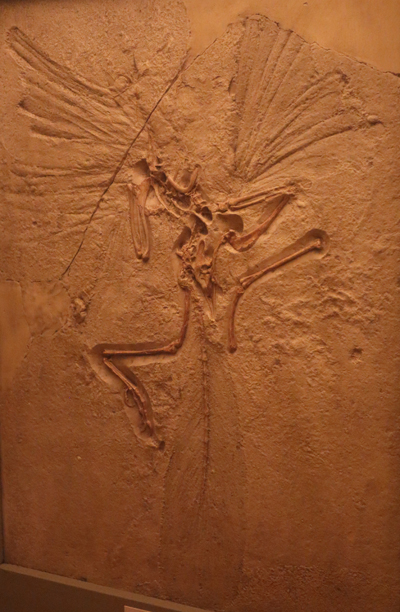
Archaeopteryx fossil cast

Archaeopteryx fossil cast. Picture credit: Everything Dinosaur.

Picture credit: Everything Dinosaur

The chances of some other types of organism being preserved as fossils are much more remote, many soft-bodied organisms such as worms rarely fossilise, although the fossil record provides some evidence of their existence, there are fossils of such creatures in very special sediments such as the Burgess shales in Canada of many marine worm burrows are preserved as trace fossils.

Potential for Fossil Preservation

Some surprising natural processes can favour fossilisation.  For example, plant material caught up in a forest fire has a greater chance of being fossilised than plants which are not.  A portion of the plant material in any fire is not entirely consumed, much may be charred and survive as charcoal.  The plant’s elemental material is effectively “carbonised” and in this state the plant is very unpalatable to herbivores and decay inducing bacteria and fungi.  Think what happens when you put a slice of bread in a toaster, but leave it too long.  The resulting toast is at first browned (water is extracted from the bread leaving a greater degree of the carbon (bread is a source of carbohydrate – made up of carbon and water), then if it is burned, it turns black.  Burnt toast is effectively carbonised bread, you would not want to eat burnt toast and neither would many natural plant eating organisms when faced with partially carbonised semi-charcoal like remains.

This plant material if buried in the appropriate conditions can survive many millions of years, preserving amazing details of the plant cells and tissues.  Electron microscope images of some of the fossilised remains of ancient plants from the Carboniferous (354 million years ago to 290 million years ago), show individual plant cell walls and tissue structures.

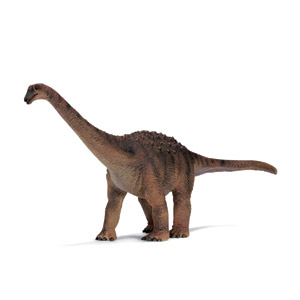
A number of factors can dictate whether an organism is likely to be fossilised or not.  If the organism has hard parts in its skeleton a shell, bones, teeth or an exoskeleton like a trilobite, then there is a much greater chance of the specimen being preserved as a fossil compared to soft-bodied organisms.  Marine organisms or animals living in lakes and other freshwater bodies have a better chance of preservation compared to animals living in drier habitats as the remains have more chance of being covered in sediments, buried and thus preserved.  The actual number of specimens can have an impact on the chances of fossilisation.  As an example, there would be little chance of a Giant Panda’s remains being fossilised as there are only a few hundred left in the wild.  Compare this to a marine snail where there may be millions of individuals representing a species.   Size of the organism can also play apart.  Even a large titanosaur carcase can be broken up by predators and weathering elements.  If the remains of an animal like a Saltasaurus (a relatively modest titanosaur but still weighing more than an African elephant), were to be washed into water by a flood event or such happening then the bones would soon become disarticulated and lost.  It would be unlikely that few parts of the skeleton and other hard elements like the body armour and teeth with this particular creature would be rapidly buried and fossilised.

A model of a Saltasaurus – (Schleich Saltasaurus)

Saltasaurus.

Picture credit: Everything Dinosaur

To view Saltasaurus and other dinosaurs:  Dinosaur and Prehistoric Animal Models.

Compare this large titanosaur to the very much more abundant, tiny micro-fossils such as foraminiferans (shelled, minute protozoans).  Tiny microscopic creatures with hard parts such as shells tend to be much more likely to be preserved.  In terms of the number of individuals preserved the vast majority of the fossil record is made up of micro-fossils.

10 02, 2008

Helpful Half-Term Ideas and Suggestions

By |2024-04-11T10:33:10+01:00February 10th, 2008|Categories: Educational Activities, Everything Dinosaur News and Updates, Main Page|0 Comments

Half-Term Fun – Ideas and Suggestions

With the school half-term holidays getting underway in the next week or so, it can be difficult finding things to do with the children, particularly if the weather is bad and there is not much you can do outside. Everything Dinosaur team members have come up with some suggestions for dinosaur themed activities during the half-term holidays.

Parents of Dinosaur fans are always welcome to contact the team members at Everything Dinosaur, we would be happy to e-mail over dinosaur quizzes, drawing materials and other items to help keep young palaeontologists amused over the holidays.  We have even put together some ideas on how enthusiastic dinosaur fans of all ages can have a go at building their own Mesozoic landscape – we’ve tried it and it was a fun exercise, ideal for a couple of wet afternoons.

Contact Everything Dinosaur

To contact Everything Dinosaur: Contact Everything Dinosaur.

We have a “contact us” site and you are always welcome to drop our team members a line.  Next week on Primeval (ITV1, Saturday evening), a Mammoth makes an appearance, taking a stroll up the M25 motorway and causing considerable havoc.  The Mammoth depicted is a Columbian Mammoth (Mammuthus columbi), a species of Mammoth even larger than the famous Woolly Mammoth.

An adult, male Columbian Mammoth could perhaps have weighed as much as 10 tonnes and stood 4 metres high at the shoulder.  This Mammoth inhabited North America and is believed to have existed until around 9,000 years ago, when like many of the large mega fauna at the time it finally went extinct.  One interesting specimen from Nashville, Tennessee has been dated to around 7,800 years ago, indicating that a few Mammoths may have survived in remote isolated areas for a few generations longer.

Woolly Mammoths

The Mammoth had entered North America via Asia over the Bering Strait land bridge (formed when sea levels fell).  Why Mammoths died out is still open to conjecture.  However, by the time of last of these magnificent elephants the last Ice Age was coming to an end and the climate in the northern hemisphere was rapidly becoming warmer and wetter.  The grasslands in the southern range of this animal were quickly replaced by forests, in too short a time to allow these specialist grazers to adapt.  In the north of the Mammoth’s range the ice age melt-water turned their environment into a boggy marsh and tundra, quite unsuitable for large animals to live in.

With their slow breeding rates, the splintering up of the grasslands with the establishment of forested areas and the predation from man, the Mammoths were doomed.  One interesting spin on the theory that the sophisticated hunting methods of “Clovis” Man did for the Mammoths in the Americas is that the dogs these people brought with them carried disease and this also contributed to the decline and eventual extinction of the Columbian Mammoth.

An Activity for the Half-term Holidays

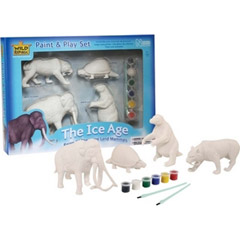
An ideal activity for the half-term holidays is to re-create many of these extinct giant mammals using the Paint and Play Ice Age Mammals Box set.  Each set comes with four famous Ice Age models a giant sloth, Glyptodon, a Sabre-Tooth cat and of course a Mammoth.  Paints and instructions are included and young children can paint their own models to depict these huge mammals from the last Ice Age – a kind of “Pleistocene Paint and Play”.

The Ice Age Mammals Box Set

Picture credit: Everything Dinosaur

Half-term Holidays

Palaeontologists have designed the models, the paints and brushes are included and it is up to you to bring these prehistoric mammals back to life.  The models are based on the actual model sets produced for sale in museums, so if it is cold and frosty outside you can create your very own Ice Age characters on your kitchen table.

Visit Everything Dinosaur’s award-winning website: Everything Dinosaur.

9 02, 2008

Dinosaur Models to appear in a Childrens’ Book

By |2022-11-09T11:34:07+00:00February 9th, 2008|Categories: Everything Dinosaur News and Updates, Main Page|0 Comments

Dinosaurs Help Children to Learn to Read

The team of teachers, parents and dinosaur enthusiasts at Everything Dinosaur get involved in all sorts of dinosaur and prehistoric animal projects, helping out schools, educational bodies and museums with lots of fascinating activities.

Our staff get asked to advise on the preparation of teaching resources, prepare quizzes, proof read materials, help write books and so on.  It is certainly a challenging job working for Everything Dinosaur, you never know what each day will bring.

Take for example a project we have been working on since the middle of January, working on a dinosaur book for children.  We have been asked by a UK based publisher of text books targeted at schools; to advise and assist with the production of a new dinosaur themed book to help young people learn to read.  A great deal of money and teaching resources are being dedicated to improving the reading skills of young children, prehistoric animals are popular and they make an ideal theme for a story book.  This new book will be available later on this year, it features a number of prehistoric animals – Brachiosaurus, Velociraptor, Apatosaurus, Stegosaurus and of course Tyrannosaurus rex.  Other animals featured include Diplodocus (we used the new Diplodocus from Carnegie Safari to represent this animal) and Oviraptor.

Our experts have advised on the mix of prehistoric animals and they will also have a role to play checking the story and the factual information included.  Choosing the correct models to feature can be difficult, the animals have to be accurate and represent a typical impression of the dinosaur in question as well as being photogenic and acceptable to the studio team who have to work with these models under the lights.

Dinosaur Models

A number of the models we chose came from the Bullyland Museum Line range.   This range of scale models are very detailed and make ideal models for collectors as well as being great for creative play.

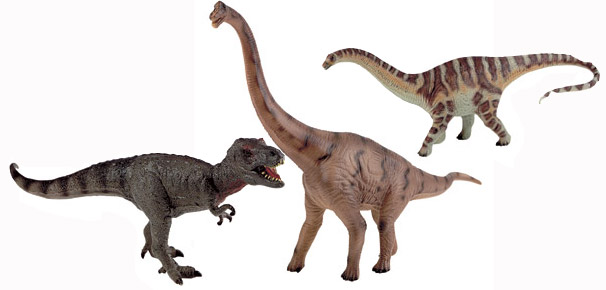
Three of the Models used in the New Educational Dinosaur Book

Picture credit: Everything Dinosaur

The Bullyland range is authenticated by the palaeontologists and researchers at the museum for Natural History at Stuttgart, Germany.  Bullyland have an excellent reputation for designing accurate models of prehistoric animals.  The detail on the model is ideal for use in books and the models are robust, substantial and able to cope with the arduous conditions of being under studio lights.

The photographers wanted models that were flexible in the way that they could be used, good for long shots as well as close up work which would show their details.  The models in the picture are Tyrannosaurus rex, a 1:30 scale model, the large Brachiosaurus in the middle of the shot and an adult Apatosaurus which are also in 1:30 scale.

To view the individual models:

Dinosaur Toys for Boys and Girls – Dinosaur Models: Dinosaur and Prehistoric Animal Models.

8 02, 2008

Primeval Team visit the Silurian in a New Episode

By |2024-04-03T07:40:35+01:00February 8th, 2008|Categories: Dinosaur Fans, Main Page, TV Reviews|0 Comments

Saturday Night and a Trip to the Silurian

The ITV science fiction series Primeval (ITV1 7.20pm) takes viewers back to the Silurian period on Saturday night, the team of time travellers take on some very nasty Arachnids based loosely on the giant sea scorpions – animals such as Brontoscorpio which could grow to nearly a metre long.

Silurian

Brontoscorpio means “thunder scorpion” it was certainly a fearsome predator of the late Silurian.  It is related to modern scorpions, but the huge arthropods such as Pterygotus which could grow to nearly 3 metres long would not have posed much of a threat to Professor Cutter and his team on land.

In this particular episode, the A.R.C (Anomaly Research Centre) team go through a time portal to around 420 million years ago to rescue a young girl and her dog.  However, some team members get stuck on the other side, trapped in the Silurian when the anomaly closes and they are left to deal with attacks from giant scorpions who erupt out of the sand beneath them.

Scientists have been impressed by the size and scale of some of these early arthropods, particularly the Eurypteridae such as Pterygotus and recent discoveries have shed further light on these fearsome ancient beasts.

It seems that these particular predators got even bigger during the Devonian, feeding on the early vertebrates, the ancestors of modern fish.

To read an article about sea scorpion discoveries: Claws! Giant Sea Scorpion of the Devonian.

Ancient Arthropods

In reality, as far as we can ascertain from the fossil record, these arthropods would have been extremely cumbersome and awkward on land.  It has been speculated that these animals ventured out onto land to scavenge on the shoreline and to shed their exoskeletons but their primitive breathing apparatus would have had to be kept moist all the time so they would not have ventured far from water.

As the vertebrates evolved so the large species of Eurypteridae went into decline perhaps they were no longer able to compete with new predators such as the larger placoderms (armoured fish) such as the fierce Dunkleosteus.

For models and replicas of prehistoric animals including Dunkleosteus (whilst stocks last): CollectA Deluxe Supreme Scale Models.

7 02, 2008

No Lyme Regis Fossil Festival for 2008 – Unique Event Postponed

By |2024-04-03T07:41:16+01:00February 7th, 2008|Categories: Everything Dinosaur News and Updates, Main Page, Press Releases|0 Comments

Lyme Regis Fossil Festival Cancelled for this Year

The Lyme Regis Fossil Festival that was scheduled to run over the first Bank Holiday weekend of May, has been cancelled.  Unfortunately, what would have been the fourth festival has been pulled due to lack of sponsorship for this event.

Lyme Regis Fossil Festival

Plans are already in place to continue the festival and to make the event bigger in 2009, themed around the 200th anniversary of the birth of Charles Darwin, the English scientist who influenced scientific thought through his theory of evolution.

Everything Dinosaur has been involved with this event since its inception,  helping to organise the event and participating with the events down at the Lyme Regis sea front and at nearby Charmouth on the “Jurassic” Dorset coast.

Past programmes have involved experts from the Natural History museum running fossil roadshows and identifying local finds, as well as events to mark the redevelopment of this part of the coast and the Lyme Regis coastal protection scheme.

Fossil Hunting in Dorset

Team members from Everything Dinosaur will no doubt be down in Dorset over the next few months and we will of course post further updates as progress on the 2009 events is made.

So roll on 2009.

In the meantime, visit Everything Dinosaur’s award-winning website: Everything Dinosaur.

6 02, 2008

Chirotherium “Hand Beast” – Tracks in the Mud

By |2022-11-09T11:29:40+00:00February 6th, 2008|Categories: Dinosaur Fans, Main Page, Palaeontological articles|0 Comments

Before Dinosaurs – Bizarre Hand-Prints Preserved

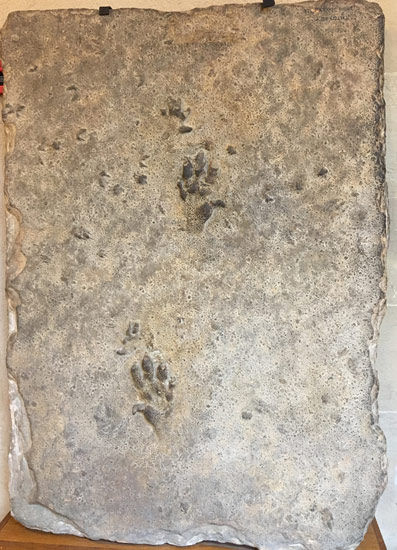
In the Triassic rocks of North America, Europe (including England) and Africa a number of trackways of strange footprints have been uncovered, the first trackway being discovered in Germany in the central state of Thuringia in 1834.  Although, individual footprints and trackways had been known to the scholars of the day for some time, these footprints were remarkable as they resembled the imprint of a human hand.   The footprints had five digits and the fifth digit (which in fact represents the equivalent of our little finger or toe), stuck out sideways and gave the impression of being poseable like our own thumbs.

At the time, the science of geology and the study of fossils were very much in their infancy.  These strange footprints were claimed to the imprints left by those unfortunate people not able to survive the Biblical flood.  Other educated people at the time speculated that they could have been the hand-prints of apes or monkeys.

Chirotherium Fossil Tracks (Oxford Museum of Natural History)

A Chirotheriuim trackway.

Chirotherium tracks on display at the Oxford University Museum of Natural History.  Picture credit: Everything Dinosaur.

Picture credit: Everything Dinosaur

Footprint images, certainly looks like the imprint of a human hand.  The trouble is these trackways have been found in sediments dated to the Early Triassic around 240 million years ago.  Since the prints resembled human hands, scientists named the animal that could have made them Chirotherium “hand beast”.

No actual fossil bones or other remains have been found in association with these trackways.  In spite of this, palaeontologists have been able to provide an impression of what the animal may have looked like.  The hind prints are nearly twice the size of the front prints, the trackways are also narrow indicating an upright gait rather than the more typical sprawling gait of other reptiles.  There is no sign of a tail drag in any of the trackways so ichnologists (scientists who specialise in studying footprints); have deduced that the tail was held well clear of the ground.

Many years later a nearly complete skeleton of another reptile from similarly aged sediments was unearthed. This animal resembled the reconstructions of Chirotherium, it was an archosaur in the region of 2-3 metres long.  This fossil find was named Ticinosuchus.  This fossil helped vindicate those palaeontologists who had depicted Chirotherium (sometimes also known as Cheirotherium) as a predatory ancestor of the dinosaurs with legs positioned directly under the body.

During the Triassic a number of different animal groups evolved and expanded to fill the ecological niches left after the Permian extinction.  As the dinosaurs evolved, they shared the world with other large reptiles such as Batrachotomus, a huge six metre long carnivore.  Similar in general build to the likes of Chirotherium (but much bigger) these fierce animals competed with the dinosaurs for places at the top of the food chain.  Huge “land crocodiles” such as Batrachotomus were very successful and their fossil remains have been found all over Pangaea.

Scale model of Batrachotomus and other figures: Dinosaur and Prehistoric Animal Models.

However, these very large, predominantly quadrupedal predators eventually became extinct around 220 million years ago, perhaps they were no longer able to compete with the rapidly expanding bipedal theropod dinosaurs.

We are grateful to Mike Batty, for pointing out to us that the accepted spelling for the footprints is Chirotherium.  The correct Greek spelling is Cheirotherium, a name we still use round the office, as it was the accepted name for a time; but scientific nomenclature principles state that the first name used as a descriptor should take precedence hence the use of Chirotherium in this instance.

Go to Top