All about dinosaurs, fossils and prehistoric animals by Everything Dinosaur team members.
4 02, 2008

Helpful Dinosaur Model Suggestions – The Dinosaur Collection Set

By |2024-04-03T07:41:48+01:00February 4th, 2008|Categories: Everything Dinosaur News and Updates, Main Page|0 Comments

Dinosaur Model Series – The Dinosaur Collection

As Everything Dinosaur team members are often asked about prehistoric animal models by parents and teachers seeking to purchase some items for their children or school, we thought it best if we made a quick comment about a particular model series.

There are certainly a lot of prehistoric models available and more in the pipeline, especially with the impact of film and TV merchandise.  The current dinosaur stage show and tour using huge animatronic models will also fuel interest in these amazing prehistoric animals.  Much has already been written on the models created by Schleich and Bullyland of Germany.  These are highly detailed, beautifully made and hand-painted models for the real enthusiasts.  We know about a number of new introductions that are due this year and we will no doubt get around to writing about them in the near future.

A Selection of Prehistoric Animal Models

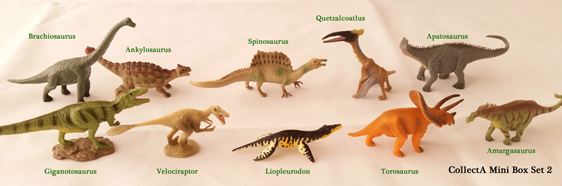
A dinosaur model set (CollectA)

A set of ten beautiful prehistoric animal models.

Picture credit: Everything Dinosaur

In addition, there are changes to the Natural History museum collection of models.  This range of 1:40 scale models is going through a bit of a transition at the moment, switching back and forth between having models available on a plinth or as frees standing items.  There is also a range of larger prehistoric animal models going to be available, but delays in production and with the design process have made a 2008 launch unlikely.

With so  many changes it can be difficult to pick your way through the model minefield.  Everything Dinosaur are always able to help fans trace a particular model or animal.  We advise people from all over the world about new introductions, which models are being retired and such like.

You can try us by simply logging onto our website, dropping an e-mail to us (address found on contact page of website), or indeed you and call upon the assistance of our “Dino Hunt” Service.

Everything Dinosaur web: Everything Dinosaur.

If you cannot find the particular item or named prehistoric animal by using our search facility (Dino-Search can be found on the top left side of our home page), you can follow the links to our contact us page and send us a request for assistance and our team will do their best to help you.

To read more about our Dino-Hunt service: Launch of the Everything Dinosaur – Dinosaur Hunt Service.

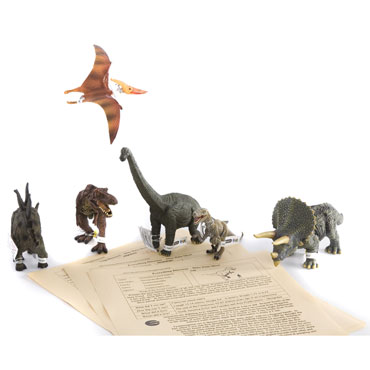
When it comes to recommending a prehistoric animal set or range, there are certainly a great deal to choose from, but one set that is well worth considering is the Dinosaur Collection series  manufactured by Procon.  This set of six prehistoric animals (Triceratops, Velociraptor, Brachiosaurus, Stegosaurus, Pteranodon and of course T. rex), is made in solid plastic, is robust and although not to scale the models show plenty of detail.  They have been specially designed to fit in the palm of a child’s hand so as to encourage active play.  The models are surprisingly large, the Tyrannosaurus rex is 19 cm long and the Pteranodon has a wingspan of over 16 cm.

The Dinosaur Collection Set from Everything Dinosaur

Picture Credit: Everything Dinosaur

The models in this series are accurate and detailed enough to satisfy the serious collector and also appealing to children.  They are available as individual models from Everything Dinosaur, but can also be purchased as a set of six models.  Naturally, every named model supplied by Everything Dinosaur comes with its own detailed fact sheet on the animal, providing information and insight into these amazing animals.

To view Dinosaur Collection Set (six models) and other replicas: Dinosaur and Prehistoric Animal Models.

3 02, 2008

Visiting Special Trade Shows – Everything Dinosaur is a sought after Company

By |2024-04-03T07:46:12+01:00February 3rd, 2008|Categories: Everything Dinosaur News and Updates, Main Page, Press Releases|0 Comments

Trade Shows – Everything Dinosaur Team Members being asked for Advice

Team members at Everything Dinosaur are often asked by parents and teachers to recommend a model or a set of models for a young dinosaur fan.  There are certainly lots of models to choose from and as a result the choice of a model can be a little confusing.

Many parents and teachers want to purchase dinosaur models that are reasonably accurate, that come with correct and scientifically based information and of course can help encourage creative play.  There are so many dinosaur sets around these days, but many are poorly designed and are simply not accurate.  Some of the team members at Everything Dinosaur are asked to advise on hang tag information, to write information notes to accompany models and such like.  Recent visits to a couple of trade fairs demonstrated clearly how many items purporting to depict prehistoric animals are available but they are simply not accurate.  It is a great shame to us (and also a source of immense frustration); when we see a model or an item such as a child’s dinner service, all nicely designed but the information provided is simply not correct.  Many adults purchase dinosaur and prehistoric animal merchandise in the belief that they are helping educate and encourage their children, but it saddens us when we see items and merchandise that contain information that are simply not accurate.

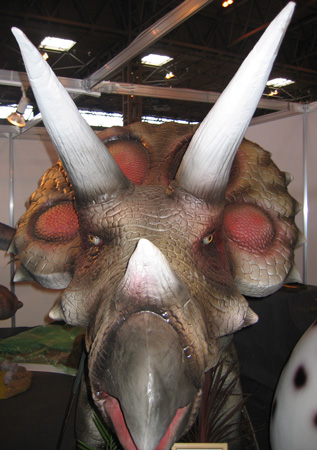
A Triceratops Spotted at a Trade Fair

The anterior portion of Triceratops spotted by Everything Dinosaur

Coming face to face with Triceratops at a trade fair.  Picture credit: Everything Dinosaur.

Picture credit: Everything Dinosaur

To view Everything Dinosaur’s range of prehistoric animal models: Dinosaur Models and Toys.

We do appreciate that to employ palaeontologists and museum staff to check and research data can be expensive but when the packaging, design and tooling costs are considered any expense in checking information would be relatively small.  Many of the wholesalers and retailers of such items are ignorant of this, they claim that their products are educational and talk openly about the information and facts that are included with their products.  However, as palaeontology is such a fluid science it can be difficult to keep up with the latest research and findings.  Many items have spelling mistakes, incorrect fact sheets and so on, which is a shame as young children have such an enthusiasm and are so keen to learn and absorb information.  We openly admit, we can make mistakes from time to time.  On numerous occasions the error of our ways has been pointed out by a well-informed young person and we do understand the appearance of dinosaurs and prehistoric animals can be open to interpretation.  For example, in many instances the posture of a model has to be compromised due to the difficulties in being able to sculpt and design an animal that can stand up.  The theropods are the worst, getting an allosaur or a tyrannosaur model to be stable when they are bipedal and difficult to balance with big heads and long tails, for instance.  This problem is solved by making the feet disproportionately bigger, or by putting the animal in a more stable posture “kangaroo style” as we call it.

We try and advise manufacturers and many approach us to pick our collective brains over prototypes and design concepts.  One of the interesting things that has begun to happen over the last 12 months or so is that our team members have been actively sought out by the MDs of companies to help and assist with design processes and packaging.  Having been to two trade fairs in 48-hours we have come back with a few new product ideas and suggestions and a lot of requests for assistance and help with other dinosaur and prehistoric animal related products.

2 02, 2008

Time Running out for the Indian Gharial

By |2023-02-25T06:24:24+00:00February 2nd, 2008|Categories: Animal News Stories, Dinosaur and Prehistoric Animal News Stories, Main Page|0 Comments

The Indian Gharial may be Close to Extinction

The Indian Gharial, one of only two surviving species of the living fossil family Gavialidae with an ancestry dating back to the Late Cretaceous is close to becoming extinct in the wild.  This magnificent and graceful crocodilian, capable of growing to lengths in excess of 6 metres had been under severe pressure in the early 1970s as the growing Indian population competed with these animals for space and fish.

Indian Gharial

Radical steps were taken to protect the nesting areas of this reptile and to preserve stretches of waterway to provide a pristine haven for these long-snouted crocodiles.  Numbers had begun to recover but over the last two years the breeding population has declined to such an extent that the International Union for the Conservation of Nature and Natural Resources (IUCN) reclassified the species last year as “Critically Endangered” acknowledging that this fish-eating crocodile was on the brink of extinction.

The Gharial, sometimes called the Gavial is now facing a new threat.  A large number of dead Gharials have been found in the Chambal river area of India, a stretch of water designated a Gharial preserve.  Despite the land’s preservation status, Gharial numbers have been threatened by illegal fishing, the removal of sand for building sites, destroying nesting areas and poaching.  Now a mysterious ailment is causing the death of many of these animals and scientists are unsure as to what the cause might be.

Post-mortems carried out on the dead crocodilians indicate high levels of lead in their bodies, but tests on the fish population (the gharials main food source), do not show high levels of lead in the fish.  The Gharials are observed as becoming dull and lifeless with slowed reactions (symptoms of poisoning) and then a few days later their carcases are found bloated and floating in the water.  Such has been the mortality that an urgent Indian scheme has been launched to investigate the deaths and to consider ways to protect the remaining Gharials in what was once their only stronghold.

1 02, 2008

Crocodile “Missing Link” Unearthed in Brazil by Researchers

By |2024-04-03T07:43:16+01:00February 1st, 2008|Categories: Dinosaur and Prehistoric Animal News Stories, Main Page|0 Comments

Brazilian Palaeontologists report on new Genus of Crocodile from the Cretaceous

Crocodiles and their close relatives caiman, alligators and gharials are often described as living dinosaurs but although related to the Dinosauria (along with birds they are the last representatives of the Archosauria – the group of reptiles that gave rise to the dinosaurs), they are not dinosaurs as such.

However, they do represent a very ancient lineage and the crocodilian’s basic body plan has not changed for something like 240 million years.  Now a team of palaeontologists from Brazil have published a paper on a new genus a crocodile – a semi-upright,  long legged animal that wandered amongst the dinosaurs of the Late Cretaceous.

A Model of an Ancient Crocodilian (Papo Kaprosuchus)

Papo Kaprosuchus model.

The pen provides scale.  A replica of the Cretaceous crocodilian Kaprosuchus from Papo.

Picture credit: Everything Dinosaur

There are several ancient crocodiles represented in model ranges from manufacturers. For example, Papo have created a model of Kaprosuchus.  To view the Papo model range: Papo Prehistoric Animal Models and Figures.

Montealtosuchus

This fossil, which was found in 2004, near the town of Monte Alto, in San Paulo state is very well preserved and quite complete.  Most importantly skull material has been found and this can help to link this fossil specimen with today’s modern crocodiles.

The fossil has been named Montealtosuchus arrudacamposi.  It would have grown to about 2 metres in length and would have been an active predator of smaller animals including dinosaurs in the Brazilian Late Cretaceous.  The relatively long limbs give scientists an indication about this animal’s behaviour.  Perhaps it was more terrestrial than its modern descendants, using its semi-upright gait to pursue prey.

“This is scientifically important because the specimen literally is the link between more primitive crocodiles that lived in the era of the dinosaurs 80-85 million years ago and modern species,” said palaeontologist Ismar de Souza Carvalho of Rio de Janeiro Federal University, who is one of the scientists responsible for the study of this rare find.

To read an earlier blog post about a crocodile skull discovered in Dorset: Ancient Crocodile Skull Found in Dorset.

Crocodilians have many links to dinosaurs, they don’t just share a common ancestor.  The name crocodilian was given to this group of reptiles by Sir Richard Owen in 1842; the same year that Sir Richard had his work on “Dinosauria” published and dinosaurs came into the scientific arena.

31 01, 2008

Stone Age Scousers – The Stone Age People of Liverpool

By |2022-11-08T14:38:25+00:00January 31st, 2008|Categories: Dinosaur and Prehistoric Animal News Stories, Main Page|0 Comments

Archaeologists working on M62 Improvement Scheme find evidence of Stone Age Settlements

This year (2008), might be the year that the city of Liverpool in north-west England celebrates its status as a “Capital of Culture” but it seems that parts of Merseyside had a thriving culture 7,000 years ago.

Archaeologists working on the Highways Agency’s M62 Junction 6 improvement scheme have uncovered 7,000-year-old evidence of Stone Age settlements at Huyton on Merseyside – the earliest signs of human activity ever discovered in the area. Time to meet some Stone Age Scousers!

Stone Age Scousers

The finds were made by a team carrying out archaeological excavations on behalf of the Highways Agency as part of preparation for the scheme. Flints and burnt hazelnuts are just some of the evidence pointing to hunter-gatherer prehistoric tribes living in the area.

The area would have been an ideal location for hunter-gatherer tribes during the latter part of the Mesolithic (Middle Stone Age) and the early part of the Neolithic (New Stone Age). The low lying marshy ground would have been a haven for wildlife and the highly tidal Mersey estuary would have provided lots of opportunity for hunting and beach-combing. Recognising the public interest in the finds, which also include some Roman pottery and other artefacts, the Highways Agency is holding a number of open days in early February. These open days will enable members of the public to view the plans for the development of this part of the M62 motorway and to examine some of the rare objects discovered during the course of the excavations.

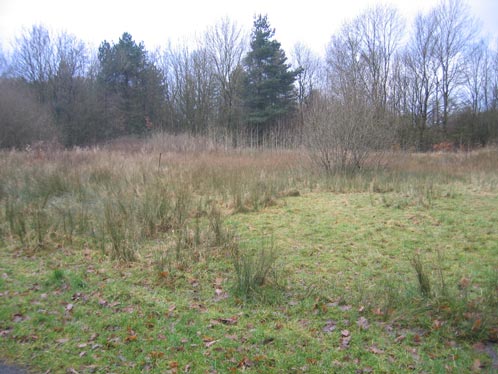
Ancient landscapes - global climate change
A wet and boggy landscape, but ideal for hunter/gatherers. Picture credit: Everything Dinosaur.

Picture credit: Everything Dinosaur

Archaeological Finds

Alongside the archaeological finds will be an exhibition featuring photos and general information about the construction scheme; details of the measures being taken to reduce the impact on the environment; information about the traffic management arrangements during the work; and a computer simulated drive through. Speaking on behalf of the Highways Agency, Project Manager Gary Hilton, said, that the Highways Agency takes its responsibility for our heritage very seriously and they were delighted to have found this window into the past. Lots of people are very excited by what has been discovered.

Mr Hilton stated:

“We are obviously keen to show off these discoveries and this is why we have decided to hold the open days. We will be turning this important construction site into a museum for the day, before the artefacts are handed over to the experts who will be able to preserve them for future generations.”

The Project Manager went onto add:

“The event will also give us the opportunity to pass on information about the construction scheme and the future benefits of the new junction once this work is complete.”

Roman Pottery Discovered

The team working on the excavations around the new link road have also discovered Roman pottery and tiles that are stamped to show they were made for the 20th Roman Legion based in the nearby Roman fort of Chester around 167 AD.

It was already known that the site had some archaeological importance. Excavations in 1993 ahead of the construction of the adjacent A5300 uncovered part of a Roman farm. Other finds hinted at prehistoric activity in the area – now that has been confirmed.

30 01, 2008

Korea Bids to get Beautiful Cretaceous Coast listed as UNESCO World Heritage Site

By |2024-04-03T07:45:35+01:00January 30th, 2008|Categories: Dinosaur and Prehistoric Animal News Stories, Dinosaur Fans, Main Page|0 Comments

Cretaceous Coastline Submitted to UNESCO for World Heritage Status

It is not just the Chinese who have been finding dinosaur fossils over the last few years in Asia, the South Koreans have been getting in on the act to.  Such is the diversity and richness of the South Korean fossil sites that the country’s Cultural Heritage Administration (CHA) has nominated part of the Korean coastline with extensive fossil bearing sediments from the Cretaceous for World Heritage Status.

Gaining World Heritage Status is a huge undertaking, it would rank this part of Korea alongside places like the Great Barrier Reef, the Grand Canyon and the Galapagos Islands.  Team members from Everything Dinosaur remember all the hard work that went into helping the Dorset and East Devon coasts to be awarded World Heritage Status.  The award was finally granted in December 2001 and the UK’s “Jurassic Coast” came into being, a world-wide recognised important scientific and conservation area.

Cretaceous Coast

CHA administrators report that the application for the nomination of this particular site (and one other within Korea), have taken place.  The review process is very lengthy with a decision by the UNESCO World Heritage Committee taking perhaps as long as two years.

The Korean Cretaceous Dinosaur Coast features numerous locations of fossilised dinosaur eggs, individual footprints and trackways throughout the southern coast of Korea. This area is considered the world’s largest grounds of various fossilised eggs and footprints of dinosaurs from the Cretaceous period.  It is likely the area will yield even more discoveries as much of the region’s geology has yet to be fully studied and explored.

Fossil sites are found in the provinces of  South Jeolla and South Gyeongsang.  These sites have yielded a large number of dinosaur fossil bones, eggs and trace fossils such as trackways.

Protecting Cultural and Natural Heritage

UNESCO seeks to encourage the identification, protection and preservation of cultural and natural heritage around the world, considered to be of outstanding and universal value to humanity.  Although the criteria for inclusion were revised in 2004, it is still an extremely difficult status to obtain.

We wish the Korean team every success with their efforts.  Perhaps the Korean palaeontologists will one day upstage the US and Chinese with their fossil finds.

Korean palaeontologists have already made a huge contribution to helping scientists understand more about animals from the Mesozoic.  Their work has led to the renaming of perhaps one of the largest dinosaurs ever to roam the Earth.  Partial remains of a huge sauropod (long-necked dinosaur) were discovered in Colorado in 1979.

Estimates made at the time from the very incomplete specimens indicated a brachiosaur-like animal with a length exceeding 30 metres.  The animal was named Ultrasaurus as a result of its huge size.  However, this dinosaur had to be renamed when it was pointed out to the Americans that the name Ultrasaurus had already been used by Korean scientists for a Sauropod (a much smaller one, only about 8 metres long), that had been discovered in Korea some years before.

The giant dinosaur remains from Colorado were named Ultrasauros to ensure that there would be no further confusion.

The name Ultrasauros is still classified as a “nomen dubium”.  This is the term used by palaeontologists to describe the name of an animal that has yet to be validated and proven to be a separate genus.  Scientists still debate whether Ultrasauros was a valid genus or just an exceptionally large brachiosaur.  Until more remains are unearthed in Colorado the debate is likely to rumble on.

Everything Dinosaur stocks a wide range of Asian prehistoric animal models and figures, including the PNSO Age of Dinosaurs series that contains several Asian dinosaur models: PNSO Age of Dinosaurs.

29 01, 2008

The Claws of Smilodon – Sabre-Tooth Tree Climbers

By |2022-11-08T14:18:05+00:00January 29th, 2008|Categories: Dinosaur and Prehistoric Animal News Stories, Main Page|4 Comments

Smilodon Claw Anatomy – Sabre-Tooths Great at Climbing but Rubbish at Descending

The Sabre-Tooth cats more appropriately termed Smilodons are one of the most enigmatic of prehistoric mammals from the Quaternary.  Thanks to the remarkable fossil sites such as tar pits of Rancho La Brea, Los Angeles, California, a large volume of Sabre-Tooth fossil remains have been excavated.  Most of the Sabre-Tooth cat fossils have been identified as belonging to S. fatalis californicus, but it is not just the volume of fossils that is important, many specimens have been preserved in pristine condition.

The tar pits have formed as crude oil has seeps through fissures in the rock strata to the surface.  Water gathers on these pools of sticky, viscous oil and animals mistaken these pits for water holes get stuck.  These attract predators such as Dire Wolves and Sabre-Tooths and these animals share the same fate as the herbivores.

Smilodon and Tar Pits

Some of the Everything Dinosaur team members were in Los Angeles and got the chance to examine some of the latest fossil finds.  The pits are trapping animals all the time, sometime earlier that morning a small bird had become stuck and died, the latest victim of La Brea.

More Sabre-Tooth remains have been found at Rancho La Brea than the rest of the world put together which is quite remarkable considering the extensive range of the Smilodon genera across the Old and New Worlds.  Once an animal had become trapped in the tar, it would have quickly sunk, so quickly that skeletons can be preserved with their bones in close association or even articulation.  Rapid burial without scavenging is one of the most effective methods of ensuring preservation.  Even pieces of skin and tufts of fur have been preserved in the tar.  The tar is a natural preservative preventing normal decay.  So well-preserved are the Smilodon remains that even the most delicate and fragile bones such as those within the inner ear are preserved, often intact.

Smilodon

To date something like sixty different species of mammals and thirty-five species of birds have been identified, even human remains have been found.  The fossils date from between 40,000 years to about 10,000 years ago.

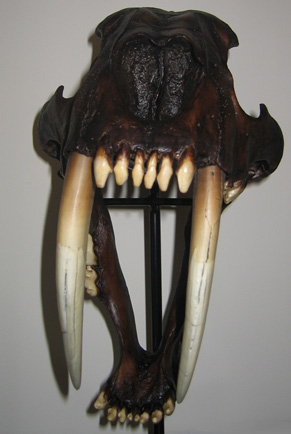
The Skull of a Smilodon (S. fatalis)

Smilodon skull

The business end of Smilodon.

Picture credit: Everything Dinosaur

Thanks to these fantastic fossils and the dedicated staff who uncover them a great deal is known about Smilodon anatomy.  The Sabre-Tooths that roamed California 10,000 years ago did not resemble modern members of the cat family (Felidae).   These animals were about the size of an African Lion (Panthero leo) but with a much stockier build.  They may have weighed up to twice as much as a modern Lion.  They had shorter limbs, a deep, barrel like chest and a bob-tail.  The forelimbs were massive and heavily muscled, much stronger than the hind-limbs.  This indicates that Sabre-Tooths were ambush predators, they were not built for pursuit of prey animals but used their extremely powerful front quarters to bring down quarry.

The fossil specimens demonstrate that these big cats had retractable claws, in common with most members of the cat family including the domestic cat (Felis silvestris catus).  The Sabre-Tooth claws were long and re-curved in shape making them the animals most formidable weapons, ideal for spearing the body of prey and holding on enabling the victim to be pulled down to the ground, for despatching with those massive canines, which would have severed arteries in the neck.  Smilodon like a domestic cat could also dig its claws into the skin further by closing the extended claws, much in the same way as we might close our fingers around an object when we pick it up.  This would dig the points of the claws further into the animal’s hide and make escape much more difficult.

Sabre-Tooth cats were fierce predators and likely to have hunted our ancestors, however, children remain fascinated with them and the Sabre-Tooth cat appears regularly in our top ten prehistoric animal surveys.

To see the latest survey results: Best Selling Prehistoric Animals 2007/8.

Despite its fearsome reputation, young children seem to be fascinated with this big cat.  It has had a recent episode of Primeval dedicated to it and it has appeared in a number of cartoons and other features, Fred and Wilma Flintstone even had one as pet.  When the wooden prehistoric animal jigsaw range was being designed as well as the Woolly Mammoth and Woolly Rhino, a Sabre-Tooth cat jigsaw had to be included as well.

To visit Everything Dinosaur’s website to see the range of Sabre-Toothed Cat merchandise we offer: Visit Everything Dinosaur’s Website.

Although as a genus, the Sabre-Tooths are not entirely associated with the Ice Ages, these animals also thrived in temperate grassland areas.  For example, Smilodon populator is known from several sites in Brazil, Argentina and Bolivia and some fossil remains have been dated to over 1.5 million years ago.  This particular species, even larger than its North American cousin hunted the grasslands of South America preying on herbivores such as Macrauchenia.  Macrauchenia was a distant relative of modern ungulates (hoofed animals), with a distinctive trunk on the end of its nose to help it browse on grasses and low growing bushes.

To see a model of Macrauchenia and other prehistoric animals: Dinosaur and Prehistoric Animal Models.

This ability to close the claws and dig the points further in may also have helped smaller Sabre-Tooths climb.  It is unlikely that a fully grown, heavy adult would do much climbing but there is no evidence in the fossil record to confirm or deny that Sabre-Tooths climbed.

Certainly, the anatomy of the claws and manus (the hand) permit Sabre-Tooths to climb objects like trees should they have wished to do so.  Domestic cats are very effective climbers and can scurry up trees with no problem at all.  However, this arrangement of the claws being able to “grasp” is excellent during the ascent and provides plenty of purchase, leverage and grip.  The trouble comes when the cat wishes to descend.  Claws when deployed in the descent of a tree provide very little grip.  This explains why your local moggy can run up a tree one minute and then get stuck having to be rescued as they cannot get down without risk of falling.

Smilodon Claws

The anatomy of the claws of Sabre-Tooths also shows that they suffered from this design drawback.  Should one have climbed a tree, perhaps looking for prey or to avoid being attacked by another predator, then they would have struggled to get down again.  Perhaps they would jump, landing on their powerful front quarters using them to cushion the shock on landing.  For a small Sabre-Tooth climbing up a tree getting down again could be hazardous, after all, in the Pleistocene they could not wait for the fire brigade to rescue them.

28 01, 2008

Aussie Palaeontologist’s Struggle to Keep up with Fossil Finds

By |2023-02-24T21:48:58+00:00January 28th, 2008|Categories: Dinosaur and Prehistoric Animal News Stories, Main Page, Palaeontological articles|0 Comments

Dinosaur Enthusiasts are Finding more Dig Sites than Museums can Handle

Those Australian dinosaur buffs are difficult to keep out of the headlines.  No sooner do we dedicate January 26th (Australia Day) to celebrating the contribution made to palaeontology by Australian scientist and their dinosaurs from down under then the Australian Associated Press releases a news story about more finds in Queensland.

Aussie Palaeontologists Struggle

Dinosaur enthusiasts in the western Queensland town of Winton claim to have found enough potential dinosaur dig sites to keep them and the local museum staff busy until at least 2058.

Cattle farmer, turned dinosaur fan David Elliott says there are thirty sites waiting to be excavated in the local area.  Winton is rapidly becoming a hot spot for dinosaur finds in Eastern Australia.  A number of important finds have already been documented and excavated from sites such as the nearby Lark Quarry (famous for its trace fossils of dinosaur footprints – the only record of a dinosaur stampede).

We have commented on the importance of the area before, a number of fossil bones have been found, many in association with each other.  These represent important clues in helping palaeontologists understand the fauna and flora of this part of Gondwanaland.

To read more about the work going on at Winton: Putting Aussie Dinosaurs on the Map.

David Elliott commented; “we are finding sites at the moment at the rate of two to three a year and we are digging sites at the moment at the rate of one every two to three years”.

“So there’s the difference, we are finding faster than we can dig it and we are digging them much much faster than we can display and study them.”

Mr Elliott’s fascination with prehistoric creatures has grown exponentially since he discovered the first fossilised bones on his property Belmont in 1995.

He has since located 16 dinosaur sites on Belmont alone and is working with the Queensland Museum to prepare the bones of two sauropods excavated on the property in the past few years.

Dinosaur Bones

The dinosaurs, nicknamed Wade and Matilda, are unique specimens representing new genera, previously unknown to science.

Work is underway to raise about AUS $20 million needed to establish the Australian Age of Dinosaurs Museum of Natural History just outside Winton, north-west of Longreach.

Queensland Premier Anna Bligh visited Winton on Friday, inspecting fossils housed on Mr Elliott’s property before contributing AUS $500,000 of government funds towards the museum.

Mr Elliott hopes the museum will aid excavation work and fossil preparations in order to educate more Australians and tourists to the area about the continent’s natural history.

He also wants to see the fossils remain in the outback, injecting new life into the region through tourism.

“Dinosaur bones out here are going to actually do something good for western Queensland, because it’s really a necessity out here to keep the country viable, to keep the town viable,” he said.

“It is the tip of the iceberg and that’s all it is at the moment. It’s going to become quite massive.”

So hats off to those Australians, their dinosaur fauna may be less well known when compared to the western USA or Europe for example but they do seem to be catching up fast.

For figures and models of Australian prehistoric animals and other extinct creatures: CollectA Prehistoric Animal Figures.

27 01, 2008

Geologists Get to the Bottom of the Chicxulub Impact Crater

By |2023-02-24T21:53:12+00:00January 27th, 2008|Categories: Dinosaur and Prehistoric Animal News Stories, Geology, Main Page|0 Comments

Chicxulub Crater gets Seen in a Whole New Light

A big rock splashing down into water deeper than first thought may be the simple explanation as to why something like 70% of all life on Earth perished at the end of the Mesozoic.  This is the conclusion of a team of researchers from the University of Texas who have carried out the most detailed study yet of the impact site using three-dimensional seismic images of the Chicxulub crater.

Chicxulub Impact Crater

The Chicxulub crater is a mostly submerged and buried impact crater on the coast of Mexico.  This new study, led by Sean Gulick (research scientist at the Institute for Geophysics at the University of Texas Jackson School of Geosciences), may modify a theory explaining the extinction of the dinosaurs, pterosaurs, marine reptiles and nearly three-quarters of life at the end of the Cretaceous 66 million years ago.

It was the American father and son team of Luis and Walter Alvarez who first put forward the theory of an extraterrestrial impact being the cause of the  mass extinction event 66 million years ago.  Their study of the worldwide layer of clay rich in the rare Earth element iridium, which was present in rocks dating from the K-T boundary (the geological time border between the end of the Cretaceous and the beginning of the Palaeocene) led them to conclude that an asteroid or meteorite impact must have occurred.

The Yucatan Peninsula

The discovery of the Chicxulub crater, on the coast of the Yucatan peninsula, Mexico, a huge impact crater dated to this period in Earth’s history provided the “smoking gun” evidence to add weight to their theory.

Debate still continues amongst scientists as to the actual cause of this mass extinction event.  The Earth was going through an extensive period of geological activity and the asteroid impact may have been just one factor in the extinction of the dinosaurs.  The huge amounts of volcanic activity in India, in an area known as the Deccan Traps  may also have played a significant role.

To read more about the Deccan Traps: Asteroid Impact Theory Challenged – Blame the Deccan Traps.

Extinction Theories

Other contributing factors to the demise of large land animals at this time in Earth’s history have also been put forward.  A book recently co-authored by George Poiner blames the emergence and increasing presence of biting and blood sucking mites and insects on the demise of the dinosaurs.

Article: New Book Claims Biting Insects and Bugs helped in Dinosaur Demise.

Now a new study into the Chicxulub impact crater indicates that the object from outer space may have landed in deeper water than previously thought, releasing 6.5 times more water vapour into the atmosphere and exacerbating the impact.  This coupled with the fact that the rocks in the area contain sulphur-rich sediments would have made the collision even more dangerous to life on Earth.

According to Gulick and his team, the impact would have caused the sulphur-rich deposits to react with the water vapour to produce sulphate aerosols which would have been thrown high into the atmosphere.  An increase in the atmospheric concentration of these high in sulphur compounds could have made the impact more deadly in two ways:

1). Altering the Climate

Particles high in sulphur could have prevented solar radiation from getting through the “thickened” atmosphere and this would have led to a cooling effect – perhaps contributing to a nuclear winter.

2). Acid Rain

Increased levels of water vapour once cooled at altitude would then fall back to Earth, the high sulphur content of the atmosphere would have formed dilute sulphuric acid and the Earth would have been subjected to extensive acid rain.

The Impact of Sulphur

Earlier studies into the geology of the Yucatan peninsula had indicated that the sulphur contained in the rocks could have contributed to the scale of the natural disaster.  When the higher volume of water is factored into models predicting the environmental consequences, the effects of atmosphere cooling and acid rain are magnified.

“The greater amount of water vapour and consequent potential increase in sulfate aerosols needs to be taken into account for models of extinction mechanisms,” stated Gulick.

An increase in acid rain might help explain why reef and surface dwelling ocean creatures were affected along with large vertebrates on land and in the sea. As it fell on the water, acid rain could have turned the oceans more acidic.

There is some evidence that marine organisms more resistant to a range of pH survived while those more sensitive did not.  Increased amount of carbon dioxide in our atmosphere today is being blamed on the acidification of the oceans.  If this process continues unchecked it could spell disaster for marine plankton and corals, which in turn would severely disrupt food chains and ecosystems.  Could the increase in acidity due to the higher levels of acid rain have led to the demise of the ammonites and other shelled creatures?

Gulick says the mass extinction event was probably not caused by just one mechanism, but rather a combination of environmental changes acting on different time scales, in different locations. For example, many large land animals might have been baked to death within hours or days of the impact as ejected material fell from the sky, heating the atmosphere and setting off firestorms.

Huge Firestorms

There is evidence to suggest that much of the planet’s vegetation was burnt at this time, again adding more green house gases into the atmosphere and exacerbating changes in the environment and climate.  More gradual changes in climate and acidity might have had a larger impact in the oceans.

Gulick and his collaborators originally set out to learn more about the trajectory of the asteroid. They had hoped the crater’s structure in the subsurface would hold a tell-tale signature. Instead, the structure seemed to be most strongly shaped by the pre-impact conditions of the target site.

“We discovered that the shallow structure of the crater was determined much more by what the impact site was like before impact than by the trajectory of the impactor,” says Gulick.

If scientists can determine the trajectory, it will tell them where to look for the biggest environmental consequences of impact, because most of the hazardous, shock-heated and fast-moving material would have been thrown out of the crater downrange from the impact.

For models and replicas of Late Cretaceous dinosaurs and other prehistoric animals: Wild Safari Prehistoric World Models.

Researchers at Imperial College in London are already using computer models to search for possible signatures in impact craters that could indicate trajectory regardless of the initial surface conditions at the impact site.

“As someone who simulates impact events using computers, this work provides valuable new constraints on both the pre-impact target structure and the final geometry of the cratered crust at Chicxulub,” says Gareth Collins, a research fellow at Imperial College.

The study “Importance of pre-impact crustal structure for the asymmetry of the Chicxulub impact crater” appears in the February 2008 print edition of the journal Nature Geoscience.

Collaborators on the project included Gail Christeson of the Institute for Geophysics, Penny Barton at the University of Cambridge, Joanna Morgan and Mike Warner at Imperial College, and several graduate students.

So it seems that the prehistoric animals around 66 million years ago were doubly unlucky.  Not only was planet Earth struck by a large object, but it was hit in the wrong place as well.

This article has been extracted from work of the University of Texas at Austin (2008, January 24). Seismic Images Show Dinosaur-killing Meteor Made Bigger Splash.


26 01, 2008

Happy Australia Day! A Tribute to Australian Dinosaurs

By |2022-11-08T14:08:25+00:00January 26th, 2008|Categories: Dinosaur and Prehistoric Animal News Stories, Dinosaur Fans, Main Page|0 Comments

January 26th – Australia Day A Tribute to Australian Prehistoric Animals

Australia Day is celebrated on January 26th each year.  It is a public holiday throughout the country as Australians celebrate all that is great and good about their unique country.  Although, only adopted fairly recently as a national holiday, there has been a tradition of celebrating on January 26th right back to the earliest times of settlement by Europeans.

The date marks the first landing of the British convict ships in 1788 at Sydney Cove and the raising of the Union Jack flag over this part of the territory.

Australian Dinosaurs

Australia has been the focus of extensive palaeontological interest in recent years as this huge continent is explored for fossils.  A number of dinosaurs are known from this part of the world, along with a number of other prehistoric animals including marine reptiles such as the pliosaur Kronosaurus.  Kronosaurus was not a dinosaur but a short-necked plesiosaur (termed pliosaur).  This huge carnivore swam around a shallow sea (now Queensland) in the Early Cretaceous.  Estimates as to the size of this animal vary but most scientists state the this animal was up to 10 metres long, with a head making up over 25% of the entire body length.

Despite the extensive fieldwork and on-going digs in various parts of the continent, Australian dinosaur fauna is little known when compared to the evidence amassed about dinosaurs in Europe, the Americas and Asia.  Many scientists see the Australian fauna as an unusual blend of ancient genera long extinct elsewhere in the world and other types of dinosaur more commonly associated with the northern hemisphere.

For example, evidence has been uncovered previously that indicated that allosaurs (large bipedal meat-eaters) survived in Australia into the Cretaceous whilst elsewhere in the world this particular family of dinosaurs died out.  Fossils that could be from a member of the Allosauridae family have been found in Victoria and South Australia.

Allosaurus was relatively slow moving.  It has been estimated that Allosaurus was capable of running at 30 km/h for a short distance; however, the forested terrain of Cretaceous Australia would have given this animal plenty of ambush opportunities.  When allosaurs lived in Australia, the continent was situated much nearer the South Pole, forming part of the super-continent Gondwanaland. There was no ice at the pole at this time but thick conifer and fern forests – like what you may see in a picture book of the New Zealand rain forest.  It was still chilly and scientists are still unsure whether these carnivores lived in Australia all year round or migrated there in the Summer following large herbivores like the iguanodontid Muttaburrasaurus.

A Typical Illustration of an Allosaur

Allosaurus illustrated.

Picture credit Everything Dinosaur

Visit Everything Dinosaur: Everything Dinosaur Website.

The Australian Allosaurus was smaller than its North America cousin, perhaps reaching lengths of 7 metres and weighing about 1 Tonne.  It has been named A. astragalus after a piece of fossilised ankle bone, the first piece of evidence that this predator lived in Australia.

Perhaps the most famous dinosaur fossil site in Australia is the Dinosaur Cove, a part of the Otway Ranges of western Victoria.  Here under the supervision of world renowned palaeontologists such as Dr Tom Rich and his wife Dr Pat Vickers-Rich, a number of dinosaurs that would have lived in harsh, “polar” type environment with a seasonal period of darkness have been found – most famously the little hypsilophodontids such as Leaellynausaura.

Happy Australia Day and keep digging!

Go to Top