All about dinosaurs, fossils and prehistoric animals by Everything Dinosaur team members.
25 01, 2008

Not a Sabre-Tooth Tiger – A Sabre-Tooth Cat Instead

By |2023-02-19T10:54:37+00:00January 25th, 2008|Categories: Everything Dinosaur News and Updates, Main Page|0 Comments

A Confusing Name – The Sabre-Tooth Tiger

In episode three of Primeval (ITV1) being shown tomorrow (26th January), a Sabre-Tooth cat makes its debut on the show.  It is seen stalking the poor visitors to a UK theme park, but not to worry the brave team of evolutionary zoologists are on their way to rescue the situation.

Sabre-Tooths are perhaps one of the best known prehistoric mammals, they feature regularly in our annual surveys into people’s most popular prehistoric animals.  In fact, the Sabre-Tooth competes with the Woolly Mammoth for the most popular prehistoric mammal.  In the last survey, this big cat just pipped the Mammoth and was number six on our top ten list.

Latest survey results: Best selling Prehistoric Animals 2007/8.

Often these animals are referred to as Sabre-Tooth Tigers, we do use this terminology in order to assist customers with queries and product searches but the name is confusing as Sabre-Tooths (genus name Smilodon), are not actually that closely related to Tigers.

The Skull of a Smilodon

Smilodon skull

Big-toothed predator.  The skull of Smilodon fatalis.  Picture credit: Everything Dinosaur.

The genus name – Smilodon means “knife tooth” in recognition of the large upper canines these animals possessed.  In a large Smilodon; such as Smilodon fatalis, the upper canines could be up to 18 cm long. The jaws on Sabre-Tooth cats were specially adapted to open wide and could gape to 120° (an African lion can open its jaws to about 70°), this would have permitted Smilodon to close its jaws around the neck of its victim and puncture vital blood vessels to the brain and sever the windpipe leading to a quick kill. However, these teeth are quite delicate and could shatter if they bit down onto bone.

Smilodon (Sabre-toothed Cats)

As well as having huge canines, many Sabre-Tooth cats had protruding incisors at the front of the mouth.  These seem to have been adapted for stripping meat off a carcase as the large Sabre-like teeth would have had limited use when feeding.

These animals spread over much of the world during the Pleistocene epoch, with the last of these magnificent predators dying out 10,000 years ago, perhaps as a result of the decline in large prey for them to hunt.

The size of a Sabre-Tooth cat depends on the individual species but estimates of a total body length of around 1.7 metres and a height at the shoulder of 1.2 metres have been given for Smilodon fatalis.  Palaeontologists still debate the weight of these animals, they were stocky and very strong with powerful front limbs and shoulders – needed when it came to taking down large prey. Estimates vary but most authorities suggest a weight of around 300 kilogrammes for a large, adult Smilodon.  In contrast, a fully grown, male African Lion (Panthera leo) might weigh between 180 to 240 kilogrammes.

To see a prehistoric animal models and toys: Everything Dinosaur.

“Sabre-toothed Tiger”

The popular name “Sabre-Tooth Tiger” is misleading.  Smilodon was not closely related to modern Tigers, although they were members of the cat family – Felidae.  The Sabre-Tooths belonged to a sub-family of the cats, called the Machairodonts which can be dated back to around 12 million years ago. None of us at Everything Dinosaur can recall when the term Sabre-Tooth Tiger came into use, but technically it is inaccurate to describe these extinct predators as “tigers”.

The famous Tar Pits of La Brea in Los Angeles have yielded some of the best preserved remains of Smilodon (mainly Smilodon californicus). Something like 162,000 Smilodon bones have been recovered, representing over 2,100 individuals.  So numerous are Smilodon fossils that this big cat has been named the official state fossil for California.  The tar pits form when crude oil seeps to the surface through fissures in the ground.  Water tends to accumulate on these sticky deposits and luckless animals get trapped when they visit these pits for a drink. Hungry predators like Sabre-Tooths or Dire Wolves would have then got caught themselves as they closed in on the hapless animal. Expecting an easy meal but ending up stuck themselves.

Most Sabre-Tooths are depicted with a speckled or tan hide.  They were not built for speed so they most likely ambushed prey. This colour scheme was incorporated into the Prehistoric Mammal soft toy depicting a Smilodon.

To see our range of prehistoric mammal plush: Prehistoric Animal Soft Toys.

Little is known about the social life of these big cats.  It seems that unlike Lions the sexes were roughly the same size. This may have meant they had a different social order than Lions. From the injuries found on fossils it seems that they helped sick and wounded cats, hunting for them and providing food. It is likely they lived in family groups with a territory, but further research is required into this particular aspect of Smilodon’s behaviour.
24 01, 2008

Trying to Trace the Dinosaur Family Tree – Summarising New Research

By |2024-04-03T07:44:57+01:00January 24th, 2008|Categories: Everything Dinosaur News and Updates, Everything Dinosaur Products, Main Page|77 Comments

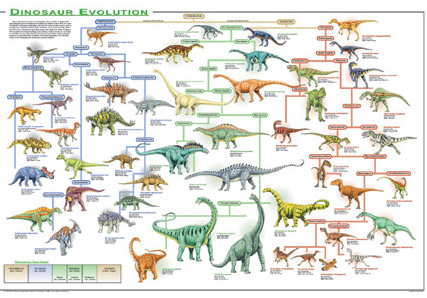
Dinosaur Evolution Poster – Tracing the Dinosaur Family Tree – A Tricky Business

Trying to organise Dinosauria into clades or family groups has kept many palaeontologists burning the midnight oil.  Unfortunately, unlike extant animals; when it comes to organising the family tree of extinct animals such as dinosaurs, a new fossil find, or some new research into existing specimens can throw everything into confusion.  It can be difficult trying to trace the dinosaur family tree.

What were once accepted relationships are often questioned and new fossils provide tantalising glimpses into the true nature of the relationship between different types of dinosaur.

The two great groups of dinosaurs are the saurischians (Lizard-hipped Dinosaurs) such as the sauropods and the theropods and the ornithischians (Bird-hipped Dinosaurs) examples being the ornithopods such as Iguanodon and the ceratopsians such as Triceratops.

The Dinosaur Family Tree

Much of the general classification was carried out in the late 19th century and this can lead to further problems.  The Victorian scientists cannot be criticised for their enthusiasm and endeavour, they worked according to the principles and practices of the era and of course their technology was very limited.  Often dinosaurs were grouped together and described using comparative anatomical measures, which is fine in itself, but we now have a lot more specimens to study.  Even the names for the suborders can lead to false assumptions.  For example, the ornithopods were so named as it was thought that the feet and footprints of these type of animals resembled birds.  In contrast, the word theropod means “Beast Foot”.  However, the common consensus amongst scientists today is that it is some of the theropods, specifically the maniraptorans such as Microraptor and Velociraptor which are closely related to true birds (Aves).

Knowledge About the Dinosauria

As our knowledge builds up of the 160-million-year-long fossil legacy left by the dinosaurs; a group so diverse that at one extreme tiny dinosaurs such as Micropachycephalosaurus could perch in the palm of your hand whilst others such as Seismosaurus could exceed 50 metres in length, scientists are still trying to classify these animals.

With thousands of different genera (and new ones being discovered all the time), it is quite difficult to piece dinosaur evolution together.  You can get a good idea from one of our posters which attempts so show the inter-relationships between the main dinosaur family groups.  The poster illustrates the complexity of the dinosaur family tree, as well as the diversity and it is certainly impressive to see so many different animals featured on one poster.

Dinosaur Evolution – See the Dinosaur Family Tree

Picture credit: Everything Dinosaur

To view posters and dinosaur themed toys and gifts: Visit Everything Dinosaur.

One interesting viewpoint put forward recently is to re-classify all dinosaurs using our understanding of their relationship to living creatures – the birds.  Two main groups of dinosaurs would emerge but not “Lizard-hipped or Bird-hipped” as before but “Non-avian” and “Avian Dinosaurs”.  If this classification was adopted it would make the dinosaur family tree look very different and the birds in your garden, penguins, pelicans, kiwis, in fact all birds would be basically classified as dinosaurs.

23 01, 2008

New Study Suggests Duck-billed Platypus and Duck-billed Dinosaurs side by side in the Cretaceous

By |2024-04-03T07:44:07+01:00January 23rd, 2008|Categories: Dinosaur and Prehistoric Animal News Stories, Main Page|1 Comment

The Duck-Billed Platypus – The Oldest type of Mammal on the Planet?

The Platypus is a bizarre looking Australian mammal, one of the few monotremes left in the world – a mammal that lays eggs.  When this strange looking creature, which can grow up to 50 centimetres long, was first studied by western scientists they thought the bill had been glued or sewn into place, few could believe that this animal was real and many dismissed drawings as total folly or an elaborate hoax.  However, this highly specialised freshwater mammal rather than being an oddity might just have remained unchanged for 120 million years.  This would make the humble Platypus one of the oldest kinds of mammal on the planet, with its origins now traced back to the middle of the Cretaceous.

A native of Australia, the Platypus uses its highly sensitive bill to find shrimps and worms underwater.  When a Platypus dives it effectively becomes blind and deaf, the bill replaces these senses by detecting prey, first by touch and then by tiny sensors that can detect the faint electrical charges given off by living organisms.  So effective is this device that an adult Platypus can eat up to half its own body weight in a single night.  It needs to, as it requires a high calorie intake to maintain its active life style.

Scientists have known for some time that as a monotreme it shares a number of characteristics with reptiles.  For example, the shoulder bones resemble those found in fossil Therapsid reptiles.  Platypus sperm is thread-like, similar to a reptiles rather than being tadpole shaped and of course the Platypus lays eggs, just like a reptile.

Cretaceous Origins

However, a fossilised jaw under the study of Dr Tom Rich and his partner Professor Pat Vickers-Rich has been identified as belonging to a member of the Platypus family and as the jaw dates from 120 million years ago, this puts the little Platypus right in amongst the dinosaurs of the Cretaceous period.

Palaeontologists Dr Tom Rich from Museum Victoria and Professor Pat Vickers-Rich from Monash University have been searching the southern coastline of Victoria for the remains of early mammals for more than two decades.

New analysis of three jaw fragments found ten years ago at Flat Rocks, near Inverloch, Victoria, has enabled the husband and wife team to positively link the fossils to the Platypus family.  Using a high resolution CT scanner in Texas the scientists discovered this ancient animal (named Teinolophos) had a large internal grove or canal along its jaw to help carry nerve fibres from the bill to the brain – just like a modern Platypus.  This puts this ancient mammal into the same family as the Platypus, the Ornithorhynchidae.

Ancient Platypus

Dr John Long (Museum of Victoria) commenting on the results of the CT scans stated that when these tiny fossil jaws were first discovered, it was thought that they may have belonged to an ancient ancestor of the modern Platypus, a close relative but not an actual Platypus type creature.  After all, the fossil jaws have teeth and the modern Platypus has none.

“But the recent discoveries made in the last week have shown with the high resolution CT scanner in Texas that some of these jaws that they found, they’re actually in the same family, Ornithorhynchidae, as the modern Platypus and this is absolutely outstanding,” Dr Long stated.

“It’s very interesting really because many of these early mammal groups had teeth,” Dr Long reported.

“It’s an ancestral condition for all mammal groups.  But throughout the course of their evolution, as the bill became more important and more specialised for their feeding to find worms and things, eventually they didn’t need teeth and they could just devour their food with their bill.”  For the scientists involved in this study it now seems that they can place the humble Platypus happily foraging streams and small rivers for food as dinosaurs such as the nodosaur Minmi and the fierce Allosaurus roamed the riverbank.

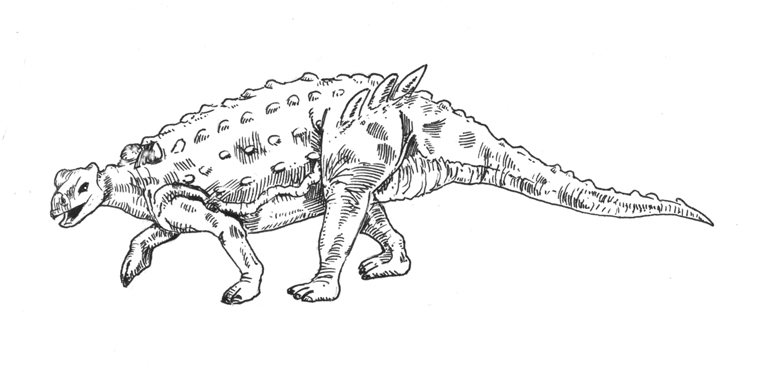
An Illustration of the Australian Nodosaurid Minmi

Minmi paravertebra illustrated.

An Aussie armoured dinosaur. Picture credit: Everything Dinosaur.

Picture credit: Everything Dinosaur

“Several kinds of mammals were living in the age of the dinosaurs, but none of those families, apart from the Platypus family, is still alive today,” Dr Long remarked.  It means Australia has the oldest living family of mammals anywhere on the planet.”

The Platypus far from being some sort of accident of nature has proved itself to be a very capable survivor with the basic body plan remaining unchanged throughout the Age of Mammals.  For a large part of the Cenozoic Australia has been cut off from other land masses and this has helped ancient animals such as the Platypus to survive to see the evolution and development of the human race.  Ironically, the Platypus still can be found in Victoria, inhabiting streams just a few miles inland from where the ancient fossilised Platypus jaw bones were found.

The research is being published in the Proceedings of the National Academy of Sciences(Australia).

Perhaps young allosaurs and other theropods actively hunted ancient Platypus amongst the horsetails and primitive flowering plants in those times so very long ago.

A potential Platypus hunter, an Allosaurus and other dinosaur models: Dinosaur and Prehistoric Animal Models.

22 01, 2008

Review of Prehistoric Times – Issue 84 (New for Winter 2008)

By |2024-04-03T07:39:19+01:00January 22nd, 2008|Categories: Magazine Reviews, Main Page|0 Comments

Review of Prehistoric Times – Issue 84

Mike Fredericks, his colleagues and contributors kick start 2008 with another very informative and packed edition of “Prehistoric Times” – the magazine for dinosaur enthusiasts and prehistoric animal merchandise collectors.

The front cover features a nothosaur – a Triassic marine reptile.  The picture has been specially commissioned for Prehistoric Times and was created by John Sibbick perhaps the most eminent dinosaur illustrator around today.  The front cover links to an article on the nothosaurid group providing a history of fossil finds and giving palaeoartists the opportunity to depict these animals in their watery environment.

The Front Cover of “Prehistoric Times” Magazine

Prehistoric Times Magazine

Issue 84 of “Prehistoric Times”

Keeping to the theme of prehistoric animals beginning with the letter “N” there is a special section on nodosaurs, part of the armoured dinosaur family the thyreophorans, similar to ankylosaurs but lacking the tail club.  Putting aside the opening paragraphs depicting a battle between a male Edmontonia and a bull Triceratops, the article sets out to “right some of the wrongs” concerning nodosaurs and give this group a little of the limelight so often hogged by the stegosaurs and ankylosaurs.

As well as the usual features about new products, fossil finds and the latest theories, issue 84 features a section on dinosaurs of Brazil.  The article is written by Augustin Martinelli and Ezequiel Vera, palaeontologists from Argentina and the article is well written and most informative.

Cleaveland-Lloyd Dinosaur Quarry

The new developments at the famous Cleveland-Lloyd dinosaur quarry in the middle of the Morrison formation are discussed with cool pictures showing the new facilities and some of the latest fossil finds and last by not least T. rex gets a look in with the second part of an article tracing the history of Tyrannosaurus illustration.

All in all, an excellent read.

“Prehistoric Times” website: Visit Prehistoric Times.

21 01, 2008

Human Kind Origins Traced to Fish – “Meet your next of Fin”

By |2023-02-24T21:55:05+00:00January 21st, 2008|Categories: Dinosaur and Prehistoric Animal News Stories, Main Page, Palaeontological articles|0 Comments

Scientists Trace Humans Fishy Origins

Neil Shubin, professor of Anatomy at Chicago University is due to publish a new book which explores the links between the osteology of humans and links to their ancient ancestors; the first fish and amphibians.

Using evidence related to the evolution of fishes and the first land living vertebrates, Shubin demonstrates that many of the traits associated with H. sapiens, traits thought unique to us, have their origins in animals that lived hundreds of millions of years ago.

Professor Shubin and his team reinforce the believe that the origin of human hands and digits lie in the emergence of the lobe-finned fish in the middle of the Devonian period.  Lobe-finned fish, more precisely described as Sarcopterygians, were so called as their fins sprouted from muscular lobes supported by bone.  Indeed, Shubin heralds Eusthenopteron (means “good strong fin”), a lobe-finned fish of the late Devonian as evidence of the development of upper arm bones such as the humerus.

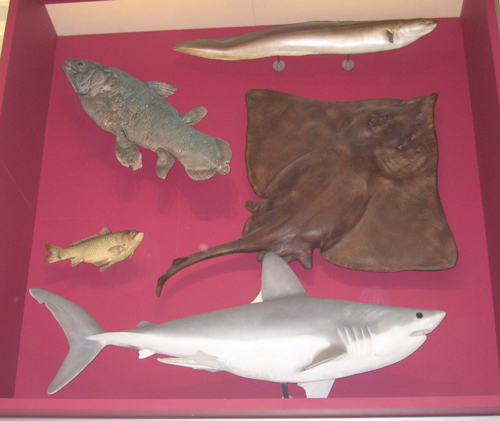
The fish family is very diverse.

A selection of different types of extant fish from an exhibit from the National Museum of Scotland (Edinburgh). Human beings – all tetrapods are highly evolved fish! Picture credit: Everything Dinosaur.

Picture credit: Everything Dinosaur

“Next of Fin”

His team go on to cite a number of examples from the fossil record that indicate that the majority of the human genome (the instructions or blueprint for making a person), evolved millions of years ago.  Study of an ancient sea creature, a Tiktaalik (fossils discovered in the Arctic in 2003), may provide a clue to the origin of our shoulder and arm joints.

Early Tetrapods

Interestingly, many of the early tetrapods such as Acanthostega and Ichthyostega had many more digits than humans.  This may be a legacy of the digits first evolving to help water based creatures clamber over vegetation in the shallows rather than for supporting body weight for movement around on land.

Close study of early amphibian fossilised vertebrae can show evidence of vertebral pegs called zygapophyses.  These helped stiffen the back bone and allowed early tetrapods to carry their bodies off the ground.  Front and rear zygapophyses can still be found in human vertebrae today – another legacy from our fishy origins.

Everything Dinosaur stocks a range of prehistoric fish figures and models of early tetrapods, to view the selection of replicas in stock: Everything Dinosaur Prehistoric Animal Models.

20 01, 2008

Best Selling Prehistoric Animals of 2007/8

By |2022-11-08T13:36:39+00:00January 20th, 2008|Categories: Everything Dinosaur News and Updates, Main Page, Press Releases|0 Comments

The Most Popular Prehistoric Animals – Everything Dinosaur Survey Results

The fierce carnivore Tyrannosaurus rex is children’s favourite dinosaur, although Stegosaurus is catching up according to a survey published by the team at Everything Dinosaur, the specialist educational toy company.

Using information gathered from dinosaur drawing workshops with schoolchildren, as well as product sales and viewings from the company’s website Everything Dinosaur Website, a top ten list of popular prehistoric animals has been compiled. Not surprisingly, the ferocious Tyrannosaurus rex tops the chart but the gentle plant eater Stegosaurus has replaced Velociraptor in the number two position.

Prehistoric Mammals are well represented in the list with the Sabre-toothed cat and the Woolly Mammoth continuing to be popular.  With the appearance of a Sabre-toothed cat (Smilodon) in the next episode of the Primeval television programme on ITV1 (Saturday 26th January), the Smilodon is expected to be boosted further in popularity.

The Top Ten Best Selling/Most Popular Prehistoric Animals

1. Tyrannosaurus rex

2. Stegosaurus

3. Velociraptor

4. Triceratops

5. Pteranodon

6. Sabre-toothed Cat

7. Woolly Mammoth

8. Diplodocus

9. Spinosaurus

10. Giganotosaurus

Survey Source: Everything Dinosaur 2007

19 01, 2008

Dinosaur Colours and Camouflage Examined in Research

By |2024-04-03T07:39:52+01:00January 19th, 2008|Categories: Dinosaur and Prehistoric Animal News Stories, Everything Dinosaur News and Updates, Everything Dinosaur Products, Main Page, Palaeontological articles|0 Comments

The Bright and Colourful Mesozoic

In the past, many scientists thought that dinosaurs were uniformly grey and drab, perhaps influenced by the relatively plain colouration of large land animals today such as elephants, rhinos and hippopotamuses (although hippos can turn a fetching shade of pink under the African sun).  Today’s experts believe that the dinosaur world may have been a surprisingly colourful place.

Dinosaur Colours and Camouflage

Dinosaurs were around for a long time before the first flowering plants appeared (the angiosperms), their world was dominated by greens and browns and although the few entirely herbivorous reptiles left today such as Iguanas generally tend to be green and brown in colour, many scientists believe that dinosaurs were brightly coloured.  Palaeontologists have cited a number of reasons why many dinosaurs could have been colourful with many skin pigment variations.

Firstly, those fossils that have traces of of skin tissue associated with them indicate that many dinosaurs were covered in scaly skin with some pebble like nodules.  These scales could possibly have contained pigment cells which would have provided many dinosaurs with an assortment of colours, perhaps even allowing them to change colour to express emotions or to provide extra camouflage like many lizards today.

The recently discovered and beautifully preserved “mummified” Hadrosaur from Dakota has actual fossilised skin.  Close examination of the this indicates that this animal may have had stripes along its tail, a suggestion put forward by Dr Phil  Manning of Manchester University who helped study this remarkably well preserved specimen.

To read more about this discovery:

Dinosaur Mummy unlocks Duck-Billed Dinosaur Secrets.

Another reason why dinosaurs may have been brightly coloured is that if they are closely related to birds, then if feathered birds are colourful, why not feathered dinosaurs?  As well as providing insulation; protofeathers could have been used in display, they could indicate which animals were reproductively mature.  Scientists believe that dinosaurs could see in colour (crocodiles and birds can, so why not their close relatives dinosaurs)?

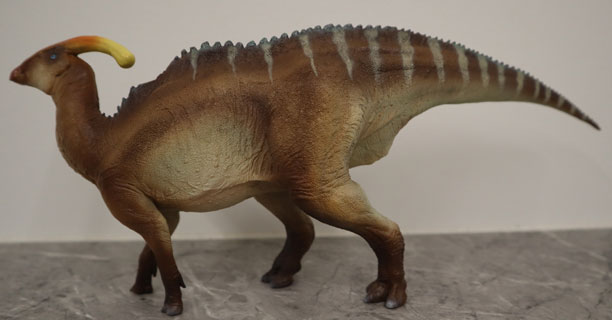
Many herbivorous dinosaurs lived in herds.  The Duck-Billed dinosaurs such as Parasaurolophus could have been stripped in order to make it difficult for a predator to pick out an individual – in the same way that zebras use colours today.

A Model of a Parasaurolophus

PNSO Wyatt the Parasaurolophus dinosaur model in lateral view.

PNSO Wyatt the Parasaurolophus dinosaur model in lateral view, a stunning replica of a Late Cretaceous duck-billed dinosaur.  The stripes will help to camouflage this herbivorous dinosaur.  Picture credit: Everything Dinosaur.

Picture credit: Everything Dinosaur

The picture (above), shows a PNSO Parasaurolophus model: PNSO Age of Dinosaurs.

Communication within the Herd

Also, with animals living in herds there would need to be some way for these creatures to communicate with each other, perhaps colourful crests and patches were used to indicate social status and social order within such herds.

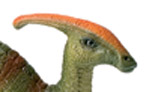
The latest model Parasaurolophus from Bullyland demonstrates this principle.  Scientists believe that the crest of this dinosaur may have varied between males and females.  The males may have had the bigger crests, some of which exceeded 1.8 metres long.  Juvenile Parasaurolophus have little or no crest, perhaps the crest grew as the animals reached maturity.  If this is the case then a large crest would perhaps indicate social dominance and status within the herd.  This would have been emphasised if the crest was a different colour from the rest of the animal, a bright colour for instance, like orange.  This is why the new Bullyland model has been depicted with an orange coloured crest.

The Bullyland Model Parasaurolophus (Orange Crest)

Picture credit: Everything Dinosaur

The model depicts a male Parasaurolophus with a distinctive and large head crest.

A Picture of a scale Model – Parasaurolophus

A crested lambeosaurine hadrosaur.

Picture credit: Everything Dinosaur

To view the model: Dinosaur and Prehistoric Animal Models.

The orange strips may have helped camouflage this animal as it moved through woodland (helping to break up it’s body outline).  Stripped animals moving in a herd are also given a degree of protection as the colour scheme can prevent a predator from selecting an individual to attack.

There are a number of interpretations available regarding the colouration of dinosaurs.  Fossils can reveal a great deal of detail about these ancient creatures but they rarely include any signs of the skin.  The softer body parts usually rot away before preservation and things like colouration do not normally fossilise.  This means that scientists can speculate as to the actual colour of dinosaurs and as a result many variants have been put forward.

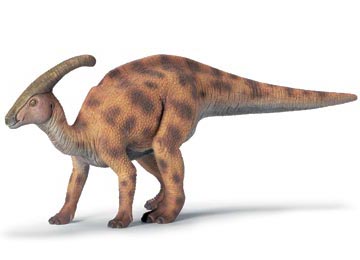
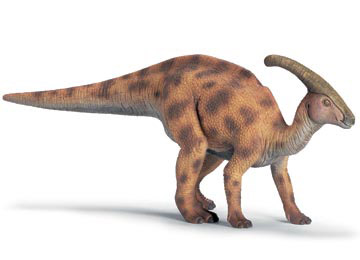
The Parasaurolophus from German model makers Schleich is depicted with a very different colouration.  In this model, a leopard like spotted coat is favoured.  Palaeontologists using evidence from Alberta believe that this animal may have favoured woodland environments.  Spots as well as stripes would have made good camouflage.  Hence in this instance, Parasaurolophus is depicted as having a spotted coat.

Another View of the Parasaurolophus Model from Schleich

Picture credit: Everything Dinosaur

To view the Schleich prehistoric animal range and other models: Dinosaur Models and Toys.

The speculation is likely to continue, what is almost for certain is that the grey, drab models of yesteryear will continue to be replaced by more colourful ones.  Could be this reflects the latest scientific research, or perhaps it is more to do with appealing to collectors and dinosaur fans.

17 01, 2008

Rare and Giant Fossil Rodent Discovered In Uruguay

By |2024-04-03T07:38:17+01:00January 17th, 2008|Categories: Dinosaur and Prehistoric Animal News Stories, Main Page, Palaeontological articles|0 Comments

“Mighty Mouse”or Perhaps more Accurately “Mighty Guinea Pig”

Hidden away in a dark corner of the storage vaults of the Natural History and Anthropology museum in Uruguay, lay the huge skull of a prehistoric mammal that scientists claim belonged to a rodent the size of a bull.

Prehistoric Rodent

The fossil, consisting of the upper portions of a skull, was discovered 20 years ago in the River Plate estuary by a Uruguayan fossil collector.  It was donated to the museum by lay in storage until museum curator Andres Rinderknecht and researcher Ernesto Blanco decided to study it.

Their findings have just been published in the proceedings of the British Royal Society B: Biological Sciences and estimates for this animal give it an approximate length of 3 metres and perhaps a body weight close to 1,000 kilos.  Such estimates have to be treated with a degree of caution, as it can be difficult to determine body size from only partial remains, particularly if there are few extant genera to make a direct comparison with.

Jospehoartigasia monesi

Large animals tend to have disproportionately smaller heads when compared to the body masses of more diminutive creatures so the estimates for this new animal – named Jospehoartigasia monesi are based on scientific deduction.  If other fossils of an adult can be found such as limb bones then perhaps a more accurate assessment can be made.

Pictures that have been circulated depict the rodent skull compared with a typical rodent of today. The parts modelled in grey provide a reconstruction of the entire skull, as can be seen the lower jaw and the incisors are missing.

The fossil has been dated to the Pliocene and is estimated to be around 4 million years old.  The skull is typical of that of a rodent but the animal was of an exceptional size.  Perhaps wandering the grassy plains of South America eating roots, fruit and leaves and sharing the plains with sloths and glyptodonts whilst trying to avoid the predatory “Terror Birds” such as Phorusrhacus.

The Largest Rodent Known to Date

This fossil may well represent the largest rodent known to date, although the rodent Phoberomys pattersoni from the Miocene of Brazil and Venezuela may also have been around the same size but perhaps with a longer tail.

It is not known whether Jospehoartigasia was amphibious, but the fossil was found in an area rich in ancient waterways so this large rodent could have spent some time in the water, safe from land predators, grazing in peace on the lush vegetation.  The jaws may have been relatively weak for such a large animal, this may support the theory that these ancient rodents fed on soft water plants.

This new fossil find has been classified into the Dinomyidae family, effectively close relatives to Guinea Pigs and Capybaras as well as the extinct Phoberomys.

It certainly was a big animal, not the sort of rodent that you would expect to catch with a conventional mouse-trap, more of a “mighty Guinea Pig” rather than  “Mighty Mouse”!

For models and replicas of prehistoric animals: Prehistoric Animal Models and Figures.

16 01, 2008

Beautiful Colour Variations on Dinosaur Models – Dilophosaurus

By |2024-04-03T07:31:17+01:00January 16th, 2008|Categories: Dinosaur Fans, Everything Dinosaur News and Updates, Main Page|1 Comment

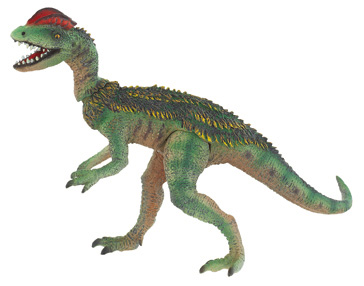
New Dilophosaurus Scale Model –  a Bright Red Crested Dinosaur

An important decision that has to be taken by every prehistoric animal model manufacturer is what colour to paint their models.  Unfortunately, palaeontologists can offer only limited advice in terms of colouration, as generally colour is not preserved in the fossil record.  This problem was illustrated when Bullyland of Germany wanted to refresh their Dilophosaurus model, which is part of the prehistoric animal scale model series.

Dilophosaurus Dinosaur Model

Dilophosaurus was a relatively large carnivorous dinosaur that lived in the western United States at the beginning of the Jurassic period (approximately 200-190 million years ago).  The Early Jurassic fossil record is quite poor and little is known about the Earth’s flora and fauna at this particular time, so the discovery of a six metre, meat-eating dinosaur was extremely significant.

The first fossils of Dilophosaurus were discovered during a fossil hunting expedition to Arizona sponsored by the University of California in 1942.  Three individual and partial skeletons were found, although two of them were very poorly preserved and crucially no skull material was found.  The American palaeontologist Dr Sam Welles was able to name and describe this new dinosaur in 1954 (it took many years for the fossils to be stabilised and prepared for further study).  Due to the poor state of the fossils, Dr Welles misidentified this dinosaur as a type of megalosaur (a Jurassic predator known mainly from Europe).  The fossil record of carnivorous dinosaurs from the Lower to Middle Jurassic is so poor that a lot of finds end up being wrongly classified.  Indeed, the genus Megalosaurus has got a bit of a reputation for being a dumping ground for dinosaur meat-eater miscellany.

To read more about this topic : Megalosaurus – A Dinosaur Waste Basket.

Another article about megalosaurs: Megalosaur Miscellany.

Palaeontological Expedition

In 1964, Dr Welles led another palaeontological expedition to the site and was fortunate to find another specimen, this time with the skull virtually intact.  Noting the double crests on the ridge of the snout, Dr Welles renamed this animal Dilophosaurus (means double crested lizard) and completed his description.

The fossil material enabled Dr Welles to classify this animal as a separate genus and to give this animal the name “double crested lizard”.  In most pictures, the right side of the skull is shown with the snout facing to the right.

The two, thin and bony semi-circular crests on the head were too fragile to be used as weapons.  Perhaps they were different between males and females and indicated sexual dimorphism.  Or perhaps they were brightly coloured and used by males in displays to win females.  From the size of the orbit in the skull (the large hole in the middle of the skull), it can be deduced that eyesight was an important sense for this dinosaur.  Studies have shown that dinosaurs may have had good colour vision so colour may have been very important to these particular dinosaurs, perhaps to display social status in the group or dominance over rivals.

The Colour of Dinosaur Models

These factors where considered when the artists and sculptors came to redesign the colour palette on their Dilophosaurus.  They chose a bright red colour scheme perhaps reflecting the importance of colour in the lives of this aggressive carnivore.

The Dilophosaurus Model from Bullyland

“Double Crested Lizard”.

Picture credit: Everything Dinosaur

To view the scale model of Dilophosaurus and other dinosaurs: Dinosaur and Prehistoric Animal Models.

The jaws of this dinosaur were quite light and delicate, with many sharp, but slender teeth.  Some scientists have suggested that the jaws were too light-weight to cope with struggling prey and that Dilophosaurus may have been a scavenger feeding on the kills of other predators.  This was taken into consideration when painting this new version of Dilophosaurus, living in a mainly green and brown world (Dilophosaurus evolved long before the first flowering plants), a red colouration would have made this animal stand out.  It could be seen from a long distance and being an aggressive red colour perhaps Dilophosaurus could have put up an impressive display.  This may have been enough to drive off a larger predator from a carcase.

Emphasis on the Colour Red

Interestingly, the colour red has a very peculiar characteristic when seen on people or animals from a distance.  It becomes very difficult to determine individuals in a group and to estimate numbers.  Hence the British army’s adoption of red for their uniforms right up until the end of the 19th Century.  The “Red Coats” numbers could not be counted accurately by the enemy from a distance.  The strength of the British forces could not be estimated easily because of the colour of their jackets.  This factor was also considered when choosing the colour for the Dilophosaurus model.  If we assume that Dilophosaurus lived in packs (the close proximity of the fossils found indicate this), then a large predator could be confused and uncertain as to the number of dilophosaurs approaching from a distance.  Rather than face an unknown number of dilophosaurs, the carnivore may opt for the safer option of abandoning its kill, thus providing the brightly coloured Dilophosaurus with an easy meal.

The unusual double crests running along the snout of this dinosaur inspired artists to add Dilophosaurus to the poster on weird and wonderful dinosaurs.  Here too, they have given Dilophosaurus a bright and colourful appearance.

Weird and Wonderful Reptiles as Illustrated on the Weird and Wonderful Dinosaurs Poster

Another weird and wonderful dinosaur.

Picture credit: Everything Dinosaur

To view a selection of prehistoric animal themed toys and gifts: Everything Dinosaur.

15 01, 2008

Research shows that Dinosaurs May have Grown Quickly but Died Young

By |2023-02-14T21:16:29+00:00January 15th, 2008|Categories: Dinosaur and Prehistoric Animal News Stories, Main Page, Palaeontological articles|0 Comments

The Life of a Dinosaur – Short and likely to end Unpleasantly

Although many scientists now believe that dinosaurs are closely related to birds there has been considerable debate about the length of dinosaurs lives, how quickly they grew and when they reached an age when they could reproduce.

Newly Published Research

Dinosaurs Grew Quickly

The finding, Werning said, suggests that dinosaurs were born precocious and suffered high adult mortality, making early reproductive maturity necessary for survival.   It seems that all those monster movies were right when the dinosaurs in the picture end up deceased, with the chances of few dinosaurs living into old age, having the ability to raise a family early makes evolutionary sense.

“This is an exciting finding, because age at reproductive maturity is related to so many things,” said the students’ adviser, Kevin Padian, who is a professor of integrative biology and a curator in UC Berkeley’s Museum of Palaeontology. “It also shows that you can’t use reptiles as a model for dinosaur growth, as many scientists still do.”

Diverse Dinosauria

Unfortunately, dinosaurs are an exceptionally diverse group with huge titans such as Argentinosaurus and Brachiosaurus as well as very much smaller members of the group like Microraptor.  Such very different animals may well have exhibited contrasting growth rates and life spans.  It could be imagined that a small theropod such as Microraptor may have led a short life, with a rapid growth rate to maturity, perhaps similar to the life styles and growth rates in garden birds.  Garden birds such as blackbirds and robins can grow from a hatchling into a fully fledged adult in under a year.

Animals such as the sauropods may have lived for much longer and continued growing throughout their lives, although their growth rates would have decreased once they had reached full maturity.  It has been estimated that a sauropod such as Brachiosaurus could have lived for as much as 150 years.

Pinpointing the age of reproductive maturity “opens up so many complementary avenues of dinosaur research,” Werning commented. “You can talk about dinosaur physiology, lifespan and reproductive strategies”.

The conclusion, reported the week of Jan. 14 in the on line early edition of the journal “Proceedings of the National Academy of Sciences”, comes from an analysis of the only three dinosaur fossils that have been definitively identified as female. Thin slices of these dinosaurs’ fossil bones all show an internal structure similar to tissue found in living female birds – a layer of calcium-rich bone tissue called medullary bone that is deposited in the marrow cavity just before egg-laying as a resource for making eggshells.

Studying Dinosaur Bones and Eggshells

Dinosaurs, which also laid eggs, apparently stored calcium in similar structures prior to ovulation. In their new paper, Werning and Lee report that leg bones from the carnivorous Allosaurus and the plant-eater Tenontosaurus both contained this structure, which means both creatures died shortly before laying eggs. The researchers concluded that these dinosaurs were both mere adolescents, because the Allosaurus was age 10 and the Tenontosaurus age eight at time of death, and prior studies have shown that these types of dinosaurs probably lived up to 30 years.

Werning and Lee also confirmed that a third bone, from a female Tyrannosaurus rex reported by Museum of the Rockies palaeontologist Mary H. Schweitzer in 2005, contained medullary tissue upon the dinosaur’s death at the age of 18. Werning noted that all three dinosaurs might have reached reproductive maturity much earlier.

“We were lucky to find these female fossils,” Werning said. “Medullary bone is only around for three to four weeks in females who are reproductively mature, so you’d have to cut up a lot of dinosaur bones to have a good chance of finding this.”

In the past 10 to 15 years, studies of dinosaur bones have revealed much about the growth strategy of dinosaurs because bone lays down rings much like tree rings. If, as with trees, each ring signifies one year, then dinosaurs grew rapidly after birth and continued to grow over several years until death. Despite the presumed close relationship between dinosaurs and reptiles, dinosaurs grew faster than living reptiles, and their bones had a bigger blood supply.

Among living vertebrates, only birds and mammals exhibit such fast growth, perhaps this is another indication that dinosaurs were indeed warm-blooded like birds and mammals. Birds and small mammals grow quickly to maturity and then become reproductively mature, but large mammals reach maturity just before growth slows.

Attempts to determine when dinosaurs became able to reproduce, and thus whether they more closely resemble birds or mammals, have been difficult because there have been no clear signs of reproductive maturity in dinosaur skeletons.

Medullary Bone

Hence the excitement when Schweitzer discovered medullary bone in a T. rex femur. Though other palaeontologists have searched fruitlessly for similar signs in fossil bones, Werning and Lee found success by focusing on Tenontosaurus (a large hypsilophodontid) and Allosaurus, a predator from the Late Jurassic whose fossils are relatively common (well at least for a carnivorous dinosaur anyway).

Werning was able to obtain many fossil bone slices from the Oklahoma Museum of Natural History. Both a femur (thigh bone) and a tibia (shin bone) from the same fossilised Tenontosaurus showed medullary bone, while growth rings in its bones indicated the pregnant dinosaur was eight years old.

“These were prey dinosaurs, so they were probably taken out when really young and small or when old,” Werning said. “So, if you don’t reproduce early, you lose your chance.”

Lee, on the other hand, focused on Allosaurus fossils from the Cleveland-Lloyd quarry in Utah, where several thousand Allosaurus bones from at least 70 individuals have been discovered. A smaller and older version of T. rex, Allosaurus lived 155 to 145 million years ago in the Late Jurassic. Lee found one tibia with medullary bone from the University of Utah vertebrate palaeontology collection.

The two researchers are continuing to analyse thin slices of fossilised dinosaur bone in hopes of finding more skeletons with medullary bone.

The work was made possible by grants from the Geological Society of America, the Palaeontological Society and the University of Oklahoma Graduate Student Senate to Werning and by grants to Lee from the Jurassic Foundation and UC Berkeley’s Department of Integrative Biology.

This article has been reproduced from press release extracts from the University of California.

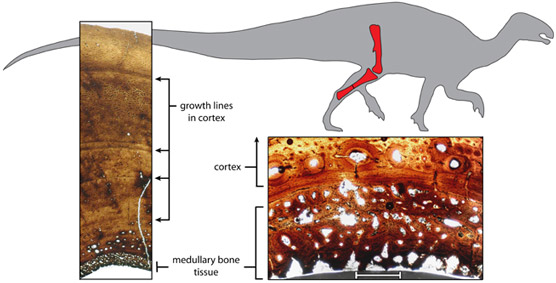
Dinosaur Growth Rates Demonstrated by Tenontosaurus

Ontogeny of dinosaurs.

CAPTION: Cross-sections through the fossilised tibia or shinbone of a 120-million-year-old female Tenontosaurus skeleton, showing growth rings and medullary bone laid down in the marrow cavity just prior to egg laying. This individual died at the age of eight, shortly before she would have laid her eggs.

Picture credit: Sarah Werning/UC Berkeley & Andrew Lee/Ohio University; fossil courtesy of the Oklahoma Museum of Natural History

Go to Top