All about dinosaurs, fossils and prehistoric animals by Everything Dinosaur team members.
27 02, 2008

Events that Shook the Country (Market Rasen Earthquake)

By |2023-02-23T08:12:10+00:00February 27th, 2008|Categories: Geology, Main Page|0 Comments

Earthquake shakes the Country – Epicentre 4km north of Market Rasen, Lincolnshire

At shortly before 1am this morning (GMT) an earthquake with a magnitude of 5.2 struck the United Kingdom.  The epicentre (the point on the Earth’s surface directly above the centre of the earthquake), was 4 kilometres north of the town of Market Rasen, Lincolnshire.  Reports have been received of a Market Rasen earthquake!

There is one report of an injury, the British Geological Society (BGS) had by 7am received over 1,400 reports from members of the public, the media and the emergency services.  Some structural damage has been caused, chimneys falling off, walls collapsing  close to the epicentral area, but this tremor was felt across a large part of the UK.  Many residents in English and Wales towns were awoken by the shaking, the quake has been felt as far away as southern Scotland.

Market Rasen Earthquake

In this country we are not immune from earthquakes, each year the BGS records around 200, but only about 10% are big enough to be felt by local residents. Fortunately, most of the quakes have epicentres which are offshore.  The largest earthquake recorded in the British Isles took place in 1931.  This quake had a local magnitude of 6.1, but fortunately it was centred on the Dogger Bank area of the North Sea.  Even so, the quake and the aftershocks were powerful enough to cause structural damage to many buildings on the east coast of England.

Finding the Epicentre

The precise epicentre of the Market Rasen quake has been calculated to be latitude 53.419 degrees north  and longitude 0.354 degrees west.  It is understood to have taken place approximately 5,000 metres underground.

Earthquakes are monitored by the British Geological Survey, part of the Natural Environment Research Council (NERC).  There is a network of 146 seismometer stations across the UK sending data to the head office based in Edinburgh four times per day.  However, during times of earthquake activity data can be sent on demand and staff at the BGS can access data and analyse results from home.  They are on call 24-hours a day, as scientists don’t know when a quake will strike.

Earthquakes of this magnitude occur approximately ever 30 years or so, in the world there are about 1,300 quakes of this magnitude or bigger each year.  This latest quake is the biggest since 1984, when on the 19th July North Wales was struck by an earthquake that had a magnitude of 5.4.  It too caused structural damage to many buildings with cities such as Liverpool 120 kilometres from the epicentre being affected.

106 Tremors

None of the team members at Everything Dinosaur felt the quake (all sound asleep in our beds).  However, one member of staff recalled the Manchester earthquakes that struck in the Autumn of 2002.  A series of tremors were recorded with an epicentre in and around Manchester over a period of five weeks.  The magnitude ranged from 1.1 to 3.9 ML (local magnitude).  In total 106 tremors were recorded, the biggest of which (3.9 ML) hit on October 21st.  Our colleague remembers particular incident very well, as he was travelling in a lift in an office block in the centre of Manchester at the time – very scary.

To read more about the work of the BGS and the latest on this mornings quake you can visit the BGS website.

Visit Everything Dinosaur’s award-winning website: Everything Dinosaur.

26 02, 2008

New Study Links Oxidation of Oceans with Speedy Evolution

By |2023-02-24T22:01:10+00:00February 26th, 2008|Categories: Dinosaur and Prehistoric Animal News Stories, Geology, Main Page, Palaeontological articles|0 Comments

Rises in Oxygen Levels may Explain “Cambrian Explosion”

A new study from a multi-national team of scientists provides evidence of the link between the explosion of early life forms and the oxidation of the deep oceans.  The rise of oxygen levels within the ocean between 635 and 551 million years ago may have helped trigger the increase and rapid diversification of early lifeforms, leading ultimately to the “Cambrian Explosion”.

The “Cambrian Explosion” is a term used by scientists to describe the huge increase in life that occurred around 545 million years ago, at this stage of the history of life on Earth, all life was associated with marine environments.  It was during the Cambrian that most of the major groups of animals that exist today evolved.

Speedy Evolution

Soft bodied animals and the stromatolites (colonies of bacteria) were partly replaced and superseded by the evolution of organisms with hard parts such as exoskeletons and shells.  The first forms of life that could be biomineralised evolved, this meant that the hard parts of their bodies could be preserved as fossils and thus this period of ancient history not only marks the increasing abundance and diversity of organisms but also marks the start of an enriched fossil record, providing palaeonotologists with more evolutionary evidence.

Complex organisms had been in existence prior to the beginning of the Palaeozoic, but the fossil record is extremely poor.  Multi-cellular life forms have been recorded in rocks of approximately 600 million years of age, but these creatures seemed to have lacked any hard parts and as soft-bodied creatures, palaeontologists have only a few tantalising fossils to work with.

A Rise in Oxygen Levels

The rise in oxygen levels and the oxidation of deep oceans in the late Precambrian has been accepted for a number of years.  However, it had been thought that the increase in photosynthetic bacteria such as cyanobacteria (formerly known as blue-green algae), assisted by other non-biological means such as the breakdown of water into hydrogen and oxygen by ultraviolet rays penetrating to the surface of the Earth through the ozone devoid atmosphere had led to the increase.

Now, new research from scientists studying the geochemical structure of the Duoshantuo Formation in southern China reveals that life on Earth may have been influenced by two distinct pulses of oxygen.  The first increase in oxygen predates the “Cambrian Explosion” by a significant amount of time but may have led to an increase in microscopic life forms.  The second burst of oxygen aerating the oceans seemed to have occurred around 550 million years ago and in geological terms immediately pre-dates the increase in life during the Early Cambrian.

Trilobites Thrived During the Cambrian

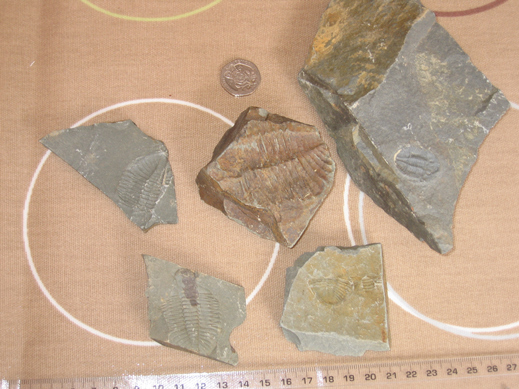
A selection of trilobite fossils.

A selection of our trilobite fossils.  These ancient marine creaturs thrived during the Cambrian.

Picture credit: Everything Dinosaur

An international team of scientists from Virginia Tech, the University of Maryland, University of Nevada (Las Vegas) and the Chinese Academy of Sciences set out to test the relationship between the evolution of more complex and diverse life forms and environmental change.  To do this the team needed to find sedimentary strata that pre-dates the Cambrian and a sequence of strata (stratigraphic column) that would show deposition and formation as a timeline, one that had not been altered or changed by other chemical or geological processes.

Finding pristine Precambrian strata is a challenge in itself but such locations are known, one being the Doushantuo Formation in the Yangtze Gorges area, Guizhou Province, southern China.  The strata consists of phosphate and dolomite sequences, laid down at the bottom of a sea.  China at this time was made up of two separate and submerged continental sheets, that lay in shallow, warm tropical waters off the coast of the super-continent Gondwana.  The first part of what was to become China, closest to Gondwana, straddled the Equator, the second part lay across the Tropic of Cancer.

Mapping Oxygen Levels

By mapping the levels of oxygen at various levels in the stratigraphic column, the team could measure the amount of oxygen in the marine environment and then associate this with the biostratigraphic column (fossils used to date and correlate strata), this would provide evidence to support the increase in oxygen leading to a diversity and increase in lifeforms.

To calculate when there was enough oxygen to support animal life in the ocean, the researchers asked, “What kind of geochemical evidence would there be in the rock record?” said Shuhai Xiao, associate professor of geosciences at Virginia Tech.

Scientists hypothesized that there was a lot of dissolved organic carbon in the ocean when oxygen levels were low. If oxygen levels rose, some of this organic carbon would be oxidized into inorganic forms, some of which can be preserved as calcium carbonate (CaCO3 ) in the rock record. “We measured the carbon isotope signatures of organic and inorganic carbon in the ancient rocks to infer oxidation events,” said co-author Ganqing Jiang, assistant professor of geology at the University of Nevada at Las Vegas.

The stratigraphic column exposed during the construction of the dams in the Yangtze Gorges area represents a large slice of ancient geological history.  The researchers carefully took samples from each strata of rock, the deeper the strata, then, unless the strata has been overturned, as can sometimes happen during mountain building processes for example, the older the rocks will be.  This is an important geological principle it is called the “Law of Superposition”.  Many hundreds of different samples were taken, representing marine deposits laid down during the Precambrian and Early Cambrian.

The researchers cleaned and crushed the small samples to powder, which they reacted with acid to release carbon dioxide from carbonate minerals, and then burned the residue to get carbon dioxide from organic matter. “The carbon dioxide that is released was measured with mass spectrometers to gives us the isotopic signature of the carbonate and organic carbon that was present in the rock,” a researcher commented.

“The relative abundances of the carbon-12 and carbon-13 isotopes, which are stable and do not decay with time, provide a snapshot of the environmental processes taking place in the ocean at the different times recorded in the layers of rock”.

The stratigraphic pattern of carbon isotope abundances suggested to these researchers that the ocean, which largely lacked oxygen before animals arrived on the scene, was aerated by two discrete pulses of oxygen.

The first pulse that occured in the Precambrian seemed to have little impact on a large organic carbon reservoir in the deep ocean, but did spark changes in microscopic life.  The second event, which occurred around 550 million years ago, immediately prior to the palaeontological event known as the “Cambrian Explosion”, resulted in the reduction of the organic carbon reservoir.  This indicates that the ocean became fully oxidized just before the evolution and diversification of many of Earth’s earliest animals.  Perhaps this dramatic increase in the level of available oxygen provided the fuel for the rapid burst of evolution.

Certainly, scientists have speculated why all of our sudden around 545 million years ago evolution seems to have pressed the accelerator when for much of the Precambrian  (Cryptozoic), evolution seemed to be progressing at a very slow pace.  You could say that evolution, prior to the second pulse of oxygen had progressed at a snail’s pace but to be fair to the Gastropods (snails) these animals did not really get going until the Early Cambrian.

Photographs show a field of view 0.15 millimetres in diameter of a beautifully preserved eukaryotes fossil from the Doushantuo formation (635-550 million years old).  Eukaryotes are cells with their genetic material enclosed in a cell nucleus.  Eukaryotes are believed to have first appeared in the fossil from strata dated to 2,100 million years ago, but evidence from molecular biology indicates that they may have been present earlier than this but left little or no fossil evidence.

“The Doushantuo Formation has a wonderful fossil record. It allows us to look at major fossil groups, when they appear and when they disappear, and to see a relationship between oxidation events and biological groups”, a researcher commented.

“This study supports the growing view that life and environment co-evolved through this tumultuous period of Earth history,” said geochemist Alan J. Kaufman, a co-author of the study from the University of Maryland.

The triggers for the oxidation events remain elusive, scientists are still not sure what set off these oxidizing events.  Members of the research team have suggested that these two events recorded in marine sediments were probably related to oxygen in the atmosphere reacting with sediments on land as rocks are eroded away.  The lack of biological activity on the land would have resulted in weathered rocks and soils on the continents releasing certain dissolved ions, such as sulphate, into rivers. These would then be transported to the sea where they might be used by bacteria to oxidize the organic carbon pool in the deep oceans.

This article has been adapted from materials published by Virginia Tech, USA.  The full article entitled “Pulsed oxidation and biological evolution in the Ediacaran Doushantuo Formation,” was written by Kathleen A. McFadden; Jing Huang and Xuelei Chu of the Institute of Geology and Geophysics, Chinese Academy of Sciences; Ganqing Jiang; Alan J. Kaufman; Chuanming Zhou and Xunlai Yuan of the Nanjing Institute of Geology and Palaeontology, Chinese Academy of Sciences; and Shuhai Xiao.

It is due to be published in March.

CollectA have recently introduced a range of models of invertebrates reflecting iconic animals from the fossil record including trilobites and members of the Mollusca: Replicas of Iconic Fossil Animals, Models, Toys and Games.

25 02, 2008

Review of the Movie Zodiac by Mike

By |2023-02-24T21:07:50+00:00February 25th, 2008|Categories: Main Page, Movie Reviews and Movie News|0 Comments

Zodiac – A Film Review

This film was directed by David Fincher, whose only other film I have seen is Seven.  It is based on the true story of the hunt for a serial killer who terrorised California in the late 1960s and remained notorious and at large for many years.  The Zodiac is not the central character in this story, the film portrays the obsession of individuals who set out to prove the identity of the killer.

Specifically the film focuses on the preoccupation of a newspaper cartoonist and his desire to find the Zodiac, at the cost of his family and his job.  I think this character is played by Jake Gyllenhaal, although for me it is Robert Downey Jr who steals most of the scenes with his portrayal of a drunken, hack and his fall from grace into despair and loneliness.

Zodiac – A Film Review

The crimes were committed when forensic science was in its infancy, there are few clues to go on and the lack of a co-ordinated police effort hampers the pursuit of the perpetrator.  At various points in the film, you are given the impression that the net is closing in but each time the investigations lead you up a blind alley.  To this end the film was a little frustrating, it lacked the clean, no fuss storyline of a CSI TV episode, but I guess that was the point.  Real life crime is nothing like television and this film depicted the hunt for the killer with a degree of realism.

The Californian police are not like Mounties – they don’t always get their man.  The main detective on the case reminded me of Columbo, perhaps a deliberate attempt by the Director to contrast the police investigation in this movie with the more predictable denouement associated with the standard fayre on TV.

The film certainly had me interested, not fascinated but interested enough not to notice that the best part of 160 minutes had passed before the lights came up.

Overall, an OK way to spend an afternoon, but not enough dinosaurs for my liking.

For dinosaur themed gifts and toys: Everything Dinosaur.

24 02, 2008

New Dinosaur Melamine Dinner Set

By |2023-02-24T22:04:05+00:00February 24th, 2008|Categories: Everything Dinosaur News and Updates, Everything Dinosaur Products, Main Page, Press Releases|4 Comments

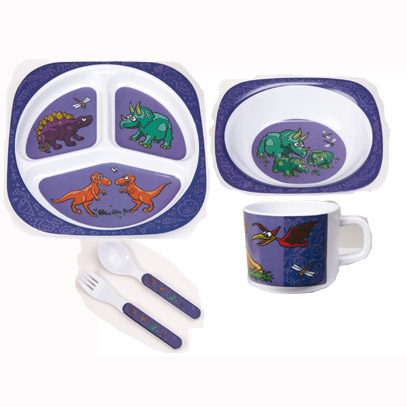
New Dinosaur Melamine Dinner Set

Turn meal times into a Mesozoic adventure with the new range of children’s’ tableware from Everything Dinosaur.  With plates, utensils, bowls and a cup including a matching vinyl coated placemat, this new range of dinnerware will have young dinosaur fans eager to take their place at the dinner table.

Everything Dinosaur

Made from tough, durable melamine, these new items have just been added to the “Dinosaurs at Home” section of the Everything Dinosaur website: Everything Dinosaur.

An Illustration of the New Tableware

Picture credit: Everything Dinosaur

Melamine Dinosaur Dinner Set

The design on this range depicts a number of prehistoric animals including a friendly looking Pteranodon, a turquoise Triceratops, a purple Stegosaurus and a hungry looking Tyrannosaurus rex, just what a young palaeontologist would expect to find on a dinner set designed with the Age of Reptiles in mind.  Available as individual items, to enable Everything Dinosaur customers to be flexible with their purchasing, these items are also available as a set.

The dinner set price has been discounted as an added incentive to encourage customers to purchase.  Included in the tableware set is the hard-wearing, matching dinosaur placemat, so Mums and Dads have everything they need to turn meal times into a dinosaur adventure.  The tough, robust tableware set is dishwasher safe and is suitable for young dinosaur fans from 12 months and upwards.

Ideal for Young Children

The table ware has been designed with little ones in mind, the plate is segmented to permit food items to be served separately if required, a good idea – parents and guardians can check what has been eaten.  The sections also assist young children with their eating as the walls of each section can assist with them getting food onto the fork and spoon.  Thought and attention has also gone into the design of the utensils and the cup.  They are ideal for little hands to grasp.  Even the bowl has been designed with care, its steep sides help prevent splashes.

Having proved popular on test, looks like the three geological periods of the Mesozoic – Triassic, Jurassic and the Cretaceous will have to renamed – breakfast, lunch and dinner!

Visit Everything Dinosaur’s award-winning website: Everything Dinosaur.

23 02, 2008

Boy Stumbles Across Dinosaur Footprints

By |2023-02-24T17:55:41+00:00February 23rd, 2008|Categories: Dinosaur and Prehistoric Animal News Stories, Dinosaur Fans, Main Page|2 Comments

Yorkshire Lad goes “Walking with Dinosaurs” (Dinosaur Footprints Discovered)

For many palaeontologists discovering a perfectly preserved set of dinosaur footprints may mark a high point in their careers but for young Rhys Nichols of Scarborough finding dinosaur trackways is as easy as taking a walk along the beach.

Whilst walking with his father, on the beach at Burniston Rocks, north of the seaside resort of Scarborough on the North Yorkshire coast, Rhys noticed that part of cliff face had fallen away and it was here that he found the footprints.  Rhys’ very proud father, Richard stated that “Rhys loves dinosaurs so for him to find something like that was wonderful. He was over the moon – I couldn’t get him away from it!

Dinosaur Footprints

“We are always coming down here beach-combing and hunting for fossils.”

Experts have agreed that these fossil prints are a “great find”.  The footprints are what is known as a trace fossil.  Trace fossils preserve evidence of the activity of animals, such as their tracks; unlike many dinosaur fossil bones that may have been transported after death a long way from where the dinosaur originally lived, most trace fossils such as these prints are direct “in situ” evidence of the environment at the time and the place where the dinosaurs roamed.

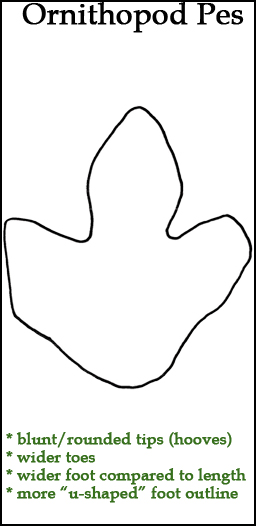
Ornithopod pes.  Dinosaur footprints found on beach.

Line drawing of the hind footprint of a large ornithopod (iguanodontid).  Picture credit: Everything Dinosaur.

Picture credit: Everything Dinosaur

Pictures show two beautifully preserved fossil footprints with the three toes of dinosaur seen clearly.  The raised appearance of the fossil is typical of this sort of trace fossil.  Footprint fossils can either be a depression-type  fossil made by the weight of the animal or a cast of the “hole” made by the animal’s foot as it walked along.  Sediments can fill the print up and it is these that are fossilised and the cast preserved giving the raised appearance.  Mr Nichols measured the footprints estimating that they were around 21 cm in diameter, other footprints have been found but they had been heavily eroded.

Fossilised Trackways

A number of fossilised dinosaur trackways have been found in the North Yorkshire area , much of the coast of the North East from Scarborough to near Redcar is comprised of exposed areas of delta mudstone and sandstone and thin coals that were laid down in the Middle Jurassic approximately 160 million years ago.  The rock strata where the prints have been found is well known for producing dinosaur trackways and isolated footprints, in fact geologists term this strata as the Burniston Footprint Bed.  As blocks of silty sandstone fall onto the beach, split apart from the cliff face by erosion, these blocks frequently come to rest at the base of the cliff upside down revealing the finely detailed tracks of dinosaurs from the Jurassic period.

It is not known what actual species of dinosaur made the prints, as with most fossil trackways, unless the culprit is found fossilised at the end of the trackway, Ichnologists (scientists who specialise in studying tracks), can only speculate what sort of creature it was.  Local museum staff have stated that this dinosaur may have been an Iguanodon.  The three-toed prints are indicative of an Iguanodontidae, however, the mid Jurassic date is very early for such an animal, more normally associated with the Early Cretaceous.  Perhaps it could be a trackway made by a dryosaur, these animals grew to lengths in excess of 3 metres, were relatively light and had a bi-pedal stance. Dryosaurs seem to have been relatively ubiquitous, with fossil being found in both the Northern and Southern Hemispheres.  Like many trackways the scientists may just have to resort to referring to these wonderfully, well preserved prints as belonging to an “in-determinant ornithopod”.

Three Toes Clearly Observed

Photographs show a close up of the footprint shown in the foreground in the picture with Rhys.   The animal would have been walking from right to left as the page is viewed. The three-toes can clearly be seen, but there is little evidence of a claw mark, adding weight to the thought that this is the footprint of an ornithopod.  Based on comparisons with the fossils of ornithopods such as the large amount of Iguanodontidae material available, it has been estimated that the dinosaur walking across the delta 160 million years ago would have been roughly the same size as young Rhys.  It is not known whether the animal was a fully grown adult or juvenile.  The pictures of the footprints indicate a bipedal stance, but as to what actual animal made these tracks, this will probably remain a mystery, unless of course Rhys happens to find another set of prints whilst beach-combing but this time with the fossils of the dinosaur which made them at the end of the track.

Here’s hoping… in the meantime well done to Rhys, palaeontology remains the only science where by going for a walk you can change the way the world views itself.

Everything Dinosaur stocks a wide range of ornithopod models and figures: Everything Dinosaur – Dinosaur Models and Figures.

22 02, 2008

New Dinosaur Species Unearthed in Eastern China

By |2023-02-24T17:54:44+00:00February 22nd, 2008|Categories: Dinosaur and Prehistoric Animal News Stories, Main Page|0 Comments

Joint Chinese and Japanese Research Team announce new Sauropod Species

Chinese news sources have confirmed the announcement of the discovery of a new species of sauropod (long-necked dinosaur) in eastern China.  The partial, disarticulated skeleton indicates a titanosaur-like animal with an estimate height of 5 metres and an approximate length of 15 metres.  The fossils were unearthed from Cretaceous period sediments at the foot of Hugong mountain, near to the large city of Dongyang in Zhejiang Province, eastern China.

New Dinosaur Species

The fossil was originally discovered in September 2007 and after a preliminary examination of the fossil bones by researchers from the Zhejiang Museum of Natural History aided by their Japanese colleagues, it has been declared a new species of dinosaur.

The deputy curator of Zhejiang Museum, Jin Xingsheng has made a statement describing the work carried out to date and claimed: ” It [the fossil] demonstrates many unique features, different from any identified dinosaur species.  It will enrich the dinosaur family”.

This new dinosaur has yet to be formerly described and named, further research is currently being conducted and this will be subject to peer review.  The fossils are being restored at the Dongyang museum and there are plans to put them on exhibit in late May or early June.  The animal has not been named yet, but it has been muted that the name will reflect the fossil site’s close proximity to the large city of Dongyang.

It is also likely that the Chinese scientists will reflect their own nomenclature framework when naming this new species, using a Chinese name rather than a standard Latinized approach.  Western palaeontologists are bracing themselves, anticipating another very long genus name and one that will prove tricky to pronounce given the recent track record on dinosaur discoveries from China.

For example, Zhejiang Province first come to prominence as far as titanosaur remains are concerned in 1977 when the 22 metre long Jiangshanosaurus lixianensis was unearthed.  This titanosaur probably possessed some form of body armour and dates from approximately 125 million years ago, Early Cretaceous (Aptian faunal stage).

In August 2007, scientists announced the identification of a new dinosaur species of armoured dinosaur which had been found near Lishui city in Zhejiang Province.  This new species was named Zhejiangosaurus lishuiensis which roughly translates to “Zhejiang lizard of Lishui”.  Zhejiangosaurus has been classified as a member of the Nodosauridae a group of armoured, herbivorous, bird-hipped dinosaurs.  This animal has been named from a partial skeleton consisting of a preserved sacrum, part of the ischium, the pubis plus some vertebrae and front limb bones.

To read more about the discovery of Zhejiangosaurus:

New Dinosaur Species Announced in Eastern China.

This article has been compiled using a number of news sources including the Xinhua news agency.  Everything Dinosaur stocks a wide range of dinosaur models from the Chinese model maker PNSO: PNSO Dinosaur Models.

20 02, 2008

The Frog from Hell – Beelzebufo ampinga that could Hop across Continents

By |2023-02-24T22:08:56+00:00February 20th, 2008|Categories: Dinosaur and Prehistoric Animal News Stories, Main Page|0 Comments

Giant Frog challenges Scientists over movement of Continents

Frogs are the most common type of amphibian alive today, with an estimated 5,500 separate species, making them the most diverse and successful clade of the Lissamphibians.  They are known from all the continents except Antarctica but their fossil record is quite poor.  Although very much extant, scientists still debate how many actual families make up the order containing frogs and toads – Anura.  With discussion ongoing as to how to classify frogs and toads around today, it is no wonder that difficulties arise when trying to piece together the development and relationships between elements of Anura when you consider how sparse the fossil evidence is.

Now the discovery of a giant, Late Cretaceous frog from Madagascar that may be related to the horned frogs of South America, has opened up the debate once again over frog family ancestry and the break up of the super-continent Gondwanaland.

Frog and Toad Evolution

Frogs and toads are very specialised Lissamphibians with a body shape (morphology) unlike their living relatives and their ancient amphibian ancestors from the Palaeozoic.  In comparison with other amphibian groups, they have dramatically reduced skeletons, lacking ribs, a tail,  with a simple pelvic girdle and relatively few vertebrae.  One of the earliest known frogs was also found in Madagascar, called Triadobatrachus; this animal dates back to the Triassic.

Frogs and toads were probably relatively abundant during the Mesozoic but the lack of fossil evidence inhibits palaeontologists when it comes to working out Anura evolution.  Fossil bones have been recorded from a number of Mesozoic sites but they are usually isolated fragments, ilia, humeri (limb bones) and the more robust skull elements such as the frontoparietals and squamosals – elements from the top and towards the rear of the skull respectively.  Some upper jaws bones (maxillae) have also been located and it is the jaws and the partial skull elements that provide the greatest assistance to palaeontologists when they attempt to work out the relationships between extinct genera and species.

Researchers Study Fossil Bones

Researchers from New York’s Stony Brook University aided by a team from University College, London headed up by vertebrate morphologist and palaeontologist Susan Evans; have published their findings on this new species of Madagascan giant frog in the journal Proceedings of the National Academy of Sciences.

This discovery, led by David Krause of Stony Brook University may undermine current scientific thinking over the isolation of Madagascar that was believed to have taken place in the Cretaceous.  Conventional theory states that by approximately 95 million years ago, the land mass that was to eventually form India and Madagascar had split away from Africa, part of the break up of Gondwanaland (Australia, New Zealand, Africa, Antarctica and South America).  Over the next 30 million years or so a rising plume of hot magma forced its way through a fault rifting apart India and Madagascar.  Madagascar was left an isolated island with its own distinct indigenous fauna and flora and India went northwards to collide with Asia.

Beelzebufo ampinga

The fossilised bones of Beelzebufo ampinga, a frog the size of a partially deflated beach ball and tipping the scales at around 4 kilogrammes, making it the largest frog found to date, resemble the bones of the extant frog group – the Ceratophyrinae.  The Ceratophyrinae, termed the “horned frogs” as many members of this family have soft extensions of skin growing out from the upper eyelid, which resemble little horns; are associated with South America.

Study of the fossils have indicated that this ancient animal is not related to any of the frog species living on Madagascar today.  If Madagascar was very much an isolated island when Beelzebufo was hopping around, then how do scientists explain a member of the Ceratophyrinae group on an island thousands of miles away from their ancestral home of the South Americas.

Beelzebufo – the Frog from Hell
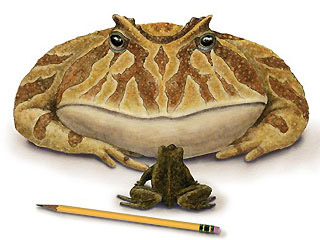
Picture credit: Associated Press

The diagram above shows an artist’s impression of Beelzebufo, with a modern frog and a pencil for scale.  Although only partial elements of the skeleton have been recovered Krause and his team estimate that this animal was 40 cm long and would have weighed as much as a large domestic cat.

The most characteristic feature of the Ceratophyrinae is not their horned eyelids (some members of the group do not possess this feature), but their large heads, huge mouths and blunt snouts.  They are voracious and unfussy hunters, lying half submerged in mud waiting for any unsuspecting small animal to wander by.  Basically, anything that can fit into their mouths is on the menu, mice, frogs, snakes, fish and such like.

Wide Mouth and Powerful Jaws

Beelzebufo had a very wide mouth and powerful jaws, plus teeth.  The skull material recovered has ridges and groves on it; perhaps indicating that this animal had bony armour or a protective head shield.

David Krause commented: “This frog, if it has the same habits as its living relatives in South America, was quite voracious.  It’s even conceivable that it could have taken down some hatchling dinosaurs.”

The name Beelzebufo is a derivative of the Greek word for Devil and bufo is the Latin for toad.  The “Devil Toad” would be an apt title for a frog capable of swallowing whole baby dinosaurs.

Krause and his team began finding fragments of abnormally large frog bones whilst studying the late Cretaceous sediments of the Mahajganga basin in north-western Madagascar in 1993.  Amongst the various dinosaur and crocodilian fossils a total of 60 fossil frog bone fragments were located during a number of expeditions to the area by the New York team.

A Relative of Extant Horned Frogs

The unusually large frog bones were sent to the University College, London for specialist Susan Evans to examine.  The London researchers were not able to piece together a complete skeleton but they had enough of the skull elements to make a diagnosis and interpret Beelzebufo as a relative of the horned frogs group.

The giveaway clinching evidence was the skull material indicating a “short, fat skull with a huge mouth”, says Evans.

Scale Drawing of Beelzebufo Skeleton compared to Living Frogs
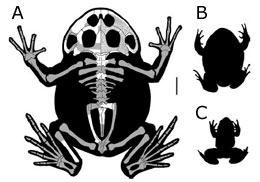
Big frog from the Mesozoic.

Picture credit: Journal of Proceedings of the National Academy of Sciences

The drawing depicts the skeleton of Beelzebufo ampinga (A) compared to the largest extant member of the South American Ceratophyrs (B) and the largest frog species found on Madagascar today (C).  The skeletal material in white represents bones found, those parts of Beelzebufo skeleton in grey are a scientific impression as to what the remainder of the skeleton would have looked like.

A Palaeontology Puzzle

The link to South America raises a palaeontology puzzle.  Standard theory for how the continents drifted apart show what is now Madagascar would have been long separated by ocean from the Americas during Beelzebufo’s time. Frogs with their soft permeable skins cannot survive long in salt water, so reaching Madagascar by swimming can be ruled out.

Krause contends that the giant frog provides evidence for competing theories that some bridge still connected the land masses that late in time, perhaps via Antarctica that was much warmer than today.  Perhaps Gondwanaland stayed together for longer than scientists currently think, could India/Madagascar have been linked to South America by an Antarctica land bridge as recently as the late Cretaceous.

Evans says that when she first began to suspect the Madagascar fragments came from a frog related to South American Ceratophryinae, she was very cautious about the claim. “We knew it would be controversial,” she says. “There are people who believe everything on Madagascar today must have been there when it broke with Gondwanaland 160 million years ago.”

Blair Hedges, a biologist at Pennsylvania State University in University Park, agrees that Beelzebufo is an important find. “The new fossil frog, besides being large and odd-shaped, is quite unexpected because of its apparent relationship with South American species,” he says.

But he says he isn’t yet convinced that the new find is related to the South American frogs. Molecular clock data suggests that these frogs split from a common ancestor more recently than 66 million years ago, he says. “Based on molecular evidence of frog relationships, the specific resemblance to some living wide-mouthed frogs is more likely from [evolutionary] convergence than actual relationship.” Convergent evolution, where unrelated species occupying similar niches tend to look the same, is common in frogs, he says.

Even if they are related, he adds, this doesn’t mean that the frogs necessarily had to walk on land from one location to another before Gondwana split. “Any organism, including a frog, can raft on dead vegetation,” he says.

Flood events and tropical storms can wash relatively large pieces of vegetation out to sea, some of these “rafts” get washed up on foreign shores.  A number of animals migrate between islands today under these circumstances.

Susan Evans and her team remain convinced that Beelzebufo is a relative of the horned frogs of the Americas and refutes the convergence evolution theory.  “It is the same family. I have no doubt of that,” she says.

It seems that this large, voracious frog – a trouble maker back in the Mesozoic, eating anything that could fit in its mouth, is going to be causing just as much trouble in scientific circles here in the Holocene.

Visti Everything Dinosaur’s website: Everything Dinosaur.

18 02, 2008

Recent Gales Reveal Unique Ancient Rock Carvings in Scotland

By |2024-04-11T10:36:40+01:00February 18th, 2008|Categories: Dinosaur and Prehistoric Animal News Stories, Main Page|0 Comments

5,000 Year old Rock Carving Uncovered in Scotland

An ancient rock carving showing strange dice-like objects has been uncovered on a mountain bike trail near the small town of Lochgilphead in western Scotland.

The rock carving, is believed to be 5,000 years old, putting it in the late Neolithic Stone Age although some observers have suggested it could be a little younger perhaps dating from the early Bronze Age.  For years, the rock art has remained hidden and protected from the elements by a huge tree in the Forestry Commission Scotland’s Achnabreac Forest, however, winter gales blew the tree down in January and a routine inspection by Forestry Commission staff led to the discovery.

Ancient Rock Carvings

The rock sits high above the mouth of Kilmartin Glen and directly overlooks the rock art previously discovered at nearby Cairnbaan.  Its close location to the other rock art sites, visual relationship with both sites, and the similar complexity of design suggests all three sites are connected, although experts remain puzzled as to what these symbols mean.

Andy Buntin, Planning Operations forester with Forestry Commission Scotland in west Argyll, said: “It seems this time the damage and disruption caused by the gales has uncovered something good”.

The significance of these sites to the Neolithic people of Scotland is a topic of speculation. During this period sedentary farming practices had been established in the area and the development of hardened, polished stone axes had led to clearing of land for settlement and to establish grazing for domesticated livestock.  Perhaps the carvings, represent boundaries between grazing areas, rights of ownership on grazing or point out nearby water sources or good hunting grounds.

Local Landmarks and Symbols

Many tribal cultures use signs on local landmarks to communicate with other tribes, demonstrate boundaries and provide helpful messages to visitors to the area.  For example, some tribes of native American Indians used to carve symbols into large trees or stake skins to the bark to indicate what type of animals could be hunted in the area – a sort of helpful guide to passers by as to what might be on the menu.

The rock is very close to the popular Fire Tower mountain bike trail, the Forestry Commission will re-route part of the trail to ensure the carving is protected and will open up access for people to view the rock.

This part of Scotland would have made an ideal area for a Neolithic settlement, the river Add and the many small lochs would have provided a water source and the opportunity to fish, there was plenty of wood for fuel and to provide cover for hunting and the nearby coast would have enabled the locals to beach-comb in search of shellfish.  Although the area is fairly rugged it is sheltered to some extent from the worst of the Atlantic storms by the nearby island of Jura.

The people of the Neolithic were also the builders of the stone circles, the henges and burial Cairns that pepper the landscape of this part of northern Britain. The exact nature or purpose of these monuments is still unknown, but many of them can be explored and it is amazing to re-trace the steps taken by some of the first settlers of Scotland.

Visit Everything Dinosaur’s award-winning website: Everything Dinosaur.

17 02, 2008

Principles of Geology – The Law of Superposition

By |2023-02-24T21:43:43+00:00February 17th, 2008|Categories: Geology, Main Page, Palaeontological articles|0 Comments

A Brief Tribute to Nicolaus Steno – The Law of Superposition

Team members at Everything Dinosaur are already working on a number of events to mark the 200th anniversary of the birth of Darwin in 2009.  However, there were many thinkers, philosophers and educated people who applied scientific processes to try to explain the world around them, long before Darwin.   One such person was the Dane Nicolaus Steno, born 370 years ago who decided at an early age to live by the principle that one should not believe everything they read, but set out to investigate, observe and come to their own conclusions – even if these conclusions challenge the accepted doctrine of the time.

Nicolaus Steno

Nicolaus Steno (sometimes Latinised to Nicolaus Stenonis or referred to in Danish as Niels Stensen), was born in Copenhagen, Denmark in 1638, once he has completed his formal education he travelled extensively in Europe working with a number of notable scientists and thinkers of the time including the likes of Galileo.  His enquiring mind and observational skills led him to improve the understanding of human anatomy and some aspects of medicine, but his fascination with the world around him led him to make some extremely important insights into the age and formation of the Earth.  His published accounts of how layers of rock (strata) are formed, challenged much of the established view on the formation of the Earth and life upon it.

Until Steno and his contemporaries, ideas like the Earth was extremely old and that fossils represented once living organisms were not accepted.  The Biblical view of life and the formation of the Earth dominated, a viewpoint that 200 years later led to Darwin’s delay in the publishing of his theory on evolution and still holds sway with many people today.

The Law of Superposition

For Nicolaus, despite some his research challenging the accepted views of the church and the state, religion still played an important role in his life.  He converted to Catholicism in 1667 and in 1675 became a priest, rising quickly through the hierarchy of the church to become the bishop of north Germany and Scandinavia.  The year before his conversion Nicolaus was presented with the head of a huge shark that had been caught off the coast of Tuscany.  His reputation had permitted him to obtain the patronage of many wealthy families and it was the Grand Duke of Tuscany who had ordered the shark’s head to be sent to Nicolaus for dissection.

Shark Tooth Fossils

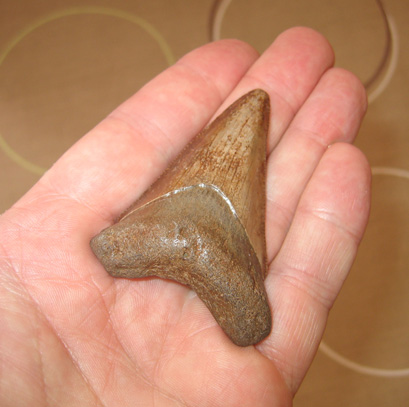
Megalodon fossil tooth

A large fossil tooth from a Otodus megalodon. Picture credit: Everything Dinosaur.

Picture credit: Everything Dinosaur

Whilst studying the shark, Steno noted that the teeth resembled stony objects that had been found embedded in rocks.  These items (now known to be the fossils of shark teeth) were called “Tongue stones”, it was thought at the time that these objects had fallen to Earth from the moon and that they possessed magical properties.  When worn as amulets they warded off danger and if dipped in poison they would render the poison ineffective.

For models and replicas of iconic fossi animals: Prehistoric Life Models (CollectA).

Understanding Fossils

Other scientists at the time, thought that these strange objects along with other items we now know as fossils, simply grew in rock formations.  Nicolaus Steno was not the first person to note the similarity between these permineralized teeth and the teeth of living sharks, but he did develop the current theories at the time and began to explore the physical and chemical processes that may have led to the change in state of these objects and their preservation.

Steno’s work on shark teeth led him to the question of how any solid object could come to be found inside another solid object, such as a rock or a layer of rock. The “solid bodies within solids” that attracted Steno’s interest included not only fossils, as we would define them today, but minerals, crystals, encrustations, veins, and even entire rock layers or geological strata.  Nicolaus theorised that layers of rock formed by deposition – sedimentary rocks laid down in a sequence, the older rocks would be at the bottom with younger rocks on top.  This is a fundamental principle of stratigraphy (the study of strata).

Unless strata has been overturned, which may sometimes happen during mountain building or other geological processes, the deeper the rock layers the older they will be.  Strata could therefore be dated relative to one another.

As Steno stated in his work published in 1669, entitled Dissertationis prodromus:

“at the time when any given stratum was being formed, all the matter resting upon it was fluid, and, therefore, at the time when the lower stratum was being formed, none of the upper strata existed”.

A Fundamental Principle of Geology

This fundamental principle became known as the Law of Superposition – the fact that bottom layers of rock must have been formed first with layers on top being progressively younger in relation to the layers underneath.   Although, other writers had eluded to this in earlier work, it was Nicolaus Stenos who first formulated this law, a cornerstone (no pun intended) of modern geology.  His work was subsequently developed by other writers and thinkers, but his theories were crucial in helping later 18th and 19th Century scientists interpret and understand geology.

So as we plan events to celebrate the 200th anniversary of birth of Darwin we will also be thinking about the other great people who have made and continue to make a contribution to the science of geology and palaeontology, after all 2009 may mark the 200th anniversary of the birth of Darwin but it also marks the 340th anniversary of the publishing of Steno’s Law of Superposition.

16 02, 2008

New Species of Tiny Pterosaur Found in China

By |2022-11-09T12:28:22+00:00February 16th, 2008|Categories: Dinosaur and Prehistoric Animal News Stories, Dinosaur Fans, Main Page, Palaeontological articles|1 Comment

Rare Fossil Find – A Tiny Pterosaur from the Ancient Cretaceous Forests of China

“Flapping about quite at home in its arboreal environment, jumping between bennettitales, cycads and conifers a tiny pterosaur flies upwards and perches safely on the uppermost branches of a ginkgo whilst a dinosaur rumbles by far below.”

Until now scientists, could only speculate as to what sort of pterosaurs lived in forest and jungle environments.  These habitats do not lend themselves easily to fossil preservation and palaeontologists have had to content themselves with the occasional find that provides a glimpse into the dark forest environments of the Mesozoic.  In addition, the light and delicate bones of pterosaurs could easily be damaged and crushed well before burial and fossilisation could take place, so scientists have had to content themselves with a few rare finds from inland ecosystems, concentrating their pterosaur research on those specimens preserved in marine sediments, where generally the chances of fossilisation are higher.  Also, marine environments being relatively open would permit larger organisms and their relatively larger bones would perhaps have  a greater chance of surviving the fossilisation process.

However, thanks to an amazing discovery by a joint Brazilian and Chinese team, scientists have the chance to study the fossils of a tiny, forest pterosaur from the Lower to Middle Cretaceous.  Discovered in western Liaoning the remains of the smallest pterosaur species on record reveal that there were flying reptiles with wingspans no bigger than a garden robin’s sharing the forests with dinosaurs.  Although some of the later pterosaurs evolved into huge animals – Pteranodon and Quetzalcoatlus for example, scientists had speculated that there were many thousands of other species of smaller pterosaurs that filled other ecological niches.

Tiny Pterosaur

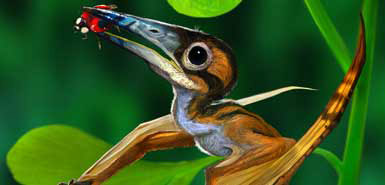
This new species, is thought to be the smallest pterosaur yet found.  Only one smaller pterosaur has been found and that was a juvenile that had only just hatched.  The animal has been named Nemicolopterus crypticus, the fossil shows a number of adaptations for a life amongst the trees. For example, the eye sockets are quite large, indicating that this pterosaur could have coped well with low light levels in the understorey of a dense primeval forest.  The four-toed hind feet had sharp claws, which could possibly have been able to grasp branches, giving this tiny flying reptile a good purchase amongst the tree tops.

Artists Impression of Nemicolopterus crypticus

Picture Credit: Lewis Smith

“Nemicolopterus crypticus presents the best adaptations for an arboreal lifestyle found in any pterosaur,” the research team from China and Brazil reported.

Interestingly, all the illustrations of this new discovery show this tiny flying reptile predating on insects. There would have been abundant insects within the forest environment for this little creature to hunt.  However, the remains of the jaws show that this little pterosaur, had no teeth, just like his larger and more illustrious relatives such as Pteranodon.  If it was warm-blooded then insects would have provided a high energy diet to keep the animal active, but it may also be worth considering whether this little chap had another food source, one that would have been virtually exclusive to it – nectar, flowers and fruit

PNSO Nemicolopterus

PNSO have made a range of small, prehistoric animal models including a replica of the pterosaur Nemicolopterus: PNSO Age of Dinosaurs.

Scientists speculate that at around this time the first flowering plants (Angiosperms) were beginning to evolve.  Small pterosaurs could have supplemented their insect diets with flowers, nectar and fruit (all high energy food stuffs).  Perhaps little Nemicolopterus specialised in eating these relatively new plants, the toothless beak could have been ideal for exploiting this new food source.  Unfortunately, the very tip of the beak has been lost in fossilisation so scientists are unsure how the end of the beak looked.  This could have yielded vital clues as the eating preference’s of this tiny flier.  To balance the argument it is worth pointing out that many species of birds thrive on insects and arthropods today and they do not have any teeth in their beaks to help them catch these animals (an adaptation long after the days of Archaeopteryx to help Aves lighten themselves to aid powered flight).

Certainly, there must have been many different types of pterosaur exploiting arboreal niches, the low likelihood of preservation has prevented palaeontologists from studying this particular branch (no pun intended); of the pterosaur family tree.  The birds were evolving and by the end of the Cretaceous only the very large Azhdarchidae type pterosaurs remained.  Perhaps birds out competed pterosaurs for certain ecological niches and this hastened the demise of the pterosaurs.

To read more about whether birds led to the extinction of flying reptiles: Did the birds wipe out the Pterosaurs?

Within the sediments of Liaoning, there may be other fossils waiting to be discovered that can shed more light on the lives of the forest dwelling pterosaurs.

Go to Top