All about dinosaurs, fossils and prehistoric animals by Everything Dinosaur team members.
16 03, 2008

Frog Blog – We have Frogspawn in the Office Pond!

By |2022-12-20T22:43:17+00:00March 16th, 2008|Categories: Animal News Stories, Educational Activities, Everything Dinosaur News and Updates, Main Page|0 Comments

Frog Blog – We have Frogspawn in the Office Pond!

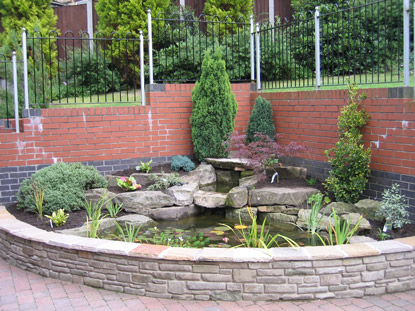
Four years ago whilst some of us were away in Canada working on some palaeontology projects, arrangements were made to build a small pond behind the office.  We had managed to persuade one of the designers of the animal enclosures from Chester Zoo to undertake the work and to produce a water feature with a seating area so that we could take our breaks and watch any wildlife that might be attracted to the water.

The work took about a week and our designer friend built two small ponds in a corner of the paved area behind the offices.  He even cleverly cast some ammonite fossils and installed these in various places in the rockery to make us palaeontologists and fossil collectors feel at home.

Using his expertise, our designer chum shaped the pond so that there would be plenty of shallow areas and margins, important when wanting to create a natural pond.  In addition, he advised on the planting and even provided the oxygenating water plants, the marginals and the lilies.  His final touch was to provide us with a population of snails to help maintain the pond.  We have two species at the moment a small pond snail and rams-horns (Planorbis sp.)

The Pond when it was First Built and Landscaped
Picture credit: Everything Dinosaur

Over the last few years this water feature has proved popular with the local birds who use the shallows as a bird bath and we have been fortunate to have damsel fly larvae as well as water boatmen take up residence.  Although, frogs had been seen in the vicinity and team members were able to count 3-4 individuals at anytime in the summer, (we even had a particularly large one that was nicknamed “Freddie” after Andrew Flintoff the England cricketer who took up residence in 2005);  no breeding had taken place.

However, this morning, whilst returning to the office to sort out some Everything Dinosaur paperwork, a quick check of the pond and hey presto – our first ever frogspawn was spotted.  There had been a number of frogs seen in the pond over the last month or so and apparently last night (a particularly dark and wet night) the spawning took place.

From the amount of spawn produced, we estimate that it is from just one female.  A total of four frogs have been observed in the pond this morning (the back of one can be seen partially hidden by the spawn to the right of the picture).  We have speculated that it is the female with her three suitors.  The frogs are Common Frogs (Rana temporaria), one of three species of frog that are found in the UK (excluding any escaped exotics).  Like all native British amphibians and reptiles they are a protected species.  With much of their habitat destroyed, areas such as landscaped offices and gardens are becoming increasingly important to them.

It is nice to know that after nearly 5 years the frogs have felt comfortable enough with our pond to breed in it, we are playing a small role in the conservation of this species and amphibians need all the help they can get, as they are globally the most endangered and threatened of all the animal classes.

Frogs are special to many of the Everything Dinosaur team members, they are very specialised Lissamphibians (the group of amphibians that includes frogs, toads, newts, salamanders and the leg-less caecilians).  The Lissamphibians were present in the Palaeozoic and it is thought that frogs evolved sometime in the Triassic,  however, the fossil record for frogs is very patchy to say the least.  They were probably relatively abundant during the Age of Reptiles, but the lack of fossil evidence inhibits palaeontologists when it comes to working out Anura (frog) evolution.  Fossil bones have been recorded from a number of Mesozoic sites but they are usually isolated fragments, ilia, humeri (limb bones) and the more robust skull elements.

Occasionally, fossils are found that demonstrate that some of these amphibians would have been formidable hunters, even capable of eating baby dinosaurs and young crocodilians.  The discovery of a giant frog from Mesozoic deposits in Madagascar is evidence of this.

To read about the discovery of fossils of a giant Cretaceous frog: Giant Frog from Madagascar.
15 03, 2008

Make Dinosaur Nests for Easter

By |2023-02-17T15:11:48+00:00March 15th, 2008|Categories: Educational Activities, Everything Dinosaur News and Updates, Main Page|0 Comments

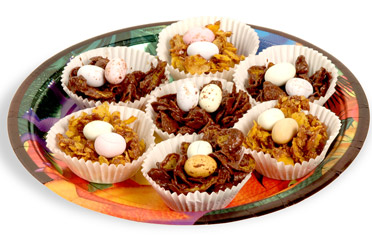
Looking for something to do with your young dinosaur fans over the school holiday.  Here is a simple and fun recipe for dinosaur chocolate nests, an ideal activity for Easter time.  A super idea to help entertain the children, dinosaur chocolate nests for kids.

Dinosaur Chocolate Nests

Ingredients – (makes a batch of about 8 nests)

Plain or Milk cooking Chocolate 225 grammes (8oz)

Packet of Breakfast Cereal Cornflakes or Shredded Wheat variety

Packet of Sugar Coated Mini-chocolate Eggs

Pack of Small Cake Cases

Dinosaur Nests – a Great Holiday Baking Activity

Picture Credit: Everything Dinosaur

Method

1.  Break the cooking chocolate into pieces and place in a heat-proof bowl.  Melt the chocolate over a pan of simmering water.

2.  Once the chocolate has melted remove it from the heat and give it a good stir in the bowl.

3.  Add some of the breakfast cereal until the mixture takes on a a brown twiggy look.

4.  Carefully spoon enough of the mix into each paper case so that a little nest is formed.  Make sure you push it down in the middle so that each nest has a hollow in the centre

5.  Place two chocolate mini-eggs in the centre of each chocolate nest, the eggs will stick when the chocolate sets. Two eggs is all you need for each nest (we know that some dinosaurs laid eggs in pairs so your chocolate nests would please a palaeontologist) – see notes below.

6.  Then leave the nests to set.

There you are a set of lovely dinosaur themed nests, an ideal activity for young palaeontologists over the Easter break.

For other baking ideas, recipes and for fun party items visit the section of the Everything Dinosaur website that deals with parties: Dinosaur Toys and Gifts.

Dinosaurs and their Nests (a little bit of science)

Many nests of dinosaurs have been discovered, particularly over the last fifteen years or so with the discovery of sauropod nesting sites in Argentina and Europe plus more evidence having been gathered from places such as the famous Flaming Cliffs area of Mongolia.

The first dinosaur eggs were discovered in 1859 (France). The first recognised dinosaur nests were uncovered by an American team of palaeontologists led by Roy Chapman Andrews during expeditions to Mongolia in the 1920s.  Over the last few years, scientists have been able to build up their knowledge about dinosaur reproduction and egg laying as egg-shell fragments, nests, and even fossils of unhatched baby dinosaurs inside eggs have been discovered.

The pairs of eggs laid in our pretend chocolate nests are based on the layout of eggs found in theropod dinosaur nests.  Many theropod nests (tyrannosaurs, allosaurs, Velociraptors, Oviraptors were theropods); consist of a dug out, roughly bowl shaped hole with pairs of eggs laid are in a circle, pushed into the earth and they are laid in pairs.

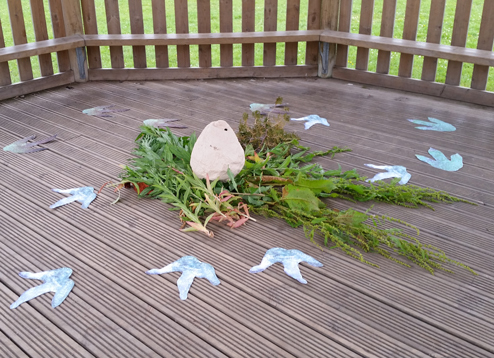
A Dinosaur Egg Spotted at a School (STEM Learning)

dinosaur nest found in a school

A dinosaur discovery at a school.

Picture credit: Everything Dinosaur

Dinosaur Eggs

The laying of eggs in pairs seems to be a unique characteristic of theropod dinosaurs.  No other group of animals either around today or found in the fossil record laid eggs in pairs.  Theropod eggs tend not to be very round, they are rounded at one end with a more pointed end opposite, a little like a loaf of French bread.  The more pointed end is often found buried in the rock which comprises of the fossil, this indicates that the female theropod that laid the eggs, pushed it into the dirt during the process of laying.  This is evidence of dinosaurs showing a delicate touch, in the same way that a crocodile cradles newly hatched baby crocodiles in her mouth in readiness to carrying them down to the nursery pool.

The eggs laid in pairs indicate that dinosaurs had two oviducts (the tube in female egg-laying animals where eggs are formed and through which they are laid).  The position of fossilised pairs of eggs in theropod nests indicate that eggs were laid from the two oviducts at the same time. This would be the equivalent of a double-barrelled shot gun firing both barrels at once.  This behaviour seems unique to theropods.  Crocodiles have two oviducts but they do not demonstrate egg laying in pairs.  Birds, (believed to be close relatives of theropod dinosaurs), only have one functioning oviduct and only one egg is formed by day.  Birds can take several days to lay a clutch of eggs.

Scientists believe that birds evolved only one functioning oviduct and the laying of eggs over a protracted period in order to help them escape from predators.  After all, it would be difficult to fly if a female had a clutch of six or seven heavy eggs inside her ready to be laid.

Other scientists have speculated that the laying of eggs over several days may help the pair bond and this may reinforce behaviour towards brooding and feeding the youngsters as they hatch.  Yet another theory is that with a delay in laying, comes a delay in the time of hatching, some birds end up with a nest full of offspring, but at slightly different ages.  If food becomes scarce then the older siblings can out compete the younger ones and these are the ones that will survive to reach the fledgling stage.

Palaeontologists have a lot to learn about dinosaurs and the egg laying habits, however whilst you contemplate these important aspects of dinosaur behaviour and social habit you can tuck into your own dinosaur nest as a treat.  Help yourself to Everything Dinosaur’s chocolate dinosaur nest recipe.

14 03, 2008

Everything Dinosaur – First of the New Spring Products Now in Stock

By |2023-02-19T10:53:37+00:00March 14th, 2008|Categories: Everything Dinosaur Newsletters, Main Page, Press Releases|0 Comments

Everything Dinosaur New Products Spring 2008

Dear All,

It has been a busy time for Everything Dinosaur team members, what with sourcing new products, putting them on test and then adding them to our website.  Our product range continues to grow and a number of new prehistoric animal themed items have been added to our shop, here is a small selection:

Dinosaurs for Dinner! turn dinner time into a dinosaur adventure, a children’s dinner set with a dinosaur design.  Tough, robust, melamine dinnerware, cups, bowls, plates and utensils, items can be purchased separately or as a set including a hard-wearing, matching dinosaur placemat, just £9.99 plus P+P.

Everything Dinosaur

Dinosaur Themed Clothing – new T-shirts, new Diplodocus socks and all sizes of the popular dinosaur pyjamas back in stock.  Kit out the young palaeontologist in your family.

With over hundreds of dinosaur themed toys and gifts there is something for everyone at Everything Dinosaur.

For the latest information on dinosaurs and prehistoric animal research, visit the Everything Dinosaur web log.  Packed with articles and lots and lots of information, written by our specialists using everyday language, great for young dinosaur fans and as a resource for teachers and home educators.

13 03, 2008

Triceratops for Sale

By |2023-02-17T15:09:14+00:00March 13th, 2008|Categories: Dinosaur and Prehistoric Animal News Stories, Dinosaur Fans, Main Page|0 Comments

Triceratops Available to the Highest Bidder – Three-horned Face up for Auction

An almost complete fossil Triceratops, perhaps one of the best known of all the dinosaurs, is going under the hammer at Christie’s; the auction house in Paris next month.  There is a Triceratops for sale at an auction house.

The almost 70% complete fossil is the prize lot in an auction of 150 rare items from natural history collections – fossils, skeletons and minerals expected to fetch in excess of £1.225 million GBP (1.6 million EUR).

As well as the three-horned dinosaur, there will be opportunities to purchase a Sabre-toothed cat skull, a tyrannosaur egg, plus the tibia (shinbone) of an Apatosaurus.  Although it is difficult to put a reserve on such unique and rare items; the egg is expected to fetch over £15,000 GBP (20,000 EUR) and the sauropod tibia around £23,000 (30,000 EUR).

The Triceratops is certainly the star attraction, the fossil is almost 70% complete, the missing bones having been replaced by resin replicas to provide an articulated and posed exhibit.  It will be the first time a dinosaur specimen has gone up for public sale since the Tyrannosaurus rex called Sue was auctioned at Sotheby’s in New York on October 27th 1997.  Sue, an almost complete T. rex fetched $8.36 million USD, it is unlikely bidding for this Triceratops will reach those dizzy heights, but if you want a three-horned face for your living room or hall expect to pay about £380,000 GBP (500,000 EUR) for the privilege.

Triceratops for Sale

Triceratops is perhaps the most famous of the horned dinosaurs.  It gets its name from the three forward facing horns on its face, approximately 60 skulls have been excavated plus a number of disarticulated specimens.  Finding a complete fossilised Triceratops is an exceptionally rare event.  The skull of an adult Triceratops is over 3 metres in length, it would have been exceptionally heavy and as there was not a great deal of meat on it, this part of the Triceratops was often left alone by Tyrannosaurus rex which predated on these animals.  The robust nature of the skull favoured preservation so there is a reasonable amount of fossilised skull material in the fossil record.  However, the rest of the animal has proved to be much more difficult for palaeontologists to find.

If a Triceratops had been killed by a meat-eater the carcase would have been broken up and eaten.  What remained would have been soon scavenged so little would remain available for transport and preservation as fossils.  Even if a Triceratops died of natural causes the body would still have been attacked by hungry scavengers, quick to seize the opportunity of an easy meal.

The Herding and Social Behaviour of Triceratops

The herding and social behaviour of Triceratops also seems to have counted against it when it comes to fossilisation potential.  Unlike other ceratopsians, Triceratops seems to have moved around in relatively small groups, so there is less likely to find a mass bone-bed with Triceratops than with other slightly earlier horned dinosaurs such as Centrosaurus.

Some scientists claim that there may be up to ten different species of Triceratops.  Subtle differences in skull morphology may indicate separate species, although these differences may be due to ontogeny and sexual dimorphism (skull shapes change as animals age and there may be difference between males and females of the same species).  The species represented in the auction exhibit is T. horridus, the largest recognised species of Triceratops.  Triceratops horridus means “horrible horned face” , but hopefully this name will not put off any bidders.

It certainly is a large specimen with an overall length of 7.5 metres and a total fossil weight of approximately 2 Tonnes – very impressive; but a full size T. horridus would have exceeded 9 metres in length and some scientists estimate a body weight of around 10,000 KGs (that is the equivalent of two African elephants).

The fossil skeleton was originally found by a ranch owner in the US state of North Dakota and acquired in 2004 by a European buyer who wants to remain anonymous, said a Christie’s spokesman.

“This specimen is the fourth most complete discovered so far,” he went on to state.

For many years scientists debated how Triceratops might have walked.  Two schools of thought emerged, one school believed that Triceratops moved its front legs like a lizard in a more sprawling type gait.  The second group of scientists believed that Triceratops walked with its elbows tucked in under the body, like a modern Rhinoceros.  To substantiate which theory was most likely to be correct the palaeontologists needed one crucial piece of evidence – an articulated Triceratops with the feet in situ.

Unfortunately, tyrannosaurs and other meat-eaters tend to leave only scraps.  When ever fossils of Triceratops were found the feet were almost never located.  Perhaps the feet of Triceratops were especially tasty for a tyrannosaur, a delicacy almost, like chicken feet are a delicacy in some parts of Asia.  More likely, the large amount of meat on this part of the animal would have made the bones attractive and although large, many predators at the time were capable of picking up and moving Triceratops limbs away from the rest of the carcase to consume without the danger of the body attracting other hungry mouths to threaten them.

Not so long ago a partially articulated fossil Triceratops was discovered.  The whole of the left side of the carcase had been washed away but the right side was almost complete and most importantly of all, the feet remained.  It was hoped that this specimen (nick-named Raymond), would solve the mystery of how Triceratops walked once and for all.  Unfortunately, the bones had been rather flattened and squashed during preservation so the fossil evidence could in effect, be interpreted and presented in such a way to support both theories.  Scientists seemed to be no nearer understanding whether this four-legged leviathan walked like a lizard or in a more erect pose like a rhino.

Thankfully, the discovery of some beautifully preserved fossilised Triceratops ribs and other body parts including shoulder blades helped shed some further light onto this mystery.  Scientists were able to see how the front legs would have moved in relation to the shoulder blade sockets.  The result, led some scientists to conclude that Triceratops had a semi-erect posture, somewhere between walking with a sprawling gait like a lizard and the elbows tucked underneath walking style of a Rhinoceros.

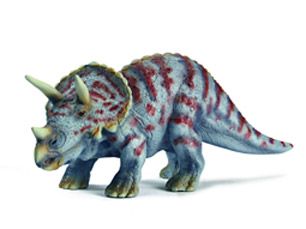
A Model of Triceratops with “modern pose”

Schleich dinosaur model.

Picture credit: Everything Dinosaur

The model shown is from the Schleich Dinosaur series, it depicts Triceratops with a semi-erect stance with the hind legs, bowed out a bit to make room for the animal’s enormous gut.

To view the hand-painted Triceratops model: Dinosaur and Prehistoric Animal Models.

The bright colours shown on this particular model is following a trend amongst palaeontologists to illustrate herding dinosaurs with stark, contrasting colours.  It is believed that Triceratops had excellent colour vision and it may have used body patterns to communicate with other members of the herd, show dominance, social status and such like.

Prices for dinosaur fossils have reached record levels in recent years.  They have become the “must haves” of the rich and famous, so this has led to the removal of many important finds out of scientific circles and into private collections.

Even movie stars have started collecting dinosaurs, to read an article on celebrities arguing over tyrannosaurs: Dinosaur Bidding Wars – Celebrities push up prices of Dinosaur Fossils.

12 03, 2008

Two-Toed Footprint found in Korea – Dromaeosaurs in Korea

By |2023-02-17T15:10:28+00:00March 12th, 2008|Categories: Dinosaur and Prehistoric Animal News Stories, Main Page|6 Comments

Two-Toed Footprint – Evidence that Dromaeosaurs stalked Ancient Korea

Reports have been circulated that a researcher from the Korean National University of Education has discovered a two-toed dinosaur footprint.  Only one family of dinosaurs is known to have made two-toed prints, the bipedal dromaeosaurs (the family is Dromaeosauridae means “swift lizards”).  Members of the Dromaeosauridae include animals such as Velociraptor, Deinonychus and Utahraptor.  A trace fossil such as a two-toed print is indicative of a dromaeosaur.  These animals did have three toes that reached the ground, but the claw on the second toe was raised when it walked, keeping it sharp and pointed.  This was the infamous “sickle claw”.  Hence when these animals walked or ran, only two-toed prints were left behind.

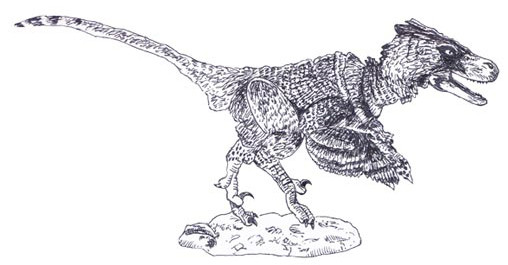
Adasaurus mongoliensis illustrated.

An illustration of the dromaeosaurid Adasaurus.

Picture credit: Everything Dinosaur

Everything Dinosaur stocks the popular Beasts of the Mesozoic range of dromaeosaurid models.  To view this range of articulated dinosaur figures: Beasts of the Mesozoic Models and Figures.

From South Gyeongsang Province

This trace fossil was found in South Gyeongsang Province.  It is relatively small when compared to other theropod footprints, measuring 15.5 cm in length with a width of 8.4 cm, but this is a significant find as dromaeosaur trackways, like most meat-eater trackways are very rare when compared to the tracks made by herbivores. This phenomenon is due to the fact that there are more prey animals around at any one time than predators.  This is the first evidence of dromaeosaurs in Korea, the strata in which the print was found has been dated to 100 million years ago.

Dromaeosaurs in South Korea

This print proves that there were small “raptor-like” dinosaurs in Korea during the Cretaceous.

Recently, a dromaeosaur trackway was unearthed in China, it may indicate social, pack behaviour.  To read more about this discovery:

Fossil Trackway provides Evidence of Pack Behaviour in Raptors.

11 03, 2008

Once more into the Studio we Go

By |2023-02-19T10:59:32+00:00March 11th, 2008|Categories: Everything Dinosaur News and Updates, Main Page|0 Comments

Prehistoric Animals Captured on Film!

Cryptozoologists spend years researching, seeking information and piecing together evidence in support of claims that mythological creatures or supposedly long extinct animals still wander around the planet.  There have been many reported sightings of sea and lake monsters; could these be plesiosaurs perhaps?  Sir Arthur C. Clarke commented on the authenticity of Woolly Mammoth sightings reported in the 17th century in his book based on the ITV television series “Arthur C. Clarke’s Mysterious World”.

Prehistoric Animals

A number of popular myths concerning dinosaurs still being around persist, the most famous is perhaps the long-necked, sauropod-like Mokele-Mbembe that lurks in the deepest, darkest parts of the Congo.  How a forested and flooded area less than 2 million years old is supposedly harbouring a population of Sauropods, remnants from the Mesozoic is not easy to explain, but so long as such inaccessible and relatively unexplored places exist then these stories and myths will continue.

To read an article on Sir Arthur C. Clarke: Happy 90th Birthday Sir Arthur C. Clarke!

Photographing Prehistoric Animals

For team members at Everything Dinosaur, photographing prehistoric animals is made a lot easier.  For us, having the opportunity to photograph prehistoric animals does not entail long treks into far off and distant lands.  However, it does mean a trip to Wales, to a small town called Cefn Mawr, where we met up with Michael, a professional photographer, who had been given the task of helping us create some images of our new products.

Michael is a member of the Master Photographers Association, and all of his twenty plus years experience as a professional photographer was applied to the task of creating shots of our new dinosaur themed tableware, biscuit making moulds, new T-shirts, books and models.  There was even a requirement to photograph some dinosaur teeth!

Into the Studio

Using Michael’s own well equipped studio, our team, working under Michael’s supervision were able to complete the photography in a morning.  Starting with the small, intricate shots of new models and working up to the bigger products such as the beach set inflatables.  The final few pics involved an Everything Dinosaur team member, pictures being taken in preparation for a forthcoming press release.

Taking a short break from preparing a Polacanthus and helping to compose a Cryolophosaurus we were able to relax in the very comfortable office that adjoins the studio and admire the results of some of the more routine photographic assignments.  The walls display a range of different types of photography from splendid wedding shots to intimate family portraits and touching shots of new babies with their proud parents.

Certainly, our brief to photograph a range of prehistoric animal themed items is a little out of the ordinary, but Michael and his partner take it all in their stride.

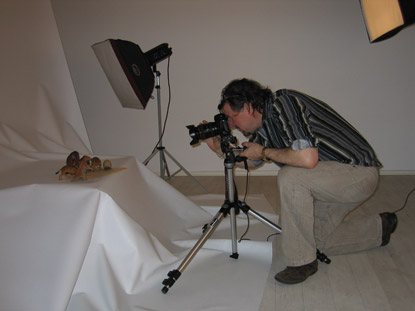
Smile Please – An Unusual Family Portrait (Prehistoric Mammals)

Picture credit: Everything Dinosaur

“Ice Age Mammals” Photoshoot

The picture shows Michael, shooting the “Ice Age” Mammals from the Natural History Museum box set, just one of the unusual subjects that he was asked to photograph during the day.

To view the prehistoric animal box set: Dinosaur Toys and Prehistoric Animal Models.

For a number of shots, close ups were required; it is a good job the studio floor is cushioned and sprung as Michael spent most of the morning on his knees, taking care to ensure each new product could be shown at its best.  The final images will be well worth all the effort, and will help us to show customers the products that we supply in our shop.

As for Michael, with a background in commercial photography, PR shoots as well as family portraits and weddings it was all in a morning’s work.

9 03, 2008

In Memory of Pioneering Mary – Mary Anning who died on this day in 1847

By |2024-04-12T08:25:20+01:00March 9th, 2008|Categories: Famous Figures, Main Page, Palaeontological articles|0 Comments

In Memory of Mary – Mary Anning (May 21st 1799 to March 9th 1847)

A breakthrough in our understanding of the world around us – a eureka moment in science is a rare thing.  More often than not scientific progress is made in small steps with scientists and researchers building upon the insights and work of others.  Palaeontology like other sciences is no exception, after all, science is driven forward by ignorance, our desire to turn what we don’t know into what we do know.

Our thoughts today turn to Mary Anning, who died on this day in 1847.  Mary was born on May 21st, 1799 in the town of Lyme Regis, Dorset.  Her father was a carpenter.  Although she had no formal education to speak of and she spent most of her life in poverty, Mary was a pioneer in the sciences of geology and palaeontology, her contribution to science is recognised throughout the world and she is one of only two scientists permitted to have a look-a-like walking the hallowed galleries of the Natural History museum in London.

Mary Anning

Mary is credited with the discovery of many ichthyosaurs, plesiosaurs and the first pterodactyl fossils (pterosaurs).  Most of the fossils Mary collected were sold to institutions and private collections, but often no record was kept of her role in discoveries and scientific research.

Although she lacked a substantial formal education, she taught herself anatomy, animal morphology and scientific illustration.  She made an immense contribution to the nascent sciences of palaeontology and geology, but much of her work was plagiarised and she was not given the recognition she deserved in her lifetime.  As a woman and with a poor social status she was never accepted into the male dominated scientific community.

Towards the end of her life it was rumoured that Mary had taken to drink.  Perhaps this was as a result of her struggle for recognition gradually wearing her down, but more likely Mary was drinking to dull the pain of breast cancer.  In the mid 19th century, one of the few pain killers that could be afforded by the poor was alcohol.  Although, weak and very ill, Mary continued to sell her “curiosities” from her fossil depot in Lyme Regis

News of her illness reached members of the Geological Society in London, William Buckland, the Dean of Westminster used his influence to raise a fund to help support her, but there was little he could do to prevent the inevitable outcome.  She died in 1847, just a few weeks before her 48th birthday.

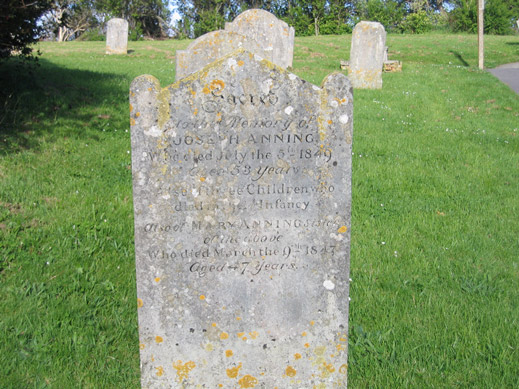
Mary is buried in the little Lyme Regis churchyard, part of which overlooks the bay.  I am sure Mary would have appreciated this, as it was in the bay overlooked by the church that Mary earned her living searching for fossils amongst the land slips and mud slides of the cliffs.

The Grave of Mary Anning and Her Brother Joseph

Mary Anning's grave.

Mary Anning’s grave at St Michael’s Church on the hill overlooking Lyme Regis

Picture credit: Everything Dinosaur

The then President of the Geological Society – Henry de la Beche wrote a eulogy in her honour, a most unusual tribute as she was not a Fellow.

He wrote: “I cannot close this notice of our losses by death without adverting to that of one, who though not placed among even the easier classes of society, but who had to earn her daily bread by her labour, yet contributed by her talents and her untiring researches, in no small degree to our knowledge of the great Enalio-Saurians and other forms of gigantic life entombed in the vicinity of Lyme Regis.

Fellows raised funds for a stained-glass window in her honour at the parish church at Lyme Regis. The window depicts Mary tending the sick and looking after the poor, an inscription underneath reads: “In commemoration of her usefulness in furthering the science of geology, as also of her benevolence of heart and integrity of life”.

Perhaps the last word for now, about Mary should come from a reporter who wrote in a journal published at the time – “the carpenter’s daughter has won a name for herself, and deserved to win it”.

Good on you Mary, we will always remember.

The fossil discoveries made by Mary Anning has inspired the British-designed CollectA range of marine reptile models: CollectA Age of Dinosaurs Popular Models.

4 03, 2008

Long-limbed Albertosaurs – a Clue to Dinosaur Predation

By |2022-11-10T11:32:45+00:00March 4th, 2008|Categories: Everything Dinosaur Products, Main Page, Palaeontological articles|0 Comments

Long-limbed Albertosaurs – possible hints at Dinosaur Hunting Habits

Despite their frequent appearance in monster movies the Tyrannosauridae are perhaps not as well known as many people might think, especially when they are faced with the overwhelming number of tyrannosaur exhibits on display at Natural History museums.  In truth, even the mighty Tyrannosaurus rex has provided less than 40 fossil specimens for palaeontologists to study and the vast majority of these are far from complete.  The popularity of these fierce carnivores is easy to understand, they were certainly impressive beasts but scientists still have a great deal to learn about these animals, their ancestry, social behaviour and morphology.

The likes of Tyrannosaurus rex is synonymous with the Hell Creek Formation of Montana in the north western United States.  The exposed strata  of sandstone, siltstone and mudstone represent sediment laid down towards the very end of the Cretaceous (late Maastrichtian faunal stage).  It was from these beds that the first T. rex fossils were unearthed.  However, a greater number of Tyrannosauridae fossils have been recovered from Canada, specifically areas such as the Dinosaur Provincial Park Formation in Alberta.    The extensive outcrops of Campanian faunal stage strata from deposits termed the Belly River Group and the Judith River Formation have been dated to approximately 75 million years ago.  The Theropod fossils recovered from these sites along with other body and trace fossils have enabled palaeontologists to build up a detailed picture of the eco-system that existed in this area at the end of the Cretaceous.  This has led to some speculation as to the hunting habits and specialisation of the tyrannosaurs in this faunal community.

Late Cretaceous tyrannosaurids of Alberta can be classified into two sub-families, the Albertosaurinae and the Tyrannosaurinae (based on research from Phil Currie et al).  The albertosaurines from the Dinosaur Provincial Park can be split into two genera, Gorgosaurus and Albertosaurus), the Tyrannosaurinae are represented by Daspletosaurus (D. torosus [Russell 1970], D horneri [Carr et al 2017]).  In the 1970s the genus Gorgosaurus was dropped and it was synonymised with Albertosaurus, following a review of existing specimens where no significant characteristics were identified, permitting both genera to be valid.  This viewpoint was overturned in 2003 when following a study by a Canadian led team looking at fossils recovered after the review in the early 1970s, several anatomical differences were identified between Albertosaurus and Gorgosaurus and so both taxa were validated.  The Gorgosaurus genus was reinstated.

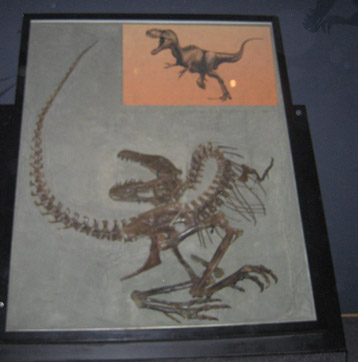
Albertosaurus Exhibit – Royal Tyrrell Museum (Alberta in Canada)

Picture credit: Everything Dinosaur

The photograph shows an almost complete and articulated restoration of an Albertosaurus specimen on display at the Royal Tyrrell museum (Alberta, Canada).  The neck and head presented in a curved position over the back and hips is typical of articulated Dinosauria fossils, this effect is believed to occur as ligaments and tendons are desiccated in the carcase and their drying out leads to the head and neck curving over the back of the animal.

The albertosaurs shared their Late Cretaceous world with the likes of Daspletosaurus, (Daspletosaurus means “frightful lizard”)Both these types of tyrannosaur were apex predators, hypercarnivores and at the top of the food chain, however, examination of their fossils reveals that they may have specialised in different hunting strategies and prey.

Albertosaurs had shorter, lower skulls than many other tyrannosaurs.  Their leg bones, especially the tibia (shin bone) were proportionately longer than equivalent sized tyrannosaurs.  They had longer toes and although the weight of an adult Albertosaurus (A. sarcophagus), has been estimated at 2.5 metric tonnes, these animals were lighter than equivalent sized Tyrannosaurinae.

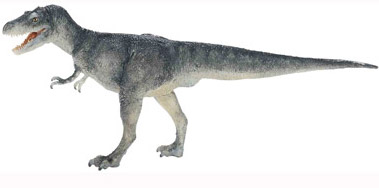
A 1:40 Scale Model of Albertosaurus (Carnegie Collection Albertosaurus)

Albertosaurus (from the now retired [2014] Carnegie Collectibles range of figures).

Picture credit: Everything Dinosaur

The picture above shows an Albertosaurus dinosaur model, part of the Carnegie Collectibles dinosaur model range (Safari Ltd) which has been retired and is out of production.

To see this model and other tyrannosaurid figures: Visit Everything Dinosaur’s Shop.

The Albertosaurus Genus

It has been speculated that the genus Albertosaurus may represent the fastest large tyrannosaurs around at the end of the Cretaceous.  Models and computer simulations have estimated running speeds of up to 25mph (40kmh), this is up to 50% faster than an equivalent member of the sub-family Tyrannosaurinae.  Putting this into perspective this long-limbed, long-toed carnivore could complete the 100 metres in around about 10 seconds.  Assuming that an Albertosaurus could be given a running start (crossing the start line at approximately full speed), and assuming that this fierce meat-eater did not stop along the way to feast on any athletes, an Albertosaurus could compete for a medal in the sprints at the Beijing Olympics.

Some scientists have speculated that tyrannosaurs began to evolve in different ways, exploiting specific niches within the eco-system.  As Albertosaurus was lighter and faster than equivalent sized Tyrannosaurinae, it could have specialised in catching lighter and faster prey types like hadrosaurs, pachycephalosaurs and ornithomimids.  Indeed, a diorama of an Albertosaurus chasing a group of ostrich-like dinosaurs greets visitors to the Royal Tyrrell museum.  The heavier members of Tyrannosaurinae may have specialised in hunting ceratopsians or possibly titanosaurs.

Lighter and More Gracile Tyrannosaurs

Fossil evidence does indicate that the albertosaurs evolved into lighter and more gracile forms, perhaps indicating that this genus specialised in hunting faster moving animals than the heavier predators.

The fossil evidence is complicated when social behaviour is considered.  Albertosaurus bone-beds have been found in Canada.  Excavations from Royal Tyrrell museum staff have revealed the remains of at least nine variously sized albertosaurs from one fossil site.  Could this be evidence of pack behaviour?

The Safari Carnegie model of Albertosaurus (shown in the picture above) has been designed to replicate much of the latest scientific thinking concerning this particular dinosaur.   Working on the guidance of scientists from the Carnegie museum the model has been sculpted to show the long legs and graceful features of this predator.  The colouration of the model, muted greys and browns would have make this hunter inconspicuous in shadow and the dappled understorey of woodland.  The back, tail and hind quarters of this particular model has darker, stripped markings, again helping to camouflage the animal and break up its outline if it was stalking from cover.  In addition, the stripped markings, particularly those on the tail are a concession towards those scientists that speculate that Albertosaurus may have been a social, pack hunter.  A group of these animals moving towards a potential group of prey animals at speed would have been a confusing site.  Their rapid speed, the dust kicked up and the stripped markings could have disorientated prey, the stripes helping to break up the outline of individual hunters within the pack as they closed in on their unfortunate victims.

2 03, 2008

Remember the Amazing Ordovician

By |2024-04-12T08:34:14+01:00March 2nd, 2008|Categories: Geology, Main Page|0 Comments

Remember the Ordovician – An important part of the Palaeozoic

Sandwiched between the geological periods of the Cambrian and the Silurian comes the Ordovician, (pronounced “Or-doe-viss-ian”).  The period lasted approximately 50 million years 495 to 443 million years ago.  Like the Silurian period that followed it, the Ordovician was named after an ancient British tribe, a Romano-British hill tribe the Ordovices.  Evidence from rock strata indicates that during the early Ordovician, marine transgressions (sea levels rising and flooding land) were at their greatest, much of the continents around at the time became flooded.  Rising seas are a problem today, a result of global climate change; but the rises experienced in the Holocene are fortunately, not likely to be on the scale as seen in the early Ordovician.

Ordovician

Marine life continued to diversify with a huge number of different types of animals and algae becoming established.  However, this abundance of life was not to last.  Geological data suggests that the global climate became increasingly wetter and colder.  At the end of the Ordovician much of the Earth experienced an Ice Age and the subsequent locking up of vast amounts of water led to a global reduction in sea level.  Estimates as to the extent of the sea level fall vary, some scientists claim that it fell by as much as 300 metres but others put forward a more conservative estimate of about 100 metres (still an immense change in climate and environment).  Many of the shallow seas dried out leaving behind salt and other minerals.  These changes led to a mass extinction with many forms of marine life, especially sedentary ones being killed off.

Trace Fossils

Rocks of Ordovician age show trace fossils indicating that during this period the first animals ventured out onto land.  Sets of strange parallel trackways, only 10 mm wide or so have been found in upper Ordovician strata in northern England.  These trackways, trace fossils, are believed to have been made by segmented arthropods as they moved over mud by the side of freshwater pools.  These are some of the first signs of animals beginning to migrate onto the land.

Despite the fact that in geological terms the Ordovician comes before the Silurian it was named and described as a period of geological time after both the Cambrian and Silurian had been named.  A Scottish schoolmaster and geologist (born in England; he settled in Scotland), Charles Lapworth made a detailed study of the strata in the Southern Uplands hills and mountains of Scotland.  He mapped the complex succession of ancient marine strata using fossils to identify the relative age of strata, this is called biostratigraphy.

Work Published

In 1879, he published his work helping to resolve a controversy regarding the age of rocks that had raged for sometime within the scientific world.  Ever since the English professor of geology, the Reverend Adam Sedgewick and his co-worker Sir Roderick Murchison named the Cambrian and Silurian periods in 1835, the actual age of ancient rocks and the order in which some of them had been laid down was debated.

Using graptolite fossils, Charles Lapworth was able to correlate successive rock strata and work out the correct chronological sequence of deposition.  He identified three distinguishable and observable lower Palaeozoic faunas.  It was this work that led to the recognition of the Ordovician as a distinct geological period separating the older Cambrian strata from the younger Silurian.

For models of Palaeozoic invertebrates and other prehistoric creatures: CollectA Age of Dinosaurs Popular Models.

29 02, 2008

Stunning and Rare Dinosaur Tracks Close to Washington D.C.

By |2024-04-12T08:36:05+01:00February 29th, 2008|Categories: Dinosaur and Prehistoric Animal News Stories, Main Page|0 Comments

Plans to display Dinosaur Trackways in Washington D.C.

When asked to comment on dinosaur discoveries in the United States most experts may cite discoveries in the Badlands of Montana or the Cleveland-Lloyd Dinosaur quarry in Utah.  Certainly, it is true to say that they are many fantastic Mesozoic fossil sites in the west of the USA but the eastern part of the United States, although perhaps a little under-represented in terms of fossil evidence, can still spring a few surprises.

Dinosaur Tracks

Now a new study of fossil trackways in Maryland, north-eastern USA has provided a glimpse into a thriving dinosaur based eco-system.  Many of the trackways, have been found just a few miles drive out of Washington D.C.  Trackways and footprints are called trace fossils.  Trace fossils preserve evidence of the activity of animals such as their trackways, borings or burrows.  The problem with most sets of footprints, even the very best preserved ones, is that, unless the animal is found fossilised at the end of the trackway, scientists can never be 100% certain as to the species or genus that actually left the prints. 

Trace fossils such as footprints do have a significant advantage over other types of fossil such as fossil bones, most are direct in situ evidence of the environment at the time and place the organism was living.

Studying Trace Fossils

A total of over 900 fossilised footprints from a variety of dinosaurs all dated from the Cretaceous have been identified from the area.  Theropods, ankylosaurs (Nodosauridae), sauropods and ornithopods are represented by the prints.  Palaeontologists have estimated that the trackways were made between 121 and 98 million years ago.

Trace fossils of other animals have also been preserved in the this part of the USA, one trackway has been identified as a flying reptile, perhaps a pterosaur flew down to get a drink and its trail was preserved in the soft sediment.  Mammal tracks have also been found, indeed one trackway indicates that some mammals were quite large, tracks of a quadrupedal mammal about the size of a large dog have been recorded.

Visit the Everything Dinosaur website: Everything Dinosaur.

Two Dozen Species of Dinosaur

“Based on the trace fossils, over two dozen species of dinosaurs were living in Maryland at that time,” co-author of the study, Ray Stanford commented.  Ray specialises in studying fossil trackways, he began to discover tracks in the area whilst out looking for native Indian artifacts, in the stream-beds that criss cross the area.

He explained that as water and human development erode such beds, “floats” can result. These are pieces of track-bearing substrate that hydrodynamically dislodge from their natural stratigraphic context during stream bank flooding.

“This is one instance where building booms and storms can benefit science,” he said.

All of the discoveries were made either in Prince George’s county, near the capital, Washington D.C. or at the White Marsh Run area of Baltimore county.

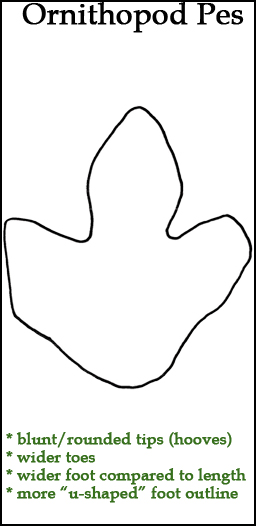
An Illustration of the Track Made by an Ornithopod Dinosaur

Ornithopod pes. Dinosaur footprints found on beach.
Line drawing of the hind footprint of a large ornithopod (iguanodontid). Picture credit: Everything Dinosaur.

Picture credit: Everything Dinosaur

Photographs show a number of footprint specimens, the peculiar, almost flower-shaped five-toed print in the foreground was most probably made by a nodosaur.  Nodosaurs are members of the Ankylosauria, heavily built, slow-moving, plant-eaters with body armour and horns.

To read an early article about dinosaur tracks discovered on the North Yorkshire coast: Dinosaur Tracks Found by Young Boy.

Ray Stanford in conjunction with a Johns Hopkins University palaeontologist called Davide Weishampel hope to publish a journal paper on this new genus of nodosaur.  The nodosaur print in the foreground is much smaller than the cast print in the very centre of the image (the print which the model nodosaur is facing), this indicates that some of the trackways may have been made by young, immature animals.  This area may have provided a Cretaceous nursery for many species, a popular nesting and breeding ground for a variety of dinosaurs.

Providing an Insight into Dinosaur Behaviour

The scientists state that they may even have uncovered trackway evidence showing youngsters following adults, a possible insight into animal’s behavioural and social relationships.

So far, Stanford has described and published Maryland’s first dinosaur track species (called an ichnospecies which translates to ‘trace species’). It consists of both front and back footprints of a hypsilophodontid dinosaur. He named the new dinosaur footprint type or species Hypsiloichnus marylandicus, meaning “trace of a hypsilophodontid dinosaur from Maryland.”

An overview of these, and other, finds was recently published in the journal Ichnos.

Analysis of the region’s geology indicates that during that dinosaur era, fresh water sources and plant life would have been plentiful. Stanford has excavated fossilised pollen for ancient plants, along with fossilised wood for a large, now-extinct fern tree similar to today’s cycads.

The Smithsonian Museum of Natural History in Washington D.C. is investigating the possibility of putting some of the tracks on display in a special exhibition.  There are certain obstacles to overcome, such as how best to present the casts so that their fine detail can be seen, but such an exhibit be popular with museum visitors.  After all, it would give the residents of Washington D.C. an opportunity to learn more about some of the previous residents in the neighbourhood.

Everything Dinosaur stocks a wide selection of dinosaur models including replicas of ornithopods and nodosaurids: Everything Dinosaur Models and Replicas.

Go to Top