All about dinosaurs, fossils and prehistoric animals by Everything Dinosaur team members.
17 06, 2008

Ancient Fish Found in Scottish Quarry

By |2023-09-02T08:28:40+01:00June 17th, 2008|Categories: Dinosaur and Prehistoric Animal News Stories, Geology, Main Page|0 Comments

Devonian Fossil Fish Found in Scottish Quarry

A Scottish fish fossil that dates from the Devonian period has been unearthed in a disused flagstone quarry.  The fish which has been identified as belonging to the genus named Actinolepis had not been known from UK strata before this discovery.  Actinolepis was a placoderm (the name means “plated skins”).  Placoderms were a class of jawed fish, protected by dermal armour around the head and front of the body.  Originating sometime in the Ordovician, the group flourished throughout the Devonian but disappeared from the fossil record around 354 million years ago.  The placoderms were one of the classes of vertebrates that went extinct at the end of the Devonian period.

Placoderm Fish Fossil

The only other example of an Actinolepis was found in Devonian strata in Estonia, making this Scottish fossil an important discovery.

During the Devonian period (approximately 417-354 million years ago), the landmasses that were to become North America, Scandinavia and Europe were joined together.  The Eastern part of this super-continent was called Baltica, a mountain ridge had formed when continental plates had collided together (Laurentia colliding with Baltica to form a landmass called by many scientists – Euroamerica).  Water draining from these uplands formed a huge, freshwater lake in the low lying areas of barren land between the mountains and the sea.

Lake Orcadie

This lake is called Lake Orcadie and at its peak it covered the land now occupied by Shetland, the Orkney, Caithness, the Moray coast and across to Norway.  The lake seems to have existed for hundreds of thousands of years and during this time it went through a series of expansions and reductions in volume.

The lake contained a diverse variety of fish genera, with many of the fish being found as fossils in the quarry at Achanarras in Caithness, from which this new placoderm fossil was extracted.  The quarry is now managed by Scottish Natural Heritage, so far sixteen different types of prehistoric fish fossil have been found at the site, including agnathans (jawless fish).  It is not only fossil fish that makes this site so interesting fossils of many invertebrates that shared this watery world with the fish have also been found including fossils of eurypterids (sea-scorpions).

Professor Nigel Trewin

This latest discovery was officially unveiled by Aberdeen-based palaeontologist Nigel Trewin, who has been visiting the Achanarras quarry for more than 35 years. Professor Trewin, with colleague Mike Newman, has published details of this find in the Scottish Journal of Geology.

The actual fossil was found by an amateur collector, however, it was soon realised that this was an unusual and important find.  Professor Trewin believed the fish, which had large pectoral fins, would have been a bottom feeder. Commenting on the demise of the placoderms, he said: “I’m afraid there are no modern relatives of this one, unlike some of the other finds which have been made here.”

The placoderms are one group of vertebrates that died out, in what has become known as the Devonian mass extinction, a mass extinction event that devastated many marine families of fish, especially those that lived on tropical reefs.
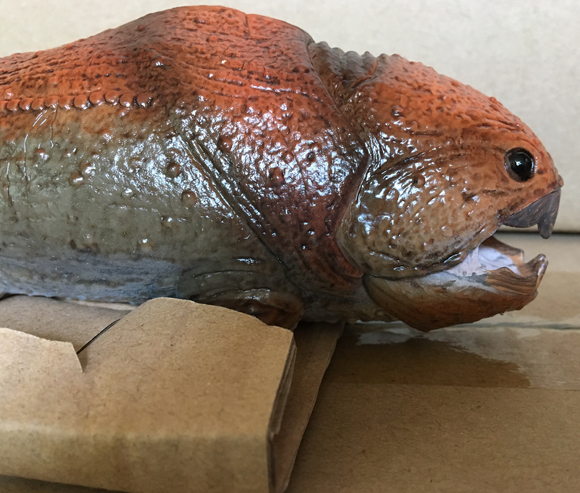
A close-up view of the anterior portion of the CollectA 1:20 scale Dunkleosteus model.
A close view of the anterior portion of the CollectA 1:20 scale Dunkleosteus model.  Dunkleosteus was a giant, predatory placoderm of the Devonian. Picture credit: Everything Dinosaur.

Picture credit: Everything Dinosaur

To view a 1:20 scale replica of a Dunkleosteus (placoderm) and models of other Palaeozoic creatures: CollectA Deluxe Prehistoric Life.

Visit the Everything Dinosaur website: Everything Dinosaur.
16 06, 2008

Part of the Dinosaur Mummy ready for Display

By |2022-11-25T13:18:31+00:00June 16th, 2008|Categories: Dinosaur and Prehistoric Animal News Stories, Dinosaur Fans, Main Page|0 Comments

Dakota the Dinosaur Mummy goes on Display

The arm and tail of a rare mummified dinosaur that has been heralded as one of the most amazing dinosaur discoveries ever made have gone on display in North Dakota’s state museum.  The dinosaur, believed to be a type of duck-billed dinosaur called an Edmontosaurus (nick-named Dakota), has been fossilised with a remarkable degree of detailed preservation, including skin and other soft body tissues.

At the unveiling of the first parts of the skeleton to go on display, the audience were able to examine one of the arms and the tail of this huge, plant-eater that roamed Dakota approximately 67 million years ago in the Late Cretaceous (Maastrichtian faunal stage).

The team at Everything Dinosaur first reported on this fantastic fossil in 2007, when the first detailed reports became available: Dinosaur Mummy unlocks Duck-Billed Dinosaur Secrets.

Commenting on the hadrosaurine fossil, Dr Phil Manning, a palaeontologist at Manchester University and one of the international team of researchers working on the project said:

“It is a fascinating fossil, and it’s one which we’re going to be disinterring secrets from … for many years to come”.

When members of the public see the huge reconstructions of dinosaur skeletons within museums, many get the wrong impression, believing that dinosaur fossils must be relatively common.  This is simply not true, even fossils of some of the most diverse and numerous types of dinosaur, such as dinosaurs from the Hadrosauridae (the Duck-Billed dinosaurs) are exceptionally rare.  Despite having ranged over much of the Northern Hemisphere in the Late Cretaceous only a few hundred hadrosaur fossils are known and the vast majority of these do not represent articulated fossils.  Dinosaur bones are extremely rare and to find the mummified remains of a dinosaur is exceptional.  Only a handful of mummified dinosaurs have ever been discovered.  For young Tyler Lyson, currently completing his Doctorate in Palaeontology at Yale University, who discovered the dinosaur remains on his uncle’s ranch back in 1999, the unveiling permits him to share his amazing discovery with a larger audience.  Up until now only the researchers and one or two privileged individuals were allowed to gaze upon this dinosaur, still partially encased in a sandstone block.

This hadrosaur, when it died was buried very quickly by fine sediment and this has preserved parts of the soft body tissue, the dinosaur’s skin scales have even been preserved on parts of the skeleton.  How much of the fossil has been recovered has still to be determined as much of the animal is still entombed in a large sandstone block that will take the research teams many years to prepare.

The tail and arm have been extracted from a smaller sandstone block, the larger block, which contains the rest of the fossil has undergone a CAT scan to determine its contents but the stone matrix is very solid and the block so big that the data produced is still being analysed.  It is not clear for example whether the skull of the animal has been preserved.

Fossilised Skin of “Dakota” the Edmontosaurus

Picture credit: Xinhua/Reuters

The picture was taken at the dig site and shows the remarkable degree of preservation of the fossilised skin, individual scales can be clearly seen.

“It’s certainly drawing a lot of attention to North Dakota,” commented state palaeontologist John Hoganson, a member of the North Dakota Geological Survey.  He went on:  “we know people are going to be coming in from all over the country and world to see this”.

It has been estimated that another $100,000 would be required to complete the work of extracting the fossil from its matrix.  Already the likes of the National Geographic Society has funded the project to the sum of approximately $200,000 but at this stage a definite cost for the work to be carried out cannot be calculated.  Since the scientists are not exactly sure what the sandstone block actually contains, any funding costs at this stage are merely estimates.  A spokesperson for the research team who helped remove the arm and the tail estimated that it could take more than a year to reveal the rest of the skeleton.

Everything Dinosaur stocks a rang of hadrosaur figures including replicas of Edmontosaurus: Dinosaur and Prehistoric Animal Models.

It is hoped that when the project has been completed Dakota will go on a world wide tour of museums, probably starting with Japan, before finally going on permanent display in the state after which it was named.

To read more about this fossil: Update on Dakota – the recently discovered Hadrosaurine Mummy.

15 06, 2008

A Maternal Mammoth

By |2023-02-25T16:32:47+00:00June 15th, 2008|Categories: Dinosaur and Prehistoric Animal News Stories, Everything Dinosaur News and Updates, Main Page|0 Comments

Did Woolly Mammoths make Good Mothers?

With the many fossils of Woolly Mammoths (Mammuthus primigenius) and the ancestral type Mammuthus meridionalis, plus the opportunity to observe modern elephant species, scientists have built up a detailed picture of the lives of Woolly Mammoths.  Well preserved frozen carcases from Siberia and other remarkable finds have enabled researchers to piece together a picture of what it must have been like to be a Mammoth in the Pleistocene, wandering the extensive, grassy plains of northern Europe.

Daniel Fisher of the Michigan University has pioneered a method of determining the age of Mammoths at death by analysing cross sections of the tusk.  It seems that Mammoths could live to about the age of sixty, a lifespan slightly shorter than the African and Asian elephants.  Like modern elephant species they lived in a sophisticated, highly structured social hierarchy.  The females and young animals lived in herds together, with perhaps a matriarch figure, the oldest female in the group acting as leader.  Mature bulls lived a solitary existence, coming into contact with females only to mate.  Younger males may have formed small herds, gathering together for protection from predators such as Dire wolves and Sabre-tooth cats.

Maternal Mammoths

Competition for mates was probably a common site when the females came into season.  One Mammoth fossil found in Nebraska comprises two skulls locked together by their curling tusks, the combatants, probably males must have become entangled during a fight and then unable to separate themselves.  They must have died a slow and lingering death from starvation.

As with most mammal species adapted to northern climates, mating probably occurred in the Summer months.  With a twenty-two month gestation period, a female Mammoth that conceived in July would give birth in the next May but one, allowing the calves to have a few months of warm, mild weather before the winter and any migration that was undertaken.  Having a calf in the spring would also benefit the Mammoth mothers as they would have plenty of new grazing to help them produce the milk required for their offspring.  A single calf would be born, and this calf would probably depend on it’s mother’s milk for at least two years.  The calf being dependent on the mother coupled with the long gestation period would have meant that mature females would only have been able to breed once every four years.

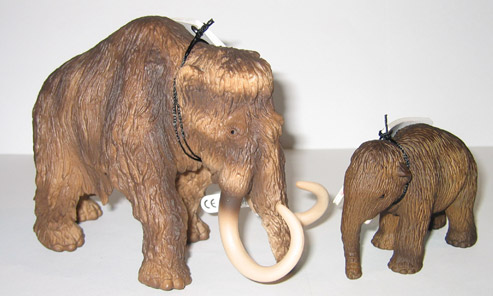
A Mother and Calf Woolly Mammoth

Picture credit: Everything Dinosaur

The Mammoths in the picture are models from the Schleich Prehistoric Mammals series.  These are 1:20 scale models of Pleistocene age mammals which are now extinct.  In recognition of the maternal instincts of Mammoths, the Everything Dinosaur team supply the adult Mammoth model and the baby as a set.

To view models of prehistoric mammals: Models of Prehistoric Mammals.

Many large mammals produce just a single calf and dedicate a lot of resources into nurturing their offspring.  This strategy is effective so long as the adult population does not decline.  As has been seen with African elephants, if there is much predation of adult animals, as with poaching for example, then the population can crash dramatically.

Some researchers have claimed that Mammoths would look after each other and orphaned calves would be fostered.  There is also some fossil evidence to suggest that Mammoths like modern elephants were reluctant to abandon a dead or dying member of their group.  Offspring off both sexes probably stayed in the female herd until about 10-12 years of age, before the males moved on to form bachelor groups.

14 06, 2008

Real Life “Jurassic Park” not too Far Away

By |2022-11-25T08:40:45+00:00June 14th, 2008|Categories: Everything Dinosaur News and Updates, Main Page, TV Reviews|0 Comments

TV Documentary Explores Dinosaur Genome

A TV programme being shown for the first time in the UK (Discovery Channel over the weekend) aims to demonstrate steps taken by scientists to bring Dinosaurs back to life.  The programme to be shown on the Discovery Channel is entitled,  “Dinosaurs: Return to Life”; highlights the work done to date to explore and identify the DNA signature of Dinosauria.

“Jurassic Park”

A team of scientists from Montana State University, a part of the Western USA with geology dating form the Age of Reptiles, aim to unlock the secrets of the dinosaur genetic code and if they are ultimately successful this could lead to the creation of dinosaurs once again.  The Jurassic Park, of the Michael Crichton novel would become a reality.  The progress the team have made on this remarkable project will be revealed in the TV documentary, receiving its premier in the UK.  The question is posed; will scientists be able to reverse an extinction and ever be able to resurrect a dinosaur?

For Jack Horner, a professor of palaeontology at Montana State University and one of the consultants on the Jurassic Park films, the answer is a definite yes.

Professor Horner commented: “Of course we can bring them back to life. Their ancestral DNA is still present.  The science is there. I don’t think there are any barriers, other than the philosophical.”

As genetic research has developed over the last twenty years or so, there have been numerous attempts to unravel the genetic make-up of a number of organisms.  Professor Raul Cano, professor of microbiology at California Polytechnic State University, attempted to extract DNA from the preserved remains of insects trapped in amber.  The Californian team claimed that they had extracted strands of DNA from a 40 million year old bee.  In a similar programme of research at the American Museum of Natural History in New York, a group of scientists claimed that they had extracted the DNA from a fossilised termite.

Mammoth DNA

However, the initial results could not be replicated and it is now thought that the samples had been contaminated with modern DNA.  Attempts have been made to recover genetic material from frozen Siberian Mammoths and from fossil Neanderthal bones, but to resurrect a dinosaur, scientists will need to be able to recover DNA from a fossil of an animal at least 65 million years old.

Many scientists believe that DNA being an organic substance would not be able to last 10,000 years under ideal preservation conditions, so finding valid dinosaur DNA would be impossible.  However, both American and Russian teams claim that they have discovered fossils that have permitted the extraction of dinosaur proteins.  This could lead to a breakthrough in this form of genetic research.  The Russian team claim to have extracted proteins from a ceratopsian (horned dinosaur) and identified it to be similar in structure to the DNA of an ostrich.  This would be somewhat expected as birds are thought to be close relatives of dinosaurs.  Indeed, some palaeontologists have speculated that the Dinosauria clade should be re-classified along avian and non-avian forms.

Work by Hans Larsson, a palaeontologist at McGill University in Canada, has begun to unravel the links between the birds and dinosaurs.  He conducted an experiment in November 2007 into the evolution from the long tail of dinosaurs into the short, stubby tails of birds.  Advanced birds, such as the ornithothoraces and the modern neornithes have a much reduced tail structure.  This is called the pygostyle and it consists of the last five tail vertebrae fused together into a plate of bone.  The anatomy of the tail is one of the diagnostic characteristics that scientists use to differentiate between birds and maniraptoran dinosaurs such as Velociraptor.  If a tail is found to contain less than 25 caudal vertebrae then this feature is used to help classify this organism as a bird.

Archaeopteryx for example had this shortened tail and so it is classified with the Aves clade.

A Picture of Archaeopteryx (Ancient Wing)

Archaeopteryx model

Picture credit: Everything Dinosaur

The picture of Archaeopteryx is a 1:5 scale model from the Museum Line range and other dinosaur models: Bullyland Museum Line Models.

Working with chicken embryos that were no more than 48-hours old, the McGill University team discovered that there were 16 vertebrae developing in the embryonic spine, effectively evidence of a reptilian tail.  As the embryo developed the “tail” became shorter and shorter, until the young bird hatched with just the five vertebrae of a modern bird (neornithes).

Larsson and his team claim that this research indicates that the blueprint for a dinosaur remains dormant within the genetic make-up of birds.  Taking their study further, the team have hatched mutant chicks with three extra vertebrae, providing evidence that they have been able to partially switch back on dormant genetic processes.

A group of researchers from the University of Wisconsin have also been attempting to manipulate the genome of chickens, not an easy task when it is considered that chickens have 78 chromosomes compared to just 46 in humans.  Although the number of chromosomes does not seem to be related to the complexity of the organism, it is more directly related to the time a species has existed, with older species accumulating more chromosomes.

This American team attempted to turn on the processes for constructing teeth within the beaks of chickens.  Early birds had teeth, but just like their long tails, they evolved toothless beaks in order to lose weight so that this would assist with flight.  The team have reported some success, with embryos producing a form of dentition similar to the teeth of embryonic alligators, another indication of the close relationship between crocodilians, Aves and Dinosauria.

Professor Horner and his fellow scientists have speculated that within 100 years the knowledge and the techniques will be available to produce a dinosaur from a bird embryo – a sort of deconstructing one advanced theropod to produce a dinosaur.

Whether or not this is the right ethical approach has yet to be debated, after all, look what happened in the Jurassic Park movie!

13 06, 2008

Happy Birthday Diplodocus – A Very Special Dinosaur

By |2024-04-12T19:19:50+01:00June 13th, 2008|Categories: Dinosaur and Prehistoric Animal News Stories, Main Page|0 Comments

The 130th Anniversary of the Naming of Diplodocus

Diplodocus one of the best known of all the dinosaurs, a regular entry in the annual Everything Dinosaur survey of children’s most popular prehistoric animals, was named in 1878.  This year marks the 130th anniversary of the naming of this long-necked sauropod.  A number of species of Diplodocus are now recognised, indeed recently the single specimen of the huge Seismosaurus has been reclassified by some palaeontologists as a Diplodocus (D. hallorum).

To read more about this: The Demise of Seismosaurus.

Diplodocus

Diplodocus means “double beam”, the name is derived from the unusual shape of the bones on the underside of the tail.  These bones, called chevrons, in most dinosaurs are simple V-shaped structures, but with Diplodocus the chevrons are striking and unusual.  They are shaped like side-on letter Ts, projecting both forwards and to the rear, as to their precise function, this remains unclear.  However, scientists now believe that Diplodocus held its tail straight out behind it, lifted off the ground.

Diplodocus owes much of its fame to the 19th century American businessman and philanthropist Andrew Carnegie.  He funded a number of expeditions to collect dinosaur fossils in the late 1800s and early 1900s.  He was one of the principals behind the funding of the Natural History museum of Pittsburgh, named the Carnegie Museum of Natural History in his honour.  When an almost complete skeleton of a Diplodocus was unearthed in the USA, he commissioned 11 casts of the massive skeleton and donated them to museums all over the world – including the Natural History Museum in London.

Services to Science

This species of Diplodocus – D. carnegii was named in recognition of Mr Carnegie’s services to science.   In the late 1980’s new studies into diplodocid anatomy concluded that the long tail was held off the ground.  This rethink over the Diplodocus stance and posture led to a revision in museum displays.  The graceful 87½ feet long skeleton had to be reconstructed, depicting the tail raised off the ground.  This work was undertaken in 1994.  The Carnegie Diplodocus dominates the main entrance and hallway of the Natural History museum.

Further Diplodocus finds from the Western USA led American palaeontologist Steven Czerkas to propose that there may have been a row of spines running down the back and tail of Diplodocus, but this theory is controversial.

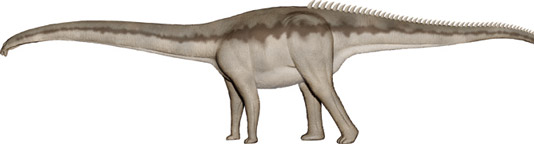
This explains one of the dilemmas facing model makers when they come to reconstruct Diplodocus.  Some manufacturers have chosen to produce a diplodocid with spines, such as the Natural History Museum model (seen below).

Natural History Museum Diplodocus

Picture credit: Everything Dinosaur

In this model, Diplodocus is depicted with spines running from over the sacral vertebrae down to the tip of the tail.  The animal’s colours have been inspired by elephantine colouration, dark, mottled greys.

To view the model: Natural History Museum Dinosaur Models.

Diplodocus carnegii

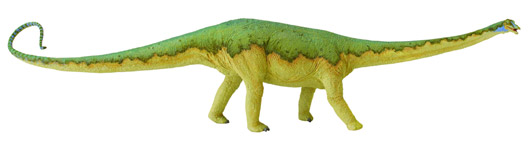
In contrast, the American company Safari, took a very different approach.  In their larger 1:30 scale model of Diplodocus, introduced this year, partly to mark the anniversary of the naming of this Dinosaur, the animal is depicted without spines.

Safari Carnegie Diplodocus

Picture credit: Everything Dinosaur

This particular model of a Diplodocus has been coloured differently in contrast to the British influenced and designed diplodocid.  The head area has been given a flash of blue, perhaps indicating that the head and neck could have been used to send signals to other animals within the herd.

To view Safari Ltd model range: Safari Ltd. Wild Safari Prehistoric World.

12 06, 2008

Potential New Dinosaur Species from British Columbia

By |2022-11-25T08:16:23+00:00June 12th, 2008|Categories: Dinosaur and Prehistoric Animal News Stories, Dinosaur Fans, Main Page|0 Comments

Potential New Dinosaur Discovered in British Columbia

Most people imagine that new species of dinosaur are discovered in some remote, desolate part of the world.  Indeed, this is often the case, excavations in the outback of Australia, up mountains in Antarctica and the deserts of China have all yielded evidence of dinosaurs new to science.   Sometimes a new, as yet undescribed dinosaur can be literally under the noses of the scientists, yet can go unnoticed.

A previously unknown dinosaur may have been discovered after a set of fossilised bones in storage at the Royal British Columbia Museum were re-examined by a group of palaeontologists.

The group of just seven bones, believed to represent a single individual were discovered in northern British Columbia in 1971, but they have only recently been studied in detail and the conclusion drawn is that these bones represent an unknown species.

The fossils were found by geologist Kenny Flyborg Larsen, searching for uranium deposits near the confluence of Birdflat Creek and the Sustut river, north-east of the small town of Terrace in British Columbia.  An area more associated with fine fishing than with dinosaur discoveries.  The partial skeleton is believed to be approximately 70 million years old (Maastrichtian faunal stage of the Late Cretaceous), although more precise dating cannot be made as no record of the exact location of the discovery exists so the sediments in which they were deposited are not known.

Larsen kept the fossils until 2004, deciding to donate them to Dalhousie University’s Earth Sciences department.  The fossils were moved to the Royal British Columbia Museum in 2006.  This gave University of Alberta palaeontologist Victoria Arbour and her co-author of the paper on these fossilised bones, Milton Graves, a scientist from Dalhousie University the chance to study them.  The authors conclude in their findings published in the latest edition of the Canadian Journal of Earth Sciences, that these bones belonged to as yet undescribed bird-hipped dinosaur, an ornithischian dinosaur.

Commenting on her research, Victoria stated:  

“There are similarities with two other kinds of dinosaurs, although there’s also an arm bone we’ve never seen before. The Sustut dinosaur may be a new species, but we won’t know for sure until more fossils can be found. It’s very distinct from other dinosaurs that were found at the same time in southern Alberta.”

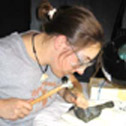
University of Alberta Palaeontologist Victoria Arbour Prepares the Fossils

Picture credit: University of Alberta Handout

She hopes to lead an expedition to the discovery site in search of more evidence.

Other dinosaur finds have been made in British Columbia. in the past three decades, but the area is not as famous for Late Cretaceous dinosaurs as the neighbouring state of Alberta.  However, there may be many more exciting dinosaurs awaiting discovery in the rugged country of British Columbia.  A number of trace fossils (footprints) of dinosaurs have been discovered at a number of sites in the state but the the belated documenting of the 1971 find could make these fossil bones the first dinosaur body fossil ever discovered in British Columbia, the authors note.

In a statement released by the University of Alberta, the seven bones consisting of leg material, arm, toe and possible skull bones resemble bones from a small, bipedal, herbivore.  For the moment, these remains have been classified as ornithischian, the same Order as the horned dinosaurs such as Torosaurus and Triceratops and the hadrosaurs such as Edmontosaurus.

Safari Ltd have a variety of ornithischian dinosaur models in their range: Wild Safari Prehistoric World Models.

The researchers have tentatively named this British Columbian dinosaur Cerapoda incertae sedis, a nomen nudum, as the authors comment that the name may be altered “pending the discovery of additional diagnostic material.”

A nomen nudum is a name given to an organism by scientists that has not yet formally been described and for which no holotype (a specimen upon which the first description of the organism is based), has been formerly designated.

So new species of dinosaur can come to light when examining the fossils already found and stored within museums and other institutions.  The British Columbia case is not unusual, a number of new exciting discoveries have been made when fossils have been re-examined.  For example, the discovery of a new type of long-necked dinosaur (Sauropod) when fossil vertebrae were studied in detail at the Natural History Museum in London.

To read about the London discovery: Where is the best place to find a new Dinosaur? In a museum collection!

11 06, 2008

Rare Australian Dinosaur Bone Questions Accepted Theory on Break-up of Gondwana

By |2024-04-12T19:20:31+01:00June 11th, 2008|Categories: Dinosaur and Prehistoric Animal News Stories, Dinosaur Fans, Geology, Main Page|0 Comments

Dinosaur Discovery “Knocks” Continental Drift

A new interpretation of a fossilised arm bone of an Australian dinosaur has brought into focus the on-going debate about the break up of the southern super-continent Gondwanaland.

In a paper published in the scientific journal “The Proceedings of the Royal Society”, Nathan Smith of the Field Museum in Chicago, Illinois, argues that a single fossilised dinosaur bone found in Australia links this country to South America.  Dating of the fossil indicates that Australia may have still been connected to the rest of the southern super-continent of Gondwanaland much later in the Cretaceous than first thought.

Gondwana

Conventional scientific theory states that the land mass in the southern hemisphere, known as Gondwana or Gondwanaland began to break up during the Cretaceous period.  The land that was to form South America, Africa, India, Antarctica and Australia began to split apart under the impact of continental plate forces.

Australia remained attached to Antarctica until approximately 95 million years ago, until the start of the formation of the south-east Indian ridge (a mid-ocean spreading ridge), began to tear these two landmasses apart.  As new ocean floor was created at this ridge, Australia was gradually separated from other areas of land and pushed northwards, towards its present position.

However, in the Field Museum study, a single bone, identified as coming from a dinosaur called a Megaraptor (the name means “big thief”), questions the accepted theory on the timing of the break up of Gondwana.  If the interpretation by the Chicago team is validated, this sheds new light on the origin of Australian dinosaurs and may indicate that land bridges existed between Australia and other parts of the splintering southern continent.

Examining Arm Bones

The single bone, an ulna (one of two bones in the forearm) has been dated to approximately 110 million years ago, it shows a striking similarity to the ulna of a Megaraptor, a large carnivorous dinosaur known exclusively from South America.

This study has suggested that Australia remained connected to the rest of Gondwanaland far later than originally thought and may help explain the diverse fauna and flora of Australia in the Late Cretaceous.

Commenting on his paper, Smith stated: “It doesn’t rewrite the biogeographic history of the early Cretaceous in Australia, but it adds an important well-constrained data point showing a South American connection”.

The unnamed Australian fossil is about 50% of the size of the corresponding bone in Megaraptor fossils, unearthed in Argentina, but it is not clear if the animal was a juvenile or an adult of a smaller related species. Such ontogenic information is difficult to infer from a single fossil bone.  The fossil has been dated to approximately 110 million years ago (Albian faunal stage), the fossils of Megaraptor from Argentina are dated to the Cenemanian faunal stage, some 20 million years later than the Australian fossil.

The CollectA Australovenator dinosaur model.

The CollectA Australovenator replica.

The picture above shows a CollectA Australovenator replica, an animal that may have been part of the Megaraptora clade of theropod dinosaurs.

To view the CollectA prehistoric animal model range: CollectA Age of Dinosaurs Popular Range.

Australian Dinosaur Bone

Professor Pat Vickers-Rich of Monash University, Victoria, casts doubts upon the Chicago study.  Professor Vickers-Rich has worked extensively on the Dinosaur fossils found at the famous Dinosaur Cove and East Gippsland sites in Victoria state.  Along with her husband Tom, Professor Vickers-Rich has been responsible for the naming of a number of new Australian dinosaur genera.  As to this new American assessment of Australia dinosaur origins she commented that Smith’s group were “pushing the envelope”, implying that they were trying to infer too much information from a single, isolated bone.

Yet Smith and his team take their case even further suggesting that the Australian bone tips the scales in the debate over Megaraptor’s closest relatives – shifting the evidence towards another group of carnivores, the Spinosauridae.

To read an article about a fossil discovery in Australia that may rewrite the evolutionary history of theropods: Tiny Fossil Leads to Theropod Revision.

The south American fossils of Megaraptor have a rather interesting history themselves.  The first fossils of Megaraptor were described in 1998, the animal being identified as a dromaeosaur due to the large 30 cm long, highly re-curved claw found.  This was first interpreted as being a sickle-like toe claw typical of the raptors.  However, the discovery a complete hand in 2003 proved that the claw belonged to the first phalanx (thumb claw).  A large thumb claw is a characteristic of baryonychids which are believed to be the ancestors of the later spinosaurs.  Hence the conclusions draw by Smith and his colleagues from the study of the ulna found in Australia.

10 06, 2008

New Research Shows Evidence of Interpersonal Violence in Neolithic Europe – Fighting over the Girls

By |2024-04-12T19:23:30+01:00June 10th, 2008|Categories: Dinosaur and Prehistoric Animal News Stories, Main Page|0 Comments

Stone Age Tribes may have fought over Women as well as Resources

Stories of conflicts and wars being fought over women are common place in most cultures and societies.  The story of Helen of Troy is a typical example, but now new research indicates that fights over women may have taken place in Neolithic times.

Neolithic Men

A new study published this week in the journal Antiquity, may indicate that men executed rivals in order to steal women from neighbouring tribes.  In the research into interpersonal violence during the Neolithic of Northwest Europe, the researchers examined the teeth of 34 skeletons found in burial pit in Talheim, southwestern Germany.  The pit was discovered in the 1980s and although the human remains had been studied previously, this research team was interested in uncovering the tribal relationships between the people who had been buried there 7,000 years ago.

The research, led by the Anthropology Department of Durham University, in co-operation with scientists from the University College London, Wisconsin University and a local German organisation, examined the teeth of the 34 skeletons found in the burial pit.  Strontium, carbon and oxygen isotopes extracted from the ancient teeth, provide information on the person’s geological origin and diet.

Genetic Evidence

The genetic evidence gathered indicates that these were the remains of people killed in a fight between two rival tribes.  The 34 people came from three groups – locals, cattle-herders and a “family” of a man, woman and two young children.

Within the group identified as being local to the area, there were only men and children, indicating that the women in this group were spared.  Adult female skeletons were found amongst the “immigrants”, perhaps these are the remains of some of the aggressors, women who took part in the attack.  The scientists have concluded that the absence of local females in the burial pit showed they were captured instead, and that could have been the primary motivation for this violent attack.

Lead author Dr Alex Bentley from Durham University’s Anthropology Department said: “It seems this community was specifically targeted, as could happen in a cycle of revenge between rival groups.”

Dr Bentley commented further: “Although resources and population were undoubtedly factors in central Europe around that time, women appear to be the immediate reason for the attack. Our analysis points to the local women being regarded as somehow special and were therefore kept alive.”

Research Funded by the Leverhulme Trust

The research was funded primarily by the Leverhulme Trust, with support from the National Science Foundation.  This is part of wider research studying the history of interpersonal violence within Neolithic communities of North-western Europe.

Many local police forces are called in when fights break out on a Saturday night, often  the cause of the dispute is an argument over girls, it seems our ancestors may also have fought over women.  The archaeological findings from this study for the first time strongly suggest violence took place over mates as early as prehistoric times.

The skeletons from the mass grave in Talheim, were all buried in a single pit of three metres long. The deliberateness of the prehistoric attack was first realised when German skeletal experts determined that the majority had been killed by a blow to the left side of the head, suggesting the victims were bound and killed, probably with a stone axe. Others may have been killed from arrow-wounds from behind as if the victims had tried to flee.

Further research will be conducted with the aim of shedding more light on the causes and consequences of such violent actions.  The perpetrators of these attacks were not some sort of ape-man but our own species, it seems men have been fighting over women for a very long time.

This article has been compiled using information from Science Daily and Durham University (2008, June 4). Men Fighting Over Women? It’s Nothing New, Suggests Research.

Visit Everything Dinosaur’s award-winning website: Everything Dinosaur.

9 06, 2008

Fossilised Burrows found in Antarctica

By |2023-02-25T16:44:43+00:00June 9th, 2008|Categories: Dinosaur and Prehistoric Animal News Stories, Main Page|0 Comments

Ancient Burrows found in Antarctica

A team of American scientists have discovered fossilised burrows in Antarctica, trace fossils of ancient land animals that pre-date the dinosaurs.  This is the first time trace fossils such as burrows have been found on this continent.  The burrows have been dated to the Early Triassic and were dug by land living, vertebrates approximately 245 million years ago.

Fossilised Burrows

Although, no remains of the excavators have been found, Christian Sidor of Washington University, who led the team has stated that these burrows were dug by Tetrapods and are not likely to have been dug out by invertebrates such as crayfish.  Tetrapod is the scientific name given to four-legged vertebrates and those two-legged and limbless vertebrates descended from them.  The term tetrapod, literally means “four feet”.

The limbs of tetrapods have distinct digits, they are believed to have evolved in the Devonian.  The oldest Tetrapod fossils, multi-digit animals such as Ichthyostega and Acanthostega have been found in late Devonian river and lake deposits (dated around 360 million years ago).  These first four-limbed vertebrates were mainly aquatic creatures but their muscular limbs, perhaps evolving first as an aid to clambering through weed clogged water or perhaps digging for shellfish, were a wonderful pre-adaptation for venturing onto land.

No Body Fossils Found

Though no animal remains were found inside the burrow casts, the hardened sediment in each burrow preserved a track made as the animals entered and exited, according to the American palaeontologists.

“In addition, scratch marks from the animals’ initial excavation were apparent in some places. We have got evidence that these burrows were made by land-dwelling animals rather than crayfish,” commented Christian, the expedition leader and assistant professor of biology at the University of Washington.

Possible Procolophonids?

Despite the absence of fossil bones, the burrows’ relatively small size prompted the U.S. team to speculate that their owners might have been small lizard-like reptiles called procolophonids or an early mammal relative called Thrinaxodon.  Thrinaxodon was a cynodont, a small carnivorous synapsid which like other cynodonts and dicynodonts are believed to have lived in burrows and fossils of this little animal, no more than 50 cm long have been found in Antarctica.

The fossils were created when fine sand from an overflowing river poured into the animals’ burrows and hardened into casts of the open spaces. The largest preserved burrow is about 35 cm long (14 inches), 15 cm wide (6 inches) and 8 cm deep (3 inches).

For models and replicas of Triassic prehistoric animals and other extinct creatures: CollectA Prehistoric Life Age of Dinosaurs.

During this time in the Earth’s history Antarctica was joined to landmasses that were to eventually form South America, Africa, India and Australia, although Antarctica may not have been directly over the south pole as it is today, it was certainly a cold, harsh environment and the southerly latitude would have meant that this area would have been in darkness for part of the year.  Perhaps these little vertebrates dug burrows to escape the most extreme of the climatic conditions around at the time.

8 06, 2008

Young boy finds Dinosaur Tooth on First Fossil hunting Expedition

By |2022-11-25T07:02:35+00:00June 8th, 2008|Categories: Dinosaur and Prehistoric Animal News Stories, Dinosaur Fans, Main Page|0 Comments

Trip to the Isle of Wight – Dinosaur Tooth Found

For young Josef Bangbala, his first fossil hunting trip turned out to be a red letter day for Isle of Wight palaeontologists.  Josef, aged seven, was out on an organised fossil hunting trip with his father whilst on holiday on the Isle of Wight.  Keen eyed Josef spotted a two-inch long dinosaur tooth, one of the largest found on the island.

His find has sparked a debate amongst scientists as the tooth, believed to belong to a baryonychid may lead to a re-think over the size and scale of these predatory dinosaurs.

Josef was on a special fossil hunting expedition during half term with his dad Tom, 52, of Stacksteads, Rossendale.

Tom said: “He is into dinosaurs and wants to be a palaeontologist when he is older and so I took him to the Isle of White on the trip last week”.

The southern part of the Isle of Wight has a number of Cretaceous sediments exposed, in fact unusually,  the only surface rocks on the island are sedimentary and they only herald from three geological periods.  A number of dinosaur fossils have been found on the island, particularly in the south-west between Compton Chine and Atherfield Point.  Wave action is constantly exposing new strata at the shoreline, providing opportunities for new fossils to come to light.

Josef’s dad went on to explain: “we were on the beach and he saw it sticking out of the shale. We showed it to the specialist we were with and he was beside himself. He said it was the best thing they have found for at least three years. They wanted to borrow it for a year and put it in the museum on display with Josef’s picture.”

A number of baryonychid teeth have been found but the size of this one makes it particularly special and may indicate that animals such as Baryonyx may have exceeded 10 metres in length.

An Illustration of Baryonyx (Baryonychid)

Picture credit: Everything Dinosaur

Baryonyx was a large meat-eating dinosaur of the Early Cretaceous, a possible ancestor of the spinosaurs.  The name means “heavy claw” after the long, re-curved, sharp claws on its thumbs.  It is believed this animal was a fish-eater, although it probably was an opportunist hunter, feeding on other dinosaurs as well as scavenging the kills of other carnivores.  The first fossils of Baryonyx were discovered by an amateur fossil hunter called William Walker on a visit to a clay pit in Surrey, southern England.  About 70% of the entire skeleton of this first specimen was found and although not fully grown, careful study of this fossil has led scientists to speculate that creatures such as Baryonyx could grow to lengths in excess of 10 metres.  The large tooth found by Josef also indicates that Baryonyx could have been larger than first thought.

Steve Hutt, curator of Dinosaur Isle, on the Isle of Wight, described the tooth as “extra special” as it was much larger than other teeth found on the island.

We find things everyday but once every few years we find something extra special like this fossil.  I would have been proud to have found it myself.  It is particularly extra lucky to have found it on his first hunt.  He is so young and he found it all by himself.”

Children often find fossils, there are a number of reasons for this, their eyesight is much more acute than an adult’s and they are able to discern strange objects amongst stones and debris.  Also being closer to the ground than an adult, they are often able to spot things overlooked by even the most dedicated expert.  Scientists are confident that this tooth is from a baryonychid as teeth from these dinosaurs are very characteristic.  They tend to be less re-curved than other large Theropod teeth, but the give-away is their unusually fine serrations (7 per mm).  These serrations are called denticles and are used to help determine the type of meat-eating dinosaur the tooth came from.  The tooth does not have a root, so it is likely that it was shed when the animal was alive.  Teeth with roots are usually associated with a dead animal, the teeth falling out of the skull complete, as the flesh rots away.

To see a model of Baryonyx: CollectA Prehistoric Life Models.

Go to Top