All about dinosaurs, fossils and prehistoric animals by Everything Dinosaur team members.
7 06, 2008

European Champions for Prehistoric Animal Genera? Let’s Have Some Fun!

By |2024-04-12T19:22:12+01:00June 7th, 2008|Categories: Everything Dinosaur News and Updates, Main Page, Press Releases|0 Comments

Euro 2008 – Who has the most Prehistoric Animal Genera?

Just for a little bit of fun, todays’ article attempts to link the start of the European football championships with geology and palaeontology.  Some of our staff members have been in the office today, trying to avoid hearing about the start of the European football championships.  With no home country participation, the championships may well pass us by but there are sixteen teams in the tournament all aiming to do what the Greeks did in the last tournament held in 2004 and become the champions of Europe.

Prehistoric Animal Genera

We have compiled a quick and very approximate comparative table of the sixteen finalists in this tournament to see which country could be heralded as the “European Champions” in terms of the number of different prehistoric animal genera and ancient human species found in that particular country.  Everything Dinosaur staff have compiled a table using various information sources and calculated a ranking for each country participating in the European Championships.  The number of dinosaur and prehistoric animal genera have been quickly assessed, weighted against the actual size of the country and correlated against the number of mentions each country has had in our own web log.

There is no real scientific method behind our research, the information has been compiled just as a little bit of fun whilst working in the office this afternoon.  According to our study, and weighted analysis of each country, Croatia comes out with the lowest rank (16) of the countries that have qualified for the finals.  There have been relatively few finds in what is quite a small European country.  Austria and Switzerland, the joint hosts may not be fancied by many football analysts to make much of an impact in the actual football tournament, but under our brief, unscientific study the hosts fair very differently.  Austria for example, comes out with a ranking of fifteenth, whilst Switzerland in contrast are ranked seventh – the equivalent of making the quarter finals.

Portugal, one of the favourites for the football trophy comes out with a high ranking under our study.  This relatively small country has had a number of different prehistoric animal genera discovered within their national boundaries.  Fossils of dinosaurs such as Brachiosaurs, Allosaurids and Iguanodontids have all been reported from Portugal.  As a result, Portugal comes out ranked fifth under our analysis.

Surprise, surprise based on our very crude reckoning we have crowned Germany as European champions. Not only do the Germans have an excellent record in the European Championships, after all, they are one of the favourites to win the competition, but they also have made a huge contribution to palaeontology and geology.  Many important fossil finds have been discovered in Germany, examples being the likes of Ichthyosaurs, Liliensternus, Paratypothorax and of course perhaps one of the most important fossil finds of all – Archaeopteryx.

European Championship Table 2008

European Champions – Prehistoric Animal Genera v Country Size (Weighted and Ranked)
 

Country size/km

Prehistoric Animal Genera

Examples of Genera

Mentions in Blog

Rank

Group A
Czech Republic

79,000

4

Edaphosaurus, Cave Bear

0

14

Switzerland

41,000

1

Plateosaurus

3

7

Turkey

783,000

8

Cave Bear

1

9

Portugal

92,000

4

Brachiosaurus, Dacentrurus

6

5

Group B
Austria

84,000

5

Rhabdodon, Struthiosaurus

1

15

Croatia

56,000

3

Neanderthal Man

0

16

Germany

357,000

21

Archaeopteryx, Juravenator

30

1

Poland

312,000

6

Sauropods, Ornithopods, Allosaurs*

0

10

Group C
Holland

41,000

3

Mammoths

3

13

Italy

301,000

12

Scipionyx, Eudimorphodon

3

11

Romania

238,000

7

Valdosaurus, Rhabdodon

2

12

France

551,000

18

Liliensternus, Dacentrurus, Plateosaurus

9

2

Group D
Greece

132,000

4

Cave Bear

4

6

Russia

17,098,000

7

Psittacosaurus, Dimetrodon

9

4

Sweden

450,000

3

Hypsilophondontids

0

8

Spain

505,000

13

Baryonyx, Pelicanimimus

6

3

Picture credit: Everything Dinosaur

Note

A number of different types of prehistoric animal have been identified within Poland, many of the dinosaurs have been identified from fossilised footprints (trace fossils).  The actual genera cannot be determined under these circumstances but the taxonomic family can usually be stated with a degree of certainty.

So based on our findings and this very rough and ready analysis, it looks like Germany will be champions with France the runners up.  The Germans do have an advantage as they have a tradition of prehistoric animal model making which is perhaps why that country receives a lot of mentions in our blog.  Nevertheless, Germany has a proud heritage of scientific discovery and as a nation can claim to have some very important palaeontological sites within their boundaries – sites such as Holzmaden and Solnhofen with their late Jurassic sediments as well as early Tertiary sites such as the quarries near Messel in southern Germany.

Some typical prehistoric animals from Germany:

Iguanodon, Plateosaurus, Emausaurus, ichthyosaurs, Europasaurus, Batrachotomus and of course Liliensternus which was named in honour after Hugo Rühle von Lilienstern, a German palaeontologist.

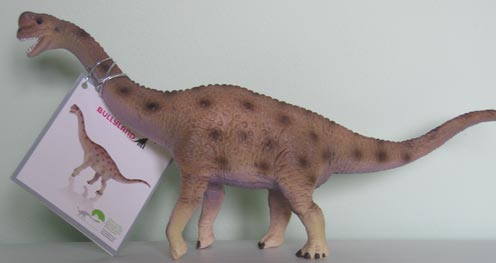
Prehistoric Animal Genera - Europasaurus
The dwarf Sauropod – Europasaurus.

Picture credit: Everything Dinosaur

A model of dinosaurs made by Bullyland of Germany: Bullyland Prehistoric Animal Models.

6 06, 2008

When is a Mass Extinction a Mass Extinction?

By |2022-11-25T06:52:34+00:00June 6th, 2008|Categories: Educational Activities, Everything Dinosaur News and Updates, Main Page, Palaeontological articles|0 Comments

Defining When a Mass Extinction Occurs

Mass extinctions by definition are substantial and significant events.   At any time in the history of life on Earth, there will be a level of background extinctions taking place as well as speciation – the evolution of new species.  The vast majority of species recorded in the fossil record have gone extinct as part of this normal background rate, this is a consequence of evolution and the process of adaptation.  However, it is the mass extinctions that grab the headlines, although the existence of such events in the geological record of this planet was not really understood and widely accepted until late on in the 19th century.

As scientists and geologists began to understand the stratigraphy (the sequences of rocks laid down in strata, indicating they were of different ages), and an appreciation of the development of life began to emerge, it was noted that many groups of fossils disappeared from the fossil record at about the same time.

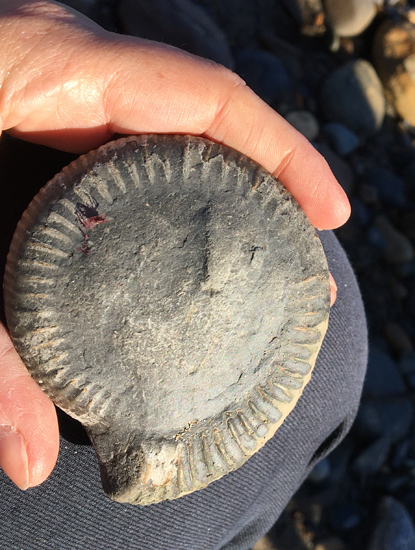
Fossils such as ammonites, very abundant in strata dated from the Jurassic and Cretaceous, become more scarce and less diverse in rocks derived from Upper Cretaceous sediments, before finally disappearing from the fossil record completely.  Ammonite fossils are not found in rocks younger than approximately 65 million years.  Although present in older rocks, they are not known from younger rocks.

An ammonite fossil find.
An ammonite partially eroded out of a nodule. We think this is an example of Dactylioceras commune. Picture credit: Everything Dinosaur.

 Picture credit: Everything Dinosaur

It is partly due to the dramatic change in the fossil record that the boundaries between geological eras and periods are where they are in the chronological history of our planet.  For instance, the boundary between the Mesozoic and the Cenozoic eras is at approximately 65 million years ago – the time of a mass extinction that saw the end of the Dinosaurs, mosasaurs, pterosaurs and plesiosaurs.  The boundary between the Palaeozoic and the Mesozoic (Permian/Triassic periods), dated to approximately 248 million years ago marks what is believed to have been the greatest mass extinction of all time.

Geologically rapid, major reductions in the diversity of life on a global scale are termed mass extinctions.  Patterns of extinction and the severity of the extinction event are assessed by examining their impact on the taxonomic hierarchy.  Individual species may become extinct, indeed whole genera (the next taxonomic category up from species) may die out, but the term mass extinction is usually reserved for those events that impact on life at the family level – the next category up from genus/genera).  Geologists and palaeontologists have identified five especially severe mass extinction events in the history of life on planet Earth.  These are termed the “Big Five” and they are summarised in the table below.

The Big Five Mass Extinction Events (Phanerozoic Eon)

Mass Extinctions – the Big Five (Phanerozoic Eon)
EraPeriodDate (approx)Main Extinctions
PalaeozoicLate Ordovician443 million yearsTrilobites, Brachipods, Corals, Echinoderms
PalaeozoicLate Devonian355 million yearsReef dwellers – Corals, Bivalves, Sponges
Palaeozoic/MesozoicLate Permian248 million yearsCorals, Reef dwellers, Trilobites, Graptolites, Brachipods, Amphibia, Reptilia*
MesozoicLate Triassic206 million yearsGastropods, Cephalopods, Sponges, Reptila, Amphibia, Mammal-like Reptiles, Insects
Mesozoic/CenozoicLate Cretaceous65 million yearsCephalopods, Dinosauria, Pterosaurs, Plesiosaurs, Plankton, Echinoderms
Mass extinction events in Deep Time.

Source: Everything Dinosaur

Note

The Phanerozoic Eon refers to the geological time from approximately 545 million years ago to the present, this eon marks the presence of visible life in the fossil record (animals with hard parts such as shells).

The Permian mass extinction is believed to have been the greatest mass extinction of all with nearly 60% of all marine families becoming extinct.  Life on land was devastated too with many groups of amphibians, reptiles and the ancestors of mammals also perishing.  Such was the devastation that the term “dead clades walking” has been coined by scientists to describe those remnants of once diverse and abundant families of organism left behind.

It is possible for a fossil of an organism to be found in rocks which were formed after these organisms are believed to have become extinct.  This is not always due to some “living fossil” existing in a remote, isolated area after the rest of their species have died out, but perhaps due to a process called redistribution.  For example, a fossil of a sea urchin, preserved as an internal flint mould, laid down originally in Cretaceous chalk strata.  As the chalk is weathered and eroded the more robust flint nodule survives this physical process and eventually under the effects of wind and rain is deposited in a river where it mixes with sand and gravels before finally coming to rest at a bend where the river water slows down, losses energy and deposits its load of debris.  Thus the flint nodule, no doubt having suffered some weathering may find itself redistributed into younger sediments.

Everything Dinosaur stocks a range of replicas of iconic animals from the fossil record: Replicas of Iconic Fossil Animals.

5 06, 2008

A Recipe for Making Tyrannosaurus rex Gingerbread

By |2022-11-25T06:46:04+00:00June 5th, 2008|Categories: Educational Activities, Everything Dinosaur News and Updates, Everything Dinosaur Products, Main Page, Photos of Everything Dinosaur Products|0 Comments

Dinosaur Gingerbread Biscuits – a Tasty Tyrannosaurus Treat

Tyrannosaurus rex is regarded as one of the fiercest predators ever to have stalked the planet.  Although palaeontologists debate what proportion of its meat only diet was from prey that had been actively hunted, compared to scavenging the kills of other animals, it certainly had the tools for a position at the top of the food chain.

With keen eyesight, a superb sense of smell plus an immensely powerful set of jaws, Tyrannosaurus rex was one dinosaur best avoided in case it made a snack out of you.  However, you can get your own back, turning the tables on T. rex and eating him rather than have a T. rex have you for dinner, with this simple recipe for T. rex shaped gingerbread.  These biscuits are ideal for a snack for young children and great for dinosaur themed parties.

A Recipe for Tyrannosaurus rex Gingerbread Biscuits

A recipe for T. rex gingerbread biscuits.

T. rex gingerbread biscuits recipe.

Picture credit: Everything Dinosaur

Recipe for Tyrannosaurus rex shaped Gingerbread

To make the dinosaur shapes, we suggest you use a dinosaur shaped cookie cutter or a similar kitchen tool.

Ingredients (makes about 20 biscuits)

For the Biscuits

Unsalted butter, softened 125 grammes (4 oz)

Soft brown sugar 60 grammes (2 oz)

Golden syrup 90 grammes (3 oz)

One egg lightly beaten

Plain flour, sifted to remove any lumps 250 grammes (8 oz)

Self-raising flour 30 grammes (1 oz)

One tablespoon of ground ginger and one teaspoon of bicarbonate of soda

Icing for Decoration

Icing sugar, sifted 125 grammes (4 oz)

Softened unsalted butter 40 grammes (1.5 oz)

Assorted food colourings

Method

1).  Preheat the oven to 180° C/350° F (gas mark 4).  Line two baking trays with baking paper.

2).  Using electric beaters, cream the butter, sugar and golden syrup in a large mixing bowl until light and fluffy.  Add the egg gradually, beating well after each addition.  Sift the dry ingredients over the butter mixture and mix with a knife until just combined.  Combine the dough with your hands.  Turn onto a well-floured surface and knead for 1-2 minutes, or until smooth.  Roll out onto a chopping board, between two sheets of baking paper, to 5mm thick.  Chill on the board for 15 minutes to firm.

3).  Cut the dough into shapes with the dinosaur cutters.  Press the remaining dough together and re-roll.  Cut out shapes and place the biscuits on the trays.  Bake for 10 minutes, or until lightly browned.  Cool on the trays.

The Tyrannosaurus rex Gingerbread on a Cooling Tray

Picture credit: Everything Dinosaur

4).  To make the icing, place the sifted icing sugar and softened unsalted butter in a mixing bowl and beat with a wooden spoon until smooth, adding 1-2 tablespoons of water if necessary.

5).  Divide the icing among several bowls and add the food colourings.  Spoon into small paper icing bags.  Seal ends, snip the tips off the bags and pipe onto the biscuits.  You can also use all sorts of cake decorations – jellies, sprinkles and such like.

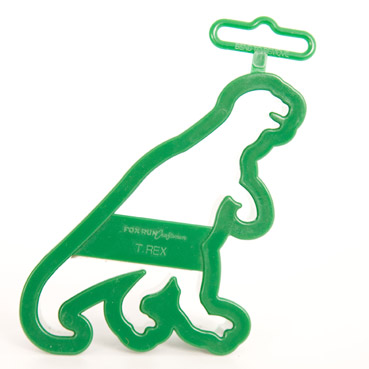
These gingerbread biscuits were made using the Tyrannosaurus rex biscuit cutter, a handy, robust cookie cutter in the shape of this famous dinosaur.

The Tyrannosaurus rex Biscuit Cutter

Picture Credit: Everything Dinosaur

Everything Dinosaur is a UK-based supplier of dinosaur and prehistoric animal themed models, toys and merchandise, check-out our website: Everything Dinosaur.

4 06, 2008

The Demise of Seismosaurus – its a Question of Vertebrae

By |2022-11-25T06:44:37+00:00June 4th, 2008|Categories: Dinosaur and Prehistoric Animal News Stories, Dinosaur Fans, Everything Dinosaur Products, Main Page|0 Comments

Is Seismosaurus a valid name or should it be regarded as a genus of Diplodocus?

Much debate has taken place over the years as to which of the dinosaurs was the biggest, the longest or the heaviest.  The origins of this controversy amongst scientists can be traced back to the “Dinosaur Wars” between the likes of Cope and Marsh in the 19th century, as expeditions competed with each other to provide the biggest and best specimens for their wealthy sponsors.  Despite improvements in technology, the much more accurate and detailed study of fossil locations, plus of course improvements in research techniques and the greater number of specimens around today to study, it is still unclear as to which genus or even family of dinosaurs can lay claim to being the biggest.

There are certainly some spectacular contenders out there, titanosaurs are well represented with genera such as Andesaurus, Antarctosaurus and Argentinosaurus being heralded as true “heavy weights” in the Dinosauria clade.  However, the titanosaurs do not have everything their own way, although these Cretaceous leviathans are certainly very impressive, many are matched in terms of size by the earlier brachiosaurids, camarasaurids and diplodocids of the Jurassic.

These huge animals do have a number of common characteristics that frustrate teams of field workers, tasked with the job of excavating such finds.  For one thing, the remains of these large animals are relatively rare within the fossil record in comparison to other herbivorous groups such as the ornithopods for example.  Another problem is the lack of fossil bones which represent one individual specimen.  Many of these large dinosaurs have been named and described from just a few isolated bones, or at best a new genus has been announced based on fossils found in association with each other – rarely do articulated fossils turn up.

Although, as with most scientific matters there are always exceptions to this rule, for example the recent discovery of another large titanosaur from Argentina:

Huge Titanosaur Specimen uncovered in Cretaceous “Lost World”.

The jumble of sauropod bones to be found in the Morrison Formation has still to be unravelled, no doubt more surprising discoveries will be made, but discussion has turned recently to the validity of another contender for certainly the longest dinosaur yet known – Seismosaurus.  Seismosaurus, the name means “earth-shaking lizard”; as it was imaginatively speculated that such a huge beast would cause the ground to shake as it walked by, could be reclassified as a Diplodocus.

The single specimen found to date of this animal was discovered in 1979, two hikers walking in New Mexico, literally stumbled upon some strange fossil bones eroding out of sandstone sediments.  David Gillette, an American palaeontologist whose work has focused mainly on the Jurassic Morrison Formation in New Mexico, organised a team to begin the long process of extracting the fossils from the matrix.  This process took many years, as the sandstone entombing the fossils was as hard of concrete.  This excavation helped with the design and modification of ground penetrating radar, as this technique was used extensively during the excavations to help locate fossils still buried in the sediment.

Seismosaurus was named and described by Gillette in 1991 (S. hallorum), the remains of this animal consisting of vertebrae, ribs and part of the pelvis.  Based on this evidence it is clear that this particular animal was a contender for the longest dinosaur yet to be described with an estimated length of around 40 metres for this late Jurassic giant (Kimmeridgian faunal stage).  Like all other diplodocids, the majority of this length was made up of the long neck and the very long tail.  In the New Mexico specimen, the body is not particularly big for a diplodocoid, it had longer back legs than front legs, a characteristic of this family, but a study of the pelvic area and the subsequent assumed position and length of the legs indicated that they may have been quite short and stubby in comparison to other closely related dinosaurs.  The impressive whip-like diplodocid tail seems to have had a “kink” in it, perhaps indicating that unlike other diplodocids, which are believed to have held their tails out straight behind them, perhaps the end portion of the tail of Seismosaurus was trailed on the ground.

However, further work on this fossil has led to a number of reviews some of which have questioned whether the name Seismosaurus would be valid.  In 2004, a case was made for Seismosaurus to be regarded as a Diplodocus, certainly from the fossil evidence these two animals do seem to be very closely related.  Whether or not there are enough differences found to regard Seismosaurus as a separate genus is still being debated.

In 2006, a scientific paper was published, following the most detailed analysis of the fossil bones made at the time, the validity of the Seismosaurus name was challenged, as indeed was the actual size of the beast.  Put into simple terms, it is largely a matter of how you construct the vertebrae, the order in which they are placed together and which part of the backbone is associated with them.  The authors of this 2006 paper renamed Seismosaurus as Diplodocus hallorum, but also speculated that it could actually be a large specimen of another Diplodocus species D. longus.

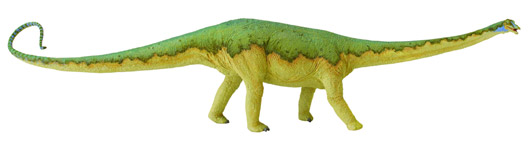
A Model of a Typical Diplodocid

Picture credit: Everything Dinosaur

The model shown above is the new scale model of Diplodocus produced by Carnegie.  It represents the latest interpretation of these huge dinosaurs, with a relatively stiff neck, not capable of obtaining the so-called “swan neck” position.  This model is one of the largest scale models currently available with a length of nearly 60 cms.  We love this new interpretation, the Everything Dinosaur packing team who were given the job of finding suitable packaging to enable this item to be posted out to customers are not so keen!

To view the Wild Safari Prehistoric World range: Wild Safari Prehistoric World Models.

As Diplodocus was named before Seismosaurus, the first Diplodocus being named and described in 1878, 113 years before Seismosaurus was named and described, the nomenclature Diplodocus would take precedence.  Seismosaurus would be a junior synonym of Diplodocus.  A synonym is another name for an object.  In taxonomic circles, the earliest of several names given to an organism is considered the senior synonym while later names are junior synonyms.  Perhaps the most famous example of this concerns another Diplodocid – Apatosaurus.  The name Apatosaurus predates Brontosaurus but both are synonyms of the same animal (genus).  Thus Apatosaurus is the senior synonym and Brontosaurus the junior synonym.  The name Brontosaurus, means thunder lizard, a great description for such a huge dinosaur was officially dropped by palaeontologists in 1974.

3 06, 2008

Media Co-ordinator Discovers Dinosaur – Hoorah for Amateurs!

By |2023-02-25T16:45:45+00:00June 3rd, 2008|Categories: Dinosaur and Prehistoric Animal News Stories, Main Page|0 Comments

Young PR Co-ordinator for Museum Discovers Dinosaur

The discovery of an articulated or associated fossilised skeleton of a large dinosaur can often be the culmination of a lifetimes work for a palaeontologist.  A reward for years of fieldwork and painstaking research – or you can simply stumble upon one, by luck.

Recently, a young public relations co-ordinator for the Houston Museum of Natural Science called Steve Cowan, discovered the remains of a duck-billed dinosaur.  The animal has been identified as a Brachylophosaurus (means short-crested lizard), a type of hadrosaur that lived approximately 75 million years ago.  Compared to other hadrosaurine hadrosaurs such as the later Edmontosaurus, this type of duck-billed dinosaur is relatively rare in the fossil record.  It is known from Late Cretaceous deposits (Santonian to Campanian faunal stages) from Alberta and Montana.

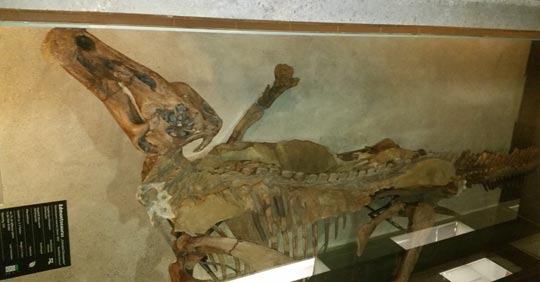
Edmontosaurus fossil exhibit.
The Edmontosaurus exhibit at the Frankfurt Natural History Museum. Picture credit: Everything Dinosaur.

Picture credit: Everything Dinosaur

The most complete (a semi-mummified specimen) of Brachylophosaurus was found in the same area in 2000, it is from this fossil that scientists have been able to obtain the most data regarding these relatively rare Hadrosaurs.  These particular dinosaurs are believed to have grown to about 7 metres in length and although regarded as duck-bills this term is a bit of a misnomer when referring to this genus.  Brachylophosaurus, rather than having the typical hadrosaurine broad, duck-like bill had a more flattened bill which was down-turned, perhaps an adaptation to grazing on a particular type of plant, such as cropping vegetation close to the ground.

Steve has nicknamed this new specimen “Marco”, he was only attending the fossil site in preparation for a media tour being organised to discuss earlier hadrosaur finds in the area.  Walking up a ridge he noticed what he thought were bones eroding out of the ridge.

Describing his find as “exciting”, Steve may have to writing a press release in the near future for his own dinosaur discovery.  Palaeontologists who have begun to study this location more closely are confident that more bones from this Brachylophosaurus will be found, perhaps even precious skull material.  The discovery had been made on a particularly cold, wet day.  Sometimes sudden downpours  can reveal new fossils quite quickly and the wet fossils can stand out more clearly against the background sediments.

The discovery, a first for Steve, also surprised Robert T. Bakker, curator of palaeontology at the Houston Museum of Natural Sciences, who was leading the expedition.

“One of the things we always need to watch out for is thinking that we know it all,” commented Robert. “I knew enough never to go to a ridge-top because you don’t find specimens there.

“But I forgot to tell that to Steven, so he did exactly that and proved me wrong.”

This particular article reminds us of an incident that happened a few years ago to one of our Everything Dinosaur colleagues whilst on a trip to the Royal Tyrrell museum at Drumheller, Alberta in Canada.  They had been visiting the museum and were working on an unrelated project when quite by chance they were invited out for the afternoon into the Dinosaur Provincial Park to accompany some field workers who were going back to a dig site to retrieve some equipment.

The weather had been unsettled for a number of days and there had been some heavy rain in the area, quite an unusual event for what is effectively semi-desert.  Jokingly, as the party set off, one of the Canadians remarked to our colleague that with all the heavy rain she might find a new specimen.  This was laughed off, the Everything Dinosaur team member, recounting the story remembered commenting that she would not know a fossil even if she fell over it.

However, within a few minutes at arriving at the dig site, our colleague climbed a small bluff to retrieve a piece of tarpaulin that had been blown up there and on the way down stumbled, kicking over some debris that that had been laying half-way up the slope.

To the parties amazement, she had tripped over some articulated hadrosaur vertebrae that had begun to erode out of the bluff.  So sometimes, dinosaurs can be found even when you are not actually looking for them, it is really a question of being sharp-eyed and being in the right place at the right time, plus of course relying on the intervention of lady luck.

Everything Dinosaur stocks a large range of duck-billed dinosaur models such as those to be found in the CollectA Prehistoric Life model range: CollectA Age of Dinosaurs Models.

2 06, 2008

Amphibian Ancestry a Little Clearer Thanks to new Discovery

By |2023-02-25T16:49:32+00:00June 2nd, 2008|Categories: Dinosaur and Prehistoric Animal News Stories, Main Page|0 Comments

Half Frog and Half Salamander helps shed light on modern Amphibian Ancestry

Attempts to understand the evolution of four-limbed vertebrates (i.e. tetrapods) has been dogged by the lack of fossil evidence to assist scientists in piecing together cladograms to show the relationships between the earliest land dwelling animals and their ancestors with more advanced forms of terrestrial creature.

Amphibian Ancestry

Even before we consider the evolutionary line of the amniotes (creatures that protect their embryos within a sealed structure – reptiles, mammals and birds, plus some early tetrapods), the evolution of Amphibia has been difficult to determine.  Now the discovery of a “Frogmander” a fossil of an animal that shows both Anura (frog) and Caudata (salamanders and newts) characteristics may help resolve some of these issues.

Three Orders of Extant Amphibia

The modern class of Amphibia is made up of three orders.  Firstly, there is the most diverse group around today the Anura consisting of the frogs and toads.  Secondly, there are the salamanders and newts that belong to order Caudata.  A third group, the Gymnophiona, contains the bizarre, segmented, leg-less caecilians.  To help remember the three orders of amphibia, simply remember that those amphibians without tails are in the Anura order, whilst tailed amphibians are in the Caudata.  Everything else, the caecilians are grouped into Gymnophiona.

The discovery and subsequent study of an ancient amphibian may help to resolve the ancestry of modern amphibians.  An ancient “Frogmander” an animal that shows both frog-like and salamander-like characteristics may indicate that these modern amphibians shared a common ancestor.

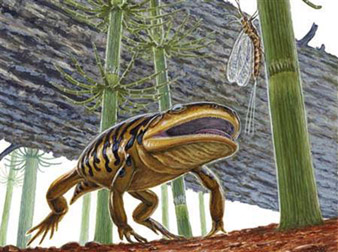
An Artist’s Impression of Gerobatrachus

Picture credit: Reuters/Michael Skrepnick/University of Calgary

Gerobatrachus hottoni

The 290-million-year-old fossil was discovered in 1995, by a team of scientists from the Smithsonian Institute on an expedition to Texas.  Canadian scientists led by Jason Anderson of the University of Calgary, Alberta, have been carefully removing the specimen from its matrix and making a close study of its morphological and anatomical features.

The fossil has been named Gerobatrachus hottoni or elderly frog, and the conclusions from the Canadian’s work have just been described in the scientific journal “Nature”.

“It’s a missing link that falls right between where the fossil record of the extinct form and the fossil record for the modern form begins,” commented Jason.

He went onto conclude that: “it’s a perfect little frogamander”.

Gerobatrachus has a mixture of frog and salamander features, with fused ankle bones as seen only in salamanders, a wide, frog-like skull, and a flexible backbone that resembles a mix of the two.

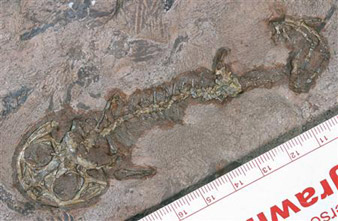
The Gerobatrachus Fossil

The “frogmander” fossil, with a ruler placed next to it for scale.

Picture credit: Reuters/University of Calgary

The picture shows the nearly complete fossil of Gerobatrachus, the large, wide, skull can be seen in the lower left of the picture.

The Evolution of Modern Amphibians

The fossil suggests that modern amphibians may have come from two groups, with frogs and salamanders related to an ancient amphibian known as a temnospondyl, and worm-like caecilians more closely related to the lepospondyls, another group of ancient amphibians.

“Frogs and salamanders share a common ancestor that is fairly removed from the origin of caecilians,” Anderson said.

Prior to this Canadian led study it had been thought that both frogs and salamanders may have been descended from the lepospondyls, but now this theory has been put forward that only the caecilians are descended from this group.  This may have implications for the classification of Lissamphibians the collective name given to all three orders of modern amphibia

“The fossil itself is almost perfectly complete,” Anderson said.

“It died on its back. Its legs and arms were curled up on its belly and it’s that part that weathered away.”

Amphibians are represented very poorly in the fossil record.  This is partly because they have relatively delicate skeletons and light bones.  However, every now and then a truly amazing amphibian fossil is found, such as the partial remains of a huge frog, one that was capable of eating dinosaur hatch-lings.

To read more about this giant frog: The Frog from Hell, one that could jump continents

1 06, 2008

A Fishy Tale Indeed – An Amazing Placoderm Parent

By |2024-04-12T19:22:53+01:00June 1st, 2008|Categories: Dinosaur and Prehistoric Animal News Stories, Main Page, Palaeontological articles|0 Comments

Live Birth Fossil – Placoderm gave birth to Live Young

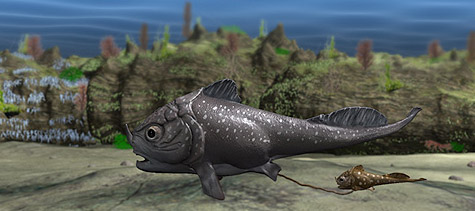
A placoderm parent!  A 380-million-year-old fossil placoderm reveals an internal embryo and a mineralised umbilical cord, indicating that these ancient fish gave birth to live young, pushing back the origins of viviparous behaviour by 200 million years.

A team of Australian scientists have claimed that this is one of the most important palaeontological finds and the earliest example of vertebrate sex discovered to date.  One of the team’s lead researchers Dr John Long (Museum Victoria) stated:

“This is one of these real eureka moments in science you have once in your lifetime.  When you look down the microscope and there it was – an embryo inside a 380-million-year-old fish – and I was blown away by the very thought of this fish giving birth to live young almost 400 million years ago.”

The fossil fish is a member of the now extinct Placodermi Class and has been dated to the  Devonian period, otherwise known as the Age of Fishes.  The 25 cm long fossil was found in the far north of Western Australia, south east of Fitzroy Crossing in a fantastically fossil rich area known as the Gogo Formation.  Approximately 380 million years ago this area of dry, scrub-land was covered by a shallow sea and teemed with life, an environment similar to the Great Barrier reef of Australia to day, the corals that provided much of the habitat were not the scleractinian corals of today, these types of corals first evolved in the Triassic, the corals that dominated this environment were rugose and tabulate corals, two types of coral that went extinct at the end of the Permian period.

The Placodermi

The placoderms were very heavily armoured fishes that possessed bony skeletons and jaws.  The head and trunk were encased in a box-like series of bony plates, the group is believed to have evolved sometime in the Silurian and diversified into as many as 200 different genera.  Fossils of placoderms have been found in sediments that represent both marine and freshwater environments.

The shales that form the Upper Devonian Gogo Formation were formed in quiet bays, that formed a link between the coral sea and the surrounding coastal areas.  The sediments contain superbly preserved fossil fish and other creatures that lived in this ancient sea.  These thick deposits contain one of the most diverse collection of animal fossils of the Devonian period with over 25 varieties of placoderms, ray-finned fishes, lobe-fins and lungfish.  Such has been the quantity and quality of fossils from this area that a placoderm has been adopted as the official state fish of Western Australia – it is known affectionately as the GoGo fish – official name Mcnamaraspis kaprios.

Preserved as original bone in limestone nodules within the shale, these fossils represent the best preserved early fishes in the world and the site is of huge importance to scientists as they try to piece together the evidence to understand how and why vertebrates moved onto land.

A Placoderm Parent

The fossil showing the embryo was found three years ago, but only after the specimen was placed in an acid bath to help dissolve away the surrounding matrix, was the significance of this particular fossil recognised.  Acid preparation is a common technique used by laboratory technicians to help reveal more of a fossil which is surrounded by a limestone matrix.  This technique was pioneered by scientists at the Natural History Museum in London and used to help reveal more of dinosaur bones embedded in calcareous rocks.

This particular placoderm, represents a new species and it has been named Materpiscis attenboroughi after Sir David Attenborough, in recognition of his work in the field of Natural History and his help in identifying the Gogo Formation as being of major scientific importance.

“The discovery is certainly one of the most extraordinary fossil finds ever made and changes our understanding of the evolution of vertebrates,” Melbourne-based Dr Long commented.

“The existence of the embryo and umbilical cord within the specimen provides scientists with the first every example of internal fertilisation – that is, sex – confirming that some placoderms had remarkably advanced reproductive biology.”

Once the cleaned and fully prepared fossil was put under a powerful CT scanner at the Australian National University in Canberra, the yolk sac and a major blood vessel inside the umbilical cord could clearly be seen.  The fossil provides evidence that the basic body plan that makes up a vertebrate was already present 380 million years ago and sheds light on how placoderms reproduced.

An Artist’s Impression of Materpiscis attenboroughi

Picture credit: Museum Victoria

The paper on this particular specimen, the oldest vertebrate mother known,  has just been published in the scientific journal Nature.  It seems that some placoderms reproduced in a very similar way to some cartilaginous fish (sharks and rays) who are also viviparous – able to give birth to live young.

Could this be evidence that the sharks and rays shared a common ancestor with the placoderms?  The fossil record of vertebrates is particularly poor in the Silurian and Ordovician and scientists are still uncertain as to the relationships between the different Orders of fish.  Perhaps this fossil of a female placoderm provides evidence of convergent evolution.  Convergent evolution is the development of similar anatomical or morphological characteristics such as the ability to give birth to live young in unrelated groups of animals or plants in response to the same environmental pressures.

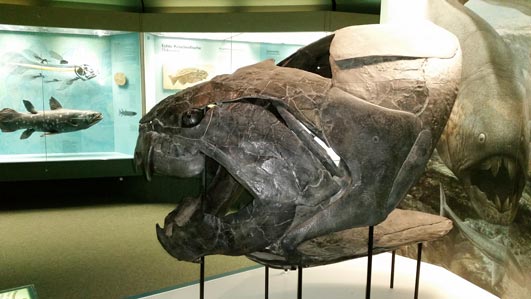
An Exhibit Featuring the Most Famous Placoderm of All – Dunkleosteus

Dunkleosteus on display. A placoderm parent?

The spectacular Dunkleosteus exhibit.  Perhaps the most famous placoderm of all.

Picture credit: Everything Dinosaur

The ability to give birth to fully developed young which had grown up inside the mother for protection would have given such creatures an advantage, helping to ensure the survival of more babies, than those species that laid eggs expelled from the body – oviparous behaviour.  There were certainly a great number of predators around ready to feast on any eggs that were found, fish such as the lung fishes, lobe-finned species as well as the large arthropod predators the sea scorpions (eurypterids).

Remarkable Fish Finds

Some other remarkable fish finds have been reported from the Gogo fossil site, including evidence of fish with muscle tissue similar to that which is found in land living vertebrates and an almost 3-D impression of a fish providing information on nerve and circulatory tissue.  Such exquisite preservation provides scientists with an opportunity to learn a great deal more about life in the Devonian seas.  Another placoderm specimen from the same formation was found in 1986, this fossil shows evidence of three internal embryos and study of the developing babies could provide the Australian team with a wealth of new data on bone formation and the growth of young placoderms.

Unfortunately, any biological advantage life birth gave some of their kind, this was have been outweighed by other factors as the entire family went extinct at the end of the Devonian – perhaps their armoured blunt bodies made them too inefficient swimmers to compete effectively with the tetrapods and the rapidly diversifying other fish families.

Everything Dinosaur stocks a range of prehistoric fish replicas including models of Dunkleosteus.  For example, the PNSO model range includes several ancient fish models including prehistoric sharks and a Dunkleosteus figure: PNSO Age of Dinosaurs Figures.

30 05, 2008

Amazing Fossil Plesiosaur Remains Discovered In Iran

By |2024-04-12T08:52:39+01:00May 30th, 2008|Categories: Dinosaur and Prehistoric Animal News Stories, Main Page|0 Comments

New Fossil Plesiosaur discovered in Iran

Reports from Iranian news services are coming in about the discovery of plesiosaur fossils found in a relatively remote area of north-eastern Iran.  It has been reported that a team of scientists from Mashad Open University have uncovered the partial remains of an ancient marine reptile believed to be more than 100 million years old.

Fossil Plesiosaur Discovered in Iran

The discovery was found in the heights of Mashad’s Kallat region, so far several rib fragments and vertebrae (backbone) fossils have been unearthed.  The sediments have been dated to around 100 million years ago; from the Early Cretaceous (Albian faunal stage).  These finds are important as the fossil record of these long-necked, marine reptiles is quite poor particularly in Lower Cretaceous strata.  These fossils, plus any additional material that has yet to be removed may provide important clues as to the development an diversity of this successful group of ocean going reptiles.

To read more about another Early Cretaceous plesiosaur:  Plesiosaur named in honour of Dr Elizabeth “Betsy” Nicholls.

The fossils have been carefully crated up and sent to Germany for further study and a more detailed examination and comparison with existing plesiosaur remains recovered from earlier strata, European Jurassic sediments.  The German scientists hope to be able to classify these new fossils more accurately, perhaps ascribing a family or a genus to this particular specimen.

Everything Dinosaur stocks a wide range of plesiosaur models and other figures of marine reptiles: Sea Monsters and Marine Reptile Models.

The pictures show (according to the press release), a couple of the larger pieces so far recovered, based on the photograph it is hard to determine which part of the skeleton might be represented, indeed the early diagnosis of a plesiosaur may in fact be proved wrong when a more complete study is carried out.  The fossils found so far represent only about 10% of the animal’s skeleton, further excavation work is planned by the Iranian team in the area, in the hope of finding more remains.

Just for a bit of fun, at the beginning of the year, Everything Dinosaur team members made their top ten predictions regarding likely palaeontological news stories that would break over the following twelve months or so.  Everything Dinosaur team members predicted more plesiosaur fossils would be found in 2008.

This is due to the extensive research being undertaken in more remote parts of the world with known Mesozoic marine sediments and also partially due to the fact that animals in a marine environment have a greater chance of fossilisation than their terrestrial peers.

To read more about the predictions for 2008, including the prediction for plenty more plesiosaurs: New Year Predictions for 2008.

Plesiosaurs

The plesiosaurs were a highly successful group of marine reptiles that evolved from land dwelling ancestors some time in the middle of the Triassic.  The group had its heyday in the Jurassic but survived right up until the end of the Mesozoic, but their fossils become rarer towards the end of the Cretaceous and this part of the fossil record is dominated by elasmosaurids.

The elasmosaurids were plesiosaurs that had gone to the “extreme” in terms of their neck length, in some genera the neck made up 50% of the entire animal’s body length.  It is believed that all long-necked plesiosaurs were fish-eaters, using their long necks and small heads to dart into shoals of fish to catch a meal.

A view a model of a typical elasmosaurid (Elasmosaurus) and other prehistoric marine reptile figures in stock at Everything Dinosaur: Prehistoric Marine Reptile Models and Dinosaurs.

When reptiles took up life in the oceans, they evolved different forms of locomotion, scientists are still puzzled as to how plesiosaurs swam.  For stability, the two pairs of flippers would have beaten in opposite directions, but the exact movement of these “underwater wings” has yet to be determined.  The flippers may have operated independently of each other, giving a sort of 4-wheel drive effect, making these animals extremely manoeuvrable , very helpful if you are trying to catch fish underwater.

The constitution of the vertebrae also indicate that their spines were very flexible, perhaps they undulated their bodies to help with propulsion through the water.  This is a very unique form of locomotion, underwater flying almost, sadly the last of these magnificent creatures disappeared at the end of the Cretaceous… or did they?

Strange sea serpents and sea monsters are reported each year, on average there are about a half a dozen sightings every 12 months or so.  Somewhere, perhaps in the remote waters of the Pacific; a population of these marine reptiles could have survived, after all up until 1938 everyone thought the Coelacanth was extinct.

29 05, 2008

Dinosaurs in the Kitchen

By |2022-11-15T14:45:16+00:00May 29th, 2008|Categories: Educational Activities, Everything Dinosaur News and Updates, Everything Dinosaur Products, Main Page|0 Comments

Dinosaurs Baking and Making

The team at Everything Dinosaur have been busy in the kitchen again testing out a range of dinosaur shaped cookie cutters so that young dinosaur fans can make dinosaur shaped biscuits and other prehistoric animal themed snacks.

We have been trying out a whole range of different kitchen cutters and recipe ideas and after a careful selection process with our testers (and tasters in this case), we have used three types of dinosaur themed cookie cutter.

Dinosaurs in the Kitchen

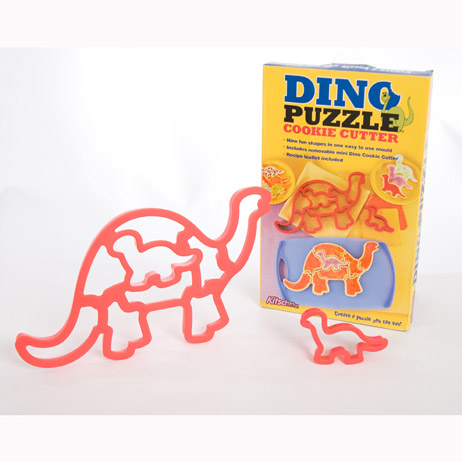
1). The Dinosaur Puzzle Cookie Cutter

A chance to create a dinosaur puzzle that you can eat!  A sturdy plastic cookie cutter set in the shape of a long-necked dinosaur, a sauropod.  Choosing a sauropod design for a biscuit making item was quite easy really, after all these animals had enormous appetites and must have spent a very large portion of their day eating.  It has been calculated for example, that a sauropod such as an adult Diplodocus would need to eat around 300 kilogrammes of food per day (that is the equivalent of over 3,000 lettuces)!

The Dinosaur Puzzle Cookie Cutter

Picture credit: Everything Dinosaur

Made from durable, robust plastic this cookie cutter set consists of several pieces that when fitted together form a long-necked dinosaur.  Young dinosaur fans can make biscuits that form a jigsaw puzzle, the set even comes with a biscuit cutter piece shaped like a baby dinosaur.

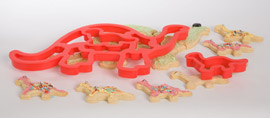
Dinosaur shortbread biscuits.

Picture credit: Everything Dinosaur

We used one of the recipes in the handy recipe leaflet included with this set to make some rather nice shortbread.  Our dinosaur testers then decorated them with coloured icing sugar and hundreds and thousands, we used a black jelly button to make the eye on the adult and edible, silver balls for the eyes of the babies.  They certainly proved very popular with our tasters and for the grown-ups the cookie cutter was easy to ease, the recipes simple to follow and best of all, the sturdy plastic cookie cutter was a doddle to wash and clean afterwards.

Cookie Cutters/Biscuit Cutters

2). Dinosaur Metal Cookie Cutter Set

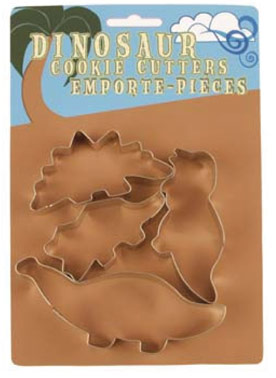
If lots of different prehistoric animal shapes are your requirement then our team members and their testers have this option covered as well with the dinosaur metal cookie cutter set.  This is a set of five, tin plated steel dinosaur shaped biscuit cutters in a handy storage box.

The Dinosaur Metal Cookie Cutter Set

Cookie cutters.

Picture credit: Everything Dinosaur

Each cutter is about 12 cm long and the set includes biscuit cutters shaped like Tyrannosaurus rex, Diplodocus, Triceratops and Stegosaurus plus a flying reptile for good measure.

Once again these items proved very versatile and our helpers made lots and lots of biscuits, like the other sets that we have tried, these items also doubled up as cutters when we were working with modelling clay.  The young children found them easy to use and once again there were no problems washing them up and clearing away.

The biscuits we made were fun to decorate and we had a whole range of multi-coloured dinosaurs at the end, we agreed that they would make super party food for a dinosaur themed party.

3. Tyrannosaurus rex shaped Biscuit Cutter

We couldn’t leave T. rex out of the mix, especially as this fierce dinosaur seems more popular than ever, so our team have tested a T. rex biscuit cutter too. 

The Tyrannosaurus rex Biscuit Cutter

Picture credit: Everything Dinosaur

This particular cutter makes dinosaur shaped biscuits that are about 11 cm tall, it was easy to use and was well suited for the particularly young children to try.  We made gingerbread and shortbread biscuits and they all proved to be very popular.  Once again we got the children to decorate them and they all had lots of fun.

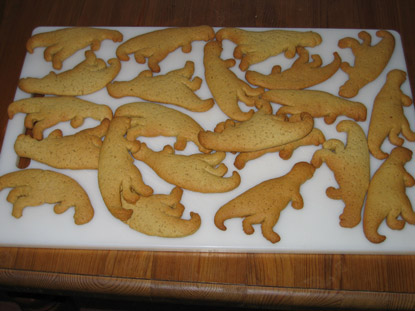
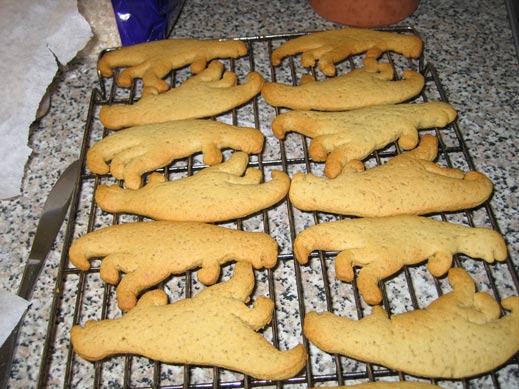
The Tyrannosaurus rex Biscuits just out of the Oven

T. rex biscuits.

Picture credit: Everything Dinosaur

As you can see we made lots of Tyrannosaurus rex shaped biscuits, the ones in the picture are gingerbread dinosaurs.  One of our dinosaur experts commented that with all these dinosaurs together on the tray like that it reminded him of a bone bed, although only a few theropod fossils have ever been found in close proximity to each other, indicating a social group or a family perhaps.

Still our biscuits did not remain in a group for long, once cooled and decorated our hungry helpers soon polished them off.  It makes a change, after all, T. rex would have considered us bite size had we been around 66 million years ago, now with these biscuits we can turn the tables on Tyrannosaurus rex, making him a bite-sized snack for us.

Visit Everything Dinosaur’s shop: Everything Dinosaur.

28 05, 2008

Getting Stalked by a Flock of Quetzalcoatlus

By |2022-11-15T12:59:53+00:00May 28th, 2008|Categories: Dinosaur and Prehistoric Animal News Stories, Main Page, Palaeontological articles|0 Comments

New Research into Late Cretaceous Pterosaurs – Not Flyers but Stalkers

New research published today, led by scientists from the University of Portsmouth has concluded that many of the large pterosaurs of the Late Cretaceous may have had a completely different lifestyle than previously thought.  Large azhdarchid pterosaurs may have been terrestrial hunter.  Animals may have been stalked by a flock of Quetzalcoatlus!  They may have been walkers, not long-distance gliders, patrolling the great fern plains snatching up prey with their long toothless beaks.

Pterosaurs are not Dinosaurs

Pterosaurs are not dinosaurs, but reptiles that shared a common ancestry with the dinosaurs (the Archosauria).  The first fossils of these flying reptiles date back to the middle of the Triassic, around 230 million years ago.  They evolved into a myriad of forms, from long-tailed pterosaurs with relatively short bodies and stubby wings to the huge, short-tailed pterosaurs of the Late Cretaceous with many species having wingspans in excess of 8 metres.

Pterosaur Success

These flying reptiles were very successful during the Mesozoic period, although their numbers and the diversity of the group declined sharply towards the end of the Cretaceous.  Scientists have speculated about why this group of animals declined, perhaps it was because of competition from the rapidly diversifying birds.  After all, feathered flyers would have a number of advantages over gliding or flying reptiles that were powered by flaps of skin, living tissue membranes, reinforced with tough, elastic fibres which were supported by an elongated fourth finger.

To read more about pterosaurs competing with birds: Did the Birds wipe out the Pterosaurs?

The last of the flying reptiles were giants, animals like Quetzalcoatlus and Pteranodon.  Interestingly, Pteranodon fossils (the family is called Pteranodontidae) have been mainly found in marine sediments.  This indicates that these animals lived in coastal habitats and they were probably piscivorous (fish-eaters).  In contrast, fossils of the genus Quetzalcoatlus (family is called the Azhdarchidae), are associated with sediments that were laid down inland; far away from a marine environment.  The fossil evidence revealed so far on the Azhdarchidae pterosaurs does not point to them being typical fish-eaters and there are some subtle differences in their anatomy when compared to other large pterosaurs that may indicate a totally different ecological niche for these bizarre creatures.

Stalked by a Flock of Quetzalcoatlus

This new study carried out by Mark Witton and Dr Darren Naish has reviewed the current data and published fossil material on the azhdarchids.  They have come to the conclusion that these animals may have been the prehistoric equivalent of ground-feeding birds such as the ground hornbills and some types of modern stork.

The study of azhdarchid anatomy, footprints attributed to these pterosaurs and the distribution of their fossils by the research team shows that the coastal glider, fish-eater stereotype of large pterosaurs does not necessarily apply to this particular family of flying reptiles.  Their review provides evidence that some types of azhdarchids were strongly adapted for terrestrial life.  According to the review of the fossil bones of azhdarchids the scientists have concluded that they were better adapted for walking than other types of flying reptile because they had long limbs in proportion to their bodies.  Their light, skulls ending in a sharp, pointed but toothless beak would have been well suited for picking up small animals and other food from the ground.  They would then have manipulated their food in the huge beak before swallowing it whole (probably head first like many species of ground hunting birds do today).

Azhdarchid Pterosaurs

Azhdarchids such as Quetzalcoatlus, a huge pterosaur with a wingspan of approximately 12 metres have big eye sockets in their skulls indicating large eyes, with perhaps telescopic vision, although this can only be speculated at the moment.  The placement of the eyes to the side of the head but looking forward would have enabled these large animals to judge distance accurately.  Some palaeontologists believe that these physical attributes would have helped Quetzalcoatlus scan lakes for fish on the surface or perhaps to search the terrain below them for carcases to scavenge as they flew high above, just like vultures do today.  However, this new paper reports on how effective these adaptations would be for spotting and grabbing prey as these huge reptiles wandered around on all fours.

An Artist’s Impression of Quetzalcoatlus Searching for Food
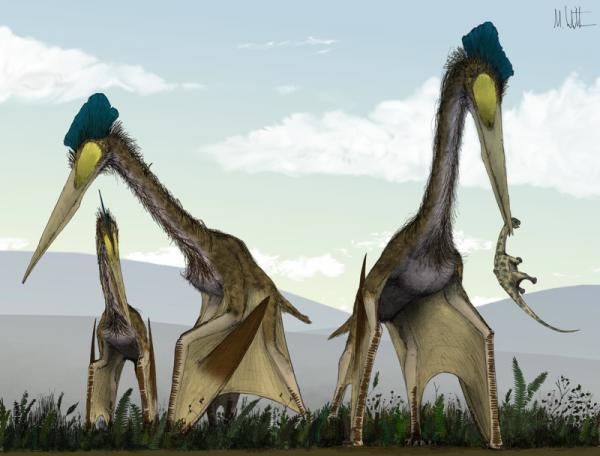
Picture credit: Mark Witton

The illustration above shows a flock of Quetzalcoatlus moving through an extensive fern plain predating on small animals including baby dinosaurs hiding in the undergrowth.  The wings may not have been particularly effective for flying with rapid wing beats, but could have served as giant shields to prevent potential prey escaping.  Moving in a line they could have co-operated together in order to stop any small animals avoiding being eaten.  Such behaviour is seen in the group hunting of some pelican species today.

If the azhdarchids did have this sort of environmental niche, it is possible to imagine them following behind the herds of hadrosaurs and ceratopsians snatching at the small creatures such as lizards, mammals and small dinosaurs disturbed by these huge herbivores as they wandered the plains.

It would be beneficial for both types of animals, the ceratopsians for example could rely on the pterosaurs with their keen eyesight to keep a look out for potential predators such as tyrannosaurs, whilst the azhdarchids could rely on the horned dinosaurs to flush out potential prey and with their horny beaks they could crop small trees and bushes helping to maintain the plains as an ideal hunting habitat for these large flying reptiles.

Loose relationships such as these can be observed on the Savannah of Africa with herds of Zebra tolerating Ostriches, as the bird’s sharp eyes can help to keep watch for predators, permitting the Zebras to remain with their heads down for longer grazing.

The Azhdarchidae

Escaping from any potential threats could pose a problem for such large pterosaurs, it had been thought that these animals needed to live by cliffs so that their take-off could be assisted by gusts of wind rising from natural obstacles.  It has also been suggested that these animals used thermals, hot air rising from the land to help them gain altitude in a manner similar to vultures and birds such as condors.  Being able to take to the air was perhaps their only effective means of defence against predators.  Although the largest species of Azhdarchidae so far described Q. northropi had a wingspan of 11-12 metres it weighed little more than 80-90 kilogrammes, so it would have been no match even for a small or sub-adult member of the tyrannosaur family.  The relatively long hind-limbs could have been quite powerful and capable of providing the impetus and initial lift to help these animals take to the air, but again the fragmentary fossil evidence of the Azhdarchidae prevents much further work on the muscle mass associated with the femur or the bones of the lower leg.

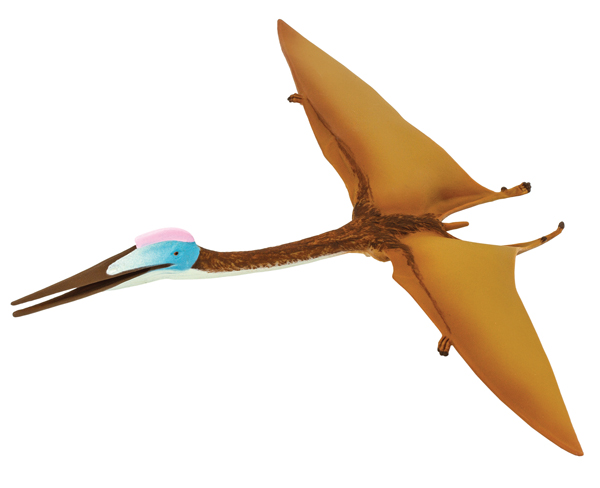
The More Typical Pose of an Azhdarchid Pterosaur
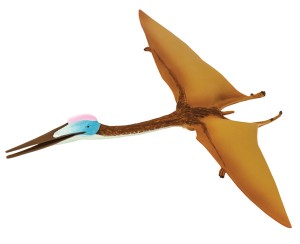
Quetzalcoatlus model.

A model of the giant Pterosaur Quetzalcoatlus.

Picture credit: Everything Dinosaur

The picture above shows a model of a Quetzalcoatlus a typical large, long-necked azhdarchid pterosaur of the Late Cretaceous.

To view a range of prehistoric animal models including pterosaur figures: Dinosaur and Prehistoric Animal Models.

Despite the lack of fossils it is now known that the azhdarchids had a substantial geographic distribution.  Fossils have been found in China, Japan, Jordan, Morocco, Russia, Senegal, Spain, North America and Uzbekistan.  Indeed, this type of pterosaur was named from the Uzbek word for dragon.

Dr Naish said: “Azhdarchids first became reasonably well known in the 1970s but how they lived has been the subject of much debate. Originally described as vulture-like scavengers, they were later suggested to be mud-probers (sticking their long bills into the ground in search of prey), and later still suggested to make a living by flying over the water’s surface, grabbing fish.

Other lifestyles have been suggested too. These lifestyles all seem radically divergent so Mark and I sat down and carefully examined the evidence and we argue that azhdarchids were specialised terrestrial stalkers. All the details of their anatomy, and the environment their fossils are found in, show that they made their living by walking around, reaching down to grab and pick up animals and other prey.”

The two researchers studied fossils in London, Portsmouth and Germany and compared the anatomy of azhdarchids with those of modern animals, that fill the sort of ecological niches previously thought to have been occupied by the azhdarchids in the Campanian and Maastrichtian faunal stages of the Late Cretaceous.  This showed that azhdarchids were strikingly different from mud-probers and animals that grab prey from the water’s surface while in flight.

Dr Naish said: “We also worked out the range of motion possible in the azhdarchid neck: this bizarrely stiff neck has previously been a problem for other ideas about azhdarchid lifestyle, but it fits with our model depicting this group as terrestrial stalkers”.

This particular group of pterosaurs have characteristically long-necks which are relatively stiff and immobile.  Such an anatomical arrangement would fit the hypothesis put forward by Mark Witton and Dr Naish as with a terrestrial, stalking habit all these animals would need to do to feed would be to raise and lower the beak in a vertical line to the ground.  Studies of the bones in neck vertebrae indicate that they could certainly do this.  The necks were also quite strong, able to support the head and a beak up to 1 metre long in the larger species, certainly some of these neck vertebrae were an impressive size, a single neck vertebrae, discovered in Jordan in 1943 and believed to have belonged to an azhdarchid was over 60 cm long.

Strong but Inflexible Necks

The strong, inflexible neck also provides evidence to support another theory about the diet of these animals, that they were scavengers operating like vultures.  The huge wings allowing them to glide effortless across the land, coupled with their excellent eye-sight would have made them superb spotters of carrion.  Once found, the carcase could be ripped open by a few strong blows of that strong, dagger-like beak.  These pterosaurs if they were scavengers living on the remains of dinosaurs would have had to break through many centimetres of tough hide to reach the flesh underneath.  The sharp beaks, powered by strong neck muscles could be capable of doing this. A long neck would enable these creatures to reach deep inside a carcase to feed.

In the scientific paper published today other aspects of azhdarchid anatomy are discussed.  Consideration is given to their relatively small padded feet which the British researchers claim would not have been suited to walking around the muddy shores of lakes, probing for burrowing shellfish and crabs.  This work casts further doubt on the mud-probers hypothesis.

In their study the researchers calculated that over 50% of all the known azhdarchid fossils are from sediments laid down inland, away from marine environments.  Significantly, the few articulated azhdarchid fossils have all been discovered in areas believed to have been a long way from saltwater when the animal perished.  The relative completeness of these finds indicate that the carcase may not have been transported very far before finally coming to rest and starting the preservation process.  This might show that the azhdarchids were very much creatures of the land and not marine environments.

From our own observations of birds such as the Marabou stork (Leptoptilos crumeniferus) on the Masai Mara, it is possible to imagine animals such as the azhdarchids filling this niche in the food chain.  Although it is worth pointing out that in the case of the Marabou stork, it scavenges carcases as well as actively hunting in the grass and reed beds of Africa.  Perhaps the azhdarchids such as Quetzalcoatlus and its close relative Montanazhdarcho were also opportunists grabbing a meal in a variety of ways.  If they were warm-blooded and this is quite likely given the pterosaur ability to fly, then they would have had to consume perhaps as much as ten times the food of a similar sized cold-blooded animal like one of the large crocodiles that also lived at the end of the Mesozoic.

No doubt the debate will continue for sometime to come.  The paucity of the fossil record for large pterosaurs does not help, there have been several attempts to review the Azhdarchidae in order to establish relationships between genera.  What is compounding the problem is that scientists are not really sure of the size of many genera so far described, many from only fragmentary remains.  For example, a single bone from the Dinosaur Provincial Park Formation in Alberta, Canada could be a femur indicating an animal with a wingspan of no more than 3 metres across.  However, if the same bone is described as a wing metacarpal, or an arm bone (ulna or radius) then with a bone diameter in excess of 60 mm this would indicate an immense animal with a wingspan approaching the size of the largest pterosaurs known (wingspan in excess of 12 metres).

Such are the difficulties that surround research into these amazing animals.  Work on the Campanian faunal stage deposits in Alberta indicates the presence of a least three genera of azhdarchid, with wingspans from 2.5 to up to 11 metres across all living in the same area at the same time.  However, the incomplete and scarce remains recovered so far mean that palaeontologists are unable to rule out the possibility that the pterosaur fossils found in this area actually represent just one genus and that the bones represent animals of different ages or perhaps even males and females.  Bennett (1992) has made a convincing case for sexual dimorphism in Pteranodon, with males believed to be up to twice the size of adult females.

The truth is, until many more fossils of azhdarchids are found then the speculation on their diet and lifestyle and even some aspects of their basic anatomy are going to continue.  Ten years ago for instance, Clark et all published a paper on a study of the posture of pterosaurs, this team concluded that the metatarsal-phalangeal joints of the azhdarchids (those bones that connect the ankle to the toes) did not seem well suited to a cursorial lifestyle.

This article has been produced using material from the Public Library of Science (2008, May 28) – Giant Flying Reptiles Preferred To Walk.

The work of Bennett referred to in the text is from a paper published in 1992 in the Journal of Vertebrate Paleontology – Sexual dimorphism of Pteranodon and other Pterosaurs with Comments on Cranial Crests.


Go to Top