All about dinosaurs, fossils and prehistoric animals by Everything Dinosaur team members.
27 05, 2008

Israeli Cave Promises an Abundance of Prehistoric Artifacts

By |2023-02-25T08:19:47+00:00May 27th, 2008|Categories: Dinosaur and Prehistoric Animal News Stories, Geology, Main Page|0 Comments

New Cave Discovered in Israel provides insight into Prehistoric Life

Construction workers digging drainage and sewage pipes in the Jewish National Fund forest have discovered a large cave system containing many prehistoric artifacts.  The workers broke into the cave as they were constructing an underground pathway for a sewage pipe in the western Galilee forest.

Prehistoric Artifacts

Some of the larger chambers contain spectacular stalactites and stalagmites, formed as minerals such as calcite dissolved out of dripping water.  The word stalactite is actually derived from the Greek word “stalaktos” which means dripping.  Stalactites are tapering deposits of calcite that hang down from the roof of caves like icicles.  Stalagmites are formed from dripping water and form rising, tapering mounds that in many cases unit with stalactites to form spectacular columns.

To help remember the difference between these two calcite structures – “stalactites hold on tight to the ceiling, whereas stalagmites might one day join up with them.

Commenting on the potential of the cave system to provide evidence of life in prehistoric times, a spokesperson from the Israel Antiquities Authority stated that already a large amount of prehistoric material had been discovered.

“It seems that during the past 40-50 years no cave has been found with such a wealth of prehistoric finds and certainly not inside such a lovely stalactite cave”, claimed Dr. Ofer Marder, the head of the Prehistory Branch of the Israel Antiquities Authority, who examined the cave.

The cave system opens out into a number of large chambers, the largest measuring 60 x 80 metres, this is approximately four times the width and three times the length of a basketball court.  Soil and other debris has fallen or been washed into the cave from the surface and a large number of flint tools used by early settlers have been found along with the bones of a variety of animals that are no longer indigenous to the area.  Bones of red deer, fallow deer, buffalo and the remains of bears have been found.

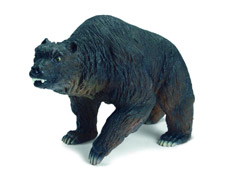
Ursus spelaeus

The remains of the bears are particularly interesting, as the cave deposits have been dated from between 40,000 years to 10,000 years ago.  The bones could have come from Brown bears (Ursus arctus) or possibly the larger Cave bear (Ursus spelaeus).  These large animals, some of which may have weighed up to 1 Tonne and had a height of over 2 metres at the shoulder, evolved around 300,000 years ago and survived to about 40,000 years ago, making any evidence found in the Israeli cave some of the last traces left by these huge omnivores.  Further work is required to confirm the presence of Cave bear remains, these bears were about 35% bigger than Brown bears, had fewer teeth in the jaws, skulls with a distinctive slope and their limbs were proportioned differently.

A Model of Ursus spelaeus (Cave Bear)

Picture credit: Everything Dinosaur

The picture above is a model of a Cave bear from the Schleich Prehistoric Mammal model collection a series of 1:20 scale models of mammals from the Pleistocene epoch.

To view the model range available from: Dinosaur and Prehistoric Animal Models.

Statement Released

In a statement released by the Israel Antiquities Authority they claim that preliminary studies indicate that the remains in the cave date from the Upper Palaeolithic period, otherwise known as the Late Stone Age.  This period dates from 40,000 years ago to approximately 10,000 years ago, the beginning of the Holocene a period in Earth’s history of dramatic climate change, increasing human populations and the start of sedentary agriculture.

The cave has been sealed and its exact location kept secret but further research is planned permitting a more accurate date to be placed on some of the finds and the cave system to be properly explored.

25 05, 2008

Britain’s Most Complete Dinosaur Fossil Discovered to Date.

By |2022-11-15T12:11:20+00:00May 25th, 2008|Categories: Dinosaur and Prehistoric Animal News Stories, Main Page, Palaeontological articles|0 Comments

Britain’s most Complete Dinosaur Found to Date ready to go on Display

The most complete dinosaur fossil ever to be found in the United Kingdom is about to go on display at the Bristol museum.  The fossil is of a Scelidosaurus, an early armoured dinosaur that dates from the Jurassic.

A Magnificent Specimen

This magnificent specimen of this plant-eater, is nearly complete, a rare find indeed when it is considered that in comparison to other ornithopods these animal’s remains are very scarce in the fossil record.  The lack of fossil evidence relating to these creatures could be for a number of reasons, perhaps these herbivores were associated with environments in which the likelihood of fossil preservation would be low, dry, upland areas for example.  The small number of fossils could also be due simply to the fact that compared with other megafauna around at the time, these types of dinosaurs only made up a small proportion of the animal community.  Such relatively rare animals would be statistically less likely to be fossilised.  Certainly, there is speculation as to the habitat of these armoured dinosaurs, with scelidosaurs being associated with marine deposits, the exceptional quality of the specimen going on display has provided scientists with lots of new data to assist in our understanding of these dinosaurs.

To read more about scelidosaurs: Scelidosaurus – a uniquely British dinosaur.

In pictures that have been released, the snout is facing to the left, with the animal’s eye socket in a direct line between the tip of the fingers on the researcher’s right hand.  The teeth can clearly be seen in the photograph, they are leaf shaped and the fossilised wear pattern indicate that Scelidosaurus had a peculiar feeding habit.  The plant food, probably low lying ferns was crushed in the mouth before being swallowed.  Perhaps not the most energy efficient way of eating and not nearly as sophisticated a process such as the feeding of the later ceratopsians, iguanodonts and the hadrosaurs.  This relatively primitive chewing process could perhaps explain why there are so few fossil skeletons of this type of dinosaur about.

An Illustration of Scelidosaurus (S. harrisoni)

Scelidosaurus

An illustration of the Early Jurassic armoured dinosaur Sceliodosaurus.

Picture credit: Everything Dinosaur

Although permineralised, specimens of almost complete skeletons such as this are extremely rare and delicate.  It is interesting to note that the researcher is wearing rubber gloves when handling the fossil.  Our fingers tend to be acidic and this can damage the surface of fossils, after all many of them are preserved in limestone and this is dissolved by acidic substances.  It is best not to handle fossils a great deal, or indeed to pick up a specimen by the fossil element itself, pick it up by the surrounding matrix if there is any present.  Fossils like this Scelidosaurus need to be looked after, they stopped making them around 175 million years ago!

Everything Dinosaur stocks a range of armoured dinosaurs including a replica of Scelidosaurus in the CollectA Deluxe range: CollectA Deluxe Prehistoric World Dinosaur Models.

24 05, 2008

Rapid Climate Change – not for the First Time

By |2022-11-15T12:06:17+00:00May 24th, 2008|Categories: Everything Dinosaur News and Updates, Main Page, Palaeontological articles|0 Comments

Quick reflection on the Holocene

Here in the Holocene, the name given to epoch that represents the last 10,000 years or so our planet is experiencing  a period of relatively cold weather in geological terms.  The planet has steadily been getting cooler since the end of the Mesozoic (65 million years ago).  It is true, if a graph of average global temperatures were drawn, the line representing temperature would not always slope downwards to the present, for example, the world got considerably warmer during the the early Eocene with global temperatures estimated to be 2 degrees Celsius higher than in the Cretaceous.  However, there has been a trend over the last 65 million years or so for the average temperature on the planet to fall.  Despite fears regarding global warming and climate change, the average global temperature is 14 degrees Celsius, compared to nearly 19 degrees 15 million years ago.

Climate Change

Climate change has an enormous impact on life, the difference between the changes we are seeing today and some of the changes in the past is the speed of the change.  If scientific predictions are correct, global temperatures could rise by about as much as 5 degrees over 100 years.  A radical change, one that would have devastating consequences for much of the planet.  The geological time period we are living in today is called the Quaternary, this is divided into two epochs, the Pleistocene which began about 1.8 million years ago and the Holocene (recent time, the last 10,000 years).  The Quaternary was divided into two parts, with a boundary at 10,000 years ago because it was then that a major thaw in the world’s ice sheets occurred, taking no more than 15-50 years.  This dramatic warming led to a number of extinctions, particularly amongst large mammals and other mega fauna.  Since this sudden warming up, the Earth’s climate has actually been more stable than during any other 10,000 year interval in at least the last 200,000 years.

Ancient Landscapes Under Threat Due to Climate Change

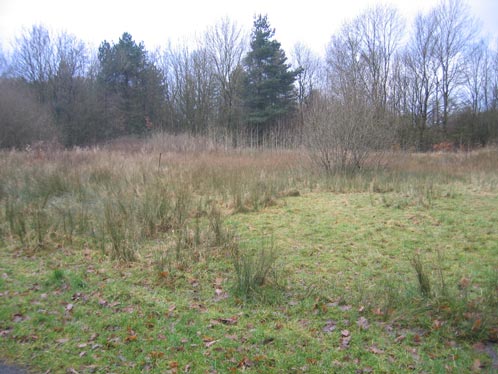
Ancient landscapes - global climate change

A wet and boggy landscape, typical of Cheshire after the last Ice Age but the UK climate is changing.

Picture credit: Everything Dinosaur

This relatively stable period of world weather, has enabled the human species to flourish, soon our population will exceed 7 billion.  Our numbers and the subsequent demand for finite resources plus the affect our species is having on the environment could spell trouble ahead, not just for the so called vulnerable species such as some of the large mammals we share the Earth with, but remember we are a large mammal too.

23 05, 2008

Rare Dinosaur Trace Fossils Discovered in Yemen

By |2024-04-12T18:47:53+01:00May 23rd, 2008|Categories: Dinosaur and Prehistoric Animal News Stories, Main Page|0 Comments

Dinosaur Footprints Discovered on the Arabian Peninsula

It may be surprising to some, but there are still significantly large areas of the world yet to be fully explored by palaeontologists and geologists, dinosaur trace fossils can still be discovered.  The geology of an area may have been mapped, indeed elements of the stratigraphic column – the sequences of rock layers and their relation to each other in terms of their time of deposition, may be known, but no detailed studies of the local fossils may have been made.

Dinosaur Trace Fossils

Over the last ten years or so, scientists have begun to explore relatively unknown areas of the world, in terms of their fossil evidence.  Digs have taken place up mountain sides in the Alps, along desiccated valley floors in the middle of the Antarctic and on the hot, dry plains of central Australia.  A scientific paper published this week provides details on a set of dinosaur tracks discovered in Yemen, a small country on the tip of the Arabian peninsula, these are the first dinosaur tracks to be found in this region.

Dinosaur Tracks in Yemen

The tracks will help scientists understand more about the relationship between dinosaurs discovered in Africa and those from Europe as well as providing an insight into the herding behaviour of these prehistoric beasts.

There are two main types of fossil, firstly there are body fossils, these are the fossilised remains of parts of the “body” of animals and plants, such as bones, leaves and shells, or their impression in the surrounding sediment.  It does not matter whether or not the parts of the body have been altered in chemical composition or physical structure.  The second type of fossil are trace fossils.  These preserve evidence of the “activity” of animals, trace fossils can be trackways (as found in Yemen), trails, burrows or borings.  Trace fossils are often the only evidence left for scientists to study of soft-bodied animals such as worms.

The dinosaur footprints from Yemen were made by two different types of dinosaur as they crossed a muddy plain approximately 150 million years ago in the Late Jurassic (Kimmeridgian/Tithonian faunal stage).  During this period in Earth’s history,  much of Europe lay under warm, shallow tropical seas, whilst the land that was to become the Arabian peninsula was still firmly attached to eastern Africa in a super continental landmass.

Dinosaur Trackways

The first set of footprints, were left by a small group of sauropods, a total of 11 animals, which all seemed to be heading in the same direction.  The footprints are of different sizes and the spaces between the individual prints made by each animal are also different.  This indicates that the animals were of different sizes, perhaps this was a family group or herd.

The footprints left by the herding herbivores varied in size, implying a roving group of adults and children. “Smaller individuals had shorter stride lengths, and took more steps to keep up with the larger individuals,” commented Nancy Stevens, an assistant professor of palaeontology at Ohio University in Athens, and one of the co-authors of the scientific paper published describing the tracks.

Sauropods were large, long-necked animals such as diplodocids, but it is not possible to identify the particular genus from these trace fossils.

A Single Dinosaur

The second set of trace fossils consist of a single trackway made by a lone dinosaur, which was walking in the opposite direction.  This set of prints were made by an ornithopod, a bird-hipped dinosaur (ornithischian).  Unlike the sauropods, this animal was bipedal, walking upright on its hind legs.  Once again, it is impossible to identify a particular genus from this set of prints, but they might have been made by an animal such as a Camptosaurus (member of the Camptosauria clade).

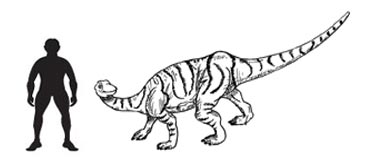
An Illustration of Camptosaurus

Camptosaurus dinosaur bones studied.

“Bent Lizard” to scale.  Dinosaur footprints from a Camptosaurus-like dinosaur have been found in Yemen.

Picture credit: Everything Dinosaur

The picture (above) shows an illustration of the CollectA Camptosaurus model in the: CollectA Age of Dinosaurs Popular Range.

The muddy plain where the tracks were made was adjacent to a watercourse that was drying up, such areas are used by animals today as natural corridors, it seems that dinosaurs used these areas as highways to, they would have been devoid of trees and open, making them difficult places for predators to stage an ambush.  The sauropods and ornithopods were plant-eaters, so these animals could have been moving to and from areas where food could be found.  Certainly, in the case of the group of sauropods they would quickly reduce a grove of cycads or bennettites to nothing more than a few crushed fronds and damage trunks, as these large animals fed.  Large herbivorous dinosaurs such as the sauropods would have had a dramatic effect on the local flora, helping to shape the landscape, just as herds of elephants on the African plains do today.

The individual ornithopod tracks, may indicate that this animal was a male, perhaps choosing to live away from the protection of a herd, the tracks are certainly quite large, indicating an adult animal possibly, although this is all speculation and cannot be proved for certain.

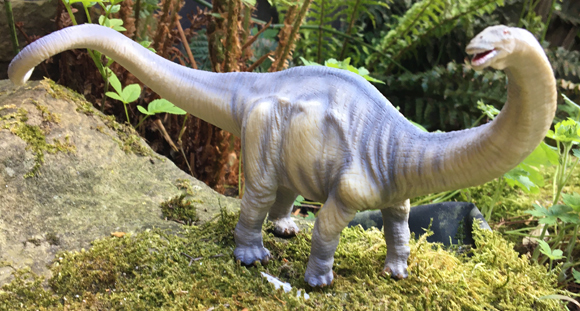
A Model of a Typical Brontosaurus Dinosaur Model

A Mojo Fun Brontosaurus dinosaur model (new for 2020)

Mojo Fun Brontosaurus figure.  A typical model of a Jurassic sauropod.

Picture credit: Everything Dinosaur

Photographs show three footprints made by this bipedal dinosaur, the tracks show the animal moving away from the point from which the picture was taken, the three toes on each foot can clearly be seen.

Analysing the Dinosaur Trackways

It is not possible to state whether the two types of dinosaur passed each other, one type of dinosaur may have passed this way a few hours before or after the other animals had wandered through in the opposite direction.  Had these two types of dinosaur met, they would most probably have ignored each other, neither would have been a threat and these types of animal, speculated to be relatively common in the area, would have been used to seeing different dinosaur species in the neighbourhood.

There are many exposed rock outcrops of Jurassic age in the area.  The authors of this new paper are confident that other fossils of Mesozoic creatures will be found, perhaps even the fossils of meat-eating dinosaurs, as it would be likely that with prey animals around the carnivores such as allosaurs would also have been in the area.

22 05, 2008

Dinosaurs for the Beach – Great Gift Ideas

By |2024-04-12T18:48:27+01:00May 22nd, 2008|Categories: Everything Dinosaur News and Updates, Everything Dinosaur Products, Main Page|0 Comments

Dinosaurs for the Beach

With the Summer holidays approaching, here is a seasonal offer from the team at Everything Dinosaur that should help keep young dinosaur fans happy on their holidays.

Dinosaurs for the Beach

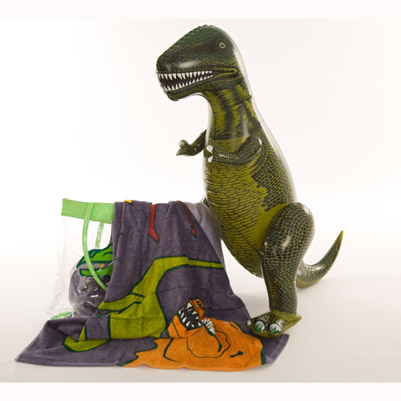
To mark the start of the Summer season, the Everything Dinosaur team have produced a dinosaur beach set consisting of a big beach towel, handy, dinosaur themed beach bag and a giant inflatable dinosaur.

The Dinosaur Beach Set from Everything Dinosaur

Picture credit: Everything Dinosaur

To view the Everything Dinosaur website: Everything Dinosaur’s Website.

The large beach towel is made from 100% cotton and measures 75 cm by 150 cm, big enough for any little monster!  The handy, clear plastic dinosaur themed beach bag is big enough to carry just about everything that a young palaeontologist might need for a trip to the beach and for splashing about in the pool or in the sea the giant inflatable T. rex, at over 1 metre long is a very appropriate accompaniment.

20 05, 2008

Most complete Dinosaur Fossil ever found in the UK ready to make its Debut

By |2023-02-25T08:18:44+00:00May 20th, 2008|Categories: Dinosaur and Prehistoric Animal News Stories, Main Page, Palaeontological articles|0 Comments

Scelidosaurus – a uniquely British Dinosaur ready to go on Display

The most complete dinosaur skeleton ever found in the UK is about to go on display at Bristol museum.  The dinosaur, identified as a Scelidosaurus was not found in the dinosaur rich sediments of the Isle of Wight, nor was it found in Oxfordshire, another likely place to find dinosaur fossils.  Instead, this dinosaur was found on a beach in Dorset, an area much more associated with fossils of marine reptiles such as plesiosaurs and ichthyosaurs.

Scelidosaurus Fossils

The first pieces were found by professional fossil collector David Sole in 2000.  His keen eye spotted something strange on the beach and decided to investigate further.

“There was a lump of rock about two foot by one foot lodged in fine-shingle sand, and I sensed there was something unusual about it,” he remembers.

Closer examination revealed that the chunk of rock was limestone and that it was packed with fossil bone.  Over the next few months and years, further pieces were found in the area, all coming from what had been one individual dinosaur.

Fossilised Bone

The limestone surrounding the fossilised bone was carefully removed using a dilute acid preparation (acetic acid) which slowly dissolved away the surrounding rock to reveal the fossils within.   The dinosaur was identified as a Scelidosaurus, an early bird-hipped (ornithischian) dinosaur, which lived in the Early Jurassic approximately 195 million years ago.

This acid soaking technique was pioneered by British scientists working at the Natural History museum – London, in the 1960s and first used to help remove the surrounding matrix from another fossil of Scelidosaurus found entombed in limestone (S. harrisoni).  It was this fossil, another near complete specimen found in the late 1850’s that was described and named by Sir Richard Owen in 1863.  At first the fossil was identified as a kind of crocodile, but further analysis proved that this was indeed a dinosaur but one that had been found in marine sediments.

“It has heavy spines all over its body, with two goat-like horns on the back of the skull forming a kind of ruff with its neck armour. This leads to the inference that this specimen was likely to have been a mature male,” explains Dr Tim Ewin of Bristol City Museum and Art Gallery, where this early plant-eating dinosaur will go on display to the public in June.

Up until this particular discovery only a handful of scelidosaur remains had been discovered, all from an outcrop of rock in the Lyme Regis/Charmouth area of Dorset, so all the remains of this armoured dinosaur seem to have been found in rocks that were laid down at the bottom of a shallow sea.  It is rather odd to find such an animal amongst strata more commonly associated with ammonites and belemnites, especially as scientists have never found any evidence that dinosaurs took to a marine existence.  How did the fossils of these dinosaurs end up in these sediments?

The answer may lie in the ancient Early Jurassic landscape that made up what was to become the British Isles.  During this period, the land in the area that was eventually to become the location of the southern part of the UK, consisted of a series of small, low-lying, tropical islands that were surrounded by a warm, shallow sea.  The area resembled the Caribbean of today.  Scelidosaurus could have been endemic to just a few islands, perhaps with each island having its own sub-species (this may help explain some of the different features that have been seen in the different specimens found).

Alternatively, this fossils found to date could be the remains of a small herd, with animals at various ages of maturity within it, this would also explain some of the subtle differences between the fossilised skeletons.

A model of a Scelidosaurus
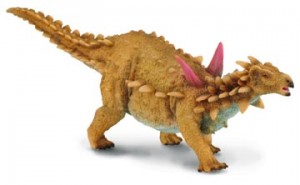
CollectA Scelidosaurus model.

A model of a Scelidosaurus.  The CollectA Deluxe Scelidosaurus replica.

Picture credit: Everything Dinosaur

An Armoured Dinosaur

Scelidosaurus was an early armoured dinosaur, with an estimated maximum length of around 4 metres.  It was quite a heavy-set dinosaur with bony plates and bumps providing armour-like protection for the back and flanks.  Another specimen of Scelidosaurus has traces of a skin impression, this reveals that the skin had a bumpy texture, being made up of a mosaic of small, rounded scales.

An Illustration of Scelidosaurus harrisoni
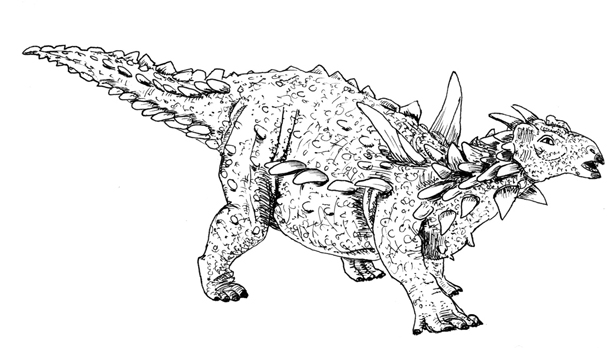
Scelidosaurus

An illustration of the Early Jurassic armoured dinosaur Scelidosaurus.

Picture credit: Everything Dinosaur

The picture of Scelidosaurus was taken from the Everything Dinosaur party model collection of dinosaurs.  Unfortunately, there are very few models of this dinosaur about, perhaps the most famous model was the black Scelidosaurus that was produced by the Invicta company in the 1960s.  This series which was for such a long time the mainstay of the Natural History museum’s model collection has been out of production for some years.  The little Scelidosaurus model (priced at 27 pence when one of our team members bought it in the mid 1970s), can still be seen in one of the Natural History museum’s dinosaur displays.  The Invicta models are highly prized by model collectors, we think the Scelidosaurus model would be worth a lot more than 27p today.

Scelidosaurus

To view range of dinosaur models available at Everything Dinosaur: Dinosaur Toys and Models.

Unusually, the specimen first found by David Sole, is an almost-complete skeleton.  The fossil bones are articulated, meaning that each bone was linked and in its correct place. Equally striking were the long, thin tendons that supported the animal’s huge stomach, which still stretched from the backbone – and the fact that the creature’s gullet contained a discoloured area, with the remains of its last meal.

Commenting on this particular find, a researcher stated: “It could be that Scelidosaurus only lived on one island, a few miles away from Lyme Regis, which would explain why the species has not been reported anywhere else. We began to wonder if we were looking at a family group that was washed off the island by a sudden tsunami, similar to what we saw on Boxing Day 2004.”

Found in Marine Sediments

Alternatively, the reason why scelidosaurs have been found in marine sediments, with many of the fossils in an upside-down orientation could be because these animals were washed out to sea and then slowly sank to the bottom.  If scelidosaurs lived well inland, perhaps in upland areas that were drained by rivers, flash floods could occur drowning individual animals and transporting them down the valleys out to sea.  During decay, the corpse would have become bloated and filled with gas, buoying up the body for some time.  The animal would have floated on its back, with the heavy armour acting like a keel on a ship.  Eventually, the body cavity would have ruptured , the gases escaped and the corpse would sink, settling on the seabed with the belly upwards.

However, these animals came to be found in Dorset remains a bit of a mystery.  A dark patch where the gullet would have been perhaps indicates that this particular animal vomited, this is often seen in animals that are drowning, so maybe this animal was swept out to sea from an island that was hit by a tidal wave.  Interestingly, crocodile teeth have been found in the mouth of this fossil, not evidence of predation but more likely regurgitated up items from the gizzard as this plant-eater may have swallowed hard objects to help it grind up and digest tough plant material.  Certainly, a low-lying island would have few stones suitable for swallowing (assuming a sandy beach), crocodiles shed their teeth regularly and these would have helped with the digestion process once swallowed and provide plenty of calcium to help form the bony armour.

It seems that the fossils of Scelidosaurus can be interpreted in many different ways, perhaps they were upland animals, washed out to sea in a flash flood, or maybe they lived on small islands that were swamped by a tsunami, evidence can be put forward to support each theory.

Ironically, had it not been for the storms that occasionally batter the south coast of England these fossils would never have been eroded out of the rocks allowing them to be found and studied in the first place.

Scelidosaurus Dinosaur Model

The dinosaur model shown in this article is from the CollectA Deluxe Age of Dinosaurs model range, to view this range of scale model prehistoric animals: CollectA Deluxe Prehistoric Life Models.


19 05, 2008

New Glow in the Dark Dinosaur Bedroom Stickers

By |2022-11-15T10:13:28+00:00May 19th, 2008|Categories: Everything Dinosaur News and Updates, Everything Dinosaur Products, Main Page|3 Comments

Glow in the Dark Dinosaur Stickers

Everything Dinosaur team members receive a lot of enquiries about how to theme up a child’s bedroom with dinosaur and other prehistoric items.  We supply lots of information, ideas and drawing materials to assist with this process, but our buyer has really come up trumps with new glow in the dark dinosaur stickers.

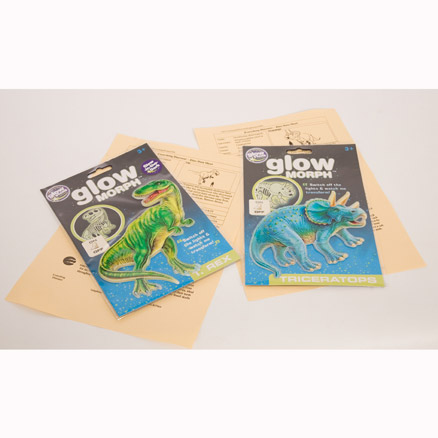
The New Dinosaur Glow in the Dark Stickers

Picture credit: Everything Dinosaur

Dinosaur Stickers

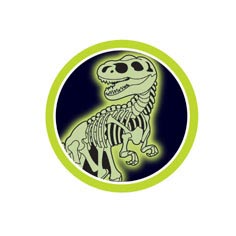
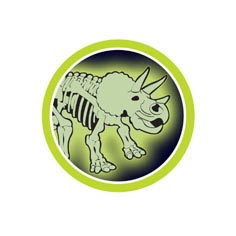
The sticker set consists of two glow in the dark stickers.  There is a fearsome Tyrannosaurus rex and the famous three-horned dinosaur Triceratops.  By day the stickers show pictures of these Late Cretaceous giants, but switch off the lights and they magically transform into glow in the dark fossil skeletons of these amazing creatures.

Each sticker comes with an adhesive tag that lets you attach them to the bedroom wall, they charge up during the daytime and at night they transform to glow in the dark skeletons.

The Tyrannosaurus rex Glow in the Dark Sticker

Glow in the Dark T. rex Wall Sticker.

Picture credit: Everything Dinosaur

Proved Popular on Test

These items have proved very popular on test, they are suitable for children aged 3+ and they have received some of the highest ratings of all the new products put into our shop recently.

The Triceratops Glow in the Dark Sticker

Glow in the Dark Triceratops.

Picture credit: Everything Dinosaur

Dinosaur Toys and Gifts

Our dedicated team will continue to search out fascinating little gift ideas such as these for our customers.  After all, they help create a little bit of a dinosaur land in a child’s bedroom.  Each sticker comes with its own prehistoric animal fact sheet written by our dinosaur experts.

To view the range of dinosaur toys and gift ideas available: Dinosaur Toys and Gifts.

Many children are fascinated with dinosaurs, learning all about Tyrannosaurus rex and Triceratops fuels imaginations that can lead to a lifetime appreciation for science and scientific enquiry.

To view the range of dinosaur and prehistoric animal themed products available from Everything Dinosaur, simply visit our website: Visit Everything Dinosaur.

18 05, 2008

The Remarkable Feathered Velociraptor from Bullyland

By |2024-04-12T19:18:02+01:00May 18th, 2008|Categories: Dinosaur Fans, Everything Dinosaur News and Updates, Main Page|3 Comments

New Feathered Velociraptor model from Bullyland of Germany

Today, we sing the praises of the feathered Velociraptor dinosaur model from Bullyland.

It has been widely accepted for almost 40 years that birds are descended from a group of dinosaurs – the theropods.  Although similarities between the skeletons of modern birds and the fossils of certain small, bipedal dinosaurs had been pointed out as long ago as the 19th century with scientists such as Thomas Huxley commenting on their similar anatomies, it was the ground breaking work of the American palaeontologist John Ostrom on the dinosaur that was to become known as Deinonychus that paved the way.

Agile, Speedy Hunters

John Ostrom’s work was published in 1969 and he depicted Deinonychus, a man-sized dromaeosaur from North America as an active, agile, speedy hunter.  Since then the scientific view of dinosaurs has been dramatically changed.  Gone are the perceptions of lumbering giants to stupid to survive, instead we now see dinosaurs as a highly successful and adaptable group with a wide range of adaptations to help them survive in a wide variety of environments.

Thanks to the amazing fossils that have been excavated from the Liaoning Province in the Sihetun region of north-eastern China scientists have an opportunity to study a whole array of small, feathered theropods.  Over the last twenty years or so, an amazing number of fossils have been discovered in this area.  It seems that around 125 million years ago, in the Early Cretaceous this part of China was covered in lush forests and large lakes in a volcanically active area.  Occasional eruptions covered the area in fine volcanic ash and dust, rapidly entombing many of the inhabitants of the area.

Feathered Dinosaurs

Many other creatures of the forest were suffocated by gas escaping from the volcanic fissures.  The fine volcanic dust has helped preserve some remarkable details of those animals and plants unfortunate to succumb to the volcanic activity.  The dust and ash sealed out oxygen preventing decay and the fine grained structures of these materials has permitted the preservation of details of hair and feathers.

Hence the preservation of a number of feathered dinosaurs, the first of which Sinosauropteryx was discovered in 1995.  Here was fossil evidence to back up what many scientists had speculated about for some time – that many small dinosaurs were covered in feathers.  It has been suggested that simply proto-feathers evolved to help keep these small active animals warm, a form of insulation.

Later plumes and crests may have evolved for display purposes.  Many of these feathered dinosaurs were classed as members of the Maniraptora, a group that also includes the dromaeosaurs like Deinonychus and Velociraptor.  If this type of dinosaur had feathers, why not the likes of Deinonychus and Velociraptor?

Although, there is very little fossil evidence to back up this theory, it is now widely believed that little dromaeosaurs like Velociraptor were feathered too.  The covering of feathers would help to keep these little animals insulated, a necessity given their active, warm-blooded lifestyles.

Feathered Velociraptor Dinosaur Model

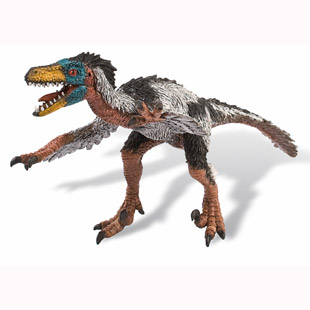
Building on the scientific speculation, Bullyland of Germany have introduced a feathered Velociraptor model, depicting how this 1 metre high dinosaur might have looked.  This model is a new addition to the Bullyland prehistoric animal  models range.

To view the Bullyland range of dinosaur and prehistoric animal figures available from Everything Dinosaur: Bullyland Prehistoric Animal Models and Figures.

The New Velociraptor Model

Picture credit: Bullyland

To view this model of Velociraptor and other prehistoric animal figures: Dinosaur and Prehistoric Animal Models.

This model is depicted in 1:20 scale and shows the latest scientific interpretation of this fierce little dinosaur, whose fossils have been found in Mongolia, China and Russia.  It is suspected that like most other dinosaurs, Velociraptors had good colour vision, so the blue face band and the black feathered head crest have been added in deference to the theory that feathers and colours may have been used for display, especially as these animals are thought to have lived in packs.

15 05, 2008

More Dinosaur Trackways Reported from Korea

By |2022-11-15T09:23:28+00:00May 15th, 2008|Categories: Dinosaur and Prehistoric Animal News Stories, Main Page|0 Comments

Baby Sauropod Trackways Reported from South Korea

The National Heritage Centre under the National Research Institute of Cultural Heritage of the South Korean Government announced this week that more evidence of the country’s dinosaur past had been discovered.  South Korea is fast building a reputation for exceptional Mesozoic body and trace fossils, a number of important finds have already been studied but this new discovery may shed light on the ontogeny of dinosaurs (the development of individuals – how dinosaurs grew).

A number of discoveries have been made in South Korea recently, to read more trace fossils found in this country: Two-toed footprints found in Korea, evidence of Dromaeosaurs.

Dinosaur Trackways

A series of fossilised trackways have been found in Euiseong County, North Gyeongsang Province in the south-east of the country.  These well preserved trace fossils seem to show the footprints of two small sauropod dinosaurs, possibly juveniles.  The fossils have been dated to the Cretaceous, around 110 million years ago (Albian faunal stage).

In total, 61 sauropod footprints have been found, stretching across 4.25 metres, making this the longest fossil trackway of baby dinosaurs found to date.  The footprints were made as these small dinosaurs, wandered across muddy land, the area is criss-crossed with other trackways made by dinosaurs, some of which can be seen in the diagram.

The direction of travel is difficult to make out in the picture, although the sauropod trackway on the left, indicates that this animal was travelling from the top of the picture to the bottom, the other trackway is too unclear in this picture to make out the direction of travel.  The lack of any object such as ruler or pencil to provide scale, makes it difficult to interpret the evidence.  It is almost impossible to relate any trace fossils such as footprints to a particular genus, although the imprints are typical of titanosaurids (a branch of the sauropod family that was relatively common in the Southern Hemisphere during the Cretaceous).

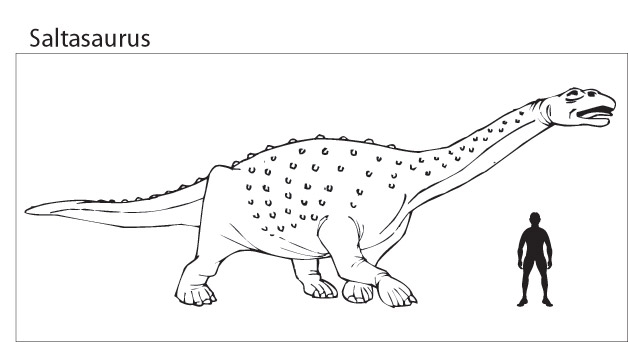
It is not known what sort of titanosaur made these trackways, or indeed if it was a titanosaur, as the morphology of the animal may change as they grow bigger.  titanosaurs were long-necked, heavy set, herbivorous dinosaurs.  A typical titanosaur was Saltasaurus (a genus of titanosaur known from South America).

Saltasaurus – a Typical Titanosaur

Saltasaurus – a titanosaur.

Picture credit: Everything Dinosaur

To view a range of long-necked dinosaur models: Dinosaur and Prehistoric Animal Models.

Little is known about the ontogeny of dinosaurs, how animals such as titanosaurs could hatch from an egg no bigger than a football and grow into huge beasts over 20 metres long and weighing tens of tonnes.  Certainly, the titanosaurs represent some of the largest land animals ever to have lived and giants like Paralititan (Egypt), Argentinosaurus and Antarctosaurus (South America) could perhaps exceed 30 metres in length and weigh upwards of 100 tonnes.

Interpreting these fossil trackways are complicated due to the lack of other fossil evidence related to baby dinosaurs.  Adult titanosaur footprints are easily distinguished from other sauropod footprints such as diplodocids and brachiosaurids by their relatively wider gait, but very little is known about how dinosaurs grew and matured.  Perhaps, if these tracks were made at the same time, this might indicate that juveniles stayed together in a creche for protection, although any such deductions are highly speculative given the evidence from the fossil record discovered to date.

The Government of South Korea has applied to UNESCO for part of the country’s coastline where Cretaceous sediments are exposed to be given World Heritage status.  This would give this area the same preservation status as other natural wonders such as the Great Barrier Reef off Australia.

To read more: Korea makes bid for World Heritage status for Cretaceous coastline.

14 05, 2008

The Proportion of Plant-Eating Dinosaurs to Meat-Eating Dinosaurs

By |2022-11-15T09:08:52+00:00May 14th, 2008|Categories: Dinosaur and Prehistoric Animal News Stories, Dinosaur Fans, Main Page|0 Comments

The Proportion of Herbivorous Dinosaurs Compared to Carnivorous Dinosaurs

Palaeontologists can determine what a long, extinct dinosaur ate if cranial material such as jaw bones and teeth are found in association with other skeletal material.  Of the twelve hundred or so known species described to date, more plant-eating dinosaurs have been identified than meat-eating ones.  It has been suggested that basal members of the Dinosauria were all bipedal, cursorial carnivores and plant-eating was a later adaptation as this group of reptiles diversified.  If this is the case, then it suggests that the saurischian dinosaurs came first with the first ornithischian members of the Dinosauria evolving later.

Plant-eating Dinosaurs

Of all the dinosaur discoveries made to date, it has been estimated that around 65 percent of all the specimens represent plant-eating dinosaurs.  Some scientists have speculated that if they were able to describe every species of dinosaur that had ever lived, the ratio of plant-eating dinosaurs to meat-eating dinosaurs would actually be higher.  A ratio in excess of 70:30 in favour of herbivorous (or semi-herbivorous) has been suggested.

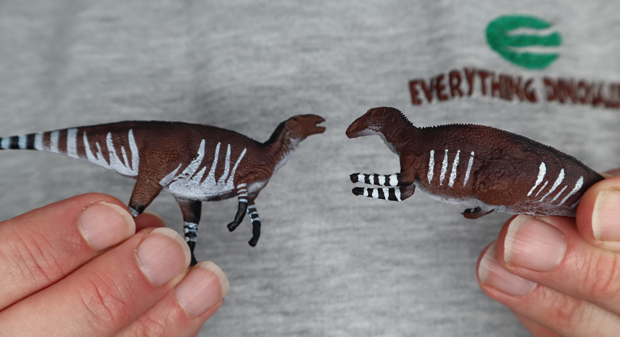
Typical Plant-Eating Dinosaurs (Ornithischia)

The two Tethyshadros models by Wild Past

The two hand-painted Tethyshadros figures (Wild Past).  Examples of plant-eating ornithischian dinosaurs (the hadrosauroid Tethyshadros).

Picture credit: Everything Dinosaur

Everything Dinosaur stocks a wide range of model depicting herbivorous dinosaurs. The company has examples of horned dinosaurs, hadrosaurs, armoured dinosaurs (Thyreophora) and sauropods.

To view the range of dinosaur models available from the award-winning Everything Dinosaur: Dinosaur Models Including Plant-Eating Dinosaur Models.

Go to Top