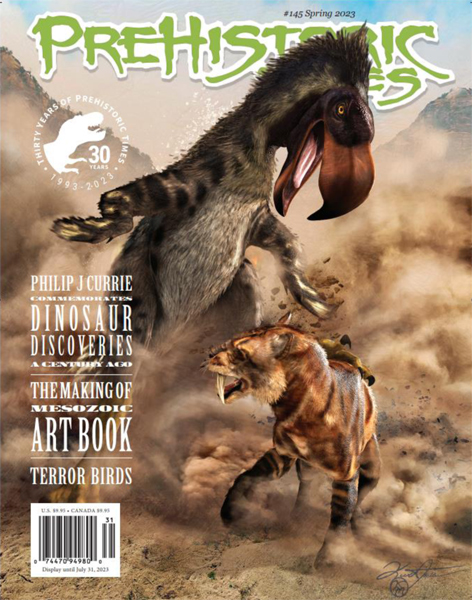
The editor of “Prehistoric Times” magazine sent team members at Everything Dinosaur a preview of the front cover of the next edition of the quarterly magazine. The dramatic front cover artwork, which features a South American “Terror Bird” attacking a sabre-toothed cat, was created by southern California artist Kurt Miller.
The front cover of Prehistoric Times magazine issue 145 (Spring 2023). Picture credit: Mike Fredericks.
Picture credit: Mike Fredericks
“Prehistoric Times”
The spring issue features artwork and information on two prehistoric animals, the dinosaur Hypsilophodon and the giant Kelenken (K. guillermoi) a “Terror Bird”, that we suspect was the inspiration behind the stunning front cover artwork.
Kelenken is known from the Middle Miocene of Argentina. Standing more than 3 metres tall, it is the largest member of the Phorusrhacidae to have been described to date. Body mass estimates vary, but some palaeontologists have suggested that this giant flightless bird weighed around 200 kilograms.
Spring 2023 Edition
The next edition of “Prehistoric Times” is due out in a few weeks. The magazine will also feature an article from the distinguished Canadian palaeontologist Phil Currie. Professor Currie will examine the key dinosaur discoveries that took place more than a century ago.
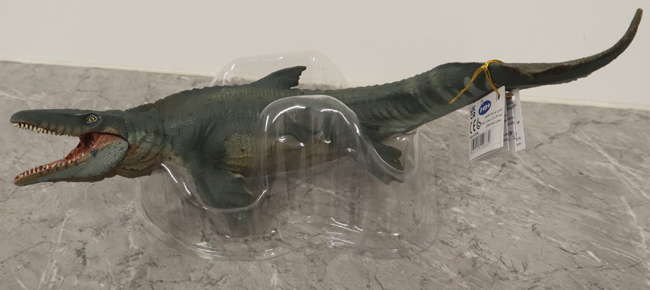
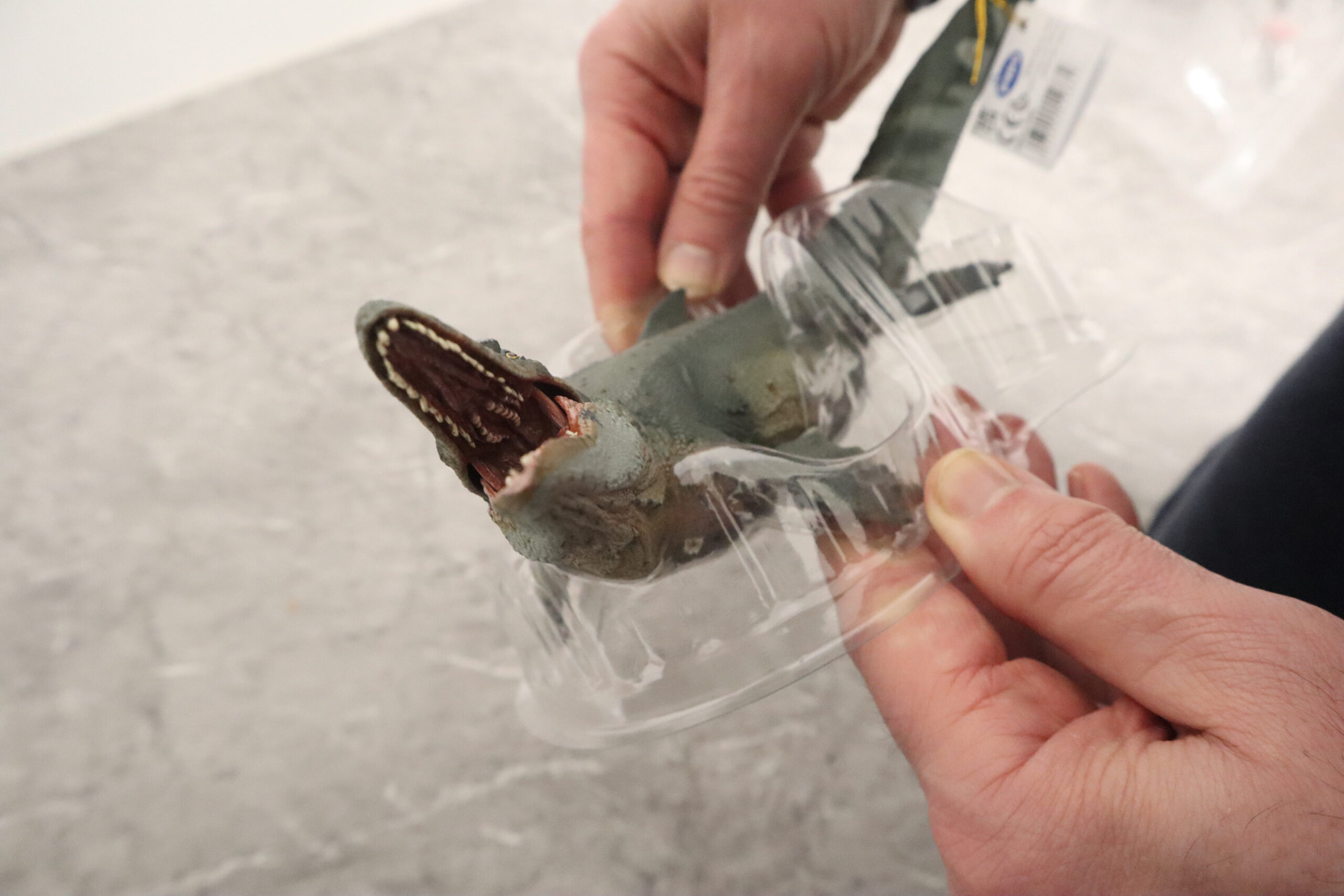
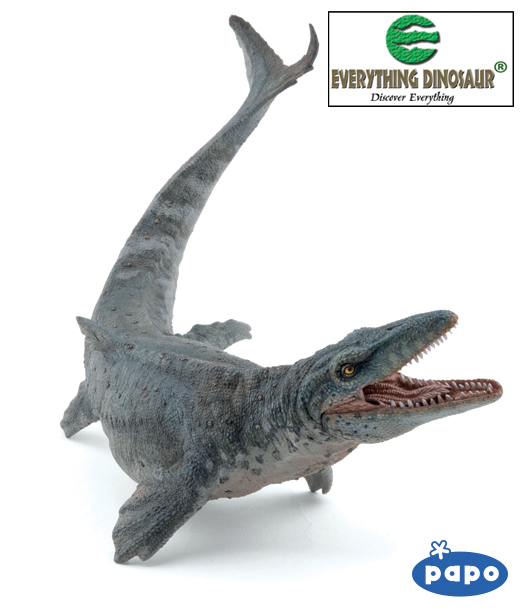
The new for 2023 Papo Mosasaurus model is in stock at Everything Dinosaur. This marine reptile figure is the first new Papo prehistoric animal model to be introduced this year (2023). The model has an articulated lower jaw. It displays some amazing details such as pterygoid teeth located in the roof of the cavernous mouth.
The new for 2023 Papo Mosasaurus model is in stock at Everything Dinosaur. The Papo Mosasaurus figure has an articulated jaw. Picture credit: Everything Dinosaur.
Picture credit: Everything Dinosaur
An Articulated Lower Jaw and Pterygoid Teeth
The Papo Mosasaurus marine reptile model measures around 25.5 cm (10 inches) in length and it has an articulated lower jaw. The impressively painted mouth reveals two rows of pterygoid teeth located towards the back of the mouth. These teeth, known in living members of the Squamata such as snakes, helped to grip prey and enabled these large predators to swallow their victims whole.
The Papo Mosasaurus figure has pterygoid teeth located in the roof of the mouth. Picture credit: Everything Dinosaur.
Picture credit: Everything Dinosaur
Papo Mosasaurus Model
This new marine reptile figure has been given an asymmetrical tail fin, referred to as a hypocercal tail. One lobe, the lower lobe of the tail, is much larger than the upper lobe. The model has also been given powerful front flippers and a dorsal fin.
There are examples of soft tissue preservation in mosasaur specimens, most notably in a specimen reported in the journal “Nature Communications” by Lindgren et al (2013). A mosasaur fossil specimen from the Upper Cretaceous sediments of central Jordan provided evidence of the shape of the tail and the flippers as soft tissue impressions were preserved.
Team members at Everything Dinosaur are not aware of any direct fossil evidence to indicate that these reptiles had dorsal fins.
The Papo Mosasaurus was due to come out at the end of 2022, it was expected quarter 1 of 2023 and it is now in stock at Everything Dinosaur.
An Intriguing Marine Reptile Figure
A spokesperson from Everything Dinosaur commented:
“The new Papo Mosasaurus is an intriguing marine reptile figure. A second marine reptile model from Papo is due out later this year. It is a Kronosaurus and we look forward to comparing the two models.”
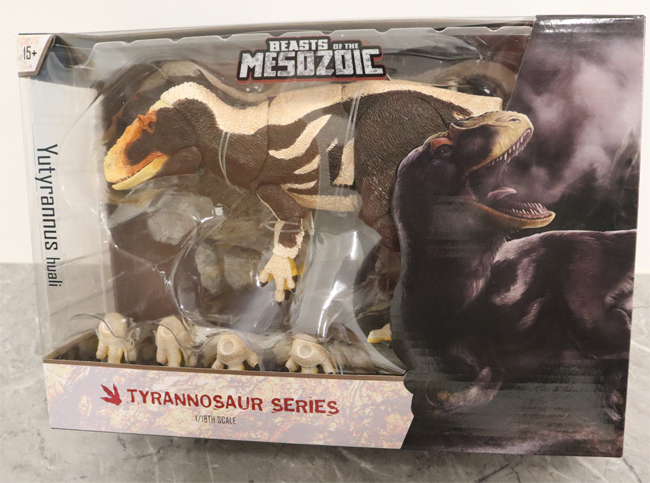
Our thanks to William who sent into Everything Dinosaur his comprehensive review of the Beasts of the Mesozoic Yutyrannus huali model.
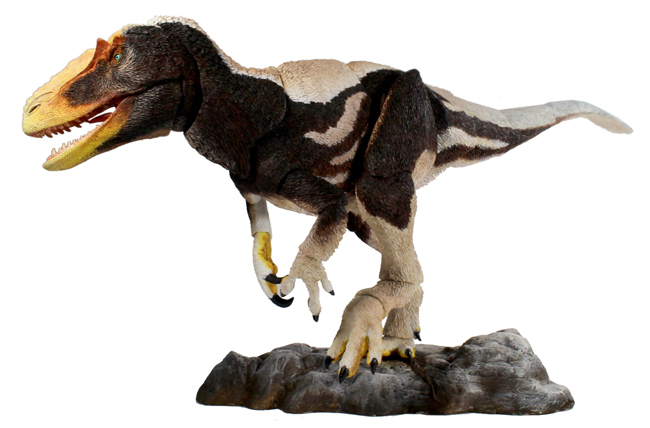
William explained that he had been eagerly awaiting the arrival of the Beasts of the Mesozoic tyrannosaur figures. He was particularly excited about the Y. huali model. In his review, he states that the nostrils are very well sculpted with nice texture. The eyes are vivid with accurate postorbital crests and the nasal crest’s midline sweeps upwards towards the postorbital crests. The jaw is praised for its accuracy.
The Beasts of the Mesozoic Yutyrannus huali articulated dinosaur model. Picture credit: Everything Dinosaur.
Picture credit: Everything Dinosaur
Commenting on the Model
The Yutyrannus was an early prototype for the large-bodied tyrannosaurs that were to evolve later. The body sculpt is carefully thought out and the model has a robust body. The articulation of the figure, the model has twenty-two points of articulation, is highlighted and praised.
William comments:
“Pose as you wish without fear of a toppling figure. You have a stable figure like the real Yutyrannus was in life.”
The reviewer explained that the fully articulated, jointed tail is easy to add to the figure. He found the fully articulated jaw complete with the tongue a delight, and stated that swapping over the feet was easy, but recommended care when making model adjustments.
Attaching the figure to the stand peg is easy.
The Beasts of the Mesozoic Yutyrannus huali model comes complete with a display base.
The Feather Sculpt
The details on the model, particularly the feathers are described as “truly awe inspiring”. The reviewer exclaims that from “start to finish”, this is one of the best feathered dinosaur figures currently on the market.
William explains that as Yutyrannus was an early member of Tyrannosauroidea, the arms are powerful and equipped with strong hands and three fingers. He points out that the arms should be held downwards with palms facing inwards. William comments on the powerful legs with the toe claws blunted through wear.
The colour scheme chosen for the figure is based on Steller’s Sea Eagle (Haliaeetus pelagicus). The reviewer describes the model and comments that stability is 100% with either sets of lower limbs fitted.
The model is supplied in a window box with packaging art and the data card illustration created by Shannon Beaumont. The articulated model is supplied with two sets of interchangeable feet with closed and open toe versions. There is a rock and snow display base, with a peg to secure the figure.
As with William’s other model reviews he provides some information about the dinosaur.
Time Period: Early Cretaceous (125 million years ago) from the Yixian Formation.
Location: Liaoning Province, China.
Yutyrannus huali Model (Dinosaur Details)
Three fossil specimens are representing three individual animals of different sizes. The fossil material was originally recovered from a fossil dealer. This dinosaur was formally described in 2012.
Clade: Theropoda Superfamily: Tyrannosauroidea Family: Proceratosauridae Type species: Yutyrannus Species: Y. huali
Weight: 1.2 tons Length: 29.5 feet Height: 9 feet
William explained that during the Early Cretaceous northern China had a climate similar to British Columbia, with coastal forests dominated by conifers. He also highlighted some of the coeval dinosaurs that shared this cold, harsh habitat. The discovery of three individual animals of different sizes found together supports the theory that these dinosaurs were social, pack animals.
In concluding his review, William exclaimed:
“For my first Beasts of the Mesozoic figure I decided upon their 1/18th Yutyrannus huali. It has great articulation, and you are purchasing the Rolls Royce of dinosaur figures.”
Our thanks to William for sending Everything Dinosaur his comprehensive review.
In January, Everything Dinosaur received an order for two PNSO Sinosauropteryx models. These are popular prehistoric animal figures but we did contact Claire, the customer, just to check that they had not purchased an additional figure in error. Claire replied to our email and reassured us stating:
“Thank you for emailing! No, the purchase of a second PNSO Sinosauropteryx figure was not a mistake. My fiancé and I are planning to use them as cake toppers for our wedding.”
Intrigued, we asked Claire would it be possible for her to send us a picture of her dinosaur themed wedding cake.
Sure, enough over the weekend we were sent a photograph of the fabulous cake.
PNSO Sinosauropteryx models used as cake toppers for a spectacular dinosaur themed wedding cake. Picture credit: Claire.
Picture credit: Claire
PNSO Sinosauropteryx Wedding Guests
What a spectacular wedding cake. Even the two PNSO Sinosauropteryx models have been dressed up for the occasion. The cake looks beautiful, and we love the little flourishes such as the ammonite fossils on the side and the cascading waterfall made from blue icing.
Claire and her husband Bradley cutting the dinosaur themed wedding cake. Picture credit Claire.
Picture credit: Claire
We at Everything Dinosaur would like congratulate the happy couple. We wish Claire and Bradley every success and happiness as they build their new lives together.
To view the Sinosauropteryx figures that featured on the wedding cake and the rest of the PNSO prehistoric animal replicas: PNSO Age of Dinosaurs.
Today, it is Mothering Sunday here in the UK. The fourth Sunday in Lent following the Christian calendar, a day dedicated to celebrating motherhood. Mother’s Day is celebrated on different days in many parts of the world, most commonly in the Northern Hemisphere spring months of March through to May.
Maiasaura
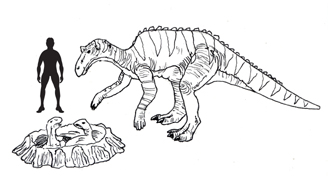
As we consider mums, maternal bonds and the contribution of mothers to society, our thoughts turn to the ornithischian dinosaur Maiasaura. Named and described in 1979 (Horner and Makela), this hadrosaurid dinosaur (Maiasaura peeblesorum) is synonymous with motherhood and maternal behaviours.
The first fossils of this dinosaur were discovered in the Badlands of Montana (USA), by a team of American scientists led by palaeontologist Jack Horner. The site the team uncovered consisted of a number of dinosaur nests, eggs, baby Maiasaura, juveniles and adults. The fossil site was renamed “Egg Mountain” and represents the fossilised remains of a Maiasaura colonial nesting area.
Happy Mother’s Day
Studies of Maiasaura provided unequivocal proof that dinosaurs raised their young and fed them at the nest (altricial behaviour). Maiasaura translates from the Greek meaning “Good Mother Lizard”, an appropriate epithet for a dinosaur that demonstrated that these reptiles, looked after their offspring.
The extensive fossil remains of this hadrosaur have enabled palaeontologists to undertake large scale studies of dinosaur ontogeny (growth rate studies). In addition, scientists have been able to determine the mortality rate of Maiasaura based on the Montana “Egg Mountain” fossils. A study of fifty Maiasaura peeblesorum tibia revealed that 90% of all Maiasaura hatchlings died within their first twelve months. If the dinosaurs survived into their second year, the mortality rate would fall to around 13%.
Today, March 18th, we at Everything Dinosaur commemorate the life of the American palaeontologist Othniel Charles Marsh. The eminent professor and president of the prestigious National Academy of Sciences passed away on this day in 1899.
Othniel Charles Marsh
Regarded as one of the great pioneers of American palaeontology he described more than a dozen new genera of dinosaurs, based on fossils excavated from the Western United States. He was responsible for naming and scientifically describing many of the most famous of all the Dinosauria. Brontosaurus, Apatosaurus, Triceratops and Stegosaurus were all named by Marsh.
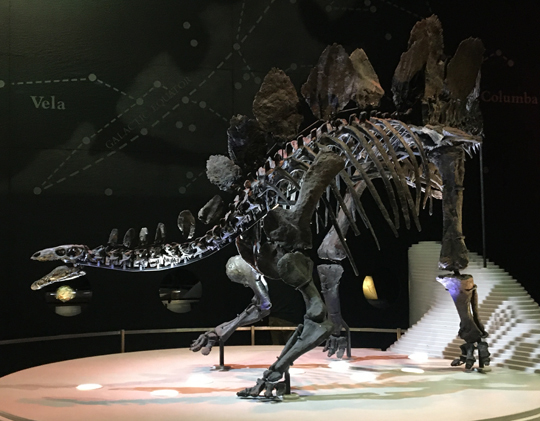
A view of the anterior of “Sophie” the Stegosaurus stenops specimen on display at the London Natural History Museum. Othniel Charles Marsh named and described the first Stegosaurus species in 1877. Picture credit: Everything Dinosaur.
Theropod Dinosaurs, Prehistoric Birds and Pterosaurs
Marsh also named and described the theropod dinosaur Allosaurus (1878), named and described toothed-birds, early horses and studied the first pterosaur fossils known from the USA.
For all his academic and scientific achievements, perhaps O. C. Marsh is best remembered for his bitter rivalry with his fellow American scientist Edward Drinker Cope. A rivalry that became known as the “Bone Wars”.
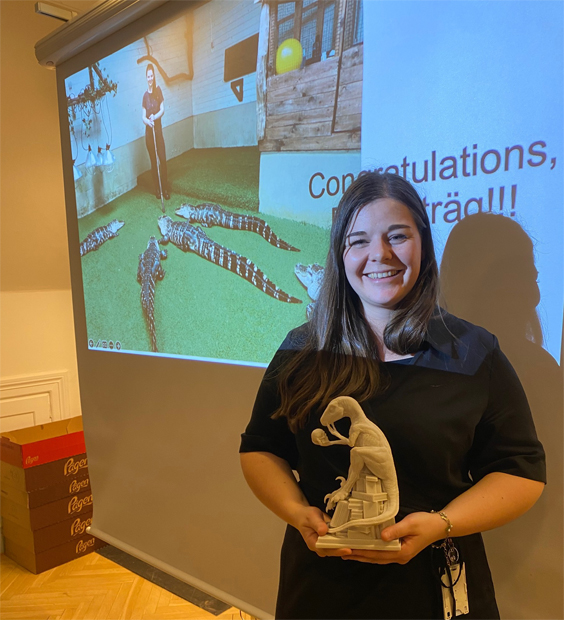
A Lund University student researching the cognitive abilities of animals was given a Rebor Oddities “Extinction” figure as a gift on completion of her PhD. Everything Dinosaur was contacted by an academic from The Cognitive Zoology Group at Lund University (Sweden), when the pair of limited-edition Rebor Oddities “Extinction” figures were first publicised. Associate Professor Mathias Osvath, wanted to gift a figure to his PhD students as they completed their doctorates.
Student Claudia of The Cognitive Zoology Group (Lund University) having successfully completed her PhD with her coveted Rebor Oddities “Extinction” Victorian neoclassical marble version figure. Picture credit: Associate Professor Mathias Osvath (Lund University).
Rebor Oddities “Extinction” Figure
Rebor produced two versions of their Oddities “Extinction” figure. Both figures are cast in elastic resin and polystone and feature a Velociraptor in contemplation holding a human skull in its right hand. The beautifully detailed dromaeosaurid is perched on a stack of twenty-three books, one book for each of our twenty-three pairs of chromosomes.
The books represent an eclectic range of publications. They are a combination of fiction and non-fiction and include titles such as The Divine Comedy, the Poems of Longfellow, Gray’s Anatomy and the Origin of Species by Charles Darwin.
Such was the interest from academics and collectors that Everything Dinosaur compiled a list of the books featured on the models in an earlier blog post: The Rebor Extinction Library.
The Rebor Oddities Extinction models. Left the bronze effect version and the Victorian neoclassical marble (right). Picture credit: Everything Dinosaur.
Picture credit: Everything Dinosaur
Dinosaur Cognition
Cognitive studies of the Dinosauria constitute an intriguing area of scientific enquiry. Everything Dinosaur expects to see several papers on dinosaur cognition being published in the near future. We wish Claudia and the other successful PhD students every success as they pursue their careers.
When asked about the special dinosaur present, Associate Professor Osvath commented:
“The gift was a success! During the party people started to notice that more or less every book the dino is sitting on had titles on the back, or even front covers. It can only be seen when shining bright light from the sides and using magnifying glasses. It must have been educated people, with a sense of humour, who designed these figures.”
“Le Penseur”
There are two variants of the Rebor “Oddities” Extinction figure. The Victorian neoclassical marble version was despatched by Everything Dinosaur to Lund University but there is also the same figure in a Renaissance bronze finish.
The Rebor “Oddities” Extinction figures remind Everything Dinosaur’s team members of Auguste Rodin’s famous sculpture “The Thinker”, also known as “Le Penseur”.
To view the range of Rebor figures and replicas in stock at Everything Dinosaur including the extinction figures (whilst stocks last): Rebor Models and Replicas.
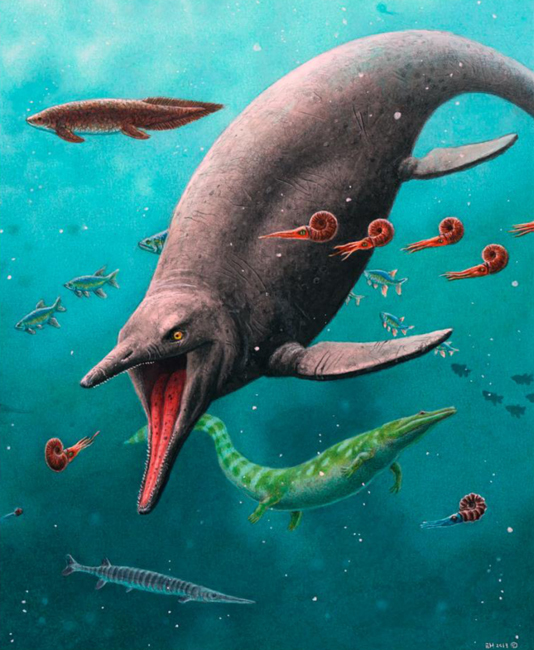
The earliest ichthyosaur fossil specimen discovered to date has been found on the Arctic island of Spitsbergen. The fossil represents a marine reptile that lived around 252 million years ago. The bones indicate that this animal was not a transitional form, but a fully adapted marine reptile.
Reconstruction of the earliest ichthyosaur and the 250-million-year-old ecosystem found on Spitsbergen. Picture credit: Esther van Hulsen.
Picture credit: Esther van Hulsen
Ichthyosaur Evolution
The evolutionary history of the ichthyosaurs remains contentious. No transitional forms representing land-dwelling tetrapods adapting to a marine habit have been found. However, small, basal ichthyosauriforms are known from the Lower Triassic of China, and the fossils of at least one, primitive Early Triassic, dolphin-shaped member of the Ichthyopterygia has already been described from Spitsbergen (Grippia longirostris).
Thanks to the work of a joint team of Swedish and Norwegian palaeontologists a fresh perspective on the origins of the “fish lizards” is provided by these newly described fossil bones.
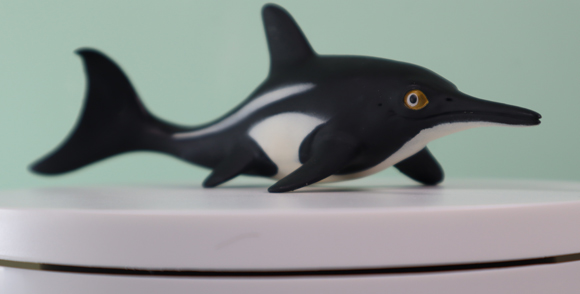
An Ichthyosaurus model, typical of the dolphin-like, streamlined forms that existed during the Early Jurassic. Picture credit: Everything Dinosaur.
Ichthyosaurs were a highly successful, globally distributed group of marine reptiles. The evolved, a “dolphin-like” streamlined body and were active, nektonic predators surviving into the Late Cretaceous.
The first marine reptiles, such as the mesosaurs evolved during the Early Permian. The end-Permian mass extinction event devasted both terrestrial and marine faunas. The cataclysmic event was thought to have led to an evolutionary reset which permitted animals such as the Ichthyosauria to evolve, exploiting niches vacated after the extinction event.
Tetrapods (land-based vertebrates), invaded shallow coastal environments to take advantage of marine predator niches that were left vacant after the mass extinction event. Over millions of years, these early amphibious reptiles became more efficient at swimming and eventually modified their limbs into flippers, developed a ” dolphin-like” body plan, and started giving birth to live young (viviparity). With the evolution of viviparity, there was no need to come ashore in order to lay eggs, so the last ties these creatures had with a terrestrial existence was lost.
The newly described fossil material from Spitsbergen is helping to revise and re-write this previous hypothesis.
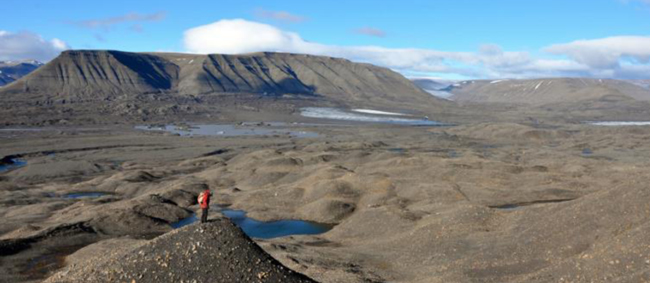
Fossil-bearing rocks on Spitsbergen that produced the earliest ichthyosaur remains. Picture credit: Benjamin Kear.
Picture credit: Benjamin Kear
Flower’s Valley Fossils
On western Spitsbergen a valley (Flower’s Valley), cuts deep into the surrounding mountains and provides access to Lower Triassic marine sediments, approximately 250 million years old. The rocks represent mud deposited at the bottom of an ancient sea and snow melt has gradually eroded the mudstone exposing rounded limestone boulders known as concretions. These objects are formed from limey sediments that coalesced around decomposing animal remains, subsequently preserving them in amazing, three-dimensional detail.
In 2014, the field team removed a number of concretions from the Flower’s Valley site. The rocks were taken back to the Natural History Museum at the University of Oslo for further study.
Scientists from The Museum of Evolution at Uppsala University have identified bony fish remains and bizarre “crocodile-like” amphibian bones, together with 11 articulated caudal vertebrae from an ichthyosaur.
Found in Rocks Thought to be Too Old for Ichthyosaur Fossils
Surprisingly, these tail bones occurred within rocks that were supposedly too old for ichthyosaurs. Also, the fossil bones do not represent a transitional form, but they show characteristics associated with geologically younger ichthyosaurs.
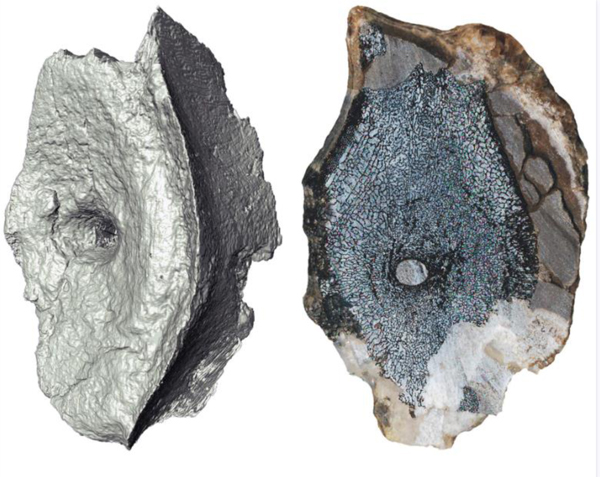
The vertebrae are identical to those of geologically much younger, larger-bodied ichthyosaurs, and even preserve internal bone microstructure showing adaptive hallmarks of fast growth, elevated metabolism and a fully oceanic lifestyle.
Computed tomography image and cross-section showing internal bone structure of vertebrae from the earliest ichthyosaur. Picture credit: Øyvind Hammer and Jørn Hurum.
Picture credit: Øyvind Hammer and Jørn Hurum
Dating the Surrounding Rock (Geochemical Testing)
Geochemical testing of the surrounding matrix dated the age of the fossils at approximately two million years after the end-Permian mass extinction. When the estimated timescale of marine reptile evolution is considered, this suggests the origins and early diversification of the Ichthyosauria took place during the Permian and prior to the Mesozoic Era.
These fossils suggest that the popular hypothesis of ichthyosaurs evolving to exploit niches vacated as a result of the end-Permian mass extinction is incorrect. Ichthyosaurs were present prior to the end of the Permian.
The discovery of the oldest ichthyosaur rewrites the popular vision of Age of Dinosaurs (Mesozoic Era), as the emergence timeframe of major reptile lineages. It now seems that at least some groups predated this landmark interval, with fossils of their most ancient ancestors still awaiting discovery in even older rocks on Spitsbergen and elsewhere in the world.
Everything Dinosaur acknowledges the assistance of a media release from the Uppsala University in the compilation of this article.
The scientific paper: “Earliest Triassic ichthyosaur fossils push back oceanic reptile origins” by Kear, B.P., Engelschiøn, V.S., Hammer, Ø., Roberts, A.J. and Hurum, J.H. published in Current Biology.
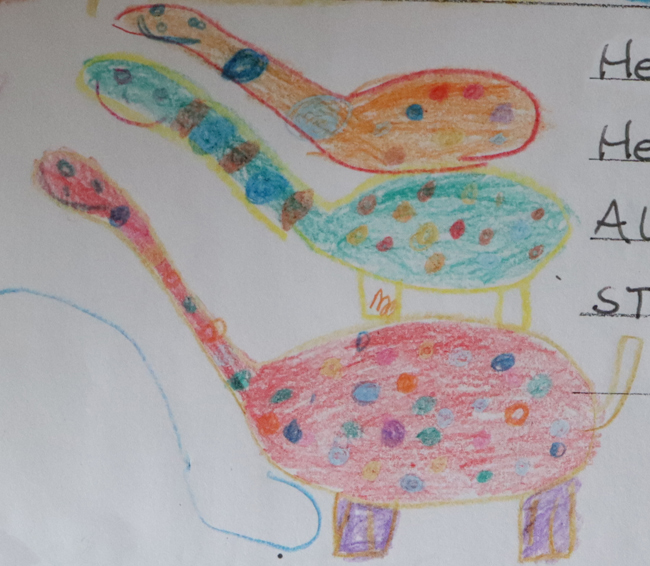
Our thanks to young dinosaur fan Esmee who sent into Everything Dinosaur a drawing which featured a trio of colourful sauropods. Team members at Everything Dinosaur get sent lots of drawings of prehistoric animals and we enjoy looking at them and some even get posted up onto our warehouse notice boards.
A trio of very colourful sauropod dinosaurs drawn by young dinosaur fan Esmee. Picture credit: Everything Dinosaur.
Picture credit: Esmee/Everything Dinosaur
Colourful Sauropods
A spokesperson from Everything Dinosaur thanked Esmee for sending in her drawing and added:
“Whilst we can’t be certain what colour sauropod dinosaurs were, it is thought they had colour vision. So, why not be brightly coloured with oranges, reds and blues. After all, if you are going to be longer than a bus you might as well stand out in terms of your colouration too. Our thanks to Esmee for creating such colourful dinosaurs.”
Our thanks to model collector William who sent into Everything Dinosaur a review of the recently introduced PNSO Therizinosaurus dinosaur model.
William begins his review by commenting on the model’s head. He praises its shape, the placement of the nostrils and the details shown around the eyes. The articulated lower jaw is also commented upon.
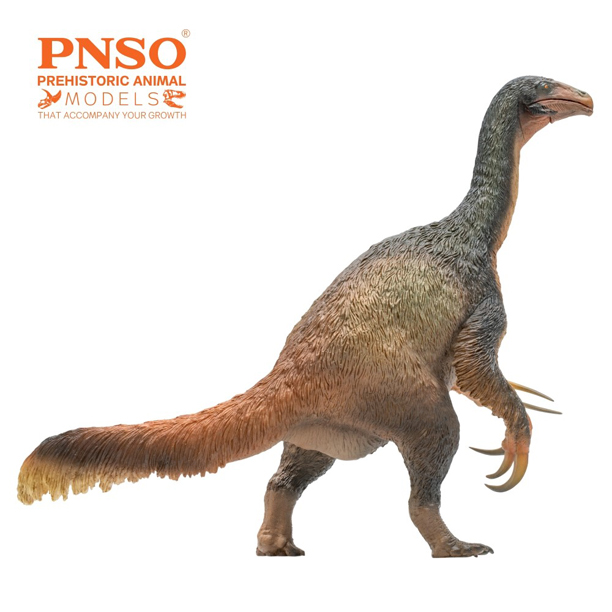
The new PNSO Therizinosaurus model has a beautifully detailed head with lots of evidence of a shaggy coat of feathers on the neck. The model also has an articulated lower jaw.
PNSO Therizinosaurus Dinosaur Model
Turning to the main body sculpt, the superb integumentary coat of feathers is praised with the reviewer awarding “100 points for this feature”. The wide pelvis is present, and the model has been given robust and powerful thighs combined with four-toed, plantigrade feet. The huge gut is highlighted and the reviewer confirms that the PNSO figure has a cloaca.
The scythe-like claws, for which this dinosaur is famous are described as “just perfection”. William comments that his figure stands unaided, but he does recommend the use of the clear, plastic display stand provided with the model for long term display.
Qingge the Therizinosaurus
PNSO selected a sloth-like colouration for their figure. There are no bright, clashing colours. The colour scheme chosen suits “Qingge”.
His eyes are a strong orange with a determined look set in them as if he means business, with a ring of green feathers around each orbit. The upper beak is pink with grey wash at the tip, with a dark wash on the mouth interior. From the back of the head down to the wrist the figure is a dark, charcoal grey which then transitions into a russet brown over the main upper body. The massive claws have a very naturalistic look.
A PNSO feathered theropod dinosaur. This is the new PNSO Qingge the Therizinosaurus dinosaur model.
Model Measurements
William provides details of the accessories supplied with the figure, the art poster and the clear, plastic support stand.
Scale: 1:35 Length: 7.8 inches Height: 6 inches
He confirms that the dinosaur fossil material comes from Upper Cretaceous deposits of the Nemegt Formation (Mongolia).
Providing Information About Therizinosaurus
As with previous reviews, William provided some information about the fossil discoveries.
Three years after the end of World War II, palaeontologists and field teams were out back in the field looking for fossil bones. A joint Mongolian/USSR Academy of Sciences expedition was despatched to the Nemegt Formation exposed in the Gobi Desert. Strange, fragmented fossils were uncovered.
Renowned palaeontologist Evgeny Maleev (who also described the tyrannosaur Tarbosaurus), thought the bones represented a turtle-like animal. He erected the family Therizinosauridae. After years of research and the discovery of more complete fossil specimens, Therizinosaurus was revealed to be bizarre, herbivorous member of the Maniraptora clade of dinosaurs.
The PNSO model has been photographed against a green, stylised background and a more detailed prehistoric scene has not been used in the background – such was the company’s eagerness to get this model announced.
The PNSO Therizinosaurus Dinosaur Model
William described Therizinosaurus cheloniformis and provided details on taxonomy.
Classification: Theropoda Superfamily: Therizinosauroidea Family: Therizinosauridae Type species: Therizinosaurus
William also described the Late Cretaceous environment as represented by the Nemegt Formation and mentioned the presence of large tyrannosaurs, the apex predators in the ecosystem.
He explained:
“Therizinosaurus would have been no easy meal for either Tarbosaurus bataar and the fleet-footed Alioramus remotus.”
“Qingge is an example of how to execute accuracy within a scale figure. PNSO’s Therizinosaurus cheloniformis is the only version I’ll ever need to own.”
Our thanks to William for sending into Everything Dinosaur his comprehensive model review.