All about dinosaurs, fossils and prehistoric animals by Everything Dinosaur team members.
25 07, 2009

Ancient Mammals Make their Mark on National Dinosaur Monument

By |2023-03-03T16:26:03+00:00July 25th, 2009|Categories: Dinosaur and Prehistoric Animal News Stories, Main Page, Palaeontological articles|0 Comments

Scientists Find Fossilised Mammal Trackways at the Dinosaur National Monument

The United States National Parks Service established the Dinosaur National Monument in October 1915 following a presidential decree and in recognition of the scientific importance of the Jurassic sediments exposed in the state of Utah.  The fossils of a number of famous dinosaurs have been found in this area, dinosaurs such as Allosaurus, Apatosaurus and Stegosaurus.  However, a keen-eyed scientist has discovered that sharing this Jurassic environment with the huge dinosaurs were a number of tiny mammal species.  The ancient footprints and trackways of rat-sized creatures have been discovered at the Dinosaur National Monument site and these tracks provide a record of mammal activity from 190 million years ago.

Ancient Mammals

Commenting on the discovery, Dan Chure, a palaeontologist with the National Park Service stated that this was “an amazing find”.

It was Dan and his co-worker George Engelmann of the University of Nebraska who spotted the tiny footprints preserved on the side of a fossilised sand dune.  The two scientists hope that further examinations of the area may reveal fossilised skeletons of the tiny mammals.

The trackways, which number in the hundreds, were preserved in the Glen Canyon Formation.  This formation which consists of fossilised sand dunes that covered much of Utah and Wyoming as well as parts of Colorado, northern Arizona, and New Mexico during the Early Jurassic period has already provided a number of important dinosaur fossils.

Mr Chure stated that their discovery was a testament to the diversity of life in the arid region when the giant dunes, which reached heights of up to several hundred feet, were interrupted by an occasional oasis.

Fossilised Trackways

The tracks, discovered in the Utah section of the monument in Uintah County, indicate the little mammals were walking uphill because the heel imprints are more distinct than the toes.  The coin is provided for scale in the photographs.  Mammal tracks in this area are rare but they have been found before, unfortunately, tiny trace fossils such as these can be easily overlooked, the tracks themselves are only visible when light is shone on them from a particular angle.

“It was almost like a bunch of juveniles running around,” Chure said.

One of the challenges is accurately mapping the tracks, some of which are so faint they can only be seen when the light is at a certain angle.  Mixed up with the small mammal prints are the trackways of other animals, the scientists have tentatively ascribed these tracks as to belonging to small dinosaurs.

George Engelmann commentated:

“This was a time when the ancestors of modern mammals were losing dominance on land to the dinosaurs.  It’s near the beginning of a long time when dinosaurs ruled and our ancestors tried to stay out of their way”.

Such finds enable scientists to understand more about the food chains and eco-systems in ancient environments, helping them to build up a picture of life in the state of Utah 190 million years ago.

For models of prehistoric mammals: Prehistoric Mammal Models from Everything Dinosaur.
24 07, 2009

New Carnegie Safari Models in Stock

By |2022-12-25T19:03:41+00:00July 24th, 2009|Categories: Everything Dinosaur News and Updates, Main Page, Press Releases|0 Comments

New Carnegie Safari Models Available from Everything Dinosaur

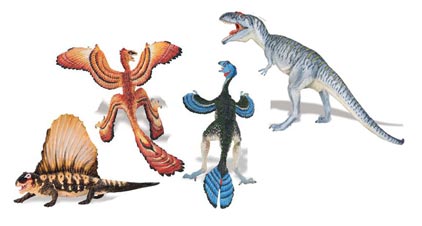
If prehistoric animals such as the huge meat-eating dinosaur Giganotosaurus, or the fearsome marine reptile Tylosaurus are amongst your favourites then this is your lucky day!  Perhaps you have a fascination for feathered dinosaurs such as Caudipteryx, Microraptor or the bizarre Oviraptor – no matter what your favourite prehistoric animal, the Carnegie Safari model collection from the United States is bound to have something to satisfy you.

Carnegie Safari Prehistoric Animal Models

Picture credit: Everything Dinosaur

The model range offered by Everything Dinosaur has been extended and now the company run by parents, teachers and real dinosaur experts is able to supply an extended range of Carnegie Safari hand-painted, scale models with the promise of more models to come.

Carnegie Safari Dinosaur Models

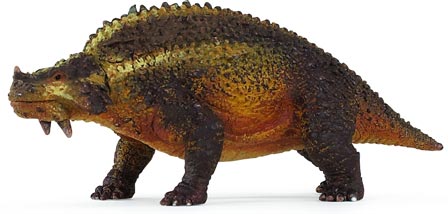
Added to the company’s range are new models of Tylosaurus, the Triassic super-predator Postosuchus and the Permian giant Scutosaurus.  Also included are some of the more difficult to obtain models such as Maiasaura, Amargasaurus and the monstrous Kronosaurus (pliosaur).  All models are packed with an Everything Dinosaur animal fact sheet providing further information on that specific prehistoric animal.

The New Model of Scutosaurus

Picture credit: Everything Dinosaur

To view the extensive range of Safari Ltd prehistoric animal models and figures stocked by Everything Dinosaur: Safari Ltd. Wild Safari Prehistoric World Models and Figures.

So if you have an interest in model collecting, of you are just curious to see what’s new visit the Everything Dinosaur website and check out the Safari Ltd section of the site, which also includes Wild Safari Dinos dinosaur models.

23 07, 2009

Confusion over “Bronto” Burgers – A Helpful Explanation

By |2024-04-17T11:10:34+01:00July 23rd, 2009|Categories: Everything Dinosaur News and Updates, Main Page|0 Comments

How not to impress eight year-olds – use the name Brontosaurus

Team members at Everything Dinosaur, were discussing yesterday an incident that happened at a local tourist attraction that they had been involved with, providing some advice and support for a dinosaur themed event.  It seems that the event organisers wanted to offer some dinosaur themed food and had a barbecue with sausages, burgers and other treats.  Having a barbecue in the great British Summer is a risk in itself, after all, the weather in July has not been exactly wonderful over most parts of the country.

However, it wasn’t the weather that caused the problem. The organisers had tried to theme up the food on sale with their dinosaur event.  There were Stegosaurus sausages, Spinosaurus salad and salsa, even some Diplodocus dips – very creative.  Unfortunately, they had also got some “Brontosaurus burgers” on sale.  Some of the young visitors soon pointed out that the name Brontosaurus is no longer valid and this dinosaur is officially referred to as Apatosaurus.  Many children obsess on dinosaurs and are able to read up on and absorb so many facts that they can quickly spot any potential mistakes.  They are quick to point things out when the grown ups get it wrong.

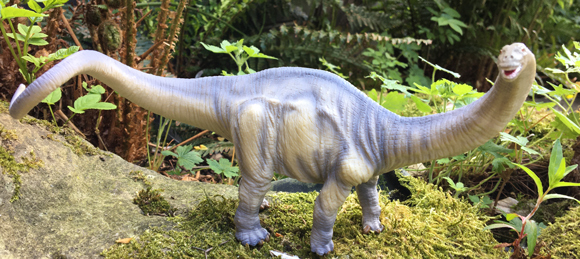
Brontosaurus

Fortunately, one of our team members was on hand to help out, a quick visit to the our office to print out some extra sauropod drawing materials and the “Brontosaurus burgers” were soon changed to “Brachiosaurus burgers” and everybody was happy once again.

Update

Following a revision of diplodocid fossil material, the Brontosaurus genus is now recognised as valid.

A Brontosaurus Dinosaur Model

Brontosaurus.

Mojo Fun Brontosaurus dinosaur model.

Picture credit: Everything Dinosaur

To view models and replicas of sauropods such as Brontosaurus and Diplodocus: Dinosaur and Prehistoric Animal Models.

22 07, 2009

“Chinasaurs” are Coming to Town as New Exhibition Opens

By |2024-04-17T10:55:29+01:00July 22nd, 2009|Categories: Dinosaur and Prehistoric Animal News Stories, Main Page|0 Comments

Largest Touring Exhibition of Chinese Dinosaur Fossils opens at the Maryland Science Center

The Maryland Science Center, based in Baltimore (United States), is playing host to the largest touring exhibit of Chinese dinosaur fossils this Summer, providing visitors with the opportunity to get up close and personal with “Sino – Dinosaurs”.  The exhibit, which runs daily until September 7th consists of more than 20 mounted prehistoric animals, including the spectacular sauropod Mamenchisaurus with the longest neck of any dinosaur known.

Chinese Dinosaur Fossils

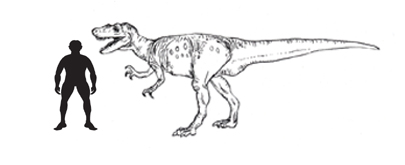
As well as amazing plant-eating dinosaurs there are plenty of meat-eating dinosaurs on display including the fleet-footed, Jurassic theropod Szechuanosaurus, a member of the allosaur family and one of the top predators around China in the Jurassic.  Szechuanosaurus is classified as a member of the Sinraptoridae, a group of fierce meat-eating dinosaurs with strong jaws and powerful grasping forelimbs.

An Artist’s Impression of a Typical Sinraptoridae Dinosaur

Picture credit: Everything Dinosaur

These animals were certainly very impressive, and some of the these fascinating prehistoric creatures have been brought to life as the exhibit also features a number of animatronic models.  As well as marvelling at the wonderful fossils, visitors will also be given the chance to see how palaeontologists interpret the fossil record and recreate dinosaurs with the wonderful robotic animals on display.

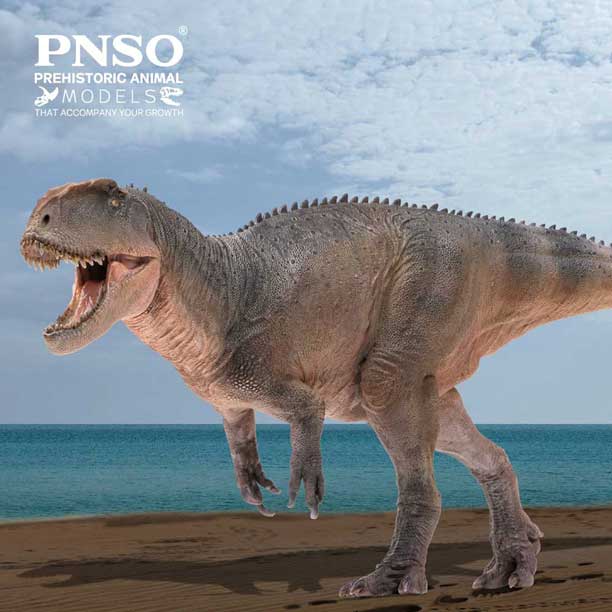
A Model of a Sinraptor (PNSO Dinosaur Models)

PNSO Xinchuan the Sinraptor figure.

Sinraptor dongi was formally named and described in 1994. The species name is in honour of the eminent Professor Dong Zhiming, one of China’s most celebrated palaeontologists.

To view the PNSO Sinraptor model and other PNSO prehistoric animal figures: PNSO Age of Dinosaurs Models and Figures.

Chinasaurs: Dinosaur Dynasty is open daily at the Maryland Science Center, for further information visit the Maryland Science Center website.

21 07, 2009

Jurassic Coast says goodbye to Unique Tyrannosaurus rex Statue

By |2024-04-17T10:56:07+01:00July 21st, 2009|Categories: Dinosaur and Prehistoric Animal News Stories, Main Page|0 Comments

T. rex Statue Removed from Beach by Public Health and Safety Officials

A six-metre-long metal sculpture of the skeleton of a Tyrannosaurus rex has been impounded by safety officers after it was sited on a Dorset beach.  The large model, approximately half the size of an adult Tyrannosaurus was towed out into Weymouth Bay in Dorset (England) and deposited there, in a publicity stunt to promote the UNESCO world heritage site, claim the sculptures owners.

The unusual sight of the skeleton a large meat-eating dinosaur in the middle of Jurassic coast caused some amusement amongst the watching holiday makers but the local council and police failed to see the joke.  Stating that this statue was in breach of health and safety rules, council employees assisted by the local police removed T. rex from his watery resting place and have impounded the sculpture.

Tyrannosaurus rex

The owner of the statue, Mr Paul Swaffield is demanding that the local council return the sculpture, which he has nicknamed “Tex”.  The model was made several years ago to help promote a maze maize that Mr Swaffield owns.  We note that the placing of the statue in Weymouth Bay coincides with the opening of many maize mazes at the start of the school holidays and being cynics we suspect that the promotion of the UNESCO world heritage site was secondary to the need to generate publicity for the opening of a maze tourist attraction.  It certainly is a novel way of generating publicity, but the local authorities don’t see the funny side of the story.

Mr Swaffield commented:

 “I just wanted people who saw it to say whether it is a good idea.  The model is on wheels and I used a 110hp tractor to tow it down the slipway and into the sea at low tide.  I drove it as far as I could – about 150 yards out – and left it there.  It was an incredible sight and people thought it was the funniest thing that had happened in Weymouth for many a year”.

Unfortunately, for Mr Swaffield and Tex, local officials and beach lifeguards soon condemned the publicity stunt and demanded that the statue be removed.

He went on to state:

“Members of the public saw the reaction of the officials as the typical state the country is in today, which is lacking in fun.”

Fearing that the dinosaur may cause harm to bathers the local council called Dorset police and they helped to remove the statue to a local police compound.  A spokesperson for the council stated that Mr Swaffield did not have any permission to put the statue up and the model had to be taken away for public safety.

The spokesperson added:

“It was quite a hazard so we had to take it away.  It had metal spikes so we could not leave it on the beach.  The dinosaur had to have a police escort when it was taken along the road as it was not a safe structure”.

This is certainly a novel way of generating publicity for a tourist attraction, but we can’t condone what has taken place at the Dorset beach.   What may be a good idea for the likes of Anthony Gormley, does not seem to be every-body’s cup of tea.  Besides, the idea of a Late Cretaceous theropod being used to promote Jurassic marine sediments is a little bizarre in the first place.  Had the statue been a life-size model of a plesiosaur, then who knows what the council officials might have said.

For models and replicas of dinosaurs such as Tyrannosaurus rex, visit the models section of the Everything Dinosaur website: Prehistoric Animal and Dinosaur Models.

20 07, 2009

Anniversary of Apollo 11 Moon Landing “One small Step for Man..”

By |2023-03-03T16:30:53+00:00July 20th, 2009|Categories: Dinosaur and Prehistoric Animal News Stories, Dinosaur Fans, Everything Dinosaur News and Updates, Main Page|0 Comments

Anniversary of First Man on the Moon – Dinosaurs in Space

Everything Dinosaur commemorates the fortieth anniversary of the first manned moon landing.

Today, marks the fortieth anniversary of the first manned moon landing.  The first people to walk on the moon were the American astronauts Neil Armstrong and Buzz Aldrin.  The Command Module pilot, Michael Collins remained in the lunar module and did not set foot on the moon.  The Apollo 11 mission was successfully completed and the team returned to Earth, bringing with them the first samples of moon rocks.

Over 20 kilogrammes of material was collected, the rocks were identified as igneous basalts and have been estimated to be over 3.7 billion years old.  The lunar module landed in the Sea of Tranquillity, a relatively flat part of the moon, but the actual landing was over 6,000 metres from the initial aim point.

Manned Moon Landing

The astronauts safely returned to Earth having spent a total of approximately 21 hours on the lunar surface.  The return craft safely splashed down in the Pacific ocean on July 24th and the warship USS Hornet was able to pick them up and retrieve the Command Module.  The total mission length was just over 195 hours.  The first manned mission to the moon with the first manned moon landing and moon walk on July 20th 1969, could arguably be regarded as mankind’s greatest technological achievement.

Dinosaurs have also made it into space.  As far as we know two species of dinosaur have made it beyond the Earth’s atmosphere.  The first dinosaur in space was Maiasaura peeblesorum a hadrosaurine dinosaur.  A piece of bone from a baby Maiasaura and Maiasaura eggshell was taken up into space by an astronaut on a NASA mission in 1985.  This dinosaur is known from a nesting colony found in Montana (United States) in the 1970s.  It lived in large herds and nested in colonies, migrating to the same nesting site each year.  More than 200 fossil skeletons ranging from embryos to mature adults have been found.

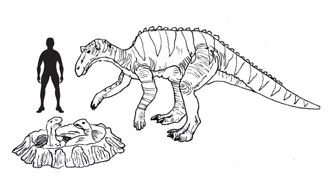
An Illustration of Maiasaura and a Nest

Picture credit: Everything Dinosaur

Just one small step for man, a great leap for a Late Cretaceous hadrosaurine.

To read more about the space dinosaurs Maiasaura and Coelophysis, take a look at the Wild Safari Prehistoric World model range in stock at Everything Dinosaur: Safari Ltd. Wild Safari Prehistoric World Models and Figures.

19 07, 2009

Dinosaur Event at Bournemouth Pulls in the Crowds

By |2023-03-03T16:31:48+00:00July 19th, 2009|Categories: Dinosaur and Prehistoric Animal News Stories, Dinosaur Fans, Everything Dinosaur News and Updates, Main Page|0 Comments

Dinosaur Exhibition at Bournemouth International Centre Pulls in the Crowds

If there are any young dinosaur fans at a loose end between now and August 31st, then a trip to the Bournemouth International Centre (BIC), Bournemouth, Dorset, is recommended as dinosaurs return to the Jurassic coast.

The BIC is hosting the “Dinosaur Encounter” exhibition a joint effort with the experts and palaeontologists of the Natural History Museum teaming up with animatronic specialists Kokoro to produce an exhibit featuring giant robotic dinosaurs.  The prehistoric creatures include ornithomimids, life-size Oviraptors, plus a Triceratops and its young, a fearsome Ankylosaurus plus of course some meat-eating dinosaurs added for good measure.

Dinosaur Fans

Visitors can marvel at the bizarre Baryonyx, an English dinosaur (fossil remains found in Surrey and in Spain), plus of course there are a couple of fierce tyrannosaurs to keep you amused, should you be brave enough to venture close enough to stare at the metre long jaws of the Tyrannosaurus rex.  This large T. rex model is one of the biggest of its kind in the world, and the exhibit permits visitors to get up close and personal with these huge prehistoric beasts.

Commenting on the event, a team member from Everything Dinosaur who had helped out over the opening weekend of the exhibit stated:

“This is a great family exhibit, at a very family friendly venue, giving young dinosaur fans the opportunity to see some of the best animatronic models of dinosaurs in the world.  The detail is amazing, you really get the feeling that a T. rex is watching you”.

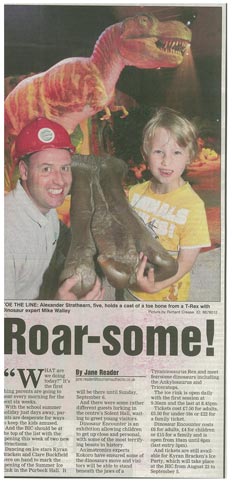
Press Cutting from the BIC (Bournemouth, Dorset) Event

Picture credit: Bournemouth Echo

In addition to running the dinosaur exhibit, the BIC have also opened an ice rink for the Summer holidays, ice skating another fun, filled family activity – why not having visited the dinosaurs try out a little bit of the Ice Age?

Visit Everything Dinosaur’s award-winning website: Everything Dinosaur.

18 07, 2009

Update on the Isle of Man Archaeological Excavations

By |2023-03-03T16:32:51+00:00July 18th, 2009|Categories: Dinosaur and Prehistoric Animal News Stories, Educational Activities, Main Page|0 Comments

Ronaldsway Site Yields Exciting Prehistoric Artifacts

The excavation on the site of the new taxiway at Ronaldsway airport on the Isle of Man is nearing completion, as the archaeologists strive to ensure that all the work is completed on schedule before the builders move in and recover as many prehistoric artifacts as they can.  The highlight of the dig has been the discovery of remains of a large Mesolithic dwelling, dated to approximately 8,000 years ago.  This is the oldest building of this nature ever found on the island and dates from the time shortly after the last Ice Age when the Isle of Man was settled.

Interestingly, until evidence of this structure was found, archaeologists had assumed that the first settlers on the island were mainly nomadic, but this substantial structure indicates that at least for part of the time the people were sedentary.

Prehistoric Artifacts

The team of archaeologists unearthed the remains of this wooden shelter, which would have measured something like 7 metres across and by studying the post holes it would have been a substantial, imposing building.

The excavation is being carried out by a team of scientists from Oxford Archaeology North.  To date the archaeologists have discovered 15,000 pieces of worked flint plus evidence of the diet of these settlers and other artifacts dating from 3,000 years before Stonehenge was built.

We first reported on this particular archaeological dig back in June 2008, when the first evidence of Mesolithic remains were found.  To read the first article in full:

Runway Extension reveals signs of Stone Age people on the Isle of Man.

It is hoped that the work will be completed in time to let the contractors back onto the site to start building the new runway extension in the next few weeks.

The picture shows archaeologists working on the large dwelling, the post holes can be seen.  Commenting on the excavation, Gemma Jones of Oxford Archaeology North stated:

We have uncovered deposits to a depth of 30-40 centimetres.  These will now be returned to our Cambridge office for further study”.

The groundworks for the new runway extension has been continuing whilst the scientists worked, the contractors involved with the project have co-operated fully with the archaeologists, allowing this unique insight into the ancient inhabitants of the Isle of Man.

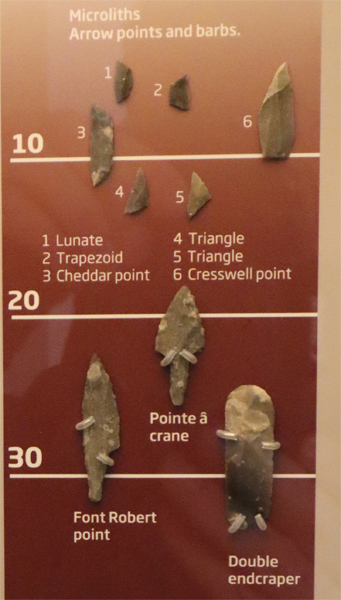
Typical Stone Tools (Museum Exhibit)

Stone Age Tools

A collection of typical Stone Age Tools. Picture credit: Everything Dinosaur.

Picture credit: Everything Dinosaur

Visit Everything Dinosaur’s award-winning website: Everything Dinosaur.

17 07, 2009

My First Dinosaur Model Set

By |2023-03-03T16:33:42+00:00July 17th, 2009|Categories: Dinosaur Fans, Everything Dinosaur News and Updates, Everything Dinosaur Products, Main Page|0 Comments

My First Dinosaur Model Set

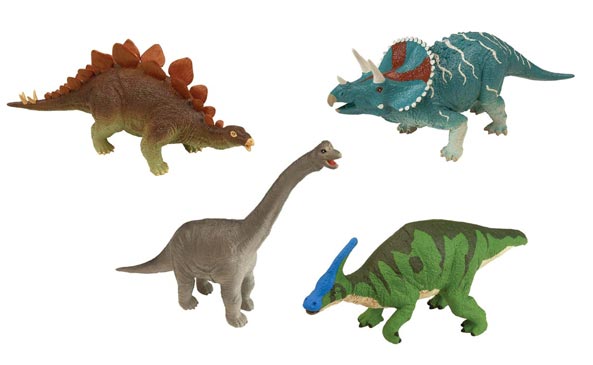
Developed with very young dinosaur fans in mind, the team at Everything Dinosaur have introduced a set of four, colourful dinosaur models especially for the very young.  The bright and colourful, soft and squeezy rubber dinosaur model set features Triceratops, Brachiosaurus, Parasaurolophus and a Stegosaurus.  These four plant-eating dinosaurs are very popular with children, each one regularly features in the Everything Dinosaur most popular dinosaur survey.

My First Dinosaur Model Set

Suitable for children aged 3 years and up, these robust, rubber models make an excellent first dinosaur set for young dinosaur fans.  They are super dinosaur toys for toddlers.

The “My First Dinosaur” Model Set

Picture credit: Everything Dinosaur

To view the extensive range of dinosaur and prehistoric animal themed toys and gifts, visit Everything Dinosaur’s award-winning website: Visit Everything Dinosaur.

16 07, 2009

New Species of Nothronychus Discovered in Utah

By |2023-03-03T16:38:51+00:00July 16th, 2009|Categories: Dinosaur and Prehistoric Animal News Stories, Main Page|0 Comments

Say Hello to Nothronychus graffami

A New Species of Nothronychus

The discovery of the most complete fossilised skeleton of a species of Nothronychus in the United States has been announced in the online scientific publication the Journal of Proceedings of the Royal Society B: Biological Sciences.  It is hoped that this new fossil of a therizinosaurid (scythe lizards), discovered in southern Utah, will help improve our understanding of these bizarre theropod dinosaurs.

The therizinosaurid group (pronounced Ther-ih-zine-oh-sore-id), are theropod dinosaurs a suborder of the Saurischia which possess adaptations for plant-eating, although many of their relatives were fierce meat-eaters.  Hopefully, the fossils of this new species Nothronychus graffami may help explain how these animals evolved such characteristics and where in the Late Cretaceous ecosystem they fitted.

Such fossil remains may provide evidence of the evolution of vegetarian theropods, an adaptation that may be older than previously thought.  Famous predatory dinosaurs such as the dromaeosaurs (Troodon and Velociraptor for example), may have evolved from less fearsome, plant-eating ancestors.

Nothronychus graffami

N. graffami was named after Merle Graffam a member of the University of Northern Arizona’s excavation team who first discovered the beautifully preserved fossil remains of this 4-metre-high dinosaur.   The fossil skeleton has been dated to approximately 93 million years ago (Cenemanian faunal stage) and the scientists estimate that this species of Nothronychus pre-dates the other Nothronychus species known from the United States Nothronychus mckinleyi.  When N. mckinleyi was formerly named and described in 2001, it became the first therizinosaurid to have lived outside of Asia.  It is likely that these strange sloth-like animals (Nothronychus means “sloth-like claw”),evolved in Asia and migrated into other parts of the northern hemisphere during the Cretaceous.

The small head, had a beak, this was perched on a long, slender neck.  The teeth are leaf shaped and adapted to eating tough plant material.  The heavy, pot-belied body with broad hips was carried along by short stumpy hind legs, the strong arms ended in three-clawed hands.  The claws are very characteristic of “scythe lizards”, indeed this is how this particular group of dinosaurs got their name.  In the case of N. graffami, the three fingered hands ended in broad, claws over 20 cm long.

New Dinosaur Species

It is believed that therizinosaurs may have been covered in primitive feathers and that they may have lived like giant sloths, using their strong, powerful claws to pull down branches so that they could graze on the leaves.

Commenting on the strange-looking creature Lindsay Zanno of the Field Museum in Chicago stated:

“It takes a lot of gut-time to digest plants, plant-eaters have to develop long digestive tracts to get the energy they need to survive”.

Pictures show the restored and mounted manus (hand) of this dinosaur, the curved, sickle-like claws can be clearly seen.  Scientists believe that the therizinosaurids are a type of maniraptoran dinosaur, although most maniraptoran dinosaurs are believed to have been meat-eaters this new fossil has helped shed light on the evolution of the group as a whole.

The Evolution of Theropods

In a bid to find out more information regarding the evolution of theropods and in particular the herbivorous forms, Dr  Zanno and her colleagues compared the anatomy of the newly discovered genus of Nothronychus with specimens from seventy-five other types of theropod.  Their research indicates that the therizinosaurids are perhaps the most primitive group of maniraptorans.  This could mean that maniraptorans also originated in Asia, before migrating across the ancient dinosaur world.

The team conclude that plant-eating may have been a trait of early maniraptorans, certainly several types of maniraptoran dinosaur show adaptations for a partial herbivorous or at least an omnivorous habit.  The ornithomimosaurs and the oviraptorids are examples of this type of dinosaur with adaptations for a non meat specific diet.

Dr Zanno commentated:

“Before this we thought that plant-eating theropods like therizinosaurs were a rare occurrence.  We knew they must have evolved from meat-eaters somewhere in their ancestry, but before our study it seemed like plant-eating was the exception not the norm for maniraptoran theropods”.

Studying the Maniraptora

Rather than being the exception to the meat-eating rule, Dr Zanno and her fellow researchers claim that eating plants exclusively or in combination with meat can be traced back to the origins of the maniraptoran group as a whole.  It is possible that many types of maniraptoran dinosaurs ate some portion of vegetable matter in their diets, an inherited trait from the common ancestor of the whole maniraptoran group, the scientists state.  The American based team have speculated that the ability to eat plant matter may have allowed the maniraptorans to migrant to new areas and exploit new niches in the Mesozoic ecosystem as plants themselves evolved.  This may help to explain their variety and diversity.

The therizinosaurs are certainly very strange animals, although these new fossils will help shed more light on the group they remain very enigmatic and extremely rare in the fossil record.

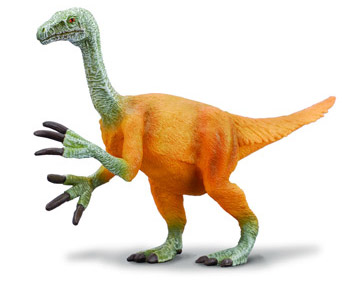
Model makers are beginning to recognise the therizinosaurs and recently a number of models of these types of dinosaur, including a Nothronychus have been introduced.

The CollectA Nothronychus Model

Picture credit: Everything Dinosaur

To view the model of the Nothronychus and other feathered dinosaurs: CollectA Prehistoric Life Models.

Go to Top