All about dinosaurs, fossils and prehistoric animals by Everything Dinosaur team members.
5 08, 2009

Start of the Everything Dinosaur Fossil Casting Activities

By |2022-12-26T07:20:06+00:00August 5th, 2009|Categories: Everything Dinosaur News and Updates, Main Page|0 Comments

Everything Dinosaur Summer Activities – Casting your own Fossil

Today, marks the start of our Summer activities programme, at this time of year we get bombarded with requests to support local authority summer play schemes and other organised play activities with our fossil casting programme.  We do try to support as many as we can but these day with all our other events, and projects it is quite difficult to do.

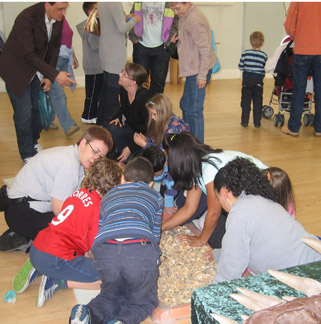
However, our road show kicks off today with an afternoon of dinosaur themed activities at a leisure centre.  We are going to bring over some of our museum replicas and real fossils to do a sort of show and tell element.

Fossil Casting

After this, we have a dinosaur dig to organise (using real fossils we have collected on our many fossil hunting trips), before we get down to making some plaster casts of fossils for the young dinosaur fans to take home.

An Indoor Fossil Hunt

Picture credit: Everything Dinosaur

Everything Dinosaur

To round off the afternoon’s activities we are going to be playing a version of our dinosaur run-around game, with lucky contestants able to take home their own set of prehistoric animal top trumps we have created especially for this year’s road trips.

These are events that take some organising but they are lots of fun, although when they have finished and we have packed everything into the “dino van” to take back to the warehouse we are shattered.

Still it’s all in a days work.

Visit Everything Dinosaur’s award-winning website: Everything Dinosaur.

4 08, 2009

New DNA Coding Technique may Help Deter Fossil Thieves

By |2023-03-03T10:35:48+00:00August 4th, 2009|Categories: Dinosaur and Prehistoric Animal News Stories, Main Page, Palaeontological articles|0 Comments

Associating Fossil Bones to their Surrounding Matrix may Prevent Thefts

A new technique that ties fossil bones to their site of origin may help deter raiders of dinosaur dig sites.  With the number of incidents of looting on the increase, then this new “finger printing” system that helps identify the source of any fossil put up for auction may act as a deterrent for would be thieves.

The Theft of Fossil Bones

The theft of fossil bones and other ancient relics from dig sites is an increasingly common occurrence.  Thieves recently stole several important sauropod fossils from a dig site in the state of Utah, this particular dig site held the fossilised bones of a young Diplodocus that lived 150 million years ago.

Commenting on the theft, Scott Williams the Collections and Exhibits Manager at the Burpee Museum of Natural History stated:

“It’s like pieces of a puzzle that are now gone”.

Unfortunately, it is highly unlikely that these fossils will ever come to light again, stolen fossils end up being sold for large amounts of money in a black market of illegal fossil sales.

However, a new fossil identifying technique being pioneered in the USA could give state officials and regulators the edge when it comes to tracking down fossil thieves.

Scientists are testing a number of methods designed to chemically match a fossil with naturally occurring elements that seep into the bones during the fossilisation process from the surrounding matrix.  Although the work is in its early stages, the techniques could help identify the unique “chemical fingerprint” of a fossil site and help link any fossil bones up for auction to a particular site.  Using this information it would be possible to determine whether the bones and other relics had been obtained for sale by legal means.

Fossil Thieves

Testing on the chemical analysis of fossil matrices is continuing in the western United States.  So far, results indicate these new methods could tie 85% to 98% of fossil samples back to their original sites.  The theft of fossils from a dig site is extremely frustrating for the palaeontologists, not only are valuable fossils removed but often the sites are damaged as the thieves recklessly dig out the bones.  Valuable information is being destroyed or lost, limiting the amount of information a fossil site can yield.

Vincent Santucci, the Head of the National Park Service Palaeontology Programme put it succinctly when he stated:

“We’re not making T. rexes any more”.

Although the impact of the recession has dampened down the prices paid for rare fossils at auction, dinosaur bones, especially those of famous dinosaurs such as T. rex or Triceratops still fetch hundreds of thousands of dollars at auction.  Wealthy private collectors keen to add a “prize specimen” to their collection will gladly pay a high price to obtain a rare and precious dinosaur fossil.

In Utah, which is rife with dinosaur quarries and regularly the source of newly found species, the losses to scientific knowledge can be dramatic, commented Jim Kirkland, the state palaeontologist.  He said he’s terrified that vandals will hit a significant site before scientists can meticulously go through it.  Hopefully, this new labelling technique that associates fossils with a particular site will deter any would be thieves and looters.

Increasing Number of Thefts and Vandalism

With several hundred reported incidents each year, any new method of helping to preserve dig sites and protect fossils is most welcome by the scientific community.  The new mapping techniques, in association with stronger legislation could help protect many important palaeontological sites, helping to preserve them so that they can be properly studied.

With looting and even vandalism of fossil sites on the increase, let’s hope that this new technique provides an effective deterrent.

Author: Mike (ezine compliance)

Visit Everything Dinosaur’s award-winning website: Everything Dinosaur.

3 08, 2009

The Mystery of Dunkle’s Bones

By |2023-03-03T14:39:09+00:00August 3rd, 2009|Categories: Animal News Stories, Dinosaur Fans, Main Page|0 Comments

A Puzzle about Dunkleosteus – A Bony Problem

The apex marine predator during the Late Devonian was the huge placoderm Dunkleosteus.  Placoderms (the term means plated or armoured skins), were a hugely successful group of primitive jawed fish.  They evolved in the Silurian and rapidly diversified to become the main predators along with the first sharks during the Devonian.

Ranging in size from a few centimetres to giants like Dunkleosteus at over 8 metres long, the placoderms were extremely successful.  However, the placoderms became extinct at the end of the Devonian and as far as the fossil record shows, no placoderms survived into the Carboniferous.  A number of marine families became extinct at the end of the Devonian (approximately 354 million years ago), many fish species become extinct and also organisms such as corals, brachiopods, bivalve molluscs and sponges.  Tropical reef-dwelling animals seem to have been the most badly affected.  The exact causes of the Devonian mass extinction are unknown.

A Model of Dunkleosteus

Dunkleosteus

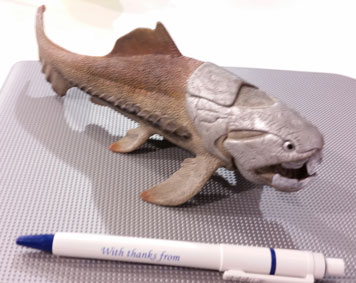
Swimming into view the Schleich Dunkleosteus model.

Picture credit: Everything Dinosaur

The picture above, shows the Dunkleosteus model from Schleich: Schleich Prehistoric Animal Models.

One of the mysteries surrounding the huge, carnivorous Dunkleosteus (the name means Dunkle’s Bones, as this animal was named after the American palaeontologist D. H. Dunkle), is exactly what this animal looked like.  Scientists believe that is lived in the open ocean, and was pelagic (lived above the sea floor).  It is likely that it was also nektonic (an active swimmer), however, only the head and thorax of this fish were covered in bony plates.

A number of these bony plates have been preserved as fossils and scientists have a good idea of what the front end of Dunkleosteus looked like. As for the rest of the animal, the lack of fossil remains (rest of the skeleton probably made of cartilage, like sharks) means that scientists have to make an educated guess as to what the animal actually looked like.

Did Dunkleosteus have a shark-like habit? Was it an active hunter, swimming constantly as it lacked a swim bladder like sharks?  Or was the bus-sized fish more like an eel with a long slender body, fringed with ribbon-like fins swimming sinuously?

Scientists have used the complete remains of smaller placoderms as the basis for their reconstructions of Dunkleosteus.

A Model of Dunkleosteus (Wild Safari Dino Dunkleosteus)

Picture credit: Everything Dinosaur

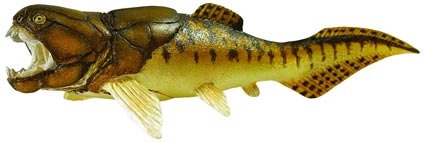
In this illustration, Dunkleosteus is modelled on the anatomy of a sleek, predator with a powerful tail providing bursts of acceleration to help it catch prey.  The body is broader than in other depictions of this particular placoderm and the tail flukes wider at the bottom to give thrust.

This is the model of Dunkleosteus created by Safari Ltd of the USA and is part of the model series entitled Wild Safari Dinos.

To view the prehistoric animal models in the Wild Safari Prehistoric World range: Safari Ltd. Wild Safari Prehistoric World.

2 08, 2009

Review of the Wild Safari Dinos Dilophosaurus Model

By |2022-12-25T19:53:40+00:00August 2nd, 2009|Categories: Dinosaur Fans, Everything Dinosaur News and Updates, Main Page|0 Comments

Review of the Wild Safari Dilophosaurus Model

With the release of the movie Jurassic Park, the Early Jurassic theropod Dilophosaurus became quite a familiar sight in dinosaur model series.  Despite the very dubious representation of this member of the Coelophysoidea in the film, Dilophosaurus models have appeared in the Carnegie Collectibles series, Bullyland, Schleich Dinosaurs and recently in the Procon/CollectA range.

Wild Safari Dinos Dilophosaurus

Dilophosaurus was badly misrepresented in Jurassic Park, first of all it was undersized, the animals depicted in the film were much smaller than an adult Dilophosaurus (D. wetherilli) would have been.  In truth, Dilophosaurus could attain lengths in excess of 6 metres, making it one of the largest predatory dinosaurs around during the Sinemurian faunal stage of the Early Jurassic (approx. 200 million years ago).  There is no evidence of a neck frill that could be extended to scare or intimidate other dinosaurs.  The neck frill idea was just part of the film designer’s imagination, perhaps they had been observing the Australian frill-necked lizard (Chlamydosaurus kingii).  Another feature of Dilophosaurus depicted in the film, again a result of an over active imagination of the film designers, was the poison glands.  The fossil record has yielded very little evidence of any poisonous theropods and certainly not with a dilophosaur.  However, the delicate and light jaws of Dilophosaurus seem unsuited to coping with struggling prey so we can see where the design team got their idea from.  A disabled victim, poisoned by venom from a Dilophosaurus would present little danger to the light and delicate jaws.

The genus Dilophosaurus seems to be quite widespread with fossils found in western North America and China.

A Scale Drawing of Dilophosaurus wetherilli

Picture credit: Everything Dinosaur

One of the newest models of this particular dinosaur is the Wild Safari Dilophosaurus (Safari Ltd of the USA).  This new model is an updated representation of this meat-eating dinosaur and presents Dilophosaurus as a more lithe and lighter creature with a long slender tail.  This contrasts with the early representation of this dinosaur as depicted in the Carnegie Dinosaur Collectibles range.  In this earlier model, introduced in 1994, a pair of dilophosaurs are portrayed together, a homage to the fact that since three skeletons of this dinosaur have been found in close proximity, they may have lived in packs.

The Wild Safari Dilophosaurus

Dilophosaurus (Carnegie Collectibles).

Picture credit: Everything Dinosaur

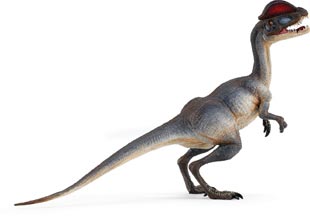
Wild Safari Dilophosaurus Dinosaur Model

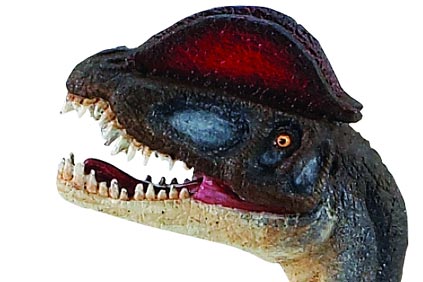
The Wild Safari Dilophosaurus shows a terrific amount of detail, the neck is much more slender in appearance and the two skull crests (after which this dinosaur is named), are narrow and delicate looking.  These crests are much more accurately reproduced when this particular model is compared with earlier versions such as the Schleich Dinosaurs series or the Bullyland Dilophosaurus model.  The legs are much thinner than on earlier models, although care has been taken to give the impression of a strong runner, after all, Dilophosaurus was probably quite agile and fast.    The model is painted in a dark brown pigment with a lighter tan under-body, with only the head showing any flashes of colour; flesh covering the anteorbital fenestra is coloured blue and the skull crests are a reddish hue.

A View of the Wild Safari Dilophosaurus Head

Picture credit: Everything Dinosaur

In the close up view of the head of the model, the blue flash on the side of the head can clearly be seen, the crests are prominent and the fine paintwork around the mouth is revealed.  The distinctive, kinked upper jaw of this particular dinosaur is visible on this replica.

This new addition to the Wild Safari Dinos model series is probably one of the best depictions of Dilophosaurus around at the moment.

To view the model and the rest of the prehistoric animal models in this series: Safari Ltd. Wild Safari Prehistoric World.

1 08, 2009

The New Everything Dinosaur Summer Newsletter

By |2024-02-22T12:40:52+00:00August 1st, 2009|Categories: Everything Dinosaur News and Updates, Main Page|0 Comments

Everything Dinosaur Summer Newsletter

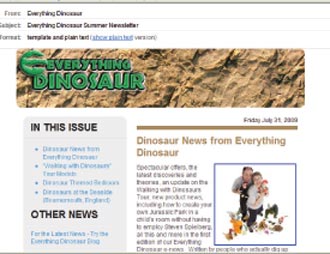
Further investment in our database management systems has enabled us to develop a new template for our occasional newsletters.  Everything Dinosaur sends out every now and then product updates, information about dinosaur events, museum attractions, news and other dinosaur or prehistoric animal related information to our subscribers.

Everything Dinosaur Newsletter

Our latest newsletter has just been dispatched and we have been watching all the statistics about email opening, click throughs and such like.  It is rather exciting seeing all the information and data, or perhaps we don’t get out enough any more.

Anyway, the newsletter features information on the new Carnegie Safari model range, how to convert a bedroom into your very own Jurassic Park, plus news on our work at the Dinosaur Encounters exhibition in Bournemouth.  There is also a cheat’s guide to purchasing merchandise related to the “Walking with Dinosaurs” UK tour.

A Snapshot from the Everything Dinosaur Newsletter

Picture credit: Everything Dinosaur

If you want to subscribe to our newsletter, or contact us about anything for that matter, click the link below to email us:

Contact Everything Dinosaur: Email Everything Dinosaur.

Today is the day we are all off to see the “Walking with Dinosaurs” show. We are going to Manchester for our VIP visit, for once I am letting everyone else do the organising.  All I know is that I have to be at the warehouse for 10am this morning, should be a fun day, so we are saying good bye to our dinosaur toys for a few hours.

To view the huge range of dinosaur and prehistoric animal themed toys and gifts available from Everything Dinosaur’s award-winning website: Visit Everything Dinosaur.

31 07, 2009

Back to the Trees – Evidence of Earliest Tree Dwelling Vertebrate

By |2023-02-25T17:44:02+00:00July 31st, 2009|Categories: Dinosaur and Prehistoric Animal News Stories, Main Page, Palaeontological articles|0 Comments

Late Permian Fossil shows evidence of Adaptations to an Arboreal Habitat

A new paper in the scientific publication of the Royal Society journal Proceedings Biology, describes a strange ancestor of mammals that may have lived in the trees.  This is the first evidence from the fossil record of a vertebrate adapting to an arboreal lifestyle.  It also reveals a change in the eco-systems of the Palaeozoic with land animals adapting to and exploiting new food sources, such as leaves in the branches of trees.

Tree Dwelling Vertebrate

The paper describes the articulated fossils and skull material of a primitive synapsid reptile.  The fossils of several individuals, including mature adults as well as juveniles were discovered in a single block of red mudstone discovered in central Russia’s Kirov region.  The long limbs and grasping hands of this 50 cm long animal seem perfectly suited to climbing trees.  The scientists have even found evidence of an “opposable thumb”, a particular adaptation of a digit to permit it to grasp and help the hand or foot to hold things, such as the branches of a tree.

The animal has been named Suminia getmanovi and the evolutionary changes that the fossils show allowed these animals to forage for food in tree branches, away from the fierce crocodilian-like predators and pelycosaurs that roamed on the ground.

In photographs of the fossil the animal is lying with the head towards the right, the long humerus and the elongated fingers can clearly be seen .

Excavating a Mudstone Block

The mudstone block containing the fossils, perhaps a group of animals that had drowned in a flash flood was discovered in 1994, but only recently have all the skeletons been available for close examination.

The team of researchers from the Field Museum in Chicago led by lead author Dr Jorg Frobisch have claimed that this is the earliest fossil evidence of a vertebrate adapting to a life in the trees, some 100 million years before the first true mammals.

Commenting on the anatomical features of this little reptile that helped it climb trees; Dr Frobisch stated:

“The hands and feet made up almost half of the length of its whole limb.  That’s humungous, if you compare it to your own arm”.

The large manus (hand) ended in long, slender and curved fingers, ideal for climbing.  The fingers probably had claws helping this small creature to grip as it clambered up tree trunks.

Dr Frobisch explained:

“In life these probably would have been covered in a hard, keratinous coating, much like in modern-day birds, these would have helped the animal climb”.

Adapted to Climbing

But the most significant observation the team made was that one finger on each hand and foot was “opposed” to the rest, much like a thumb.  Such an adaptation can be seen in our own thumbs, part of the tree climbing ancestry of humans.

Commentating on the importance of their discovery, Dr Frobisch added:

“It’s the first time in the fossil record that we’ve seen evidence of an opposable thumb”.

Between the time when Suminia lived, and the period to which fossils of the earliest-known tree-dwelling mammals have been dated, there is a gap of about 100 million years.

Simon Conway Morris, a palaeobiologist from the University of Cambridge added:

“In this case a vertebrate, specifically a synapsid – from which the mammals themselves emerged – was ahead of the game of climbing trees.  In fact it was about 30 million years ahead of schedule”.

Visit Everything Dinosaur’s website: Everything Dinosaur.

30 07, 2009

Dunkleosteus An Amazing Fish Built like a Bulldozer and a Guillotine for Jaws

By |2024-04-18T06:56:22+01:00July 30th, 2009|Categories: Animal News Stories, Dinosaur Fans, Main Page|0 Comments

Dunkleosteus – The Terror of the Devonian

The Devonian period which lasted approximately sixty-three million years (417 million years to 354 million years ago), is known as the Age of Fishes, as fish were the most advanced vertebrates on the planet for much of the Devonian.  Although the Devonian period marks the formation of a supercontinent with the closing of the Lapetus Ocean, life in the oceans still dominated and it was only towards the end of the Devonian that primitive tetrapods began to venture out onto land. Lakes and rivers were becoming populated by fish and the land was forested as plants evolved greater adaptations to a terrestrial habit.  Indeed by the Middle Devonian, land plants were becoming more complex and taller and by the end of this geological period the first trees had become established.

Dunkleosteus

Insects diversified and began to increase in number, exploiting the many new opportunities life on land was providing.  However, it was in the sea where the truly spectacular animals lurked.  The top predators in the marine environment were the newly evolved primitive sharks and the armour plated placoderms such as Dunkleosteus.

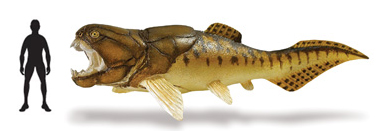
A Scale Illustration of Dunkleosteus

Picture credit: Everything Dinosaur

The model in the picture is a Wild Safari Dinos Dunkleosteus model.

Dunkleosteus was a huge prehistoric fish with an armoured head and thorax made up of several interlocking plates.  In large specimens (the biggest may have been as long as bus), the armour was up to 5 cm thick.  The word placoderm means armoured or plated skin, it is pronounced plak-oh-dermz and this particular group of jawed fish had their origins in the Silurian, rapidly diversified in the Devonian before becoming extinct at the end of this period, leaving a sort of evolutionary dead end.  The ancestors of placoderms lacked teeth, instead this group developed a pair of bony plates that hung down from the top jaw, whilst the edges of the lower jaw were also bony and very sharp.  When the mouth was closed the jaws sheared against each other making a self-sharpening cutting surface.  Dunkleosteus was a top predator and the fossilised remains of regurgitated fish, the remnants of a meal from a Dunkleosteus have been found.

A Replica of the Anterior Portions of the Giant Member of the Placodermi Class – Dunkleosteus

A Dunkleosteus exhibit.

A Dunkleosteus cast on display.

Picture credit: Everything Dinosaur

With jaws like a guillotine and a front end built like a bulldozer, Dunkleosteus was a very formidable predator indeed.

To view a model of Dunkleosteus and other amazing replicas of prehistoric animals, take a look at the PNSO section of the Everything Dinosaur website: PNSO Age of Dinosaurs.

29 07, 2009

Land of the Lost Movie Review

By |2022-12-25T19:44:56+00:00July 29th, 2009|Categories: Main Page, Movie Reviews and Movie News|0 Comments

Land of the Lost Movie Review

Summer holidays must be here and the schools broken up as this time of year sees the release of a certain genre of film designed to entertain families and hopefully while away an afternoon.  The Land of the Lost straddles the science fiction/screwball comedy genre and if you are keen to spend an afternoon out of the rain at the cinema then this film delivers a number of nice comedy moments.  It doe not really hang together as a cohesive story though, it gave us the impression of a number of sketches and bizarre situations rather stitched together, but it does have its funny moments.  Most of the amusing lines are delivered by the film’s main star, Will Ferrell who plays Dr Rich Marshall.  The cast includes Anna Friel, playing a somewhat smarter research assistant and Danny McBride as a sort of American version of Ray Mears.

Land of the Lost Movie Review

Our trio of unlikely heroes end up proving Dr Marshall’s theory of time travel correct and ending up in a strange parallel universe populated by early hominids, lizard people, pterosaurs and of course dinosaurs.  The chase scenes with T. rex at least allow Will Ferrell the chance to test some of the theories scientists have regarding this large predator.  For example, how fast could T. rex run, was this dinosaur able to turn swiftly and such like.  We enjoyed the references made to some of these theories and concepts, but in parts of the film the CGI did not look very realistic and overall the look of the movie was quite disappointing.

If you like the bumbling humour of Will Ferrell then you won’t be too disappointed.  The film is based on a old American TV series, none of us can remember the original and we suspect that this film will also soon slip from our collective memory.

Visit Everything Dinosaur’s award-winning website: Visit Everything Dinosaur.

27 07, 2009

The Remarkable Scutosaurus – a Brilliant Light Bulb

By |2022-12-25T19:40:43+00:00July 27th, 2009|Categories: Dinosaur and Prehistoric Animal News Stories, Dinosaur Fans, Main Page|0 Comments

The Remarkable Scutosaurus – Permian Giant

The Permian period lasted from 290 million years to 248 million years ago.  A major event during this part of the Palaeozoic was the formation of the super-continent of Pangaea.  Shifting continental plates had begun to create a single, huge landmass in Carboniferous times, but it was in the Permian that the supercontinent Pangea formed.  Pangaea was to last for over a 100 million years before beginning to break up in the Early Jurassic.  As the continental plates that make up the Earth’s crust are still moving today, the break up is continuing.  For example, the Atlantic ocean is getting a little wider each year, roughly at the same speed your finger nails grow.

The end of the Permian is marked by a mass extinction event, approximately 65% of all vertebrate families became extinct.  Amongst the casualties were the bizarre armoured Pareiasaurs, a group of strange looking reptiles, some of which grew to the size of cars.

Scutosaurus

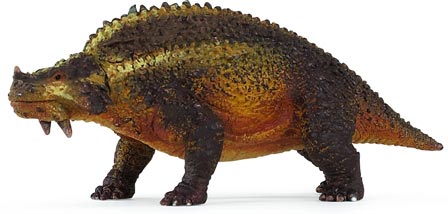
One of the more advanced pareiasaurs was the enormous Scutosaurus.  At something like 3 metres long and weighing as much as 1,000 kilogrammes this animal was one of the largest land living animals to have ever existed when they roamed the dry, arid landscapes of the Permian supercontinent.

Scutosaurus had a squat body, strong, powerful legs, and a short tail that was too small to reach the ground.  The broad head had a large mouth and the animal was probably an unfussy grazer of coarse, plant material.  The large body supported a huge gut, a prerequisite if you are going to try to digest tough plant matter.

Thickened Skull

The skull was thickened and ornamented with bizarre knobs and bumps.  Ornamentations on the skull are a common feature of pareiasaurs, some smaller forms even evolved head shields, making them resemble horned dinosaurs such as Triceratops and Styracosaurus.

Scutosaurus was a very advanced Permian reptile, the legs of this animal did not sprawl out to the side like other reptiles.  Instead they were directly under the body, supporting the animal’s great weight.  This stance and gait made Scutosaurus a very efficient walker and these animals may have migrated long distances in search of food to fill their enormous stomachs.

When the fossil record is examined, the pareiasaurs seem to have evolved and diversified very quickly towards the end of the Permian, perhaps exploiting the environmental niches left vacant as other genera died out.  Scientists have estimated that there may have been dozens of different genera.  Then, as quickly as they appear in the fossil record, they all disappear, it seems that no pareiasaurs survived into the Mesozoic.  Some palaeontologists refer to ancient reptiles like Scutosaurus as fossil record light bulbs – they shine very brightly, but briefly in the fossil record, before like a light bulb, burning out and disappearing forever.

A Scale Model of Scutosaurus

Scutosaurus.

Picture credit: Everything Dinosaur

To view the huge range of prehistoric animal models and figures available from Everything Dinosaur: Dinosaur and Prehistoric Animal Models.

26 07, 2009

Questions About Dinosaurs – What’s in a Name?

By |2023-02-25T20:48:40+00:00July 26th, 2009|Categories: Dinosaur and Prehistoric Animal News Stories, Dinosaur Fans, Main Page|1 Comment

Naming Female Dinosaurs – use “a” not “us”

Team members at Everything Dinosaur get asked all sorts of questions by young dinosaur fans when we are out and about visiting schools.  Now that most of the schools in the UK have broken up for the Summer holidays, the questioning does not stop, we get sent emails or we are cornered at a dinosaur event and put on the spot.

Our experts try to answer every enquiry the best they can and do follow them up, sending out more information if an a particular query requires it.  For example, one of our team members was asked the other day why Maiasaura had such a strange name compared to other dinosaurs.  Maiasaura was a Late Cretaceous hadrosaur (hadrosaurine, duck-billed dinosaur).

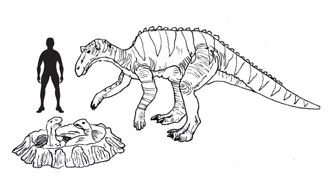
Fossils of this particular dinosaur have been found in North America and the animal is most closely associated with the Upper Cretaceous sediments at Two Medicine Formation near Choteau in western Montana.  On a visit to the area in 1978, the famous American palaeontologist Jack Horner was shown a collection of tiny dinosaur bones by a group of amateur fossil collectors.  Jack, recognised the remains as fossils of baby dinosaurs, and, when the location was fully explored, a fossilised nesting colony of Maiasaura was discovered.  This site in Montana has yielded over 200 individual specimens, ranging from unhatched eggs to fully sized adults.

A Scale Drawing of an Adult Maiasaura with a Nest

Picture credit: Everything Dinosaur

Dinosaurs

It seems that Maiasaura lived in large herds and migrated to favourite nesting sites to breed and raise their young, just like some modern birds.  Something like, fifteen individual nests were discovered by Jack Horner and his team, but the site itself is much larger with extensive fossil rich sediments to explore.  The Maiasaura built nests by piling together leaves and soil in a similar fashion to Alligators.  The rotting vegetation helped incubate the eggs.  When the eggs hatched the young stayed in the nest for sometime and depended on the parents to feed them (altricial behaviour).

Jack Horner and his colleagues estimated that the baby Maiasaura stayed in the nest for about one month.  Interestingly, the space between each nest on the Montana site was quite uniform.  There was approximately 7 metres between each one, just about enough room for an adult Maiasaura to squat next to her nest to guard it.  This type of formation is found in many sea bird nesting colonies today.

Questions About Dinosaurs

As Maiasaura is associated with a nesting colony and altricial behaviour she was named “Good Mother Lizard” and since it was suggested that the majority of adult skeletons associated with the site were female, Maiasaura was given the female gender for her name.  The female form is “saura” and the male, more commonly used format is “saurus”.  This is why Maiasaura has an unusual ending to her name (binomial name M. peeblesorum).

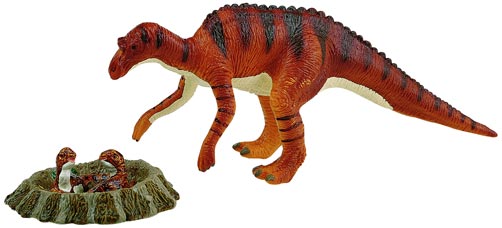
The Scale Model of Maiasaura by Carnegie Safari

Model of “Good Mother Lizard”.

Picture credit: Everything Dinosaur.

Maiasaura is represented in the modelling world by a super replica from Carnegie Safari.  When the model was first introduced, (Carnegie Collectibles Maiasaura dinosaur), the adult Maiasaura was depicted sitting on her nest.  This was not an accurate representation, a fully grown Maiasaura would have crushed any eggs she sat on.  The model makers introduced a second model showing the mother Maiasaura and her eggs separately.

To view the prehistoric animal models and figures in the Wild Safari range: Safari Ltd. Wild Safari Prehistoric World Models and Figures.

The only other dinosaur with the female form to her name that we can think of is the small dinosaur Leaellynasaura, associated with polar deposits in the southern hemisphere.  This dinosaur was named by husband and wife palaeontologists Tom and Patricia Rich after their daughter Leaellyn.

Go to Top