All about dinosaurs, fossils and prehistoric animals by Everything Dinosaur team members.
15 07, 2009

Spectacular Bournemouth Dinosaur Exhibition a Roaring Success

By |2024-04-17T11:08:36+01:00July 15th, 2009|Categories: Dinosaur and Prehistoric Animal News Stories, Everything Dinosaur News and Updates, Main Page|0 Comments

Bournemouth International Centre – Dinosaur Encounter Exhibition/Summer Ice Rink

The dinosaur exhibition located at the Bournemouth International Centre is a big success.

“Mum, Dad what can we do today”?  This is the question that a lot of Mums and Dads are going to be asked over the next few weeks as the school holidays begin.  With young ones to entertain and amuse over the Summer, why not take a trip to the Bournemouth International Centre (Bournemouth, Dorset) for a day out with a difference!

Dinosaur Exhibition

The Bournemouth International Centre (BIC) offers two fun activities for the Summer holidays, especially designed with families in mind.  Firstly, get your skates on and get down to the BIC as the Summer Ice Rink has just opened.   This ice rink, built in association with Heart 102.3FM is the UK’s largest indoor temporary event providing the opportunity for the whole family to try ice skating in a safe, and friendly environment.  There is even a special section of ice for very young skaters with their Mums and Dads to have a go. Who knows you could end up an Olympic champion!

Running alongside the ice skating is the Dinosaur Encounter exhibition, a chance for families to get up close and personal with huge, animatronic models of some of the most famous dinosaurs known in the fossil record.  Are you brave enough to come face to face with a Triceratops and its babies?  Could you scare away a flock of Oviraptors as they attempt to steal eggs from a dinosaur nest?  Are you fast enough to run from an angry Ankylosaurus when it swings its massive tail club at you?

The Ankylosaurus at the Dinosaur Encounter Exhibition (BIC)

Picture credit: Everything Dinosaur (BIC)

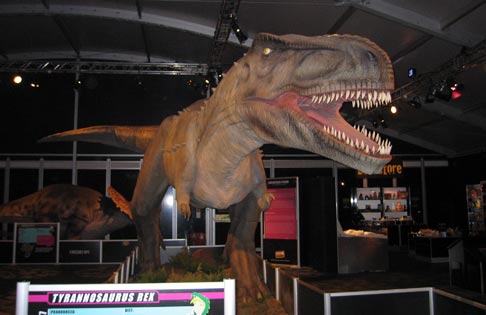
The animatronic dinosaurs are some of the largest models in the world and with the support of the Natural History Museum – London, you can be guaranteed that they depict these prehistoric giants accurately.  The highlight of the exhibit is the 2/3 size Tyrannosaurus rex, it really is a monster!  Watch young children’s jaws drop as they get up close to one of the largest and fiercest animals ever to live on our planet.

The Animatronic Tyrannosaurus rex (BIC)

Ferocious T. rex

Picture credit: Everything Dinosaur

Are you brave enough to stare back at a T. rex?

The ice skating rink is open until Sunday 6th September and the Dinosaurs Encounter Exhibit is open daily from 10am until August 31st.

For further information visit the BIC website or check out the Everything Dinosaur blog.

Visit Everything Dinosaur’s user-friendly website: Everything Dinosaur.

14 07, 2009

What was a Kronosaurus? That’s a Great Question!

By |2024-04-17T11:09:11+01:00July 14th, 2009|Categories: Dinosaur Fans, Main Page|0 Comments

Kronosaurus – A Fierce Cretaceous Marine Predator

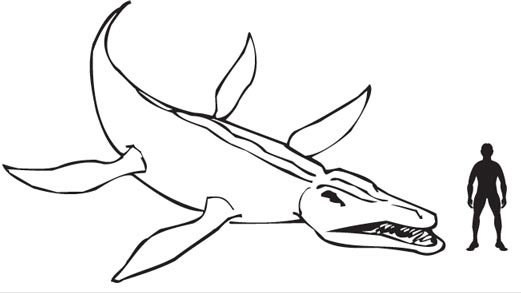
Kronosaurus  (Kronosaurus queenslandicus), was an enormous marine reptile, not a Dinosaur but a pliosaur, a short-necked member of the Plesiosauria.  Fossils of this animal have been found in Australia (Queensland) and South America.  It was an apex predator of marine environments during the Cretaceous, with the largest species such as Kronosaurus queenslandicus reaching lengths in excess of 10 metres.

The massive head of Kronosaurus accounted for approximately 25% of its total length.  The jaws ran almost the length of the skull, giving this predator an enormous gape.  The largest teeth in an adult Kronosaurus were over 7 inches long.

An Illustration of Kronosaurus

Picture credit: Everything Dinosaur

Kronosaurus queenslandicus

The first fossils of this marine predator were found in 1889, it was named and described in 1901.  Kronosaurus had very strong gastralia (belly ribs), when compared to other pliosaurs.  Scientists have speculated that this animal may have spent more time out of the water than other pliosaurs.  It has also been suggested that these animals did go onto land to lay eggs, like modern turtles.

Over the years, there have been numerous models and replicas of Kronosaurus produced.  CollectA for example, have a Kronosaurus replica in their Deluxe scale model series.

To view the Kronosaurus and the rest of the scale models in the CollectA Deluxe series: CollectA Deluxe Prehistoric Life.

13 07, 2009

Not all Fossils are Dinosaurs (A Helpful Explanation)

By |2024-04-17T11:09:44+01:00July 13th, 2009|Categories: Main Page, Teaching|0 Comments

Not All Fossils are Dinosaurs

Everything Dinosaur team members are often asked questions by school children about the biggest and fiercest meat-eaters.  The students may ask whether Giganotosaurus really was bigger than T. rex for example.  Whilst trying to answer their many questions we do try to stress that the fossil record is not made up of just dinosaurs.

Dinosaur Fossils

When the fossil record is examined, dinosaurs make up only a tiny portion, indeed the fossil record is dominated by marine organisms (as far as we know all dinosaurs lived on land) and it is the invertebrates who make up the vast majority of fossils.

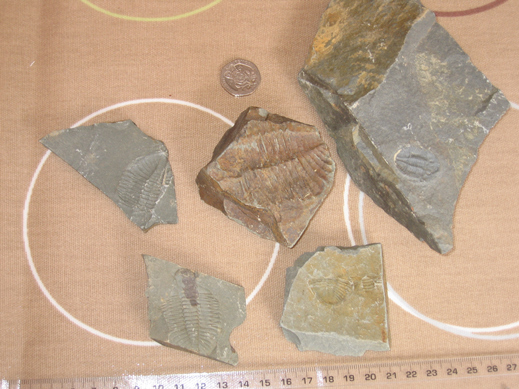
A Selection of Trilobite Fossils from Wales

A selection of trilobite fossils.

A selection of our trilobite fossils.  The coin helps to provide a scale.

Picture credit: Everything Dinosaur.

Trilobites and Ammonites

Many invertebrate groups, trilobites and ammonites are much more important to palaeontologists than vertebrate fossils.  Identifying strata by examining the types of fossils they contain has been a process of enquiry since the early 19th Century.  Indeed, engineers such as William Smith were able to work out the relationships between different rock layers based on the different types of invertebrate fossils they contained.  This method of using fossils to identify the relative age of strata is called biostratigraphy. The stratigraphic column (rock strata), is divided into zones, sometimes called biozones, these are characterised by one or more specific fossil species.  These in turn are called zonal fossils.

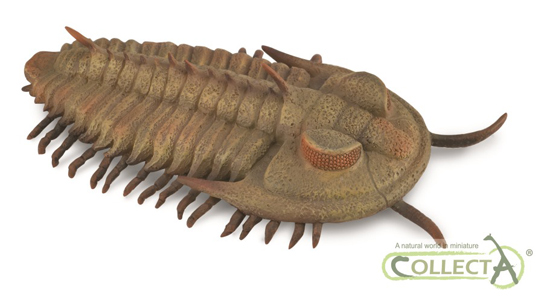
A Replica of a Trilobite (Redlichia rex)

CollectA Redlichia rex trilobite.

CollectA Redlichia rex trilobite model.

To be a helpful zone fossil, an organism needs to be relatively abundant, live in a marine environment and rapidly evolving so as to develop many different forms.  The more geographically dispersed the better, so ammonites and trilobites make very effective zone fossils.

CollectA have introduced several model figures representing important invertebrate animals from the fossil record.  To view the CollectA range: CollectA Age of Dinosaurs Models and Figures.

Despite all the hyperbole and media attention given to the Dinosauria, they really only make up a tiny portion of the known fossil record.  Being rare, often found as incomplete, partial skeletons and terrestrial; dinosaurs are not good zone fossils.  Whilst talking to some palaeontology students from Canada the other day, we were not unduly surprised to hear that in three years of lectures, the dinosaurs had been covered in a single afternoon.

12 07, 2009

Themed Dinosaur Party Food is Easy to Make

By |2024-04-17T11:02:22+01:00July 12th, 2009|Categories: Educational Activities, Everything Dinosaur News and Updates, Main Page|0 Comments

Food for Dinosaur Parties

When it comes to organising that dinosaur themed birthday party for a dinosaur obsessed youngster one of the many questions we get asked is how to customise food so that it fits in with the party theme?  It is not easy to find dinosaur shaped sandwiches and tit-bits in your local supermarket, but you needn’t spend a fortune to ensure that your party buffet cuts the Mesozoic mustard

Dinosaur Themed Party Food

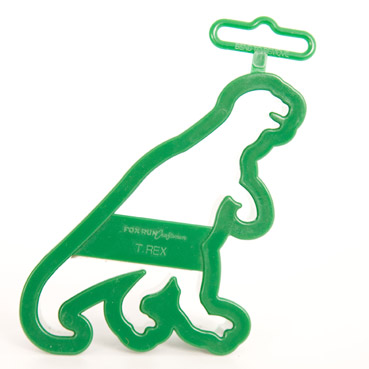
For example, dinosaur shaped cookie cutters are inexpensive to purchase and can be used to create biscuits shaped like prehistoric animals.  We supply a range on our website along with free to download recipes and instructions.  However, don’t be limited just to the sweet elements of your menu when it comes to using the cookie cutters.  We have used both our plastic and metal cutters to create dinosaur shaped sandwiches for hungry dinosaur fans.

To view the Everything Dinosaur range: Visit Everything Dinosaur.

Using soft bread, we find that white or wholemeal sliced loaves work best; and a series of simple fillings such as spreads, (peanut butter, chicken paste, jam, honey), dinosaur shaped sandwiches and light bites can be created simply by using the cookie cutters to cut out the sandwich once the slices have been prepared.

A Tyrannosaurus rex Themed Cookie Cutter – Ideal for Dino Shaped Sandwiches
Picture credit: Everything Dinosaur

The biscuit cutter is dishwasher prove and makes lovely shaped biscuits and sandwiches shaped like Tyrannosaurus rex.  They prove very popular at dinosaur themed birthday parties and the cutter is very easy to use and clean afterwards.

Taking a cocktail stick, and a coloured piece of paper prepare a label for the sandwich platter using simple dinosaur vocabulary (a quick look in your child’s dinosaur book should give you plenty of inspiration).  The cocktail stick can be used to stick securely the label to the plate, like a little flag.  Make sure you blunt the end of the cocktail stick still sticking up after you have secured the label to it, you don’t want anyone pricking their finger.

Summer Dinosaur Parties

With Summer dinosaur parties, the barbecue can often come out into its own.  Naturally, with us Mums and Dads supervising the cooking.  Ordinary burgers can become dinosaur inspired “Brachiosaurus burgers” with Tyrannosaurus rex red relish (tomato ketchup to you and me).  Please don’t be tempted to call your burgers “Brontosaurus burgers”, unless you want to incur the wrath of any of the more erudite of your young guests.  The name Brontosaurus is no longer accepted or used in scientific circles, although a genus of Late Jurassic diplodocid dinosaur was recently named Eobrontosaurus.  Brontosaurus had to undergo a name change in the 1970s, the reason for this is laid out below:

The eminent American palaeontologist Othniel Charles Marsh described and named Apatosaurus in 1877 from fossils found near the town of Morrison in Colorado, USA. Two years later, bones of what was thought to be another dinosaur were found at a quarry at Como Bluff, Wyoming. This animal was described and named as Brontosaurus “Thunder Lizard” by Marsh. As more skeletons were found, scientists realised that these two dinosaurs were actually the same genus, and since Apatosaurus was described first, the name Brontosaurus had to be disregarded.

In 1905 when the world’s first long-necked dinosaur skeleton went on display at the American Museum of Natural History it was wrongly labelled as Brontosaurus. Thanks to this and many Hollywood films, the name Brontosaurus seems to have stuck in people’s imaginations and for many years “thunder lizard” was one of the best-known dinosaurs.

So be warned, if your young dinosaur fans know their dino-data they will point out to you your mistake if you name anything Brontosaurus.

Herbivorous dinosaurs were some of the first large land animals to exploit the new food source of fruit in the mid to Late Cretaceous.  Don’t forget to add some fruit salad to your Mesozoic menu.  You can always label it up as “Fruit Salad Swamp” or “Fruit-o-saurus”.  By doing this you can ensure a healthy and nutritious balance to your “Styracosaurus Snacks”.

Finding Recipes

For recipes, more instructions and of course more information about dinosaur themed party food, simply log onto our website: Everything Dinosaur you will find a whole section of the site dedicated to this subject with free downloads, ingredient check lists and all sorts of helpful stuff.  There is even the recipe, instructions and templates to create your own dinosaur shaped birthday cake.  Best of all these information is available free as a download.

Every item put into our dinosaur shop is tested by ourselves and our pet parents and dinosaur fans.  We even tested out the biscuits and cake recipes.  Each member of staff was given job of trying to come up with recipes suitable for dinosaur themed events.  Then using our cookie cutters and such like we all had to make some.

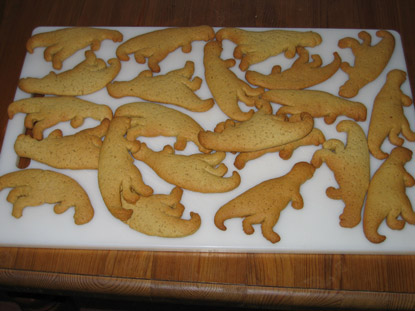
My Tyrannosaurus rex Gingerbread
Picture credit: Everything Dinosaur

My gingerbread dinosaurs, just out of the oven and cooling down ready for icing.  Not a bad effort for someone like me, who generally struggles to remember the recipe for toast.

Update

Following an extensive revision of diplodocid fossils, Brontosaurus is once again accepted as a valid genus.


11 07, 2009

Experimenting with Ezines and Ezine Formats

By |2022-12-25T18:17:35+00:00July 11th, 2009|Categories: Everything Dinosaur News and Updates, Main Page, Press Releases|0 Comments

Communicating with Customers – using Ezines

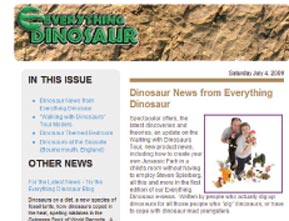
One of the many projects team members at Everything Dinosaur have been working on is a new format for our occasional customer newsletters.  According to those who are more digitally minded than the rest of us, these are termed ezines (electronic magazines we assume).

Everything Dinosaur

We have been asked to test out a number of software packages that offer supposedly easy to use email newsletter writing systems.  I guess we were chosen as we are not the most IT literate of company’s, but we have all been having a go, trying out the different templates and formats.

Most of the systems we tried seem to be fairly easy and logical to operate, using WYSIWYG technology (stands for What You See Is What You Get).  The layout and style of the email piece can be changed and we were each given the option to try out a particular template to see what we thought worked the best.

After a little debate a template style called “Smooth Water” proved to be the most popular.  It was then just a case of getting it customised with our logo and corporate style and then we were ready to write and send our first piece.

An Example of the New Ezine Format

Picture credit: Everything Dinosaur

Communicating with Customers

We are certainly not experts at creating a newsletter but when we have sent out occasional news letters and emails to our database, we do get a high number of openings and click throughs and very few nifties (bounce backs).  I am sure there is more that we can do to improve communication with our customers and those who have submitted their contact details to us, but we are learning all the time.

To learn more about how Everything Dinosaur uses customer information or to register to join our newsletter database: Email Everything Dinosaur.

At one of our weekly meetings, just after we had decided on the type of ezine we wanted to send out and agreed the style we came up with a list of 5 tips to help with electronic communication with customers.  There are a lot better informed people than ourselves but we thought we would share these tips in case they prove helpful.

Some Tips for Electronic Communication

* One click unsubscribe – a quick way to unsubscribe is very important.  In some countries it is a mandatory requirement.  The unsubscribe link should take the recipient directly to a page where they are then removed, courteously and without fuss from your mailing list.

* Get the attention of your readers quickly, try to devise a snappy attention grabbing subject line for your electronic communication, perhaps offer a benefit or something to get them reading more.

* Always include a signature at the bottom of any communication, it is one of the easiest ways to attract more traffic to your website.  This signature should include your company contact details and an unsubscribe link.  You can use your signature to link back to your website, and even to other products, but we think this shows professionalism.

* Provide the option to have readers view the electronic communication in a “browser format”, by offering them this you are showing courtesy and acknowledging that some readers may have difficulty viewing your communications using their own software.

* Try to personalise your email, rather than state “Dear Reader” invest in database technology that permits you to personalise and customise your communications, after all, everyone wants to be treated as an individual.

One final thought, in this age of data protection, we would recommend that anyone with a company holding data in a variety forms in the UK, they ought to subscribe to the Data Protection Act.  We subscribe to this act and pay our annual fee and do all we can to protect our customer’s and employees information plus ensuring that we abide by UK legislation regarding data protection.

Visit Everything Dinosaur’s award-winning website: Everything Dinosaur.

10 07, 2009

Review of Ice Age 3 – Dawn of the Dinosaurs

By |2023-03-02T13:48:04+00:00July 10th, 2009|Categories: Main Page, Movie Reviews and Movie News|0 Comments

Review of Ice Age 3 – Dawn of the Dinosaurs

With a release timed to coincide with the start of the school holidays, the third film in the Ice Age franchise is definitely written with the need to keep the kids entertained in mind.  Manny the mammoth, his friends Diego and Sid find themselves in a lost world with dinosaurs to contend with as well as the imminent arrival of Manny’s first child, with his heavily pregnant partner Ellie (voiced by Queen Latifah).

Dawn of the Dinosaurs

The animation is up to the high standards of the previous two movies, but this time the movie is shot in 3-D, whether this gimmick adds anything to the enjoyment of the film is debatable, perhaps the film makers thought it best to add a novel twist to freshen up the franchise.

There are some particularly funny moments and some subtle jibes at parent hood, epitomised by the increasingly anxious Manny as he tries to “baby proof” nature prior to the arrival of his baby.  New characters are introduced, a romantic love interest for Scratt, the acorn chasing prehistoric squirrel and a strange, swashbuckling weasel character called Buck voiced by the English actor Simon Pegg.  Buck reminded us of Ben Gunn, the character in Treasure Island (the novel by Robert Louis Stevenson), that was left on the island and craved toasted cheese whilst awaiting rescue.

An enjoyable and light hearted film, that kept the children entertained.

Visit Everything Dinosaur’s website: Everything Dinosaur.

9 07, 2009

A Remarkable Ancient Duck – Oldest Bird with a Toothless Jaw found to Date

By |2024-04-17T11:01:25+01:00July 9th, 2009|Categories: Dinosaur and Prehistoric Animal News Stories, Main Page|0 Comments

Discovery of Earliest Known Fossil of a Toothless Bird Announced

The discovery of the oldest known toothless bird has been announced by Chinese scientists.  The evolution of birds and their diversification during the Late Jurassic and Cretaceous is little understood by palaeontologists.  There are very few fossils to study.  Birds with their ability to fly took to forests and wooded areas very early in their evolution, especially with so many small theropod dinosaurs running around, being up in a tree and relatively safe was a good place to be for a bird.  However, in forest environments the potential for fossil preservation is often very poor, so there are only a few fossils of early birds within the fossil record.

An Ancient Duck

The north-eastern Chinese province of Liaoning is the exception with many fine specimens of birds (and feathered dinosaurs) having been unearthed.  This new Liaoning genus, named Zhongjianornis yangi was about the size of a pigeon and like the majority of fossils found in this area, the specimen represents an individual that ended up at the bottom of a lake, covered with fine sediment which was low in oxygen and ultimately this aided preservation as a fossil.  A study of the fossil, the paper of which is due to appear in the scientific journal – Proceedings of the Royal Society B, reveals that this early bird may have been semi-aquatic, a sort of early duck.

Fossil Skeleton

To date only one fossil skeleton has been found, but it is virtually complete and like many of the other Liaoning fossils shows exceptional detail.  This particular bird had a long, pointed snout with toothless jaws, shedding new light on the evolution of that well-known feature of birds – the beak.  The Chinese team have dated this creature to approximately 120 million years ago, Early Cretaceous (Aptian faunal stage), it represents the most primitive toothless bird discovered to date.

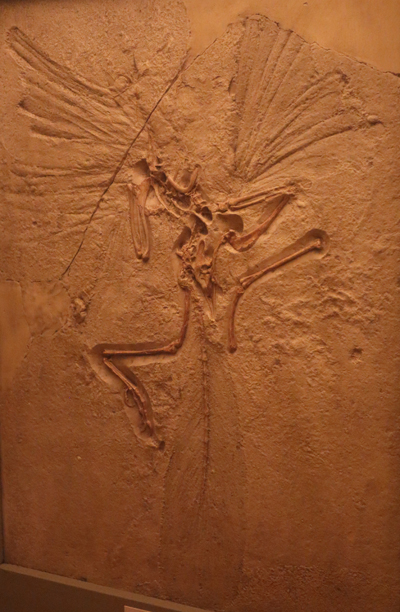
Although the earliest known bird Archaeopteryx had a number of reptilian features including needle-like teeth in the jaws, a number of different types of bird soon lost their teeth as the Aves order diversified.  This is an example of parallel evolution, with different types of creature evolving the same solution to a common problem, in this case the need to lose weight so that flight could become more efficient.  This is an example of selective pressure to produce a lighter skeleton to aid flight.

A Replica of an Archaeopteryx Fossil

Archaeopteryx fossil cast

Archaeopteryx fossil cast. Picture credit: Everything Dinosaur.

Picture credit: Everything Dinosaur

This particular primitive bird may have fed on fish, although this is speculation, the pointed snout would have helped it catch them but the lack of teeth may have made holding onto slippery prey difficult.  However, many bird species feed on fish today so this is quite possible.  There was a lot of prey in the lush forests and lakes of the Liaoning region during the Early Cretaceous.  The fossil record from Liaoning is very rich with many types of fish, amphibians, reptiles, mammals, plants and birds known, as well as the dinosaurs.

Commenting on this discovery, palaeontologist Dr Zhonghe Zhou, of the Chinese Academy of Sciences, Beijing, stated:

“Over 30 genera of Early Cretaceous birds have been reported in the last two decades from the Lower Cretaceous of north-eastern China, documenting a burst of avian diversification that followed the appearance of the earliest bird Archaeopteryx”.

This new discovery will add to our knowledge regarding the diversity of early birds.

Dr Zhou added:

“The new material is represented by a nearly complete and articulated skeleton. The new bird displays a combination of features that are unknown in any previously reported taxon; in particular, it represents the most basal avian that had completely lost teeth”.

It is very likely that the vast Liaoning deposits will yield even more strange and wonderful fossils in the future, providing scientists with an insight into life in the Mesozoic.

Visit Everything Dinosaur’s website: Everything Dinosaur.

8 07, 2009

Cave Women had a “Hand” in Prehistoric Art

By |2023-03-02T13:49:00+00:00July 8th, 2009|Categories: Dinosaur and Prehistoric Animal News Stories, Main Page|0 Comments

Evidence Suggests Cave Women not Cave Men were Responsible for Cave Paintings

The contemporary image of a solitary cave man carefully painting an image of the animals he and his fellow hunters intended to catch is being challenged by a new study into European cave art. Cave women played a significant role, according to new research..

Professor Dean Snow and a team of researchers from Pennsylvania State University have compared the hand impressions left by our ancestors on cave walls with those of modern Europeans and concluded that many of the hand prints were from women.  If the prints are female, then it could be suggested that the artworks, too were by the hand of the fairer sex.  The hand print, being a symbolic gesture indicating ownership of the painting or perhaps staking a claim for recognition for their artwork, just as a painter may sign their work today.

Cave Women

Having studied the Palaeolithic paintings in French caves such as Pech Merle in south-western France and the cave at Gargas (French Pyrenees), the American team concluded that even after a “superficial” examination of published photographs there seemed to be plenty of female hands depicted on the cave walls.

Adult male hands are normally much larger in size than adult females, the smaller prints left behind by our ancestors on cave walls could have been made by woman or younger males or females.  Such a revelation could challenge our existing understanding of the role of the sexes in early human settlements.

Professor Snow and his team used measurements of the hands of modern Europeans and compared these to the measurements taken of the hands from the cave walls.  Using ratios between the digits to determine the sex, the team concluded that a number of the prints were female.

Commenting on the digit ratios, Professor Snow stated:

“The very long ring finger, it is a dead giveaway for male hands, a long index finger and a short little finger is very feminine”.

If you give a child a paint tray and ask him or her to make an impression of their hand, they normally place their hand in the paint and then press it down on the paper to make an impression of the hand.  However, cave paintings depicting hands were made very differently.  Hand prints were not used, instead the hand was used as a sort of stencil.

Scientists have suggested two techniques, firstly the hand was placed on the area of wall where the imprint was required and the paint spat out of the mouth to create a stencil affect.  An alternative method of using a straw to blow the pigment-like paint onto the wall has also been proposed.

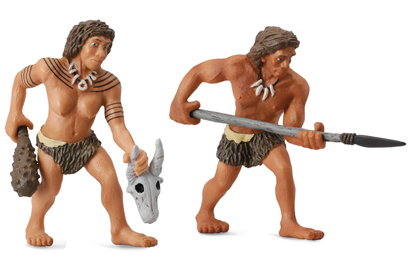
CollectA Neanderthal Models (Cave Man and Cave Woman)

CollectA Neanderthals

CollectA Neanderthal models.

To view the CollectA model collection: CollectA Age of Dinosaurs Popular Models.

Many of the cave paintings have been dated to between 40,000 and 20,000 years ago.  If the artwork was made by women, then the current thinking regarding the role of females in cave society will have to be re-examined.  Indeed, the artwork may have had a different purpose than that assumed previously.  Many of the pictures depict oxen, horses and antelope, the sort of animals that our ancestors hunted.  If the artwork was produced by the women of the clan, did they also participate in the actual hunts?  Images of people hunting left on cave walls have always been interpreted as male, but perhaps if the role of women was greater in ancient cave clan society, perhaps they also took part in hunts.

7 07, 2009

Lazy “Couch Potato” Dinosaurs According to New Research

By |2024-04-17T10:15:12+01:00July 7th, 2009|Categories: Dinosaur and Prehistoric Animal News Stories, Main Page|0 Comments

Dinosaur Size Linked to their Lifestyle and Availability of Food

No sooner have papers been published suggesting that the body weights of dinosaurs may have been overestimated, a new report has just come out suggesting that dinosaurs got so big simply because the resources in their environment allowed them to do so.

Recently, the accepted methodology for estimating the mass of dinosaurs has been challenged.  Heavyweight dinosaurs such as Apatosaurus and Diplodocus have had their estimated body weights reduced using a new mathematical formula.  Now zoologists from the University of Florida have published research that indicates that dinosaurs were the “couch potatoes” of the Mesozoic.

To read the article challenging the accepted methods for calculating the weight of dinosaurs: Dinosaurs were “Thinosaurs” – A weighty issue.

Dr McNab and his team have argued that with easy access to abundant food and a sedentary lifestyle dinosaurs were able to grow into the biggest land living animals known in the fossil record.  A number of theories have been put forward suggesting why dinosaurs were able to grow so big.  For example, natural selection may have favoured bigger and bigger animals through predation pressure and the need to fight to secure a mate.  Or being large may have helped dinosaurs regulate their body temperatures, as large animals with a greater surface area to body mass ratio are generally able to maintain a stable body temperature when compared to much smaller creatures.

However, the team from the University of Florida believe that it was the availability of food resources that was the most important factor.

Using a model based on a vertebrate’s energy use, expenditure, mass and eating habits, Dr McNab explained the body size of living and extinct mammals, including baleen whales, an ancient rhinoceros and modern elephants.  He used the example of the larger mass found in some marine mammals which reflect greater resources in their environment.  Developing his argument Dr McNab has stated that the dinosaurs were neither warm or cold-blooded but maintained a stable body temperature somewhere between the warm-blooded mammals and the cold-blooded reptiles of today, thanks to their enormous size.

While Dr McNab said that thermal biology differences are easily seen in small organisms, he suggested dinosaurs were neither cold nor warm blooded but maintained an intermediate temperature between mammals and reptiles, thanks to their size.

According to the American team, herbivorous dinosaurs grew large as their diet of plants was very edible, with later types of dinosaur benefiting from the development of flowering plants (angiosperms) and fruit.  The paper is published in the scientific journal “The Proceedings of the National Academy of Sciences”.

Dr McNab commented:

“Like couch potatoes sitting within easy reach of high calorie foods, the gargantuan size of dinosaurs most likely stems from the abundance of resources available, coupled with low energy expenditures.   Some dinosaurs reached masses that were at least eight times those of the largest, ecologically equivalent terrestrial mammals”.

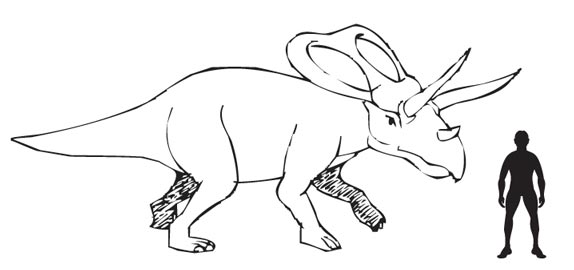
A Scale Drawing of a Herbivorous Dinosaur – Torosaurus

Picture credit: Everything Dinosaur

The picture shows an approximate size comparison between a person and a Late Cretaceous herbivorous horned dinosaur, a Torosaurus, a close relative of Triceratops.  Could access to lots of plants including fruit have helped these dinosaurs grow so big?

Dr McNab went onto state:

“The factors most responsible for setting the maximal body size of vertebrates are resource quality and quantity, as modified by the mobility of the consumer, and the vertebrate’s rate of energy expenditure”.

This new report is certainly going to raise one or two eyebrows, when extant types of fern and conifer are studied it is clear that they are difficult to digest and lacking in nutrients.  Even angiosperms quickly evolved toxins and other defences to protect themselves from the ravages of large herbivores.  Having to eat particularly difficult to digest food may be a reason in itself why dinosaurs grew so big.  Herbivores needed a huge digestive system to cope with such a diet and the carnivores grew big too, as their prey got gradually bigger and bigger – a sort of plant-eater/meat-eater arms race.

Visit Everything Dinosaur’s website: Everything Dinosaur.

6 07, 2009

A Clever Dinosaur Birthday Cake

By |2023-03-02T13:52:05+00:00July 6th, 2009|Categories: Dinosaur Fans, Everything Dinosaur News and Updates, Main Page|0 Comments

A Clever Dinosaur Birthday Cake

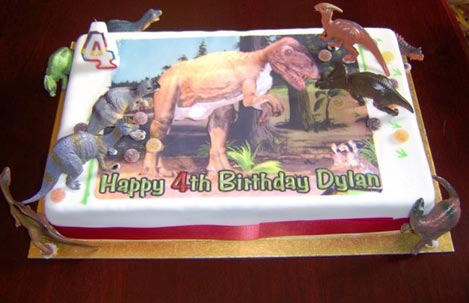
We get lots of pictures, letters and emails from customers showing us how creative they have been using our dinosaur and prehistoric animal products.  For example, a lady called Susan sent us in a picture of a dinosaur birthday cake that had been embellished with the addition of some dinosaur models supplied by us.  It was a huge hit at the family’s dinosaur themed birthday party.

The cake was created for her dinosaur-mad, grandson Dylan, to celebrate his fourth birthday.  He was delighted with it and Susan received lots of compliments from the parents who attended the dinosaur birthday party and got the chance to see it before the cake was devoured.

A Dinosaur Themed Birthday Cake

Picture credit: SW/Eat your Photo

Dinosaur Birthday Cake

It looks like a lovely cake, it would have been a fantastic centre piece to any dinosaur themed birthday party.  The models were from our dinosaur party range, Susan used four on the top and five around the sides on the cake board.  There was a tenth model, but as Susan says in her email to us, she had to give the tenth model to Dylan to keep him happy because he did have to wait for the cake to be cut before he could have the rest to play with.

We are sure Dylan loved his dinosaur birthday cake and he does have a very clever grandmother.

To view Everything Dinosaur’s huge range of dinosaur themed toys and games: Visit Everything Dinosaur.

Go to Top