All about dinosaurs, fossils and prehistoric animals by Everything Dinosaur team members.
24 11, 2010

New Ways to Display your Dinosaurs – Museums for the 21st Century

By |2023-01-14T10:31:47+00:00November 24th, 2010|Categories: Dinosaur and Prehistoric Animal News Stories, Main Page|0 Comments

Landmark Dinosaur Experience due to Open in 2011

The dusty multi-drawed cabinets, dark, dimly lit rooms with a single mounted skeleton almost obscured by metal supports and struts all shown off against a drab, wooden panelled backdrop, straight out of the 19th century.  This may be the rather old-fashioned view of a dinosaur museum gallery, one, team members at Everything Dinosaur recall with familiarity, but museums are changing and the emphasis these days is on innovation when it comes to displaying dinosaurs.

Leading the way is the Natural History Museum of Los Angeles County, as they reveal their plans for their new state-of-the-art dinosaur hall – a large, permanent exhibition area which will double the museum’s capacity to display its dinosaur fossil collection.

Dinosaur Experience

Naturally, there is only so much that creative museum directors and the collection curators can do given the difficulties of exhibiting large dinosaur specimens in what are, in many cases unsuitable display galleries.  Take London’s Natural History Museum building for example, a magnificent monument to science in the reign of Queen Victoria.  It is indeed, a very beautiful building and at the time it opened in 1881 it was heralded as a triumph of architecture.  However, the building is difficult to maintain, expensive to heat and the dinosaur gallery is quite dark and poorly illuminated.  Only a limited number of the extensive collection of fossils can be displayed at any one time and visitors are often unable to walk completely around a particular mounted exhibit, thus limiting the view of the specimen on display.

Is this Just About Everyone’s View of a Museum T. rex?
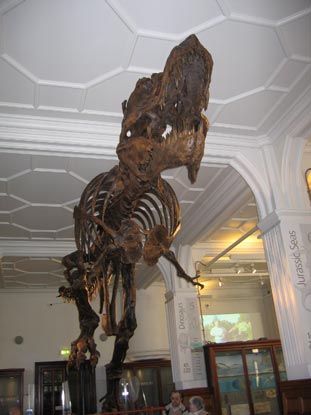
Picture credit: Everything Dinosaur

Lack of space often restricts the view of a mounted specimen, thus limiting the viewers experience and preventing them from seeing parts of the skeleton, for example, in this case the top of the T. rex skull.

The newly opened Darwin Centre at the Natural History Museum has addressed some of these problems for the London based attraction.  This two-phase project (the first phase was opened last year), has provided extra work areas for the museum’s scientific staff as well as enabling the provision of more hands-on visitor exhibits.  The second phase of the Darwin Centre project will be to add a multi-media studio to permit even more educational themed events to take place.

The Natural History Museum, like many natural history museums around the world has recognised that the tastes and requirements of the public is changing and if museums are to attract visitors in the future, they must change to.

Team members at Everything Dinosaur, having had the opportunity to visit a number of the major natural history museums have seen these changes taking place at first hand.  Gone are the rows and rows of Victorian glass-fronted display cases, they have been replaced by interactive displays that use the latest digital technology to bring ancient worlds and ancient creatures back to life.

One of the most eagerly awaited museum refurbishments is taking place at the Natural History Museum of Los Angeles County (California, USA).  There is going to be a brand new museum section especially dedicated to dinosaurs and some of the fundamental scientific questions surrounding these prehistoric reptiles.  Scheduled to open in July 2011, the new dinosaur hall will provide twice the display space as the museum had previously and it will feature more than twenty full-size, articulated specimens, many of which have never been put on display to the public before.

This permanent exhibition will feature the world’s first Tyrannosaurus rex family consisting of a baby, a juvenile and fully grown adult T. rex.  Members of the public will be able to see for the first time, how the anatomy and body shape of this iconic dinosaur changed as it grew.  This exhibit reflects the increased scientific interest in recent years regarding dinosaur ontogeny – how dinosaurs changed as they grew up.  This particular part of the new dinosaur hall, reflects the underlying theme of all the displays – helping to make scientific investigation open to all and providing vibrant, dynamic displays that will help to investigate some of the many mysteries surrounding these extinct animals.

Tyrannosaurus rex Models

The computer generated rendering provides an impresion of how the T. rex growth series will look. Visitors will be able to tour around this mount, viewing the specimens from a variety of viewpoints, the lack of glass frontage will permit these Late Cretaceous specimens to be examined in close detail, the gallery running above will permit observers to have a “birds-eye view” of a Tyrannosaurus rex family.  The thinking behind the design of this new dinosaur hall, is to showcase dinosaurs and other prehistoric animals as dynamic, active creatures.  The unprecedented access to the specimens afforded by the innovative layout will allow palaeontology and other related sciences to be presented as vibrant, on-going investigations into ancient life.

To see scale models of dinosaurs and other prehistoric animals: Dinosaur and Prehistoric Animal Models.

The largest single specimen on display in the hall will be a twenty metre long Mamenchisaurus (Chinese sauropod), other standout exhibits include an imposing full size Triceratops and a set of Cretaceous marine reptiles, excavated in California, inhabitants of the warm, tropical sea that once covered this part of the United States.

Two-thirds of the full-sized specimens have never been displayed before; the specimens that have been displayed have all been re-articulated in new and more life-like poses.  Long gone are the days of the actual bones being on display supported by tonnes and tonnes of metal scaffolding – often referred to by museum staff as “parking lots for fossil bones” or as we at Everything Dinosaur call it “public fossil storage”.

Commenting on the new dinosaur halls, Dr Jane Pisano, President and Director of the Museum stated:

“The new dinosaur hall is a spectacular realisation of the goal of our transformation, which is to bring the research and collections of the Natural History Museum vividly to life for a public that is hungry for wonder.”

For Dr Pisano and the rest of the staff the new dinosaur hall is just part of a major six-year campaign to upgrade and revamp the Museum’s facilities and exhibition space.  The cost of the work has been estimated at around £90 million GBP.

The new dinosaur hall will be organised around a series of fundamental questions surrounding the Dinosauria and other types of extinct animal – questions such as what is a dinosaur?  What was their world like?  How did they live, grow and behave?  Of course, no major dinosaur exhibition would be complete without an exploration of their fate and the mass extinction event that marked the end of the Mesozoic.

Inspired by the museum’s own in-house Dinosaur Institute (led by world famous palaeontologist Dr Luis Chiappe), the specimen-rich permanent exhibition will provide the public with the opportunity to learn how scientists piece together evidence to answer fundamental questions about the origin, diversification and eventual death of these magnificent creatures.

One of the many aims of the new dinosaur hall is to create a sense of continuum for the thrill of discovery and scientific inquiry.  After all, a new dinosaur species is named and described approximately every three weeks.

Commenting on the new exhibition space, Dr Chiappe said:

“The new Dinosaur Hall has the potential of inspiring new generations of scientists, since this exhibition highlights discovery-based fieldwork, the experience of going outdoors and finding treasures, and then understanding how they fit within the current scientific record.”

Dr Chiappe went on to add:

“Most dinosaur exhibitions are organised around specific types of dinosaurs or by periods of time.  Our approach is quite different.  Using new discoveries and research findings, we’re able to bring visitors into the world of dinosaurs by exploring the great questions of how they lived, behaved, and died, and whether they still exist.”

When the new exhibition opens in the Summer of 2011, visitors will also be able to learn more about the museum’s work on marine reptiles, ancient extinct leviathans such as plesiosaurs and mosasaurs.  The Natural History Museum of Los Angeles County has an extensive collection of marine reptile fossils, many excavated by the museum’s own research team and field workers.

Recently, Dr Luis Chiappe co-authored a scientific paper revealing that our current understanding of the anatomy of one such group of marine reptiles – the fearsome mosasaurs, may be incorrect.  Some of these giant animals, relatives of modern lizards, may have had tail flukes just like sharks.

To read the article on the reconstruction of mosasaurs: Mosasaurs – Monsters with a Shark’s Tail.

We wish the Natural History Museum of Los Angeles County every success with their preparations for the dinosaur hall’s opening.  Hopefully, we will get some pics sent into us when the exhibition project is complete.
23 11, 2010

Post Dinosauria – The Mammals Got Big

By |2023-01-14T10:28:03+00:00November 23rd, 2010|Categories: Animal News Stories, Dinosaur and Prehistoric Animal News Stories, Main Page|0 Comments

Why did the Mammals get Big after the Cretaceous Mass Extinction?

With the dinosaurs dead and gone, it was the mammals that took over the mega fauna roles in the Palaeogene and with the exception of the phorusrhacids in South America, the mammals went onto to dominate food chains and ecosystems across the planet.  However, the types of mammals that became the biggest plant-eaters and carnivores varied as the Cenozoic progressed.

The question remains, as to how the mammals, so long in the shadow of the Dinosauria, were able to diversify and dominate, leading to the evolution of animals many thousands the times heavier than their Cretaceous ancestors just twenty million years later.

The Class Mammalia, has ancient roots.  Many unique groups of small mammals evolved during the Mesozoic, but today there are only three main Orders, the monotremes (egg laying mammals), the marsupials (possums and wombats etc.) and the most successful Order to date – the placentals (bats, hoofed animals, tigers, dogs, whales and of course, ourselves).

Prehistoric Mammals

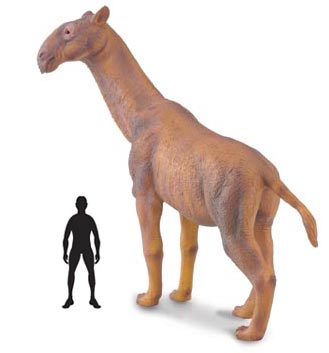
In a new study, published in the scientific journal “Science”, an international team of researchers have concluded that the mammals were able to exploit food resources and adapted to colder climatic conditions and this combination of factors led to them increasing in size.  Some of the largest mammals, for example, rivalled the dinosaurs in terms of bulk.  Indricotheres, ancient ancestors of modern rhinos, were perhaps the largest.  Weighing over 15 tonnes and standing nearly 5 metres high at the shoulder, these giant herbivores are known from Oligocene strata from the famous Hsanda Gol formation and other fossilferous strata of the Asian sub-continent.

A Scale Diagram of an Indricothere (Paraceratherium)

Picture credit: Everything Dinosaur

The research project funded by a U.S. Foundation National Science grant brought together scientists from universities all over the world to track the mammalian fossil record and analyse how they diversified and grew bigger.

For models and replicas of prehistoric mammals: Models of Prehistoric Mammals.

Researcher Jessica Theodor of the University of Calgary (Canada) commented:

“When dinosaurs went extinct, maximum mammal size was between one and ten kilogrammes, in that size range.  But it did not take long for mammals to start growing after the dinosaurs died out 65 million years ago, leaving loads of vegetation for others to eat.”

She went on to add:

“Twenty-five million years later, we have mammals that are a thousand times bigger.”

The two year study, conducted by researchers from around the world, examined the mammalian fossil record in a bid to understand how the mammals became big.  With the dinosaurs around, the quick-metabolising mammals had to try to compete with larger reptilian rivals for food resources, the mammals were not able to compete.  With the mass extinction event, mammals took their opportunity and rapidly came to dominate.

The research team concluded that trends in mammalian growth were seen on all the continents, what was happening in Asia was also being mirrored in the Americas and Europe.

Researcher John Gittlemen of the University of Georgia stated:

“It includes information on the size of all mammals, living and fossil, from around the world.  The database is powerful and unique.”

An Extensive Database

Having compiled such an extensive database, examining large body bones and tooth fossils, both of which provide solid evidence of overall animal size, the researchers were able to draw conclusions regarding the science of growing big.

Jessica Theodor concluded:

“There is strong selection pressure for herbivores to get really big.  Being big protects you from predation because very large herbivores do not get preyed on very much.”

In addition, falling global temperatures over the later stages of the Palaeocene and the Eocene would have led to the evolution of bigger body sizes, as large animals are able to maintain a constant internal temperature more efficiently than smaller creatures.

Jessica added:

“Large mammals do not have to work so hard to stay warm, so cold climates tend to favour the evolution of large mammals.  More food would have been available to bigger mammals because their stomachs were larger and produced compounds that could break down tougher parts of trees and plants.”

Larger animals could accommodate a larger gut, permitting these creatures to specialise in different kinds of herbivory eating parts of plants that are not that nutritious.  Such animals could rely on gut bacteria to break down plant cellulose.

Interestingly, the scientists discovered that just because you are “top dog” one day or epoch, there is no guarantee that you are going to stay on top.

Reflecting on this finding, Theodor said:

“It was not the case that say, elephants get big and then elephants are always the biggest mammal [land living] on the planet.  There are times when it is giant rhinos, there are times when in South America it is all kinds of weird things including – believe it or not camels.”

Commenting on the study, a spokesperson for Everything Dinosaur stated:

“Camels are ruminants and being big permits them to have large guts to handle fibrous vegetation.  Today we think of camels as animals living in dry, arid environments, however, many extinct species were at home in forest habitats and grassland environments.”

The change in dominance implies that there is something fundamental about being a large mammal.  The research team have concluded that the “top dog” niche exists apart from who is filling it.  It is an open space into which some type of mammal will move.

This research suggests that in the future other types of mammal may grow large to take over from the Proboscidea (animals with trunks such as elephants) as the largest land living mammals.  Giant pigs, racoons, or horses perhaps?

22 11, 2010

How to Make your very own “Dinosaurs in a Net Set”

By |2023-03-06T12:14:31+00:00November 22nd, 2010|Categories: Everything Dinosaur News and Updates, Everything Dinosaur Newsletters, Main Page|0 Comments

Inexpensive and Creative Christmas Gift Idea – Dinosaur Models in a Net

These days with Christmas rapidly approaching there never seems to be enough time available to personalise a present or to make something a little bit special for your young dinosaur fan.  To assist our customers, here is some information on how you can create an inexpensive and novel dinosaur themed gift, one that would make an ideal stocking filler for Christmas – a “Dinosaurs in a Net Set”,

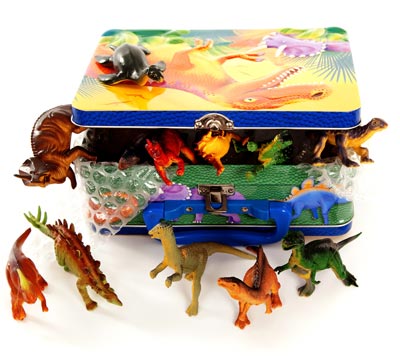
Presentation sets and gift sets of dinosaurs and prehistoric animals are always popular with young dinosaur fans.  We at Everything Dinosaur sell a variety of such items, for example the “Dinosaurs in a Tin” gift set, twelve carefully selected plastic prehistoric animal models packed into their own dinosaur themed tin storage box.

Everything Dinosaur – Dinosaurs in a Tin Gift Set

Picture credit: Everything Dinosaur

To view the dinosaurs in a tin gift set and other dinosaur themed gifts and presents: Dinosaur Toys and Gifts.

However, for those of you who want to be a little more creative, here is an idea for your very own and unique dinosaur themed gift set – make your own “Dinosaurs in a Net Set”.

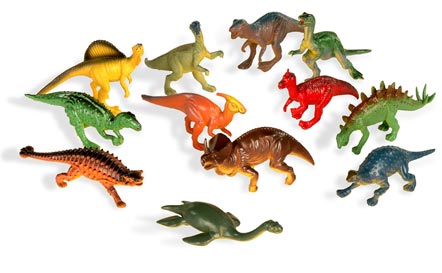
Simply, purchase a number of individual dinosaur models, there are lots and lots to choose from.  At Everything Dinosaur we sell a number of ranges, supplying models singly, or in batches of five, ten or even twenty.  Then next time you are out shopping pop into your local greengrocers (grocery store) and ask for a small plastic net.  Greengrocers break bulk items into handy, smaller packs for their customers.  They use small, plastic nets (usually coloured green), to pack items like onions, shallots, peppers and fruit such as satsumas.

If you are a regular shopper, most greengrocers would be happy to let you have some nets for free, or perhaps they may charge you a token amount.  However, this is very much cheaper than having to pay for the cardboard wrapping and packaging with a shop bought dinosaur model gift set.

Once home, give the net a quick wash, if you want to, let it dry and then when you are ready to assemble your unique gift set – simply pop your chosen models into the bag.

Put your Dinosaur Models into the Plastic Net

Picture credit: Everything Dinosaur

The picture above shows some of the many different types of prehistoric animal models available from Everything Dinosaur.

To view the dinosaurs and other models: Prehistoric Animal Replicas.

Dinosaur Models

You will find the plastic net expands and you can get more than a dozen hand-sized prehistoric animal models into it.  Tie it up with a bit of spare ribbon, we found that red ribbon looked the best when used with a green plastic net.  Don’t forget the gift tag, this is easy to add, just by simply looping the ties through the plastic netting towards the neck of the bag.

Viola!  Your very own, handmade and unique dinosaur model gift set.  Your very own “Dinosaurs in a Net Set”, a personalised gift for your young dinosaur fan.  All put together in a matter of minutes at a fraction of the cost of a shop bought gift set such as a plastic dinosaur play set.

To view a video demonstrating how to make your very own dinosaur model gift set:

Video: How to make your “Dinosaurs in a Net Set”

This idea was sent into us at Everything Dinosaur, by a customer and we know that it has proved to be a big hit with those mums, dads and grandparents who have put together their very own dinosaur gift set for the young palaeontologist in their family.

21 11, 2010

How to Revive a Triceratops

By |2023-03-06T12:16:44+00:00November 21st, 2010|Categories: Everything Dinosaur News and Updates, Main Page, Press Releases|2 Comments

Resuscitating a Triceratops (or an Apatosaurus or Stegosaurus for that Matter)

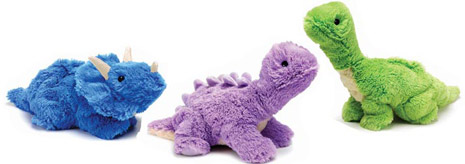
With the onset of the first severe frosts of winter, time to get out your wheat grain filled dinosaur Bedtime Buddies.  These cute and adorable dinosaur themed soft toys are filled with special wheat grains and scented with lavender and are designed to be heated in the microwave to provide children with a scented, warm bedtime buddy to curl up to in bed.  There are three different dinosaurs in the current range, a purple Stegosaurus, a deep blue Triceratops and a green Apatosaurus.

Apatosaurus and Brontosaurus

The Apatosaurus is sometimes marketed as a Brontosaurus but as all young dinosaur fans know, the name Brontosaurus is no longer valid and this dinosaur formerly known as Brontosaurus (Thunder Lizard) has been renamed.

The Dinosaur Bedtime Buddy Range

Picture credit: Everything Dinosaur

Cute Dinosaur Soft Toy

These beat a hot water bottle any day, a cute toy dinosaur which is fully microwavable to make a super soft, cuddly and warm bedtime buddy.

For dinosaur toys and models of prehistoric animals like Triceratops and Apatosaurus: Everything Dinosaur.

As the soft toy gets microwaved then it gradually loses its lavender fragrance.  However, there is no need to panic, since every product that is in the Everything Dinosaur shop has been tested by ourselves and our own pet test families and researchers we know exactly what to do to revive your bedtime buddy and bring back its soothing lavender scent.

Bedtime Buddies

When the bedtime buddy is cold, carefully put a few drops of a good quality lavender oil onto it and this will bring back the relaxing scent.  In our tests, we found that four drops of lavender on the Triceratops worked best, we placed three evenly spaced along the back and one on the belly.  A similar arrangement worked for the purple Stegosaurus, but for the Apatosaurus we used five drops.  We put a drop on the head of the Apatosaurus, one into neck, with a further two more into the body.  Once again, the final drop was placed on the tummy.

We found it was better to put top up drops of lavender oil onto the soft toy when it was cold as microwaving the bedtime buddy really brought out the aroma and it was more difficult to judge when enough drops had been added.

A Triceratops Fossilised Skeleton on Display at a Museum

Triceratops Fossil on Display

A cast of a Triceratops skeleton on display at the Naturmuseum Senckenberg (Natural History Museum – Frankfurt). On the left a wall mounted example of a Plateosaurus can be seen. Picture credit: Everything Dinosaur.

Picture credit: Everything Dinosaur

By reviving the bedtime buddies in this way we found that the lovely smell of lavender was always on hand, these high quality soft toys should provide you with thousands of hours soothing warmth and comfort – just the ticket for these cold nights.

*Following a revision of diplodocid fossil remains, Brontosaurus is once again a valid genus.

To view Everything Dinosaur’s range of soft toy dinosaurs: Dinosaur Soft Toys.

20 11, 2010

Last Safe Posting Dates for Surface Mail (Western Europe) Approaches an Important Update

By |2024-04-21T09:21:06+01:00November 20th, 2010|Categories: Everything Dinosaur News and Updates, Main Page, Press Releases|0 Comments

Tuesday 23rd – Last Recommended Posting Date for Surface Mail

The Holocene is certainly whizzing by, and another Christmas is nearly upon us.  We at Everything Dinosaur, do all we can to pack and despatch parcels out to customers as quickly as possible.  Once again, a number of our team members are busy this morning (Saturday) packing orders to ensure that they are collected today (Saturday) by our especially arranged collection.

For amazing dinsaur themed toys and prehistoric animal themed games visit Everything Dinosaur’s award-winning website: Everything Dinosaur.

Posting Dates

Please note, the last recommended posting date for surface mail deliveries to western Europe is rapidly approaching.  The last “safe” posting date for goods sent to western Europe by international surface mail is Tuesday 23rd November.  Parcels sent after this date, may not reach their destination in time for Christmas.  This time of year international postal delivery networks are increasingly stretched so please, please, order as early as possible to give your parcels and gifts every chance.  Of course airmail services are still available after 23rd November.

To learn more about the last safe posting dates for Christmas gifts, please visit our web log article which provides further information:

Christmas Post: Recommended Posting Dates for Christmas 2010.

19 11, 2010

Dinosaur Themed Christmas Gift – Dinosaur Models in a Net

By |2023-01-14T07:50:13+00:00November 19th, 2010|Categories: Dinosaur Fans, Everything Dinosaur News and Updates, Everything Dinosaur videos, Main Page|0 Comments

Dinosaur Models in a Net – An Inexpensive Gift

Looking for a easy, inexpensive, yet creative Christmas gift?  Why not try a “Dinosaurs in a Net Set” from Everything Dinosaur.  Here is a short video that explains how to create your very own and unique dinosaur model gift set, a gift that will cost you a fraction of what you spend if you have to buy something similar on the high street.

“Dinosaurs in a Net Set” from Everything Dinosaur

An inexpensive gift idea – dinosaurs in a net.

Video credit: Everything Dinosaur

This is a simple idea, one that will appeal no doubt to mums and dads purchasing dinosaur models and toys for their  young dinosaur fans.  After all, dinosaur toys are a big hit at Christmas.

Dinosaur Models

Dinosaur models and replicas of prehistoric animals are wonderful for helping children to develop imaginative and creative play. Learning about dinosaurs is often one of the first term topics that children encounter when they move up from nursery into the reception year group. After all, who doesn’t like learning about dinosaurs and prehistoric animals.

A Selection of Dinosaur and Prehistoric Animal Models

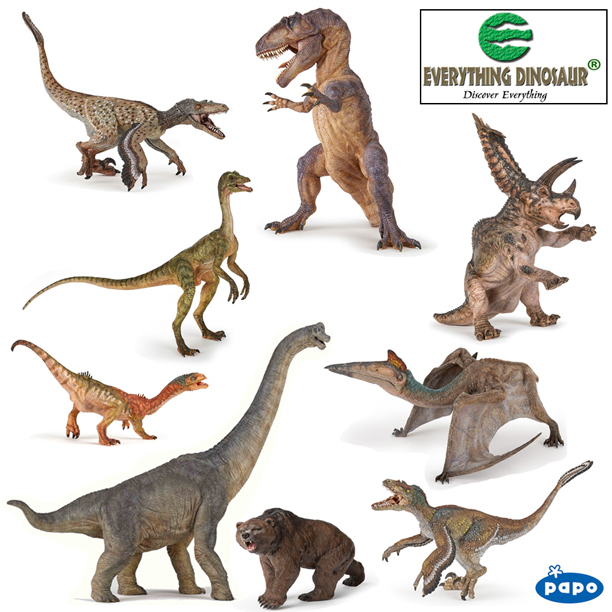
Papo prehistoric animal models in stock.  Dinosaur models in stock.
Everything Dinosaur received (mid July 2021) a large shipment of Papo prehistoric animal models. More than a dozen Papo figures are now back in stock at Everything Dinosaur.

The models shown above are from the Papo prehistoric animal model range.

To view this collection: Papo Dinosaur Models.

18 11, 2010

Fact sheets, Fact sheets and more Fact sheets

By |2023-01-14T07:42:19+00:00November 18th, 2010|Categories: Educational Activities, Everything Dinosaur News and Updates, Main Page|0 Comments

Update on Everything Dinosaur Prehistoric Animal Fact sheet Production

For every named prehistoric animal that is represented in the Everything Dinosaur product range, from Palaeozoic invertebrates right up to prehistoric Ice Age mammals, we research and write a fact sheet on that animal.

Everything Dinosaur

Over the last six years or so, our team members have built up an extensive library, working on a huge variety of prehistoric creatures, we can’t say that we merely focus on extinct animals anymore, as a few months ago we added a Coelacanth fact sheet to our inventory.  Although, very much endangered, there are at least two species of the genus Latimeria extant (alive today) and known to modern science.

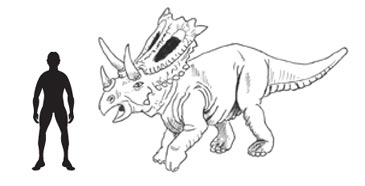
For each fact sheet, we commission a scale drawing so that readers can appreciate how big the animals were in relation to a fully grown adult human.  We provide information on the fossils found, who first discovered them, where the fossils were discovered and when.  We provide information on the likely diet (with T. rex that was easy, but for therizinosaurs and oviraptorids things get a little more tricky).  Team members try to add little snippets of information that would not be found in a reference book, something unusual about the particular animal being written about.

Prehistoric Animal Fact Sheets

We have just been briefed on the new fact sheet and drawing requirements for 2011, at least another eight fact sheets with illustrations will be required for the spring.  Some dinosaurs but mostly other extinct reptiles.

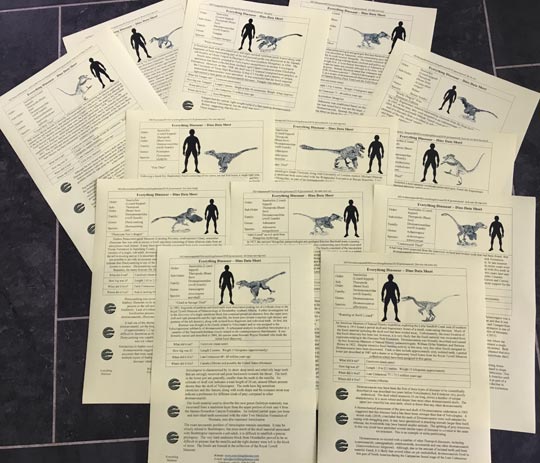
A Selection of Everything Dinosaur Prehistoric Animal Fact Sheets

Fact sheets prepared by Everything Dinosaur for the Beasts of the Mesozoic range of models.

A collection of Beasts of the Mesozoic fact sheets created by Everything Dinosaur. Picture credit: Everything Dinosaur.

Picture credit: Everything Dinosaur

Looks like our researchers and writers at Everything Dinosaur are going to be very busy.

Visit Everything Dinosaur’s award-winning website: Everything Dinosaur.

17 11, 2010

Chasmosaurus Pronunciation Providing Helpful Information

By |2024-04-20T07:56:04+01:00November 17th, 2010|Categories: Dinosaur Fans, Educational Activities, Everything Dinosaur News and Updates, Main Page|0 Comments

The Pitfalls of Dinosaur Pronunciation

Everything Dinosaur team members provide a guide to Chasmosaurus pronunciation and highlight a Chasmosaurus dinosaur model.

With a new dinosaur species being announced on average once every twenty days or so, it can be hard keeping up with all the developments in the dinosaur family tree.  One of the biggest problems we have when reading a scientific paper is the fact that in almost every paper or journal we have ever encountered, there isn’t a handy pronunciation guide provided.

This can cause problems when determining how a dinosaur, or indeed any other extinct organism name should be said.  We are not alone with this problem, a number of extinct animals are pronounced in slightly different ways by palaeontologists, remember the great debate about how to exactly say the genus Diplodocus for example.

One of the dinosaurs most commonly tripped over by young dinosaur fans when it comes to its name being said out loud is the dinosaur genus known as Chasmosaurus.  The name is not as tongue-twistingly difficult as some members of the Dinosauria, for example Micropachycephalosaurus (mike-row-pack-ee-sep-hal-low-sore-us), things become worse when you have to pronounce the formal binomial classification, i.e. the genus and the species name together, in this instance Micropachycephalosaurus hongtuyanensis.

Chasmosaurus belli

Chasmosaurus, for example Chasmosaurus belli, is known from extensive fossil material found in western North America from as far north as Alberta; to the deep south of the United States (Texas).  This five metre long, Late Cretaceous horned dinosaur, (Ceratopsian) is one of the most studied of all Campanian (Campanian faunal stage) ornithischian dinosaurs.  However, the name still catches out the unwary.

An Illustration of Chasmosaurus

“Chasm Lizard”. Picture credit: Everything Dinosaur.

Picture credit: Everything Dinosaur

To view a model of Chasmosaurus and other horned dinosaur figures: CollectA Age of Dinosaurs Prehistoric Life Models.

Despite this dinosaur being known about for almost 140 years, its name can still catch you out if you are not careful.  This dinosaur’s name means “Chasm Lizard”, from the Latin chasma which itself is derived from the Greek khasma which means “gaping hollow”.  This is why sometimes the meaning for this dinosaur’s name is stated as “Ravine Lizard”.  Anyway, the trick to saying this name correctly is to remember the original Greek root – Chasmosaurus is not stated as “Chas-mow-sore-us” as in “Chas and Dave” for example.  It is pronounced “Kaz-mow-sore-us”.

Following an extensive revision of the fossil material in the mid 1990s, the number of species assigned to the Chasmosaurus genus has been greatly reduced, but undoubtedly new species will come to light and there is a good chance that the unwary reader of a news article or report on a discovery will make the mistake that has haunted this dinosaur for all of its near 140 years of being known to science – the name will be pronounced incorrectly.

A Chasmosaurus Dinosaur Model

Chasmosaurus dinosaur model.

“Chasm Lizard” in the spotlight.

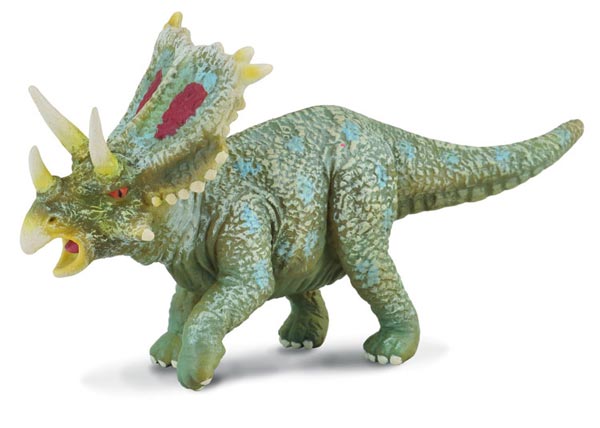
The Chasmosaurus dinosaur model is one of the horned dinosaurs available in the CollectA not-to-scale model range.

To view this range: CollectA Age of Dinosaurs Popular Range.

16 11, 2010

“Egg-citing” News Scientists Crack Open Mystery of Dinosaur Diversity in New Study

By |2024-04-21T09:23:15+01:00November 16th, 2010|Categories: Dinosaur and Prehistoric Animal News Stories, Main Page|0 Comments

Early Jurassic Dinosaur Eggs Provide Clues to Dinosaur Diversity

A team of scientists have been going to work on an egg, as they study 190-million-year-old dinosaur eggs and the tiny embryos they contain in a bid to learn more about how dinosaurs diversified.

The research’s lead author, palaeontologist Robert Reisz of the University of Toronto stated that the study:

“Opens an exciting window into the early history and evolution of the dinosaurs.”

Dinosaur Eggs

The fossils of two unborn baby dinosaurs, still preserved in their eggs, were discovered in South Africa in 1976. They had remained in storage for more than three decades and it was only with the development of new imaging techniques and powerful X-ray based scanning devices that has allowed scientists to explore and study their contents.

The eggs were laid by a primitive dinosaur known as Massopondylus (the name means “massive vertebrae”).  Massopondylus was a member of the prosauropods, a group of long-necked, lizard-hipped dinosaurs regarded by many scientists as a basal member of the Sauropodomorpha – a group of plant-eating dinosaurs that were to evolve into the largest land living animals of all time, giants like the Late Jurassic Diplodocus and Titanosaurs such as Saltasaurus.

For models of sauropods including titanosaurs: Wild Safari Prehistoric Life Models and Figures.

Massopondylus Embryos

The Massopondylus embryos, dating from approximately 190 million years ago, (Pliensbachian faunal stage) are believed to be the oldest embryos ever found from a land dwelling vertebrate.  The study, published in this month’s issue of the Journal of Vertebrate Palaeontology was co-written by two of Reisz’s colleagues – David Evans and Diane Scott, aided by U.S. based scientist Hans-Dieter Sues of the Washington-based National Museum of Natural History.

The twenty centimetre long, fossil embryos have provided the scientists with a great deal of information on how these babies once hatched would have developed into five metre long adults – the embryos are helping scientists to understand more about dinosaur growth and development, the study of the development of individuals to an adult state is called ontogeny.

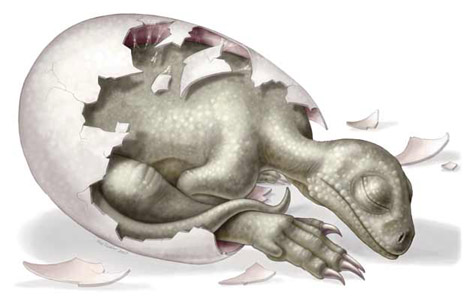
An Artist’s Impression of the Baby Massospondylus


Picture credit: Heidi Richter

Commenting on the research work, Dr Reisz added:

“Prosauropods are the first dinosaurs to diversity extensively and they quickly became the most widely spread group, so their biology is particularly interesting as they represent in many ways the dawn of the age of dinosaurs.”

The exact taxonomic relationship between the prosauropods and sauropods is still debated, some scientists assert that the prosauropods are ancestral to the rest of the Sauropoda clade, whereas others argue that they are not basal to the group.  However, a study of such perfectly preserved baby dinosaurs is providing researchers with a new understanding of just exactly how these dinosaurs grew and developed.

How Dinosaurs Grew and Developed

To read an article about the discovery of an ancestral Sauropod: The Mother of all Sauropods?

While the embryos had “relatively long front limbs and disproportionately large heads,” the research paper reports, the five metre long adults they would have become in maturity “had relatively tiny heads and long necks” typical of Diplodocus and its sauropod cousins.  The embryos are providing the research team with a better understanding of distil growth, as many vertebrate babies have different body proportions than their adult forms.  This is helping to highlight connections between the development of dinosaur infants and that of other back-boned animals including mammals.

In a summary of the team’s findings it is stated that:

“In at least one way, Massospondylus development resembles that of humans; infancy is awkward, and a more erect stance and evenly proportioned body only comes later.”

The fact that the babies may be born relatively helpless also provides a valuable insight into dinosaur parental care.  The scans of the embryos reveal that the babies had no teeth and this, combined with their awkward bodies suggests that the hatchlings may have been looked after for some time by their parents – altricial care.  If this is proved to be the case, then these fossils also represent the oldest record of parental care.

In the past, scientists assumed that huge sauropods were too large and ungainly to run the risk of having young animals under their feet.  It was thought that sauropods laid eggs in a nest but then abandoned the nest leaving any hatchlings to fend for themselves. This study when discussed in conjunction with the recent trace fossil of a sauropod trackway which suggest young sauropods walking close to an adult, may provide clues to indicate that these leviathans may have had a greater degree of parental care than previously thought.

To read more about the sauropod trackway: Running with Baby Dinosaurs

15 11, 2010

Pterosaurs “Pole-Vaulted” to Become Airborne

By |2023-01-13T22:16:24+00:00November 15th, 2010|Categories: Dinosaur and Prehistoric Animal News Stories, Main Page, Palaeontological articles|0 Comments

New Study Suggests Large Pterosaurs Used Their Arms and Legs to Get off the Ground

A new study published in the open access and online journal PLoS One (Public Library of Science) suggests that the largest of the pterosaurs launched themselves into the air by using the powerful muscles of their legs and arms to push off from the ground, effectively pole-vaulting over their wings.  Once airborne these huge creatures could fly long distances using air currents to help them stay aloft with the minimum of effort, just like many large birds do today.

Pterosaurs

Pterosaurs, otherwise known as flying reptiles, are an extinct group of reptiles that evolved in the Triassic and survived until the very end of the Cretaceous.  Their wings were formed out of skin that stretched from the body over the forelimbs and along an elongated fourth finger that acted as a supporting strut for the wing membrane.  A number of unrelated reptile groups had taken up gliding since the Permian Period, most likely to exploit food resources in trees and to escape from predators.  An example of an early glider would be a genus like Kuehneosaurus.  However, active flight in vertebrates, that is, being able to control movements in the air under the power of their own muscles, was first seen in the pterosaurs.  For millions of years, these highly specialised archosaurs, had the skies to themselves.  With the evolution of the birds, slowly but surely this once spectacular and diverse group of reptiles went into decline.

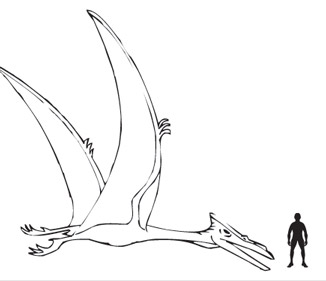
The last types of pterosaurs to evolve were huge.  The very last kinds of pterosaur that survived into the Maastrichtian faunal stage of the Cretaceous belonged mainly to a family of flying reptiles known as the azhdarchids – huge creatures like Quetzalcoatlus northropi with a wingspan in excess of 12 metres.  Scientists had puzzled for many years over how these very large and quite heavy creatures were able to launch themselves into the air in order to fly.

An Illustration of a Late Cretaceous Azhdarchidae Pterosaur – Quetzalcoatlus northropi

Picture credit: Everything Dinosaur

The Azhdarchidae Pterosaurs

Indeed, a recent theory regarding the largest of the Azhdarchidae, suggested that these reptiles, some of which were as tall as a modern giraffe, did not fly very much at all.  Instead, they roamed the Cretaceous plains, like Secretary birds; stalking small animals in the undergrowth and snatching up unwary creatures, including baby dinosaurs with their long, sharp toothless beaks.

To read an article on this theory: Getting Stalked by a Flock of Quetzalcoatlus.

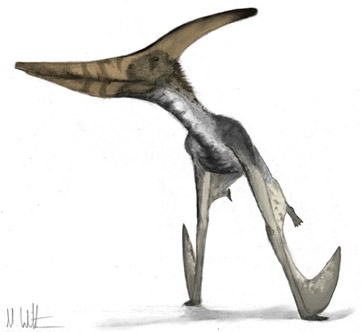
The research was conducted by Dr Mark Witton, a palaeontologist from the University of Portsmouth, a specialist in pterosaur evolution and flight mechanics.  He was aided and assisted by Dr Michael Habib from Chatham University (Pennsylvania).  The two scientists examined the bones of giant pterosaurs to see if they could work how these bizarre creatures could have become airborne.  They concluded that these animals may have literally pole-vaulted themselves up into the air.

A Pterosaur “Pole-Vaulting” into the Air

Pterosaur becomes airborne.

Picture credit: Dr Mark Witton

Another, top class illustration by Dr Mark Witton shows a pterosaur, in this instance a member of the Pteranodontidae family, a Pteranodon longiceps taking to the air, by springing off the ground using its immensely strong arms.

Pterosaur Fossils

Many pterosaur fossils have been found in strata laid down in what was a marine environment.  This suggest that these particular flying reptiles lived close to the sea.  They could have launched themselves into the air by leaping from a cliff face, in the same way that many seabirds do today.  However, for those fossils of large pterosaurs found in non-marine strata, how they would have become airborne remained more problematical.  A thorny problem that now the UK and USA based researchers suggest they have a solution to.

They examined the fossil evidence and avoided trying to compare and contrast the pterosaurs with Aves (birds).

Dr Witton commentated:

”Most birds take off either by running to pick up speed and jumping into the air before flapping wildly, or if they’re small enough, they may simply launch themselves into the air from a standstill.  Previous theories suggested that giant pterosaurs were too big and heavy to perform either of these manoeuvres and therefore they would have remained on the ground.”

However, if birds are disregarded, and the fossil evidence examined with an emphasis on anatomical features, wing proportions and muscle attachment scars on the pneumatised Pterosaur bones, then it becomes clear that these flying reptiles would have achieved flight in a very different way compared to their feathered counterparts.

Dr Witton stated:

”These creatures were not birds, they were flying reptiles with a distinctly different skeletal structure, wing proportions and muscle mass.  They would have achieved flight in a completely different way to birds and would have had a lower angle of take-off and initial flight trajectory.  The anatomy of these creatures is unique.”

The two doctors propose that pterosaurs with up to 50 kilogrammes of forelimb muscle, could easily have propelled themselves into the air despite their huge size and considerable weight.

Previous theories have asserted that the largest of the pterosaurs could have been six metres in height with a wingspan of up to 12 metres but the researchers argue that five metres high with a 10 metre wingspan would have been perhaps more accurate.

Commenting on the strength of the forelimbs, Dr Witton said:

”The size of the flight muscles in a giant pterosaur would be incredible; they alone would be up to 50 kg (110lbs) and account for 20% of the animal’s total mass providing tremendous power and lift.”

Dr Habib added:

”Scientists have struggled for decades to figure out how giant pterosaurs could become airborne, and some recent proposals have simply assumed it must have been impossible.  But they may have approached the problem from the wrong end, instead of taking off with their legs alone, like birds, pterosaurs probably took off using all four of their limbs.”

This method of launching into the air, would be unique to the pterosaurs, if true, it might help to explain how they were able to grow to such huge sizes, with many genera of pterosaur far bigger in size than the largest flying birds today.

Dr Habib concluded:

”By using their arms as the main engines for launching instead of their legs, they use the flight muscles, the strongest in their bodies, to take off and that gives them potential to launch much greater weight into the air.  This may explain how pterosaurs became so much larger than any other flying animals known.”

The researchers examined anatomical aspects of large pterosaur skeletons calculating the relative strength of the bones and assessed the animal’s likely performance when “flap gliding” – the form of flight most likely to have been undertaken by these large creatures.  The team concluded that not only could flying reptiles the size of a bus, fly, they could do so extremely well and probably travelled vast distances crossing oceans and continents.  Recent studies of endocasts of pterosaur brains and other elements related to skull morphology suggest that these animals had keen senses and a great sense of balance – just what is required for active, powered flight.

The scientists found that it was unlikely that the flying reptiles would need to flap continuously to remain aloft once airborne.  Instead, these creatures would flap powerfully in short bursts with their large size allowing them to achieve rapid cruising speeds.

Commenting on this aspect of their study, Dr Witton said:

”Pterosaurs had incredibly strong skeletons, for their weight, they are probably amongst the strongest ever evolved.  And, unlike birds, where the wings become relatively weak as they grow in size, those of pterosaurs do the opposite: they become stronger.  As pterosaurs became larger, they reinforced their wings and expanded their flight muscles to ensure they could keep flying.”

A fascinating insight into how, pterosaurs could perhaps have taken off.  Whilst we at Everything Dinosaur, agree that many flying reptiles living in marine environments may have used cliffs to launch themselves into the air, how those pterosaurs that lived inland became airborne has remained a mystery.  Could this new theory provide the explanation?

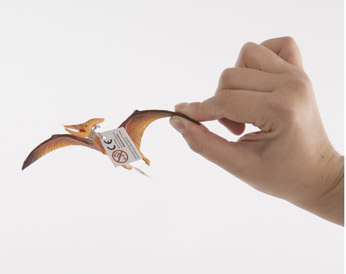
We do have our own way of making pterosaurs fly.  When we were working on the publicity shots for the new Pteranodon longiceps replica from CollectA we were asked to try to show this model flying low over the other models in the series.  The shot was achieved by the use of a strategically placed hand, some fishing line and photo-shop.

Our Pterosaur “Takes to the Air”

Pterosaurs. A flying Pteranodon.

Our Pteranodon flying.  Picture credit: Everything Dinosaur.

Picture credit: Everything Dinosaur

To view the CollectA range of not-to-scale prehistoric animal models: CollectA Prehistoric Life Models and Figures.

Go to Top