All about dinosaurs, fossils and prehistoric animals by Everything Dinosaur team members.
14 11, 2010

Intriguing Theory on Dinosaur Extinction – The Eggs that Didn’t Hatch

By |2023-03-06T12:18:23+00:00November 14th, 2010|Categories: Dinosaur and Prehistoric Animal News Stories, Main Page, Palaeontological articles|0 Comments

Global Cooling Found Dinosauria’s Achilles Heel

Many theories have been proposed regarding the extinction of the Dinosauria at the end of the Cretaceous.  Although the Cretaceous mass extinction event was not the only, or indeed, the most severe extinction event recorded in the Phanerozoic Eon, the demise of the dinosaurs seems to have attracted the most attention.  New research sheds light on the dinosaur extinction.

The Demise of the Dinosauria Explored

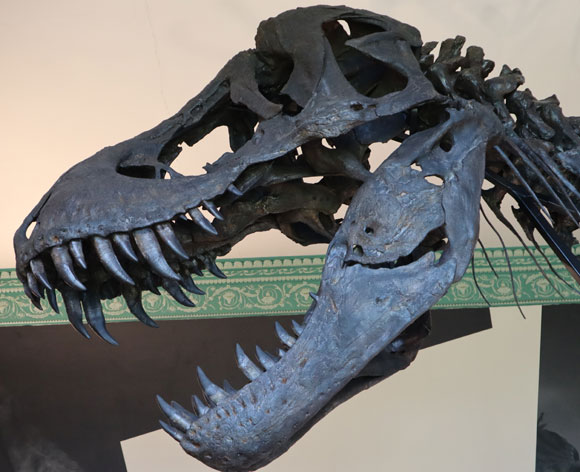
Titus the T. rex Skull and Jaws.  Dinosaur extinction.

The skull of the T. rex exhibit on display.  A fresh examination of dinosaur extinction theories.  Picture credit: Everything Dinosaur.

Picture credit: Everything Dinosaur

Victor Babbitt, from Boulder, Colorado (a great place to live if you happen to be interested in geology and palaeontology like Victor), has written an informative article speculating on why the dinosaurs may have become extinct but cold-bloodied reptiles, mammals and birds survived the extinction event.  It is well worth a read.

From the blog, a paper can be downloaded that provides the case for a sustained period of global cooling leading to the failure to hatch of dinosaur eggs.  This is a well argued article, that provides a very neat answer as to the demise of the dinosaurs but explains why their near relatives, the birds survived into the Cenozoic relatively unscathed.

Dinosaur Extinction

The paper suggests that the decades-long global cooling period caused by either asteroid impact or Deccan volcanism had a differential effect on dinosaur eggs versus bird and reptile eggs, such that many bird and reptile eggs hatched, but dinosaur eggs did not. This resulted in a “dead generation” that wiped out a 100 million years of dinosaur mega-fauna dominance in just a few decades.

If science is essentially a search for truth, it is not an exclusive club, contributions are most welcome.  Certainly a thought provoking article, one that has led to a lot of discussions amongst our team members.

For dinosaur themed toys and games, visit Everything Dinosaur’s user-friendly website: Dinosaur Toys and Gifts.

13 11, 2010

Review of BBC Television’s “First Life” Documentary

By |2023-03-06T12:20:11+00:00November 13th, 2010|Categories: Dinosaur Fans, Main Page, TV Reviews|2 Comments

Praising David Attenborough’s “First Life”

Last night, the BBC showed the second and concluding part of the television documentary “First Life”, which provided information regarding the origins of life on Earth.  Sir David Attenborough may be an octogenarian but his energy and enthusiasm for the natural world is as undiminished as ever and his intelligent commentary combined beautifully with state of the art computer graphics to give viewers an insight into the origins of life on Earth.

“First Life”

The long slow fuse to the Cambrian explosion, as we at Everything Dinosaur like to call the later stages of the Cryptozoic Eon, was handled very well in the first of the programmes entitled “Arrival”, the second and final part, called “Conquest” dealt with the rise of the arthropods and the rapid diversification of animals which ultimately led to the evolution of the first land animals.

In fairness to the production company, cramming 3.3 billion years of the history of life on Earth into just two, one-hour documentaries is an achievement in itself.  Such a programme would have been very difficult to make twenty years ago as our understanding of the evolution of early life forms has increased immensely over the last few years.

The major fossil sites that help to document the origins of life were visited and Sir David, tackled the steep slopes of the Burgess shales (British Columbia) and the sweltering heat of the Ediacaran hills with gusto.  We were expecting to hear a little more about the Gunflint sedimentary rocks of western Ontario (Canada) and their micro-organism fossils, but the oldest fossils visible to the naked eye – Stromatolites were discussed and Sir David did visit colonies in Australia, giving the viewer an impression of what some parts of the world would have looked like way back in time.

Great to see Charnia and Charnwood forest in the documentary, a part of England that Sir David knows well as he used to indulge in his hobby of fossil collecting in the exposed sedimentary rocks in the area.  One thing that did make a lasting impression on us, was the use of computer graphics to bring Charnia back from the dead as it were.  The lack of pigmentation was something that had not occurred to us.  This is obvious now that we think about it, organisms living at the bottom of the sea in complete darkness would not need pigmentation.

The Diversification of the Trilobites

The diversification of the trilobites was well handled, although it would have been nice to have seen a number of genera animated so that viewers could get a real impression of the multitude of forms that arose.  Indeed, in the second episode – “Conquest” the arthropods dominated, there was not much coverage of the molluscs, brachiopods or the Echinodermata.

The locations were stunning and the camera crew certainly racked up the air-miles with a number of exotic sites featured, but lovely to see the important Scottish fossils that have helped document the rise of the arthropods and the evolution of land animals.

A Replica of a Trilobite
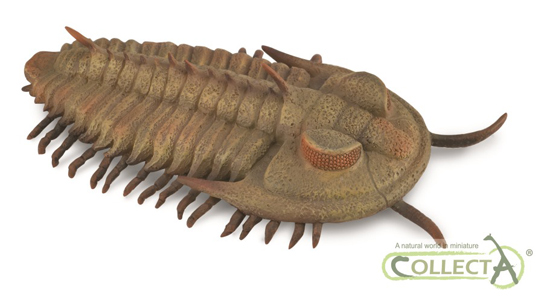
CollectA Redlichia rex trilobite. "First Life"

CollectA Redlichia rex trilobite model.

For models and replicas of early prehistoric animals such as trilobites an nautiloids: CollectA Prehistoric Life Models.

Organisms that most readily capture our attention tend to be easily visible, intelligent with complex behaviour – mammals like us, for example.  Yet, as far as the history of recorded life on Earth is concerned – the fossil record, it is the invertebrates that are much more abundant and it is wonderful to see a television series that provides an insight into our current knowledge as to life’s origins.

The fossil remains of Pikaia (pronounced pick-kay-ah), from the Burgess Shale deposits did get a mention.  The discovery of a Cambrian organism with a notochord – the rise of Chordata Phylum had to be covered, after all, if it wasn’t for creatures like Pikaia, we would not be here today.

Personally, I would like to have seen more information on the competition that arose between Arthropoda and Mollusca and perhaps a little more on the evolution of plants, but apart from these minor points – another broadcasting triumph for the BBC.

A number of team members have asked for the book that accompanies the television programmes to be added to their Christmas lists.

Scientist’s knowledge of the Palaeozoic and the origins of life has been increased exponentially over the years.  A study of ancient strata in Sweden has led some researchers to conclude that the impact of extraterrestrial objects led to another spurt in the evolution of life in the Ordovician Period.

To read more about this research: Palaeozoic Meteorite Bombardment gives Life on Earth a Helping Hand.


12 11, 2010

What are “Terror Birds”?

By |2023-01-13T21:48:09+00:00November 12th, 2010|Categories: Animal News Stories, Dinosaur and Prehistoric Animal News Stories, Educational Activities, Main Page|0 Comments

Question – What is a “Terror Bird”?

Featured in films such as 10,000 BC and the original King Kong film released in 1933 as well as in television documentaries such as “Walking with Beasts” and science fiction programmes such as “Primeval” – the “Terror Birds” as they are known are certainly in the public’s conscience.

“Terror Birds”

However, who or what exactly is a “Terror Bird”?  We do get asked this question quite a lot, usually by boys aged between six and eight years of age.

The term “Terror Bird” was first used to describe the fossils of a large, carnivorous, flightless bird, fossilised remains of which had been discovered in South America.  This particular genus was named Phorusrhacos and a number of species have now been ascribed.  These birds were apex predators competing alongside placental mammals in South America for millions of years, although phorusrhacids had once roamed widely with the oldest fossils dating from Europe.  Although the term “Terror Bird” was first used to describe a South American genus, this phrase is now used to describe most of the large, flightless carnivorous birds of the Cenozoic.  They were certainly terrifying with some specimens standing over 3 metres tall, with hugely powerful legs capable of running as fast as a race horse and with hatchet shaped beaks.

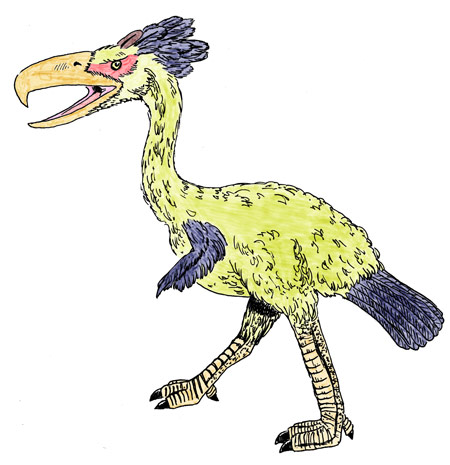
An Illustration of a Typical “Terror Bird”

A drawing of Kelenken. Phorusrhacids illustrated. The "Terror Birds".

The Kelenken in all its glory.  An illustration of a typical “Terror Bird”. Picture credit: Everything Dinosaur.

Picture credit: Everything Dinosaur

When the dinosaurs became extinct at the end of the Cretaceous period (66 million years ago) there were no large predators left on the land.  Into this space left vacant with the extinction of animals like Tyrannosaurus rex came the “Terror Birds” – large flightless birds that evolved long, powerful legs and sharp beaks to chase down the newly evolving mammals and to attack them.

The last of their kind, (in South America), became extinct as recently as 15,000 years ago.  Modern humans migrating into South America from the North would most certainly have encountered them.  One wonders what the people who actually saw these creatures would have called them.

CollectA have made a replica of a “Terror Bird”, to view this range including the Kelenken “Terror Bird”, whilst stocks last: CollectA Deluxe Prehistoric Life Models.

11 11, 2010

New 2011 Product Releases from Safari – Prehistoric Crocodiles and Prehistoric Sharks

By |2024-04-20T07:55:30+01:00November 11th, 2010|Categories: Dinosaur Fans, Everything Dinosaur News and Updates, Main Page|0 Comments

New Safari Toobs for 2011 – Sharks and Crocodiles

As well as introducing a number of individual prehistoric animal models into their Wild Dinos and Carnegie ranges, Safari are also launching two new tubes (called Toobs) in 2011.  We revealed what the new models were in exclusive articles published on this blog recently.

New Carnegie Models 2011: Carnegie Product Releases 2011.

Wild Dinos: Safari Wild Dinos Model Releases 2011.

Safari is going to release two sets of must have collectibles, the first features a range of ten prehistoric sharks, charting the evolution of these marine predators.  The second tube features a range of prehistoric crocodile models.

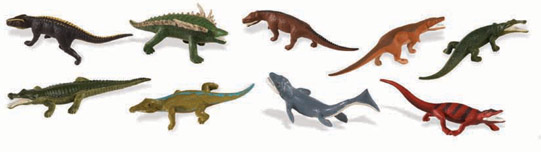
The New Safari Prehistoric Crocodile Toob

Picture credit: Everything Dinosaur

Prehistoric Animal Models

The crocodile tube (toobs) consists of the following models: Champsosaurus, Chasmotosaurus, Dakosaurus, Desmatosuchus, Euparkeria, Montealtosuchus, Postosuchus, Pristichampsus, Rutiodon validus, Sarcosuchus.  Great to see such a diverse range of different types of crocodile in this particular set.

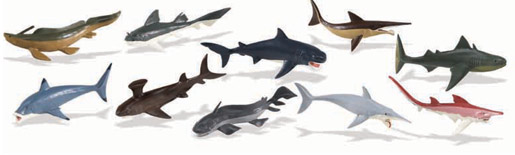
The New Safari Toob of Prehistoric Sharks

Picture credit: Everything Dinosaur

The Toob of prehistoric sharks features the following:

Cretoxyrhina, Cladoselache, Edestus, Helicoprion, Hybodus, Ornithoprion, Orthacanthus, Scapanorhynchus, Stethacanthus and Xenacanthus.

Prehistoric animal models and dinosaur figures to buy on-line from Everything Dinosaur including new for 2011 prehistoric animal toobs.

To view the current range of Everything Dinosaur prehistoric animal models and figures: Safari Ltd. Wild Safari Prehistoric World Models.

10 11, 2010

Everything Dinosaur Website Permits a Little Bit of Creativity

By |2023-01-13T21:39:08+00:00November 10th, 2010|Categories: Adobe CS5, Everything Dinosaur News and Updates, Main Page|0 Comments

Christmas Greetings!

The newly upgraded and improved Everything Dinosaur website permits the team members to express a little bit of creativity as they have the opportunity to put up their own visuals and images of dinosaurs.

Everything Dinosaur Website

The home page of the website contains a number of special slots or “skins” which permit the addition of new visuals, which Everything Dinosaur team members can develop and add.  For the dinosaur experts and teachers in the company this has meant that they have had to learn some new skills, but they have the chance to customise images and pictures and post up their own original content.

The company invests in a lot of photography, and Everything Dinosaur has built up an extensive library of images, pictures, artwork and drawings related to dinosaurs and dinosaur toys and models, so it is time for team members to indulge in a little creativity.

Christmas Greetings – An Image Produced by Everything Dinosaur

Picture credit: Everything Dinosaur

The picture shows a couple of the Ice Age soft toys from Everything Dinosaur, displayed against a seasonal background, one of a number of new images the company has planned for their home page.

A spokesperson for Everything Dinosaur stated:

“We are giving everybody in the company the opportunity to take part, lots of ideas and designs have been suggested, the trick is that whoever thinks of an idea has to work out how to create the image and then get it posted up online”.

More used to using a brush to dust away sand grains from an outcropping fossil, no doubt the staff will soon get used to the new paint shop skills and brush strokes required to customise their own artwork related to dinosaur models and images.

Visit Everything Dinosaur: Everything Dinosaur’s Website.

9 11, 2010

New Tyrannosaurus rex Game – A Classic Dinosaur Game

By |2024-04-20T07:55:00+01:00November 9th, 2010|Categories: Dinosaur Fans, Everything Dinosaur News and Updates, Main Page|100 Comments

Being Chased by Tyrannosaurus rex

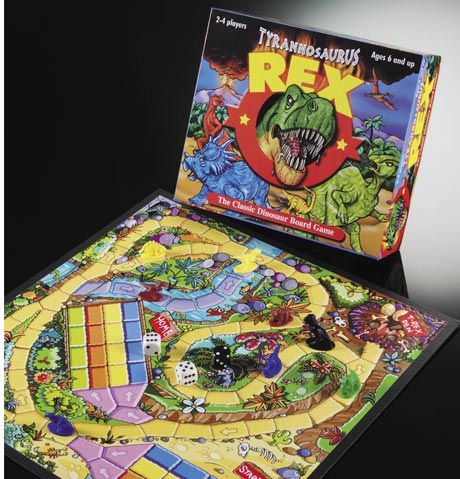
Have you ever imagined what it would be like to be chased by a hungry, ferocious T. rex?  If you think you can shepherd your herd of dinosaurs to safety and avoid becoming part of a Tyrannosaurus rex dinner, then this board game called simply “Tyrannosaurus rex“; might be the thing for you.  From two to four players, the object of the game is to take your dinosaur charges from the bone dry desert to the safety of their lush jungle home.

Each player starts with four different types of herbivorous dinosaurs, the aim is to race your pieces around the bright and colourful playing board, but watch out!  There’s a hungry T. rex about – aiming to catch as many of your dinosaurs as he can.  This dice based game has proved popular on test with our families, we ourselves have played it in the office, there is a bit of skill and strategy required to make it to home safely.  It is certainly a very innovative dinosaur themed board game.

Tyrannosaurus rex – Board Game

Picture credit: Everything Dinosaur

To view the extensive range of dinosaur and prehistoric animal themed toys and gifts available from Everything Dinosaur’s award-winning website: Visit Everything Dinosaur.

This game is suitable for dinosaur fans from 5 years and upwards, it is easy to play and the rules are quite simple.  We played a slight variant swapping the dinosaur shaped counters supplied with the game with some mini dinosaur models, we also added one or two rules of our own, for example, we gave every player four models of the same type of dinosaur, rather than four different ones, as in the conventional game.  For each dinosaur species we made a special rule, for example the ornithomimids (speedy ostrich-like dinosaurs) had a weighted dice throw as they could have run more quickly than the other dinosaurs represented in the board game.  For the armoured dinosaurs we gave them extra protection so they could resist more effectively a T. rex attack.  For the pachycephalosaurs, (boneheads) represented in the board game, we gave them a little more protection, but not as much as the armoured dinosaurs, and a touch more speed, but not as much as the ostrich-like dinosaurs.  We enjoyed experimenting with the game to see what other versions we could come up with.

8 11, 2010

Huge Prehistoric Bison Skull Unearthed in Colorado – An Amazing Fossil Discovery

By |2024-04-20T07:54:33+01:00November 8th, 2010|Categories: Dinosaur and Prehistoric Animal News Stories, Main Page|0 Comments

Giant Bison Fossil Discovered at Ice Age Dig Site

A team of scientists from the Denver Museum of Science and Nature have announced the discovery of the almost perfectly preserved prehistoric bison skull at a dig site nearly 100 miles west of Denver (Colorado).  This discovery is just the latest in a series of important finds made at this location.  The sediments represent the remains of an ancient lake, and the team of American researchers and field workers are collecting a treasure trove of important fossils consisting of a range of prehistoric mammal mega fauna.

Dr Ian Miller, a curator of palaeontology and the Chairperson of the Earth Science Dept. at the Denver museum, spotted a bison horn core, as it was being uncovered by an excavator.  The horn was so large, that Dr Miller initially thought that it was the tusk of a Mammoth or Mastodon, as a number of fossils of these prehistoric elephants had already been found at the site in the previous month.

After more of the matrix was carefully removed, a second horn corn was found.  This led the fieldworkers to the spot where the skull was located.  The span of the horns is approaching nearly two metres across, making this prehistoric beastie nearly twice the size of extant bison today.

Chief curator at the Denver Museum of Science and Nature, Dr Kirk Johnson, stated:

“I’m trying to think of a cooler fossil that I’ve seen in my life.  This is the iconic fossil recovered thus far in this excavation.”

Prehistoric Bison Skull

The horns of this particular species of prehistoric bison, extend straight out from the head, before curving at the tips, reminiscent of African Water Buffalo.  Fossils of similar sized giant bison have been found elsewhere in the western United States, in strata ranging from 30,000 to 50,000 years of age.  This suggests that the ancient lake deposits that the scientists are exploring may actually represent sediments laid down much further back in history.  The research team, exploring the deposit had suggested that the fossils found up to date, had been no more than 15,000 years old.  Dr Johnson commented that if much older fossils were found than previously thought this would make the location, close to Snowmass Village – very significant.

Snowmass Village

A second bison skeleton was also discovered over the weekend, this may be juvenile of the same species.  It and the larger specimen have been taken back to the museum, where they can be properly cleaned, subjected to radiocarbon dating to determine their exact age and have a DNA sample taken.

Museum staff and volunteers are racing against time to get the majority of the dig site explored before the worst of the Colorado winter sets in.  So far fossils of ancient deer, Mastodons, Mammoths and the remains of Giant Ground Sloth have been discovered.  The site, now a reservoir but once part of a glacial lake is being renovated and expanded, it was as this work got underway that the first of the prehistoric mammal fossils were found.

For models and replicas of Ice Age prehistoric mammals: Prehistoric Mammal Figures.

7 11, 2010

New Website – New Functions

By |2023-08-31T07:50:11+01:00November 7th, 2010|Categories: Everything Dinosaur News and Updates, Main Page, Press Releases|0 Comments

Everything Dinosaur’s Website Offers Customers More Choice

The new Everything Dinosaur website, with its upgrades is providing customers with an easier and simpler on line shopping experience.

The recently upgraded Everything Dinosaur website – Everything Dinosaur contains many more features, each designed to help make on-line shopping easier and more convenient.  With advancements to the “Wish list” function, plus easier sharing of information via RSS feeds and emails, visitors to the website can share information amongst their friends and relatives.

Everything Dinosaur

The new home page layout has already won a number of admirers, but the work for the Everything Dinosaur developers does not stop there.  They are about to role out a number seasonal themed banners giving the website a much more polished appearance.

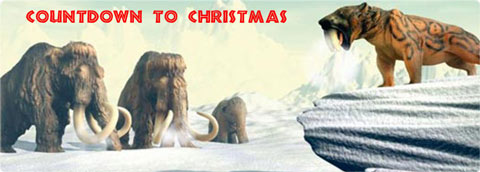
Countdown to Christmas Home Page Banner

Everything Dinosaur website banner.
Merry Christmas and a Peaceful and Prosperous New Year.

Picture credit: Everything Dinosaur

The picture above shows one of the prototypes for the new seasonal and special offer banners that Everything Dinosaur can now display on their website’s home page.

Team members at Everything Dinosaur will be using various products and other company images to show their products and services in a variety of new ways.  Watch out for a few prehistoric scenes from Everything Dinosaur.

Visit Everything Dinosaur’s award-winning website: Everything Dinosaur.

6 11, 2010

Hoard of Palaeogene Amber from Indian Coalmine

By |2023-01-13T20:49:00+00:00November 6th, 2010|Categories: Dinosaur and Prehistoric Animal News Stories, Educational Activities, Main Page|0 Comments

Prehistoric Creatures Preserved in 52 million year old Amber

The remains of hundreds of ancient arthropods have been discovered in a hoard of Palaeogene amber preserved in sediments discovered in a coalmine located in western India.  Researchers have been able to identify over 700 insects, mites and spiders, many of which are remarkably well preserved.  The fossils will help scientists to determine the extent to which Indian fauna and flora was influenced by the sub-continent’s gradual drift away from Africa towards Asia throughout the Mesozoic under the influence of plate tectonics.

Palaeogene Amber

Amber is a sticky, scented resin produced by certain types of trees since Jurassic times as protection against disease and to help seal wounds in the bark.  Occasionally, insects and other small creatures can become trapped in the resin and fossilised when it hardens into amber.

Everything Dinosaur has written extensively on fossil discoveries associated with organic remains preserved in amber, last year for example, we reported on the discovery of elements of a Jurassic spider’s web preserved in fossil amber.

To read more about this discovery: World’s Oldest Cobweb Preserved in Amber.

The international team of researchers excavated something approaching 150 kilogrammes of the light, brown, coloured amber pieces from the coalmine located in Gujarat Province (India).  This is one of the largest finds of amber ever recorded from Asia.  The animals, pollen grains and other items trapped inside the amber are helping to provide scientists with an insight into the Indian eco-system at around the time that the Indian subcontinent collided with Asia to form the Himalayas.

A spokesperson for the research team, palaeontologist Jes Rust, based at Bonn University (Germany) stated that the remarkably well preserved fossils consisted of ancient bees, termites, gnats, flies and ants – in total more than 700 arthropods.

Dr Rust commented:

“They [the organisms] are so well preserved.  It is like having the complete dinosaur, not just the bones.  You can see all the surface details on their bodies and wings.  It’s fantastic.”

The amber itself is helping scientists to understand more about the flora in India during this part of the Palaeogene.  Tests on the fossilised resin indicate that it comes from a type of hardwood tree, that today make up nearly 80% of lowland forest canopies in south-east Asia.  The amber and the fossilised wood found in the same rock strata suggests that India must have been extensively forested at the time the amber was formed.

Reporting in the American based, scientific journal “Proceedings of the National Academy of Sciences”, the researchers describe the creatures preserved and theorise on the changes undertaken in Indian flora and fauna as the sub-continent drifted towards Asia under the influence of plate tectonics.

As the Indian plate moved towards the Asian plate,  a chain of islands may have formed.  These would have permitted the interchange and mixing of different floras and faunas as the islands acted as stepping stones for organisms between the two landmasses.

Dr Rust stated:

“We think that, before the final collision between India and Asia, some sort of island arc was established.  Our findings suggest that the mixing of fauna was already so strong, that it was already happening for several million years.”

Once species from India had crossed into Asia, they could have spread further, eventually reaching Australia.  The team has so far recorded 100 different arthropod species.  They are hopeful that the amber will reveal more, some of which are likely to be close relatives of arthropods that live in Africa and Madagascar as the Indian sub-continent was once attached to these areas of land, for much of the Palaeozoic and into the Mesozoic forming the super-continent Gondwanaland.

For models and replicas of Palaeozoic creatures such as trilobites and ammonites: CollectA Prehistoric Animal Models.

5 11, 2010

Looking Forward to “First Life”

By |2023-01-13T20:45:45+00:00November 5th, 2010|Categories: Dinosaur Fans, Famous Figures, Main Page|0 Comments

David Attenborough’s Documentary “First Life” on Television this Evening

We have been discussing the new television documentary series produced by the BBC – “First Life” all week.  Tonight at 9pm (GMT) we get the chance to see the first of the two-hour documentaries that make up this programme.

Narrated by Sir David Attenborough, “First Life” completes the series of television documentaries made by the BBC recording life on Earth, the first of which entitled “Life on Earth” we think was shown in 1979.

“First Life”

This new series, explores how life on the planet began and takes viewers through the first few billion years of the history of our planet, known as the Cyrptozoic (hidden life) and into the eon known as the Phanerozoic (visible life), which covers the last 550 million years or so.  The stars of these two programmes are the amazing fossils but there is extensive use of CGI so viewers can look into life in a shallow Cambrian sea.  Some of the bizarre creatures featured have never been animated before.  This gave scientists an opportunity to see how their fossilised charges would have moved, swam or crawled.

Tonight’s opening episode starts with the first signs of life on our planet and provides an account of how the first single-celled micro-organisms kick-started life as we know it.  In the office at Everything Dinosaur, we are having a competition to see how high up the BBC ratings chart the programme will go, we all have drawn a number from a sweep-stake which corresponds to the ranking the programme will get in terms of viewer numbers in that particular week.  I have the number four, so I think I am in with a good chance of winning – not sure what the prize is, but we all can’t wait to watch tonight.

For models and replicas of iconic Palaeozoic animals such as trilobites and ammonites: CollectA Prehistoric Animal Models.

Go to Top