All about dinosaurs, fossils and prehistoric animals by Everything Dinosaur team members.
11 02, 2011

Early Hominids had their Feet Firmly on the Ground

By |2023-01-15T12:16:43+00:00February 11th, 2011|Categories: Dinosaur and Prehistoric Animal News Stories, Main Page|0 Comments

Analysis of 3.2-million-year-old Toe Bones Indicates Walking Tall A. afarensis

One of the many fascinating puzzles surrounding the evolution of hominids is at which point in their evolutionary development did they stop behaving like apes and started to adopt recognisable human traits such as leaving an arboreal lifestyle and adapting to a life, walking the open grasslands.

A team of American scientists, analysing a single toe bone, dating from around 3.2 million years ago, have suggested that one of our earliest known ancestors Australopithecus afarensis may have been an obligate walker, with foot arches to cushion movement as they walked along.  Such evidence, if the controversial interpretation is accepted, suggests that these early hominids had evolved adaptations suited to walking and not for climbing trees.  Perhaps the first steps on the pathway to the evolution of ground dwelling human ancestors.

Australopithecus afarensis

According to researcher William Kimbel, (Institute of Human Origins at Arizona State University), one of the authors of this new study, A. afarensis had a permanently arched foot and walked essentially the same as our own species.  The fossil of the fourth metatarsal, ascribed to belonging to A. afarensis suggests that these hominids had a foot designed to cushion the effect of walking.  This indicates that this particular species was an obligate walker.

The research team’s work is published in this months edition of the academic journal “Science”.  The team concludes that this research resolves the debate between palaeoanthropologists who think that this species was a biped and those who believe that A. afarensis was a stepping-stone between a tree-climbing ape and full bipedalism.

Commenting on the research, Kimbel stated:

“This fourth metatarsal is the only known of Australopithecus afarensis and is a key piece of evidence for the early evolution of the uniquely human way of walking.”

The fossil was found in Ethiopia, at Hadar, the famous location of Late Pliocene aged strata that has yielded a number of exceptional hominid fossils, some more than 3.5 million years old.  The area is so important in terms of  its fossil hominid remains, that the site is known as the “home of the first family”.  The village of Hadar, in the Awash river valley has given its name to the rock formation that yields these fossils – the Hadar Formation.

Researcher Carol Ward, another author of the study, stated:

“Understanding that the foot arches appeared very early in our evolution shows that the unique structure of our feet is fundamental to human locomotion.”

However, not all the scientific community agree with the paper’s findings.  Some scientists have suggested that it may be better to assess the degree of arching found in some of the larger toe bones such as the big toe (first metatarsal) before making such claims.

Australopithecus Model (Bullyland Figures)
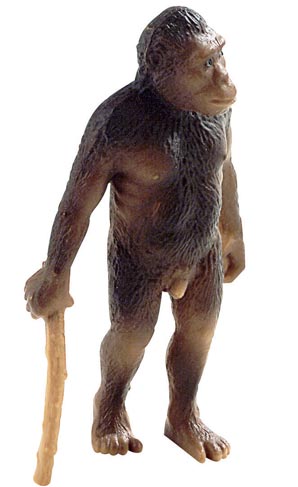
Australopithecus afarensis.

At home on the plains putting their best foot forward a model of Australopithecus.

To view models of ancient creatures: Bullyland Prehistoric Animal Models and Figures.

Bones of a human foot showing the uniquely arched configuration of the foot bones, and where the fourth metatarsal is located. The 3.2-million-year-old bones from Ethiopia reveal the foot arches in the ancient hominid Australopithecus afarensis.

An almost complete set of hand bones for A. afarensis is known.  This fossil was also found at Hadar, it dates from approximately 3.3 million years ago.  Metacarpals as well as proximal and distal phalanges are known.  This set of bones seem to suggest that A. afarensis had hands close to but not resembling human ancestors.  They show characteristics of both an arboreal tree-climber and a ground-based animal.  Of course, since no species is fixed, over the time that Australopithecus afarensis existed it is possible that they adapted to a drier climate with less trees and become more accustomed to living on the ground.  Over generations, natural selection would have led to modifications such as adaptations to a more ground based existence.  Whether or not these relatively small animals walked the same way as we modern humans do, is open to debate.  They may have been upright and competent bipeds, but they probably had a different gait.
10 02, 2011

Dinosaurs at National Science and Engineering Week

By |2023-01-15T11:50:25+00:00February 10th, 2011|Categories: Educational Activities, Everything Dinosaur News and Updates, Main Page, Teaching|0 Comments

Everything Dinosaur Prepared for National Science Week

Next month sees the annual National Science and Engineering Week, the event actually runs from March 11th through to March 20th and its aim is to showcase the best in science and engineering in the UK and to get people involved.  There are a huge number of events and activities taking place again this year, from intimate cafe venues holding discussions on science related topics to enormous science festivals all round the country.

National Science and Engineering Week

The dinosaur experts at Everything Dinosaur are not being left out, they are visiting a number of schools with fossils and other dinosaur related activities to enthuse the next generation of young scientists.

To view the extensive range of dinosaur and prehistoric animal toys and gifts available from Everything Dinosaur’s award-winning website: Dinosaur Toys and Gifts.

A Communication Theme

The theme for this event is communication, bringing the general public together to discuss science topics, discover new things and to communicate the role science and engineering has to play in everyone’s lives.

Organised by the British Science Association, this annual event goes from strength to strength and Everything Dinosaur are proud to be involved especially with the elements that involve teaching about dinosaurs in school.

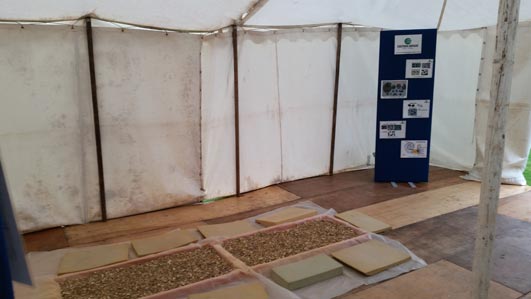
Preparing a Fossil Hunting Activity (Everything Dinosaur)

Everything Dinosaur fossil hunting activity.

Fossil trays laid out at for a fossil hunting activity prepared by Everything Dinosaur team members.  Picture credit: Everything Dinosaur.

Picture credit: Everything Dinosaur

Everything Dinosaur

For educational, dinosaur themed toys, models and games visit Everything Dinosaur’s child-friendly and award-winning website: Everything Dinosaur.

9 02, 2011

David Attenborough’s Life Stories Series Two on Radio 4

By |2023-03-06T15:27:05+00:00February 9th, 2011|Categories: Educational Activities, Main Page, Radio Reviews|0 Comments

First Life – Back on Air

The highly acclaimed “First Life” radio series, a collection of stories and anecdotes by Sir David Attenborough is starting a second series.  One of the world’s best known and most popular presenters, Sir David examines twenty marvels of the natural world, a collection of experiences in some fifty years of broadcasting.

Each ten minute programme deals with a different subject and they are on radio four at 8.50pm on Friday evening (GMT) repeated the following Sunday at 8.50am.  Sir David’s enthusiasm is infectious and his curiosity for the natural world really comes out in these broadcasts.

Well worth a listen, and we suspect the series will be available on CD from the BBC in the Summer.

For models and replicas of many of the extinct and prehistoric animals featured in the Radio 4 series visit Everything Dinosaur’s award-winning website: Everything Dinosaur.

8 02, 2011

Fact Sheets, Fact Sheets and more Fact Sheets

By |2023-01-15T11:39:08+00:00February 8th, 2011|Categories: Everything Dinosaur News and Updates, Main Page|0 Comments

New Prehistoric Animal Models means New Fact Sheets

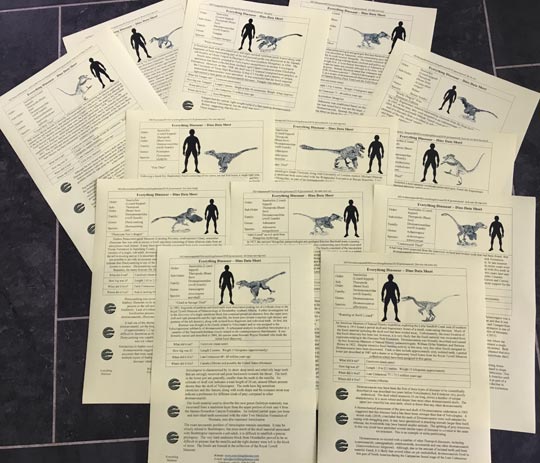
The next few days are going to be busy for the dinosaur experts at Everything Dinosaur.  For every named prehistoric animal we supply; we research, write and produce a fact sheet on that creature.  Our library of fact sheets is already quite extensive, everything from trilobites to pterosaurs, unfortunately, with new model releases imminent our team are having to add to our free prehistoric animal fact sheet collection.

Everything Dinosaur Fact Sheets

Over the next few days, fact sheets on several prehistoric animals will have to be completed – Kelenken (Terror Bird), Jobaria (sauropod), Camptosaurus and Majungatholus to name just a handful of the animals that require their own data sheet.

Everything Dinosaur Fact Sheets

Fact sheets prepared for the Beasts of the Mesozoic range of models.

A collection of dinosaur and prehistoric animal fact sheets researched and written by Everything Dinosaur team members.

Picture credit: Everything Dinosaur.

Each fact sheet provides information on fossil finds, research into the genera or individual species and a scale drawing so the size of the creature can be seen.    There is something like 120 fact sheets on our database at the moment, with another dozen or so to add once they have been checked and approved by our specialists.

For the majority of the named prehistoric animal models and figures that we supply a fact sheet featuring that animal will be included with purchases.

To view the huge range of dinosaur and prehistoric animal models available from Everything Dinosaur: Dinosaur and Prehistoric Animal Models.

7 02, 2011

Ancestor of Bugs Bunny goes on Display at Special Exhibition

By |2024-04-21T12:14:33+01:00February 7th, 2011|Categories: Dinosaur and Prehistoric Animal News Stories, Main Page|0 Comments

Oldest Fossil Lagomorph on Display to Commemorate Year of the Rabbit

On Thursday, 3rd February to mark the Chinese New Year, we put up an article about prehistoric rabbits, just a snippet in recognition that according to the Chinese astrological calender, this was the start of the year of the rabbit.

At the time we professed that none of the Everything Dinosaur team members knew anything about rabbits and their ancestors in the fossil record.

To view this article: Rabbits and the Chinese New Year.

We did not think it would be long before a Chinese museum or research institute put a fossilised lagomorph on display to mark the year of the rabbit, and sure enough, shortly afterwards, we were told of a Eocene Epoch rabbit skull going on display last week, to mark this special occasion in the Chinese New Year.

The fossil is a beautifully skull and jaws of a prehistoric rabbit dating from approximately 54 million years ago.  It is on display at the Palaeozoological Museum of China in Beijing.

Fossil Lagomorph

The fossil was discovered three years ago in the Eren Basin region.  It represented a new species of lagomorph, the oldest known in the fossil record.  It was formally named and described as Dawsonlagus antiquus.  The Chinese exhibition celebrates the rabbit in China’s culture and traces the origins and evolution of the rabbit family.  So if you want to see the earliest known ancestor of Bugs Bunny hop over to Beijing.

To view models and replicas of prehistoric animals made by the Chinese company PNSO: PNSO Age of Dinosaurs Models and Figures.

6 02, 2011

Plans for Special Fossil Festival Well Underway

By |2024-04-21T12:15:04+01:00February 6th, 2011|Categories: Dinosaur Fans, Everything Dinosaur News and Updates, Main Page|0 Comments

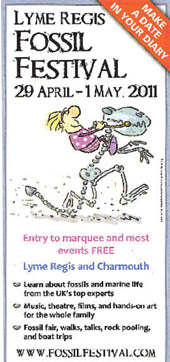
Lyme Regis Fossil Festival 29th April to 1st May

The fossil festival located at Lyme Regis (Lyme Regis and Charmouth) is just over ten weeks away and plans for the events and activities are well in hand.  The event is scheduled to take place over the first Bank Holiday weekend in late April and early May, fingers crossed for some fine weather to help the fossil hunters.

Fossil Festival

The programme of events starts Friday 29th April and runs through the weekend to Sunday evening.  There will be a chance to meet fossil experts, get involved in dinosaur sized artwork, dig for ammonites, shop at the fossil fair, participate in street theatre, construct a giant dinosaur jigsaw and to go fossil hunting on the Jurassic coast with an expert guide.

This year, we are delighted to hear that our chum, Brandon Lennon has been invited to lead a fossil festival guided walk along the Dorset shoreline.  Brandon is one of the most knowledgeable and experienced fossil experts in the area, and a walk with him exploring the Jurassic sediments is one thing not to be missed.

Come rain or shine, Brandon will be at Festival information booth at 8.45am sharp on the morning of the 29th ready to lead those fortunate people lucky enough to be able to sign up for this activity.  We know that part of the Jurassic coast extremely well and for an informed walking tour of the beach area, Brandon is just the sort of person needed to take you back to the time of ichthyosaurs, long-necked plesiosaurs and the beautiful ammonites and belemnites.

Fossils from Lyme Regis

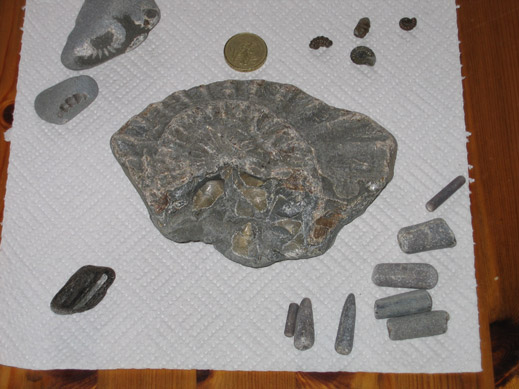
Fossils found at Lyme Regis (Dorset). What is a fossil?

Lyme Regis full of fossils.  Plans in place for the Lyme Regis Fossil Festival.  Picture credit: Everything Dinosaur.

Picture credit: Everything Dinosaur

To view models and replicas of ammonites, belemnites and other prehistoric animals associated with the “Jurassic Coast” of Dorset: CollectA Age of Dinosaurs Popular Range.

Dress for the Weather

We would advise dressing for the weather, rain gear – if it is going to be wet and be sure to wear sensible shoes as walkers will be venturing over wet sand and rocks as they travel back in time.

Further information on the special fossil walks being organised, including information on how to book for Brandon’s walk on the Friday morning will be provided.  The Fossil Festival website also contains details of all the other exciting events and activities that are going to be taking place over that weekend.

The 2011 Fossil Festival

Picture credit: Fossil Festival

We wish all the organisers and volunteers the very best and hope that his year’s event will be bigger and better than ever.  Don’t tell Prince William that the Fossil Festival starts on the 29th of April, he may be tempted to cancel the wedding!

5 02, 2011

Dinosaurs Left Tracks Thanks to the “Goldilocks” Effect

By |2023-03-06T15:30:12+00:00February 5th, 2011|Categories: Dinosaur and Prehistoric Animal News Stories, Main Page|0 Comments

Manchester Researchers Reveal Secret to Dinosaur Tracks

A team of researchers based at Manchester University (England) have identified the ideal conditions needed for dinosaur tracks to be preserved as trace fossils.  Footprints and trackways are known as trace fossils.  These preserve evidence of the activity of animals, they have one major advantage over the other main type of fossil – body fossils, they are direct in situ evidence of the environment at the time and place the organism lived.  If you were to stand in the preserved, fossilised footprint of a dinosaur, you will literally be “walking with dinosaurs”.

Dinosaur Tracks

University of Manchester researchers used computers to simulate prehistoric creatures making tracks in different types of mud.  This university has developed an extensive range of software programmes which have led to insights into dinosaur travel speed and locomotion.  The team found that soil conditions had to be perfect for different dinosaurs to leave fossil footprints behind.

Computers Used to Assess Dinosaur Trackways

Picture credit: Manchester University

Dubbed the “Goldilocks effect”, scientists say it explains why tracks were left at some sites and not others.

Dr Peter Falkingham, who led the research team stated:

“By using computer modelling, we were able to recreate the conditions involved when a 30-tonne animal makes a track.”

He went onto add:

“Now we can use this Goldilocks effect as a baseline for exploring more complicated factors such as the way dinosaurs moved their legs, or what happens to tracks when a mud is drying out.”

The Diversity of the Dinosauria

Dinosaurs were incredibly diverse over their 160 million year reign, ranging from leviathans that weighed upwards of fifty tonnes to tiny, bipeds such as Compsognathus from Germany and Microraptor from China.  However, different sites and different strata have yielded different tracks.

The Paluxy River site in Texas, USA – where one of the most famous sets of fossil prints was found – only reveals prints of larger dinosaurs.  Using computer modelling, the team simulated up to twenty different dinosaurs walking in different conditions.  What they found was that heavier dinosaurs only left lasting tracks in thick, shallow mud.

In deeper, softer mud, only lighter dinosaurs could leave prints while larger animals would become stuck and trapped in the soft mud they could die.

Dinosaur Tracks Reveal Secrets

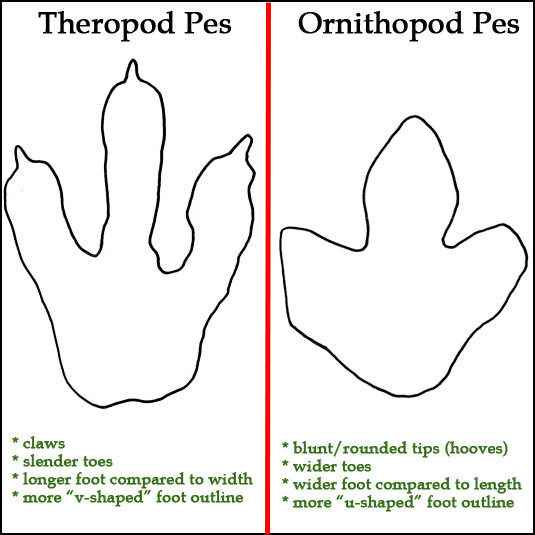
Comparing different types of dinosaur footprint.

A theropod print compared to an ornithopod print.

Picture credit: Everything Dinosaur

The findings also suggest that significant sites such as Paluxy River could have been host to a larger number of creatures than the tracks themselves show.  The fauna of an area was probably a lot more diverse than the footprint record reveals.

Dr Falkingham commented:

“A skeleton is the remains of a dead animal; the footprints are the remains of a living animal, something made during life.  That’s what is absolutely fascinating for me about dinosaur footprints.”

For models and figures of dinosaurs and other prehistoric animals: Dinosaur Models and Prehistoric Animal Replicas.

4 02, 2011

Everything Dinosaur’s 300th Customer Feedback Published on the Company Website

By |2024-04-21T12:18:00+01:00February 4th, 2011|Categories: Everything Dinosaur News and Updates, Main Page|0 Comments

Three Hundred Not Out – Customer Feedback

Three hundred not out and still counting.  The three hundredth customer feedback comment has just been put up on the Everything Dinosaur website.  Mail order can often be a remote process, with online mail order companies having little or no interaction with their customers.  This scenario couldn’t be further from the truth with Everything Dinosaur, the UK based dinosaur company staffed by parents, teachers and real dinosaur experts.

Customer Feedback

Since April last year, as part of a substantial investment programme in the company’s website Everything Dinosaur customers of Everything Dinosaur have been able to put up comments and feedback about the products purchased and the service received.

In just over two hundred and ninety days since the new customer feedback module was put up on the site, three hundred customer comments have been posted up.  Commenting on the feedback a spokesperson for Everything Dinosaur stated:

“We are delighted to see such a positive reaction to our company and our efforts so pack and despatch orders on time.  It is so nice to be appreciated, and customer feedback including product reviews are extremely important to us.”

The customer feedback module is not the only method of receiving customer’s comments. Ever since the company first stated trading more than six years ago, they have included a freepost reply feedback form into all UK orders.  A third of all UK customers send in the feedback, and this information has helped the company with new product ideas and has played a major role in driving continuous customer service improvements.

Testimonials on websites placed online by customers play a very important role in helping new visitors to a website to assess the quality of the service they are likely to get from the company.  With an average of one new customer comment or review a day, there is certainly a great deal of unbiased information published online at Everything Dinosaur to help new visitors make an informed choice when it comes to purchasing dinosaur toys and dinosaur models.

3 02, 2011

Chinese New Year – the Year of the Rabbit

By |2023-03-06T15:30:58+00:00February 3rd, 2011|Categories: Animal News Stories, Everything Dinosaur News and Updates, Main Page|0 Comments

Chinese New Year – the Year of the Rabbit

Today, marks the start of the Chinese New Year, otherwise known as the Lunar New Year.  It will be commemorated with a fortnight of celebrations and activities.  There are events going on throughout the world to mark the start of the year of the rabbit.

Year of the Rabbit

Rabbits are members of the Order Lagomorpha and not rodents as is commonly supposed.  Although they may share a common ancestor with those mammals that are members of the Order Rodentia such as rats along with mice, beavers, voles and squirrels.  The rodents represent the largest group of extant mammals with something like 1,800 species worldwide with more yet to be scientifically named and formally studied.  The lagomorphs which include Pikas and Hares are much less numerous with just eight different genera recognised.

We are not sure when lagomorphs appear in the fossil record, but we would assume the first evidence would be found in Lower Tertiary rocks, most probably Palaeogene, certainly by the Miocene these creatures were common and widespread.  The Pikas, which resemble small, short-eared rabbits were particularly abundant in the Miocene but since about five million years ago their numbers have declined rapidly, being replaced by true rabbits.  Pikas are mainly restricted to mountain habitats in the Northern Hemisphere today.

According to Chinese astrology, people born in the year of the rabbit are conscientious, industrious and financially lucky.  Perhaps we ought to be conscientious and make an effort to study the origins of the lagomorphs this year.

For replicas of prehistoric mammals and extinct animals (no lagomorphs at the moment), visit: Models of Prehistoric Mammals and Extinct Animals.

2 02, 2011

Everything Dinosaur gets it “Right on the Nose” – A Horned Nose That is – A Successful Prediction

By |2024-04-21T12:18:53+01:00February 2nd, 2011|Categories: Everything Dinosaur News and Updates, Main Page|0 Comments

Everything Dinosaur’s First Prediction for 2011 Proved Correct

Just for a bit of fun, whilst some of our team members were working over the Christmas and New Year period, we put our heads together and wrote a list of palaeontological predictions for 2011.  We came up with seven predictions of likely scenarios that we thought would take place in the following twelve months.

Everything Dinosaur

There were no prizes to be awarded, it was simply a case of debating amongst ourselves what might happen with Everything Dinosaur in particular and Earth sciences in general over the next year.

For the article that lists our predictions: Everything Dinosaur Predictions for 2011.

It is pleasing to note that our first prediction, that a new genus of ceratopsian would be announced, has already come true.  Yesterday, we wrote an article concerning the strange case of Titanoceratops; a new genus of horned dinosaur that had originally been ascribed to Pentaceratops sternbergi.  So just over a month gone and the first of our predictions has already come true.

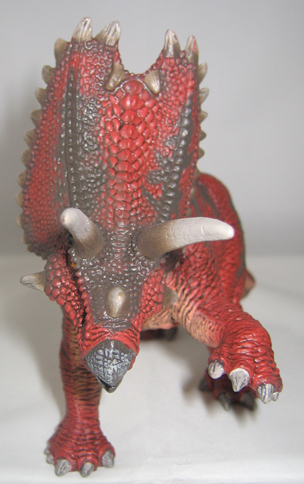
A Schleich Pentaceratops Model – Or is it Titanoceratops?

Schleich Pentaceratops.

Schleich Pentaceratops available from Everything Dinosaur. A new dinosaur that was originally described as a Pentaceratops is now regarded as a separate genus – Titanoceratops.

Picture credit: Everything Dinosaur

Mind you, you don’t have to have a crystal ball to identify that with so much more research being directed at the centrosaurines and chasmosaurines at the moment, the announcement of a new genus was almost bound to happen.  Still, we can say that we got something right, we were on the nose as it were and a horned one at that.  Check out the Everything Dinosaur blog for further news and updates about our 2011 predictions.

Visit Everything Dinosaur’s award-winning website: Everything Dinosaur.

Go to Top