All about dinosaurs, fossils and prehistoric animals by Everything Dinosaur team members.
21 02, 2011

Call for Crocodile Hunting to be Permitted in the Northern Territories

By |2023-01-15T18:14:47+00:00February 21st, 2011|Categories: Animal News Stories, Everything Dinosaur News and Updates, Main Page|0 Comments

State Government to Lobby Canberra for the Reinstatement of Crocodile Hunting

The State Government of the Northern Territories (Australia) is to lobby national Government for the return of crocodile hunting in the State, home to the fearsome and extremely dangerous Estuarine Crocodile.

Since the hunting and trapping of crocodiles was banned, these ancient creatures have bounced back from near extinction to a very healthy population.  In fact, scientists estimate that there is now one Saltwater crocodile to every two people in the Australian state of the Northern Territory.  The call to reinstate hunting of these crocodiles, capable of growing in excess of six metres in length; follows the death of a teenage boy, killed in a crocodile attack at Milingimbi Island about 250 miles east of the city of Darwin.

Currently, these crocodiles and their smaller cousin the Freshwater crocodile are protected but Northern Territory Environment Minister Karl Hampton has called on this to be reassessed and has asked federal Environment Minister Tony Burke to visit the state to see the situation at first hand.

Mr Hampton said when speaking in favour of the return of safari style hunting:

“Talk to a lot of the indigenous groups, go and visit, see first hand what opportunities there are in terms of economic development, creating indigenous jobs.”

He went onto add:

“So I’m heartened with the response I’ve got to date from Tony and we’ll continue to talk and continue to push for that safari hunting opportunity for the Territory.”

He also acknowledged that more could be done to educate young people in remote communities about the danger of attacks from Saltwater crocs.

He expressed deep sorrow about what happened to the 14-year-old boy, and said the state government needs to continue with the education campaign making sure that DVDs, posters and the teachers are talking to the kids in the school about being what he termed as “crocodile-wise”.

There have been a number of attacks reported in recent years, in 2009 a young boy was killed by a three metre crocodile whilst swimming with friends in a swampy area on the outskirts of Darwin.  However, environmentalists and herpetologists will most likely object to the return of safari style hunting of crocodiles, pointing out that such hunting is banned in Florida where the resident Alligators regularly come into contact with people.

The increasing number of Estuarine (otherwise known as Saltwater) crocodiles on the northeast coast of Australia is causing concern amongst local residents and the surfing community.

The Estuarine crocodile (Crocodylus porosus) can be found over a large area of Southeast Asia.  It ranges from Sri Lanka to the Fiji islands, with a resurgent population in northern Australia as hunting them has been banned.  These animals are the largest living reptiles.  The Saltwater crocodile is capable of living in a number of habitats but prefers the mouths of rivers and other tidal areas.  Estuarine crocodiles are quite happy swimming out to sea and many have been spotted tens of miles off shore.  This may explain why they are so widely spread in south-eastern Asia.

A Model of a Crocodile Compared to an Alligator
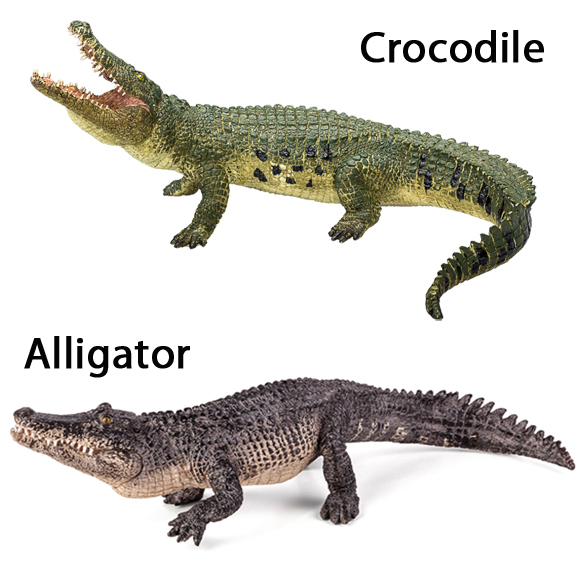
Crocodile and Alligator comparison.
Crocodile (top) and Alligator (bottom). The difference between a crocodile and an alligator.

The models (above) are part of the Mojo Fun model range to see the range of Mojo Fun figures available from Everything Dinosaur: Mojo Fun Prehistoric and Extinct Models.

Unfortunately, their numbers in Northern Australia have grown substantially over the last twenty years and many crocodiles are beginning to be seen on popular surfing beaches and basking close to areas frequented by swimmers.  It is very likely that as crocodile numbers increase so there will be more attacks on people.
20 02, 2011

Review of David Attenborough’s Life Stories

By |2023-01-15T13:50:08+00:00February 20th, 2011|Categories: Main Page, Radio Reviews|0 Comments

David Attenborough’s Life Stories – Given a big Thumbs Up!

One of the United Kingdom’s most popular presenters and incidentally, one of the people that we would invite over to dinner when we play our “who would you like to invite to your fantasy dinner party game”, when things are quiet in the office – David Attenborough; has just started a new series of “Life Stories” on radio 4.

David Attenborough’s Life Stories

Episode one of the series of twenty short programmes had David Attenborough explaining a little of what it was like to try and film in the rain-forest canopy.  His engaging and enthusiastic style of narration shone through.  These monologues allow Sir David to draw on his many years of natural history broadcasting, examining marvels of the natural world and we all agreed as we listened to the repeated programme this morning how fascinating a life this gentleman has led.  His ability to convey the wonders of the natural world is second to none in our opinion and these short ten minute radio programmes are going to be compulsive listening for us over the next few weeks.

A great radio programme from a truly great broadcaster and who involved deserve our heartfelt congratulations.  We are already looking forward to next week’s broadcast, all about that most enigmatic member of the Aves – the Kiwi.

For replicas and models of extinct creatures that feature in the series, animals such as Archaeopteryx and the Coelacanth: Wild Safari Prehistoric World Models and Figures.

19 02, 2011

What was Marrella? That is a Great Question!

By |2024-04-21T12:24:45+01:00February 19th, 2011|Categories: Main Page, Palaeontological articles|1 Comment

The Marrella Mystery

The 520-million-year-old Burgess Shale in British Columbia (Canada), is one of the world’s most important fossil sites as it contains the remains of soft-bodied organisms including remarkable specimens of Marrella splendens, that thrived in a shallow sea in the Cambrian Period.  It also documents the marine ecosystem that existed in the Middle Cambrian, including the first evidence of hard-shelled organisms.

Although, the location is now thought not to be unique, other sites in Canada that seem to have been subjected to very special geological conditions that permitted the fine fossilisation of a marine community have been found, the Burgess Shale remains exceptionally important.

To read more about similar locations to the Burgess Shale: Putting the Burgess Shales in the Shade.

One of the most abundant of all the fossils found at the site is Marrella splendens with something like over 15,000 known specimens.  However, this Canadian site is the only location known in the world where fossils of this strange creature have been found.

Marrella splendens

So despite the large number of fossils of Marrella found in British Columbia, these fossils have not been discovered elsewhere in the world.  Does this mean that Marrella sp. were localised to the Canadian province?  Or does this indicate that Marrella sp. had such a low fossilisation potential that only under exceptional conditions could fossils of this animal be formed?

There is another mystery surrounding this creature, it does not resemble any extant animal (animals living today).  Scientists debate how best to classify this bizarre creature.  Informally regarded as a “lace crab” by the American palaeontologist Charles Walcott, this strange creature may not be closely related to lace crabs.  Marrella had two distinct pairs of large, backward facing appendages, these grew out of a head-shield but rather than being hard like the calcium carbonate exoskeletons of arthropods, the head-shield seems to have been soft.

The body was composed of approximately twenty segments, each segment had pairs of jointed limbs and gill branches.  The antennae (two pairs) faced forward of the body, one pair was short and spiky with the second outer pair, much longer and thinner.

This thumb-sized animal may have been a member of the Order Arthropoda, but whether it was an ancient ancestor of crabs, trilobites or spiders remains open to intense scientific debate.

To view models and replicas of ancient Palaeozoic creatures like trilobites and Anomalocaris: CollectA Prehistoric Life Models.

18 02, 2011

Majungatholus or Majungasaurus – What’s the Difference? A Helpful Explanation

By |2024-04-21T12:25:42+01:00February 18th, 2011|Categories: Dinosaur Fans, Educational Activities, Main Page|0 Comments

The Joy of Junior Synonyms

Everything Dinosaur examines a probelmatic theropod dinosaur and its binomial name. Is it Majungatholus or Majungasaurus?

Today, some of our team members have been reviewing the fact sheets that are being produced for new prehistoric animal models being introduced into the Everything Dinosaur model range.  One such fact sheet concerns the abelisaurid Majungatholus atopus, or as it should, more correctly be called, Majungasaurus crenatissimus. 

Majungatholus or Majungasaurus?

The fossilised bones of a large, bipedal dinosaur were first discovered on the island of Madagascar by French scientists who accompanied a French military expedition to secure the island from the British in 1895.  The fossils were found in a region of exposed Upper Cretaceous strata in the north-west of the island.  As a result of this work, a new genus of theropod dinosaur – Majungasaurus was formally named and described.

In the 20th century, more fossil remains were discovered, some of which were ascribed to the Megalosaurus taxon – an example of a taxonomic waste basket, but clearly the fossil evidence suggested the presence of a large meat-eater present on the island at the end of the Cretaceous.  Scientists have studied the ancient fauna and flora of Madagascar, as technically, it is the world’s oldest island.

During the Cretaceous the landmasses that were to become India and Madagascar were still joined together, located in the southern hemisphere east of the broken up super continent of Gondwanaland.  Rising magma in the Earth’s mantle under Madagascar began to stretch the crust.  Eventually, the Earth’s crust at this point, rifted and lava began to pour out onto the surface of the Earth.  It was this rifting process that was to lead to the separation of India from Madagascar, so helping to isolate Madagascar and leading to the development of its unique flora and fauna.

In 1979, a team of German and French scientists excavated a partial skull from the same formation as where the earlier Majungasaurus fossils were found.  They identified this fossil as being part of the thickened skull of a pachycephalosaur and this specimen became the holotype for the genus Majungatholus atopus.

Studying Theropods

However, an almost complete skull of the theropod known as Majungasaurus was unearthed in 1996 and what was thought to have been a part of a pachycephalosaur was identified as being the frontal horn of an abelisaurid.  In 1979, when the pachycephalosaur from Madagascar was named and described it created a sensation amongst palaeontologists as no pachycephalosaur material had ever been discovered in the Southern Hemisphere.

However, we now know that this particular fossil was misidentified and in essence Majungatholus and Majungasaurus are effectively one and the same genus.  In taxonomy, an organism can have a number of names, the earliest names given to an organism are known as senior synonyms, whereas, later names are junior synonyms.

In this case, Majungatholus is a junior synonym of Majungasaurus as Majungasaurus was first used in 1896 and Majungatholus not used until 1979.  The two names effectively describe the same animal.

The act of declaring a name to be the synonym of another is called synonymisation.

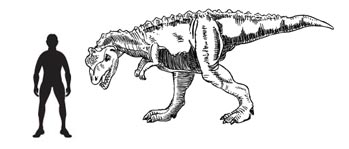
An Illustration of Majungasaurus crenatissimus (M. atopus)

Abelisaurid illustration.

Picture credit: Everything Dinosaur

The illustration above shows an adult man as an approximate scale.  Note the frontal horn on the top of the skull, the cause of the confusion between what was an abelisaurid and what was thought to be a pachycephalosaur.

In order to prevent confusion, and in recognition that this theropod was most probably the apex predator on the island of Madagascar in the Late Cretaceous, some of our team members have resorted to calling this dinosaur “the monster from Madagascar”.

The view a model of “the monster from Madagascar” and other dinosaur and prehistoric animal figures: CollectA Age of Dinosaurs Prehistoric Life Models.

17 02, 2011

Bristol Remembers its Special Dinosaur

By |2024-04-21T12:25:10+01:00February 17th, 2011|Categories: Dinosaur and Prehistoric Animal News Stories, Main Page|0 Comments

Thecodontosaurus Remembered in Bristol

With all the amazing dinosaur discoveries in exotic places such as South America, the Badlands of America and remote areas of China, it is difficult to believe that some of the very first dinosaur discoveries were made in England.  Take the Triassic sauropodomorph Thecodontosaurus (T. antiquus) for example.

Thecodontosaurus

Thecodontosaurus fossils have been found in an number of locations in England, but the first evidence for this two-metre-long, Late Triassic dinosaur was discovered in 1834 when a partial jawbone and some teeth were found in limestone deposits at a quarry on Durdham Downs, a site just north of what is now Bristol’s bustling city centre.

We were in Bristol at the beginning of the year, it was very chilly and it was difficult to comprehend that back in the Late Triassic (Norian faunal stage), around 212 million years ago or so, this part of the world was a lush tropical paradise, superficially resembling the Caribbean of today.  The area that was to become Bristol was covered by low lying islands, set in a warm shallow sea that teemed with life.  Living on the islands was the little, herbivore Thecodontosaurus, an ancestor of the giants of the Jurassic such as Diplodocus and Apatosaurus.

To read more about Bristol’s tropical past: New Insights into Thecodontosaurus.

Thecodontosaurus was only the fourth dinosaur genus to be described (Iguanodon, Megalosaurus and Hylaeosaurus preceded it), however, when the fossil bones were first examined it was thought too small to be a dinosaur.  It was only officially added to the Dinosauria Order after a review by Thomas Huxley in 1870.

Thecodontosaurus Fossils

This agile little dinosaur had a small head, with plant-shearing teeth located in sockets in its narrow jaws.  It is from these teeth that Thecodontosaurus got its name (name means “socket-toothed lizard”).  The forelimbs were shorter than the hind-limbs.  This suggests that this dinosaur was a facultative biped, it normally walked on all fours but when required it could rear up and run on its hind legs.

This dinosaur was officially named and described by the Georgian geologists Samuel Stutchbury and Henry Riley in 1836.  Samuel Stutchbury was the curator of the Bristol Institution, this later became the city’s museum and Bristol is renowned throughout the world for its University with its very prominent departments and faculties specialising in Earth Sciences.

A Fellow of the Geological Society of London

Samuel Stutchbury became a Fellow of the Geological Society of London, he is perhaps best remembered for this geological survey work of Australia.  He died in February 1859 and he was buried in Bristol’s Arnos Vale cemetery.  The cemetery staff have teamed up with Bristol University to host a series of events this month to commemorate his work and to remember Bristol’s very own dinosaur.

Some of the original fossil material can still be viewed at Bristol Museum, unfortunately, many of the earliest specimens handled by the likes of Stutchbury and Riley were destroyed by German bombing in World War Two.

Arnos Vale cemetery intends to hold a number of events throughout this year to commemorate the lives and achievements of people remembered or buried at the cemetery.

To view models and replicas of Triassic dinosaurs and other prehistoric animals from this geological period: Triassic Dinosaurs and Prehistoric Animal Models.

16 02, 2011

First Frog of 2011

By |2023-01-15T12:40:54+00:00February 16th, 2011|Categories: Animal News Stories, Everything Dinosaur News and Updates, Main Page|0 Comments

First Frog Sited in Office Pond

A little bit of excitement around the office today, a colleague has spotted a large frog in the pond next to our office building.  We have restored this pond and watched over the years to see how many frogs it attracts in the spring.  Last year we recorded ten and we had a record amount of frog spawn.

The bad weather over the Christmas period was a concern, we wondered how many of that year’s hatchlings had survived, but at least it is reassuring to see a frog in the pond this early in the year.  Hopefully, the weather will stay mild and for the frogs and the other creatures that we have observed in and around our office (we saw a fox the other day), the worst of the winter is over.

We are going to organise a clean up of the area around the pond over the weekend.  Some of our team members will be in the office on Saturday and Sunday and if they get some free time, they have agreed to give the pond some attention, remove any surface leaves trim the dead plants around the margins and so forth.

I suppose this is giving our pond a spring clean.

15 02, 2011

Amateur Archaeologists Set Out to Preserve “Open Field” Prehistoric Site

By |2023-03-06T15:24:41+00:00February 15th, 2011|Categories: Dinosaur and Prehistoric Animal News Stories, Main Page|0 Comments

Locals set out to Protect part of Prehistoric Nottinghamshire

Nottinghamshire, a county in the heart of England, may be more famous for Robin Hood and the origins of the modern game of football, but the discovery of what may prove to be a seasonal hunting camp of our Palaeolithic forefathers has got local amateur archaeologists waving their trowels in excitement.

The site, known as an “open field” location has yielded a large number of flint tools, all dating from approximately 13,000 years ago (Upper Palaeolithic).  The discoveries have centred around the Nottinghamshire village of Farndon and so far a number of flint tools have been found, but many more and other tantalising evidence may lie beneath plough depth, just waiting to be found.  The site is claimed to be unique in the British Isles, certainly, such large numbers of stone tools, some of which are complete, are usually associated with cave locations.

Amateur Archaeologists

Local amateur archaeologists and residents are seeking funds so that the site can be fully explored and researched.  The prehistoric site was first discovered during preliminary analysis of a road widening project (A46 Newark to Widmerpool).  In order to permit the site to be fully explored funding is required and locals have formed the Farndon Archaeological Research Investigations (FARI) to raise awareness and to act as a focus for their fund raising activities.

Pictures show some of the flint tools found at the location.  They have worked cutting edges and would have been used for various jobs including cutting up carcases and scraping hides.

Daryl Garton, a professional archaeologist supporting FARI stated:

“There is not another site in Britain of the same age and with the spread of activity.  It is incredibly important.”

Probably a Seasonal Camp

Initial work indicates that this site was probably a seasonal camp or a collection of camps, where hunters would have butchered animals that had been killed, perhaps herds of wild horses and deer as they crossed the treacherous River Trent nearby.

Farndon Archaeological Research Investigations (FARI) are bidding for £50,000 of Heritage Lottery Funding to be used over three years.

With this they hope to do more field walks, dig several test pits and carry out scientific tests they would otherwise not be able to afford.

Anne Coyne, from FARI, said the funding would be good, not only for archaeologists but also for the area.

She added:

“Its like ancient family history, studying how our ancestors lived in the past.  It would be great to put Newark on the map in terms of prehistory.”

Communicating with the Public

As important as work in the field, FARI plans to communicate the importance of the site to the public, through talks and displays.  With all the interest in tracing family trees, and with so much media dedicated to exploring ancient Britain, it seems that they will have an eager audience.

Anne commented:

“Eventually what we would like to do is to put on a permanent display of the finds at the local museum at Newark [Nottinghamshire] for people to view for future generations.”

FARI are expecting to finalise their application by the end of March and hope to hear from the Heritage Lottery Fund a few months later.  With luck (and with funding), they hope to start work excavating the first pits in the summer.

Visit Everything Dinosaur’s award-winning website: Everything Dinosaur.

14 02, 2011

One Small Step for Man a Giant Leap for Mankind

By |2023-03-06T15:26:23+00:00February 14th, 2011|Categories: Educational Activities, Main Page, Palaeontological articles|0 Comments

Best Foot Forward for Homo sapiens – Spring Loaded Heels

Our species may have had a crucial, anatomical advantage over Neanderthals when it came to surviving the environmental change that led to the development of wide expanses of tundra.  We were better at long distance running and walking.

For those of us who remember the perils of enforced cross-country runs when we were at school, it may be hard to imagine that our species may have had a mechanical advantage when it came to travelling distances, but the structure of the bones and tendons in our feet could have provided us with a crucial evolutionary advantage over Neanderthals.

Researchers studying the heels of modern humans have found that our bone structure stretches the Achilles tendon taut, storing energy more efficiently than the Neanderthal foot and allowing us to run better.

Neanderthals

However, Neanderthals (H. neanderthalensis), were no slouches when it came to walking, their feet and ankles gave them an advantage in walking uphill and the bones in the foot supported the ankle more if they jumped, so says the research team based at the University of Arizona in Tucson.

In our ancestors, just as with people today, a short, lower heel stretched the Achilles tendon tight.  This arrangement increases the tendon’s spring-like action, making it an efficient store of energy; helping us to run efficiently and to make long-distance treks.  This anatomical difference between our species and the Neanderthals, one of a number of subtle differences, could have given us the edge when hunting on the wide, open plains of prehistory.

Anthropologist, David Raichlen, who led the research, published in the “Journal of Human Evolution”, commented:

“We can say that energy costs of running differed between Neanderthals and modern humans, but our data does not really provide answers as to what happened to the Neanderthals.”

Extinction Around 28,000 Years Ago

Scientists believe that the last of the Neanderthals died out approximately 28,000 years ago.  These humans, were very well adapted to the cold European environment, they had bigger brains than us and were physically stronger, but for some reason or reasons, they became extinct and our species went onto thrive.

Anthropologists already know that compared to our ancestors, Neanderthals were stronger, heavier, had shorter legs and smaller inner-ear canals (important for co-ordination and balance) – all factors in making them less efficient runners compared to us.  However, this new line of study provides evidence to suggest that Neanderthals were disadvantaged compared to us when it came to moving long distances.

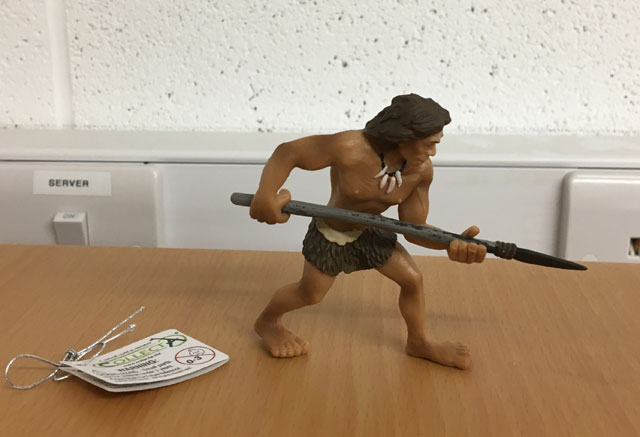
A Replica of a Neanderthal Man

CollectA Neanderthal man model

Selecting a CollectA Neanderthal man figure for an Everything Dinosaur customer. Picture credit: Everything Dinosaur.

Picture credit: Everything Dinosaur

To view the CollectA range of prehistoric figures: CollectA Prehistoric Life Figures and Models.

Homo sapiens

The research shows the distance runner’s foot and ankle was very efficient.  Measurements of part of the heel bone has helped the researchers determine how efficiently an individual could run long distances.

In a forested environment, the Neanderthals tactics of ambushing prey would have been a successful strategy.  Their strength and power would have given them an edge over H. sapiens.  However, if climate change led to a loss of forests and a more open environment, the ability to track animals over long distances, running prey to exhaustion would have been a tactic better suited to our ancestors.  Unfortunately, the lack of fossil human foot bones is preventing scientists from determining when our running-friendly, spring-loaded heels first evolved.

Raichlen and his team calculated rates of oxygen consumption for eight experienced long-distance runners as they performed on a treadmill for 10 minutes running at a pacy 16 km/h.  On a separate day, MRI scans of each person’s heel and Achilles tendons revealed the nature of the potential mechanical advantage.  Those runners who used oxygen most efficiently whilst running had shorter heel bones.

Heel Bone Measurements

Heel-bone measurements of 13 fossil Homo sapiens that lived between approximately 30,000 and 100,000 years ago resemble those of today’s runners, the scientists have stated.  On average, the measurements indicate that the ancient humans expended 6.9 percent more energy while running than their counterparts today did, not a substantial difference, according to the researchers.

Analyses of heel bones of six Neanderthals from the same time period indicate that these hominids used an average of 11.4 percent more energy while running than modern athletes did, a statistically notable disparity.

Energy efficiency while running depends far more on a person’s anatomy than on physical training, the researchers say. They used distance runners as a modern comparison group in order to account for any training effects.  The research concludes that our springy heels enabling us to run for longer may have proved decisive as hunting moved to the open plains.

Is this a case of best foot forward, in terms of hominid evolution?

13 02, 2011

Was Dilophosaurus related to Tyrannosaurus rex?

By |2023-01-15T12:31:28+00:00February 13th, 2011|Categories: Dinosaur Fans, Main Page|0 Comments

Questions about Theropods

On one of our many expeditions into schools, to meet young palaeontologists and keen dinosaur fans studying dinosaurs, we were asked by a student who was busy helping us create a montage of dinosaur pictures was Dilophosaurus related to Tyrannosaurus rex?

Dilophosaurus and Tyrannosaurus rex

An interesting question, the short answer is yes, but they were only distantly related.  Dilophosaurus fossils are known from western North America and possibly China, interestingly large tyrannosaur fossils such as T. rex and Tarbosaurus are also found in these parts of the world.  Both Dilophosaurus and Tyrannosaurus rex were meat-eaters and members of the Theropoda.  However, to all intents and purposes this is where the similarities end.

Dilophosaurus

Dilophosaurus lived in the Jurassic Period, Tyrannosaurus rex existed at the very end of the age of reptiles, in the Late Cretaceous.  Although these two dinosaurs were theropods they represent examples of different families in the theropod clade.  Dilophosaurus was agile and its most significant distinguishing feature were the pair of semi-circular crests that it sported on the top of its head.  Quite what these thin crests were used for remains a mystery, but they may have played in role in communication amongst pack members.

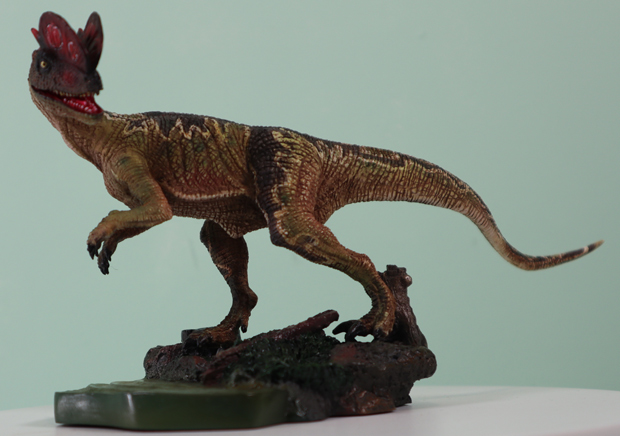
A Model of Dilophosaurus

ITOY Studio Dilophosaurus dinosaur model.

The ITOY Studio Dilophosaurus dinosaur model. Picture credit: Everything Dinosaur.

Picture credit: Everything Dinosaur

To more models and replicas in the ITOY Studio series, (including Dilophosaurus and Tyrannosaurus rex): ITOY Studio Models.

Measuring perhaps as long as 8 metres, Dilophosaurus was certainly a large, formidable predator, but it was considerably smaller and less heavy than Tyrannosaurus rex.

Tyrannosaurus rex

We enjoyed meeting the enthusiastic primary school children and we tried to answer all their questions.  Hopefully, we were able to explain the difference between Dilophosaurus and T. rex.  Later on in the lesson we constructed a time-line and put these dinosaurs on it, so the children could see how many millions of years apart these particular dinosaurs lived.  The children reported that their favourite dinosaur was Tyrannosaurus rex.

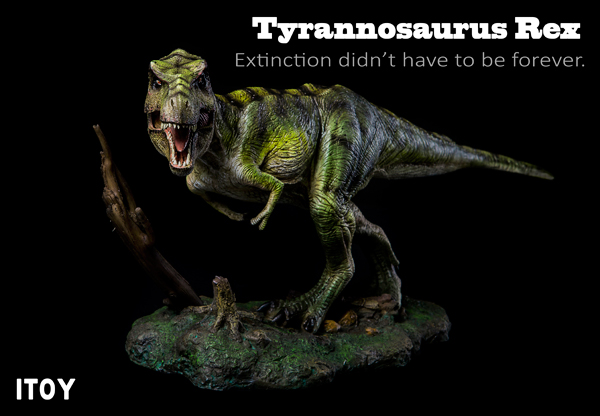
ITOY Studio Tyrannosaurus rex Model

The ITOY Studio Green T. rex Dinosaur Model.

The ITOY Studio Green Tyrannosaurus rex dinosaur model with an articulated jaw and complete with display base.

12 02, 2011

“Terror Bird” (Kelenken) on its Way

By |2023-01-15T12:22:33+00:00February 12th, 2011|Categories: Everything Dinosaur News and Updates, Everything Dinosaur Products, Main Page|3 Comments

New “Terror Bird” Model (CollectA Kelenken Model Arrives)

Our stock of the new CollectA Kelenken model, a “Terror Bird” is due to arrive in the next few days or so.  We are all looking forward to its arrival along with the other new models in this extensive range.  This “Terror Bird” (phorusrhacid), is part of the scale model range of prehistoric animal models, it is the first bird sculpted by the CollectA team.

The model represents a Kelenken, a genus of South American phorusrhacid, a creature that was only formally named and described four years ago.

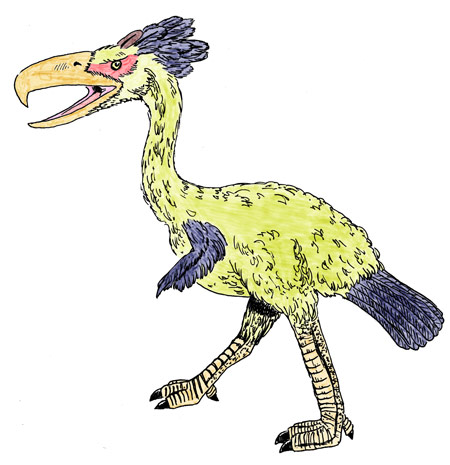
An Illustration of Kelenken (Kelenken guillermoi)

The Kelenken in all its glory. Picture credit: Everything Dinosaur.

Picture credit: Everything Dinosaur

We have illustrated our “Terror Bird” quite vividly.  The plumage is bright and colourful, in recognition of how important eyesight was to these creatures.  The large feathered head crest and the red flash along the eyeline, pure speculation on our part, would have been used in visual communication.

Known only from a rostrum and a handful of foot bones, scientists are unsure just how big this bird was.  It has been suggested that this creature stood over two metres tall and would have weighed as much as an African lion.

CollectA Kelenken Model

Certainly, Kelenken guillermoi was a formidable predator.  We certainly are going to enjoy having a Kelenken guillermoi model in stock.

To view our range of CollectA dinosaur models and other dinosaur toys: CollectA Deluxe Prehistoric Animal Figures.

Go to Top