All about dinosaurs, fossils and prehistoric animals by Everything Dinosaur team members.
3 03, 2011

A Video Review of the New Papo Dinosaur Model Styracosaurus

By |2023-01-15T18:51:46+00:00March 3rd, 2011|Categories: Everything Dinosaur News and Updates, Everything Dinosaur videos, Main Page, Product Reviews|0 Comments

Video Review of the Papo Styracosaurus Dinosaur Model

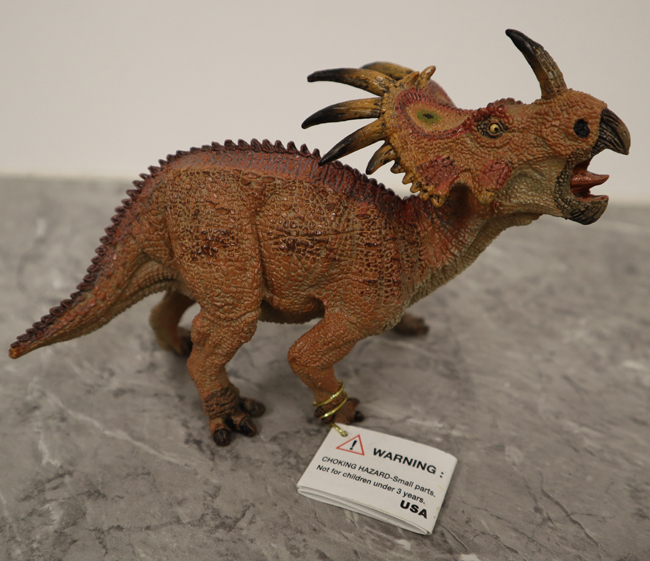
A welcome addition to the Papo “Les Dinosaures” model collection, a wonderful, hand-painted replica of that Late Cretaceous centrosaurine with the mean looking spikes on its neck frill – Styracosaurus. Everything Dinoaur team members have produced a short video reviewing the Papo Styracosaurus dinosaur model.

Papo, the figure and model manufacturers based in France are fast becoming firm favourites amongst professionals and model collectors when it comes to turning out authentic prehistoric animal replicas.  This sixteen centimetre model is a lovely example of a horned dinosaur and a credit to Papo’s designers and model makers.

A Short Video Review

In this short video, we showcase this new Styracosaurus model.  Staff at Everything Dinosaur discuss the relevance of this new model to the fossil material and highlight one or two features of note on this dinosaur replica.

Everything Dinosaur’s Review of the Papo Styracosaurus

Our review of the Papo Styracosaurus dinosaur model (Styracosaurus in red).

Everything Dinosaur’s video review of the red Papo Styracosaurus dinosaur model.

Video credit: Everything Dinosaur.

Papo Styracosaurus Dinosaur Model

The Papo Styracosaurus dinosaur model is supplied with a Styracosaurus fact sheet that has been researched and written by Everything Dinosaur team members.

To view the exciting range of Papo dinosaur and prehistoric animal figures: Papo Dinosaur Models and Prehistoric Animal Models.

2 03, 2011

Attenborough in Search of the Elephant Bird and his Fossil Fascination

By |2023-03-06T11:25:02+00:00March 2nd, 2011|Categories: Everything Dinosaur News and Updates, Main Page, Radio Reviews|0 Comments

Highlights on Television and Radio this Week

Tonight the BBC are showing a documentary entitled “Attenborough and the Giant Egg”, this is part of the BBC Natural History Unit’s documentary series on the amazing fauna and flora of Madagascar.  These programmes have been narrated by Sir David Attenborough and the programme being shown tonight recounts Sir David’s quest to find out more about the Elephant Bird that once lived on the island.

Elephant Bird

The hour long programme starts at 8pm on BBC2, it combines archive footage of Sir David’s Zoo Quest television show which documented his visit to Madagascar in 1960, with an update on the story.

Back in 1960 he tried to piece together a egg from the giant Elephant bird, (Aepyornis genus), which lived on the island before being wiped out by hunters in the 17th century.  This flightless bird was one of the most massive birds known to science and certainly the largest seen by modern people.

Pieces of Eggshell

David enquired amongst locals for pieces of eggshell and offered a reward for any pieces that could be found.  He was inundated with fragments and then one native brought him an almost complete egg.  He was astonished at just how many pieces of egg shell that turned up and the documentary tonight, filmed fifty years later, goes in search of the birds that laid these eggs.

Should be a fascinating programme.

Also, don’t forget to tune into Radio 4, Friday 8.50pm GMT (repeated Sunday mornings 08.50am GMT) for the latest instalment of David Attenborough’s Life Stories.  In the next programme, Sir David discusses his fascination with fossils.  So this week we have both compulsive viewing and listening to look forward to.

For models and replicas of extinct animals and prehistoric creatures: Mojo Fun Extinct Animals and Prehistoric Animal Figures.

1 03, 2011

Create Your own Prehistoric Scene with Helpful Advice from Everything Dinosaur

By |2024-04-21T12:23:30+01:00March 1st, 2011|Categories: Educational Activities, Everything Dinosaur News and Updates, Main Page|0 Comments

Dinosaurs Come Back to Life

Since Everything Dinosaur began, sometime back in the Holocene (the name of the Epoch that we are living in at the moment), staff have created drawing materials, quizzes, puzzles and games relating to dinosaurs and prehistoric creatures.  We have even helped young dinosaur fans create their own prehistoric scene. These items are part of our ongoing commitment to help young people learn more about Earth Sciences through their fascination with dinosaurs.

Our work with teachers and educators has been recognised and we have supplied lots of help and assistance when it comes to teaching science subjects.

Prehistoric Scene

A natural extension, (we like to think that we are evolving), is to take the vast number of prehistoric animal drawings, fact sheets and other data and utilise them in such a way so as to help schools, and mums and dads create their own prehistoric scenes for young dinosaur fans.

Our idea is very simple, we provide all the drawing materials of dinosaurs, prehistoric animals, vegetation, marine creatures and such like and dinosaur fans can create their very own prehistoric scenes featuring their favourite animals.  With so many illustrations, dinosaur drawings can be supplied by Everything Dinosaur.

A Mesozoic Timeline

We have created four scenes that link together providing a time-line from the Triassic through to the end of the Cretaceous.  We even have a marine environment scene so that prehistoric animal enthusiasts can depict marine reptiles swimming in the sea and create their version of sea monsters.

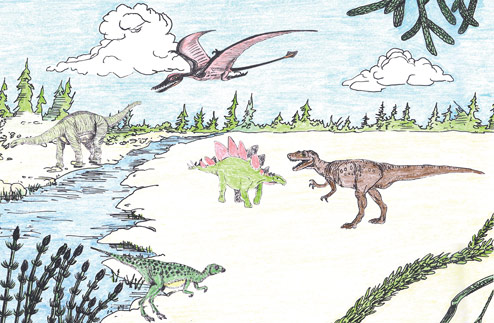
Life in the Late Jurassic

Picture credit: Everything Dinosaur

The scene shows a view of the Late Jurassic, sometime around 148 million years ago for instance.  A large allosaur (predator) confronts a Stegosaurus waiting for an opportunity to attack.  A sauropod wanders by in the background, whilst in the foreground a small, nimble ornithopod tries to avoid the gaze of the fierce Allosaurus and scampers back into the horsetails.  The vegetation is based on fossil plants from this geological period and the animals depicted are creatures whose fossils date from this time in the Late Jurassic.  The pterosaur flying overhead, surveying the scene is a long-tailed pterosaur, a Rhamphorhynchus, the dominant type of flying reptile that lived during this time.  Dinosaur fans can create their own Jurassic scene using our backdrop, we can supply a range of prehistoric animals so that they can have their own, unique dinosaur poster on their wall, or why not think big and make a wall mural?

To view the extensive range of dinosaur and prehistoric animal models available from Everything Dinosaur’s award-winning website: Dinosaur and Prehistoric Animal Models.

28 02, 2011

BBC Annouces Plans for their Dinosaur Season

By |2023-01-15T18:43:16+00:00February 28th, 2011|Categories: Dinosaur and Prehistoric Animal News Stories, Everything Dinosaur News and Updates, Main Page, TV Reviews|0 Comments

The Dinosaurs are Back on the BBC – this time in 3-D

The BBC have announced details of their new ground breaking television programmes combining prehistoric animals, the latest research and new media technology.  This marks the first time that the BBC has developed a palaeontology themed television series since the world famous “Walking with Dinosaurs” aired more than a decade ago.

Prehistoric Animals

The new documentary series, filmed in 3-D is to be entitled “Planet Dinosaur” and focuses on the research that has been carried out since the “Walking with” series.  Dinosaurs featured will include Spinosaurus and the fierce, cannabalistic Majungasaurus (also known as Majungatholus).

To see a replica of Majungatholus and other dinosaur models: CollectA Age of Dinosaurs Prehistoric Life Models.

Giant Marine Reptiles

The television programmes will also include giant marine reptiles such as the infamous pliosaur “predator X”, perhaps the largest carnivore ever to live on planet Earth.  The three-part series will combine 3-D graphics, computer imagery and photo-realistic fight scenes to give a fresh perspective on dinosaurs.  At Everything Dinosaur, we have been contacted to help with the graphics, advising on a number of projects associated with the programmes.

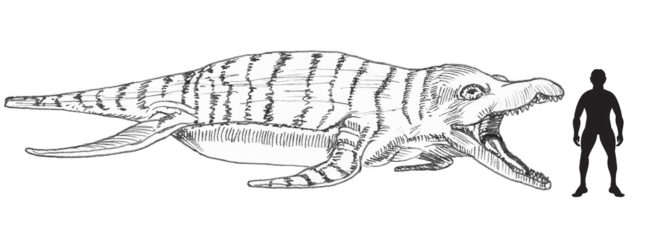
A Scale Drawing of a Pliosaur

Pliosaurus scale drawing. Huge pliosaur remains.

A scale drawing of a Pliosaurus. Picture credit: Everything Dinosaur.

Picture credit: Everything Dinosaur

To accompany the programmes BBC 4 will show three documentaries – a sort of “making the sequels to Walking..”, they will be called How to build a dinosaur, Survivors and Dinosaurs, Myths and Monsters.

For models and replicas of prehistoric animals: Models of Prehistoric Animals.

27 02, 2011

Agreement Reached to Let Museum Continue its Important Dig for Ice Age Fossils

By |2024-04-21T12:24:13+01:00February 27th, 2011|Categories: Dinosaur and Prehistoric Animal News Stories, Main Page|0 Comments

Denver Museum Reaches Agreement with Contractors

The Denver Museum of Science and Nature has reached agreement with contractors and the state’s historical preservation office to permit palaeontologists and field workers to return to a reservoir construction site where Ice Age fossils including of a number of prehistoric elephants have been discovered.

Ice Age Fossils

The site at Ziegler Reservoir has already yielded a number of very well preserved Ice Age mammal fossils including Woolly Mammoth specimens, one of which has been named “Snowy” by local residents as the location is near to the small town of Snowmass.

To read more about the discoveries, including the finding of the fossilised skull of a huge extinct species of bison: Huge Prehistoric Bison Skull Unearthed in Colorado.

The agreement permits the museum staff to spend seven weeks from mid May until July 1st continuing the excavation work that commenced last October, after the first fossils were found by builders extending the reservoir.  The site marks an ancient lake bed which seems to have preserved a large number of mega fauna specimens, large Ice Age mammals including Mastodon and Mammoth remains.

The Ziegler Reservoir Agreement

The agreement will allow the scientists to have the extra time they need to explore and map the site before the bulldozers move in.  Hopefully any more large specimens can be located and extracted before the reservoir extension work goes ahead.

Described as a “once in a lifetime discovery”, by museum staff, the Snowmass site can provide vital information about the local large mammal population that roamed the area more than 10,000 years ago.

To view models and replicas of Ice Age creatures: CollectA Deluxe Prehistoric World Models.

26 02, 2011

The “Walking Cactus” – Transitional Fossil between Worms and Arthropods?

By |2023-01-15T18:34:34+00:00February 26th, 2011|Categories: Dinosaur and Prehistoric Animal News Stories, Main Page|0 Comments

The Worm that Walked Tall – Diania cactiformis

Approximately 520 million years ago (Middle Cambrian), slowly stalking its way across the muddy seabed of what was to become the Yunnan province of southern China was a strange worm-like creature that had ten pairs of partially-jointed, armoured legs.  This peculiar creature, just one of many bizarre Cambrian animals, may represent the type of transitional animal between soft-bodied, legless worms and the armoured arthropods such as trilobites, crabs and lobsters.

Bizarre Cambrian Animals

The creature has been named Diania cactiformis it may have only been six centimetres long, but this is quite a large size when compared to other animals that existed at the time or indeed when compared to older fossil organisms from the Burgess Shale locations.

Nick-named the “walking cactus”, this animal seems to have a distinctive head, or at least one end of it ended in a swollen bulbous appendage that may have been the site of sensory organs.  The creature’s remains were discovered in 2006, in Cambrian aged strata in the county of Chengjiang in southern China’s Yunnan province.  Chinese palaeontologists from the country’s Northwest University found the fossil and have ascribed it to the Lobopodia, a long-extinct group of organisms that outwardly resemble worms with legs.  Diania cactiformis differs from other members of the Lobopodia by seeming to have spiny, armoured legs.

The discovery and research into this ancient creature has been documented in the latest edition of the scientific publication “Nature”.  Dr Liu Jianni, leader of the research team from the Northwest University expressed excitement at having had the opportunity to study what may be an extremely important fossil, helping to explain the evolution of hard-bodied animals from soft-bodied animals during the early Phanerozoic.

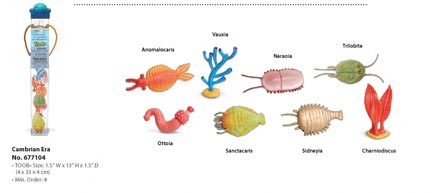
Bizarre Cambrian Animals

Cambrian Toob by Safari Ltd bizarre Cambrian animals

Say hello to Cambrian wildlife. Bizarre Cambrian animals.

It is thought that the bulbous appendage seen in the top left of the picture represents the head end, but scientists remain uncertain with regards to the exact anatomical structure of this strange creature.  The head reminds us at Everything Dinosaur, of the bizarre structure to be found at one end of that famous Burgess Shale animal – Hallucigenia.  Whether Hallucigenia actually had a head is open to debate, the head-like structure on the fossils found may not be related to the specimen at all, but fossils of this animal, classified as an arthropod have been found in China.  Perhaps, this walking cactus is related to Hallucigenia in some way.

Diania cactiformis

Looking like a 520-million-year-old pressed flower, the fossil of Diania cactiformis is very well preserved and the spiky appendages on the leg-like structures can clearly be made out.  This animal may have walked tall across the muddy sediments at the bottom of the shallow sea that covered China.  It may hold the key to the development of the Arthropoda a huge Phylum that contains something like 80% of all known living species.

The arthropods show great diversity and morphology and includes the crustaceans, insects, millipedes, spiders, scorpions and trilobites.

Commenting on the discovery, Professor Shu Degan, head of the Northwest University’s Early Life Institute commented on the evolution of the leg-like structures:

“With these appendages, arthropods were able to run faster, jump higher and move with more agility.  Some appendages even evolved into preying instruments.  They helped arthropods become powerful and eventually dominant members of marine, freshwater, land and air ecosystems.”

To view models of ancient prehistoric creatures: Wild Safari Prehistoric World Figures.

25 02, 2011

New Papo Styracosaurus Model in Stock

By |2023-01-15T18:29:07+00:00February 25th, 2011|Categories: Dinosaur Fans, Everything Dinosaur News and Updates, Main Page|0 Comments

The New Papo Styracosaurus Replica

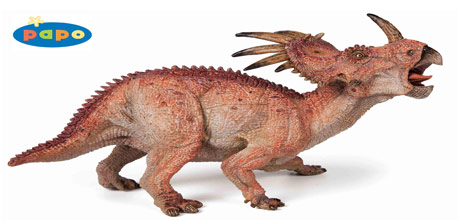
Papo, that famous model and figure manufacturer based in France has launched the first of its two new dinosaur models this year.  The new interpretation of Styracosaurus measures over sixteen centimetres long and depicts this horned dinosaur from the Campanian faunal stage of North America in colourful salmon pink.  It is a super Papo dinosaur model.

The Papo Styracosaurus Dinosaur Model

Picture credit: Papo/Everything Dinosaur

To view the Papo “Les Dinosaures” model range: Papo Dinosaurs and Prehistoric Animal Models.

Of the nineteen prehistoric animal models currently marketed by Papo, three are members of the Ceratopsidae family, Styracosaurus joins Triceratops and Pachyrhinosaurus.  Indeed, if you consider the Marginocephalia (the Suborder to which the Ceratopsidae belong), there are four models in the current Papo range that are classified as members of the Marginocephalia – the fourth Papo dinosaurs model being the Pachycephalosaurus replica.

The Papo Styracosaurus Dinosaur Model

The Papo Styracosaurus model.

The Papo red Styracosaurus dinosaur model (right lateral view). Picture credit: Everything Dinosaur.

Picture credit: Everything Dinosaur

All of the Papo horned dinosaur figures sold by Everything Dinosaur including the Papo Styracosaurus model will be sent out with a free dinosaur fact sheet researched and written by Everything Dinosaur team members.

24 02, 2011

Discovering Dinosaurs – The Next Generation of Palaeontologists

By |2023-03-07T10:06:04+00:00February 24th, 2011|Categories: Educational Activities, Everything Dinosaur News and Updates, Main Page, Press Releases, Teaching|0 Comments

Pupils get to Grips with Dinosaurs and Fossils

Pupils at Hugo Meynell Primary School, near to the Shropshire town of Market Drayton, had the chance to travel back to the time and to learn about dinosaurs and fossils with a visit from one of Everything Dinosaur’s palaeontologists.

Taking part in a number of experiments, in what was a dinosaur themed workshop, the students in years 3 and 4 learned about these prehistoric animals and had the chance to get grips with a number of fossils, all part of a special topic on dinosaurs that they had been studying.

Young Palaeontologists

As part of the day’s activities, the lucky pupils were able to help cast museum replicas of some of the dinosaur fossils that are part of Everything Dinosaur’s collection, a collection that includes very rare and special items such as Tyrannosaurus rex teeth.  For the classes involved they, and the teaching staff, were able to keep their own very special souvenir of the visit from a dinosaur expert.

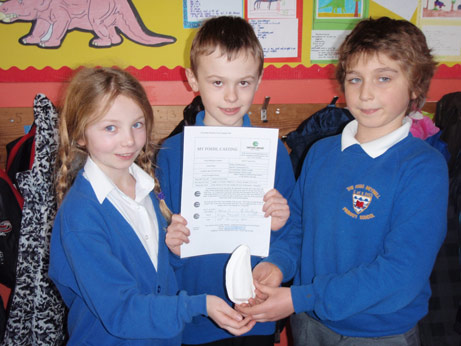
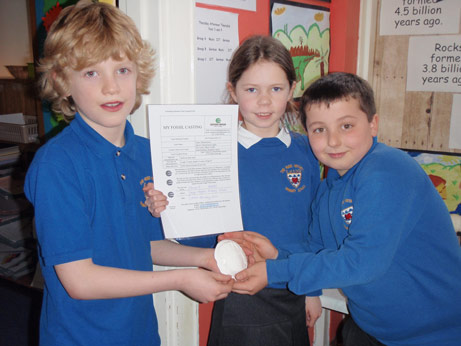
Pupils with a Cast of a Large Theropod Tooth (Tyrannosaurus rex)

Picture credit: C. Cowley

Hugo Meynell School Young Palaeontologists with Edmontosaurus Toe Bone

Everything Dinosaur’s visit to Hugo Meynell School.

Picture credit: C. Cowley

The pictures show some of the young palaeontologists from Hugo Meynell school with the cast replicas of dinosaur fossils, along with a special certificate given to them by which explained where the fossil from which the cast was made was found and from which dinosaur the fossil came from.

Dinosaurs and Fossils

Dinosaurs in schools, these young palaeontologists were thrilled at the prospect of getting to handle real fossils.

Visit Everything Dinosaur’s award winning website: Visit Everything Dinosaur.

23 02, 2011

Palaeontologists get a “Kick” out of New Sauropod Genus

By |2023-01-15T18:21:23+00:00February 23rd, 2011|Categories: Dinosaur and Prehistoric Animal News Stories, Main Page, Palaeontological articles|0 Comments

Brontomerus mcintoshi – The Dinosaur Dubbed “Thunder Thighs”

A team of American and British scientists have named a new genus of Early Cretaceous sauropod from Utah “Thunder Thighs” as they believe that this particular long-necked dinosaur possessed a strong and powerful kick.

Although only fragmentary remains have been found, partially due to the poor state of preservation of the fossils, but also due to the fact that the excavation site had been looted by private collectors, scientists are confident that this new genus of sauropod had very robust, powerful limbs, strong enough to send a predatory dinosaur flying with one swift kick.

Commenting on this large-limbed Sauropod Dr Mike Taylor of the University College London, the lead author on the scientific paper on this creature stated:

“If predators came after it, it would have been able to boot them out of the way.”.

Details regarding this new dinosaur taxon have been published in the scientific journal “Acta Palaeontologica Polonica”, it will no doubt get a lot of publicity due to the genus name resembling the now defunct taxon Brontosaurus and the fact that it had very large thighs.  Hopefully, as a result of the publicity, more will be done to help protect scientific sites from looting, as little more can be found out about this dinosaur due to the limited fossil material recovered.  The name of this new taxon literally means “thunder thighs”, but just why this dinosaur had such strong legs remains open to speculation.

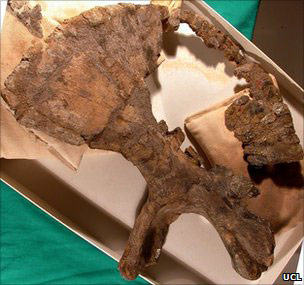
The Ilium (Hip-Bone) of B. mcintoshi
Picture credit: University College London

The ilium bone of this dinosaur has a forward projecting blade, proportionally much bigger than in similarly sized sauropods.  This suggests that large thigh muscles were anchored there.

The fossils of two specimens an adult; estimated to measure around 14 metres in length and to weigh perhaps as much as six tonnes and a pony-sized juvenile were found in close proximity.  The American and British researchers have speculated that the youngster could be the offspring of the adult, although there is little firm evidence to prove this.

However, sauropod tracks discovered last year seem to show young animals following an adult, perhaps these huge animals did protect their offspring by staying close to them, at least until the babies were big enough to look after themselves.

To read more about the sauropod trackways: Running with Baby Sauropods.

The fossils have been dated to around 110 million years ago (Albian faunal stage of the Cretaceous), a time when fast running packs of dromaeosaurs roamed the open plains.  Perhaps, this dinosaur evolved strong legs in order to kick out at and fend off attacks of predatory dinosaurs such as Deinonychus and Utahraptor.

The site, part of a quarry had been looted by commercial fossil-hunters but despite this enough fossil material was located in order to provide an analysis and the information required to identify a new taxon.

Brontomerus mcintoshi

The evidence for the large leg muscles comes from the ilium (part of the hips).  It is unusually large in comparison with other similar sized dauropods and the wide blade of the ilium projects forward providing a large area for the anchoring of leg muscles (femoral protraction and abductor muscles), muscles which would have helped to move the leg out and away from the body.  No actual leg bones have been recovered so at this time the reason for the big thigh muscles remains unknown, however, this dinosaur would have been capable of delivering a powerful kick, easily strong enough to send a hungry dromaeosaur flying.

Dr Taylor added:

“As you put the skeleton together, you can run muscles down from the hip-bone to join at the knee and that gives you a whopping thigh.  What’s interesting is that if it were a sauropod that could move particularly fast, you would expect to see very strong muscles on the back of the legs to pull it along [retractor muscles], but we don’t.

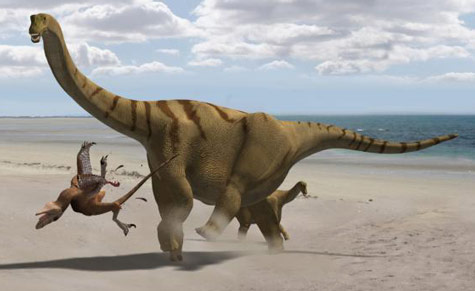
A Restoration of B. mcintoshi
Picture credit: F. Gascó.

In the picture, a mother Brontomerus is defending a juvenile by kicking out at an attacking dromaeosaur.

In addition to the unusual ilium, the shoulder blade (scapula) has strange bumps on it that probably mark the boundaries of muscle attachments, indicating that this dinosaur also had powerful forelimb as well.

Co-author of the study Dr Matt Wedel, from the Western University of Health Sciences in Pomona, California stated:

“It’s possible that Brontomerus mcintoshi was more athletic than most other Sauropods.  It is well established that far from being swamp-bound hippo-like animals, Sauropods preferred drier, upland areas; so perhaps Brontomerus lived in rough, hilly terrain and the powerful leg muscles were a sort of ‘dinosaur four-wheel drive’.”

This discovery, plus numerous other sauropod finds dating from Lower Cretaceous strata is helping to change palaeontologist’s perception about the diversity of the Sauropoda during the Early Cretaceous.  It had been thought that the lizard-hipped sauropods had been largely replaced by herbivorous ornithischian dinosaurs in the food chains of the Northern Hemisphere by around 100 million years ago.  As more sauropod fossils are discovered it seems that scientists may have to revise the views held regarding the diversity and abundance of long-necked dinosaurs.

Dr Wedel commented:

“In the past twenty years, however, we are finding more sauropods from the Early Cretaceous period, and the picture is changing.  It now seems that sauropods may have been every bit as diverse as they were during the Jurassic, but much less abundant and so much less likely to be found.”

The fossilised bones of the two dinosaur specimens are currently at the Sam Noble Museum of Natural History in Norman (Oklahoma).  Plans are at an early stage to re-visit the location to see if more fossil material relating to this new genus can be discovered.  If elements of the leg bones could be found then this may help solve the mystery of the dinosaur with the “thighs like a body builder”.  With more fossils to study, the team could perhaps provide a more accurate assessment of the phylogeny of this sauropod, at the moment it has been tentatively ascribed to the camarasaurids.

It is possible, that this dinosaur may have resembled a giraffe and the strong hind limbs could have played a role in supporting the animal’s weight as it rocked back onto its back legs so that it could crane its neck higher to reach the branches of trees that other dinosaurs could not reach.

In antelopes there are many members of this family who have adapted a basic body plan to help them feed on vegetation that other animals cannot.  The long-limbed, long-necked Gerenuk (Litocrannius walleri) of southern Africa has exceptionally strong thighs that enable it to rear up on its hind legs to feed on the branches of thorn bushes that other antelopes can’t reach – could the large thigh muscles of B. mcintoshi have helped this dinosaur to do something similar?

For models and replicas of sauropod dinosaurs: Mojo Fun Prehistoric and Extinct Figures.

22 02, 2011

Sabre-Toothed Cats are not Closely Related to Tigers

By |2023-01-15T18:18:25+00:00February 22nd, 2011|Categories: Animal News Stories, Dinosaur Fans, Everything Dinosaur News and Updates, Main Page|0 Comments

Smilodon et al are not Related to Tigers

The phrase “Sabre-Tooth Tiger” is often used to describe species of the genus Smilodon.  We are not sure how this phrase entered the public’s consciousness, but we do here it quite frequently.  Team members at Everything Dinosaur have encountered this term on a number of occasions recently, as they have been talking about the launch of a new model of a Smilodon – Sabre-toothed cat from Papo of France.

Often these animals are referred to as “Sabre-Tooth Tigers”, we do use this terminology in order to assist customers with queries and product searches but the name is confusing as Sabre-tooths (genus name Smilodon), are not actually that closely related to tigers.

The genus name – Smilodon means “knife tooth” in recognition of the large upper canines these animals possessed.  In a large Smilodon; such as Smilodon fatalis, the upper canines could be up to 18 cm long. The jaws on Sabre-toothed cats were specially adapted to open wide and could gape to 120° (an African lion can open its jaws to about 70°), this would have permitted Smilodon to close its jaws around the neck of its victim and puncture vital blood vessels to the brain and sever the windpipe leading to a quick kill. However, these teeth are quite delicate and could shatter if they bit down onto bone.

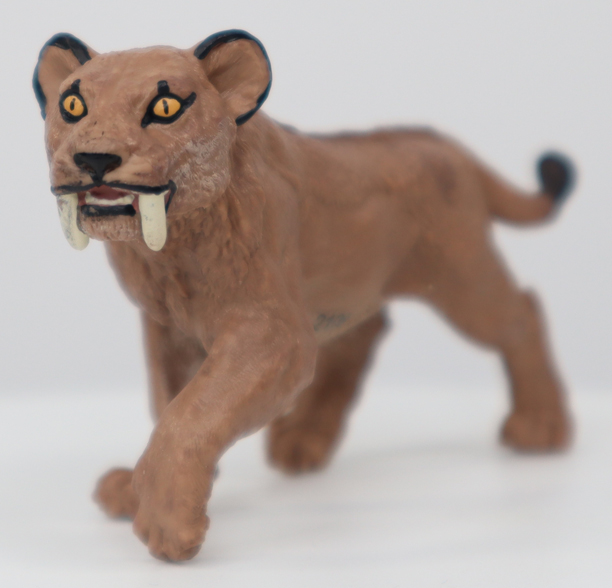
A Papo Young Smilodon Model

Papo young Smilodon model.

Running towards you! The Papo young Smilodon model. Picture credit: Everything Dinosaur.

Picture credit: Everything Dinosaur

To view the Everything Dinosaur prehistoric animal models and dinosaur toys including the Papo range of dinosaurs and prehistoric animal figures: Papo Dinosaurs and Prehistoric Animal Models.

The popular name “Sabre-Tooth Tiger” is misleading.  Smilodon was not closely related to modern tigers, although they were members of the cat family – Felidae.  The Sabre-tooths belonged to a sub-family of the cats, called the machairodonts which can be dated back to around 12 million years ago. None of us at Everything Dinosaur can recall when the term “Sabre-Tooth Tiger” came into use, but technically it is inaccurate to describe these extinct predators as “tigers”.

Go to Top