All about dinosaurs, fossils and prehistoric animals by Everything Dinosaur team members.

Important and influential figures in science or from other related areas concerning dinosaurs and prehistoric animals.

18 07, 2010

Today is Nelson Mandela Day Time to Celebrate

By |2024-04-19T10:44:59+01:00July 18th, 2010|Categories: Everything Dinosaur News and Updates, Famous Figures, Main Page|0 Comments

Happy Birthday Nelson Mandela

Today, is the ninety-second birthday of Nelson Mandela, a man whose humility and humble dignity has done much to advance the course of world peace.  Mandela’s immense achievements and role on the world stage are far to many to list on this small web log article, but clearly he has been one of the most influential political leaders in the last one hundred years or so.  He is a world icon, his role in the destruction of apartheid, his presidency of South Africa and his role as a human rights advocate have been well documented, but he has also done much to promote education and the study of science in South Africa and beyond.

Nelson Mandela

The 18th of July has been declared Nelson Mandela International day. To commemorate this and, as it is his birthday, we wanted to reflect on his support for education and the teaching of science.  The Nelson Mandela Foundation supports a vast range of educational and science themed projects – many of them centred around South Africa’s particularly rich fossil heritage.

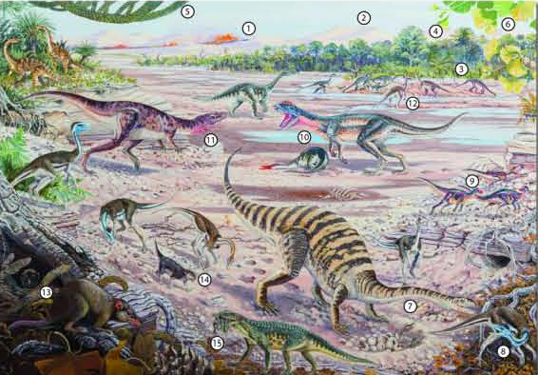
The Rich Permian and Triassic Fossil Heritage of South Africa

Prehistoric life in South Africa

The prehistoric life of South Africa celebrated in a poster. Picture credit: The Evolutionary Studies Institute (Witwatersrand University).

Picture credit: The Evolutionary Studies Institute (Witwatersrand University)

Promoting Science and Education

For example, the annual Nelson Mandela Science Lecture, held last November featured Professor Chris Stringer of the Natural History Museum presenting a talk on Darwin, Africa and the origins of our own species.  Although, perhaps as not widely known as his other achievements, Nelson Mandela has done much to open up the South African education system and to permit access to learning to far more people in South Africa and neighbouring countries.

The Nelson Mandela Science Lecture is a partnership project between the Africa Genome Education Institute and the Nelson Mandela Foundation.  The 2009 lecture was held jointly with the Darwin200 series of lectures, a partnership project of the Africa Genome Education Institute & the Division of Human Genetics at the University of Cape Town.

Just another example of the great man’s influence on his beloved South Africa and the world – many happy returns Mr Mandela.

Everything Dinosaur also tries in its own small way to promote science and education.

Visit Everything Dinosaur’s award-winning website: Everything Dinosaur.

21 05, 2010

Happy Birthday Mary Anning Many Happy Returns

By |2024-04-19T10:01:30+01:00May 21st, 2010|Categories: Dinosaur Fans, Famous Figures, Geology, Main Page|0 Comments

Remembering Mary Anning a Pioneering English Fossil Collector and Palaeontologist

Today, the 21st of May, is the anniversary of the birth of Mary Anning, a pioneering English fossil collector and amateur palaeontologist.  Mary was born in the small, seaside town of Lyme Regis, an area of Britain’s coast famous for its Jurassic sediments and fossils of marine animals (and pterosaurs plus one dinosaur genus).

Mary Anning

Her father was a carpenter by trade, although he supplemented the family’s income by also selling curios (fossils) that they had found on the beach and in the cliffs that surround Lyme Regis.  Mary became prominent as an expert in fossils and fossil finding, although she did not receive the full credit for her contribution to science during her lifetime.  She discovered the first plesiosaur fossils in 1821 and the first pterosaur (flying reptile) fossils in England in 1828.

Many of her specimens can be seen in museums today, her finds helped to build up the collections of a number of wealthy individuals but often no record was kept of her contribution or role in the research and study of such specimens.

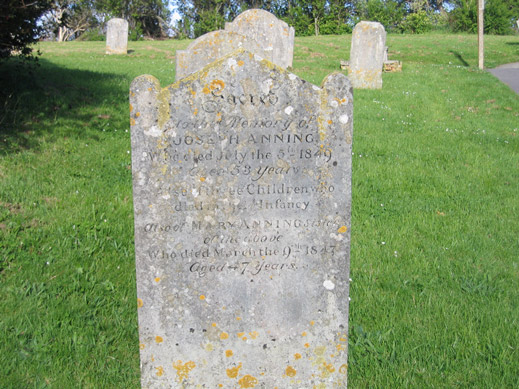
Mary died in 1847, she is buried at St Michael’s church which stands above the cliffs at Lyme Regis.

A Picture of the Grave of Mary Anning and her Brother Joseph

Mary Anning's grave.

Mary Anning’s grave at St Michael’s Church on the hill overlooking Lyme Regis.

Picture credit: Everything Dinosaur

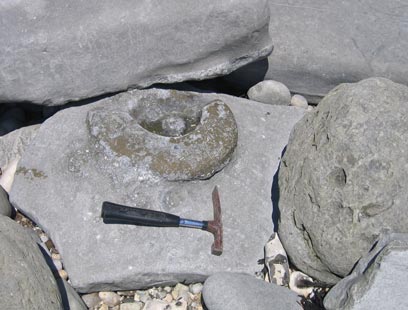
Ammonite Fossils

Thousand of people every year visit the UNESCO Jurassic coast to go hunting for fossils such as ammonites. They are following in the footsteps of Mary Anning.

Typical Fossils Found on the Beaches at Lyme Regis

An Ammonite fossil. The geological hammer provides a scale (geology hammer).
A big fossil close to the Ammonite Pavement. Picture credit: Everything Dinosaur.

Picture credit: Everything Dinosaur

For replicas of ammonites and other prehistoric creatures, take a look at Everything Dinosaur’s extensive range of models and figures: Prehistoric Animal Models and Figures.

22 04, 2010

The Movius Line – A Brief Explanation

By |2023-01-05T09:28:51+00:00April 22nd, 2010|Categories: Dinosaur and Prehistoric Animal News Stories, Everything Dinosaur News and Updates, Famous Figures, Main Page|0 Comments

What is the Movius Line?

The Movius line is named after the American archaeologist Hallam Movius (1907 -1987), it is a theoretical line that separates those parts of Europe, Africa and Asia with or without Acheulean hand axe technology.  An expert in Stone Age human remains and relics, Movius plotted the distribution of early hominid sites where advanced stone tools were found.  Sophisticated stone tools such as the Acheulean hand axe took a great deal of skill to make.  An ancient hominid would have had to carefully select a stone to work on, finding a suitable stone would have taken a lot of planning.  Then a variety of tools would have been employed to shape and cut the stone hand axe to the ideal size.  Each side of the stone would have had to be worked in turn and a number of other stone tools and even antler points would have been required to finish it off.

The Movius Line

Movius discovered that there was a clear division between those parts of the world with the Acheulean stone technology and those parts without.  Across Africa and most of southern Europe, hominids had the advanced stone hand axe technology, but it was absent from large areas of Asia (although other types of stone tool were found at dig sites).

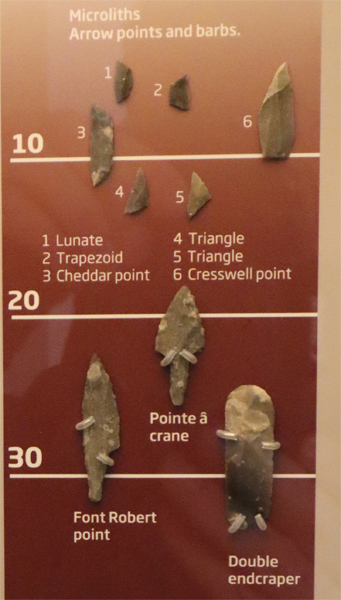
Examples of Stone Age Tools on Display

Stone Age Tools.  The Movius line explained.

A collection of typical Stone Age Tools. Picture credit: Everything Dinosaur.

Picture credit: Everything Dinosaur

A number of theories have been put forward to explain this division.  The first hominids to leave Africa may have carried older types of stone tools, alternatively, areas without Acheulean axes may not have had suitable stones for the hominids to work.  Migrating groups of hominids may have lost the ability to make sophisticated hand axes (after all, how many of us these days can start a fire just using sticks).  Another theory put forward is that other materials may have been used by ancient humans living in Asia, for example, bamboo and any bamboo tools would not be likely to have been preserved as fossils.

For models of Stone Age people and Pleistocene mammals: Prehistoric Animal Models and Stone Age People.

12 04, 2010

Remembering Edward Drinker Cope (1840 – 1897) a Famous American Scientist

By |2024-04-18T21:48:06+01:00April 12th, 2010|Categories: Dinosaur and Prehistoric Animal News Stories, Dinosaur Fans, Educational Activities, Famous Figures, Main Page|0 Comments

Edward Drinker Cope – Eminent American Palaeontologist

Today, April 12th marks the anniversary of the death of Edward Drinker Cope, who along with his rival Charles Othniel Marsh did so much to explore and study vertebrate fossils of the United States.  Although the techniques employed by both parties in the “bone wars” of the late 19th century would certainly raise eyebrows today, there is no denying Cope’s dedication to the science of palaeontology.

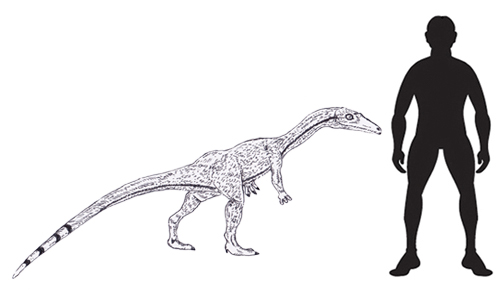
As professor of comparative zoology and botany at Haverford College, Pennsylvania (USA), Cope led a number of expeditions to explore the fossil rich strata of the western United States.  It has been estimated that he and his team, discovered more than 1,000 species of extinct vertebrates – including dinosaurs.  Responsible for naming and describing iconic dinosaurs such as the sauropod Camarasaurus and the Triassic theropod Coelophysis, Cope has been honoured by having a dinosaur genus named after him.  Drinker nisti, a small ornithopod dinosaur whose fossils have been found in Wyoming (USA) was a 2 metre long, herbivorous dinosaur of the Late Jurassic  However, it seems that even naming dinosaurs after Cope brings him into direct conflict with his great rival Othniel Charles Marsh.  Drinker is known from a number of fragmentary remains and the partial skeletons of one adult and a juvenile.  It is very closely related to Othnielia (Othnielia rex), named in honour of Marsh.  In fact the differences between these two dinosaurs are so slight that it has been argued that Drinker is not a separate genus, but in fact a species of Othnielia.

A Scale Drawing of Coelophysis

Coelophysis illustrated. Remembering Edward Drinker Cope.

A scale drawing of the Triassic dinosaur Coelophysis. Remembering Edward Drinker Cope.  Picture credit: Everything Dinosaur.

Picture credit: Everything Dinosaur

For models of Coelophysis (whilst stocks last) take a look here: Wild Safari Prehistoric World Replicas.

Looks like the rivalry between Marsh and Cope will rumble on.  However, Cope’s contribution to science cannot be doubted.  He published more than 1,200 books and papers during his lifetime and contributed greatly to the understanding of vertebrate evolution.

4 02, 2010

Darwin on the “Imperfection of the Geological Record”

By |2023-03-04T15:07:33+00:00February 4th, 2010|Categories: Famous Figures, Main Page, Palaeontological articles|0 Comments

Darwin’s Comments on the Geological Record

For Darwin, at the time of writing his ground-breaking study into evolution – “The Origin of Species”, palaeontology and geology were relatively new sciences.  Amongst the educated elite of Great Britain in the Georgian era, there were to our modern minds some very peculiar ideas.  For example, it was widely believed that Europeans were a separate species to those natives of places such as North America and the Pacific.  Women were considered intellectually inferior to men and they were not permitted to hold certain positions in society or to study at certain universities, or indeed enter a number of academic professions.  These ideas persisted into the Victorian era (indeed, some may say that they have persisted for much longer).

Darwin

It is against this background and a backdrop of a general lack of understanding concerning natural selection and evolution that Darwin attempted to argue his case for a tree of life and an all embracing single theory that could explain the great diversity of life on Earth.

Aware of the difficulties that he would encounter when attempting to convince his readers about the merits of his theory, Darwin, naturally provides extensive evidence in support of his point of view in his book.  However, he also sets out to counter the arguments that he anticipated would be put forward against his hypothesis.  Darwin was aware that his theory centred around the belief that specific forms are distinct from each other but descended from a common ancestor.

Between two specific organisms that share a common ancestor there must have been innumerable transitional links that eventually resulted in the species seen in his day.  He put forward a number of proposals as to why extant transitional forms were extremely rare, the very fact that that subsequent generations would out compete and eradicate their parent generations was one of his main points here.  However, he knew that the lack of transitional extinct forms found in the fossil record would also be used as an argument to counter the thrust of his theory.

The Imperfections of the Fossil Record

Darwin dedicates two of the fourteen chapters in his third edition to explaining why transitional forms are not found in plentiful numbers in the fossil record, some sixty pages in total.  Palaeontology and geology were very much nascent sciences, Darwin comments on the intermittent nature of the geological record and refers to the paucity of the fossil record.  He puts forward a number of points to explain why fossils are so rare and comments on the need for certain geological conditions to be present before fossilisation can occur.  To him the imperfections found in the then known geological record were no barrier to his theory on natural selection.

The “Origin of Species”, or to give this book its full title; “The Origin of Species by Means of Natural Selection or the Preservation of Favoured Races in the Struggle for Life”, was first published in 1859.  The first complete fossilised skeleton of Archaeopteryx was found in 1861.  A perceived weakness in Darwin’s theory was the lack of intermediate creatures preserved in the fossil record.  If animals and plants had been changing from one form to another over vast amounts of time, the process of evolution, then some evidence should be found in palaeontological collections.

Here was a bird with Dinosaurian features, Darwin had predicted that such forms would be found and this was seen by evolutionists as clear support from the geological record for Darwin’s point of view.

Visit Everything Dinosaur’s website: Everything Dinosaur.

3 02, 2010

Happy Birthday to Gideon Mantell

By |2023-03-04T15:08:24+00:00February 3rd, 2010|Categories: Dinosaur and Prehistoric Animal News Stories, Dinosaur Fans, Educational Activities, Famous Figures, Main Page|0 Comments

Happy Birthday Dr Gideon Mantell

Today, marks the birthday of Gideon Algernon Mantell, a English doctor, avid fossil collector and amateur geologist who made a considerable contribution to the early science of palaeontology.  Gideon Mantell was born on the 3rd of February in 1790, he was responsible for naming and describing two of the three dinosaurs that made up the Order Dinosauria as proposed by Sir Richard Owen.  These dinosaurs were Iguanodon and Hylaeosaurus.

The naming of Iguanodon (Iguana Tooth) has a stroke of luck about it.  Having studied the very worn, teeth, of a large, herbivorous reptile, as described by the French scientist Cuvier, Mantell was fortunate to see a freshly prepared skeleton of an Iguana  from the Caribbean.  He visited the Museum of the Royal College of Surgeons and was shown the newly prepared Iguana skeleton.  Noticing that the teeth of this lizard resembled the fossilised teeth of his as yet unnamed prehistoric reptile, he began to speculate on a formal scientific name for his extinct reptile.  The actual name of Iguanodon was suggested to Mantell by the Reverend William Conybeare.

Gideon Mantell

Hence the genus Iguanodon came about, the second dinosaur to be formerly named and described.

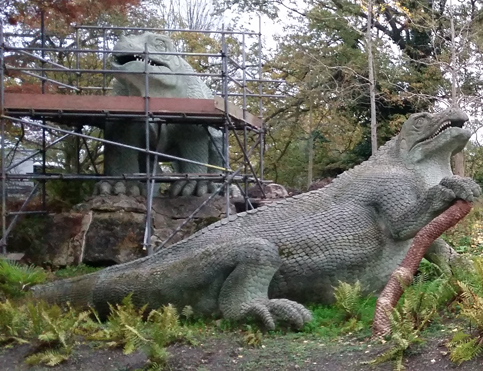
Iguanodon Figures at Crystal Palace Park

Iguanodons at Crystal Palace.

A pair of Iguanodons study the Crystal Palace landscape, these were the first, large dinosaur figures to be made. Picture credit: Everything Dinosaur.

Picture credit: Everything Dinosaur

To view models of iguanodontids and other ornithischian dinosaurs: Dinosaur Models and Figures.

13 12, 2009

Darwin Alludes to a Different Opinion – Cosmogony

By |2023-03-04T14:23:20+00:00December 13th, 2009|Categories: Famous Figures, Geology, Main Page|0 Comments

Darwin uses Cosmogony to Argue against Independent Creation of Species

Our tea stained and well-worn copy of the “Origin of Species” the seminal work by Charles Darwin has been well-thumbed this year, what with 2009 being the 200th anniversary of Darwin’s birth and the 150th anniversary of this books first publication.

In chapter five, of our edition (based on the third edition published), Darwin attempts to map put the laws of variation in nature, covering areas such as the effect of climate and environment on natural selection and the reversion of long-lost characters through successive generations.

At the time of Darwin’s research and writing of his most famous book, most scientists believed that species existed forever and that even though similarities in species and genera were recognised, all types of organism had been independently created.  Darwin and a number of other academics and scientists were beginning to challenge this view and Darwin on his chapter detailing the laws of variation comments on the beliefs of cosmogonists as he draws this particular part of this argument for natural selection to a close.  We had not come across this word – cosmogonists before.  An explanation is not provided in the book’s glossary, so we had to look up the definition in a dictionary.

Cosmogony is the study of the origin of the universe, a cosmogonist is someone who studies cosmogony or believes in these principles.  The word is derived from the Greek “kosmogonia” from the word kosmos meaning world and gonia meaning begetting.

Darwin compares the beliefs of cosmogonists to those views held by himself after his research into the origin of species and natural selection.  He describes the re-emergence of striped features in types of horse as an indication that all these diverse and geographically widespread equines shared a common ancestor.

Darwin writes: “He who believes that each equine species was independently created, will I presume, assert that each species has been created with a tendency to vary, both under nature and under domestication, in this particular manner, so as often to become striped like other species of this genus; and that each has been created with a strong tendency , when crossed with species inhabiting distant quarters of the world, to produce hybrids resembling in their stripes, not their own parents, but other species of the genus.”

He goes on to write: “To admit this view is, as it seems to me, to reject a real for an unreal, or at least for an unknown ,cause.  It makes the works of God a mere mockery and deception; I would almost as soon believe with the old and ignorant cosmogonists, that fossil shells had never lived, but had been created in stone so as to mock the shells now living on the sea-shore.”

One of the important aspects of Darwin’s work, is the way in which he uses prose to get his message across.  He had studied the works of many poets and other writers, the long voyage on the Beagle gave him plenty of opportunity to do so and his use of words and his ability to express himself eloquently has been admired by many modern writers.

Visit Everything Dinosaur’s award-winning website: Everything Dinosaur.

30 11, 2009

Sir Roderick Murchison – A Scottish Pioneer in Geology

By |2022-12-31T20:58:27+00:00November 30th, 2009|Categories: Famous Figures, Main Page|0 Comments

Sir Roderick Murchison – A Scottish Pioneer in Geology

On this day, November the 30th, St., Andrews day, the patron saint of Scotland, it is worth remembering the great contribution to science made by Scots.  One person in particular springs to mind – Sir Roderick Murchison (1792 – 1871).

Sir Roderick Murchison

Born into a wealthy Scottish family, at Tarradale House, on the shores of the river Beauly in the region of the Scottish Highlands called Easter Ross, the young Roderick Murchison was destined for a career in the British military.  He attended military college and fought in the Napoleonic wars.  However, when he married he was introduced to the joys of fossil collecting by his wife and his high status in Scottish society led him to be influenced by the many distinguished scientists that he met.  He became an active member of the Geological Society of London, helped to form the British Association for the Advancement of Science and the Geographical Society, becoming this Society’s President.

He is perhaps best remembered for his work on the dating of geological strata.  Working with the Reverend Adam Sedgewick, a professor at the University of Cambridge, Murchison mapped the strata of Wales.  He was truly a pioneer of geology and his study of Palaeozoic rocks helped define our understanding of deep geological time.

He identified rock strata younger than the Cambrian, in his study of Wales and his analysis of fossil arthropods, brachiopods and mollusca enabled him to help develop an understanding of biostratigraphy.  He named the Silurian period in 1835 and together with Adam Sedgewick named the Devonian System of strata in 1839.  He also helped to establish the Permian System in 1841.

He was knighted in 1846 and is regarded today as one of the early pioneers of Earth Sciences.

Visit Everything Dinosaur’s website to find models and replicas of iconic animals from the fossil record: Models of Fossil Animals.

10 11, 2009

Remembering the Great Gideon Mantell 03.02.1790 – 10.11.1852

By |2024-04-18T07:32:12+01:00November 10th, 2009|Categories: Dinosaur and Prehistoric Animal News Stories, Dinosaur Fans, Educational Activities, Everything Dinosaur News and Updates, Famous Figures, Main Page|0 Comments

Gideon Mantell – Died this day in 1852

The son of a shoe maker, Gideon Mantell rose from humble origins to become one of the most influential and respected scientists in the early years of palaeontology. Despised by the likes of Sir Richard Owen, who did much to destroy Mantell and his reputation, the passing of time has shown that this physician had a far greater insight into the Dinosauria than many of his contemporaries, including Owen himself.

Gideon Algernon Mantell

Gideon Algernon Mantell, was born in 1790 and died this day in 1852.  He is perhaps best remembered as the discoverer and describer of the first ornithischian dinosaur to be scientifically named and described – Iguanodon.  This was only the second dinosaur to be formerly studied and along with Megalosaurus (the first) and Hylaeosaurus it was included in the Order Dinosauria by Richard Owen.

The story of how Mantell came to name and describe Iguanodon, is shrouded in mystery.  His wife Mary Ann, often accompanied Mantell on visits to patients.  The possibly apocryphal story suggests that it was Mary Ann who found a strange tooth in a pile of stones placed on the road by workmen, as she waited for her husband.  This is believed to have taken place sometime in 1822.  A number of researchers have claimed that this story is nothing more than Georgian romantic make believe, but others have claimed that this version of the events may well turn out to be accurate.  Either way, Mantell went on to describe this tooth and others as well as a number of fossil bones found in the Tilgate Forest strata of the Weald of Sussex.

Remembering Gideon Mantell

Mantell was highly influential in the early years of the study of dinosaurs and other prehistoric animals, writing several books on geology and palaeontology.  Although, despised by the vindictive Owen, Mantell is remembered by scientists and a number of Lower Cretaceous fossil species are named after him.  He even has a species of Iguanodon named in his honour Iguanodon mantelli.  Recently, an iguanodontid from the Isle of Wight, formerly named I. atherfieldensis, a lightly built, Early Cretaceous member of the Iguanodontid family, was re-named by some scientists in Mantell’s honour.  This new dinosaur name is Mantellisaurus.

A Model of a Mantellisaurus Dinosaur

CollectA Mantellisaurus dinosaur model.

CollectA Mantellisaurus drinking.

To view a model of an Iguanodon. a Mantellisaurus and other ornithischian dinosaurs, take a look at the CollectA Age of Dinosaurs model range: CollectA Age of Dinosaurs Prehistoric Life Models.

18 09, 2009

Hats Off to the Fantastic Sir David Attenborough

By |2024-04-17T13:40:05+01:00September 18th, 2009|Categories: Dinosaur Fans, Famous Figures, Main Page|0 Comments

Hats Off to Sir David Attenborough

Sir David Attenborough is a real national treasure.  How we have enjoyed listening to his life stories broadcast on Radio 4.  These radio programmes are a series of short monologues with Sir David Attenborough narrating a number anecdotes from his long career in making natural history programmes.  His enthusiasm and love for the natural world comes across, as does his considerable knowledge about this subject.

Sir David Attenborough

He is a keen fossil hunter and has since childhood had a fascination for prehistoric animals such as ammonites and trilobites.  I believe he has gathered together over the years, quite a large collection.  Good luck to him we say, and how we enjoyed listening to his latest broadcast when he spoke eloquently about how important trace fossils are.  In his brief monologue on the subject of trackways; he discussed the remarkably well preserved fossils of Solnhofen.  The amazing fossil of a king crab trackway with the trackway preserved in the lithographic limestone and at the end of the trail, the fossilised remains of the arthropod that made them.

Sir David Attenborough also discussed some other trackways from Solnhofen, the mini-motorbike like tracks made by ammonite shells as they were washed along the bottom of the lagoon by currents.  We have not seen any of these particular trace fossils, but they way in which Sir David described them was quite mesmerising.

The Wonders of Trace Fossils

To end his segue into the wonders of trace fossils, he discussed the Laetoli footprints.  These hominid footprints (two adults and a juvenile) were discovered in 1978 by Mary Leakey.  These footprints have been dated to around 3.6 million years ago and are believed to have been made by Australopithecus afarensis.  Very few broadcasters can cover such a range and breadth of subject material, especially in a short ten minute programme.  However, Sir David is a very rare and special broadcaster indeed, listening to him talking about fossils, animals and other aspects of nature is a real pleasure.

Visit Everything Dinosaur’s user-friendly website: Everything Dinosaur.

Go to Top