All about dinosaurs, fossils and prehistoric animals by Everything Dinosaur team members.

Important and influential figures in science or from other related areas concerning dinosaurs and prehistoric animals.

20 07, 2008

Happy Birthday Sir Richard Owen

By |2023-02-25T17:25:16+00:00July 20th, 2008|Categories: Everything Dinosaur News and Updates, Famous Figures, Main Page|0 Comments

Happy Birthday Sir Richard Owen

Sir Richard Owen, English anatomist and palaeontologist was born this day in 1804.  Born in Lancaster, in the north west of England, he rose from relatively humble origins as a university educated surgeon’s apprentice to become one of the most prominent and eminent scientists of the 19th century.

He pioneered the science of vertebrate palaeontology conducting extensive research into extinct mammals, reptiles and birds.  Perhaps he is best remembered for two particular contributions to the world of science.  He coined the phrase “Dinosauria” meaning “Terrible Lizards” or “Fearfully Great Lizards”, hence the term Dinosaur was created.

Sir Richard Owen

A manipulative and resourceful person, Owen was keen to promote himself and his achievements, often to the detriment of his scientific rivals.  The naming of Dinosaurs as a separate and distinct order of reptiles illustrates his scheming.  It has been claimed that when the paper describing the similarities of Megalosaurus and Iguanodon and identifying them as a distinct order of reptiles – the Dinosaurs was published, many were wrongly dated as August 1841 and not April 1842 (the actual date of publication).   As a result Sir Richard Owen was able to claim that he had come to these conclusions much earlier than any of his peers.

Courted by aristocracy and royalty Sir Richard Owen (he was knighted in 1884), rose to the highest echelons in Victorian society and he is regarded as a brilliant anatomist and scientist with perhaps his most important work being the four volume “History of British Fossil Reptiles” first published in 1849.  His second major contribution to popular science was his determination to unite all the various fossil and anatomical collections under one roof.  He was the driving force behind the creation of the British Museum of Natural History (now the Natural History Museum), in South Kensington, London.  This museum opened up science to the public and gave ordinary people access to knowledge, indeed the museum has often been cited as model for the later museums that were to follow in other major cities in the world.  There is some irony to this as Owen based much of his plans for the London museum on the Museum National d’Histoire Naturelle in Paris.

Discrediting Fellow Scientists

Although often criticised for his willingness to discredit fellow scientists and there is some evidence to suggest that he wrongly claimed scientific discoveries as his own, Sir Richard was instrumental in developing the science we know today as palaeontology.

Technically, Sir Richard Owen was not the first person to classify dinosaurs as a separate group from the extant reptile orders, The German palaeontologist Hermann von Meyer viewed the dinosaurs as a separate group as early as 1832.  He classified dinosaurs as “Saurians”.  During the early 1830s only a few dinosaurs had been named and described, Owen was able to identify a number of anatomical characteristics that showed that genera such as Megalosaurus and Iguanodon were related.  Although only a few bones and teeth of Megalosaurus had been found, it had been classified as a meat-eating quadruped.

More remains of Iguanodon had been discovered and this animal had been classified as a four-footed herbivore.  The breakthrough came for Owen when he was able to study  a newly discovered Iguanodon sacrum and compare it to a Megalosaurus sacrum that was in the collection of the Ashmolean Museum at Oxford.  The five sacral vertebrae forming the lower part of the spine of these animals were fused in exactly the same way.

It was Owen who grasped the significance of the adaptation, as it would have enabled these animals to carry their huge bulk on land.  This and other anatomical features led Owen to conclude that these animals deserved a distinct classification from other reptiles and this led him to develop the Dinosauria classification.

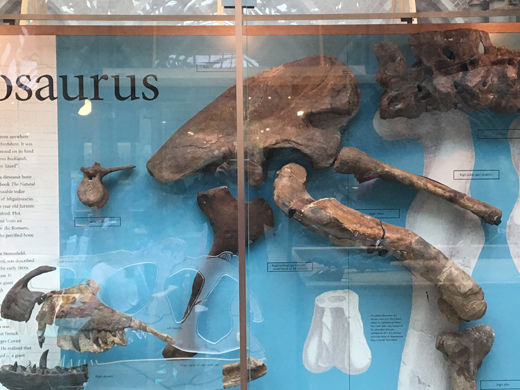
Megalosaurus fossil material on display.
The Megalosaurus display case (Oxford Museum of Natural History).

Picture credit: Everything Dinosaur

To view models of Megalosaurus and other dinosaurs: Prehistoric Animal Models and Figures.

1 07, 2008

Anniversary of the Publication of “The Origin of Species”

By |2023-02-25T16:58:56+00:00July 1st, 2008|Categories: Dinosaur and Prehistoric Animal News Stories, Famous Figures, Main Page|0 Comments

Anniversary of Darwin’s first Treatise on the Origin of Species

With preparations well under way to celebrate the 200th anniversary of the birth of Charles Darwin in 2009, we could not let today pass without putting together a little comment on the significance of July 1st 2008.

It was on this day 150 years ago that Darwin’s outline theory on natural selection was first put formerly to fellow scientists.  Under pressure to publish his theories as other learned gentleman of the Victorian age were already working on mechanisms to explain evolution, Darwin was persuaded to submit a joint paper to the Linnean Society.  The Linnean Society is based in London, founded in 1788, the society is dedicated to advancing knowledge of natural history and taxonomy.  The society is named after Carolus Linnaeus, the Swedish botanist who laid the foundations for the classification of organisms.

Origin of Species

Fearing that his work could be overshadowed by other scientists, including the British naturalist and explorer Alfred Russel Wallace, it was agreed that Darwin and Wallace would present joint papers on their theories of natural selection to the Linnean Society.

Thus it was on this day in history that the world officially got to hear Darwin’s theory for evolution.  The book for which Darwin is most famous for “The Origin of Species” was published  a year later.  Ironically, the papers did not create a great deal of interest amongst Society members at the time, although the work of Darwin and his peers have had a huge impact on science as we know it today.

Darwin’s Book

With typical Victorian grandeur, Darwin’s book when it was first published was entitled “On the Origin of Species by Means of Natural Selection, or the Preservation of Favoured Races in the Struggle for Life”, it was only in a very much later edition did the title change to the slightly snappier “The Origin of Species”.  Indeed phrases such as “survival of the fittest” do not appear in the early editions, these terms now synonymous with Darwin, were not originated by him. The term “survival of the fittest” along with considerable changes, edits and re-writes were made in subsequent print runs.

Still, July 1st is a special date in the history of natural science.

On a lighter note, now that the European Football Championships are over we can reflect on our experiment to try to guess the performance of national football teams by comparing the diversity of fossil records and mentions in our own web log.

To read the full article and see our predictions: Football champions based on Prehistoric Genera.

We forecasted that Germany would win, they made the final but lost to Spain, a team that we had picked for the semi-finals and rated third by our parameters.  We could say that our choices of Germany and Spain (ranked 1st and 3rd by our criteria), showed remarkable consistencies with football performance, but no, statistically a random selection would have yielded potentially similar results.  After all, using our methodology we had calculated that France would be runners up and look what happened to them.

Never mind, perhaps we can revise our formulae in time for the 8th of August and the start of the Olympics.

Visit the Everything Dinosaur website: Everything Dinosaur.

21 03, 2008

Plesiosaur named in honour of Dr Elizabeth “Betsy” Nicholls

By |2023-02-25T07:08:19+00:00March 21st, 2008|Categories: Dinosaur and Prehistoric Animal News Stories, Famous Figures, Main Page|0 Comments

New Plesiosaur Genus named in honour of Dr Elizabeth “Betsy” Nicholls

A new plesiosaur discovered in Alberta, Canada has been named Nichollsia borealis in honour of  Dr Elizabeth Nicholls who sadly passed away in 2004.  Dr Nicholls was a member of the Royal Tyrrell museum research team staff for 14 years and much admired by her fellow palaeontologists and researchers.  Her energy, enthusiasm and fascination for palaeontology was the stuff of legend, regularly commuting long distances to work at the museum and journeying to some of the most remote and inhospitable parts of the Canadian wilderness in her search for fossils.

Dr Elizabeth Nicholls

The book “Dinosaur Provincial Park – A Spectacular Ancient Ecosystem Revealed”; edited by Phillip Currie and Eva Koppelhus is dedicated to her memory.

This new genus of Plesiosaur (marine reptile) was discovered in 1994 by machine operators working underground digging through a sandstone deposit at Syncrude’s Base mine, near Fort McMurray, Alberta.  Despite the near completeness of the specimen (left forelimb and scapula missing), the fossil was not named and described until recently.  The paper on this new animal has just been published in the German scientific journal Palaeontographica Abteilung A.

The Alberta Oil Sands

The mines in this part of Alberta have attracted a lot of controversy, the sediments being mined, known as the Alberta oil sands are producing crude oil, part of a global trend to search for oil and natural gas from oil sands, oil shales and deep ocean deposits, reserves that are more and more difficult to reach.  More oil companies are turning to these unconventional sources of fossil fuels as demand for them begins to outstrip supply.

Environmentalists have lobbied against such activity, the sites tend to be very polluting and there is a higher cost of extraction.  Those in favour of such mining argue that with dwindling reserves in the Middle East there is a need to utilise existing technology to explore and exploit new sources of oil and natural gas.

Just occasionally, these miners discover fossils that shed light on the fauna and flora of the Cretaceous.

Plesiosaur Specimen

This specimen measures just under 3 metres in length and dates from approximately 112 million years ago (Aptian/Albian faunal stages).  During this period the eastern part of the super-continent Laurasia, effectively the land mass that was to become North America, was split into as sea levels rose.  A warm, shallow, tropical sea was eventually formed; this is called the Western Interior Seaway, at its greatest extent it covered Mexico, much of the mid USA and a huge central swathe of what was to become Canada.

A Plesiosaur Exhibit on Display at a Museum
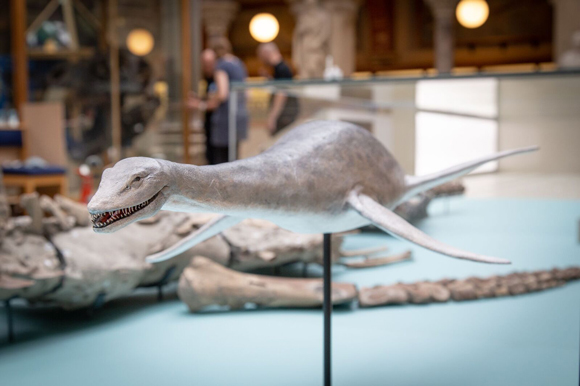
Oxford University Museum of Natural History plesiosaur.

A replica of a long-necked plesiosaur swims into view. Picture credit: Everything Dinosaur.

Picture credit: Everything Dinosaur

Nichollsia borealis was probably an active swimmer, an open water predator chasing down fish in the waters.  Close examination of the sharp, needle-like, overlapping teeth indicate that they would have been ideally suited for catching and holding slippery fish.

The relatively large orbits are perhaps an adaptation for hunting in low light levels and their position in the skull indicate that this animal would have been good at judging distances, an important skill if you are going to hunt by striking at swiftly moving fish.  The fossil provides important information on the evolution of plesiosaurs as the fossil record for these marine reptiles is relatively poor from the mid Cretaceous.

On Display at the Royal Tyrrell Museum

The fossil has just been placed on display at the Royal Tyrrell Museum, Drumheller, Alberta, Canada.  We are sure Dr Nicholls would have felt immensely proud to have a marine reptile named after her on display at the Royal Tyrrell, an institution where she spent so much of her working life.

A former student of the University of Calgary, Dr Nicholls is perhaps most well known for her work on marine vertebrates.  She conducted an extensive study and review of marine vertebrate fossils from Manitoba, Canada in the 1970s and went on to help in the discovery and excavation of the largest ichthyosaur fossil known to date.

A Giant Ichthyosaur

Discovered in a remote part of British Columbia in the late 1990s, Dr Nicholls and her colleagues over the period 1999-2001 gradually removed the huge beast from its surrounding matrix.  The ichthyosaur is estimated to have measured 23 metres in length, it has been dated to the Triassic and has been ascribed to the genus Shonisaurus.  The animal had no teeth in its elongated snout.  It was a filter feeder, feeding on phytoplankton and zooplankton, plus other small free swimming marine organisms, like a modern baleen whale or a bashing shark.  Much of this specimen is now stored in the vast warehouse area of the Royal Tyrrell museum.

For models and replicas of prehistoric marine creatures: CollectA Prehistoric Life Models.

Betsy Nicholls first decided that she wanted to be a palaeontologist when aged nine she visited the offices of Sam Wells, a university classmate of her father’s.  Later she wrote a letter to Roy Chapman Andrews of the American Museum of Natural History (the discover of the first dinosaur nests amongst other things).  She wrote asking how a girl could become a palaeontologist.  She kept Andrew’s encouraging letter as a treasured memento.

Although Dr Nicholls worked on a number of dinosaur discoveries within the Dinosaur Provincial Park, her first love was marine reptiles.  It is only fitting that a newly discovered plesiosaur should be named in her honour.

Nichollssaura borealis

Update

The genus name had to be changed, as Nichollsia was already in use, it described a genus of isopods (marine crustaceans).  In 2009, the scientific name for this plesiosaur was changed to Nichollssaura borealis.

19 03, 2008

The Amazing Sir Arthur C. Clarke 1917 – 2008

By |2024-04-12T08:29:02+01:00March 19th, 2008|Categories: Everything Dinosaur News and Updates, Famous Figures, Main Page|0 Comments

Sir Arthur C. Clarke 1917-2008

Science fiction writer, futurist and visionary Sir Arthur C. Clarke died in hospital in Sri Lanka today.  Already, a number of tributes have been paid to him by fellow writers, politicians and scientists.  Sir Arthur, who turned 90 just a few weeks ago, passed away at the Apollo hospital, he had been in and out of hospital for several weeks suffering from breathing difficulties.

Sir Arthur C. Clarke

Born in Minehead, Kent, Sir Arthur made Sri Lanka his adopted home in 1956, he was knighted in 1998.  Clarke, who in 1945 predicted the creation of communication satellites, wrote more than 80 books. He was Sri Lanka’s best-known resident guest and has a scientific academy named after him, as well as an asteroid and a joint European/Russian satellite.

British astronomer Sir Patrick Moore, who had worked with Clarke on several writing projects, paid tribute to his “dear friend” and said his death was a “great loss.”

“He was ahead of his time in so many ways,” Moore told the BBC. “Quite apart from artificial satellites there were other things too. A great science fiction writer, a very good scientist, a great prophet and a very dear friend, I’m very, very sad that he’s gone.”

“2001: A Space Odyssey”

Sir Arthur was perhaps best known for his work on the Stanley Kubrick film “2001: A Space Odyssey”.  The story was loosely based on and developed by Sir Arthur and Stanley Kubrick from Clarke’s short story ‘The Sentinel’, first printed in 1951.

A quotation attributed to Stanley Kubrick on the release of the film helps to sum up the life and times of Sir Arthur:

“He (Sir Arthur) has the kind of mind of which the world can never have enough, an array of imagination, intelligence, knowledge and a quirkish curiosity, which often uncovers more than the first three qualities.”

Source: Fiona Harrison/Associated Press

Sir Arthur worked on a ground breaking television series in the early 1980s.  It was called “Arthur C. Clarke’s Mysterious World”.  This thirteen part series covered the paranormal and explored strange mysterious such as UFOs, monsters of the deep, apeman and other phenomenon.  In one of the later episodes (episode 11), entitled “Dragons, Dinosaurs and Giant Snakes” – Sir Arthur explored the then, current myths and stories about unknown animals lurking in explored parts of the world.

Exploring Myths and Legends

Each programme was written in a documentary style with an introduction and conclusion filmed with the great man from his residence in Sri Lanka.  An earlier episode had focused on the strange stories from around the world of lake monsters such as Nessie and Champ.  A book was published in 1981 to accompany the series.

To read more about Sir Arthur: Sir Arthur C. Clarke’s 90th Birthday.

Sir Arthur’s enquiring mind and curiosity was an inspiration to many scientists and writers, he will be sadly missed, perhaps it is fitting to finish with a brief quotation from the man himself, it pointedly sums up why many people are inspired to become palaeontologists:

“The truth as always will be far stranger”.

9 03, 2008

In Memory of Pioneering Mary – Mary Anning who died on this day in 1847

By |2024-04-12T08:25:20+01:00March 9th, 2008|Categories: Famous Figures, Main Page, Palaeontological articles|0 Comments

In Memory of Mary – Mary Anning (May 21st 1799 to March 9th 1847)

A breakthrough in our understanding of the world around us – a eureka moment in science is a rare thing.  More often than not scientific progress is made in small steps with scientists and researchers building upon the insights and work of others.  Palaeontology like other sciences is no exception, after all, science is driven forward by ignorance, our desire to turn what we don’t know into what we do know.

Our thoughts today turn to Mary Anning, who died on this day in 1847.  Mary was born on May 21st, 1799 in the town of Lyme Regis, Dorset.  Her father was a carpenter.  Although she had no formal education to speak of and she spent most of her life in poverty, Mary was a pioneer in the sciences of geology and palaeontology, her contribution to science is recognised throughout the world and she is one of only two scientists permitted to have a look-a-like walking the hallowed galleries of the Natural History museum in London.

Mary Anning

Mary is credited with the discovery of many ichthyosaurs, plesiosaurs and the first pterodactyl fossils (pterosaurs).  Most of the fossils Mary collected were sold to institutions and private collections, but often no record was kept of her role in discoveries and scientific research.

Although she lacked a substantial formal education, she taught herself anatomy, animal morphology and scientific illustration.  She made an immense contribution to the nascent sciences of palaeontology and geology, but much of her work was plagiarised and she was not given the recognition she deserved in her lifetime.  As a woman and with a poor social status she was never accepted into the male dominated scientific community.

Towards the end of her life it was rumoured that Mary had taken to drink.  Perhaps this was as a result of her struggle for recognition gradually wearing her down, but more likely Mary was drinking to dull the pain of breast cancer.  In the mid 19th century, one of the few pain killers that could be afforded by the poor was alcohol.  Although, weak and very ill, Mary continued to sell her “curiosities” from her fossil depot in Lyme Regis

News of her illness reached members of the Geological Society in London, William Buckland, the Dean of Westminster used his influence to raise a fund to help support her, but there was little he could do to prevent the inevitable outcome.  She died in 1847, just a few weeks before her 48th birthday.

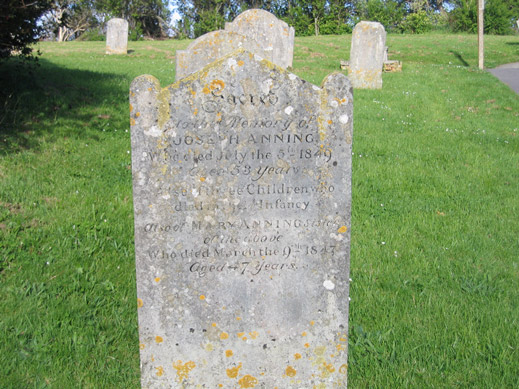
Mary is buried in the little Lyme Regis churchyard, part of which overlooks the bay.  I am sure Mary would have appreciated this, as it was in the bay overlooked by the church that Mary earned her living searching for fossils amongst the land slips and mud slides of the cliffs.

The Grave of Mary Anning and Her Brother Joseph

Mary Anning's grave.

Mary Anning’s grave at St Michael’s Church on the hill overlooking Lyme Regis

Picture credit: Everything Dinosaur

The then President of the Geological Society – Henry de la Beche wrote a eulogy in her honour, a most unusual tribute as she was not a Fellow.

He wrote: “I cannot close this notice of our losses by death without adverting to that of one, who though not placed among even the easier classes of society, but who had to earn her daily bread by her labour, yet contributed by her talents and her untiring researches, in no small degree to our knowledge of the great Enalio-Saurians and other forms of gigantic life entombed in the vicinity of Lyme Regis.

Fellows raised funds for a stained-glass window in her honour at the parish church at Lyme Regis. The window depicts Mary tending the sick and looking after the poor, an inscription underneath reads: “In commemoration of her usefulness in furthering the science of geology, as also of her benevolence of heart and integrity of life”.

Perhaps the last word for now, about Mary should come from a reporter who wrote in a journal published at the time – “the carpenter’s daughter has won a name for herself, and deserved to win it”.

Good on you Mary, we will always remember.

The fossil discoveries made by Mary Anning has inspired the British-designed CollectA range of marine reptile models: CollectA Age of Dinosaurs Popular Models.

16 12, 2007

Happy 90th Birthday Sir Arthur C. Clarke

By |2023-02-23T17:07:36+00:00December 16th, 2007|Categories: Everything Dinosaur News and Updates, Famous Figures, Main Page|1 Comment

Happy Birthday to Sir Arthur C. Clarke

Today, (December 16th) marks the 90th birthday of Sir Arthur C. (stands for Charles); Clarke – author, scientist and thinker.  Perhaps Sir Arthur is best known for his ground breaking novel “2001 – A Space Odyssey”, which was later made into a film of the same name directed by Stanley Kubrick.  To many palaeontologists and other scientists, Sir Arthur acted as an inspirational figure.   In 1980; an ITV television series “Arthur C. Clarke’s Mysterious World” was aired.  This thirteen part series covered the paranormal and explored strange mysterious such as UFOs, monsters of the deep, apeman and other phenomenon.  In one of the later episodes (episode 11), entitled “Dragons, Dinosaurs and Giant Snakes” – Sir Arthur explored the then, current myths and stories about unknown animals lurking in explored parts of the world.

Each programme was written in a documentary style with an introduction and conclusion filmed with the great man from his residence in Sri Lanka.  An earlier episode had focused on the strange stories from around the world of lake monsters such as Nessie and Champ.  A book was published in 1981 to accompany the series.

Quick Correction

The film 2001: A Space Odyssey was loosely based on and developed by Sir Arthur & Mr Stanley Kubrick from Clarke’s short story ‘The Sentinel’, first published in 1951 and much-reprinted. The novel of 2001 was first published in 1968 to accompany the film’s release, based on the screenplay.  Our thanks to Epacris for this information.

Sir Arthur’s rational approach helped de-bunk some of the more outlandish stories but in his concluding commentary on episode 11, comments, which can be found in the book that accompanied the series, he tells a strange story from his childhood.  His mother once claimed to have seen strange sheep with five horns in a neighbour’s field.  Young Arthur dismissed this sighting stating that she must have been mistaken.  Off they went on their bikes to see for themselves and sure enough in the field just as his mother had stated was a small flock of strange curly horned sheep the like of which he had never seen.

It may be relatively easy to dismiss strange stories of sea monsters like pliosaurs, or plesiosaurs roaming remote parts of the world’s oceans.  Claims of a sighting of a long-necked dinosaur in the inhospitable marshlands and rain-forests of the Congo may seem unlikely but as Sir Arthur famously commented:

“The truth as always will be far stranger”.

You never know…

Happy Birthday Sir Arthur.

10 09, 2007

Remembering the Unique Talent of Stephen Jay Gould

By |2024-04-01T10:01:41+01:00September 10th, 2007|Categories: Famous Figures, Main Page, Palaeontological articles|0 Comments

Today, September 10th, would have been the sixty-sixth birthday of the American palaeontologist Stephen Jay Gould.  Stephen; died of lung cancer on May 20th, 2002 but in his life he did as much as anyone to popularise palaeontology and evolutionary biology.

Remembering the Palaeontologist Stephen Jay Gould

A prolific writer and gifted teacher, Stephen inspired many students to further develop their careers in science.  He taught at Harvard University and was a key member of the American Museum of Natural History, producing numerous research papers and putting forward some far-reaching theories.  He became widely known from his science articles written for the American Natural History journal.

Such was his popularity and statue that he was called “America’s unofficial evolutionist laureate” and he certainly captured the public’s imagination with books such as “Bully for Brontosaurus”, published in 1991, a wonderful title for a book that explored the reasons for the extinction of the dinosaurs.  He also studied the diversification of the fossil record in the Burgess Shale deposits and wrote many papers on the explosion of life forms that occurred at this time.

Along with fellow scientist, Niles Eldredge, Gould put theory the idea of “Punctuated Equilibria”, building on the theory of Darwinism to propose that evolution did not happen in a smooth process but occurred in rapid bursts followed by periods where organisms changed little.  He was a strong opponent of Creationism and Intelligent Design and argued vociferously against these concepts.  His engaging writing style and sense of fun made him a firm favourite amongst readers of popular science.

He Made Palaeontology Popular

He appeared in a number of science documentaries and related programmes.  He even appeared in an episode of the Simpsons, providing the voice for his own caricature.  The makers of this television cartoon series were big fans and after his death a tribute was paid to him by dedicating an episode to his memory.

Go to Top