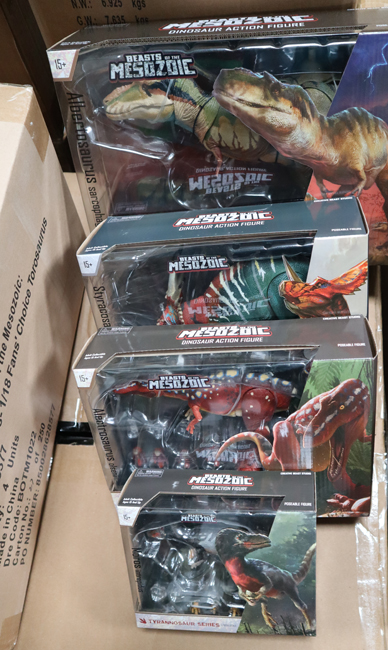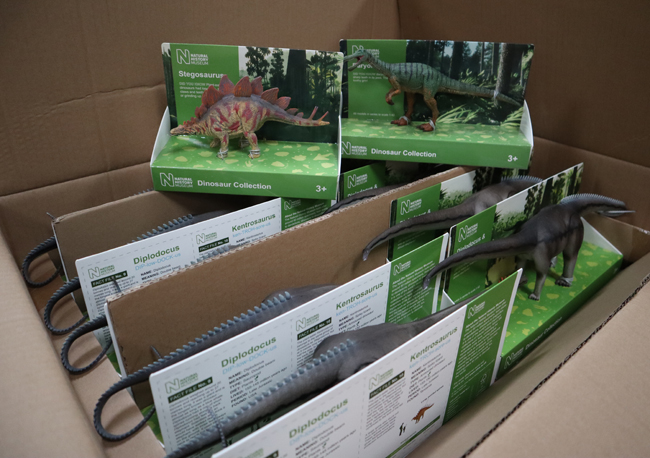
The new for 2024 Schleich red Brachiosaurus model has arrived at Everything Dinosaur. It arrived along with the new Schleich Stegosaurus figure. Both dinosaur models are now on-line and available to purchase.
The Schleich red Brachiosaurus and Stegosaurus dinosaur model have arrived and are now in stock. Team members were busy unloading the figures and allocating space for them in the company’s warehouse. Picture credit: Everything Dinosaur.
Picture credit: Everything Dinosaur
The New for 2024 Schleich Red Brachiosaurus Figures
The red Brachiosaurus model is a new version of an earlier Schleich Brachiosaurus. The red tones are most impressive. This new sauropod figure measures twenty-seven centimetres in length (approximately). The carefully sculpted head is around nineteen centimetres off the ground. The Schleich red Brachiosaurus model is supplied with an Everything Dinosaur Brachiosaurus fact sheet.
Five new Schleich dinosaur models and one repainted Brachiosaurus figure. Picture credit: Everything Dinosaur.
The Schleich Stegosaurus is a new sculpt. The Stegosaurus is approximately twenty centimetres long. Those impressive, red plates over the hips of this dinosaur are around ten centimetres off the ground.
At Everything Dinosaur, we receive lots of emails from fans of prehistoric animals. Many of these emails contain questions. For example, we received an enquiry earlier this week asking what other types of prehistoric fish lived alongside placoderms? That is an excellent question! We are no experts on the evolutionary development of fishes, but since the questioner wanted to know about brackish and freshwater environments in the Devonian, we thought we would try to help.
Defining Placoderms
The Devonian covers approximately sixty million years. It is often referred to as the “Age of Fishes”, due to the radiation of several fish types including the Sarcopterygii (lobe-finned fishes), the placoderms and sharks (cartilaginous fish otherwise referred to as chondrichthyians).
(Class Placodermi) represents an extremely diverse and varied group of jawed fishes that evolved during the Silurian, thrived in the Devonian but seem to have died out during the end-Devonian mass extinction. They were the first fish to evolve a pair of pelvic fins. Several Orders have been described all united by the defining characteristic of the Placodermi, their heads and thorax being covered by a series of articulated, armoured plates.
Perhaps the best-known placoderm is Dunkleosteus (D. terrelli). It was a member of the Arthodira and is thought to represent the earliest vertebrate “superpredator”.
Swimming into view a placoderm model – Dunkleosteus. Picture credit: Everything Dinosaur.
Picture credit: Everything Dinosaur
The picture (above) shows the Schleich Dunkleosteus figure.
Non-marine Vertebrate Fauna of the Emsian Faunal Stage
The query requested information regarding non-marine fish from the Early Devonian. We decided to examine the fossil record of freshwater and estuarine fish from the Emsian faunal stage of the Early Devonian. This would cover the period of Earth’s history from 407.5 million years ago to around 393 million years ago.
Although it is thought that vertebrates evolved in marine environments, by the Early Devonian many different types of fish had adapted to brackish or freshwater. Placoderms are known from non-marine palaeoenvironments of the Early Devonian. In addition, heterostracans are also associated with non-marine palaeoenvironments.
Heterostracans (Heterostraci) are an extinct subclass of the Agnatha (jawless fishes). There is some fossil evidence to indicate that jawless fish of the Pteraspidiformes Order, most notably pteraspids and drepanaspids lived in brackish and freshwater environments. These types of fish may have been preyed upon by the jawed placoderms. A scientific paper exploring potential predator/prey relationships was published in 2019 (Randle and Sansom).
Research suggests that predation by jawed vertebrates could have eradicated some types of jawless fish.
Picture credit: Julio Lacerda/The University of Manchester
During the Silurian and Early Devonian, possible predators of pteraspids and drepanaspids could have been jawed vertebrates as well as eurypterids.
We replied to the customer and emailed them some information in response to their query. We also included links to two blog posts that examined the Placodermi and potential Early Devonian food webs in more detail.
The customer emailed later to thank us for the information.
The two, new for 2024 Rebor Dire wolves will be coming into stock at Everything Dinosaur shortly. Team members have been informed that the shipment is on its way. The two figures are the 1:11 scale Dire wolf (plain version) and the grey version (Havallagata).
Rebor is introducing a pair of Dire wolves into their model range. One of the figures is the 1:11 scale Dire wolf known as “low roar”. The animal is shown in lateral view.
To view the amazing range of Rebor models and figures in stock at Everything Dinosaur: Rebor Models.
Rebor Dire Wolves
Each Rebor Dire wolf is supplied with three interchangeable heads. This impressive Pleistocene carnivore can be displayed with the mouth closed, the mouth open or with this fearsome predator snarling. Recently published research (Perri et al 2021), demonstrated that the dire wolf (Aenocyon dirus) was not closely related to the Grey wolf.
The second Rebor A. dirus figure is known as “Havallagata”. It has a grey colouration. It can be displayed as a 1:11 scale Dire wolf model or as a 1:18 scale fantasy wolf figure.
The Rebor Dire wolf Havallagata Nord version.The animal is depicted in lateral view.
A spokesperson from Everything Dinosaur confirmed that both figures were on their way.
“We do not know quite when these Dire wolves will arrive. However, customers can be assured that as soon as the delivery arrives at our warehouse, we will get these models on-line.”
The spokesperson also confirmed that Everything Dinosaur customers will receive a Dire wolf fact sheet. This fact sheet will be sent out with the dire wolf models. It has been researched and written by Everything Dinosaur team members. It will also include a scale drawing of a Aenocyon dirus.
Visit the award-winning and user-friendly Everything Dinosaur website: Everything Dinosaur.
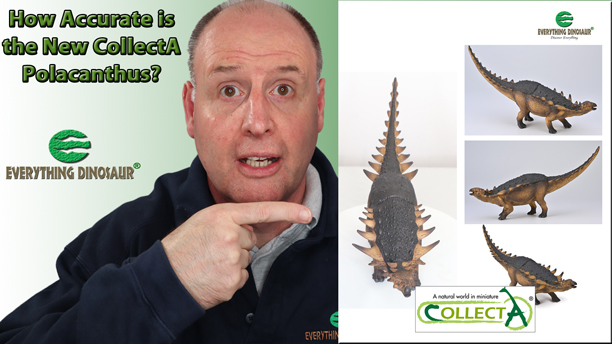
A new 1:20 scale Polacanthus foxii model will be added to the CollectA Deluxe range this year. This armoured dinosaur was named in 1865. At the time, it was one of only a handful of armoured dinosaurs known to science. It was named before Stegosaurus (Marsh 1877) and Ankylosaurus (Brown 1908). The CollectA Polacanthus model represents the very latest scientific interpretation of this iconic dinosaur.
The Sacral Shield
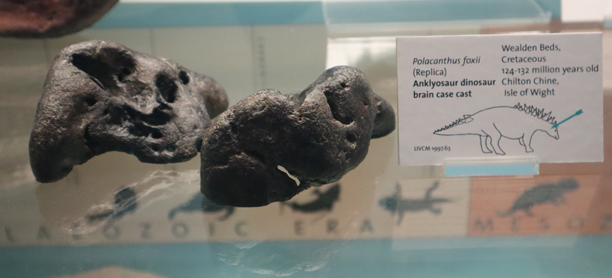
This dinosaur is famous for its shield of armour located over the hips (sacral shield). This fused sheet of dermal armour was repaired and restored by Caleb Barlow (1882). He did a remarkable job considering the fossils had deteriorated and the work was regarded as a “hopeless undertaking” by the geologist John Whitaker Hulke. Most descriptions of the osteoderms and raised bosses associated with this sacral shield refer to four rows of osteoderms on each side of this pelvic shield. However, these features do not seem to be present in the fossil material.
A close-up view of the sacral shield on the CollectA Polacanthus model. Damaged spikes are highlighted by red arrows. Picture credit: Everything Dinosaur.
The shield on the CollectA Polacanthus model does reflect the morphology of the fossil material. It closely follows the layout of dermal armour as indicated in lithographs of the actual fossils that were produced in the late 19th century.
Hulke described the specimen based on the restored material in 1887. The Hungarian polymath Franz Nopcsa created the first skeletal reconstruction and hypothesised that tail armour consisted of eleven rows of parallel spines that became smaller towards the distal end of the tail. The CollectA Polacanthus model has eleven rows of caudal spines. However, unlike Nopsca’s illustration, the armour is orientated horizontally reflecting the arrangement of tail armour associated with better known nodosaurids like Gastonia burgei.
He also suggested that there were two rows of upward pointing presacral spines. The first reconstruction of the skeleton occurred in 1905 when the fragmentary fossils of P. foxii were put on public display.
The new for 2024 CollectA Deluxe 1:20 scale Polacanthus figure. The model lacks presacral spines. Whilst the configuration of dermal armour remains unknown, it is likely that the spines and spikes were located on the flanks and were directed outwards rather than upwards.
CollectA Polacanthus Model
The CollectA Polacanthus model does not have vertically orientated presacral spines. Instead, the model has spines that are located on the flank and point outwards. This is a more modern depiction of the armour and reflects the fact that much of the fossil material previously associated with this genus has been reassigned.
An illustration of Polacanthus from circa 1950. Polacanthus is depicted as lizard-like with round, conical and upward pointing armoured spikes. This reconstruction of Polacanthus foxii is now regarded as outdated. Picture credit: Everything Dinosaur.
Picture credit: Everything Dinosaur
The CollectA Polacanthus model is due in stock at Everything Dinosaur later this year.
Everything Dinosaur has commissioned a Tlatolophus galorum scale drawing. It will be used on a fact sheet being created that will be sent out with sales of Tlatolophus models. The fact sheet is being prepared as the Haolonggood Tlatolophus figures are due to arrive soon.
A scale drawing of the lambeosaurine dinosaur Tlatolophus galorum. This duck-billed dinosaur is estimated to have grown to a length of around eight metres. Picture credit: Everything Dinosaur
Picture credit: Everything Dinosaur
Tlatolophus galorum
A beautifully preserved and semi-articulated hadrosaur tail was excavated from Campanian-aged deposits of the Cerro del Pueblo Formation (Coahuila, Mexico). Fieldwork revealed extensive fossil material and this duck-billed dinosaur was formally named and described in 2021 (Ramírez-Velasco et al).
The genus name Tlatolophus is pronounced Tlat-to-lo-fus.
This name is derived from a local dialect (Náhuatl), and it translates as “word”. In addition, the genus name uses the Greek lophos “crest”. The etymology relates to this dinosaur’s head crest being similar to a symbol in the Aztec culture resembling an inverse comma that means “word”.
The species or trivial name honours the philanthropist Jesús Garza Arocha and recognises the assistance of the López family, who helped the palaeontologists by providing food and accommodation during the field seasons.
A spokesperson from Everything Dinosaur commented:
“We will complete the Tlatolophus galorum fact sheet shortly. It will be ready for the arrival of the Haolonggood figures which are expected in about twenty days or so.”
Everything Dinosaur has received 300 5-star Google reviews. Every Google reviewer to date has awarded the UK-based mail order company top marks. Earlier today, the company’s 300th Google review was posted up. Team members expressed their gratitude and stated that they were humbled by all the kind comments they had received.
Confirmation that Everything Dinosaur has received three hundred Google reviews. Team members are grateful for all the feedback received. Picture credit: Everything Dinosaur.
The Everything Dinosaur website has thousands of customer reviews on it. In addition, the company has been working with Feefo for many years, gathering customer feedback and comments. It is estimated that Everything Dinosaur has received over 3,500 Feefo reviews.
The company was recently awarded Feefo’s highest accolade – the Platinum Trusted Service Award.
The Platinum Trusted Service Award certificate given to Everything Dinosaur in recognition of the company’s outstanding customer service.
A spokesperson from Everything Dinosaur stated:
“Our thanks to all the wonderful people that have provided feedback. We read every single one and we respond to all those that require a reply. What with the website, Feefo and Google we have received thousands of 5-star reviews from customers.”
Everything Dinosaur has received three hundred Google reviews. Every reviewer has awarded Everything Dinosaur five stars. Picture credit: Everything Dinosaur.
Picture credit: Everything Dinosaur
Whether it is prehistoric animal figures, clothing or dinosaur soft toys, Everything Dinosaur has got it covered. The feedback from customers demonstrates the team’s commitment to service.
Everything Dinosaur has received some new images of Mojo Fun prehistoric animal models. One of our favourites highlights the recently introduced Mojo Fun Woolly Rhinoceros. This replica of Coelodonta antiquitatis was introduced in 2023. The model has proved to be extremely popular with prehistoric animal model collectors.
The popular and highly praised Mojo Fun Woolly Rhinoceros model.
This Woolly Rhino model measures approximately 18 cm in length. Everything Dinosaur team members estimate its head height is around 7 cm. It is a stunning figure of a prehistoric mammal.
The new for 2023 Mojo Fun Woolly Rhino model is in stock. Picture credit: Everything Dinosaur.
Picture credit: Everything Dinosaur
A spokesperson from Everything Dinosaur praised Mojo Fun for their excellent Woolly Rhino image and added:
“The Woolly Rhino is synonymous with the Ice Age. However, these magnificent animals were geographically widespread during the Pleistocene Epoch and thrived in grassland habitats.”
The Wild Safari Prehistoric World Utahraptor dinosaur model is now in stock. This extremely colourful and detailed dromaeosaur model is available from Everything Dinosaur. Team members got the opportunity to photograph the figure whilst visiting a trade show in Europe.
The Wild Safari Prehistoric World Utahraptor model spotted at a trade show. The soon to be available colourful Kentrosaurus figure can be seen to the left of the Utahraptor. Picture credit: Everything Dinosaur.
This hand-painted Utahraptor replica measures twenty-three centimetres in length. It stands around eleven and a half centimetres tall. It is an extremely colourful dinosaur model. The vivid blue colouration reminds us of a budgerigar. Dromaeosaurids like Utahraptor are, after all, distantly related to modern birds. The Wild Safari Prehistoric World Utahraptor dinosaur model is supplied with an Everything Dinosaur Utahraptor fact sheet.
A Wild Safari Prehistoric World Utahraptor dinosaur model.
A spokesperson from Everything Dinosaur welcomed the arrival of the Utahraptor dinosaur model. Other new figures from Safari Ltd will be available later in the year.
Unpacking the new Wild Safari Prehistoric World Utahraptor dinosaur figure. Picture credit: Everything Dinosaur.
Picture credit: Everything Dinosaur
To view the extensive range of prehistoric animal figures and dinosaur toys available from Everything Dinosaur’s award-winning website: Visit Everything Dinosaur.
Our thanks to Mojo Fun for sending Everything Dinosaur some new images of the Mojo Fun prehistoric life dinosaur models. The images we received includes a clever illustration of a Mojo Fun Tyrannosaurus rex model.
We think this T. rex dinosaur model was introduced into the Mojo Fun prehistoric and extinct range in 2020. It has certainly proved to be popular with dinosaur fans and model collectors. The manufacturer has paid tribute to dinosaurs in films by mimicking a famous scene from the “Jurassic Park/Jurassic World” franchise.
Mojo Fun pays tribute to the “Jurassic Park/Jurassic World” franchise with this clever piece of artwork featuring a Mojo Fun T. rex model.
Mojo Fun Tyrannosaurus rex
The Mojo Fun T. rex figure is escaping from captivity. The image parodies scenes from the famous Universal Studio’s film franchise.
The Mojo Fun Tyrannosaurus rex Deluxe figure measures around 30 cm in length. Team members at Everything Dinosaur estimate its head height to be approximately 11 cm.
A spokesperson from Everything Dinosaur commented:
“Every dinosaur fan will get the connection between the Mojo Fun T. rex image and the movies. There are rumours circulating that a new film in the “Jurassic Park/Jurassic World” franchise will be released in 2025. Mojo Fun’s timing of the release of this new image is apposite.”
Everything Dinosaur team members had the opportunity to view the five new Mojo Fun repaints for 2024 at the recent Spielwarenmesse trade fair in Germany. The repainted dinosaur models will be in stock at Everything Dinosaur soon. The five figures include the Parasaurolophus (biped and quadruped stance), the Baryonyx, Troodon and a Stegosaurus.
The five repainted Mojo Fun dinosaur models for 2024. The standing Parasaurolophus (left) and the Parasaurolophus in the quadrupedal pose (mid left). The repainted Baryonyx is at the back and the Stegosaurus repaint is also at the back (back right). A pair of Troodon repaints can be seen (right). Picture credit: Everything Dinosaur.
Whilst there are new dinosaur models scheduled for 2025, the 2024 offering consists of five repainted figures. The Mojo Fun repaints for 2024 are listed below:
Standing Parasaurolophus.
Quadrupedal Parasaurolophus.
Stegosaurus.
Troodon with an articulated jaw.
Baryonyx with an articulated jaw.
The repainted Mojo Fun Baryonyx figure for 2024. This figure has a muted colour scheme compared to the original Mojo Fun Baryonyx. The articulated jaw has been retained. Picture credit: Everything Dinosaur.
Picture credit: Everything Dinosaur
A spokesperson from Everything Dinosaur commented:
“We had the opportunity to see the new Mojo Fun repaints at the recent Spielwarenmesse in Germany. We were particularly impressed with the paint schemes. The Baryonyx and the Troodon figures are our personal favourites.”