All about dinosaurs, fossils and prehistoric animals by Everything Dinosaur team members.

Everything Dinosaur’s work with schools and other educational bodies. Articles, features and stories about dinosaurs and their role in education and educating young people.

10 09, 2016

Emily’s Remarkable and Special Fossils

By |2024-05-06T08:53:36+01:00September 10th, 2016|Categories: Educational Activities, Main Page, Teaching|0 Comments

Year 3 at Yarnfield Primary Learning About “Footprints in the Past”

Yesterday, was another busy day with a visit to the vibrant Yarnfield Primary School to work with the three classes of Year 3 children as they began their term topic entitled “Footprints in the Past”.  The teaching team had developed an exciting and challenging scheme of work utilising a term topic all about dinosaurs and fossils to help 3Red, 3Yellow and 3Green classes study life in the past.

One of the spacious and well-organised classrooms had been designated to the member of the Everything Dinosaur teaching team to conduct the workshops, he noted that a number of special areas had been allocated on the walls of the classroom on which the children could display their work.  There was even a large area dedicated to science related elements of the curriculum.

“Footprints of the Past”

Naturally, there is a big focus on literacy and numeracy throughout the school.  Year 3 was no exception and prior to the workshops, our dinosaur expert talked through some extension ideas with the enthusiastic teaching team.  A dinosaur footprint measuring exercise certainly ticked all the right boxes when it came to supporting numeracy and the “dinosaur foot facts” writing activity was well received.

A Collection of Fossils

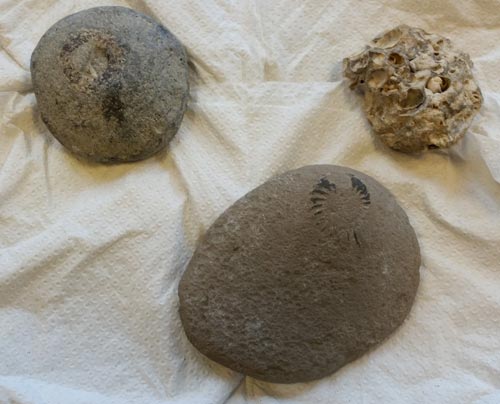
Emily had brought in a collection fossils that her father had found.  She had carefully wrapped them in tissue paper and stored them in a sturdy plastic box to keep them safe.  Could the children work out why you have to wear special, soft gloves when you handle some fossils?

A Picture of the Fossils Emily had Brought into School

Fossils brought into school.

Fossils brought into school by a Year 3 pupil.

Picture credit: Yarnfield Primary School/Everything Dinosaur

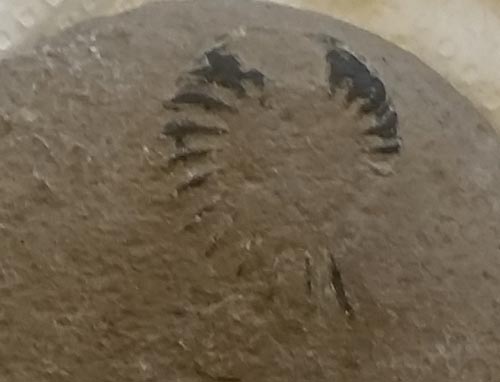
An Ammonite Fossil

Our fossil expert was able to identify the fossils and explain that they came from a beach, the remains of the coiled shells of ammonites and other fossil fragments have been preserved in the rocks.

Can You Spot the Fossil?

An ammonite fossil.

A close-up of the fossil (ammonite).

Picture credit: Yarnfield Primary School/Everything Dinosaur

For replicas of ammonites and other iconic animals from the fossil record: Replica Fossils and Models of Iconic Fossil Animals.

An idea might be for the children to set up their own dinosaur and fossil museum in the classroom so that they can display their work and exhibit some of their discoveries.  During the workshops, Year 3 learned about Mary Anning, a Georgian fossil collector, dealer and palaeontologist who was to become famous for her fossil discoveries from the cliffs at Lyme Regis (Dorset).

Mary’s discoveries include the first ichthyosaur fossil to be scientifically described along with plesiosaurs, ancient fish and the first flying reptile fossil to be found in England.  Although her finds made her quite well known and a number of leading scientists used Mary’s work and her knowledge to further their own careers, she never gained the public recognition her contribution to science merited.  Good luck to all the pupils who attempt the “sea shells” tongue twister inspired by Mary Anning  that we provided.

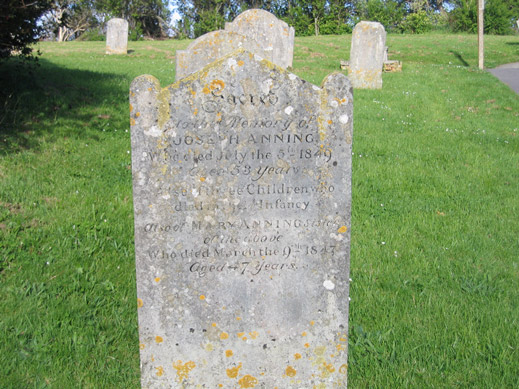
The Grave of Mary Anning 1799 – 1847

Mary Anning's grave.

Mary Anning’s grave at St Michael’s Church on the hill overlooking Lyme Regis.

Picture credit: Everything Dinosaur.

The picture above shows a the gravestone of Mary and Joseph Anning in the church close to the beach at Lyme Regis.  Perhaps Emily’s fossils will inspire the children at Yarnfield Primary School to become famous fossil collectors just like Mary Anning.

Visit Everything Dinosaur’s website: Everything Dinosaur.
7 09, 2016

Remembering the Beautiful Thylacine – Threatened Species Day

By |2024-05-06T08:49:10+01:00September 7th, 2016|Categories: Animal News Stories, Dinosaur Fans, Educational Activities, Everything Dinosaur Products, Main Page, Teaching|1 Comment

Remembering the Thylacine

On this day, eighty years ago, the last known Thylacine died at Beaumaris Zoo in Hobart.  It was on the 7th of September 1936, that staff at the Tasmanian zoo discovered “Benjamin”, as the animal was believed to have been named, dead.  Sadly, just two months earlier, the species Thylacinus cynocephalus had been granted protected status, after more than a hundred years of persecution.

Today, we live in what is regarded as more enlightened times, and September 7th in Australia is “National Threatened Species Day”, a day dedicated to honouring those people who work to protect Australia’s unique wildlife.  It is also a day for reflecting on how our own species has led to the demise of other species.  For example, the Thylacine was thought to attack and kill sheep and other domesticated animals and so it was hunted with bounties being paid for each “Tasmanian Tiger” killed.

The Sad Tale of Benjamin – The Last Known Tylacine

Benjamin is believed to have been captured in the Florentine Valley area (south central Tasmania) in 1933 and brought to Beaumaris Zoo (Hobart).  Although once thought to be female, a more recent analysis confirmed that Benjamin was indeed, in all probability a male.  An inability to determine gender reflects the relative neglect the animal suffered in the zoo.  Indeed, the fact that the animal was even nick-named Benjamin has been challenged by a number of academics and authors.

The Tasmanian winter of 1936 was particularly severe and it seems that the last known Thylacine in captivity probably died of exposure after having been locked out of its sheltered sleeping quarters.  And so, the last Thylacine was dead.  Ironically, Beaumaris Zoo, for years dogged by financial difficulties, was to close shortly afterwards.  It was shut down by the Hobart City Council in the last week of November 1937.

In 1996, on the sixtieth anniversary of the death of the only Thylacine to have been given official protection, “National Threatened Species Day” was declared.  A time to reflect on the demise of the Thylacine and how similar fates await other species of flora and fauna unique to Australia unless action is taken to reverse their decline.

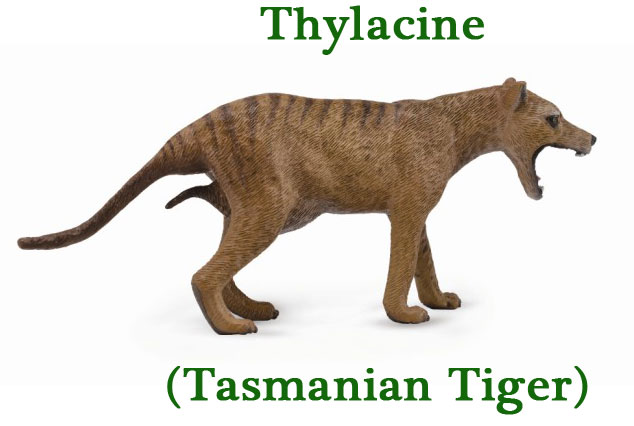
The CollectA Female Thylacine Model

Everything Dinosaur is proud to have added the beautiful CollectA female Thylacine model to its range of CollectA models.  The Thylacine, (Thylacinus cynocephalus), was the largest carnivorous marsupial to have lived in Australia in modern times and the last member of a once much more diverse group of marsupials.  The “Tasmanian Tiger” may be thought to be extinct, but is it?

The CollectA Thylacine Model

The CollectA Thylacine replica.

The CollectA Thylacine model.

Picture credit: Everything Dinosaur

To see the range of not to scale prehistoric animal figures in stock at Everything Dinosaur: CollectA Age of Dinosaurs Popular Range.

Is the Thylacine Extinct?

The main island that makes up the State of Tasmania is a fraction under 25,000 square miles in size, that’s around three times the size of Wales or about the size of the State of West Virginia in the USA.  There have been a number of reported sightings of “Tigers” both in Tasmania and on the Australian mainland.

Evidence for the existence of Thylacines is a little threadbare to say the least.  Blurred and very indistinct photographs, casts of footprints and some poor quality film footage, but nonetheless, there are a number of people, including academics who fervently believe that the Thylacine, although extremely endangered and very vulnerable, is still holding on.  Every now and then a new eyewitness account is published.

Let’s hope that the Thylacine still exists and that one day soon, September 7th will have even greater significance to the people of Australia.

Visit Everything Dinosaur’s website: Everything Dinosaur.
2 09, 2016

Remarkable Dinosaur Fossil Skulls as Helpful Teaching Aids

By |2024-05-06T08:51:32+01:00September 2nd, 2016|Categories: Dinosaur Fans, Educational Activities, Everything Dinosaur Products, Main Page, Teaching|0 Comments

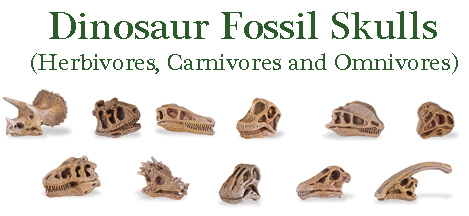
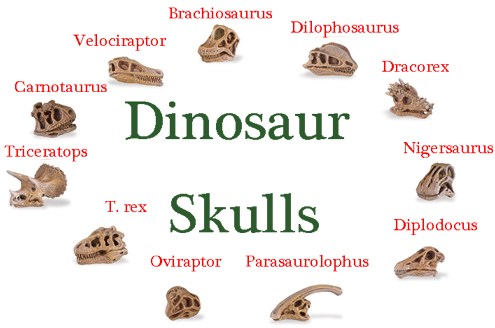
A Set of Eleven Dinosaur Skulls

At this time of year, more so than any other time of year, our offices are inundated with requests from teachers and teaching assistants regarding information on suitable dinosaur themed teaching resources for school.  With many of the Everything Dinosaur team members having a background in education, we do appreciate how busy educationalists are at the moment as they prepare for the start of the new academic year.

Dinosaur Fossil Skull Models

We have been helping a number of teaching teams as they prepare to introduce dinosaurs as a term topic theme.  Working under the “land before time” or the creative curriculum’s “footprints in the past”, Everything Dinosaur is able to advise and assist with the preparation of schemes of work.  Take for example, the Year 2 teacher who contacted our office this week, with a request to help provide suitable resources for her class of eager seven year-olds.

We recommended a set of model dinosaur skulls (Safari Ltd dinosaur skulls), and we helped the teacher further by providing additional information on each of the dinosaurs featured in this eleven piece model set.

A Set of Dinosaur Fossil Skulls Ideal for School

Dinosaur fossil skull models, ideal for school.

A set of eleven dinosaur fossil skulls.

Picture credit: Everything Dinosaur

Herbivore, Carnivore or Omnivore?

These well made and quite accurate plastic replicas represent herbivores, carnivores and even an omnivore.  Can the class work out what the dinosaurs ate by examining the skulls?  Can they identify a potential omnivore?  Naturally, this is a great way to help reinforce understanding regarding the terms herbivore, carnivore and omnivore.  Can the children identify living carnivores, omnivores and herbivores?  Where do human beings fit into this?

To view the dinosaur skulls and to see the range of other prehistoric animal models and replicas Everything Dinosaur offers: Wild Safari Prehistoric World Dinosaurs.

Identifying Dinosaurs by their Skull Shape

The dinosaur skull set provides lots of scope for independent research on dinosaurs and for sorting games.  For example, we recommend that the fossil skulls be buried in a small sand tray and then the children can have a go at excavating fossils using old art brushes and other digging tools.   What sort of tools would a palaeontologist use?  One teacher split his class into eleven groups and gave each group a different skull. Each group was then challenged to produce a science poster with lots of facts about their dinosaur.

Dinosaur Skull Models

Everything Dinosaur helping to identify dinosaur skulls.

Identifying dinosaur skulls.

Picture credit: Everything Dinosaur

Commenting on the use of the skulls in education a spokesperson from Everything Dinosaur stated:

“These robust models are great for creative teaching projects.  Using inexpensive props such as these, teaching teams can conduct all sorts of lesson activities that appeal to all types of learners.  The fossil models are very kinaesthetic and children love to handle them and they are very well made and accurately represent real dinosaur fossil skulls.  These models not only help children learn about individual dinosaurs but they can gain an appreciation of the diversity of the Dinosauria and how different types of prehistoric animal adapted to particular ecological niches.”

Visit Everything Dinosaur’s website: Everything Dinosaur.
21 08, 2016

Learning Life Skills – The Achievosaurs

By |2023-05-06T17:38:48+01:00August 21st, 2016|Categories: Educational Activities, Main Page, Teaching|0 Comments

The Achievosaurs Soft Toys

Teachers and teaching assistants all round the country are busy finalising their schemes of work in readiness for the new term and Everything Dinosaur team members have been helping.  Early Years Foundation Stage (EYFS) children have been benefiting from an innovative use of dinosaur and prehistoric animal soft toys – the Achievosaurs and Everything Dinosaur has been busy supplying schools and other educational establishments with fluffy and soft prehistoric animal plush in preparation for the start of the autumn term.

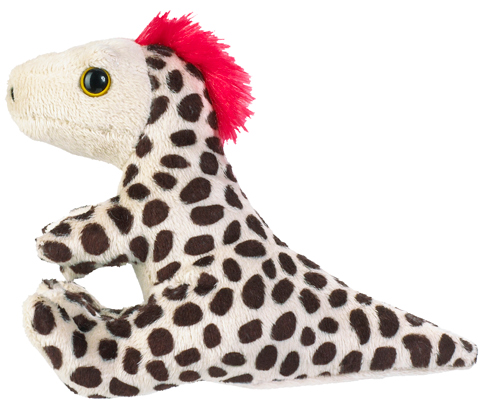
“Askaraptor” One of the Achievosaurs from Everything Dinosaur

A Utahraptor dinosaur soft and cuddly toy.

“Askaraptor” – a Utahraptor dinosaur soft toy.

Picture credit: Everything Dinosaur

For children in Foundation Stage classes (Nursery and Reception), the start of a new term can be quite daunting.  However, teaching teams are tasked with introducing key learning skills at a young age.

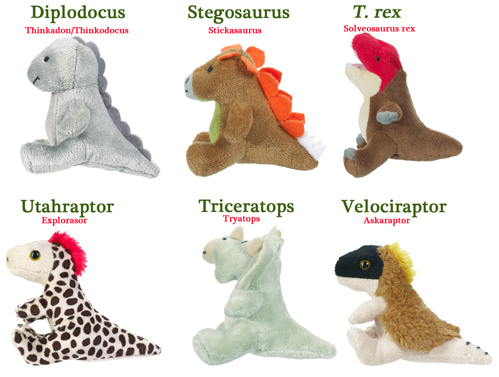
The “Achievosaurs”, a group of soft toy prehistoric animals can help children to develop these key skills.  In essence, the Achievosaurs, or as they are sometimes called “the Achieveosaurs”, with the extra “e”, aims to teach children about positive ways in which they can improve their ability to learn.  These qualities include being prepared to ask questions, to share ideas and thoughts and to persevere.  To help reinforce learning the children are incentivised by being able to look after the dinosaur soft toy which epitomises the learning skill that they have demonstrated.

Adopting the Achievosaurs Learning Concept

A large number of schools have adopted the Achievosaurs learning concept across the EYFS cohort and into Year 1.  The dinosaur soft toys often link with a term topic whereby the children study dinosaurs and fossils, for example “the Jurassic Forest” scheme of work.

Achievosaurs Helping to Reinforce Life-Long Learning Skills

Achievosaur soft toy dinosaurs

Helping to reinforce life-long learning skills.

Picture credit: Everything Dinosaur

Dinosaur Soft Toys

To purchase dinosaur soft toys to make up your own learning skills Achievosaurs set: Dinosaur Soft Toys.

Here is a list of some of the key learning skills that can be reinforced through the use of the Achievosaurs teaching concept:

ASKARAPTOR – I can use my imagination and ask interesting questions (based on a “raptor” dinosaur such as Velociraptor or Utahraptor regarded as some of the more intelligent and agile of all the dinosaurs).

EXPLORASOR – I like to explore ideas and I enjoy new experiences.

SOLVEOSAURUS REX – I can solve problems and improve (based on T. rex the most famous dinosaur of all).

STICKASAURUS – I stick at tasks and persevere (based on Stegosaurus a popular, plant eating dinosaur with plates on its back).

THINKODOCUS – I think carefully about what I learn (based on the big, plant-eating dinosaur called Diplodocus).

TRYCERATOPS – I try new things, don’t give up and work really hard (based on Triceratops, a very well known horned dinosaur with three horns).

A spokesperson from Everything Dinosaur commented:

“One of the great things about the Achievosaurs learning concept is that you can create your own Achievosaurs to suit the particular needs of each class.  For example, we were informed by a Nursery teacher that one of her charges, an only child, had difficulty integrating into the class and found it hard to share things with the other children.  The teaching assistant created “Shareosaurus”, so that this child could be rewarded when they shared items with their classmates.”

Preparations for Later on in Life

These important skills can help prepare children for learning later on in life.  Teachers and teaching assistants can come up with their on variants and new additions, however, the trouble is, identifying soft toys that represent the likes of Diplodocus and Tyrannosaurus rex.  The experts at Everything Dinosaur can help.

With the support of Everything Dinosaur’s trained specialists, teachers can utilise a child’s fascination with dinosaurs to help reinforce important life lessons.  Enthusing and motivating children to learn by using dinosaur soft toys in school.

Team members from the company also visit schools to delivery practical, lively and very kinaesthetic dinosaur themed workshops:

To read more about Everything Dinosaur: About Everything Dinosaur.

24 07, 2016

Back to School with Everything Dinosaur

By |2023-05-04T07:23:10+01:00July 24th, 2016|Categories: Dinosaur Fans, Educational Activities, Photos of Everything Dinosaur Products, Press Releases, Teaching|0 Comments

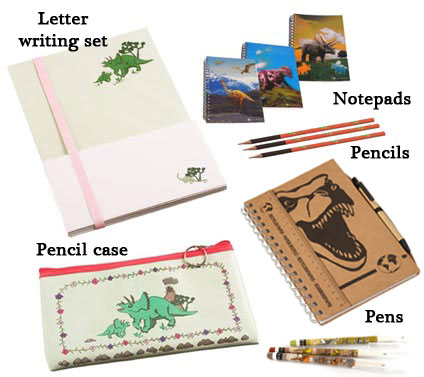
Fantastic Dinosaur Themed Back to School Items from Everything Dinosaur

No sooner do the schools break up then our thoughts are turning to the Autumn Term.  The teaching team at Everything Dinosaur are already booked up quite a lot for both next term and into the Spring but there are still some dates available for our dinosaur workshops in school.  However, just as teachers commence preparations for their scheme of work to be delivered next term, so parents too are planning ahead.

Back to School with Everything Dinosaur

Mums and dads, grandparents and guardians will be turning their thoughts to kitting out their charges ready for when the children go back to school.  For budding young palaeontologists Everything Dinosaur has a huge range of prehistoric animal themed school items, from pencils through to lunchboxes and backpacks, Everything Dinosaur has getting ready for school covered.

Some of the Dinosaur Themed Back to School Items Available from Everything Dinosaur

Back to school items available from Everything Dinosaur

Back to school stationery available from Everything Dinosaur.

Picture credit: Everything Dinosaur

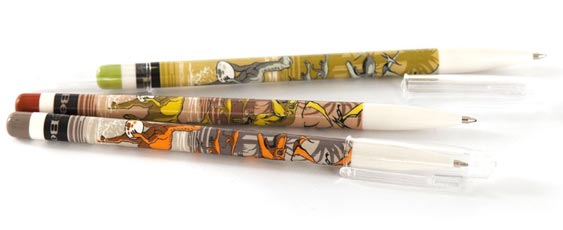
Whether you are looking for notepads with a dinosaur motif, or pens and pencils so that young dinosaur fans can jot down their discoveries, Everything Dinosaur is the place to go to find back to school prehistoric animal themed school sets and stationery.

Back to School stock in stock at Everything Dinosaur: Dinosaur Themed Educational Items and Toys.

There are school kits, dinosaur stationery sets, soft and cuddly back packs, pencil cases, notebooks, notepads and a whole range of other items, a list as long as a the neck of a Tanystropheus – there is plenty of choice, enough to make even the most reluctant school child roar in approval like an angry Tyrannosaurus rex.

Back to School with Everything Dinosaur

Dinosaur pens available from Everything Dinosaur.

Picture credit: Everything Dinosaur

Notes for Teachers

As for our popular dinosaur and fossil themed workshops in schools, our team members are booked up well into the Spring term.  However, there are some dates still available and for further information about Everything Dinosaur’s work in schools, simply visit the link below for further information.

Contact Everything Dinosaur to learn more about our science outreach work: Contact Everything Dinosaur.

15 07, 2016

Year 1 Send Letters to Everything Dinosaur

By |2023-05-03T07:43:50+01:00July 15th, 2016|Categories: Educational Activities, Main Page, Teaching|0 Comments

Year 1 at Forden Church in Wales School Send Letters

The children in Year 1 at Forden Church in Wales School have been studying dinosaurs and prehistoric animals this term.  The young scientists have been learning all about fossils and life in the past.  A team member from Everything Dinosaur visited the school for a morning last month to show the children fossils and to teach them about dinosaurs.  Our fossil expert challenged the children in Year 1 to write letters to Everything Dinosaur and sure enough, yesterday, we received a lovely set of dinosaur themed letters from the children.

Everything Dinosaur

Year 1 Children Send in Letters to Everything Dinosaur

Schoolchildren write to Everything Dinosaur.

Examples of the dinosaur themed letters sent in.

Picture credit: Forden Church in Wales School (Ellie, Evan, Faye and Logan)

Year 1 Learning About Technology

Mrs Davies, the enthusiastic teacher, explained that her class had written thank you letters after the fabulous morning of workshops with Everything Dinosaur.  Year 1 have been learning how to take photographs on the iPad and import them into a different document, the children have also been showing off their typing skills too.

Learning About the Biggest Meat-Eating Dinosaurs

William learnt about meat-eating dinosaurs.

A thank you letter from William.

Picture credit: Forden Church in Wales School (William)

William now knows that Spinosaurus was bigger than Tyrannosaurus rex.  Hollie was amazed by all the fossils and she enjoyed playing the games.

Most Real Fossils Feel Cold When You Touch Them

Thank you after the dinosaur workshop.

A thank you letter from Hollie.

Picture credit: Forden Church in Wales School (Hollie)

Thank You Letters

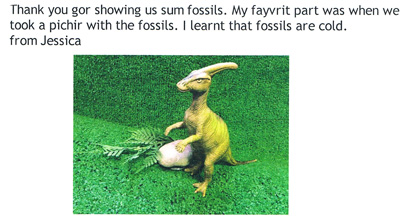
Hollie chose to illustrate her thank you letter to Everything Dinosaur using a model of a Pteranodon (flying reptile).  Jodie was amazed by all the fossils and she now knows that when you touch a fossil it feels cold!  Jodie also chose to illustrate her letter with a Pteranodon.  Jessica on the other hand, selected a wonderful model of a duck-billed dinosaur, a big plant-eater called Parasaurolophus for her letter.  She liked having her picture taken with the fossils.

For models of pterosaurs and other types of dinosaur: CollectA Age of Dinosaurs Popular Range.

Jessica’s Letter and the Parasaurolophus Model

A thank you note to Everything Dinosaur.

After the dinosaur workshop, Jessica wrote in to thank us.

Picture credit: Forden Church in Wales School (Jessica)

A big thank you to all the children in Year 1 who sent in letters to Everything Dinosaur (Chloe, Arthur, Jack, Jodie, Jessica, Hollie, William, Evan, Ellie, Logan and Faye).  A special thank you to the teachers and staff at Forden Church in Wales School, for assisting the Year 1 children in their letter writing extension activity.

Visit the award-winning website of Everything Dinosaur: Everything Dinosaur.

9 07, 2016

The Daresbury Laboratory Open Day

By |2023-05-02T06:39:07+01:00July 9th, 2016|Categories: Educational Activities, Everything Dinosaur News and Updates, Main Page, Teaching|0 Comments

The Dino Zone at Daresbury Laboratory Open Day

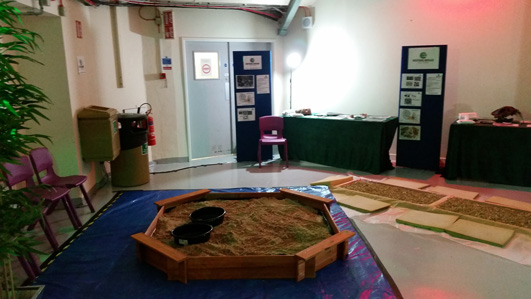
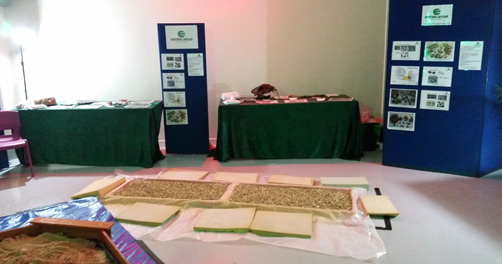
All is set and ready for the Daresbury Laboratory Open Day, taking place today.  Team members arrived at the site, located close to Warrington (Cheshire) and set up all the fossils and other dinosaur related items for the “Dino Zone”.

Daresbury Laboratory Open Day

All Ready for Action at the “Dino Zone”

The Dino Zone and Everything Dinosaur

Ready for action, the Everything Dinosaur exhibit as part of the Dino Zone at Daresbury Laboratory.

Picture credit: Everything Dinosaur

Staff had been on site the day before to help organise the layout and to assist in the first stage of the set up, then it was an early start to ensure we were ready to begin meeting and greeting dinosaur fans from the time the science fair opened promptly at 9am.  Sure enough, despite the inclement weather we had our first visitors a few minutes later.

For replicas of fossils and models of iconic animals from the fossil record: Dinosaur Themed Crafts and Replica Fossils.

The Calm Before the Storm

Everything Dinosaur and their Dino Zone

Fossil digging and lots of fossils to explore.

Picture credit: Everything Dinosaur

We had just finished setting up the fossil identification display boards when the first family arrived.  In total, something like 7,500 people had registered for this free-to-attend science event.  It was a long day for Everything Dinosaur team members, but everyone seemed to enjoy themselves and there were lots of happy children, mums and dads, despite the rain.

Feedback on the Daresbury Laboratory Open Day

We noted lots of wonderful, positive feedback on social media.  It seems that the event has been a really big success.

Marielle wrote to say:

“Such a fantastic science discovery day!  Well done Daresbury Lab/STFC and all who helped make this a truly amazing public and family-friendly event!!  My 6-year-old and I enjoyed everything we experienced, from walking the T. rex, having our infra-red picture taken to digging up human bone replicas and ‘driving’ mini-rovers, and more!  But the winning attraction seems to have been the Dino Zone, especially fossil digging… Please, please, do not wait 10 years to organise another one!!!  (Oh, and the logistics was great too!).  Thank you.”

Lisa added:

“Thanks to all the organisers and staff for a thoroughly enjoyable day.  We are so lucky to have such a great place on our doorstep where wonderful things are happening each day and by allowing the community to visit you are inspiring our children to want to do great things in life.”

It seems that the Daresbury Laboratory Open Day and the “Dino Zone” was a roaring success.  Just time to thank all the wonderful staff and volunteers at Daresbury Laboratory for making today, a day to remember for lots of people.

Visit Everything Dinosaur’s website: Everything Dinosaur.
5 07, 2016

The Beautiful Dark Matter Garden at Daresbury

By |2024-05-06T07:15:45+01:00July 5th, 2016|Categories: Educational Activities, Main Page, Teaching|2 Comments

The Daresbury Dark Matter Garden

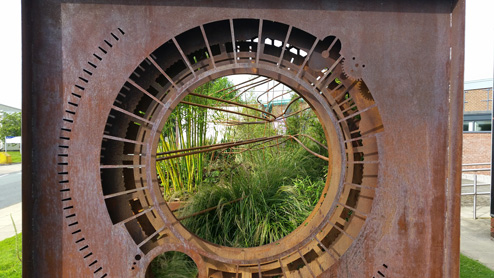
As Everything Dinosaur team members prepare to take part in the public open day at Daresbury Laboratory (Cheshire), there was time to admire the wonderful, mature Dark Matter garden on the site.  The garden was commissioned in 2015 to mark the centenary of the publication of Albert Einstein’s theory of general relativity.

A View into the Dark Matter Garden Located at Daresbury Laboratory (Cheshire)

The dark matter garden (Daresbury Science Laboratories)

A view into the Dark Matter garden at Daresbury Science Laboratories (Warrington, Cheshire)

Picture credit: Everything Dinosaur

What is Dark Matter?

Dark Matter is very mysterious, it is the “stuff” that is believed to make up a significant percentage of our universe, but it cannot be seen and detecting it is extremely difficult.  However, we can measure the effect of Dark Matter on other objects.  It has gravitational effects on visible matter, these effects can be detected and the presence of this Dark Matter inferred from such interactions.

The Award Winning Dark Matter Garden

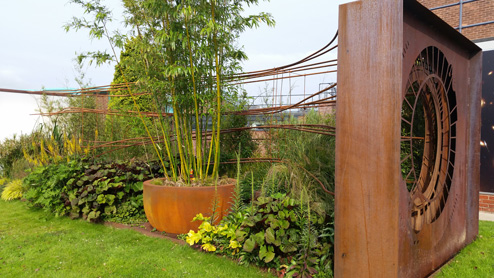
The award winning Daresbury dark matter garden.

The warped steel rods represent the effect of dark matter on the bending of light.

Picture credit: Everything Dinosaur

The garden has matured since it was awarded a gold rating at the prestigious Chelsea Flower Show last year.  The planting emphasises our changing universe and the warped steel rods, as they bend and twist through the plot represent the bending of the trajectory of light around massive objects.  As the wind blows through the substantial bamboo grass in the centre it reflects the effect invisible forces have.  At one end is a large square metal structure with a round aperture.  The symbolises the human view from Earth based telescopes as we look into space and explore the wonders of the universe.

The Hunt for Dark Matter

Dark Matter fascinates the scientific community and scientists from all over the world are working hard to understand more about it.  Our planet would not have formed without it, stars, galaxies and our universe is dependent upon it yet Dark Matter’s existence has only been proved indirectly.  Scientists are on a quest to find out more about it.

Professor Andy Newsam, Director of the National Schools’ Observatory at Liverpool John Moores University which organised the garden, explained:

“Dark Matter is a hypothetical kind of matter that cannot be seen with telescopes but accounts for most of the matter in the universe.  The existence and properties of Dark Matter are inferred from its gravitational effects on visible matter, radiation and the large-scale structure of the universe.”

The Science and Technology Facilities Council (STFC), as funders of Dark Matter research in the UK and at the Large Hadron Collider at CERN, sponsored the Chelsea Flower Show exhibit.

Visit Everything Dinosaur’s website: Everything Dinosaur.

30 06, 2016

Dinosaur Workshop in the Land of Dragons

By |2023-05-01T17:03:20+01:00June 30th, 2016|Categories: Educational Activities, Main Page, Teaching|2 Comments

Forden Church in Wales School Dinosaur Workshop

A trip into Wales for Everything Dinosaur this morning as one of the team members had been invited to visit Forden Church in Wales School to conduct dinosaur themed workshops with the Foundation children and a mixed class of Year 1 and Year 2.  The children had prepared lots of questions and our fossil expert did his best to answer them all.  The extra resources that he had brought with him went down well with the dedicated and enthusiastic teaching team, especially the dinosaur name pronunciation guide.

Setting Challenges

A number of challenges were set, with one special challenge for the mixed Year 3 and Year 4 class, could they compose a letter to Everything Dinosaur and if they did, could they think of a question that would stump our dinosaur experts?

Year 3 and Year 4 Children Wrote Letters to Everything Dinosaur

Letters from children to Everything Dinosaur

The children even illustrated their letters with some wonderful prehistoric animal drawings.

Picture credit: Everything Dinosaur

Dinosaur Footprints and Dinosaur Drawings

The children illustrated their letters with some wonderful prehistoric animal drawings.  Ffion and Aimi drew dinosaur footprints and they both wanted to know about dinosaur teeth.  Aimi asked do all types of dinosaurs have fierce teeth?  Her query ties in with a question sent in by Matthew who enquired how many dinosaur herbivores were there?  Ffion asked do all types of dinosaurs have special teeth?  The mouths of dinosaurs were adapted to help them eat the food that the ate.

Some dinosaurs, such as most of the meat-eaters, had teeth that were sharp and fierce looking, whilst many of the herbivorous dinosaurs such as Triceratops had rows and rows of square and blocky shaped teeth, ideal for grinding up plants.  Some dinosaurs did not have any teeth at all.  About two-thirds of all the dinosaurs described so far were plant eaters.

Matthew Wanted to Know How Many Herbivorous Dinosaurs Were There?

Proportion of plant-eaters to meat-eaters in the Dinosauria.

Proportion of plant-eaters to meat-eaters in the Dinosauria.

Picture credit: Everything Dinosaur

In an email sent to Mrs Davies, one of the teachers, we were able to answer questions from Dan, Bethany and Nicky.  Ryan had wanted to know what the name Tyrannosaurus rex means, we challenged the class to be “dinosaur detectives” and to conduct some research to find out for themselves.

How Many Pterodactyls Were There?

Wayne wanted to know how many Pterodactyls were there?  This tied in with a question asked during one of our dinosaur workshops.  The correct term for these flying reptiles is Pterosaurs and so far, something like 120 different types of Pterosaur have been named.  The children were surprised to learn that the biggest Pterosaurs were taller than giraffes.

Prehistoric Animal Drawings from the Children

Children write letters about dinosaurs.

Ben wanted to know how many fossils we had found?

Picture credit: Everything Dinosaur

How Many Fossils Have We Found?

Ben asked about the number of fossils we had found.  Everything Dinosaur team members are really lucky and they get to go on lots of fossil hunts.  They have found thousands of fossils, some of which we keep and store in our warehouse so we can learn more about prehistoric life.

One Letter Featured Pachycephalosaurus and Apatosaurus

Key Stage 2 dinosaur lettters.

An illustrated dinosaur letter.

Picture credit: Everything Dinosaur

For models and replicas of prehistoric animals: Prehistoric Animal and Dinosaur Models.

Marine Reptiles in a Dinosaur Workshop

A number of letters featured drawings of marine reptiles.  Harvey drew a green coloured marine reptile and asked when did the dinosaurs become extinct?  This is a question that we will leave for the children to research, perhaps they can look at the evidence and come up with their own theory as to why the non-avian dinosaurs died out.  The question why are dinosaurs called dinosaurs was also asked.  The term dinosaur was first coined more than 150 years ago, to find out about the scientist responsible, check out this link here: Happy Birthday Sir Richard Owen.

 When Did the Dinosaurs Live?

Year 3 children wrote to Everything Dinosaur

Marine reptiles used to illustrate a letter with questions about dinosaurs.

Picture credit: Everything Dinosaur

Zak asked when did the dinosaurs live?  The timeline we provided along with the other extension resources should help Zak to answer this one.  He also asked why are dinosaurs called reptiles?  Dinosaurs make up part of a group of animals called reptiles, there are many different types of reptile living today.  We sent a word game over to the school via email, can the children fill in the blanks and work out the names of reptiles alive today?

Dinosaur Workshop

Our thanks to all the children  and their teachers at Forden Church in Wales School.  We shall pin up these very colourful letters onto one of the walls in our office.

Visit Everything Dinosaur’s website: Everything Dinosaur.

26 06, 2016

Abercrombie School and Beautiful Dinosaurs

By |2024-05-06T06:45:59+01:00June 26th, 2016|Categories: Educational Activities, Main Page, Teaching|0 Comments

Abercrombie School Pupils Study Dinosaurs

Earlier this month, a member of the Everything Dinosaur team visited Abercrombie Primary School in Chesterfield (Derbyshire), as part of two days of science study with Year 2, 3, 4, 5 and Year 6.  Over the course of the workshops we conducted, we set a number of challenges for the classes.  One challenge was to have the children “design their very own prehistoric animal”, with a new dinosaur species being named, on average, every three weeks or so, there is plenty of scope for new dinosaurs.

Another challenge involved the children writing Everything Dinosaur a thank you letter, from our bulging mail bag on Friday, it looks like lots of the pupils at the school took up the opportunity to send in examples of their work.

Drawings of Dinosaurs

A Collection of Very Colourful Prehistoric Animal Drawings

Schoolchildren send in dinosaur drawings.

Pupils from Abercrombie Primary sent in dinosaur drawings.

Picture credit: Abercrombie Primary School/Everything Dinosaur

Everything Dinosaur Says Thank You

Our thanks to Henry, Daisy, Frasier, Sophie, Ebony, Daisy, Reuben, Lucy, Daniel, Ibrahim, Alfie, Holly, Noah and all the other children who sent in super prehistoric animal drawings, they are certainly very colourful.

The children have thought very carefully about their prehistoric animal designs.  They considered where the animal might live, what it might eat and how it would keep itself safe.

Joelasaurus by Henry

A dinosaur designed by a schoolchild.

A very colourful dinosaur drawing by Henry.

Picture credit: Abercrombie Primary School/Everything Dinosaur

We enjoyed looking at all the prehistoric animal pictures that had been sent into us by the children.  Some of the dinosaur names the children had invented were very creative such as “Hungry eater steeler” from Leo and we even had a drawing of Indominus rex from the film Jurassic World.

For dinosaur toys, games and gifts: Dinosaur Toys and Gifts.

Thank You Letters Sent to Everything Dinosaur

The hand-writing challenge involved composing a thank you letter to Everything Dinosaur and sure enough we received a set of beautiful and well written thank you letters, some of which had even been illustrated.

Thank You Letters Sent in by the Children (Abercrombie Primary School)

A set of thank you letters from a class.

Pupils sent in thank you letters to Everything Dinosaur.

Picture credit: Abercrombie Primary School/Everything Dinosaur

Our thanks to Ali, Dexter, Oliver, Libby, Alice (yes, you are quite right fossils are usually found in sandstone and limestone), Erin and Harry (wonderful dinosaur skull drawing).

Isobel wanted to know how long have we been looking for fossils?  Everything Dinosaur team members found their first fossils when they were not much older than Georgia or Felix.  Louie wrote to say that he was sorry to have missed all the dinosaurs as he had been ill but he did send in a nice letter and even took the trouble to draw some dinosaur eggs.

Cole Sent in a Beautiful Thank You Letter

Abercrombie Primary children sent in letters to Everything Dinosaur.

A thank you letter from a pupil at Abercrombie Primary.

Picture credit: Abercrombie Primary School/Everything Dinosaur

How Do You Get Fossils of Dinosaurs?

The question was asked, how do you get fossils?  Fossil can be found in lots of places but most fossils are found in rocks and one of the best places to find them is at the seaside.  Arthur wrote in to say that his favourite part was holding the Tyrannosaurus rex tooth and he also liked the stickers we gave him.

A special thank you to all the children at Abercrombie Primary who sent in letters and pictures.

Visit Everything Dinosaur’s website: Everything Dinosaur.

Go to Top