All about dinosaurs, fossils and prehistoric animals by Everything Dinosaur team members.

Everything Dinosaur’s work with schools and other educational bodies. Articles, features and stories about dinosaurs and their role in education and educating young people.

19 11, 2016

Exploring Life in the Past with Year 2/3

By |2023-05-09T12:25:46+01:00November 19th, 2016|Categories: Educational Activities, Main Page, Teaching|0 Comments

Dinosaurs and Fossils with Year 2/3

For the children in the three classes of Year 2/3 at Pebble Brook Primary School, the autumn term has been dedicated to learning all about prehistoric life.  Over the last eight weeks or so, the dedicated teaching team have introduced a wide range of cross-curricular activities all linked to learning about dinosaurs, prehistoric animals and the Stone Age.

Prehistoric Life

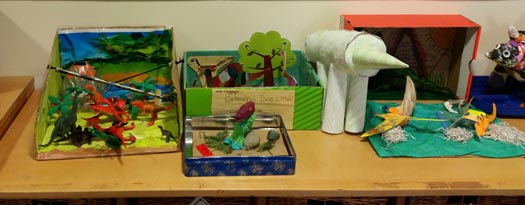
As part of the challenging scheme of work that had been devised, the children were asked to make a dinosaur themed model over the half-term break.  A member of the Everything Dinosaur team visiting the school had the opportunity to view some of the amazing dinosaurs and prehistoric scenes the children had created.

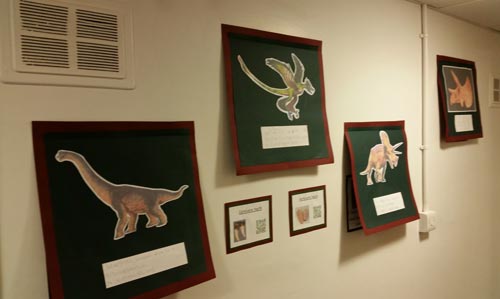
On Display Outside the Year 2/3 Classrooms – Prehistoric Scenes

Dinosaurs on display.

Dinosaur and prehistoric scenes outside the classrooms.

Picture credit: Pebble Brook Primary School/Everything Dinosaur

The collection of prehistoric landscapes and dinosaur dioramas made a very attractive exhibit and several of the children’s models were used in a special assembly following our dinosaur and fossil workshop.  The Year 2/3 children presented some of the fascinating facts that they had learned about dinosaurs to other classes as well as the mums and dads.

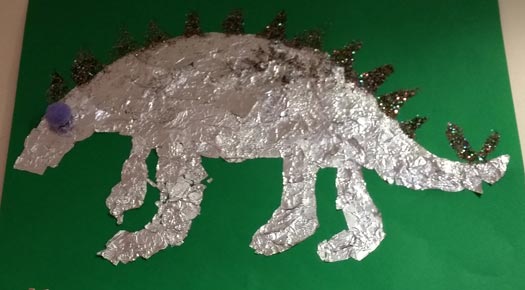
A Very Sparkly Dinosaur Created as a Half-term Project

A very sparkly armoured dinosaur.

A very sparkly armoured dinosaur spotted in Year 2/3 AP classroom.

Picture credit: Pebble Brook Primary School/Everything Dinosaur

Fiction and Non-fiction Writing Exercises

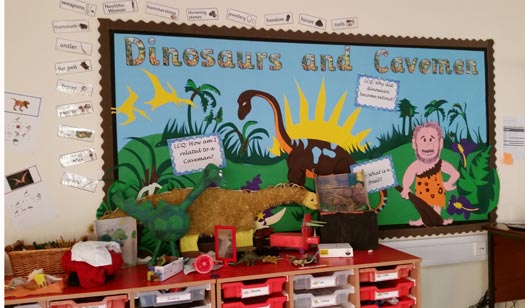
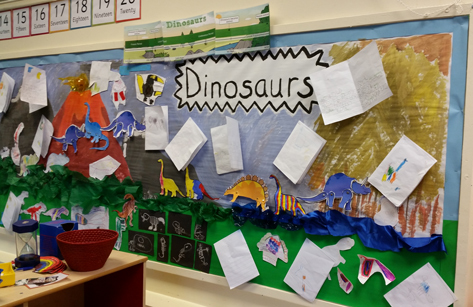
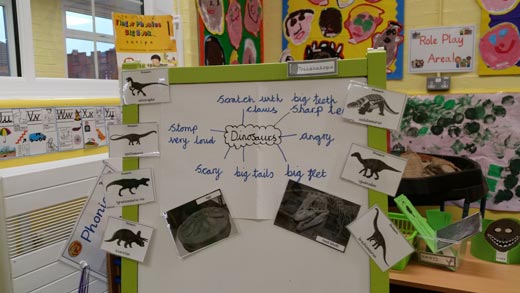
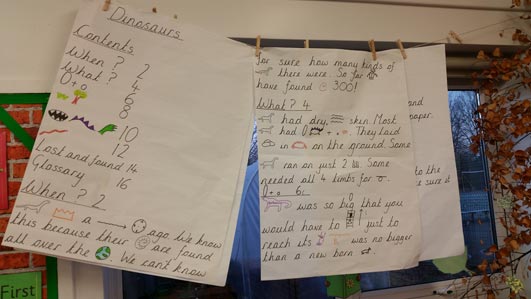
The well-appointed classrooms highlighted lots of fiction and non-fiction writing exercises and each of the three classrooms had a special “wow wall” with a wonderful dinosaur and Stone Age people illustration surrounded by lots of topic themed words to help the budding young palaeontologists expand their vocabularies.

Prehistoric theme for a special topic about life in the past.

A colourful dinosaur and cavemen display board.

Picture credit: Pebble Brook Primary School/Everything Dinosaur

For creative, dinosaur themed toys and gifts: Prehistoric Animal Themed Toys and Gifts.

Carnivores, Omnivores and Herbivores

The children were keen to demonstrate their knowledge and they enthusiastically explained the foods that carnivores, omnivores and herbivores ate, all linking nicely into that part of the Year 2 science programme in the English national curriculum that relates to living things and their habitats.  In addition, the Year 3 children enjoyed learning about the properties of fossils, which dove-tails into the lower Key Stage 2 science programme that covers soils, rocks and fossils.

Exploring Life in the Past

Dinosaurs and cavemen.

A dinosaur and cavemen themed display board.

Picture credit: Pebble Brook Primary School/Everything Dinosaur

Measuring Dinosaurs and Other Prehistoric Life

All three classes would be getting to grips with the use of rulers for measuring in the very near future, the extension activity we provided which involves measuring and comparing the footprints of different dinosaurs should work well with the teaching team’s lesson plans.  The dinosaur coprolite certainly proved to be very popular and it helped reinforce the children’s learning after they had examined some “dinosaur poo” in a previous classroom activity.

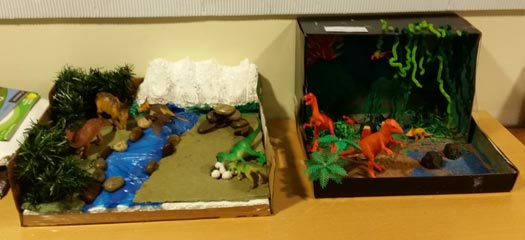
Mini “Jurassic Worlds” on Display

Colourful dinosaur scenes.

Several prehistoric scenes on display outside the classroom.

Picture credit: Pebble Brook Primary School/Everything Dinosaur

Everything Dinosaur and a Dinosaur Workshop

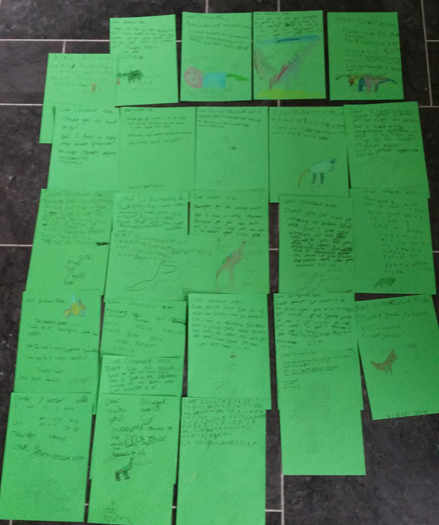
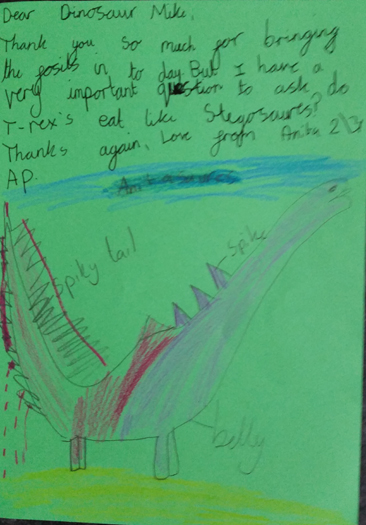
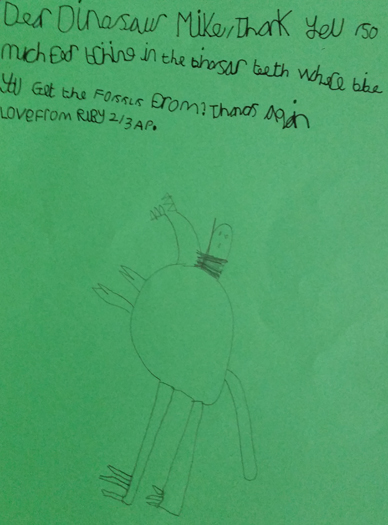
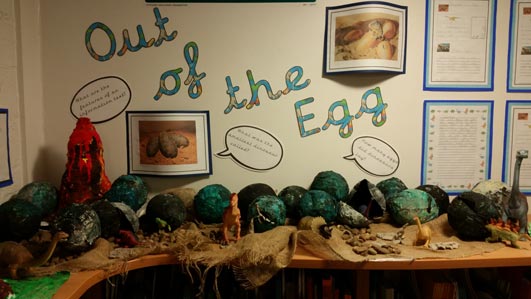
All too soon, it was time to leave the enthusiastic pupils and their dedicated teachers.  However, we did set the children a special challenge.  As they had lots of questions and since we were unable to address them all during the day, it was suggested that the children could write into our office or email us and we would do our best to provide them with answers.  This provided yet another non-fiction writing activity for the children to undertake, as well as giving the teachers the opportunity to explore the differences between writing a letter and sending an email with their pupils.

Take a tour of the Everything Dinosaur website: Tour Our Website (Everything Dinosaur).

1 11, 2016

Exclusive Fossil Hunting at Biddulph Grange

By |2024-05-06T15:15:14+01:00November 1st, 2016|Categories: Dinosaur Fans, Educational Activities, Geology, Main Page, Teaching|0 Comments

Already for the Fossil Hunting at Biddulph Grange

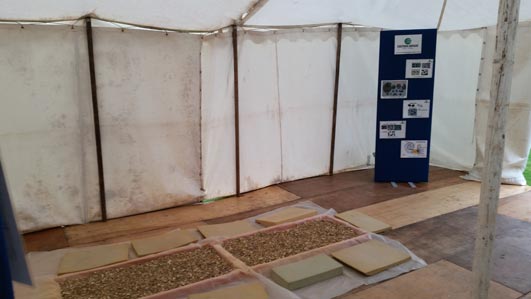
Last Sunday, Everything Dinosaur team members visited Biddulph Grange Garden in Staffordshire as part of the dinosaur themed activities that had been organised at the National Trust property.  Our staff arrived nice and early and set up a fossil hunting activity for the budding young palaeontologists in the specially erected marquee that had been provided.

Fossil Hunting with Everything Dinosaur

All Ready for the Fossil Hunting Activity at Biddulph Grange Garden

Everything Dinosaur fossil hunting activity.

Fossil trays laid out at Biddulph Grange Gardens.

Picture credit: Everything Dinosaur

The picture above shows the marquee starting to get prepared for all the visitors we were expecting that day.  The event, part of The National Trust’s promotional campaign to raise awareness about the restoration of the unique Geology Gallery at Biddulph Grange, had been sold out for some weeks.

However, on the day itself our dedicated team met up with a number of other visitors to the beautiful gardens and we even gave away some fossils to visitors who had been unaware of the event and “popped into the tent to have a look around”.

To take a look around Everything Dinosaur’s award-winning website: Everything Dinosaur.

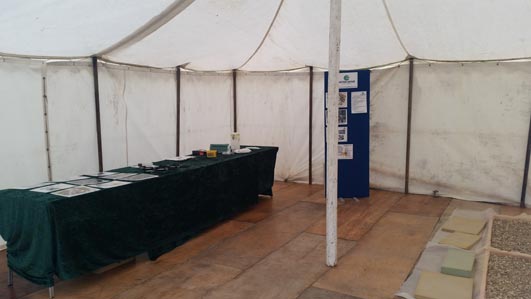
Preparing the Tables to Help Identify the Fossils

Everything Dinosaur at Biddulph Grange Gardens 2016.

Fossil trays laid out at Biddulph Grange Gardens.

Picture credit: Everything Dinosaur

Giving Away Fossils

We put lots of gravel into the trays on the floor and then carefully added a variety of fossils so that visitors could have a go at spotting fossils amongst the stones.  There were shark teeth, bivalves, brachiopods, fossilised wood, trilobites, ammonites, belemnite guards and even pieces of fossilised bone.

We certainly had a busy day, our early arrival allowed us to get organised and lay out all the helpful fossil identification charts that we had prepared.  We had to keep up topping up the fossil hunting trays, the visitors were finding so many specimens.

The Geology Gallery

The early arrival also allowed Everything Dinosaur team members to visit the partially restored Geology Gallery.  When completed (late spring 2017), the gallery will house many fossils and casts that help explain about prehistoric animals and life in the past.  Mr James Bateman, the former owner of Biddulph Grange and Gardens, built a wonderful gallery dedicated to uniting the ideas of a biblical creation with the newly emerging sciences of geology and palaeontology, scientific ideas that were beginning to take root in the 1860s.

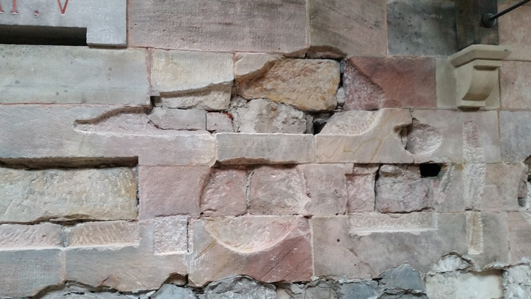
Day V (Five) in the Geology Gallery

Biddulph Grange Geology Gallery.

Part of the Geology Gallery at Biddulph Grange Gardens, ready for restoration.

Picture credit: Everything Dinosaur

The picture above shows the spaces in the walls where the original fossils were housed.  The large, almost triangular space at the top of the photograph was the location of a partial ichthyosaur skull (Temnodonotosaurus platydon).  Sadly, very little documentation regarding the gallery and its contents have been preserved.  One of the fascinating problems associated with this particular restoration project is trying to work out what fossils went into the various spaces.

For replicas of iconic animals from the fossil record: Learning – Dinosaur Crafts and Replica Fossils.

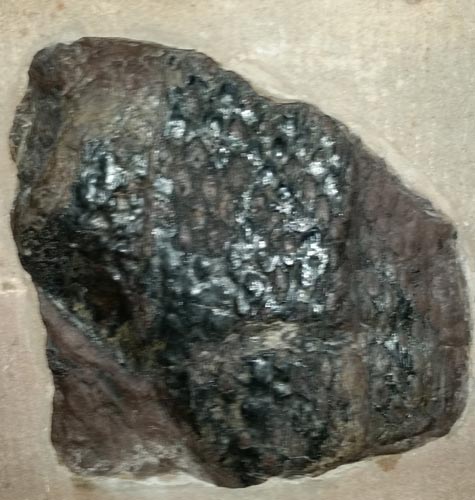
Only one of the original fossils remains, a section of Lepidodendron bark with its characteristic diamond shaped leaf scars.

The Lepidodendron Bark Fossil in the Geology Gallery

A piece of fossilised bark (Lepidodendron).

The Lepidodendron fossil (ancient bark).

Picture credit: Everything Dinosaur

Lepidodendron Fossil Hunting

Although the term Lepidodendron is used to refer to a genus of tree-sized lycopsid, strictly, only the scale bark on the uppermost part of the plant is named Lepidodendron.  Plants are rarely preserved as whole fossils but normally occur as isolated fragments, often representing different parts of the organism, the leaves, roots, trunk, stems, fruiting bodies, flowers and such like.  As these different parts are found separately, each plant tends to get a separate scientific name.  Hence, the roots of this lycophyte are referred to as Stigmaria and the base of the trunk is called Knorria.

Lepidodendron is derived from the Greek, it means “scale tree”, a very apt description for the diamond-shaped leaf scales which can be clearly seen in the Biddulph Grange fossil.

31 10, 2016

Everything Dinosaur and the Cornerstones Curriculum

By |2023-05-08T13:46:17+01:00October 31st, 2016|Categories: Educational Activities, Main Page, Teaching|0 Comments

Whole School Topic Maps and the Cornerstones Curriculum

One of the main focal points linked to the establishment of a new curriculum was the aim to help every child reach his or her potential.  Providing an enriched and stimulating environment is essential and every day we come across examples of teaching excellence.

We see the efforts of many teachers to introduce a range of teaching styles and to really enthuse and motivate their class.  Thanks to the support of the senior leadership team, teaching professionals can set out to develop children emotionally and help them to prepare for adult life as well as embracing an appreciation of lifelong learning.  Hence the renewed focus on helping the children to experience personal, social, health and emotional development.

Helping Young People to Become Lifelong Learners

Personal, emotional and social development.

Helping learners to gain an appreciation of lifelong learning.

Picture credit: Press (Frankfurter Buchmesse)

The Cornerstones Curriculum

A lot of schools have chosen to adopt the Cornerstones curriculum.  This topic based curriculum reflects the requirements of the National Curriculum in a structured and organised manner, helping pupils to remain engaged and to apply skills and knowledge.  Often a whole school topic map will be planned, usually running on a biannual cycle.

Learning about rocks and fossils is now part of the science curriculum for Lower Key Stage 2, whilst evolution and natural selection subjects are found within the science subject areas for Year 6, so Everything Dinosaur’s workshops have a very broad appeal.  In addition, teachers of younger children find dinosaurs as an ideal term topic area, following on from children’s fascination for dinosaurs and providing an opportunity to develop and improve skills learnt to enable them to reach their full potential.

A Dinosaur Term Topic Can Really Help the Development of Young Minds

Children enjoy learning about dinosaurs.

Lots of literacy and numeracy activities displayed.  Picture credit: Everything Dinosaur.

Picture credit: Everything Dinosaur

A Cross Curricular Approach to Learning

The Cornerstones curriculum allows the teaching team to tailor the content and delivery of the teaching scheme of work to meet the needs of individual pupils.  It is essentially, a cross curricular approach to learning, hence when we are delivering a dinosaur themed workshop to Lower Key Stage 1 for example, we like to be briefed on the learning outcomes that the teaching team require.  In this way, we can cover key aims and help to reinforce learning, as well as providing plenty of numeracy, literacy and IT based extension exercises.

Cornerstones has four main areas of learning:

  • Engage
  • Develop
  • Innovate
  • Express

Interlocking Stages – Supporting Learning

During each of these interlocking stages, children have the opportunity to develop and improve skills learnt to enable them to reach their full potential.   We are often amazed at just how much knowledge children demonstrate during our school visits, for example, during our last fossil themed workshop, children were eager to tell us all about some marine reptiles that they had been learning about.

In the “Engage” element, pupils have the opportunity to kick-start a topic area with a memorable, thought provoking, first-hand learning experience.  Everything Dinosaur’s dinosaur workshops in schools are often used as a provocation to help give the term topic a good start.  Our dedicated teaching team will be undertaking a number of these provocations over the next two weeks as schools start a new dinosaur and fossil themed topic area at the beginning of the second half of the autumn term.

In the “Develop” element, children improve their knowledge and understanding in relation to their topic.  They develop and practice new skills learnt and have time to explore and create in relation to their term topic.  Many of the extension ideas we provide to teaching teams allows children to build on their pre-knowledge and to apply this and newly acquired knowledge to a range of scientific themed exercises.  All these extensions are aimed at helping to reinforce learning.

Everything Dinosaur and the Cornerstones Curriculum

For further information about Everything Dinosaur’s outreach work: Contact the Team at Everything Dinosaur.

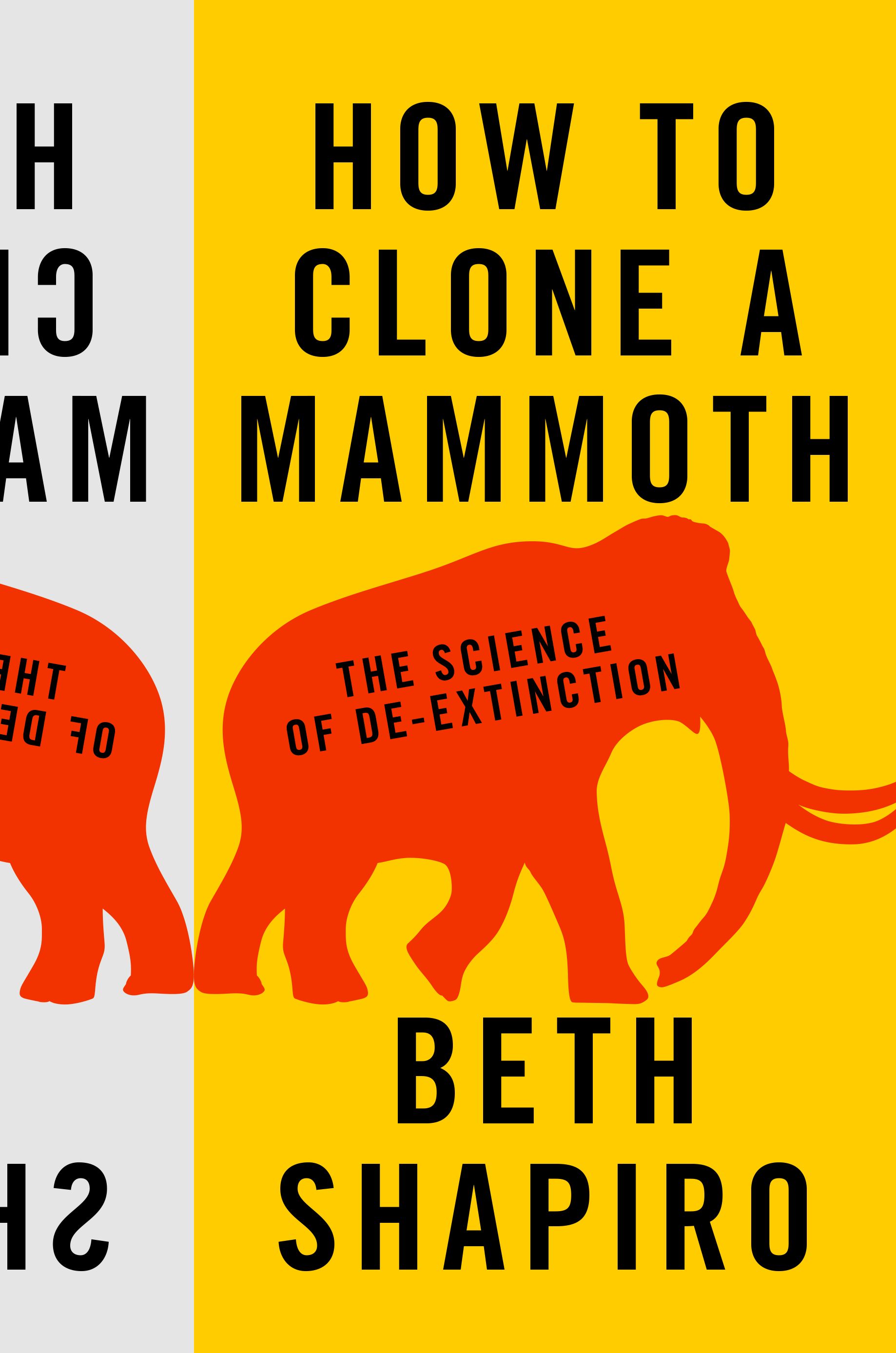
When it comes to the “Innovate” section, we like to see pupils applying the skills and knowledge they have learnt in real life, palaeontological contexts.  An example of this is challenging a Year 6 class to debate whether cloning a Woolly Mammoth would be a good idea.

Thoughtful and Provocative Debates Related to Climate Change, Extinction and the Ethics Behind De-extinction

The science behind de-extinction.

The science of de-extinction by Beth Shapiro.

Picture credit: Princeton Press

During our workshops, we like to give children the opportunity to explore real problems.  This helps to inspire them through learning and allows them to see how classroom teaching can be applied to real scientific conundrums.

Finally, we come to the “Express” section.  This provides young learners with the opportunity to become performers, experts and to inform others.

Everything Dinosaur Team Members Advising Teaching Teams

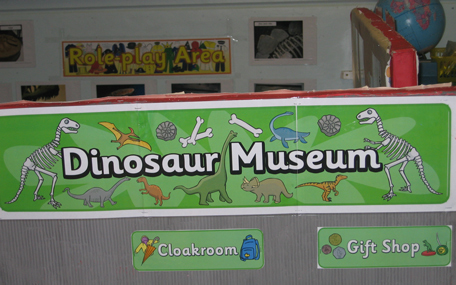
Demonstrating what they have learned can come in different forms, from a school assembly presentation related to mass extinction to writing and performing an expressive dance piece that depicts the extinction of the dinosaurs.  We advise teachers to have a dinosaur and fossil themed “learning wall” for this type of term topic.  This permits the class to showcase and celebrate their achievements as they have studied the topic.  A dinosaur museum set up in the classroom can provide a useful focal point for showcasing the work undertaken.

Come to the Dinosaur Museum!

A dinosaur museum set up on the classroom.

Come to our dinosaur museum! Picture credit: Everything Dinosaur.

Picture credit: Everything Dinosaur

We wish everyone well with the start of the second half of the autumn term.  Onwards and upwards with learning, whatever curriculum the school is following.

Visit the Everything Dinosaur Website: The Website of Everything Dinosaur.

25 10, 2016

A Special Fossil Hunting Event at Biddulph Grange Garden

By |2024-05-06T15:16:42+01:00October 25th, 2016|Categories: Dinosaur Fans, Educational Activities, Geology, Main Page, Teaching|0 Comments

Budding Palaeontologists Wanted at Biddulph Grange Garden – Sunday 30th October

On the cusp of “Dinovember” already and Sunday 30th October will see team members from Everything Dinosaur visiting the prestigious Biddulph Grange Garden (Staffordshire), to set up a fossil hunting activity in support of the fund to help restore and refurbish the amazing Geological Gallery at this National Trust property.

A Fossil Hunting Activity

The beautiful Biddulph Grange House and Gardens, a fine example of Victorian architecture and landscaping, hide a secret.  Theologian, lay preacher and naturalist James Bateman, the erstwhile owner of the house and gardens, built a unique gallery dedicated to uniting the ideas of a biblical creation with the newly emerging sciences of geology and palaeontology.

An Illustration of the Victorian Geological Gallery

An lithograph of the geological gallery at Bidduph Grange House.

An illustration of James Bateman’s amazing Geological Gallery in its Victorian heyday.

Picture credit: National Trust

The Geological Gallery

This amazing gallery is currently being restored and Everything Dinosaur will be inviting “palaeontologists in training” to brush up on their fossil hunting skills and help us to discover fossils.  What you find you can take home and keep!

For further information about Everything Dinosaur: Everything Dinosaur – About Us.

Everything Dinosaur team members are busy sorting out all sorts of amazing fossils that they intend to giveaway to lucky fossil hunters on Sunday 30th October, with so many fossils to find, visitors to this fund-raising event are bound to come away with something special, we might even bring a few of our dinosaur fossils and other items along too.

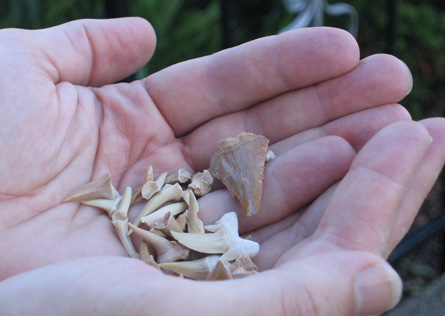
Sorting Prehistoric Sharks Teeth Ready for the Fossil Hunt

fossilised shark teeth.

A successful fossil hunt.

Picture credit: Everything Dinosaur

For replicas of iconic animals from the fossil record: Dinosaur Games, Dinosaur Crafts and Iconic Fossil Replicas.

A Unique Space

The Geological Gallery demonstrates the growing scientific understanding of ancient life on Earth and marries it with the biblical view of creation as outlined in the first book of the bible (Genesis).  James Bateman’s vision was to set out fossils and the history of prehistoric animals and plants in the context of the seven days of the Christian creation story.

The garden was a marvel of its age, providing a striking exhibition of beautiful fossils and colourful rocks.  A dedicated team of volunteers at the National Trust are setting out to restore the Geological Galley to its former glory and visitors on Sunday have the opportunity to see the progress, as well as to take home a little bit of Earth’s prehistory for themselves.

Team members at Everything Dinosaur might even play one or two games and provide some palaeontological puzzles to test the knowledge of the young fossil hunters who join us on the day (watch out mums, dads, grandparents and guardians, we might just teach you a thing or two too).

Chirotherium Fossil Track Being Restored to the Exhibit

A Chirotherium reptile print (Triassic).

Restoring one of the fossil exhibits in the Biddulph Grange Geological Gallery.

Picture credit: National Trust

This exciting day of dinosaur themed activities starts at 11.30am Sunday morning, check out this link to visit our website: Everything Dinosaur.

24 10, 2016

Visit to the Senckenberg Natural History Museum

By |2023-05-08T11:25:34+01:00October 24th, 2016|Categories: Dinosaur Fans, Educational Activities, Main Page, Photos/Pictures of Fossils|0 Comments

The Senckenberg Natural History Museum (Naturmuseum Senckenberg)

When in Frankfurt, take the opportunity to visit one of the largest natural history museums in Germany, the Naturmuseum Senckenberg (Senckenberg Natural History Museum).  Team members at Everything Dinosaur did just that, visiting the museum just prior to the commencement of a major refurbishment programme.  The spacious dinosaur gallery is perhaps, the most popular gallery in the museum and it is certainly worth a look around, but in addition, there are plenty of other gems to spot amongst the extensive collection of The Senckenberg Research Institute.

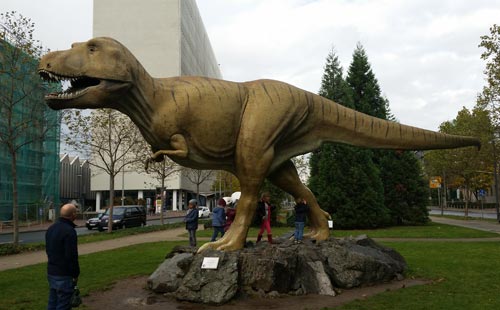
Tyrannosaurus rex Greets Visitors to the Naturmuseum Senckenberg

T. rex replica outside the Frankfurt museum.

A well-known Frankfurt landmark. The T. rex outside the Naturmuseum Senckenberg .

Picture credit: Everything Dinosaur

The Dinosaur Gallery at the Naturmuseum Senckenberg

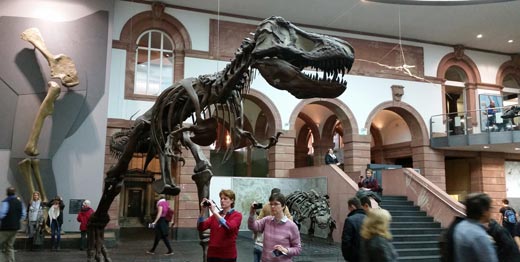
With a life-size replica of T. rex to be found opposite the main entrance, visitors to the museum will not be surprised to discover that a cast of Tyrannosaurus rex can be found in the ground floor dinosaur gallery.

The near forty-foot-long replica positioned on a landscaped area over the road from the entrance to the museum, is in very good condition, given the amount of attention the Frankfurt T. rex was getting from young dinosaur fans who were delighted to get up close to the statue and run between the theropod’s giant legs.

A Cast of a Tyrannosaurus rex Skeleton in the Dinosaur Gallery

T. rex skeleton at the Frankfurt Natural History Museum

The museum’s dinosaur gallery. Naturmuseum Senckenberg

Picture credit: Everything Dinosaur

Visiting the Dinosaur Gallery

Although the gallery is quite large and all the life-size dinosaurs that occupy the floor space are mounted on raised platforms, visiting the gallery later in the afternoon, affords the visitor the best views as towards closing time the galleries are much less busy.

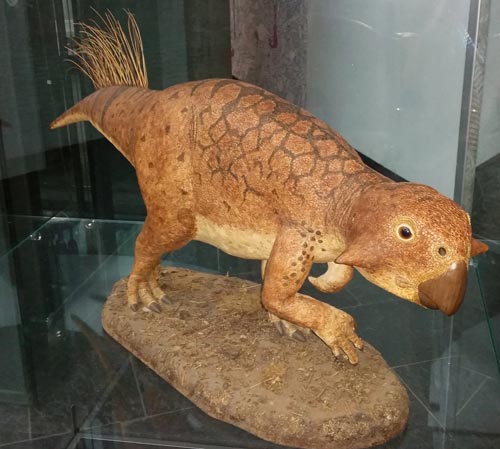
For us, a highlight of the dinosaur gallery was being able to view the marvellous Bob Nicholls replica of Psittacosaurus, the dinosaur featured in a recently published scientific paper that examined the idea of counter shading in forest dwelling dinosaurs.  This beautiful model demonstrates how our views about the appearance of dinosaurs has changed.  Contrast, for example, Bob’s remarkable replica with some of the painted images of dinosaurs that occupy the walls of the dinosaur gallery.

The Life-size Psittacosaurus Replica on Display

Life-size Psittacosaurus replica.

A model of the dinosaur called Psittacosaurus.

Picture credit: Everything Dinosaur

A Psittacosaurus Fossil Specimen

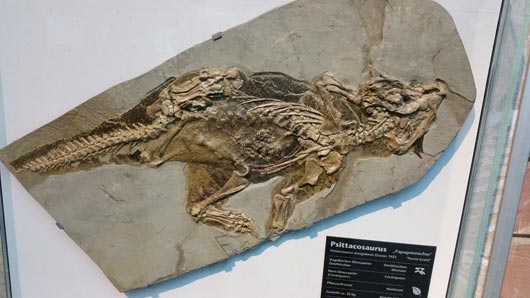
The beautifully preserved fossil Psittacosaurus specimen that was used in the recent study into dinosaur colouration can be found in the Senckenberg Research Institute’s vertebrate fossil collection.  The fossil probably came from the Yixian Formation of Liaoning Province (north-eastern China), most likely from an illegal smuggling operation.  However, the specimen was purchased by the Frankfurt museum (see photograph below).

To read an article from Everything Dinosaur about this exciting area of research: Calculating the Colour of Psittacosaurus.

A Cast of the Psittacosaurus Fossil on Display at the Museum

A Psittacosaurus fossil.

Psittacosaurus fossil on display at the Senckenberg Naturmuseum (Frankfurt).

Picture credit: Everything Dinosaur

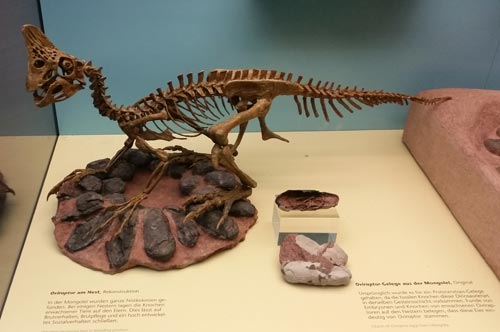
As well as specimens of Diplodocus, Iguanodon, Triceratops (T. prorsus) and Euoplocephalus, look out for the wall-mounted Plateosaurus and the collection of dinosaur eggs.

An Oviraptor on Display Next to Examples of Dinosaur Nests and Eggs

An Oviraptor and dinosaur eggs exhibit.

An Oviraptor and its nest.

Picture credit: Everything Dinosaur

With many of the information panels written in both German and English, these thoughtful displays are most illuminating.

Other Museum Highlights – the Naturmuseum Senckenberg

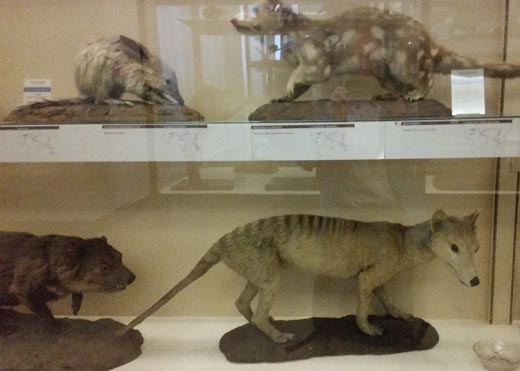
The mammal gallery is most impressive, look out for the Quagga display (an extinct sub-species of plains Zebra), one of just a handful of specimens in the world.  In the marsupial area, a Thylacine can be found, standing amongst its close relatives the Tasmanian Devil and the Quoll.

The Thylacine is Included in the Marsupial Mammals Display

A Thylacine on display.

A Thylacine is included in the Australian mammals part of the gallery (Senckenberg Museum).

Picture credit: Everything Dinosaur

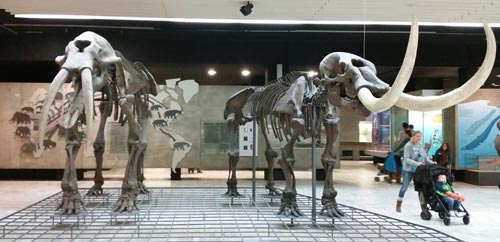
Spectacular Displays of Ancient and Not So Ancient Prehistoric Elephants

Large elephants on display.

Prehistoric elephants on display at the Senckenberg Museum (Frankfurt).

Picture credit: Everything Dinosaur

For models and replicas of prehistoric elephants and other amazing, extinct creatures: Eofauna Scientific Research Models.

Messel Oil Shales and Marine Reptiles

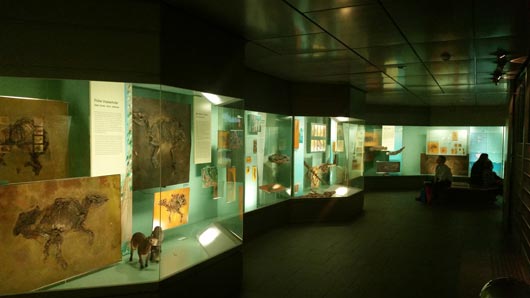
For the keen fossil fan, there is a substantial display of invertebrate fossils helping to get across the concept of deep time as well as explaining biostratigraphy (check out the ammonites that help to illustrate this).  An entire side gallery has been dedicated to the remarkable fossils from the Messel Oil Shales.  We suspect this part of the museum has been recently modernised, the displays were well lit and the many different types of animal and plant fossil from the Messel pits were thoughtfully showcased and grouped by Phyla and Orders.

Part of the Messel Oil Shales Gallery

Part of the Messel gallery (Senckenberg Museum).

The atmospheric Messel gallery at the Senckenberg Museum (Frankfurt).

Picture credit: Everything Dinosaur

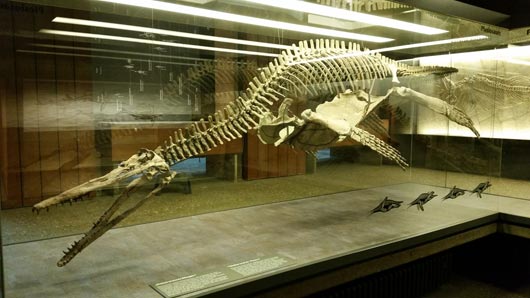
The marine reptile gallery was also most impressive.  There were a large number of replica fossils on display including spectacular examples of ichthyosaurs, placodonts, plesiosaurs, turtles and nothosaurs.

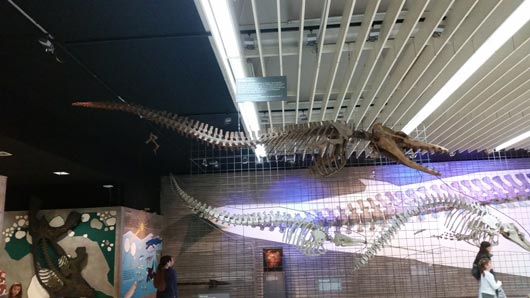
Visitors to the museum also have the opportunity to view examples of giants of the sea around today with a most informative cetacean gallery.  It was also a pleasure to see explanation panels on the evolution of the whale family along with specimens representing Basilosaurus and Ambulocetus, the Ambulocetus tying in nicely with the Messel fossils exhibit.

 An Exhibit Explaining How the Plesiosauria “Flew” Underwater

An underwater flyer (Plesiosauria).

A display explaining how marine reptiles “flew” underwater.

Picture credit: Everything Dinosaur

One of the Displays from the Spectacular Cetacean Gallery

Ancient whales on display.

The spectacular ancient whales gallery (Senckenberg Museum).

Picture credit: Everything Dinosaur

We look forward to learning more about the refurbishment programme for this museum and whilst we appreciate there will be some disruption during this work, we recommend this museum.  It is well worth a visit.

Also worth a visit, the award-winning and very popular Everything Dinosaur website: Everything Dinosaur.

11 10, 2016

A Beautiful Dinosaur “Wow Wall”

By |2024-05-06T15:12:14+01:00October 11th, 2016|Categories: Educational Activities, Main Page, Teaching|0 Comments

Displaying Children’s Dinosaur Topic Work

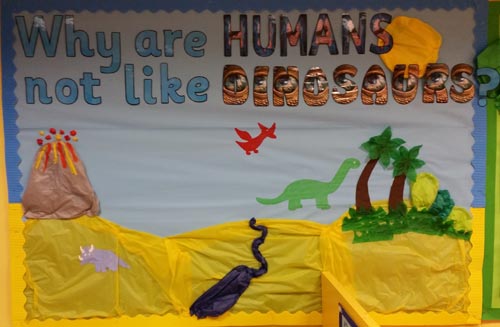
Year 1 children at Lowton St Mary’s CE Primary have commenced their autumn term topic entitled “Why are humans not like dinosaurs?  The children have not learned about prehistoric animals in school before, for the teacher too, this is a new topic, requiring careful planning to help cement the learning targets already achieved in Reception and to prepare the children for more directed learning tasks targeted on developing confidence with literacy and numeracy.

A Dinosaur Themed Topic

A question at the heart of the topic, provides the teaching team with a focal point on which to centre the scheme of work for the term.  In this instance, the question asking about the differences between people and dinosaurs links into one of the key areas of the English national curriculum for Lower Key Stage 1, that of learning about our bodies.

The Focal Point for a Dinosaur Themed Term Topic – “Why are Humans not like Dinosaurs”?

A "Wow Wall" in Year 1 helping to enthuse the children.

Why are humans not like dinosaurs?

Picture credit: Lowton St Mary’s CE Primary/Everything Dinosaur

A “Wow Wall”

A number of display areas have been prepared around the well-organised classroom to showcase the children’s work.  This can provide a focal point for the children and allows good examples of writing (fiction and non-fiction), to be prominently displayed.  During a visit to the school, to conduct a dinosaur themed workshop with the class to act as a provocation for the term topic, our fossil expert provided further advice as well as some handy extension resources to support planning of the topic areas.

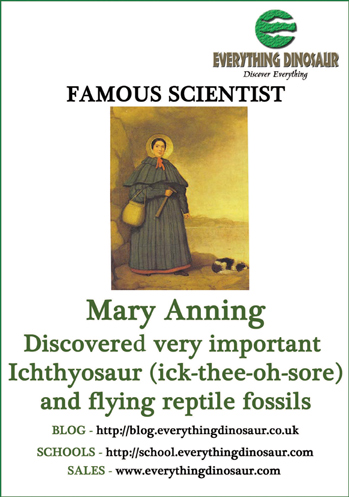
One suggestion was to introduce the story of Mary Anning (1799-1847).  This Georgian lady found a number of important fossils around the cliffs of Lyme Regis and the tongue twister “she sells sea shells” is connected with her.  Mary also provides a fine role model for girls, in what otherwise might be viewed as a boy focused topic.

Mary Anning – A Famous Fossil Hunter from Dorset (southern England)

Mary AnningPoster

Helping to learn all about scientists.

Picture credit: Everything Dinosaur

A Dinosaur Museum

Many teachers dedicate an area of the classroom for a dinosaur museum, this allows craft ideas such as fabric and clay models or salt dough fossils to be displayed.  This permits the teaching team to support an area of curriculum learning related to exploring the properties of everyday materials.

During our visit we met one little boy who explained that he had some fossils at home.  With permission, these items could be brought into school and put on display in the museum, this allows the teacher to explore with the children what might be needed to keep the fossils safe, how might the fossils be displayed?  When creating a dinosaur museum in a classroom environment we like to ask the class what sort of rules their museum should have.  Thinking about the rules for good behaviour in the museum links into the PSHE elements (personal, social, health and economic values), that are encouraged by Ofsted.

The children considering appropriate behaviour in their museum can help them to understand and develop knowledge, understanding, attitudes and responsibilities with regards to their own behaviour in the class generally.

Different Materials Used to Make a Prehistoric Animal Themed Display

A dinosaur themed display.

Different materials used to make a prehistoric animal themed display.

Picture credit: Lowton St Mary’s CE Primary/Everything Dinosaur

A Dinosaur Themed Topic “Wow Wall”

The prehistoric animal themed display, the “wow wall” as we like to call it, was comprised of a number of different materials.  This was a clever way of helping the children to explore textures as well as the properties of materials.

The Everything Dinosaur website: Everything Dinosaur.

10 10, 2016

A Clever Milk Carton Woolly Mammoth – A Great Craft Idea

By |2024-05-06T15:12:47+01:00October 10th, 2016|Categories: Educational Activities, Main Page, Teaching|0 Comments

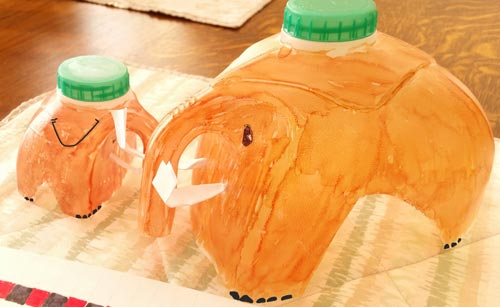
Milk Carton Woolly Mammoth

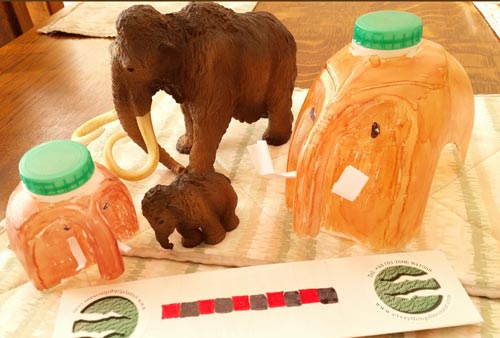
Here’s a simple craft idea for teachers, home educationalists and museum staff who want to teach about Ice Age prehistoric animals.  A plastic milk carton can be turned into a Woolly Mammoth model.

A Milk Carton Woolly Mammoth Model

Making a Woolly Mammoth out of a plastic milk carton.

Making a Woolly Mammoth out of a milk carton.

Picture credit: Everything Dinosaur

Visit Everything Dinosaur’s website: Everything Dinosaur.

A Woolly Mammoth Model

This is a simple and fun to make Woolly Mammoth model and would be a great activity for Key Stage 1 or Lower Key Stage 2 children to try.

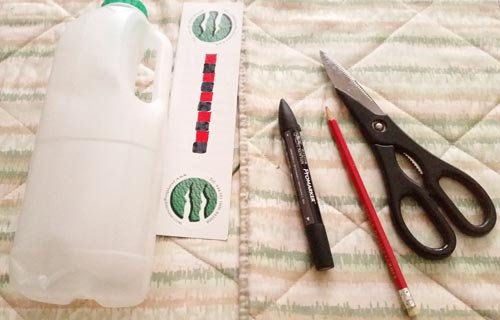
What You Will Need to Make a Milk Carton Woolly Mammoth

  • Empty plastic milk cartons (washed out to remove any milk residue)
  • Pair of round ended scissors
  • Pencil and black highlighter pen
  • White card or paper
  • Paints

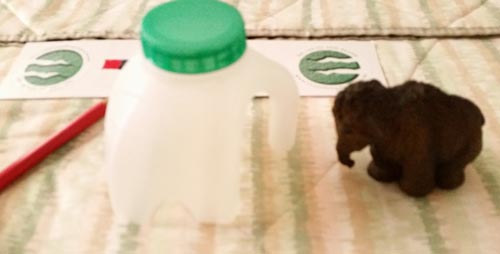
Taking your milk carton, carefully cut it into half, using the handle as a guide.  The handle will form the trunk of your Mammoth so cut the handle first then cut around the rest of the carton about two centimetres lower down the carton.  This will ensure that your Mammoth’s trunk will be raised off the ground.

What You Need to Make a Milk Carton Mammoth

What you need to make a Woolly Mammoth model from a milk carton.

Tools required to make a milk carton Mammoth.

Picture credit: Everything Dinosaur

A Milk Carton Woolly Mammoth Model

Once the milk carton has been cut, then simply cut two tongue-shaped slots on the widest part of carton, these will make the legs.  Use a pencil to sketch out where the cuts will be made and then go over the pencil line with the black marker pen to give you a distinctive shape to follow as you cut.  Finally, cut a third tongue-shaped slot on the back of the carton, this slot will help to form the back legs.  If you want, you can cut a small “V” shape at the top of this slot, you can then bend this plastic out to make the Woolly Mammoth’s little tail.

The Milk Carton Woolly Mammoth Begins to Take Shape

Milk carton Woolly Mammoth takes shape.

Woolly Mammoth takes shape (milk carton).

Picture credit: Everything Dinosaur

Once the legs and tail have been cut out, simply paint the carton a sandy, brown colour to mimic the shaggy Mammoth coat.  Add the eyes, (draw on the tail, if you have not cut out a “V-shaped” slot at the back), and add the five rounded nails on each foot.  You can mark the area of the ears as well.  Remember, Woolly Mammoths had relatively short ears compared to those of modern elephants (an adaptation against the cold).

Build Your Own Herd of Woolly Mammoths

A pair of milk carton Woolly Mammoths.

Build your own herd of milk carton Woolly Mammoths.

Picture credit: Everything Dinosaur

Adding the Tusks

To finish off your Woolly Mammoth cut two small holes either side of the trunk and then slot in a piece of white card or paper to make the tusks.  Don’t forget to bend the tusks upwards a fraction and there you have it, an easy to make milk carton Woolly Mammoth, a super craft idea to support teaching about Ice Age animals and life in the Stone Age.

Different sized milk cartons can be used to make different sized members of your Mammoth herd.

For models and replicas of prehistoric animals including Woolly Mammoths: Papo Replicas of Prehistoric Animal Models.

8 10, 2016

Reception Classes Explore Amazing Dinosaurs

By |2024-05-06T15:13:36+01:00October 8th, 2016|Categories: Educational Activities, Main Page, Teaching|0 Comments

Manor Primary and Dinosaurs

Friday was yet another busy day for the young learners at Manor Primary School (Coseley, West Midlands).  The three Reception classes had embarked on their first ever term topic and to cap an exciting week, the children were visited by one of the dinosaur experts from Everything Dinosaur.

Dinosaurs and Prehistoric Animals

With three workshops to deliver over the course of the day, the teaching schedule was quite tight, but within minutes of arriving our team member had settled in and prepared the spacious dance hall in readiness for the first of that morning’s dinosaur workshops.  There was plenty of time prior to the arrival of the children to conduct a briefing with one of the Foundation Stage teachers.  This helped establish learning objectives and intended outcomes for each class workshop.  In addition, our dinosaur expert was given the opportunity to view some of the excellent preparation that had been undertaken by the teaching team in this Ofsted rated “outstanding” school.

RLC Class Children Had Thought About Dinosaurs Prior to the Workshop

A simplified KWL chart with Reception children.

Reception children think about dinosaurs. What can they tell the teacher?

Picture credit: Manor Primary/Everything Dinosaur

First Time Dinosaurs

This was the first term topic for the three Reception classes, the autumn term marking the transition from the Nursery programme onto the more structured learning associated with Foundation Stage 2 on the national curriculum.  It was also the first time that the teachers had covered dinosaurs with their charges, our handy phonetic pronunciation guide was greatly appreciated, we know how challenging some of those dinosaur names can be!  The extra resources that we had provided were well received and there was even an opportunity to inspect the organised and tidy classrooms prior to the start of the school day.

As a teaching school, providing support and training to other schools in the area, Manor Primary sets high standards for both pupils and staff.  Emphasis is placed on developing confident, enthusiastic learners and the stimulating activities that the children had been focused on in the first few days of this term topic provided plenty of evidence of a thoughtful and well-planned scheme of work.

Clay Fossils

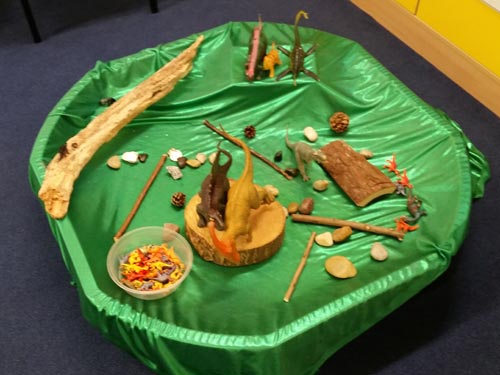
Some of the children had made clay fossils, whilst others had been constructing dinosaur teeth.   One class had been excavating their very own set of dinosaur bones in the classroom sand tray.  Dinosaurs and fossils as a topic certainly gives plenty of scope for exploring the properties of materials as well as for creative, imaginative play.

For prehistoric animal toys and games: Prehistoric Animal Toys and Games.

RAB Class Had Been Making Their Own Dinosaur Land

A Reception class dinosaur themed creative play area.

A creative play area with a dinosaur theme in the Reception class.

Picture credit: Manor Primary/Everything Dinosaur

Dinosaur Drawing Challenge

Plenty of space had been set aside in each of the three Reception classrooms to allow the children’s work to be displayed.  We challenged the children to have a go at drawing their very own dinosaur, but we also wanted to see plenty of labelling of the dinosaur’s body parts.  Could they label the dinosaur’s head?

Lots of pre-knowledge was demonstrated by the children, they certainly know their dinosaurs, but our workshops also focused on developing vocabulary as well as exploring the differences between people and prehistoric animals.  Plenty of good listening in evidence, which was quite remarkable given the fact that some of these enthusiastic palaeontologists have only just turned four.

RKM Class Take Up Palaeontology in the Sand Tray

Reception class dig for dinosaurs.

Digging for dinosaurs with a Reception class.

Picture credit: Manor Primary/Everything Dinosaur

Diverse and Varied Dinosaur Themed Activities

The children certainly have access to diverse and varied dinosaur themed activities.  All learning styles seem to be well catered for.  We hope that our novel way of demonstrating the size of a Tyrannosaurus rex, part of the extension resources that were provided, helps the FS2 children to appreciate that some dinosaurs were very big indeed!  Or were they massive, giant, huge, bigger – just some or the words the children came up with when we examined fossils and challenged the children to describe some of them.

Discover Everything Dinosaur’s website: Everything Dinosaur.
27 09, 2016

Special Dinosaurs Roar with Jonah!

By |2024-05-06T08:59:45+01:00September 27th, 2016|Categories: Educational Activities, Main Page, Teaching|0 Comments

Jonah Class Explore Dinosaurs

It was a busy morning for the Reception class at Astbury St Mary’s Church of England Primary School.  It was also a busy morning for Everything Dinosaur.

Class Jonah have been learning all about dinosaurs and the enthusiastic teaching team had invited a member of the Everything Dinosaur staff into the school to explore dinosaurs and fossils.  The spacious hall was taken over and turned into a mini dinosaur museum and the budding young palaeontologists quickly learned that they had more fingers on their hands than a Tyrannosaurus rex.

Dinosaurs as a Term Topic

Dinosaurs as a term topic was proving very popular amongst the children as they settled into full-time education, the girls were delighted to hear that a girl T. rex grew up to be bigger and stronger than a boy T. rex!  As far as we can tell, the female Tyrannosaurs were probably bigger than the males.

Lots of Creative Dinosaur Drawings on Display

FS2 children draw prehistoric landscapes.

Drawings of a prehistoric landscape by FS2 children.

Picture credit: St Mary’s Primary School/Everything Dinosaur

A Well-organised Classroom

The well-organised classroom already had lots of dinosaur themed drawings and models on display.  The children had made some pointy dinosaur teeth (probably a meat-eater) and the walls were decorated with some lovely prehistoric animal drawings.   The class teacher Miss Irwin, had challenged her class to imagine what a prehistoric landscape looked like, the children had certainly produced some very imaginative drawings.

For dinosaur toys, models and gifts: Dinosaur Gifts and Toys.

The dinosaur food we brought with us helped support the children’s learning about herbivores and carnivores and we note that on the Jonah class blog there are some pictures of a dinosaur plant-eater/meat-eater sorting exercise that our expert suggested the children attempt to help reinforce their understanding about the diets of different dinosaurs.

Dinosaur Land with an Erupting Volcano

FS2 draw dinosaurs.

Reception draw a volcano.

Picture credit: St Mary’s Primary School/Everything Dinosaur

Did Dinosaurs Have Phones?

Prior to our visit, the children under the supervision of Miss Irwin and with the support of Mrs Ainscough, had come up with some super questions about dinosaurs that they would like to explore.  The eager learners busy practising their phonics and getting to grips with reading wanted to learn lots of amazing facts about life in the past.

Questions About Dinosaurs from Jonah Class

Questions about dinosaurs from Reception.

Dinosaur questions from FS2

Picture credit: St Mary’s Primary School/Everything Dinosaur

The Big Teeth of Dinosaurs

Sebastian asked why do dinosaurs have big teeth?  Toby enquired why dinosaurs have bones?  Brad questioned whether there were dinosaurs in the playground?  Some news for you Toby, perhaps some birds like Robins, Magpies and Blue Tits will visit your dinosaur museum outside.  Birds are so closely related to some types of dinosaur that, technically, birds are dinosaurs.  Jude asked did dinosaurs have phones?  That’s an interesting question!  With T. rex having such short arms and only two fingers on each hand, do the children think that this dinosaur could make a phone call?  If you happen to receive a text from a T. rex what would it say?

Did Dinosaurs Have Phones?

Did dinosaurs have phones?

Reception class consider whether dinosaurs had phones and how closely related birds are to dinosaurs.

Picture credit: Everything Dinosaur

Visit Everything Dinosaur’s award-winning website: Everything Dinosaur.

13 09, 2016

Dedicated Everything Dinosaur Visits Howes Primary School for Exclusive Dinosaur Fun

By |2024-05-06T08:55:32+01:00September 13th, 2016|Categories: Educational Activities, Main Page, Teaching|0 Comments

Dinosaurs “Get Sent to Coventry”

Tuesday was “dinosaur day” for the Key Stage 1 children at Howes Primary school with a visit from Everything Dinosaur to help support the term topic for Year 1 and Year 2 children.  This friendly and very welcoming school is located in Coventry (East Midlands), however, thanks to the unseasonably warm weather, Coventry felt more like Copacabana beach as noon temperatures touched thirty degrees Celsius.

Noel, the helpful Site Manager, had the forethought to open the windows in the spacious hall where we were working and despite the heat, the children learned that just like stones, most fossils feel cold when you first touch them.

Dinosaur Workshop

The Children in Year 1 Gave our Dinosaur Expert some Wonderful Dinosaur Drawings

A horned dinosaur drawn by a child in Year 1.

A dinosaur drawing from Year 1.

Picture credit: Howes Primary School (Year 1)

The children in Year 2 were joined by some of the budding palaeontologists from the Hearing Impaired Unit.  All the children enjoyed handling the various fossils and learning about the super power of a giant armoured dinosaur.

A Pink Long-Necked Dinosaur

A very pink dinosaur by Year 1.

A pink long-necked dinosaur drawing.

Picture credit: Howes Primary School (Year 1)

Everything Dinosaur

The Year 1 and Year 2 teachers asked us to help them by providing information about carnivores, herbivores and omnivores.  A number of the children demonstrated considerable pre-knowledge regarding dinosaurs and the extension resources we brought with us should support the teaching team and their scheme of work.  On returning to the office, our team member who visited the school, prepared a couple of extra exercises aimed at supporting this section of the curriculum.

These resources and materials were emailed over to the teacher.  They also recommended a set of dinosaur skulls that featured omnivores, carnivores and herbivores along with other prehistoric animal themed teaching resources to help support learning.

A Set of Dinosaur Skulls – Helpful for Omnivore, Carnivore and Herbivore Sorting Games

Dinosaur fossil skull models, ideal for school.

A set of eleven dinosaur fossil skulls.

Picture credit: Everything Dinosaur

The dinosaur skulls and other useful Key Stage 1 teaching resources can be found here: Safari Ltd. Wild Safari Prehistoric World.

After our busy morning exploring dinosaurs, the Year 1 teacher presented us with a selection of  colourful dinosaur drawings that her class had created.  We shall pin up these pictures onto our warehouse wall, they will cheer us up as we study fossils.

Colourful Prehistoric Animal Drawings from Year 1 at Howes Primary School (Coventry)

Year 1 draw colourful dinosaurs.

Wonderful dinosaur and fossil drawings from a Year 1 pupil.

Picture credit: Howes Primary School (Year 1)

Our thanks to all the children in Year 1 and Year 2 at Howes Primary, we really appreciate the beautiful prehistoric animal drawings that you created and we are sure, that, thanks to the dedicated teaching team, all the children are really going to enjoy their dinosaur themed autumn term topic.

Visit Everything Dinosaur’s website: Everything Dinosaur.
Go to Top