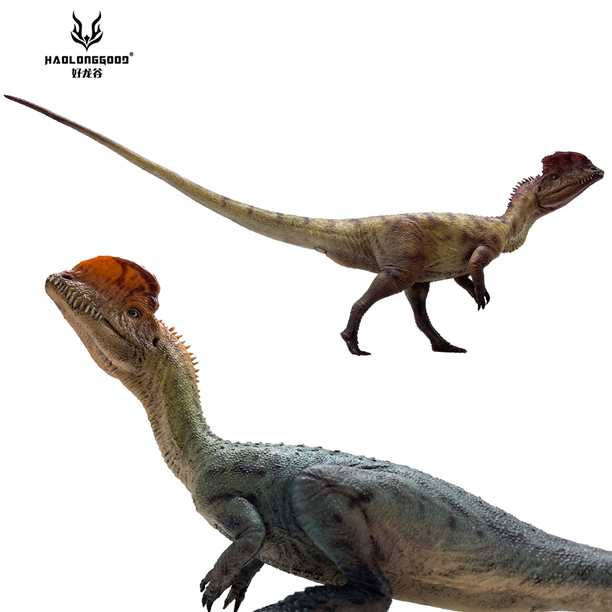
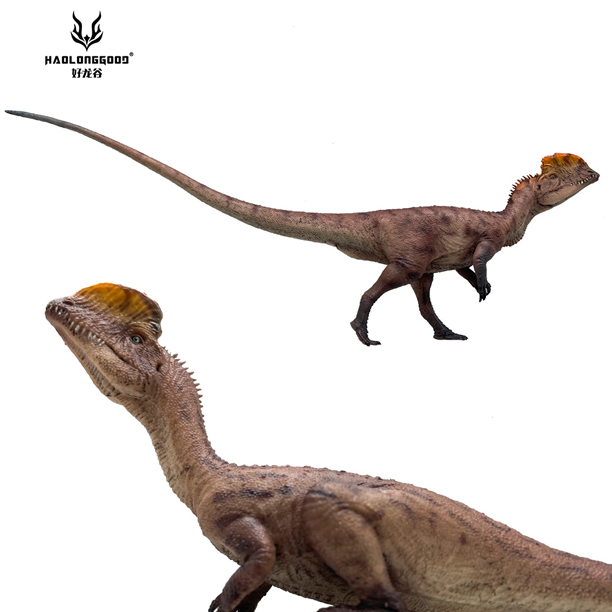
Haolonggood intend to manufacture three versions of a 1:35 scale Alamosaurus. They are not sure how many to make of each version, so they have asked Everything Dinosaur to highlight this offer and make enquiries. The three versions, A and B plus C, a limited-edition, plain version will be available in the early spring of 2024. The Haolonggood Alamosaurus offer is open until December 28th (2023). If customers reserve a figure before 28th December, the Alamosaurus will be supplied with base and pterosaur figure.
Haolonggood Alamosaurus Version A
Haolonggood Alamosaurus model. Version A colour scheme.
To help customers select which figure(s) they want, Haolonggood have supplied computer generated images of the proposed colour schemes.
Haolonggood Alamosaurus Version B
Haolonggood Alamosaurus model version B.
The third Alamosaurus model is the limited-edition, plain version (version C).
Haolonggood Alamosaurus Version C (Limited-edition, Plain)
The limited-edition, plain version of the Haolonggood Alamosaurus model.
To reserve your model, simple contact Everything Dinosaur and let them know which model (A, B or C) you would like.
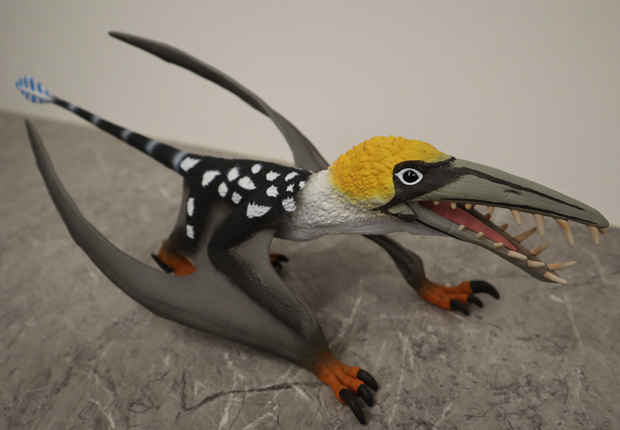
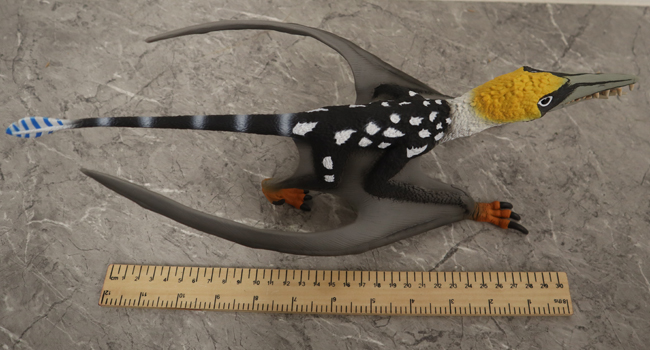
If booked before 28th December (2023), the Alamosaurus scale figure will be supplied with a base and one of two special pterosaur models.
If ordered before the cut-off date of December 28th (2023), the model will be supplied with a base and one of two white pterosaur figures.
Haolonggood Alamosaurus Model Measurements
The actual model measurements have yet to be finalised. However, each PVC figure will weigh several kilos and the proposed product packaging suggests that the 1:35 scale Alamosaurus will stand about 35 cm tall and measure around 65 cm in length.
Haolonggood supplied box dimensions: 65 cm (25.6 inches) long, width 14 cm (5.5 inches) and height 36 cm (14.1 inches).
Showing the size of the Haolonggood Alamosaurus figures.
There has been some confusion over these figures and the product offering. We can confirm that all three models are currently available. Version C will only be available for a limited time (it is a limited-edition model). It is painted in a brown colour scheme. The base and detachable tree plus the unpainted pterosaur figure (there are two pterosaur model versions), are only available for orders placed before December 28th.
It is only the pterosaur models that will require painting.
As promised, Everything Dinosaur has produced a video of the new for 2024 CollectA Deluxe Velociraptor model. This new 1:6 scale Velociraptor will be available in the middle of 2024. This new CollectA figure commemorates the centenary of the formal scientific description of this famous dinosaur.
In this video (duration fifteen minutes), the narrator reviews this new figure and outlines some of the anatomical features of this theropod. The suggestion of scent glands associated with the cloaca is discussed and the addition of a propatagium on the wing is highlighted.
The new for 2024 CollectA Deluxe Velociraptor model reflects some of the very latest research into the Dinosauria.
Everything Dinosaur looks at a prototype of the new for 2024 CollectA Deluxe 1:6 scale Velociraptor model.
The CollectA Deluxe Velociraptor Figure
The Velociraptor figure measures around 32 centimetres in length. The narrator looks at the scale model and comments on its scale accuracy. In addition, the 1924 scientific paper is discussed and the relationship between Velociraptor mongoliensis and Protoceratops andrewsi explored.
The new for 2024 CollectA Deluxe Velociraptor. Picture credit: Everything Dinosaur.
Picture credit: Everything Dinosaur
Velociraptor Video Contents
The video review has been broken into numerous small segments. Viewers can dip in and out of this video review. There is a section that explains about the depiction of the digits. In addition, information about when this model will be in stock at Everything Dinosaur is provided.
Video Contents
0:00 – Introducing a New Velociraptor. 0:43 – Velociraptor Prototype. 1:52 – Subscribe! 2:04 – Examining the Model! 4:12 – Killer Toes and the Wings. 6:18 – Velociraptor Scent Glands! 8:27 – Discovery in 1924. 10:45 – Propatagium! 12:50 – In Stock When? 13:14 – Question of the Day! 14:00 – Follow us on Social Media. 14:45 – Where to Buy CollectA Models. 15:15 – Thank You!
The stunning Rebor Tyrannosaurus rex “Kiss” Mountain figure is back in stock at Everything Dinosaur. Team members have been able to bring in more stock of this popular tyrannosaur in time for the festive season.
The Rebor Kiss T. rex figure (Mountain), this tyrannosaur model has been given lips. Picture credit: Everything Dinosaur.
The Rebor Tyrannosaurus rex has been beautifully painted, and the figure has been given lips. The debate about lips in the Dinosauria is on-going. Many palaeontologists believe that dinosaurs did indeed have lips.
To read an article from earlier this year (2023) about lips in the Tyrannosauridae: Tyrannosaurus rex Had Lips.
The spectacular Rebor Tyrannosaurus rex “Kiss” in the mountain colour variant measures approximately 40.5 cm long and that magnificent head stands around 14 cm high. The model is in an approximate scale of 1:35.
A spokesperson from Everything Dinosaur commented:
“It is wonderful to see this popular Rebor figure back in stock. We have been busy contacting customers who wanted to be notified when this replica arrived. The Tyrannosaurus rex figure has an articulated jaw, poseable arms and a flexible tail. It is a clever piece of dinosaur design.”
Many prehistoric animal models are photographed in lateral view. Everything Dinosaur explains the differences between right and left lateral views. It can be a little confusing for model collectors when photographs of a new prehistoric animal figure are released. Often the images include lateral views, these are images of the figure seen from the side.
The new for 2023 PNSO Megalosaurus dinosaur model. Picture credit: Everything Dinosaur.
Picture credit: Everything Dinosaur
The image (above) shows a view of the recently introduced PNSO Edward the Megalosaurus dinosaur model. The left side of the model can be seen. This photograph shows the left lateral view of the figure. That is, in a left lateral view the object faces to the left as you look at the image.
Determining whether a prehistoric animal figure is in left lateral or right lateral view is made easier if the whole of the model is shown in the image.
Left lateral view – the head of the figure faces to the left as you look at the image.
Right lateral view – the head of the figure faces to the right as you look at the image.
The Papo Kronosaurus marine reptile photographed in right lateral view. Picture credit: Everything Dinosaur.
Picture credit: Everything Dinosaur
In the image (above) the recently introduced Papo Kronosaurus model is facing to the right. Therefore, this model is being shown in the right lateral view.
A spokesperson from Everything Dinosaur commented:
“Our blog often features details of scientific papers. Some of them can be quite technical and we try to summarise the findings and provide simplified explanations for the general reader. Interpreting scientific drawings can be a challenge. It can also be difficult to understand the details shown on a photograph of a prehistoric animal model if the orientation is not known.”
The partial skull of the lizard shown in right lateral view. Picture credit: David Whiteside, Sophie Chambi-Trowell, Mike Benton and the Natural History Museum UK
The photograph (above) shows the skull of the stem lizard Cryptovaranoides microlanius in right lateral view. Computerised tomography (CT) was used to help the researchers to construct the left side of the skull of C. microlanius. This enabled the team to construct a left lateral view of the skull.
Although left lateral and right lateral are terms that are not often used in scientific disciplines, it is helpful to have an understanding of their meaning. It is important to have standard anatomical terms and scientific papers have been published that examine the use of such terms when describing fossils.
The next time you see a photograph of a prehistoric animal model, we hope our short explanation will help you to understand whether the view is left or right lateral.
It is another hectic day at Everything Dinosaur. Team members have been busy picking and packing orders for customers. However, there was time to take a quick photograph of three Horseshoe crab soft toys. These cute and cuddly invertebrates will soon be on their way to customers.
The horseshoe crab soft toys look quite happy at the prospect of leaving our warehouse.
A trio of horseshoe crab soft toys photographed in the Everything Dinosaur warehouse. These cute and cuddly animals will soon be on their way to customers. Picture credit: Everything Dinosaur.
Picture credit: Everything Dinosaur
Prehistoric Plush
Everything Dinosaur stocks a wide range of dinosaur soft toys and prehistoric plush. We have T. rex soft toys, Triceratops and even Woolly Mammoths. We also like to stock some of the more unusual soft toys. Horseshoe crabs are still around today, but they first evolved nearly five hundred million years ago.
Our Horseshoe crab soft toys represent “living fossils”. However, these marine animals are under threat. Habitat destruction that accompanies coastal development presents a danger and the animals are used as bait in the fishing industry. Their unusual metabolism and their blue-coloured blood has been extensively studied. The blood has clotting agents (amebocytes), which are of great benefit to medical science.
A spokesperson from Everything Dinosaur commented that they thought the horseshoe crabs were cute and cuddly.
The spokesperson added:
“These are beautiful soft toys and very unusual. The horseshoe crab soft toys looked like they were smiling at us as they awaited their turn to be packed. We took a quick photograph before returning to our packing duties.”
Visit the award-winning and user-friendly Everything Dinosaur website: Everything Dinosaur.
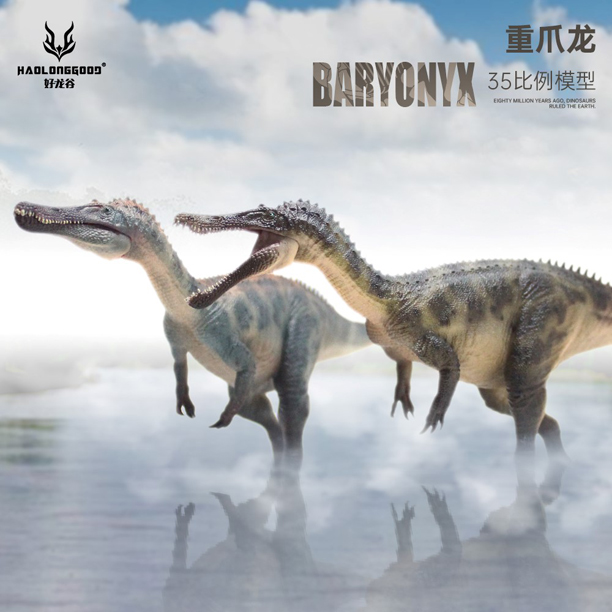
A newly published scientific paper has highlighted the diet of juvenile tyrannosaurs. Writing in the academic journal “Science Advances” the research team report that a young Gorgosaurus consumed the hind limbs from a pair of caenagnathid dinosaurs (Citipes elegans). This is the first time that stomach contents have been found in association with a tyrannosaur specimen.
A superb, well-preserved Gorgosaurus libratus specimen was found by Royal Tyrrell Museum of Palaeontology staff in the Dinosaur Provincial Park in 2009. The specimen is a juvenile, thought to be between five and seven years of age. When it died this dinosaur weighed around 335 kilograms, only about 13% of the mass of an adult Gorgosaurus.
Dr François Therrien (Curator of Dinosaur Palaeoecology at the Royal Tyrrell Museum) and Dr Darla Zelenitsky (Assistant Professor at University of Calgary) stand next to the young Gorgosaurus specimen. Picture credit: Royal Tyrrell Museum of Palaeontology.
Stomach Contents Preserved in a Young Gorgosaurus
Whilst being cleaned and prepared at the Royal Tyrrell Museum of Palaeontology (Alberta, Canada), the partial remains of two small theropods were discovered inside the stomach cavity. The research team determined that this juvenile tyrannosaur ate the hind limbs of two caenagnathids. Rather than consuming the whole animal, the young tyrannosaur only ate the hind limbs (the meatiest parts of the body).
The red square highlights where the preserved gut contents found in the Gorgosaurus libratus can be found. Picture credit: Royal Tyrrell Museum of Palaeontology.
Analysis of the Citipes remains demonstrated that they were young animals, perhaps twelve months old. Alongside the Citipes limb bones caudal vertebrae were discovered. This suggests that there was preferential consumption of the Citipes hind quarters.
The stomach contents preserved inside Gorgosaurus libratus. The light and dark blue elements show the right and left hindlimbs of one Citipes individual. The light and dark green bones represent the other Citipes specimen consumed. Picture credit: Royal Tyrrell Museum of Palaeontology.
The elements highlighted in green in the illustration (above) are the remains of the first Citipes individual the gorgosaur consumed. The elements highlighted in blue are fossilised bones from the second Citipes individual eaten.
The Same Meal but Consumed at Different Times
As the elements of the two Citipes individuals are at different stages of digestion, the researchers were able to conclude that the gorgosaur’s stomach contents represent two different meals. These two juvenile Citipes could have been ingested hours or days apart. The presence of two dinosaurs of the same species and age in the stomach contents, ingested at different times, suggests that young caenagnathids may have been among the preferred prey of juvenile gorgosaurs.
This specimen is the first to provide direct evidence that young gorgosaurs had different diets than their adult counterparts. When fully grown Gorgosaurus would have been an apex predator. Feeding traces preserved on fossil bones indicate that Gorgosaurus fed on ceratopsians and duck-billed dinosaurs.
This evidence suggests that tyrannosaurs occupied different ecological niches over their lifetime. As young tyrannosaurs grew and matured, they would have transitioned from hunting small and young dinosaurs to preying on large herbivores. This dietary shift likely began around the age of eleven, when their skulls and teeth started becoming more robust.
The recently introduced PNSO Tristan the Gorgosaurus dinosaur model in lateral view. A replica of an adult Gorgosaurus libratus. Picture credit: Everything Dinosaur.
Picture credit: Everything Dinosaur
The picture (above) shows a replica of an adult Gorgosaurus. The skull is much more robust and powerful and the teeth proportionately larger. The model is from the PNSO Age of Dinosaurs range.
Dietary differences are seen in animals at different ontogenic stages in modern ecosystems. These differences in diet provide a competitive advantage by lessening intraspecific competition for resources. Therefore, such a shift may have allowed juvenile and adult tyrannosaurs to coexist in the same environment with reduced conflict.
Being able to occupy different ecological niches during their lifespan was probably a key to the evolutionary success of the Tyrannosauridae.
An illustration of Gorgosaurus libratus eating Citipes elegans. Royal Tyrrell Museum of Palaeontology/Julius Csotonyi.
Everything Dinosaur acknowledges the assistance of a media release from the Royal Tyrrell Museum of Palaeontology in the compilation of this article.
The scientific paper: “Exceptionally preserved stomach contents of a young tyrannosaurid reveal an ontogenetic dietary shift in an iconic extinct predator” by Francois Therrien, Darla K. Zelenitsky, Jared T. Voris, Gregory M. Erickson, Philip J. Currie, Christopher L. Debuhr and Yoshitsugu Kobayashi published in Science Advances.
Everything Dinosaur receives lots of five-star feedback from customers. Today, we highlight some five-star Feefo feedback sent by a customer in Germany. The UK-based mail order company has thousands of customers in Europe. Everything Dinosaur has developed an excellent reputation for customer service.
Five-star feedback from a customer in Germany. Picture credit: Everything Dinosaur.
Picture credit: Everything Dinosaur
Five-star Feefo Feedback from All Over the World
Over the last thirty days (November 7th 2023 – December 7th 2023), Everything Dinosaur has received a total of twenty-seven Feefo customer service reviews. All of these rate our customer service as five-star. Over this same period, we have also received sixty product reviews all of them rating our models and figures as excellent.
A spokesperson from Everything Dinosaur commented:
“It is wonderful to receive feedback from all over the world. We have many customers in Europe, and we welcome their comments and views.”
The German-speaking customer commented:
“Sehr guter Service, rasche Lieferung, schöne Figuren, besonders aus der neuen Serie (Halonggood).”
This translates as:
“Very good service, fast delivery, beautiful figures, especially from the new series (Haolonggood).”
A total of nineteen different Haolonggood dinosaur models were in the first shipment of figures from China. Ten different genera of dinosaur are represented. These models have received praise from many customers. Picture credit: Everything Dinosaur.
The latest edition of “Prehistoric Times” magazine has arrived at Everything Dinosaur. This is the autumn (fall) edition of this popular, quarterly magazine.
The front cover artwork featuring the theropod dinosaur Concavenator was provided by the talented Spanish artist Daniel Navarro.
The front cover of “Prehistoric Times” issue 147. Picture credit: Everything Dinosaur.
Picture credit: Everything Dinosaur
The featured prehistoric animals are Ornitholestes and the Early Cretaceous mammal Repenomamus. These articles feature some superb reader submitted artwork. Our congratulations to M. Elliot Massion, Wade Carmen and Samuel Pickens for their Ornitholestes illustrations. Cover artist Daniel Navarro provides a dramatic Repenomamus attacking Psittacosaurus illustration and congratulations also to Jaime Martinez for the fantastic Repenomamus sculpture.
Look out for a Dromaeosaurus illustration in right lateral view by our chum Tim Bollinger. In addition, Fabio Pastori highlights Spinosaurus complete with accompanying butterflies.
Burian Features in “Prehistoric Times”
Jon Lavas continues his long-running series discussing the influential artwork of Zdeněk Burian. In this edition, he features xenarthrans and how Burian painted these bizarre American mammals. The detailed and highly informative article includes a number of artworks. The depiction of several different types of ground sloth are particularly impressive, as are the reference materials reflecting glyptodonts.
The image of glyptodonts (Doedicurus foreground and Glyptodon (background) that features in the account of Burian’s depiction of xenarthrans in issue 147. Picture credit: Robert B. Horsfall.
Tracy Lee Ford examines the scales of more advanced theropods in his regular feature entitled “How to Draw Dinosaurs” and editor Mike Fredericks summarises new book releases. Julian Michael Carver concludes his short story and Randy Knol updates collectors about the latest model releases.
It was great to see the stunning Sauriermuseum Aathal in Switzerland featured. Our thanks to John F. Davies for his excellent article. It was also a pleasure to read John Navroth’s account of the filming of “The Lost World”, the cinematic adaptation of Arthur Conan Doyle’s novel of the same name. Any article featuring an image of stop motion pioneer Willis O’Brien is fine by us. As Mike Fredericks (editor) comments, perhaps this article is a prelude to a later piece that will feature the classic “King Kong” film from 1933.
The holiday season is very nearly upon us. It is that time of year when Everything Dinosaur is busy packing and despatching orders in time for the festivities. As always, we have contacted Royal Mail and can provide an update on the recommended last posting dates for Christmas.
Everything Dinosaur team members have been working extremely hard to stay on top of orders and to ensure parcels are despatched quickly. Our staff will do all they can to assist customers. We recommend that shoppers place orders as early as possible to give us every opportunity to get parcels out to customers.
We have published (below) a helpful table from Royal Mail outlining the last recommended posting dates:
A table showing the last recommended posting dates for parcels in time for the festive season (December 25th) – 2023.
Table credit: Royal Mail
For dinosaur themed toys, models and games visit the award-winning Everything Dinosaur website: Visit Everything Dinosaur.
Last Recommended Posting Dates for 2023
The last recommended posting dates for Africa, Asia, Central America, South America, the Middle East and the Far East is this Wednesday (6th December).
A spokesperson from Everything Dinosaur commented:
“This time of year the mail network is getting extremely busy. We are doing all we can to pack and despatch parcels quickly. Customers are advised to place their orders as early as possible.”
Helpful Tips and Advice
Here are our top tips to ensure you have a happy and stress-free mail order experience:
Please remember to include the house name or house number with the delivery address information that you provide with your order.
Remember to check the postcode/zip code.
Before finally hitting the “submit” button to send an order to Everything Dinosaur, it is a good idea to check the delivery address for one last time.
PayPal and in our own website’s ordering process, customers can include a message to Everything Dinosaur in the order message box. You can use this message box to inform us about any special delivery circumstances that you might have.
Everything Dinosaur’s website makes it easy for you to specify a different delivery address to your billing address, perhaps you want to send a parcel to work or to a relative.
If you do decide to send an item to your work address, (assuming that you are not working from home), please ensure that you include the company name in the delivery address details. Please remember to check the postcode or zip code.
You can always specify a neighbour’s address, or a designated safe place where the parcel can be delivered to if you will be out when the delivery is likely to occur.
For further advice and information, you are welcome to contact Everything Dinosaur: Email Everything Dinosaur.
On November 7th, 1924, the American Museum of Natural History published a short, scientific paper written by Henry Fairfield Osborn which described three types of new theropod dinosaur based on fossils from the Djadochta Formation (Gobi Desert). The first theropod documented was Velociraptor mongoliensis. Its description being based on a skull and jaws (specimen number A. M. 6515) along with additional material including the scythe-like second toe claw, although in the paper this was misidentified, it was thought the claw came from a first finger of the hand.
A close-up view of the detailed wing. In the 1924 scientific paper describing V. mongoliensis, the second toe claw was thought to have come from a finger. Picture credit: Everything Dinosaur.
Osborn surmised that these fossils represented an “alert, swift-moving carnivorous dinosaur”, hence the genus name Velociraptor which translates as “swift thief” or “speedy robber”. At the time Velociraptor was thought to be a diminutive member of the Megalosauridae. Over the last hundred years, more than a dozen Velociraptor mongoliensis skeletons have been found. As our understanding of theropod taxonomy has developed, these types of dinosaur, the swift lizards, the dromaeosaurs are now known to be very distantly related to the megalosaur family.
The skull was found on August 11th, 1923, by expedition member Peter Kaisen. Ironically, it was found lying alongside the skull of a Protoceratops (Protoceratops andrewsi) and indeed, ever since, these two dinosaurs Protoceratops andrewsi and Velociraptor mongoliensis have been linked together as predator and prey. Perhaps most spectacularly in the remarkable “fighting dinosaurs” specimen that preserves a Velociraptor and Protoceratops locked in mortal combat.
A skeleton of a Protoceratops on display. Picture credit: Everything Dinosaur.
Picture credit: Everything Dinosaur
The New CollectA Deluxe Velociraptor (2024 Release)
Whilst the new for 2024 CollectA Deluxe 1:6 scale Velociraptor does not show signs of an encounter with a Protoceratops, it does reflect Osborn’s original view of this being an “alert, swift-moving carnivorous dinosaur”. In addition, the figure reflects some of the very latest research into members of the Maniraptora. In 2023, researchers from the University of Tokyo applied a statistical analysis on forelimb structure that demonstrated that dinosaurs like Velociraptor had a propatagium (pronounced pro-pah-ta-gee-um). This is a soft tissue structure that joins the wrists and the shoulders. This structure is seen in living, volant birds. It helps with the wing flapping motion and provides a leading edge to the wing. Without this structure, birds could not fly.
Velociraptor could not fly, so why did it have a propatagium? This has been the subject of much debate amongst palaeontologists. Perhaps it had a role in visual display. Perhaps it acted as an additional stabiliser as the animal turned swiftly, or maybe it demonstrated fitness for breeding. It has been suggested that an enlarged surface area of the forelimb would have been beneficial in helping to shade eggs or perhaps it played some other role in the brooding process.
CollectA Deluxe Velociraptor model.
Whatever the reason or reasons for the propatagium, it is great to see CollectA have incorporated some of the very latest research into their commemorative Velociraptor figure.