All about dinosaurs, fossils and prehistoric animals by Everything Dinosaur team members.

Dinosaur and prehistoric animal themed articles, features and stories.

14 11, 2018

Fossil Bird from Late Cretaceous Utah – Deepens a Mystery

By |2023-11-11T08:17:50+00:00November 14th, 2018|Categories: Dinosaur and Prehistoric Animal News Stories, Dinosaur Fans, Main Page, Palaeontological articles, Photos/Pictures of Fossils|0 Comments

Mirarce eatoni – Deepens the Mystery Over Late Cretaceous Avian Extinctions

All living birds from Albatrosses to Zebra finches belong to one group of avians – the Neornithes.  Our feathered friends share a number of key anatomical traits that defines them as a group from the smallest such as the Bee Hummingbird to the largest living bird, the Ostrich.  However, back in the Cretaceous, things were very different.  There were several different taxa of birds including the very diverse and highly successful enantiornithines that shared the skies with early members of the neornithines, but only the ancestors of today’s extant birds survived the end-Cretaceous extinction event and that’s a puzzle for palaeontologists.

The puzzle has just become a little more complex with the publication of a scientific paper in the on-line, open access journal “PeerJ”.  This paper describes the fossilised remains of an enantiornithine that lived around 75 million years ago, in Utah (USA).  This prehistoric bird, about the size of a Raven, has been named Mirarce eatoni and its fossils show that it was probably a match for most modern birds in terms of its aerial abilities.

Perched on the Horns of a Utahceratops (Mirarce eatoni)
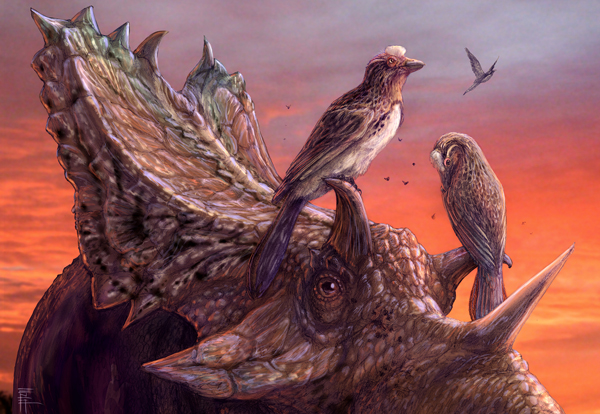
Mirarce eatoni - life reconstruction.
An illustration of the Late Cretaceous enantiornithine Mirarce eatoni.

Picture credit: Brian Engh

This leads to one very intriguing question, if enantiornithines like Mirarce were so advanced, then why after the Cretaceous-Palaeogene mass extinction event did only one group of birds survive?

A Complete Anatomical Description

The fossil material consists of several neck bones (cervical vertebrae), back bones (dorsal vertebrae), the fused caudal vertebrae making up the pygostyle, elements from the limbs, parts of the hips, a partial scapula, coracoid, the furcula (wishbone) and several other fragmentary elements including the radius and ulna.

This represents a veritable treasure trove of North American enantiornithine fossils for palaeontologists to study, most North American members of this taxon are known from very scrappy fossil remains, mostly consisting of isolated fused leg bones and toes.  All in all, about 30% of the total skeleton is known and crucially, unlike most of the more complete enantiornithine specimens from the Lower Cretaceous deposits of China, this specimen, is preserved in three-dimensions, it has not been crushed as flat as a pancake.  The excellent state of preservation and the number of fossil bones has permitted the researchers to undertake a complete anatomical description.

A Skeletal Reconstruction of the Newly Described North American Enantiornithine Mirarce eatoni
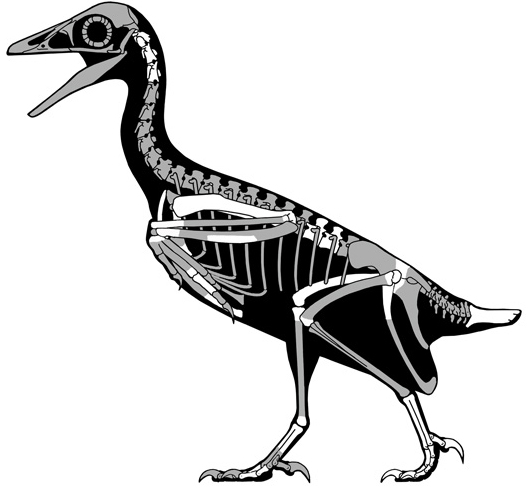
Mirarce eatoni skeletal reconstruction.
A skeletal reconstruction of the Enantiornithine Mirarce eatoni from Late Cretaceous Utah.  The bones shaded white represent known fossil material.  Note, cranial material is not known.

Picture credit: Scott Hartman

The “Kaiparowits Avisaurid”

The specimen was originally discovered back in 1992, by University of California, Berkeley palaeontologist Howard Hutchinson, whilst he was exploring Kaiparowits Formation deposits for evidence of turtles.

It was quickly identified as an enantiornithine and ascribed to the Avisauridae family, a family of prehistoric birds known from South America, North America, parts of Europe, Siberia and the Middle East (Lebanon).  The partial skeleton (UCMP 139500), was nicknamed the “Kaiparowits avisaurid”.   Although, its significance was noted, after all, the fossils represent the most complete example of an enantiornithine ever found in North America, it remained undescribed.  All that changed when PhD student Jessie Atterholt (University of California, Berkeley), was given the opportunity to provide a formal scientific description.

Research Suggests that Mirarce eatoni was a Strong Flier and Well-Adapted to Life in the Late Cretaceous
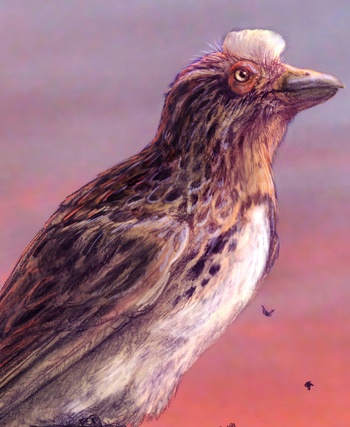
Mirarce eatoni - life reconstruction.
A close-up view of the newly described Late Cretaceous bird Mirarce eatoni (colouration and plumage speculative).

Picture eredit: Brian Engh

A Strong and Capable Flier

In collaboration with her colleague Howard Hutchinson and with the support of Jingmai O’Connor, from the Chinese Academy of Sciences and an authority on Cretaceous fossil birds, a complete analysis of the fossil bones was undertaken.  This study revealed that M. eatoni possessed several of the same physical adaptations for highly refined powered flight that modern birds (Neornithines) have.

Fossils of Enantiornithines from the Lower Cretaceous of China, birds such as Confuciusornis sanctus show a mix of basal and more advanced anatomical traits.  For example, the breast bone (sternum), of C. sanctus, is relatively small.  Modern birds have a deeply keeled sternum, this allows the attachment of large muscles to aid powered flight.  The wishbone (furcula) of Confuciusornis and most other Early Cretaceous enantiornithines, is little more than a curved bar.  However, the furcula of M. eatoni is shaped much more like the “V-shaped” wishbones of modern birds.  The furcula of Mirarce would have been able to flex and to store energy released during the flapping of the wings.

Commenting on the significance of these anatomical characteristics, Atterholt stated:

“We know that birds in the early Cretaceous, about 115 to 130 million years ago, were capable of flight but probably not as well adapted for it as modern birds.  What this new fossil shows is that enantiornithines, though totally separate from modern birds, evolved some of the same adaptations for highly refined, advanced flight styles.”

The Furcula (Wishbone) of Mirarce eatoni
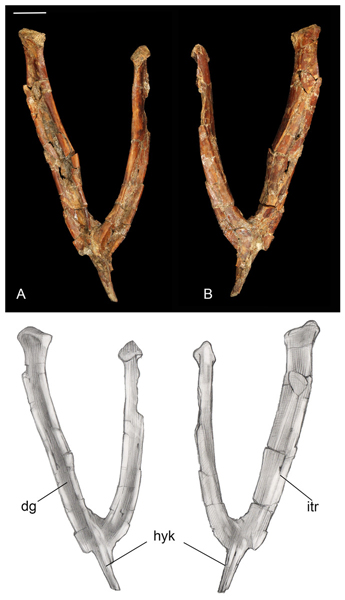
The furcula of Mirarce eatoni.
Two views of the wishbone (furcula) of Mirarce eatoni (A) dorsal and (B) ventral with line drawings.  Scale bar = 1 cm.

Picture credit: PeerJ

Quill Knobs?

A close examination of the right ulna (lower arm bone), revealed evidence of two roughened patches preserved on the shaft of the bone.  These rough patches were interpreted as being attachment sites for quill knobs, that anchor the wing feathers to the skeleton and to help strengthen the wings for use in active, prolonged, powered flight.  Quill knobs are found in living birds.  This is the first time that such a feature has been seen in an enantiornithine and indicates that Mirarce was, very probably, a strong flier.

Potential Quill Knobs Identified in an Enantiornithine (M. eatoni)
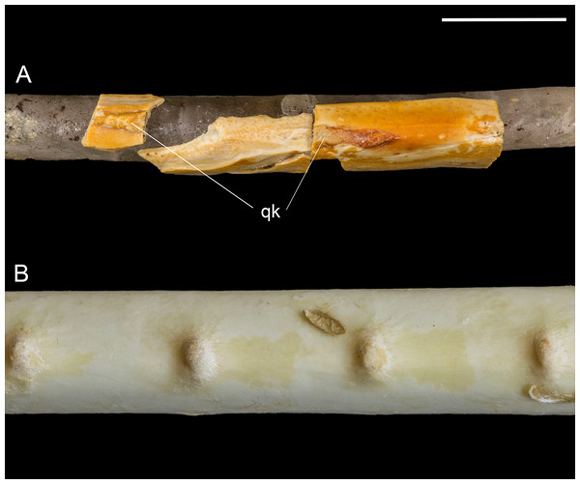
Quill knobs on an Enantiornithine.
Roughed structures on the ulna of Mirarce compared to the quill knobs found on the ulna of a Pelican.

Picture eredit: PeerJ

If these structures are quill knobs, then this suggests that this anatomical trait evolved in parallel with members of the Dinosauria (dromaeosaurids and other maniraptorans along with the ornithomimids) and in parallel with a number of types of prehistoric bird.

How Did Mirarce eatoni Get its Name?

The genus name reflects that fantastic state of preservation of the fossil material (Latin “mirus” for wonderful) and after Arce, the winged messenger of the Titans in Greek mythology.  The trivial name honours Dr Jeffrey Eaton, in recognition of his work studying the vertebrates of the Kaiparowits Formation.  A spokesperson from Everything Dinosaur commented that this prehistoric bird’s name was pronounced “mere-ark-ee ee-tow-eye”.

But Why Did These Advanced Enantiornithines Die Out?

If Late Cretaceous enantiornithines were just as advanced as modern birds, then, why did they die out with the non-avian dinosaurs while the ancestors of modern birds survived the extinction event?

Atterholt, who has moved onto a position of Assistant Professor and human anatomy instructor at the Western University of Health Sciences in Pomona (California), added:

“This particular bird is about 75 million years old, about 10 million years before the die-off.  One of the really interesting and mysterious things about enantiornithines is that we find them throughout the Cretaceous, for roughly 100 million years of existence and they were very successful.  We find their fossils on every continent, all over the world, and their fossils are very, very common, in a lot of areas more common than the group that led to modern birds.  Yet modern birds survived the extinction while enantiornithines go extinct.”

Forest Dwellers Versus Seed Eaters

A number of ideas have been put forward to help explain why some types of birds survived the end-Cretaceous mass extinction event whilst others did not.  For example, one hypothesis proposes that enantiornithines were forest dwellers and when the asteroid strike/volcanism resulted in a dramatic loss of woodland habitats, these types of birds suffered more than other birds that lived in different environments.

The absence of cranial material prevents the researchers from investigating what Mirarce might have eaten.  Most known members of the Enantiornithes had teeth in their beaks and Mirarce supports the idea that these types of birds gradually got larger over time, but what this bird ate remains a mystery.  If it had been a predator of small vertebrates and insects, any major disruption to the food chain could have led to extinction.  However, a paper published in 2016 proposed that birds with toothless beaks such as the early neornithines could have survived the extinction event by eating seeds that persisted in the soil.

To read more about this paper: Seed Eating May Have Helped the Birds Survive.

The scientific paper: “The Most Complete Enantiornithine from North America and a Phylogenetic Analysis of the Avisauridae” by Jessie Atterholt, J. Howard Hutchinson and Jingmai K. O’Connor published in PeerJ.

Visit the award-winning Everything Dinosaur website: Everything Dinosaur.
13 11, 2018

Getting to the Bottom of Ornithischian Teeth

By |2023-11-11T07:52:59+00:00November 13th, 2018|Categories: Dinosaur and Prehistoric Animal News Stories, Dinosaur Fans, Main Page, Palaeontological articles|0 Comments

Scientists Sink Their Teeth into Toothy Dinosaur Problem

Two of the most successful lineages of ornithischian dinosaurs are the ceratopsians (horned dinosaurs) and the hadrosaurs (duck-billed dinosaurs).  These herbivores dominated the megafauna of many Late Cretaceous environments and one of the reasons for their success was their remarkable dental batteries.  Although horned dinosaurs and duck-bills processed plant food in their mouths differently, (they had different chewing and grinding actions), the rows of teeth permitted these types of plant-eaters to process the toughest vegetation extremely efficiently

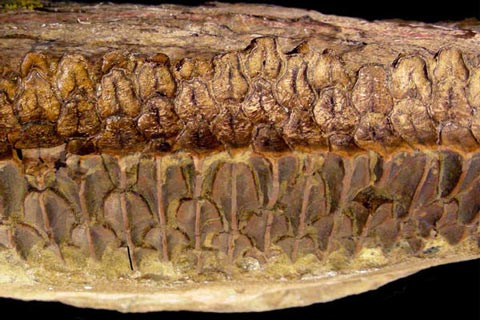
The Dental Battery of a Typical Hadrosaurid

Typical Hadrosaur dental battery.
These teeth were made for grinding. The rows and rows of tough teeth in the jaw of a hadrosaurid – the dental battery.

Picture credit: Dr Gregory Erickson

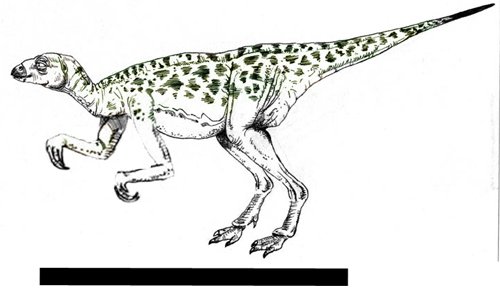
However, the evolution of these dental batteries is poorly understood, so a team of Canadian and Chinese scientists set out to examine how this dentition may have come about.  To do this they examined the teeth morphology and jaws of a little ornithopod from north-eastern China called Changchunsaurus parvus.  This light-weight dinosaur that measured around 1.5 metres in length, is known from several skulls and other postcranial material from Jilin Province (China).

A Life Reconstruction of the Ornithopod Changchunsaurus (C. parvus)

Changchunsaurus Life Reconstruction
An illustration of the Chinese ornithopod Changchunsaurus. Note scale bar = 1 metre. A study of ornithischian teeth. Picture credit: Everyting Dinosaur.

Picture credit: Everything Dinosaur

How Did “Typical” Ornithischian Dentition Develop?

Writing in the academic, on-line journal “PeerJ”, the researchers from Jilin University and the University of Alberta, describe how thin slices were taken from five jaw bones of this dinosaur so that teeth in the jaw could be studied.  In addition, the slices once polished to show their internal structure, would help the researchers determine tooth composition and to see how the teeth are maintained throughout the life of this little dinosaur.  Changchunsaurus makes a good candidate for this type of work, as it is known from numerous skulls (albeit, some of them are quite distorted), and it is regarded taxonomically as being close to origins of the Ornithopoda.

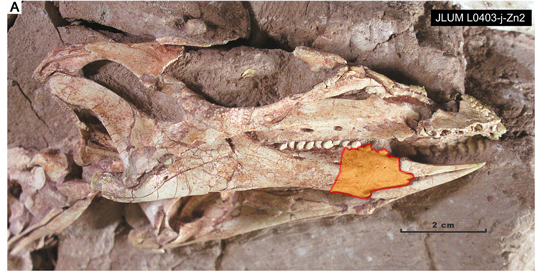
One of the Skulls of Changchunsaurus parvus Used in the Study

The holotype of Changchunsaurus parvus.
Image of the skull of the holotype specimen of C. parvus (JLUM L0304-j-Zn2).  The skull is shown in lateral view and the yellow shaded area indicates the area of the jaw from which the samples were taken.  Scale bar = 2 cm.

Picture credit: Chen et al (PeerJ)

A Unique Method of Tooth Replacement

Among the notable features of Changchunsaurus parvus dentition is a unique method of tooth replacement that allowed this herbivore to recycle teeth without disrupting the continuous shearing surface formed by its tooth rows.  This permitted Changchunsaurus to have an efficient tooth-grinding surface all the time, thus helping it to process tough plant material.  The scientists also discovered that the teeth feature wavy enamel, a tissue type formerly thought to have evolved only in more derived members of the Ornithopoda.  The wavy enamel of Changchunsaurus is the phylogenetically earliest occurrence of this type of tissue known.

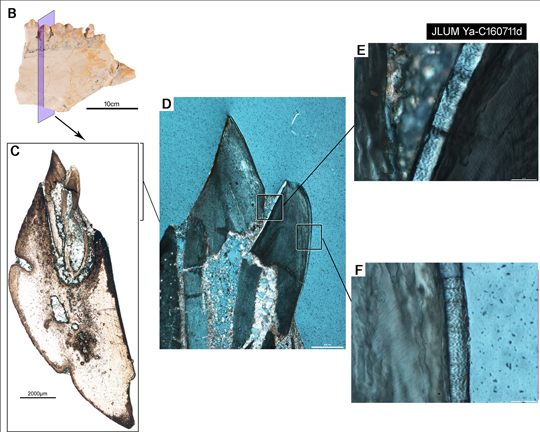
A Section of Dentary (Lower Jaw) Sample Along with Cross-sections of Teeth Showing Morphology

Changchunsaurus tooth morphology.
(B) a partial dentary showing the area cross-sectioned and magnified cross-sections of teeth (C to F) identifying teeth replacement and tooth morphology.

Picture credit: Chen et al (PeerJ)

The picture above shows (B), an image of one of the partial lower jaws used in this research.  The purple line shows the plane of sectioning.  A whole view image of one of the thin sections through the lower jaw is shown (C) and (D) shows a magnified view of the process of tooth replacement.  Images (E) and (F) show highly magnified views of identified wavy enamel on the crown of replacement teeth (labial and lingual margins).

Well-adapted to a Diet of Abrasive Plants

Commenting on the significance of this study, lead author Professor Chen Jun stated:

“These tissue-level details of the teeth of Changchunsaurus tell us that their teeth were well-adapted to their abrasive, plant-based diets.  Most surprisingly, the wavy enamel described here, presumably to make it more resistant to wear, was previously thought to be exclusive to their giant descendants, the duckbilled dinosaurs.”

This research contradicts previous interpretations that this type of wavy enamel arose in association with more complex hadrosauroid dentitions.  In view of its early appearance, the research team suggests that wavy enamel may have evolved in association with a shearing-type dentition in a roughly symmetrically-enamelled crown, although its precise function still remains somewhat of a mystery.

The authors suspect these features may have arisen early on in the Ornithopoda as they became adapted to herbivory, having to process tough vegetation.

The scientific paper:

“Tooth Development, Histology, and Enamel Microstructure in Changchunsaurus parvus: Implications for Dental Evolution in Ornithopod Dinosaurs” by Jun Chen , Aaron R. H. LeBlanc , Liyong Jin, Timothy Huang and Robert R. Reisz published in PeerJ.

Visit the Everything Dinosaur website: Everything Dinosaur.
12 11, 2018

A Super and Colourful Compsognathus

By |2023-11-11T07:46:06+00:00November 12th, 2018|Categories: Dinosaur and Prehistoric Animal Drawings, Dinosaur Fans, Main Page|0 Comments

Colourful Compsognathus

A fan of Everything Dinosaur very kindly sent into us a beautiful illustration of the small, Jurassic theropod Compsognathus.  Our thanks to Maurizio from Italy for producing such a fantastic piece of artwork and sharing it with us.

A Very Colourful Compsognathus

Compsognathus illustrated.
A beautiful illustration of the Late Jurassic theropod dinosaur Compsognathus.

Picture credit: Maurizio

Compsognathus – An Elegant Ilustration of “Elegant Jaw”

The fast-running Compsognathus was about the size of a small goose and for a time it was regarded as the smallest dinosaur known to science.  The scientific name for this European dinosaur is Compsognathus longipes, the genus name comes from the Latin for “elegant jaw”, a reference to the delicate, slender jaws of this little predator, which probably fed on insects and small vertebrates.

Commenting on the drawing, illustrator Maurizio said:

“I just wanted to send  you [Everything Dinosaur] this illustration.  The illustration features a Compsognathus inspired by the ones seen in “Jurassic Park” and the “Lost World” movies.  My Compsognathus is hiding inside some prehistoric plants.”

Maurizio Has Skilfully Drawn the “Elegant Jaw” of Compsognathus

A close-up view of the elegant jaw of Compsognathus.
A close-up view of the head of the Compsognathus longipes that had been drawn by Everything Dinosaur fan Maurizio.

Picture credit: Maurizio

Always Happy to Receiver Prehistoric Animal Drawings

A spokesperson from the UK-based dinosaur company stated that team members were always happy to receive prehistoric animal drawings from fans of dinosaurs and this person went onto state:

“We get sent a lot of illustrations and examples of prehistoric animal themed artwork and we are always happy to post up the pictures onto the walls of our office or within the company warehouse.  These drawings make a very attractive display.”

Our thanks once again to Maurizio for taking the time and the trouble to send into Everything Dinosaur an example of his artwork.

Visit the Everything Dinosaur website: Everything Dinosaur.
9 11, 2018

New CollectA Models 2019 (Part 2)

By |2023-11-11T06:29:56+00:00November 9th, 2018|Categories: Dinosaur Fans, Everything Dinosaur News and Updates, Everything Dinosaur Products, Main Page, Photos of Everything Dinosaur Products, Press Releases|11 Comments

New CollectA Models 2019 (Part 2)

Here is the second part of our series of articles introducing the new for 2019 prehistoric animal models from CollectA and fittingly, part two features two new figures to be added to the range.

The two new prehistoric animal figures are:

  • A 1:20 scale replica of the sail-backed reptile Edaphosaurus (available first quarter 2019).
  • A 1:40 scale replica of the “meat-eating bull” Carnotaurus (available first quarter 2019).

The New for 2019 CollectA 1:20 Scale Edaphosaurus Model

CollectA Edaphosaurus model.
The CollectA 1:20 scale Edaphosaurus model.

The CollectA Deluxe 1:20 Scale Edaphosaurus Model

CollectA have expressed a wish to increase the number of Palaeozoic creatures represented in their range, hence the introduction of the Permian pelycosaur Edaphosaurus.  This beautiful figure is a great accompaniment to the Dimetrodon model that came out last year.  It is great to see another synapsid introduced into the CollectA range, especially a herbivore.

Commenting upon the 1:20 scale Deluxe Edaphosaurus model, designer Anthony Beeson stated:

“I have tried to make the Deluxe Edaphosaurus a more active animal than generally portrayed and again less sprawling.  My version of the sail is quite thickly fleshed, unlike the sails of Dimetrodons and you will see that only the knobs of the cross-pieces protrude from the sides.  I have always liked Edaphosaurus and never really understood why there are so few toy versions around.  The shape of the sail is very pleasing.”

The CollectA Deluxe 1:40 Scale Carnotaurus

2019 will see CollectA add to their collection of abelisaurid dinosaurs.  Joining the Rugops, Rajasaurus and the Majungasaurus will be a spectacular Carnotaurus figure.  Unlike the existing members of the Abelisauridae within the CollectA portfolio, this will be a scale model (1/40th), the first of this type of dinosaur to be added to CollectA’s Deluxe range.

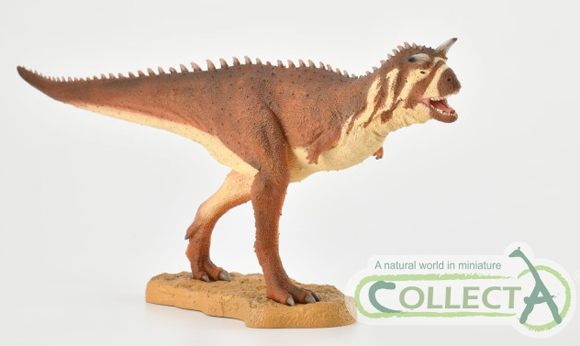
The New for 2019 CollectA 1:40 Scale Carnotaurus Dinosaur Model

The CollectA Age of Dinosaurs Deluxe Carnotaurus.
The CollectA Age of Dinosaurs 1:40 scale Deluxe Carnotaurus dinosaur model.

Fans Requesting Carnotaurus

Fans of the CollectA dinosaurs have been requesting a Carnotaurus for quite a while.  It is wonderful to see a replica of this Argentinian giant from the Late Cretaceous added to the scale model range.  Dinosaur enthusiasts will probably know that skin impressions have been found in association with the fossils of this dinosaur.

A considerable portion of the right side of the dinosaur left a skin impression which was preserved in the rock.  The design team at CollectA have taken great care to ensure that the texture of their Carnotaurus reflects what is known about the skin of this carnivore, although, the striking flashes of colour on the head and neck are purely speculative.

The short, deep skull and those amazing horns that give this dinosaur its name have been beautifully crafted.  Note the use of a base to support the figure, this has permitted the sculpting team to give the Carnotaurus appropriately sized feet, after all, this dinosaur was nicknamed by palaeontologists studying the locomotion of this theropod, the “Dinosaur Speed Demon” .

Commenting on the introduction of a Carnotaurus, designer Anthony Beeson remarked:

“The Deluxe Carnotaurus is the result of repeated requests from fans for a CollectA version of this creature.  I was never very keen to do it in the past as, when we started, almost every firm was producing models in the wake of the Disney dinosaur film and Jurassic Park.  I am glad that we waited.  I have tried to emphasise in the tail the shape proposed in the work of Currie and Persons and the fact that the caudofemoralis muscle in Carnotaurus was very large enabling great speed to be maintained.”

It was W. Scott Persons IV and Phil Currie who looked at the tail muscle structure in Carnotaurus sastrei and published a paper in 2011, suggesting that this dinosaur had a larger caudofemoralis muscle than any other Theropod described at the time – hence the “Dinosaur Speed Demon” nickname.  This muscle provides the power to help move the dinosaur forward and such a huge muscle indicated that Carnotaurus was capable of great bursts of speed.  Ironically, straight line running was its speciality, the shape of the muscle and the tail bones supporting it suggested that Carnotaurus was not so good at making tight turns.

We suspect that both the new 1:40 scale Deluxe Carnotaurus and the 1:20 Deluxe Edaphosaurus will be flying off our shelves in the warehouse when they come into stock in early 2019.

Model Measurements

Here are those all-important model measurements:

  • CollectA Edaphosaurus 1:20 scale – length 20 cm, height of sail just under 8 cm.
  • Carnotaurus Deluxe 1:40 scale The Age of Dinosaurs – length 28 cm, height 10.5 cm.

To view the current range of CollectA Deluxe scale prehistoric animal models including that superb Dimetrodon: CollectA Deluxe Prehistoric Life.

To read about the first of the 2019 models to be introduced: New CollectA Models 2019 (Part 1).

7 11, 2018

Preparing for a New Prestosuchus

By |2024-05-11T06:32:26+01:00November 7th, 2018|Categories: Dinosaur and Prehistoric Animal Drawings, Dinosaur Fans, Everything Dinosaur News and Updates, Everything Dinosaur Products, Maintenance on Website, Photos of Everything Dinosaur Products, Press Releases|0 Comments

Preparing for Prestosuchus

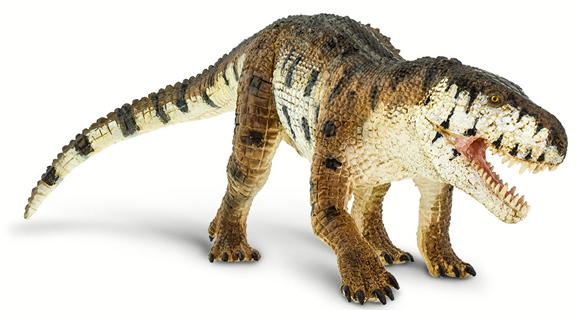
Everything Dinosaur team members are preparing for the arrival of some of the new for 2019 Wild Safari Prehistoric World models including the Prestosuchus replica.  The beautiful Prestosuchus figure is just one of a number of new Wild Safari Prehistoric World figures that Everything Dinosaur hopes to stock before Christmas.

Coming Soon – The Wild Safari Prehistoric World Prestosuchus Model

Prestosuchus model.
The Wild Safari Prehistoric World Prestosuchus model.

A Formidable Predator of the Middle Triassic of Brazil

Prestosuchus (P. chiniquensis) was not a dinosaur, but a member of the Archosauria, just like the dinosaurs, but from a lineage that is more closely related to modern crocodilians than to living birds and extinct dinosaurs.  Fossils of this large predator have been found in south-eastern Brazil from strata that date from the Middle Triassic.  Prestosuchus was named by the German palaeontologist Friedrich von Huene in 1942, the genus name honours Brazilian self-taught palaeontologist Vicentino Prestes de Almeida and the trivial name honours the town where Vicentino Prestes de Almeida was born (Chiniquá, Rio Grande do Sul).

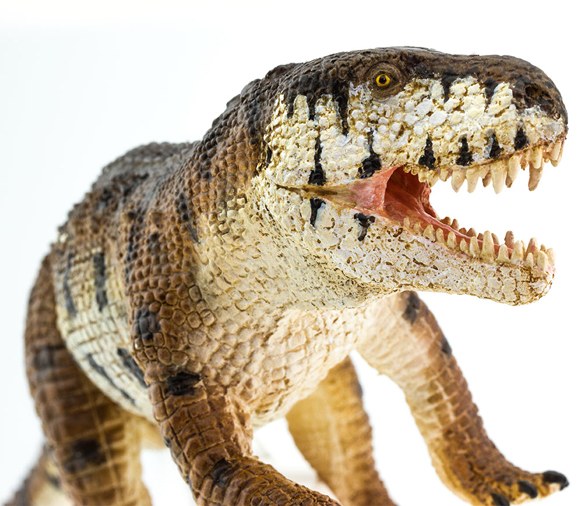
The Wild Safari Prehistoric World Prestosuchus Model

New for 2019 the Wild Safari Prehistoric World Prestosuchus.
The Wild Safari Prehistoric World Prestosuchus model.   A close-up view of the new for 2019 P. chiniquensis model from Safari Ltd.

Producing a Scale Drawing

It had been thought that this animal measured around 5 metres in length, about the size of a Nile crocodile (Crocodylus niloticus), however, a specimen described in 2010 indicated that this quadruped may have reached lengths of around 7 metres and it might have weighed 1,000 kilograms or more.  Everything Dinosaur team members have had to examine a number of scientific papers in order to produce a scale drawing for use in their Prestosuchus fact sheet.  This fact sheet will be sent out with purchases of the Prestosuchus model.

To view the Wild Safari Prehistoric World figures: Wild Safari Prehistoric World Figures.

Everything Dinosaur Prepares a Fact Sheet for the Arrival of the Wild Safari Prehistoric World Prestosuchus Model

Prestosuchus chiniquensis scale drawing.
A scale drawing of Prestosuchus chiniquensis. Picture credit: Everything Dinosaur.

Picture credit: Everything Dinosaur

To read an article from Everything Dinosaur published in 2010 that describes the discovery of this new, larger fossil specimen of Prestosuchus chiniquensisThe Most Complete Fossil of a Crocodylotarsian found in Brazil.

6 11, 2018

Beautiful Red Plates on a Stegosaurus

By |2024-05-11T06:33:22+01:00November 6th, 2018|Categories: Adobe CS5, Dinosaur and Prehistoric Animal Drawings, Dinosaur Fans, Main Page, Photos of Everything Dinosaur Products|0 Comments

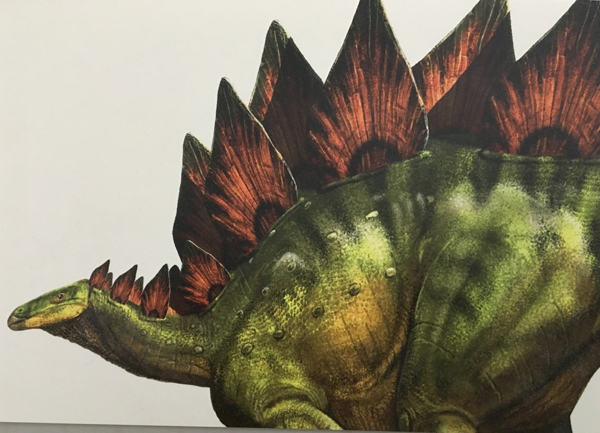
Red Plates on a Stegosaurus

This morning, we feature a superb illustration of the Late Jurassic armoured dinosaur Stegosaurus by the renowned palaeoartist from China, Zhao Chuang.  Enormous diamond-shaped plates were located on the neck, back and tail of Stegosaurus.   These plates were not just made of bone, they also had a horny, keratin covering.  This covering has not been preserved in the known fossil record so palaeontologists don’t know how big the plates were or indeed, what shape they were in life.

A Life Reconstruction of the Armoured Dinosaur Stegosaurus

A life reconstruction of the armoured dinosaur Stegosaurus.
Stegosaurus illustration by Zhao Chuang.

Picture credit: Zhao Chuang

What Colour were the Plates on Stegosaurus?

When first described by the American palaeontologist Othniel Charles Marsh in 1877, the bizarre plates of Stegosaurus were thought to provide protection against attack.  They were regarded as armour, however, it was soon noted that although their exact position in life was difficult to determine (the plates are embedded in the skin and not attached to the bone), it was likely that these structures were too high on the back to be effective armour-plating for this plant-eating dinosaur.

As palaeontologists employed more sophisticated techniques to study these plates, it was revealed that they were quite thin with lots of blood vessels running through them.  The theory that these plates played a role in thermoregulation was postulated.  On cold mornings a Stegosaurus could face towards the sunrise and warm its plates.  The blood running through the vessels close to the surface of the plates would then be warmed up, helping the dinosaur to raise its body temperature.  Furthermore, in order to cool down, the Stegosaurus could face the sun in such a way that only a small surface area of the plates was exposed, thus permitting the body to cool down.

Thermoregulation

As the largest plates were high on the animal’s back, their position several metres in the air, would permit cooler air away from the ground surface to circulate around them, thus cooling the dinosaur still further.

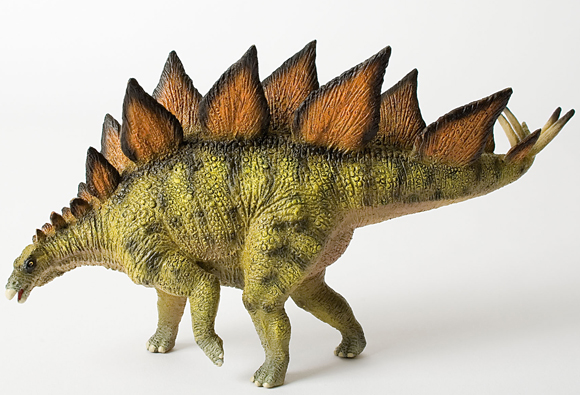
It was the scientist Kenneth Carpenter who first proposed that the plates could be flushed with blood at will and this led to the idea that these adornments could be used to display or to intimidate predatory dinosaurs.  As a result, numerous Stegosaurus illustrations and indeed models, have tended to give Stegosaurus some reddish colour plates.

A Model of a Stegosaurus (Bullyland Stegosaurus) with Red Coloured Plates

Bullyland Stegosaurus dinosaur model.
The Bullyland Stegosaurus dinosaur model.

Picture credit: Everything Dinosaur

To view the range of Bullyland prehistoric animal figures in stock at Everything Dinosaur: Bullyland Prehistoric Animal Figures.

As for the colour of Stegosaurus plates, when they were not being flushed with blood, nobody knows.

Visit the Everything Dinosaur website: Everything Dinosaur.
5 11, 2018

Super Efficient Lungs Powered Remarkable Dinosaur Success

By |2024-05-11T06:33:52+01:00November 5th, 2018|Categories: Dinosaur and Prehistoric Animal News Stories, Dinosaur Fans, Main Page, Palaeontological articles|2 Comments

Bird-like Lungs Could Have Helped Dinosaurs to Dominate

There has been a great deal of debate regarding the rise of the Dinosauria.  How and when did these relatively unassuming members of the Dinosauria, which only made up a small proportion of terrestrial biota during the Middle Triassic, rise to dominance, out-competing a host of other reptilian groups?  The respiratory system of dinosaurs could provide a clue.  In a new study published in the open access journal of the Royal Society (Royal Society Open Science), a team of researchers postulate that the lung-air sac system could have helped dinosaurs thrive in Earth’s oxygen-depleted atmosphere.

Did a Super-efficient Pulmonary System Help the Dinosaurs to Thrive?

Dinosaurs probably had a super-efficient respiratory system.
New research suggests super-efficient dinosaur lungs assisted the rise of the Dinosauria.

Picture credit: Chinese Academy of Sciences

Studying the Breathing Systems of Modern Birds and Alligators

Birds have a super-efficient respiratory system that is unique amongst the vertebrates.  However, palaeontologists remain uncertain as to when the avian-style lung evolved.  Did it evolve in dinosaurian ancestors or is it restricted to birds?  After all, if you are going to fly, then you need a very efficient and powerful set of lungs to get enough oxygen to your flight muscles.

This area of anatomy has attracted a great deal of debate.  Recently, Everything Dinosaur reported on a study conducted on a specimen of Archaeorhynchus spathula, a primitive bird (basal member of the Ornithuromorpha), from the Lower Cretaceous of China, that may show preservation of an advanced avian lung.  To read more about this research: Breathing Life into the Bird Lungs Debate.

The scientists, including researchers from the University of Manchester, compared dinosaur lungs to those of living crocodilians and the lungs of extant birds.  Lead researcher, PhD student Robert Brocklehurst (School of Earth and Environmental Sciences, Manchester University), stated:

“The respiratory system of non-avian dinosaurs has been the topic of considerable study over the years, both in an attempt to shed light on the biology of now extinct members of the dinosaur family, and in order to understand the origins and evolution of modern birds and reptiles.”

Low Oxygen Levels in the Triassic and Early Jurassic

Today, our atmosphere contains approximately 21 percent oxygen, however, things have not always been like that.  During the Middle Triassic, through to the Early Jurassic, a time that saw the evolution and the radiation of the Dinosauria, the atmospheric oxygen percentage of our planet fell to around 15-17%.   With less oxygen in the air, a group of vertebrates with more efficient lungs would have had a definite evolutionary advantage over other terrestrial animals.

During the Triassic A Wide Variety of Terrestrial Reptilian Vertebrates Co-existed

The flora and fauna of the Late Triassic.
Dinosaurs, aetosaurs, phytosaurs and and rauisuchians co-existed in the Triassic, but did super-efficient lungs help the Dinosauria to become dominant.

Picture credit: Victor Leshyk

Studying the Lungs of the Dinosauria

To investigate the different kinds of respiratory systems the team used Computerised Tomography (CT) scans to look at the lung cavities of four modern crocodilians and twenty-nine modern birds, including the largest living bird today, the ostrich and compared their structure with those of sixteen different dinosaur species.  The detailed scans revealed that all the dinosaurs had vertebrae more similar in shape to those of birds than those of crocodilians.  In addition, the scientists discovered that the dinosaur vertebrae jutted into the lung cavity, the same as found in living birds.

Robert explained:

“We thought some of the dinosaurs would have lungs more like birds, and others would be similar to reptiles, but this wasn’t the case at all.  Every dinosaur sample we scanned just looked like the birds we scanned.”

Dissection Used in this Study

As well as using CT scans, the team removed the lungs of an alligator and an ostrich, and found the skeletal support structures surrounding the lungs were very different in each animal.  The alligator’s lung cavity was smooth and allowed the lungs and other internal organs to glide as they move to pump air in and out while the animal swims.  However, the ostrich lung cavity was found to be furrowed, similar to the anatomical condition found in the dinosaurs.

The scientists concluded that having more efficient bird-like lungs permitted the dinosaurs to adapt and thrive in an oxygen depleted environment, whereas other groups including the the Crurotarsi clade of archosaurs that gave rise to modern crocodiles, struggled.

Commenting on the research, co-author Professor Bill Sellers (Manchester University) added:

“If even the very first dinosaurs to evolve had bird-like lungs, this goes some way to explaining why dinosaurs became the dominant animal species of their time.  Other animal groups simply may not have had lungs as well suited to extracting oxygen from the air.  That simple evolutionary difference may have let dinosaurs rule world.”

An Anatomical Advantage for the Dinosauria

The scientists concluded that respiratory and pulmonary modifications would have provided dinosaurs with more efficient means of oxygen uptake relative to other vertebrates during the environmentally hypoxic conditions which pervaded much of the early part of the Mesozoic.  This anatomical advantage enjoyed by the Dinosauria could thus potentially have contributed to their radiation and dominance over terrestrial ecosystems, which was to last for around 150 million years.

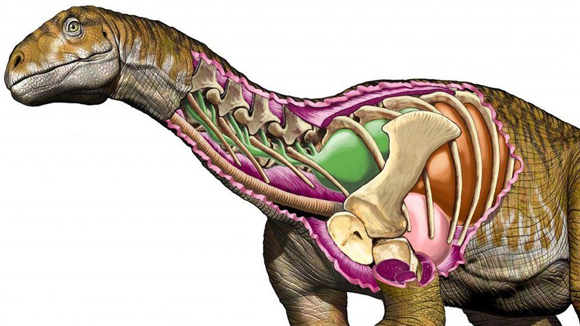
The Lungs of Dinosaurs Helped to Power Their Evolutionary Success

The sophisticated respiratory system of Ingentia prima.
The air sacs of Ingentia prima (green) the lungs shown in brown.  This large, Early Jurassic sauropod had a super-efficient respiratory system.

Picture credit: Jorge A. González

Everything Dinosaur acknowledges the assistance of a press release from Manchester University in the complilation of this article.

The scientific paper: “Vertebral Morphometrics and Lung Structure in Non-avian Dinosaurs” by Robert J. Brocklehurst, Emma R. Schachner and William I. Sellers published in Royal Society Open Science.

Visit the user-friendly Everything Dinosaur website: Everything Dinosaur.

4 11, 2018

A New Species of Rebbachisaurid is Named

By |2023-11-06T09:12:22+00:00November 4th, 2018|Categories: Dinosaur and Prehistoric Animal News Stories, Dinosaur Fans, Main Page, Photos/Pictures of Fossils|2 Comments

Lavocatisaurus agrioensis – A New Long-Necked Dinosaur from Argentina

A team of palaeontologists from Argentina and Spain have announced the discovery of a new species of long-necked dinosaur from the Early Cretaceous of Argentina.  The dinosaur, represented by a set of bones that indicate the remains of at least three individuals, has been named Lavocatisaurus agrioensis and it will help to shed more light on a rare and enigmatic group of sauropods known as the rebbachisaurids.

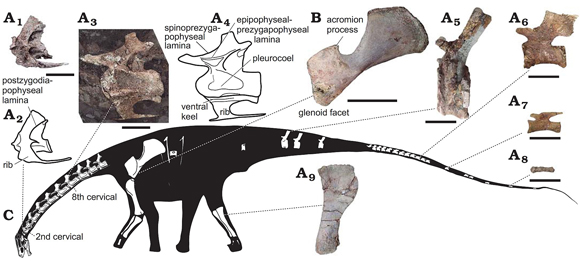
A Skeletal Reconstruction and Photographs of Key Fossils from L. agrioensis

Skeletal reconstruction and fossil bones attributed to Lavocatisaurus agrioensis.
Skeletal reconstruction based on the holotype and paratype specimens of Lavocatisaurus agrioensis.  Scale bars = 10 cm.

Picture credit: AFP/Agencia CTYS

The picture above shows the skeletal drawing of the adult dinosaur with illustrations of key bones from the excavation.  Most of the neck and the skull has been recovered.  Cranial fossils associated with the Rebbachisauridae are rare, the discovery of these specimens from Agrio del Medio (Neuquén Province, Argentina) will help scientists to better understand taxonomic relationships amongst members of this sauropod family, largely associated with Gondwanaland fossil deposits.

Fossils of a Family Group?

Writing in the journal “Acta Palaeontologica Polonica”, the scientists report the discovery of one large, presumably adult animal with two smaller sub-adults found in association.  The fossil material come from terrestrial sandstone deposits laid down around 110 million years ago (Aptian to Albian faunal stage of the Early Cretaceous), in an arid environment with isolated oasis and other water sources (Rayoso Formation).

One of the authors of the scientific paper, José Luis Carballido, of the Egidio Feruglio Museum (Argentina), stated:

“We found most of the cranial bones: the snout, the jaws, a lot of teeth, also the bones that define the eye sockets for example and in that way, we were able to create an almost complete reconstruction.  Not only is this the discovery of a new species in an area where you wouldn’t expect to find fossils, but the skull is almost complete.”

Lavocatisaurus agrioensis

The fossils represent one large dinosaur estimated to be around twelve metres in length and two smaller animals around six to seven metres in length.  The research team postulate that this could represent a family group that lived together and perished together, perhaps unable to find a water source in a time of drought.

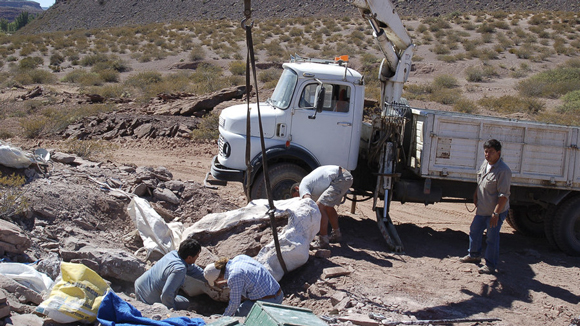
Preparing to Move Some of the Fossil Material (Lavocatisaurus)

Fossils of Lavocatisaurus are prepared for removal.
The jacketed remains of one of the Lavocatisaurus specimens is prepared for transport away from the dig site.

Picture credit: AFP/Agencia CTYS

Lead author of the paper, José Ignacio Canudo (Zaragoza University, Spain) added:

“This discovery of an adult and two juveniles also signifies the first record of a group displacement among the Rebbachisaurus dinosaurs.”

The Rebbachisauridae Family

The Rebbachisauridae family of sauropods are a group of basal members of the Diplodocimorpha clade that includes more famous Late Jurassic dinosaurs such as Diplodocus, Apatosaurus and Brontosaurus.  The rebbachisaurids are known from both Lower Cretaceous and Upper Cretaceous strata and had a wide geographical distribution throughout Gondwana and southern Laurasia with fossils reported from north and central Africa as well as South America and Europe (Spain).

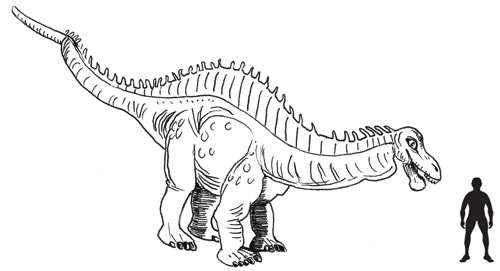
An Illustration of a Typical Rebbachisaurid Dinosaur (R. garasbae)

Rebbachisaurus scale drawing.
Scale drawing of Rebbachisaurus (R. garasbae). Picture credit: Everything Dinosaur.

Picture credit: Everything Dinosaur

Visit the Everything Dinosaur website: Everything Dinosaur.

3 11, 2018

Elaborate Plumage in Confuciusornis Described in New Paper

By |2024-05-11T06:34:18+01:00November 3rd, 2018|Categories: Dinosaur and Prehistoric Animal News Stories, Dinosaur Fans, Main Page, Palaeontological articles, Photos/Pictures of Fossils|0 Comments

Patterns on the Feathers of Confuciusornis as Complex as Modern Birds

A team of international scientists, including researchers from the China University of Geosciences (Beijing), the University of Ghent (Belgium) and the University of Texas at Austin (United States), have discovered that the patterns on the feathers of an Early Cretaceous bird may have been very similar to and as complex as the patterns seen on the feathers of extant Aves.  Writing in the academic, on-line journal “PeerJ”, the researchers conclude that the patterning of Confuciusornis feathers probably performed similar functions to the patterning on modern bird’s feathery coats, that is, they provided camouflage and also played a role in display.

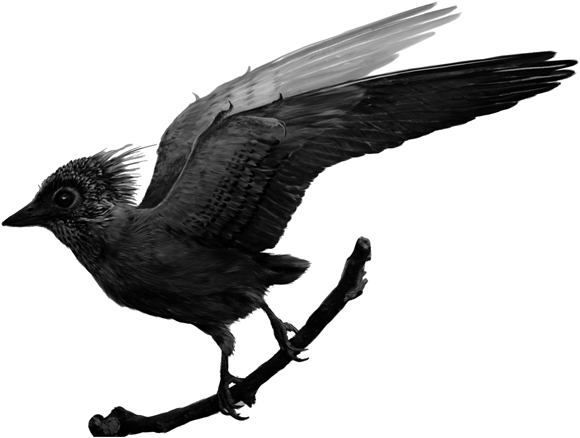
Confuciusornis Integumentary Covering – Elaborate Plumage

Study suggests Confuciusornis had elaborate plumage.
Reconstruction of the plumage of Confuciusornis (specimen number CUGB P140).

Picture credit: Li et al (PeerJ)

Complex Patterning Detected by Sophisticated Chemical Analysis

The specimen studied consists of a slab and counter slab of a single, individual bird from Early Cretaceous deposits in Fengning County, Hebei Province (north-central China).  The fossils are from the vertebrate collection of the China University of Geosciences and represent an example of Confuciusornis sanctus.

The research team identified exceptional feather preservation but poor preservation of the bones, the unusual state of preservation permitted the scientists to identify melanin signals in the fossilised feathers indicating a complex patterning of spots on the wings, throat and on the tuft of feathers at the back of the head forming a small crest.  The shape of the structures that form these patterns in conjunction with chemical analysis confirmed the diagnosis of the pigment melanin.  However, specific colouration associated with the patterns could not be discerned.

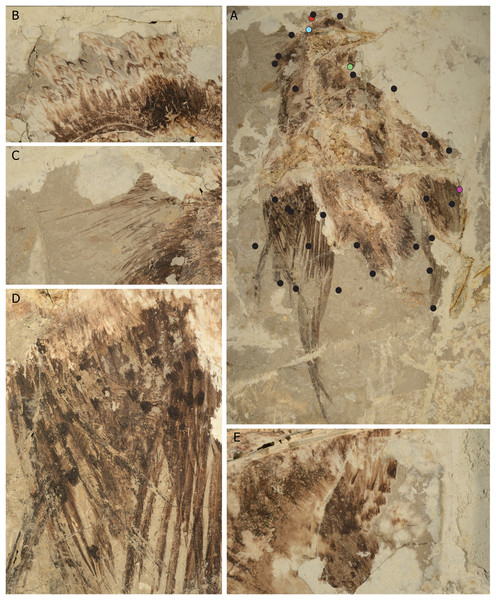
The Slab and Counter Slab or a C. sanctus Specimen Reveals Complex Patterning on the Plumage

Evidence of Confuciusornis plumage.
Evidence of plumage diversity in the Confuciusornithidae from the new specimen (CUGB P1401).

Picture credit: Li et al (PeerJ)

The photograph (above) shows various views of the main slab of the fossil specimen showing details of the plumage.  The dots in (A) indicate places that were subjected to sampling, whereas B and C reveal the crest located on the back of the head.  Parts D and E show elements of the integumentary covering in close detail.

A Range of Analytical Techniques Used to Study Confuciusornis

Using a range of analytical techniques including scanning electron microscopy and ion mass spectrometry (ToF-SIMS) the researchers concluded that the elaborate spotting on this specimen exceeds that found in exceptionally-preserved troodontids and compsognathids and rivals that in modern birds, suggesting that plumage patterns evolved greater complexity through avian evolution.

The exact age of the strata is uncertain, although it is believed that the deposits from Fengning County are approximately equivalent in age with the Dawangzhangzi Member of the Yixian Formation, around 122-123 million years old (Aptian faunal stage of the Early Cretaceous).  The data from this study suggests that Confuciusornis had more complex patterning than the patterning identified in Achiornis or in the stripes of the compsognathid Sinosauropteryx.  The research team conclude that this specimen of a primitive bird provides evidence to support the idea that complex patterning of feathers evolved at a relatively early stage in avian evolution.

The Chinese manufacturer PNSO have produced a model of Confuciusornis.

To view the PNSO model range: PNSO Age of Dinosaurs Replicas and Models.

The Link to Barn Owls

Integumentary patterns and colours play a variety of roles in living birds.  Such patterning in fossil specimens probably performed the same sort of functions and in addition, they can help to inform on the habitat in which the extinct creature lived.  In some modern bird groups, barn owls for example (Strigiformes), it has been observed that the size and placement of the spots on the feathers play a role in mate selection.  Male barn owls tend to prefer females with larger spots.  The patterning identified on this C. sanctus specimen leads to the intriguing idea that for confuciusornithids, just like barn owls, the location and the size of the spots on the plumage played a role in choosing a mate.

The scientific paper: “Elaborate Plumage Patterning in a Cretaceous Bird” by Quango Li, Julia A. Clarke, Ke-Qin Gao, Jennifer A. Peteya and Matthew D. Shawkey published in PeerJ.

Visit the Everything Dinosaur website: Everything Dinosaur.

2 11, 2018

New CollectA Models 2019 (Part 1)

By |2023-11-06T08:49:47+00:00November 2nd, 2018|Categories: Dinosaur Fans, Everything Dinosaur Products, Main Page, Photos of Everything Dinosaur Products|9 Comments

New CollectA Models 2019 (Part 1)

At this time of year, our friends at CollectA give Everything Dinosaur official clearance to publish information and pictures on the new for 2019 CollectA prehistoric animal models.  Working closely with this manufacturer, we intend to put up a series of posts over the next few weeks informing dinosaur fans and figure collectors about what they have to look forward to in terms of new model introductions.

CollectA Prehistoric Animal Models

The first three we can announce are:

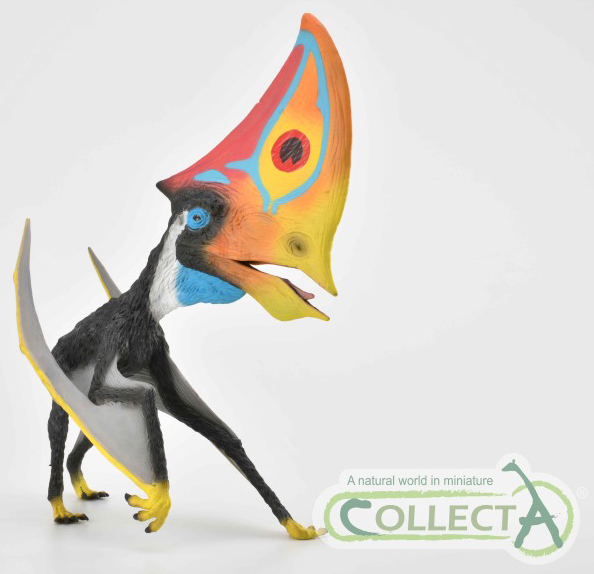
  • A Caiuajara pterosaur model with a moveable jaw (CollectA Supreme Deluxe range) – available first quarter 2019.
  • A Borealopelta armoured dinosaur model (CollectA The Age of Dinosaurs Popular range) – available first quarter 2019.
  • A CollectA box of mini prehistoric animals (prehistoric mammals, a “terror bird” and Estemmenosuchus – available first quarter 2019.

CollectA Borealopelta Model

CollectA will be adding another armoured dinosaur replica to their excellent not-to-scale range of dinosaur figures, a model of the Canadian nodosaurid Borealopelta (B. markmitchelli).

The CollectA Borealopelta Dinosaur Model

CollectA Borealopelta dinosaur model.
The Age of Dinosaurs Popular – CollectA Borealopelta.

Picture credit: CollectA

Borealopelta was officially named and described only last year, but this remarkable fossil was actually found back in 2011.   It took the team of dedicated preparators more than five and half years to separate this 5.5 metre long giant from its fossil matrix.   The lead preparator and one of the most patient people on the planet, was Mark Mitchell and the species name honours his efforts in the restoration and preparation of one of the most perfectly preserved large dinosaur specimens ever discovered.

An Early Cretaceous Nodosaurid

The CollectA figure accurately portrays this Early Cretaceous nodosaurid, the reddish/brown colouration and the presence of counter-shading reflects the conclusions drawn from a scientific paper describing the exquisite details of the armour published in August 2017.

The fossil, found at the Suncor Millennium Mine in north-eastern Alberta, was so well-preserved that the armoured scales and plates were in their original position.  Small amounts of keratin that would have covered the spikes and skin was detected.  The CollectA design team have done their own restoration work on this model.  They modelled this figure to match the position of the fossil in situ and restored the missing pelvic area, which was unfortunately destroyed when a digger at the mine first broke into the block of stone that held the specimen.

CollectA Supreme Deluxe Caiuajara

Large pterosaur models are becoming a bit of a CollectA speciality.  Joining the large Dimorphodon and Guidraco figures will be a beautiful and very colourful model of a Brazilian flying reptile – Caiuajara.  The genus name is pronounced “Kay-you-ah-jar-rah”.

The New for 2019 CollectA Supreme Deluxe Caiuajara Pterosaur Model

CollectA Deluxe Caiuajara with moveable jaw.
The Age of Dinosaurs Deluxe Caiuajara pterosaur figure with a moveable jaw.

Picture credit: CollectA

Pterosaur Fossils from Brazil

Most pterosaur fossils associated with Brazil come from the north-eastern part of the country, but Caiuajara comes from southern Brazil (Paraná State).  It is a member of the Tapejaridae family and like most tapejarids it had a very flamboyant crest.  Both males and females sported crests, although it is thought that it was the males that tended to have the larger and more spectacular head ornamentation.  The team at CollectA have provided their model with a vivid crest, complete with an eye-spot.  Most palaeontologists believe that these crests were used in displays, so as far as a pterosaur is concerned, the flashier the crest the better.  Like the other CollectA supreme pterosaur models, this figure is depicted on the ground.

Hundreds of fossils of Caiuajara have been discovered, all from the same locality.  The first fossil discoveries were reported in 1971 but a formal analysis and scientific description was only completed in 2014.  The remains are found in a series of sandstone layers that represent an arid area adjacent to a lake.  The majority of the bones come from sub-adults and juveniles, palaeontologists have speculated that this was a colony and that these flying reptiles were highly social.

The Designer Comments about CollectA Prehistoric Animal Models

Model designer Anthony Beeson commented:

“The Brazilian taperjarid Caiuajara has been requested by a number of CollectA fans and we were happy to oblige.  He is in the Supreme range for scale and has a moveable jaw.  I chose to portray a fully grown adult because the head-crest was then at its most extreme.  The head-crest seemed to need a striking decoration if it was to be used for species recognition or mating ritual, so I have given him a false eye decoration.”

Intriguingly, when the scientific paper describing Caiuajara (C. dobruskii) was published, the authors postulated, that the fossil site represented a staging post on a migration route for these pterosaurs.  Expect this excellent CollectA Caiuajara to be migrating into Everything Dinosaur’s warehouse in the spring of 2019.

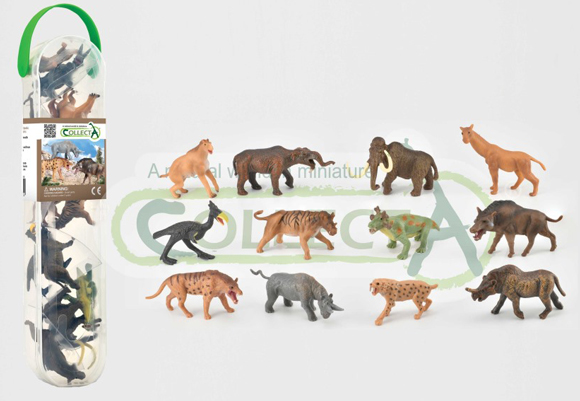
CollectA Box of Mini Prehistoric Animal Models

The third and final item to be announced this week is a box of mini prehistoric animals.

CollectA Mini Prehistoric Animals

The CollectA Box of Mini Prehistoric Animals (2019)
The CollectA box of mini prehistoric animal models which is going to be available in 2019. Twelve prehistoric animal models.

Picture credit: CollectA

This skilfully crafted set of mini figures features replicas of prehistoric animals already represented in the CollectA range termed “other prehistoric animals”.  There are twelve figures in the set namely: Moropus, Deinotherium, Woolly Mammoth, Paraceratherium, Kelenken (terror bird), Uintatherium, Estemmenosuchus, Daeodon, Andrewsarchus, Arsinoitherium, Smilodon and Megacerops.  CollectA have built up a strong reputation for the prehistoric mammal figures and it is great to see a mini set of these models introduced.

To view the current range of CollectA “Prehistoric Life” figures: CollectA Prehistoric Life.

For the CollectA Deluxe scale models: CollectA Deluxe Scale Models and Figures.

To read an article describing the amazing preservation of the Borealopelta fossil: Amazing Armoured Dinosaur Fossil Reveals Camouflage and Shading.

For an article outlining the discovery of the tapejarid Caiuajara: New Species of Flying Reptile from a Pterosaur Graveyard.

Model Measurements

  • CollectA Supreme Deluxe Caiuajara with moveable jaw length = 19 cm, height = 23.5 cm.
  • The CollectA Age of Dinosaurs Borealopelta length = 15 cm, height = 4.5 cm.
  • CollectA Box of Mini Prehistoric Animals – models measure around 3 cm long with some models up to 4.2 cm in height.

Visit the Everything Dinosaur website: Everything Dinosaur.
Go to Top