The “witching hour” is almost upon us, time to wish all our customers and readers a happy Halloween. “All Hallows Eve” is a time traditionally linked with monsters and demons and the fossil record is crammed full of very scary looking invertebrates and vertebrate specimens that would have been very much at home in the cast of a horror movie.
Take for example, a demonic dinosaur…
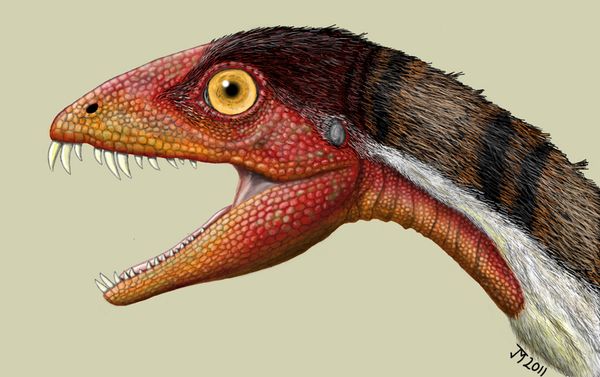
In April 2011, a scientific paper was published announcing the formal scientific description of a demonic-looking dinosaur. A fearsome, little meat-eater that would have terrorised New Mexico in the Late Triassic. The dinosaur was named Daemonosaurus chauliodus and the name translates as “buck-toothed evil spirit”.
Although small compared to some of its later descendants, (D. chauliodus measured less than two metres long), it had a deep skull and oversized teeth in the front of its jaws which gave this little theropod a strong and nasty bite.
A Life Reconstruction of Daemonosaurus chauliodus
The vicious-looking Late Triassic theropod dinosaur Daemonosaurus chauliodus from New Mexico.
Picture credit: Jeffrey Martz
Happy Halloween!
Visit the award-winning and user-friendly Everything Dinosaur website: Everything Dinosaur.
Mistralazhdarcho maggii – From the Upper Cretaceous of France
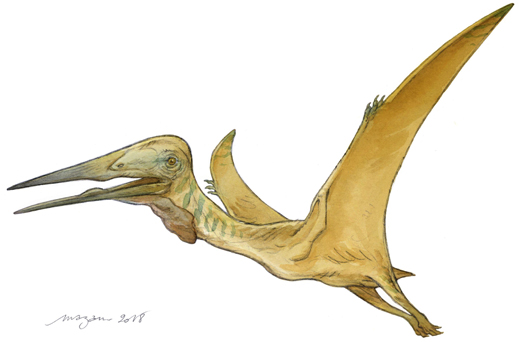
A team of scientists based in France and Belgium have announced the discovery of a new species of pterosaur from Upper Cretaceous rocks in south-eastern France (Bouches-du-Rhône). The fragmentary bones have been assigned to the Azhdarchidae family of pterosaurs, one of the last groups of flying reptiles to exist and a family that contains giants such as Quetzalcoatlus and Hatzegopteryx. With a wingspan estimated to be around 4.5 metres, the specimen, believed to be a juvenile, provides evidence of a third azhdarchid pterosaur size class from the cluster of islands that represented continental Europe towards the end of the Mesozoic.
The pterosaur has been named Mistralazhdarcho maggii pronounced (miss-tral-ads-dar-cho may-gee).
A Life Reconstruction of the Newly Described French Azhdarchid Pterosaur – Mistralazhdarcho maggii
An illustration of the newly described (2018) azhdarchid pterosaur from France Mistralazhdarcho maggii.
Picture credit: Pierre Lavaud
One of the Most Complete Pterosaur Fossils Known from Late Cretaceous Europe
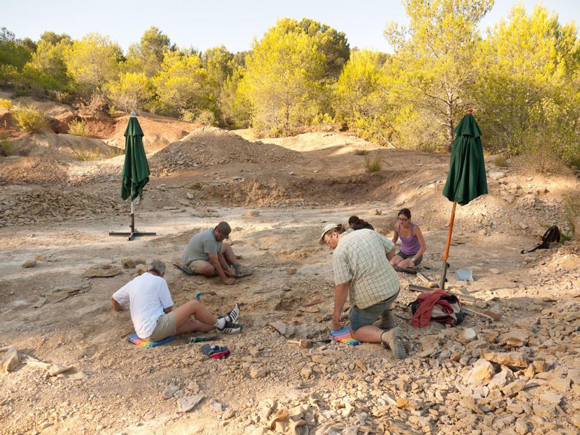
Writing in the academic publication the “Journal of Vertebrate Paleontology”, the researchers describe the finding of part of a lower jaw, a neck bone and several other postcranial bones in 2009. The bones were found in association with each other and therefore, probably represent the fossilised remains of a single pterosaur. The material comes from the excavation site of Velaux, near Aix-en-Provence and from strata that dates to the Campanian faunal stage of the Late Cretaceous.
Views of the Fossil Material Ascribed to the New Pterosaur Mistralazhdarcho maggii
Fossil material associated with the newly described French pterosaur Mistralazhdarcho maggii.
Picture credit: Royal Belgian Institute of Natural Sciences
The photograph (above), shows a part mandible (a) with a distinctive ridge (mandibular symphysis). A cervical vertebra (b), left humerus (c), left radius (d) and two bones from the hand – metacarpal IV (e) and a finger bone (f).
Although the fossil material is fragmentary, such is the poor fossil record of Late Cretaceous pterosaurs from Europe that these few bones make Mistralazhdarcho one of the most complete European azhdarchids described to date. In addition, Mistralazhdarcho is the first partial skeleton of a flying reptile excavated from Upper Cretaceous deposits of western Europe.
Related to a North African Pterosaur?
The scientists, which included researchers from the University of Rennes, the Royal Belgian Institute for Natural Sciences and Poitiers University, conclude that Mistralazhdarcho was related to an earlier pterosaur called Alanqa (A. saharica), which lived in North Africa around 95 million years ago. When Alanqa was first described, back in 2010, it was assigned to the Azhdarchidae, but more recent studies incorporating skull material discovered in 2015, have cast doubt on the taxonomic position of Alanqa.
An Adult Probably Had a Wingspan of Around 5-6 metres
Examination of the fossil bones suggest that they were not fully ossified and that this was a sub-adult. The researchers speculate that a fully-grown Mistralazhdarcho would have had a wingspan of around 5 to 6 metres, possibly even bigger. This size estimate is in between the size estimates given for the two azhdarchids from the Maastrichtian of Romania (Hateg Formation), which also represents the European Late Cretaceous archipelago environment.
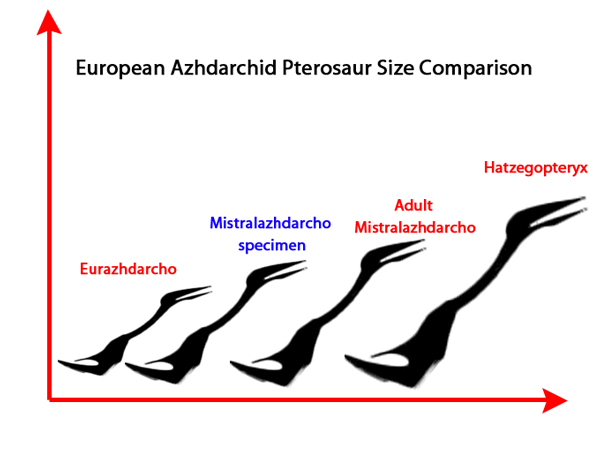
A Size Comparison of European Azhdarchid Pterosaurs
A comparison of European azhdarchid pterosaurs. Picture credit: Everything Dinosaur.
Picture credit: Everything Dinosaur
Mistralazhdarcho is estimated to be intermediate in size between the medium-sized genus Eurazhdarcho (wingspan of 3 metres) and the enormous Hatzegopteryx (estimated wingspan of 10 metres or more), the two other azhdarchids associated with the island ecosystem of the latest Cretaceous European archipelago. The different sized pterosaurs might reflect a form of niche partitioning, whereby, different sized animals did not directly compete with each other for resources.
The flying reptile’s genus name is from the “mistral”, a strong, north-westerly wind associated with southern France. The species name honours the former mayor of Velaux, Jean-Pierre Maggi, without whom, the excavation of the fossil material would not have been possible.
Field Team Members Working at the Velaux Excavation Site
Fossil excavation work at one of the dig sites at Velaux (south-eastern France).
Picture credit: Royal Belgian Institute of Natural Sciences
The scientific paper: “Mistralazhdarcho maggii, gen. et sp. nov., a New Azhdarchid Pterosaur from the Upper Cretaceous of south-eastern France” by Romain Vullo, Géraldine Garcia, Pascal Godefroit, Aude Cincotta and Xavier Valentin published in the Journal of Vertebrate Paleontology.
Anhuilong diboensis – From the Middle Jurassic of Anhui Province
Chinese scientists have published details of a new species of long-necked dinosaur from eastern China. The fossilised remains, although fragmentary, have permitted the researchers to confidently assign the specimen (AGB 5822), to the Mamenchisauridae family of sauropods. The dinosaur has been named Anhuilong diboensis and it suggests that by the Middle Jurassic, mamenchisaurids were already a diverse family. It is likely that the sandstones and mudstones that form the majority of the fossil bearing, Middle Jurassic-aged strata near Huangshan (Anhui Province), will yield more dinosaur fossils.
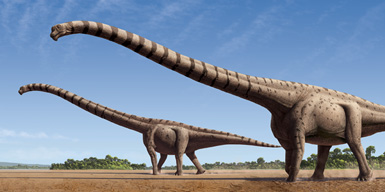
A Life Reconstruction of a Typical Mamenchisaurid Dinosaur
A typical member of the Mamenchisauridae family (Mamenchisaurus).
Picture credit: Julius Csotonyi/Natural History Museum of Los Angeles County
The Second Member of the Mamenchisauridae from Anhui Province
The fossil material, consisting of the remains of a single forelimb, representing one individual dinosaur (humerus, ulna and radius bones), was distinct enough to permit the scientists, which included researchers from the Chinese Academy of Sciences and the Anhui Geological Museum, to establish a new genus.
Anhuilong diboensis
Anhuilong diboensis is the second mamenchisaurid to be identified from the Middle Jurassic Hongqin Formation of Shexian, Huangshan (Anhui Province, eastern China). The first mamenchisaurid from this locality, Huangshanlong anhuiensis, was named and described in 2014. The authors of the scientific paper describing A. diboensis were also responsible for the earlier study of H. anhuiensis. A phylogenetic analysis of the limb bones from these two specimens suggest that Anhuilong is the sister taxon of Huangshanlong and with Omeisaurus from Sichuan Province, they together form a sister clade to all other members of Mamenchisauridae.
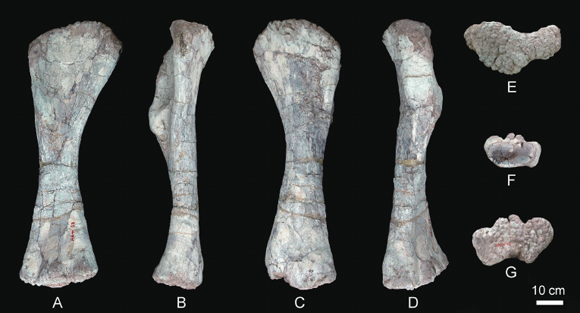
Views of the Right Humerus of Huangshanlong anhuiensis
Huangshanlong anhuiensis – views of the humerus of a typical mamenchisaurid dinosaur.
Picture credit: Vertebrata PalAsiatica/Jian-Dong Huang et al
The picture above shows various views of the right humerus (upper arm bone) of H. anhuiensis. The morphology of limb bones and how they compare to each other (total length of the ulna to the humerus and the total length of the radius to the humerus), are distinct enough for palaeontologists to ascribe them to the Mamenchisauridae and to erect a new genus.
Key
A = humerus viewed from the front.
B = humerus viewed from one side (medial view).
C = humerus viewed from the back.
D = humerus viewed from the other side (lateral view).
E = viewed from the top down (cranial margin pointing upwards)
F = view of a cross section, near the narrowest part of the bone.
G = viewed from underneath (distal view).
The Spread of the Sauropoda
Until recently, palaeontologists had thought that although the Sauropoda were geographically widespread by the Middle Jurassic, sub-groups such as the Mamenchisauridae family and the Diplodocidae had restricted geographical ranges. However, earlier this year, a diplodocid dinosaur was described from northern China, proving that these long-necked dinosaurs were present in Asia during the Middle Jurassic. The fossil record for the Mamenchisauridae indicates that these types of Sauropods were restricted to China.
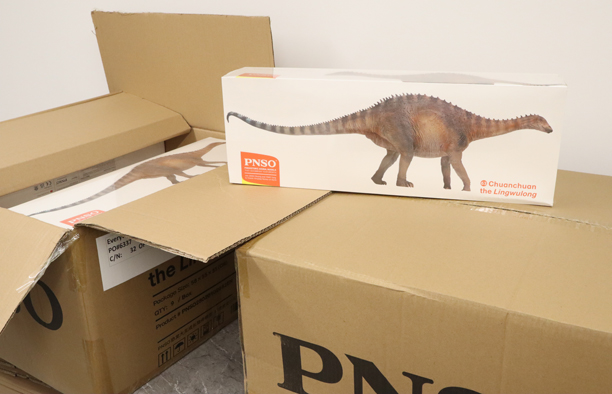
The PNSO Chuanchuan the Lingwulong dinosaur model has arrived at Everything Dinosaur. Team members inspect boxes and check contents prior to booking this new for 2022 sauropod figure into stock. Picture credit: Everything Dinosaur.
Picture credit: Everything Dinosaur
The picture (above) shows Lingwulong dinosaur models arriving at Everything Dinosaur’s warehouse. These are PNSO figures.
Theropod-like Front Teeth Identified in a Pachycephalosaur
Pachycephalosaurus, that dome-headed dinosaur that lived alongside such famous prehistoric animals as T. rex and Triceratops, in the Late Cretaceous of Montana, has always been a bit-player when it comes to depicting life in the very last couple of million years before the extinction of the non-avian dinosaurs. Its more illustrious contemporaries tend to hog the limelight somewhat.
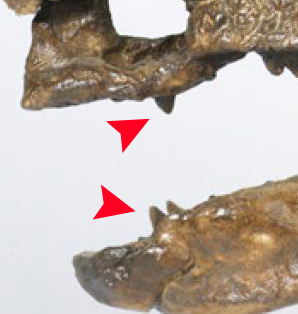
However, the scientific description of a nearly complete skull and jaws of what has been identified as a juvenile Pachycephalosaurus, might just have revealed a surprising side to this peaceful plant-eater. The teeth in the front of jaws are triangular and pointed, reminiscent of the dentition of a meat-eating dinosaur. Could palaeontologists have got Pachycephalosaurus wrong?
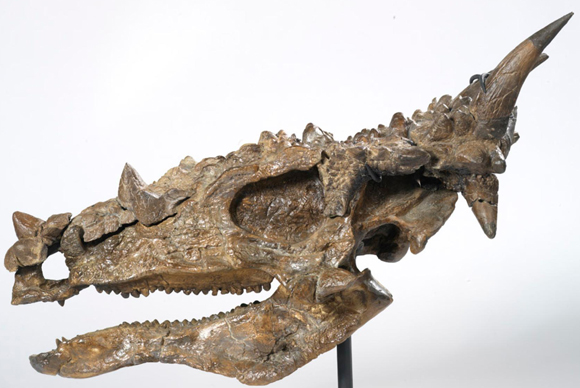
A Reconstruction of the Juvenile Pachycephalosaurus Skull and Jaws
A reconstruction of the fossil skull of the juvenile Pachycephalosaurus that has theropod-like teeth in the front of the jaws.
Picture credit: Brian Boyle (Royal Ontario Museum)
Front Portion of the Jaws Suggests Omnivory in Certain Pachycephalosaurs
In a presentation made at the annual meeting of the Society of Vertebrate Palaeontology held in Albuquerque, New Mexico, Mark Goodwin (University of California Museum of Palaeontology) and David Evans (Royal Ontario Museum), described a near complete juvenile pachycephalosaur skull from eastern Montana. The back of the jaws contained the broad, leaf-shaped teeth which seem well suited to herbivory. It had been assumed that the teeth in the front of the jaws (premaxilla and the anterior portion of the dentary, immediately behind the predentary), were the same shape. However, until this fossil specimen was found, no record of the front teeth of these dinosaurs existed.
Palaeontologists may have to re-think their views on the diet of this member of the Hell Creek Formation biota. The sharp, blade-like triangular teeth located at the front of the mouth seem adapted to ripping and tearing flesh.
The Teeth at the Front of the Jaws are Typical of a Meat-eating Theropod Dinosaur
A close-up view of the teeth in the premaxilla (upper jaw) and the anterior portion of the dentary (lower jaw). Triangular theropod-like teeth have been identified in a juvenile Pachycephalosaurus.
Picture credit: Brian Boyle (Royal Ontario Museum) with additional annotation by Everything Dinosaur
Confusing Pachycephalosaurs
Pachycephalosaurus is the largest member of the Pachycephalosauridae family to have been scientifically described and notwithstanding a cameo appearance of a jail-breaking Stygimoloch in the recent “Jurassic World – Fallen Kingdom” movie, perhaps the most famous. However, not a great deal is known about Pachycephalosaurus and other bone-headed dinosaurs. Fossil remains tend to be very fragmentary and most species have been named from quite scrappy remains and then you have those amazing skulls to consider.
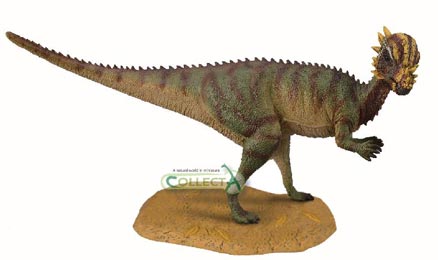
The CollectA Pachycephalosaurus Dinosaur Model
A lithe Pachycephalosaurus dinosaur model. Pachycephalosaurus (P. wyomingensis) is the largest known member of the Pachycephalosauridae with an estimated body length of 4.6 metres.
The model (above) is from the CollectA Prehistoric Life range.
Several species have been named based on the shape and cranial ornamentation associated with those thickened skulls. The thick bone may resist erosion and provide palaeontologists with some fossil bone to study, but it has been suggested that the skulls of these dinosaurs changed dramatically as the animal grew. So much so in fact, that a number of academics, including Mark Goodwin, have published scientific papers that cast doubt on the validity of many pachycephalosaur species. For example, palaeontologists such as Goodwin have put forward evidence to suggest that both Dracorex and Stygimoloch are not distinctive species, the fossils ascribed to these two genera could represent juvenile Pachycephalosaurus specimens.
It seems, just like many other types of Late Cretaceous ornithischian dinosaur, the pachycephalosaurs underwent extreme changes to the shape of their heads as they grew up. Such changes in cranial morphology have resulted in the establishment of several species that may actually just represent examples of the same species but at different growth stages.
Some Palaeontologists Suggest that Radical Changes in Skull Shape and Ornamentation Do Not Indicate Different Species but Different Growth Stages
It has been proposed that the cranial ornamentation and skull shape of Pachycephalosaurs changed as these animals grew and matured. This can cause confusion when trying to identify species.
Picture credit: Kari Scannella with additional annotation by Everything Dinosaur
To complicate matters, pachycephalosaur fossil material covers a period of approximately 2 million years. Over this timescale, these animals evolved and their skull morphology changed, thus, further blurring the lines between different species and fossils of the same species but at different levels of maturation.
Confirming the Likely Diet of Pachycephalosaurus
It would be difficult to confirm that Pachycephalosaurus also ate other animals as well as plants, but not impossible. Only one jaw fossil with the front teeth in situ has been found, so scientists don’t know whether the diets of these dinosaurs changed as they grew. Perhaps, young pachycephalosaurs were omnivorous, whilst when fully grown, adults tended to consume plants rather than other animals. The rib cages of those genera which have a more complete fossil record, suggest that these bipeds had large guts, this would indicate a digestive system adapted to processing vegetation.
Professor Philip Currie (University of Alberta), who also attended the Society of Vertebrate Palaeontology meeting, has proposed that studying carbon isotopes preserved in the tooth enamel might provide further evidence relating to diet. In addition, the many hundreds of examples of isolated, broken teeth from the Hell Creek Formation could be re-examined and checked for any potential affinities with the Pachycephalosauridae. Feeding traces from fossil bone could also yield more data in support of the idea that bone-headed dinosaurs ate meat.
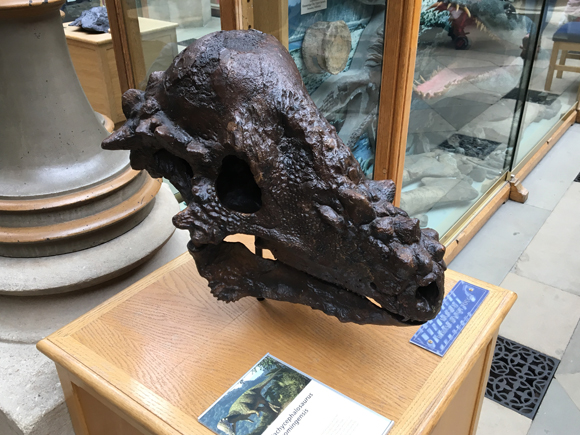
A Reconstruction of the Skull of an Adult Pachycephalosaurus
A spokesperson from Everything Dinosaur commented:
“It is likely that there are many more examples of pachycephalosaurs to be found in Upper Cretaceous rocks, hopefully, if more fossil material can be discovered, then palaeontologists will be able to piece together a more complete phylogeny of these strange dinosaurs. Furthermore, if more examples of their dentition [teeth] come to light, then we might be able to gain a better understanding of their diets. “
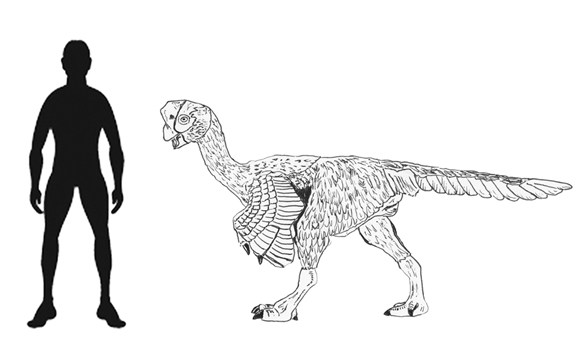
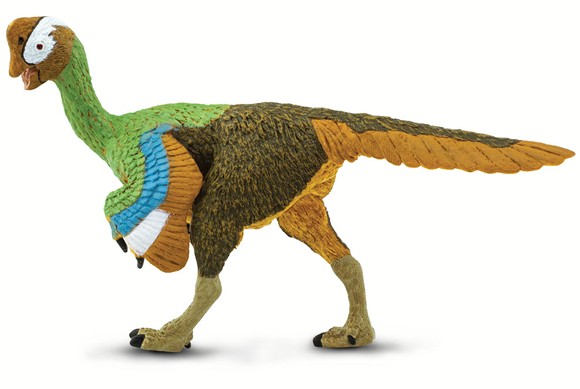
In the new for 2019 Wild Safari Prehistoric World (Safari Ltd) model range, there is going to be a model of an oviraptorid – Citipati (C. osmolskae). As a result, team members at Everything Dinosaur have been busy preparing for the arrival of these models by finalising the fact sheet that will accompany sales of this colourful dinosaur model. The fact sheet has just about been completed, it needs only to have the scale drawing added to it.
Everything Dinosaur’s Scale Drawing of the Mongolian Oviraptorid Citipati osmolskae
Everything Dinosaur’s scale drawing of the oviraptorid Citipati (C. osmolskae).Picture credit: Everything Dinosaur.
Picture credit: Everything Dinosaur
Citipati osmolskae – “Funeral Pyre Lord”
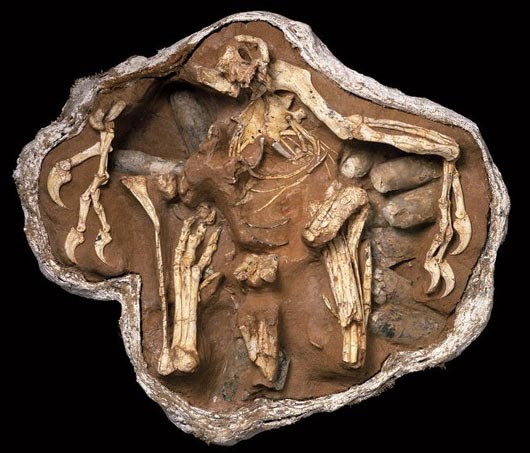
Our scale drawing is an approximation, the true size of this dinosaur is not known. It may have measured more than three metres long, although a body length of 2.5 metres is also possible. In the late spring (2018), a scientific paper was published that reported upon the finding of another oviraptorid specimen discovered in association with a nest.
This specimen has been assigned to the Citipati osmolskae taxon, after all, fossils of this dinosaur are relatively common in the Ukhaa Tolgod region of Mongolia, where this new specimen was discovered. Intriguingly, a comparison of the upper arm bones indicates that this new example of dinosaur nesting behaviour represents an adult animal more than 10% bigger than the original Ukhaa Tolgod nesting Citipati osmolskae specimen (IGM 100/979). Estimating size for this member of the Dinosauria is therefore somewhat difficult.
Although several examples of nesting/brooding behaviour have now been described (we think the total to date is five), no evidence for colonial breeding for these dinosaurs has ever been discovered.
An Example of a C. osmolskae Fossil Found in Association with a Nest
The Citipati fossil sitting on a nest. The fossil has been nick-named “Big Mamma”.
Picture credit: The American Museum of Natural History (New York)
The Wild Safari Prehistoric World Citipati replica is one of several new models in this range. Everything Dinosaur is hoping to have the first of the new for 2019 introductions, including the colourful Citipati replica, in their warehouse and available to purchase in December (2018).
The Wild Safari Prehistoric World Citipati (C. osmolskae) Model
The Wild Safari Prehistoric World Citipati dinosaur model.
Honouring the Polish Palaeontologist Halszka Osmólska
The genus name for this oviraptorid comes from the Sanskrit for “funeral pyre lord”, a reference to a story from Buddhist folklore about two monks that were beheaded by a thief. These monks are frequently depicted as a pair of dancing skeletons surrounded by fire. The beautifully preserved Citipati specimens excavated from the red sandstones of the Djadokhta Formation, reminded the research team responsible for their study (Clark, Norell et al), of the dancing monks.
The species name honours the Polish palaeontologist Halszka Osmólska (1930 – 2008), who pioneered research into Mongolian dinosaurs and made a substantial contribution to our understanding of Theropoda from the Upper Cretaceous deposits of Mongolia.
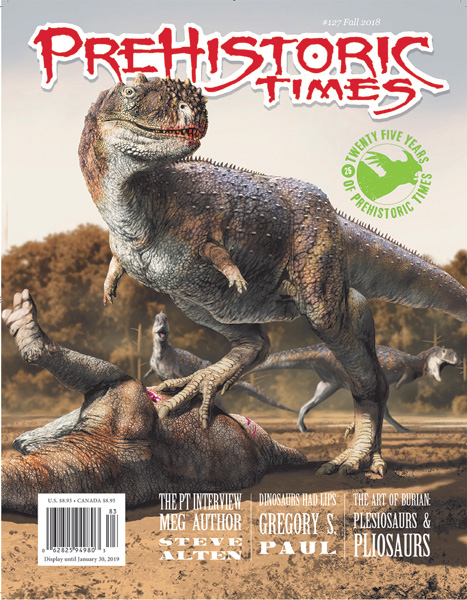
A Review of Prehistoric Times Magazine (Issue 127)
Autumn is very much with us, the long summer seems a distant memory already. Our chums across the Atlantic refer to this season of mellow fruitfulness as the Fall, so time to review the latest copy of “Prehistoric Times” magazine, issue 127 (autumn/fall). This issue of the quarterly magazine features “Prince Lizard” – Rajasaurus, on the front cover, the illustration has been created by renowned palaeoartist J. A. Chirinos.
The Front Cover of Prehistoric Times Issue 127 (Autumn/Fall 2018)
“Prehistoric Times” issue 127 (autumn 2018).
Picture credit: Mike Fredericks/Prehistoric Times
The “Prehistoric Times” Interview: Steve Alten
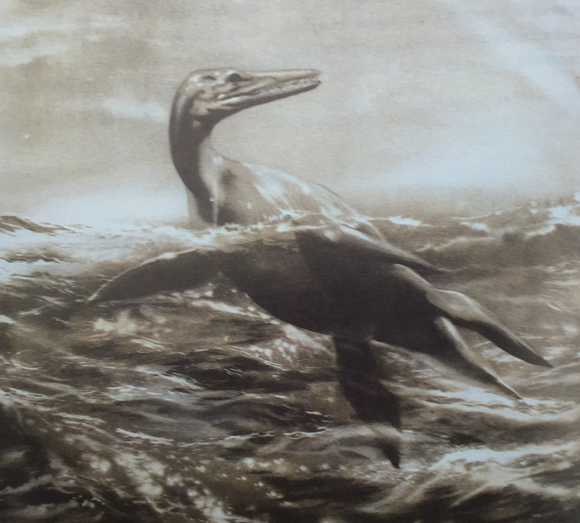
Mike Fredericks has included a summary of his recent YouTube interview with Steve Alten, the author of the book “Meg”, upon which the summer blockbuster movie of the same name starring Jason Statham was based. The interview script is accompanied with some amazing illustrations featuring the giant prehistoric shark but look out for a marine reptile too. On the subject of marine reptiles, New Zealander John Lavas discusses the artwork of Zdeněk Burian that portrays plesiosaurs and pliosaurs, as he continues his comprehensive overview of the work of the influential Czech artist and illustrator.
Burian’s Painting of the Pliosaurid Peloneustes philarchus Features in Prehistoric Times
An illustration of the mid-Jurassic pliosaurid Peloneustes by Burian.
Picture credit: John Lavas/Prehistoric Times
Dinosaurs with Lips
The debate as to whether dinosaurs had lips is discussed at length in a most informative article written by Gregory S. Paul, we wait to see whether future editions of “Prehistoric Times” will include the counter argument, perhaps Tracy Lee Ford, a regular contributor, can provide a summary of the evidence that contradicts this hypothesis. For the time being, the aforementioned Tracy Lee Ford focuses on the skull of Triceratops in his regular feature “How to Draw Dinosaurs”. This article is part one of a two part series, in the winter edition, the emphasis will be on drawing the body of this famous horned dinosaur.
Jordan Mallon of the Canadian Museum of Nature continues the horned dinosaur theme with an article on the safe removal of a Chasmosaurus skull from a dig site located near the South Saskatchewan River in Alberta.
As well as contributions from leading scientists, this magazine provides a platform for dinosaur fans to showcase their artwork. A highlight for us was reading about the Rajasaurus inspired artwork produced by students at Brandywine Heights High School in Pennsylvania. Look out also for the superb Leptoceratops painting supplied by Mohamad Haghani and Mike Landry’s beautiful Platybelodon artwork that is included in Phil Hore’s article on the “shovel tuskers”.
For further information on “Prehistoric Times” magazine and for details how to subscribe: Prehistoric Times Magazine.
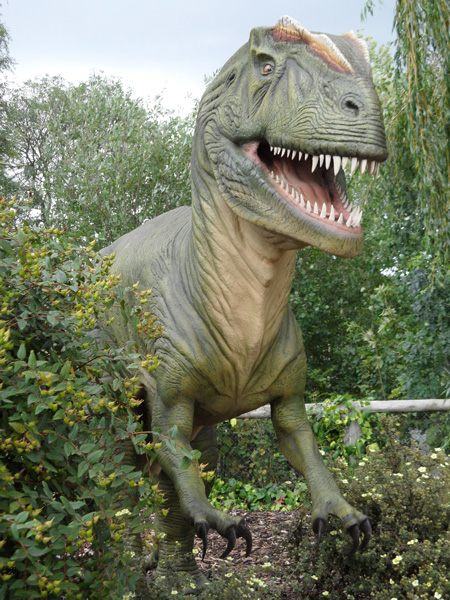
Hunting Behaviour in Allosaurus
Jack Wilkin writes about Allosaurus, sometimes referred to as the “Lion of the Jurassic”. The hunting behaviour of this iconic theropod is explored and the author suggests that Allosaurus hatchlings probably fed on insects before moving on to vertebrates. Evidence for Allosaurus/prey interaction is presented and the theory that Allosaurus used its jaws like an axe to overcome its victims is explained.
Allosaurus and Hunting Behaviour is Explored
Allosaurus attacks! How did it hunt?Picture credit: Everything Dinosaur.
Picture credit: Everything Dinosaur
What with information about new prehistoric animal models, fossil discoveries, classified advertisements and reviews of books related to palaeontology, there is certainly a lot going on inside the latest edition. Look out also for a review of Tracy Lee Ford’s and Mike Frederick’s book “What Colour were Prehistoric Mammals?” which also features in this jam-packed publication.
Archaeorhynchus spathula – Lungs in an Ancient Bird Fossil?
Modern birds have a very efficient respiratory system. Their lungs are much more efficacious than those of mammals. However, scientists are not sure when and how this breathing system evolved. It has been suggested that the origins of the bird’s respiratory system, complete with air sacs and the ability to stop de-oxygenated air mixing with oxygenated air as it is expelled from the lungs, is one anatomical trait inherited from their dinosaur ancestors.
Writing in the academic journal the “Proceedings of the National Academy of Sciences”, a group of international scientists claim that the fossilised remains of an Early Cretaceous bird breathes new life into the evolution of the bird lungs debate.
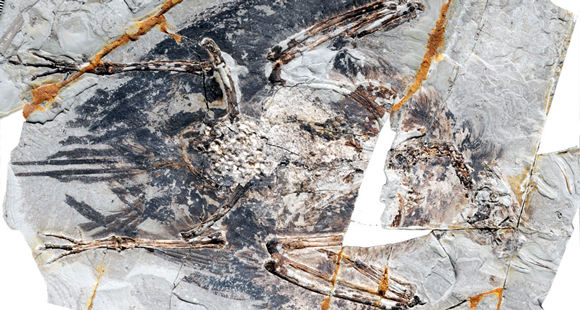
The Main Slab Showing the Archaeorhynchus spathula Specimen
The main slab showing the fifth specimen of Archaeorhynchus spathula to have been described. Palaeontologists have identified what might be evidence for avian lungs as well as a pintail on this ancient bird.
Picture credit: J. Zhang/Institute of Vertebrate Palaeontology and Palaeoanthropology (IVPP)
The Fifth Specimen of Archaeorhynchus spathula to be Described
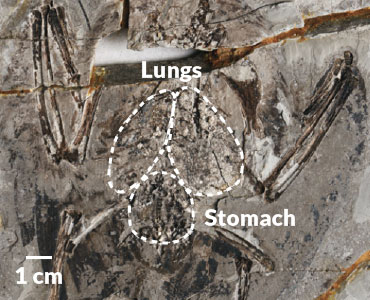
A study of the slab and counter slab representing the fossilised remains of a prehistoric bird (Archaeorhynchus spathula), suggests that, in this remarkably complete specimen, remnants of the animal’s soft tissues including internal organs such as the lungs could have been preserved. Using scanning electron microscopy, the research team, including members of the Beijing based, Institute of Vertebrate Palaeontology and Palaeoanthropology (IVPP), identified what could be evidence of paired lungs.
The structures identified by the team suggest that Archaeorhynchus had a respiratory system capable of handling the large amount of oxygen required to sustain powered flight. Although, the conclusions drawn in the scientific paper have been questioned by several academics, if these are lungs, then it indicates that physiological adaptations in Aves came before changes in their skeleton during the evolution of anatomically modern birds.
The Scientists Identified What Could be Paired Lungs on the Counter Slab of the Fossil Specimen
Counter slab of Archaeorhynchus spathula specimen interpreted as having lung preservation. The dotted outlines mark the location of organs (paired lungs and the stomach).
Picture credit: X Wang et al (PNAS)
The Significance of this Research
Archaeorhynchus spathula is one of a number of bird genera known from the Lower Cretaceous Jiufotang Formation (China). Copious amounts of gizzard stones associated with this and the previous specimens suggest that these primitive birds were probably vegetarian. They form part of a rich prehistoric fauna known as the Jehol Biota. In total, five specimens have been described to date but this fossil, consisting of a crushed specimen represented by a slab and counter slab, is the most complete.
Numerous feathers and traces of plumage can be made out and the researchers report that Archaeorhynchus had a pintail, a feature previously not seen in Mesozoic birds. A. spathula has been classified as a basal member of the Ornithuromorpha, a group distantly related to today’s birds and one that possessed a mix of ancient and more modern anatomical features.
This fascinating fossil described as looking something like “road kill” by one observer, might have allowed palaeontologists to catch a glimpse of a stage of bird evolution where an advanced pulmonary system had evolved yet the skeleton lacked the adaptations seen in extant birds to permit efficient powered flight.
At Everything Dinosaur, we have had lots of interest already from customers, social media followers and blog readers asking about new for 2019 models from Papo. We are not able to publish this information as yet, it remains embargoed. However, when we can, we will put up information and pictures, all part of our plans to inform people about what is new and upcoming in terms of 2019 model introductions from manufacturers next year.
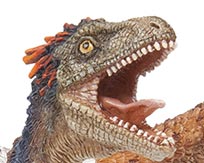
In the meantime, it is sensible to focus on those models and figures that are being withdrawn and are going out of production. Papo will be retiring two figures from their “Les Dinosaures” range next year, ironically neither of the models represent a dinosaur.
Papo is retiring:
Archaeopteryx
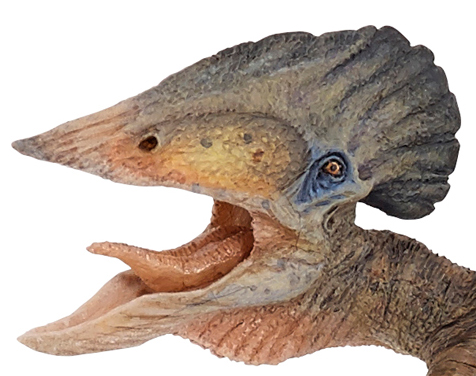
Tupuxuara
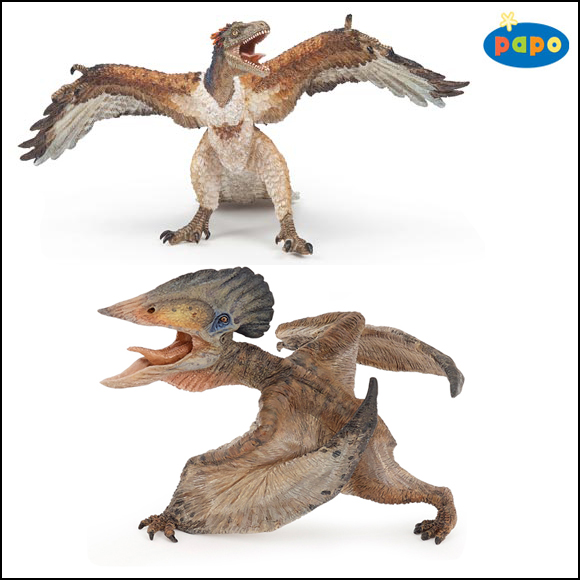
Papo Model Retirements – Archaeopteryx and Tupuxuara
Papo model retirements 2019 – Archaeopteryx and Tupuxuara. Picture credit: Everything Dinosaur.
Picture credit: Everything Dinosaur
Winged Wonders Out of Production
Both these models represent animals from the Mesozoic that were capable of powered flight. Of the two, palaeontologists believe that the pterosaur, Tupuxuara was probably more confident in the air. Some of the latest research on the enigmatic “Urvogel” suggests that Archaeopteryx was actually quite a poor flier. Whatever their volant abilities, both these figures are being retired and are now out of production. However, thanks to Everything Dinosaur collectors and model fans are being pre-warned about their withdrawal. There is still time to add these two models to your Papo figure collection.
Papo Archaeopteryx
The Papo Archaeopteryx figure was introduced in 2014 and at the time of its introduction, it received a lot of positive feedback as representations of Archaeopteryx lithographica were, if you pardon the pun, a bit thin on the ground. Sadly, after nearly five years, this model has flapped its wings for the last time and has been officially withdrawn.
The Papo Archaeopteryx Model Received Lots of Praise When it was Introduced in 2014
A close view of the head of the Papo Archaeopteryx model.Picture credit: Everything Dinosaur.
At the time of this model’s introduction, Everything Dinosaur published several reviews of this figure including a video review. These releases have been seen thousands of times.
Papo Tupuxuara
It is always a pleasure to see more models representing the Pterosauria being introduced, so the loss of the Papo Tupuxuara is a big blow. This figure was only introduced in 2015, alongside the Papo young Apatosaurus model. Three species of Tupuxuara have been named to date, the first being described in 1988. These pterosaurs are synonymous with Lower Cretaceous sediments found in north-eastern Brazil.
The Papo Tupuxuara is Flying Off into the Sunset
The head of the Papo Tupuxuara pterosaur model. The diet of this large pterosaur from the Lower Cretaceous of Brazil remains uncertain.Picture credit: Everything Dinosaur.
Picture credit: Everything Dinosaur
One of the reasons suggested for the withdrawal of the Papo Tupuxuara figure, is the difficulty encountered when trying to pronounce the name of this flying reptile. Tupuxuara was named after a spirit referred to within the culture of the local Tupi people of north-eastern Brazil. Tupuxuara is pronounced “Too-pooh-hwar-ah”.
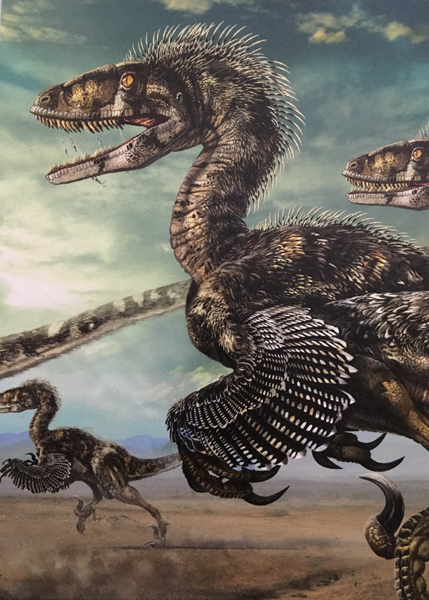
The bird-like qualities of the large dromaeosaurid Deinonychus (D. antirrhopus) have been captured in this superb dinosaur-themed artwork by the Chinese palaeoartist Zhao Chuang. This is one of our favourite illustrations of this enigmatic, fast-running theropod, finally named and described in 1969.
An Illustration of the Large North American Dromaeosaurid Deinonychus antirrhopus
“They are flocking this way!” A flock of dromaeosaurid dinosaurs (Deinonychus) on the move. Artwork by Zhao Chuang.
Deinonychus – A Modern Interpretation with a Retrospective Look
This beautifully-crafted image was created quite recently (2016, we think), but the choice of colours and the muted tones of the backdrop give this image quite a retrospective look. It is reminiscent of the prehistoric animal illustrations that featured in the Brooke Bond Picture Cards series “Prehistoric Animals”, that was first published in the early 1970s, ironically, just a few years after Deinonychus (which features in the card set), was named and described).
The artist has taken great care to depict this three-metre-long predator as an active, agile animal just as the palaeontologist John Ostrom envisioned it in his ground-breaking work that led to a complete re-think about the Dinosauria. This revolution in thinking about the dinosaurs and their close relatives was termed the “dinosaur renaissance”. The idea that these were slow-moving, clumsy, stupid animals was swept away and there was a definitive move towards portraying dinosaurs as animals that were as well adapted to their environments as modern mammals.
Moving at Speed
Zhao Chuang shows Deinonychus as a social animal, moving in a flock and at speed too. The killing second-toe claw is raised off the ground as this dinosaur moves and it possesses a shaggy integumentary covering of simple feathers on its body as well as pennaceous feathers on its arms. The yellow eye with its slit pupil gives this dinosaur a particularly frightening look. A flock of Deinonychus heading your way would have been a terrifying sight.
It is a pleasure for Everything Dinosaur to highlight the artwork of Chinese palaeoartist Zhao Chuang. Today, we feature one of our favourite illustrations of Deinonychus.
Bite Marks Found on the Frill of a Young Centrosaurus
The movies and television documentaries featuring dinosaurs are stuffed full of them, but the fossil record tells a different story. What are we referring to? Dinosaurs hunting, attacking and fighting other dinosaurs. Rarely has a programme or film been produced about the Dinosauria that does not feature some gory scenes of a bloody battle or a fearsome theropod feasting on some poor, unfortunate plant-eating victim. However, although such interactions obviously took place, the fossil record demonstrating such behaviour is extremely sparse. A new paper, published in the open access journal “PeerJ”, reports on the discovery of bite marks preserved on the frill of a young Centrosaurus.
This raises two intriguing questions:
Which meat-eating dinosaur made the bite marks?
Is this evidence of predation or scavenging a carcass?
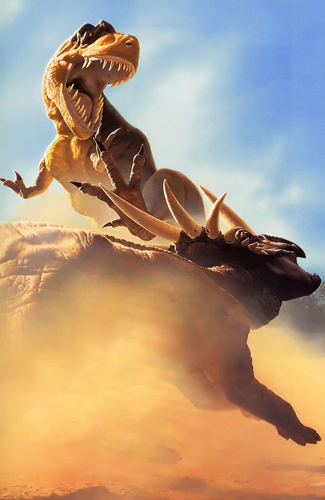
Dinosaurs Fighting – A Tyrannosaur Attacks a Horned Dinosaur (Styracosaurus)
Tyrannosaur fighting a horned dinosaur.
Picture credit: John Gurche
Bite Marks – Tell-Tale Signs of Predator/Prey Interaction
Bite marks on fossil bones can provide valuable information about interactions between carnivorous dinosaurs and the animals that they attacked. It is not always possible to distinguish whether the trace fossils represent wounds inflicted on an animal during a fight, or whether these marks represent post-mortem feeding, such as consumption of the victim. If there are signs of healing and bone growth, palaeontologists can be confident that the bite marks in that instance represent a lucky escape for the intended victim.
The key thing to note, is that the more data about bite marks that can be collected, the better the dataset that palaeontologists have to compare potential bite mark injuries against.
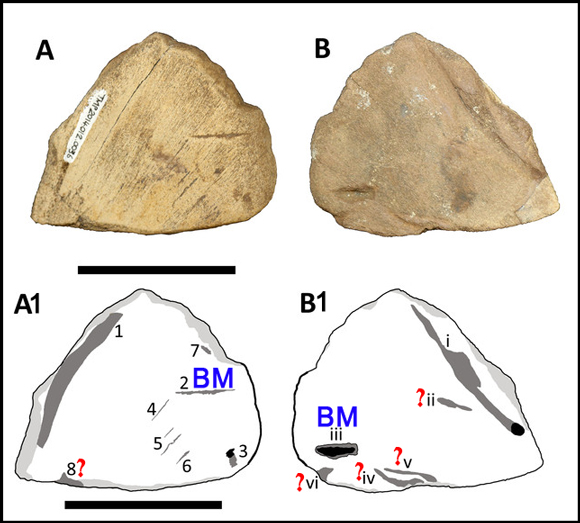
Part of the Skull of a Juvenile Centrosaurus With Tooth-marks
Ironically, quite a large proportion of the tooth-mark fossils associated with dinosaurs come from those deposits that are associated with the remains of large-bodied tyrannosaurids. In this newly published paper, the scientists from Queen Mary University London and the Royal Tyrrell Museum (Alberta, Canada), report on the discovery of a portion of the skull from a juvenile horned dinosaur. The bone, a fragment of the squamosal, which makes up part of the frill, was found on the surface of a dinosaur bonebed in the Dinosaur Provincial Park Formation. The fossil is approximately 76.3 to 75.6 million years old and has been assigned to the horned dinosaur species Centrosaurus apertus.
Views of the Fragment of the Squamosal Bone (Centrosaurus apertus) and Line Drawings
The two sides of the partial squamosal bone from a juvenile Centrosaurus showing signs of damage/wear/bite marks. Actual fossil (A and B), interpretive line drawings (A1 and B1).
Picture credit: PeerJ with additional annotation by Everything Dinosaur
Key
BM = Probable bite marks
? = Possible bite marks
Feeding on a Young Centrosaurus
Analysis of the fossil found numerous marks and gouges on both sides of the fossil bone. Some of these marks could have resulted from damage due to transportation prior to burial. Other marks could reflect effects caused by chemical erosion or the presence of vascular grooves. However, the scientists were able to propose that at least some of the marks were due to teeth coming into contact with the bone.
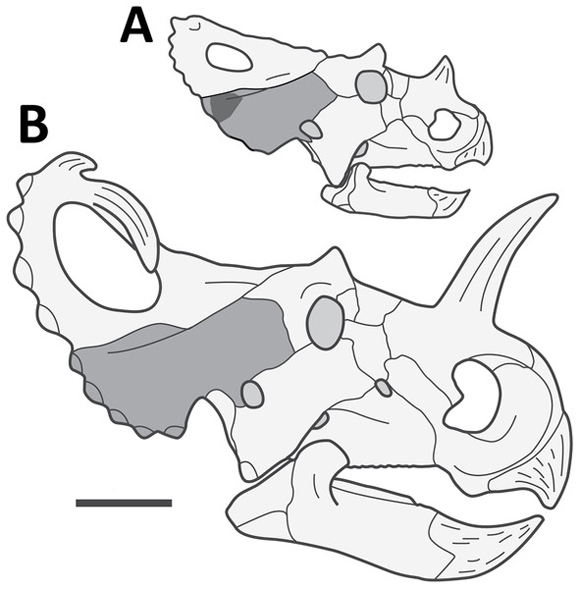
The Position of the Partial Squamosal on the Skull of a Juvenile Centrosaurus and an Adult Skull Shown for Comparison
A comparison of Centrosaurus skulls (C. apertus) Juvenile (A) and adult (B). The squamosal bone that makes up part of the frill is shaded grey, whilst the portion of bone in the study is shaded dark grey.
Picture credit: PeerJ
Although it is difficult to assess the size of the horned dinosaur based on such a small fragment of bone, the scientists suggest that based on comparisons with squamosal bones from adults, the juvenile Centrosaurus was perhaps about a third the size of a fully grown Centrosaurus.
Which Dinosaur Made the Feeding Traces?
The researchers ruled out crocodiles, other reptiles and mammals when it came to identifying what creature made the bite marks. This left the team with three types of theropod dinosaur to investigate. troodontids, dromaeosaurs and tyrannosaurs are known from the Dinosaur Provincial Park Formation. There is also the genus Richardoestesia to consider, its affinity within the Theropoda is uncertain. The bite marks are too small to have been made by a large tyrannosaur, but a juvenile tyrannosaur might have scavenged the carcass.
It is also possible that a dromaeosaurid may have fed on the remains as well. It is possible that both the dromaeosaurid and a young tyrannosaur fed on the carcass, after all, modern carcasses may be fed on by multiple species (lions may kill a zebra but hyenas may chase them off the kill and rob them of the carcass – kleptoparasitism).
To read an article from Everything Dinosaur published in 2015 that looks at the structure of the teeth of different Theropod dinosaurs: Research to get your Teeth Into.
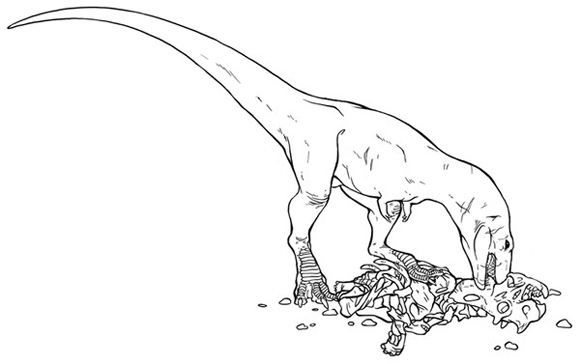
A Hypothesised Reconstruction of a Juvenile Gorgosaurus Feeding on the Carcass of a Juvenile Centrosaurus
A young tyrannosaur (Gorgosaurus) scavenging the carcass of the juvenile Centrosaurus.
Picture credit: Marie-Hélène Trudel-Aubry/PeerJ
Slim Pickings
The marks on the squamosal fragment represent the first documented case of a carnivore consuming a juvenile ceratopsid, but the trace fossils may represent scavenging a corpse rather than predation. However, there is not a lot of meat on a squamosal bone. The scientists suggest that the feeding marks represent late stage consumption, as the most nutritious parts of the young Centrosaurus had already been eaten. It is possible that a large tyrannosaur made the kill, fed and then abandoned the carcase which was later picked over by other theropods.
Despite the apparent preferences for feeding on juvenile dinosaurs, most feeding traces described to date are on the bones of adults which may have resisted being consumed and destroyed (even by large tyrannosaurs). Feeding traces on a juvenile dinosaur remain unusual and exceptionally rare. Perhaps the size and shape of ceratopsian skulls, even in juveniles, made them difficult to process or required an excess of handling effort for a relatively little reward in terms of food.
The scientific paper: “Bite Marks on the Frill of a Juvenile Centrosaurus from the Late Cretaceous Dinosaur Provincial Park Formation, Alberta, Canada” by David W.E. Hone, Darren H. Tanke and Caleb M. Brown published in PeerJ.