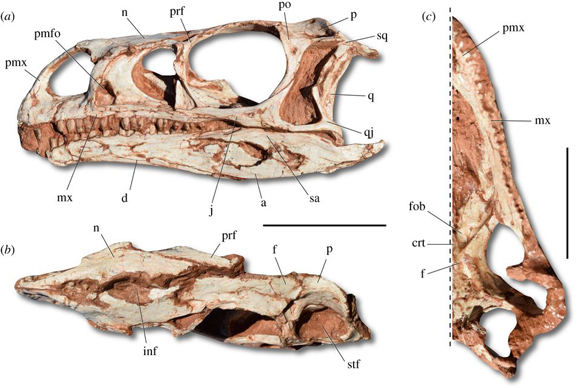
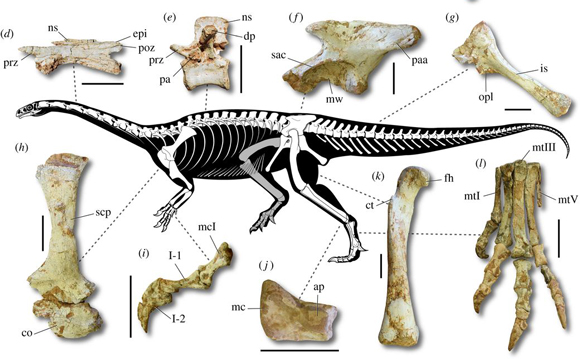
All about dinosaurs, fossils and prehistoric animals by Everything Dinosaur team members.

Fossil finds, new dinosaur discoveries, news and views from the world of palaeontology and other Earth sciences.

5 12, 2018

New Dinosaur Named from New South Wales

By |2023-11-11T21:24:23+00:00December 5th, 2018|Categories: Dinosaur and Prehistoric Animal News Stories, Dinosaur Fans, Main Page, Photos/Pictures of Fossils|0 Comments

Weewarrasaurus pobeni – Hints at Different Kinds of Dinosaur Communities

The fortuitous discovery of pieces from the lower jaw of a small, plant-eating dinosaur is helping scientists to discover more about the Cretaceous dinosaurs that once roamed Australia.  Writing in the academic journal “PeerJ”, the researchers provide evidence to support the idea that there were numerous small-bodied ornithopods at high latitudes in south-eastern Australia, whilst further north, in what would have been slightly warmer environments, these types of dinosaurs co-existed with much bigger ornithopods and titanosaurs.

The dinosaur has been named Weewarrasaurus pobeni (pronounced wee-whah-rar-sore-us poe-ben-eye) and it is the first new dinosaur to be described from New South Wales for nearly 100 years.

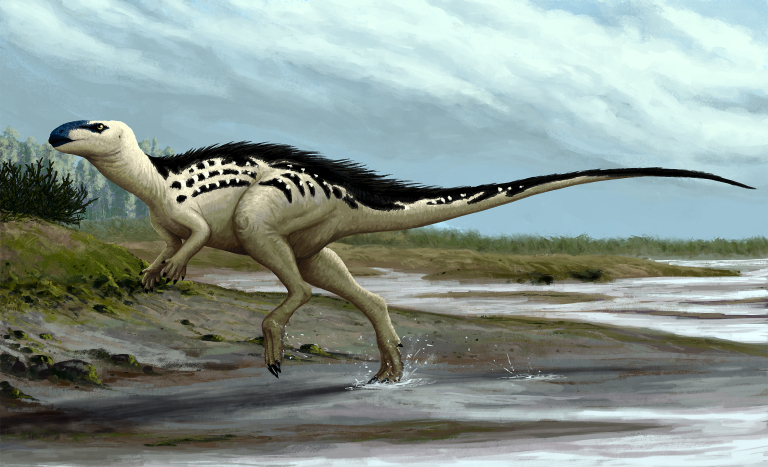
A Life Reconstruction of the Newly Described Gondwanan Ornithopod Weewarrasaurus pobeni
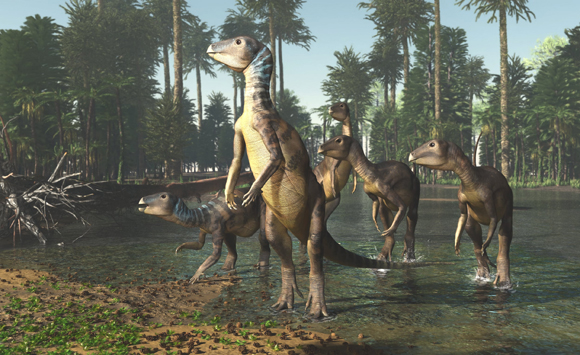
Weewarrasaurus life reconstruction.
A life reconstruction of the small ornithopod Weewarrasaurus.

Picture credit: James Kuether

A Lucky Fossil Find

Adelaide-based opal buyer Mike Poben spotted the fossil pieces in a bucket of opal rubble from the Wee Warra opal field at Lightning Ridge (New South Wales, Australia).  The dinosaur was named in honour of the location and the trivial name recognises the contribution of Mr Poben who donated the specimens for research.

Numerous opalised dinosaur fossils are known from the Lightning Ridge area.  The material, including fragments of bones and isolated teeth come from the Griman Creek Formation.  Recent radiometric dating indicates that these deposits are around 100 to 96 million years old (Cenomanian stage of the Late Cretaceous), making these rocks some 10 million years younger than equivalent exposures containing dinosaur fossils found in northern Queensland.

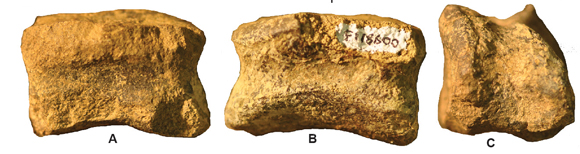
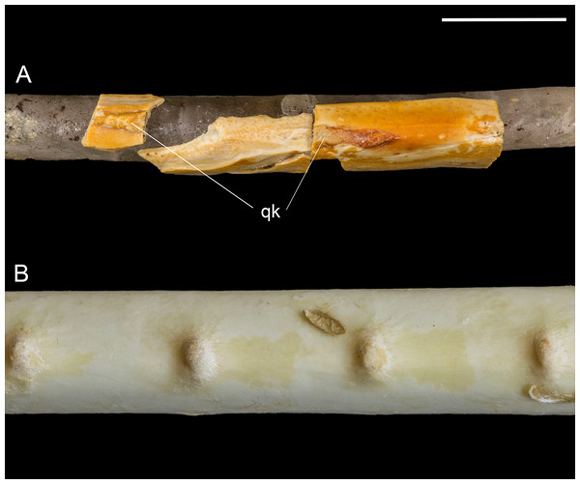
The Fossil Jaw Fragments (Right Dentary) of Weewarrasaurus pobeni
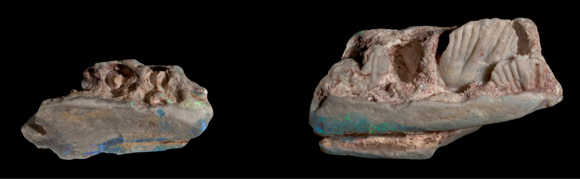
W. pobeni fossil material (right dentary in medial view).
The right dentary of W. pobeni (medial view). The two pieces are part of the same lower jaw.

Picture credit: PeerJ

Unfortunately, the underground mining process involves breaking up the rocks, so any specimens found tend to consist of isolated broken pieces, however the presence of a scalloped-shaped tooth in the object immediately caught the attention of Mr Poben, so he was able to quickly appreciate that this was part of a jawbone.  Lightning Ridge is the only place in the world where dinosaur bones and teeth routinely turn to opal.  Corresponding author of the scientific paper, Dr Philip Bell (University of New England), explained that researchers were now looking into acquiring more fossil material from opal mines.

Dr Bell stated:

“Unfortunately, the fossil remnants we see are almost always part of mining spoil… but on another hand, we would never get to see even those fragments if it wasn’t for mining.”

Opal Helps to Identify a Dinosaur

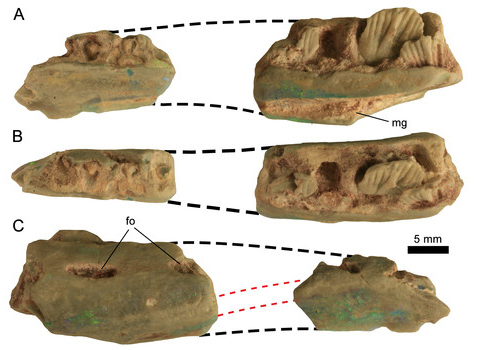
One of the benefits of the presence of opal in the fossil is that the distinctive banding pattern formed helped the scientists to identify that the two fossil pieces belonged to the same jawbone.

Views of the Jawbone Fossil (Weewarrasaurus pobeni)
Weewarrasaurus fossils.
Weewarrasaurus pobeni fossils (right dentary fragments in medial view).

Picture credit: PeerJ/Dr Bell (University of New England)

The picture above shows three views of the fossils, (A), medial; (B), dorsal; and (C) lateral views.   The dashed black line shows the outline of the missing pieces that would have comprised a more substantial part of the dentary.  The dashed red lines indicate the distinctive banding pattern in the opal used to estimate the extent of the missing area.  Another jawbone fragment (LRF 766), representing a right dentary with teeth in situ from the nearby Three Mile opal field has also been assigned to this new dinosaur species.

Faunal Differences in Different Regions of Prehistoric Australia

The Griman Creek Formation fossils from Lightning Ridge indicate that there were numerous small Ornithopods living in this environment during the Cenomanian stage of the Late Cretaceous.  This research provides further evidence to support previous studies that favour a general abundance of small-bodied basal Ornithopods in high-latitude localities of south-eastern Australia.  These little dinosaurs, most of which were under two metres in length, inhabited a verdant flood plain, but this part of the Gondwana was at approximately 60 degrees south.  Today, Australia is much further north, the city of Sydney (New South Wales), is located at approximately 33.86 degrees south.  During the Cretaceous, the dinosaurs that inhabited the part of Australia we now call New South Wales, would have had to endure periods of darkness in the year when the sun dipped below the horizon, although the presence of ectothermic reptiles such as crocodyliforms and turtles indicate that average minimum temperatures may not have fallen below 5 degrees Celsius.

Even so, the climate may have been too extreme for sauropods.  Cretaceous deposits in Queensland (Winton Formation), have revealed several titanosaurs, but the colder temperatures experienced further south may have limited sauropod distribution.

The researchers conclude that although future dinosaur fossil discoveries have the potential to alter these interpretations, it is suggested that the Griman Creek Formation at Lightning Ridge occupied a “meeting point” between more northern sauropod-dominated faunas and the ornithopod-dominated faunas that existed further south.

Computer Generated Images from Fossil Scans Helped to Identify Ornithopod Characteristics
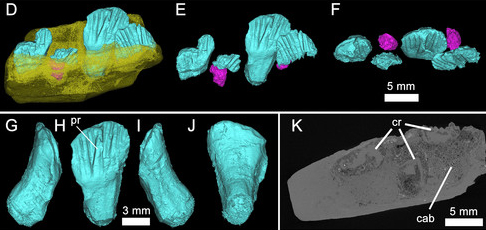
Weewarrasaurus three-dimensional, computer generated images of the fossil material.
Three-dimensional renders of the posterior dentary fragment.

Picture credit: PeerJ

To read a recent article about an opalised dinosaur toe bone found in South Australia: Lost Dinosaur Toe Bone Turns Up on the Internet.

Visit the award-winning Everything Dinosaur website: Everything Dinosaur.

3 12, 2018

Lost Dinosaur Toe Bone Turns Up on the Internet

By |2023-11-11T14:06:18+00:00December 3rd, 2018|Categories: Dinosaur and Prehistoric Animal News Stories, Dinosaur Fans, Main Page, Photos/Pictures of Fossils|0 Comments

Toe Bone Turns Up on the Internet

A rare dinosaur bone, one of only three dinosaur fossils known from the state of South Australia, is going on display at the South Australian Museum some forty-five years after it was lost to science.  The opalised bone, representing a single toe bone (phalanx), is believed to come from a type of theropod dinosaur and although named Kakuru kujani, which was officially described from opalised remains representing lower leg bones back in 1980, very little is known about this Cretaceous dinosaur.

The toe bone was found in Andamooka in the far north of South Australia sometime in the early 1970s.  It was spotted for sale in an opal shop in Hindley Street, Adelaide by Neville Pledge, the South Australian Museum’s then curator of fossils, in 1973.  Neville had the foresight to take several photographs, measurements and plaster casts of the toe bone.  However, shortly afterwards, the item was sold and it disappeared from the scientific community.

The Opalised Toe Bone on Display at the South Australian Museum

An opalised dinosaur toe bone on display (ventral view)
The five cm long opalised dinosaur toe bone from South Australia.

Picture credit: Ashleigh Glynn

The Tale of a Dinosaur Toe Bone

In April 2018, the bone was spotted up for sale on the internet by Coober Pedy resident Joy Kloester, who purchased the bone and then offered it to the South Australian Museum.  The Museum’s Senior Collections Manager for Earth Sciences, Ben McHenry acted quickly to acquire the specimen for the vertebrate palaeontology department.

Mr McHenry commented:

“I couldn’t believe our luck in finding the same bone after forty-five years.”

Dinosaur bones from South Australia are extremely rare.  The only two other bones known to science found to date are also part of the vertebrate fossil collection of the South Australian Museum.  During the Early Cretaceous period (around 110 million years ago, Albian fauna stage), when dinosaurs roamed the land, most of South Australia was under water, being part of the ancient Eromanga Sea.  The sediments deposited on the floor of this ancient sea now form the rocks of the Great Artesian Basin and preserve the abundant remains of marine life that can be viewed in the Museum’s Opal Fossil gallery.

This special dinosaur toe bone will be on display in this gallery from today (December 3rd).  Neville Pledge is now an Honorary Researcher at the South Australia Museum, it seems his discovery from 45 years ago, has now joined him at this highly respected institution.

What Sort of Dinosaur was Kakuru kujani?

Kakuru kujani (pronounced: Kah-koo-roo koo-yan-eee), is believed to be about the size of a turkey.  Unfortunately, given the limited fossil material, it is not possible to identify its taxonomic position with the Theropoda.  K. kujani was described from fragmentary lower leg bones (tibia and possible fibula fragments), the toe bone may not belong to this genus at all, but given the lack of other candidates, the Museum has assigned the bone to Kakuru.

It has been postulated that this dinosaur was an oviraptorid, although some affinity to the Abelisauridae has also been proposed.  Its formal classification remains Theropoda incertae sedis, which means it has an uncertain placement within this Suborder.

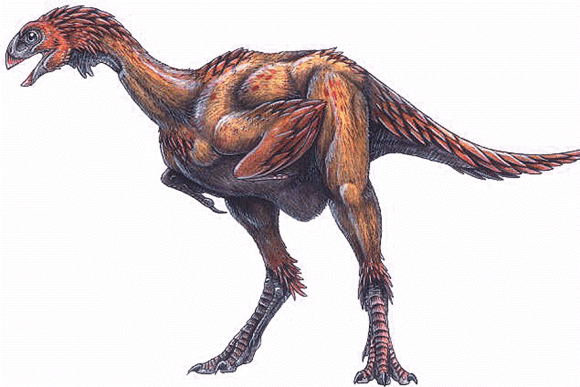
A Speculative Reconstruction of Kakuru kujani

A life reconstruction of Kakuru kujani.
A speculative reconstruction of the theropod dinosaur Kakuru kujani from South Australia.  In this illustration, K. kujani is depicted as an oviraptorosaurian dinosaur.

Picture credit: South Australian Museum

Everything Dinosaur acknowledges the assistance of a press release from the South Australian Museum in the compilation of this article.

Visit the Everything Dinosaur website: Everything Dinosaur.
26 11, 2018

Extinction of the “Siberian Unicorn” Caused by Climate Change

By |2023-11-11T12:30:15+00:00November 26th, 2018|Categories: Dinosaur and Prehistoric Animal News Stories, Main Page|0 Comments

Elasmotherium Survived Until Around 36,000 Years Ago

The enormous rhinoceros Elasmotherium sibiricum, sometimes referred to as the “Siberian unicorn”, on account of its massive, single nose horn, survived until much more recently than previously thought.  In a new study, published in the academic journal “Nature Ecology and Evolution”, a team of international scientists conclude that E. sibiricum survived in eastern Europe and central Asia until at least 39,000 years ago.  It probably finally died out sometime around 36,000 years ago.  Furthermore, the study has resolved a long-standing debate amongst palaeontologists as to the taxonomic relationship of rhinos like Elasmotherium with their living, distant relatives.

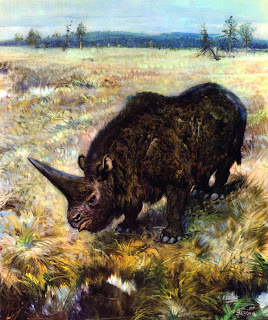
A Life Reconstruction of Elasmotherium sibiricum

Elasmotherium sibiricum life reconstruction.
A life reconstruction of Elasmotherium sibiricum.

Picture credit: Zdeněk Burian

Climate Change Led to the Demise of Elasmotherium

The research team which included scientists from the Oxford University, the University of New South Wales, Adelaide University, the London Natural History Museum, Groningen University (Holland) and the Russian Academy of Sciences, conclude that although, this more than three-tonne giant lived at the same time as Neanderthals as well as modern humans, hominins probably played very little part in its eventual demise and extinction.  Instead, it is likely that climate change, resulting in the reduction of the steppe (grasslands), on which this rhino grazed, led to the extinction of Elasmotherium.

One of the co-authors of the study, Professor Chris Turney, a climate scientist at the University of New South Wales stated:

“It is unlikely that the presence of humans was the cause of extinction.  The Siberian unicorn appears to have been badly hit by the start of the Ice Age in Eurasia when a precipitous fall in temperature led to an increase in the amount of frozen ground, reducing the tough, dry grasses it lived on and impacting populations over a vast region.”

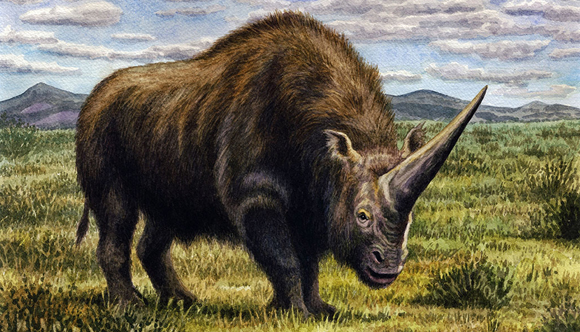
The “Siberian Unicorn” May Have Persisted Until Around 36,000 Years Ago

A painting of the "Siberian unicorn" - Elasmotherium.
Elasmotherium illustrated.

Picture credit: W S van der Merwe/Natural History Museum

A Handful of Rhino Species Today

There are only a handful of rhinoceros species living today, all of which are faced with extinction.  The extant rhinos are just the remnants of a huge and very diverse sub-group of “odd-toed” hoofed mammals (Perissodactyla).  Elasmotherium is known from numerous fossils from China, Russia, Kazakhstan and Mongolia.  As part of the research, a genetic analysis of collagen extracted from Elasmotherium bones was undertaken.  The DNA data revealed that Elasmotherium was the last surviving member of a unique family of rhinos.

The DNA analysis showed that a divergence between the Elasmotherium and other rhino subfamilies started taking place in the Eocene Epoch (between 56 and 34 million years ago).

Adelaide University researcher Dr Kieren Mitchell, who analysed the ancient DNA, the first time that DNA had been recovered from Elasmotherium sibiricum fossil bones stated:

“The ancestors of the Siberian unicorn split from the ancestors of all living rhinos over 40 million years ago.  That makes the Siberian unicorn and the African white rhino even more distant cousins than humans are to monkeys.”

This new genetic evidence overturns previous studies that suggested the Siberian unicorn was a very close relative of the extinct woolly rhino (Coelodonta antiquitatis) and the living, but critically endangered, Sumatran rhinoceros (Dicerorhinus sumatrensis).

The Quaternary Megafaunal Extinction Event

It had been thought that Elasmotherium became extinct around 200,000 B.C. well before the last Ice Age event in the northern hemisphere and many tens of thousands of years before the Late Quaternary megafaunal extinction event, which began around 130,000 years ago.  Radiocarbon dating of twenty-three individual specimens indicate that E. sibiricum survived in eastern Europe and central Asia until at least 39,000 years ago and possibly as late as 36,000 years ago.  Isotope data taken from fossil teeth indicate that this giant rhinoceros lived on the dry steppe and had a highly specialised diet, which probably contributed to its eventual extinction.

As the last surviving member of the Elasmotheriinae, the extinction of E. sibiricum marked the termination of this part of the Rhinoceros family tree.

Other species that shared the Siberian unicorn’s environment were either less reliant on grass, such as Coelodonta antiquitatis, or more flexible in their diet , like the saiga antelope and escaped the Siberian unicorn’s fate, although the C. antiquitatis eventually became extinct some 20,000 years later.

Everything Dinosaur announced earlier this month that they would be stocking a 1:20 scale model of Elasmotherium sibiricum (CollectA Deluxe).

To view the CollectA Deluxe range: CollectA Deluxe Prehistoric Life Models.

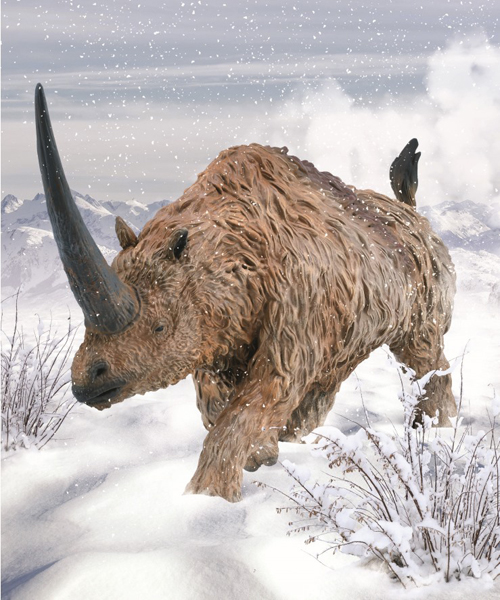
The CollectA Elasmotherium sibiricum Model Coming to Everything Dinosaur in 2019

 CollectA Deluxe Elasmotherium model.
The CollectA Deluxe Elasmotherium model.

A fantastic Elasmotherium model.

Everything Dinosaur acknowledges the assistance of a press release from the University of Adelaide in the compilation of this article.

Visit the Everything Dinosaur website: Everything Dinosaur.
25 11, 2018

Newly Described Giant Dicynodont from the Late Triassic

By |2023-11-11T12:10:26+00:00November 25th, 2018|Categories: Dinosaur and Prehistoric Animal News Stories, Dinosaur Fans, Main Page, Photos/Pictures of Fossils|0 Comments

Lisowicia bojani Huge Dicynodont from the Late Triassic of Poland

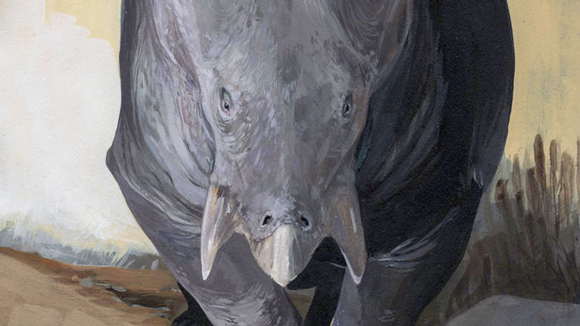
The Late Triassic of southern Poland was home to a giant “mammal-like” reptile the size of an elephant and weighing some 9 tons.  Scientists from the Polish Academy of Sciences in collaboration with colleagues from Uppsala University (Sweden), have published details on the discovery of the fossilised remains of a huge therapsid, specifically a dicynodont, that has been named Lisowicia bojani.  This super-sized, distant ancestor of modern mammals is believed to have measured around 4. 5 metres in length and stood more than 2.6 metres tall.

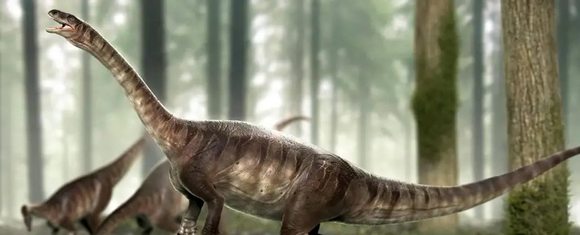
A Life Reconstruction of the Newly Described Giant Dicynodont Lisowicia bojani

L. bojani illustrated.
A life reconstruction of the giant dicynodont Lisowicia bojani.

Picture credit: Karolina Suchan-Okulska

More than 1,000 Bones Recovered from a Clay Pit

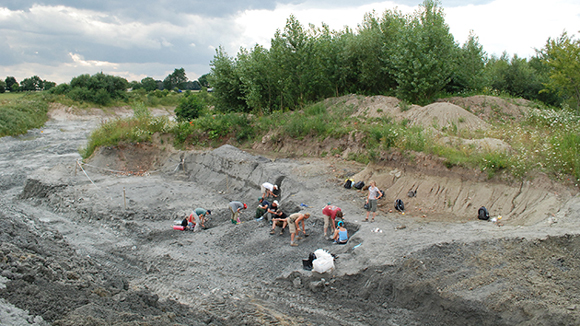
The first fossil remains were found by Polish geologists Robert Borzęcki and Piotr Menducki in 2005, when they were exploring a clay pit which represented a river deposit from the Upper Triassic.  The dig site is close to the village of Lisowice, numerous field teams have been despatched to the area and over the last few years, more than 1,000 bones and bone fragments have been collected, including the fossilised remains of a giant dicynodont.  At first the scientists thought they had discovered the fossils of a sauropod, but soon it was realised that the large and robust bones represented a therapsid.

The genus name is in honour of the nearby village, whilst the trivial name honours the German comparative anatomist Ludwig Heinrich Bojanus.

Field Team Members Excavated Fossils from the Clay Pit (Silesia, southern Poland)

Field team members at work.
Field team members working in the clay pit looking for dicynodont fossils.

Picture credit: Dr Grzegorz Niedzwiedzki (Uppsala University)

Lisowicia bojani – Defining Dicynodonts

Dicynodonts (die-sigh-no-donts), are a group of extinct, synapsids which evolved during the Permian period.  These quadrupeds were herbivorous and belong to the Order Therapsida, which includes modern mammals.  It had been thought that by the Late Triassic, these animals had died out, the discovery of L. bojani from strata estimated to be around 210-205 million years old indicates that they persisted into the Late Triassic in Europe.  The fossilised remains of Lisowicia are at least ten million years younger than any previously described dicynodont fossil material.

Commenting on the discovery, Dr Tomasz Sulej (Polish Academy of Sciences) and one of the researchers involved in this study, stated:

“The discovery of Lisowicia changes our ideas about the latest history of dicynodonts, mammal Triassic relatives. It also raises far more questions about what really make them and dinosaurs so large.”

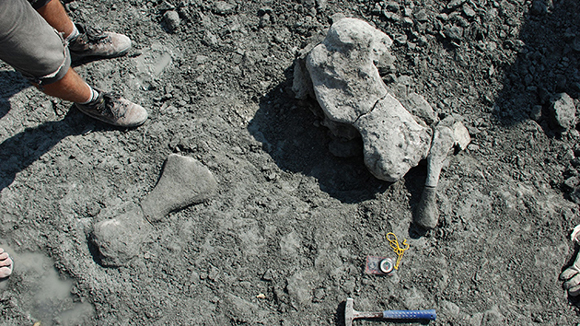
The Massive and Very Robust Limb Bones of Lisowicia bojani

Excavating the giant limb bones of Lisowicia.
The huge fossil limb bones of Lisowicia.  The large bone above the compass is a humerus (upper arm bone), the bone by the feet is a scapula.

Picture credit: Dr Grzegorz Niedzwiedzki (Uppsala University)

CollectA have produced a scale model of Lisowicia bojani: CollectA Deluxe Prehistoric Life.

The discovery of Lisowicia provides the first evidence that mammal-like elephant sized dicynodonts were present at the same time as the more well-known long-necked Sauropodomorpha dinosaurs, contrary to previous belief.  Lisowicia fills a gap in the fossil record of dicynodonts and it shows that some anatomical features of limbs thought to characterize large mammals or dinosaurs evolved also in the non-mammalian synapsid.  Furthermore, these findings from Poland are the first substantial finds of dicynodonts from the Late Triassic in Europe.  Lisowicia is at least 40% bigger than any known dicynodont.

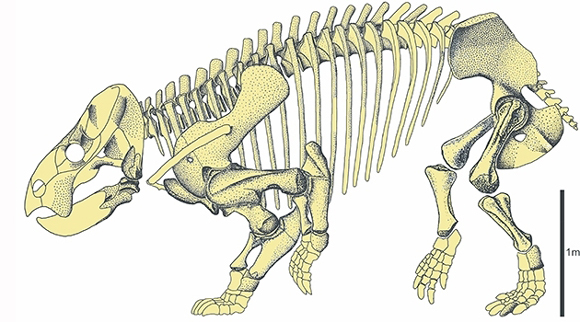
A Skeletal Drawing of Lisowicia bojani (Note Scale Bar)

A reconstruction of the skeleton of Lisowicia bojani.
Skeletal drawing of Lisowicia bojani.  Note the scale bar = 1 metre.

Picture credit: Dr Tomasz Sulej (Polish Academy of Sciences)

Commenting on the significance of the fossil find, Dr Tomasz Sulej remarked:

“The discovery of such an important new species is a once in a lifetime discovery.”

Visit the Everything Dinosaur website: Everything Dinosaur.
22 11, 2018

How Did Some Dinosaur Get Their Long Necks?

By |2023-11-11T12:16:43+00:00November 22nd, 2018|Categories: Dinosaur and Prehistoric Animal News Stories, Dinosaur Fans, Main Page, Photos/Pictures of Fossils|0 Comments

Macrocollum itaquii – Oldest Long-necked Sauropodomorph is Described

A team of scientists based in Brazil have described the fossilised remains of three Triassic dinosaurs that lived some 225 million years ago that shed light on the evolution of long-necks in plant-eating dinosaurs.  The new species, a member of the Sauropodomorpha, has been named Macrocollum itaquii, the genus name comes from the Greek for “long neck”, an appropriate moniker for a prehistoric animal that is helping to unravel the developmental history of the long-necked dinosaurs bauplan.

Macrocollum itaquii

Although Macrocollum is estimated to have measured about four metres in length and weighed approximately 100 kilograms, a lot smaller than later sauropods, some of which were the largest terrestrial animals to have ever lived, it is considerably bigger than older dinosaur fossil specimens found in South America, some of the earliest dinosaurs known, that lived around ten million years earlier and represent some of the very first dinosaurs to evolve.

A Life Reconstruction of Macrocollum itaquii

Macrocollum life reconstruction.
A life reconstruction of the newly described Macrocollum itaquii from southern Brazil.

Picture credit: SWNS

The Rise of the Sauropodomorpha

Despite a number of recent fossil discoveries, palaeontologists have a relatively poor understanding of the rise of the sauropodomorphs, a group that includes some of the most famous of all the dinosaurs, giants such as Diplodocus and Brachiosaurus.

The fossil material, representing three individuals, was collected from the upper portion of the  Candelária Sequence of the Paraná Basin, from a site in Agudo, Rio Grande do Sul (southern Brazil).  Nearby strata have been dated to the Norian faunal stage of the Late Triassic.  Writing in the academic journal “Biology Letters”, the researchers, which included biologist Rodrigo Müller from the Federal University of Santa Maria (Brazil), conclude that these three animals died together and therefore provide the oldest evidence of herding behaviour in sauropodomorphs described to date.

The proposal that the three individuals died together and as such, indicate gregarious behaviour, has been challenged by a number of academics.  It is possible that these three herbivores died at different times and the carcases just happened to be transported and ended up in association.

Commenting upon this, Rodrigo Müller explained:

“There are three articulated skeletons in five tons of rock.  This is unique.  It suggests these animals probably died together, as they share the same degree of disarticulation.  So, if they died together, these dinosaurs probably lived together.”

Long Necks and Long Thigh Bones

Two of the specimens include skull material, the holotype (CAPPA/UFSM (Centro de Apoio à Pesquisa Paleontológica da Quarta Colônia) 0001a), is virtually complete and articulated.  It is one of the best preserved Triassic dinosaur skeletons ever found.  With such exceptionally well-preserved specimens the scientists have been able to conduct an analysis looking at how the long-neck of these types of dinosaurs evolved and study the femur (thigh bone), length to give an indication in the change of body size since the first plant-eating dinosaurs evolved.  In addition, these fossils have shed light on how these animals adapted to a fully herbivorous diet.

Macrocollum Fossil Material Has Helped Shed Light on Important Evolutionary Developments within the Sauropodomorpha

Macrocollum itaquii phylogeny.
Mapping the phylogeny of Macrocollum itaquii.

Picture credit: R T Müller et al in Biology Letters

The table above shows the phylogenetic position attributed to the newly described M. itaquii.  Based on this assessment it has been assigned to the Unaysauridae family, basal members of the Sauropoda, that are known from Triassic-aged rocks from the Southern Hemisphere (India and South America).  The discovery of Macrocollum has helped palaeontologists to gain a better understanding of the evolution of the long-neck of sauropods.  The cervical vertebrae (neck bones) of M. itaquii are already much more elongated than seen in earlier representatives of the Sauropodomorpha known from around 233 million years ago.  The teeth are more spatulate in shape, indicating an adaptation to a plant-eating diet and over this 8 million year period (233-225 million years ago), femora measurements demonstrate that sauropodomorphs increased in size by 230%.

Views of Skull Material Associated with M. itaquii

View of skull material associated with Macrocollum itaquii.
(a) Skull in left lateral view (CAPPA/UFSM 0001a – holotype), (b) Skull in dorsal view (CAPPA/UFSM 0001a – holotype) and (c) part of a skull in ventral view (CAPPA/UFSM 0001b).

Picture credit: R T Müller et al in Biology Letters

The typical long neck was also established,  becoming proportionally twice as long than those necks of basal taxa.  Indeed, the new dinosaur is the oldest-known sauropodomorph with such an elongated neck, suggesting that the ability to feed on high vegetation was a key trait achieved along the early Norian.

Skeletal Reconstruction and Significant Bones Including Elongated Cervical Vertebrae

Macrocollum itaquii - skeletal reconstruction.
Skeletal reconstruction of Macrocollum itaquii.  Known fossil material shaded white, scale bar = 5 cm.  The elongated neck bone is (d).

Picture credit: R T Müller et al in Biology Letters

The species name honours Mr José Jerundino Machado Itaqui, one of the main drivers behind the creation of the Centro de Apoio à Pesquisa Paleontológica da Quarta Colônia and the Federal University of Santa Maria.

To read about the recent discovery of an Early Jurassic sauropod from China (Yizhousaurus sunae), that is helping palaeontologists to learn more about how some types of dinosaur were able to evolve into giants: Helping to Give Sauropod Evolution a Head Start.

To read about a giant Late Triassic sauropodomorph (Ingentia prima): Triassic Dinosaur Just Got a Lot Bigger.

The scientific paper: “An Exceptionally Preserved Association of Complete Dinosaur Skeletons Reveals the Oldest Long-necked Sauropodomorphs” by Rodrigo Temp Müller, Max Cardoso Langer and Sérgio Dias-da-Silva published in Biology Letters.

Visit the Everything Dinosaur website: Everything Dinosaur.
18 11, 2018

Very Rare Dinosaur Fossil Find in Oregon

By |2023-11-11T11:14:12+00:00November 18th, 2018|Categories: Dinosaur and Prehistoric Animal News Stories, Dinosaur Fans, Main Page, Photos/Pictures of Fossils|2 Comments

An Oregon Ornithopod

There may be many famous dinosaurs known from the United States of America, after all, when it comes to naming dinosaurs, Tyrannosaurus rex, Stegosaurus and Triceratops tend to trip off the tongue, but America’s dinosaur fossil heritage is not uniform across the whole country.  Several parts of the U.S. have no record of dinosaur discoveries, and numerous others have a very fragmentary record when it comes to the preserved remains of Dinosauria.  Oregon, the ninth largest State in terms of area, has a very poor dinosaur fossil record, however, a newly described fossil discovery made in the eastern part of the “Beaver State”, has got palaeontologists quite excited about the prospect of more dinosaur fossil finds being made.

The Toe Bone from a Dinosaur (Ornithopoda)

Writing in the “Journal of Vertebrate Palaeontology”, scientists from the University of Oregon in collaboration with the University of Calgary (Canada), have published a paper on the discovery of a single toe bone from a plant-eating dinosaur – an extremely rare find considering that this part of north-western North America was underwater throughout most of the Mesozoic Era.

Various Views of the Single Dinosaur Toe Bone (Pedal Phalanx)

Indeterminate pedal phalanx (Oregon dinosaur).
Views of the single dinosaur toe bone discovered in eastern Oregon.

Picture credit: University of Oregon

The fossil bone was found by University of Oregon Earth Sciences Professor Greg Retallack during field work in 2015, near the town of Mitchell (Wheeler County, eastern Oregon).  The single bone was spotted amongst mollusc fossils exposed on a slope consisting of marine shale.  The fossil dates from the Albian fauna stage of the Cretaceous and is the first ever Oregon dinosaur fossil to be the subject of a paper in a peer-reviewed scientific journal.  Furthermore, it represents the first dinosaur fossil find from Oregon from strata not regarded as Upper Cretaceous.

Oregon might be bigger than the whole of the United Kingdom, but the Mesozoic-aged exposures represent marine sediments, that harbour very few remains of ancient terrestrial animals.

Greg Retallack stated:

“Oregon landscapes are rich with Cretaceous rocks, but they rarely contain the kinds of dinosaur remains we see elsewhere in the United States.  The rocks here are the right age but are mostly from under the sea where dinosaurs did not live or from swamps where dinosaur bones are seldom preserved.”

Not Able to Assign a Genus

Although, identified as a dinosaur bone (pedal phalanx), it is not possible to assign it to a specific species or genus, although the research team are confident that it came from a plant-eating ornithopod dinosaur.

An Illustration of a Typical Ornithopod Dinosaur

Burianosaurus augustai illustrated.
An illustration of a typical member of the Ornithopoda – the basal ornithopod from the Czech Republic – Burianosaurus augustai.

Picture credit: Edyta Felcyn

Co-author of the paper, Edward Davis (University of Oregon), explained that the remains of a terrestrial animal ended up in the mollusc bed, after having been swept out to sea.

He explained:

“It’s a phenomenon we sometimes call “bloat and float”.  That is, the animal died on shore in its terrestrial habitat, then was washed out to sea, where it floated while bloated with decomposition gasses.  Eventually it burst, and only this toe bone was entombed and became a fossil.”

A Sizeable Plant-eating Dinosaur

Although very little taxonomic information can be gained from a single, isolated toe bone, a size comparison with much more complete and better known Cretaceous ornithopods such as Tenontosaurus, suggests that this dinosaur may have been about six to seven metres long and weighed around a tonne.

A spokesperson from Everything Dinosaur commented:

“Although such a fossil find in marine sediments is exceptionally rare, it just goes to show that dinosaurs fossils can be found and if there is one, then there may be more. Many of the Mesozoic-aged rocks in this part of Oregon represent near coastal marine deposits.  Given that dinosaurs would have roamed the land close to the sea for millions of years it is possible that more dinosaur remains might be found.”

To read an article published by Everything Dinosaur in 2015, which looks at which part of the United States are not associated with dinosaur fossils: Washington State the 37th U.S. State with a Dinosaur.

Visit the Everything Dinosaur website: Everything Dinosaur.
14 11, 2018

Fossil Bird from Late Cretaceous Utah – Deepens a Mystery

By |2023-11-11T08:17:50+00:00November 14th, 2018|Categories: Dinosaur and Prehistoric Animal News Stories, Dinosaur Fans, Main Page, Palaeontological articles, Photos/Pictures of Fossils|0 Comments

Mirarce eatoni – Deepens the Mystery Over Late Cretaceous Avian Extinctions

All living birds from Albatrosses to Zebra finches belong to one group of avians – the Neornithes.  Our feathered friends share a number of key anatomical traits that defines them as a group from the smallest such as the Bee Hummingbird to the largest living bird, the Ostrich.  However, back in the Cretaceous, things were very different.  There were several different taxa of birds including the very diverse and highly successful enantiornithines that shared the skies with early members of the neornithines, but only the ancestors of today’s extant birds survived the end-Cretaceous extinction event and that’s a puzzle for palaeontologists.

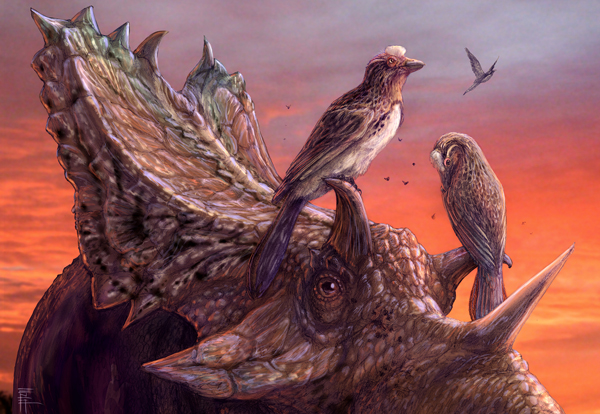
The puzzle has just become a little more complex with the publication of a scientific paper in the on-line, open access journal “PeerJ”.  This paper describes the fossilised remains of an enantiornithine that lived around 75 million years ago, in Utah (USA).  This prehistoric bird, about the size of a Raven, has been named Mirarce eatoni and its fossils show that it was probably a match for most modern birds in terms of its aerial abilities.

Perched on the Horns of a Utahceratops (Mirarce eatoni)

Mirarce eatoni - life reconstruction.
An illustration of the Late Cretaceous enantiornithine Mirarce eatoni.

Picture credit: Brian Engh

This leads to one very intriguing question, if enantiornithines like Mirarce were so advanced, then why after the Cretaceous-Palaeogene mass extinction event did only one group of birds survive?

A Complete Anatomical Description

The fossil material consists of several neck bones (cervical vertebrae), back bones (dorsal vertebrae), the fused caudal vertebrae making up the pygostyle, elements from the limbs, parts of the hips, a partial scapula, coracoid, the furcula (wishbone) and several other fragmentary elements including the radius and ulna.

This represents a veritable treasure trove of North American enantiornithine fossils for palaeontologists to study, most North American members of this taxon are known from very scrappy fossil remains, mostly consisting of isolated fused leg bones and toes.  All in all, about 30% of the total skeleton is known and crucially, unlike most of the more complete enantiornithine specimens from the Lower Cretaceous deposits of China, this specimen, is preserved in three-dimensions, it has not been crushed as flat as a pancake.  The excellent state of preservation and the number of fossil bones has permitted the researchers to undertake a complete anatomical description.

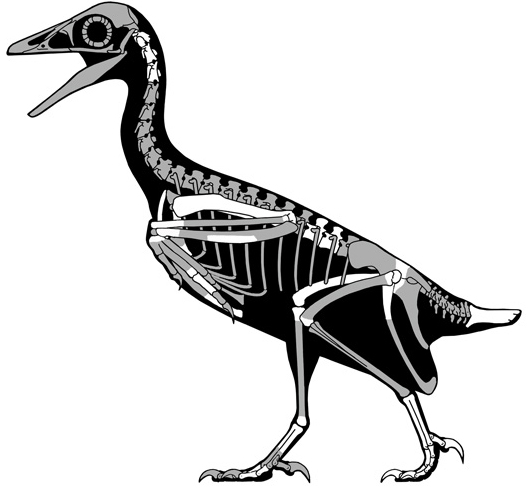
A Skeletal Reconstruction of the Newly Described North American Enantiornithine Mirarce eatoni

Mirarce eatoni skeletal reconstruction.
A skeletal reconstruction of the Enantiornithine Mirarce eatoni from Late Cretaceous Utah.  The bones shaded white represent known fossil material.  Note, cranial material is not known.

Picture credit: Scott Hartman

The “Kaiparowits Avisaurid”

The specimen was originally discovered back in 1992, by University of California, Berkeley palaeontologist Howard Hutchinson, whilst he was exploring Kaiparowits Formation deposits for evidence of turtles.

It was quickly identified as an enantiornithine and ascribed to the Avisauridae family, a family of prehistoric birds known from South America, North America, parts of Europe, Siberia and the Middle East (Lebanon).  The partial skeleton (UCMP 139500), was nicknamed the “Kaiparowits avisaurid”.   Although, its significance was noted, after all, the fossils represent the most complete example of an enantiornithine ever found in North America, it remained undescribed.  All that changed when PhD student Jessie Atterholt (University of California, Berkeley), was given the opportunity to provide a formal scientific description.

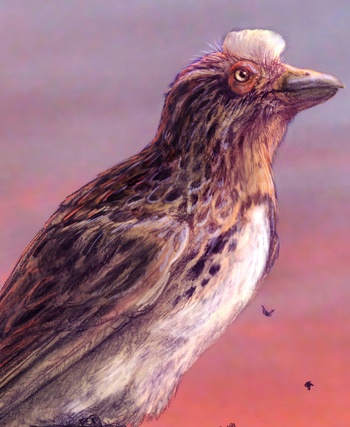
Research Suggests that Mirarce eatoni was a Strong Flier and Well-Adapted to Life in the Late Cretaceous

Mirarce eatoni - life reconstruction.
A close-up view of the newly described Late Cretaceous bird Mirarce eatoni (colouration and plumage speculative).

Picture eredit: Brian Engh

A Strong and Capable Flier

In collaboration with her colleague Howard Hutchinson and with the support of Jingmai O’Connor, from the Chinese Academy of Sciences and an authority on Cretaceous fossil birds, a complete analysis of the fossil bones was undertaken.  This study revealed that M. eatoni possessed several of the same physical adaptations for highly refined powered flight that modern birds (Neornithines) have.

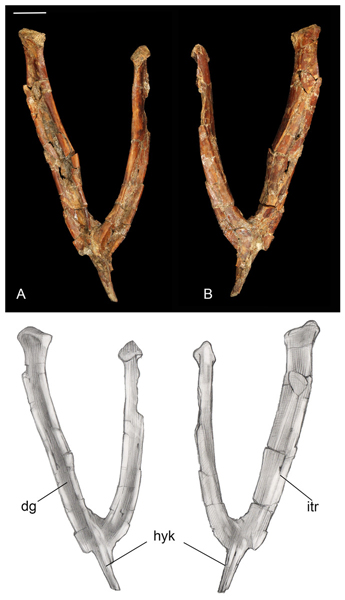
Fossils of Enantiornithines from the Lower Cretaceous of China, birds such as Confuciusornis sanctus show a mix of basal and more advanced anatomical traits.  For example, the breast bone (sternum), of C. sanctus, is relatively small.  Modern birds have a deeply keeled sternum, this allows the attachment of large muscles to aid powered flight.  The wishbone (furcula) of Confuciusornis and most other Early Cretaceous enantiornithines, is little more than a curved bar.  However, the furcula of M. eatoni is shaped much more like the “V-shaped” wishbones of modern birds.  The furcula of Mirarce would have been able to flex and to store energy released during the flapping of the wings.

Commenting on the significance of these anatomical characteristics, Atterholt stated:

“We know that birds in the early Cretaceous, about 115 to 130 million years ago, were capable of flight but probably not as well adapted for it as modern birds.  What this new fossil shows is that enantiornithines, though totally separate from modern birds, evolved some of the same adaptations for highly refined, advanced flight styles.”

The Furcula (Wishbone) of Mirarce eatoni

The furcula of Mirarce eatoni.
Two views of the wishbone (furcula) of Mirarce eatoni (A) dorsal and (B) ventral with line drawings.  Scale bar = 1 cm.

Picture credit: PeerJ

Quill Knobs?

A close examination of the right ulna (lower arm bone), revealed evidence of two roughened patches preserved on the shaft of the bone.  These rough patches were interpreted as being attachment sites for quill knobs, that anchor the wing feathers to the skeleton and to help strengthen the wings for use in active, prolonged, powered flight.  Quill knobs are found in living birds.  This is the first time that such a feature has been seen in an enantiornithine and indicates that Mirarce was, very probably, a strong flier.

Potential Quill Knobs Identified in an Enantiornithine (M. eatoni)

Quill knobs on an Enantiornithine.
Roughed structures on the ulna of Mirarce compared to the quill knobs found on the ulna of a Pelican.

Picture eredit: PeerJ

If these structures are quill knobs, then this suggests that this anatomical trait evolved in parallel with members of the Dinosauria (dromaeosaurids and other maniraptorans along with the ornithomimids) and in parallel with a number of types of prehistoric bird.

How Did Mirarce eatoni Get its Name?

The genus name reflects that fantastic state of preservation of the fossil material (Latin “mirus” for wonderful) and after Arce, the winged messenger of the Titans in Greek mythology.  The trivial name honours Dr Jeffrey Eaton, in recognition of his work studying the vertebrates of the Kaiparowits Formation.  A spokesperson from Everything Dinosaur commented that this prehistoric bird’s name was pronounced “mere-ark-ee ee-tow-eye”.

But Why Did These Advanced Enantiornithines Die Out?

If Late Cretaceous enantiornithines were just as advanced as modern birds, then, why did they die out with the non-avian dinosaurs while the ancestors of modern birds survived the extinction event?

Atterholt, who has moved onto a position of Assistant Professor and human anatomy instructor at the Western University of Health Sciences in Pomona (California), added:

“This particular bird is about 75 million years old, about 10 million years before the die-off.  One of the really interesting and mysterious things about enantiornithines is that we find them throughout the Cretaceous, for roughly 100 million years of existence and they were very successful.  We find their fossils on every continent, all over the world, and their fossils are very, very common, in a lot of areas more common than the group that led to modern birds.  Yet modern birds survived the extinction while enantiornithines go extinct.”

Forest Dwellers Versus Seed Eaters

A number of ideas have been put forward to help explain why some types of birds survived the end-Cretaceous mass extinction event whilst others did not.  For example, one hypothesis proposes that enantiornithines were forest dwellers and when the asteroid strike/volcanism resulted in a dramatic loss of woodland habitats, these types of birds suffered more than other birds that lived in different environments.

The absence of cranial material prevents the researchers from investigating what Mirarce might have eaten.  Most known members of the Enantiornithes had teeth in their beaks and Mirarce supports the idea that these types of birds gradually got larger over time, but what this bird ate remains a mystery.  If it had been a predator of small vertebrates and insects, any major disruption to the food chain could have led to extinction.  However, a paper published in 2016 proposed that birds with toothless beaks such as the early neornithines could have survived the extinction event by eating seeds that persisted in the soil.

To read more about this paper: Seed Eating May Have Helped the Birds Survive.

The scientific paper: “The Most Complete Enantiornithine from North America and a Phylogenetic Analysis of the Avisauridae” by Jessie Atterholt, J. Howard Hutchinson and Jingmai K. O’Connor published in PeerJ.

Visit the award-winning Everything Dinosaur website: Everything Dinosaur.
13 11, 2018

Getting to the Bottom of Ornithischian Teeth

By |2023-11-11T07:52:59+00:00November 13th, 2018|Categories: Dinosaur and Prehistoric Animal News Stories, Dinosaur Fans, Main Page, Palaeontological articles|0 Comments

Scientists Sink Their Teeth into Toothy Dinosaur Problem

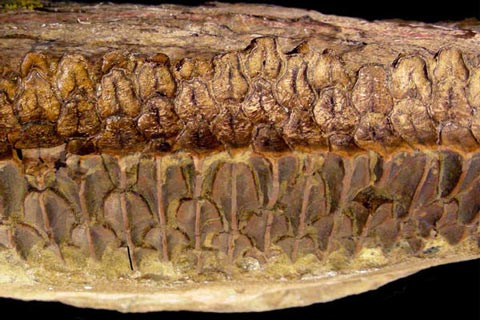
Two of the most successful lineages of ornithischian dinosaurs are the ceratopsians (horned dinosaurs) and the hadrosaurs (duck-billed dinosaurs).  These herbivores dominated the megafauna of many Late Cretaceous environments and one of the reasons for their success was their remarkable dental batteries.  Although horned dinosaurs and duck-bills processed plant food in their mouths differently, (they had different chewing and grinding actions), the rows of teeth permitted these types of plant-eaters to process the toughest vegetation extremely efficiently

The Dental Battery of a Typical Hadrosaurid

Typical Hadrosaur dental battery.
These teeth were made for grinding. The rows and rows of tough teeth in the jaw of a hadrosaurid – the dental battery.

Picture credit: Dr Gregory Erickson

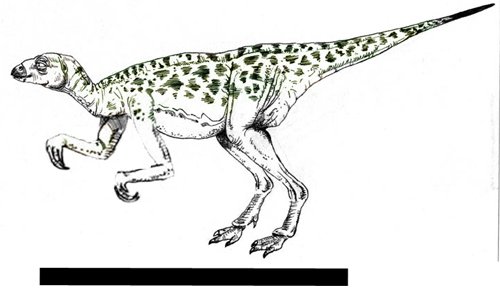
However, the evolution of these dental batteries is poorly understood, so a team of Canadian and Chinese scientists set out to examine how this dentition may have come about.  To do this they examined the teeth morphology and jaws of a little ornithopod from north-eastern China called Changchunsaurus parvus.  This light-weight dinosaur that measured around 1.5 metres in length, is known from several skulls and other postcranial material from Jilin Province (China).

A Life Reconstruction of the Ornithopod Changchunsaurus (C. parvus)

Changchunsaurus Life Reconstruction
An illustration of the Chinese ornithopod Changchunsaurus. Note scale bar = 1 metre. A study of ornithischian teeth. Picture credit: Everyting Dinosaur.

Picture credit: Everything Dinosaur

How Did “Typical” Ornithischian Dentition Develop?

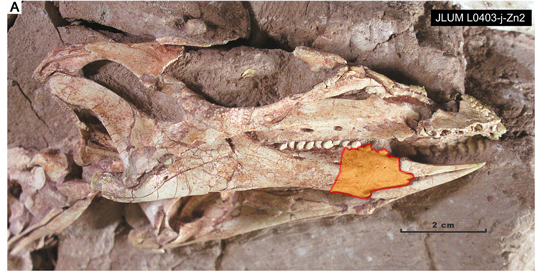
Writing in the academic, on-line journal “PeerJ”, the researchers from Jilin University and the University of Alberta, describe how thin slices were taken from five jaw bones of this dinosaur so that teeth in the jaw could be studied.  In addition, the slices once polished to show their internal structure, would help the researchers determine tooth composition and to see how the teeth are maintained throughout the life of this little dinosaur.  Changchunsaurus makes a good candidate for this type of work, as it is known from numerous skulls (albeit, some of them are quite distorted), and it is regarded taxonomically as being close to origins of the Ornithopoda.

One of the Skulls of Changchunsaurus parvus Used in the Study

The holotype of Changchunsaurus parvus.
Image of the skull of the holotype specimen of C. parvus (JLUM L0304-j-Zn2).  The skull is shown in lateral view and the yellow shaded area indicates the area of the jaw from which the samples were taken.  Scale bar = 2 cm.

Picture credit: Chen et al (PeerJ)

A Unique Method of Tooth Replacement

Among the notable features of Changchunsaurus parvus dentition is a unique method of tooth replacement that allowed this herbivore to recycle teeth without disrupting the continuous shearing surface formed by its tooth rows.  This permitted Changchunsaurus to have an efficient tooth-grinding surface all the time, thus helping it to process tough plant material.  The scientists also discovered that the teeth feature wavy enamel, a tissue type formerly thought to have evolved only in more derived members of the Ornithopoda.  The wavy enamel of Changchunsaurus is the phylogenetically earliest occurrence of this type of tissue known.

A Section of Dentary (Lower Jaw) Sample Along with Cross-sections of Teeth Showing Morphology

Changchunsaurus tooth morphology.
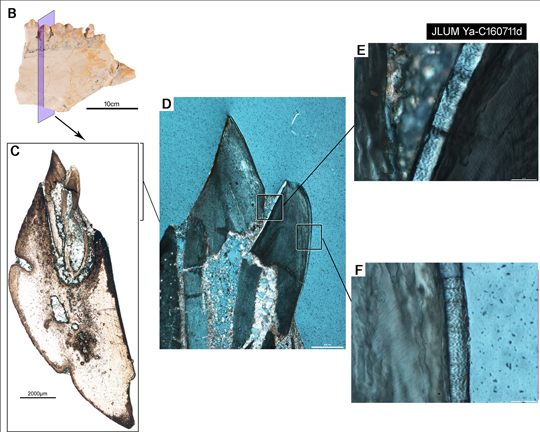
(B) a partial dentary showing the area cross-sectioned and magnified cross-sections of teeth (C to F) identifying teeth replacement and tooth morphology.

Picture credit: Chen et al (PeerJ)

The picture above shows (B), an image of one of the partial lower jaws used in this research.  The purple line shows the plane of sectioning.  A whole view image of one of the thin sections through the lower jaw is shown (C) and (D) shows a magnified view of the process of tooth replacement.  Images (E) and (F) show highly magnified views of identified wavy enamel on the crown of replacement teeth (labial and lingual margins).

Well-adapted to a Diet of Abrasive Plants

Commenting on the significance of this study, lead author Professor Chen Jun stated:

“These tissue-level details of the teeth of Changchunsaurus tell us that their teeth were well-adapted to their abrasive, plant-based diets.  Most surprisingly, the wavy enamel described here, presumably to make it more resistant to wear, was previously thought to be exclusive to their giant descendants, the duckbilled dinosaurs.”

This research contradicts previous interpretations that this type of wavy enamel arose in association with more complex hadrosauroid dentitions.  In view of its early appearance, the research team suggests that wavy enamel may have evolved in association with a shearing-type dentition in a roughly symmetrically-enamelled crown, although its precise function still remains somewhat of a mystery.

The authors suspect these features may have arisen early on in the Ornithopoda as they became adapted to herbivory, having to process tough vegetation.

The scientific paper:

“Tooth Development, Histology, and Enamel Microstructure in Changchunsaurus parvus: Implications for Dental Evolution in Ornithopod Dinosaurs” by Jun Chen , Aaron R. H. LeBlanc , Liyong Jin, Timothy Huang and Robert R. Reisz published in PeerJ.

Visit the Everything Dinosaur website: Everything Dinosaur.
5 11, 2018

Super Efficient Lungs Powered Remarkable Dinosaur Success

By |2024-05-11T06:33:52+01:00November 5th, 2018|Categories: Dinosaur and Prehistoric Animal News Stories, Dinosaur Fans, Main Page, Palaeontological articles|2 Comments

Bird-like Lungs Could Have Helped Dinosaurs to Dominate

There has been a great deal of debate regarding the rise of the Dinosauria.  How and when did these relatively unassuming members of the Dinosauria, which only made up a small proportion of terrestrial biota during the Middle Triassic, rise to dominance, out-competing a host of other reptilian groups?  The respiratory system of dinosaurs could provide a clue.  In a new study published in the open access journal of the Royal Society (Royal Society Open Science), a team of researchers postulate that the lung-air sac system could have helped dinosaurs thrive in Earth’s oxygen-depleted atmosphere.

Did a Super-efficient Pulmonary System Help the Dinosaurs to Thrive?

Dinosaurs probably had a super-efficient respiratory system.
New research suggests super-efficient dinosaur lungs assisted the rise of the Dinosauria.

Picture credit: Chinese Academy of Sciences

Studying the Breathing Systems of Modern Birds and Alligators

Birds have a super-efficient respiratory system that is unique amongst the vertebrates.  However, palaeontologists remain uncertain as to when the avian-style lung evolved.  Did it evolve in dinosaurian ancestors or is it restricted to birds?  After all, if you are going to fly, then you need a very efficient and powerful set of lungs to get enough oxygen to your flight muscles.

This area of anatomy has attracted a great deal of debate.  Recently, Everything Dinosaur reported on a study conducted on a specimen of Archaeorhynchus spathula, a primitive bird (basal member of the Ornithuromorpha), from the Lower Cretaceous of China, that may show preservation of an advanced avian lung.  To read more about this research: Breathing Life into the Bird Lungs Debate.

The scientists, including researchers from the University of Manchester, compared dinosaur lungs to those of living crocodilians and the lungs of extant birds.  Lead researcher, PhD student Robert Brocklehurst (School of Earth and Environmental Sciences, Manchester University), stated:

“The respiratory system of non-avian dinosaurs has been the topic of considerable study over the years, both in an attempt to shed light on the biology of now extinct members of the dinosaur family, and in order to understand the origins and evolution of modern birds and reptiles.”

Low Oxygen Levels in the Triassic and Early Jurassic

Today, our atmosphere contains approximately 21 percent oxygen, however, things have not always been like that.  During the Middle Triassic, through to the Early Jurassic, a time that saw the evolution and the radiation of the Dinosauria, the atmospheric oxygen percentage of our planet fell to around 15-17%.   With less oxygen in the air, a group of vertebrates with more efficient lungs would have had a definite evolutionary advantage over other terrestrial animals.

During the Triassic A Wide Variety of Terrestrial Reptilian Vertebrates Co-existed

The flora and fauna of the Late Triassic.
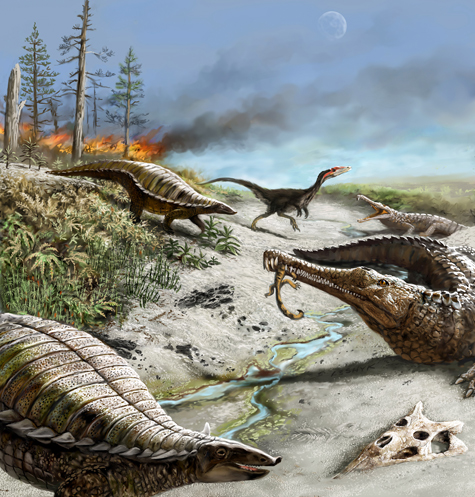
Dinosaurs, aetosaurs, phytosaurs and and rauisuchians co-existed in the Triassic, but did super-efficient lungs help the Dinosauria to become dominant.

Picture credit: Victor Leshyk

Studying the Lungs of the Dinosauria

To investigate the different kinds of respiratory systems the team used Computerised Tomography (CT) scans to look at the lung cavities of four modern crocodilians and twenty-nine modern birds, including the largest living bird today, the ostrich and compared their structure with those of sixteen different dinosaur species.  The detailed scans revealed that all the dinosaurs had vertebrae more similar in shape to those of birds than those of crocodilians.  In addition, the scientists discovered that the dinosaur vertebrae jutted into the lung cavity, the same as found in living birds.

Robert explained:

“We thought some of the dinosaurs would have lungs more like birds, and others would be similar to reptiles, but this wasn’t the case at all.  Every dinosaur sample we scanned just looked like the birds we scanned.”

Dissection Used in this Study

As well as using CT scans, the team removed the lungs of an alligator and an ostrich, and found the skeletal support structures surrounding the lungs were very different in each animal.  The alligator’s lung cavity was smooth and allowed the lungs and other internal organs to glide as they move to pump air in and out while the animal swims.  However, the ostrich lung cavity was found to be furrowed, similar to the anatomical condition found in the dinosaurs.

The scientists concluded that having more efficient bird-like lungs permitted the dinosaurs to adapt and thrive in an oxygen depleted environment, whereas other groups including the the Crurotarsi clade of archosaurs that gave rise to modern crocodiles, struggled.

Commenting on the research, co-author Professor Bill Sellers (Manchester University) added:

“If even the very first dinosaurs to evolve had bird-like lungs, this goes some way to explaining why dinosaurs became the dominant animal species of their time.  Other animal groups simply may not have had lungs as well suited to extracting oxygen from the air.  That simple evolutionary difference may have let dinosaurs rule world.”

An Anatomical Advantage for the Dinosauria

The scientists concluded that respiratory and pulmonary modifications would have provided dinosaurs with more efficient means of oxygen uptake relative to other vertebrates during the environmentally hypoxic conditions which pervaded much of the early part of the Mesozoic.  This anatomical advantage enjoyed by the Dinosauria could thus potentially have contributed to their radiation and dominance over terrestrial ecosystems, which was to last for around 150 million years.

The Lungs of Dinosaurs Helped to Power Their Evolutionary Success

The sophisticated respiratory system of Ingentia prima.
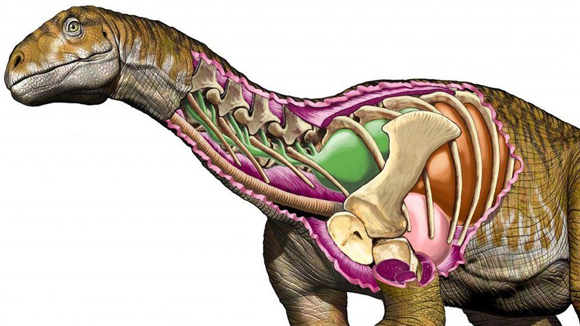
The air sacs of Ingentia prima (green) the lungs shown in brown.  This large, Early Jurassic sauropod had a super-efficient respiratory system.

Picture credit: Jorge A. González

Everything Dinosaur acknowledges the assistance of a press release from Manchester University in the complilation of this article.

The scientific paper: “Vertebral Morphometrics and Lung Structure in Non-avian Dinosaurs” by Robert J. Brocklehurst, Emma R. Schachner and William I. Sellers published in Royal Society Open Science.

Visit the user-friendly Everything Dinosaur website: Everything Dinosaur.
4 11, 2018

A New Species of Rebbachisaurid is Named

By |2023-11-06T09:12:22+00:00November 4th, 2018|Categories: Dinosaur and Prehistoric Animal News Stories, Dinosaur Fans, Main Page, Photos/Pictures of Fossils|2 Comments

Lavocatisaurus agrioensis – A New Long-Necked Dinosaur from Argentina

A team of palaeontologists from Argentina and Spain have announced the discovery of a new species of long-necked dinosaur from the Early Cretaceous of Argentina.  The dinosaur, represented by a set of bones that indicate the remains of at least three individuals, has been named Lavocatisaurus agrioensis and it will help to shed more light on a rare and enigmatic group of sauropods known as the rebbachisaurids.

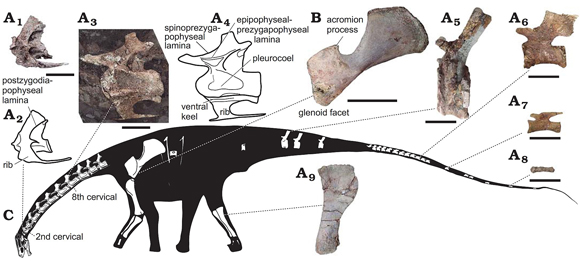
A Skeletal Reconstruction and Photographs of Key Fossils from L. agrioensis

Skeletal reconstruction and fossil bones attributed to Lavocatisaurus agrioensis.
Skeletal reconstruction based on the holotype and paratype specimens of Lavocatisaurus agrioensis.  Scale bars = 10 cm.

Picture credit: AFP/Agencia CTYS

The picture above shows the skeletal drawing of the adult dinosaur with illustrations of key bones from the excavation.  Most of the neck and the skull has been recovered.  Cranial fossils associated with the Rebbachisauridae are rare, the discovery of these specimens from Agrio del Medio (Neuquén Province, Argentina) will help scientists to better understand taxonomic relationships amongst members of this sauropod family, largely associated with Gondwanaland fossil deposits.

Fossils of a Family Group?

Writing in the journal “Acta Palaeontologica Polonica”, the scientists report the discovery of one large, presumably adult animal with two smaller sub-adults found in association.  The fossil material come from terrestrial sandstone deposits laid down around 110 million years ago (Aptian to Albian faunal stage of the Early Cretaceous), in an arid environment with isolated oasis and other water sources (Rayoso Formation).

One of the authors of the scientific paper, José Luis Carballido, of the Egidio Feruglio Museum (Argentina), stated:

“We found most of the cranial bones: the snout, the jaws, a lot of teeth, also the bones that define the eye sockets for example and in that way, we were able to create an almost complete reconstruction.  Not only is this the discovery of a new species in an area where you wouldn’t expect to find fossils, but the skull is almost complete.”

Lavocatisaurus agrioensis

The fossils represent one large dinosaur estimated to be around twelve metres in length and two smaller animals around six to seven metres in length.  The research team postulate that this could represent a family group that lived together and perished together, perhaps unable to find a water source in a time of drought.

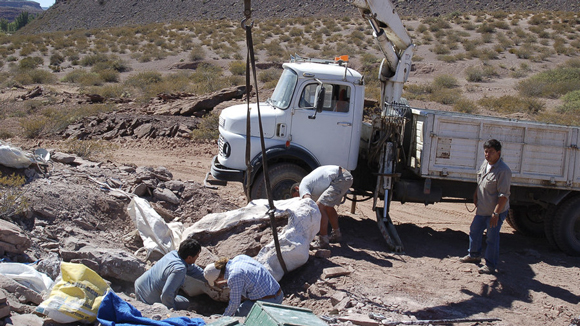
Preparing to Move Some of the Fossil Material (Lavocatisaurus)

Fossils of Lavocatisaurus are prepared for removal.
The jacketed remains of one of the Lavocatisaurus specimens is prepared for transport away from the dig site.

Picture credit: AFP/Agencia CTYS

Lead author of the paper, José Ignacio Canudo (Zaragoza University, Spain) added:

“This discovery of an adult and two juveniles also signifies the first record of a group displacement among the Rebbachisaurus dinosaurs.”

The Rebbachisauridae Family

The Rebbachisauridae family of sauropods are a group of basal members of the Diplodocimorpha clade that includes more famous Late Jurassic dinosaurs such as Diplodocus, Apatosaurus and Brontosaurus.  The rebbachisaurids are known from both Lower Cretaceous and Upper Cretaceous strata and had a wide geographical distribution throughout Gondwana and southern Laurasia with fossils reported from north and central Africa as well as South America and Europe (Spain).

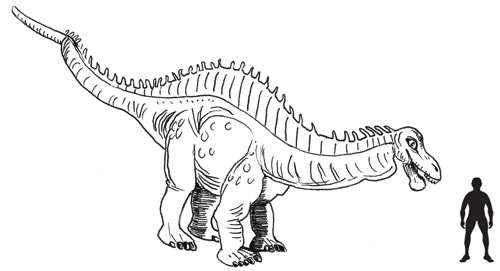
An Illustration of a Typical Rebbachisaurid Dinosaur (R. garasbae)

Rebbachisaurus scale drawing.
Scale drawing of Rebbachisaurus (R. garasbae). Picture credit: Everything Dinosaur.

Picture credit: Everything Dinosaur

Visit the Everything Dinosaur website: Everything Dinosaur.
Go to Top