All about dinosaurs, fossils and prehistoric animals by Everything Dinosaur team members.

Fossil finds, new dinosaur discoveries, news and views from the world of palaeontology and other Earth sciences.

24 06, 2015

New Sauropodomorph Dinosaur from South Africa

By |2023-03-31T18:36:40+01:00June 24th, 2015|Categories: Dinosaur and Prehistoric Animal News Stories, Dinosaur Fans, Main Page|0 Comments

Sefapanosaurus – Another Piece in the Dinosaur Jigsaw Puzzle

Yet another example of a new genus of dinosaur found lurking in a museum collection, this time from South Africa.  Team members at Everything Dinosaur often state that one of the best places to find a new dinosaur species is not out in the field but by re-examining fossil material already within a museum’s collection.  New techniques have enabled palaeontologists to gain a much better understanding of known fossils, many of which might have been excavated and prepared decades earlier.

New South African Sauropodomorph

As the number of dinosaur discoveries grows, so scientists can use new fossil finds to compare and contrast already studied specimens, this can provide fresh insight and help to place a museum specimen into a wider context within the Dinosauria.

That’s exactly what happened in the case of the newly described sauropodomorph dinosaur named Sefapanosaurus zastronensis.   The team of South African and Argentinian palaeontologists who made this discovery, re-classified the fossils, which had been thought to represent another South African Sauropodomorph called Aardonyx (A. celestae).  Aardonyx had been named and described six years ago.

To read Everything Dinosaur’s article announcing the discovery of Aardonyx celestae: New Basal Sauropod Described.

Sefapanosaurus zastronensis

Researchers from South Africa’s University of Cape Town, the University of Witwatersrand, Museo de La Plata (Argentina) and Museo Paleontológico Egidio Feruglio (also Argentina) have published a scientific paper about this new dinosaur in the Zoological Journal of the Linnaean Society.  It is hoped that S. zastronensis will help palaeontologists to better understand the phylogenetic relationships between basal Sauropodomorpha and their spread and diversity during the Late Triassic/Early Jurassic.

A Reconstruction of Sefapanosaurus zastronensis

The bones shaded in grey represent actual fossil material.

The bones shaded in grey represent actual fossil material.

Picture credit: University of Witwatersrand

At Least Four Individual Animals Represented

The fossils represent at least four individuals and consist of post cranial material (limb bones, foot bones and some vertebrae) and they were found back in the 1930s and resided in the collection of the Evolutionary Studies Institute (University of Witwatersrand).  The Evolutionary Studies Institute houses the largest fossil collection in Africa, there are over 30,000 catalogued plant fossils and approximately 6,000 fossils from the Karoo Basin, most of the fossils originate from Africa, but there are a number of important specimens from elsewhere in the world housed at the Institute.

The Sefapanosaurus fossils were excavated from the Upper Elliot Formation (Zastron locality), the strata in this area dates from the very end of the Triassic to the beginning of the Jurassic geological period.   The fossils are estimated to be around 200 million years old and they were located more than one hundred miles south of where the Aardonyx celestae fossils were found.

Studying the Ankle Bones

One of the most distinctive features of this dinosaur are the ankle bones (astragalus), they are shaped like a cross.  This unique autapomorphy (distinct anatomical feature), accounts for this dinosaur’s name.  The genus name comes from the word “sefapano” in the local Sesotho dialect, it means “cross”.  The species name honours the small agricultural town of Zastron, which is close to where the fossils were found.

The Incomplete Left Foot (Pes) showing the Ankle Bones (Proximal View)

Holotype fossil material (386) showing ankle bones.

Holotype fossil material (386) showing ankle bones.

Picture credit: University of Witwatersrand with additional annotation from Everything Dinosaur

Tall Ascending Process of the Astragalus

One of the unique morphologies found in the fossil bones is the tall ascending process of the astragalus (ankle bone).

Anusuya Chinsamy-Turan (University of Cape Town), one of the co-authors of the scientific paper stated:

“The discovery of Sefapanosaurus shows that there were several of these transitional early sauropodomorph dinosaurs roaming around southern Africa about 200 million years ago.”

A subsequent phylogenetic analysis of basal sauropods from South American and southern Africa places Sefapanosaurus within the group of sauropodomorphs more closely related to sauropods than to the genus Massopondylus (Sauropodiformes).

Filling a Gap in Sauropod Evolution

Argentinian palaeontologist and lead author, Dr Alejandro Otero, explained that Sefapanosaurus helps to fill in the gap between the earliest Sauropodomorphs and the gigantic sauropods that are so well known, dinosaurs such as Brontosaurus, Apatosaurus, and Brachiosaurus from the Late Jurassic.

Everything Dinosaur stocks a large range of sauropod models in the Mojo Fun range of figures.  To view the Mojo Fun range of prehistoric animal models: Mojo Fun Prehistoric Animal and Extinct.

“Sefapanosaurus constitutes a member of the growing list of transitional sauropodmorph dinosaurs from Argentina and South Africa that are increasingly telling us how they diversified.”

A Diverse Early Jurassic Biota

The discovery of Sefapanosaurus and other recent dinosaur fossil finds in the Southern Hemisphere reveals that the diversity of plant-eating dinosaurs in Africa and South America was remarkably high in the Early Jurassic, a time when these two continents were joined together as part of a single super-continent known as Gondwana.

A picture of the Right Scapula (shoulder blade)

Scale bar =

Scale bar = 8cm

Picture credit: University of Witwatersrand
23 06, 2015

Early European Had Close Neanderthal Ancestor According to New Study

By |2024-05-05T14:18:17+01:00June 23rd, 2015|Categories: Dinosaur and Prehistoric Animal News Stories, Main Page, Teaching|0 Comments

Early Modern European Humans Interbred with Neanderthals

The very last of the Neanderthals may have died out some 28,000 years ago but their legacy lives on as the modern human genome (Homo sapiens) contains traces of Neanderthal genetic material.  The Neanderthals (Homo neanderthalensis) are the closest related species to our own, we share a common ancestor but this fact alone does not account for the one to three percent contribution to the genome of Eurasians, scientists believe that some time in the recent past these two species interbred.  It seems that interbreeding between these two related species may have taken place much more recently than previously thought.

A new scientific paper published in the journal “Nature” reports on the study of an ancient human jawbone, this research suggests that interbreeding took place as recently as some 40,000 years ago.

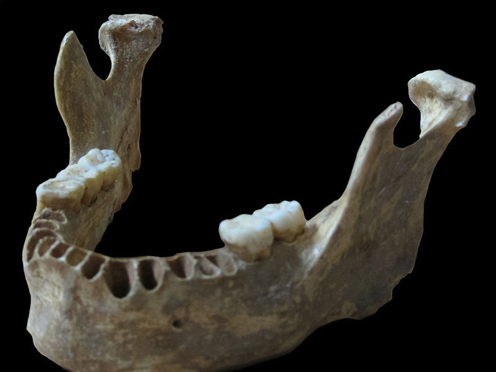
The Ancient Human Jawbone Used in the Genetic Study

DNA analysis reveals very recent Neanderthal ancestor.

DNA analysis reveals a very recent Neanderthal ancestor.

Picture credit: Max Planck Institute for Evolutionary Anthropology/Svante Pääbo

Robust Human Jawbone

A robust human mandible was discovered in a cave system close to the town of Anina in south-western Romania back in 2002.  The cave contains a huge amount of mammal bones including large numbers of Cave Bears (Ursus spelaeus) which probably used one of the chambers in the cave system as a hibernation den.  The explorers found that a number of bones had been placed on nearby rocks, this suggested human activity and sure enough, the remains of early modern humans were found.  A beautifully preserved human jawbone (mandible) and part of a skull were discovered.

Radiocarbon dating estimates that the jawbone is around 37,800 years old, making these fossil materials the oldest modern human bones to have been found in Europe.  The cave, was called the “Peștera cu Oase”, which translates from the Romanian to mean “the cave of bones”.

Even if more conservative dating methods are used, the human remains come out at between 37,000 and 42,000 years old.  The jaw is definitely H. sapiens as it shows a number of modern human morphologies including a prominent chin.  However, a genetic analysis carried out by an international team of researchers which included scientists from Harvard Medical School, the Max Planck Institute of Evolutionary Anthropology and the Chinese Academy of Sciences, indicates that between six to nine percent of this person’s genome originates from Neanderthals.  This is far greater than any other human sequenced to date.

Neanderthal Ancestor

As large segments of this individual’s chromosomes are Neanderthal in origin, it suggests that a Neanderthal was among this person’s most recent ancestors, perhaps just four to six generations back in this Romanian’s family tree.  This new study provides substantial evidence that the first modern humans that arrived in Europe interbred with local Neanderthals.

Put simply, the person whose jawbone was found in the cave may have had a Neanderthal great grandparent!

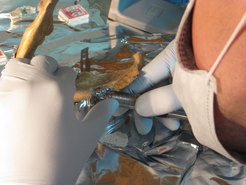
A Researcher Carefully Extracts Fragments of Bone for the DNA Analysis

For their analysis the researchers used 35 milligrams of bone powder from the jawbone.

For their analysis the researchers used 35 milligrams of bone powder from the jawbone.

Picture credit: Max Planck Institute for Evolutionary Anthropology/Svante Pääbo

Homo sapiens bred with Homo neanderthalensis

A previous study had suggested that early modern humans migrating out of Africa mixed with Neanderthals in the Middle East between 50,000 and 60,000 years ago.  Modern humans spread eastwards into Asia and westwards into Europe.  Eventually, it was our species that spread to all parts of the world, the last of the Neanderthals dying out around 28,000 years ago.

One of the lead authors of the report Qiaomei Fu (Chinese Academy of Sciences), stated:

“The data from the jawbone imply that humans mixed with Neanderthals not just in the Middle East but in Europe as well.”

Svante  Pääbo (Max Planck Institute for Evolutionary Anthropology), added:

“It is such a lucky and unexpected thing to get DNA from a human who was so closely related to a Neanderthal.”

Removing the Contaminating DNA

The research team had to very carefully sift out all the contaminating DNA before being able to assess the presence of remnants of Neanderthal genetic material.  Most of the contamination was caused by microbial DNA in contact with the bone whilst it was in the cave, most of the hominin DNA recorded came from researchers who had handled the fossil bone.

Only a very tiny proportion of the genetic material analysed could be traced back to its Neanderthal origins.

The robust jaw and teeth do show some Neanderthal morphologies, this is to be expected given the close relatedness of this person to H. neanderthalensis.  The scientists hope to continue their studies and identify more Neanderthal genetic material from ancient human remains.  This will help them map potential Neanderthal/human interactions across Europe and Asia.

20 06, 2015

New Study Suggests Sixth Mass Extinction Phase

By |2024-05-05T14:18:40+01:00June 20th, 2015|Categories: Dinosaur and Prehistoric Animal News Stories, Educational Activities, Main Page, Teaching|1 Comment

Our Planet is Entering New Mass Extinction Phase

A team of international scientists based in the United States and Mexico have published a report declaring that a sixth mass extinction event is well under way and our species is running out of time to reverse this trend through conservation efforts.  Everything Dinosaur team members have written a number of articles on this blog about reports detailing the current rate of extinctions being recorded and the irreversible loss of ecosystems and biota.

Sixth Mass Extinction

This latest research takes a more conservative approach to calculating species loss than many earlier studies and this study focuses on the impact on vertebrates.  Even so, the team conclude that animals with back bones are becoming extinct more than 114 times faster than the “normal”, background extinction rate.

Scientists from Universidad Nacional Autónoma de Mexico, (Mexico), the University of California, Stanford University, Princeton University and the University of Florida state that the Earth is entering the sixth great mass extinction event, some sixty-five million years after the fifth mass extinction which ended the reign of the dinosaurs.

Report States This is the Greatest Extinction Phase Since the Demise of the Dinosaurs

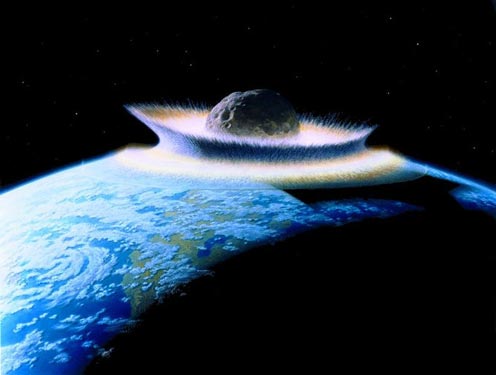
Cataclysmic impact event that led to the extinction of the dinosaurs.

Cataclysmic impact event that led to the extinction of the dinosaurs.

Picture credit: Don Davis commissioned by NASA

Mass Extinctions Recorded in the Fossil Record

The fossil record suggests that there have been five major extinction events in the Phanerozoic Eon which represents the last 545 million years or so of our planet’s history.  The term Phanerozoic is derived from the Greek, for “visible life”, this reflects that the preserved fossilised remains of organisms become much more plentiful in rocks dated from 545 million years ago and younger.

Over this huge amount of time, there have always been extinctions.  Scientists are aware of the fact that there is a “background” level of extinction, but in this new research, the scientist report that amongst vertebrates the current trends suggest extinction rates 114 times faster than normal.

A Table Showing the Five Previous Mass Extinctions

Mass Extinction in Summary

Table credit: Everything Dinosaur

For model and replicas of prehistoric animals: Dinosaur Models and Prehistoric Animal Figures.

Scientists Comment on the Sixth Mass Extinction Event

Gerrado Ceballos, (Universidad Nacional Autónoma de Mexico), lead author of the paper, that has just been published in the academic journal “Science Advances” commented:

“We are now entering the sixth great mass extinction event.  If it is allowed to continue, life would take many millions of years to recover and our species itself would likely disappear early on.”

The report concludes that since 1900, more than four hundred species of vertebrates have died out.  Such a loss would normally occur over 10,000 years if extinction rates were at the normal, background level.

The rapid loss of biodiversity is put down to the effect of an increasing human population on our planet.   The number of humans living on our planet is estimated to have been around 1.9 billion in 1900, today, the human population is estimated to be around 7.325 billion, an increase of 385% over the last one hundred and fifteen years.  The expansion of urban populations, pollution, loss of habitats, deforestation and climate change are some of the reasons for the dramatically increasing loss of vertebrates according to the paper’s authors.

Key Vertebrate Species Dying Out

With the disappearance of key vertebrate species from an ecosystem, the other components such as insects and plant life will also be affected.   The report states that beneficial insects such as pollinating bees could be lost to humanity within three human generations.  The loss of these pollinators would have a huge impact on human food resources and place our own species Homo sapiens very much under threat.

To read an article written in 2014 about potential mass extinctions: Heading for a Sixth Mass Extinction?

The number of global mass extinction events preserved in the fossil record has been challenged recently.  Back in April of this year, Everything Dinosaur reported on a new study that suggested that there had been an additional, major extinction event around 260 million years ago in the Permian.  This extinction phase preceded the End Permian extinction event that is believed to be the most devastating extinction known from the Phanerozoic.  Some 95% of all life is believed to have died out.

To find out more: A Sixth Mass Extinction Event?

19 06, 2015

Woman Killed by Rock Fall at Popular Fossil Hunting Location

By |2023-03-31T08:03:10+01:00June 19th, 2015|Categories: Dinosaur and Prehistoric Animal News Stories, Main Page, Press Releases|0 Comments

Fatal Accident at Llantwit Major (South Wales)

A twenty-four year old woman has been killed after a rock fell on her at Llantwit Major, Vale of Glamorgan (South Wales).  The accident happened yesterday evening and emergency services were called to this popular walking and fossil hunting location just before 5.30pm. A spokesperson for the Welsh ambulance service stated that they had received a report of an incident where a rock from the cliffs had fallen on a person’s head.

Unfortunately, the impact proved fatal and the woman was pronounced dead at the scene.  The cliffs are extremely dangerous and there are numerous signs posted up along the beach warning visitors of the potential hazards.

Very Dangerous Cliffs along the British Coast

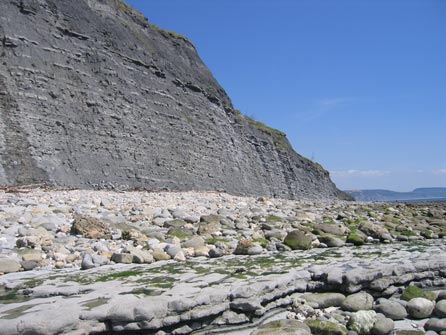
Lyme Regis at low tide.

Good idea to go fossil collecting on a falling tide and to keep away from the steep cliffs.  There are some very dangerous cliffs along the British coast.

Picture credit: Everything Dinosaur

Rock Fall

Each year, the beautiful beaches to be found in this part of south Wales attract thousands of visitors, many of whom are keen to explore the area looking for fossils.  There are a lot of different types of fossil to be found, including giant gastropods and numerous bivalves.

Occasionally, vertebrate fossils can be discovered, fish scales and teeth as well as isolated bones from marine reptiles.  The blue lias rocks date from the Early Jurassic and they are approximately 200 million years old.

A spokesperson from Everything Dinosaur stated:

“This is very sad news.  We will soon be at the height of the holiday season with thousands of tourists flocking to locations such as the Vale of Glamorgan, Ravenscar and the Dorset coast.  However, many of the cliffs at these places which are so popular with tourists, are extremely dangerous.  Rock falls and land slips are very common around the Lyme Regis and Charmouth areas for example and we urge all visitors to heed the warning signs and to stay away from cliffs.”

Dangerous Cliffs Around Britain’s Coasts

Back in 2012, Everything Dinosaur reported on a fatal accident that took place at Hive Beach (near Bridport, Dorset), this latest terrible incident demonstrates that care and precaution must be taken at all times and visitors to locations such as Llantwit Major are urged to stay clear of the cliffs.

If you are looking for fossils, Everything Dinosaur advises that visitors limit their searches to the rocks along the foreshore and the shales exposed on the beach away from the cliffs.  Fossils are being constantly eroded onto the beach and there are always plenty of specimens to find.

The Fossil Collecting Code

Our team members are happy to provide advice and guidance to fossil hunters, in addition, we wrote an article a few years ago now that provided hints and safety tips for fossil hunters.

To read Everything Dinosaur’s tips on safe fossil collecting: Fossil Collecting Code – Safety Tips.

The accident occurred just a few miles to the west of Lavernock Point, it was at Lavernock Point that the fossilised remains of an Early Jurassic meat-eating dinosaur were discovered in 2014.   These fossils have just been put on display at the National Museum of Wales.  This exceptional fossil find might persuade more people to visit these sites along the Welsh side of the Bristol Channel, whilst fossil hunting can be a wonderful hobby, all the team members at Everything Dinosaur strongly urge that visitors take great care and that they do not approach the cliffs. No fossil collecting should be attempted from the cliffs themselves or any adjacent scree slopes.

16 06, 2015

Extreme Equatorial Climates Slowed the Rise of the Dinosaurs

By |2023-03-30T22:09:01+01:00June 16th, 2015|Categories: Dinosaur and Prehistoric Animal News Stories, Dinosaur Fans, Geology, Main Page|0 Comments

Climate of the Tropics too Unstable for the Dinosaurs to Dominant in the Late Triassic

The vast majority of the reptile species found today are confined to the tropics.  However, a new study undertaken by an international team of researchers suggests that during the Late Triassic as one group of reptiles came to dominate the land, the dinosaurs, they struggled to gain a foothold in the tropics due to extreme climate fluctuations.

Dramatic swings in the equatorial climate from wet and humid to extremely hot and dry checked the evolutionary development of the Dinosauria.  Such conditions may be repeated in equatorial regions in the very near future due to increased amounts of carbon dioxide in the atmosphere as a result of global warming.  What slowed the rise of the dinosaurs, could provide our species Homo sapiens with a viable model of what lies in store for us.

The Late Triassic of New Mexico

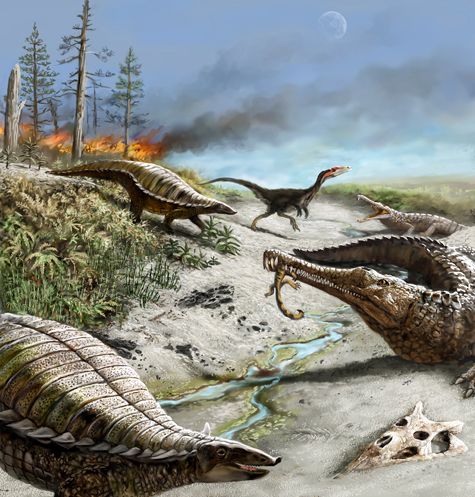
The Flora and Fauna of the Late Triassic (Ghost Ranch, New Mexico)

Dramatic climate changes from very wet to very dry conditions limited the range of large, herbivorous dinosaurs.

Dramatic climate changes from very wet to very dry conditions limited the range of large, herbivorous dinosaurs.

Picture credit: Victor Leshyk

The picture above shows a typical scene representing the flora and fauna of the Late Triassic (Ghost Ranch, New Mexico).  Thick forests of primitive ,drought resistant conifers, araucaria, redwoods and podocarps dominate the landscape.  Armoured aetosaurs (foreground and background) would have grazed upon ferns, club mosses and horsetails, whilst phytosaurs, which superficially resemble modern-day crocodiles, would have hunted small animals and mammal-like reptiles.

The vast majority of dinosaur fossils associated with the Ghost Ranch location (Chinle Formation), relate to small, theropod dinosaurs.

Late Triassic Equatorial Dinosaur Puzzle

What has troubled the curiosity of palaeontologists, is why so very little evidence of larger plant-eating dinosaurs have been found in rock formations that represent deposits laid down close to the Equator?  The first dinosaurs might have evolved some 240 million years ago, perhaps slightly earlier.  Although, the fossil record is far from complete, it is likely the first dinosaurs lived in the Southern Hemisphere.

Over the next thirty million years or so, the Dinosauria gradually diversified and spread.  At this time in our planet’s history, most of the landmasses were joined together to form a single, super-sized land mass (Pangaea or Pangea).  Fossils of sauropodomorphs have been found in Late Triassic strata from northerly as well as southerly latitudes but very few fossils of big, herbivorous dinosaurs have been found from locations that would have been close to the Equator.

The Ghost Ranch Fauna

Small-bodied, meat-eaters are found, although they do not make up a huge proportion of the total fauna, least not until the latter stages of the Triassic, but there is very little evidence to suggest the presence of large, plant-eating sauropodomorphs.

To read about the recent discovery of a new type of meat-eating, theropod dinosaur from the south-western United States: New Theropod Dinosaur Discovery Provides Evidence of Meat-Eating Dinosaur Diversification.

A Map of the World in the Late Triassic

The position of the continents during the Late Triassic.

The position of the continents during the Late Triassic.

Picture credit: North Arizona University with additional annotations by Everything Dinosaur

The map shows the approximate location of the Ghost Ranch site (New Mexico, USA), which during the Late Triassic lay close to the Equator.

The Rise of the Dinosaurs

To help understand the why certain types of dinosaur may have struggled to survive in the tropics, an international team of scientists, including researchers from the University of Southampton, have created a remarkably detailed picture of the ecology and climate of the famous Ghost Ranch fossil site (New Mexico).

The colourful rock layers preserved in this part of south-western United States represent a series of continental deposits, consisting mainly of sandstones and shales.  They date mostly from the Late Triassic (Carnian and Norian faunal stages).  The research team sampled different layers and used these samples to identify microscopic trace fossils such as plant pollen and fern spores.

Changing Plant Populations over Time

This provided the researchers with some understanding of the changing plant populations over time.  This data was correlated with the work of organic geochemist Jessica Whiteside (Southampton University), who analysed carbon isotopes preserved in the rocks.

Dr Whiteside identified repeated highs and lows in the amount of “heavy” carbon-13 that was recorded, signs of major changes in the ecology of the area over time.  These peaks and troughs lined up with changes in the composition of the fossil pollen and fern spores preserved  This suggests that there were wild and dramatic climate swings leading to a flipping of floras, between a dominance of water loving species suited to a humid, warm and wet environment and those species that thrived when the climate became much more arid.

Dr Whiteside Taking Samples for Isotope Analysis

Researchers Jessica Whiteside and Maria Dunlavey taking rock samples for analysis of the isotopic signature of organic carbon at Ghost Ranch, New Mexico. These data help reconstruct ecosystem productivity and environmental changes in the Triassic.

Researchers Jessica Whiteside and Maria Dunlavey taking rock samples for analysis of the isotopic signature of organic carbon at Ghost Ranch, New Mexico. These data help reconstruct ecosystem productivity and environmental changes in the Triassic.

Picture credit: Randall Irmis

Rapid Changing Environments

Commenting on the implications of this part of the study, Dr Whiteside stated that this see-sawing between wet and dry environments occurred as atmospheric carbon dioxide levels rose from around 1,200 part per million in the oldest rocks sampled up to 2,400 parts per million in the youngest rocks included in the study.  These levels are well in excess of the current CO2 levels in our atmosphere (400 parts per million), but as global warming occurs and the amount of green house gases like carbon dioxide in the atmosphere increases, then we too, are likely to experience much more extremes in world weather.

Ian Glasspool, a specialist in studying ancient plant remains, examined the layers of charcoal that could be found in those sediments associated with the drier, hotter climate.  These are the remains of trees that were caught up in forest fires that periodically swept through this part of the world in the Late Triassic.  He measured the reflectiveness of the charcoal to estimate the intensity of the wildfires that had occurred.

Hot and Intense Forest Fires

The suggestion is that, the greater the amount of fuel available for a fire to consume, then the greater the heat generated.  The biomass available to burn would be directly related to dry conditions, the drier the climate the greater likelihood of very hot forest fires due to the presence of so much combustible material.

The evidence from the charcoal samples support the idea of a tropical climate swinging violently from extremes.  Severe droughts and forest fires would have continually reshaped the vegetation available for plant-eating dinosaurs.  Perhaps the large bodied, sauropodomorphs, with their much greater food demands compared to other plant-eating reptiles, were not able to cope with the changes in the flora.

 The Field Team Excavating Vertebrate Fossils

A field team excavating vertebrate fossil remains (Ghost Ranch).

A field team excavating vertebrate fossil remains (Ghost Ranch).

Picture credit: Randall Irmis

Note the clearly defined bands of different rocks which is a hall mark of the Chinle Formation.  The layers represent different deposition environments, the red sandstones are coloured due to the amount of iron minerals that they contain.  In the published academic paper that outlines this research, the scientists conclude that extreme climate fluctuation led to ecosystem instability in the tropics, which in turn suppressed the rise of the large, plant-eating dinosaurs in these regions.

Warm-blooded versus Cold-blooded

This new study may go some way to explain why fossils of small theropod dinosaurs are found amongst the vertebrate fossil assemblage, but the remains of large sauropodomorphs are extremely rare.  Although this new research provides a fascinating insight into an prehistoric ecosystem, it throws up some intriguing but controversial ideas.

The scientists postulate that these extreme climates prevented large, active, warm-blooded herbivorous dinosaurs from becoming established in sub-tropical low latitudes until much later in the Mesozoic.  It is suggested that the higher metabolic rates of plant-eating dinosaurs which were endothermic or had a form of endothermy (warm-bloodedness), prevented them from getting a foothold.  They would have needed greater amounts of food to sustain them when compared to the other types of, presumably, cold-blooded reptile that did live in those regions.

The debate over dinosaur metabolism is not resolved and even if the majority of the Dinosauria were endothermic or even mesothermic (a combination of cold-blooded and warm-blooded features), the early long-necked dinosaurs and their descendants, the Sauropoda, may have been entirely ectothermic.

The Femur of a Small Meat-Eating Theropod Dinosaur Excavated by the Researchers

A fossilised dinosaur thigh bone (Ghost Ranch), only small dinosaurs were present close to the Equator.

A fossilised dinosaur thigh bone (Ghost Ranch), only small dinosaurs were present close to the Equator.

Picture credit: Randall Irmis

The small scribe provides a simple scale.  The distal end of the femur is towards the left of the photograph.

To read a short article about another early meat-eating dinosaur from the Ghost Ranch site: Buck Toothed Vicious Dinosaur Daemonosaurus chauliodus.

13 06, 2015

Valley of the Whales – Basilosaurus Fossil Discovery

By |2023-03-30T18:54:40+01:00June 13th, 2015|Categories: Dinosaur and Prehistoric Animal News Stories, Dinosaur Fans, Main Page|0 Comments

Scientists Study Nearly Complete Basilosaurus Fossil 

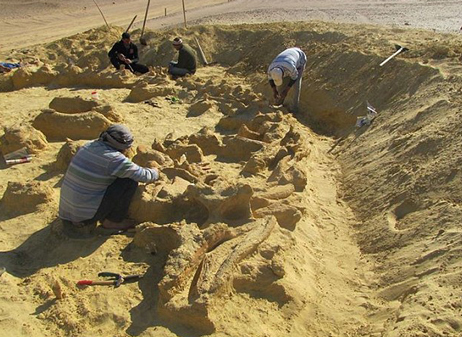
Egypt’s “Valley of the Whales” has proved to be a very happy hunting ground as a team of scientists announce the discovery of the most complete skeleton of the ancient whale known as Basilosaurus ever found.  The skeleton, believed to be around forty million years old, measures eighteen metres in length.  A second whale fossil has also been discovered in the body cavity of the leviathan, at this early stage, scientists are unsure whether these bones represent the last meal of the Basilosaurus or perhaps its unborn young.

A Giant Whale

The giant whale was the apex predator in the shallow sea, a remnant of the mighty Tethys Ocean, that once covered this part of the world during the Eocene Epoch.  Fossils of crustaceans and a number of fish species have also been discovered at the site.  In addition, the discovery of several large shark teeth indicate the Basilosaurus corpse may have been scavenged prior to its burial.

Researchers Carefully Excavating the Nearly Perfectly Articulated Basilosaurus Fossil

The remains of the skull are nearest the camera.

The remains of the skull are nearest the camera.

Picture credit: Egyptian Ministry of the Environment

Basilosaurus

Basilosaurus was an early type of toothed whale.  It is descended from a group of terrestrial carnivores, the Mesonychians.  Two species have been described to date and this specimen represents one of the largest found in the Fayum deposits south-west of Cairo.  The fossil material comes from one of the most important Cenozoic-aged fossil sites in the world, the Wadi Al-Hitan (Whale Valley), a region of the Western Desert of Egypt, which contains the remains of the earliest types of ancient whales (Archaeoceti), scientists are able to trace from these fossils the last stages of cetacean limb evolution, in which the hind limbs were eventually lost.

A World Heritage Site

Wadi Al-Hitan has been a UNESCO World Heritage site since 2005.  It provides a unique insight into an ecosystem dominated by shallow waters and mangrove swamps that existed  along the northern coast of Africa and into what is now, the Sahara Desert.

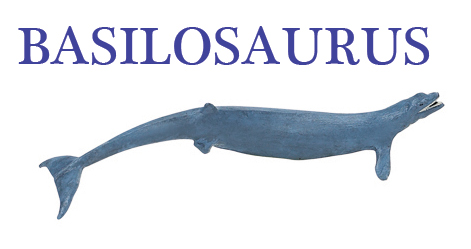
A Model of the Fearsome Marine Predator Basilosaurus

One of the ancient sea creatures featured in the Prehistoric Sealife Toob

One of the ancient sea creatures featured in the Prehistoric Sealife Toob

Picture credit: Everything Dinosaur

Basilosaurus Featured in a Documentary

Basilosaurus featured in the BBC television series “Walking with Beasts”, a follow up to the hugely successful 1999 “Walking with Dinosaurs”.  Episode Two was entitled “Whale Killer” and told the story of a female Basilosaurus as she struggles to find food and find somewhere safe to give birth.  As a result of this media exposure, Everything Dinosaur does receive requests for information about this early whale from time to time.

In terms of models, a Basilosaurus is featured in the “Prehistoric Sealife Toob” manufactured by Safari Ltd.  It is one of ten models in this model set.

To see the range of Safari Ltd models supplied by Everything Dinosaur, including the Prehistoric Sealife Toob: Wild Safari Prehistoric World Models.

To read Everything Dinosaur’s review of the Safari Ltd Prehistoric Sealife Toob: Prehistoric Sealife Toob Reviewed.

Basilosaurus Fossils

It is hoped that this new fossil discovery can help solve one of the enduring mysteries associated with Basilosaurus.  The very long and serpentine shape of Basilosaurus (the name means “King Reptile”), has presented anatomists and vertebrae palaeontologists with a bit of a puzzle.  The distal caudal vertebrae are compressed in a very similar way to those seen in animals with a tail fluke.  However, having the tail fluke at the very end of a long, sinuous tail (as in the model above), would have given this marine mammal quite an awkward and inefficient swimming action.

With a complete specimen of the tail bones to study, it is hoped that these fossils will provide more information on early cetacean locomotion.

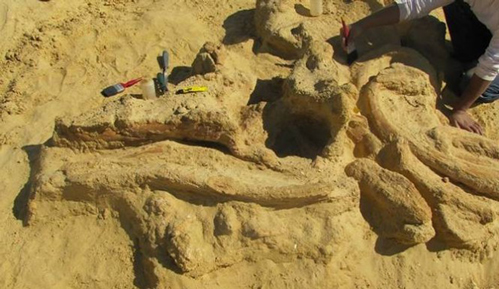
A Close up of the Preserved Skull and Jaws of Basilosaurus

Basilosaurus skull excavation.

Basilosaurus skull excavation.

Picture credit: Egyptian Ministry of the Environment

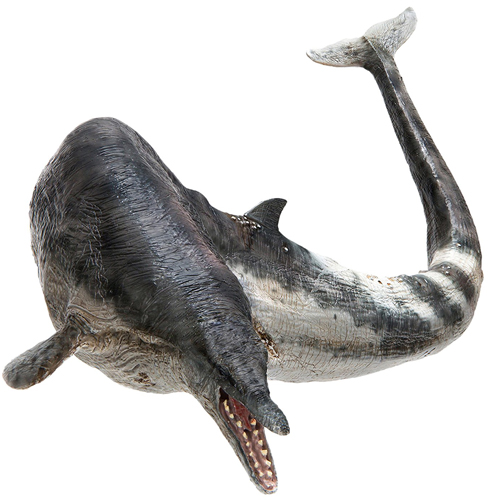
A Model of a Basilosaurus (PNSO

PNSO Age of Dinosaurs Basilosaurus replica.

The PNSO Age of Dinosaurs Basilosaurus model.

PNSO have a large Basilosaurus prehistoric whale model in their range: PNSO Prehistoric Animal Models and Figures.

12 06, 2015

Fibres and Cellular Structures Observed in Dinosaur Fossils

By |2023-03-30T18:47:18+01:00June 12th, 2015|Categories: Dinosaur and Prehistoric Animal News Stories, Dinosaur Fans, Main Page, Palaeontological articles|2 Comments

Soft Tissue Preservation in Late Cretaceous Dinosaur Bones

When Everything Dinosaur team members were first informed of a paper being published that reported on “blood cells and soft tissue” having been discovered in dinosaur fossils the day before the film “Jurassic World ” was released, there was some scepticism around the office.  Amid the inevitably lurid and rather dramatic headlines which have been seen in some publications we thought it a good idea to try to put this fascinating piece of research into a wider context.

The study was undertaken by scientists at the Imperial College London, their findings were published in the academic journal “Nature Communications”, it is not going to herald the establishment of a number of genetically engineered dinosaur themed safari parks, but it does suggest that even poorly preserved body fossils may contain more than just permineralised materials.

Bone and Teeth Alone are Not Enough

Most of what we have learned about the Dinosauria has been gained from studying their bones and teeth.  Trace fossils too have proved useful, even permitting researchers to speculate on behaviours such as social groupings and pack hunting, but if traces of soft tissue could be analysed, then our understanding could move forward exponentially.  Such a study could provide valuable insights into dinosaur physiology, it would for example, provide strong evidence with regards to the endothermy versus ectothermy debate (warm-blooded versus cold-blooded).

Importantly, the link between the Coelurosauria and birds could be established beyond doubt.  In short, it could be proved that the Robin perched on your bird table is indeed a distant relative of Tyrannosaurus rex.

Dr Susannah Maidment One of the Authors of the Study Holding a Stegosaurus Skull Cast

Dr Susannah Maidment, one of the authors of the study holding a cast of a Stegosaurus skull.

Dr Susannah Maidment, one of the authors of the study holding a cast of a Stegosaurus skull.

Picture credit: Laurent Mekul

Dinosaur Biology

A point that we frequently make is that dinosaur biology remains very much a mystery.  What we have learned has come about through some very remarkable research that utilises techniques and scientific methods that were undreamed of even a few years ago.  It is the collaboration between different scientific disciplines that is providing so much new information on dinosaurs and other extinct creatures.  The use of computerised tomography (CT), for example, has enabled palaeontologists to explore the three-dimensional structures of fossil bone, even when it has been embedded in extremely dense rock.

In this study, samples from eight dinosaur bone specimens were subjected to scanning electron microscopy (SEM) to provide exquisite images of the fossil structures in minute detail.

A number of samples were studied using a focused ion beam  (FIB), an imaging and resolution technology more at home in a materials science lab but now finding an increasing number of applications in other scientific areas of enquiry including vertebrate palaeontology.  It is the adoption and application of different scientific methods, drawn from a whole variety of research fields that is enabling academics to make some remarkable discoveries, shedding light, or in this case electrons and ions on those most enigmatic of extinct creatures – the dinosaurs.

Any Old Fossils?

The novel approach undertaken by the Imperial College scientists sets up an intriguing possibility, one that allows us to use an analogy from the “Jurassic Park” franchise  to explain.  The eight fossils used in this study came from the Natural History Museum (London), which is conveniently located just a few hundred metres away from the College.  Specifically the fossils come from two collections at the Museum, all of them relate to Late Cretaceous dinosaur fossil material from North America (Dinosaur Provincial Park and Lance Formations respectively).

The fossils studied represent a claw bone from an unknown species of meat-eating dinosaur, a partial rib from an indeterminate duck-billed dinosaur and other bits and pieces of assorted dinosaur that would not have got a second glance had they been on display.  That’s the point.  Evidence for soft tissue preservation in a number of vertebrate fossils have been reported before, even in the Dinosauria.  This area is not without controversy, but here evidence has been presented for the potential preservation of organic remains from reptiles that died more than seventy million years ago.

Dinosaur Claw Bone used in the Study

Manual ungual (dinosaur claw) from an unknown species of Theropod used in the Imperial College London study.

Manual ungual (dinosaur claw) from an unknown species of theropod used in the Imperial College London study.

Picture credit: Laurent Mekul

If these fragments of fossils can possibly contain proteins and other biological structures, then maybe, just maybe there is a lot more preserved within the fossil record – we just have not been looking for it.

Jurassic Park

Let’s use that “Jurassic Park” analogy to look at this intriguing aspect further.  In the original book, written by Michael Crichton and published in 1990, the InGen scientists (the team behind the creation of various dinosaurs using DNA recovered from blood-sucking insects preserved in amber, mixed with amphibian genetic material and so forth), come up with what they think to be an infallible method of ensuring that all their engineered dinosaurs stay on their island home.  Each animal’s position is tracked and movements can be recorded using a simple receiver.

With three hundred dinosaurs on the preserve, it is just a case of asking the software that tracks the animals’ comings and goings to find three hundred dinosaurs.  Every day without fail, when asked, the computer read out states that there are three hundred dinosaurs on the island.  The flaw in this safety precaution is pointed out by Dr Ian Malcolm, a mathematician who has been brought to the resort in order to validate it prior to the park opening to the public.

Interrogating the Data

The good doctor, asks the computer programme to find three hundred and one dinosaurs, and sure enough the software reports on that number.  Dr Malcolm continues to interrogate the team behind the computer programme asking repeatedly for the software to detect more and more dinosaurs.

The doctor, a  specialist in Chaos Theory, had predicted that the biological preserve would fail “nature finds a way” as he so eloquently states in the film.  Despite the entire dinosaur population starting out as female, the animals had started to breed and that was why there were more dinosaurs recorded than expected.

Just like in the example above, scientists may have been asking the wrong questions.  Soft tissue preserved in the fossil record of long extinct creatures might be more common than previously thought.  Similar structures have been observed before, but for most of the time, the research was focused on investigating the range of criteria that were believed to have existed to have led to the preservation of organic remains, these specimens were treated as the exception – could they be the norm?

Caution Advised

Tiny egg-like shapes identified deep within a dinosaur claw bone that have a resemblance to red blood cells, certainly deserve further analysis and investigation.  Admittedly, the red and green images of the structures with the different colours reflecting varying material densities can be confusing, after all, if a lay person reads a headline in a magazine stating that dinosaur blood may have been found and sees a picture covered in red, he or she may jump to one very obvious conclusion.

Mass spectrometry analysis, another relatively recent addition to the palaeontologist’s ever increasing technical armoury, this time from the laboratory of an analytical chemist, threw up tantalising results when the red blood cell-like materials were scrutinised.  Four different regions from the same fossilised theropod claw were compared to the mass spectrometry report for Emu blood.  The resulting data suggested that there were indeed chemical similarities.

If this really is some form of preserved, (although quite probably severely degraded), remnant of a theropod dinosaur’s blood then, as Ratites such as the Emu are believed to be closely related to the Theropoda then similar mass spectrometry results could be anticipated.

Potential Evidence of Preserved Red Blood Cells in Dinosaur Bone

Evidence of potential red blood cells preserved in 75 million year old dinosaur bone.

Evidence of potential red blood cells preserved in 75-million-year-old dinosaur bone.

Picture credit: Laurent Mekul

Microscopic Fibres – More Caution Advised

Fibres or fibrous-like structures were reported from half the samples studied.  In one specimen, a fragment of rib bone from an unknown dinosaur revealed a structure within it that resembled collagen.  Further chemical analysis revealed traces of amino acid fragments such as glycine, alanine and proline.  This is consistent what you would expect to find if you were analysing collagen.

If a fragment of collagen could be recovered, then that would be a remarkable discovery indeed.  Like blood and other organic materials these substances are believed to degrade relatively quickly after death.  However, if a protein based structure like collagen could be found in the fossilised bones of a dinosaur then this would open up an entirely new area of research into the Dinosauria.

Potential Collagen Structures Preserved in Fossil Bone

Fibrous structures preserved in fossilised bone.

Fibrous structures preserved in fossilised bone.

Picture credit: Laurent Mekul

Further Study is Required

The scientists behind this paper are keen to point out that further study is required.  Two of the fossil bones used in this research revealed no traces of any potential soft tissue components, a point missed by a number of media outlets that covered this story. However, if poorly preserved fossil material can retain microscopic traces of blood and other organic materials then it will change our science forever.

Dig sites will be subjected to forensic procedures, perhaps a clean room will be have to be set up in the field to help minimise the risk of organic cross-contamination.  What about the use of glues and resins that act as fossil bone stabilisers?  Could the over enthusiastic use of super glue at a dig station compromise the chances of retrieving viable traces of organic material later, back in the prep lab?

Can the Results be Repeated?

If other institutes can repeat these experiments and produce the same results consistently, then this has some dinosaur-sized implications for palaeontology.  If it can be concluded that the structures observed and analysed within the samples do indeed originate from preserved proteins from the extinct animal, then we may have an opportunity to study soft tissues in long dead creatures.  A more complete understanding of dinosaur biology may be within our grasp.

Now that would be something to make a movie about.

10 06, 2015

Welsh Dinosaurs – New Early Jurassic Theropod Discovered

By |2023-03-30T16:58:10+01:00June 10th, 2015|Categories: Dinosaur and Prehistoric Animal News Stories, Dinosaur Fans, Main Page|2 Comments

Early Jurassic Dinosaur Goes on Display

The story broke this week of the discovery of a new species of meat-eating dinosaur after fossils found at Lavernock beach (near Penarth, South Wales), went on display at the National Museum of Wales.  Many of the news reports that carried this story heralded this important discovery and claimed that this new meat-eating dinosaur was a Welsh cousin of the famous Tyrannosaurus rex.  Whilst it is true, this lithe and agile theropod was indeed distantly related to T. rex it is important to stress the term “distantly” in this context.

The domestic cat is much more closely related to a tiger than this Welsh dinosaur was to the North American “King of the Tyrant Lizards”, at least a domestic cat and a tiger belong to the same taxonomic family (Felidae).

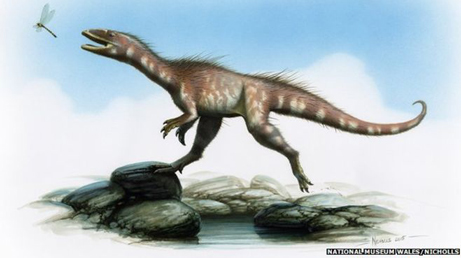
A New Early Jurassic Dinosaur has been Discovered

Significant dinosaur discovery.

Significant dinosaur discovery.

Picture credit: National Museum of Wales/Bob Nicholls

The Theropoda

The theropods (Theropoda) are a suborder of dinosaurs, they are lizard-hipped and perhaps the most diverse and most specious of all the Dinosauria.  This new fossil find is important for a number of reasons.  Firstly, the Lavernock shales represent strata formation in a shallow, marine environment.  These rocks were laid down at the very beginning of the Jurassic geological period (Hettangian faunal stage), this discovery is one of just a handful of dinosaur fossils known from this location.

Most of the dinosaur material from the Lavernock Point area that had been found in the past consisted of highly eroded, isolated and very fragmentary bones.  The rocks do preserve fossils of vertebrates, fish scales and teeth are the most common finds these too are usually quite worn.

Early Jurassic Dinosaur

It seems some 200 million years ago, the carcase of a not fully grown, meat-eating dinosaur was washed out to sea, when the corpse sank, it was covered in fine silt and the fossilisation process began.  The five blocks in which the largely disarticulated fossil was found, (bone material representing about 5% of the total skeleton), were washed out of the cliffs during storms in the spring of 2014.  Brothers Nick and Rob Hanigan were responsible for making the fossil find.  One of the brothers came across the exposed blocks whilst out fossil hunting and alerted his brother to help explore the immediate location after the rock fall.

Nick and Rob were able to locate a number of bones including fragments of the skull and some very fine examples of the dinosaur’s teeth.  They are to be congratulated for their discovery, had the fossils remained exposed on the beach for just a few weeks they may have been subjected to erosion or even washed out to see with the next high tide and therefore potentially lost forever.

For models and figures of Jurassic dinosaurs and other prehistoric creatures: Mojo Fun Prehistoric and Extinct Models.

A Close up of the Upper Jaw Bone and Tooth Surrounded by Other Skull Material

Jaw and skull fossil material

Jaw and skull fossil material.

Picture credit: National Museum of Wales

Welsh Dinosaur Discovery

Fragmentary fossils that have been assigned to the Dinosauria have been found in this part of the British Isles before, we have had the opportunity to look at pictures of a number of specimens from south, central England.

These specimens consist of, for the most part, isolated bones, here is an Early Jurassic Theropod dinosaur that is represented by a lot more fossil material.  The specimen has been studied by scientists from the National Museum of Wales, along with experts from Manchester and Portsmouth Universities.  We are expecting a formal scientific paper to be published in the autumn and we think that the distinguished University of Portsmouth palaeontologist Dr David Martill we be one of the authors.

Dr John Nudds, (Manchester University), who has examined the specimen stated:

“It is very rare to find this type of dinosaur at all and never before in Wales.  In fact it is only the second dinosaur ever found in Wales.”*

The Blocks of Material and a Reconstruction on Display at the National Museum of Wales

On display the fossils with a skeleton reconstruction.

On display the fossils with a skeleton reconstruction.

Picture credit: National Museum of Wales

A Welsh Dinosaur

We are aware of a number of ichnogenera described from trace fossils found near Bendrick Rock, down the coast from the Lavernock site.  Theropod footprints have been found in Wales, but body fossils are extremely rare.  The first dinosaur described from Welsh deposits is Pantydraco caducus, which is known from a partial skull and post cranial material, it belongs to the Sauropodomorpha group and its fossils were collected from a quarry in Bonvilston, about six miles north-west of the Lavernock fossil discovery.  Could Pantydraco have been attacked by this, as yet, unnamed theropod?  The answer is no, the strata in which the fossils of Pantydraco were found are several million years older than the Lavernock sediments.

The Lavernock Specimen

In addition, the Lavernock specimen represents an individual that would have been around half a metre high at the hips and measuring around two to three metres in length.  It is very likely that this little meat-eating dinosaur fed on insects, small reptiles and mammals, although when fully grown, perhaps over five metres in length, other Early Jurassic dinosaurs including sauropodomorphs were probably on the menu.

* This may not be the second dinosaur fossil discovered in Wales, isolated bone fragments have been found in South Wales from near Bridgend and from the Lavernock area.  Unfortunately, these fossils are very difficult to assign with any certainty to a specific clade of the Dinosauria.  They may not represent dinosaurs at all but other related archosaurs.

We shall have to wait for the scientific paper, this will provide a lot more information and also help to assign this particular specimen to a family.  We suspect that the fossils represent a member of the Coelophysidae, it will most certainly be a new species.  So very few fossils of Late Triassic/Early Jurassic theropod dinosaurs have been found, a time when the Theropoda were diversifying and evolving into a number of new forms.  This little dinosaur may represent the earliest known dinosaur from the Jurassic.

Illustrating the Dinosaur

There are a couple of things to note about the illustration produced by the highly talented palaeo-artist Bob Nicholls, first of all the animal is not painted a dull grey or brown.  This dinosaur has a reddish hue with distinctive white markings, a sign of the times as more colourful depictions of the Dinosauria are now becoming the norm.  In addition, this theropod dinosaur has quills and tufts of simple feathers.  This is a nod to the now widely accepted theory that most theropod dinosaurs were indeed feathered.

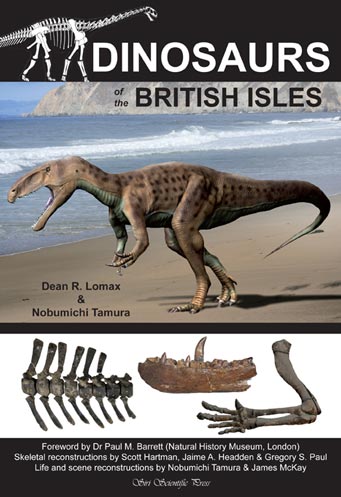
More Information About British Dinosaurs

A comprehensive guide to British dinosaurs over 400 pages.

A comprehensive guide to British dinosaurs over 400 pages.

Picture credit: Siri Scientific Press

For further information on dinosaurs from the British Isles we recommend the excellent “Dinosaurs of the British Isles” by Dean R. Lomax and Nobumichi Tamura

Copies can be purchased here: Siri Scientific Press.

9 06, 2015

Annual Queensland Dinosaur Dig Yields Rare Fossils

By |2024-05-05T13:42:59+01:00June 9th, 2015|Categories: Dinosaur and Prehistoric Animal News Stories, Dinosaur Fans, Main Page, Palaeontological articles|0 Comments

Queensland Dinosaur Dig Unearthing Bones

At the beginning of the month we reported on the annual Australian dinosaur excavations that were opening up once again in Queensland.  As the digs continue to progress, scientists from the Australian Age of Dinosaurs Museum (Winton), have stated that a number of new dinosaur fossils have been found.

At the start of the dig season, palaeontologists had expressed the wish to discover a new species of Cretaceous dinosaur, given the wealth of material recovered so far it seems that there is a strong possibility that the fossil specimens, once fully prepared might lead to the identification of a new genus of Australian dinosaur.

To read Everything Dinosaur’s earlier article about the annual excavations: Time for Some More Aussie Dinosaurs.

Queensland Dinosaur Dig

The exposed strata around Winton dates from the Late Cretaceous (98 to 95 million years ago).  During this time, (Late Albian faunal stage of the Lower Cretaceous), Australia was beginning to separate from Antarctica as the super-continent of Gondwana continued to break up, most of the dinosaur’s described from Queensland rocks are unique to Australia, although they are related to other types of dinosaur found elsewhere in the Southern Hemisphere.

Dr Stephen Poropat (Australian Age of Dinosaurs), commented that a number of intriguing specimens had already been found including some large dinosaur bones.

He added:

“We are looking for a sauropod dinosaur, so a long-necked dinosaur with four elephant-like legs and then a long tail – and we know that because we have found some of its back bone and some of its ribs.”

A number of locations are currently being explored, some of them have not been studied and mapped before.   It is hoped that these excavations and the dinosaur discoveries will help to provide a boost to the local economy as tourists visit the area to view Australia’s very own “Jurassic Park”, or to be more correct and with the age of the strata considered it would be more appropriate to refer to this location as “Cretaceous Park”.

Discovery of a Scapula

The Australian Age of Dinosaurs Executive Chairman, David Elliott explained that the work carried out so far, it had been hard going but some significant finds had been unearthed.

Mr Elliott stated:

“We found one really nice scapula [shoulder bone], like a big shoulder blade and it is beautiful, it is quite a large bone.”

Dinosaur bones had been found at several locations, the Executive Chairman added:

“We’re just starting to really hit on the bones now, we have found this big row of boulders, and we are talking massive boulders, like the size of a ute [utility vehicle].”

Once identified as fossil bearing rock, these large boulders will have to be carefully jacketed and then loaded onto either large pick-up trucks (utes to use the local vernacular), or onto a low loader.  Once safely back at the laboratory, the careful job of preparing and cleaning the fossilised bones can begin.

Although, Everything Dinosaur team members have no additional information at this stage and we have not received details of the measurements of any fossil material, but if the fossils are as large as predicted, then the palaeontologists will probably be looking at another sizeable Australian titanosaur, perhaps something in excess of twenty metres in length.

Australian Titanosaurs

A number of titanosaurs are already known from this part of the world, dinosaurs such as Wintonotitan (W. wattsi), which may have reached a length of around fifteen metres or so when fully grown and the slightly smaller Diamantinasaurus (Diamantinasaurus matildae).  The palaeoenvironment must have been particularly rich and diversified to be able to sustain a number of different types of Titanosaurs within the same habitat.

We look forward to hearing more about these new fossil discoveries from Queensland.

For dinosaur models and figures including replicas of Australian dinosaurs: CollectA Prehistoric Life Models.

6 06, 2015

Regaliceratops – A Right Royal Rumble!

By |2023-03-30T15:29:43+01:00June 6th, 2015|Categories: Dinosaur and Prehistoric Animal News Stories, Dinosaur Fans, Main Page|0 Comments

 Regaliceratops peterhewsi – The Curious World of Royal Chasmosaurines

Recently published in the journal “Current Biology” comes a description of the remarkably flamboyant Regaliceratops, the name translates as “royal horned face”,  a new species of horned dinosaur from south-western Alberta (Canada) that highlights once again that the Dinosauria have a few more surprises for palaeontologists awaiting in the Upper Cretaceous aged sediments of North America.

A large fossilised skull of a horned dinosaur was discovered by geologist Peter Hews back in 2005.  The fossil material consists of much of the cranial material, but the rostral bone and lower jaw are missing.  Although the exact stratigraphical location of the fossil find is a little uncertain (blame the lack of distinctive marker beds in the locality), it is likely that this horned dinosaur lived in the Middle Maastrichtian faunal stage of the Cretaceous around 68 million years ago.

Geologist Peter Hews with the Prepared Regaliceratops peterhewsi

Geologist Peter Hews with the skull of Regaliceratops.

Geologist Peter Hews with the skull of Regaliceratops.

Picture credit: Royal Tyrrell Museum

Horned dinosaurs are well known for their huge heads and flamboyant crests.  Surrounding the skull frill was a crest of large, plate-like epoccipitals, that reminded the palaeontologists responsible for the study of the fossil (Dr Caleb Brown and Dr Donald Henderson, both from the Royal Tyrrell Museum, Alberta), of a crown, hence, in part this dinosaur’s genus name representing royalty.

Honouring Royalty and a Museum?

The genus name also honours the Royal Tyrrell Museum in Drumheller, a leading centre of palaeontological research into Late Cretaceous prehistoric animals.  The species name honours Peter Hews for his work in researching the strata of the St Mary’s River, from which the fossil was extracted.

An Illustration of the Royal Dinosaur (Regaliceratops)

 A right royal member of the Ceratopsidae.

A right royal member of the Ceratopsidae.

Picture credit: Julius Csotonyi

An Absence of Postcranial Material

Although no postcranial material has been found, based on the skull dimensions and using an analysis of closely related genera such as Anchiceratops, it has been estimated that this herbivorous dinosaur was around five to six metres in length and that it may have weighed as much as 1.5 tonnes, possibly a little more.  The frill ornamentation reminded team members at Everything Dinosaur of the dermal plates found on stegosaurs, but this similarity is superficial.

These structures in combination with the overall shape of the skull, along with the pair of fenestrae (holes) within the crest, were probably used to communicate visually with other members of the herd, although that large crest and the big nose horn may have had defensive functions also.

Hellboy!

A number of media outlets have reported that this dinosaur was nick-named “Hellboy” due to the small pair of brow horns that this dinosaur possessed. They reminded the palaeontologists of the horns on the top of the head of the comic book character, we suspect that the main reason for the nick-name was the great difficulty the scientists had when trying to remove the very hard matrix that surrounded the fossil material.

Although this part of Alberta has not yielded  a great deal of dinosaur fossil material, least not when compared to geological formations such as the Dinosaur Park Formation and Horseshoe Canyon Formation which occur to the west of the fossil site, but this discovery hints that many more species of bizarrely crested horned dinosaurs await discovery.

Characteristics of Chasmosaurine as well as Centrosaurine Dinosaurs

The Ceratopsidae (horned dinosaur) family can be split into two distinct sub-families, the Chasmosaurinae and the Centrosaurinae.  Up until a few years ago, it was a relatively straight forward process when it came to classifying a horned dinosaur into one of these groups.  Centrosaurines tended to have shorter neck shields, small brow horns and a prominent bump or large nose horn.  In contrast, the chasmosaurs were classified as having relatively longer neck frills, a small nose horn and much larger brow horns.

This rather simplistic assessment has fallen out of favour as the myriad of new North American dinosaur species described in the last decade or so have rather “muddied the phylogenetic waters somewhat”, as an Everything Dinosaur team member has stated.

Regaliceratops has centrosaurine characteristics despite its classification of a member of the Chasmosaurinae.

Regaliceratops Compared to Styracosaurus (Centrosaur) and Triceratops (Chasmosaur)

Characteristics of Centrosaurines as well as Chasmosaurines.

Characteristics of centrosaurines as well as chasmosaurines.

Picture credit: Royal Tyrrell Museum

The picture above shows the skull and horns Regaliceratops (middle) compared to those of the centrosaurine Styracosaurus (left) and the chasmosaurine Triceratops (right).  Regaliceratops has the relatively long neck frill associated with the Chasmosaurinae, but it has very much reduced brow horns which is a typical trait of the centrosaurines.

Late Cretaceous Horned Dinosaurs and Regaliceratops peterhewsi

Late Cretaceous horned dinosaurs of North America, diversified in a relatively short time (geologically)  into a huge range of different types.  The authors of the paper published in “Current Biology” undertook a phylogenetic study of chasmosaurs and they propose the these chasmosaurine dinosaurs can be further split into two groups.

The first, older group of chasmosaurs, containing dinosaurs such as Pentaceratops, Utahceratops, Chasmosaurus and Mojoceratops that lived during the Late Campanian and into the very Early Maastrichtian faunal stage, were smaller and possessed anatomical features that resembled the Centrosaurines.

The second group represents those chasmosaurs that lived towards the very end of the Cretaceous, the likes of Ojoceratops, Eotriceratops, Torosaurus and the most famous horned dinosaur of them all Triceratops.  These chasmosaurs tended to be larger and to have more highly developed chasmosaur features (large brow horns and big, simple neck frills).

Regaliceratops peterhewsi

Based on the known fossil material, the authors state that as the Centrosaurine-like chasmosaurs such as Pentaceratops et al seem to have become extinct at the same time as the true centrosaurs, then a common cause may have been responsible for both these two groups demise.  The second more derived group of chasmosaurines, the group that includes Triceratops, may have diversified to occupy the niches in the ecosystem that were subsequently vacated.

If this phylogenetic study is examined carefully, then an argument can be made for there being a common ancestor of the two groups of chasmosaurines, but no candidate fossil material has been discovered to date, so there is likely to be a number of surprises in the shape of Late Cretaceous horned dinosaurs that represent new species awaiting discovery in North America.

The Skull Material within the Extremely Hard Matrix

Extremely hard limestone matrix (hard work digging out "hell boy").

Extremely hard limestone matrix (hard work digging out “hell boy”).

Picture credit: Royal Tyrrell Museum

This latest report on the bizarre horned dinosaurs raises a fascinating, yet highly controversial point.  If the authors are correct in their conclusions, then we have chasmosaurine dinosaurs diversifying to fill the ecological niches left empty with the extinction of the centrosaurines. To fill those niches, the chasmosaurs developed anatomical characteristics that resembled the centrosaurs.  This is an example of convergent evolution and it is unique in the Dinosauria as far as we at Everything Dinosaur can work out.  Horns and bony display structures that evolve in two separate groups of dinosaurs which are very similar in appearance and apparent function.

Romantic Palaeontologists

We can’t draw to a close our brief examination of “royal horned face” without mentioning the extremely romantic gesture included in the scientific paper by Caleb Brown.  At the bottom of the acknowledgements section of the paper, Caleb sneaked in a marriage proposal to his partner Dr Lorna O’Brien who works as a technician at the museum.  In the sometimes dry world of academic publishing, the addition of this very personal message may come as a surprise to some, but there have been a number of cases of comments, plays on words or even outright jokes being published in such papers.  However, none of us here can recall a marriage proposal being contained within such a publication.

Proposal Appearing at the Very Bottom of the Paper

By "Royal Command".

By “Royal Command”.

Picture credit: Current Biology

Lorna said yes and we wish the happy couple a peaceful and prosperous future.

Go to Top