All about dinosaurs, fossils and prehistoric animals by Everything Dinosaur team members.

Fossil finds, new dinosaur discoveries, news and views from the world of palaeontology and other Earth sciences.

16 07, 2015

The New Winged Dragon from Liaoning Province

By |2023-04-01T14:12:21+01:00July 16th, 2015|Categories: Dinosaur and Prehistoric Animal News Stories, Dinosaur Fans, Main Page|0 Comments

Zhenyuanlong – A Big Bird, well, Almost

This week we have seen the latest feathered and fluffy dinosaur revealed from the Lower Cretaceous deposits of Liaoning Province, north-eastern China.  Scientists from the University of Edinburgh including the very talented Dr Steve Brusatte, in collaboration with colleagues from the Institute of Geology (Chinese Academy of Geological Science, Beijing), have published a paper in the journal “Scientific Reports”, that describes Zhenyuanlong suni, the latest in an ever growing flock of feathered dinosaurs from Liaoning.

An Illustration of Zhenyuanlong suni
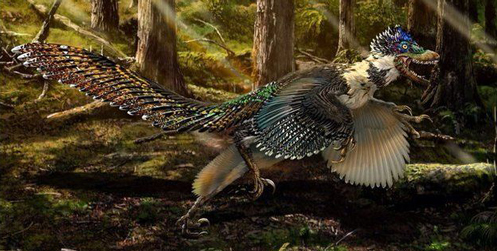
Very probably a ground-dwelling predator.

Very probably a ground-dwelling predator.

Picture credit: Zhao Chuang

A New Winged Dragon

We do understand why many of the media reports have focused on this Early Cretaceous dinosaur’s more famous relative – Velociraptor.  Dr Steve Brusatte of Edinburgh University’s School of GeoSciences refers to Velociraptor in interviews, although, Velociraptor and Zhenyuanlong (pronounced jen-won-long), are separated by some forty-five million years.  As Zhenyuanlong suni has been classified as member of the Dromaeosauridae family, it is indeed distantly related to the more famous Late Cretaceous “raptor”.  By discussing Velociraptor, it helps members of the public to put this new dinosaur into context.

Zhenyuanlong suni

Zhenyuanlong is most certainly not Velociraptor’s direct ancestor, but if these dinosaurs were feathered, then the point that Velociraptor, shown as a scaly-skinned reptile in dinosaur movies, is in all likelihood not being accurately depicted, is well made.  Although no evidence of feathers or any other integumental covering for that matter has been found in association with Velociraptor fossil material.  This has probably got more to do with the fossilisation process and the coarse sandstone matrix than any lack of feathers on Velociraptor’s part.

Velociraptor – Most Probably Feathered

Very probably feathered (V. mongliensis and V. osmolskae)

Very probably feathered (V. mongoliensis and V. osmolskae)

Picture credit: Everything Dinosaur

Dromaeosaurid Models

The picture above shows the new for 2015, Velociraptor dinosaur model by Safari Ltd.  The model depicts Velociraptor as a dinosaur that was covered in a coat of feathers.  To view Everything Dinosaur’s range of Safari Ltd prehistoric animal models, including feathered dinosaur models: Feathered Dinosaur Models – Wild Safari Prehistoric World.

The Liaoning Dromaeosaurids – Now There are Six Genera

A total of six genera of dromaeosaurids are now known to have lived in the forests that once covered north-eastern China.  Several of these genera have more than one species associated with them and there are going to be more feathered dinosaurs described from the Yixian and Jiufotang Formations.  Everything Dinosaur team members will do their best to keep up to date with new discoveries and to write about them on this blog.

The six genera described to date:

  1. Sinornithosaurus (named in 1999)
  2. Microraptor (named in 2000)
  3. Graciliraptor (named in 2004)
  4. Tianyuraptor (named in 2010
  5. Changyuraptor (named in 2014)
  6. Zhenyuanlong (newly described)

Please don’t imagine all six of these dinosaurs roaming the forests that would have covered Liaoning Province about 125 million years ago, at the same time.  As the fossils come from different layers of strata, they are not all contemporaneous, in fact accurately dating Liaoning fossil material is known to be extremely tricky.  However, it is likely that many different types of feathered dinosaur co-existed and indeed many of them were specially adapted to a particular ecological niche.

The Holotype Fossil Material – Zhenyuanlong suni
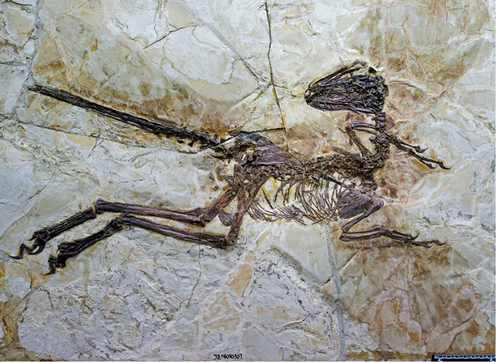
 Large-bodied, short-armed Liaoning dromaeosaurid

Large-bodied, short-armed Liaoning dromaeosaurid

Picture credit: Chinese Academy of Geological Science

Examining the Type Specimen

The type specimen (pictured above), measures 126.6 cm in length, however, much of the tail is missing and this dinosaur was probably over 160 cm long.  This makes it one of the larger dromaeosaurids from Liaoning, the skull, although badly crushed reveals that this little dinosaur was carnivorous and a closer examination of the fossil revealed that it was covered in feathers, (pennaceous feathers = feathers with a central vane).  Pennaceous feathers are found in most modern birds, however, given the large body size and disproportionately small forelimbs when compared to other Liaoning domaeosaurids, it is unlikely that Zhenyuanlong was capable of powered flight.

Feathered Zhenyuanlong – Just Like a Big Bird

Our "feathered friend".

Our “feathered friend”.

Picture credit: Chinese Academy of Geological Science

The picture above shows, the complete holotype (A) with a close up of the posterior portion of the tail showing feather impressions (B), the skull and part of the forelimb (C), the right manus (hand) with extensive feathers (D) and (E) a close up of the ulna and radius (forearm) showing evidence of pennaceous feathers on this region of the body too.  Unlike other Liaoning dromaeosaurids, Graciliraptor and Microraptor for example, there is no evidence for feathers on the hind limbs.

Zhenyuanlong and Tianyuraptor

The describing of Zhenyuanlong does not just add to the diversity of dromaeosaurids known from China, it confirms the fact that short-armed dromaeosaurids were also covered in feathers too, just like their longer-limbed cousins.  There have been two basic Dromaeosauridae body plans (bauplans) described from the Jehol Biota.  Most of the Dromaeosauridae family members known from this part of the world had small bodies, with proportionately long forelimbs and accompanying broad wings covered in pennaceous feathers.  Then there is the other body plan, a much larger dinosaur with a heavier body and short arms.

Tianyuraptor (T. ostromi) was the only example known, until the discovery of Zhenyuanlong, but unlike Z. suni, the Tianyuraptor fossil specimen does not show any preserved evidence of feathers.

A Phylogenetic Analysis of Zhenyuanlong suni Amongst the Dromaeosauridae

The Liaoning dromaeosaurids nested within the Dromaeosauridae.

The Liaoning dromaeosaurids nested within the Dromaeosauridae.

Picture credit: Chinese Academy of Geological Science with additional annotation by Everything Dinosaur

The “big bird” that is Zhenyuanlong although distantly related to Velociraptor (the Velociraptorinae sub-family), does suggest that more famous dinosaurs like Velociraptor were indeed probably feathered.

The Beasts of the Mesozoic model range contains a variety of raptors including Z. suni figures: Beasts of the Mesozoic Prehistoric Animal Figures.
15 07, 2015

Let’s Hear It for Mammalian Evolution (New Research)

By |2024-04-11T10:15:58+01:00July 15th, 2015|Categories: Dinosaur and Prehistoric Animal News Stories, Dinosaur Fans, Main Page|0 Comments

The First Detailed Analysis of the Stapes In Triassic Cynodonts

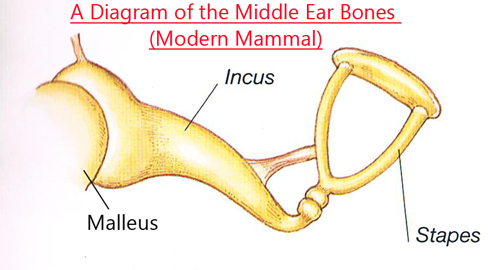
The smallest bone in the human body and how it evolved has been the subject of a major research project conducted by scientists at the University of Witwatersrand (Johannesburg, South Africa).  That small bone is called the stapes and it forms part of the three bones of the middle ear, the malleus, incus and the stapes which together are known as the ossicles.  All modern mammals possess these three bones, which are also called the hammer, anvil and the stirrup, these names relate to their shapes, as the stapes for example, resembles a stirrup, the support for a rider’s foot.

Mammalian Evolution

A Diagram Showing the Shape of a Extant Mammal’s Stapes

The three middle ear bones of a modern mammal.

The three middle ear bones of a modern mammal.

Picture credit: Everything Dinosaur

University of Witwatersand Research

A team of scientists from the University of Witwatersand’s Evolutionary Studies Institute which includes Dr Leandro Gaetano and Professor Fernando Abdala have completed the first detailed comparative analysis of ancient ear bones of Triassic cynodonts, ancient synapsids that are ancestral to the Mammalia.  Until this study was carried out, it had long been thought that the stapes showed no differences between species.  However, in this new research, published in the academic journal PLoS One, the researchers map variations in the morphology of this bone, even amongst animals of the same species.

Commenting on their findings, Dr Gaetano stated:

“No one has really paid attention to this small bone before.  In studying this ear bone of Triassic Cynodonts, the forerunners of mammals, including humans, over the past two years we now start to see these differences.”

The Hearing Mechanism of Reptiles

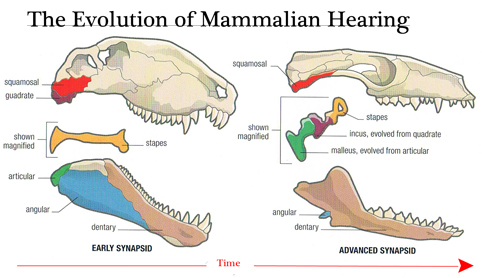
Reptiles have a different hearing mechanism when compared to mammals.  As the synapsid clade evolved and modern mammals came about, they evolved more sophisticated and sensitive hearing.  Scientists believe that the three middle ear bones gave the early mammals, which were probably nocturnal, an improved ability to detect high-frequency sounds – useful if you spent your waking hours in the dark and you relied on your hearing to detect prey as well as to sense danger.  Bones in the reptilian jaw, the articular (lower jaw) and the quadrate (upper jaw) evolved into the middle ear bones, connecting to the stapes and forming the ossicles.

Mammalian Middle Ear (Evolution)

The evolution of the mammalian middle ear.

The evolution of the mammalian middle ear.

Picture credit: Everything Dinosaur

Embryo Studies and Transitory Fossils

Embryo studies and the discovery of a number of transitory fossils have provided evidence for this, however, in this study it was the stapes as found in many Triassic cynodonts which lived between 250 and 22o million years ago, that was central to this new analysis.  The stapes is the only ear bone in mammalian ancestors, the evolution of the middle ear configuration as found in modern Mammalia had not yet occurred when the animals featured in this study were alive.

The Variation in the Shape of the Stapes of Triassic Cynodonts

Shape of the stapes bone in different Cynodonts studied.

Shape of the stapes bone in different cynodonts studied.

Picture credit: Witwatersrand University

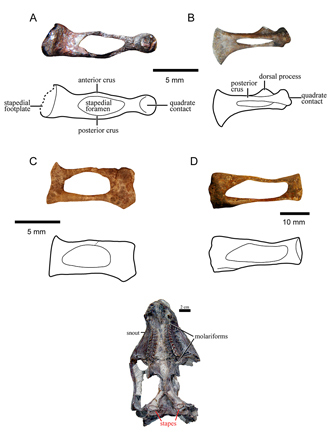
The picture above shows morphological variation in the stapes of Triassic gomphodont cynodonts.

A, Diademodon; B, Trirachodon; C and D, Massetognathus.

Below is the ventral view of the skull of a cynodont showing the position of the stapes.

Dr Gaetano explained:

“Few contributions studied the stapes in cynodonts and it has been historically regarded as a conservative element, showing no difference among species.  Surprisingly, we discovered that there are noticeable variations in the morphology of this bone, even within representatives of the same species.

This research is helping to unravel a mystery surrounding the origins of the middle ear bones and their configuration.  Professor Abdala suggests that the sound waves in cynodonts  were transmitted to the inner ear from an eardrum at the posterior part of the lower jaw through the stapes and quadrate bones.  The research is on-going, utilising the extensive Permian and Triassic vertebrate fossil record found in South Africa (the biota of the Karoo basin).

The Next Stage of the Research Project

The next stage is to try to calculate the impact on hearing ability of the differently shaped stapes bones that the team have identified.  In addition, the scientists will focus on ontogenic changes (changes in the shape of the stapes from the youngest to the oldest animal in one extinct species).

For replicas and models of ancient reptiles and other prehistoric creatures: CollectA Deluxe Prehistoric Life Figures.

11 07, 2015

Wendiceratops pinhornensis from southern Alberta

By |2023-04-01T12:35:21+01:00July 11th, 2015|Categories: Dinosaur and Prehistoric Animal News Stories, Dinosaur Fans, Famous Figures, Main Page|0 Comments

North America’s Newest Centrosaurine is Also One of its Oldest

The Royal Ontario Museum (Canada) put on exhibit this week the horned dinosaur Wendiceratops (W. pinhornensis) and what a splendid new addition this exhibit is.  There has been lots of media coverage regarding this dinosaur, but we at Everything Dinosaur wanted to clarify three points that had been made in a number of publications, this is not a newly discovered ceratopsian, the bone bed containing the fossils of these one tonne dinosaurs was found way back in 2010.  It has taken over five years to prepare the bones, study them and then to publish a scientific paper on this new dinosaur.

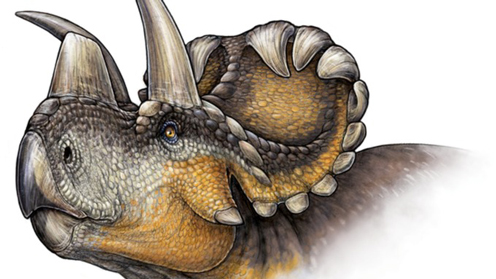
An Illustration of Wendiceratops pinhornensis

An early, very ornate Centrosaurine.

An early, very ornate centrosaurine – Wendiceratops pinhornensis.

Picture credit: Danielle Dufault

Not Closely Related to Triceratops

Secondly, this horned dinosaur that roamed southern Alberta approximately 79 million years ago (78.7 to 79.0 million, according to radiometric dating from nearby Kennedy Coulee Ecological Reserve which is believed to be of the same geological age), was not that closely related to Triceratops.

Mention a new type of horned dinosaur and Triceratops comes trotting out as a comparison.  We think this is because, since Triceratops is one of the best known of all the dinosaurs, journalists use “Trike” as a sort of “dinosaur clothes horse” upon which the story can be hung.  True, the horn configuration between Wendiceratops and Triceratops is very similar, both have large brow horns and a smaller nose horn, but in reality Wendiceratops and Triceratops are separated by at least ten million years and they are members of two different sub-families of the Ceratopsidae.

  • Wendiceratops is a member of the centrosaurines
  • Triceratops belongs to the chasmosaurine group

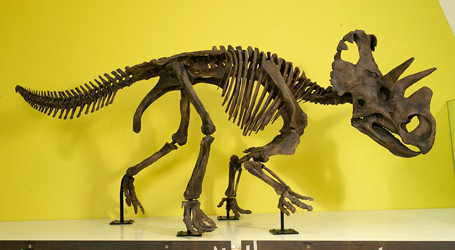
 On Display at the Royal Ontario Museum (Toronto, Canada) a Cast of Wendiceratops

A reconstruction of the dinosaur's skeleton.

A reconstruction of the dinosaur’s skeleton.

Picture credit: Royal Ontario Museum

A reconstructed skeleton of the dinosaur called Wendiceratops pinhornensis is pictured above, the fossils in the type locality represent at least four individuals, three adults and a juvenile.  This dinosaur has been described from approximately 220 bones that were found in a single bone bed.  The scientific paper that has been published reaffirms the very high diversity of North American ceratopsians and this supports the theory that around 80 million years ago there was a rapid evolutionary radiation of the Ceratopsidae.  Although a large and prominent, (although somewhat flattened) nose horn has been inferred, the nasal bone is only represented by fragmentary specimens and the actual shape of the nose horn is not known.

The Earliest Evidence of a Tall Nose Horn

Wendiceratops can claim to provide the earliest evidence of a tall nose horn being found in the Ceratopsians.  Not only does this centrosaurine tell scientists that by 79 million years ago, horned dinosaurs existed with large, nose horns, the research reveals that a large, cone-shaped nose horn evolved in this group at least twice in the evolutionary history of the Ceratopsidae.

Those Necks and Horns

It used to be thought that horn and neck frill configuration was a good methodology when it came to tell centrosaurine and chasmosaurine dinosaurs apart.  Back in the old days (pre-2000), when a lot fewer species of North American horned dinosaur had been described, a number of writers classified these types of dinosaurs based on the size, orientation and morphology of those nose horns and their accompanying neck frill.  For example, in general it was thought that centrosaurine dinosaurs such as (Brachyceratops, Einiosaurus, Xenoceratops and Centrosaurus) had short frills (relatively), combined with a large nose horn and much smaller horns over the eyes.

In contrast, the chasmosaurine dinosaurs such as Pentaceratops, Triceratops and Torosaurus had much more elongated neck frills, a small nose horn and much larger brow horns.  With the spate of recent discoveries these ideas have proved to be too simplified, Ceratopsidae classification has got a lot more complicated as new genera have been described.

A case in point is the recently described (June 2015) Regaliceratops, a member of the chasmosaurine group but with characteristics of a centrosaurine.

To read more about the research into Regaliceratops: A Right Royal Rumble.

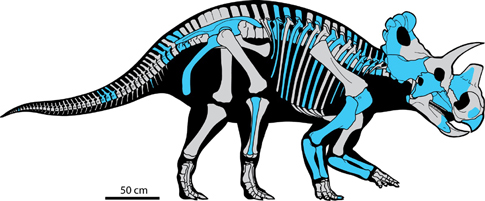
A Skeletal Drawing of Wendiceratops (W. pinhornensis)

The bones marked in blue have been found to date.

The bones marked in blue have been found to date.

Picture Credit: Danielle Dufault

Last but not Least that Trivial Name Wendiceratops pinhornensis

The third point we wanted to clear up was the specific or trivial name “pinhornensis”.   The species name has nothing to do with the shape, size or orientation of any horn, it refers to the Pinhorn Provincial Grazing Reserve in southern Alberta, where the bone bed is located.

Honouring Wendy Sloboda

The genus name honours the remarkable Wendy Sloboda, who discovered the type locality back in 2010.

Wendy has a Dinosaur Named After Her

Naming a new dinosaur after Wendy.

Naming a new dinosaur after Wendy.

Picture credit: Michael J. Ryan (one of the authors of the scientific paper published in the journal PLOS One)

Today we pay tribute to all those field workers, scientists and technicians that have helped prepare the Royal Ontario Museum exhibit, special mention to all those that helped remove the enormous rock overburden that permitted the bone bed to be fully explored.  Along with the fossilised remains of a Ceratopsian, the scientists found two tyrannosaurid teeth (genera not known), along with other reptilian remains, notably turtles and crocodilian.

The Beasts of the Mesozoic range consists of a large number of ceratopsian figures including a Wendiceratops.  To view the range of models and figures: Beasts of the Mesozoic Articulated Dinosaur Figures.

10 07, 2015

Nosing Around a Remarkable Coloborhynchus Rostrum

By |2024-04-11T10:17:39+01:00July 10th, 2015|Categories: Dinosaur and Prehistoric Animal News Stories, Dinosaur Fans, Main Page|2 Comments

Pterosaur Rostrum Discovered on the Isle of Wight

Thanks to sharp-eyed, local fossil collector Will Thurbin, a fragment of bone from an Early Cretaceous pterosaur has established that a another member of the Ornithocheiridae flew over the skies of what was to become the Isle of Wight.  Whilst searching for fossils along Chilton Chine beach on the south-west coast of the Isle of Wight, Mr Thurbin spotted a strange looking, well worn pebble that when examined more closely showed traces of eroded teeth

Strange Fossil Discovery

Unsure of what the object was, he brought the specimen to the Dinosaur Isle museum on the island so that the experts there could examine it.  After consulting Dr Dave Martill (School of Earth and Environmental Sciences at the University of Portsmouth), an expert in vertebrate fossils from the Isle of Wight, the find was identified as the tip of the rostrum the upper jaw of a Pterosaur genus known as Coloborhynchus.

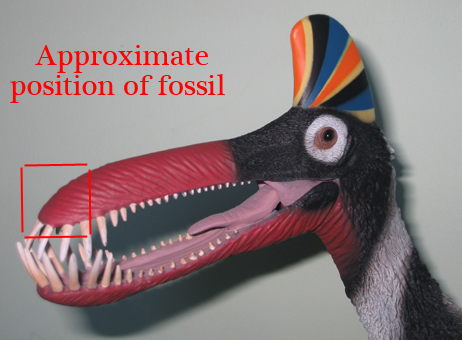
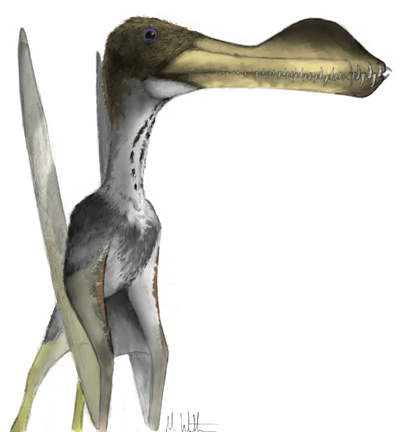
To give readers an idea of which part of the animal the fossil belongs, we have taken the excellent model of Guidraco made by CollectA, another ornithocheirid, but this time from China and used this replica to show you where the rostrum is located.

The tip of the upper jaw.

The tip of the upper jaw.

Picture credit: Everything Dinosaur

CollectA Deluxe Pterosaur Figure

The picture (above), shows the rostrum of a CollectA Supreme/Deluxe pterosaur model.  To view the CollectA Supreme/Deluxe range: CollectA Deluxe/Supreme Prehistoric Animal Figures.
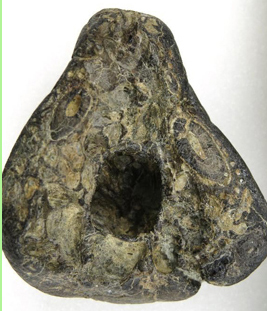
Although very worn, the fossil still retained enough detail to provide the scientists with the opportunity to identify the family (Ornithocheiridae) and the pterosaur genus.  The specimen, which is just a few centimetres long has gone on display at the Dinosaur Isle Museum.

The Isle of Wight Coloborhynchus Pterosaur Fossil

posterior view for Isle of Wight fossil.

Posterior view for Isle of Wight fossil.

Picture credit: Isle of Wight Council

The fossil may not look much, but this fossil fragment, the tip from the upper jaw (rostrum), represents the world’s oldest example of the Coloborhynchus genus.  It pre-dates earlier Coloborhynchus fossils by around ten million years.  In all likelihood it is a new species, but that’s the trouble with the Pterosauria, lots of species have been named from just fragments of fossil material.  This tends to “muddy the waters somewhat” when it comes to Pterosauria taxonomy, let’s look into this in a bit more detail.

The Problem with those “English Pterosaurs”

Coloborhynchus belongs to a very enigmatic family of pterosaurs, the Ornithocheiridae.  The fossil record for the ornithocheirids is a bit of a “curates egg”, that is to say, that the fossil record is good in parts.  Thanks to beautifully preserved specimens from China and South America, this family is amongst the best known of all the flying reptiles, but it has only been in the last twenty-five years or so that these specimens have come to light.  Before that much of what we knew (or thought we knew) about these widespread Cretaceous pterosaurs came from the study of extremely fragmentary specimens found in southern England.

Poorly Preserved Specimens

These very poorly preserved fossils probably would not get a lot of attention these days, but back in the latter part of the 19th century these remains were studied by some of the most eminent scientists around at the time.  The likes of Sir Richard Owen and Harry Govier Seeley examined and described these specimens, as a result, a range of different genera were erected, most of them now regarded as nomen dubium.  Much of these fossil were excavated from the Cambridge Greensand of southern England, marine deposits laid down in the Cretaceous, with most of the material dating from around 105 to 115 million years ago.

Three-dimensional Fossil Material

The fossils are preserved in three-dimensions, just like the Isle of Wight Coloborhynchus specimen but they are the remains of pterosaurs that died far out to sea.  The corpses were scavenged, the bones once they had sunk to the bottom of the sea became encrusted with shelled animals such as barnacles and they were drilled into by marine worms.  These bones were eventually buried only to be exposed again by violent storms and finally buried as part of the fossil record several million years after the flying reptile had actually died.  As a result, these fossils are extremely difficult to interpret, let alone assign to a new species.

Coloborhynchus clavirostris Holotype Fossil Material (Hastings Group)

Rostrum from the Hastings Group (West Sussex)

Rostrum from the Hastings Group (West Sussex). A Coloborhynchus rostrum.

Picture credit: Natural History Museum

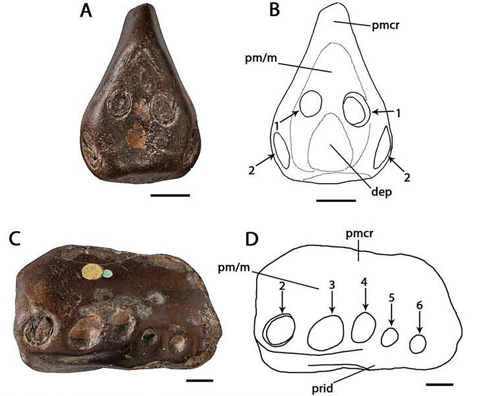
The picture above shows one of the pterosaur fossils from the 19th century.  This is the holotype for C. clavirostris, (A) = anterior view (view from the front), with (B) a line drawing of the same view.  The fossil is viewed from the side, a left lateral view (C) with a corresponding line drawing (D).  Numbers and arrows indicated teeth sockets (alveoli) and individual teeth.

Scale bar = 1cm.

Coloborhynchus Rostrum

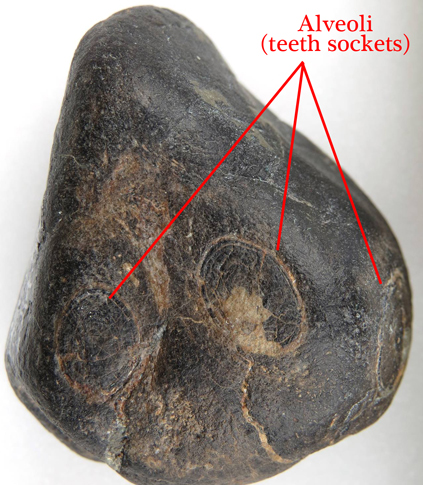
When the Isle of Wight fossil is compared to the holotype fossil material (both seen in anterior view), these two specimens look very similar, but it was the position, orientation of the alveoli (teeth sockets) that aided identification.

The Isle of Wight Fossil Material with Teeth Sockets Labelled (anterior view)

Teeth sockets can clearly be seen, it was the orientation, shape and position of the teeth sockets that led to the Coloborhynchus identification.

Teeth sockets can clearly be seen, it was the orientation, shape and position of the teeth sockets that led to the Coloborhynchus identification.

Picture credit: Isle of Wight Council with additional annotation by Everything Dinosaur

Pterosaur Piscifores

It is very likely that these toothy pterosaurs were mainly fish-eaters and they lived on the coast, or at least in estuarine environments.  The paper detailing this 2014 discovery has just been published in the Proceedings of the Geologists Association.

Intriguingly, in 2014, two fragmentary pieces of pterosaur rostrum were found on the Isle of Wight.  They were found at different locations and they are shaped differently.  The second fossil, donated by Mr Glyn Watson (Nottinghamshire), is currently being researched in order to identify the pterosaur family.  This too, is likely to be a new species, although whether a species can be assigned from the rostrum alone has yet to be determined.

An Illustration of Coloborhynchus

An illustration of the Pterosaur called Colobrhynchus (C. clavirostris)

An illustration of the pterosaur called Colobohynchus (C. clavirostris).

Picture credit: Mark Witton

 Coloborhynchus was certainly a sizeable pterosaur, although not the biggest member of the Ornithocheiridae.  Size estimates are difficult to calculate based on fragmentary material, but a maximum wingspan between four and six metres has been cited by a number of authors.

8 07, 2015

New Study of Karoo Rocks Provides Fresh Insight into Extinction Event

By |2024-04-11T10:23:54+01:00July 8th, 2015|Categories: Dinosaur and Prehistoric Animal News Stories, Dinosaur Fans, Main Page, Palaeontological articles|0 Comments

Shedding Light on an Extinction Event from 260 Million Years Ago (Karoo Basin Fossils)

One global extinction event may have affected both terrestrial and marine biotas at the same time, some 260 million years ago, a study of Karoo Basin fossils is helping to shed light on ancient mass extinctions.  With all the news recently of our planet entering a sixth mass extinction, studies into previous extinction events can help scientists to model and predict the impact of future events on environments and the species that live within them.

Karoo Basin Fossils

An international team led by researchers from the Evolutionary Studies Institute (ESI) at the University of the Witwatersrand, (Johannesburg), has obtained an age from rocks of the Great Karoo that shed light on the timing of a mass extinction event that occurred around 260 million years ago.  The Great Karoo refers to a enormous sequence of rocks often cited as the “Karoo Supergroup”, which consists of mostly non marine sandstones and shales that represent a vast tract of geological time, from the Carboniferous through to the Jurassic.

This research focused on exploring fossils from the Beaufort unit, a sequence of rocks that were laid down in South Africa from the Middle Permian through to the Early Triassic.  These rocks provide a record of the plants, invertebrates and vertebrates that thrived in the semi-arid conditions found in southern Africa during the Permian and Triassic.  In particular, they provide evidence of the wide variety of terrestrial vertebrates that lived at this time, the forerunners of today’s reptiles and mammals.

A Mass Extinction Event

The mass extinction event of 260 million years ago led to the disappearance of a diverse group of early mammal-like reptiles called dinocephalians, which were the largest land-living animals of the time.  Dinocephalians, were large bodied and evolved into a variety of forms including carnivores and herbivores.  They were synapsids and as such, ancestral to modern mammals.

The research project was led by Dr Michael Day, (postdoctoral fellow at Wits University), the findings have been published today in the Royal Society’s biological journal, “Proceedings of the Royal Society B.”  The paper is entitled:  “When and how did the terrestrial Mid-Permian mass extinction occur?  Evidence from the tetrapod record of the Karoo Basin, South Africa.”

Permian and Triassic Periods

The Karoo is very rich in fossils of terrestrial animals from the Permian and Triassic geological periods, which makes it one of the few places to study extinction events on land during this time.  As a result, South Africa’s Karoo region provides not only a historical record of biological change over a period of Earth’s history but also a means to test theories of evolutionary processes over long stretches of time.  By collecting fossils in the Eastern, Western and Northern Cape Provinces the team was able to show that around 74–80% of species became extinct along with the dinocephalians in a geologically short period of time.

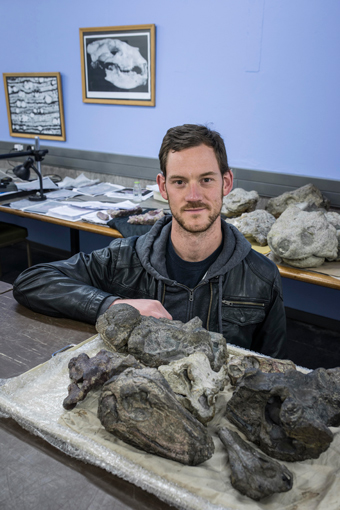
Dr Michael Day with Some of the Fossils Used in the Study (Cranial Material)

Dr. Michael Day and some of the fossils used in the study.

Dr Michael Day and some of the fossils used in the study.

Picture credit: Wits University

Calculating the Extinction Date

The new date was obtained by high precision analysis of the relative abundance of uranium and lead in small zircon crystals from a volcanic ash layer close to this extinction horizon in the Karoo.  This provides a means of linking the South African fossil record with the fossil record in the rest of the world.  In particular, it helps correlate the Karoo with the global marine record, which also records an extinction event around 260 million years ago.

Dr Day explained:

“A Mid-Permian extinction event on land has been known for some time but was suspected to have occurred earlier than those in the marine realm.  The new date suggests that one event may have affected marine and terrestrial environments at the same time, which could mean its impact was greater than we thought.”

Mid-Permian Extinction

The Mid-Permian extinction occurred near the end of what geologists call the Guadalupian epoch that extended from 272.3 to around 259.1 million years ago.  It pre-dated the massive and much more famous end-Permian mass extinction event by 8 million years.

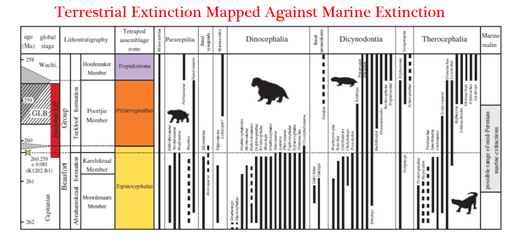
Mid-Permian Terrestrial Extinction Plotted Against Proposed Marine Extinction Dates

Table examining the impact of the Mid Permian extinction event on terrestrial fauna.

Table examining the impact of the Mid Permian extinction event on terrestrial fauna.

Table credit: Proceedings of the Royal Society B.

Dinocephalia Demise

The table shows that in this new study of Karoo fauna, the demise of the Dinocephalia can be clearly mapped to a marine extinction event (marked by the yellow star).  The marine extinction event has been identified through a study in the change of marine fossils deposited in strata from China (Wuchiapingian age, which has been dated to around 260 million years ago).

The scientists have therefore concluded that one global event may have affected both marine and terrestrial environments simultaneously.  The impact of this event was greater than previously thought.

Dr Day added:

“The South African Karoo rocks host the richest record of Middle Permian land-living vertebrate animals.  This dataset, the culmination of 30 years of fossil collecting and diligent stratigraphic recording of the information, for the first time provides robust fossil and radioisotopic data to support the occurrence of this extinction event on land.”

Dating the Formation

Jahandar Ramezani (Massachusetts Institute of Technology), was responsible for dating the stratigraphic sequences using the zircon uranium to lead degradation study (CA-TIMS method).  Dr Ramezani, of the Department of Earth and Planetary Sciences at the Massachusetts Institute of Technology commented:

“The exact age of the marine extinctions remains uncertain, but this new date from terrestrial deposits of the Karoo, supported by palaeontological evidence, represents an important step towards a better understanding of the Mid-Permian extinction and its effect on terrestrial faunas.”

For models and replicas of Permian and Triassic prehistoric animals: CollectA Prehistoric Life Models.

7 07, 2015

Super-duper a New Dinosaur Named Cooper

By |2024-04-11T10:26:02+01:00July 7th, 2015|Categories: Dinosaur and Prehistoric Animal News Stories, Dinosaur Fans, Main Page|0 Comments

“Cooper” Australia’s Biggest Dinosaur Awaits Scientific Description

The largest dinosaur discovered to date in Australia is set to go on public display for the first time with the opening of the Eromanga Natural History Museum (Eromanga, south-western Queensland).  The fossilised bones, part of a treasure trove of Cretaceous dinosaur fossils, were found back in 2007, but it has taken years of careful, painstaking research to reveal details of this enormous plant-eating dinosaur, a creature that exceeded thirty metres in length.  The huge dinosaur, a titanosaur which has been nicknamed “Cooper” will go on display when the museum opens in a few months time.

Australia’s Largest Dinosaur

An Illustration of the Giant Titanosaur

Australia's giants.

Australia’s giants.

Picture credit: ABC News/David McSween

Excavating Fossils in Queensland

This part of Queensland has been suffering from severe drought, it is hoped that the dinosaur themed museum will bring in much needed tourist revenue to the town.  At the moment a number of dig sites in Queensland are being excavated, this is the “digging season” Down Under, the slightly cooler weather permits such excavations to take place as scientists and local volunteers strive to uncover Australia’s rich dinosaur fossil heritage.

To read more about current excavations in the Queensland area: Annual Queensland Dig Yields Dinosaur Fossils.

Everything Dinosaur team members did predict that 2015 was going to be an important year for dinosaur discoveries in this part of the world, in fact, we made it one of our New Year predictions, to read more about our predictions for breaking news stories in 2015:

Everything Dinosaur’s 2015 predictions: Our 2015 Palaeontology Predictions.

Commenting on the importance of regional museums, Dr Scott Hocknull (Queensland Museum) stated:

“The opportunity for this small town to actually become a point of real national pride, there’s a great opportunity that we can’t miss.”

Titanosaurs

Titanosaurs are sauropods.  The Titanosauria consists of about four dozen genera and they seem to have replaced the diplodocids and the brachiosaurids that thrived during the Late Jurassic.  Titanosaur fossils have been found on all the continents, including Antarctica, but they seem to have been most successful and diverse in the Southern Hemisphere.  Some titanosaurs are amongst the largest terrestrial vertebrates known.  Dr Hocknull and his colleagues are currently working on the scientific paper which will describe and formally name “Cooper”.

This Australian dinosaur, whose fossils were found on a remote sheep station, will be amongst the largest titanosaurs so far described.  Bodyweight estimates suggest that “Cooper” weighed about as much as ninety Merino rams, that’s around 40,000 kilogrammes (a lot of sheep)!

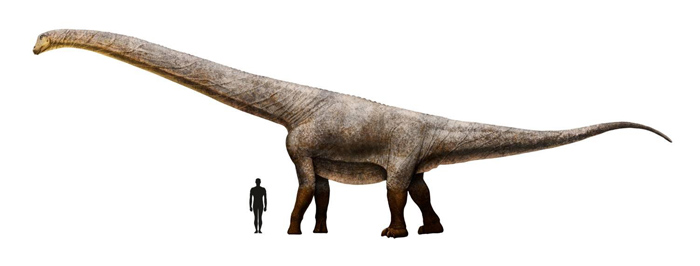
A Scale Drawing Illustration of Australia’ Biggest Dinosaur Known to Date (2015)

Scale drawing of "Cooper".

Scale drawing of “Cooper”.

Picture credit: Dr Scott Hocknull

More Dinosaur Discoveries Likely

Several other dinosaur specimens have been found in and around the Eromanga basin area since this location was first identified as a “hot spot” for Southern Hemisphere Cretaceous dinosaurs back in 2004.    Soon after the first large dinosaur fossils were found, plans were put forward to build a local dinosaur museum (Eromanga Natural History Museum), after ten years and a great deal of fund raising from the locals, the museum is nearly ready to open its doors.

The Enormous Pelvis of “Cooper” will be on Display

Giant Aussie dinosaur bones.

Giant Aussie dinosaur bones.

Picture credit: ABC News/Josh Bavas

“Cooper” may not hold the title of “Australia’s biggest dinosaur” for long.  Over the last few years a number of titanosaurid specimens have been discovered, the majority have been given nicknames such as “Zac”, “Tom”, “George” and “Sid”.   “George,” may be bigger still, but it too has yet to be formally described.

The Giant Femur (Thigh Bone) of “Cooper”

Giant limb bone of Australian Titanosaur.

Giant limb bone of Australian titanosaur.

Picture credit: ABC News/Josh Bavas

Huge Femur

The 1.9 metre long femur (thigh bone) can be seen in the foreground.  Like the pelvis pictured earlier, it is still partially in its protective plaster jacket.  The distal end (articulating with the lower leg bones, is towards the left of the photograph).  The picture is not too clear but the second femur might be just behind.

Palaeontologists think that both Cooper and Sid (titanosaurs) became trapped in mud and subsequently died.  The fossils also show evidence of trampling from other titanosaurs.  As the bones lay on the ground, other titanosaurs walked over them.  This is not the first time that such incidents have been preserved in the fossil record.  In addition, field workers found a preserved tree branch stuck in the femur, the bones of these dinosaurs were so massive that they formed “log jams” in rivers trapping other material and debris.

Planning to Make Three-dimensional Models

Dr Hocknull explained that cutting edge technology such as photogrammetry to make three-dimensional models coupled with CT scans are changing the way palaeontologists work.

He stated:

“All this is completely revolutionising the way we even do our science.  Instead of just taking a happy snap of the actual bone we can recreate the bone in three-dimensions and that gives us more data than we can ever poke a stick at.”

Everything Dinosaur team members would not advise poking sticks at dinosaur bones, no matter how big the fossils might be.  However, we look forward to the grand opening of the Eromanga Natural History Museum as well as learning more about Australia’s ancient and most impressive mega-fauna.

For models and replicas of titanosaurs and other dinosaurs: CollectA Deluxe Prehistoric Life Models.

Note: A revision of the Winton Formation sauropods published in April 2024 has cost doubt on the validity of this taxon.

4 07, 2015

New Oviraptorid from the Late Cretaceous of Southern China

By |2023-04-01T06:54:09+01:00July 4th, 2015|Categories: Dinosaur and Prehistoric Animal News Stories, Dinosaur Fans, Main Page|0 Comments

Huanansaurus ganzhouensis – Demonstrating the Diversity of the Oviraptorids

Some very peculiar things can turn up at railway stations, just ask anyone who works in a lost property office.  However, for one group of construction workers helping to build the new Ganzhou Railway Station in Jiangxi Province (southern China), they got rather a big surprise when they unearthed the partial remains of a new type of theropod dinosaur.

A New Dinosaur Species

The new dinosaur has been identified as a member of the Oviraptoridae family, an extremely bird-like group of dinosaurs, it has been named Huanansaurus ganzhouensis and it suggests that there were many different types of oviraptorids living in the same environment but each type may have evolved a different feeding and foraging habit.

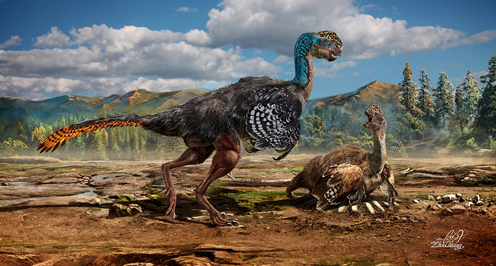
An Illustration of H. ganzhouensis (Male and Female)

A new feathered dinosaur from China.

A new feathered dinosaur from China.

Picture credit: Chuang Zhao

Although no feather impressions have been found with the fossils, it is assumed that this lithe dinosaur was indeed feathered.  The illustrator has also assumed that the males had different colouration when compared to the females.  In this imagined scene, one of a breeding pair approaches the other which is sitting on a nest of eggs.  More than two hundred oviraptorosaurian nests have been found in the Ganzhou area and this part of the world seems to have been a hot bed of oviraptorid evolution with a total of five genera now known from the strata around the city of Ganzhou.

Huanansaurus ganzhouensis

Size estimates vary, but based on skull measurements and comparisons with other Asian oviraptors, Everything Dinosaur’s team members estimate that Huanansaurus would have measured around 1.5 metres long and stood over a metre tall, making this dinosaur about half the size of its closest relative Citipati (C. osmolskae), fossils of which come from the Gobi Desert (Djadokhta Formation), that lies some 1,800  miles to the north-east of Jiangxi Province.

It is analysis of the beautifully preserved skull material that has permitted the research team to conduct a phylogenetic analysis placing Huanansaurus close to the Citipati genus in the Oviraptoridae family.  Huanansaurus is distinct from the other four other types of oviraptorid discovered to date from the Upper Cretaceous rocks (Nanxiong Formation),  located around Ganzhou city.

The four other types of oviraptorosaurs found in this area are:

  • Banji long (named and described in 2010)
  • Ganzhousaurus nankangensis (named and described in 2013)
  • Jiangxisaurus ganzhouensis (also named and described in 2013)
  • Nankangia jiangxiensis (named and described in that bumper year for southern Chinese oviraptorosaurs, 2013)

A Line Drawing of the Skull and Cranial Material (HGM41HIII-0443)

Left side (lateral view) of the skull and jaws.

Left side (lateral view) of the skull and jaws.

Picture credit: Journal Science with additional annotation by Everything Dinosaur

Edentulous – Lacking Teeth

Like most of the later oviraptorosaurs, Huanansaurus lacked teeth, the shape and size of the skull along with the morphology of the jaws suggests that lots of different types of feathered oviraptorid dinosaur were able to live in the same environment.  These little dinosaurs co-existed as they probably had different foraging and feeding strategies.  The prevalence of oviraptorosaurs in southern China indicates that other parts of Asia may have had different types of oviraptorid present within their biota, but these fossils may not have been found as yet.

The researchers involved in this study include scientists from Japan, South Korea, Uppsala University (Sweden), Henan Geological Museum and the Chinese Academy of Scientists.  The fossils are currently stored in the vertebrate fossil collection of the Henan Geological Museum.

To view a selection of feathered theropod models: Wild Safari Prehistoric World Models.

Everything Dinosaur Comments on the Fossil Find

A spokesperson from Everything Dinosaur explained:

“In simple terms, the jaw shapes and sizes are different in the Jiangxi Province oviraptors.  Although these feathered dinosaurs all lived at the same time, the very late Late Cretaceous and they shared the same environment, they probably specialised in eating different types of food.  For example, the lower jaw tip of Banji long is very strongly curved downwards, whilst the same part of the jaw found in Nankangia jiangxiensis is not.  Both Jiangxisaurus and the newly described Huanansaurus come somewhere in between these two extremes.  It is likely that each type of dinosaur occupied a different ecological niche in the Late Cretaceous palaeoenvironment.”

More Research Required into Oviraptorids Like Huanansaurus ganzhouensis

What did oviraptor-like dinosaurs eat?  That remains a bit of a mystery, we suspect that they were omnivorous with perhaps each animal adapted to eating different types of seed, fruit and nuts as well as catching and eating amphibian, small mammals and insects.

Everything Dinosaur stocks a range of oviraptors within the Papo model range: Papo Oviraptor Models and Dinosaur Figures.

29 06, 2015

Important Dinosaur Tracks Vandalised

By |2024-05-05T14:23:02+01:00June 29th, 2015|Categories: Dinosaur and Prehistoric Animal News Stories, Dinosaur Fans, Main Page|0 Comments

Dinosaur Tracks Vandalised – Plaster Casts Attempted

We have picked up a number of reports from the United States that several dinosaur tracks have been vandalised at the Manti-La Sal National Forest, a national park managed by the United States Forestry Service.  Manti-La Sal National Forest straddles the State border between Utah and Colorado and a number of important vertebrate fossils including dinosaur bones and tracks are located within the 1.4 million acre park.  It is illegal to collect or make duplicates of any vertebrate fossils, including trace fossils from lands managed by the U.S. Forestry Service without the correct permits.

Permits are normally only issued to qualified palaeontologists and those parties involved in federally approved research.

Dinosaur Tracks Vandalised

A spokesperson from the Manti-La Sal National Forest, explained that three-toed dinosaur tracks in the Moab (Utah), area had been vandalised and a number of suspects identified.  As we at Everything Dinosaur understand the situation, no arrests have been made yet.

This part of Utah is famous for its amazing dinosaur fossils.  Sadly, Everything Dinosaur team members have reported on numerous occasions deliberate damage being caused to fossil sites, or the theft of dinosaur bones and tracks.  With private collectors prepared to pay large sums of money for dinosaur fossils, there is a big black market in illegally acquired artefacts.  Last year we reported on the theft of a dinosaur footprint from a Bureau of Land Management managed site, not too far away from this incident.

A local man (Jared Ehlers) was arrested and sentenced to six months house arrest, fined and given an additional one year probation sentence.  Mr Ehlers claimed he had stolen the footprint as he wanted to make a coffee table out of it.  The stolen footprint has not been recovered.

Attempts to Make Casts

In this latest incident, although no footprints were actually taken, the plaster poured into the footprint impressions will have caused some damage to these important trace fossils.   The dinosaur tracks, probably made by a large, carnivore, have been preserved in hyporelief (depressions), such tracks are relatively rare and the Utah specimens are of exceptional quality, the consistency of the sediment at the time the dinosaur walked on it was just right to permit an accurate footprint impression to be created.

Important Trace Fossils

Palaeontologists can use these footprints to explore theropod locomotion by calculating the way the foot moves as it contacts and leaves the sediment surface.  Although the plaster can be carefully removed and the footprints cleaned, subtle details related to the dinosaur’s locomotion will be probably obliterated.

Everything Dinosaur would like to take this opportunity to advise readers that no collection permits for any type of fossil (plants, invertebrates, vertebrates or trace fossils), are issued by the U.S. Forestry Service  for commercial purposes.  The selling, trading or bartering of any fossil material from National Forest System Lands is strictly prohibited.

For dinosaur models and prehistoric animal figures: Dinosaur Figures and Prehistoric Animal Models.

28 06, 2015

The “Grandfather” of All Tortoises and Turtles

By |2023-03-31T21:43:31+01:00June 28th, 2015|Categories: Dinosaur and Prehistoric Animal News Stories, Main Page, Palaeontological articles|0 Comments

German Fossil Discovery Could be Transitional Fossil

How did the turtle get its shell?  It sounds like the opening line from one of Aesop’s fables but in reality this question has been vexing palaeontologists for the best part of two hundred years.  Thanks to some remarkable fossil discoveries from southern Germany (Baden-Württemberg) and the work of scientists from the Natural History Museum of Stuttgart and the Smithsonian Institute (National Museum of Natural History, Washington D.C.), we might be one step closer to solving this puzzle.

German Fossil Find

About thirty-five miles north-east of the city of Stuttgart, lies the picturesque town of Vellberg, there are a large number of quarries extracting Triassic-aged limestone and other materials in this locality, as in this part of the Germany, there are extensive outcrops of Lower Keuper sedimentary material.

In a band of claystone, which represents strata from the Erfurt Formation, (Lower Keuper stratigraphic unit), scientists have excavated eighteen specimens of a small reptile, the fossils of which, could represent a transitional fossil between basal Chelonians (turtles and tortoises) and the types of turtles and tortoises we see today.

Middle Triassic Rocks

The claystone represents sediments deposited at the bottom of a large lake that existed some 240 million years ago in the Middle Triassic (Ladinian faunal stage).  Although the claystone layer is relatively thin, no more than fifteen centimetres deep at its thickest part, palaeontologists have been exploring these rocks since 1985 as the fossils they provide give a unique insight into the fauna of this part of the world a few million years after the End Permian extinction event, at around the time of the very first dinosaurs.

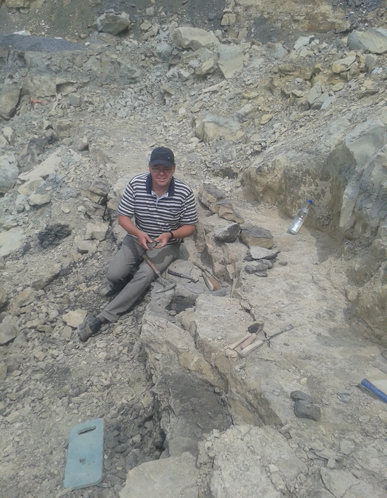
Dr Rainer Schoch at the Excavation Site (Erfurt Formation)

Dr. Rainer Schoch working at the claystone bed.

Dr Rainer Schoch working at the claystone bed.

Picture credit: Dr Rainer Schoch/Natural History Museum of Stuttgart

Pappochelys rosinae

The reptile has been named Pappochelys rosinae, the genus name translates from the Greek meaning “grandfather turtle”, the species name honours Isabell Rosin of the Natural History Museum of Stuttgart as she was responsible for preparing the fossil specimens for study.  This little reptile measured around twenty centimetres in length, the long tail made up about fifty percent of the total body length.

Anatomical features indicate that this reptile is a transitional animal from the more primitive and older Eunotosaurus known from strata dating from approximately 260 million years ago and the more recent Odontochelys, whose fossils come from Chinese rocks and date from about 220 million years ago.

Pappochelys

Pappochelys could be an intermediary form in between Eunotosaurus and Odontochelys.  It helps to fill the forty million year gap in Chelonian fossils.  Whilst Odontochelys, lacked the full turtle shell (carapace) it did possess a hard, flat underbelly (plastron).  P. rosinae lacks a plastron, but the gastralia (belly ribs) on its underside are broader and closer to fusing than in Eunotosaurus.

To read about the discovery of Eunotosaurus: An Insight into Chelonian Evolution.

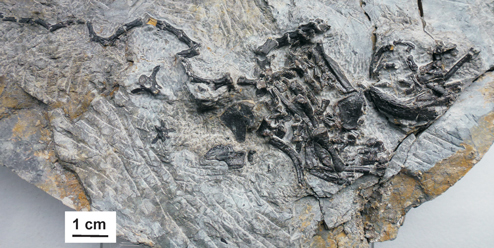
Associated Post Cranial Material of Pappochelys rosinae

Post cranial fossil material including the thickened trunk ribs.

Post cranial fossil material including the thickened trunk ribs.

Picture credit: Natural History Museum of Stuttgart

Hans-Dieter Sues, (Curator of Vertebrate Palaeontology, at the National Museum of Natural History, Washington D.C.) explained:

“In the case of Pappochelys, we see that its belly was protected by an array of rod-like bones, some of which are already fused to each other.  Such a stage in the evolution of the turtle shell has long been predicted by embryological research on present-day turtles but never observed in fossils – until now.”

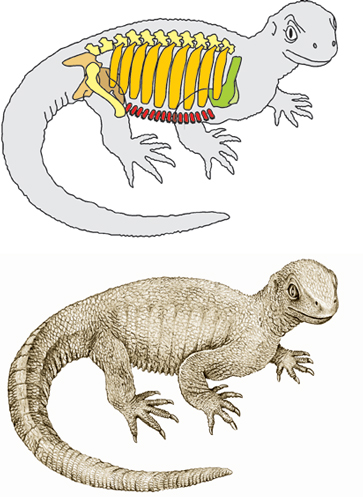
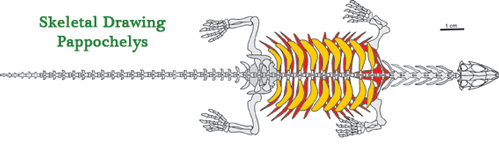
An Illustration of Pappochelys and Outline Plan of Key Bones

Illustration and outline plan of bones - ribs (yellow), gastralia (red), shoulder girdle (green), pelvis (brown), femur and vertebrae (mustard)

Illustration and outline plan of bones – ribs (mustard), gastralia (red), shoulder girdle (green), pelvis (brown), femur and vertebrae (yellow)

Picture credit: Natural History Museum of Stuttgart

Thickened Ribs

The diagram shows the thickened trunk ribs of this ancient reptile and the lacustrine (lake) deposit might provide a clue as to why such creatures eventually evolved a hard shell.  The bones are thickened and more dense, if this animal was semi-aquatic, then the heavier bones would help to provide ballast and counter the animal’s natural buoyancy in water.

The more robust, heavier bones might have helped this reptile to dive deeper and to stay underwater for longer.  The pelvis and the shoulder girdle are very similar to those found in Odontochelys, which is regarded by many scientists as the earliest true turtle.

A Dorsal view of the Bauplan Showing Modified Ribs and Gastralia

Expanded ribs (yellow) gastralia (red)

Expanded ribs (mustard) gastralia (red)

Picture credit: Natural History Museum of Stuttgart

The picture above shows a skeletal reconstruction of Pappochelys.  The ribs (mustard) and the gastralia (red).

Evolution of Turtles

Dr Sues outlined the anatomical developments leading to modern-day turtles that could be traced from the fragmentary fossils found at Vellberg.  The paper on these specimens, which Dr Sues co-authored has just been published in “Nature”.

He stated:

“It [Pappochelys] has real beginnings of the belly shell developing, little rib-like structures beginning to fuse together into larger plates and then ultimately making up the belly shell [plastron].”

Where do the Tortoises and Turtles Fit in with Other Reptile Groups?

The origins of the Chelonia (turtles and tortoises) remain controversial.  More modern Chelonia, such as those genera still around today do not have teeth.  Instead, they have a beak.  Pappochelys had teeth, (some cranial material including jawbones and teeth have been found) and it is known that Odontochelys also had teeth (the genus name translates as “toothed turtle with half a shell”).  However, scientists have long argued where in the Order Reptilia the Chelonia actually sit.

They are regarded as a very ancient group of reptiles.  It had been thought that turtles and tortoises were descended from ancient Parareptiles, but the skull bones of Pappochelys reveal an affinity to the diapsid reptiles, a wide-ranging group that includes lizards, snakes, crocodiles as well as extinct marine reptiles and the Dinosauria.

Implictions for Reptile Taxonomy

It had been thought that tortoises and turtles were anapsids, lacking temporal fenestrae (holes behind the eye socket in the skull, but the Pappochelys cranial material shows a pair of openings in the skull behind each eye socket.  This suggests that the Chelonia are not descended from parareptiles but have phylogenetic affinities to the diapsids.  This places them in the same clade as lizards and snakes.

26 06, 2015

Finally Getting to Look at the Face of Hallucigenia

By |2023-03-31T21:23:45+01:00June 26th, 2015|Categories: Dinosaur and Prehistoric Animal News Stories, Dinosaur Fans, Main Page|0 Comments

Bizarre Hallucigenia Gets a Face

Growing up with an interest in fossils and prehistoric life, for many team members at Everything Dinosaur, meant that during their formative years, one of the most bizarre of all the animals that are known to have existed, would periodically enter their lives.  The mysterious Hallucigenia, fossils of which are found in the famous Burgess Shale deposits of British Columbia, would have a new research paper published and there would be a fresh perspective on this most peculiar looking creature.

Fossils of the Very Mysterious and Bizarre Hallucigenia

A fossil of Hallucigenia (Burgess Shale)

A fossil of Hallucigenia (Burgess Shale)

Burgess Shale Fossils

The facial features and the mouth of this little animal have finally been revealed.  A study conducted by scientists Dr Martin Smith (Cambridge University) and Dr Jean-Bernard Caron (Curator of Invertebrate Palaeontology, Royal Ontario Museum, Canada), has led to some of the mysteries surrounding Hallucigenia being resolved.  For example, we know now which end was the head and which end was the tail.  In addition, electron microscopy has shown that Hallucigenia had a ring of teeth inside its mouth and a further set of teeth running down its throat.

These teeth in the throat probably served as ratchets.  Palaeontologists think that the tube like body of Hallucigenia was designed to digest food that it sucked into the opening at the front of its body, the simple mouth.  The teeth in the throat may have helped to push food particles down the gut as well as preventing food from being sucked out again as the animal pumped in mud and water as part of its feeding mechanism.

This previously unidentified feature (a throat lined with needle-like teeth), helps connect this Cambrian sea creature to extant Velvet Worms and the evolution of the arthropods, which today make up more than 80% of all the animal life on Earth.

Hallucigenia

Commenting on the discovery of Hallucigenia’s facial features, Dr Smith explained:

“When we put it into the electron microscope, we were delighted to see not just a tiny pair of eyes looking back at us, but also beneath them a really cheeky semi-circular smile.  It was as if the fossil was grinning at us at the secrets that it had been hiding.”

This new study into Hallucigenia, the first fossils of which were found by Charles Walcott who discovered the Burgess Shale fossil site in 1909, has also solved another mystery.  Although, specimens are relatively rare in the Burgess Shale biota, a number of fossils that have been found show a tear shaped blob preserved adjacent to the body.  For some years, this was thought to be the head, or possibly some sort of appendage of the animal.  However, the new paper, published in the journal “Nature”, identifies these strange blobs as gut contents.

Dr Smith stated:

“What our study shows is that it [the blob] has a different composition from the animal.  And rather than representing part of its body, it actually represents decay fluid – the contents of its guts – squeezed out as the animal was buried and fossilised.”

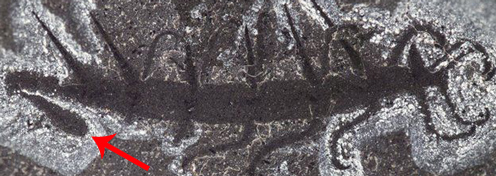
 What was that Mysterious Blob?

A Hallucigenia specimen (Royal Ontario Museum).

A Hallucigenia specimen (Royal Ontario Museum).

Picture credit: Royal Ontario Museum/Dr. Jean Bernard Caron with additional annotation by Everything Dinosaur

The arrow in the picture shows the location of the strange blob.

A Rare Fossil

Compared to the bountiful fossils of other species associated with the Burgess Shale Formation, Hallucigenia fossils are rare, so much so that the first species to be formerly described in the Hallucigenia genus was named H. sparsa. It was English palaeontologist Simon Conway Morris who established the Hallucigenia genus after he reviewed the earlier Walcott study.  Walcott had thought that this little animal was some form of early bristle worm (polychaete worm), like a Lugworm, but Conway Morris decided that this creature was so unique it deserved its own genus.  He established the genus Hallucigenia, so named for its “bizarre and dream-like appearance”.

Like a number of other Burgess Shale animals, Hallucigenia was thought to be an evolutionary experiment that left no descendants.   The Cambridge University/Royal Ontario Museum team have been able to map, approximately where the alien-looking Hallucigenia fits into the Kingdom Animalia.  It seems to be a precursor to the Velvet Worms (Onychophorans), that still can be found in the tropics today.  Velvet Worms, arthropods and Tardigrades (Water Bears), belong to a huge group of animals that all moult, these are called Ecdysozoans.

Establishing the Phylogeny of Hallucigenia

The researchers were able to establish that Hallucigenia was not the common ancestor of these moulting animals but that it was an ancestor of the extant Onychophorans.  Finding the mouth and the  pharyngeal teeth (teeth in the throat), helped the scientists to determine that Velvet Worms originally had the same configuration, but these were eventually lost.

Dr Smith explained:

“The early evolutionary history of this huge group is pretty much uncharted.  While we know that the animals in this group are united by the fact that they moult, we haven’t been able to find many physical characteristics that unite them”.

Dr Jean-Bernard Caron added:

“It turns out that the ancestors of moulting animals were much more anatomically advanced than we ever could have imagined, ring-like, plate-bearing worms with an armoured throat and a mouth surrounded by spines.  We previously thought that neither Velvet Worms nor their ancestors had teeth.  But Hallucigenia tells us that actually, Velvet Worm ancestors had them, and living forms just lost their teeth over time.”

Team members at Everything Dinosaur have a lot of time for the Hallucigenia genus.  Most of the individuals are much smaller than people imagine.  The largest specimens are around thirty-five millimetres in length and when Conway Morris published his research in 1979, it turns out that his study depicted this animal the wrong way up and back to front.

Remembering Early Reconstructions

Conway Morris illustrated Hallucigenia as walking on stiff spine-like legs, with a single row of tentacles waving around on its back.  A model was created that showed this new view of Hallucigenia.  The model can be seen at the start of the Royal Ontario Museum video featuring Dr Caron who explains about the latest research.  Although, anatomically not correct, the model remains a curiosity that is kept at the Museum along with a large number of Burgess Shale specimens including many of the fossils collected by Charles Walcott.

The Original Simon Conway Morris Model of Hallucigenia

The very alien-looking Hallucigenia model.

The very alien-looking Hallucigenia model.

Picture credit: Royal Ontario Museum

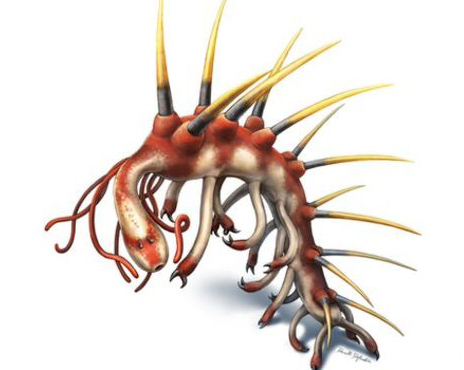
The bulbous head turns out to be the rear end of the creature and thanks to this new research (plus some similar types of Chinese fossils that have been extensively studied), we have a very different interpretation of this marine creature.  It looks quite graceful and delicate.  A picture of Charles Walcott can be seen in the background.

Based on the New Research The Reconstructed Hallucigenia

Scientists have been able to stare into the face of Hallucigenia for the first time.

Scientists have been able to stare into the face of Hallucigenia for the first time.

Picture credit: Danielle Dufault

Spines Evolved as Defensive Structures

Those spines, once thought to be legs probably evolved as a number of predators shared Hallucigenia’s marine habitat.  The spines would have been an effective deterrent against attacks from nektonic arthropods.

Hallucigenia remains one of the most remarkable animals within the Burgess Shale biota, but thanks to this new study some of the mysteries surrounding it have been solved.  It remains an enigmatic little creature and after more than a century since its discovery it is still capable of springing a few surprises.  The story of Hallucigenia and how it has been interpreted and reinterpreted over the years provides a fascinating example of how new techniques and study methods can lead to a reinterpretation of the fossil evidence.

CollectA have recently introduced a range of not-to-scale replicas of important animals from the Palaeozoic.  To review this range of models and figures: CollectA Prehistoric World Models.

Go to Top