All about dinosaurs, fossils and prehistoric animals by Everything Dinosaur team members.

Fossil finds, new dinosaur discoveries, news and views from the world of palaeontology and other Earth sciences.

4 06, 2015

Getting Under a Dinosaur’s Skin

By |2023-03-30T15:19:58+01:00June 4th, 2015|Categories: Dinosaur and Prehistoric Animal News Stories, Dinosaur Fans, Main Page|0 Comments

Origins of Feathers More Complex Than Previously Thought

Over the last week or so, team members at Everything Dinosaur have reported upon new research into whether dinosaurs were warm-blooded or not.  In addition, in response to requests from readers, we discussed the lack of feathers in dinosaurs such as the fearsome Velociraptors that are featured in the forthcoming movie “Jurassic World”.

Feathered Dinosaurs

This morning, we turn once again to the “were dinosaurs feathered” debate as a new study published in the journal “Biology Letters” suggests that the common ancestor of the Dinosauria was not covered in feathers and indeed, most dinosaurs probably were scaly.

Analysis undertaken by scientists from the Natural History Museum (London), Uppsala University (Sweden) and the Royal Ontario Museum (Toronto, Canada) suggest that feathered dinosaurs were probably the exception amongst the Order Dinosauria.  A comprehensive review of known dinosaur skin fossils coupled with an in-depth study of the dinosaur family tree was used to assess the probability of feathers appearing in different types of dinosaur.

The team conclude that the majority of non-avian dinosaurs were more likely to have had scales like a crocodile or lizard rather than exhibiting signs of feathers or “feather-like” structures.

Once Again Palaeontologists Debate the Extent of Feathers in the Dinosauria

Adult and juvenile feathered dinosaurs

Adult and juvenile feathered dinosaurs.

Picture credit: Xing Lida and Song Qijin

Why do Scientists Get into a Flap over Feathers?

If the majority of dinosaurs had feathers then this has huge implications for dinosaur biology and behaviour.  Insulating feathers infer that the animal that possesses them must be warm-blooded (endothermic), so this argument links directly into the cold-blooded versus warm-blooded dinosaur debate.

To read the article on the research from Stony Brook University that challenges 2014 data on mesothermic dinosaurs and argues that dinosaurs were indeed warm-blooded: Dinosaur Warm-blooded Debate Hots Up.

Thanks to the astonishing fossils from Liaoning Province (China) scientists have been able to identify feathers in a number of different types of theropod dinosaur.  It is widely accepted that many different types of meat-eating dinosaur were feathered or at least partially feathered.

Those dinosaurs which are believed to be closely related to birds provide the greatest number of candidates for feathers rather than scales.  Dinosaurs such as Caudipteryx (Oviraptoridae), Beipiaosaurus (Therizinosauridae), Microraptor (Dromaeosauridae) and Deinocheirus (Ornithomimosauria) were all very probably feathered.  All these dinosaurs are classified as coelurosaurian theropods, the clade of dinosaurs that taxonomically are placed close to the evolutionary line leading to the Aves (birds) fossil evidence supports this hypothesis.

Beautifully Feathered Dinosaur Fossil from Liaoning Province (Microraptor)

Feathers found preserved in many dinosaur fossils from China.

Feathers found preserved in many dinosaur fossils from China.

Scored for the Presence of Absence of Feathers

The researchers included thirty-four ornithischian dinosaurs, six sauropods and forty theropods (which included some Mesozoic birds).  These taxa along with a number of others were scored for the presence of feathers or proto-feathers in the fossil record.  Where on the body feathers had been found was also taken into account along with the type of depositional environments that allowed the preservation of filamentous feathers or scaly skin.

Pterosaurs as a group related to the Dinosauria and also archosaurs were included in the study.  Although the fossil record is extremely poor, the team were able to conclude that, based on the probability analysis and the consensus tree that was constructed, it was likely that the ancestor of the dinosaurs was not feathered.  In addition, the research suggests that although the majority of coelurosaurian theropods were indeed feathered to some degree, the majority of other dinosaurs were very probably not feathered.

Commenting on the research, one of the authors of the paper, Nicolás E. Campione (Uppsala University) stated:

“As palaeontologists we are at the mercy of available data, which given the interest in the field are ever changing.  Our study shows that dinosaurs experimented extensively with their “outer look” and potentially independently along separate evolutionary lineages.  That is what the data allows us to say at present.”

The Way Flying Reptiles (Pterosaurs) Were Assessed Affected the Results

Intriguingly, the single biggest influence on the feather versus scales debate in this analysis was the way in which the Pterosauria (flying reptiles) were treated.  Pterosaurs are not dinosaurs, but a related group belonging to the archosaurs just like the Dinosauria.  How closely related the pterosaurs are to the dinosaurs remains an area of controversy.  This research showed that if the ancestor of the Pterosauria was assumed to be scaly then different feather probabilities in the Dinosauria resulted when compared with the study with a fuzzy Pterosaur ancestor included in the database.

Professor Paul Barrett, (Natural History Museum), one of the co-authors of this report summarised the team’s findings:

“Using a comprehensive database of dinosaur skin impressions, we attempted to reconstruct and interpret the evolutionary history of dinosaur scales and feathers.  Most of our analyses provide no support for the appearance of feathers in the majority of non-avian dinosaurs and although many meat-eating dinosaurs were feathered, the majority of other dinosaurs, including the ancestor of all dinosaurs, were probably scaly.”

Feathered Dinosaurs

The biology of the dinosaurs is going to remain a hotly debated topic.  Work such as this new study helps to move the debate forward by reflecting evidence put forward by new fossil discoveries.  However, the fossil record is far from complete and conclusions such as the ones made in this research need to be tested in the light of further fossil finds that help to fill in important and significant gaps in our knowledge of the epidermal coverings of dinosaurs and their close relatives.

To read an article about a fossil find that suggests a Jurassic Ornithischian dinosaur was feathered: Kulindadromeus – Did All Dinosaurs Have Feathers?

A consequence of the inference that most coelurosaurian theropods were probably feathered is that the most famous dinosaur of all Tyrannosaurus rex may also have been covered in a coat of feathers.  Perhaps a young T. rex had a shaggy coat of feathers to help keep it warm.  As the animal grew and became more massive, the need to insulate its body (surface area to volume ratio), became less important.  An adult Tyrannosaurus rex, however, may indeed have been feathered, at least in part.

As fossils of filaments and feathers are associated with low energy depositional environments and finely grained substrates (not a description readily given to much of the Hell Creek Formation), then palaeontologists may never find a feathered T. rex fossil.

CollectA Will Introduce a Feathered T. rex Model in the Summer of 2015

1:40 scale model of a feathered T. rex.

1:40 scale model of a feathered T. rex.

To view the CollectA scale model range and the feathered T. rex (from late summer 2015): CollectA Prehistoric Life Models.

2 06, 2015

Britain’s Oldest Sauropod as Rare Fossils Found

By |2024-05-05T14:14:26+01:00June 2nd, 2015|Categories: Dinosaur and Prehistoric Animal News Stories, Dinosaur Fans, Palaeontological articles|0 Comments

A New Sauropod Dinosaur from the Middle Jurassic

Here is a tale of a tail bone from the United Kingdom, one that once formed part of the skeleton of a primitive sauropod that lived in Yorkshire some 176 million years ago.  It fell out of a cliff and was found on the beach close to the north Yorkshire coastal town of Whitby, not too far away from the famous Abbey.  The fossil was sent to the University of Manchester for further study and detailed X-ray computer tomography analysis was undertaken at the nearby Manchester Royal Infirmary (Dept. of Radiology) in a bid to learn more about the specimen.

The fossil represents a caudal vertebra (a tail bone) one that would have been located in the long tail but near to the hips.

Britain’s Oldest Sauropod

Team members at Everything Dinosaur have seen this specimen up close.  We were shown the fossil on a visit to Manchester University some years ago by Professor Phil Manning.  A paper detailing this discovery has been published in the journal PLOS One, Professor Phil Manning co-authored this paper along with colleague Victoria Egerton (School of Earth, Atmospheric and Environmental Sciences) with the help of Mike Romano, an independent researcher based in Sheffield (South Yorkshire).

The Sauropod Dinosaur Tail Bone

The specimen is currently housed at the Yorkshire Museum (York).

The specimen is currently housed at the Yorkshire Museum (York).

Picture credit: Manchester University

An Indeterminate Sauropod Caudal Vertebra

The picture above shows the indeterminate sauropod caudal vertebra, the face of the centrum can clearly be seen as can the hole in the bone which represents the neural canal where the spinal cord passed through.  The specimen is significant as it comes from the Saltwick Formation which forms one of the oldest sequences of rock from the Ravenscar Group of largely terrestrial deposits laid down in an estuarine environment.

Very few body fossils have been found in these rocks, but a number of dinosaur trackways have been described.  These tracks represent a number of different types of dinosaur, theropods, stegosaurs, ornithopods and long-necked dinosaurs – sauropods.  The strata was formed around 176 million years ago (Aalenian faunal stage ) of the Middle Jurassic.  This fossilised bone is therefore the oldest sauropod fossil scientifically described from the British Isles.  It is some 4 million  years older than the Cetiosaurus spp. material which has been described from strata laid down during the Bajocian and Bathonian faunal stages of the Jurassic.

A New Species

It most certainly represents a new species and the specimen had been nick-named “Hildasaurus” after St Hilda, the abbess who founded Whitby Abbey on the East Cliff overlooking the town.  However, due to the very low number of sauropod caudal vertebrae that have been described from the Middle Jurassic, it is not possible to assign this fossil to a new species and to give the dinosaur bone a binomial scientific name.

A Typical Cetiosaurid Sauropod Dinosaur

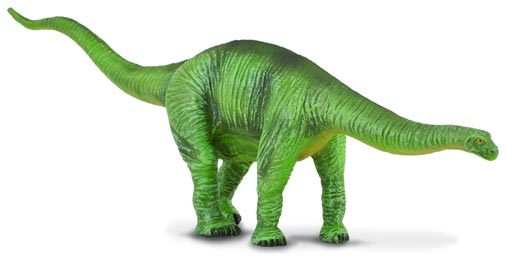
Cetiosaurus early Sauropod

Cetiosaurus model – an early sauropod.

Picture credit: Everything Dinosaur

Professor Manning explained:

“It was a splendid surprise to come face-to-face with a fossil vertebra from the Jurassic rocks of Yorkshire that was clearly from a sauropod dinosaur.  This fossil offers the earliest “body fossil” evidence for this important group of dinosaurs but it’s impossible to define a new species based on this single bone.”

 Views of the Caudal Vertebra (Specimen Number: YORYM: 2001.9337)

Not possible to determine a species for this important fossil.

Not possible to determine a species for this important fossil.

Picture credit: PLOS One

“Hildasaurus”

The picture above shows two further views of the fossil material (A) oblique view (photograph taken at an angle, not quite an anterior view), which shows a distinct keel on the bottom of the bone and a partial caudal rib (CR) that can be seen on the left of the bone.

Key (Picture A)

PRZ = prezygapophysis – a peg of bone located on the neural arch which articulates with the next tail bone in the caudal vertebrae sequence.

SPRF = spinoprezygapophyseal fossa – a channel in the reinforcing ridge of bone commonly associated with sauropod vertebrae that strengthens the connection between the bones

CPRL = centroprezygapophyseal lamina – the ridge of bone the connects the centrum with the prezygapohysis at the top of the vertebra

CR = caudal rib – one of a pair of thin, struts of bone that point out at roughly ninety degrees to the face of the centrum.  These small bones support tail muscle attachments.

KEEL = keel – describes the shape of the bone at the base of the centrum.

Not an Example of Cetiosaurus

Although the fossil bone is not complete, these features have helped the scientists to determine that this specimen, most probably does not represent a Cetiosaurus.  Caudal tail bones located relatively close to the hips, such as those fossils assigned to the “Rutland Cetiosaurus” lack the keel shaped portion of bone on the ventral face of the vertebra.  In addition, the fragment of caudal rib present in the specimen is located at a different position in relation to the centrum when compared to the caudal ribs found on cetiosaurid fossil material.

Picture B shows a lateral view (a view of the right side of the fossil).  The shape of the neural spine (NS) can be clearly seen in this view.

Key (Picture B)

NS = neural spine, a blade shaped bone projection that sits on top the neural arch.

SPRL =  spinoprezygapophyseal laminae – a ridge of bone that strengthens the connection between the neural  with one of the prezygapophyses.

FOSSAE = recessed areas or depressed areas of bone (single = fossa).

In both picture A and B, the scale bar is 5 cm.

Although, the caudal vertebra is similar to that found in Cetiosaurus spp. and has some potential affinity with another sauropod called Haplocanthosaurus (Upper Jurassic Morrison Formation of the United States), the morphological differences described indicate that this fossil bone does represent a new, as yet undescribed species of long-necked, Middle Jurassic dinosaur.

A Close up View of the Sauropod Fossil showing the Distinctive Keel

Ventral view (view from underneath)

Ventral view (view from underneath).

Picture credit: PLOS One with additional annotation from Everything Dinosaur

Pointed Keel Representing Britain’s Oldest Sauropod

The pointed keel shape can be made out in this ventral view (photograph above).  The density of the surrounding matrix made CT interpretation difficult but enough of the fossil bone has been prepared to confirm the sauropod diagnosis but genus level or even family level identification is not possible.  Fossilised fragments of plant rootlets and other material has helped the palaeontologists to identify the origins of this fossil, even though it was found on the beach having eroded out of the cliff face.

The lack of abrasion (erosion) on any of the exposed faces suggests that this fossil was not transported far prior to burial, or indeed, that the fossil material had not been exposed on the shore for very long prior to its discovery.

This discovery gives team members at Everything Dinosaur the opportunity to applaud the hard-working team of scientists (both amateur and professional) that so conscientiously dedicate so much time to the exploration and study of the many important geological sites in the British Isles.  It was Alan Gurr who actually found this proximal caudal vertebrae on a field trip led by Professor Phil Manning.

The specimen (YORYM:2001.9337), may not be able to be assigned to a species, but the fossil was nick-named “Alan” in honour of the finder.  The very talented Mike Marshall of Yorkshire Coast Fossils was responsible for preparing the vertebrae and such careful preparation permits a rare insight into the ancient fauna of the Jurassic.

1 06, 2015

Time for Some More “Aussie Dinosaurs”

By |2023-03-30T14:45:43+01:00June 1st, 2015|Categories: Dinosaur and Prehistoric Animal News Stories, Dinosaur Fans|0 Comments

New Queensland Dig Sites Opened Up – More Australian Dinosaurs

In January, Everything Dinosaur team members put their heads together and tried to come up with some predictions about what might happen over the coming twelve months in the world of dinosaurs and fossil study.  We predicted more Australian dinosaurs.  Our “palaeontology predictions” are just for a bit of fun, but we make them and then we review how we got on with them at the end of the year.

Australian Dinosaurs

To read Everything Dinosaur’s list or palaeontology related predictions for 2015: 2015 Everything Dinosaur Dinosaur and Palaeontology Predictions.

One of things we confidently predicted is that there would be more dinosaur fossils discovered in Australia, particularly in the State of Queensland.

As the Southern Hemisphere moves into its winter, there are a lot more field excavations planned, particularly in dinosaur fossil hotspots such as Queensland.  Conditions are simply too hot in many parts of Queensland for field work during the summer months, but the slightly cooler temperatures of this time of year are perfect to permit more field expeditions to be conducted.

Field Work in Eromanga (Queensland)

A dig is currently under way at a new site about eighteen miles from the small town of Eromanga in south-west Queensland.  Palaeontologists from Queensland Museum as well as volunteers are exploring the site.  The strata laid down in this area represents the fluvial plain that was adjacent to an island sea that existed during the Early Cretaceous.  The field team are optimistic about finding more dinosaur fossils and potentially a new species.

A number of dinosaur remains have already been found in this area and several new genera described, for example the armoured dinosaur Minmi (M. paravertebra) comes from marine sediments located approximately 250 miles to the east. These deposits all make up a huge geological formation known as the Eromanga basin.  Closer to Eromanga itself the fossilised remains of a large titanosaur nick-named “Zac” was uncovered in 2009.

Fossils of Titanosaurs and Armoured Dinosaurs Have Been Discovered in the Area

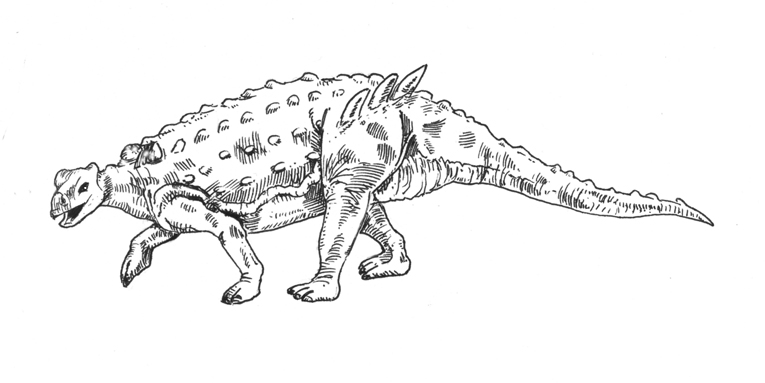
Minmi paravertebra illustrated.

An Aussie armoured dinosaur.  Time for more Aussie dinosaurs perhaps?  Picture credit: Everything Dinosaur.

Picture credit: Everything Dinosaur

More Australian Dinosaurs

Another excavation is due to start at a new site this month, this time, at a location to the north of Eromanga, heading up towards the town of Winton.  The Australian Age of Dinosaurs and other institutions are busy organising field teams to open up once again previously explored dig sites or to start new excavations as scientists strive to uncover more of Australia’s dinosaur heritage.

A spokesperson from Everything Dinosaur commented:

“Due to the very high daytime temperatures it can be difficult to attract palaeontologists to this part of Queensland during mid-October through to early March.  However, we are now approaching the period of peak activity and we are looking forward to hearing about some more dinosaur fossil discoveries.”

CollectA have introduced several not-to-scale replicas including a replica of the armoured dinosaur Minmi, titanosaurs and Australovenator: CollectA Prehistoric Life Models.
31 05, 2015

The Bony Past of Sharks a Unique Insight

By |2024-05-05T14:16:19+01:00May 31st, 2015|Categories: Dinosaur and Prehistoric Animal News Stories, Main Page|0 Comments

Australian Shark Fossil Discovery – Sharks Have a Bone to Pick with Palaeontologists

A fossil discovery made in Western Australia may help palaeontologists to piece together the early evolutionary history of the shark family.  It seems that the very first sharks may have had bony skeletons, only later did this group evolve a skeleton entirely made up of cartilage.

Fish – Very Successful Vertebrates

Fish are the most specious of all the vertebrates.  There are more species of fish alive today, than amphibian, reptile, bird and mammal species combined.  Fishes are certainly very diverse, but if we set aside the jawless fish for a moment (the agnathans), plus one or two other extinct groups and focus on the jawed types, fish can be split into two specific clades.

  1. Chondrichthyes – fish with cartilage for a skeleton (sharks and rays)
  2. Osteichthyes – fish with bony skeletons, this is the group that gave rise to the other types of vertebrates mentioned above – the amphibians, reptiles etc.

The Evolution of Sharks

Sharks may have been around for some 400 million years but fossils of these early sharks are extremely rare and many species have been identified from very fragmentary evidence, isolated teeth, preserved scales and even dorsal spines.  A team of Australian scientists have published a paper in the academic journal “PLOS One” that details the discovery of a remarkable ancient shark fossil, one that dates from around 380 million years ago and suggests that early sharks may have had bony skeletons before evolving the cartilaginous form that we know today.

The Gogo Formation

The fossil discovery was made in July 2005 and the specimen comes from the Gogo Formation Lägerstatte of the remote Kimberley region of Western Australia.  The strata represents an ancient tropical reef environment and dates from the Frasnian faunal stage of the Late Devonian (380-385 million years ago).  This location contains the richest, most diverse and best-preserved fish fossils found in Upper Devonian rocks anywhere in the world.  Professor John Long (School of Biological Sciences, Flinders University, Adelaide), commented that this fossil specimen represents a transitional form of shark, from one with a bony internal skeleton to the more “modern” forms we find today with their skeletons entirely made up of cartilage.

Professor John Long Holding the Fossil Specimen (2005)

The professor holds the precious find.

The professor holds the precious find.

Picture credit: Flinders University

Primitive Shark

It had been thought that the sharks and rays represented a more primitive fish lineage when compared to their bony cousins.  However, a series of discoveries coupled with new research has led many palaeontologists to suggest that it is the Chondrichthyes that represent the more advanced, derived evolutionary route.

Professor Long commented:

“Our shark more or less nails that theory, because here we have a heavily mineralised type of cartilage in the skeleton, which contains remains of bone cells.”

This is the first shark specimen to be discovered in the Gogo Formation, a fossil rich marine deposit that has been studied for more than six decades.

A Close up of the Fossil Material (Lower Jaws) Prior to Full Preparation

Scale bar = 1cm

Scale bar = 1 cm

Picture credit: PLOS One

The Fossil Material

The fossil material consists of the jaws, parts of the shoulder girdle along with teeth and scales.  It is difficult to estimate the actual size of the shark, but Everything Dinosaur estimate that this specimen represents a fish that would have been perhaps around the size of a Smallspotted Catshark (Scyliorhinus canicula), which is a common shark in British waters and grows to 60-80 centimetres long.

The picture above shows the remains of the lower jaws, which consist of cartilage and bone.  In extant Chondrichthyans (fish with cartilaginous skeletons), the lower jaws are formed entirely from cartilage, this is referred to as Meckelian cartilage.  However, in mature Osteichthyans (bony fish) and all tetrapods the cartilage becomes covered in bone.

To remove the fossil from the surrounding matrix, a team at Museum Victoria (Melbourne), bathed the specimen in a solution of 10% acetic acid.  This acid etching technique exposed the jaws, other elements of the skeleton as well as teeth and scales.  This is the first time a Devonian shark specimen has been prepared in this way.

The Fossil During Preparation (B) and Fully Prepared (C)

Diagram B scale = Diagram C scale =

Diagram B scale = 1 cm 
Diagram C scale = 1 cm

Picture credit: PLOS One

The picture above shows the specimen (B) during early acid bath preparation, whilst (C) shows the Meckelian cartilage once it has been removed from the surrounding rock.

Gogoselachus lynbeazleyae

The species has been named Gogoselachus lynbeazleyae.  The genus nomenclature comes from the name of the geological formation and the Greek “selachos” which means shark.  The trivial name honours neuroscientist Professor Lyn Beazley (University of Western Australia), in acknowledgement of her role as an ambassador for science.

As a bath of acetic acid had been used to recover the specimen, the fossil was left in three-dimensions, almost perfect, this enabled the research team to identify bone cells in the remains of the calcified cartilage.

A “Missing Link”

Professor Long explained that the fossil could be almost described as a “missing link” in shark evolution.  It showed that early sharks had a lot more bone in their skeleton and that just before modern sharks evolved they lost the bone, with only the soft cartilage remaining.  The professor stated that this indicates a direction in their evolution that shows that sharks are much more specialised than previously thought.

In addition, the acetic acid bath revealed a array of loose teeth, this Late Devonian shark was clearly a predator, but the Australian research team were unable to shed much light on precisely what it might have eaten.

 A G. lynbeazleyae Tooth (Gogo Formation, Western Australia)

A = Lingual view B = Labial view

A = Lingual view
B = Labial view

Picture credit: PLOS One

The picture above shows one of the larger teeth found in association with the other body fossils.  The top picture (A) shows the tooth in lingual view (the side adjacent to the tongue), picture B shows the labial view, a view of the teeth on the mandible that would face the cheeks or lips.

With the discovery of this first shark fossil from the site, Professor Long and his field team hope to return to the location later on this year in a bid to find more evidence of ancient sharks.

30 05, 2015

Dinosaurs were Warm-blooded? Debate Hots Up with New Research

By |2024-05-05T14:16:43+01:00May 30th, 2015|Categories: Dinosaur and Prehistoric Animal News Stories, Main Page, Palaeontological articles|0 Comments

New Study Suggests Dinosaurs were Warm-blooded (Endothermic)

A scientist from Stony Brook University has reassessed a study into whether dinosaurs were cold or warm-blooded.  Dr Michael D’Emic, a palaeontologist at the New York based university, has re-examined the research in a report published last summer which proposed that dinosaur metabolism was a kind of “half-way house” between a cold-blooded reptile and that of a warm-blooded mammal.  Palaeontologist Dr D’Emic suggests that dinosaurs were not mesotherms (half-way between cold and warm-blooded), but instead their growth rates suggest that the Dinosauria are indistinguishable from the Mammalia in terms of their metabolism.

The Debate Over Dinosaur Metabolism Heats Up

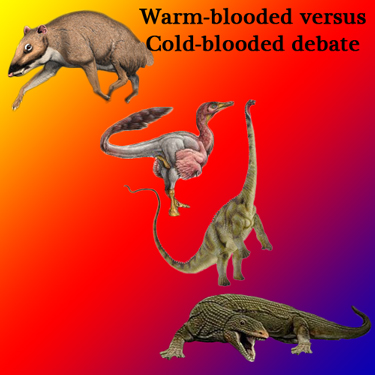
Where on the spectrum between endothermic and ectothermic are the Dinosauria?

Where on the spectrum between endothermic and ectothermic are the Dinosauria?

Picture credit: Everything Dinosaur

Published a Technical Comment

Yesterday, (May 29th), Dr D’Emic’s study was published as a technical comment in the academic journal “Science” in response to the 2014 research.  In the absence of a living, non-avian dinosaur to study, the debate boils down to interpretation of the evidence and statistical analysis. But why the fuss over what kind of metabolism the dinosaurs had?

Ectothermic versus Endothermic – It is Rather Important

We at Everything Dinosaur doubt very much that members of the public are going to be whopping and hollering about ectotherms (cold-blooded animals) or endotherms (warm-blooded) as they leave cinemas in a few weeks time having just watched “Jurassic World”, but understanding the metabolism of the Dinosauria is essential if scientists are really going to be able to learn how these animals lived and behaved.  Let’s kick off with some simple explanations.

What does it mean to be Cold-blooded or Warm-blooded?

These terms are frequently used, but they are themselves a little misleading.  These two distinct states do not define all vertebrates, things are a little more complicated than that, but in essence a creature that is regarded as cold-blooded relies on external sources to help regulate its body temperature.  Typical examples are lizards and snakes basking in the sun to warm up in the morning, but then seeking much cooler shade to avoid over-heating in the middle of the day.

Warm-blooded animals (mammals and birds), are able to maintain a body temperature that is higher than the temperature of the environment.  In simple terms, they can generate their own body heat. This heat comes from the animal’s metabolism, the chemical reactions that take place in the body (although there are other methods of keeping cool and warming up).

Applying this to the Dinosauria

If the dinosaurs had the same body chemistry as a crocodile (a reptile, regarded as an ectotherm), then they would have been relatively inactive compared to large mammals.  Nocturnal activity could have been reduced along with geographical distribution, very cold environments would have been extremely hostile to cold-blooded dinosaurs.  This is why today, we see the majority of reptile species confined to the tropics.  If the dinosaurs had the same metabolism as birds and mammals, then they would have been much more active and not reliant on external sources to help maintain a body temperature that enabled them to function.

Body Chemistry

The type of body chemistry employed would impact on every aspect of their lives – migration, breeding, food intake, social interactions, growth rates, intra-specific and inter-specific competition and so forth.

Take food as an example.  Whether herbivore, omnivore or carnivore, an ectotherm requires a lot less food in order to survive than an equivalent sized endotherm.  Lions (warm-blooded),  have to feed every three to five days on average.  They have high metabolisms and high food demands as a result.  Nile crocodiles that live in the same environment need much less food.  One substantial meal can last a Nile crocodile several months, crocs are much less expensive to run.  Sunlight can provide their bodies with all the heat they need, they don’t need to create it themselves, so their bodies need less food.

Dinosaurs were Warm-blooded

Over the years, team members at Everything Dinosaur have posted up articles on the ectotherm versus endotherm debate.  In June 2014, we published a feature on the research carried out by student John Grady (University of New Mexico) in association with colleagues from the University of Arizona and the Sante Fe Institute.  It is the results of this research that Dr D’Emic has reassessed.

To read about the June 2014 study: Goldilocks and Dinosaurs – The Warm-blooded/Cold-blooded Debate.

Dr D’Emic proposes that further analysis of microscopic growth rings preserved in dinosaur fossil bone, suggests that dinosaurs grew as quickly as mammals.  This suggests fast metabolisms and therefore that the Dinosauria were endothermic.  The earlier study had undertaken a detailed analysis on the growth rates of a wide variety of extinct and extant organisms.  The research team led by John Grady concluded that dinosaurs were mostly like mesotherms.

Dr D’Emic stated:

“Upon re-analysis, it was apparent that dinosaurs weren’t just somewhat like living mammals in their physiology – they fit right within our understanding of what it means to be a “warm-blooded” mammal.”

Examining Bone Structure

As a Research Instructor in the Dept. of Anatomical Sciences, Dr D’Emic specialises in the study of the structure of bone.  Using microscopic slices of fossil bone that has been carefully cut and polished, the doctor read growth rings preserved in the bone just as a dendrochronologist examines tree rings.  He looked at the 2014 study from two specific view points, firstly the research had scaled down yearly growth rates to daily ones in order to standardise  the data.

Commenting on this aspect of the earlier study, he explained:

“This is problematic, because many animals do not grow continuously throughout the year, generally slowing or pausing growth during colder, drier, or otherwise more stressful seasons.”

He concluded that the 2014 study may have underestimated the growth rate of the different types of dinosaur included in the dataset, by failing to account for their uneven growth.  Like many extant animals, dinosaurs slowed or paused their growth.  This is marked by the growth rings that can be made out in micro-anatomical bone studies.  The doctor added that growth rates were especially underestimated for larger animals and animals that live in very stressful or seasonal environments – both of which characterise the Dinosauria.

Microscopic studies of Dinosaur Bone Reveal Growth Rings

The bands mark periods of arrested or stopped growth.

The bands mark periods of arrested or stopped growth.

Picture credit: Stony Brook University

Secondly, in the paper entitled “Evidence for Mesothermy in Dinosaurs”, birds in the sample studied were treated separately from the twenty-one dinosaurs that were included,  In this reassessment, birds and dinosaur data was included as one homogeneous group.  Birds are warm-blooded and they are direct descendants of dromaeosaur dinosaurs.

The doctor explained:

“Separating what we commonly think of as “dinosaurs” from birds in a statistical analysis is generally inappropriate, because birds are dinosaurs – they’re just the dinosaurs that haven’t gone extinct.”

Were Dinosaurs Mesotherms?

Under these new conditions for examining the statistics, the birds being included in the dinosaur assessment data, lends more weight to the idea that the Dinosauria were endothermic and not the “half-way house” as mesotherms.

It seems that as with virtually all studies of this nature, the way that the data is handled and the terms of reference will influence the conclusions that can be drawn.

Microscopic Analysis of Fossilised Bones Helps Identify Growth Patterns

A microscopic image of the thigh bone (femur) of a dinosaur shows concentric rings. The rings represent unrecorded time, so an annual growth rate (dashed line in graph) is an underestimate relative to the true growth rate during the favourable growing season.

A microscopic image of the thigh bone (femur) of a dinosaur shows concentric rings. The rings represent unrecorded time, so an annual growth rate (dashed line in graph) is an underestimate relative to the true growth rate during the favourable growing season.

Picture credit: Scott Hartman

Comments regarding this new assessment of the earlier research have already been made.  For example, the team behind the 2014 study have responded to this analysis by commenting that the new study raises a number of important statistical and methodological questions, however, the proposals made lack biological and statistical justification.

All scientists who step bravely into this area of academic endeavour deserve our admiration, both papers are part of the rich and extremely diverse range of research that has gone into tackling this very thorny problem, it seems that the warm-blooded versus cold-blooded debate is likely to rumble on.

29 05, 2015

A New Face to the Human Family Tree

By |2023-03-30T13:49:27+01:00May 29th, 2015|Categories: Dinosaur and Prehistoric Animal News Stories, Main Page, Palaeontological articles|0 Comments

Australopithecus afarensis Had Neighbours!  Say Hello to Australopithecus deyiremeda 

Had you and I been able to travel back in time to the Afar region of northern Ethiopia some 3.4 million years ago in a bid to meet our ancient ancestors, we might have been spoilt for choice when it comes to trying to work out from which species we are descended from.  Lucy* the most famous example of Australopithecus afarensis had company, she had neighbours, a newly described species of Australopithecine has just been announced.

Two fragmentary upper jaws along with two fragments of lower jaws, representing fossil material from three individuals were found in March 2011 in the Woranso-Mille area of the Afar region.  These fossils have been assigned to an entirely new genus of Australopithecine, say hello to Australopithecus deyiremeda. 

Casts of the Four Fossil Jaws are Displayed

A new Australopithecus species has been described.

A new Australopithecus species has been described.

Picture credit: Laura Dempsey

Australopithecus deyiremeda

The fossil material assigned to Australopithecus deyiremeda (pronounced ost-tral-oh-pith-e-kus day-ihremy-dah) was described by a team of international palaeoanthropologists led by Dr Yohannes Haile-Selassie, the Curator of Physical Anthropology at the Cleveland Museum of Natural History (Cleveland, Ohio).  The fossils are estimated to between 3.3 million and 3.5 million years old, which means that this species overlapped and lived in the same region as Australopithecus afarensis, the species that the famous fossils called “Lucy” have been assigned to.

However, although A. deyiremeda and A. afarensis lived at the same time and shared the same habitat, the “Lucy” fossil material has been dated to 3.2 million years ago, meaning that the most famous representative of the Australopithecus afarensis species – “Lucy” lived more recently and could never have met the individuals whose jawbones have been preserved.

A Field Photograph Showing the First Jaw Fragment Found

The upper jaw (holotype) found on March 4th 2011.

The upper jaw (holotype) found on March 4th 2011.

Picture credit: Yohannes Haile-Selassie/Cleveland Museum of Natural History

The picture above shows a field photograph of the holotype (upper jaw), five teeth can be clearly seen.

A Significant Fossil Discovery

 The discovery of this new species is significant for a number of reasons.

  1. This is the first irrefutable evidence of two species of Australopithecine co-existing.  These two species lived at the same time in the Middle Pliocene and in the same part of the world.
  2. These fossils suggest that the Australopithecus genus was more diverse than previously thought, it had been thought that the Homo genus evolved from A. afarensis but this may not have been the case, a number of candidate species are emerging.
  3. The morphology of the jaws, the size and shape of the teeth and their enamel thickness suggest characteristics not found in A. afarensis but more akin to later genera, the Paranthropus and the Homo genus, for example.  These traits go back much further in time than previously thought.

The Left Half of a Lower Jaw Found on March 4th 2011

A lower jaw fragment  of A. deyiremeda.

A lower jaw fragment of A. deyiremeda.

Picture credit: Yohannes Haile-Selassie/Cleveland Museum of Natural History

Published in the Journal “Nature”

The academic paper that details this discovery has just been published in the journal “Nature”.  In recent years, the hypothesis of a relatively simple, linear progression from Australopithecus to the Homo genus and ultimately the origin of our own species has become less popular amongst researchers.  It seems the hominin family tree is much more complicated than previously thought.

To read an article written by Everything Dinosaur back in 2011, about other Australopithecus discoveries, but this time from southern Africa: The Human Family Tree Just Got More Complicated.

A Close Up of the Left Lower Jaw Prior to Cleaning

The left portion of the lower jaw, prior to cleaning.

The left portion of the lower jaw, prior to cleaning.

Picture credit: Yohannes Haile-Selassie/Cleveland Museum of Natural History

A. afarensis Not the Only Potential Human Ancestor

Commenting on the importance of this fossil discovery Dr Yohannes Haile-Selassie stated:

“The new species is yet another confirmation that Lucy’s species, Australopithecus afarensis, was not the only potential human ancestor species that roamed in what is now the Afar region of Ethiopia during the Middle Pliocene.  Current fossil evidence from the Woranso-Mille study area clearly shows that there were at least two, if not three, early human species living at the same time and in close geographic proximity.”

Dr Yohannes Haile-Selassie added:

“This new species from Ethiopia takes the ongoing debate on early hominin diversity to another level.  Some of our colleagues are going to be sceptical about this new species, which is not unusual.  However, I think it is time that we look into the earlier phases of our evolution with an open mind and carefully examine the currently available fossil evidence rather than immediately dismissing the fossils that do not fit our long-held hypotheses”.

The Very Near Complete Lower Jaw (Field Photograph)

A field photograph of a nearly complete lower jaw fossil with teeth.

A field photograph of a nearly complete lower jaw fossil with teeth.

Picture credit: Yohannes Haile-Selassie/Cleveland Museum of Natural History

Early Hominins Co-existing

This discovery raises the question of how multiple types of early hominins may have been able to co-exist in the same environment.  For those readers unfamiliar with the term hominin, a hominin is defined as a species more closely related to humans than to our closest extant ape relative the chimpanzee.  Clues can be found in the fossilised jaws and teeth.  The jaws of A. deyiremeda are very deep and robust, but the teeth are proportionately smaller than seen in other Australopithecines.

The canine teeth are particularly small, smaller than all known hominins that have been described previously.  The jaws and teeth may reflect adaptations to a different type of diet.

A member of the Everything Dinosaur team explained:

“Teeth are relatively common in the hominin fossil record, as the extreme hardness of the enamel means that, compared to bones for example, they have a greater fossilisation potential.  If patterns of wear can be discerned then it might be possible to hypothesis on the diet of this new species.  As the jaws and teeth are different from A. afarensis, it could be assumed that these two hominins did not compete directly with each other for food resources, in short, each species ate different types of food.”

Significant Canine Teeth

The size of the canine teeth may also be very significant.  We have four canine teeth, two in the top jaw and two in the lower  jaw. They sit between the first premolar and the last incisor and the size of the canine teeth can provide evidence about social behaviours associated with a species.

In primates, where males compete with each other over females, the canine teeth of the males are usually much larger than the canines of females.  Canine teeth can be used as weapons as the males fight each other to establish social hierarchies and dominance.

A Close Up of the Upper Jaw Fragment with the Canine Tooth Highlighted

Teeth can tell us a lot about an extinct creature.

Teeth can tell us a lot about an extinct creature.

Picture credit: Laura Dempsey, with additional annotation by Everything Dinosaur

If more teeth ascribed to A. deyiremeda can be found, then more research can be undertaken on the potential dietary differences between different hominins and some exciting inferences about social behaviours and social structures could be made.

Everything Dinosaur, acknowledges the contribution of the Cleveland Museum of Natural History in the compilation of this article.

For models and replicas of early hominins and other prehistoric creatures: Wild Safari Prehistoric World Figures and Replicas.

27 05, 2015

Washington State’s First Dinosaur an Exclusive Discovery

By |2024-05-05T13:40:03+01:00May 27th, 2015|Categories: Dinosaur and Prehistoric Animal News Stories, Dinosaur Fans, Main Page|1 Comment

Partial Theropod Femur – Right People, in the Right Place at the Right Time

News broke this week of the discovery and subsequent description of a partial left femur from a theropod dinosaur that had been found on the south-west tip of Sucia Island, which is part of Washington State.  This is the first time that a dinosaur fossil has been recorded from Washington State.  Sucia Island is part of the San Juan archipelago group of islands, it is a conservation area, part of a marine park (Washington State Marine Park).  Sucia Island is very small, it covers approximately 0.88 square miles, making the island about the size of the Queen Elizabeth Olympic Park in London, the site of the 2012 Olympic Games.

The Shoreline where the Theropod Fossil was Discovered (Sucia Island State Park)

The shoreline where the fossil was found.

The shoreline where the fossil was found.

Picture credit: Burke Museum

The First Dinosaur

The fossil was collected by a team of palaeontologists from the Burke Museum of Natural History and Culture (Seattle) in May 2012.  The partial femur was located in very hard, silty sandstone rocks which represent a shallow marine environment.  The discovery of the fossil had been made earlier by Burke museum field workers who had been excavating ammonite fossils and other invertebrates from the same bed.  It has taken three years to prepare the fossil for further study by carefully removing the extremely hard matrix and then to identify what type of animal the partial thigh bone might represent.

Based on comparative studies the bone has been ascribed to a tyrannosaur, but more about that later.

Scientists Proudly Show Off Washington State’s First Dinosaur Fossil

Dr. Christian Sidor (right), Burke Museum curator of vertebrate paleontology, and Brandon Peecook (left), University of Washington graduate student, show the size and placement of the fossil fragment compared to the cast of a Daspletosaurus femur.

Dr Christian Sidor (right), Burke Museum curator of vertebrate palaeontology, and Brandon Peecook (left), University of Washington graduate student, show the size and placement of the fossil fragment compared to the cast of a Daspletosaurus femur.

Picture credit: Burke Museum

Right People at the Right Time

This really is an example of the right people, in the right place at the right time.  Occasionally vertebrate fossils are found in marine deposits, in the United Kingdom, the Dorset coast provides an example of this.  The “Jurassic Coast” around Charmouth and Lyme Regis in Dorset represent a shallow marine environment but the fossilised bones of a dinosaur (Scelidosaurus) have been found.  It seems likely that the corpses of dinosaurs were washed out to sea and once the body cavity had ruptured the carcase sank to the bottom and became covered in sediment permitting the fossilisation process to begin.

The picture above shows Dr Sidor holding the partial femur fossil, Brandon is holding a cast of femur from a tyrannosaur called Daspletosaurus (D. torosus) to allow a visual comparison to be made.  Both scientists are showing the back view of the objects (the posterior view), the photographer is looking at the back of the fossil, this is important to note as an anatomical feature located at the back of the fossil bone is helping palaeontologists to classify the sort of dinosaur the Washington State bone represents.

A Rare Find

To find a dinosaur fossil in an marine environment is very rare and given the strong waves and tides associated with Sucia Island the fossil material could have been quickly washed out to sea and lost forever, so it really is a question of the right people being in the right place at the right time.  The analysis and identification of the femur was undertaken by Dr Sidor (Burke Museum of Natural History and Culture) and Brandon Peecock (University of Washington), their paper has just been published in the on line journal PLOS One.  It is highly unlikely that other fossils related to this individual will be found at the site.

Why a Tyrannosaur?

To answer this question we first have to take a step back.  How do we know that this is a dinosaur bone in the first place?  The fossils are found in a horizon that makes up a member of the Cedar District Formation, Upper Cretaceous strata that outcrops along the north-western coast of the United States and the extreme southern portion of the Canadian Pacific coast around Vancouver.

The exact age of these rocks is debated, but the rocks were probably laid down in the Campanian faunal stage and are perhaps around 80 million-years-old.  During this time, in the Late Cretaceous, North America was divided into several landmasses by the Western Interior Seaway.

Laramidia

The island of Laramidia lay to the west and this strip of land is represented by strata found in Alaska all the way down to Mexico on the western seaboard of this continent.  Dinosaurs were the dominant terrestrial megafauna and much is known about the dinosaurs that roamed the eastern side of Laramidia.  Less is known about those from the western provinces of this landmass, this is due to the relative paucity of fossil material found to date on America’s Pacific coast.  Hence the significance of the Sucia Island discovery.

Dinosaur and Prehistoric Bird Fossil Locations (Western Laramidia)

The Sucia Island fossil site is 3 (highlighted in red).

The Sucia Island fossil site is 3 (highlighted in red).

Picture credit: PLOS One

Three Tell-tale Signs

There are three tell-tale signs that indicate that this fossil fragment represents a potential tyrannosaur, let’s briefly go through these:

  • The Size of the Fossil (UWBM 95770)

Although only a fragment of the top part of the femur (see picture below to gain an understanding of which part of the thigh bone has been preserved), the fossil measures a whopping 42.5 cm long and 22.4 cm wide at its widest part (the top end of the fossil, this represents that portion of the femoral head that articulates with the hip socket.  This fossil is from a very large animal, hence the confident dinosaur diagnosis.

The researchers writing in PLOS One undertook a comparative analysis study, comparing this fragment to the bones of theropod dinosaurs.  Based on this analysis, the projected actual size of this thigh bone would be about 1.17 metres long (1.167 metres +/- 63 mm with 95% degree of confidence in the result).

  • Anatomical Features Indicate a theropod dinosaur

Although the bone is fragmentary, there is evidence of matrix infill in the medullary cavity (the middle of the bone, where marrow was present).  This indicates that this bone was hollow in the middle, this feature is only seen in theropod dinosaurs in this geological period. Thus, the hollow middle cavity is diagnostic of this bone having come from a theropod dinosaur.

The Fourth Trochanter

  • The Clincher!  The Fourth Trochanter

An anatomical feature on the back of the thigh bone (posterior), called the fourth trochanter suggests a theropod dinosaur.  The fourth trochanter is a prominent bump or ridge of bone that indicates muscle attachment.  In this specimen, the fourth trochanter is located in the top third portion of the thigh bone, close to the hip socket.  Its shape and position on the bone suggests Theropoda.  All dinosaurs (all archosaurs for that matter), have this characteristic, but in other big, Late Cretaceous dinosaurs such as ceratopsians and hadrosaurs, the fourth trochanter is shaped differently and in a different position at the back of the femur.

In hadrosaurids for example, the fourth trochanter is located near the middle of the femur and is triangular in shape.  In horned dinosaurs (ceratopsians) the fourth trochanter is typically a long, low, straight ridge, which is also positioned towards the middle portion of the thigh bone.

An Illustration of the Fossil Fragment and Comparison with Left Femur of Daspletosaurus

An illustration of the fossil find.

An illustration of the fossil find.

Picture credit: Burke Museum of Natural History and Culture with additional annotation by Everything Dinosaur

 If you look carefully at the picture above, the bottom end of the fourth trochanter is wider and roughened (distal end).  The top portion (proximal) appears smooth and thinner.  A similar morphology is found on the fourth trochanter of the Late Cretaceous tyrannosaur known as Daspletosaurus (D. torosus).

Daspletosaurus spp.

This explains why the research team have tentatively assigned this fossil fragment to the tyrannosaur family and used Daspletosaurus fossil material as a direct comparison.

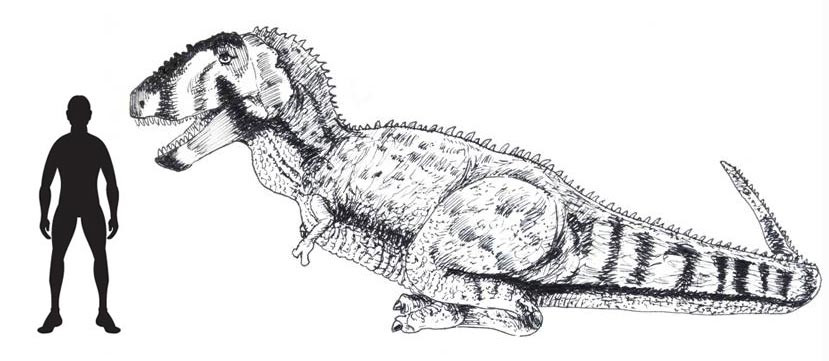
An Illustration of Daspletosaurus (D. torosus)

Larger Tyrannosaur present in the ecosystem.

Larger tyrannosaur present in the ecosystem.

Picture credit: Everything Dinosaur

Commenting on the significance of the fossil discovery, Dr Sidor stated:

“This fossil won’t win a beauty contest.  But fortunately it preserves enough anatomy that we were able to compare it to other dinosaurs and be confident of its identification.”

The First Dinosaur from Washington State – A Tyrannosaur?

The partial thigh bone, now tentatively assigned to the same dinosaur clade as Tyrannosaurus rex is on display at Burke Museum.  It is worth noting that based on the thigh bone’s total estimated size, the individual meat-eater the fossil material represents would have been over eight metres in length.  The dinosaur would have been approximately the same size as a Daspletosaurus, a Gorgosaurus or an Albertosaurus (all tyrannosaurids).  Although the tyrannosaurid diagnosis cannot be confirmed with absolute certainty and a definition down to genus level is not possible, the tyrannosaurs dominate the apex predator positions within the Laramidia fossil sites.

Perhaps as many as nine genera have been identified to date, the Late Cretaceous seems to mark the peak in the Superfamily Tyrannosauroidea diversity.

Tyrannosaurs Present in Laramidia

Team members at Everything Dinosaur have tried to list the nine genera of tyrannosaurs identified thus far from strata that represent Laramidia.

  1. Albertosaurus
  2. Gorgosaurus
  3. Tyrannosaurus
  4. Daspletosaurus (to read an article about face biting in potential Daspletosaurs): Cannibal Daspletosaurus?
  5. Lythronax (to read an article about this dinosaur discovery): The King of Gore.
  6. Nanotyrannus (Nomen dubium) – to read more about this potential new genus of tyrannosaurid and the debate surrounding it: Duelling Dinosaurs.
  7. Bistahieversor (for a review on the CollectA Bistahieversor model: CollectA Bistahieversor Reviewed.
  8. Teratophoneus (refer to the Lythronax article for more information): “Monstrous Murderer” of a Tyrannosaur.
  9. Nanuqsaurus – the polar tyrannosaurid: Nanuqsaurus hoglundi.

Dinosaur Provinciality

Palaeontologists have proposed that there was a great deal of dinosaur provinciality within the landmass of Laramidia.  The idea of different parts of the landmass being home to different types of dinosaur has been studied for the last two decades.

Unfortunately, due to the tectonic activity on the Pacific coast of western North America, it is difficult to determine where exactly in Laramidia this new tyrannosaur came from.  It has been suggested that since the end of the age of dinosaurs there has been around 1,800 miles of tectonic displacement in roughly a northerly direction.  This tyrannosaur could have lived as far south as what is now southern California.

CollectA have introduced a wide selection of tyrannosaur models into their not-to-scale range of replicas including a model of Daspletosaurus: CollectA Prehistoric Life Figures.

26 05, 2015

Dinosaurs May Have Laid Coloured Eggs According to New Study

By |2024-05-05T13:40:24+01:00May 26th, 2015|Categories: Dinosaur and Prehistoric Animal News Stories, Dinosaur Fans, Main Page|2 Comments

New Research Suggests Colourful Dinosaur Eggs

Birds today lay many different sized eggs, the New Zealand Kiwi (genus Apteryx), for example, lays an egg that is up to 25% of its entire bodyweight.  The Kiwi lays the biggest egg in proportion to its body size of any living bird.  The Bee Hummingbird (Mellisuga helenae), which we at Everything Dinosaur believe to be the smallest species of bird alive today, lays an egg that is not much bigger than a garden pea.

Palaeontologists know that dinosaurs laid different sized eggs too.  The eggs of a giant titanosaur being many times bigger than the eggs of a small dromaeosaurid.

Dinosaur Eggs

Images released show a selection of the 3,000 dinosaur eggs taken off smugglers by Chinese customs officials.   The pictures nicely illustrates the huge variety of dinosaur egg size and shape.

However, birds today lay eggs not only of different sizes but of many different colours as well and until recently there had not been much research undertaken as to the pigmentation of dinosaur eggs.

Scientists had studied melanosomes to uncover information about feather colour in the Dinosauria, but little work had been undertaken to assess the potential colours of dinosaur eggs.  For many years, scientists had assumed that dinosaurs and primitive birds laid plain, white eggs which were most certainly not coloured.  Intriguingly, if you look at pictures of dinosaur nests as illustrated in many dinosaur books, the eggs tend to be coloured pale or almost white

The Convention is to Colour Dinosaur Eggs White or Pale

Why have white coloured dinosaur eggs?

Why have white coloured dinosaur eggs?

Coloured Eggs

Pale or white coloured eggs would not necessarily help with camouflage, especially when you consider that due to the size of some of those dinosaur mothers, they could not have laid eggs in a secluded, hidden location.  The chances are that many dinosaurs laid eggs in open and exposed places, hence the need to breed in colonies to afford some protection to their offspring.  Two new studies have shed some light on the potential colour of dinosaur eggs, suggesting that they might have been blue-green instead of pale or plain white.

One study conducted by scientists at Bonn University (Germany) discovered that two pigments that provide colour for extant bird eggs also existed in the eggshells of an oviraptorid dinosaur from China called Heyuannia huangi.

Heyuannia huangi

H. huangi, was typical of the Oviraptoridae. Fossils of several individuals have been excavated from Upper Cretaceous sediments in Guangdong Province (southern China).  The fleet-footed dinosaur was most probably feathered and measured a little over 1.5 metres long when fully grown (about 40% of its body length was made up of its tail)

Thousands of small theropod eggshell fragments have been found in association with the body fossils and it is thought that the sediments represent a H. huangi nesting site.  The German study, which has yet to be peer-reviewed, concludes that the two pigments protoporphyrin and biliverdin, responsible for colouring chicken eggs brown and the eggs of emus and other birds blue, were present in the eggshells of this dinosaur.  The German scientists also related egg colour to the type of nesting habit of the bird concerned.  Birds that lay more open, exposed nests tend to have specific egg colours to help camouflage the eggs.

The team suggest that based on this evidence, dinosaurs such as oviraptorids that laid open nests may have laid eggs that were camouflaged.  Heyuannia huangi for example, could have laid blue/green eggs of a similar colour to that of an emu’s egg.  The researchers also propose that the discovery of eggshell pigments may have implications on how the adult dinosaurs looked after the nests.  Behaviours similar to extant birds could perhaps be inferred.

Mapping Pigments

This research builds upon an earlier study undertaken by a team of animal behaviourists at Hunter College in New York.  Professor Mark Hauber, one of the lead authors of the scientific paper, published recently in the academic journal “Biology Letters”, and his team effectively mapped the presence of two pigments protoporphyrin and biliverdin and used the way they combine with each other and blend with the calcium carbonate of the eggshell to predict egg colour.

The New York based team produced a series of computer models that plotted the ways in which these two pigments combine in various ratios and used these models to work out what colour eggs would occur as a result.

Taken together these two studies suggest that different types of dinosaurs may have laid different coloured eggs just as birds do today.  In addition, it seems that the ability to lay camouflaged eggs goes back a long way into the Mesozoic, with the dinosaurs evolving this ability which was then inherited by the Aves.

Oviraptorids May Have Laid Coloured Eggs

Oviraptors may have laid camouflaged eggs.

Oviraptors may have laid camouflaged eggs.

Picture credit: University of Bonn/PeerJ

Everything Dinosaur and Coloured Eggs

A spokesperson from Everything Dinosaur commented:

“Given the great many hues and colours seen in modern Aves it makes sense that ground-nesting dinosaurs in open environments would have produced eggs that enabled them to blend in with the background of the nest.  Colours seen in fossils, such as the oviraptorid eggs from China pictured above, however, do not normally reflect the actual “true” colours as they would have been in life.  Colouration of the fossil is strongly influenced by the permineralisation process and so readers should not be deceived into seeing fossils of different colours and assuming that is what they were like when, as in this case, the eggs were laid.”

Could it be time for Papo, to change the colour of the dinosaur egg that their model Oviraptor is grasping in its claws?

The Papo Oviraptor Model (with Egg)

A Papo Oviraptor with a blue egg.

A Papo Oviraptor with a blue egg.

Picture credit: Everything Dinosaur

To visit the Papo models section of the Everything Dinosaur website: Papo Prehistoric Animal Models.

24 05, 2015

Prehistoric Parasites from the Silurian

By |2023-03-30T10:44:06+01:00May 24th, 2015|Categories: Dinosaur and Prehistoric Animal News Stories, Main Page, Palaeontological articles|0 Comments

 Rare Discovery Provides Insight into Ancient Parasite

A team of international researchers have got up close to a prehistoric parasite, one that is perfectly preserved along with its 425-million-year-old host.  The ancient parasite, known as a “tongue worm” provides scientists with a glimpse of life and the interactions between species in a warm tropical sea that existed in Britain back in the Middle Silurian.

Fossils of tongue worms are extremely rare, examples have been recovered from Ordovician as well as older Cambrian deposits, the Silurian fossils are exceptionally well preserved, we at Everything Dinosaur believe the fossils to be part of the Wenlock Epoch biota.  The actual location of the fossil find has not been disclosed in order to protect the site from amateur fossil hunters and those keen to exploit the fossil deposits commercially.

Silurian Fossils

The fossils come from a deposit in Herefordshire, close to the border with Wales, scientists from the University of Leicester, who took part in the study stated that the tongue worm represents a new species and they range in size from 1 mm to 4 mm in length.  Tongue worms have tongue shaped bodies, a distinct head and two pairs of limbs.  At least 140 species are known to exist today, most are respiratory or gut parasites of vertebrates (usually reptiles), these fossils provide scientists with information on how these creatures evolved before they made the move onto land to become parasites of terrestrial vertebrates.

The Computer Model Showing the Ostracod Shell (grey) with the Tongue Worm attached (orange)

Looking at the micro-fauna of the Silurian.

Looking at the micro-fauna of the Silurian.

Picture credit: Siveter, Briggs, Siveter and Sutton

The picture above shows the pentastomid Invavita piratica and its host, the ostracod Nymphatelina gravida.

Prehistoric Parasites

The newly described fossils show the tongue worm species in association with its host, in this case a species of ostracod (an arthropod).  It was professor David Siveter, (Department of Geology) at Leicester University, who  made the discovery.  An academic paper describing the new species, named as Invavita piratica, (the name translates as ancient, pirate intruder) has been published in the journal “Current Biology”.  As well as academics from the University of Leicester, the research team included scientists from Imperial College (London), Oxford University and Yale.

Tongue worms belong to the Pentastomida family, part of the subphylum Crustacea, although for many years the taxonomic relationship between this group of obligate parasites and other parts of the Arthropoda was disputed.

Tongue Worms are not Worms at all

Professor Siveter, explained that the tongue worms were not “worms” at all, they got their name because one genus resembles the tongue of an animal.  They are an unusual and widespread group of mainly obligate parasites.  An obligate parasite is an organism that cannot complete its life-cycle without finding a suitable host.

The professor stated:

“This discovery affirms that tongue worms were “external” parasites on marine invertebrates animals at least 425 million years ago.  It also suggests that tongue worms likely found their way into land-based environments and associated hosts in parallel with the movement of vertebrates onto the land by some 125 million years later.”

The Computer Model with the Ostracod Shell Removed to Reveal the Internal Parasites

Internal parasites identified by high powered scans and computer modelling.

Internal parasites identified by high powered scans and computer modelling.

Picture credit: Siveter, Briggs, Siveter and Sutton

Computer Generated Images

The computer image above shows the ostracod with its shell removed, showing the external pentastomids and a pentastomid near the eggs of the ostracod (parasites in orange).  The picture shows how this group of parasites got their name.  “Penta” refers to the number five and these parasites have five anterior appendages.  One is the simple mouth, the others are two pairs of hooks which they use to attach themselves to their host.  The large pentastomid  (top left) is a highly magnified image of a single parasite, not to scale with the rest of the image.

To view models and replicas of Palaeozoic creatures including many invertebrates: Prehistoric Animal Models.

Using sophisticated microscopic scanning techniques and three-dimensional computer modelling, the scientists were able to reconstruct the ostracod and its parasites.  Some of the tongue worms were found inside the ostracod’s shell , near its eggs, on which they probably fed.  Other tongue worms are attached to the external surface of the ostracod’s shell, a unique position for any fossil or living tongue worm.  These tiny fossilised creatures are helping the scientists to understand a little more about inter-relationships between parasites and potential hosts in ancient marine environments.

Back in 2012, Everything Dinosaur reported on the discovery of another ancient ostracod from the same location.  The fossil had been identified using the same techniques to discover the parasites.  Professor Siveter, named this new genus of ostracod after his wife.

To read more about this: Ostracod from Herefordshire, reconstructing the Silurian.

19 05, 2015

Not a Wishing Well and Not a Dinosaur Either

By |2023-03-30T07:44:50+01:00May 19th, 2015|Categories: Dinosaur and Prehistoric Animal News Stories, Main Page|0 Comments

Beijing Museum of Natural History Exhibit (Lotosaurus Confusion)

Team members have read with interest the various media reports about a Chinese museum exhibit being used as a wishing well.  Such is the hold that the Dinosauria seems to have over us, that any vertebrate fossil in a museum, ends up being described as a dinosaur by the media.  We can understand why this happens, but let’s try to put the record straight.

Lotosaurus

First the story, the Beijing Museum of Natural History has a huge collection of fossils and an amazing array of exhibits of long extinct animals.  Both vertebrates and invertebrates are exhibited, the vast majority of the displays highlighting the extremely diverse fossil assemblage from this part of Asia.  There are lots of dinosaurs to see.

However, the Museum has encountered a problem, it seems that tourists (and we suspect some superstitious locals too), have a habit of putting coins and notes inside the glass case of one of the many Chinese prehistoric animal mounted fossils on view.  The animal concerned is a Lotosaurus adentus, it might sound like a dinosaur but a member of the Dinosauria this reptile most certainly was not.

The picture above shows the mounted exhibit of the quadruped L. adentus.  Tourists and other visitors have taken to stuffing notes and coins through gaps in the glass case, the specimen makes a rather unusual “piggy bank”.  According to the media reports this practice has been going on for about a year, we suppose it’s a question of one person doing it and others following the trend.

A security guard at the Museum, one of Beijing’s leading tourist attractions stated:

“Most of it is five or ten Yuan bills [around £0.50 GBP to £1.00 GBP] and coins from kids and grown-ups…they do it for fun.  We usually don’t stop them since it doesn’t damage the booth or the exhibits.”

Seal the Glass Case

The Director of the Museum Zhou Ying has been quoted saying that people might be tossing in money as they believe the specimen will bring them wealth, good luck or better health.  This habit of “donating” to the glass case is going to come to an abrupt end as the Museum has taken steps to prevent this from happening.  Construction workers have been hired to seal the glass case and make it “coin and note proof”.

Perhaps it might be sensible to position a donation box close by.  We are not sure of the Museum’s policy on such matters, but if visitors wish to make a donation, perhaps something could be installed to enable them to do so.  Funds raised could support the educational work of the museum, that’s just a suggestion, but you never know.

Lotosaurus Not a Dinosaur

If you look at the display panels behind the Lotosaurus skeleton in the picture above, you can see some pictures of dinosaurs.  Lotosaurus may be displayed alongside the dinosaurs but it was not a member of the Dinosauria.  Let us explain…

Lotosaurus might be being exhibited in the dinosaur gallery as it was around at approximately the time when the very first basal members of the Dinosauria are believed to have evolved.  The fossils of this barrel-chested reptile come from Hunan Province (south-central China) and date from between 245 and 237 million years ago (Anisian faunal stage of the Triassic).

For models and replicas of Triassic animals and other prehistoric creatures: Prehistoric Animal Models and Figures.

A Bizarre Creature

Most palaeontologists now believe that this bizarre creature is a member of the Poposauroidea clade, part of the archosaur group, but this phylogenetic analysis has been disputed.  Trouble is, Lotosaurus is such a bizarre creature.  It measured in size from 1.5 to 2.5 metres long, the neural spines were many times taller than they were wide and this suggests that this animal had some sort of sail or large hump running down from its neck, down the back to the tail.

The top jaw is curved over and the robust skull suggests a powerful bite, but there are no teeth in the jaws.   What this animal ate has been debated, the fossil material is associated with having been laid down in a swampy environment.  Lotosaurus could have been a herbivore, but it has also been suggested that this slow-moving reptile might have specialised in eating the abundant shellfish, fossils of which are also associated with sediments to be found in the Hunan Province.   The species was formally named and described in 1975.

“Lotus Lizard”

 Although, there may be some debate as to the exact phylogenetic position of Lotosaurus, it was not a dinosaur.  The genus name (we think) means “Lotus lizard” and whilst to some observers it might look like a dinosaur and its genus name does end in “saurus” but it was most definitely not a dinosaur.

A spokesperson from Everything Dinosaur commented:

“Whilst we doubt much of the exhibit in question consists of actual fossil material, we can’t condone this behaviour as money being thrown into a display case would have to be retrieved and the opening of the case and working in close proximity to any fossils could lead to their accidental damage.  In addition, if coins are thrown in and they hit the preserved fossil bone then this could result in the fossil material being chipped and scratched.”

Visit Everything Dinosaur’s award-winning website: Everything Dinosaur.

Go to Top