All about dinosaurs, fossils and prehistoric animals by Everything Dinosaur team members.

News stories and articles that do not necessarily feature extinct animals.

7 08, 2008

Tuatara set to become a Father aged 111

By |2023-02-25T18:19:08+00:00August 7th, 2008|Categories: Animal News Stories, Main Page|0 Comments

Ancient Reptile set to become a Dad at the Age of 111

The number 111 is often regarded as a bad omen, especially by cricketers as when written down it resembles a wicket without the bails, an indication of being “out”, but for one reptile, 111 has turned out to be their lucky number.

An 111 year-old Tuatara is set to become a father for the first time.  After nearly 40 years in captivity, Henry, a male Tuatara and his sprightly 80 year-old mate, Mildred have produced a clutch of eleven eggs.

The Tuatara in the picture is a male, they tend to be bigger than the females and sport a more prominent crest running down their neck and back.

Henry and Mildred are residents at the Southland Museum and Art Gallery at Invercargill on the southern tip of New Zealand’s South Island.  The Tuatara is very rare and is to be found only on a few remote islands off the coast of New Zealand, although a team of scientists and conservationists are trying to establish a viable colony of these little reptiles in a secret location on South Island.

To read more about the attempts to introduce Tuataras to the mainland of New Zealand: Living Fossil helped back to Mainland.

Few plants and animals around today can be seen as relics from pre-history, such organisms are often referred to as “living fossils”.  The Tuatara is one such creature, an ancient reptile that superficially resembles a lizard but is in fact a member of the Order Sphenodontia and not part of the Order Squamata (lizards and snakes).  Tuatara is actually a Moari name, this animal is known by the genus Sphenodon (means wedge tooth), by scientists.  Henry and Mildred are certainly doing their bit to help maintain the population of these rare and special animals, however, it will be a further six months before the eggs hatch and they will need to be carefully incubated.

For many years, Henry showed no interest in mating, in fact his aggressive behaviour towards other Tuataras meant that he had to be kept in isolation.  When the keepers at the Museum first tried to mate Henry with Mildred twenty-five years ago, they certainly did not get along.  Poor Mildred had her tail bitten off by feisty Henry, so the two were separated and Henry was sent to solitary confinement.  However, the passage of time seems to have mellowed Henry and in his later years he seems to becoming a bit of a ladies man.

Back in 2002, Henry underwent surgery to have a growth removed, this growth must have caused him some discomfort which may explain why he was always so grumpy.  The eggs are doing well under incubation after getting off to a difficult start and under the watchful gaze of the keepers the little brood has a good chance of making it.

However, Henry’s handler will not be counting his Tuataras before they hatch, producing offspring is a difficult process, even under the carefully managed conditions of captivity, but the museum was able to produce 21 hatch-lings last year and they are hoping to break this record over the next 12 months.

Tuataras are certainly remarkable creatures, how remarkable has recently come to light when scientists began to study their DNA closely.  To read more about what we are learning about Tuataras from their genes: Tuatara with a surprise in its genes.

24 07, 2008

Frog Blog Update – At Least one Made It

By |2022-11-26T07:39:09+00:00July 24th, 2008|Categories: Animal News Stories, Educational Activities, Everything Dinosaur News and Updates, Main Page|0 Comments

Frog Blog – Tiny Frog Spotted near Pond

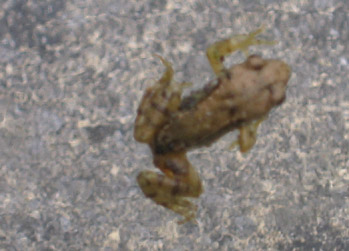
Yesterday one of our team members spotted a tiny frog whilst they were outside watering the office tomato plants (another one of our projects).  The frog was one that had just emerged this year and it was discovered within 5 feet of the office pond.  Although we cannot prove it conclusively, we can surmise that this frog hatched in the pond and had been one of the tadpoles we had been attempting to observe.

Once the tadpoles hatched, within days they disappeared and we thought that they had all perished.  From late April until early July not one single tadpole was seen by any of our staff members.  We were quite surprised, as although the pond was relatively small and shallow we just could not find any amongst the weed.

The Baby Frog

Picture credit: Everything Dinosaur

However, the finding of a frog that had recently undergone metamorphosis so close to the office pond, with no other water source nearby may indicate that at least one of the tadpoles has made it to the frog stage.  We will keep a close look out in case we spot any more.

3 05, 2008

Exciting Frog Blog (week 8) And then there were None

By |2024-04-12T08:56:44+01:00May 3rd, 2008|Categories: Animal News Stories, Educational Activities, Everything Dinosaur News and Updates, Main Page|0 Comments

No sign of Tadpoles in the Pond

Spring has finally arrived and we have been enjoying a period of settled, warm weather with temperatures up to 20 degrees Celsius (not bad for our part of the world, at this time of year).

Staff have been keeping a close watch on the pond, after the virtual disappearance of the tadpoles just a few days after hatching.  The last sighting was on Tuesday morning (April 29th) when one tadpole was seen swimming close to the large clump of Elodea towards the centre of the pond.  The pond looks very healthy, the water is clear, well oxygenated and there is certainly plenty of invertebrate life in the pond, but no tadpoles.

No Tadpoles

We suspect that the tadpoles may have been eaten, it is certainly true that we would expect only a very few to reach the adult stage and leave the pond as little froglets.  According to informed literature mortality rates for these animals can be as high as 99.95% but it is slightly shocking to have to contend with the thought that hundreds of tadpoles met an untimely death just a few days after hatching and finally freeing themselves from their protective jelly.

Some team members had hoped that the tadpoles had simply concealed themselves amongst the pond weed and were remaining inconspicuous, but as the water has warmed up due to the higher temperatures we would have expected to find more signs of tadpole activity.  No tadpoles have been observed for over a week.

No Tadpoles Observed for a Week

As for what might have caused the demise of our tadpole population, we are still debating a number of theories.  Frustratingly we have no evidence to work with, the tadpoles were around in profusion a couple of weeks ago and now there are virtually no signs of them.  Many could be hiding in the weed or silt at the bottom of the pond but if this is not the case then we have to consider what might have wiped them out.

Tadpoles have many predators and succumb to fungal and viral infections.  The absence of any bodies to be seen, coupled with the relatively healthy state of the tadpole population and the healthy state of the pond itself leads us to discount these theories.

We think they have been eaten, but by what?  Certainly, Blackbirds and Robins eat tadpoles and catch them by wading into the shallows.  We have seen Blackbirds in particular around the pond, we are away of a nest site nearby and we have observed these birds taking a bath in the pond but no one has seen them catching and eating the tadpoles.

Tadpole Population Decimated

The majority of us suspect that the other pond life has decimated the tadpole population.  Once out of their protective jelly and swimming freely they would have been easy prey for the newly emerged water-boatmen.  However, the main culprits may be the numerous damsel-fly larvae that can be seen in the pond.  There are a large number and these are known to be voracious predators.  We suspect that many tadpoles may have ended up being eaten by these creatures.

Disappearing Tadpoles

We have a number of damsel-fly nymphs in the pond, they can be distinguished from other larvae by the three appendages that stick out like fans from the back of the thorax.  These are not part of the tail but the caudal lamellae, a set of gills.  There are a number of different sized larvae in the pond, this is not surprising considering that they can spend up to 5 years at this nymph stage

These larvae are ambush predators and hunt mainly at night and at the moment they are the number one suspects as we set out to investigate our tadpole disappearance.

Visit Everything Dinosaur’s website: Everything Dinosaur.

30 04, 2008

Birds can Detect Predators by Sense of Smell

By |2022-11-14T14:21:15+00:00April 30th, 2008|Categories: Animal News Stories, Dinosaur and Prehistoric Animal News Stories, Main Page|0 Comments

New Study Demonstrates that Birds can “Smell a Rat”

It seems that common everyday creatures can still cause a surprise amongst scientists when research provides an insight into behaviour and conditioning.  One such example is a study of Blue Tits (Cyanistes caeruleus), that has been reported in the latest edition of “Functional Ecology”.

The researched focus on whether or not these common garden birds used their sense of smell to detect danger and alter their behaviour accordingly.  Many animal species detect and avoid predators and other dangers by using their sense of smell.  This sense has largely been ignored in the study of birds, since it was thought that this particular sense was not as important to them as other senses such as sight.  This new research was carried out amongst a population of wild Blue Tits in nest boxes in Miraflores de la Sierra in the Sierra de Guadarrama mountains, Madrid province, Spain.

This study has revealed that birds are not only capable of detecting potential predators through chemical signals, but they also alter their behaviour depending on the perceived level of threat.  This is an effective survival strategy to adopt as reported by Luisa Amo de Paz, the study’s lead author who was working as a biologist at the Spanish National Research Council’s Natural History Museum while the study was carried out.

This research, provides the first ever evidence to show that birds are able to distinguish their predators using chemical signals. According to the research team this new work: “opens up a new and promising area of research in understanding numerous aspects of bird behaviour, which have been ignored until now.”

The sharpness of the sense of smell among certain birds, especially those that raise their young in holes in trees, such as some of the Tit species, is essential for determining whether their major predators, weasels or martens, have got into their nests or are approaching, particularly because of the limited visibility inside their nests.  These birds are active during the day (diurnal) and therefore may have difficulty seeing any potential dangers when peering into the dark holes of their nesting chambers.

The researchers placed the scent of mustelids (ferrets) inside the nest boxes when the chicks were eight days old, and “the parents took longer to enter the boxes to feed their chicks, and they approached the boxes more often without going inside,” commented Ms. Amo de Paz.

Thanks to the images captured by a video camera located several metres from the nest box, the scientists were able to work out the number of times the chicks were fed, and deduced that the birds did not feed their chicks on fewer occasions, although “they spent less time inside the nest while feeding their babies,” according to the biologist. By spending less time in the nest box, the parents lessened the risk of predator attack while still feeding their chicks.

The biologists added the scent of Quail (another, non-threatening bird) in other nest boxes in order to monitor the effect of a new smell on the Blue Tits’ behaviour, and water in others to monitor the effect caused by moisture. This demonstrated that when the birds detected an unknown smell, such as that of the Quails, they did not wait such a long time before entering their nests, and did not reduce the amount of time spent feeding their chicks.

The evidence presented indicates that these small birds are able to detect potential predators and can alter their behaviour accordingly, in essence if they “smell a rat” or indeed any other predatory mammal, they take precautions.

When the chicks were 13 days old, the scientists topped up the corresponding scent for each nest box, and measured the results again. Ms. Amo de Paz said this was to “see whether the ferret scent had an effect on the chicks’ physical condition”, given that their parents had spent less time inside the nest. The conclusions show that the chicks’ growth was not affected during the time they were exposed to the supposed predator. The research team concluded  that birds such as tree nesting Blue Tits are able to detect the chemical signals of predators and use these to weigh up the risk of predator attack.  In this way their behaviour is modified based on the evidence presented to them from their sense of smell.

This article as been adapted from material provided by Plataforma SINC and Science Daily article published on 30th April 2008 “Birds Can Detect Predators Using Smell”.

Blue Tits are common throughout the British Isles and are resident year round, many studies and surveys have been carried out on these types of birds, although they can be observed from virtually every kitchen window in the country and are a common sight in British gardens their complex behaviour should not be underestimated.  Blue Tits for example are capable of producing sophisticated songs, specific sounds being related to the mating season, warding off rivals, proclaiming territory and providing an alarm warning of danger.  Although prolific breeders, Blue Tit numbers were severely hit by the extensive flooding that occurred in the UK last Summer.  It has been estimated that ten million chicks perished as a result of this weather, either directly as a result of the floods or indirectly due to the lack of available prey.

Research into the sense of smell of birds which are believed to be closely related to Theropod dinosaurs is of interest to palaeontologists as a great deal of speculation has taken place as to the capabilities of dinosaur senses.  Thanks to casts of brain cases, and CAT scans, a lot more data on how dinosaur’s brains worked has been gathered over recent years.

By tracing pathways of nerves, scientists can estimate the relative importance of senses like smell and sight to certain dinosaurs.  The olfactory bulbs (the areas of the brain associated with processing smell data); of Tyrannosaurus rex for example, were quite large and well developed.  This indicates that a sense of smell was important to this creature.  Scavengers such as vultures also have a large portion of their brains dedicated to their sense of smell.

Is this evidence indicating that T. rex was not a hunter but a scavenger like a hyena or vulture is today?  Unfortunately, being unable to observe a Tyrannosaurus rex actually hunting prevents scientists from testing this theory.  All they can say with any certainly is that tyrannosaurs like T. rex probably had a good sense of smell and this sense was important to them.

T. rex Had an Excellent Sense of Smell

Nanmu Studio T. rex dinosaur model.

A close-up view of the Nanmu Studio Alpha T. rex in the brown colouration. A dinosaur with an excellent sense of smell.

Picture credit: Everything Dinosaur

View dinosaur models such as Tyrannosaurus rex for sale at Everything Dinosaur: Dinosaur and Prehistoric Animal Models.

27 04, 2008

Exciting Frog Blog Week 7 – Where have all the Tadpoles Gone?

By |2024-04-12T18:35:10+01:00April 27th, 2008|Categories: Animal News Stories, Educational Activities, Everything Dinosaur News and Updates, Main Page|0 Comments

Frog Blog Week 7 – Disappearing Tadpoles

Typical April weather for England has continued over the last seven days or so, with lots and lots of showers interrupted by occasional sunny intervals.  As the sun is climbing quite high in the sky at the moment heading for the Summer solstice just 7 weeks away, when the sun does shine, it is very warm, with temperatures around the pond area being recorded as high as 20 degrees Celsius.

Disappearing Tadpoles

There has been lots of activity in the pond this week, particularly amongst the invertebrate residents, snail eggs (small blobs of jelly attached to pond weeds), have been found and relatively large numbers of pond snails, including rams-horns (those that survive bird attacks – see Frog Blog week 6) have been seen.  Everything Dinosaur team members observing the pond have counted at least two water boatmen that have hatched out.  Undoubtedly more will be observed over the coming weeks.  A careful study of the shallows reveals that quite large numbers of damsel fly nymphs can be seen.

These armoured invertebrate predators look quite prehistoric, perhaps resembling ancient Eurypterids, the savage water scorpions that dominated the Palaeozoic seas.  Given the opportunity they would certainly feed on the tadpoles, as indeed would the water boatmen.

Perhaps as a result of this increased predator activity the tadpoles have all but disappeared from the pond.  Over the last five days or so the number of tadpoles observed by team members has fallen dramatically.  A week ago, over a ten minute period nearly 100 tadpoles were counted, now no more than 6 or 7 are seen over the same time interval.

Predation of the Tadpoles

We suspect that many of the tadpoles will get eaten, only a very few will survive to escape the pond as miniature frogs, but we did not expect to see so few only after about 14 days after hatching.  Having considered this carefully we have concluded that the majority of the tadpoles are still fine, however, their survival strategy freed from the protective jelly that surrounded the developing embryo is to hide amongst the pond weed and algae, this may be why so very few can be seen by observers.

Tadpoles Gone

In the past, when tadpoles have been kept, these animals have always been in tanks, so it has always been easy to watch them.  In the natural pond, with so much more cover it is likely that the number of tadpoles is still quite high, but we just cannot see them anymore.

We will keep up our observations to see if we can spot more of them as they grow bigger.

Two frogs have been seen in the pond over the last few days, the smaller male frog has been joined by a larger one – at least they seem to be enjoying the rain.

20 04, 2008

Exciting Frog Blog Week 6 – Jelly beginning to go

By |2024-04-12T18:40:56+01:00April 20th, 2008|Categories: Animal News Stories, Educational Activities, Everything Dinosaur News and Updates, Main Page|0 Comments

Jelly beginning to Go

Weather in the northern part of the UK has been unseasonably cold with temperatures still dipping near to freezing during the night and an chilly wind blowing for the last couple of days.  There has not been a great deal of sign either, just showers and a very cloudy, grey sky with little breaks to permit the sunshine through.

This inclement whether has not seemed to have hindered the progress of the tadpoles, we think all those that are actually going to hatch have now hatched.  The first brave individuals have been spreading out across the pond, by Wednesday of this week they had ventured to the back of the pond and a few could be seen hanging from the pond sides a couple of inches under the surface.  By today, all parts of the pond have been conquered and some of the first of the tadpoles to hatch have spread themselves out amongst the pond weed and other hiding places.

Tadpoles

Incidentally, a large number of tadpoles seem content to remain in the projective jelly.  Perhaps these were amongst the last to emerge and therefore still have the remnants of the egg  yolk in their stomachs to sustain them.  They will have no need to leave the jelly until they have to seek food.  The jelly itself is now very discoloured and only a few of the spherical former eggs can be made out in this grey mass.

The Remnants of the Protective Jelly

Picture credit: Everything Dinosaur

The picture shows the grey, discoloured jelly in which a group of tadpoles can be clearly seen.  Other tadpoles, perhaps the first ones to hatch have now dispersed throughout the pond.  Perhaps those tadpoles remaining close to the jelly have still got the remnants of the egg yolk in their stomachs and so have not been forced to leave the protective jelly environment in order to find food.

Looking for Frogs

Members of the Everything Dinosaur team have not observed any frogs in the pond over the last week.  Even the small, male frog seems to have gone.  As far as we know adult Common Frogs tend not to feed in water, so the frogs may have left the pond to seek food.  Perhaps staying close to the pond or moving further out into the grassy area at the back of the yard.

Blackbird Feeding

Talking of food, we have worked out what has been happening to the Rams-horn snails that inhabit the pond.  A male blackbird was observed snatching up a snail from the shallows and attempting to fly off with it.  The snail was found in the middle of the yard in a battered and bloodied state.  It was returned to the water and seems to have survived its ordeal.

We wonder whether the blackbird is going to attempt to snatch a tadpole, they would certainly be more difficult to catch, but at least there is no hard shell to deal with.

Visit Everything Dinosaur’s award-winning website: Visit Everything Dinosaur.

13 04, 2008

Exciting Frog Blog Week 5 – Tadpoles nearly all Hatched

By |2024-04-12T08:37:59+01:00April 13th, 2008|Categories: Animal News Stories, Educational Activities, Everything Dinosaur News and Updates, Main Page|0 Comments

Nearly all Tadpoles Hatched

The weather over the last week or so has been unsettled, but fortunately we have not had any snow showers, just rain and sunny intervals.  The majority of the tadpoles have now hatched, although there are still several still within their transparent egg cases, but these are very active and we suspect that the remainder of the tadpoles will hatch in the next few days.

First Hatchlings

The first hatchlings emerged from the spawn that was in the middle and at the very top.  These animals hatched first perhaps due to the fact that the being at the top they received most sunlight and therefore were kept warmer, being in the middle of the spawn may have helped keep these embryos insulated and therefore protected better as the surface water cooled in the chilly nights.

Frogspawn is Hatching

By Thursday of this week some of the first hatched tadpoles had left the spawn and could be seen hanging vertically from pond weed and the fine fronds of algae, one of our team members remarked that they looked like little music notes hanging from the staves on a score sheet.  By today, Sunday,  a number of tadpoles have made the break from the spawn and are seeking shelter amongst the pond weed.  This might be as the yolk that nourished them once they had emerged, (the slightly brown bulge in the belly of the tadpole), has now been used up and the tadpoles are beginning to seek their own food.  Their black colouring whilst being effective in helping to absorb heat, does not provide them with a lot of camouflage in amongst the green Elodea.

Most of the Tadpoles have now Hatched

Picture credit: Everything Dinosaur

Tadpoles Have Hatched

The pictures shows that the majority of the tadpoles have now hatched.  They remain congregated around the spawn, especially on top of it where it is warmest.  Over the next few days it is likely that the tadpoles will disperse throughout the pond.

We noticed that during daylight hours the “clump” of hatched tadpoles spread out to form a rough doughnut shape, then as it grew darker and presumably colder the tadpoles seemed to gather together again, concentrating as a mass on top of the spawn again.  Whether this is an instinctive response to less daylight in order to keep warm so as to survive the colder night; or whether this is a strategy to avoid predation is unclear.

One adult frog has been spotted in the pond this week, the small adult male.  He has kept a low profile staying on the periphery of the pond away from the hatching tadpoles.  He has preferred to remain in cracks on crevices around the pond’s edge during daylight hours.

6 04, 2008

Exciting Frog Blog Week 4 – Tadpoles Starting to Hatch

By |2024-04-12T08:40:15+01:00April 6th, 2008|Categories: Animal News Stories, Educational Activities, Everything Dinosaur News and Updates, Main Page|1 Comment

The Tadpoles have Started to Hatch

Great excitement this week in the pond as the tadpoles have begun to hatch.  The first signs of movement were detected on Wednesday morning.  This was on the 2nd of April, just 17 days after the spawn was laid.  Given the quite cold weather that we had been experiencing we were surprised how quickly the tadpoles developed.  However, it is worth noting that despite the cold weather and the chilly pond water, the spawn had been laid in a central position in the pond and this allowed the spawn to get what sun there was for most of the day.  Also, the jelly swells and becomes buoyant thus permitting the spawn to stay at the surface, again helping to warm the eggs.  Sat on their bed of pond-weed (Elodea) the spawn has been fairly quick to develop.

The Latest Picture of the Frog Spawn

Picture Credit: Everything Dinosaur

Tadpoles Starting to Hatch

By Wednesday lunchtime, team members were taking turns to watch the spawn, every now and then a little tadpole would move slightly, either curling or uncurling.  By Friday the movements had become stronger and more frequent.  The embryos had assumed a more tadpole-like shape and could be seen moving inside the egg membrane.

The first hatchlings were observed on Saturday afternoon (5th April).  The tadpoles have developed a definite head end (a round bulge) and a basic tail.  However, it will be a few days before they are swimming freely.

At this stage, the muscular and circulation systems are developing, the gill arches either side of the head are now forming.  The tadpoles hatch at around the time these gills are able to function.  The eyes and mouth are not fully developed and there is an adhesive organ present on the top of the head.  This permits the tadpole to attach itself to pond weed and remain there until further changes have taken place.

Spotting the External Gills

If you can get close enough and look very carefully at a tadpoles head from the top downwards (called a dorsal view by scientists), you should be able to see two small tiny bumps, one on each side of the head.  These are the external gills and they should be visible for about 12 days or so.  Over this period a fold of skin known as the operculum develops on the first branchial arch just in front of the external gills.  It grows backwards until the external gills are covered.  The eyes and mouth begin to develop.

The operculum does not close up completely, a single hole (called a spiracle) remains on the left side of the body.  Water is taken in through the newly formed mouth, passes over the internal gills and is expelled through this spiracle.  By this time the mouth should have developed definite jaws and the adhesive organ on top of the head should have almost completely disappeared.

The digestive system should have expanded (for the first few days after hatching the tadpoles live on the remains of the yolk from the egg – this can be seen as a bulge in their tummies).  Soon the tadpoles will have acquired the ability to swim and they will have started their journey towards becoming frogs – metamorphosis.

Frog Observed

Only one frog has been observed in the pond during daylight hours.  We think this is a male, it has been seen around the spawn and some of us have jokingly speculated that this might be the “expectant father” waiting for his babies to hatch.  We know that many species of amphibian demonstrate some care for their offspring.  For example, male Midwife toads (Alytes obstetricans) gather up the eggs once they have been fertilised and they carry them around on their back legs, but we are not aware of any paternal instinct being demonstrated by Common Frogs (R. temporaria).

Much of the country has been covered in a blanket of snow, this morning.  Typical of the British weather, no snow in winter and then on the 5th April we get some.  This picture was taken of the area behind the office this morning.

Oh to be in England now that April’s Here!

Picture credit: Everything Dinosaur

3 04, 2008

Man saves Wife from Crocodile

By |2023-02-25T08:14:41+00:00April 3rd, 2008|Categories: Animal News Stories, Main Page|0 Comments

Husband saves Wife from a Saltwater Crocodile Attack

A husband and wife had a lucky escape from a crocodile attack in a remote part of the Australian outback.  The couple were swimming in a small creek whilst holidaying in an area 100 miles southwest of Darwin in Australia’s Northern Territory.

Saltwater Crocodile Attack

The attack was from a Saltwater, otherwise known as an Estuarine crocodile (Crocodylus porosus).  These animals are the largest species of crocodile on the planet and the heaviest of all the reptiles around today.  Adult males can reach lengths in excess of 20 feet and weigh up to 1 Tonne.  The largest Estuarine recorded was shot in Sumatra, Indonesia in 1978, it was reputed to be over 28 feet long and weighed more than 1300 kilogrammes.

The woman suffered leg and hand injuries but things could have been much worse had it not been for the bravery of her partner, who jumped on the 8 foot crocodile’s back in the successful rescue.  Acting like a real-life “Crocodile Dundee” the man leaped onto the reptile and this forced the crocodile to let the woman go.

The wife was taken to the Royal Darwin Hospital to have her wounds treated, a spokesman for the hospital commented: “the husband’s very swift and diligent actions have saved the day”.

This is the fourth crocodile incident that has been reported in recent weeks from the Northern Territory.  A few days earlier police were forced to open fire on a crocodile as it closed in on a swimmer who had accepted a dare to swim to an offshore crocodile trap.  A crocodile attacked a boat of tourists in the same area and in January a man rescued his colleague from a crocodile but accidentally shot his unlucky co-worker in the process.  Well, if it is not your day, it’s not your day!

Many parts of the Northern Territories have seen an increase in the number of Saltwater crocodiles, now that hunting has been largely banned.  Unfortunately, these aggressive predators are very capable of attacking people and once above 8 foot in length they are officially classed as man-eaters.  There has been a call for a controlled cull in order to reduce the number of large crocodiles in the area.

To read more about the problems caused by the growing population of Estuarine crocodiles in the Northern Territory: Invasion of the Crocodiles.

2 04, 2008

The Tuatara has a Surprise in its Genes

By |2022-11-14T07:29:22+00:00April 2nd, 2008|Categories: Animal News Stories, Main Page|0 Comments

The Tuatara is the fastest-known Evolving Animal

A team of researchers have identified the rare New Zealand Tuatara as the fastest evolving animal yet to be fully studied, at least at the molecular level.

The Tuatara (Sphenodon punctatus) belongs to an otherwise extinct reptilian group called the Rhynchocephalians.  These reptiles are characterised by the presence of a beak-like upper jaw.  Although the origin of this particular group of reptiles can be traced back to the Early Triassic, just one genus (one species) remains today.   To estimate the rate of evolution taking place within a species the research team studied DNA samples taken from ancient Tuatara remains dating from approximately 8,000 years ago and compared them to samples taken from living Tuatara.

New Zealand Tuatara

The scientists found that although these little reptiles have remained largely unchanged physically over very long periods of evolution, they are evolving, at a molecular level faster than any other animal yet examined.

“What we found is that the Tuatara has the highest molecular evolutionary rate that anyone has measured,” commented researcher David Lambert from the Allan Wilson Centre for Molecular Ecology and Evolution in New Zealand.

Many scientists have hypothesised  that molecular evolution would be fastest in animals whose physical form, or morphology, also evolved swiftly.  The Tuatara findings dispute this, perhaps indicating that there is no relationship between the rate of molecular change and the rate of physical change in a species. This small reptile, now confined to a few small islands of the coast of New Zealand (but also recently introduced to the New Zealand mainland once again), closely resembles the extinct reptile Homoeosaurus which dates from the Early Jurassic (180 million years ago).

David Lambert and his team have studied molecular change in a number of animals, extinct and extant populations, including Adelie penguins, foxes, lions, horses and the Cave Bear (Ursus spelaeus).  Of these animals, the Tuatara has a faster rate of DNA evolution.   The information will assist scientists as they try to conserve this endangered species and provide guidance as to future areas of study.  How helpful this rapid molecular evolution has been to the Tuatara genus has yet to be determined.  These animals are reputed to be extremely long lived with estimated life spans of between 100 and 300 years.

Living in Burrows

The reason why the Tuatara has survived at all is more down to luck than judgement.  These small lizard-like animals live in burrows and are relatively slow moving, their populations are soon overwhelmed if predatory mammals such as rats are introduced into their habitats.  The fact that New Zealand was isolated from other land masses before land mammals become abundant probably resulted in the survival of this species, the speedy DNA of the Tuatara had nothing to do with this species survival.

The Tuatara remains severely threatened, this representative of an ancient reptile order cannot compete against introduced animals such as rats and cats.  Indeed, even when these predators have been eliminated from the Tuataras few remaining strongholds, they may still face extinction.  As global temperatures rise this is affecting the balance of males and female Tuataras being hatched from eggs.  The warmer climate has meant that more eggs are hatching as males (temperature seems to be a determinant factor in deciding the sex of Tuatara offspring).  Fewer females in the population could lead to a critical decline in the breeding population.

To read more about attempts to re-introduce the Tuatara to the New Zealand mainland: Living Fossil helped back to New Zealand mainland.

Go to Top