All about dinosaurs, fossils and prehistoric animals by Everything Dinosaur team members.

News stories and articles that do not necessarily feature extinct animals.

30 03, 2008

Frog Blog – Week 3 – Our Little Black Commas

By |2022-11-11T22:20:01+00:00March 30th, 2008|Categories: Animal News Stories, Educational Activities, Everything Dinosaur News and Updates, Main Page|0 Comments

Frog Blog – Week 3 – Little Black Commas

Our frog spawn in the office pond is approximately 2 weeks old and despite the very bad weather we have experienced in the last few days there are signs that things are beginning to happen.  The weather has been quite cold, although it is hard to say that it has been unseasonal, with the early Easter it is easy to forget that we are still in March and on the whole the winter has been relatively mild.

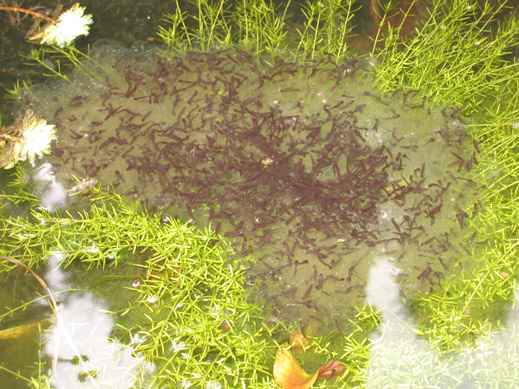
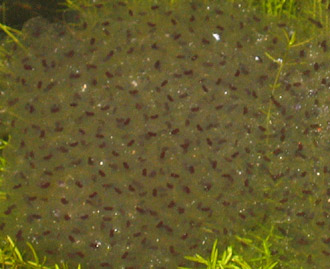
Only one warm sunny day over the last week, we have had heavy rain and blustery showers but fortunately not too many bonfires from the construction workers nearby polluting the water with ash drifting into the pond.  The water temperature remains cold but a close examination of the frog spawn shows that the little black dots we started with inside their protective jelly are beginning to change.  The majority of them are showing some definition, we have a lot of “little black commas”, the eggs are showing signs of development and we can see the start of a defined head end and a tail.

A Close up of the Frog Spawn

Picture credit: Everything Dinosaur

Despite the cold weather the spawn is beginning to change, the picture shows that the embryos are developing, becoming more elongated and showing signs of progress.  We suspect that the water temperature will still be determining the rate of development, perhaps the warmer weather forecast for next week will help the spawn to hatch in the next 10 days or so.

Only one adult frog has been observed in the pond during office hours.  Ironically, it has taken to sitting next to the frog spawn using the surround pond week (Elodea) to support its weight.  We were a little concerned about this frog, normally frogs confine themselves to the margins of the pond, where there is more cover.  However, this frog, (we think it is a male), seemed quite happy to sit amongst the pond week in the centre of the pond.

Some of us started to speculate that this was the father, checking on his family to be, but this was probably a bit too fanciful for the more rational members of the team.  Amphibians do adopt many strategies when it comes to looking after and raising their young.  It is not just the so called higher forms of life, the mammals and birds that adopt a benevolent attitude to their offspring.

23 03, 2008

Exciting Frog Blog Week 2 Update – The Tiny Black Dots

By |2024-04-12T08:33:01+01:00March 23rd, 2008|Categories: Animal News Stories, Educational Activities, Everything Dinosaur News and Updates, Main Page|0 Comments

Frog Blog Week 2 – Tiny Black Dots – no movement yet

We have been keeping a careful watch on the frog spawn in the office pond.  The frogs spawned for the first time in our pond last Sunday, so we have decided to keep an observational record of how the tadpoles get on.  Four frogs were in the pond, we suspect one female and three males.  Identifying males and female frogs is not our strong suit, but we estimated the ratio of boys to girls based on the fact that one frog was bigger than all the rest, so we speculated that this was the female.

During the breeding season, the male frogs develop pronounced dark pads on their first digits of the hand.  These pads are present all year round but swell up in the breeding season and help permit males to grip the usually larger females during mating.

Also, the smaller frogs croaked and we think that only the males do this.  The sound does not carry very far, it is certainly not the loudest frog croaking we have heard, many tropical frogs would easier drown out the noise made by these Common Frogs as these animals lack a vocal sac to help the sound resonate.

By Monday the pond was empty and the adult frogs had left, perhaps to hunt in the surrounding rockery, we did not expect to see all four of them together again, but surprisingly on Wednesday all four frogs (one big one and three smaller ones) returned to the pond and there was a lot of activity again but no further spawning.

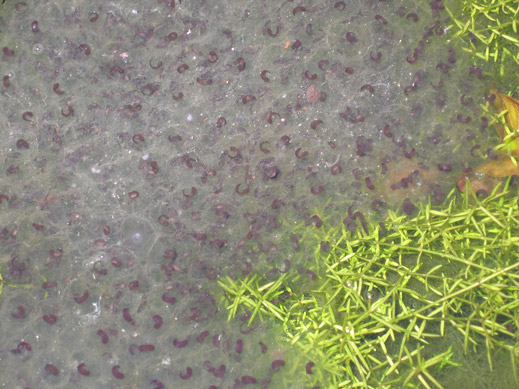
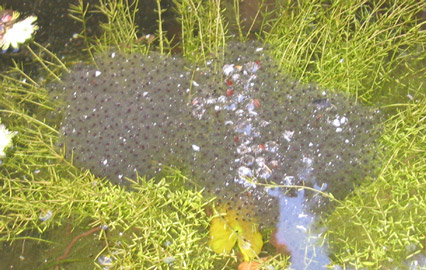
Frog Blog – Week 2

Picture credit: Everything Dinosaur

The weather in the north-west of England has been particularly cold over the last few days.  We have experienced strong gales, hail storms and even some snow.  This is the earliest Easter for 95 years, we suspect that the development of the eggs will be dependent on the water temperature, so it may take a while for the embryos to start to develop.  The jelly surrounding the tiny black dots (each no more than about 2mm across), has swollen and this helps the spawn stay afloat and close to the surface of the pond.  In this way the spawn can be warmed by sunlight to the greatest extent (surface water of ponds tends to be warmest).

We have been concerned this week, as there has been a lot building work going on around us and the construction teams have lit several bonfires.  This has led to large deposits of ash and other debris getting blown into the pond.  The silvery “scum” surrounding some of the spawn that can be seen in the picture, is ash that has drifted into the pond, we are not sure what effect this pollution will have on the spawn’s development.

We will have to keep you posted on the spawn’s progress…

Science Bit

Amphibians were the first truly semi-terrestrial animals, evolving in the late Devonian and becoming more numerous and diverse during the Carboniferous and Permian periods before suffering in the Late Permian mass extinction.  At the end of the Permian there were about 35 known families of amphibians, many of them considerably larger than their modern counterparts.  After the mass extinction event, at the beginning of the Triassic (248 million years ago), there were about 10 families remaining.

About 70 percent of all the types of amphibians around at the time of the Late Permian went extinct.  Today, there are about 4,300 species of amphibians in the world (mostly frogs), but the amphibian class has never fully recovered from the Permian mass extinction.  Amphibians were at their most diverse (in terms of families) and spectacular something like 50 million years before our ancestors (the first mammals) evolved.

16 03, 2008

Frog Blog – We have Frogspawn in the Office Pond!

By |2022-12-20T22:43:17+00:00March 16th, 2008|Categories: Animal News Stories, Educational Activities, Everything Dinosaur News and Updates, Main Page|0 Comments

Frog Blog – We have Frogspawn in the Office Pond!

Four years ago whilst some of us were away in Canada working on some palaeontology projects, arrangements were made to build a small pond behind the office.  We had managed to persuade one of the designers of the animal enclosures from Chester Zoo to undertake the work and to produce a water feature with a seating area so that we could take our breaks and watch any wildlife that might be attracted to the water.

The work took about a week and our designer friend built two small ponds in a corner of the paved area behind the offices.  He even cleverly cast some ammonite fossils and installed these in various places in the rockery to make us palaeontologists and fossil collectors feel at home.

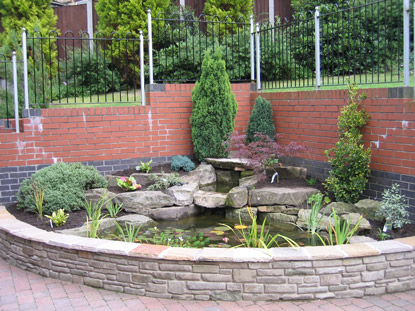
Using his expertise, our designer chum shaped the pond so that there would be plenty of shallow areas and margins, important when wanting to create a natural pond.  In addition, he advised on the planting and even provided the oxygenating water plants, the marginals and the lilies.  His final touch was to provide us with a population of snails to help maintain the pond.  We have two species at the moment a small pond snail and rams-horns (Planorbis sp.)

The Pond when it was First Built and Landscaped

Picture credit: Everything Dinosaur

Over the last few years this water feature has proved popular with the local birds who use the shallows as a bird bath and we have been fortunate to have damsel fly larvae as well as water boatmen take up residence.  Although, frogs had been seen in the vicinity and team members were able to count 3-4 individuals at anytime in the summer, (we even had a particularly large one that was nicknamed “Freddie” after Andrew Flintoff the England cricketer who took up residence in 2005);  no breeding had taken place.

However, this morning, whilst returning to the office to sort out some Everything Dinosaur paperwork, a quick check of the pond and hey presto – our first ever frogspawn was spotted.  There had been a number of frogs seen in the pond over the last month or so and apparently last night (a particularly dark and wet night) the spawning took place.

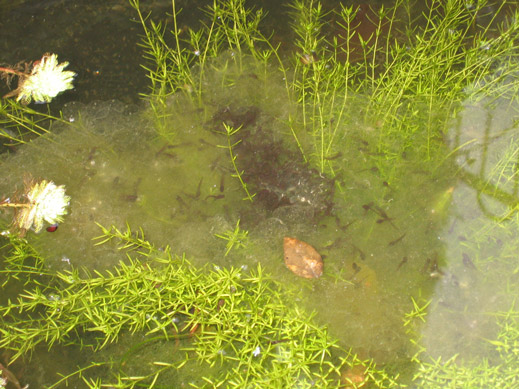
From the amount of spawn produced, we estimate that it is from just one female.  A total of four frogs have been observed in the pond this morning (the back of one can be seen partially hidden by the spawn to the right of the picture).  We have speculated that it is the female with her three suitors.  The frogs are Common Frogs (Rana temporaria), one of three species of frog that are found in the UK (excluding any escaped exotics).  Like all native British amphibians and reptiles they are a protected species.  With much of their habitat destroyed, areas such as landscaped offices and gardens are becoming increasingly important to them.

It is nice to know that after nearly 5 years the frogs have felt comfortable enough with our pond to breed in it, we are playing a small role in the conservation of this species and amphibians need all the help they can get, as they are globally the most endangered and threatened of all the animal classes.

Frogs are special to many of the Everything Dinosaur team members, they are very specialised Lissamphibians (the group of amphibians that includes frogs, toads, newts, salamanders and the leg-less caecilians).  The Lissamphibians were present in the Palaeozoic and it is thought that frogs evolved sometime in the Triassic,  however, the fossil record for frogs is very patchy to say the least.  They were probably relatively abundant during the Age of Reptiles, but the lack of fossil evidence inhibits palaeontologists when it comes to working out Anura (frog) evolution.  Fossil bones have been recorded from a number of Mesozoic sites but they are usually isolated fragments, ilia, humeri (limb bones) and the more robust skull elements.

Occasionally, fossils are found that demonstrate that some of these amphibians would have been formidable hunters, even capable of eating baby dinosaurs and young crocodilians.  The discovery of a giant frog from Mesozoic deposits in Madagascar is evidence of this.

To read about the discovery of fossils of a giant Cretaceous frog: Giant Frog from Madagascar.

2 02, 2008

Time Running out for the Indian Gharial

By |2023-02-25T06:24:24+00:00February 2nd, 2008|Categories: Animal News Stories, Dinosaur and Prehistoric Animal News Stories, Main Page|0 Comments

The Indian Gharial may be Close to Extinction

The Indian Gharial, one of only two surviving species of the living fossil family Gavialidae with an ancestry dating back to the Late Cretaceous is close to becoming extinct in the wild.  This magnificent and graceful crocodilian, capable of growing to lengths in excess of 6 metres had been under severe pressure in the early 1970s as the growing Indian population competed with these animals for space and fish.

Indian Gharial

Radical steps were taken to protect the nesting areas of this reptile and to preserve stretches of waterway to provide a pristine haven for these long-snouted crocodiles.  Numbers had begun to recover but over the last two years the breeding population has declined to such an extent that the International Union for the Conservation of Nature and Natural Resources (IUCN) reclassified the species last year as “Critically Endangered” acknowledging that this fish-eating crocodile was on the brink of extinction.

The Gharial, sometimes called the Gavial is now facing a new threat.  A large number of dead Gharials have been found in the Chambal river area of India, a stretch of water designated a Gharial preserve.  Despite the land’s preservation status, Gharial numbers have been threatened by illegal fishing, the removal of sand for building sites, destroying nesting areas and poaching.  Now a mysterious ailment is causing the death of many of these animals and scientists are unsure as to what the cause might be.

Post-mortems carried out on the dead crocodilians indicate high levels of lead in their bodies, but tests on the fish population (the gharials main food source), do not show high levels of lead in the fish.  The Gharials are observed as becoming dull and lifeless with slowed reactions (symptoms of poisoning) and then a few days later their carcases are found bloated and floating in the water.  Such has been the mortality that an urgent Indian scheme has been launched to investigate the deaths and to consider ways to protect the remaining Gharials in what was once their only stronghold.

20 10, 2007

Living Fossil Helped back to New Zealand Mainland

By |2023-02-24T17:48:46+00:00October 20th, 2007|Categories: Animal News Stories, Main Page|0 Comments

Tuatara Sanctuary receives new Residents

In the world today there are a few plants and animals that are relics from ancient history, they are often referred to as “living fossils”.  One such animal is the very rare Tuatara, an ancient reptile that superficially resembles a lizard but is in fact a member of the Order Sphenodontia and not part of the Order Squamata (lizards and snakes).  Tuatara is actually a Moari name, this animal is known by the genus Sphenodon (means wedge tooth), by scientists.  It is found on 32 remote islands off the coast of New Zealand, but a team of conservationists have been attempting to establish a colony on the mainland near Wellington.

Tuatara

Tuatara from Stephens Island in the Marlborough Sounds have been captured and are being re-homed at the Karori Wildlife Sanctuary, to help boost the numbers of these reptiles at this special preserve.  With the Stephens islands having an estimated population of 50,000 Tuatara, the removal of around 200 animals will not make much difference to the island’s population it will more than treble the Tuatara numbers at the Karori Wildlife Sanctuary.

The process of catching these animals, which can grow up to 60 cm long was not easy, as by day they live in burrows dug by petrels and rarely venture far from the burrow entrance during daylight.  Once grabbed the conservationists need to be mindful of the animals sharp teeth and claws.  Tuataras have a dental arrangement unique amongst terrestrial chordates, a sign of their ancient heritage.

Tuatara Dentition

They have a single row of teeth on the dentary (lower jaw) but two rows of teeth on the maxilla.  When the mouth is closed the lower jaw teeth fit perfectly into the space between the upper teeth rows, providing a very effective bite mechanism.  The animal seems to lack a predentary and the premaxilla forms a beak-like structure at the front of the mouth.

We can tell it is a male from the picture as these animals demonstrate sexual dimorphism, the males are generally bigger than the females and the crest which runs down the spine is more pronounced in males than females.

In December 2005, the Karori Sanctuary became the home to 70 Tuatara, the first time these animals had made it back to the mainland for 200 years after going extinct in the 19th Century.  The new additions will help to strengthen the population and perhaps play a part in the re-introduction of these animals to other parts of New Zealand.

The lack of vermin, particularly rats will help the Tuatara, as these rodents eat the eggs of the reptiles and were largely responsible for their decline.  With luck, the two species of Tuatara still surviving will flourish and continue to provide a link between our world and the Triassic, as the sphenodonts are first found in the fossil record dating back 220 million years.

For models and replicas of Triassic prehistoric animals and other creatures: CollectA Deluxe Prehistoric Animal Figures.

8 08, 2007

Welcome to the Holocene – How to define a Epoch

By |2023-02-14T13:50:16+00:00August 8th, 2007|Categories: Animal News Stories, Main Page|0 Comments

How to Define an Epoch – Death of a Dolphin

Recently the team members of Everything Dinosaur were asked to comment about an article that had featured in a popular women’s magazine.  The article was part of a feature which highlighted bizarre facts about the animal kingdom.  The particular part that attracted one of our customer’s attention was the snippet on Sabre Tooth Tigers.  The author had stated that the Sabre Tooth Tiger was the last tiger species to go extinct.

The Holocene Epoch

This customer had queried this, emailing us asking whether we could confirm that the Sabre Tooth Tiger was indeed the last tiger to go extinct.  The first thing we had to do was to point out that the name “Sabre Tooth Tiger” was misleading.   This phrase is commonplace, but Sabre-toothed cats are not closely related to tigers.  We are not sure how this misnomer arose, or who was responsible for first coining the phrase “Sabre Tooth Tiger” but this term is now synonymous with the Smilodon genus.

Sabre-Toothed Cats

Sabre-toothed cats belong to a sub-family of the cat family (Felidae) called machairodonts.  The machairodonts seem to have first evolved around 12-15 million years ago (mya) and although their ancestry is uncertain, they seem to have quickly spread all over the Northern Hemisphere, before moving into the New World an estimated 5 mya.

Once we had explained this, we then went on to point out that animals like Smilodon fatalis went extinct about 10,000 years ago (the last Sabre-toothed cats survived in the Americas until the end of the last Ice Age).

However, many more big cats have gone extinct far more recently.  We know of at least three sub-species of tigers that may have died out in the last 60 years.  The Caspian tiger (P. tigris virgata) which once roamed Afghanistan, Iran and parts of Russia has not been seen since the 1950s.  The Javan tiger (P. tigris sondaica) was last sighted in 1972 and the Bali tiger (P. tigris balica) has not been seen on the island since 1947.

Yangtze River Dolphin

Today, we read that the Yangtze River dolphin or Baiji (Latin name Lipotes vexillifer) may have died out as well.  This mammal, that could reach lengths of over 2.5 metres was last seen in 2002 and a survey conducted in the animals habitat failed to record a single dolphin.  It would be no surprise if this cetacean had become extinct.  The Yangtze river is one of the world’s busiest waterways, it has been extensively over fished and is heavily polluted as China’s economy continues to grow.

Officially, the Worldwide Fund for Nature only recognises that a species is extinct if it is not seen for 50 years.  The Yangtze River dolphin remains on the Critically Endangered classification but if any are surviving, they are so few in number not to make the species viable.

Sabre-Tooth Cat Model (Mojo Fun Prehistoric Life Smilodon)

Mojo Smilodon prehistoric animal figure

The Mojo Smilodon model is a replica of a sabre-toothed cat. The Smilodon model measures approximately 13 cm long.

Picture credit: Everything Dinosaur

The picture (above) shows the Mojo Fun Prehistoric Life Smilodon model, to view the Mojo Fun range of prehistoric animal figures: Mojo Fun Prehistoric Life Figures.

The magazine article on Sabre-toothed cats also provided information on how time is divided up into geological periods  it mentioned that scientists classify the time since the last Ice Age as the Holocene (recent time).  When we submitted our notes clarifying the points raised about the cats, we were asked to state what the Holocene stands for.  We commented about this mentioning the obvious – this being an interglacial period, the ascent of man moving to a sedentary lifestyle with domesticated animals, the rise of civilisations and so on.  We also commented that the Holocene was being marked by the dominance of just one species – us.

Homo sapiens

In just 10,000 years the population of Homo sapiens has exploded and our impact on this planet is being felt everywhere and by every other creature.  The Holocene epoch could be defined by extinctions caused by the activities of mankind.

We lament the passing of the Yangtze River dolphin, sadly much, much more is yet to come.

23 07, 2007

Invasion of the Crocodiles

By |2023-02-13T08:12:48+00:00July 23rd, 2007|Categories: Animal News Stories, Dinosaur and Prehistoric Animal News Stories, Main Page|0 Comments

Invasion of the Crocodiles

The increasing number of Estaurine (otherwise known as Saltwater) crocodiles on the North-east coast of Australia is causing concern amongst local residents and the surfing community.

The Estaurine crocodile (Crocodylus porosus) can be found over a large area of South-east Asia.  It ranges from Sri Lanka to the Fiji islands, with a resurgent population in northern Australia as hunting them has been banned.  These animals can grow up to 9 metres in length (27 feet) although many stories abound about even larger specimens being seen.  It is capable of living in a number of habitats but prefers the mouths of rivers and other tidal areas.  Estaurine crocodiles are quite happy swimming out to sea and many have been spotted tens of miles off shore.  This may explain why they are so widely spread in Southeastern Asia.

Unfortunately, their numbers in Northern Australia have grown substantially over the last twenty years and many crocodiles are beginning to be seen on popular surfing beaches and basking close to areas frequented by swimmers.

There are even been reports of crocodiles being spotted close to Cairns and Townsville the main centres of population in the region.  A recent study by local rangers and Aboriginal guides have estimated numbers to be around 500 – 1,000.  The rise in population has been attributed to the ban on hunting crocs and the decline in natural predators of crocodile eggs such as dingoes and other wild dogs.

These crocodiles are very capable hunters and once above 8 feet in length would be classified as man-eaters.  The larger specimens are mainly ambush predators preying on animals as they come to the rivers to drink.

A call for a cull has been made and many locals are already lobbying to be able to carry guns.  However, the local Environmental Protection Agency is reluctant to support a cull as if open season was declared on the Saltwater crocodiles the population may be devastated in just a few years.  Despite their fearsome reputation crocodile attacks are relatively rare with only 17 attacks being recorded since 1985 with only five fatalities.

The Crocodilian order is very ancient with crocodiles of various types thriving throughout the Mesozoic.  The first modern crocodiles evolved around 90 million years ago, all crocodiles and alligators belong to a Crocodilian group called the Eusuchians, these became widespread during the Late Cretaceous and survived the mass extinction that ended the reign of their cousins the dinosaurs.  Although the Estaurine is the largest reptile living today, it was dwarfed by many of the crocodiles that lived in the past.

Giants like Sarcosuchus (means “flesh crocodile”) and Deinosuchus (means “terrible crocodile”)  from the Cretaceous are believed to exceeded 12 metres (40 feet in length).

Crocodile Models: Dinosaur and Prehistoric Animal Models.
Scientists still debate which was the largest crocodile known, as often only fragments of the skeleton are fossilised.  Perhaps the biggest of all was Purussaurus from South America.  This animal inhabited rivers and lacks of the late Miocene (8 mya), estimates of its length vary but it may have reached over 17 metres (55 feet).

28 05, 2007

Dodos in the 21st Century

By |2023-02-11T13:35:52+00:00May 28th, 2007|Categories: Animal News Stories, Main Page, Photos|0 Comments

I want a Dodo Figure!

Well it is different I suppose, a dodo figure.  One extinct animal is as good as another, although I’m not sure where I can find one, I have never seen one in any shops or on-line, and don’t know if it is part of any range (or what range of animals it would belong to).  At Everything Dinosaur we specialise in dinosaur models and dinosaur toys and we do know the Wild Safari Dinos model range quite well.

Dodo Figure

Started by looking at our books and magazine articles on dinosaurs and prehistoric mammals to see if I could find a picture of a Dodo, and maybe a reference to it.  Found what I wanted in an old book – a reference to Doug Watson (a sculptor), who had made a Dodo model.  Now we just had to find it.

Contacted our American museum friends and found that they did have one that was part of a range called “Wings of the World”, covers a multitude of animals.  At least I now knew what range it belonged too.  One Dodo sourced, and one happy customer.

Fact file – Dodo – common name “nauseating bird”.  Apparently, because when sailors first encountered this bird on the island of Mauritius, and killed it for food, it was found to be so greasy and oily it made anyone eating it ill.

We find all sorts of models for our customers.

To see what other models we do – click on: Everything Dinosaur, Toys and Dinosaur Models.

Go to Top