All about dinosaurs, fossils and prehistoric animals by Everything Dinosaur team members.

News stories and articles that do not necessarily feature extinct animals.

14 03, 2009

Frog Blog 2009 – We have Spawn in the Pond again

By |2022-12-20T14:37:45+00:00March 14th, 2009|Categories: Animal News Stories, Educational Activities, Everything Dinosaur News and Updates, Main Page|0 Comments

Frog Blog 2009 – Frogspawn in the Office Pond Again

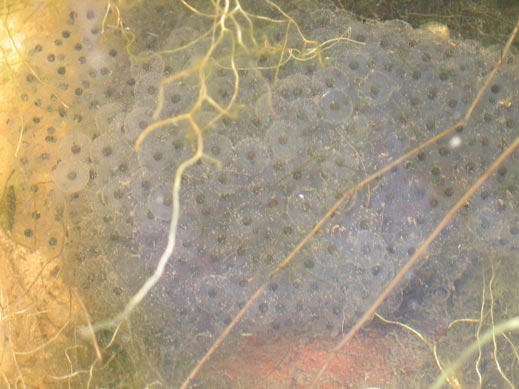
For the second year running we have got frogspawn in the office pond.  We had noticed a number of frogs around and in the pond over the last few days, but today on a quick tour of the office yard we have discovered a small amount of spawn close to the edge of the pond.  There are three frogs in the pond at the moment, they are relatively small and all are croaking.  We think these are males, calling for females, however, one frog has already spawned in the pond and we think that only male common frogs croak.  The spawning probably took place yesterday or very early this morning.

Frogspawn

We shall leave the frogs alone and see if the males can attract any more females to come and lay their eggs.

The Frogspawn laid in the Office Pond

Picture credit: Everything Dinosaur

In a Different Part of the Office Pond

The spawn has been laid in a different part of the pond this year.  The frogspawn laid last year was in the centre of the pond over a deep part of the pond, this year the spawn has been laid in a shallow part.  Folklore states that if frogs spawn in the shallow part of the pond it is going to be a wet spring.  The suggestion is that if frogs lay their eggs in the shallows they believe that there will be plenty of rain to keep the pond topped up and their eggs will not dry out.   We shall have to wait and see.  Hopefully, other frogs will spawn in the pond in the next few days.

1 03, 2009

Exciting Frog Blog 2009 – Frogs take up Residence in the Office Pond

By |2024-04-12T09:14:34+01:00March 1st, 2009|Categories: Animal News Stories, Main Page|0 Comments

Frogs take up Residence in the Everything Dinosaur Office Pond

Last year we had our first frog spawn laid in the office pond.  We had been monitoring the pond for sometime, but 2008 was the first time that frogs had decided to spawn in it.  The spawn was laid on the 16th March last year and we have been eagerly looking forward to seeing if the frogs would spawn in our pond again this year.

As we work quite late these days, (some team members don’t leave the office until 10pm), we have been able to watch a couple of frogs late at night as they emerge from their winter hideaways and prepare for the mating season.  We have two frogs in residence in and around the pond at the moment.  These are common frogs (Rana temporaria) and at the moment we think that both these animals are males.  We have noticed how bold the frogs have become, one of them sat on the stone flags that surround the pond for over an hour this morning.  It was sunbathing in the spring sunshine, quite exposed to any cats or other predators.  We have alerted the rest of the team and we will try to keep a look out in case a hungry hunter comes along.  We have speculated that this near suicidal approach may have a lot to do with demonstrating to rival males that the pond is occupied and within the territory of a male.  After the mating season, the frogs become much more cautious and remain in the more inaccessible areas of the pond, perhaps the lure of females encourages these little amphibians to show a little more bravado at this time of year.

We will keep a close watch on the pond and see if we get any frog spawn in a couple of weeks or so.

Visit Everything Dinosaur’s award-winning website: Visit Everything Dinosaur.

19 02, 2009

Parents of Boy Eaten by Crocodile don’t want Croc Killed

By |2022-12-20T12:57:59+00:00February 19th, 2009|Categories: Animal News Stories, Main Page|0 Comments

Crocodile responsible for Death of Young Boy Identified

The parents of Jeremy Doble, the young boy who was attacked and eaten by an Estuarine crocodile have declared that they don’t want the crocodile killed by the Australian authorities.

The attack took place on February 8th as Jeremy played with his seven-year-old brother and pet dog in flooded swampland adjacent to the Daintree River in Queensland.  The Daintree river and rain-forest is a world heritage site but the river has a high density of Estuarine crocodiles and these huge reptiles have a reputation for being man-eaters.  The Estuarine or Saltwater crocodile (Crocodylus porosus) is the largest species of crocodile and the biggest reptile species on the planet.  Mature adults can reach lengths in excess of 6 metres, any crocodile bigger than 2 metres is considered a potential man-eater.

Nobody witnessed the actual attack, but Ryan saw a crocodile shortly after his brother had disappeared and Steve Doble, the boy’s father, ran into the water trying to save his son when he heard screams.  Steve Doble operates a tourist and trekking company and the family were used to seeing large crocodiles in the area.  The threat of an attack was always there, Saltwater crocodiles like most species of large crocodile are ambush predators and unfortunately, a number of fatal crocodile attacks are reported each year.

This incident was the second such occurrence in the Daintree area in recent months.  A man was eaten by a large crocodile on the Endeavour river just north of the Daintree.  One shoe, a camera and some crocodile slide marks were found on the spot where the man disappeared.  A hunt was launched by the local law enforcement agencies and a large crocodile trapped which when examined revealed the human remains inside its stomach.

After the attack on Jeremy, the authorities launched a large-scale search for the predator.  Two crocodiles were caught, one male and a female.  The female when x-rayed showed no human remains, however, the male croc was proved to be the culprit.

The boy’s parents have specifically asked authorities not to kill the animal.  Instead, it will be sent to a crocodile farm or zoo but will not be put on public display.   Crocodiles that measure over 4 metres long had been seen in the area and one of these creatures is more than capable of overpowering a human being.  It is very sad to hear of this news, unfortunately as the numbers of crocodiles increase and they have more contact with people, such incidents are likely to occur.  To a crocodile a person is another item of prey and there have been calls for another cull of large crocodiles in the area.

The population of Estuarine crocodiles in Australia fell dramatically in the 19th and early 20th Century due to hunting.  However, protection and conservation schemes running since the 1970’s has permitted the crocodile population to increase.  Australians seem to have a love – hate relationship with their crocodile species.  Only a few days ago we reported on a new exhibit, a showcase of crocodilian evolution being opened at Darwin.

To view this article: Crocodile Exhibition opens to celebrate Darwin’s Birth.

It seems that having such magnificent creatures sharing your neighbourhood has some very serious drawbacks and unfortunately, there is little evidence to suggest that crocodiles can be successfully deterred from making such attacks.

17 02, 2009

I’m Dreaming of a White Alligator

By |2022-12-20T12:34:47+00:00February 17th, 2009|Categories: Animal News Stories, Dinosaur and Prehistoric Animal News Stories, Main Page|0 Comments

Bizarre Looking Alligator on show at American Tourist Attraction

A white alligator is the star turn at a Florida crocodile farm and tourist attraction Gatorland.

The Alligator is a member of the Order Crocodylia.  There are just two species of alligator on the planet, the well-known and often viewed at zoos and American tourist attractions such as Gatorland, American alligator (Alligator mississipiensis) and the much rarer Chinese alligator (Alligator sinensis).  Alligators are therefore found in only two, widely separated regions of the world, in the south-eastern USA and China.  To be precise, the critically endangered Chinese alligator is found mainly in the upper reaches of the Yangtse river valley.

A Replica of a Chinese Alligator (Alligator sinensis)

Siamese crocodile model.

Family Zoo Siamese crocodile model.

Tourist attractions like Gatorland in Florida, play a vital role in helping to preserve crocodiles, caimans and alligators.  As well as providing curious tourists with information and permitting them to get up close and personal with some of the most dangerous animals on Earth, Gatorland and other attractions carry out  conservation programmes and captive breeding schemes to help support the dwindling wild populations.

White Alligator

The latest residents of Gatorland to benefit from their protection is an exceptionally rare, white alligator, believed to one of only twelve such animals in the world.  This animal, a 200 kilogramme male called Bouya Blan (the name means white fog in the local Indian dialect) was collected from a Louisiana swamp and transferred from Audubon zoo in New Orleans to Gatorland.

This particular male alligator, with its ivory skin and deep blue eyes was part of a clutch of seventeen young alligators collected by workers from the Louisiana Land and Exploration Company who were surveying the swamp land in 1986.  The group was taken to the Audubon zoo where they remained until last year, before being transferred to the specialists at Gatorland.  Unfortunately, only a few of the original seventeen survived in the twenty years of so they spent in captivity, but now under the supervision of the Gatorland experts they may have a more certain future.

These bizarre looking animals are not examples of albino-ism, the nearly complete absence of any pigment is caused by a genetic disorder.  Animals that lack pigmentation are called leucistic (from the Greek leukos meaning white).  The large male alligator in the picture is one of four leucistic alligators kept at Gatorland.

Mark McHugh, President and Chief Executive of the Floridian tourist attraction commented:

“People are awestruck when they see them, and just one look into those icy, blue eyes will give you chills”.

He went on to state how excited he and the rest of the Gatorland staff were at having these rare alligators at the park.

Mark’s colleague Tim Williams added:

“This is the largest group of giant white gators in the world.  These are not albino animals, they are what we call leucistic, which means they have a little bit of pigmentation around the mouth and a little touch on the tail and they have piercing blue eyes.”

Mr Williams went on to explain that in the wild any animal with this genetic disorder would be unlikely to survive very long.  They have a sensitivity to sunlight and their lack of camouflage would make them easy to spot, bad news with so many hungry predators around in their swamp homes.

As a result of their rare genetic condition, the alligators are housed in special enclosures to protect them from sunlight – and the unwanted attention of other males.

“We have four white alligators here at Gatorland and because they are all males they cannot be in the same enclosure as they are all very big and they would all fight with each other”;

commented Mr Williams, noting the natural aggressive tendency of male alligators.

Creatures with the leucistic condition need extra vitamin D (normally obtained from sunlight), to help the Alligators; their diet is supplemented with food rich in this particular vitamin.  They are fed chicken, fish, red meat and do receive vitamin supplements as well.

Tim and his team are now hoping to breed white alligators with two female American gators who carry the leucistic gene.   They will certainly be quiet a site at the Gatorland park, but we at Everything Dinosaur, are concerned about such a breeding programme.

Perhaps it would be better to focus resources on breeding the critically endangered Chinese alligator, rather than trying to breed a type of alligator that could not survive in the wild.  We can appreciate the need for the attraction to generate visitor numbers by offering them the chance to view such strange creatures but we remain unsure as whether it is “right” to deliberately attempt to prolong this genetic disorder in a captive population of crocodilians.

15 02, 2009

New Crocodile Exhibition to Celebrate Darwin’s Birth

By |2024-01-14T09:15:53+00:00February 15th, 2009|Categories: Animal News Stories, Dinosaur and Prehistoric Animal News Stories, Main Page|0 Comments

Crocodile Exhibition to Celebrate Darwin 200

An Australian museum is putting on an exhibition showcasing the evolution of the crocodile as part of their celebrations marking the 200th anniversary of Charles Darwin’s birth.  The exhibit which is on display at the Northern Territories Museum and Art Gallery in Darwin is open until November.

Darwin itself, was named after the famous English scientist, he visited the area when the ship, HMS Beagle docked in September 1839, part way through its surveying expedition.  Australia has two native species of crocodile, the Saltwater or Estuarine and the smaller freshwater crocodile.  The Saltwater crocodile (Crocodylus porosus) is the largest living reptile with some specimens reaching lengths in of over 6 metres.

The exhibition is entitled “Supercrocodilians: Darwin’s ultimate survival story” is free to enter and tells the story of the evolution and development of this remarkable reptile group, one that has outlasted the dinosaurs.

Commenting on the events programme, exhibition curator Paul Horner said:

“We wanted to show Charles Darwin’s theory of evolution through an icon like the crocodile”.

Animals that were similar to modern crocodiles (phytosaurs) evolved around 240 million years ago.  Crocodiles as a group have been around since the Late Triassic period with the ancestors of the modern species known today (23 species of crocodiles in the world at present, although most are endangered), being traced back to the Cretaceous (neosuchians).  Some of the species of crocodilian around today may have remained largely unchanged for 5 million years or so.  The crocodilian life style of being a heavily armoured, ambush predator of rivers and lakes does seem to be a formula for a sustained run in terms of survival.  However, in their evolutionary history crocodiles have evolved to exploit a variety of environmental niches, from almost entirely marine forms such as Metriorhynchus, to fast running entirely terrestrial types.

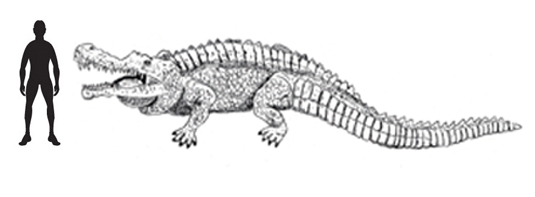
The exhibition highlight is the reconstructed skull of a 15 metre long giant crocodile called Sarcosuchus.  This particular crocodile, now fortunately extinct, lived in Africa during the Cretaceous period and although it had a long snout adapted for catching fish, it probably ambushed dinosaurs as they came down to drink.

Pictures show the skull of a Sarcosuchus and museum curator Paul Horner is dwarfed by it.  Even allowing for the change in perspective as Paul is further from the lens than the crocodilian skull, the cast of this fossil skull is very impressive.  Note the hooked tip to the upper jaw and the many sharp, needle-like teeth, believed to be adaptations to help catch slippery fish.  Such a jaw configuration and dentition is seen in baryonychid dinosaurs, which were also believed to be fish-eaters in the main.

A Scale Drawing of a Prehistoric Crocodile – Sarcosuchus

Sarcosaurus scale drawing

Everything Dinosaur’s scale drawing of Sarcosuchus. Picture credit: Everything Dinosaur

Picture credit: Everything Dinosaur

The exhibition has been planned for over a year and is a fitting tribute to Darwin, after whom the city is named and also highlights a need to conserve these remarkable and dangerous creatures.

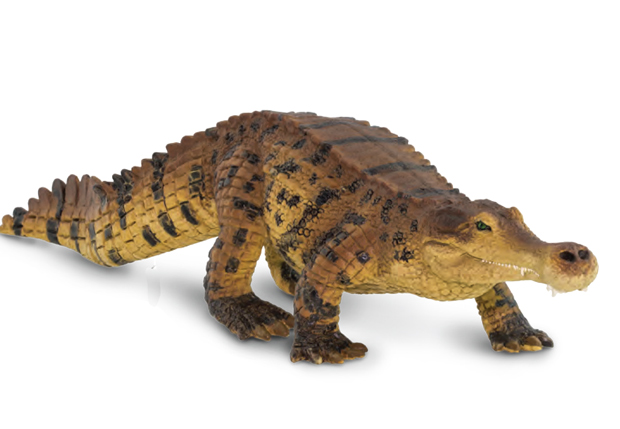
Team members at Everything Dinosaur have been working on a model of Sarcosuchus that is being introduced later this year. Drawings have just been commissioned so that a fact sheet can be created for this new item.  Scientists remain unsure as to which type of crocodilian was the biggest of them all.  Sarcosuchus is a contender, along with the more heavily built Deinosuchus and the later Purussaurus from South America that lived during the Late Pliocene.  This particular crocodile, believed to be more closely related to modern Alligators could reach lengths in excess of 16 metres.

To view models of a variety of prehistoric crocodilians and other related species: Dinosaur, Crocodilian and Prehistoric Animal Models.

31 01, 2009

A Picture Puzzle – Can you Guess what’s in the Picture?

By |2023-02-25T20:54:32+00:00January 31st, 2009|Categories: Animal News Stories, Everything Dinosaur News and Updates, Main Page|0 Comments

A Mysterious Photograph – Watch the Birdie!

A couple of snaps taken by one of our team members in the early evening around 5pm GMT.  Every day for the last month, as we have been organising the late afternoon despatches to the post office and collection depot we have been observing a phenomenon.

What’s in the Picture?

Picture credit: Everything Dinosaur

The tiny black dots in the sky are actually birds, common starlings to be exact and over the last few weeks since Christmas, increasing numbers of them have been coming to our town to roost.  Starlings are small birds found in gardens and in the countryside, however, they form communal roosts and prefer to roost in towns (where it is slightly warmer than the surrounding countryside), and they create massive swirling clouds as they fly in vast numbers.

It is hard to estimate their numbers but an ornithologist suggested that there were in excess of 100,000 and they will dance and weave about above the town as they decide where to sleep for the night.  We were told that they prefer to roost in conifers and that it is very unwise to park your car near them as during the night several kilogrammes of highly corrosive guano will be created.

As these birds fly in huge flocks above the town, the perform a spectacular aerobatic display.  We have been lucky enough to  see some amazing animal sights in our travels over the years, herds of wildebeest migrating across the Masai Mara, vast flocks of flamingos nesting on salt lakes, elephants, tigers and such like.  However, perhaps the most amazing natural animal phenomenon any of us have observed is created by the humble starling just a few miles from our office.

Not a bad spectacle and I only got “pooped” on twice whilst taking the photographs.

Visit the Everything Dinosaur website: Everything Dinosaur.

31 12, 2008

Prehistoric Cheetah Fossil Indicates that Big Cats Originated in the Old World

By |2022-12-11T10:21:01+00:00December 31st, 2008|Categories: Animal News Stories, Dinosaur and Prehistoric Animal News Stories, Main Page|0 Comments

Prehistoric Cheetah Skull found in Asia

A prehistoric cheetah skull found in Asia re-writes the evolution of these big cats. The origins of the big cats of today, the lions, tigers, pumas and cheetahs for example, are shrouded in mystery.  It had been thought that the modern cheetah Acinonyx jubatus had originated from North America (known as the new world), but now fossil evidence unearthed in China indicates that these felines may have evolved in Asia.

Prehistoric Cheetah Skull

The fossil record of large feline predators is extremely sparse.  There are several reasons for this, firstly, as animals at the top of the food chain there are fewer of them compared to the herbivores and omnivores in any habitat, so the chance of any remains becoming fossilised is statistically less likely.  Also, most of the big cats live in areas such as jungle or savannah and these habitats provide very few opportunities for effective fossilisation to take place, so big cat fossils are very rare.  Finding a skull or teeth is a huge prize for palaeontologists when it comes to piecing together the relationships between various extinct species of large cat.  It is the skull morphology and the teeth that can be most helpful in determining the relationships between different genera.

A modern Cheetah (Acinonyx jubatus)


A model of a cheetah (PNSO).

A model of a cheetah, an extant big cat (PNSO).

A team of Chinese scientists have announced the discovery of the oldest fossil of a new species of cheetah.  This discovery would indicate that cheetahs originated in Asia and not in North America as previously thought.  Researchers found a partial cranium and some teeth in the Gansu Province of north-west China.  It is similar in size and shape to the skulls of modern cheetahs, but the teeth are much more primitive.

In a paper published by scientists from the Shanghai Science and Technology Museum, this fossil represents an early stage in the evolution of these big cats.  The new species of cheetah has been named Acinonyx kurteni.  In prehistoric times, the big cat species were much more widespread, with cheetahs roaming Europe, Asia, India and North America.  Fossils of cheetahs found in various parts of the world have intrigued scientists as they try to calculate the site of the earliest fossils and hence the origins of this particular big cat family.

The newly studied fossils were dated to the Late Pliocene, between 2.15 and 2.55 million years ago.   Although, not the oldest cheetah fossils known, this new discovery challenges the accepted theory that the cheetahs originated in the Americas.

Prehistoric Cheetahs of North America

Two prehistoric cheetah-like species of North America are believed by some scientists to be distant cousins of giant cheetahs of ancient Europe.  In North America, up until the end of the Pleistocene period, large cheetahs hunted on the plains (Miracinonyx).

To read more about the mega fauna of North America: The Bison – a Contributor to Mammoth Extinction.

This possible relationship has led some scientists to suggest that the earliest cheetahs may have originated in North America and travelled across the Bering Strait from Alaska to Siberia, during a period of falling sea levels, when a land bridge between Asia and the Americas was formed.

This new find challenges this theory, the skull and teeth from China indicate a Eurasian/African origin of the cheetah family.  For instance, the primitive dental features would have been more developed in the Chinese fossil if cheetahs had come from North America.  The research paper supports the theory that the big cats originated in the old world and not the new world of the Americas.

Eveything Dinosaur stocks a range of prehistoric mammal models including replicas of big carnivores: Replicas of Prehistoric Mammals.

2 12, 2008

The Last Stand of the Gharial

By |2022-12-11T08:09:01+00:00December 2nd, 2008|Categories: Animal News Stories, Dinosaur and Prehistoric Animal News Stories, Main Page|0 Comments

Critically Endangered Crocodile Species – The Gharial on the Brink of Extinction

In a web log article back in February we reported on the mysterious deaths of a number of adult Gharial crocodiles in their last remaining sanctuaries in northern India.    This long-snouted fish-eating Crocodilian can trace its ancestry back to the dinosaurs but the species is facing extinction.

To read the first article: Time Running Out for the Indian Gharial.

Analysis of the bloated corpses of these crocodiles show high levels of lead, but the fish that they eat don’t show any significant levels of this toxic metal.  The demise of the Gharial in one of the last natural habitats remains a mystery.

In another one of the few places in India where these animals can still be seen in the wild, their last nesting sandbank is under threat from construction companies anxious to commandeer the sand for use in building projects.

The plight of this extremely rare reptile and the work of a remarkable group of conservationists as they attempt to save it is highlighted in a BBC 2 programme this evening – part of the Natural World series.

Herptologist Romulus Whitaker in collaboration with other conservationists has set up a “crocodile bank” (Madras Crocodile Bank Trust), this conservation centre has managed to start a breeding programme for gharials (the first time this has been achieved).  Thanks to efforts of Romulus and his dedicated team this magnificent creature may have a future after all.

The Natural World is broadcast tonight at 8pm GMT on BBC2.

For further information about the work Everything Dinosaur has done to raise the awareness of the plight of endangered animals with schoolchildren and teachers: Email Everything Dinosaur.

5 11, 2008

The Incredible and Adaptable Horseshoe Crab

By |2024-04-15T13:05:27+01:00November 5th, 2008|Categories: Animal News Stories, Dinosaur Fans, Main Page|0 Comments

The Ancient Horseshoe Crab

A member of the phylum known as the Arthropoda, Horseshoe crabs have not changed over millions of years.  The first fossils of these tough, marine creatures have been dated to around 450 million years ago (Katian faunal stage of the Upper Ordovician).  Superficially they resemble crustaceans such as crabs and lobsters but in fact they are more closely related to arachnids (spiders, mites and scorpions).   Horseshoe crabs are therefore not closely related to crabs, despite their common name.  Indeed, these animals are classified into the subphylum called Chelicerata (the term means claws and horns and relates to the structure of the mouth parts).

Horseshoe Crab

A Model of an Extant Horseshoe Crab (CollectA Prehistoric Life Model Range)

CollectA Horseshoe Crab model.

CollectA Age of Dinosaurs Popular Size Horseshoe Crab.

A beautifully preserved Horseshoe crab fossil from south-western China (Luoping Formation).  Fossils in photographs probably date from the Early Triassic and are perhaps more than 240 million years old.

There are four known species of Horseshoe crab, three can be found in south-east Asian waters whilst the fourth species can be found in the Gulf of Mexico and on the Atlantic coast of the United States.  All four species are believed to be endangered due to over fishing, loss of suitable breeding beaches and pollution.

To view the CollectA Prehistoric Life model range: CollectA Prehistoric Life Models and Figures.

2 11, 2008

Biological Terms Associated with Phyla – Helpful Definitions

By |2024-04-13T08:45:37+01:00November 2nd, 2008|Categories: Animal News Stories, Everything Dinosaur News and Updates, Palaeontological articles|0 Comments

Defining Pelagic and Nektonic Terms in Biology

A number of terms are used by biologists and palaeontologists to provide an overview of the habit or mode of life of organisms.  Most of the terms relate to marine or freshwater environments due to the number of different habitats and modes of life that exist in the world’s oceans, lakes and rivers.  One term that is frequently seen in academic papers related to zoology or botany is the term “pelagic”.  Pelagic (pronounced pel-laj-jick) refers to animals and plants that live above the sea floor.  This term is further divided up into nektonic, (pronounced neck-ton-nick) referring only to animals that live above the sea floor or planktonic (animals and plants).  Nektonic animals are creatures that actively swim such as herring, squid and sharks.  The collective noun is nekton (pronounced neck-ton).

Biological Terms

Planktonic organisms (animals and plants) swim feebly or drift passively in water currents.  Most organisms are confined to the sunlight surface waters.  The collective noun is plankton).  The term includes phytoplankton (fie-toe-plank-ton), organisms that use the process of photosynthesis, using sunlight energy to create sugars, mostly algae and zooplankton which consists mostly of microscopic animals including the larvae of larger nektonic animals, but also so macroscopic animals that are readily visible to the naked eye, animals such as those from the Order Cnidaria such as jellyfish.

An Overview of Some Important Terms in Biology

Defining biological terms.

Defining biological terms.  Picture credit: Everything Dinosaur.

Picture credit: Everything Dinosaur

Visit Everything Dinosaur’s website: Everything Dinosaur.

Go to Top