All about dinosaurs, fossils and prehistoric animals by Everything Dinosaur team members.
About Mike
Mike runs Everything Dinosaur, a UK-based mail order company specialising in the sale of dinosaur and prehistoric animal models, He works alongside Sue, and between them they have become the "go to guys" for museum quality prehistoric animal models and figures. An avid fossil collector and reader of dinosaur books, Mike researchers and writes articles about palaeontology, fossil discoveries, research and of course, dinosaur and prehistoric animal models.
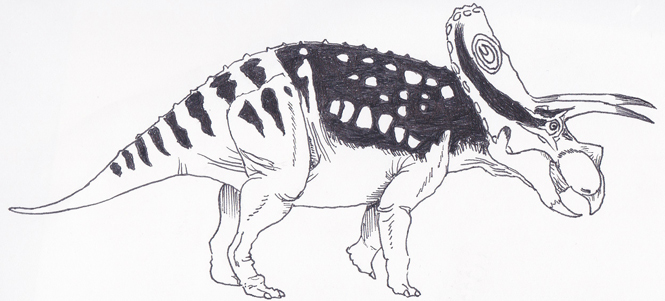
A few days ago, team members at Everything Dinosaur posted up a picture of a recently commissioned dinosaur drawing and challenged our blog readers and social media followers to identify the species illustrated. Sure enough, these knowledgeable collectors of prehistoric animals were quickly able to identify Torosaurus (T. latus).
Everything Dinosaur set a challenge, could you identify the dinosaur species illustrated in their recently commissioned drawing?Picture credit: Everything Dinosaur.
Picture credit: Everything Dinosaur
Beasts of the Mesozoic Torosaurus Dinosaur Model
The drawing of Torosaurus was commissioned in preparation for the arrival this autumn of the Beasts of the Mesozoic Wave 3 ceratopsians, seven new, articulated horned dinosaur models including a Torosaurus replica. The drawing (above), was inspired by the photograph of the Torosaurus shown below.
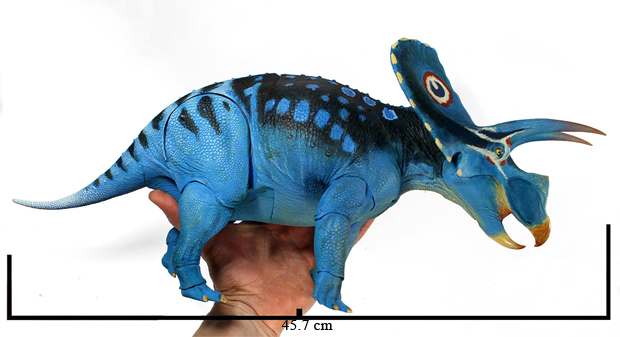
The Beasts of the Mesozoic Torosaurus dinosaur model with its striking blue colour scheme. A fantastic dinosaur model part of the Wave 3 ceratopsians series.
The Wave 3 ceratopsians (Albertaceratops, Pentaceratops, Sinoceratops, adult Triceratops, Utahceratops, Xenoceratops and the Torosaurus model), are due to be shipped from the factory in September (September 2021). It is difficult to predict when these figures will be in stock at Everything Dinosaur, but they could be available sometime after the middle of October. Team members will do all they can to expediate delivery into their UK warehouse.
The target spots on the headshield of the Beasts of the Mesozoic Torosaurus dinosaur model can be clearly seen in this image.
A spokesperson from Everything Dinosaur commented:
“We like to set little puzzles and quizzes on our Instagram, Facebook and other social media pages. We thought that our picture puzzle would prove a bit of a challenge, but once again, our fans and followers have demonstrated their in-depth knowledge of prehistoric animals as well as dinosaur models and figures. Not only did respondents correctly identify Torosaurus latus but they recognised that our illustration had been inspired by the Beasts of the Mesozoic Torosaurus model. Perhaps it was the prominent target spots on the headshield that gave the game away.”
Torosaurus Model Measurements
The Beasts of the Mesozoic Torosaurus is a huge model! It is considerably bigger than both the Pachyrhinosaurus lakustai and the Centrosaurus apertus figures that were introduced earlier. The articulated Torosaurus measures nearly 46 cm in length. The dinosaur model has a declared scale of 1:18.
The Beasts of the Mesozoic Torosaurus (T. latus) dinosaur model measures nearly 46 cm long.
The spokesperson from Everything Dinosaur added:
“The Torosaurus and the adult Triceratops figures are the largest horned dinosaur models in the Beasts of the Mesozoic model range. These two figures and the other models in Wave 3 are going to make a big splash when they touch down at Everything Dinosaur’s warehouse.”
The stunning Beasts of the Mesozoic Torosaurus (T. latus) articulated dinosaur model.
To view the range of Beasts of the Mesozoic models currently in stock at Everything Dinosaur: Beasts of the Mesozoic.
A superbly preserved and almost complete specimen of the pterosaur Tupandactylus navigans has enabled researchers to get a better understanding of the body of this Brazilian flying reptile. The skull too, with its exquisite preservation has provided new data on the amazing super-sized sagittal crest associated with this genus.
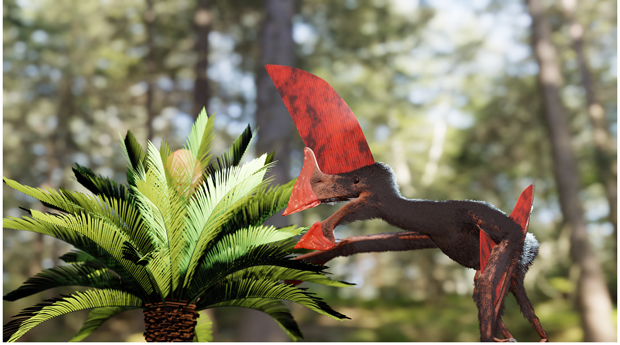
Tupandactylus navigans life reconstruction. The study of a nearly complete articulated specimen confiscated in a police raid has provided palaeontologists with the opportunity to study post-cranial fossils of this spectacular tapejarid pterosaur for the first time. Picture credit: Beccari et al.
Confiscated in a Police Raid
The fossil specimen (number GP/2E 9266), was confiscated in a police raid at Santos Harbour, São Paulo State (Brazil), along with several other beautifully well-preserved fossils. Unfortunately, illegal fossil collection and sale of specimens on the black market is an increasing problem in Brazil. However, the successful raid prevented this hugely significant pterosaur fossil from ending up in the hands of a private collector.
The specimen is now housed at the Universidade de São Paulo (Brazil) and most of the researchers involved in the scientific paper are also based in Brazil, except for Octávio Mateus (Museu da Lourinhã, Portugal). Writing in the on-line, open access journal PLOS One, the scientists conclude that this specimen is the best-preserved tapejarid skeleton discovered to date. Their analysis has shed new light on the anatomy of this Tapejaridae family.
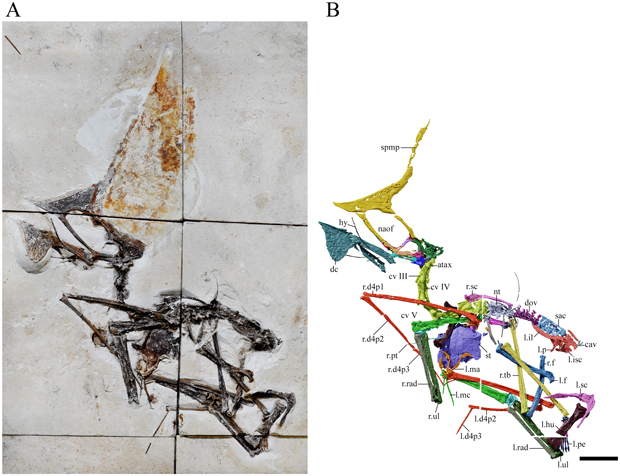
Tupandactylus navigans specimen number GP/2E 9266. Photo of specimen (A) and three-dimensional model of specimen based on CT scans (B). Picture credit: Beccari et al.
CT Scans
The pterosaur fossil is comprised of six limestone slabs. As this fossil was collected illegally, its provenance is unknown. However, by studying the yellow-stained, laminated limestone matrix, the research team were able to confidently assign the fossil to the Aptian-aged Crato Formation. The fossil took a trip to the local hospital in São Paulo, to enable CT scans to be undertaken. The subsequent three-dimensional models generated enabled the scientists to reconstruct the body of Tupandactylus for the first time. Prior to the discovery of this fossil, most Brazilian tapejarids had been described based on isolated skull bones.
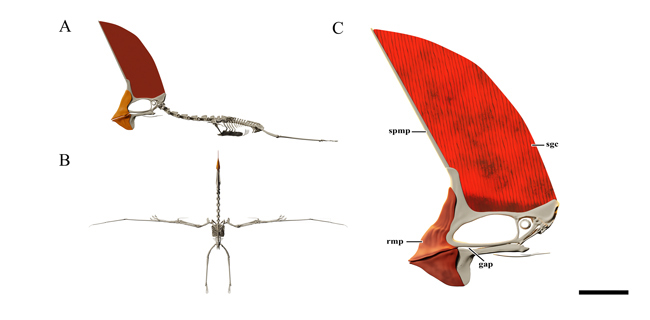
Skeletal reconstruction of Tupandactylus navigans based on specimen number GP/2E 9266 in (A) lateral view and (B) dorsal view. Skull reconstruction (C). Scale bar in C = 10 cm. This superb, articulated specimen enabled scientists to learn more about the anatomy of tapejarid pterosaurs. Picture credit Beccari et al.
Tupandactylus and a Remarkable Head Crest
Soft tissue from the huge crest on the top of the head, extends to more than five times the actual height of the skull. Analysis of the crest enabled the research team to confirm differences between Tupandactylus navigans and the closely related T. imperator. Specimens of T. navigans tend to be smaller than T. imperator and it had been speculated that just one species was represented with the differences between T. imperator and T. navigans being explained by sexual dimorphism. Thanks to the exquisite preservation of this fossil specimen the research team were able to identify several anatomical traits that support the idea that Tupandactylus navigans and Tupandactylus imperator are indeed separate species.
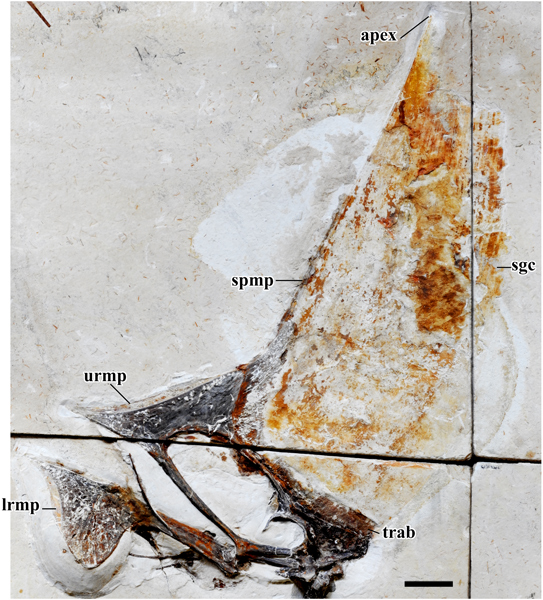
Different colour patterns seen in the sagittal crest do not represent fossilisation of any colour patterning but may have occurred due to oxidation of the material. However, a more detailed analysis of the soft tissues associated with GP/2E 9266 is currently being undertaken.
A close-up view of the skull of T. navigans showing the soft tissue preservation. Picture credit: Beccari et al.
Tupandactylus navigans
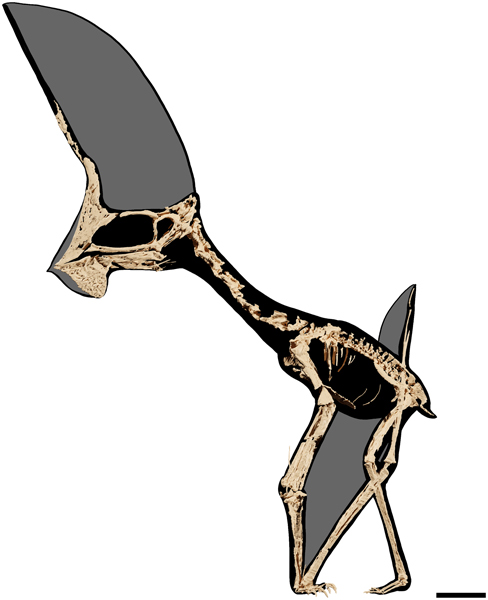
Tupandactylus navigans was named and scientifically described in 2003 based on a study of two fossil skulls (Frey, Martill and Buchy). At the time, it was postulated that the huge head crest could have been used as a sail to help with flight stability and assist with aerial propulsion. For this structure to work in this way, the neckbones would have had to be robust, relatively short and supported by powerful tendons to combat stresses imposed on the neck. With an almost complete, articulated skeleton to study, the scientists led by Victor Beccari (Universidade de São Paulo), discovered that this pterosaur had a long neck, long limbs and relatively short wings (estimated wingspan 2.7 metres).
The enormous crest probably did not play a role in aiding powered flight. Such a huge structure may well have hindered this pterosaur’s aerial abilities.
A spokesperson from Everything Dinosaur commented:
“The sagittal crest of Tupandactylus may have evolved due to sexual selection pressure, females showing a bias towards males with larger crests. The crest may have been used for display or to denote maturity, status or fitness for breeding. Many living birds sport crests, wattles and other structures, perhaps adult T. navigans sacrificed some aerial ability by growing enormous crests in a bid to attract mates.”
Skeleton reconstruction of Tupandactylus navigans based on specimen number GP/2E 9266. Scale bar = 5 cm. Picture credit: Beccari et al.
Spotting a Notarium
The front five dorsal vertebrae form a notarium which helps brace the chest and counter the stresses on the torso created by the flapping of the wings. This structure is found in living birds and some types of pterosaur but this is the first time, as far as Everything Dinosaur team members are aware, that a notarium has been identified in a tapejarid.
he scientific paper: “Osteology of an exceptionally well-preserved tapejarid skeleton from Brazil: Revealing the anatomy of a curious pterodactyloid clade” by Victor Beccari, Felipe Lima Pinheiro, Ivan Nunes, Luiz Eduardo Anelli, Octávio Mateus and Fabiana Rodrigues Costa published in PLOS One.
Everything Dinosaur team members have been helping fossil collector and dinosaur fan Robert source various prehistoric animal figures and replicas to accompany his fossil collection. As a token of appreciation, he sent a little gift to our offices to say thank you for our work.
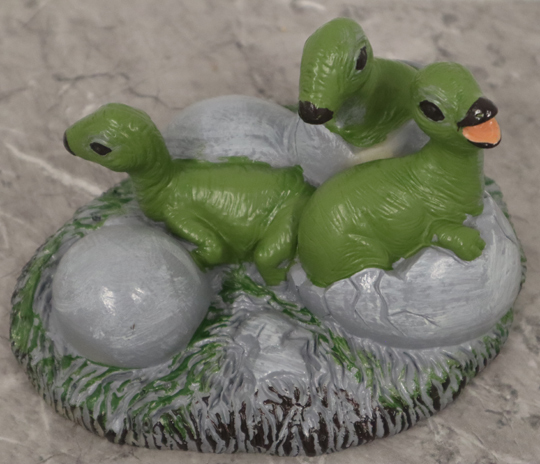
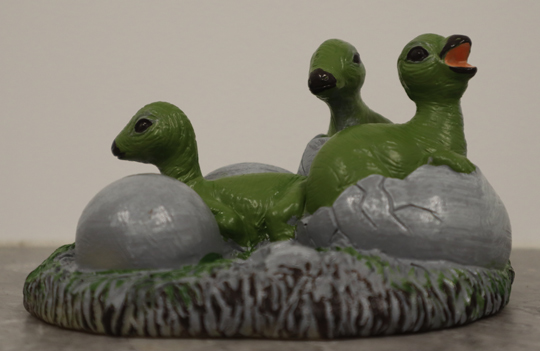
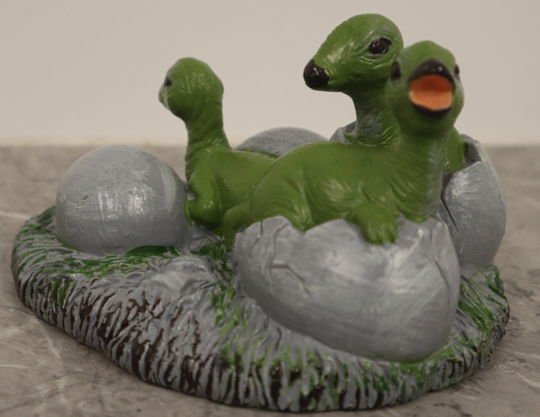
The parcel got mislaid on its way from Scotland to our warehouse but it finally arrived yesterday and when the package was opened we found this model of three hatching dinosaurs inside.
A model of three hatching dinosaurs sent to Everything Dinosaur by a delighted customer.Picture credit: Everything Dinosaur.
Picture credit: Everything Dinosaur
Maiasaura peeblesorum
Recently Robert had telephoned asking us to help him source a model of a Maiasaura with young. A dinosaur model featuring a Maiasaura with a nest was once part of the Carnegie collection of figures, but this range was retired and went out of production back in 2014. We were able to provide Robert with a fact sheet on this herbivorous dinosaur from the Late Cretaceous of Montana.
In gratitude and as a token of appreciation we were sent this little gift of hatching dinosaurs.
Dinosaur hatchlings. After providing some information on the Late Cretaceous hadrosaurid Maiasaura (M. peeblesorum) to a customer, Everything Dinosaur received this little gift in return– a trio of hatching dinosaurs.Picture credit: Everything Dinosaur.
Picture credit: Everything Dinosaur
A spokesperson from Everything Dinosaur commented:
“We were very touched to receive this little gift. We try our best to help customers and we provide all kinds of advice, information and support. Team members took some photographs of the hatching dinosaurs in our packing room and now we have put this on display in one of our offices.”
A trio of hatching dinosaurs complete with eggs.A little token of appreciation sent to Everything Dinosaur from a grateful customer.Picture credit: Everything Dinosaur.
Picture credit: Everything Dinosaur
Thank you for the Token of Appreciation
When the parcel arrived, we sent an email to Robert, just to let him know that the parcel had got to us safely and to thank him for his very kind gesture.
At Everything Dinosaur, we are amazed at the in-depth dinosaur and prehistoric animal knowledge that is often demonstrated by our customers. Our fans, followers and supporters on the various social media platforms that we occupy such as Facebook, Instagram and YouTube constantly impress us with their knowledge of palaeontology.
We are often humbled by the sheer breadth and depth of knowledge they collectively possess. So, it’s time for another little tease, time to put our customers and social media fans to the test.
Below, we have posted up a dinosaur drawing that we at Everything Dinosaur recently commissioned.
Can you identify the dinosaur species from the drawing?
An illustration of an ornithischian dinosaur commissioned recently by Everything Dinosaur, but can you identify the dinosaur species from the drawing? Picture credit: Everything Dinosaur.
Picture credit: Everything Dinosaur
Dinosaur Picture Puzzle
Based in the UK, Everything Dinosaur is run by teachers and knowledgeable dinosaur enthusiasts helping collectors of prehistoric animal models and promoting education and an appreciation of the Earth sciences. We research and write fact sheets for many of the models and figures we sell and we commission illustrations of prehistoric animals that can be used in these fact sheets and in our other educational activities.
The dinosaur drawings that we commission help to support a network of palaeoartists and illustrators. Our financial support of these illustrators is just one of the ways in which Everything Dinosaur assists the wider community.
A spokesperson from Everything Dinosaur commented that they would reveal the identity of the dinosaur featured in the drawing in a blog post to be published later this week.
Researchers writing in the on-line, open-access journal PLOS One have described the most complete plesiosaur skull found to date from sub-Saharan Africa. The skull and post cranial fossil material reported upon comes from the Upper Cretaceous Mocuio Formation exposures located at Bentiaba in the Namibe Province of Angola.
The fossils represent another specimen of the elasmosaurid Cardiocorax (C. mukulu) one of just six valid plesiosaurian taxa known from the whole of Africa. This plesiosaur swam in a shallow, tropical sea and the fossils are around 71.5 million years old.
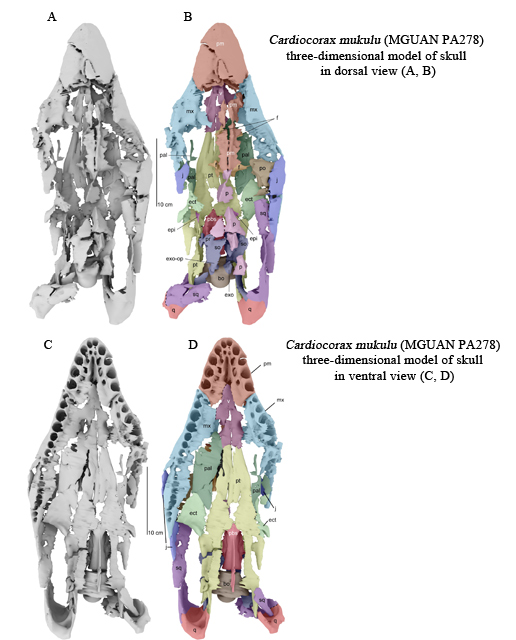
Three-dimensional computer models showing the skull of Cardiocorax mukulu (A) computer image in dorsal view with (B) annotated diagram of skull also in dorsal view. Picture (C) shows the computer model in ventral view with (D) an annotated diagram of the skull (dorsal view). Picture credit: Marx et al.
Cardiocorax mukulu
The specimen was found in sandstone deposits, stratigraphically just 3 metres above where the holotype material for this taxon was found. The researchers who studied the fossils, which included Octávio Mateus (Museu da Lourinhã, Portugal) and lead author Miguel Marx from the Southern Methodist University (Dallas, Texas), concluded that the fossils represented C. mukulu as the overlapping skeletal material of this specimen – MGUAN PA278 with that of the holotype were virtually identical.
An illustration of Cardiocorax mukulu based on the holotype and the newly described cranial material (MGUAN PA278). The illustration is based on the earlier elasmosaurid Thalassomedon (T. haningtoni).Picture credit: Everything Dinosaur.
Picture credit: Everything Dinosaur
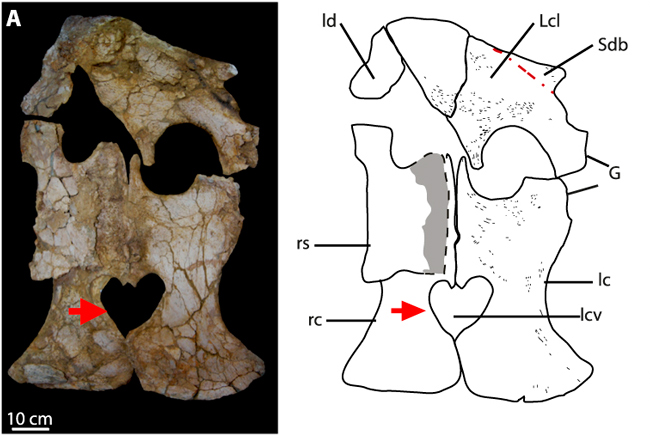
This elasmosaurid had been originally named and described back in 2015. The genus name comes from the Greek “kardia” which means heart and coracoid, a paired bone that forms part of the shoulder in most vertebrates. This is a reference to the unique heart-shaped fenestra (hole) which occurs between the coracoid bones, a characteristic that is unique to this genus. The specific or trivial name comes from the local Angolan Bantu dialect and means “ancestor).
The pectoral girdle of Cardiocorax (specimen number MGUAN PA103) in ventral view with the heart-shaped fenestra between the coracoid bones highlighted (red arrow). Picture credit: Araújo et al.
High Resolution CT Scans Reveal Details of Plesiosaur Skull
The exquisite, three-dimensional preservation of the skull material provided the scientists with an opportunity to examine in close detail the morphology of the skull. The delicate fossil could have been damaged during further preparation, so the specimen was subjected to high resolution CT scans at the University of Texas High-Resolution X-ray CT Facility this permitted the anatomy of the skull to be revealed.
The holotype fossils, which were used to name and describe this elasmosaurid back in 2015 lacked skull bones. The discovery of an almost complete, three-dimensional skull of Cardiocorax enabled the research team to conduct an elaborate series of phylogenetic assessments to assess where within the Plesiosauria Cardiocorax should be placed.
Most of these analyses suggest an early-branching or intermediate position for Cardiocorax mukulu within the Elasmosauridae family. Elasmosaurines have elongated neck bones (cervical vertebrae), this anatomical characteristic is absent in Cardiocorax mukulu which suggests that it was a relic of an older, less derived lineage of elasmosaurids. These results indicate that several different types of elasmosaurid persisted into the Maastrichtian faunal stage of the Cretaceous.
The scientific paper: “The cranial anatomy and relationships of Cardiocorax mukulu (Plesiosauria: Elasmosauridae) from Bentiaba, Angola” by Miguel P. Marx, Octávio Mateus, Michael J. Polcyn, Anne S. Schulp, A. Olímpio Gonçalves and Louis L. Jacobs published in PLOS One.
In the summer of 2010, a giant sculpture of a plant-eating dinosaur named Luna Park was erected on Southsea Common. The huge statue, created by Studio Morison, stood 16 metres tall and was over 22 metres long. It was so large that it could be seen from the Isle of Wight. Unfortunately, a fire in October 2010 completely destroyed this local landmark, but plans are in place to install a tribute to the “Southsea Dinosaur”, albeit on a smaller scale.
Plans are well advanced to introduce a new public artwork for Portsmouth that pays tribute to the much loved “Southsea Dinosaur”. A new artwork designed by Ivan Morison and Heather Peak of Studio Morison will be installed this autumn. The installation will be officially opened on October 2nd, exactly ten years since the original sculpture was destroyed in a fire.
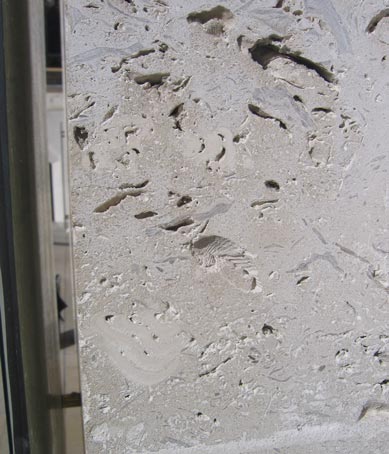
This new piece of public art will consist of a bronze sculpture of the original, affectionately known by local residents as the “Southsea Dinosaur” atop a fossil Portland stone plinth. Portland stone is limestone that was laid down at the very end of the Jurassic. It has been quarried for centuries and is an excellent building material. It is highly fossiliferous and contains many fossils including the famous “Portland screws”, which are the moulds in the rock created by snail shells as they dissolved away.
The highly fossiliferous Portland stone has been used as a building material for centuries. Picture credit: Everything Dinosaur.
Picture credit: Everything Dinosaur
A spokesperson from Everything Dinosaur commented that the choice of Portland stone for the plinth was very appropriate as footprints representing giant, long-necked dinosaurs similar to Luna Park had been discovered preserved in these rocks.
The work will be 1.4 metres high in total. In addition to key information about the work, a plaque on the plinth will also feature a QR code which when scanned with a smartphone will connect to an augmented reality experience, showing a digital rendering of the original artwork seemingly in front of the user, on Southsea Common.
Viewers will also be able to use their mobile device to visit a digital archive of memories contributed by the general public in honour of the original artwork. The work will be located within a direct sightline to the position of the original Luna Park sculpture.
It is hoped that the piece will generate new memories for locals and visitors. More than 12,000 residents joined an independently created Facebook group called “RIP Southsea Dinosaur” when Luna Park was tragically destroyed in 2010 and since summer 2020, a Crowdfunder has raised £10,000 to build a bronze replica of the original statue.
Moulds will be used to cast the new bronze statue that pays tribute to the Southsea dinosaur.
Joanne Bushell, Director of Aspex, Portsmouth’s contemporary art gallery, currently celebrating its 40-year anniversary which is curating the installation commented:
“There is a tremendous spirit of warmth towards the original work and we are thrilled to be exhibiting it this year as part of our anniversary celebrations.”
We at Everything Dinosaur wish the organisers every success with their venture. It is great to see a tribute to Luna Park and whilst marvelling this contemporary installation, perhaps visitors will reflect that some 145 million years earlier, dinosaurs similar to Luna Park roamed nearby.
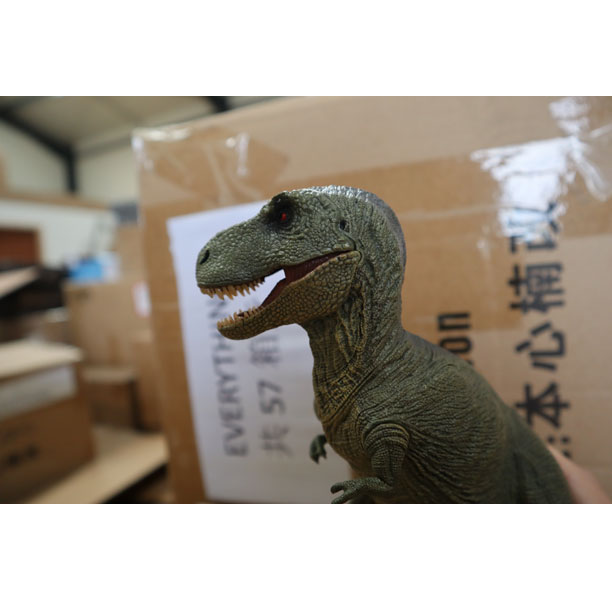
The new “Retrosaurs” range from Rebor has been very well received by many dinosaur fans and model collectors. The first two figures in this series “Californiacation” and “Mesozoic Rhapsody” have attracted lots of praise and Everything Dinosaur customers have been providing feedback and reviews of these two Rebor models.
The first of the two Rebor “Retrosaurs” have arrived in stock at Everything Dinosaur. The Rebor 1:35 scale 80s T-REX Toy HD Remastered “Californiacation” (left) and the Rebor 1:35 scale vintage palaeoart T. rex “Mesozoic Rhapsody” (right).These exciting models with their articulated arms and jaws have attracted rave reviews from model collectors.Picture credit: Everything Dinosaur.
Take for example, the feedback we received recently from long-time Everything Dinosaur customer Ed. He was delighted with his Rebor 1:35 Vintage Palaeoart Tyrannosaurus rex “Mesozoic Rhapsody” Valley and sent us a detailed review of the figure. He commented on how the introduction of this dinosaur reminded him of prehistoric animals depicted in movies and stated that “Mesozoic Rhapsody” reminded him of good memories from his childhood.
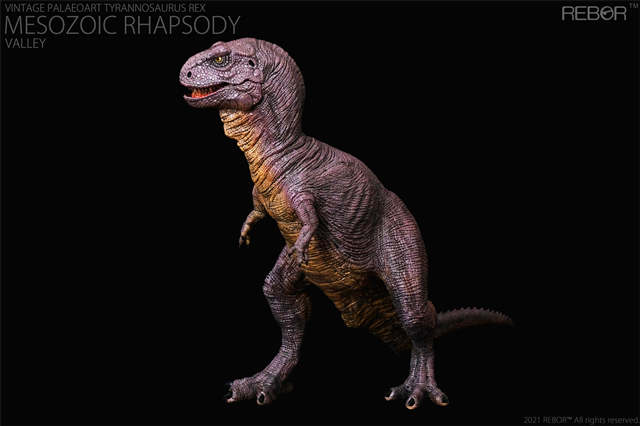
Rebor 1:35 Vintage Palaeoart Tyrannosaurus rex “Mesozoic Rhapsody” Valley.This figure, one of two new “vintage” models introduced recently by Rebor, has attracted praise from dinosaur model collectors.
Customer Review’s Rhapsody
Ed wrote:
“What a blast from the past this model is. Growing up in the 80’s I had a few of these toys, all be it a lot smaller. It is amazing how dinosaur toys have gone far more accurate these days. The only one I remember being up to date at the time was the natural museum T. rex and that never appealed to me. I love this model’s pose. It is a homage to Ray Harryhausen’s “Gwangi” and his Allosaurus in 1 million years B.C. It is because of these films I started my interest in dinosaurs. True, not up to date by today’s standards but the way he breathed life into them and were a threat to any caveman! The model is a lot bigger than expected therefore it stands out a bit more. I have got mine next to Rebor’s T. rex. it is amazing how far the depiction of these animals has changed. To be honest it could any carnosaur they were all depicted the same. I know they are doing a Ceratosaurus based on 1 million BC. I would love Rebor to do other depictions of yesteryear. Triceratops and Deinonychus would be nice.“
We note Ed’s model suggestions, comments which the talented people at Rebor consider when developing this range, no doubt.
The new for 2021 Rebor 1:35 Vintage Palaeoart Tyrannosaurus rex “Mesozoic Rhapsody” Valley.Picture credit: Everything Dinosaur.
Picture credit: Everything Dinosaur
Feefo Feedback Too
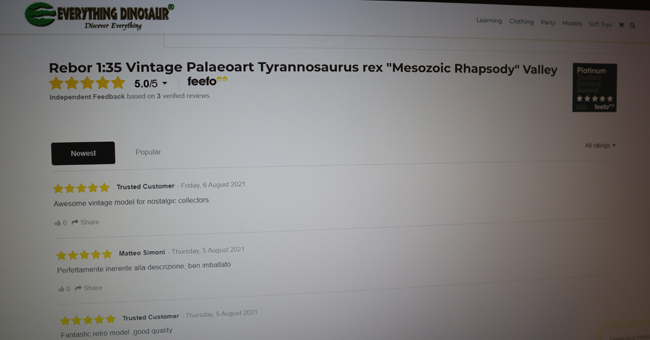
Both the Rebor 1:35 Vintage Palaeoart Tyrannosaurus rex “Mesozoic Rhapsody” Valley and “Californiacation” replicas have started to receive Feefo feedback. The Feefo feedback consists of genuine customer reviews of Everything Dinosaur products. Although these models have only been available for a few days the Feefo emails have begun to be sent out and feedback from purchasers received.
Feefo independent feedback on the Rebor 1:35 Vintage Palaeoart Tyrannosaurus rex “Mesozoic Rhapsody” Valley.Picture credit: Everything Dinosaur.
Picture credit: Everything Dinosaur
The Rebor 1:35 80s T-REX Toy HD Remastered “Californiacation” VHS dinosaur model has proved to be very popular as it too, also brings back happy memories for model collectors.
The Rebor 1:35 80s T-REX Toy HD Remastered “Californiacation” VHS dinosaur model.Picture credit: Everything Dinosaur
Picture credit: Everything Dinosaur
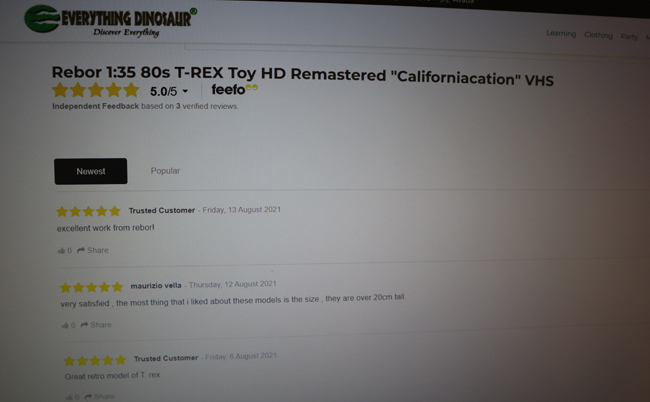
The Feefo feedback on the Rebor 1:35 80s T-REX Toy HD Remastered “Californiacation” VHS figure.
Feefo feedback on the Rebor 1:35 80s T-REX Toy HD Remastered “Californiacation” VHS. It’s 5-star reviews for the Rebor dinosaur model. Picture credit: Everything Dinosaur.
Dinosaur model collector Ed concluded his review by stating:
“I think Rebor could do really well with this line of models. They are vintage but they also bring back forgotten good memories as well. Really good price compared to other model makers who are doing the same thing and top service from Everything Dinosaur.”
Recently, Everything Dinosaur team members produced a blog article discussing the first dinosaurs to be named and described from the Shengjinkou Formation located in the Xinjiang Uygur Autonomous Region, China. Today, we pay tribute to Zhao Chuang, the scientific illustrator who provided a life restoration of these newly described sauropods and who had earlier illustrated Hamipterus, a pterosaur known from the same strata.
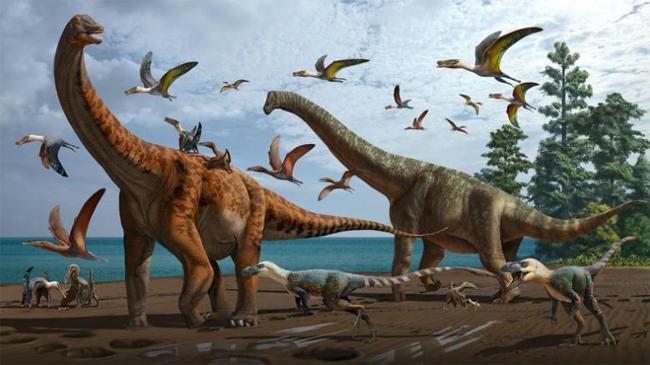
Two sauropods disturb a nesting colony of Hamipterus pterosaurs. Silutitan sinensis (left) and Hamititan xinjiangensis (right), a single theropod tooth found in association with the H. xinjiangensis fossil material indicates the presence of carnivorous dinosaurs. This illustration combines artwork similar to that which accompanied the Hamipterus bonebed scientific paper. A pair of Hamipterus pterosaurs (far left) look after their brood as the newly described sauropods wander past. Picture credit: Zhao Chuang.
Spectacular Artwork
Chinese illustrator and palaeoartist Zhao Chuang created the spectacular artwork that brought to life some of the vertebrate biota associated with the Lower Cretaceous Shengjinkou Formation of north-western China. As an artist at the Peking Natural Science-Art Organisation (PNSO), he has worked on numerous scientific publications and papers helping to illustrate prehistoric animals that are the subject of scientific research. He is also responsible for the stunning artwork associated with PNSO prehistoric animal models and figures.
In 2017, Zhao Chuang was commissioned to provide a life reconstruction of the pterosaur nesting colony that was due to be described in a research paper published in the academic journal “Science”.
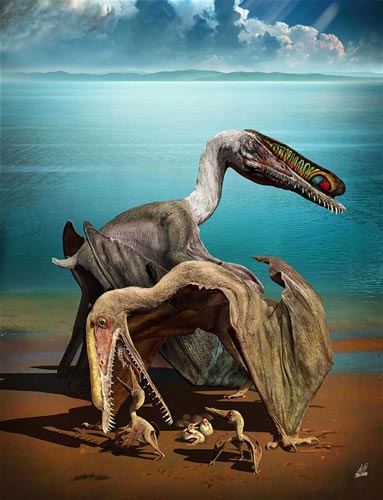
The male Hamipterus (background) stands guard whilst the female regurgitates food to her offspring (altricial behaviours in pterosaurs). Picture credit: Zhao Chuang.
Sauropod Fossil Discoveries
With the discovery of sauropod fossil bones either in association with Hamipterus pterosaur fossils or in close proximity, Zhao Chuang cleverly combined an image he had painted when describing the Hamipterus bonebed with a new painting showing the two newly described dinosaurs from the same geological formation.
In keeping with the science behind the illustrations, the artist brought together an image of pterosaurs and their offspring with the sauropod illustration. The newly described sauropod species, Silutitan sinensis, Hamititan xinjiangensis and fossils from the hip region of an as yet unnamed species, were all collected from different sites which are 2 to 5 kilometres apart. The horizon where the cervical vertebrae used to describe Silutitan sinensis were found is particularly rich in Hamipterus pterosaur fossils, although all the sauropod sites showed evidence of the presence of Hamipterus remains.
Resting up against one of the large neck bones of Silutitan, the research team discovered a fragment of a lower jaw from a flying reptile. As Hamipterus (H. tianshanensis), is the only pterosaur known from this region and as the bone fragment was similar to more complete Hamipterus specimens, the authors of the scientific paper assigned this bone to the Hamipterus taxon.
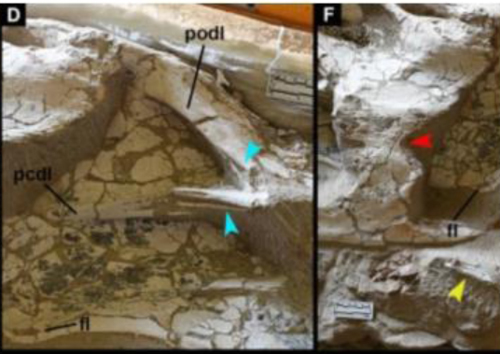
An incomplete lower jaw of a pterosaur was recovered associated with the cervical vertebrae assigned to the taxon Silutitan (Figure 3F). Despite its incompleteness, this jaw fragment, highlighted by the yellow arrow, shows the same anatomy of the sole pterosaur collected in this region, Hamipterus tianshanensis and is therefore referred to this species. Picture credit: Wang et al.
Hamipterus and Sauropod Fossil Remains
The association of pterosaur fossils with sauropod remains has not been reported in scientific literature often. However, it is not clear if there were any more specific palaeoecological interactions between these taxa.
The close association of the fossil remains might just be due to taphonomy (the fossilisation process). Although it is intriguing to imagine a colony of nesting Hamipterus being disturbed as two giant sauropods roam through the nesting ground, just as the stunning illustration from Zhao Chuang depicts.
Earlier this week, Everything Dinosaur team members posted up a close-up view of a prehistoric animal figure that we stock. We challenged our followers on Instagram, Twitter and Facebook to see if they could identify the model from the image that we had provided.
The puzzle pic image posted up on Everything Dinosaur’s Instagram, Twitter and Facebook page – the challenge could you identify the prehistoric animal model from this close-up view?
Clever Customers
We have posted up a few mystery pics and puzzles over the last few months or so. Our clever customers, fans and followers have been quick to identify the figure featured. This picture puzzle certainly proved more of a challenge. We had a lot of answers identifying that this was a picture of a crocodilian, but which model?
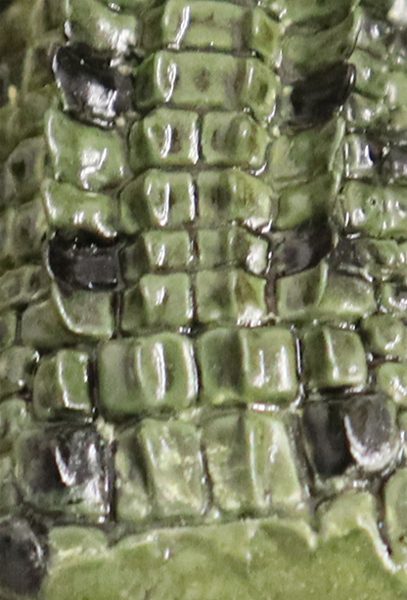
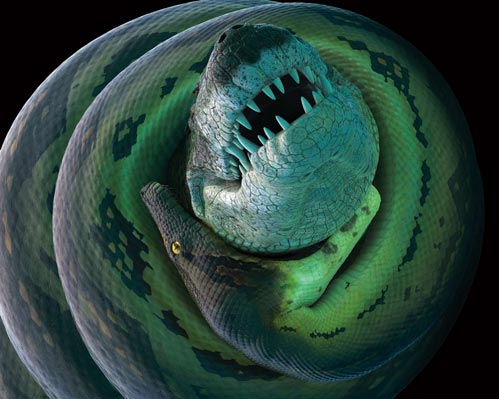
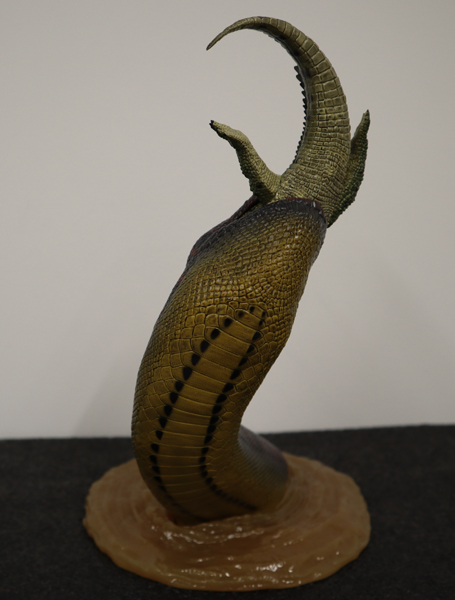
The green crocodile figure from the Rebor Brian Diccus Titanoboa figure. The close-up view has been highlighted (red square). The absence of the anterior portion of the model makes identification of the genus difficult as numerous genera of crocodyliforms have been described from the same coal mine from where the Titanoboa fossil material was found.
The Green Crocodilian Prey from Rebor Titanoboa Brian Diccus
Many of our clever customers and social media followers correctly guessed that this was the green crocodilian prey from the recently introduced Rebor Titanoboa Museum Class Maquette Brian Diccus. Fossils of Titanoboa (T. cerrejonensis), the largest snake known to science, come from the open cast Cerrejón mine in Columbia (Cerrejón Formation). Several genera of crocodyliforms have been described from fossils from the same strata as Titanoboa.
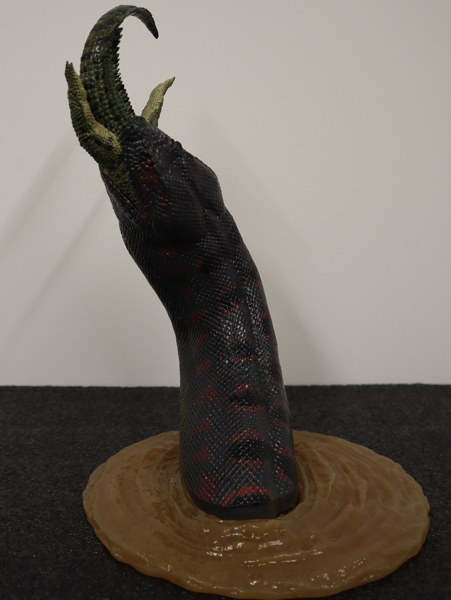
The assembled Rebor Titanoboa Museum Class Maquette Brian Diccus prehistoric animal model.
Which Crocodile?
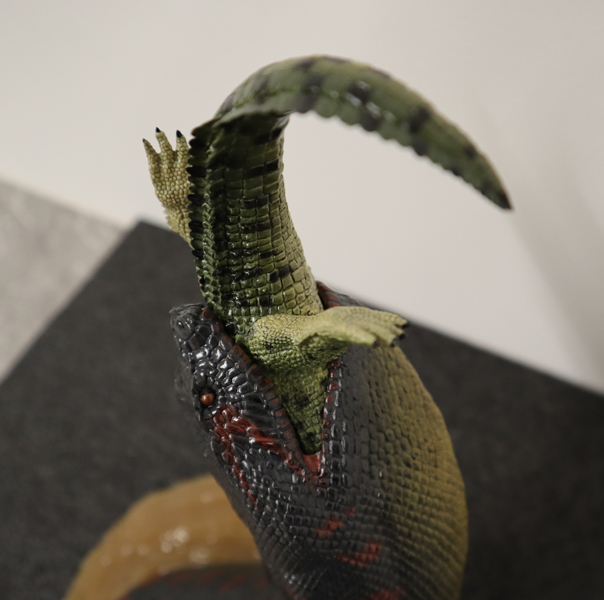
The Rebor Titanoboa Museum Class Maquette Brian Diccus has a declared scale of 1:11. Team members measured the crocodilian prey model and estimated its length to be around 15 cm, which suggests a body length of 1.65 metres at this scale. As this is the posterior portion of the crocodile, we estimate that this figure suggests a total length of over 3 metres and the unfortunate victim of the giant snake could be Anthracosuchus (A. balrogus), a member of the Dyrosauridae family of crocodyliforms named and described in 2014.
Rebor Titanoboa Museum Class Maquette Brian Diccus with the green crocodilian prey.
The absence of the anterior portion of the figure in the Rebor composition makes genus identification difficult, but when Anthracosuchus was described, it was speculated that this crocodile was an apex predator and it would have eaten juvenile Titanoboas. In turn, adult Titanoboas could have preyed upon small, immature members of the Anthracosuchus population.
Titanoboa tackles the short-snouted Anthracosuchus. Picture credit: Florida Natural History Museum.
Rebor Titanoboa Museum Class Maquette Brian Diccus model.
A spokesperson from Everything Dinosaur commented:
“We have been very impressed by the in-depth knowledge of prehistoric animal figures that has been demonstrated. We thought that this was going to be a tough picture puzzle to solve, but as always our customers and social media followers rose to the challenge”.
The global pandemic has caused unprecedented levels of disruption to manufacturing and logistics. Lots of industries have been affected and fans of prehistoric animal models will know how difficult it has been to get hold of dinosaur models and other figures. Everything Dinosaur has just received a shipment of CollectA prehistoric animal models. A total of thirty-five different figures and one prehistoric animal model set. Team members have been busy emailing customers who had reserved CollectA models, letting them know that the model they wanted is in stock.
Everything Dinosaur has received a big delivery of CollectA prehistoric animal models and figures. This substantial shipment includes 35 different prehistoric animal figures.
CollectA Models in Stock at Everything Dinosaur
Covid-19 has interrupted the production plans of many companies. Organising shipment of goods from factories has also been extremely difficult due to the shortage of ships and shipping containers. Everything Dinosaur in collaboration with their chums at CollectA have been working hard to ensure that stock of prehistoric animal models and figures can be shipped to Everything Dinosaur’s warehouse.
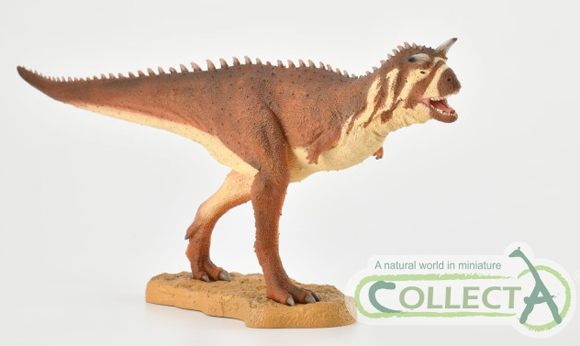
The CollectA Age of Dinosaurs 1:40 scale deluxe Carnotaurus dinosaur model. The Everything Dinosaur shipment includes this popular Carnotaurus figure.
Everything Dinosaur’s Commitment to CollectA
Everything Dinosaur stocks a huge range of CollectA prehistoric life figures including many of the rarer and difficult to obtain models. The delivery also includes the CollectA Rebbachisaurus, Gigantspinosaurus and Alioramus models. Team members know how hard these models can be to obtain. Collectors can be assured that Everything Dinosaur is committed to stocking as many of the CollectA prehistoric animal models and figures as possible.
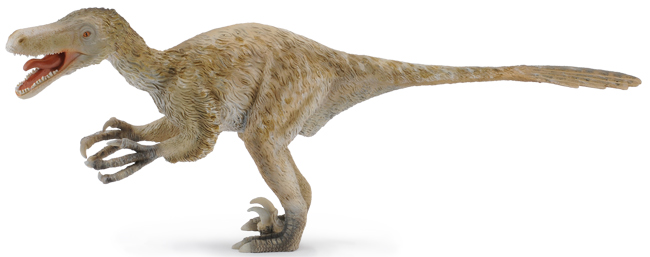
The delivery also included a handful of the very difficult to find CollectA Velociraptor Deluxe 1:6 scale dinosaur model.
The rare CollectA Deluxe 1:6 scale Velociraptor model. This figure was first introduced in 2011 and is becoming increasingly difficult to find.
A spokesperson from Everything Dinosaur commented:
“We do appreciate how frustrating it has been for dinosaur model collectors not being able to get hold of models. Our latest CollectA shipment contains a substantial quantity of figures including some of the more obscure and rare models within the Prehistoric Life and Deluxe model ranges. This delivery demonstrates our support for CollectA.”
New for 2021 CollectA Models
The spokesperson added that they hoped to receive the rest of the new for 2021 CollectA prehistoric animal figures in September.
To view the range of not-to-scale models and figures in the CollectA Prehistoric Life range: CollectA Prehistoric Life.