All about dinosaurs, fossils and prehistoric animals by Everything Dinosaur team members.
About Mike
Mike runs Everything Dinosaur, a UK-based mail order company specialising in the sale of dinosaur and prehistoric animal models, He works alongside Sue, and between them they have become the "go to guys" for museum quality prehistoric animal models and figures. An avid fossil collector and reader of dinosaur books, Mike researchers and writes articles about palaeontology, fossil discoveries, research and of course, dinosaur and prehistoric animal models.
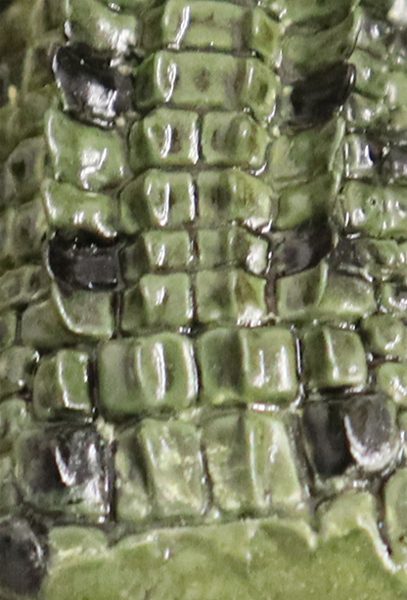
Time for a little teaser! Everything Dinosaur team members have taken a close-up photograph of one of the many prehistoric animal models that we stock. We have challenged our social media followers, customers and blog readers to see if they can identify the particular figure from this close-up view. There are no prizes, just our total respect if dinosaur fans and model collectors can identify the prehistoric animal figure from the picture puzzle we have posted.
The puzzle pic image posted up on Everything Dinosaur’s Instagram, Twitter and Facebook page – the challenge could you identify the prehistoric animal model from this close-up view? Picture credit: Everything Dinosaur.
Picture credit: Everything Dinosaur
A spokesperson from Everything Dinosaur explained:
“Over the last few months or so, we have posted up various picture puzzles and challenged our customers and social media fans to see if they can identify the prehistoric animal model from a close-up photograph. We have been most impressed with all the correct answers received, we think we are going to have to set some more difficult challenges. Best of luck identifying the model from the picture we have posted”.
Remember, there are no prizes being awarded, it’s just for a bit of fun, but can you identify the prehistoric animal model from the picture clue that we have provided?
Researchers from the Department of Space Studies at the Southwest Research Institute (Boulder, Colorado), have developed a dynamic model to predict the origin of the extra-terrestrial body that smashed into our planet 66 million years ago. This colossal impact event played a significant role in the end-Cretaceous mass extinction event that wiped out the non-avian dinosaurs.
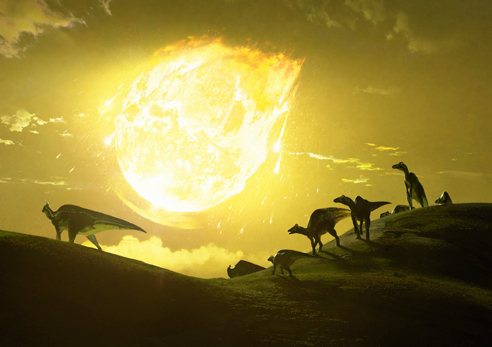
An artist’s impression of the bolide about to impact with the Gulf of Mexico 66 million years ago. Picture credit: Chas Stone.
Picture credit: Chas Stone
From the Outer Half of the Main Asteroid Belt
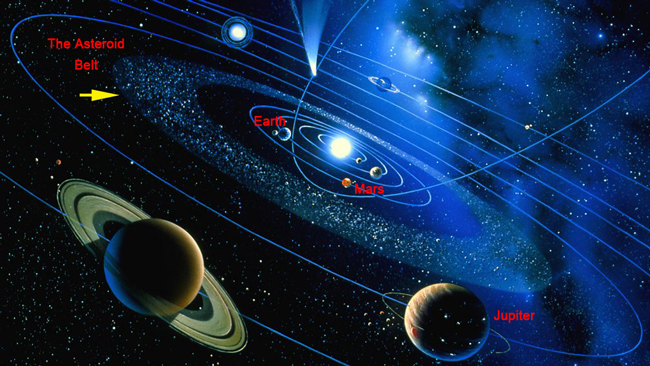
The research suggests that the dinosaur-killing asteroid originated from the outer half of the main asteroid belt between Mars and the gas giant Jupiter. It had been thought that this region of space did not produce many impactors (bodies that crash into other planets, moons etc). The paper published in “Science Direct” concludes that the processes that deliver large asteroids to Earth from that region occur at least ten times more frequently than previously thought and that the composition of these bodies match what we know of the dinosaur-killing impactor.
The Southwest Research Institute team consisting of lead author Dr David Nesvorný, Dr William Bottke and Dr Simone Marchi used sophisticated computer models of asteroid evolution combined with observations of known asteroids to investigate how frequently so-called Chicxulub events might occur. Around 66 million years ago an extra-terrestrial bolide estimated at around 10 kilometres in diameter smashed into the Gulf of Mexico (Yucatan peninsula). This impact event devastated life on Earth and formed the Chicxulub crater – which is over 150 kilometres across.
Commenting on the purpose of their research, Dr William Bottke explained that two very important questions remained unanswered:
“What was the source of the impactor? How often did such impact events occur on Earth in the past?”
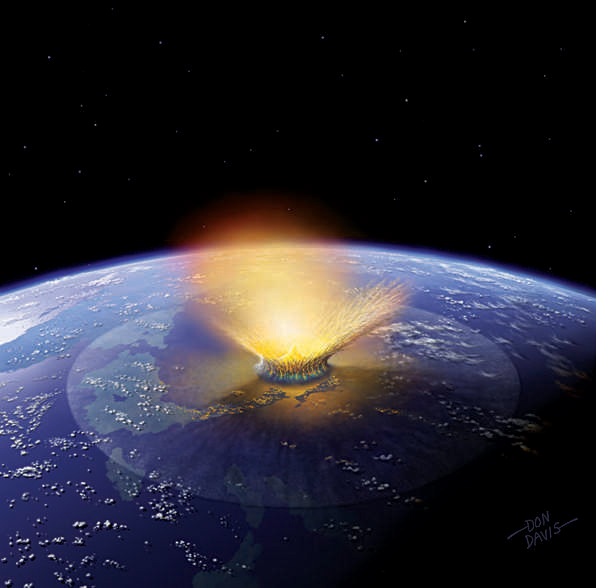
An artist’s impression of the impact event which helped to wipe out the non-avian dinosaurs. Picture credit: SwRI and Don Davis.
Picture credit: SwRI and Don Davis
The Search for the Source of the Dinosaur-Killing Asteroid
Using recently published research on the composition of the Chicxulub crater the researchers identified that the extra-terrestrial body that smashed into Earth had a similar chemical signature to the carbonaceous chondrite class of meteorites. Intriguingly, whilst carbonaceous chondrites are common amongst the many mile-wide bodies that approach the Earth, none today are close to the size needed to produce the Chicxulub impact with any kind of reasonable probability.
Dr Nesvorný explained that this finding sent the team on a hunt into space to find the likely source of the bolide that collided with Earth with such catastrophic consequences for about 75% of all terrestrial lifeforms.
He commented:
“We decided to look for where the siblings of the Chicxulub impactor might be hiding.”
The team turned to the NASA’s Pleaides Supercomputer and modelled the trajectories of 130,000 asteroids, examining how gravitational kicks from the planets might push these objects into orbits near to Earth. The researchers found that their computer simulations predicted Earth impacts from asteroids originating from the outer half of the asteroid belt ten times more frequently than previously thought.
A map of the solar system with the outer portion of the asteroid belt shown by the yellow arrow. Picture credit: BBC with additional annotation by Everything Dinosaur.
Picture credit: BBC with additional annotation by Everything Dinosaur
They calculated that asteroids in excess of 10 kilometres in diameter hit Earth once every 250 million years or so.
This suggests that the non-avian dinosaurs and the other organisms that became extinct 66 million years ago, were very unlucky. Fortunately, in deep geological time, such catastrophic Earth impacts remain rare.
Commenting on the importance of this new research, Dr Nesvorný added:
“This work will help us better understand the nature of the Chicxulub impact, while also telling us where other large impactors from Earth’s deep past might have originated.”
Everything Dinosaur acknowledges the assistance of a media release from the Southwest Research Institute in the compilation of this article.
The scientific paper: “Dark primitive asteroids account for a large share of K/Pg-scale impacts on the Earth” by David Nesvorný, William F. Bottke and Simone Marchi published in Science Direct.
Team members at Everything Dinosaur were very saddened to hear the news of the death of Dr Angela Milner formerly the senior dinosaur researcher in the Dept of Palaeontology at the London Natural History Museum. Dr Milner passed away on the morning of the 13th August (2021). During her long career, she played a prominent role in vertebrate fossil research and authored many books about dinosaurs.
The death of Dr Angela Milner was announced on Friday 13th August, 2021. Dr Milner talks about the discovery of Baryonyx walkeri and discusses the famous thumb claw. Picture credit: Natural History Museum (London).
Baryonyx walkeri
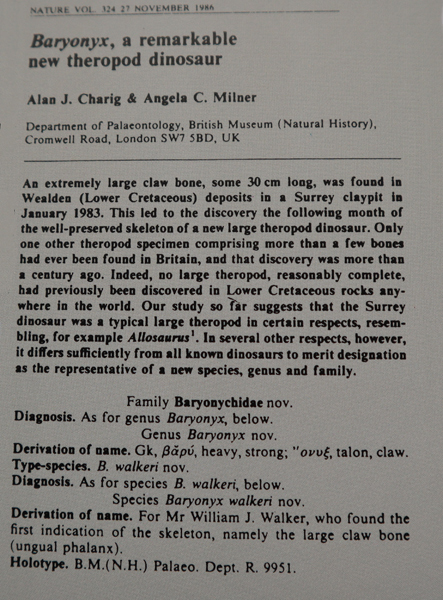
The Everything Dinosaur blog has featured the work of Dr Milner on numerous occasions. We have blogged about her work on the evolution of birds, her research into Archaeopteryx, using the famous “London” specimen in the collection of the Natural History Museum and discussed her contribution to a better understanding of the evolution of tyrannosaurs. Perhaps, she is most closely associated with the theropod dinosaur Baryonyx walkeri. In 1986, Natural History Museum colleagues Alan Charig and Angela Milner published in the journal Nature, a formal, scientific description of Baryonyx walkeri.
The scientific paper announcing Baryonyx walkeri by Alan J. Charig and Angela C. Milner (London Natural History Museum).
In 2011, the contribution of Dr Milner to vertebrate palaeontology was recognised when the specific name of a new carcharodontosaurid from the famous Tendaguru Formation of Tanzania – Veterupristisaurus was named in her honour (V. milneri).
A spokesperson from Everything Dinosaur commented:
“We were all very sad when we heard this news. Our thoughts are with Dr Angela Milner’s family and friends.”
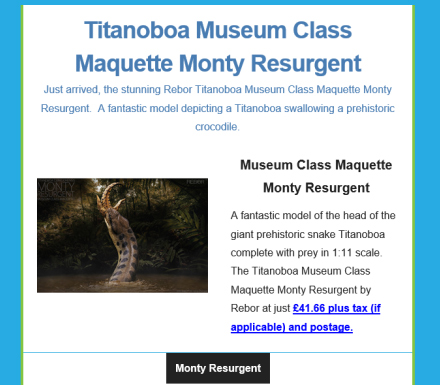
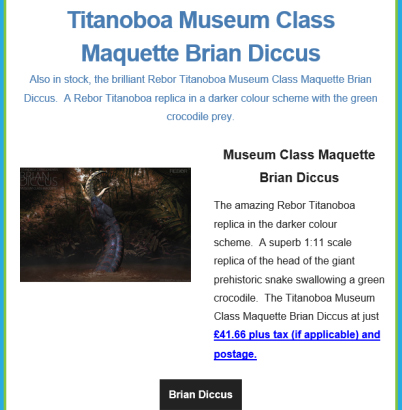
The latest Everything Dinosaur customer newsletter features new models from Rebor. The two Museum Class Maquettes Monty Resurgent and Brian Diccus have arrived and the first of the “Retrosaurs”- Californiacation and Mesozoic Rhapsody are in stock. In addition, the next pair of the Rebor GrabNGo tyrannosaurs are also available.
The Rebor Museum Class Maquette Monty Resurgent 1:11 scale model. Picture credit: Everything Dinosaur.
Picture credit: Everything Dinosaur
Rebor Titanoboa Figures
After the successful introduction of the limited edition “Monty” replica last year, Rebor have followed this up by producing two 1:11 scale replicas of the head of the giant prehistoric snake Titanoboa (T. cerrejonensis) swallowing a crocodile. Titanoboa is the largest snake known to science. Size estimates vary, but based on the fossilised vertebrae a length of between 12 and 15 metres has been proposed and this huge Palaeocene reptile might have weighed around 1,400 kilograms.
The two Rebor Titanoboa figures are in stock at Everything Dinosaur, Monty Resurgent with the brown crocodile prey and Brian Diccus, with its darker colour scheme and green crocodilian.
The Rebor Museum Class Maquette Brian Diccus 1:11 scale model of a giant prehistoric snake (Titanoboa). Picture credit: Everything Dinosaur.
Picture credit: Everything Dinosaur
Rebor Retrosaurs
Last year, Rebor announced plans to produce a new range of vintage dinosaur collectables. The objective was to create classic dinosaur figures honouring prehistoric animals in movies from the 20th century. The first of the figures in this exciting range are now in stock. The Rebor 1:35 scale 80s T-REX Toy HD Remastered “Californiacation” and the Rebor 1:35 scale vintage palaeoart T. rex “Mesozoic Rhapsody”, both models feature in the latest Everything Dinosaur newsletter.
The first of the two Rebor “Retrosaurs” have arrived in stock atEverything Dinosaur. The Rebor 1:35 scale 80s T-REX Toy HD Remastered “Californiacation” (left) and the Rebor 1:35 scale vintage palaeoart T. rex “Mesozoic Rhapsody” (right). Picture credit: Everything Dinosaur.
Picture credit: Everything Dinosaur
Film fans and vintage model collectors have been contacting Everything Dinosaur team members about these two new figures for some time, they are proving to be very popular.
The Everything Dinosaur customer newsletter provides helpful information to model collectors and dinosaur fans as well as free to enter competitions and contests. To subscribe to Everything Dinosaur’s newsletter, simply: Contact Everything Dinosaur.
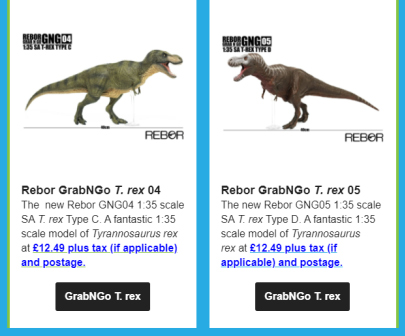
Our latest newsletter also provided the opportunity to announce the arrival of the latest Rebor GrabNGo T. rex dinosaur models. The new pair of figures are the Rebor GNG04 1:35 scale SA T. rex Type C and the Rebor GNG05 1:35 scale SA T. rex Type D. These models are at a lower pricing point than the majority of the Rebor range, helping to extend the Rebor product offering to a wider audience.
New Rebor GrabNGo Tyrannosaurus rex models. The Rebor GNG04 1:35 scale SA T. rex Type C (left) and the Rebor GNG05 1:35 scale T. rex Type D (right). These are wonderful Rebor prehistoric animal models. Picture credit: Everything Dinosaur.
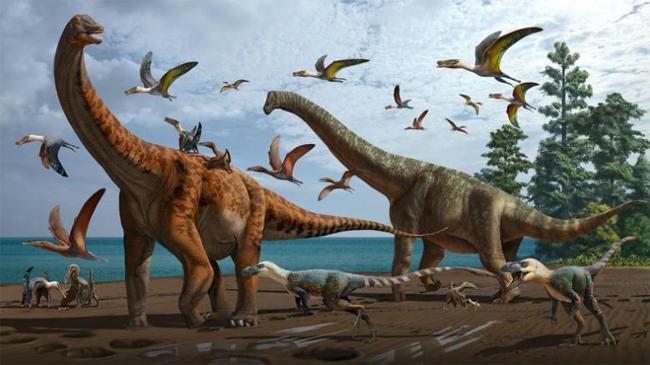
In 2017, Everything Dinosaur reported on the discovery of an extensive pterosaur nesting site that had been found south of the Tian Shan Mountains in Xinjiang (Xinjiang Uygur Autonomous Region), in north-western China. The bonebeds represented colonial nesting sites of Hamipterus tianshanensis. It was a flying reptile that had been formally named and described back in 2014.
Fieldwork in this area has revealed the presence of dinosaurs and a paper has been published this week describing sauropod fossils. These are the first dinosaurs to be identified from this part of China. Two of the fossil specimens have led to the erection of new sauropod species Silutitan sinensis and Hamititan xinjiangensis. Four incomplete bones from the sacrum along with associated sacral ribs representing another sauropod specimen have also been found, but as yet, no genus for these fossils has been assigned.
Two sauropods disturb a nesting colony of Hamipterus pterosaurs. Silutitan sinensis (left) and Hamititan xinjiangensis (right), a single theropod tooth found in association with the H. xinjiangensis material indicates the presence of carnivorous dinosaurs. Picture credit: Zhao Chuang.
Silutitan sinensis
Described from a series of six articulated cervical vertebrae (neck bones), with associated cervical ribs, Silutitan sinensis (which translates as Chinese Silk Road Titan), has been assigned to the Euhelopodidae family and is thought to have been closely related to Euhelopus (E.zdanskyi). At an estimated twenty metres plus, it is the larger of the two sauropods to be described in the scientific paper.
Silutitan sinensis gen. et sp. nov. (holotype-IVPP V27874) in left lateral view. Note scale bar in (B) = 50 cm. Picture credit: Wang et al.
Hamititan xinjiangensis
Although contemporaneous with Silutitan (Lower Cretaceous, Shengjinkou Formation of the Tugulu Group). Hamititan was not closely related. Cladistic analysis based on the tail bones (caudal vertebrae) from which this dinosaur was described, suggests that Hamititan is a titanosaur (a lithostrotian titanosaur), as such, it seems more closely related to South American titanosaurs such as Epachthosaurus and Notocolossus.
The genus name translates as Hami City Titan, whilst the species name honours the Xinjiang Uygur Autonomous Region of China.
A single theropod tooth (below, picture F), indicates the presence of theropod dinosaurs.
Hamititan xinjiangensis gen. et sp. nov., caudal sequence (HM V22) in right lateral view. Scale bar for specimen (top) = 50 cm. Scale bar for theropod tooth (F) = 5 cm. Picture credit: Wang et al.
No Name for the Third Specimen
A third specimen consisting of four sacrum bones and associated sacral ribs has not been assigned to a species. However, the researchers, writing in the academic journal Scientific Reports conclude that not only do these fossils represent the first dinosaurs to be described from the Shengjinkou Formation but they also help to support the hypothesis that Asia was home to a great variety of different types of sauropod during the Early Cretaceous.
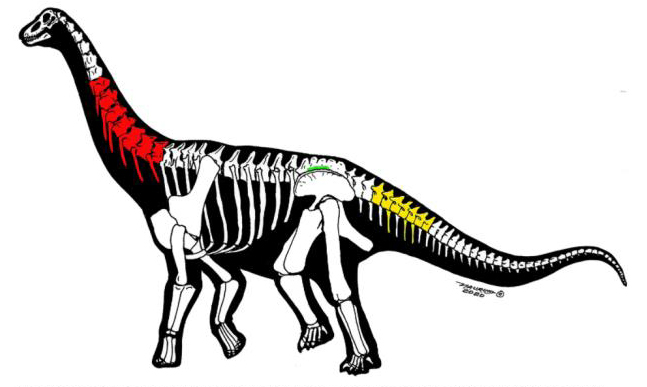
All specimens described in the scientific paper shown in one skeleton of a typical titanosaur. Preserved cervical elements of Silutitan sinensis (IVPP V27874) in red with preserved caudal elements of Hamititan xinjiangensis (HM V22) shown in yellow and the preserved sacral elements of the unnamed sauropod (specimen number IVPP V27875) in green. Picture credit: Maurílio Oliveira.
The scientific paper: “The first dinosaurs from the Early Cretaceous Hami Pterosaur Fauna, China” by Xiaolin Wang, Kamila L. N. Bandeira, Rui Qiu, Shunxing Jiang, Xin Cheng, Yingxia Ma and Alexander W. A. Kellner published in Scientific Reports.
A new species of Australian pterosaur has been named and described based on a fragmentary fossil representing the front portion of the lower jaw. Thapunngaka shawi is just the fourth pterosaur to have been named and described from the “land down under” and with a wingspan estimated to be as much as 9.47 metres, it might just be the largest Australian flying reptile known to science.
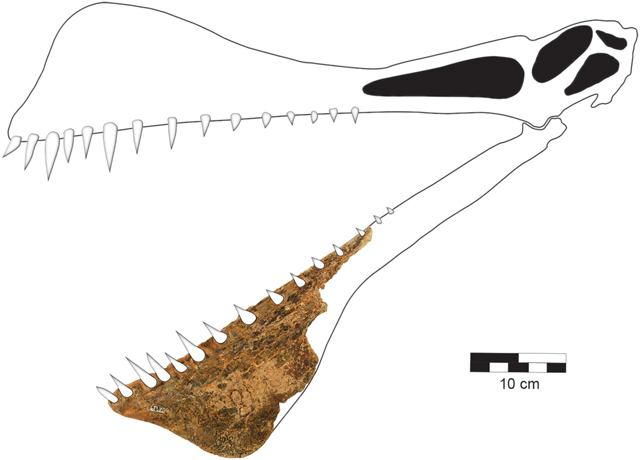
A reconstruction of the metre-long skull of Thapunngaka shawi showing the placement of the rostral portion of the mandible. Scale bar = 10 cm. Picture credit: Richards et al.
Thapunngaka shawi
Pterosaur fossils from Australia are exceptionally rare. The light and hollow bones of flying reptiles rarely survive fossilisation, T. shawi is only the fourth pterosaur to have been described from the twenty fossil specimens attributed to members of the Pterosauria discovered in Australia.
Council worker and local fossil collector Len Shaw found the fossil bone ten years ago at a site known as the “water pond” at the “Free Fossil Hunting Site”, located seven miles northwest of the town of Richmond (Queensland). The strata at this site were laid down at the bottom of the Eromanga Sea (Toolebuc Formation) around 106 million years ago (Early Cretaceous). A researcher from the Kronosaurus Korner Museum was sent out to view and excavate the area and a scientific paper on T. shawi was published this week in the “Journal of Paleontology” with the collaboration of scientists from the University of Queensland.
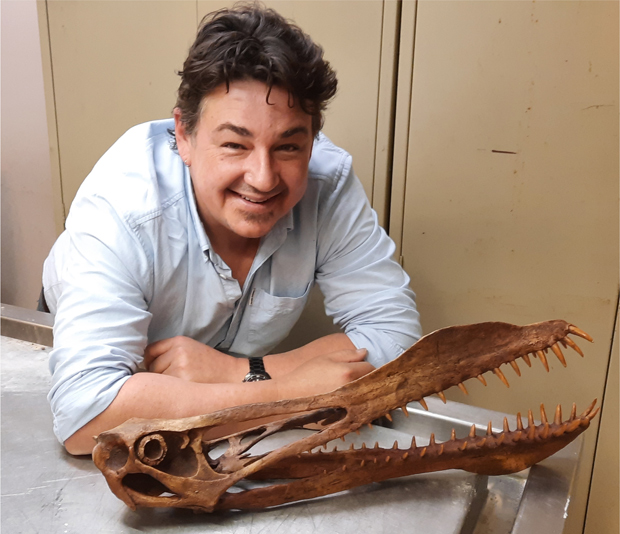
PhD student Tim Richards (University of Queensland), poses with a cast of the skull and jaws of an anhanguerid pterosaur.
Commenting on the significance of the fossil discovery, one of the report’s authors, University of Queensland PhD student Tim Richards stated:
“By world standards, the Australian pterosaur record is poor, but the discovery of Thapunngaka contributes greatly to our understanding of Australian pterosaur diversity.”
“Shaw’s Spear Mouth”
The genus name is derived from the local aboriginal language of the Wanamara Nation, on whose land the holotype material was found. It translates as “spear mouth”, a reference to the sharp teeth that would have been located in the alveoli (tooth sockets) preserved on the fossil specimen. The species name honours Len Shaw.
Assigned to the Anhangueridae, Thapunngaka and other anhanguerid pterosaurs from Queensland help to demonstrate the global distribution of these types of flying reptile during the Cretaceous, with anhanguerids known from South America, Africa, Europe and Australia.
A phylogenetic assessment indicates that Thapunngaka was related to Tropeognathus from South America.
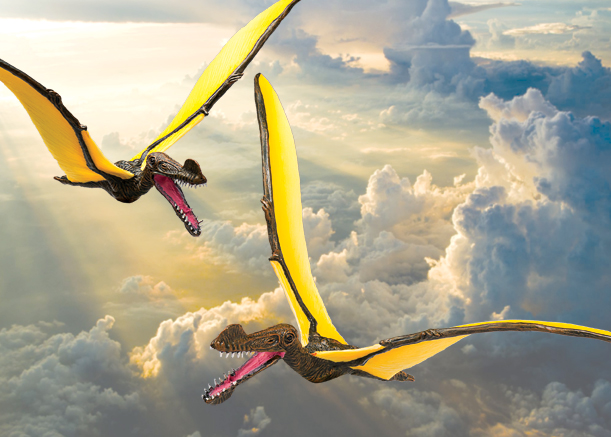
A pair of Mojo Fun Tropeognathus pterosaurs. The newly described Australian anhanguerid T. shawi would have looked similar to Tropeognathus.
The picture (above) shows a pair of Mojo Fun Tropeognathus pterosaur figures. This flying reptile figure was recently introduced into the Mojo Fun Prehistoric and Extinct range.
Of the four Australian pterosaurs named to date, three of them Mythunga, Ferrodraco and Thapunngaka have been assigned to the Anhangueridae family which suggests anhanguerids were the dominant group of Australian pterosaurs during the Early Cretaceous.
Aussiedraco molnari is the only non-anhanguerian pterosaur described so far from Australian fossil finds. This flying reptile has been assigned to the Targaryendraconia, a clade of pterosaurs that was created following a reassessment of ornithocheirid fossil material.
A List of the Australian Pterosaurs Described to Date:
Mythunga camara – a member of the Anhangueridae family, named and described in 2008 based on fossils from the Toolebuc Formation.
Ferrodraco lentoni – also an anhanguerid and believed to be the sister taxon of M. camara which was named and described in 2019: Australia’s Most Complete Pterosaur Fossil.
Thapunngaka shawi – the third anhanguerid to be described.
Aussiedraco molnari – named and described in 2011, also from the Toolebuc Formation.
The Largest Australian Pterosaur
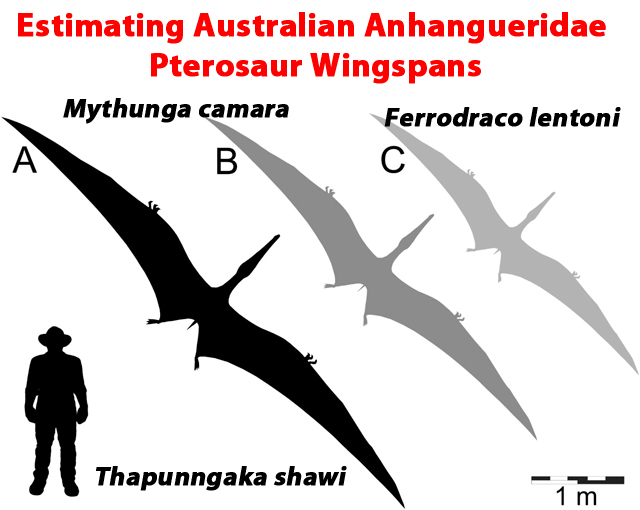
Estimating the size of Thapunngaka with only a fossil fragment to study is challenging. The researchers compared the size and proportions of the mandible fossil with those of better-known and more complete anhanguerids. Although the authors of the scientific paper admit that there is not a strong relationship between mandible size and wingspan, they estimate that Thapunngaka could have had a wingspan from around 5.83 metres up to a massive 9.47 metres. The researchers suggest that Thapunngaka shawi is the largest pterosaur known from Australia.
Estimates of the wingspans of Australian anhanguerid pterosaurs. Based on a comparison of mandibles, Thapunngaka shawi is thought to have had a wingspan from 5.83 to 9.47 metres in diameter. Note scale bar = 1 metre. Picture credit: Richards et al with additional annotation from Everything Dinosaur.
The scientific paper: “A new species of crested pterosaur (Pterodactyloidea, Anhangueridae) from the Lower Cretaceous (upper Albian) of Richmond, North West Queensland, Australia” by Timothy M. Richards, Paul E. Stumkat and Steven W. Salisbury published in the Journal of Vertebrate Paleontology.
The amazing ITOY Studio Paraceratherium models have arrived at Everything Dinosaur. We have in stock the ITOY Studio Deluxe Paraceratherium that comes with a heavy polystone base and the ITOY Studio Elite Paraceratherium, the model being supplied without the display base.
The two ITOY Studio Paraceratherium replicas are in stock at Everything Dinosaur (whilst stocks last). The ITOY Studio Elite without display base (top) and (bottom) the ITOY Studio Deluxe Paraceratherium model which is supplied with a polystone display base. Picture credit: Everything Dinosaur.
Picture credit: Everything Dinosaur
A Very Large Model of a Very Large Prehistoric Mammal
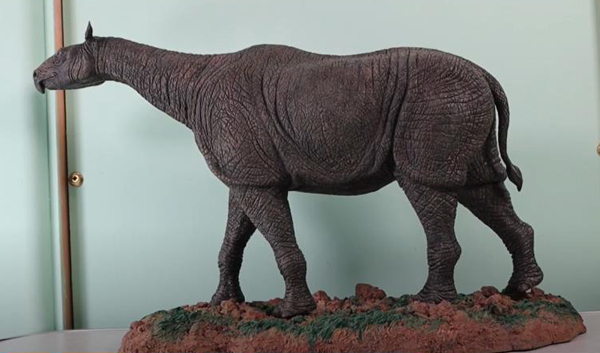
The Paraceratherium genus is considered by many palaeontologists to have been the largest land mammal to have ever existed. Some fossil specimens indicate that this giant relative of the extant rhinoceros stood nearly five metres tall at the shoulder. The ITOY Studio model, in keeping with the fossil record, is also enormous. The figure measures over 40 cm in length and that beautifully detailed head is nearly 25 cm off the ground.
A view of the eagerly anticipated ITOY Studio Paraceratherium model. This figure is in stock at Everything Dinosaur (August 2021). This is the Deluxe version – it is supplied with a polystone display base. Picture credit: Everything Dinosaur.
Picture credit: Everything Dinosaur
Everything Dinosaur customers who purchase this model will also receive our free fact sheet that provides information about this extinct genus. Scientists are learning more about Paraceratherium as new fossils are discovered. Recently, we published a blog post about a newly described species of Paraceratherium
Scientists had uncovered fossil bones and we produced a blog post summarising the paper that announced a new Paraceratherium species (Paraceratherium linxiaense) from Gansu Province, China.
The ITOY Studio Paraceratherium replica. The model in the picture is the ITOY Studio Deluxe Paraceratherium (polystone display base included).
Paraceratherium Elite and Deluxe
The decision was taken to bring in both versions of the Paraceratherium replica (Elite and Deluxe). This enabled team members to price the Elite version (supplied without the heavy polystone base) lower than the price for the Deluxe figure.
The ITOY Studio Paraceratherium (Elite).
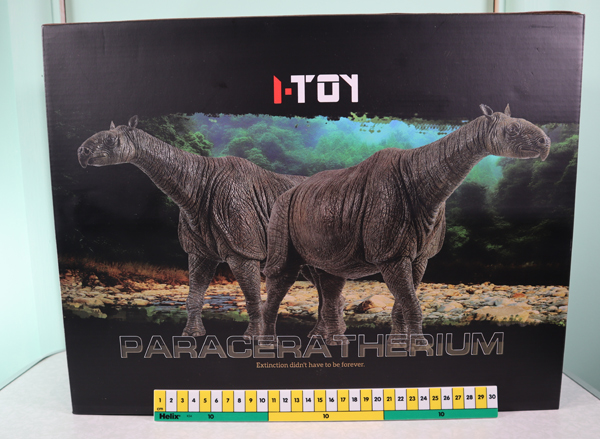
The Elite Paraceratherium figure is supplied in a big black box, whilst the Deluxe model with base is supplied in a large white box. At least this colour scheme will help our packing team to differentiate between the two replicas.
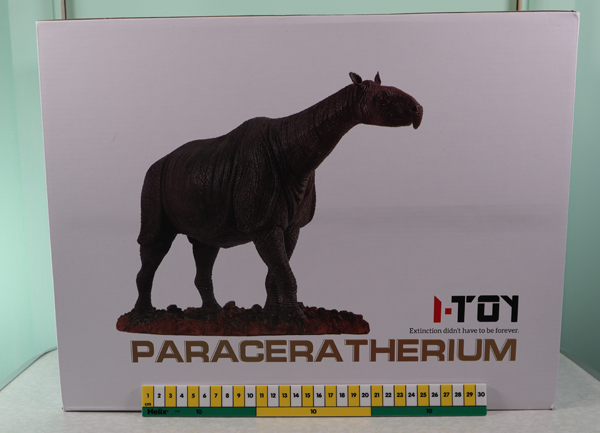
The ITOY Studio Paraceratherium packaging – this is the Elite Paraceratherium box, it is huge! The geology ruler provides a scale. Picture credit: Everything Dinosaur.
The ITOY Studio Paraceratherium Deluxe packaging – this is the white Deluxe Paraceratherium box, it is enormous. The geology ruler provides a scale. Picture credit: Everything Dinosaur.
Picture credit: Everything Dinosaur
To view the two new Paraceratherium models and the rest of the ITOY Studio figures available from Everything Dinosaur: ITOY Studio Models.
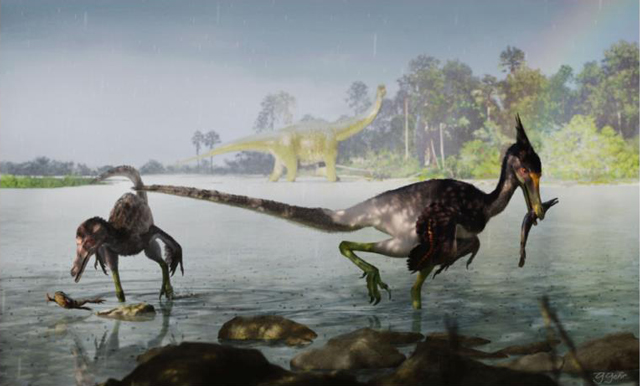
Scientists have named a new species of dromaeosaurid from fragmentary jawbones found in Upper Cretaceous deposits in the Brazilian state of Minas Gerais (south-eastern Brazil). Named Ypupiara lopai, this is the first dromaeosaurid described from fossils found in Maastrichtian-aged deposits in Brazil. Y. lopai has been classified as a member of the dromaeosaurid subfamily the Unenlagiinae, possibly a sister taxon to Austroraptor (A. cabazai), which is known from the Late Cretaceous of Argentina.
A life reconstruction of Ypupiara lopai. The shape and spacing of the teeth of this small dromaeosaurid suggest that it was a fish-eating dromaeosaurid. Picture credit: Guilherme Gehr.
Fragmentary Bones from the Jaws
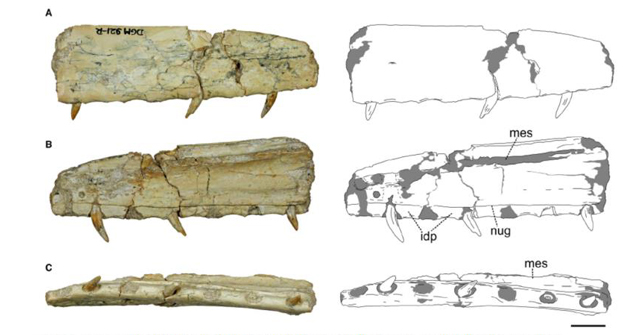
A fragment of upper jaw and a piece of bone representing the back portion of the lower jaw (dentary), were found in close association and are believed to have come from a single animal. The fossils originate from the Marília Formation (Maastrichtian faunal stage).
The right maxilla of the newly described fish-eating dromaeosaurid Ypupiara lopai from Brazil. The maxilla (DGM 921-R), is shown in lateral view (A), medial view (B) and ventral view (C) with accompanying line drawings. Note scale bar = 1 cm. Sadly, this fossil and the portion of dentary were lost in a fire that took place in September 2018. Picture credit: Brum et al.
The researchers, writing in “Papers in Palaeontology”, conclude that these fossils represent the first evidence of unenlagiines from the Marília Formation (Bauru Group, Brazil) and the second confirmed evidence of this type of dromaeosaur in Brazil. Previously, a single dorsal vertebra from the geologically younger Adamantina Formation (Bauru Group) had been assigned to the Unenlagiinae subfamily. Numerous isolated teeth had hinted at the presence of dromaeosaurs including potential unenlagiines in the Late Cretaceous of Brazil, but Ypupiara is the first to be named and scientifically described.
Outlining the Unenlagiinae
The Dromaeosauridae consists of several subfamilies although the taxonomy of this geographically and temporally widespread family of theropod dinosaurs is subject to almost constant revision as more fossil discoveries are made around the world. The Unenlagiinae comprises several genera of small to medium-sized theropods and for the time-being they are confined to the southern portion of the Gondwana landmass (Antarctica and South America). Their geographical distribution may change as fossil specimens from Madagascar, Europe, Australia and North America have been putatively assigned to the Unenlagiinae.
The biggest member of this subfamily described to date is Austroraptor, which at five-metres long was much larger than Ypupiara. To read Everything Dinosaur’s article from 2008 about the discovery of Austroraptor: Introducing Austroraptor – Fearsome Predator of the Late Cretaceous.
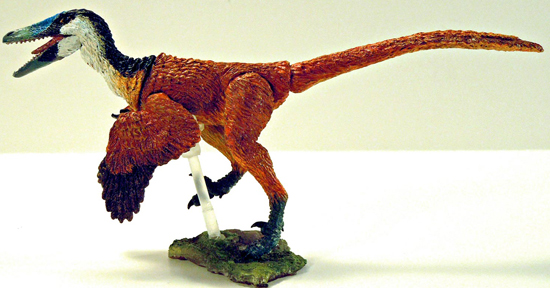
Models of this kind of dromaeosaur are few and far between, but within the Beasts of the Mesozoic “Raptor” series, the Wetlands Accessory Pack features a replica of Buitreraptor, an unenlagiine from western Argentina known from deposits some 30 million years older than those associated with Ypupiara lopai.
The Beasts of the Mesozoic Buitreraptor gonzalezorum model from the Wetlands Accessory Pack.
The picture above shows an articulated dinosaur figure from the Beasts of the Mesozoic model series.
Analysis of the three teeth located in the upper jaw (shape and spacing along the jaw), suggests that Ypupiara was a piscivore (fish-eating). The strata associated with the fossil find, indicates that Ypupiara inhabited an alluvial floodplain with sediments extensively reworked by a braided river system. The genus name comes from the local Tupian dialect and refers to a mythical aquatic creature, a reference to the high probability that this little dinosaur lived near water. The species name honours Alberto Lopa, for his role in helping to map the geology of the state of Minas Gerais and in recognition of his discovery of the fragmentary bones that led to the erection of this new dinosaur genus.
Lost to Science
Sadly, the original fossils are no longer available to study. The fossil material was on loan to the Museu Nacional-Universidade Federal do Rio de Janeiro when fire destroyed the main building of the museum in September 2018, the fossils were not recovered and are considered to have been lost.
The scientific paper: “A New Unenlagiine (Theropoda, Dromaeosauridae) from the Upper Cretaceous of Brazil” by Arthur S. Brum, Rodrigo V. Pĕgas, Kamila L. Bandeira, Lucy G. Souza, Diogenes A. Campos and Alexander W. A. Kellner published in Papers in Palaeontology.
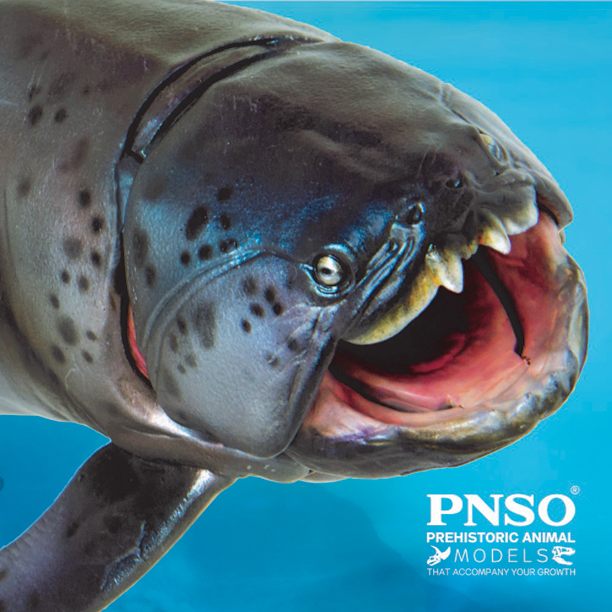
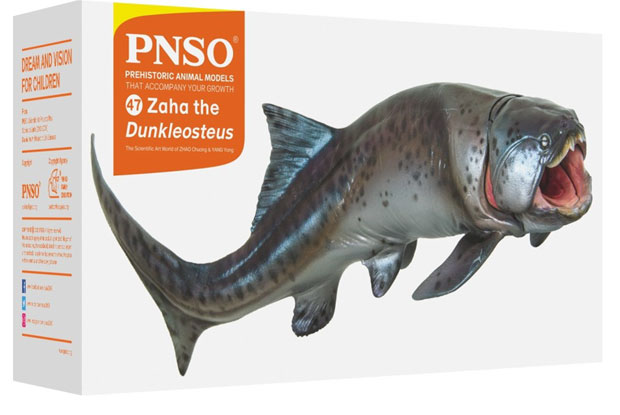
PNSO will be adding a replica of the prehistoric fish Dunkleosteus to their mid-size model range. This stunning placoderm model will be in stock at Everything Dinosaur in the autumn (2021).
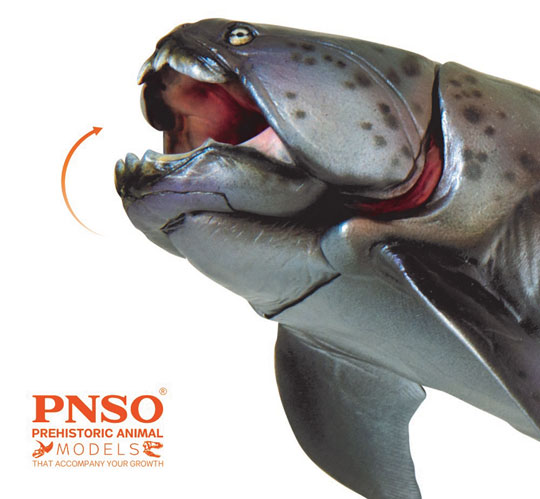
A close-up view of the articulated head and jaws of the PNSO Dunkleosteus model.
A Perfect Placoderm
Those clever and talented people at PNSO have increased their range of mid-size prehistoric animal models dramatically over the last 12 months or so. For example, Zaha the Dunkleosteus is the second prehistoric fish to be introduced, after the announcement of Haylee the Helicoprion earlier this year. Dunkleosteus is a firm favourite amongst prehistoric animal model collectors, with a number of replicas of this Late Devonian terror already on the market, but we at Everything Dinosaur suspect that the PNSO Dunkleosteus figure is going to be very popular.
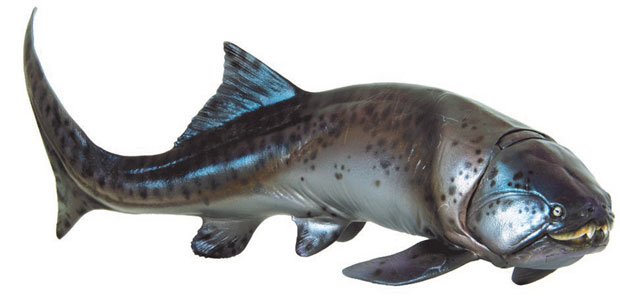
A stunning model of a placoderm – the PNSO Dunkleosteus model.
Zaha the Dunkleosteus
The Placodermi are famous for their armoured heads, but they were also the first fish to evolve pelvic fins, an important evolutionary step that was later reflected in the first tetrapods. Dunkleosteus was one of the last placoderms to evolve and at approximately 6 metres in length, it was an apex marine predator during the Late Devonian. The cleverly designed PNSO model reflects the hinged armoured plates associated with the head shield and this figure has been engineered in such a way to permit an articulated lower jaw to be added.
The PNSO Zaha the Dunkleosteus has an articulated jaw and armoured plates.
Commenting on the Scale of Zaha the Dunkleosteus
PNSO do not declare a scale size for their mid-size model range. However, the model measures around 23 cm in length and based on an adult Dunkleosteus terrelli which could have been 6 metres long, then this figure is in approximately 1:26 scale.
Ten species of Dunkleosteus have been described. The body plan and the maximum size of this fish is unknown. Some commentators have suggested that D. terrelli could have been up to 10 metres long. If this is the case, then a 23 cm long model would be in approximately 1:43 scale.
The PNSO Zaha the Dunkleosteus measures 23 cm in length and the caudal fin stands some 7.5 cm tall.
PNSO’s Placoderm – Zaha the Dunkleosteus
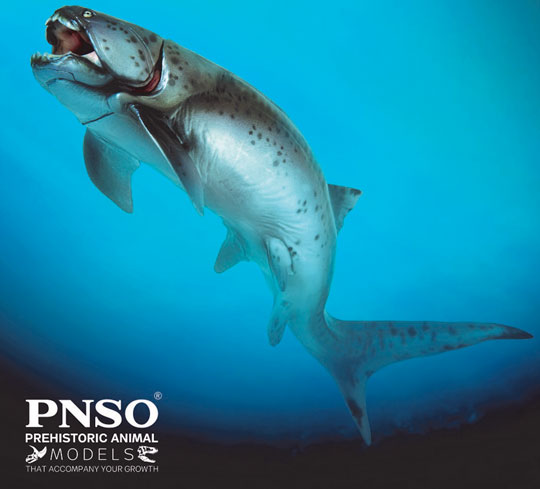
Several beautifully preserved fossils of the armoured head of Dunkleosteus have been found, but very little is known about the posterior portions of this fish. In the PNSO model a sloping dorsal fin has been placed quite far along the back of the animal, directly over the paired pectoral and pelvic fins. The PNSO model has been given a heterocercal tail, with an extended dorsal lobe of the tail fin and a much less prominent ventral lobe. This reflects what has been seen in smaller placoderm fossils and a heterocercal tail is commonly seen in many living sharks.
PNSO Zaha the Dunkleosteus the second prehistoric fish to the PNSO mid-size model range after Haylee the Helicoprion.
The sleek and supple body shape given by PNSO to their Dunkleosteus replica supports the hypothesis that the largest members of this genus were active, nektonic predators of ocean surface waters.
The product packaging for the new for 2021 PNSO Dunkleosteus model.
In Stock in the Autumn of 2021
A spokesperson from Everything Dinosaur praised PNSO for introducing a replica of the iconic Devonian predator Dunkleosteus into the mid-size model range and confirmed that this figure will be in stock at the UK-based company in the autumn of 2021.
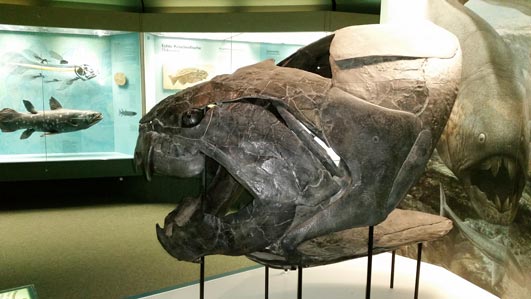
A spectacular Dunkleosteus exhibit. A museum display showing the armoured head and thorax of the giant Devonian predator Dunkleosteus terrelli. Picture credit: Everything Dinosaur.
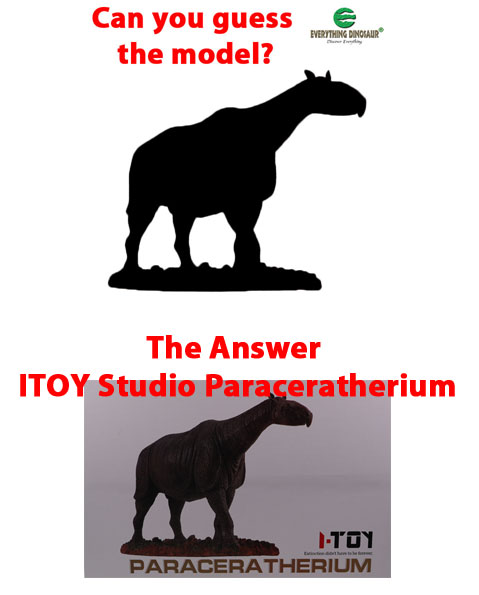
Last week, Everything Dinosaur team members posted up a silhouette of a prehistoric animal model and challenged our customers and fans on social media to see if they can guess what the model was. Once again, our loyal customers, dedicated fans and followers on social media rose to the challenge and although we thought we had set quite a tricky test, lots of respondents guessed correctly.
The model in question was the ITOY Studio Paraceratherium.
The silhouette image we posted last week as a teaser, our congratulations to all those who correctly guessed it was the ITOY Studio Paraceratherium model. The silhouette image was taken from the box image of the ITOY Studio Paraceratherium. Picture credit: Everything Dinosaur.
The eagerly awaited ITOY Studio Paraceratherium replicas (Elite and Deluxe) docked at a UK port last week and once cleared customs these models should be in stock at Everything Dinosaur in a few days’ time (mid-August 2021).
The ITOY Studio Paraceratherium replica. This is the deluxe version (supplied with a display base).
The ITOY Studio Paraceratherium is a very large figure. What an amazing replica the ITOY Studio model is! The detail on the figure is simply fantastic! It is incredibly realistic with beautiful skin folds and creases. It is very big too, the model measures over 40 cm long and the display base is a generous 32 cm in length and over 14 cm wide.
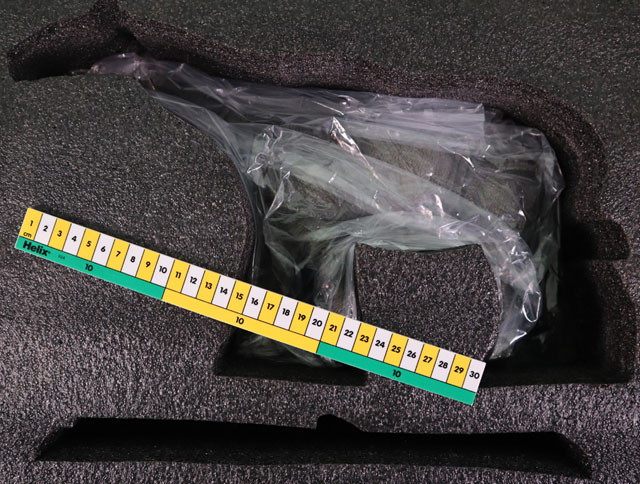
The box contents (Paraceratherium elite replica). The ruler provides a scale, giving an impression of the size of the ITOY Studio figure. Picture credit: Everything Dinosaur.
Picture credit: Everything Dinosaur
Two ITOY Studio Paraceratherium Figures
Everything Dinosaur has imported both models in the ITOY Studio Paraceratherium portfolio. The two figures that will be available are:
ITOY Studio Paraceratherium – Deluxe (model supplied with polystone display base)
ITOY Studio Paraceratherium – Elite (model supplied without polystone display base)
To view the existing range of ITOY Studio prehistoric animal models available from Everything Dinosaur: ITOY Studio Models and Figures.