All about dinosaurs, fossils and prehistoric animals by Everything Dinosaur team members.
About Mike
Mike runs Everything Dinosaur, a UK-based mail order company specialising in the sale of dinosaur and prehistoric animal models, He works alongside Sue, and between them they have become the "go to guys" for museum quality prehistoric animal models and figures. An avid fossil collector and reader of dinosaur books, Mike researchers and writes articles about palaeontology, fossil discoveries, research and of course, dinosaur and prehistoric animal models.
Our thanks to talented artist Caldey who sent into Everything Dinosaur an illustration of a synapsid, a very festive Lystrosaurus. This Permian/Triassic dicynodont has been given a Christmas hat and a collar with small bells attached. It is a very festive looking herbivore.
A very festive looking dicynodont. A Lystrosaurus one of the last of its kind, a dicynodont that survived into the Triassic and thrived after the Permian mass extinction event. Caldey has given this herbivore a Christmas hat, and a set of its very own jingle bells. Picture credit: Caldey.
A Festive Lystrosaurus
In the recently released “Jurassic Park Dominion” (summer 2022), fans of prehistoric animals would have spotted a Lystrosaurus in the scenes shot in Malta. We think that Caldey was inspired by this animal’s appearance in the film, and she has created a splendid drawing of a Lystrosaurus getting into the festive spirit.
Our thanks to Caldey for sending in this super illustration to Everything Dinosaur.
The evolution of different types of herbivorous Triassic dinosaurs was helped by climate change and this played a key role in their rise to dominance of terrestrial ecosystems during the Mesozoic. Writing in the academic journal “Current Biology”, the researchers, which include Professor Richard Butler (University of Birmingham), postulate that it was climate change rather than competition that played a key role in the ascendancy of the Dinosauria.
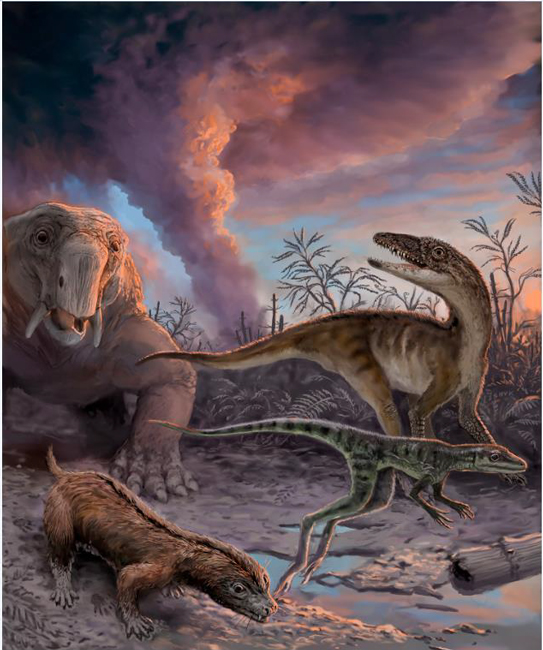
Some of the diverse terrestrial life associated with Gondwana in the Late Triassic. North-western Argentina, a large dicynodont (background) disturbs a small theropod dinosaur (right), a silesaurid takes flight (centre) along with a cynodont (left). Picture credit: Victor O. Leshyk.
Picture credit: Victor O. Leshyk
Triassic Dinosaurs
The scientists conclude that global climate change associated with the Triassic-Jurassic mass extinction event, which occurred approximately 201 million years ago, wiped out many types of terrestrial vertebrate and this opened up ecosystems for the Dinosauria to exploit. Large herbivores such as the Aetosauria (eagle lizards) died out and this permitted the Sauropodomorpha to diversify.
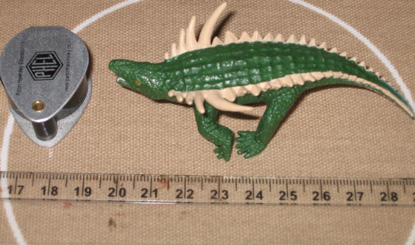
A model of a typical aetosaur (ruler provides scale). Picture credit: Everything Dinosaur.
Sauropods Benefit
The lizard-hipped sauropods (Sauropodomorpha), in particular, were able to thrive and move into new territories as the Earth grew warmer after the end-Triassic mass extinction event.
Other scientists involved include researchers from Bristol University, the University of São Paulo (Brazil) and the Friedrich-Alexander University Erlangen-Nürnberg (FAU), in Germany.
Computer Generated Models of Global Climate Change
Computer generated models of palaeoclimates and changes to rainfall and temperature gradients were created using the extensive Paleobiology Database as the source of reference materials. The study demonstrated that the long-necked sauropods became more specious and geographically diverse as the planet experienced a period of global warming.
Dr Emma Dunne, a lecturer in palaeontology at FAU and one of the authors of the paper published today stated:
“What we see in the data suggests that instead of dinosaurs being outcompeted by other large vertebrates, it was variations in climate conditions that were restricting their diversity. But once these conditions changed across the Triassic-Jurassic boundary, they were able to flourish.”
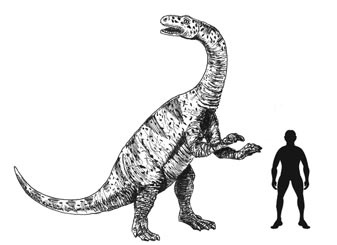
A scale drawing of Lufengosaurus. Picture credit: Everything Dinosaur.
Picture credit: Everything Dinosaur
The picture (above) shows a scale drawing of Lufengosaurus (L. huenei), from the Early Jurassic of south-western China. According to the researchers, sauropodomorphs like Lufengosaurus benefitted from a warming world permitting these types of herbivorous dinosaur to thrive.
Dr Dunne added:
“The results were somewhat surprising, because it turns out that sauropods were really fussy from the get-go: later in their evolution they continue to stay in warmer areas and avoid polar regions.”
Everything Dinosaur stocks the CollectA Age of Dinosaurs Popular range that contains several replicas of Triassic and Jurassic sauropodomorphs: CollectA Age of Dinosaurs Popular Range.
Professor Richard Butler commented:
“Climate change appears to have been really important in driving the evolution of early dinosaurs. What we want to do next is use the same techniques to understand the role of climate in the next 120 million years of the dinosaur story”.
Everything Dinosaur acknowledges the assistance of a media release from the University of Birmingham in the compilation of this article.
The scientific paper: “Climatic controls on the ecological ascendancy of dinosaurs” by Dunne et al published in Current Biology.
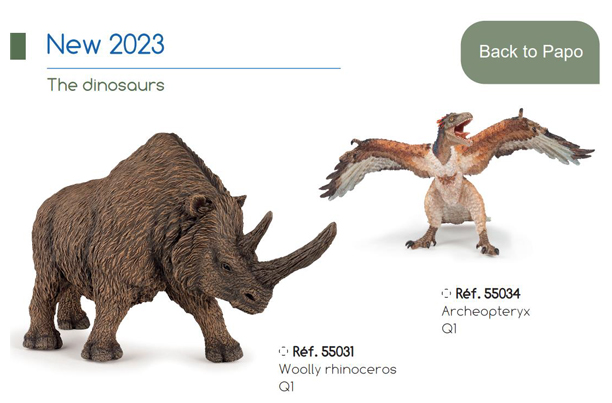
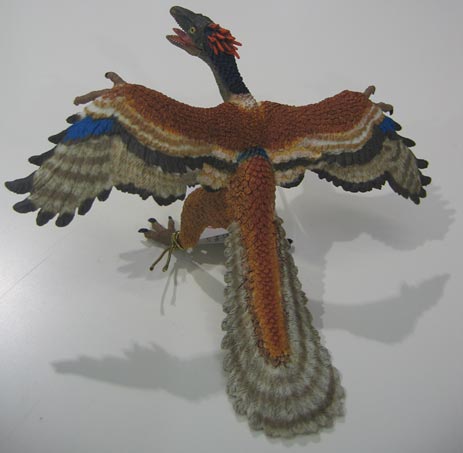
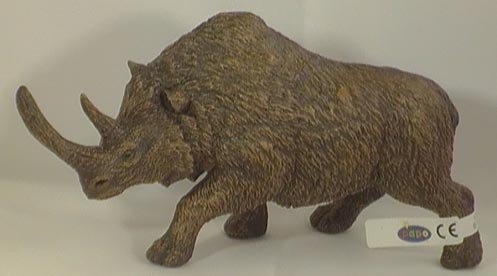
Papo the French manufacturer of replicas and figures is going to reintroduce two retired prehistoric animal models into their “Les Dinosaures” range in 2023. The Papo Woolly Rhino and the Papo Archaeopteryx figures will be available from Everything Dinosaur early next year.
Papo intend to reintroduce two recently retired models in quarter 1 of 2023 – the Papo Woolly Rhinoceros figure and the Papo Archaeopteryx model.
Papo Prehistoric Animal Models
The Papo Archaeopteryx figure was first added to the Papo range in 2014 before going out of production and being retired in 2019.
Papo Archaeopteryx “ancient wing” by Papo. Once retired and out of production (2019), the Archaeopteryx figure is being reintroduced in 2023. Picture credit: Everything Dinosaur.
Picture credit: Everything Dinosaur
The Papo Woolly Rhinoceros model was introduced a year earlier than the Archaeopteryx (2013). It was retired a few years later. When it was first introduced the Papo Woolly Rhino figure was highly praised and Everything Dinosaur team members wrote about the shape of the horn.
Ankylosaurs battled each other using their tail clubs for social dominance in intraspecific combat. A recently published scientific paper on the ankylosaur Zuul crurivastator suggests that these armoured dinosaurs used their tail clubs to bash each other as well as to fend off tyrannosaurs.
In the study, published in “Biology Letters” the research team, examined the osteoderms of the remarkably well preserved Zuul crurivastator, an armoured dinosaur described from fossils found in the Coal Ridge Member of the Judith River Formation (Montana). Several of osteoderms along the flanks show signs of damage and healing which led the scientists to postulate that these dinosaurs battled each other with their tail clubs. These fights would have been for social or territorial dominance, perhaps even a result of a “rutting” season fighting for mates – behaviour associated with many mammals today.
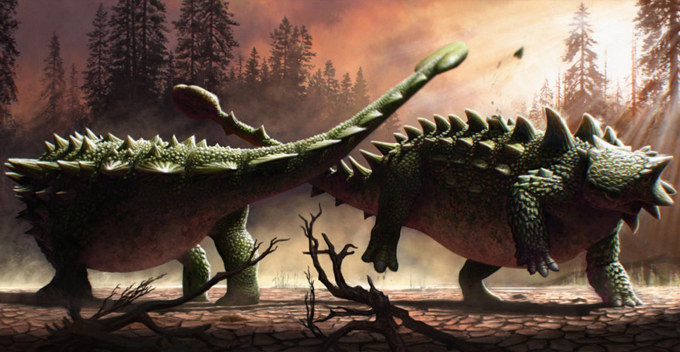
A pair of ankylosaurs (Zuul crurivastator) indulge in some intraspecific combat. Picture credit: Henry Sharpe
Zuul crurivastator
Named and formally described in 2017, Zuul crurivastator (pronounced Zoo-ul cruh-uh-vass-tate-or) roamed the northern part of Laramidia approximately 76 million years ago (Campanian faunal stage of the Late Cretaceous).
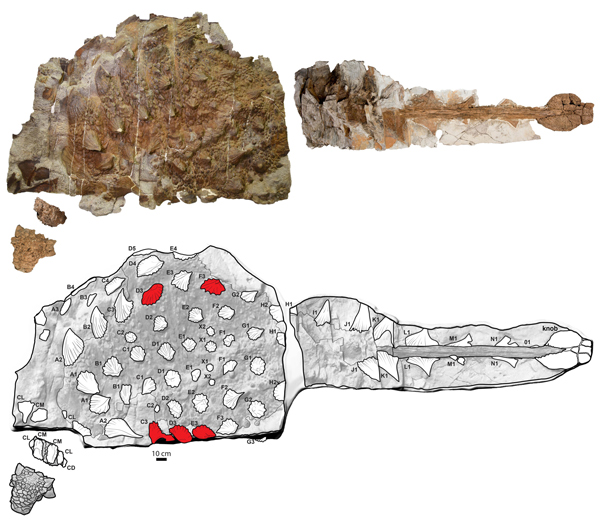
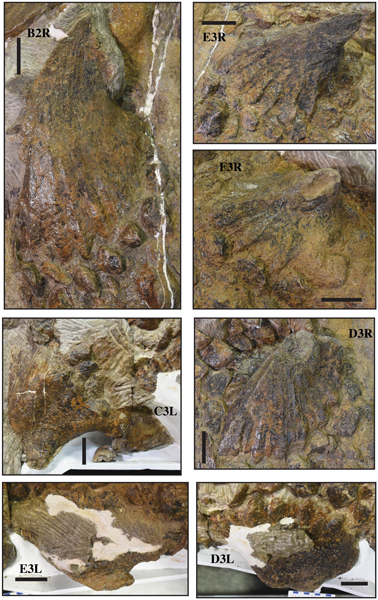
Zuul’s body was covered in bony plates (osteoderms) of different shapes and sizes and the ones along its flanks were particularly large and spiky. Interestingly, the scientists which included lead author and renowned ankylosaur expert Dr Victoria Arbour (Royal British Columbia Museum, Canada), noted that dermal armour near the hips on both sides of the body showed damage that had subsequently healed. This localised, bilaterally symmetrical pathology is speculated to have been caused by ritualised combat rather than wounds inflicted by an attacking theropod dinosaur.
Identifying damaged osteoderms in the holotype of Zuul crurivastator. A composite photograph of the skull, first cervical half ring, body block and tail block (top). Fossil material is brown and surrounding rock matrix is grey. Interpretive illustration showing non-pathological osteoderms in white and pathological osteoderms in red (bottom). Picture credit: Arbour, Zanno and Evans.
An Exciting Piece of the Ankylosaur Puzzle
Dr Arbour commented:
“I’ve been interested in how ankylosaurs used their tail clubs for years and this is a really exciting new piece of the puzzle. We know that ankylosaurs could use their tail clubs to deliver very strong blows to an opponent, but most people thought they were using their tail clubs to fight predators. Instead, ankylosaurs like Zuul may have been fighting each other.”
The genus name honours a fictional monster from the 1984 film “Ghostbusters”, whilst the trivial part of the binomial name translates as “the destroyer of shins”, a nod to the idea that tail clubs were used as defensive weapons to deter attacks from predatory theropod dinosaurs. The substantial club on the end of the three-metre-long tail being used to bash into the lower legs of tyrannosaurs. This new research does not refute the idea that these tail clubs had a role in defence, but based on the pathology seen in the Zuul holotype (specimen number ROM 75860) the scientists propose that sexual selection and intraspecific combat drove their evolution. Many mammals today such as deer, antelope, cattle and sheep have horns and antlers that have evolved for use in battles between members of the same species.
Details of pathological and non-pathological osteoderm morphology in ROM 75860 (Zuul crurivastator). B2R and E3R are non-pathological flank osteoderms. F3R and D3R are pathological flank osteoderms missing the tips of the apex, and the keratinous sheath has not grown over the tip. D3L is a pathological flank osteoderm missing a large portion of the apex, and the keratinous sheath has overgrown the damaged region. C3L and E3L are pathological flank osteoderms with highly modified morphologies, missing large portions of the trailing posterior edge and with the keratinous sheath covering the damaged region. Picture credit: Arbour, Zanno and Evans.
It had been suggested previously that ankylosaurs may have clubbed each other, and that broken and healed ribs could provide evidence to support this idea. Unfortunately, ankylosaurid skeletons are extremely rare in the fossil record, these animals were not common, even in the Late Cretaceous of North America, where the ecosystem was dominated by other ornithischian dinosaurs such as duck-billed dinosaurs and ceratopsians.
Implications for Ankylosaur Behaviour
The remarkable Zuul fossil skeleton provides palaeontologists with an opportunity to study pathology recorded on the bones and dermal armour.
Co-author Dr David Evans (Curator of Vertebrate Palaeontology at the Royal Ontario Museum) explained:
“The fact that the skin and armour are preserved in place is like a snapshot of how Zuul looked when it was alive. And the injuries Zuul sustained during its lifetime tell us about how it may have behaved and interacted with other animals in its ancient environment.”
Tail Clubs for Social Dominance
The researchers conclude that the imposing tail club of Zuul could have been used in defence when needed, but the analysis suggest that sexual selection drove the evolution of this weapon. This finding has consequences for how palaeontologists perceive ankylosaurs. It suggests that these dinosaurs were capable of complex behaviours and that they likely engaged in ritualised combat over mates or for social dominance as inferred in other types of dinosaurs and observed in living mammals and birds.
Everything Dinosaur acknowledges the assistance of a media release from the Royal Ontario Museum in the compilation of this article.
The scientific paper: “Palaeopathological evidence for intraspecific combat in ankylosaurid dinosaurs” by Victoria M. Arbour, Lindsay E. Zanno and David C. Evans published in Biology Letters.
A recently published scientific paper has refuted the idea that Spinosaurus (S. aegyptiacus) was an aquatic dinosaur. Writing in the academic journal eLife, the researchers which included Paul Sereno (University of Chicago), conclude that Spinosaurus was not aquatic. Instead, they revert to the earlier hypothesis that this super-sized carnivore was a semi-aquatic, bipedal predator that did feed on fish but ranged far inland.
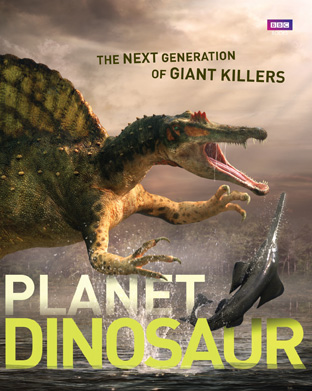
Over a decade ago, Everything Dinosaur team members were contacted by members of the CGI team working on the Spinosaurus segment of the soon to be launched television series entitled “Planet Dinosaur”. At the time, (2010), S. aegyptiacus was thought to be a semi-aquatic, bipedal predator that specialised in hunting fish, but was not thought to be an almost entirely aquatic dinosaur.
From paddler to swimming and back to paddler again – the “evolving” image of Spinosaurus. A recently published paper refutes the hypothesis that Spinosaurus aegyptiacus was an aquatic animal. Researchers postulate that it was semi-aquatic, a biped feeding on fish but not a dinosaur that could dive and swim very efficiently. Picture credit: BBC Worldwide.
Picture credit: BBC Worldwide
The 2014 Scientific Paper
In 2014, Paul Sereno (the lead author of the latest paper), was one of the authors of a study into Spinosaurus material found in Morocco. In the paper, the researchers proposed that this huge theropod possessed adaptations that indicated a semi-aquatic lifestyle. The skull had small nostrils located further up the snout to allow this dinosaur to breathe whilst its jaws were partially submerged and neurovascular openings along the jaws were interpreted to be sense organs that permitted Spinosaurus to sense the movements of fish through the water. Analysis of the centre of gravity indicated that Spinosaurus was a quadruped.
However, commenting on the 2014 paper, Professor Sereno admits that there was a mistake made when examining the centre of gravity of Spinosaurus. When the centre of gravity was calculated leading to the conclusion that this huge theropod walked on all fours, the volume of the lungs were not properly accounted for. When a new assessment of the centre of gravity is made, using a more accurate lung volume assessment, the results are radically different. The data suggests that Spinosaurus was a biped, with a typical posture associated with other large-bodied carnivorous dinosaurs.
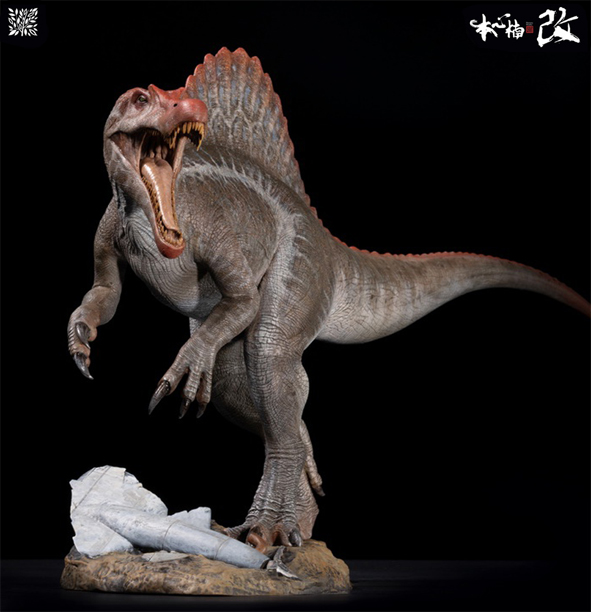
The new research which included a more accurate assessment of lung volume, indicates that Spinosaurus was bipedal, perhaps the Jurassic Park III Spinosaurus was not that inaccurate after all?
The image (above) depicts Spinosaurus with the typical bipedal posture of a large-bodied theropod dinosaur. The model is a Nanmu Studio Spinosaurus (version 2.0).
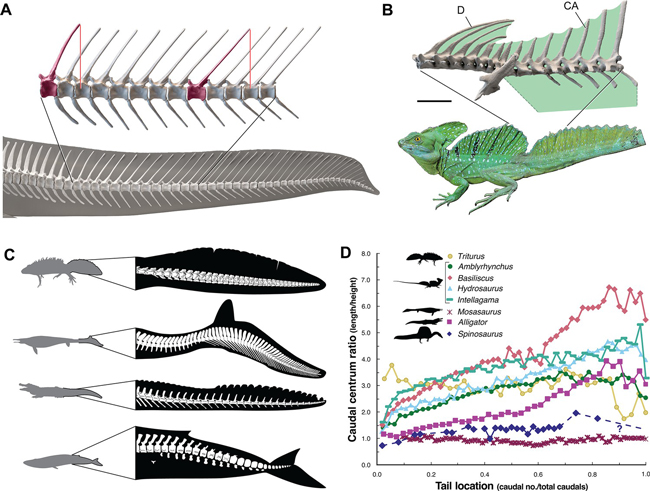
In 2020, another paper was published which examined the caudal vertebrae of Spinosaurus aegyptiacus, tail bones having not been part of previous studies. Writing in the journal “Nature” the researchers which included Nizar Ibrahim (University of Detroit Mercy, Detroit), along with colleagues from the University of Portsmouth, proposed that Spinosaurus had a broad, flexible, fin-like tail that could have propelled this dinosaur through the water. This seemed to be the decisive evidence, that Spinosaurus was indeed an aquatic hunter.
In this newly published research, Sereno and his colleagues looked at the biomechanics of the fin-like tail and analysed its effectiveness as an organ of propulsion through water. When compared to alligators, the tail and hind feet of Spinosaurus were found to be very inefficient swimming organs. Spinosaurus was an unstable, slow-surface swimmer only capable of a swimming speed of less than one metre a second.
Comparing the skeleton of S. aegyptiacus with a basilisk lizard and aquatic vertebrates. The tail of S. aegyptiacus (A) showing the overlap of neural spines (red) with more posterior caudal vertebrae. A CT scan showing the sail structure of a green basilisk lizard (B). Researchers propose that the tail of Spinosaurus was not adapted to propulsion in water but most probably a display structure. Skeletal illustrations of the caudal vertebrae of aquatic vertebrates (C) – crested newt, a mosasaur, crocodilian and a whale. A graph plotting the centrum proportions along the tail (D) comparing S. aegyptiacus with a crested newt (Triturus cristatus), semi-aquatic lizards (marine iguana Amblyrhynchus, common basilisk Basiliscus basiliscus, Australian water dragon Intellagama lesueurii and a sailfin lizard Hydrosaurus amboinensis), a mosasaur and an American alligator (Alligator mississippiensis). Picture credit: Sereno et al.
The team also calculated that Spinosaurus would have been too buoyant to submerge fully. It was not capable of diving and those robust, heavy hind limbs helped it to walk on land or wade, not acting as additional ballast to help this fifteen-metre-long giant remain underwater.
Sereno and his fellow authors suggest that living reptiles with similar tail bone morphology, such as the basilisk lizard, do not use their tails for propulsion, instead they have a display function.
Spinosaurus Ranged Far Inland
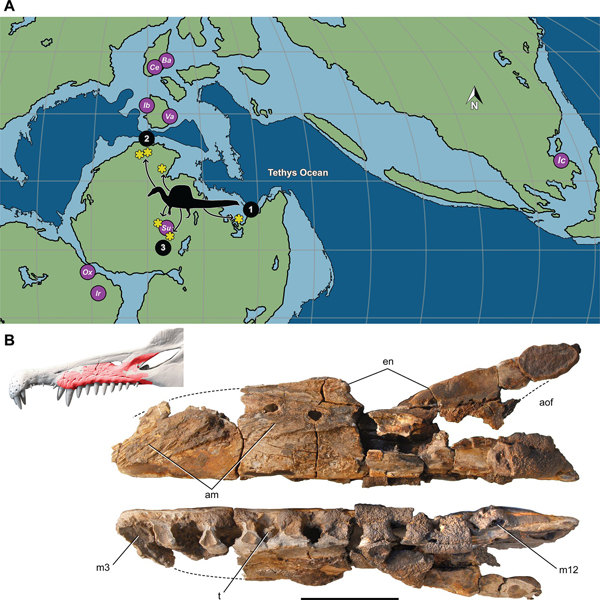
Fossils ascribed to Spinosaurus recovered from fluvial deposits in Niger suggest that this dinosaur ranged far inland. It is true that most Spinosaurus fossils come from sediments that represent extensive coastal deltas. However, these deposits include a large number of non-spinosaurid dinosaur remains, all of which may have been transported for some distance downstream. Spinosaurus fossil material may have also been transported, leading to the misconception that this was a dinosaur confined to the coast. Recently discovered fossils ascribed to Spinosaurus from two inland basins in Niger (Égaro North), indicate that Spinosaurus lived far from the shore. These fossils which include part of an upper jaw (maxilla) were found in fluvial deposits in association with rebbachisaurid and titanosaurian sauropods which are regarded as entirely terrestrial animals.
Spinosauridae fossil localities mapped (Early Cretaceous Albian faunal stage). The map (A) shows the fossil location for Baryonyx and Suchomimus (baryonychines) along with spinosaurs (Ichthyovenator, Vallibonavenatrix, Oxalaia, Irritator/Angaturama and Spinosaurus). Yellow asterisks indicate location of Spinosaurus fossils, these range from coastal sites (1 – Bahariya, Egypt and 2 – Zrigat, Morocco) to a site much further inland (3 – Égaro North, Niger). Spinosaurus sp. right maxilla (B), specimen number MNBH EGA1 from central Niger, in medial and ventral views. The inset image shows the fossil material superimposed on the snout of S. aegyptiacus. Abbreviations: am, articular rugosities for opposing maxilla; aofe, antorbital fenestra; Ba, Baryonyx walkeri; en, external naris; Ic, Ichthyovenator laosensis; Ir, Irritator challengeri/Angaturama limai; m3, 12, maxillary alveolus 3, 12; Ox, Oxalaia quilombensis; Su, Suchomimus tenerensis; t, tooth; Va, Vallibonavenatrix cani. Scale bar is 10 cm. Picture credit: Sereno et al.
Comfortable in Water but Not Truly at Home in an Aquatic Environment
Confirming that the researchers think Spinosaurus was a bipedal, semi-aquatic animal that specialised in hunting fish, Professor Sereno added:
“Do I think this animal would have waded into water on a regular basis? Absolutely, but I do not think it was a good swimmer or capable of full submergence behaviour.”
Everything Dinosaur acknowledges the assistance of a media release from the University of Chicago in the compilation of this article.
The scientific paper: “Spinosaurus is not an aquatic dinosaur” by Paul C Sereno, Nathan Myhrvold, Donald M Henderson, Frank E Fish, Daniel Vidal, Stephanie L Baumgart, Tyler M Keillor, Kiersten K Formoso and Lauren L Conroy published in eLife.
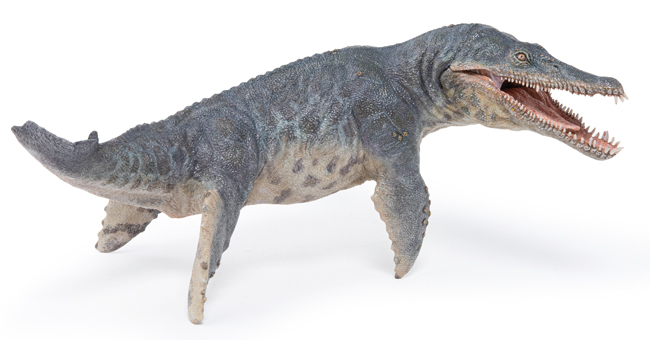
Everything Dinosaur has received the official image from Papo of the new for 2023 Papo Kronosaurus model. Although no details of this new marine reptile figure have been published (information remains strictly embargoed), team members at Everything Dinosaur expect this figure to have an articulated jaw. It is due to be available around quarter 3 (July to September) of 2023.
The new for 2023 Papo Kronosaurus model. We expect the figure to have an articulated jaw and to be available around Q3 (July to September) 2023.
A Marine Reptile with Barnacles
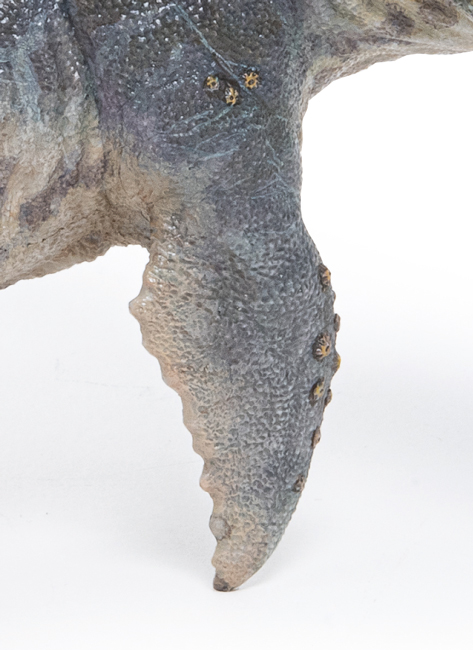
Eagle-eyed Papo model fans will note that there are some strange lumps and bumps visible on the upper arm, the top of the shoulder and along the leading edge of the front flipper. Everything Dinosaur has been able to use the official Papo image to gain a closer view of these features on the marine reptile model. The Kronosaurus has a colony of barnacles.
A close-up view of the right front flipper and shoulder of the new for 2023 Papo Kronosaurus model. The figure has been given a small colony of barnacles.
Parasites and Kronosaurus
Barnacles are a type of crustacean (Crustacea, from the Arthropoda phylum), they are often seen attached to the flippers and bodies of large whales. It is thought these whale barnacles evolved from barnacles that attached themselves to the carapace of marine turtles. Their evolutionary origins are indistinct, but it is believed that these types of parasitic barnacle evolved during the Cretaceous, so it is quite feasible to imagine a large marine reptile acting as a symbiont (living together) with a colony of stalkless barnacles, although they do seem relatively rare in the Early Cretaceous fossil record, before radiating and becoming more specious during the Late Cretaceous. As the fossil record of barnacles dates back to the Carboniferous, an Early Cretaceous marine giant such as Kronosaurus queenslandicus may have picked up some of these parasites as it patrolled the sea that covered much of what is now Australia approximately 115 million years ago.
Papo Kronosaurus Model
A spokesperson from Everything Dinosaur commented:
“Whilst we can’t be certain about the presence of barnacles on a Kronosaurus, these apex predators probably suffered from many different types of parasite. It is great to see Papo adding a replica of another type of marine reptile to their model range.”
The spokesperson also confirmed that the Papo Kronosaurus figure was due in stock around quarter 3 (July to September) of 2023.
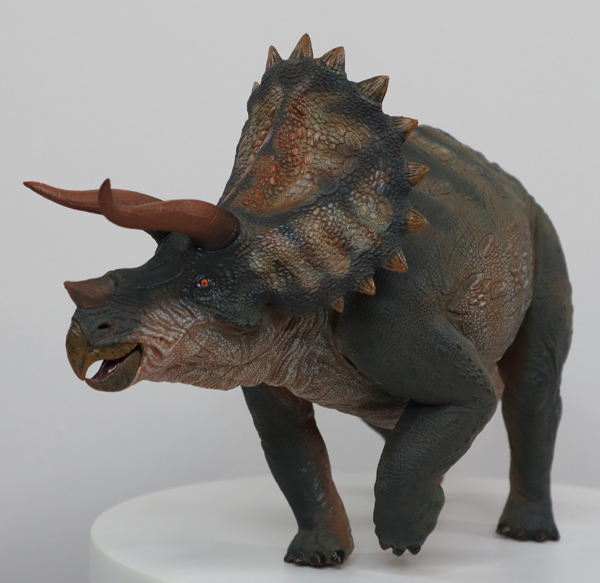
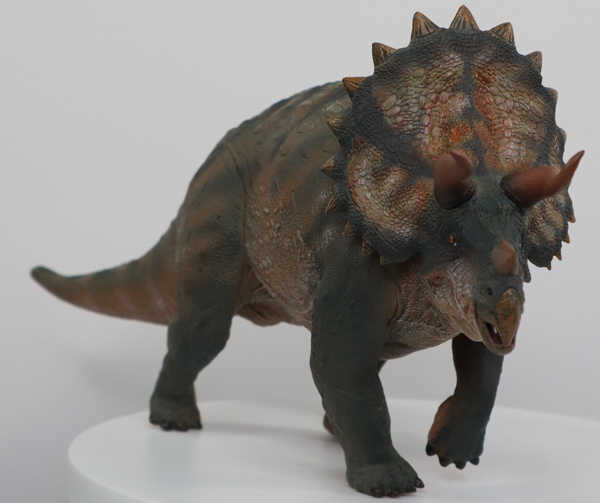
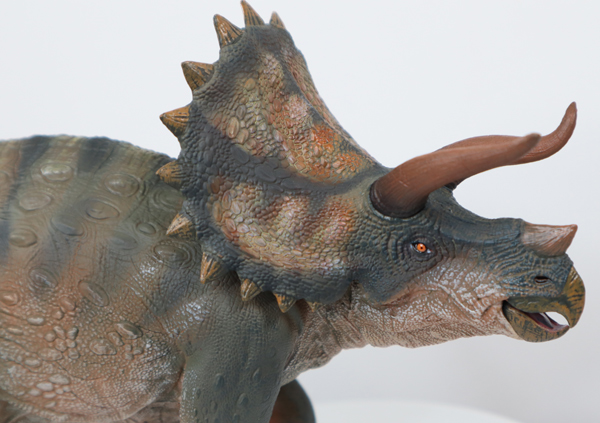
Everything Dinosaur team members have taken time out of their busy schedule to take some photographs of the spectacular Heavy Lance Triceratops model from Nanmu Studio. This beautiful, 1/35th scale, horned dinosaur replica is one of several ornithischian dinosaur models in the Nanmu Studio Jurassic Series available from Everything Dinosaur.
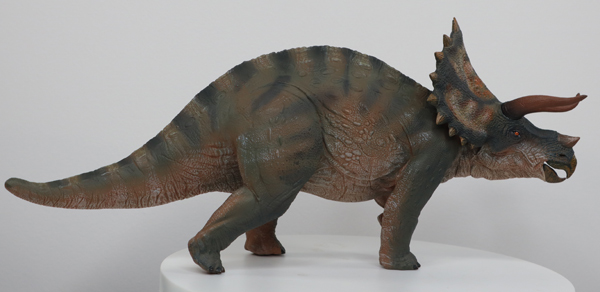
The Nanmu Studio Heavy Lance Triceratops (tricolor version) dinosaur model (in lateral view). Picture credit: Everything Dinosaur.
Picture credit: Everything Dinosaur
Heavy Lance Triceratops Model
The Nanmu Studio Jurassic Series Heavy Lance Tricolor figure is a fantastic Triceratops dinosaur model in 1:35 scale. The Triceratops model is supplied with an Everything Dinosaur Triceratops fact sheet which has been researched and written by Everything Dinosaur team members.
The Triceratops model (Heavy Lance – Tricolor) in anterior view. Picture credit: Everything Dinosaur.
Picture credit: Everything Dinosaur
Triceratops Model Measurements
This stunning replica of perhaps, the most famous horned dinosaur of all, was introduced as part of a trio of Triceratops collectables. The model measures 29 cm in length and that beautifully painted ceratopsian frill is approximately 13.5 cm off the ground.
A Triceratops ready to charge! A closer view of the stunning frill on the Nanmu Studio Jurassic Series Triceratops (tricolor colour variant). Picture credit: Everything Dinosaur.
Picture credit: Everything Dinosaur
A spokesperson from Everything Dinosaur commented:
“Triceratops regularly features in the top three of our survey looking at the most popular prehistoric animals. We congratulate the design team at Nanmu Studio for their superb horned dinosaur figures. It still amazes us that with our current stock of Triceratops models, we can offer customers more Nanmu Studio Triceratops model variants than the actual number of currently valid species of this iconic Late Cretaceous dinosaur.”
A close-up view of the Nanmu Studio Triceratops Heavy Lance (Tricolor). Picture credit: Everything Dinosaur.
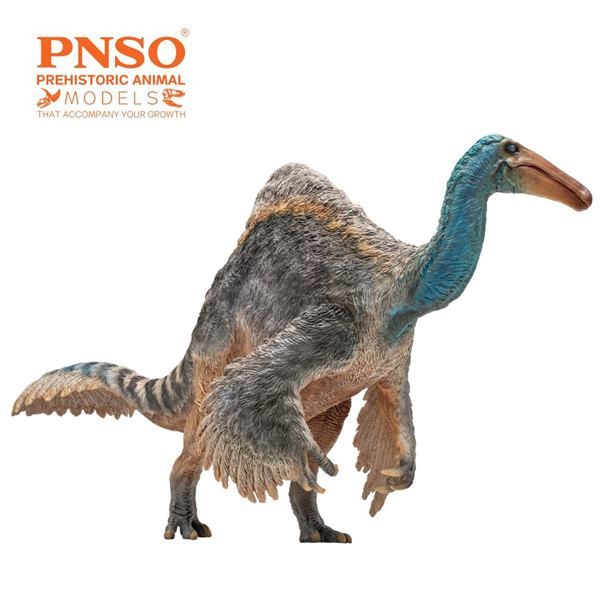
Our thanks to dinosaur fan and model collector William who sent into Everything Dinosaur a detailed PNSO Deinocheirus review accompanied by some additional facts and information about this bizarre Late Cretaceous theropod.
Jacques the PNSO Deinocheirus mirificus
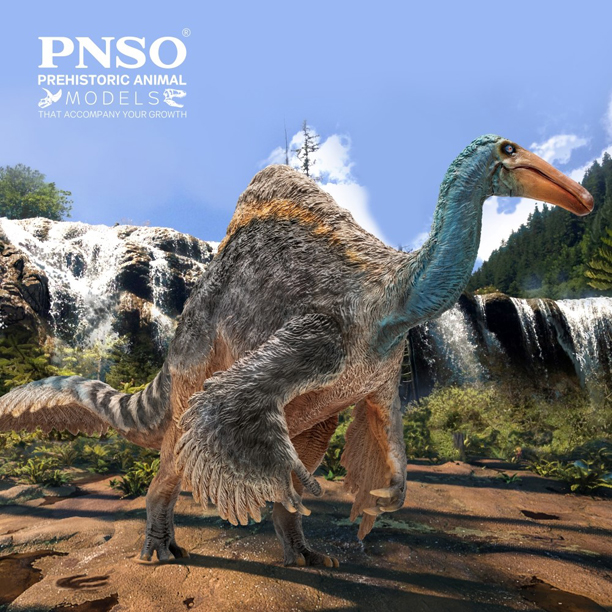
The beautifully painted, feathered theropod – Jacques the Deinocheirus dinosaur model.
The reviewer praises PNSO for being able to get this item into production quickly. Jacques the Deinocheirus is described as “a bold but extremely welcome final gift to end their 2022 releases”. The reviewer also commented that this bizarre theropod had an increased profile due to its appearance in the award-winning television series “Prehistoric Planet”.
Super Duck!
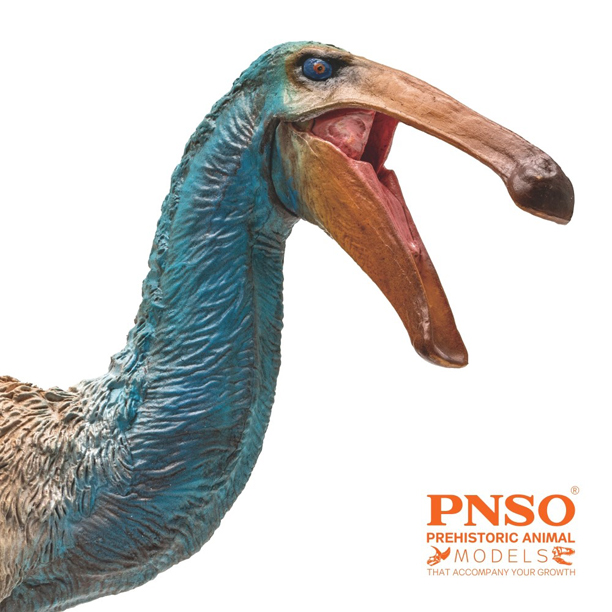
William confesses that he was previously not a big fan of the “Super Duck” theropod, but the PNSO figure has persuaded him to add this dinosaur model to his collection. He compliments the design team for the detailed head sculpt, including the articulated jaw and the anatomical accuracy of the dinosaur’s bill. The reviewer marks the head as a 10 out of 10!
A close-up view of the elongated beak of the Deinocheirus model, this dinosaur has an articulated lower jaw.
PNSO Deinocheirus Review
Turning his attention to the main body sculpt, William compares the hump-backed appearance of this model to the neural spines found in the very distantly related Spinosaurus. The plumage is praised, and the feather sculpting is singled out for additional comment, with the reviewer stating that he would have purchased the model for its excellent plumage alone.
William states that in life Deinocheirus would have been a robust and massive animal and one best avoided by predators as it grazed. The tail fan is complimented although no cloaca could be detected on the figure, the presence of the feathers obscuring this anatomical detail. The long powerful tail reminded the reviewer of the large plumes of feathers found on the wings of ostriches.
The PNSO Jacques the Deinocheirus dinosaur model.
The Forearm and Hindlimbs
The hands with their massive claws are described and the musculature of the forelimbs is commented upon. The integumentary covering is praised with the reviewer stating:
“In case you wonder, yes, PNSO did not slack! All under wings and body feathers are fully recreated in the finest detail.”
The large hip muscles of “Super Duck” are singled out for comment and the robust weight-bearing toes with their blunt claws are praised.
When commenting on the colour scheme chosen for the model, William explains that the tip of the bill is coloured tan brown with the reminder a rich yellow with a dark wash.
The flanks are a mixture of dark grey with black and white edging. The grey colour scheme continues down to the tip of the tail ending in a crown of white feathers with wide, grey and white bands to provide contrast.
William adds:
“The neural spine is reminiscent of a snow-topped mountain peak with a beige border separating the main body colouration.”
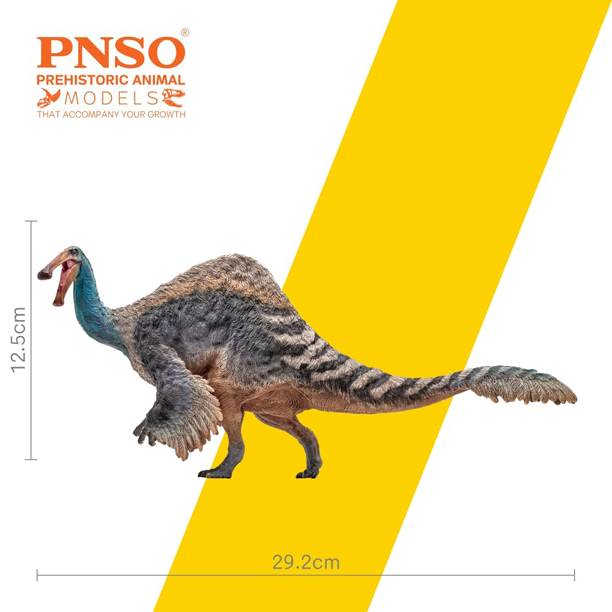
The PNSO Deinocheirus model measures 29.2 cm long and the head stands some 12.5 cm off the ground.
Providing Further Information on the Deinocheirus Figure
In his detailed review, William provided more information about the PNSO Deinocheirus model:
Scale: 1:32
Length: 11.4 inches
Height: 4.8 inches
In addition, he explained that the figure is supplied with a clear, plastic support stand, along with an A3-sized colour poster, a 64-page, illustrated booklet and a QR code which permits access to a short video about the model.
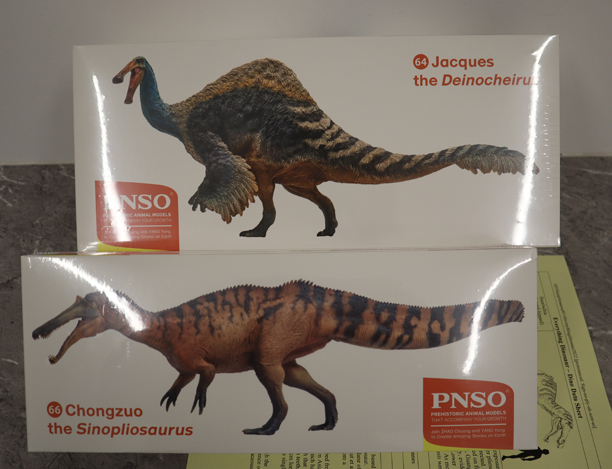
The two, new for 2022 PNSO model arrivals (early November 2022), the PNSO Jacques the Deinocheirus (top) and (bottom) the Chongzuo the Sinopliosaurus figure. The free Sinopliosaurus fact sheet can be seen underneath the boxes. Our thanks to William for his comprehensive Deinocheirus review. Picture credit: Everything Dinosaur.
Picture credit: Everything Dinosaur
As well as providing a detailed review, William also supplied information on Deinocheirus and the history of its fossil discovery:
Time Period – Late Cretaceous 71-69 million years ago
Location – Nemegt Basin of the Gobi Desert (Mongolia)
Environment – An extensive river delta with a climate similar to that of tropical Africa or South America today
A Polish/Mongolian expedition uncovered the first fossil evidence of this theropod (1965). The fossils consisted of postcranial elements including three dorsal vertebrae and a complete shoulder girdle with the forelimbs, minus the claws from the right hand.
The dinosaur was formally described and named Deinocheirus mirificus in 1970.
William explained that work undertaken between 2012 and 2017 to find more specimens and to recover fossils in private collections led to a comprehensive reassessment of this dinosaur.
“Jacques is the greatest Deinocheirus mirificus ever created and if you are a serious collector, it is a must, the model will be the crown jewel in any collection.”
The reviewer also praised the efforts of Everything Dinosaur in sourcing prehistoric animal figures and the rapid delivery service the company offers.
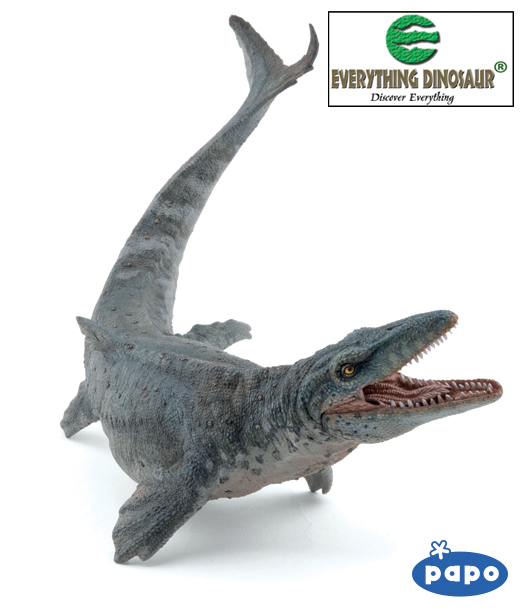
Everything Dinosaur has received the official images for the new for 2023 Papo figures including the new Papo Mosasaurus model. We are now also able to confirm the model’s measurements. The Papo Mosasaurus is due in stock at Everything Dinosaur in early 2023.
Everything Dinosaur will be stocking the delayed Papo Mosasaurus model. It was due to come out at the end of 2022, it is now expected in early 2023.
Papo Mosasaurus Model
Originally scheduled to be introduced in the fourth quarter of 2022, the Papo Mosasaurus model was delayed and is now due to be released next year (early 2023). Many manufacturers have experienced problems with production, partly caused by issues arising from the global pandemic. However, Papo intend to introduce a total of four new figures into their “Les Dinosaures” range next year.
Two dinosaurs (Concavenator and Einiosaurus) are due to come out along with a second marine reptile model (Kronosaurus). There are also two product reissues (Archaeopteryx and Woolly Rhino).
Model measurements have been released by Papo for the new Mosasaurus figure. It will be 25.5 cm in length. The official Papo information also states that the Mosasaurus will be 15 cm in width with a height of 11 cm. We suspect that the width measurement has been taken across the front flippers and the height measurement refers to the height of the tail fluke off the ground.
The Papo Mosasaurus marine reptile model is due in stock at Everything Dinosaur early in 2023.
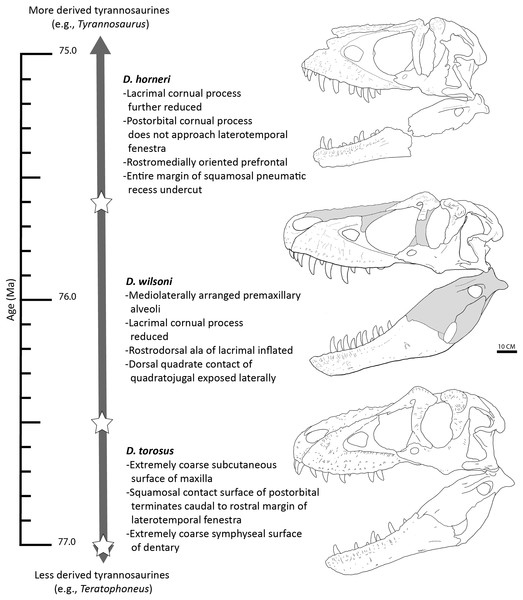
A new species of North American, Late Cretaceous tyrannosaur has been announced. It is the third species in the Daspletosaurus genus. Daspletosaurus wilsoni is older than D. horneri, but geologically younger than D. torosus. The skull demonstrates a mix of traits found in primitive tyrannosaurs as well as several more derived characteristics associated with later members of the Tyrannosauridae such as Tyrannosaurus rex.
Writing in the on-line, open access journal PeerJ, the researchers from the Badlands Dinosaur Museum (North Dakota), suggest that the discovery of a tyrannosaur intermediate in age between the previously described species of this genus, supports earlier research identifying several species of Daspletosaurus as a single evolving lineage, and supports the descent of T. rex from this group.
Changes in the Daspletosaurus genus over time with three distinct species now identified. Known skull bones of D. wilsoni shown in white. The evolutionary changes in these tyrannosaurs with key anatomical differences listed. Note scale bar = 10 cm. Picture credit: Warshaw and Fowler.
From the Judith River Formation (Campanian Faunal Stage)
The fossil specimen was discovered in 2017. It consists of a partial, disarticulated skull and jaw bones with an exceptional degree of preservation along with vertebrae, a rib and the first metatarsal. The material comes from Judith River Formation exposures in north-eastern Montana. The fossil was found by John Wilson and the species name has been erected in his honour.
The new species displays a mix of characteristics found in more primitive, geologically older tyrannosaurs. For example, D. wilsoni sports a prominent set of horns around the eye, as well as features otherwise known from later members of this group (including T. rex), like a tall eye socket and expanded air-pockets in the skull. In this way, this newly described species represents a transitional form between older and younger tyrannosaur species.
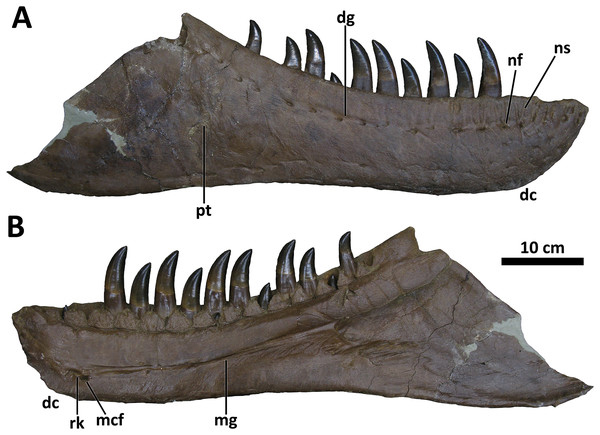
The right dentary of BDM 107 (the holotype). Picture credit: Warshaw and Fowler.
Daspletosaurus wilsoni
Several tyrannosaurs have now been named from the Upper Cretaceous of North America. The researchers note that many of the species are very closely related, forming consecutive sequences where one species evolves into another species over time. When one ancestral species evolves into a second descendant species, this is referred to as anagenesis, as opposed to cladogenesis when successive branching events produce many species that are closely related to each other but not direct descendants of a single species.
The authors of the scientific paper conclude that anagenesis might be the driver of evolutionary change within the Dinosauria at the end of the Cretaceous rather than cladogenetic evolutionary models.
Daspletosaurus Replicas
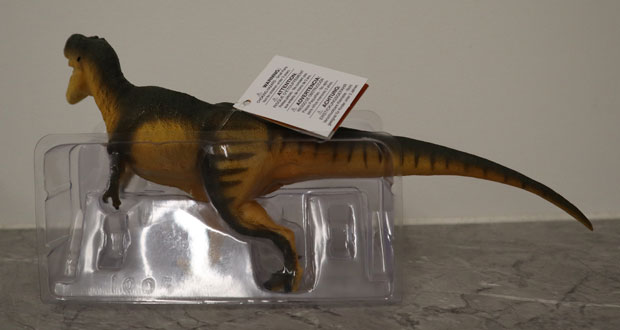
The first species of Daspletosaurus (D. torosus) was named and described in 1970, the second species, the geologically youngest species, D. horneri was named in 2017. Few models of this tyrannosaur existed but in 2013 CollectA added a Daspletosaurus model to their Prehistoric Life model range. More recently (2021), Safari Ltd introduced a Daspletosaurus figure into their Wild Safari Prehistoric World range.
The new for 2021 Wild Safari Prehistoric World Daspletosaurus dinosaur model. Picture credit: Everything Dinosaur.
The scientific paper: “A transitional species of Daspletosaurus Russell, 1970 from the Judith River Formation of eastern Montana” by Elias A. Warshaw and Denver W. Fowler published in PeerJ.