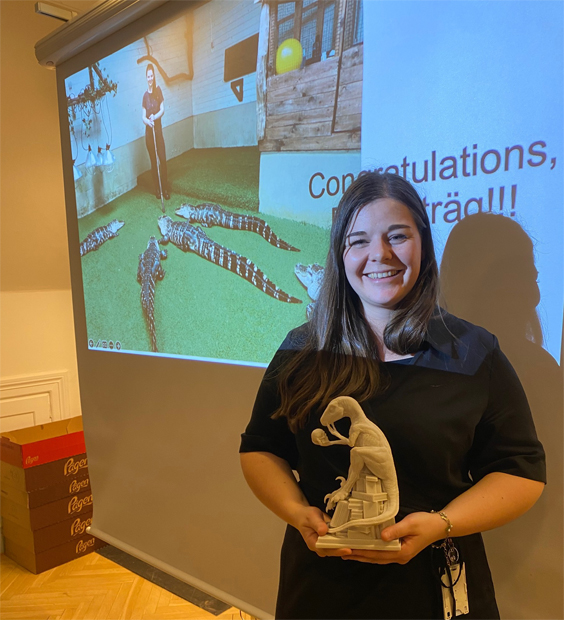
A Lund University student researching the cognitive abilities of animals was given a Rebor Oddities “Extinction” figure as a gift on completion of her PhD. Everything Dinosaur was contacted by an academic from The Cognitive Zoology Group at Lund University (Sweden), when the pair of limited-edition Rebor Oddities “Extinction” figures were first publicised. Associate Professor Mathias Osvath, wanted to gift a figure to his PhD students as they completed their doctorates.
Student Claudia of The Cognitive Zoology Group (Lund University) having successfully completed her PhD with her coveted Rebor Oddities “Extinction” Victorian neoclassical marble version figure. Picture credit: Associate Professor Mathias Osvath (Lund University).
Rebor Oddities “Extinction” Figure
Rebor produced two versions of their Oddities “Extinction” figure. Both figures are cast in elastic resin and polystone and feature a Velociraptor in contemplation holding a human skull in its right hand. The beautifully detailed dromaeosaurid is perched on a stack of twenty-three books, one book for each of our twenty-three pairs of chromosomes.
The books represent an eclectic range of publications. They are a combination of fiction and non-fiction and include titles such as The Divine Comedy, the Poems of Longfellow, Gray’s Anatomy and the Origin of Species by Charles Darwin.
Such was the interest from academics and collectors that Everything Dinosaur compiled a list of the books featured on the models in an earlier blog post: The Rebor Extinction Library.
The Rebor Oddities Extinction models. Left the bronze effect version and the Victorian neoclassical marble (right). Picture credit: Everything Dinosaur.
Picture credit: Everything Dinosaur
Dinosaur Cognition
Cognitive studies of the Dinosauria constitute an intriguing area of scientific enquiry. Everything Dinosaur expects to see several papers on dinosaur cognition being published in the near future. We wish Claudia and the other successful PhD students every success as they pursue their careers.
When asked about the special dinosaur present, Associate Professor Osvath commented:
“The gift was a success! During the party people started to notice that more or less every book the dino is sitting on had titles on the back, or even front covers. It can only be seen when shining bright light from the sides and using magnifying glasses. It must have been educated people, with a sense of humour, who designed these figures.”
“Le Penseur”
There are two variants of the Rebor “Oddities” Extinction figure. The Victorian neoclassical marble version was despatched by Everything Dinosaur to Lund University but there is also the same figure in a Renaissance bronze finish.
The Rebor “Oddities” Extinction figures remind Everything Dinosaur’s team members of Auguste Rodin’s famous sculpture “The Thinker”, also known as “Le Penseur”.
To view the range of Rebor figures and replicas in stock at Everything Dinosaur including the extinction figures (whilst stocks last): Rebor Models and Replicas.
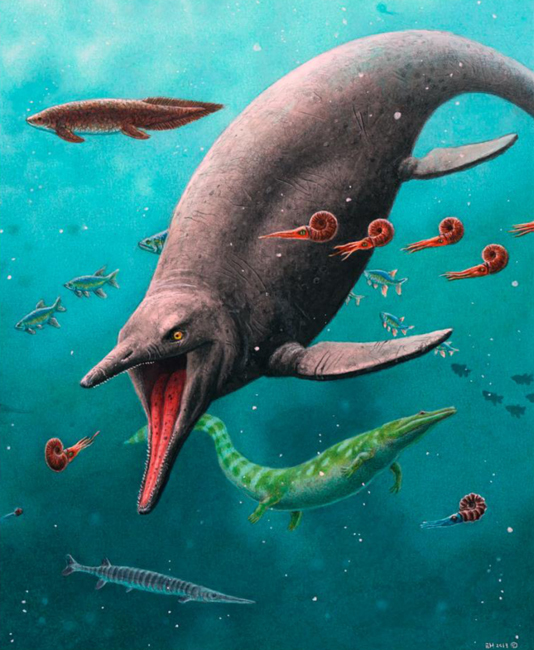
The earliest ichthyosaur fossil specimen discovered to date has been found on the Arctic island of Spitsbergen. The fossil represents a marine reptile that lived around 252 million years ago. The bones indicate that this animal was not a transitional form, but a fully adapted marine reptile.
Reconstruction of the earliest ichthyosaur and the 250-million-year-old ecosystem found on Spitsbergen. Picture credit: Esther van Hulsen.
Picture credit: Esther van Hulsen
Ichthyosaur Evolution
The evolutionary history of the ichthyosaurs remains contentious. No transitional forms representing land-dwelling tetrapods adapting to a marine habit have been found. However, small, basal ichthyosauriforms are known from the Lower Triassic of China, and the fossils of at least one, primitive Early Triassic, dolphin-shaped member of the Ichthyopterygia has already been described from Spitsbergen (Grippia longirostris).
Thanks to the work of a joint team of Swedish and Norwegian palaeontologists a fresh perspective on the origins of the “fish lizards” is provided by these newly described fossil bones.
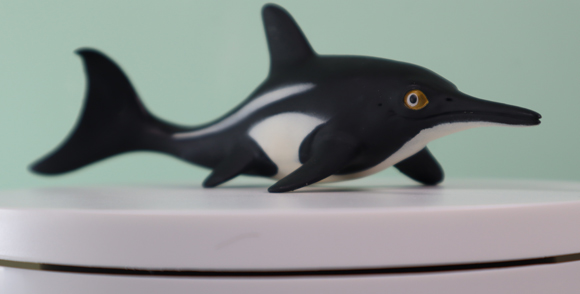
An Ichthyosaurus model, typical of the dolphin-like, streamlined forms that existed during the Early Jurassic. Picture credit: Everything Dinosaur.
Ichthyosaurs were a highly successful, globally distributed group of marine reptiles. The evolved, a “dolphin-like” streamlined body and were active, nektonic predators surviving into the Late Cretaceous.
The first marine reptiles, such as the mesosaurs evolved during the Early Permian. The end-Permian mass extinction event devasted both terrestrial and marine faunas. The cataclysmic event was thought to have led to an evolutionary reset which permitted animals such as the Ichthyosauria to evolve, exploiting niches vacated after the extinction event.
Tetrapods (land-based vertebrates), invaded shallow coastal environments to take advantage of marine predator niches that were left vacant after the mass extinction event. Over millions of years, these early amphibious reptiles became more efficient at swimming and eventually modified their limbs into flippers, developed a ” dolphin-like” body plan, and started giving birth to live young (viviparity). With the evolution of viviparity, there was no need to come ashore in order to lay eggs, so the last ties these creatures had with a terrestrial existence was lost.
The newly described fossil material from Spitsbergen is helping to revise and re-write this previous hypothesis.
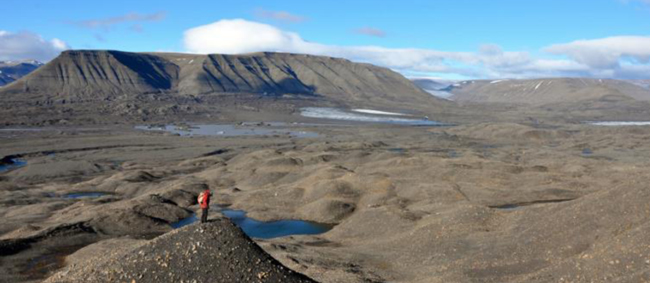
Fossil-bearing rocks on Spitsbergen that produced the earliest ichthyosaur remains. Picture credit: Benjamin Kear.
Picture credit: Benjamin Kear
Flower’s Valley Fossils
On western Spitsbergen a valley (Flower’s Valley), cuts deep into the surrounding mountains and provides access to Lower Triassic marine sediments, approximately 250 million years old. The rocks represent mud deposited at the bottom of an ancient sea and snow melt has gradually eroded the mudstone exposing rounded limestone boulders known as concretions. These objects are formed from limey sediments that coalesced around decomposing animal remains, subsequently preserving them in amazing, three-dimensional detail.
In 2014, the field team removed a number of concretions from the Flower’s Valley site. The rocks were taken back to the Natural History Museum at the University of Oslo for further study.
Scientists from The Museum of Evolution at Uppsala University have identified bony fish remains and bizarre “crocodile-like” amphibian bones, together with 11 articulated caudal vertebrae from an ichthyosaur.
Found in Rocks Thought to be Too Old for Ichthyosaur Fossils
Surprisingly, these tail bones occurred within rocks that were supposedly too old for ichthyosaurs. Also, the fossil bones do not represent a transitional form, but they show characteristics associated with geologically younger ichthyosaurs.
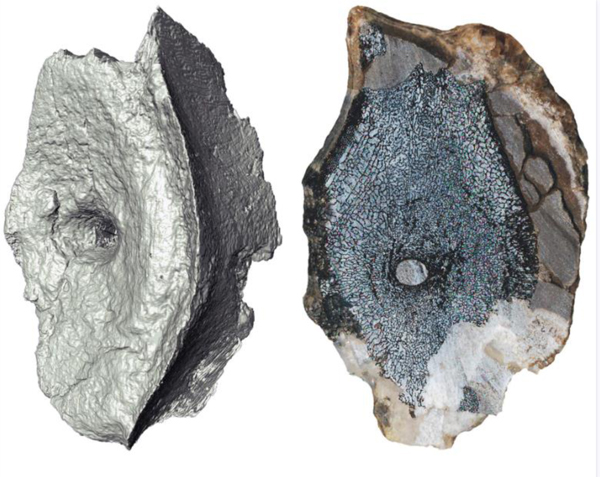
The vertebrae are identical to those of geologically much younger, larger-bodied ichthyosaurs, and even preserve internal bone microstructure showing adaptive hallmarks of fast growth, elevated metabolism and a fully oceanic lifestyle.
Computed tomography image and cross-section showing internal bone structure of vertebrae from the earliest ichthyosaur. Picture credit: Øyvind Hammer and Jørn Hurum.
Picture credit: Øyvind Hammer and Jørn Hurum
Dating the Surrounding Rock (Geochemical Testing)
Geochemical testing of the surrounding matrix dated the age of the fossils at approximately two million years after the end-Permian mass extinction. When the estimated timescale of marine reptile evolution is considered, this suggests the origins and early diversification of the Ichthyosauria took place during the Permian and prior to the Mesozoic Era.
These fossils suggest that the popular hypothesis of ichthyosaurs evolving to exploit niches vacated as a result of the end-Permian mass extinction is incorrect. Ichthyosaurs were present prior to the end of the Permian.
The discovery of the oldest ichthyosaur rewrites the popular vision of Age of Dinosaurs (Mesozoic Era), as the emergence timeframe of major reptile lineages. It now seems that at least some groups predated this landmark interval, with fossils of their most ancient ancestors still awaiting discovery in even older rocks on Spitsbergen and elsewhere in the world.
Everything Dinosaur acknowledges the assistance of a media release from the Uppsala University in the compilation of this article.
The scientific paper: “Earliest Triassic ichthyosaur fossils push back oceanic reptile origins” by Kear, B.P., Engelschiøn, V.S., Hammer, Ø., Roberts, A.J. and Hurum, J.H. published in Current Biology.
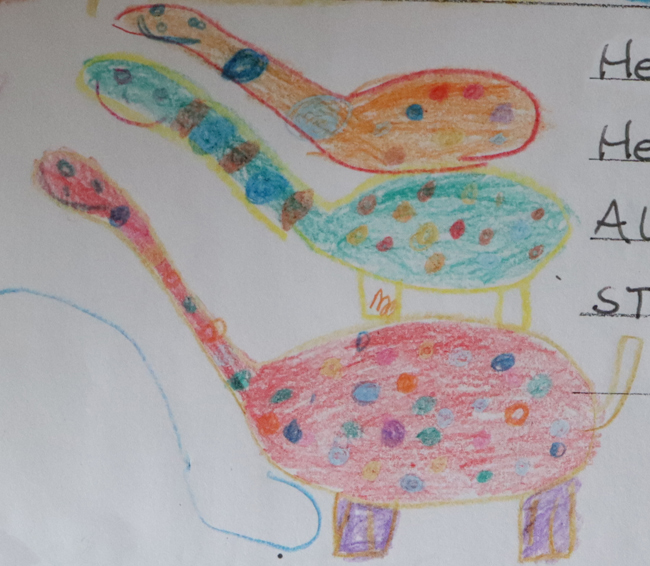
Our thanks to young dinosaur fan Esmee who sent into Everything Dinosaur a drawing which featured a trio of colourful sauropods. Team members at Everything Dinosaur get sent lots of drawings of prehistoric animals and we enjoy looking at them and some even get posted up onto our warehouse notice boards.
A trio of very colourful sauropod dinosaurs drawn by young dinosaur fan Esmee. Picture credit: Everything Dinosaur.
Picture credit: Esmee/Everything Dinosaur
Colourful Sauropods
A spokesperson from Everything Dinosaur thanked Esmee for sending in her drawing and added:
“Whilst we can’t be certain what colour sauropod dinosaurs were, it is thought they had colour vision. So, why not be brightly coloured with oranges, reds and blues. After all, if you are going to be longer than a bus you might as well stand out in terms of your colouration too. Our thanks to Esmee for creating such colourful dinosaurs.”
Our thanks to model collector William who sent into Everything Dinosaur a review of the recently introduced PNSO Therizinosaurus dinosaur model.
William begins his review by commenting on the model’s head. He praises its shape, the placement of the nostrils and the details shown around the eyes. The articulated lower jaw is also commented upon.
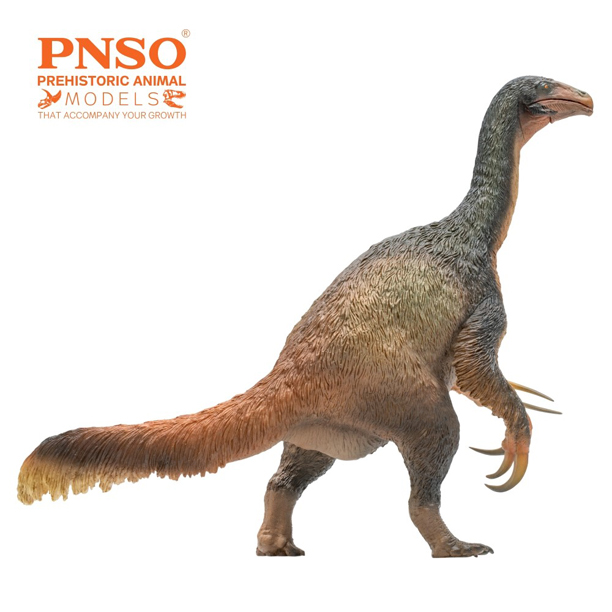
The new PNSO Therizinosaurus model has a beautifully detailed head with lots of evidence of a shaggy coat of feathers on the neck. The model also has an articulated lower jaw.
PNSO Therizinosaurus Dinosaur Model
Turning to the main body sculpt, the superb integumentary coat of feathers is praised with the reviewer awarding “100 points for this feature”. The wide pelvis is present, and the model has been given robust and powerful thighs combined with four-toed, plantigrade feet. The huge gut is highlighted and the reviewer confirms that the PNSO figure has a cloaca.
The scythe-like claws, for which this dinosaur is famous are described as “just perfection”. William comments that his figure stands unaided, but he does recommend the use of the clear, plastic display stand provided with the model for long term display.
Qingge the Therizinosaurus
PNSO selected a sloth-like colouration for their figure. There are no bright, clashing colours. The colour scheme chosen suits “Qingge”.
His eyes are a strong orange with a determined look set in them as if he means business, with a ring of green feathers around each orbit. The upper beak is pink with grey wash at the tip, with a dark wash on the mouth interior. From the back of the head down to the wrist the figure is a dark, charcoal grey which then transitions into a russet brown over the main upper body. The massive claws have a very naturalistic look.
A PNSO feathered theropod dinosaur. This is the new PNSO Qingge the Therizinosaurus dinosaur model.
Model Measurements
William provides details of the accessories supplied with the figure, the art poster and the clear, plastic support stand.
Scale: 1:35 Length: 7.8 inches Height: 6 inches
He confirms that the dinosaur fossil material comes from Upper Cretaceous deposits of the Nemegt Formation (Mongolia).
Providing Information About Therizinosaurus
As with previous reviews, William provided some information about the fossil discoveries.
Three years after the end of World War II, palaeontologists and field teams were out back in the field looking for fossil bones. A joint Mongolian/USSR Academy of Sciences expedition was despatched to the Nemegt Formation exposed in the Gobi Desert. Strange, fragmented fossils were uncovered.
Renowned palaeontologist Evgeny Maleev (who also described the tyrannosaur Tarbosaurus), thought the bones represented a turtle-like animal. He erected the family Therizinosauridae. After years of research and the discovery of more complete fossil specimens, Therizinosaurus was revealed to be bizarre, herbivorous member of the Maniraptora clade of dinosaurs.
The PNSO model has been photographed against a green, stylised background and a more detailed prehistoric scene has not been used in the background – such was the company’s eagerness to get this model announced.
The PNSO Therizinosaurus Dinosaur Model
William described Therizinosaurus cheloniformis and provided details on taxonomy.
Classification: Theropoda Superfamily: Therizinosauroidea Family: Therizinosauridae Type species: Therizinosaurus
William also described the Late Cretaceous environment as represented by the Nemegt Formation and mentioned the presence of large tyrannosaurs, the apex predators in the ecosystem.
He explained:
“Therizinosaurus would have been no easy meal for either Tarbosaurus bataar and the fleet-footed Alioramus remotus.”
“Qingge is an example of how to execute accuracy within a scale figure. PNSO’s Therizinosaurus cheloniformis is the only version I’ll ever need to own.”
Our thanks to William for sending into Everything Dinosaur his comprehensive model review.
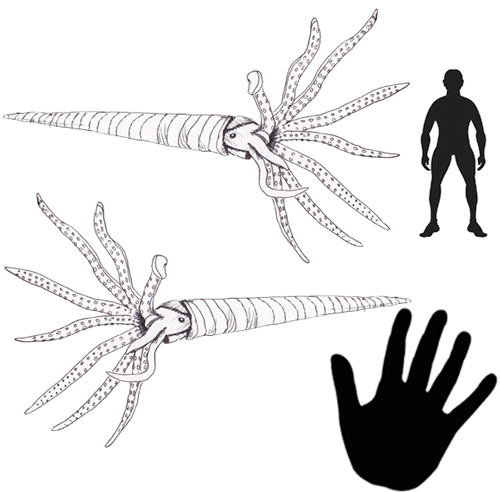
The Silurian is a relatively short geological time period when compared to the other periods outlined in the geological time scale. The Silurian lasted around twenty-five million years (444 million years ago to approximately 419 million years ago). Although it was brief, in relative terms, during the Silurian the first land plants evolved and many invertebrate forms began to make the transition to a terrestrial habit. Life in the seas still dominated the Earth’s biota. One of the apex, marine predators was the straight-shelled nautiloid. Some of these orthocones evolved into giants.
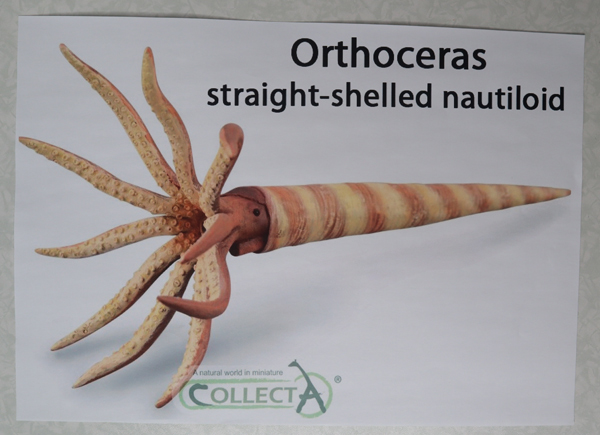
Everything Dinosaur and the straight-shelled nautiloid Orthoceras which was introduced into the CollectA range in 2020. Picture credit: Everything Dinosaur.
Picture credit: Everything Dinosaur
Straight-shelled Nautiloid
During the Silurian most of the nautiloid cephalopods had straight or slightly curved shells. The planispiral forms had yet to become common. The last straight-shelled forms (Orthocerida), probably died out during the Mesozoic. Most straight-shelled nautiloids became extinct at the end of the Triassic, but one fossil specimen collected in the Caucasus (Zhuravlevia insperata), indicates that one species persisted into the Early Cretaceous.
An early scale drawing design for the Orthoceras/Orthocone fact sheet. Picture credit: Everything Dinosaur.
Picture credit: Everything Dinosaur
Zhuravlevia insperata
Described in 1994 by Larisa Doguzhaeva of the Swedish Museum of Natural History, based on a fragmentary orthocerid fossil, Zhuravlevia insperata is the geologically youngest straight-shelled orthocone known to science. The tiny fossil, just 1.3 cm long, with four chambers preserved, was found when Aptian-aged concretions from the Hokodz River Basin in the north-western Caucasus (Russia), were being split.
The orthocone fragment would be around 120 million years old.
CollectA introduced an Orthocone replica in 2020. The figure was added to the Age of Dinosaurs Popular range.
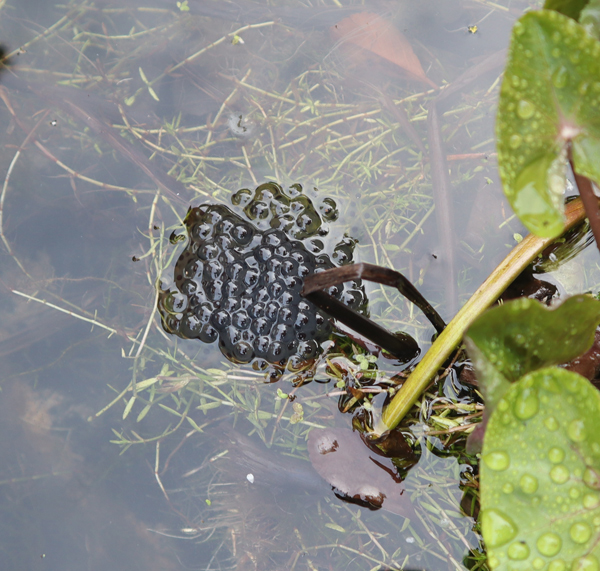
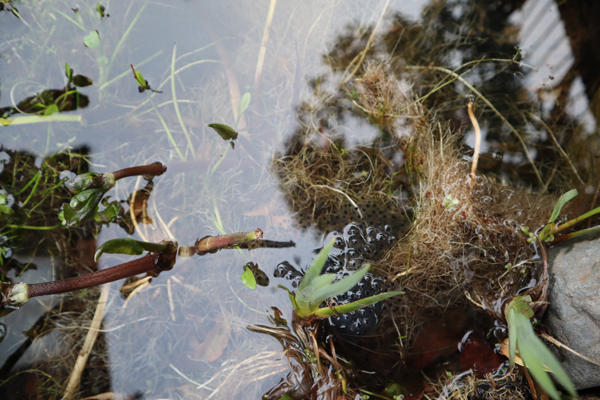
Everything Dinosaur team members have recorded the sixth batch of frogspawn in the office pond. The recent cold snap has ended and the wetter and milder weather may have encouraged more frogs to spawn. A sixth batch of frogspawn was observed early this morning. We suspect that it had been laid last night or in the early hours of the morning.
The sixth batch of frogspawn spotted in the office pond on March 12th 2023. Picture credit: Everything Dinosaur.
Common Frogs
At least one Common frog (Rana temporaria) is still in the pond. The frog has a bright white throat patch so, we suspect that this is a male. Team members will continue to monitor the pond to see if more frogspawn is laid. Frog numbers have declined in recent years. Five years ago, as many as a dozen frogs could be seen in the pond during the spawning season. Hopefully, our small pond will continue to support a frog population, attract other wildlife and provide a bathing area for nesting birds.
The macronarian clade of sauropods includes some of the largest dinosaurs to be scientifically described. However, many of these super-sized sauropods are known from scrappy and fragmentary remains. Dinosaurs with a high profile with the public are often very poorly understood by palaeontologists. Team members at Everything Dinosaur, take a look at one such example concerning the Macronaria. Time to outline the differences between Brachiosaurus and the Giraffatitan genus. Giraffatitan vs Brachiosaurus – a tale of the tape.
Giraffatitan vs Brachiosaurus
The Brachiosaurus genus was erected by Elmer Riggs (1903) following a study of two partial sauropod skeletons found in the Grand River Valley of Colorado. Riggs named this newly discovered dinosaur Brachiosaurus altithorax, it remains the type species.
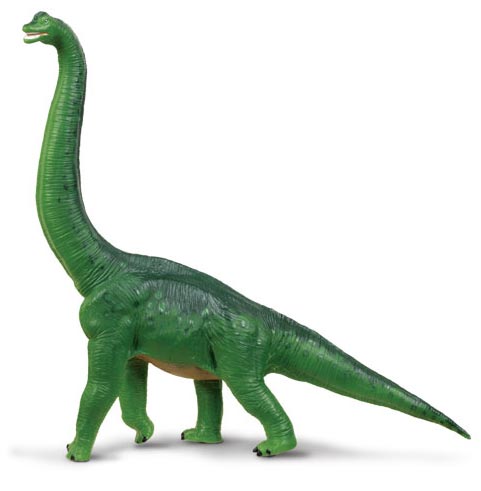
The Wild Safari Brachiosaurus dinosaur model (lateral view). The official model image from 2013.
In the early 20th century, extensive excavations in German East Africa (Tanzania), resulted in the collection of a large amount of brachiosaurid and other dinosaur fossil material. The German palaeontologist Werner Janensch, in 1914, compared the African fossils with Brachiosaurus fossil remains from North America and concluded that the African material represented the same genus. Janensch named two further species of Brachiosaurus – Brachiosaurus brancai and Brachiosaurus fraasi.
A Dinosaur Subgenus
The American palaeontologist Gregory S. Paul reconstructed the skeleton of Brachiosaurus brancai and highlighted several autapomorphies between these African fossils and B. altithorax. He still considered the Tanzanian material to represent Brachiosaurus but concluded that these fossils should be placed in a subgenus and proposed Brachiosaurus (Giraffatitan) brancai whilst designating the U. S. fossil material as Brachiosaurus (Brachiosaurus) altithorax.
Further revisions and studies from other scientists led to the realisation that the African brachiosaurid was generally more gracile with a different body shape when compared to Brachiosaurus altithorax. The tail of the African dinosaur was shorter and not as tall. In addition, Brachiosaurus altithorax had a dorsal vertebrae series that was 23% bigger than that associated with the Tanzanian material.
Over the last fifteen years or so, the genus Giraffatitan and the species G. brancai became more accepted by academics with most palaeontologists regarding the African fossils as distinct but representing a dinosaur that was closely related to the sauropod represented by the American material.
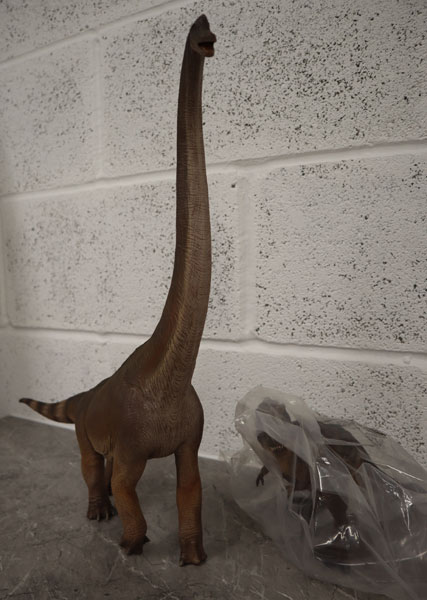
W-Dragon Giraffatitan Compared to a Papo standing T. rex dinosaur model. Picture credit: Everything Dinosaur.
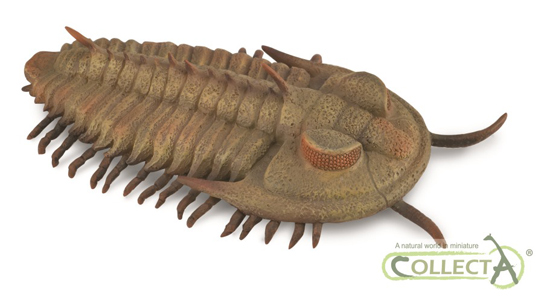
Everything Dinosaur team members received a request from a prehistoric animal model collector for more information about the invertebrate replicas included within the CollectA Age of Dinosaurs Popular model range. As always we were happy to oblige and emailed over further information, including some pictures of the CollectA trilobite model.
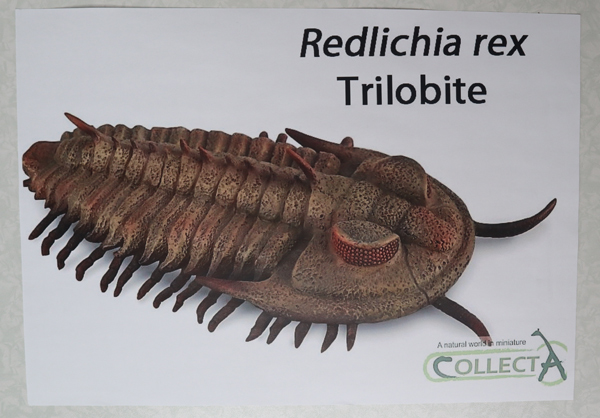
CollectA Redlichia rex trilobite model.
CollectA Age of Dinosaurs Popular Models
Over recent years, the design team at CollectA have added several replicas of extinct, iconic prehistoric invertebrates to their Age of Dinosaurs Popular range. For example, in 2020 CollectA added a trilobite replica to their product portfolio, a replica of the large, predatory trilobite called Redlichia rex.
Everything Dinosaur team members have prepared some images of CollectA invertebrate models including the CollectA Age of Dinosaurs Popular trilobite model (Redlichia rex). Picture credit: Everything Dinosaur.
Picture credit: Everything Dinosaur
CollectA Trilobite Model
Team members were happy to send over the additional information as requested. We are always pleased to hear from fellow model and figure collectors.
The fifth batch of frogspawn has been spotted in the office pond. The fresh spawn was spotted yesterday morning (8th March, 2023). Despite the wintry weather, with air temperatures dropping to near zero the frogs have continued to spawn. The night was cold and a small amount of ice formed over the pond. Team members will continue to monitor the office pond frogspawn.
The frogs (Common frogs), seem undeterred and have continued their spawning.
The 5th batch of frogspawn has been spotted in the Everything Dinosaur office pond. The frogspawn was laid on March 8th. Picture credit: Everything Dinosaur.
Picture credit: Everything Dinosaur
Frogspawn in the Office Pond
The first frogspawn was observed on the morning of the 28th of February. This is the earliest date in the year that we have seen frogspawn. Over the years, the date of the Common frogs (Rana temporaria) spawning has got earlier and earlier. A decade ago, frogspawn was normally observed around the third week of March. In 2022, frogs spawned on the 2nd of March. Our monitoring of the spawning dates suggests that the trend is for the frogs to breed earlier each year. Perhaps this is indicative of climate change and global warming.
A spokesperson from Everything Dinosaur, took a break from packing dinosaur and prehistoric animal themed orders for customers and stated:
“We try not to disturb the pond too much. However, we like to monitor the frogs to make sure all is well. As cold weather is forecast for the next two to three days, we have gently and carefully moved the spawn into deeper water to give the eggs some protection from the forecast cold snap.”
Potentially Delayed Hatching
The unseasonably cold temperatures with widespread snow likely to fall across the north-west of England could delay the hatching of the eggs. Everything Dinosaur team members think that the rate of development of the tadpoles is influenced by the water temperature. The pond water is likely to remain very cold for at least the next few days. This cold weather may slow the rate of hatching.
Team members promise to keep observing and taking steps to make sure that the pond wildlife is safe.
Today, March 8th is International Women’s Day (IWD), a day for celebrating and commemorating the social, economic, cultural, scientific and political achievements of women. This is a global event and many schools and colleges will be highlighting the contribution made by women, including in the field of scientific endeavour and business.
A collection of women scientists part of a poster montage spotted during a school visit. Celebrating International Women’s Day. Female scientists providing role models for the next generation. Picture credit: Everything Dinosaur.
Picture credit: Everything Dinosaur
International Women’s Day
Since the blog started, we have covered some remarkable stories that celebrate the contribution made to Earth Sciences by the next generation of academics and young scientists. We have also taken the opportunity to highlight the contribution to palaeontology and geology made by women who lived in less enlightened times.
For example, over the last few years we have followed the campaign to honour the pioneering early palaeontologist Mary Anning. Inspired by Evie Swire who wanted greater recognition in Lyme Regis of Mary Anning’s contribution to the Earth Sciences, a successful fund raising effort led to the erection of a statue of Mary Anning on the sea front.
A close-view of the statue of Mary Anning which was created by leading artist and sculptress Denise Dutton. Mary is holding an ammonite fossil in her left hand. Picture credit: Mary Anning Rocks.
Picture credit: Mary Anning Rocks
Designed by sculptor Denise Dutton, the bronze figure was unveiled in May 2022.