All about dinosaurs, fossils and prehistoric animals by Everything Dinosaur team members.

Reviews of products supplied by Everything Dinosaur. Product and gift reviews written by Everything Dinosaur team members.

14 04, 2012

A Review of the CollectA Kosmoceratops Dinosaur Model

By |2023-01-29T10:19:23+00:00April 14th, 2012|Categories: Dinosaur Fans, Product Reviews|0 Comments

CollectA Kosmoceratops Dinosaur Model Reviewed

Over the last three years or so there have been a number of remarkable horned dinosaur discoveries, many which have been found in the United States.  Dinosaur model manufacturers are beginning to catch up with the palaeontologists, producing replicas of the newly discovered dinosaurs.  CollectA have recently added a number of  new horned dinosaur models to their product range, one of which is a new model of the recently discovered ceratopsian known as Kosmoceratops.

The CollectA Kosmoceratops Dinosaur Model

A new horned dinosaur model from CollectA.

Picture credit: Everything Dinosaur

CollectA Kosmoceratops Dinosaur Model

The Kosmoceratops dinosaur model is painted mostly green and is a member of the Chasmosaurinae group of horned dinosaurs, although it is certainly not a typical member of the Chasmosaurinae.  Kosmoceratops (K. richardsoni) named after Scott Richardson, an amateur fossil collector who was helping to survey the area  when this dinosaur’s fossils were found, was formally named and described in 2010.  Fossils of this dinosaur have been found in the state of Utah (USA).  The discovery of Kosmoceratops  has helped scientists to establish two distinct Late Cretaceous dinosaur faunas on the landmass that formed part of western North America.

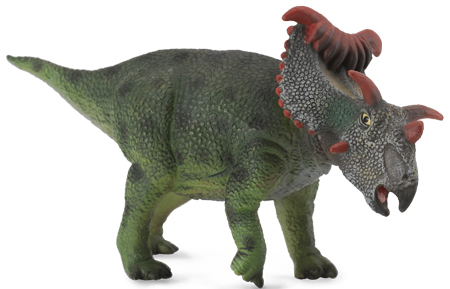
Painted a striking green the Kosmoceratops is certainly an eye-catching replica.  This is highly appropriate as although the neck frill and the skull is much smaller than when compared to another recently discovered horned dinosaur from Utah, Utahceratops, this dinosaur had one of the most ornate and highly decorated skulls and neck frills known to science.  Palaeontologists have estimated that there were at least fifteen horns or horn-like structures adorning Kosmoceratops.  Each of these lumps and bumps is painted an attention-grabbing, bright red and the large brow horns project sideways,  just like the horns of Utahceratops.  Why the brow horns on these two ceratopsians pointed out sideways remains a mystery.  They would not have been much use to repel a frontal attack from a large predator such as a tyrannosaur, perhaps the brow horns were used in fights amongst herd members to establish herd  hierarchies.

Palaeontologists have suggested that the brow horns and their sideways projection is reminiscent of extant buffalo who use their horns in wrestling contests with fellow herd members.  Perhaps Kosmoceratops locked horns with rivals in a similar fashion to help settle disputes within the herd.

To view Everything Dinosaur’s extensive range of dinosaur models: CollectA Horned Dinosaur Models and Replicas.

CollectA have built a good reputation amongst dinosaur model collectors for the quality of their dinosaur replicas.  It is also interesting to note that this company is prepared to produce models of lesser known dinosaurs such as Kosmoceratops and this is to be welcomed by dinosaur model collectors and dinosaur enthusiasts.  It certainly is an interesting addition to the range of CollectA dinosaurs.
13 04, 2012

A Review of the CollectA Miragaia Dinosaur Model

By |2023-01-29T10:17:12+00:00April 13th, 2012|Categories: Dinosaur Fans, Product Reviews|0 Comments

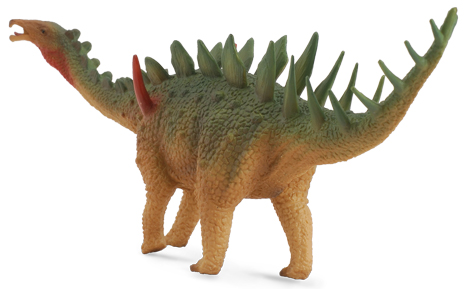
The CollectA Miragaia Dinosaur Model Reviewed

Team members at Everything Dinosaur provide a review of the CollectA Miragaia dinosaur model.

Fossils of European stegosaurs are very rare.  What fossil material that has been excavated provides evidence of a number of stegosaur genera from the Jurassic, but most of the specimens are incomplete and highly fragmented.  Little is known about the evolution of  the Thyreophora (armoured dinosaurs) in Europe.  However, over the last few years a number of better preserved and more complete stegosaur fossils have been discovered in western Portugal.  One of these recent fossil discoveries, that of a dinosaur that came to be known as Miragaia has inspired CollectA to make a replica of this armoured dinosaur.

CollectA Miragaia Dinosaur Model

In contrast to most other European stegosaur remains, much of the front part of the skeleton of this Late Jurassic stegosaur is known.  Paleontologists have excavated at least two specimens, one adult, one sub-adult from the same dig site in Upper Jurassic strata attributed to the Lourinhã Formation of western Portugal.  Elements of the skull have been discovered and from this scientists have been able to reconstruct this dinosaur.  CollectA, the dinosaur model makers, have used the scientific data to produce a colourful, not-to-scale dinosaur model of this Portuguese herbivore.

The New CollectA Miragaia Dinosaur Model

A European stegosaur – Miragaia.

Picture credit: Everything Dinosaur

Skull material includes the premaxilla, maxilla and the naris post elements that comprise the back of the skull.  Post cranial material comprises of shoulder bones, most of the front legs, neck bones and a number of armoured plates.  Miragaia seems to have had a remarkably long neck for a stegosaur.  It had an estimated fifteen cervical vertebrae (neck bones), more than long-necked sauropods such as Diplodocus and Apatosaurus.

The Miragaia Model

The Miragaia model from CollectA shows this long neck in fine detail. In fact the head and the neck make up about twenty-five percent of the length of the entire model.  Scientists have debated how flexible the neck of Miragaia was, ironically the plastic compound used to make this replica has left the model with a rather bendy neck, but this does not detract from the overall quality of the model.

The head is narrow and the front legs are smaller than the hind legs, a trait seen in most other stegosaur genera. The model has been painted light brown, with a red flash on the throat pouch. The armour plating and the tail spikes are painted in a dark green colour, mimicking the colouration of the top of the spine and down to the tail.  The model has two shoulder spikes, these are large, more than two centimetres in length and painted bright red.

To view Everything Dinosaur’s model range,  including Miragaia: CollectA Age of Dinosaurs Prehistoric Life Models.

The Miragaia dinosaur model has been given a rough skin texture, to give the impression that this dinosaur had large scales, with some dermal armour embedded along the flanks.  Scientists are not sure what the tail of this dinosaur was like.  There have been no fossils of the back-end of Miragaia found.  The model makers at CollectA have given their replica a row of spines running back from over the hips to the tip of the tail.

The model’s overall length is nineteen centimetres approximately and it is a welcome addition to the CollectA model range, one that will no doubt delight fans of stegosaurs.

29 03, 2012

New Papo Standing Tyrannosaurus rex (Green versus Brown – the Differences)

By |2024-04-23T07:27:35+01:00March 29th, 2012|Categories: Dinosaur Fans, Everything Dinosaur Products, Product Reviews|1 Comment

Outlining some of the Differences between the Two Papo Models

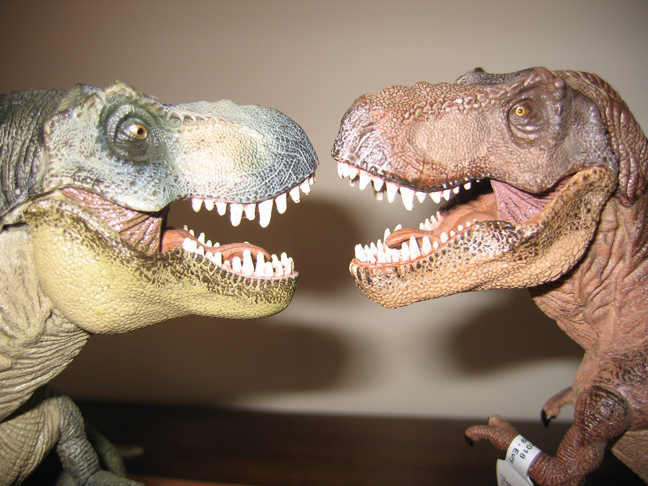
Team members at Everything Dinosaur were informed some time ago that the Papo green T. rex replica, part of the French manufacturer’s “Les Dinosaures” range would be replaced in what was termed a “running change”, the replacement would be a re-paint of the original model.  The new replica would be coloured brown.  No other changes to the figure were expected, but as these new brown coloured models have started to enter circulation, a number of keen-eyed collectors and dinosaur fans have identified some differences between these two models.

Papo T. rex Dinosaur Models

The Papo T. rex was one of the first dinosaur models introduced by the new management team at Papo (product code 55001), it is one of the company’s most popular replicas and it has been nick-named by several Everything Dinosaur staff as the “JP rex”, due to this model’s resemblance to the Tyrannosaurus rex seen in the first two films of the Jurassic Park trilogy.  It seems that the 2012 version (we call it simply the “brown T. rex“), has a different head.

Green T. rex and the Brown T. rex (spot the difference)

Spot the differences?

Picture credit: Everything Dinosaur

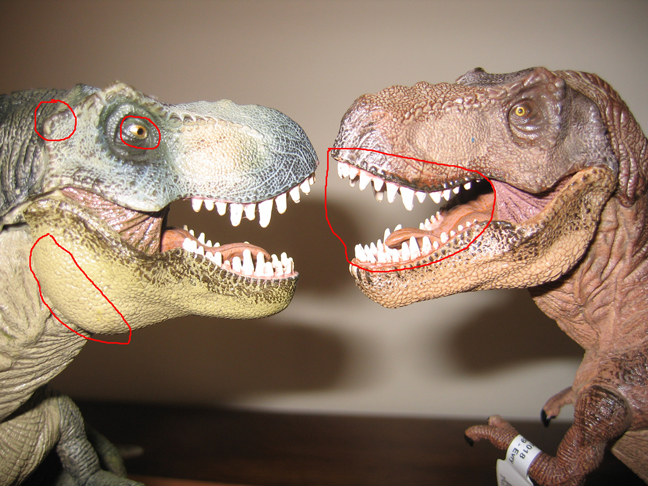
We are grateful to all the collectors and model enthusiasts who have contacted us with information about these two models, in the picture below we highlight some of the differences between these two dinosaur models.

Papo Green and Papo Brown T. rex Models Compared

Outlining some of the differences between the models.

Picture credit: Everything Dinosaur

T. rex Dinosaur Models

The eye of the brown T. rex (orbit) shows some subtle differences, it is more rounded in the new model when compared to the green T. rex, the eye socket is also reduced in size.  The sclera (yellow area of the eye) and the actual pupil are much smaller when compared to the older T. rex version.

Both models retain the articulated jaw but the teeth (dentition) in the new version are different, whilst not conforming exactly to the premaxilla, maxilla, dentary arrangement seen in Tyrannosaurus rex skeletons the new model does have slightly better moulded teeth which are less peg-like.

The lower jaw of the new, brown version of T. rex is leaner.  The bulk of the lower jaw seen in the older model is not there any more and as a result the lower jaw looks thinner.

In addition, the prominent ridge of bone around the squamosal at the back of the skull looks less angular in the new version of  T. rex.

Both models are good, well-crafted and immaculately painted, it is interesting to note these changes and we suspect there are one or two more subtle differences that we may have missed.

To view the range of Papo models: Papo Dinosaurs and Prehistoric Animal Toys.

28 03, 2012

A Review of the 1:40 Neovenator Dinosaur Model from CollectA

By |2023-01-29T07:44:09+00:00March 28th, 2012|Categories: Everything Dinosaur News and Updates, Everything Dinosaur Products, Product Reviews|0 Comments

“New Hunter” Dinosaur Model from CollectA – A Review

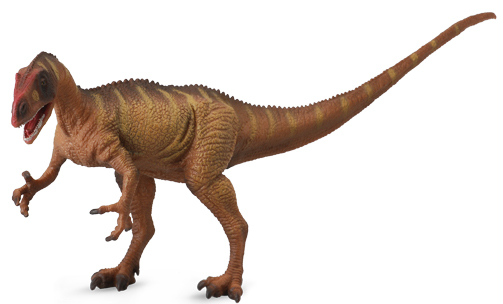
It is always a pleasure to see a new scale model of a meat-eating dinosaur introduced into the CollectA dinosaur model range and it is a treat to see a British prehistoric animal featured.  That is exactly what has happened with the launch of the CollectA 1:40 scale replica of Neovenator (New Hunter). Team members at Everything Dinosaur review the new CollectA Neovenator dinosaur model.

CollectA Neovenator Dinosaur Model

Known from a seventy percent complete skeleton excavated from a secret location on the Isle of Wight, (southern England) Neovenator is described as a basal member of the Carcharodontidae, although that is disputed by a number of scientists.  Although the holotype material is very complete, especially for a European, meat-eating dinosaur; as normally the fossilised bones of these theropods are extremely rare, the taxonomic picture is somewhat confused by the amount of potential Neovenator fossil material from the Wealden succession from the English mainland ascribed to Megalosaurus.

The 1:40 Scale Model of Neovenator (CollectA Dinosaurs)

CollectA scale model of Neovenator.

Picture credit: Everything Dinosaur

It certainly was an apex predator, stalking herds of Iguanodons and Hypsilophodons amongst the horsetail beds and seed ferns of what was a flood plain, criss-crossed by meandering rivers in the Early Cretaceous of western Europe.  Estimated to have reached lengths in excess of eight metres and weighing more than 1.5 Tonnes, Neovenator was a formidable predator.

A Formidable Predator

It probably had an “S-shaped” neck which supported a long, snout and jaws lined with sharp, re-curved teeth.  The lower jaw was quite delicate, whilst the muzzle was relatively large and robust.  The naris (nostrils) were particularly large and this suggests that this dinosaur had an acute sense of smell, perhaps it used this sense to “sniff” out potential prey amongst the dense vegetation of its lowland, flood plain home.  Relatively lightly built for its size, more than half the length of this animal is made up of a long muscular tail, it is thought that Neovenator may have been a speedy runner, perhaps hunting in packs to ambush and bring down slower moving large prey animals such as iguanodonts or even sauropods.  No actual arm bones or bones from the hand have been ascribed to this genus.  It is most likely that this meat-eating dinosaur had relatively short arms which ended in three-fingered hands, with each figure armed with a sharp claw.  Some interpretations of Neovenator give this dinosaur slightly larger forelimbs than seen in other replicas of dinosaurs that were in the clade Allosauridae.

To view Everything Dinosaur’s range of dinosaur models including the CollectA Age of Dinosaurs range: CollectA Dinosaur and Prehistoric Animal Figures.

The CollectA Neovenator model is well balanced and depicts Neovenator as a lightly built predator with relatively long forelimbs and a long tail.  The model is painted a light tan on the flanks, intertwined with darker strips down the back and the along the length of the tail.  In common with many models in the CollectA range this replica depicts Neovenator with its mouth open, perhaps it is just about to roar or attack an unsuspecting ornithopod.

The three-fingered hands are a little over-sized in relation to other 1:40 scale replicas in this series, we shall have to wait for more fossil discoveries before the accuracy of this aspect of the model can be determined.  The fingers on each hand are rather splayed out in a slightly unrealistic pose, but at least this gives the model makers the opportunity to show the enlarged second finger, an attribute of most members of the Allosauridae.

Measuring a little over twenty-seven centimetres in length and with a head height of eleven centimetres, we would estimate the scale to be approximately 1:35 (in comparison with the known fossil material).

This is an excellent model of a British meat-eating dinosaur, the figure even comes with a plastic model of a palaeontologist so that the scale of the dinosaur can be appreciated.

23 03, 2012

A Review of the CollectA Hypsilophodon Family Model

By |2023-01-29T07:26:53+00:00March 23rd, 2012|Categories: Everything Dinosaur News and Updates, Product Reviews|0 Comments

Hypsilophodon Model Reviewed

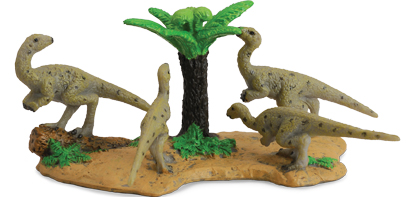
Hypsilophodon models are like buses, dinosaur model fans wait for ages for one to come along and then a model is launched that features four of these dinosaurs at once.  The new Hypsilophodon dinosaur model from CollectA features a group of these small, agile dinosaurs – a family group gathered around a tree fern feeding.  As far as we know, there is no official collective noun for a group of hypsilophodonts, here we shall use the term “flock”.  The flock consists of two larger animals probably adults and two smaller juveniles, all the models have been mounted on a small base, painted a sandy colour with flecks of green to present other types of Cretaceous vegetation.

Hypsilophodon Dinosaur Model

One of the adults, is perched on a fallen log, perhaps in recognition of early 20th Century pictures of this dinosaur which depicted Hypsilophodon as a tree-dwelling reptile.  Early reconstructions of this dinosaur, based on fossil material discovered on the Isle of Wight, showed Hypsilophodon to have grasping hands and feet.  Scientists thought these were adaptations to tree climbing and for many years, it was thought that this dinosaur was arboreal, a sort of prehistoric tree kangaroo.  This theory has largely fallen out of favour and hypsilophodonts are thought to be facultative bipeds that were highly cursorial and capable of startling bursts of speed.

The CollectA Hypsilophodon Family Group (CollectA Dinosaurs)

CollectA Hypsilophodon family group.

Picture credit: Everything Dinosaur

 Describing the size and the scale of this excellent replica, designer Anthony Beeson commented:

 “The Hypsilophodon group is about 1.50 inches high to the top of the new fern growth.  The figures themselves are around an inch in height for the adults but much smaller for the immature animals.   I wanted them to look in scale with the standard [CollectA] models.”

To view Everything Dinosaur’s dinosaur models including the CollectA Age of Dinosaurs model range: CollectA Age of Dinosaurs Models and Replicas.

One of the problems encountered when creating replicas of small, bipedal dinosaurs is how to make the models stable.  CollecA have cleverly overcome this problem by designing a dinosaur model replica on a base, providing a stable and secure platform, permitting the dinosaurs to be show in a natural, life-like pose.

The model measures approximately ten centimetres in width and it has been very well painted.  The adults and juveniles are depicted as agile dinosaurs with a light gray, scaly coat flecked with black dots, excellent camouflage as these creatures foraged in the undergrowth of Early Cretaceous forests.  The discovery of many fossils of this dinosaur in a single bone bed formation – known as the hypsilophodont beds (Isle of Wight); suggests that these little dinosaurs were probably highly social animals that lived in groups.  Being only two metres long, there was probably safety in numbers as these little ornithopods shared their Cretaceous environment with a number of large, predatory theropods.

This is a well designed and innovative model, an excellent representation of Hypsilophodon that we think will prove to be very popular with dinosaur enthusiasts and dinosaur model collectors.

19 03, 2012

The New Mapusaurus Makes Its Mark

By |2024-04-22T14:12:31+01:00March 19th, 2012|Categories: Dinosaur Fans, Everything Dinosaur Products, Product Reviews|4 Comments

CollectA Mapusaurus Dinosaur Model

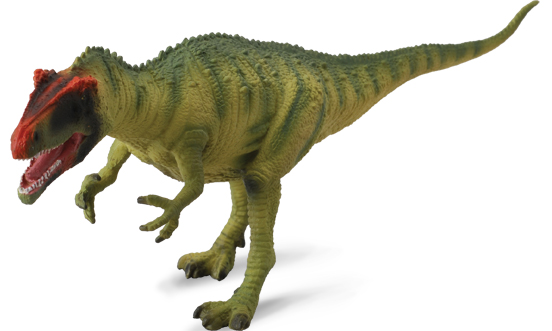
Originally thought to be a new discovery of G. carolini fossil remains, Mapusaurus (M. roseae) has struggled to get out from under the shadow of its larger, theropod cousin, however, a Mapusaurus model has been added to the CollectA model range  and this large carcharodontosaurid can take its place alongside other meat-eater replicas.  A CollectA Mapusaurus has been added to the Prehistoric Life model range.

Mapusaurus

Members of a joint Argentinian/Canadian scientific expedition discovered the remains of a gigantic meat-eating dinosaur in exposed rocks forming part of the Huincul Formation of central Argentina in 1997.  Subsequent excavations over the next four years uncovered the remains of at least seven theropod dinosaurs, representing fully grown individuals as well as immature specimens.  The excitement over the discovery and naming of the giant, carnivorous dinosaur Giganotosaurus which had been found in the same part of Argentina just a few years before, had hardly died down when these new fossils were found.  Initially, thought to be fossils of Giganotosaurus, a rigorous and thorough analysis of the skull material confirmed that this was a new meat-eating dinosaur discovery.  Mapusaurus  roseae was formally named and described by Rodolfo Coria and Phil Currie in 2006.

CollectA Mapusaurus

It is very exciting to see such a recently named and described dinosaur being featured in a model range.  However, given the extensive fossil material ascribed to this species, much more than most large theropods it is no surprise.  Mapusaurus was certainly an impressive animal, perhaps getting on for forty feet in length and weighing in at a hefty five/six tonnes, this dinosaur was an apex predator capable of bringing down the largest prey – even the mighty Argentinosaurus if enough of these meat-eaters attacked the same animal.

A Picture of the New CollectA Mapusaurus Model (CollectA Dinosaurs)

“Rose’s Earth Reptile” – Mapusaurus – a model of this South American theropod dinosaur.

The long, narrow snout of Mapusaurus (pronounced “mah-pus-sore-us”), distinguishes this meat-eating dinosaur from other super predators such as the later abelisaurids and tyrannosaurs.

Model Measurements

Measuring an impressive twenty-five centimetres in length and with a head held seven centimetres off the ground, this is one of the larger not-to-scale models currently offered by CollectA.   The model is painted a light green with darker stripes running from the backbone down the flanks and the hind limbs.  There is a splash of contrasting red on the snout and highlighting the two small crests that are placed directly over the eyes.  This dinosaur is posed with its mouth open and the small, fine teeth have been painted in well.  This model has been given a thick, muscular neck, not the typical “S” shaped neck of an allosaurid model. This feature when combined with the thick and heavy tail, tends to make the model look rather stiff.

The short arms are well depicted and collectors will be pleased to see that the three-fingered hands with their claws have been skilfully moulded by the design team.  Running along the spine there is a small, spiky crest that helps to give this dinosaur model a fearsome appearance.

Model collectors and dinosaur fans will appreciate the work that has gone into creating this replica.  Perhaps a Carcharodontosaurus is on the cards for next year.  Would you want a Carcharodontosaurus replica?

To view Everything Dinosaur’s dinosaur models currently in stock, including the CollectA model range: CollectA Prehistoric Life Models – Age of Dinosaurs.

16 03, 2012

A Review of the CollectA Dead Triceratops Model

By |2023-01-29T07:03:13+00:00March 16th, 2012|Categories: Dinosaur Fans, Product Reviews|2 Comments

CollectA Provide Realistic Model of a Dead Triceratops

Triceratops may be one of the best known dinosaurs.  Certainly, it is true that no dinosaur enthusiast’s model collection can be said to be complete without one or two horned dinosaurs, but CollectA have broken the mould (no pun intended) with the introduction of a new CollectA Triceratops replica but one that represents a dead dinosaur, a corpse that is being scavenged by a meat-eater.

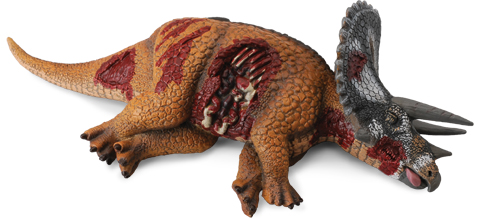
Model collectors can now have a dead Triceratops to use when creating their own prehistoric scenes, the model itself is very cleverly designed, on the reverse, the side that is placed downwards, there are no signs of injury to the beast.  However, on the other side, the side that faces upwards there are deep wounds and cuts present indications that this herbivore was attacked by a large predatory dinosaur, the implication being that it is a Tyrannosaurus rex.

The CollectA Dino Prey – Dead Triceratops

A dinner for a T. rex?

Picture credit: Everything Dinosaur

CollectA Triceratops Replica

The model measures eighteen centimetres long approximately and it is beautifully painted.  The neck shield is black with white patches and the body is mostly light brown, with a slightly lighter underside.  Running along the spine there is a darker band and over the rump the model makers have added a small crest of bristles.  Recent research has suggested that some of these ceratopsians (horned dinosaurs) had bristles running down their backs, a characteristic seen in more primitive, basal forms of this dinosaur clade – the psittacosaurs for example.

Now for the gory bits, the evidence of predation, the way in which the model gives the impression that this poor Triceratops has been attacked by a Tyrannosaurus rex.  Firstly on the right side of the neck frill there is a red coloured “U” shape.  The model makers have tried to give the impression that this is the bite mark of a tyrannosaur.  The fossil record provides evidence that T. rex did indeed attack the frill of Triceratops.  Whether or not these bite marks are the result of a predator attacking its prey, or whether they are evidence of feeding on a carcase is still debated by palaeontologists.  Our Triceratops corpse has more wounds along the jaw and the throat.  If this Triceratops had been attacked by a T. rex, then it could be speculated that the throat bites were the fatal bites.  Lovely detail on the model, even the pink tongue is lolling to the side of the mouth.

There is a large bite mark at the base of the tail, this could have been inflicted during the attack or it could be evidence of post-mortem feeding.  The body cavity has been partially opened with the ribs and part of the digestive tract visible.  In reality, many carnivores today, target the soft stomach area of their prey as this permits access to the highly nutritious organs such as the liver and provides the carnivore with an opportunity to open up the carcase permitting the consumption of as much meat as possible in a short time.

The Inspiration behind the new Triceratops Model

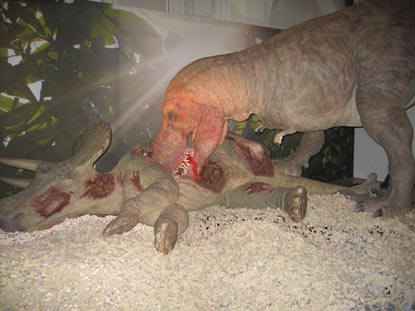
The inspiration behind the CollectA Dino Prey – Dead Triceratops?

Picture credit: Everything Dinosaur

There are also deep wounds to be seen on the top of the thigh, perhaps where a T. rex raked its prey as it was down with its strong hind legs, each foot armed with three powerful, forward facing claws.

This is certainly a thoughtfully crafted replica, one that will allow dinosaur scenes to have a sense of extra realism.  Model makers can now pose a Tyrannosaurus rex model standing over its Triceratops kill.

To view Everything Dinosaur’s model range that includes replicas of prehistoric animal carcases and corpses: CollectA Age of Dinosaurs Models and Figures.

14 03, 2012

A Review of the CollectA Utahceratops

By |2023-01-28T18:37:01+00:00March 14th, 2012|Categories: Dinosaur Fans, Everything Dinosaur News and Updates, Product Reviews|0 Comments

CollectA Utahceratops in Review

Horned dinosaur models are a bit like buses, you wait ages for one to come along and then several arrive altogether.  This is certainly the way with CollectA and the new CollectA Utahceratops model.  Hot on the heels of the Kosmoceratops model release comes this new replica of a ceratopsian.  It is apt that these two dinosaurs should be reviewed in close proximity as both these dinosaurs were found in the same rock strata – Kaiparowits Formation in Utah (United States) and they co-existed all those years ago in the Late Cretaceous.

CollectA Utahceratops Model

Utahceratops, (yet another dinosaur named after the state of Utah), that’s at least two that we can recall, the other being Utahraptor, was bigger than Kosmoceratops.  Scientists estimate that this horned dinosaur was around seven metres long when fully grown and it would have weighed as much as an Indian elephant.  This dinosaur is known from at least six individual specimens, including two partial skulls which when combined provide palaeontologists with an almost complete skull to study.  Like its contemporary, Kosmoceratops, this dinosaur was named and described in 2010.

The CollectA Utahceratops Dinosaur Model (Collecta Dinosaurs)

CollectA Utahceratops dinosaur figure.

Utahceratops Model Measurements

The model measures a fraction over twelve centimetres in length and the first impression is of the use of muted colours in the painting of the replica.  It is noted that the actual model has a different finish than the original pre-release publicity photographs of the replica.  In the earlier photographs the pattern on the extensive neck frill of Utahceratops was highlighted and brighter colours were used for the paintwork.  The model has a more muted tone, and this makes it look more realistic.

The unusual facial horns are well depicted.  The two larger horns, placed over the eyes point out sideways as revealed by the fossil evidence.  A crest just below each horn and directly above the eye has been painted a contrasting red colour by the designers.  The rest of the model is painted a light, sandy brown colour with a darker pigment used to mark out patterns on the large neck frill.  Along the limbs and across the flanks the model makers have added one or two lighter stripes, a subtle use of colour on the replica dinosaur figure.

To view Everything Dinosaur’s model range including the CollectA “Prehistoric Life” models and figures: CollectA Prehistoric Life Models and Figures.

As with all CollectA figures the detail is exceptional and we loved the finishing touch of the slight kink to the very end of the dinosaur’s tail, as if it was about to swish it.  It is interesting to note that with the plethora of horned dinosaurs being added to the CollectA range, war gamers and other role game players have been keen to get hold of these replicas to add to their fantasy model collections.  It seems that these beautiful, many horned dinosaurs are proving popular additions to the models used by fantasy war game hobbyists.

It is always a pleasure to see a new horned dinosaur figure and this Utahceratops keeps up the high standards set by CollectA.

13 03, 2012

A Review of the CollectA Kosmoceratops Model

By |2023-01-28T18:34:51+00:00March 13th, 2012|Categories: Everything Dinosaur News and Updates, Everything Dinosaur Products, Product Reviews|0 Comments

“Ornate Horned Dinosaur” Kosmoceratops gets Reviewed

With the discovery of so many new horned dinosaurs over the last three years or so, model manufacturers have had a job catching up.  However, with the introduction of the CollectA Kosmoceratops model, it seems that dinosaur models are once again the focus of attention.

CollectA Kosmoceratops Model

Kosmoceratops was formally named and described in 2010.  Its fossils have been found in Utah (United States), it shared its wooded, semi-arid environment with an even larger ceratopsian known as Utahceratops.  Both these dinosaurs lived at the end of the Cretaceous period.  Although the neck shield and the skull is smaller when compared to later members of this group, such as the famous horned dinosaur Triceratops, Kosmoceratops had the most ornate and decorated known.  There were at least fifteen horns or horn-like structures adorning the skull and neck crest.  Scott Richardson, an amateur fossil hunter, helping to map the geology of Utah discovered the first fossils of this dinosaur in 2006.   Further discoveries followed including an almost complete skull, ribs, vertebrae and elements of the pelvic girdle.

The CollectA Kosmoceratops Dinosaur Model

A dinosaur that was a bit of a show off.

Picture credit: Everything Dinosaur

The large brow horns stick out to the side, an unusual feature for a horned dinosaur, most of these creatures had horns that faced forwards.  It is unknown what functions these horns and the elaborate frill performed, perhaps they were used in ritual combat with other members of the herd to for a display device.

The CollectA Kosmoceratops model measures a little over 12 centimetres in length.  It has been estimated that a fully grown Kosmoceratops would have exceeded 4.5 metres in length.  This gives an approximate scale to this model of 1:360.

A Colourful Dinosaur Frill

The texture of the skin is quite rough, giving the impression of large body scales.  The frill is painted a dark green colour with the individual horns and bumps on the skull highlighted in a contrasting red hue.  The model makers have obviously sided with those scientists who believe that the ornate frill on Kosmoceratops was some sort of signalling device.  The majority of the model is painted in a green tint, with a lighter underside and generally becoming less dark towards the tail.  This Kosmoceratops replica has a quite stocky appearance, building on the scientific evidence from the fossilised pelvic bones and sturdy backbones that have been found.

This model shows lots of fine detail and it is bound to be popular amongst dinosaur fans and specialist model collectors who want to be kept up to date with the latest dinosaur discoveries.

To view the new CollectA model range: The CollectA Prehistoric Life Model Range.

5 03, 2012

Bullyland Museum Line Therizinosaurus Model Reviewed

By |2023-01-28T18:02:31+00:00March 5th, 2012|Categories: Dinosaur Fans, Everything Dinosaur Products, Product Reviews|0 Comments

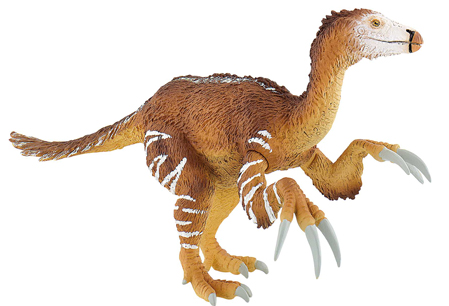
Bullyland’s Scythe Lizard – Therizinosaurus Replica Reviewed

Amongst the many new prehistoric animal model introductions in 2012 comes this replica of a Therizinosaurus (Scythe lizard) from Bullyland of Germany.  This company is well-known for its animal and figure models and for many years they have also produced a model range representing extinct creatures. The Bullyland Therizinosaurus model is an addition to their “Prehistoric World” product line.  It has articulated arms so the giant forelimbs with their huge claws can be moved up and down, permitting the model to be put into a number of different poses.

Therizinosaurs

The therizinosaurs, sometimes known as segnosaurs were a group of strange-looking theropod dinosaurs with long necks, stocky bodies, relatively short hind limbs but with massive forelimbs.  On each of their six fingers (three per hand) they had a huge, blade-like claw.  This claw, some of which measured more than a metre long are the largest claws known in the fossil record.

Scientists believe that although Therizinosaurus was descended from meat-eating dinosaurs, it and other therizinosaurs adapted to a plant-eating habit, becoming almost entirely vegetarian, browsing on leaves like a giant ground sloth.  The enormous claws were probably used to pull down branches so that this animal could slowly wander through its forest habitat pulling down branches so that leaves and fruit could be easily picked off by its slender jaws.

Therizinosaurus was formally named by the Russian palaeontologist Evgeny Aleksandrovich Maleev in 1954.  Although, this animal is still very poorly known due to the lack of fossils found to date, remains of smaller therizinosaur-like animals have been found and the reconstruction of Therizinosaurus in museums and by model makers is based on these remains.   Since other, smaller therizinosaurs may have been covered by downy feathers, scientists have assumed that Therizinosaurus may have sported a shaggy, feathery coat.

Bullyland Therizinosaurus Model

This new Bullyland Therizinosaurus model measures approximately 25 centimetres long, the head stands around 13 cm high.  Since palaeontologists estimate that Therizinosaurus was at least 10 metres long, this makes this model something like 1:40 scale, although the manufacturers normally state 1:30 scale for a model in their museum line range.

Bullyland Therizinosaurus Model

“Scythe Lizard” from Bullyland.

Picture credit: Everything Dinosaur

The model has the impression that it is covered in a coat of downy, proto-feathers, with longer quills present at the end of the tail and along the forearms – evidence for this arrangement has been found in the fossil record of other feathered dinosaurs.  They body is painted a dark, sandy brown, with a lighter, mustard yellow under belly.  The model has painted white stripes across the squat back legs and along the arms and shoulders.  Two rows of white markings can also be seen running along the back to the end of the tail.  Such a colouration would help to camouflage this large animal in the dappled sunlight of a forest in the same way that similar markings help to camouflage animals today such as  forest dwelling antelope and the Okapi, a large, herbivore often referred to as the “forest giraffe” due to its close taxonomic relationship to its tall-necked, grassland cousin.

Discreetly on the underside the manufacturer has stamped the Bullyland trademark, and stated the models name – Therizinosaurus as well as confirming their suggested scale size 1:30.  The head shows lots of detail, the large nostrils positioned forward on the snout, typical of a segnosaur.  The beak is prominent and the head is painted white to match the body markings.

The additional of articulated arms enabling dinosaur enthusiasts to position the great arms in a variety of poses gives this Therzinosaurus model extra play value.  A well-crafted replica of a bizarre Cretaceous dinosaur, well done Bullyland, this is another asset in their Museum Line model range.

To view Everything Dinosaurs model range, including Bullyland Museum Line replicas: Bullyland Prehistoric Animal Models and Replicas.

Go to Top