Papo Dilophosaurus Dinosaur Model – A Video Review
With the introduction of the second Papo prehistoric animal figure for 2014, it is time to get the camcorder out again and to produce a video review of this new addition to Everything Dinosaur’s range. In this short video, we reveal a surprise about this dinosaur model and comment on how this replica reflects the known Dilophosaurus fossil material.
Papo Dilophosaurus
Everything Dinosaur’s Video Review
Video credit: Everything Dinosaur
The video lasts for five minutes and ten seconds, we examine the model in a little more detail. Naturally, the Everything Dinosaur team members focus on those bizarre crests, after all, the name Dilophosaurus does mean “double crested lizard”. The pose of the model is discussed as is the colouration, on what is an excellent new addition to the Papo prehistoric animals model range.
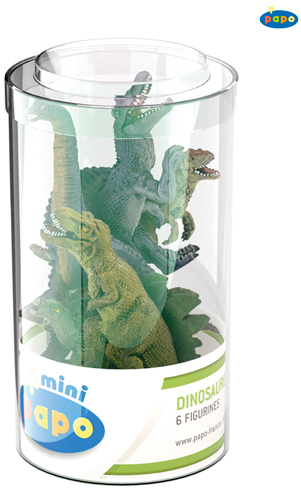
Papo, the France based figure and replica manufacturer, have for some time marketed a series of smaller models sold in tubs which mirror animals already included in the company’s larger model collections. In 2014, Papo have added a tub of mini dinosaur models to their portfolio and this is a review of that model set.
Papo Mini Dinosaurs
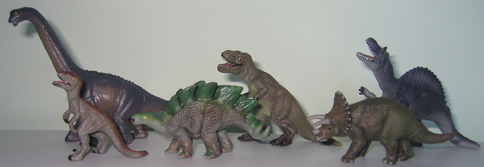
The tub of dinosaurs contains six figures, three herbivores and three carnivores. Namely, Triceratops, Stegosaurus, Brachiosaurus with the meat-eaters being Velociraptor, Spinosaurus and T. rex. It is not surprising that Papo have chosen these particular dinosaurs, firstly Papo already makes large models of these six members of the Dinosauria and secondly, in Everything Dinosaur’s annual prehistoric animal survey, all six dinosaurs regularly feature in the top ten.
To view the list of top ten prehistoric animals for 2013: Top Ten List.
The Papo Mini Dinosaurs Model Tub
A dinosaur model set that contains six figures.
Picture credit: Everything Dinosaur
The three theropods, that is the Velociraptor, the Tyrannosaurus rex and the Spinosaurus have been posed with their tails resting on the ground, what is termed a tripodal stance. Although tail drag marks have been preserved in the fossil record, it is very likely that these sorts of dinosaur held their tails out behind them. We think the stance is purely to help stabilise the models to make them easier to stand up, especially if being played with on a carpet for example.
We don’t think any of the models will win any awards for anatomical accuracy, they have been designed very much with the young dinosaur fan in mind and not the serious model collector but they are appealing and quite quirky and for anyone collecting the Papo prehistoric animal model range, they are a worthwhile addition.
The Papo Mini Dinosaurs Model Set
A dinosaur model set which features six prehistoric animals.
Picture credit: Everything Dinosaur
Although not to scale, there are a couple of points worth making. For example, the Velociraptor figure works well when used in any dioramas featuring the larger Papo dinosaur models.
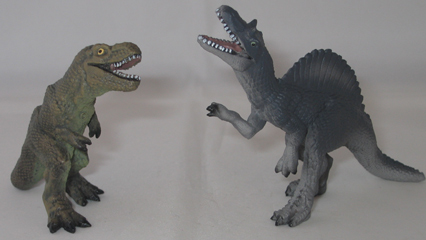
In addition, something that young dinosaur fans will approve of, is the fact that the Spinosaurus replica is larger than the T. rex model in this series. This reflects what is seen in the fossil record with Spinosaurus (S.aegyptiacus) regarded by many palaeontologists as the largest land carnivore of all time.
The Papo Mini Dinosaurs Tyrannosaurus rex and Spinosaurus Compared
Spinosaurus is just a little bigger than the T. rex figure.
Picture credit: Everything Dinosaur
The models measure in size from the diminutive Velociraptor which measures around 5 centimetres long to the Brachiosaurus which stands nearly 9 centimetres tall and is around 10 centimetres in length, the skin textures have been very well crafted and they are an ideal dinosaur model gift set for children from 3 years and upwards
Papo prehistoric animal models tend to have a characteristic look about them and we at Everything Dinosaur have long suspected that the design team at Papo have been heavily influenced by the look of the prehistoric animals featured in the Jurassic Park movie franchise. The colour of the Spinosaurus model reminded us of the Spinosaurus seen in Jurassic Park 3 and the look of the T. rex model brought to mind the final scene in the first Jurassic Park film when the T. rex knocks the Jurassic Park banner to the ground.
One thing about these small models, is that they can always be used to represent babies when shown next to the larger models in the Papo model range.
The Baby Stegosaurus (Mini Dinosaurs) and the Papo Stegosaurus Dinosaur Model
An adult and baby Stegosaurus perhaps?
Picture credit: Everything Dinosaur
This is an excellent dinosaur model play set, one that is a welcome addition to the Papo prehistoric animal series.
One of the new additions to the Schleich World of History model series for 2014, the only horned dinosaur to be added this year, is this colourful model of the ceratopsid known as Pentaceratops (P. sternbergii). In this short dinosaur model review, we will discuss this replica, the fossil evidence and compare the Pentaceratops replica to the Triceratops model also made by Schleich which was introduced back in 2012.
Schleich Pentaceratops Dinosaur Model
The first fossils of Pentaceratops were discovered in 1921 by the famous American palaeontologist Charles Hazelius Sternberg as the Upper Cretaceous sedimentary strata of the south-western United States was being mapped. Pentaceratops was named and scientifically described in 1923, by Henry Fairfield Osborn, the same palaeontologist who named Tyrannosaurus rex back in 1905.
Pentaceratops had a very elongated and relatively narrow head shield when compared to other chasmosaurine dinosaurs such as the distantly related Triceratops (T. horridus). This feature has been very well recreated by the design team at Schleich and the detailing is superb, although the model shows little evidence of the large parietal fenestrae, the pair of substantial, skin covered holes that were located towards the top of the head crest.
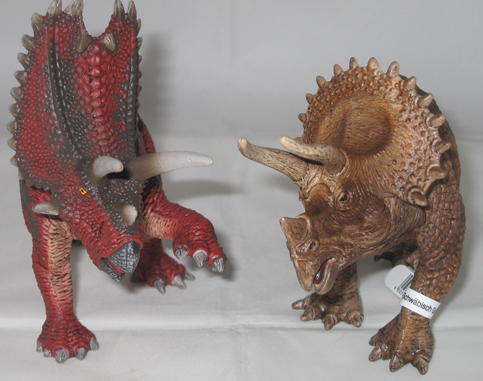
The Schleich Pentaceratops Compared to the Schleich Triceratops Dinosaur Model
Pentaceratops model is on the left. Picture credit: Everything Dinosaur.
Picture credit: Everything Dinosaur
The Size of the Skull
Many articles published on Pentaceratops refer to the size of the skull, which was certainly very big. It had been thought that this dinosaur possessed the biggest skull of any terrestrial vertebrate, although many larger specimens once ascribed to Pentaceratops, have been reassigned to a new dinosaur genus, Titanoceratops which was established in 2011.
The lines between these two genera remain a little blurred, although there is plenty of fossil material to study, much of the skull material related to Pentaceratops from the Fruitland and Kirtland Formations of New Mexico and Colorado is crushed and distorted so definitive classification is somewhat hazardous.
Pentaceratops means “five horned face”, this is a bit of a misnomer, as this dinosaur did not have five horns. The jugal bone, the bone over the cheek area of the skull, was prominent and came to a point. The cheek bones may have been covered by horny outgrowths so when viewed from the front, it would look like this dinosaur did indeed have five horns.
An Anterior (view from the front) of Pentaceratops compared to Triceratops
One of the enlarged jugal bones with a horny sheath on it can be clearly seen on the Pentaceratops model (cheek area, under the eye). Picture credit: Everything Dinosaur.
Picture credit: Everything Dinosaur
The horn configuration was the same as the better known Triceratops, the Schleich World of History Triceratops which can be seen adjacent to the Pentaceratops model illustrates this point nicely. Both dinosaurs had long forward facing brow horns, with a shorter nasal horn. Pentaceratops was smaller than the largest species of Triceratops and it also had a shorter tail, these details can clearly be seen when the two Schleich models are compared. Although smaller than the largest species of Triceratops known (T. horridus), scientists estimate that this Late Cretaceous herbivore may have weighed in excess of 3,000 kilogrammes.
Based on an adult Pentaceratops reaching a length of around 6.3 metres, we estimate that this figure is in approximately 1:37 scale as this Schleich replica measures a little over seventeen centimetres in length. The model has been very well painted and the skin texture with its irregular sized scales and folds of skin, particularly on the underside of the neck, has been rendered with a great deal of care and attention.
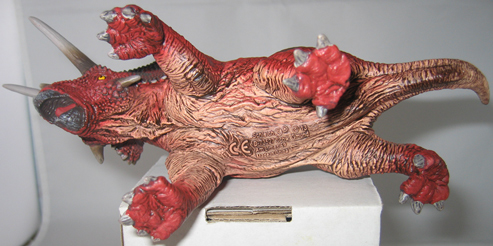
A View of the Underside of the Schleich Pentaceratops
The detail on the underside of the Schleich Pentaceratops. Picture credit: Everything Dinosaur.
Picture credit: Everything Dinosaur
The picture above shows the fine detail on the underside of the Schleich Pentaceratops dinosaur model. Note the folds of loose skin underneath the neck and the texture on the underside of the short, stubby tail.
This dinosaur is posed with one front foot off the ground, quite an unusual stance for a prehistoric animal model. The correct number of digits have been added, five on the front feet, with four toes on the hind feet, the red colouration makes this replica stand out, although we suspect that since the Pentaceratops name is not reproduced on the underside of the model, (see picture above), less well informed dinosaur fans and model collectors could end up referring to this as another Triceratops replica.
Everything Dinosaur provides a fact sheet on Pentaceratops with each model that we sell, hopefully this will help clear up any confusion that may arise.
Pentaceratops and the other models in the Schleich World of History range are available from Everything Dinosaur, the UK based retailer of dinosaur models, toys and games that is staffed by parents, teachers and real dinosaur experts.
A Video Review of the Bullyland Lambeosaurus Dinosaur Model
Duck-billed dinosaurs had been relatively under represented in the Bullyland range of prehistoric animals. In fact, Everything Dinosaur team members had trouble remembering what duck-billed dinosaur models this German manufacturer had made in the past. There used to be a Parasaurolophus in the range, but the last version of this model, a lovely replica with a bright orange crest was retired a few years ago, so it is refreshing to see the name sake of the lambeosaurines stepping into the spotlight as Bullyland added a Lambeosaurus to their Museum Line series.
Museum Line Lambeosaurus
In this short video review, we take a look at this new for 2014 replica, comment on the fossil evidence and naturally, we discuss that wonderful head crest.
Everything Dinosaur’s Review of the Bullyland Museum Line Lambeosaurus
Video credit: Everything Dinosaur
The video is 5 minutes, 33 seconds long, it gives viewers a little more information about this dinosaur, where it lived and how difficult it is to classify lambeosaurine fossil material.
A Review of the Light Green, 2014 Schleich T. rex Dinosaur Model
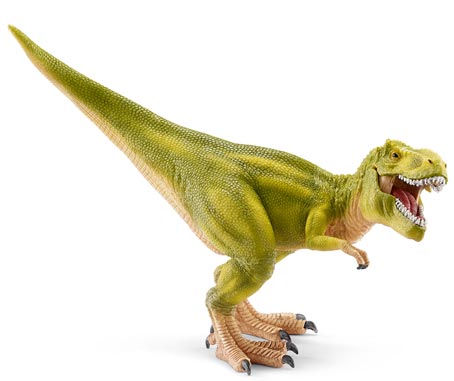
One of the first of the 2014 Schleich World of History dinosaurs to be reviewed by team members at Everything Dinosaur is the new, light green T. rex figure from the German manufacturer. Schleich have made a number of replicas of what is perhaps the most famous dinosaur of all and this new addition to their prehistoric animal model range is bound to prove popular with young dinosaur fans.
Schleich T. rex Dinosaur Model
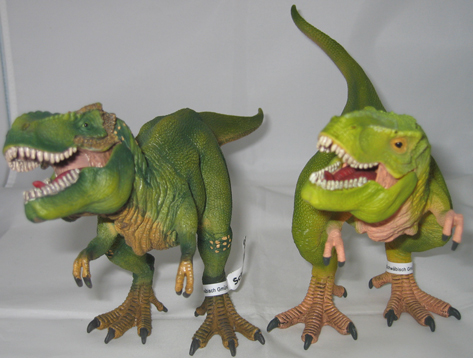
This is the second, large-sized Tyrannosaurus rex model in the World of History series, when compared to the 2012 T. rex, this model is fractionally smaller, the earlier model measuring around 28 centimetres from nose to tail, whilst the 2014 Tyrannosaurus rex measures about 27 centimetres in length. Apart from the obvious colour difference, the actual pose is slightly different with the head turned more to the left and the slightly longer tail is raised upwards.
A Comparison Between the 2014 T. rex (right) with the Schleich 2012 T. rex (left)
2012 version on left with the 2014 version on right. Picture credit: Everything Dinosaur.
Picture credit: Everything Dinosaur
Articulated Lower Jaw
As with the earlier T. rex model, the lower jaw is articulated, so this dinosaur can be posed with its mouth open or closed, or indeed posed in any position in between. When the jaws are opened, the care attention taken over the painting of the mouth area by the artists at Schleich can be clearly seen.
Schleich Tyrannosaurus rex has an Articulated Lower Jaw
A moveable lower jaw on this T. rex dinosaur model.
The model is very well balanced and it is ideal for creative play, although as with the majority of the Schleich dinosaur replicas that represent bipeds, the hind feet are a little oversized. The large feet permit this dinosaur model to be posed with the tail raised off the ground, the anatomically correct position. It seems that Schleich have had to trade off having slightly bigger feet on their meat-eating dinosaur models against being able to portray them in more dynamic poses.
Examining the Skin Texture
The texture of the skin with its scales and skin folds has been beautifully rendered. There is a lot of fine skin detail to admire, even individual rounded scales along the flank can be picked out. The level of detail is also reflected on the underside of the model, an area of some replicas often neglected, but this is not the case with this new Schleich T. rex.
The skull is particularly well modelled with individual wrinkles around the nostrils depicted along with accurate representations of the skull morphology complete with its fenestrae and lumps and bumps. Intriguingly, this dinosaur’s eye is black, with no obviously definition such as an iris. This gives this T. rex quite a menacing, frightening look, especially when light reflects off the highly glossy black paint of the eye to give the impression of a white pupil.
As this replica measures approximately 27 centimetres in length, by our estimates this makes this particular model something like 1:50 scale. The model is very robust, it almost has a waxy feel to it and it would be a great T.rex model to encourage creative, imaginative play.
These two World of History T. rex models work well together, perhaps the bigger figure could represent a larger, mature female and the slightly smaller, light green model a male, her mate. For scientists believe that, just like many of today’s birds, female T. rexes were bigger than the males. Here is another opportunity for model collectors and dinosaur fans to acquire another interpretation of Tyrannosaurus rex and there is a lot to commend this particular Schleich replica. Everything Dinosaur even includes a T. rex fact sheet that we send out with all our sales of Tyrannosaurus rex dinosaur models.
This review is of the new for 2014 Bullyland Lambeosaurus model, part of the company’s Museum Line prehistoric animal model range. This is the only duck-billed dinosaur model currently available from this German manufacturer and this replica has a lot to commend it.
Lambeosaurus
Lambeosaurus is one of the better known genera of hadrosaurid dinosaurs and substantial fossil remains ascribed to the lambeosaur family have been found. All the fossils discovered to date and related to this genus, come from North America. In most circumstances, it is the lack of fossil material that gives palaeontologists problems when it comes to describing a new dinosaur species and working out where it fits into the dinosaur family tree.
Lambeosaurus is an exception to this, as the amount of fossil material discovered has led to considerable confusion with regards to this dinosaur and to the number of species of Lambeosaurus there might have been and how closely related it is to other crested duck-billed dinosaurs.
The Bullyland Lambeosaurus Dinosaur Model
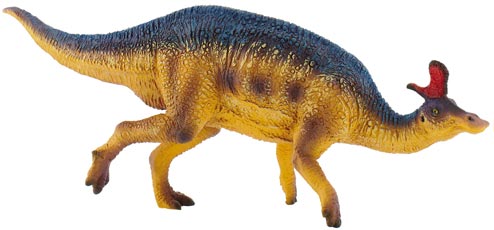
New interpretation of Lambe’s lizard.
Picture credit: Everything Dinosaur
“Hatchet-like” Crests
As these animals grew and developed, so the size and the shape of that famous “hatchet-like” crest changed. There may also have been differences in the crest morphology between males and females. Defining what is actually a species of Lambeosaurus is therefore a bit tricky, however, something like three species are currently recognised and the geographical range of the fossil finds suggests that these types of duck-billed dinosaur lived all along the western part of North America, from Alberta (Canada), in the north, down to New Mexico in the south.
Bullyland Lambeosaurus Dinosaur Model
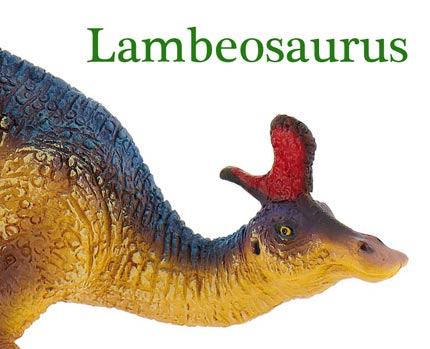
The Bullyland Lambeosaurus is very well painted and there is lots of detail to admire. The hatchet crest has a bumpy, roughened texture and it is painted bright red with a brown/black border. The size and shape of the crest suggests that this model represents one of the larger species of Lambeosaurus currently recognised and that the model is a male. The ears and nostrils can be clearly seen, little details often overlooked with inferior models.
The replica is roughly in proportion to the known fossil material and the striking blue stripe running down the model gives this Lambeosaurus a certain flamboyance. The model makers have done a lot of work on the skin texture with some raised dermal scutes and smaller scales, these reflect what is known about Lambeosaurus as impressions of fossilised skin have been found. The figure measures around twenty-six centimetres in length and based on a comparison with the fossil material associated with one of the bigger Lambeosaurs, Lambeosaurus magnicristatus, we estimate that the figure is in approximately 1:27 scale. It is posed in quite a dynamic, active stance with the tail held out straight behind the body, to give the impression of movement.
A Close up of the “Hatchet Shaped” Crest
The body and the crest of this dinosaur have been given an authentic roughened texture.
The Bullyland design team have taken care to depict the digits of this dinosaur. A characteristic of the hadrosaurids is that the fingers of the hand on the front limbs were often united, connected by skin to form a fleshy pad, whilst the toes of the hind feet could be more splayed. It is this webbing between the fingers of the hands of this dinosaur that helped give weight to the early hypothesis that these herbivores were largely aquatic.
The model with its Front Digits United to Form a Fleshy Pad
The Museum Line Lambeosaurus with an Everything Dinosaur fact sheet. Picture credit: Everything Dinosaur.
There is much to be admired about this latest interpretation of a Lambeosaurus from Bullyland. The model’s bright colours and dynamic pose are likely to make it a favourite amongst collectors and dinosaur fans.
A Video Review of the 2014 Schleich Pentaceratops Dinosaur Model
The colourful Schleich Pentaceratops dinosaur model gets the Everything Dinosaur video treatment. In this short video review, (five minutes and forty-two seconds), team members discuss the model, compare it to the Schleich Triceratops replica that came out in 2012 and talk about Pentaceratops fossil finds.
Schleich Pentaceratops Dinosaur Model
Everything Dinosaur’s Video Review of the Schleich Pentaceratops Dinosaur Model
Video credit: Everything Dinosaur
Titanoceratops (Titanoceratops ouranos) even gets a mention.
It may be more than ninety years since the first fossils of Pentaceratops were discovered in New Mexico, but there is a lot of fossil material from the San Juan basin ascribed to Pentaceratops that requires further research and study. It is also possible that in many of the burlap and plaster wrapped specimens that lie in the vaults of museums there may be other species of ceratopsid awaiting discovery.
Schleich Light Green Tyrannosaurus rex Video Review
The new for 2014 Schleich light green Tyrannosaurus rex is the first of the new Schleich dinosaurs to have a a video review created for it. Team members at Everything Dinosaur have enthusiastically plotted the progress of the four new models scheduled for introduction this year by Schleich into their “World of History” series. It is our intention to produce reviews for all the new models, but the T. rex replica is a very good place to start.
Tyrannosaurus rex Model
There are a total of three tyrannosaurs currently made by Schleich, two within the larger model series and a third, smaller model in what was called “die kleinen Dinos” by our German friends. As with all prehistoric animal model manufacturers, T. rex tends to act as a flagship model for the factory, after all, it is the one dinosaur replica that is made by all the model manufacturers and the new, light green Tyrannosaurus rex from Schleich stands up very well to scrutiny.
The Light Green Tyrannosaurus rex Model (Schleich)
T. rex (Schleich 2014).
A Video Review by Everything Dinosaur
It is a very tactile model, has lots of detail and the articulated lower jaw is bound to make it very popular amongst young dinosaur fans. The five minute video review discusses some of the features of this new replica and compares it to the 2012 tyrannosaur model introduced by Schleich when their revamped prehistoric animal model range “Urzeittiere Dinosaurier”, this translates as prehistoric animals – dinosaurs, first came out.
Everything Dinosaur’s Video Review of the Light Green T. rex (Schleich)
Video credit: Everything Dinosaur
In this short video, we look at the possibility of making this new T. rex model the male in a pair of tyrannosaurs with the slightly larger, dark green, 2012 T. rex being the female. There is evidence to suggest that the females were larger than the males. The fossil record from locations such as the the Hell Creek Formation of the western United States indicates two forms of Late Cretaceous tyrannosaur, a robust form and a gracile form. Could this fossil material represent differences between boys and girls just as we see today with some species of birds?
The females may have been bigger as they required wider hips to permit the storage and passage of eggs. Females in many different types of animal tend to be bigger than the males, In tyrannosaur circles, could the girls have ruled the roost? For the moment, the fossil evidence poses this intriguing question finding definitive proof is somewhat tricky, however, thanks to Schleich at least dinosaur fans and model collectors can create their own family of tyrannosaurs.
A Review of the CollectA Ichthyovenator Dinosaur Model
Over the last decade or so, palaeontologists have begun to realise that the spinosaurs were a very geographically widespread group of theropod dinosaurs. Fossils have been found in South America, Africa, Europe and there has even been fragmentary remains assigned to spinosaurids found in Australia.
When the fossils of Ichthyovenator were discovered by a French led, scientific expedition to the Savannakhet Basin of south, central Laos in 2010, they represented the first definitive spinosaurid fossil material to have been found in the whole of Asia.
CollectA Ichthyovenator Dinosaur Model
Ichthyovenator is known from an individual specimen, all the fossil bones assigned to this new genus of carnivorous dinosaur were found in a single stone block, about two metres square. The fossils consist of two dorsal vertebrae (backbones), five partially articulated sacral vertebrae (back-bones over the hips), two tail bones, elements from the hips themselves and a single rib.
No skull material was found so CollectA have modelled the head of ichthyovenator on better known spinosaurs such as Suchomimus. The head on the dinosaur model is typical for a spinosaur, the snout is long and narrow and there is a distinctive hook in the front portion of the upper jaw.
Asian Spinosaurid
As well as being the first definitive spinosaur from Asia, Ichthyovenator is the first to be described that had two sail-like structures running along its back. The two dorsal vertebrae, numbers 12 and 13 are adjacent to hip area, dorsal vertebrae 12 is tall and fan shaped, it is believed to have supported a sail that ran from just before the hips down to the shoulder. The first sacral vertebra is less than 50% of the size of dorsal vertebra number 13, it is very much reduced, so it could not have supported a sail-like structure, the sacral vertebrae posterior to it are much larger and the sacral vertebrae numbers 3 and 4 are fan shaped just like dorsal vertebra number 12. This suggests that a second “sail” ran from over the hips down to the base of the tail.
The CollectA Ichthyovenator Dinosaur Model
The first mainstream model available of this bizarre dinosaur.
Picture credit: Everything Dinosaur
Reviewing the CollectA Model
In essence, based on the fossil evidence, Ichthyovenator seems to have U-shaped notch in the middle of its back. The model shows these bizarre sails in fine detail. The sails have been tipped with large scales and there is a row of spines running parallel to the sails on each side of the model. There are also prominent projections on the thigh. These projections, in combination with the triangular spines on the tail give this dinosaur a very crocodile-like appearance.
The model measures a fraction under eighteen centimetres in length. No one knows for sure how big Ichthyovenator (I. laosensis) was but it has been estimated to have been between seven and a half and nine metres in length. This makes this model to be around the 1:42 to 1:50 scale size. Ichthyovenator could have weighed as much as two and half tonnes.
CollectA have decided to put their Ichthyovenator model onto a base. This gives the model stability, allows the feet to be moulded in proportion to the rest of the dinosaur’s body and in this case, it gives a hint at where the animal might have lived. The feet are sunk into the base, to give the impression of the dinosaur standing on soft mud, the base even has claw marks and a fragment of a leaf. It is thought that Ichthyovenator hunted for fish on the banks of large rivers that criss-crossed Laos in the Early Cretaceous.
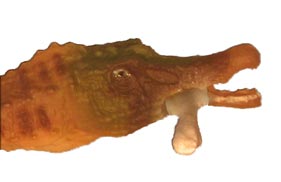
Ichthyovenator even has a small fish in its mouth, to reinforce the idea of this dinosaur being closely related to other fish-eating dinosaurs such as Suchomimus and Baryonyx. It is appropriate for the CollectA dinosaur model to show this, after all, the name of this dinosaur translates as “Fish Hunter from Laos”.
A Close up Showing the Fish in the Mouth of Ichthyovenator
This is a beautifully crafted, hand-painted replica of Ichthyovenator, a dinosaur that was only named and scientifically described two years ago. It is an exciting addition to the CollectA range of dinosaur models.
Everything Dinosaur Reviews the CollectA Xenoceratops
The prehistoric animal model manufacturer called CollectA have produced a number of horned dinosaur models over recent years and in 2014 they have introduced a replica of the bizarre Xenoceratops, a horned dinosaur that is distantly related to the better known Styracosaurus and Pachyrhinosaurus.
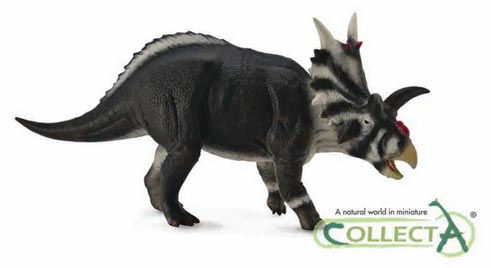
This dinosaur is known only from fragmentary skull material representing at least 3 individual animals found in Upper Cretaceous strata in south-western Alberta, the rest of the animal has been modelled on more complete fossil material. CollectA have chosen to give their replica a very striking paint job, with a black body contrasting with a lighter coloured underside and white strips on the head crest standing out against flashes of blood red located on the nasal bone and on the top of the neck frill.
CollectA Xenoceratops
The CollectA Xenoceratops Dinosaur Model
The dinosaur with “alien” headgear. The CollectA Xenoceratops dinosaur model.
Note that Xenoceratops has been give a line of bristle-like protrusions running along the top of the hips to the base of the tail. Palaeontologists have uncovered evidence to suggest that some Late Cretaceous horned dinosaurs may have had bristles or quills on their rumps. If they had such structures, then there purpose remains unclear, perhaps they were brightly coloured and used in visual communication between members of the herd.
If viewed from the side, the bristles may have made this herbivore look bigger than it actually was, a deterrent to an attacking tyrannosaur. Or indeed, it has even been suggested that the structures were made up of sharp spines that could protect the hip area from attack, it has even been proposed that these spines were tipped with poison.
The model measures approximately thirteen and a half centimetres long and the tip of those impressive, white horns on the top of the frill are about seven centimetres off the ground. Although it is difficult to conclusively gauge the size of this dinosaur based on the fossil record, we estimate that this model is in approximately 1:44 scale based on an adult Xenoceratops being around six metres in length.
The bizarre horns and neck shield of this dinosaur are very well recreated by CollectA. It did have a spectacular frill with two huge horns sticking out of the top of the neck frill and two large, sideways pointing horns positioned over the eyes. Analysis of a partial, right nasal bone suggests that this dinosaur may also have possessed another horn on the tip of its nose, this is not shown in the model but the base, the boss, is painted a bright red colour.
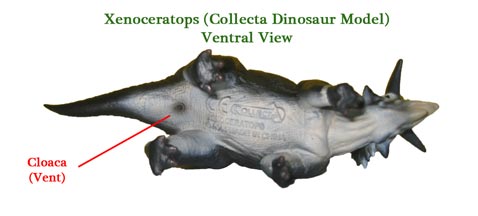
One area of a dinosaur model, often overlooked is the cloaca or vent, the posterior opening of the animal. Collecta have made sure that their Xenoceratops has a very obvious vent and the model shows lots of nice detail on the underside. Note the correct number of fingers and toes, again CollectA taking the time and trouble to make sure that the replica is anatomically correct.
View of the Underside of the CollectA Xenoceratops Dinosaur Model
Excellent detail on the underside of the dinosaur model.
Picture credit: Everything Dinosaur
This is an excellent addition to the CollectA range of prehistoric animal models, this is, after all, a replica of a dinosaur that itself was only named and described less than two years ago.