All about dinosaurs, fossils and prehistoric animals by Everything Dinosaur team members.

Pictures of fossils, fossil hunting trips, fossil sites and photographs relating to fossil hunting and fossil finds.

14 12, 2019

A New Basal Allosauroid from Argentina

By |2024-01-06T15:31:34+00:00December 14th, 2019|Categories: Dinosaur and Prehistoric Animal News Stories, Dinosaur Fans, Main Page, Photos/Pictures of Fossils|2 Comments

Asfaltovenator vialidadi – Linking Megalosaurs and Allosaurs

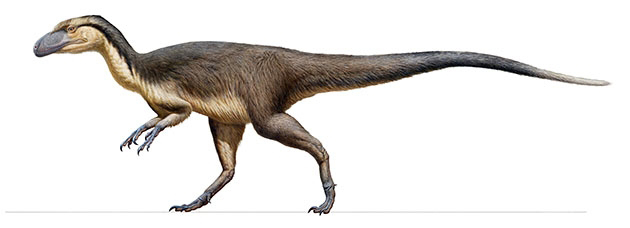
This week has seen the formal publication of a scientific paper announcing the discovery of a new type of meat-eating dinosaur from Chubut Province in the Patagonia of Argentina.  This dinosaur named Asfaltovenator vialidadi shows a range of anatomical characteristics which are similar to both Allosaurs and Megalosaurs and whilst it poses a bit of a phylogenetic puzzle when it comes to classifying tetanuran theropods (stiff tails), it does suggest that the Allosauroidea  and Megalosauroidea have a common ancestor.

A Life Reconstruction of the Newly Described Asfaltovenator vialidadi
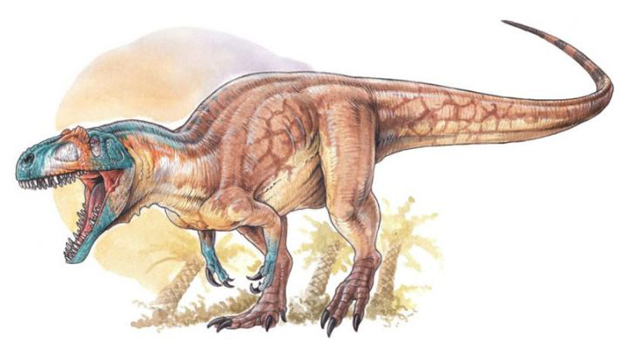
Asfaltovenator illustration.
Asfaltovenator life reconstruction.

Picture credit: Gabriel Lio/Conicet

Predator of Patagonia Around 175 to 170 Million Years Ago

Discovered back in 2002, from lacustrine deposits (sediments from an ancient lakebed), located about a mile north-east of the village of Cerro Cóndor (Patagonia), the fossil material consists of most of the front portion of the skeleton, including a well-preserved skull.  The genus name honours the geological formation from whence it came, the Cañadón Asfalto Formation and the word “venator” from the Latin for hunter.  The trivial epithet honours the Administración de Vialidad Provincial of Chubut and the Dirección Nacional de Vialidad, for their help with field expeditions of the Museo Paleontológico Egidio Feruglio.

Dating the deposits associated with the Cañadón Asfalto Formation has proved difficult.  Isotope analysis using material from volcanic ash layers has yielded varying results, but in the paper published in the academic journal “Scientific Reports”, the age of the strata associated with this fossil find is stated as late Toarcian to Bajocian, indicating that this predatory dinosaur roamed Gondwana around 175 to 170 million years ago.

Views of the Skull and Jaws of Asfaltovenator with Line Drawings

Skull and jaws of Asfaltovenator with accompanyin line drawings.
Cranial anatomy of Asfaltovenator vialidadi, MPEF PV 3440.  (A) composite reconstruction of the skull and lower jaws, based on disarticulated cranial elements.  (B), graphic reconstruction of articulated skull.  (C), braincase in occipital view.  (D,E) posterior end of left mandible in dorsal view; (D) photo; (E) outline drawing.  Note scale bar (A,B and C) is 10 cm, scale bar (D, E) is 5 cm.

Picture credit: Scientific Reports

The skull is estimated to be around 80 cm in length and the overall body size of Asfaltovenator is estimated at between seven to eight metres in length.

A Tweak to the Tetanurae

Asfaltovenator demonstrates an unusual combination of anatomical characteristics.  Its discovery could have implications for the way in which palaeontologists arrange the family tree of meat-eating dinosaurs. 

The Suborder Theropoda, the lizard-hipped, primarily carnivorous dinosaurs, is further divided up into several sub-groups, for example the allosauroids, megalosauroids, ornithomimosaurs, tyrannosauroids, maniraptorans and their close relatives, the birds.  Arguably, the most successful part of the Theropoda were the Tetanurae (stiff tails), a clade that is defined as all theropods more closely related to modern birds than to Ceratosaurus.  It is thought that the Tetanurae diverged from its sister clade, the Ceratosauria, during the Late Triassic.

Asfaltovenator vialidadi

The discovery of Asfaltovenator is important, as most Middle Jurassic theropods are only known from quite fragmentary material and this dinosaur, described as a basal allosauroid, has traits linking it to both the allosauroids and the megalosauroids.

This suggests that the Allosauroidea and the Megalosauroidea evolved from a common ancestor and that these two parts of the Tetanurae are more closely related to each other than they are to the Coelurosauria, that part of the Tetanurae that gave rise to the tyrannosaurs, ornithomimids, Maniraptora and the birds.

Postcranial Material and a Skeletal Drawing Showing the Known Fossil Material (Asfaltovenator vialidadi)
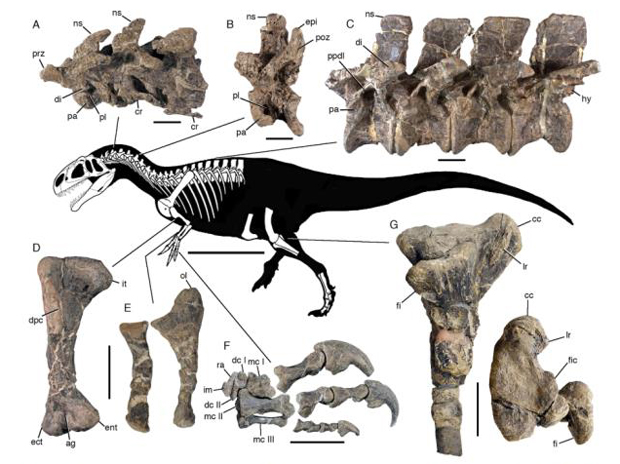
Skeletal drawing of Asfaltovenator and postcranial fossil material.
Skeletal reconstruction and postcranial anatomy of Asfaltovenator vialidadi.

Picture credit: Scientific Reports

Scientists hope that more large tetanurans can be found in Middle Jurassic strata, as further discoveries will help to hone Theropoda classification.

The Everything Dinosaur website: Everything Dinosaur.
10 12, 2019

Lice Feeding on Dinosaur Feathers Entombed in Amber

By |2024-01-06T13:42:03+00:00December 10th, 2019|Categories: Dinosaur and Prehistoric Animal News Stories, Dinosaur Fans, Main Page, Palaeontological articles, Photos/Pictures of Fossils|0 Comments

Ancient Lice Fed on Dinosaur Feathers

With the evolution of modified scales into feathers, it was very likely that feather-feeding invertebrates would evolve to exploit this new food source.  However, the lack of fossils prevents palaeontologists from being able to plot how feather-feeding behaviours evolved.  However, damaged dinosaur down, complete with several lice-like insects preserved in 100-million-year-old amber confirms that by the Early Cretaceous, feathered dinosaurs had parasites that specialised on feeding upon their integumentary systems.

Feathered Dinosaurs Had Parasites

Writing in the on-line, academic journal “Nature Communications”, a team of scientists, including researchers from the Russian Academy of Sciences, the Smithsonian Institute and the Chinese Academy of Sciences, describe the discovery of ten nymph specimens, a new lineage of insect preserved alongside the dinosaur downy feathers they were feeding upon in amber from northern Myanmar.

The new insect species has been named Mesophthirus engeli.  The specific name “engeli” is dedicated to Dr Michael S. Engel, for his outstanding contribution to entomological research.

Parasitic Nymphs Feeding on Dinosaur Feathers

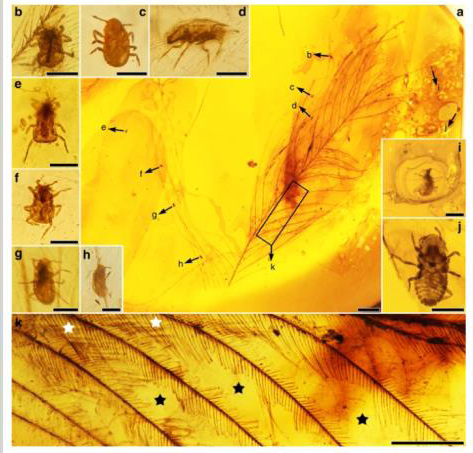
Feather-feeding insects preserved in amber.
Parasitic insects feeding on a dinosaur feather preserved in amber.

Picture credit: Nature Communications

The photograph (above), shows an amber nodule with the specimens of the newly described parasitic insect Mesophthirus engeli preserved in situ.  Photograph (a), shows the whole feather and the locations of the insects.  White stars indicate parts of the feather with relatively complete barbules, whilst the black stars indicate areas that show probable feeding damage.  Scale bars (a) = 1 mm, 100 µm (b-j) and (k) 0.5 mm.

Ectoparasitic Morphological Characters

The nymphs demonstrate a series of ectoparasitic morphological traits such as a small, wingless body, a relatively large head with strong mouth parts and robust, short antennae.  These insects preserved in association with partially damaged dinosaur feathers, the damage probably caused by their feeding behaviour, suggests that feather-feeding insects originated in the Cretaceous, accompanying the radiation of the feathered dinosaurs, including the early birds.

Magnified Views of Mesophthirus engeli Along with Line Drawings and Life Reconstruction

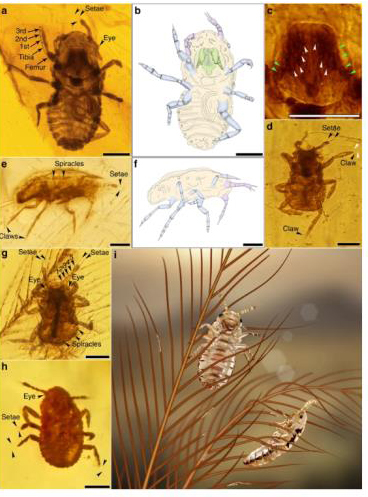
Feather-feeding insects preserved in amber.
Views of Mesophthirus engeli specimens, line drawings and life reconstruction.

Picture credit: Nature Communications

The picture (above), shows magnified views of the M. engeli specimens (a, c, d, e, g and h), with accompanying line drawings (b and f) and a life reconstruction (i).  Scale bars equal 50 μm.  The colour of the insects in the life reconstruction (i) are conjectural and reflect the general colouring of living feather-feeding lice.

To read a related article about the remains of blood-sucking mites being found preserved in burmite (amber from Myanmar): A Blood-sucking Story – Dinosaur Parasites Preserved in Amber.

The scientific paper: “New insects feeding on dinosaur feathers in mid-Cretaceous amber” by Taiping Gao, Xiangchu Yin, Chungkun Shih, Alexandr P. Rasnitsyn, Xing Xu, Sha Chen, Chen Wang and Dong Ren published in Nature Communications.

The Everything Dinosaur website: Everything Dinosaur.
3 12, 2019

New Research Tells Teenage Tyrannosaurs Apart

By |2024-01-06T07:59:35+00:00December 3rd, 2019|Categories: Dinosaur and Prehistoric Animal News Stories, Dinosaur Fans, Main Page, Palaeontological articles, Photos/Pictures of Fossils|0 Comments

Fossils From Alberta Help to Tell Teenage Tyrannosaurs Apart

It is often the case that a newly described fossil specimen only leads to confusion and controversy as its details are published.  However, a reassessment of a partial skull of a juvenile dinosaur that had been attributed to the tyrannosaurine Daspletosaurus (Daspletosaurus torosus) has now been referred to Gorgosaurus libratus.  The finding of a scrap of bone, a part of the skull (postorbital), discovered in the Dinosaur Park Formation of Alberta, was the key to unlocking a mystery when it came to deciphering the fossilised bones of young tyrannosaurids.

Thanks to this new research, identifying which fossils represent different tyrannosaurid species might just have become a little easier.

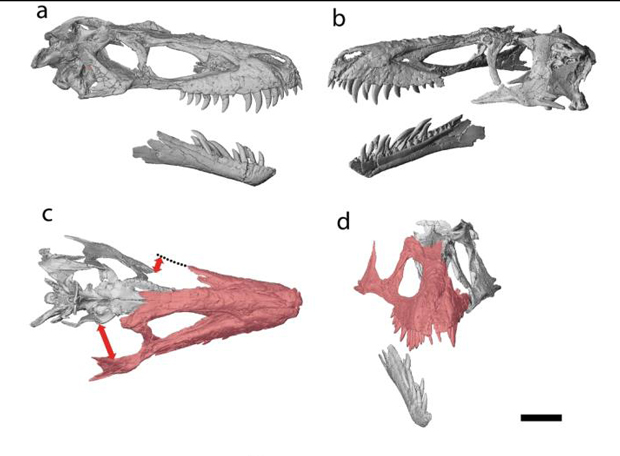
A Digital Reconstruction of the Skull Elements (TMP 1994.143.1.)

Skull restoration TMP 1994.143.1.
Skull reconstruction of TMP 1994.143.1. Digital rendering of skull based on CT data in right lateral view (a), left lateral view (b), dorsal view (c) and anterior view (d).  Note that not all preserved elements were CT scanned.  Skull reconstruction in right lateral view based on combination of preserved right and left elements.  Scale bar = 10 cm.

Picture credit: Voris et al/Scientific Reports

TMP 1994.143.1

The partial skull and jaws (specimen number TMP 1994.143.1.), comes from the Dinosaur Provincial Park Formation of southern Alberta.  Although the fossil material was well preserved, the fossils were found in a jumbled and disarticulated state.  The bones had also been distorted during burial and the fossilisation process (the red shaded elements in the picture above depict the bones affected).  This distortion led to the bones becoming slightly wider, thus altering the dimensions of the fossil skull when it was reconstructed by scientists.

The skull length is around sixty-two centimetres whilst other skulls associated with Daspletosaurus torosus measure more than eighty-five centimetres in length, hence TMP 1994.143.1. was thought to represent a juvenile Daspletosaurus.

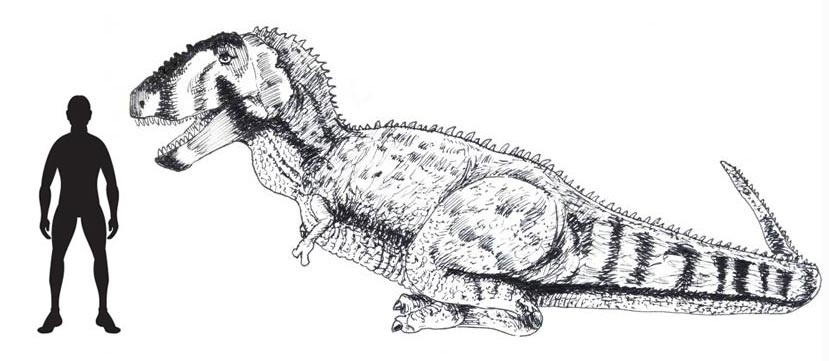
A Scale Drawing of an Adult Daspletosaurus

Drawing of Daspletosaurus.
Daspletosaurus (D. torosus) is estimated to have been around 8-9 metres in length when fully grown.  Picture credit: Everything Dinosaur.

Picture credit: Everything Dinosaur

Defining a Juvenile Dinosaur

As scientists have been able to work out the likely growth rates of different dinosaurs, so a definition of what makes a juvenile specimen has emerged.  Lead author of the newly published paper, Jared Voris (University of Calgary), explained that juvenile dinosaurs were about half the body length of the largest adult animal known from that species.  A juvenile Daspletosaurus would have been around 4 metres in length, the equivalent in age of a human teenager, but still a formidable predator, one best avoided by all but the largest herbivorous dinosaurs.

A Small Piece of Tyrannosaur Skull Bone – Changes Views

The discovery of a small, isolated tyrannosaurid postorbital bone found in the Dinosaur Park Formation led to a reassessment of TMP 1994.143.1.  What was thought to represent the only known juvenile Daspletosaurus skull material has been assigned to the Gorgosaurus genus.  The study reveals that previously unrecognised morphological differences exist between juvenile albertosaurines and tyrannosaurines and demonstrates that juvenile tyrannosaurids are more morphologically distinct than originally thought.

Previous issues associated with differentiating juveniles of these two clades were likely caused by the misidentification of TMP 1994.143.1 as a juvenile Daspletosaurus.

Views of the Postorbital Bone Assigned to a Juvenile Daspletosaurus

Juvenile Daspletosaurus postorbital bone.
Views of the juvenile Daspletosaurus postorbital (TMP 2013.18.11) with line drawings.  Lateral view (a) with line drawing (c) and medial view (b) and accompanying line drawing (d).  Note scale bars equal 5 cm.

Picture credit: Voris et al/Scientific Reports

Commenting on the significance of this new research, co-author Darla Zelenitsky (University of Calgary), explained that young Daspletosaurus specimens:

“Are now only represented by a few isolated bones instead of a nearly complete skull.  Regardless, we still have been able to figure out the earlier growth stages in the life cycle of both tyrannosaurs, Gorgosaurus and Daspletosaurus.”

It seems that skull diagnostic features develop quite early in these types of theropod dinosaur, if this is the case, then distinguishing different Late Cretaceous tyrannosaurid species from even fragmentary fossil remains might just become a little easier in future.

The scientific paper: “Reassessment of a juvenile Daspletosaurus from the Late Cretaceous of Alberta, Canada with implications for the identification of immature tyrannosaurids” by Jared T. Voris, Darla K. Zelenitsky, François Therrien and Philip J. Currie published in Scientific Reports.

Visit the Everything Dinosaur website: Everything Dinosaur.
2 12, 2019

New Toothy Pterosaur Identified from the Afro-Arabian Continent

By |2024-01-06T06:53:10+00:00December 2nd, 2019|Categories: Dinosaur and Prehistoric Animal News Stories, Dinosaur Fans, Main Page, Photos/Pictures of Fossils|0 Comments

Mimodactylus libanensis Newly Described Lebanese Pterosaur

The Pterosauria were very probably ubiquitous over much of our planet during the Mesozoic.  Once these flying reptiles had begun to diversify during the Late Triassic and into the Jurassic, these winged-wonders, the first vertebrates to master powered flight, would have spread far and wide.  Trouble is, although palaeontologists have described more than 120 genera, our knowledge of the Pterosauria is limited and scientists rely on a few key deposits to provide them with the majority of specimens to study.  Pterosaurs are now known from every continent, but surprisingly, very little material has been collected from Africa and the Arabian peninsula.

Writing in the academic journal “Scientific Reports”, a team of international scientists have announced the discovery of a Late Cretaceous pterosaur from Lebanon.  Mimodactylus libanensis is the most complete pterosaur specimen to have been discovered from the Afro-Arabian continent.  Intriguingly, the fossil material shows a strong taxonomic affinity with a genus known from China (Haopterus gracilis), together the pair form a new clade of toothy pterosaurs – the Mimodactylidae.

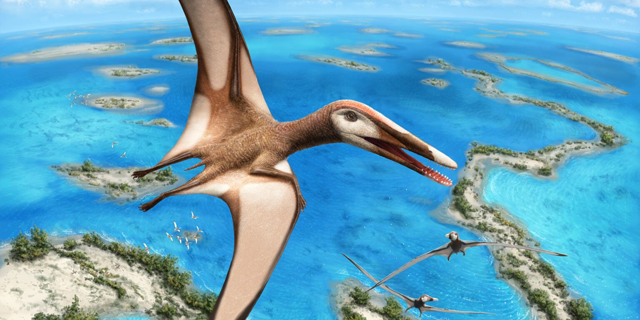
A Life Reconstruction of the Newly Described Pterosaur Mimodactylus libanensis

A life reconstruction of the pterosaur Mimodactylus.
A life reconstruction of Mimodactylus.  This flying reptile lived on the western side of the Tethys Seaway, which divided Europe from North Africa.  The sea was shallow with many reefs and lagoons, it was a spur of the mighty Tethys Ocean that stretched eastwards to south-eastern Asia.

Picture credit: Julius Csotonyi

Pterosaurs with Long, Narrow Wings

The fossil specimen comes from the famous Hjoûla Lagerstätte of Lebanon, a deposit famous for its beautifully preserved fossil fish, but tetrapod fossils are exceptionally rare.  The nearly complete and articulated skeleton indicates that Mimodactylus had long, narrow wings and that it would have been well-adapted to soaring over the sea, in a similar way to extant frigate birds.  As to what this pterosaur ate, that is open to speculation, but the robust, conical teeth located at the front of the jaws suggest a durophagus diet.  Perhaps this pterosaur fed on molluscs and other shelled creatures.

A View of the Fossilised Remains of Mimodactylus libanensis

Mimodactylus fossil material and line drawings.
Mimodactylus views of the fossil material and accompanying line drawings.  Photo (a) and drawing of the complete specimen.  Close up (b) of scapula and coracoid whilst (c) shows detail of the wrist, showing the relation of the pteroid and the carpus.  Detail (d) of the humerus.  Note scale-bars, a: 50 mm; b-d: 10 mm.

Picture credit: Kellner et al/Scientific Reports

The Mimodactylidae

The single specimen represents a sub-adult, the wingspan is estimated to be around 1.3 metres, but in the absence of any fossil material representing an adult animal, the actual size of a fully grown Mimodactylus is not known.  A phylogenetic analysis of the 95 million-year-old specimen suggests that Mimodactylus libanensis is closely related to pterosaurs from Asia and that with the taxon Haopterus gracilis, which is known from the Yixian Formation of Liaoning Province (north-eastern China), it forms a new clade of derived toothy pterosaurs, the Mimodactylidae.

One of the co-authors of the scientific paper, Michael Caldwell (University of Alberta), commented:

“This means that this Lebanese pterodactyloid was part of a radiation of flying reptiles living in and around and across the ancient Tethys Seaway, from China to a great reef system in what is today Lebanon.”

What’s in a Name?

The genus name is from the acronym (MIM), the Mineral Museum of Beirut in Lebanon, where the specimen is housed and the Greek “dactylos” meaning digit.  The trivial epithet honours Lebanon where this rare specimen was found.  An honourable mention to the anonymous philanthropist who acquired the fossil and ensured this important pterosaur was kept in Lebanon.

A Closer View of the Skull and Jaws of Mimodactylus libanensis

Mimodactylus skull and jaws.
A close up view of the skull and the jaws of Mimodactylus (inset – close view of the conical teeth). Scale bars (a) 10 mm and (b) 1 mm.

Picture credit: Kellner et al/Scientific Reports

The scientific paper: “First complete pterosaur from the Afro-Arabian continent: insight into pterodactyloid diversity” by Alexander W. A. Kellner, Michael W. Caldwell, Borja Holgado, Fabio M. Dalla Vecchia, Roy Nohra, Juliana M. Sayão and Philip J. Currie published in Scientific Reports.

The Everything Dinosaur website: Everything Dinosaur.
1 12, 2019

New Study Demonstrates Majungasaurus Replaced Teeth as Fast as Herbivorous Dinosaurs

By |2024-01-06T06:39:10+00:00December 1st, 2019|Categories: Dinosaur and Prehistoric Animal News Stories, Dinosaur Fans, Main Page, Photos/Pictures of Fossils|0 Comments

Majungasaurus – Elevated Tooth Replacement Rate

Scientists writing in the academic journal “PLOS One”, have really got their teeth into an aspect of dinosaur anatomy, that surprisingly has not attracted that much research to date.  Dinosaurs replaced their teeth, as teeth were shed, perhaps when feeding or fighting, then replacements would erupt from the gumline permitting these reptiles to retain their toothy grins.

The speed of tooth replacement can provide palaeontologists with important information about feeding ecology.  The fastest tooth replacement rates had been associated with herbivorous dinosaurs, the likes of the Ceratopsia and the hadrosaurids.  After all, these plant-eaters fed on very coarse plant material so their teeth were subjected to plenty of wear and tear.  In this new study, undertaken by researchers at Ohio University and Adelphi University (New York), tooth replacement rates for three carnivorous dinosaurs were calculated.

Surprisingly, Majungasaurus (M. crenatissimus), from the Late Cretaceous of Madagascar, had a much faster tooth replacement than the other theropods studied.  Its tooth replacement rate puts it on a par with the rates associated with the horned dinosaurs and the duck-bills.

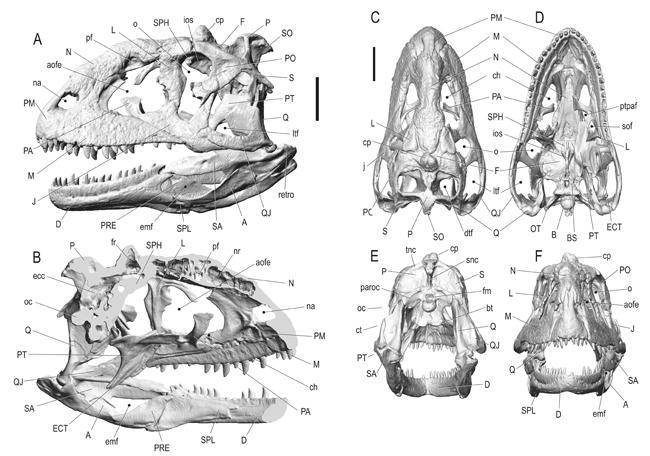
Computer Generated Images of the Skull of Majungasaurus

Majungasaurus skull diagram.
A diagram showing the details of the skull of Majungasaurus.  Views (A) left lateral, (B) buccal view, (C) dorsal view, (D) ventral view, (E) posterior view, (F) anterior view.

Picture credit: Memoirs of the Society of Vertebrate Paleontology/Ohio University/from Sampson, S. D. and L. M. Witmer (2007)

Rapid Replacement of Majungasaurus Teeth

CT scans and detailed cross-sectional analysis were carried out on individual teeth and jaw elements associated with three theropod dinosaurs.  These dinosaurs were the blunt-snouted, deep-skulled Majungasaurus along with Allosaurus and Ceratosaurus.  High tooth replacement rates were identified in three genera, but the researchers concluded that Majungasaurus replaced its teeth much faster than either Allosaurus or Ceratosaurus.  Majungasaurus would form a new tooth in each socket every fifty-six days or so, whilst Allosaurus and Ceratosaurus took in excess of a hundred days.

Lead author of the research, Michael D. D’Emic, (Adelphi University), explained the significance of this finding by commenting:

“This meant they [Majungasaurus] were wearing down their teeth quickly, possibly because they were gnawing on bones.  There is independent evidence for this in the form of scratches and gouges that match the spacing and size of their teeth on a variety of bones — bones from animals that would have been their prey.”

An Accelerated Replacement Strategy

Assistant professor D’Emic went onto add that extant animals too, gnaw on bones, this is a way for them to get certain nutrients, but to feed like this requires exceptionally tough and strong teeth, Majungasaurus did not have teeth like that, so they evolved an accelerated replacement strategy to compensate.

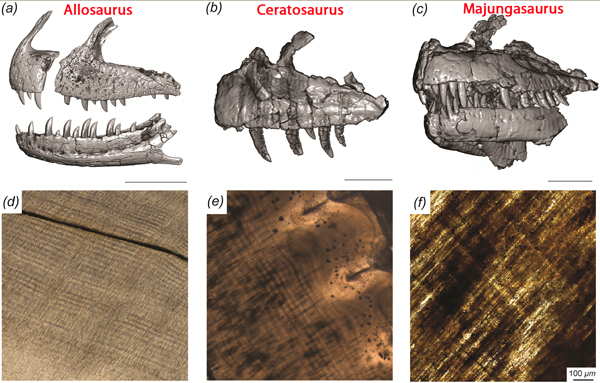
Examining Tooth Replacement in Theropod Dinosaurs

Theropod dinosaurs in the study - Allosaurus, Ceratosaurus and Majungasaurus.
Studying tooth replacement in theropod dinosaurs.  Three theropod genera were studied – Allosaurus, Ceratosaurus, Majungasaurus.  Scale bar for (a), (b) and (c) equals 10 cm, the scale bar for (d), (e) and (f) equals 100 μm.

Picture credit: M. D. D’Emic et al/PLOS One with additional annotation by Everything Dinosaur

The picture (above), shows computer generated images of jaw elements of each dinosaur associated with the study (a) Allosaurus, (b) Ceratosaurus and (c) Majungasaurus.  The images (d-f) show histological tooth sections which reveal incremental growth lines that can help to determine the individual age of teeth (d) Majungasaurus, (e) Ceratosaurus and (f) Allosaurus.

Using a statistical model to predict tooth age from tooth length measured in CT slices, replacement rates for these three genera are estimated at:

  • Majungasaurus 56 days
  • Allosaurus 104 days
  • Ceratosaurus 107 days

The rapid replacement rate recorded in Majungasaurus puts it on a par with living sharks and herbivorous dinosaurs.

Building on Research from Twenty Years Ago

This research builds on an earlier paper published twenty years ago, the authors of this new study suggest that with so many new dinosaurs being named and described over the last two decades or so, there is a lot of scope to build on the data collected so far and to provide further insights into dinosaur feeding ecology.

Michael D’Emic stated:

“I’m hoping this latest project spurs more people to study other species.  I bet that it will reveal further surprises and hopefully that will lead to a better understanding of how dinosaurs evolved to be successful for so long.”

Now that less destructive forms of study are available to scientists, the analysis of tooth wear and the internal structures of dinosaur teeth will help to provide a clearer picture regarding dinosaur feeding behaviour and dietary preferences – now that’s something to smile about.

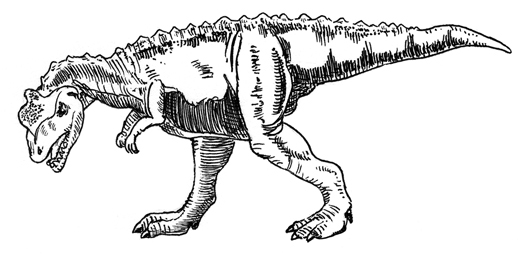
An Illustration of the Late Cretaceous Abelisaurid Majungasaurus (M. crenatissimus)

A drawing of Majungasaurus.
An illustration of the abelisaurid Majungasaurus. Picture credit: Everything Dinosaur.

Picture credit: Everything Dinosaur

The scientific paper: “Evolution of high tooth replacement rates in theropod dinosaurs” by Michael D. D’Emic , Patrick M. O’Connor, Thomas R. Pascucci, Joanna N. Gavras, Elizabeth Mardakhayav and Eric K. Lund published in PLOS One.

The Everything Dinosaur website: Everything Dinosaur.

27 11, 2019

New Targaryendraco – Unravelling the Ornithocheiridae

By |2024-01-05T13:42:49+00:00November 27th, 2019|Categories: Dinosaur and Prehistoric Animal News Stories, Dinosaur Fans, Main Page, Palaeontological articles, Photos/Pictures of Fossils|0 Comments

Targaryendraco – When the Pterosauria and “Game of Thrones” Meet

The Ornithocheiridae is one of the most extensively researched of all the pterosaur families.  However, this family of flying reptiles has a reputation amongst researchers for being one of the most difficult when it comes to mapping out their taxonomy.  The fragmentary fossils (usually jaw tips), first studied in the middle of the 19th century, has led to the erection of all kinds of genera and species.  Many palaeontologists are trying to make sense of this complicated and confused taxonomy, trying to unpick and unravel all those dubious pterosaurs assigned from the Cambridge Greensand of southern England and from the Lower Cretaceous deposits of central Germany as well as elsewhere in the world.

Targaryendraco wiedenrothi

A team of researchers writing in the academic journal “Historical Biology”, have reassessed a specimen housed at the State Museum of Natural History – Stuttgart (Staatliches Museum für Naturkunde).  This specimen, the most complete pterosaur fossil known from Lower Cretaceous deposits in Germany, consists of material from the lower jaws, (including the jaw tips), a partial rib as well as elements from the forelimbs, hand and fingers.

Originally assigned to the Ornithocheirus genus and named Ornithocheirus wiedenrothi, the authors build on previous studies that questioned whether this specimen represented a species of Ornithocheirus, redescribe it and assign this pterosaur to its own genus – Targaryendraco.  The trivial name is still retained, honouring amateur palaeontologist Kurt Wiedenroth who discovered the fossil material back in 1984.

A Life Reconstruction of Targaryendraco wiedenrothi

A life reconstruction of the pterosaur Targaryendraco.
Targaryendraco life reconstruction.  The single specimen known probably represents a sub-adult, so the size of this flying reptile is uncertain, some estimates have suggested a wingspan of between 3-4 metres.  Ironically the fossil specimen demonstrates a narrow mandible, a characteristic of the Ornithocheiridae.

Picture credit: Vitor Silva

The “Game of Thrones” Connection

The genus name is a combination of Targaryen and “draco” from the Latin for dragon.  Targaryen is one of the Houses in the fictional chronicles “A Song of Ice and Fire” by George R. R. Martin, upon which the television series “Game of Thrones” is based.  The dragons of the popular saga have dark coloured bones, the type specimen of Targaryendraco wiedenrothi is a dark grey colour, caused by mineralisation from the surrounding matrix.  The name also references the connection between pterosaurs and dragons, a link cited almost since the first fossils of these flying reptiles came to be known by western science.

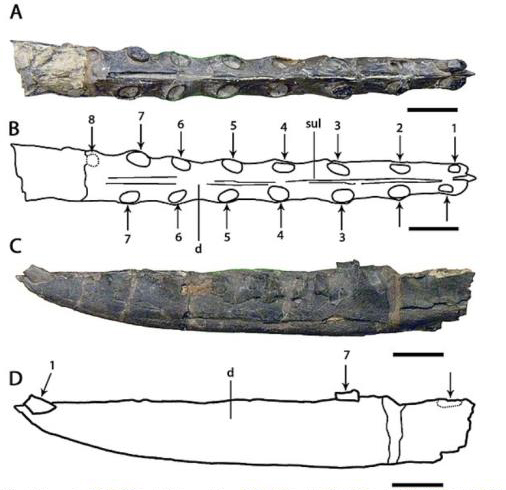
The Holotype Lower Jaw with Line Drawings (Targaryendraco wiedenrothi)

Views of the holotype lower jaw of Targaryendraco wiedenrothi.
Holotype lower jaw of Targaryendraco wiedenrothi with line drawings.  The holotype fossil (SMNS 56628) dorsal view (A) with line drawing (B) and a lateral view (C) with accompanying line drawing (D).

Picture credit: Alexander Kellner and Taissa Rodrigues

A New Clade of Pterosaurs – the Targaryendraconia

The researchers, Rodrigo V. Pêgas, Borja Holgado and Maria Eduarda C. Leal undertook a phylogenetic analysis based on the three-dimensional German fossils and subsequently erected a new clade of pterosaurs – the Targaryendraconia which consists of six genera (see below).  This new clade is both geographically and temporally widespread and demonstrates that the diversity of Lower Cretaceous toothy pterosaurs was higher than previously thought.

The six genera assigned to the clade Targaryendraconia:

  • Targaryendraco – described in 2019 from fossil material found in near Hannover in Germany.
  • Aussiedraco – described in 2011 from fossils found in Queensland, Australia.
  • Barbosania – described in 2011 (Santana Formation of north-eastern Brazil).
  • Camposipterus – redescribed in 2013 and known from the Cambridge Greensand formation.
  • Aetodactylus – described in 2010 and known from Texas (USA).
  • Cimoliopterus – redescribed in 2013 and known from fragmentary fossils from Texas and Kent in south-eastern England.

Studying the ornithocheirids might be like trying to untie the Gordian Knot of ancient mythology, but at least with this new assessment, a small part of this complicated fossil collection has been unravelled.

The Everything Dinosaur website: Everything Dinosaur.
26 11, 2019

Styracosaurus Skull Provides a Head’s Up When it Comes to Naming New Dinosaurs

By |2024-01-05T13:36:28+00:00November 26th, 2019|Categories: Dinosaur and Prehistoric Animal News Stories, Dinosaur Fans, Main Page, Photos/Pictures of Fossils|0 Comments

Asymmetrical Styracosaurus Skull Could Change the Way in Which Dinosaur Species are Erected

A team of researchers based at the University of Alberta have published a scientific paper that might just turn some assumptions when it comes to naming a new dinosaur species on their head.  Cranial fossil material can provide palaeontologists with important indicators that can help them establish that a newly found fossil represents a new species.

Often it is the skull and jaws that provide the important morphological evidence to help palaeontologist establish taxonomic relationships between genera.  However, the mainly University of Alberta-based team challenge some of these assumptions, all thanks to “Hannah” a Styracosaurus skull named after one of the researcher’s dogs.

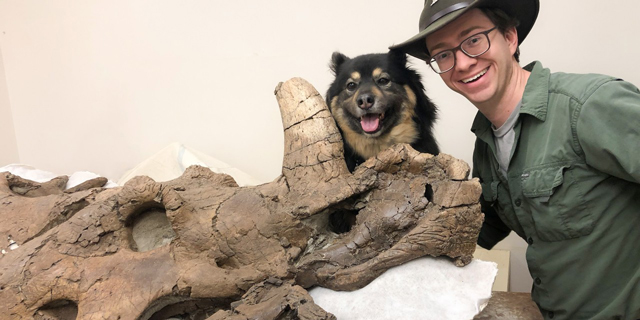
Palaeontologist Scott Persons with “Hannah” the Styracosaurus and his Dog Hannah

Scott Persons with dog and "Hannah" the Styracosaurus.
Scott Persons with “Hannah” the Styracosaurus and his dog.

Picture credit: Scott Persons/University of Alberta

Studying Styracosaurus

In 2015, a field team working in the Dinosaur Provincial Park of southern Alberta uncovered the skull of a five-metre-long horned dinosaur (Styracosaurus).  Nothing too unusual so far, after all this spiky-frilled horned dinosaur was scientifically described based on an almost complete skull (the type specimen), found in the Dinosaur Provincial Park, but Hannah’s skull was different – very different!  It is not symmetrical, the left half of the skull looks different from the right half – cue concerns being raised over how dinosaur genera and species are erected.

Co-author of the scientific paper published this week in the journal “Cretaceous Research” Scott Persons commented:

“When parts of one side of the skull were missing, palaeontologists have assumed that the missing side was symmetrical to the one that was preserved.  Turns out, it isn’t necessarily.  Today, deer often have left and right antlers that are different in terms of their branching patterns.  This fossil shows dramatically that dinosaurs could be the same way.”

An Asymmetrical Dinosaur Skull

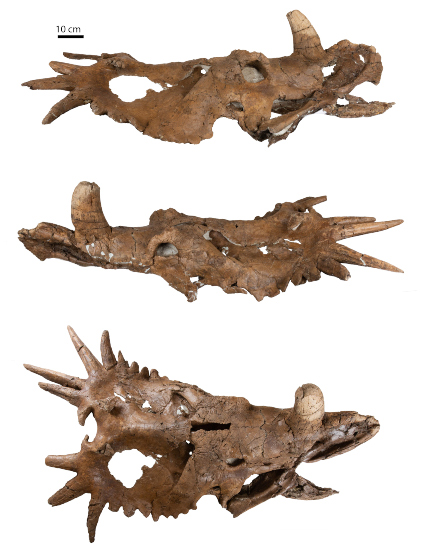
The well-preserved Styracosaurus skull (UALVP55900), has cranial imperfections that could change how palaeontologists identify new species of dinosaurs.  Differences in the shape of horned dinosaur’s skulls and their bony frills have been noted before, after all, there is variability recorded in fossils assigned to a species due to differences in age, in growth stages and from the effects of pathology.  In this case, the Styracosaurus called “Hannah” demonstrates previously unrecorded differences between the left side and the right side of the skull.

As with the type specimen collected by the famous scientist C H. Sternberg, the right lateral parietal bar (the right side of the skull frill) has seven bony projections (epiossifications), but the left parietal bar is not symmetrical it has eight epiossifications!

A Computer Rendered Image Showing the Skull of the Styracosaurus

Asymmetrical Styracosaurus skull.
Asymmetrical Styracosaurus albertensis skull.

Picture credit: Scott Persons/University of Alberta

The skull (UALVP55900) is shown in right lateral view (top) and left lateral view (middle).  The dorsal view (bottom) shows the clear differences in the shape of the left and right sides of the skull (asymmetry).

Marked Differences in the Styracosaurus Skull

The differences are so marked, that if the scientists had found only isolated halves, they could have concluded that each half represented a different horned dinosaur species.

Lead author of the study, Robert Holmes (University of Alberta), explained that “Hannah” shows that the pattern of a dinosaur’s horns could vary so much from one side of the skull to the other.  This raises doubts over the validity of some species such as Rubeosaurus ovatus.  Rubeosaurus was originally described as a species of Styracosaurus (1930), based on a single parietal bone (part of the skull frill), collected in the Two Medicine Formation of Montana.  This fossil and a second more complete skull fossil found in 1986, were subsequently reviewed and the genus Rubeosaurus (R. ovatus) erected in 2010.

Thanks to Hannah, it looks like the research undertaken in 1930 was right, the authors of the newly published paper suggest that Rubeosaurus ovatus is a junior synonym of Styracosaurus.

What are the Implications for the Naming of Dinosaur Species?

Styracosaurus with an asymmetrical skull.
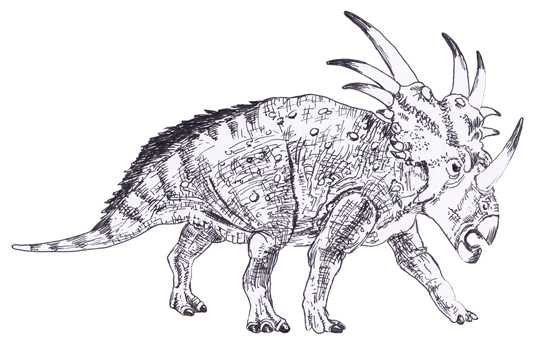
A drawing of an asymmetrical skull (Styracosaurus albertensis).  In our illustration the epiossifications associated with the skull frill are asymmetrical. Picture credit: Everything Dinosaur.

Picture credit: Everything Dinosaur

Since working on the paper, Scott Persons has moved on, becoming a professor and museum curator at the College of Charleston.  He may have had to leave “Hannah” the Styracosaurus behind but we presume Hannah the dog is still with him.

Persons commented:

“Hannah the dinosaur is named after my dog.  She’s a good dog, and I knew she was home missing me while I was away on the expedition.”

Despite the nickname, palaeontologists are not able to determine whether specimen number UALVP55900 represents a male or a female Styracosaurus.

Everything Dinosaur acknowledges the assistance of a press release from the University of Alberta in the compilation of this article.

The scientific paper: “Morphological variation and asymmetrical development in the skull of Styracosaurus albertensis” by Robert B. Holmes, Walter Scott Persons, Baltej Singh Rupal, Ahmed Jawad Qureshi and Philip J. Currie published in Cretaceous Research.

The Everything Dinosaur website: Everything Dinosaur.

20 11, 2019

First Fossil Evidence of Feathered Polar Dinosaurs

By |2024-01-05T09:42:36+00:00November 20th, 2019|Categories: Dinosaur and Prehistoric Animal Drawings, Dinosaur and Prehistoric Animal News Stories, Dinosaur Fans, Main Page, Palaeontological articles, Photos/Pictures of Fossils|0 Comments

Fossilised Bird and Dinosaur Feathers from Australia

Palaeontologists know that dinosaurs roamed high latitudes, that is to say that fossil finds have demonstrated that dinosaurs once inhabited parts of the world that are now in the Arctic Circle and similar fossil discoveries have been made in the Southern Hemisphere demonstrating that the Dinosauria also inhabited Antarctica.

Although, the climate during the Mesozoic was much warmer than it is today, in these high latitudes the fauna and flora would still have had to endure challenging conditions, such as freezing temperatures and many months of darkness with the sun not rising above the horizon.  It has been suggested that many dinosaur residents were feathered, their integumentary coverings of protofeathers and down helping to keep them warm.

However, actual evidence of fossilised feathers was lacking, but scientists writing in the journal “Gondwana Research”, describe several feathers from the Lower Cretaceous-aged sediments at the Koonwarra Fish Beds Geological Reserve located in Victoria (Australia).

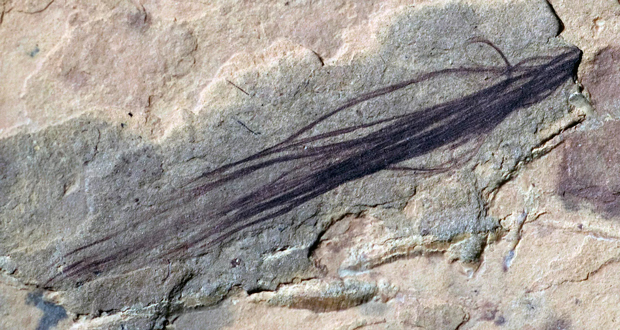
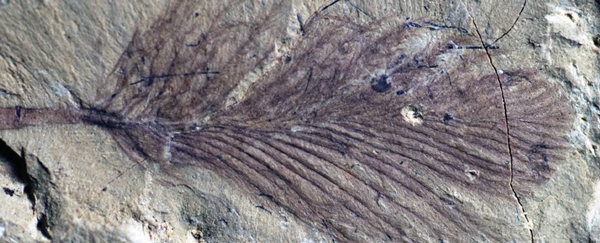
A Fossilised Feather from the Koonwarra Fish Beds Geological Reserve

A protofeather likely to have come from a theropod dinosaur.
A fossilised filamentous protofeather associated with the Theropoda from the Koonwarra Fish Beds Geological Reserve.

Picture credit: Kundrát et al (Gondwana Research)

Different Types of Feathers Found

Researchers from the Pavol Jozef Safarik University (Slovakia), Monash University, Swinburne University of Technology (both in Australia), Lund University, Uppsala University (Sweden) and from the Natural History Museum of Los Angeles County (USA) in collaboration with other colleagues have identified the first record of avian and non-avian integumentary structures described from Mesozoic polar regions.

In essence, feathered dinosaurs and birds were present at a latitude of around 70 degrees south between 118-115 million years ago.  Finding feathers this far south reinforces the view that feathered dinosaurs were ubiquitous for much of the Mesozoic.

Importantly, the handful of fossilised feathers from this site show a lot of variation.  Some fossils consist of the preserved remains of tufted body feathers, whilst others show asymmetrical bird-like flight feathers.  Fossils of simple, open-vaned contour feathers reminiscent to those of the Liaoning theropod Caudipteryx have also been found.

A Tufted Body Feather from the Koonwarra Fish Beds Geological Reserve

Feather fossil from the A fossilised feather from the Koonwarra Fish Beds Geological Reserve.
A fossilised feather from the Koonwarra Fish Beds Geological Reserve.

Picture credit: Kundrát et al (Gondwana Research)

Bird and Dinosaur Feathers

One of the co-authors of the scientific paper, Dr Benjamin Kear (Uppsala University) commented:

“Dinosaur skeletons and even the fragile bones of early birds have been found at ancient high-latitudes before.  Yet, to date, no directly attributable integumentary remains have been discovered to show that dinosaurs used feathers to survive in extreme polar habitats.  These Australian fossil feathers are therefore highly significant because they came from dinosaurs and small birds that were living in a seasonally very cold environment with months of polar darkness every year”.

The Koonwarra Fish Beds Geological Reserve

The feathers come from the Koonwarra Fish Beds Geological Reserve located in South Gippsland, Victoria.  The sediments represent the fine-grained clay deposits formed in a large, shallow lake. Many different fossils have been found at this location, including a fossilised flower and Ginkgo leaves.  Invertebrates are well represented, the fine grained deposits preserving insects, freshwater mussels, spiders and even the remains of a horseshoe crab.

Apart from the feathers, the only evidence of vertebrates associated with this location are the remains of fish.  The strata consist of alternate light and dark bands indicating an extreme seasonal environment, what you would expect in a part of the polar region where lakes would have frozen over during the extremely long winter.

A Life Reconstruction of a Theropod Dinosaur – A Likely Inhabitant of the Polar Region

Life reconstruction of a polar theropod dinosaur.
A life reconstruction of a polar theropod dinosaur.  Feathers found in Victoria indicate the presence of feathered polar dinosaurs in southern Gondwana during the Early Cretaceous.

Picture credit: Peter Trusler

Dinosaur Feathers Preserved as Fossils

Feather fossils from this site were first described in the 1960s but at the time they were thought to represent bird feathers, thanks to feathered dinosaur discoveries from elsewhere in the world, most notably north-eastern China, this fossil material has been reassessed and the researchers conclude that the variety of feathers at this site augments the limited skeletal evidence for a range of insulted non-avian theropods and birds living at extreme high latitudes in the southern hemisphere.

Analysis of some of the feathers has revealed residual patterning and the preservation of rod-shaped structures at the cellular level suggests the presence of eumelanosomes which in turn could help scientists determine pigments and colouration.

The scientists infer that many of the feathers indicate a dark pigmentation, such a colouration might have provided effective camouflage or permitted the absorption of a greater proportion of the energy from the rays of the sun – very useful if you inhabit a cold, dark world for much of the year.

Everything Dinosaur acknowledges the assistance of a media release from Uppsala University in the compilation of this article.

The scientific paper: “A polar dinosaur feather assemblage from Australia” by Kundrát, M., Rich, T. H., Lindgren, J., Sjövall, P., Vickers-Rich, P., Chiappe, L. M. and Kear, B. P. published in Gondwana Research.

The Everything Dinosaur website: Everything Dinosaur.

13 11, 2019

The Great Lizard – Megalosaurus

By |2023-12-31T20:29:53+00:00November 13th, 2019|Categories: Dinosaur Fans, Main Page, Photos/Pictures of Fossils|0 Comments

Megalosaurus bucklandii

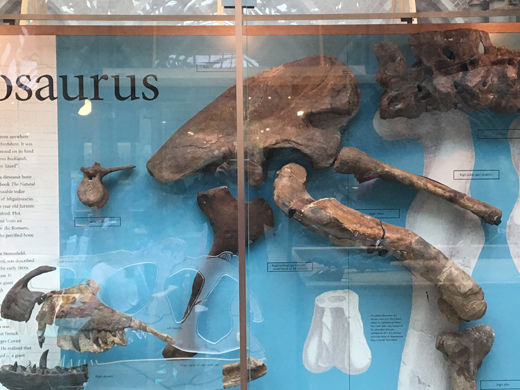
Recalling a recent visit to the Oxford Museum of Natural History which houses the fossilised remains of the first dinosaur to be described by scientists – Megalosaurus (M. bucklandii).  The display case features actual fossil material and casts of this nine-metre-long giant theropod from the Jurassic of Oxfordshire.  The specimens on show include most of the fossil material that William Buckland, in collaboration with the renowned French anatomist Georges Cuvier, used to confirm that these were the remains of a giant reptile.

The Megalosaurus Display Case – Centre Court Area of the Oxford Museum of Natural History

Megalosaurus fossil material on display.
The Megalosaurus display case (Oxford Museum of Natural History). Picture credit: Everything Dinosaur.
Picture credit: Everything Dinosaur

Megalosaurus

In the bottom left corner of the photograph that iconic lower jawbone can be seen, the display case contains the majority of the fossil material officially ascribed to the Megalosaurus genus.  In the lower centre is a drawing of the partial portion of a thighbone (distal end of the femur), that was illustrated in Robert Plot’s book “Natural History of Oxfordshire”, that was originally published back in 1677.  This fossil, sadly lost, had been found in a limestone quarry north of the city of Oxford (Middle Jurassic Taynton Limestone).

The concept of animals becoming extinct was not accepted thinking in the 17th century so Plot, aware that the bone could not belong to any animal living in Oxfordshire, claimed that this partial thigh bone came from an elephant that had been brought to Britain by the Romans.

Later this illustration was used by the author Ricard Brookes (1763), he coined the phrase “scrotum humanum” and considered this fossil to represent the remains of a giant man.  It was not until 1824 that Megalosaurus was formally described, the first dinosaur to be so, although the Dinosauria was not erected until the early 1840s.

A Close-up View of the Skull and Jaw Material on Display

Megalosaurus bucklandii fossils.
A view of the skull and jaw material associated with the first dinosaur to be scientifically described (Megalosaurus).  The left premaxilla is a cast. Picture credit: Everything Dinosaur.
Picture credit: Everything Dinosaur

A Model of a Megalosaurus

CollectA Age of Dinosaurs Popular Megalosaurus in Ambush
A replica of the first “dinosaur” to be scientifically described, the CollectA Megalosaurus in ambush figure. This dinosaur was named before the term “Dinosauria” had been coined. Picture credit: Everything Dinosaur.
Picture credit: Everything Dinosaur

The image (above) shows a CollectA Prehistoric Life Megalosaurus model.

To view this range: CollectA Prehistoric Life Models.

A sequence of Megalosaurus footprints can be seen on the lawn in front of the Museum. Visitors can literally “walk in the footsteps of a dinosaur”.  This sixty-metre long trackway is comprised of tridactyl print casts, copies of the dinosaur tracks discovered at the Ardley Quarry site (Oxfordshire), in 1997.

11 11, 2019

The First Unique Dinosaur Species from British Columbia

By |2023-12-31T20:11:37+00:00November 11th, 2019|Categories: Dinosaur and Prehistoric Animal News Stories, Dinosaur Fans, Main Page, Photos/Pictures of Fossils|0 Comments

Ferrisaurus sustutensis – Newest Member of the Leptoceratopsidae

This week has seen the announcement of a new species of horned dinosaur, a member of the Leptoceratopsidae and the first unique dinosaur species to be reported from the Canadian province of British Columbia.  The little dinosaur (estimated to be about 1.75 metres long and to have weighed around 150 kilograms), has been named Ferrisaurus sustutensis and it hints of an intriguing prehistoric fauna that roamed the more northerly and western portions of Laramidia around 67 million years ago.

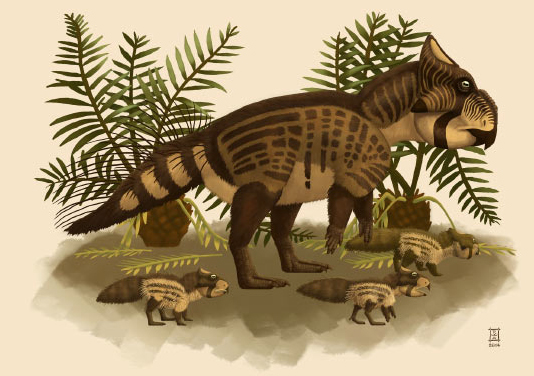
A Life Reconstruction of the Newly Described Leptoceratopsid Ferrisaurus sustutensis 

Ferrisaurus sustutensis life reconstruction.
Ferrisaurus sustutensis illustrated.

Picture credit: Raven Amos and courtesy of the Royal British Columbia Museum

First an Indeterminate Neornithischian

In 1971, construction workers building the now abandoned British Columbia Rail line close to the confluence of Birdflat Creek and the Sustut River in the Sustut Basin, discovered fragmentary bones in loose rubble.  At first the bones were thought to represent an indeterminate neornithischian dinosaur, but in this study undertaken by Dr Victoria Arbour (Royal BC Museum) and Dr David Evans (Royal Ontario Museum/University of Toronto), they have been assigned to the Leptoceratopsidae.

Leptoceratopsids were a family of hornless, parrot-beaked herbivores related to the Ceratopsidae, dinosaurs such as Triceratops and Styracosaurus.  These dinosaurs were restricted to the Late Cretaceous of the Northern Hemisphere, but there is some disputed fossil evidence to suggest a presence in Australia and in Europe too.

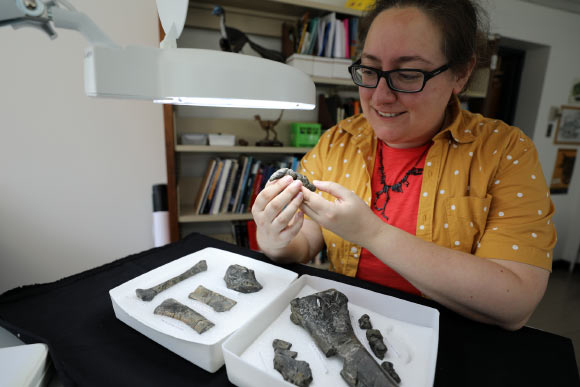
Dr Arbour Examining the Fossilised Remains of  Ferrisaurus sustutensis

Dr Arbour with the fossils of Ferrisaurus sustutensis.
Dr Victoria Arbour examines the fossilised remains of Ferrisaurus sustutensis.

Picture credit: Brandy Yanchyk and courtesy of the Royal British Columbia Museum

Ferrisaurus sustutensis

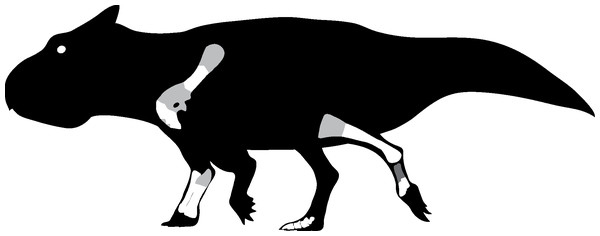
Fossil remains include elements from the shoulder girdle, a complete left radius, a partial ulna along with hind limb bones, ankle bones and articulated toes from the right foot.  An as yet, unprepared block may also contain metatarsals from the left foot.  The researchers used the ulna (bone from the forearm) and compared it with other leptoceratopsids such as Leptoceratops (L. gracilis), Cerasinops (C. hodgskissi) and Montanaceratops (M. cerorhynchus).

They also examined the proportions of the toes and concluded, based on this assessment, that the fossilised remains represented a new genus, one that is phylogenetically firmly nested in the Leptoceratopsidae and probably quite closely related to Gryphoceratops morrisoni, which is known from the Dinosaur Provincial Park of southern Alberta.

Ferrisaurus sustutensis – What’s in a Name?

Ferrisaurus sustutensis (pronounced Fair-uh-sore-us suss-tut-en-sis), is the first unique dinosaur species reported from British Columbia and represents a western range extension for Laramidian leptoceratopsids.  The name translates as “the iron lizard from the Sustut River”, a reference to the location of the fossil discovery. When the fossil material was being prepared and studied the specimen was affectionately known as “Buster”.

Scientists are confident that more vertebrate fossil material will be found in the Upper Cretaceous rocks of the Sustut Basin, but there are problems with accessing and exploring this area.  As much of British Columbia is mountainous and forested, finding exposures of sedimentary rock to explore is challenging.  In 2017, Dr Arbour led a field team to the site and found fossilised plants and a fragment of a Cretaceous turtle (Basilemys).

Leptoceratopsid fossil material is quite rare and when these types of dinosaurs are found, they usually only represent a very small part of the dinosaur biota.  It is more usual for Upper Cretaceous, dinosaur fossil bearing strata to be dominated by duck-billed dinosaurs, horned dinosaurs or even tyrannosaurids. 

Scientists have documented a preservational bias against small-bodied dinosaurs such as Ferrisaurus.  The first dinosaur to be described from the Sustut Basin might represent a fauna that was relatively unique to that part of Laramidia, or to find a leptoceratopsid dinosaur first, could simply be down to serendipity.

A Diagram Showing the Known Preserved Remains of Ferrisaurus sustutensis

Preserved elements of Ferrisaurus sustutensis.
Preserved elements of Ferrisaurus sustutensis (bones shaded grey represent missing parts of incomplete bones)

Picture credit: PeerJ/Royal British Columbia Museum

The scientific paper: “A new leptoceratopsid dinosaur from Maastrichtian-aged deposits of the Sustut Basin, northern British Columbia, Canada” by Victoria M. Arbour and David C. Evans published in the journal PeerJ.

The Everything Dinosaur website: Everything Dinosaur’s Website.

Go to Top