All about dinosaurs, fossils and prehistoric animals by Everything Dinosaur team members.

Pictures of fossils, fossil hunting trips, fossil sites and photographs relating to fossil hunting and fossil finds.

14 09, 2020

Pachycephalosaur Squamosals – Examining Research Papers

By |2024-03-15T07:44:40+00:00September 14th, 2020|Categories: Adobe CS5, Dinosaur Fans, Main Page, Photos/Pictures of Fossils|0 Comments

Pachycephalosaur Squamosals

As Everything Dinosaur team members prepare for the arrival of the new for 2020 Papo Stygimoloch dinosaur model, team members have been examining the scientific papers that led to the erection of this pachycephalosaur genus (Peter Galton and Hans-Dieter Sues in 1983).

An isolated fossil bone referred to as a left squamosal (a bone from the back part of the skull) was found in Hell Creek Formation deposits located in McCone County, eastern Montana.  This fossil bone was given the catalogue number UCMP 119433 and although its prominent horns and raised bony bumps were very distinctive, it was not formerly described until 1983.  This fossil bone became the holotype fossil for the new species of North American pachycephalosaur Stygimoloch spinifer.

Stygimoloch spinifer

Distinctive Squamosal Bones Attributed to S. spinifer
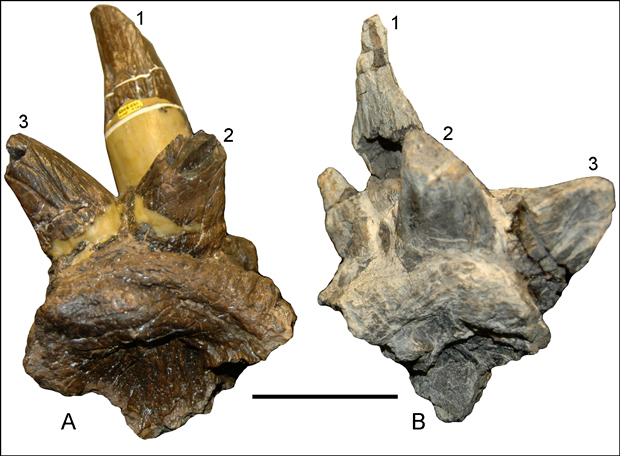
Squamosal Bones Associated with Stygimoloch spinifer
The holotype left squamosal (UCMP 119433) in (A) and a right squamosal (UCMP 131163) in (B) in posterior view.  Note scale bar equals 5 cm.

Picture credit: Horner and Goodwin (published in PLOS One)

The picture (above), shows the holotype left squamosal (UCMP 119433) alongside a right squamosal which also comes from the Hell Creek Formation of Montana (UCMP 131163).   When first described, the flat-headed, narrow skull of Stygimoloch with its array of horns and bumps that were most prominent at the back of the skull, was thought to represent a different type of pachycephalosaur than the dome-skulled species such as Pachycephalosaurus wyomingensis.

Extremely Scrappy Fossil Remains

Stygimoloch had been described from extremely scrappy fossil remains.  Although a more complete skull found in North Dakota was also assigned to this genus, Stygimoloch remained poorly known.

The New for 2020 Papo Stygimoloch Dinosaur Model
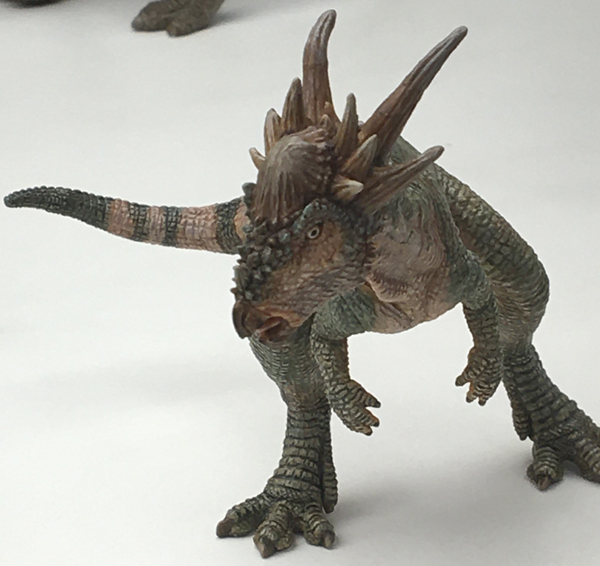
Papo Stygimoloch model.
A view of one of the production prototypes of the Papo Stygimoloch dinosaur model.  Picture credit: Everything Dinosaur.

Picture credit: Everything Dinosaur

Stygimoloch spinifer is Probably a Subadult Pachycephalosaurus

A paper presented at the annual meeting of the Society of Vertebrate Paleontology in 2007 challenged the validity of the Stygimoloch taxon.  Palaeontologists John (Jack) Horner of the Museum of the Rockies, Montana State University and Mark Goodwin of the Museum of Paleontology at the University of California, Berkeley published a paper in the on-line, peer reviewed journal PLOS One (2009), that proposed that both Dracorex hogwartsia and Stygimoloch spinifer represented younger individuals of the Pachycephalosaurus wyomingensis species.

More recent fossil discoveries from the Hell Creek Formation and further analysis of existing pachycephalosaur fossil material from North America supports the idea that Dracorex hogwartsia, Stygimoloch spinifer and Pachycephalosaurus wyomingensis are the same taxon.

Pachycephalosaur Ontogeny – Three Hell Creek Formation Taxa May Actually Represent Just One Taxon

Different skull shapes and ornamentation linked to different growth stages.
It has been proposed that the cranial ornamentation and skull shape of pachycephalosaurs changes as these animals grow and mature.  This can cause confusion when trying to identify species.

Picture credit: Kari Scannella with additional annotation by Everything Dinosaur

When first described, (Galton and Sues), the suggested morphology of the skull of Stygimoloch (narrow and lacking a raised, thickened dome), led the researchers to propose that unlike other pachycephalosaurs Stygimoloch probably did not indulge in any head-butting behaviour.

To view the range of Papo figures in stock at Everything Dinosaur, including a Pachycephalosaurus figure (whilst stocks last): Papo Models and Figures.

The 2009 scientific paper: “Extreme Cranial Ontogeny in the Upper Cretaceous Dinosaur Pachycephalosaurus” by John R Horner and Mark B Goodwin published in PLOS One.

The Everything Dinosaur website: Everything Dinosaur.
12 09, 2020

A Unique Predator of Lisowicia – Smok wawelski

By |2024-03-15T07:32:18+00:00September 12th, 2020|Categories: Dinosaur Fans, Everything Dinosaur Products, Main Page, Photos of Everything Dinosaur Products, Photos/Pictures of Fossils|0 Comments

A Predator of Lisowicia – Smok wawelski

Prehistoric animal model collectors have been eager to get their hands on the new for 2020 CollectA Deluxe Lisowicia bojani, dicynodont model.  Everything Dinosaur team members are busy creating a short video review of the model entitled “Dynamic Dicynodonts”.  Our YouTube video aims to showcase the CollectA 1:20 scale figure and to discuss dicynodonts in general.  Ironically, in the Late Triassic there was a predator that the elephant-sized Lisowicia might have feared.

The bonebed in southern Poland has revealed the presence of a five-metre plus archosaurian carnivore.  A powerful animal scientifically described in 2011, the meat-eater has been named Smok wawelski and although a fully grown Lisowicia was probably invulnerable to attack, Smok would have been capable of bringing down juvenile or sick individuals, as Smok is the largest terrestrial predator known from the Late Triassic of central Europe.

Dangerous Company for Lisowicia bojaniSmok wawelski

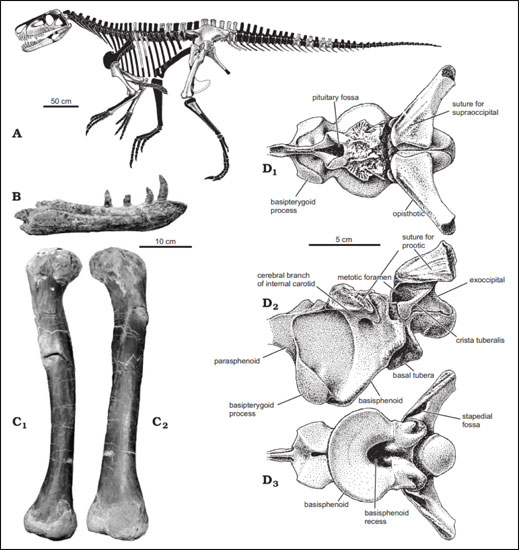
Skeletal reconstruction of Smok wawelski
A skeletal reconstruction of Smok wawelski (known bones in white) along with views of key elements from the fossil remains.  Although originally believed to be a theropod dinosaur related to the Allosauroidea, Smok wawelski could be a member of the crocodile lineage of the Archosauria.

The CollectA Deluxe Lisowicia bojani

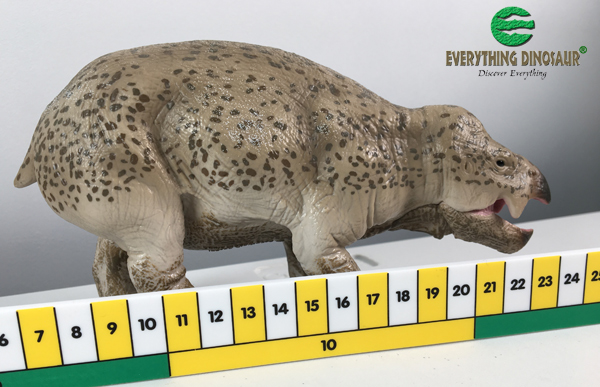
The CollectA Deluxe Lisowicia bojani Dicynodont Model

The CollectA Deluxe Lisowicia bojani model.
The ruler helps to show the size of the CollectA Lisowicia model.  The Lisowicia replica measures around 19 cm long and the model has an articulated lower jaw. Picture credit: Everything Dinosaur.

Picture credit: Everything Dinosaur

To view the CollectA Deluxe Lisowicia bojaniCollectA Deluxe Prehistoric Life Models.

The “Dragon of Lisowice”

Smok had a skull which was more than half a metre in length.  It was the apex predator of a diverse biota revealed by the clay pit fossils found close to the village of Lisowice in Silesia, southern Poland.  The first evidence of this large animal, consisting of cranial material was discovered in 2007, based on these fossils it was assigned to the Theropoda.

The braincase was similar to that seen in allosaurs, hence the classification.  However, more recent fossil discoveries have thrown doubts upon this taxonomic assessment.  It may not belong to the dinosaur/bird lineage of the Archosauria at all, Smok could be a member of the Rauisuchidae, a globally diverse family of archosaurs from the crocodile branch of the Archosauria.

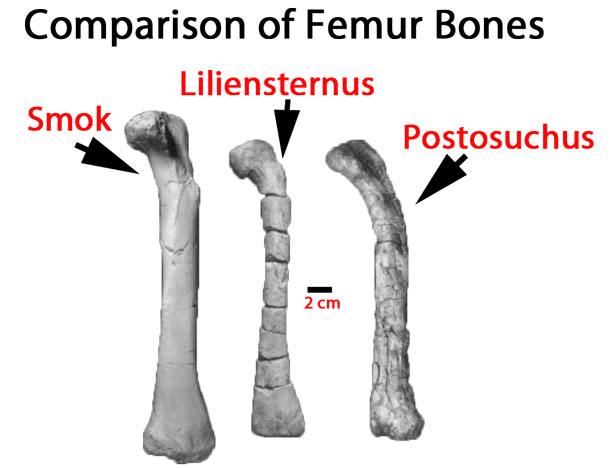
Femur Bone Comparison Smok wawelski Compared to a Theropod (Liliensternus) and a Rauisuchid (Postosuchus)

Archosaur bone comparison (thigh bone comparison).
The femur of S. wawelski is compared to femori representing two other archosaurs, one from the Theropoda (Liliensternus) and a femur from the rauisuchid Postosuchus.  When first described Smok wawelski was thought to be a theropod but further fossil discoveries led to its placement within the Archosauria becoming more uncertain.

Picture credit: Everything Dinosaur

Once completed Everything Dinosaur’s video review of Lisowicia bojani and the information on Smok wawelski will be posted up on the company’s YouTube channel.  Click here to visit Everything Dinosaur on YouTube: Everything Dinosaur on YouTube.

Please subscribe to our YouTube channel.

The Everything Dinosaur website: Everything Dinosaur.
11 09, 2020

A Dinosaur “Begs” to Differ

By |2024-03-14T18:55:20+00:00September 11th, 2020|Categories: Dinosaur and Prehistoric Animal Drawings, Dinosaur and Prehistoric Animal News Stories, Dinosaur Fans, Main Page, Palaeontological articles, Photos/Pictures of Fossils|0 Comments

A Neoceratopsian from Mongolia – Beg tse

A new species of basal neoceratopsian has been described from fossils found near the town of Barunnbayan in the Gobi Desert of Mongolia.  The little dinosaur, which was probably less than a metre long, has been named Beg tse in honour of the Himalayan deity Beg-tse.  In Mongolian culture, prior to the spread of Buddhism, Beg-tse was a god of war, often depicted as heavily armoured with large, roughened patches on its body.  The researchers studying the fossil material noted that, like other members of the Neoceratopsia, Beg had rugosities (roughened areas), on its skull, notably on the jugal and the surangular.

Beg tse – A Newly Described Dinosaur

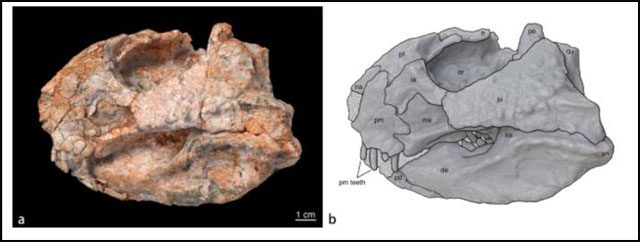
The Compressed Skull of Beg tse with an Accompanying Line Drawing

Beg tse skull and line drawing.
Lateral view of the holotype skull of Beg tse with line drawing.  The compressed skull measures 14 cm in length approximately.

Picture credit: Yu et al (Nature)

The Most Basal Neoceratopsian Described to Date

The only known specimen of Beg tse (specimen reference: IGM 100/3652), was discovered by a joint American Museum of Nature/Mongolian Academy of Sciences expedition in 2015.  The fossils probably represent a single individual and consist of an articulated partial skull along with postcranial elements consisting of a fragmentary right ischium, a partial left scapula, one rib bone and numerous bone fragments.

A phylogenetic analysis conducted by the scientists, which included Dr Mark Norell (American Museum of Natural History),  indicates that Beg is the most basal neoceratopsian dinosaur known to date and is more derived than both the Psittacosauridae and Jurassic Chaoyangsauridae.

A Speculative Life Reconstruction of the Basal Neoceratopsian Beg tse

Beg tse life reconstruction.
A speculative life reconstruction of the basal neoceratopsian Beg tse.  The illustration has been based on the neoceratopsian Liaoceratops yanzigouensis from north-eastern China. Picture credit: Everything Dinosaur.

Picture credit: Everything Dinosaur

Proving Difficult to Date

It is difficult to estimate the date of the fossil bearing strata for many of the Gobi Desert dig sites due to the lack of detailed geological mapping and the limited number of sediments suitable for radiometric dating.  The sandstone dominated deposit has been dated to between 113 – 94 million years ago, with a most probable date of circa 100 million years ago.  As a result, the researchers conclude that Beg dates from the latest Early Cretaceous or the earliest Late Cretaceous.

The Ceratopsia may have originated around the Middle Jurassic, but the skull of Beg tse exhibits a combination of primitive and more derived traits which suggests that the basic ceratopsian bodyplan persisted until at least the Early-Late Cretaceous boundary.  Beg along with other Asian neoceratopsians such as Auroraceratops and Mosaiceratops represent transitional forms between basal ceratopsians and more derived forms.  With a wide geographical range from South Korea, China and Mongolia and a long time span from the Aptian to possibly the Campanian, the early evolutionary history of the horned dinosaurs is probably much more complex than previously thought.

The scientific paper: “A neoceratopsian dinosaur from the early Cretaceous of Mongolia and the early evolution of the ceratopsia” by Congyu Yu, Albert Prieto-Marquez, Tsogtbaatar Chinzorig, Zorigt Badamkhatan and Mark Norell published in Nature (Communications Biology).

The Everything Dinosaur website: Everything Dinosaur.
8 09, 2020

Eternal Sleeping Dinosaur a New Fossil Discovery

By |2024-03-14T16:58:19+00:00September 8th, 2020|Categories: Adobe CS5, Dinosaur and Prehistoric Animal News Stories, Dinosaur Fans, Main Page, Photos/Pictures of Fossils|0 Comments

Changmiania liaoningensis A New Basal Ornithopod from Liaoning Province

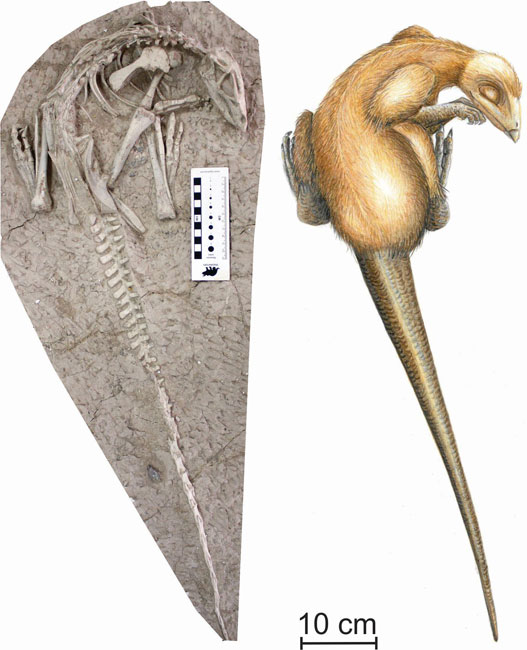
A new species of basal ornithopod dinosaur has been named and described from Liaoning Province in north-eastern China.  The dinosaur has been named Changmiania liaoningensis which translates from the Chinese as “eternal sleeper from Liaoning”.  The researchers which include Pascal Godefroit of the Royal Belgian Institute of Natural Sciences and Paul-Emile Dieudonné (Universidad Nacional de Río Negro, Argentina), in collaboration with colleagues from Jilin University and Shenyang Normal University (China), postulate that Changmiania lived in burrows.

The Holotype of Changmiania liaoningensis (PMOL AD00114) and a Life Reconstruction

Changmiania liaoningensis fossil material and life reconstruction.
The perfectly preserved holotype fossil of Changmiania liaoningensis with a life reconstruction.  The very nearly intact, articulated specimens suggest that the dinosaurs were entombed in their burrows during a volcanic eruption.

Picture credit: Carine Ciselet

From the Lujiatun Beds of the Yixian Formation

The pair of beautifully preserved fossils, like so many vertebrate fossils from this part of the world were acquired from farmers.  Many locals supplement their incomes by finding and excavating specimens.  Whilst welcoming the opportunity to be able to study the material, palaeontologists are often frustrated by the lack of information available to them pertaining to the fossil’s location and how it was preserved (taphonomy).  However, it is thought that the fossils herald from the Lujiatun Beds (Yixian Formation) of western Liaoning Province.

These three-dimensional fossils were formed when these dinosaurs were entombed in pyroclastic material created by a volcanic eruption.  Numerous dinosaurs are known from the Lujiatun Beds including the dromaeosaurid Graciliraptor (G. lujiatunensis), the troodontid Mei long, the small tyrannosauroid Dilong paradoxus along with psittacosaurs, neoceratopsians and the ornithopod Jeholosaurus (J. shanyuensis).

Changmiania liaoningensis

Scientists have been able to accurately date the volcanic ash layer to approximately 123 million years ago, which means this diverse dinosaur biota lived during the early Aptian faunal stage of the Early Cretaceous.   The hot, volcanic debris that covered these two dinosaurs may have perfectly preserved most of the skeleton but any evidence of an integumentary covering such as feathers was destroyed as these animals met their fate whilst fast asleep in their burrows.  The resting dinosaurs having been caught up and consumed in a violent pyroclastic flow is the scenario tentatively proposed by the research team in the scientific paper published in PeerJ.

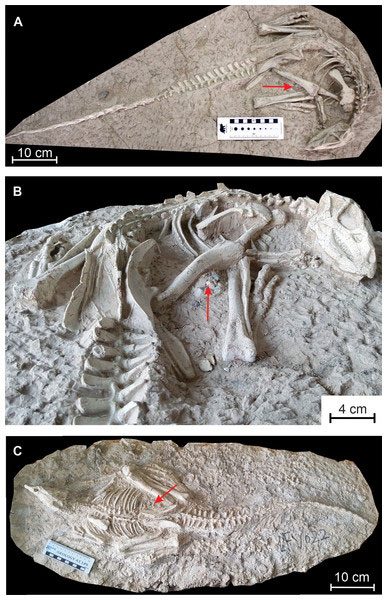
The Two Fossils of Changmiania liaoningensis

Views of the holotype and a referred specimen of Changmiania liaoningensis.
The holotype fossil (A) and a close view of the anterior portion of the holotype (B), with a second referred specimen of Changmiania liaoningensis (C). A small cluster of around a dozen pebbles were found in the stomach cavity (indicated by red arrow). These small stones, ranging in diameter from 5 mm to 13 mm are thought to be gastroliths (stomach stones). They represent the earliest recording of gastroliths in a member of the Ornithopoda.

Picture credit: Yang et al (PeerJ)

A Basal Ornithopod

The little dinosaur measured approximately 1.2 metres long, the tail representing fifty percent of the animal’s total body length.  The extremely short neck, consisting of just six cervical vertebrae, the robust forelimbs and stocky shoulder blades suggest that this dinosaur might have dug burrows.  This idea is supported by the position of the fossil specimens and the morphology of the front of the skull, which may have assisted with shovelling dirt aside.  The long hindlimbs and tail indicate that Changmiania was a fast runner, able to avoid trouble whilst away from its underground den.

This is not the first time fossorial behaviour has been inferred for a dinosaur.  For example, in 2007 Everything Dinosaur wrote a short post about another potential burrowing ornithischian, another basal ornithopod that was named Oryctodromeus cubicularis, remains of which come from the sandstones of the Blackleaf Formation of Montana (USA): A Burrowing Dinosaur from Montana.

Changmiania lived at least 10 million years earlier than O. cubicularis.  A phylogenetic analysis places Changmiania liaoningensis as the most basal ornithopod dinosaur known to science.

The scientific paper: “A new basal ornithopod dinosaur from the Lower Cretaceous of China” by Yuqing Yang, Wenhao Wu, Paul-Emile Dieudonné and Pascal Godefroit​ published in PeerJ.

Visit the Everything Dinosaur website: Everything Dinosaur.
6 09, 2020

An Armoured Dinosaur from British Columbia

By |2024-03-14T15:07:00+00:00September 6th, 2020|Categories: Adobe CS5, Dinosaur and Prehistoric Animal News Stories, Dinosaur Fans, Main Page, Palaeontological articles, Photos/Pictures of Fossils|0 Comments

Body Fossils of an Ankylosaurian Dinosaur from British Columbia

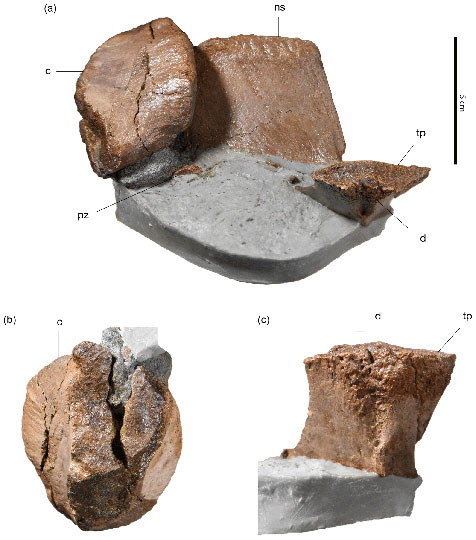
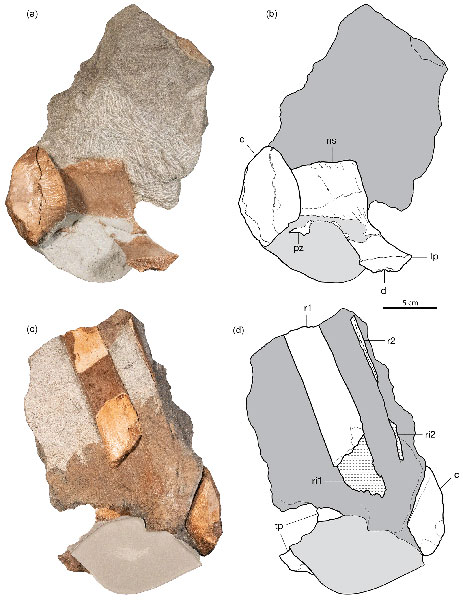
A small sandstone block containing the back end of a single, fragmentary dorsal vertebra, a dorsal neural arch and two pieces of rib, probably fossils from one animal, have been identified as the fossilised bones of an armoured dinosaur.  This material, originally collected in 1930, is one of just a handful of dinosaur bones known from the early Late Cretaceous of Canada (Cenomanian faunal stage).  Although fossilised footprints associated with ankylosaurian dinosaurs are known from the area, these are the earliest reported body fossils from the Dunvegan Formation of British Columbia and as such these bones may provide palaeontologists with a new perspective on the transition of dinosaur biotas into the Late Cretaceous of North America.

Fossil Material Identified as Ankylosaurian

Photographs and line drawings of ankylosaurian fossil material.
Sandstone block containing portions of two ankylosaurian dorsal vertebrae and two probable ribs.  Photograph (a) and line drawing (b) lateral view.  Photograph (c) reserve side of block showing two probable ribs and parts of the vertebrae with (d) line drawing.

Picture credit: Arbour et al (Fossil Record)

Armoured Dinosaur Bones Collected in 1930

The specimen was collected by the Canadian geologist Merton Yarwood Williams in 1930 during a geological survey of the area of the “Peace River district”.  Charles M. Sternberg later identified the fossil material as representing an ornithischian dinosaur resembling Camptosaurus.

It was loaned to the Royal Ontario Museum for preparation and study and as part of the research, several members of the scientific team visited the area where the fossil was discovered in an attempt to relocate the original site.  Unfortunately, high river levels prevented an extensive search of the steep sided riverbanks.  The team did find a number of plant fossils and a natural cast of a dinosaur footprint – Tetrapodosaurus, an ichnogenus believed to represent an ankylosaurian.  Dinosaur footprint fossils are associated with this area, many of these tracks are thought to represent armoured dinosaurs.

Details of the Ankylosaurian Vertebrae (British Columbia)

Details of the Ankylosaurian vertebrae (British Columbia).
Right lateral view of isolated neural arch (a), with (b) axial view of the isolated centrum, broken at its approximate mid-length and showing strong constriction, inferring an hour-glass shape for the bone.  Ventral view of the transverse process of the isolated neural arch (c).

Picture credit: Arbour et al (Fossil Record)

The Dunvegan Formation

The Dunvegan Formation outcrops in both northern Alberta and British Columbia, it is primarily composed of marine strata and deposits laid down in a near-shore delta environment.  Vertebrate fossils are rare but shark and teleosts (bony fish), fossils have been found, including one remarkable discovery of a bony fish found in a 75 mm diameter oil drill core – Tycheroichthys dunveganensis.

To read about this serendipitous fossil fish discovery: Amazing Fossil Fish Found in Canadian Oil Drill Core.

These fragmentary remains (CMN 59667), are the only body fossils of an ankylosaurian known from British Columbia, although a few dermal scales and ossicles from an outcrop of the Dunvegan Formation in Alberta have been ascribed to an armoured dinosaur.  It is difficult to date the sediments accurately, but the fossils are approximately 99-96 million years old.

What Sort of Ankylosaurian Was It?

CMN 59667 has been identified as ankylosaur material based on a number of traits and characteristics observed in the vertebrae.  Although ankylosaur fossils are known from roughly contemporaneous strata in the United States, these types of dinosaurs are not common components of the associated dinosaur fauna.

The body fossils are too fragmentary to confidently assign them to either a nodosaurid or an ankylosaurid ankylosaur.  The fossils are still highly significant, terrestrial Cenomanian assemblages are rare in North America but those fossils that have been found provide evidence of an important time in our planet’s history when there was a considerable faunal turnover between the end of the Early Cretaceous and the earliest Late Cretaceous.

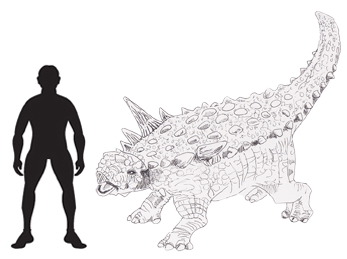
A Scale Drawing of the Roughly Contemporaneous Animantarx from the Cedar Mountain Formation of Utah (USA)

Animantarx Scale Drawing.
A scale drawing of the armoured dinosaur from Utah – Animantarx ramaljonesi.  This dinosaur speculatively assigned to the Nodosauridae, is roughly contemporaneous with the ankylosaurian from the Dunvegan Formation of British Columbia. Picture credit: Everything Dinosaur.

Picture credit: Everything Dinosaur

Potentially Providing Important Information on Faunal Turnover

The discovery of skeletal fossils from the Pine River demonstrates the potential for the Dunvegan Formation to produce terrestrial vertebrate fossils that may provide important new data on this significant transitional period during the Cretaceous.  The researchers hope that the discovery of more body fossils from this location will help them to make a more specific identification as to what sort of ankylosaurian dinosaur roamed this part of British Columbia.

To read about the discovery of a leptoceratopsid, the first unique dinosaur from British Columbia, that was named and described by two authors of the ankylosaurian scientific paper: A New Leptoceratopsid Ferrisaurus sustutensis from British Columbia.

The scientific paper: “An ankylosaurian dinosaur from the Cenomanian Dunvegan Formation of northeastern British Columbia, Canada” by Victoria M. Arbour, Derek Larson, Matthew Vavrek, Lisa Buckley and David Evans published in the Fossil Record, an open-access journal of the Museum für Naturkunde.

The Everything Dinosaur website: The Website of Everything Dinosaur.

4 09, 2020

A New Armoured Dinosaur from China

By |2024-03-14T10:22:35+00:00September 4th, 2020|Categories: Adobe CS5, Dinosaur and Prehistoric Animal News Stories, Dinosaur Fans, Main Page, Photos/Pictures of Fossils|0 Comments

Sinankylosaurus zhuchengensis – Late Cretaceous Chinese Ankylosaur

Chinese scientists have described a new species of armoured dinosaur based on a single fossilised bone found at a dig site in the city of Zhucheng in Shandong Province (eastern China).  The fossil, a right ilium, has been identified as typical of the Ankylosauria clade and represents the first evidence found to date of ankylosaurs being present in the Late Cretaceous of that part of eastern China.  The dinosaur has been appropriately named Sinankylosaurus zhuchengensis which translates as “Chinese Ankylosaurus from Zhucheng”.

Sinankylosaurus zhuchengensis

The Holotype Fossilised Right Ilium (Sinankylosaurus zhuchengensis)

Sinoankylosaurus ilium in (a) ventral and (b) dorsal views. Scale bar = 10 cm.
The fossil ilium bone (holotype specimen) of Sinankylosaurus.  Sinankylosaurus ilium in (a) ventral and (b) dorsal views.  Scale bar = 10 cm.

Picture credit: China Geological Bulletin

A Significant Hip Bone

The ilium is a broad, plate-like bone located at the top of the hip girdle.  Its shape and size varies considerably depending on the dinosaur genus.  These bones and the placement of the hips can be very helpful to palaeontologists when it comes to identifying different members of the Dinosauria.  For example, most theropods have narrow hips so the distance between the left and right ilia (plural for ilium), is relatively short.  However, there are exceptions, the mainly herbivorous theropods the therizinosaurids have much wider hips.

Numerous sauropods and all thyreophorans (armoured dinosaurs), have very wide hips in relation to their body proportions.  In armoured dinosaurs the distance between the left and right ilia is substantial and in Cretaceous ankylosaurs this bone is very distinctive as it exhibits lateral flaring, providing anchor points for large muscles.

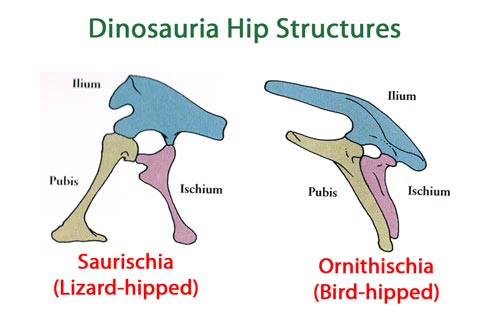
The configuration of the ilium in association with the other hip bones, the ischium and pubis, led to the establishment of two main dinosaur Orders – Saurischia and Ornithischia as proposed by the British palaeontologist Harry Govier Seeley in 1887.  These three bones form the “hip socket” into which the head of the femur (thigh bone) is located.

Classifying Dinosaurs Based on Hip Structure

The shape of the hip bones help to classify the Dinosauria.
Classifying dinosaurs by the shape of their hip bones.  The configuration and orientation of the hip bones led to the establishment to two main groups of dinosaurs in the 19th century. Picture credit: Everything Dinosaur.

Picture credit: Everything Dinosaur

From the Xingezhuang Formation

The ilium was found about a decade ago.  It comes from the Xingezhuang Formation of the Upper Cretaceous Wangshi Group.  The strata have proved difficult to date but most palaeontologists suggest that this formation is between 77 to 73 million years old (middle to late Campanian faunal stage).  With so very little fossil material to go on, the scientists have used the roughly contemporaneous ankylosaurid Pinacosaurus (P. grangeri) which heralds from the Djadokhta Formation of Mongolia, as a reference and to permit a life reconstruction of an ankylosaurid to be used in media releases.

A Life Reconstruction of Pinacosaurus – Sinankylosaurus May Have Been Similar

Life reconstruction Pinacosaurus grangeri.
Pinacosaurus life reconstruction.  Sinankylosaurus zhuchengensis may have been similar.

Picture credit: Zhao Chuang (PNSO)

To view PNSO prehistoric animal models and figures: PNSO Age of Dinosaurs Models.

Sinankylosaurus is estimated to have measured around 5 metres in length and it may have weighed around 2 tonnes.

East Meets West

The discovery of a new dinosaur species adds to the diversity of dinosaurs associated with the Upper Cretaceous deposits of the Wangshi Group and also demonstrates the similarity between the dinosaurian faunas of eastern Asia and western North America in the Late Cretaceous.

For example, dinosaur fossils from the Xingezhuang Formation include hadrosaurs such as Shantungosaurus, ceratopsids such as Sinoceratops, tyrannosaurs and now an ankylosaurid.  This biota is similar to the dinosaur fauna associated with Campanian-aged deposits found in southern Canada and the USA.

The Everything Dinosaur website: Visit Everything Dinosaur.

3 09, 2020

New Research into Calculating the Size of Megalodon

By |2024-03-14T10:15:03+00:00September 3rd, 2020|Categories: Adobe CS5, Dinosaur and Prehistoric Animal News Stories, Main Page, Photos/Pictures of Fossils|0 Comments

Measuring Megalodon

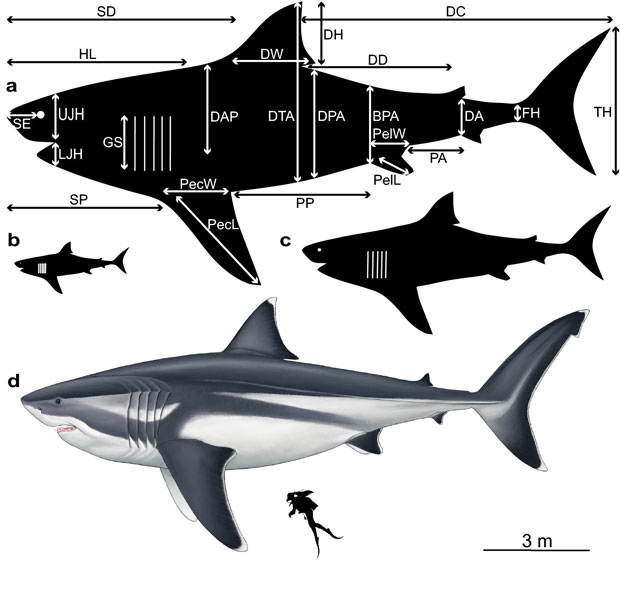
Researchers from the University of Bristol in collaboration with colleagues from the University of Swansea have undertaken a detailed analysis using mathematical models and comparisons with extant shark species to provide an answer to the question – just how big was “megalodon”?  Writing in the academic journal “Scientific Reports”, the scientists set about trying to calculate the overall size and the body part dimensions of the giant prehistoric shark (Otodus megalodon). It is believed to be the largest macropredatory shark that has ever existed.

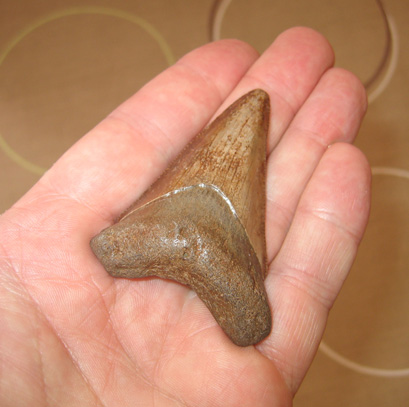
As a shark and therefore with a skeleton made from cartilage and not bone, body fossils are limited to the triangular teeth and to rare calcified vertebrae.  In the absence of extensive fossil material, it is very difficult for scientists to estimate just how big this predator was.  The problem is compounded when an extinct animal is considerably larger than the largest living macropredatory shark, the Great White (Carcharodon carcharias).

This Prehistoric Shark is Known Mainly From Fossilised Teeth

Megalodon fossil tooth
A large fossil tooth from a Otodus megalodon. Picture credit: Everything Dinosaur.

Visit the Everything Dinosaur website: Everything Dinosaur.

Referencing Otodus megalodon

The research team which includes Professor Michael Benton (School of Earth Sciences, University of Bristol), use the species moniker Otodus megalodon in the scientific paper.  Readers of this blog may note, that “megalodon” is listed as Carcharocles megalodon in many of our articles and indeed elsewhere in other scientific literature.

When it comes to this iconic fish, a creature which recently starred in its own movie, “The Meg”, which was released in 2018 and grossed more than $500 million dollars in cinemas, it is not only it size and body proportions that cause debate.  Its taxonomic placement is also controversial.  Most scientists consider “megalodon” to be a member of the Lamniformes Order – the mackerel sharks, furthermore, part of the Otodontidae family, the “megatoothed sharks”, but the phylogeny of the species remains uncertain.

Studies of “Megalodon”

Most studies of “megalodon” rely on comparisons with Carcharodon carcharias as the teeth morphology is similar, but in this research, the scientists estimated the body size and proportions of the extinct animal by comparing it to Great Whites and four other types of mackerel shark – namely:

  • The Porbeagle shark (Lamna nasus) which is present in British waters.
  • The Salmon shark (Lamna ditropis) from the North Pacific.
  • The Shortfin Mako (Isurus oxyrinchus) which has a global distribution including British waters but it is increasingly rare.
  • The Longfin Mako (Isurus paucus) which is found in both temperate and tropical waters and like the closely related Shortfin Mako it is becoming increasingly rare.

This study marks the first quantitative estimate of O. megalodon specific body-part dimensions, beyond its overall body size.

Measuring the “Megalodon”

Measuring megalodon.

Silhouette models visualising Otodus megalodon body dimensions based on the extrapolations at different total lengths.  Silhouette (a)  ~ 16 m, (b)  ~ 3 m and (c)  ~ 8 m.  Life reconstruction of O. megalodon with 1.65 metre tall diver for scale.

Picture credit: Cooper et al (Scientific Reports)

A Giant Prehistoric Shark

The Hollywood “megalodon” was around twenty-three metres in length.  The scientific paper does not suggest that this shark was that big, but their results suggest that a sixteen-metre-long animal had a head around 4.65 metres in length, that’s about the length of a Range Rover Discovery 4×4 vehicle.  The tail fin was estimated to have been approximately 3.85 metres high and this study suggests that the dorsal fin was around 1.62 metres tall.

This research is not likely to influence movie makers and film directors as they plan a sequel to the 2018 release, but the reconstruction of this giant fish,  represents a significant step towards a better understanding of the physiology of this monster.  In addition, having a better understanding of its body proportions and overall size will allow scientists to infer how much food these animals had to consume and other factors that may have facilitated its ultimate demise and extinction.

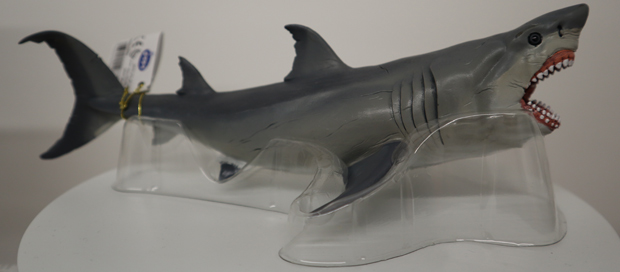
A Prehistoric Shark Model (Papo Megalodon Figure)

Papo Megalodon model (lateral view)
The new for 2021 Papo Megalodon model, one of just two replicas to be introduced by the French model and figure replica this year. Picture credit: Everything Dinosaur.

Picture credit: Everything Dinosaur.

For Papo prehistoric animal models and figures: Papo Prehistoric Animal Models.

The scientific paper: Paper: “Body dimensions of the extinct giant shark Otodus megalodon: a 2D reconstruction” by J. A. Cooper, C. Pimiento, H. G. Ferrón, and M. J. Benton published in Scientific Reports.

31 08, 2020

Hunting Ammonites A Wonderful Fossil Collecting Trip

By |2024-03-14T09:21:22+00:00August 31st, 2020|Categories: Educational Activities, Geology, Photos, Photos/Pictures of Fossils|0 Comments

Hunting Ammonites

For a few hours team members at Everything Dinosaur were able to take a break from their duties and to visit the Yorkshire coast on a hunt for ammonites and other fossil remains.  It was an early start to take advantage of collecting on a low tide and to make the best of the fine weather that had been forecast.  For many fossil hunters, the hunt is almost as rewarding as the finds.  With all the problems with travel at the moment due to the COVID-19 pandemic, it made a pleasant change to be able to participate in a fossil hunting expedition, albeit only for a few hours.

The Spectacular and Very Beautiful Yorkshire Coast

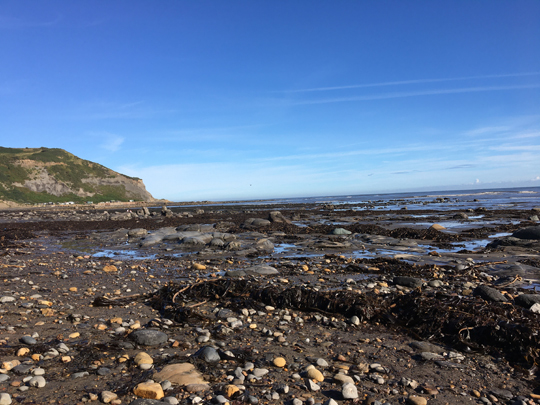
A trip to the coast to collect fossils.
A visit to the North Yorkshire coast on fossil collecting expedition.  The beginning of the day, fine weather is forecast and the early start permitted the team to collect fossils on a falling tide.  Picture credit: Everything Dinosaur,

Picture credit: Everything Dinosaur

Avoiding the Cliffs Whilst Fossil Hunting

The recent heavy rains had saturated the cliffs, making the risk of rockfalls even greater.  During the team’s visit to the beach, several small rockfalls were observed, however, team members stayed away from the cliffs and were content to scour the foreshore looking for fossils.  As this location on the North Yorkshire coast is a SSSI (site of special scientific interest), hammering rocks out of the cliffs is not permitted.  There were plenty of ammonites to see, including quite large ones, preserved at numerous locations at beach level.

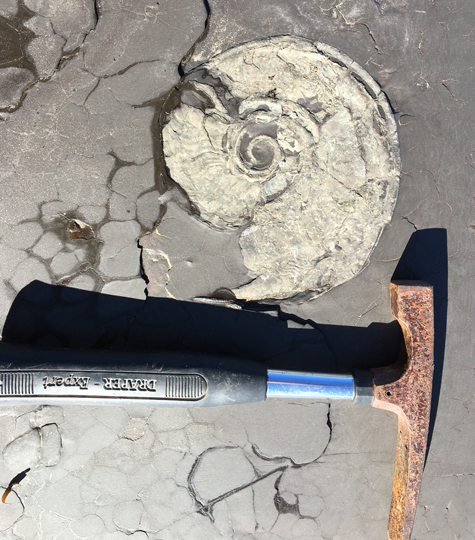
Large Ammonite Fossils Could be Observed on the Beach

Fossil ammonite (geological hammer provides scale).
Large ammonites preserved on the beach.  The geology hammer provides a scale.

Picture credit: Everything Dinosaur

The cliffs at this location are very dangerous and there is a steep and hazardous descent to the beach from the cliff top, this location is not for the faint hearted and not suitable for family groups.

Searching for Fossils on the Foreshore – Some Interesting Finds

Fossil hunting on the foreshore.
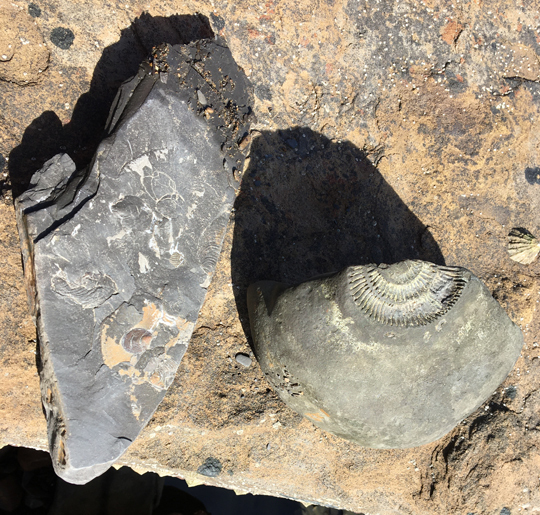
A Dactylioceras ammonite negative exposed in a broken “cannonball” and some brachiopod pieces collected from the foreshore.

Picture credit: Everything Dinosaur

The Everything Dinosaur website: Everything Dinosaur.
Lower Jurassic Fossils

The strata dates from the Lower Jurassic and there were plenty of small fragments of ammonites to collect in addition to the occasional gryphaea fossil along with various bivalves and brachiopods.  Some of the large specimens were kept as when we visit schools or conduct outreach science activities, we like to give away fossils to help provide resources to the teaching team and to encourage young people to take up fossil collecting as a hobby.

An Ammonite Fossil Found on the Beach

An ammonite fossil find.
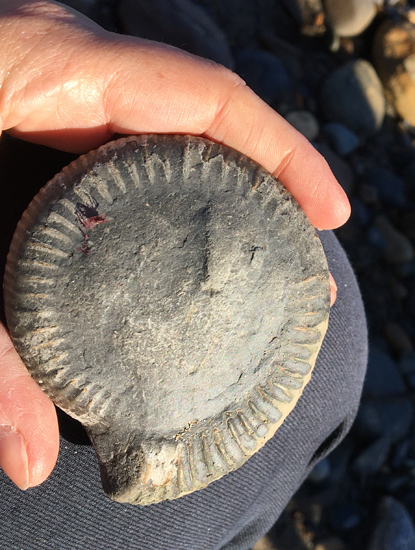
An ammonite partially eroded out of a nodule. We think this is an example of Dactylioceras commune. A wonderful discovery whilst fossil hunting.

Picture credit: Everything Dinosaur

An Ammonite Model

When we visited schools we liked to take an ammonite model with us as well as ammonite fossils. The model helped the children to understand what the creature looked like in real life.

A Model of an Ammonite

CollectA Pleuroceras ammonite model.
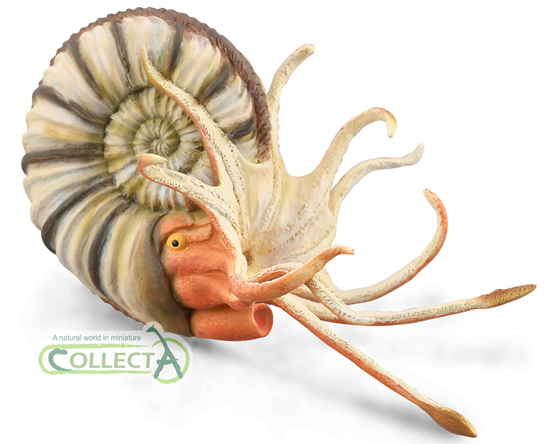
CollectA Age of Dinosaurs Popular Size Pleuroceras ammonite model.

The picture (above) shows a CollectA ammonite figure. To view this range of prehistoric animal models: CollectA Prehistoric Life Figures.

30 08, 2020

New Study Suggests Ancient Crocodile Attacked Ground Sloths

By |2024-03-14T08:56:19+00:00August 30th, 2020|Categories: Adobe CS5, Dinosaur and Prehistoric Animal News Stories, Main Page, Palaeontological articles, Photos/Pictures of Fossils|0 Comments

Juvenile Purussaurus Attacked Ground Sloth

The giant prehistoric caiman Purussaurus is regarded as one of the largest crocodilians to have ever lived.  How big this predator of the wetlands of South America during the Miocene actually was, remains open to debate.  It is known mainly through skull material, (the largest measuring 1.45 metres in length) and isolated teeth.  It is one of several types of crocodiles associated with the Pebas Mega-Wetland System from the north-western side of the continent.  Evidence of Purussaurus interaction with prey is limited, confined to a scarred and dented turtle shell, documenting a failed attack by an adult Purussaurus.

Fossilised Tibia with Pathology

However, scientists have reported the discovery of the lower leg bone of a ground sloth that bears the tell-tale tooth marks and scratches of an attack from a Purussaurus (P. neivensis).  The sloth identified as the genus Pseudoprepotherium very probably did not survive the encounter with a four-metre-long caiman.

A Life Reconstruction of the Purussaurus Attack

Ground sloth attacked by Purussaurus.
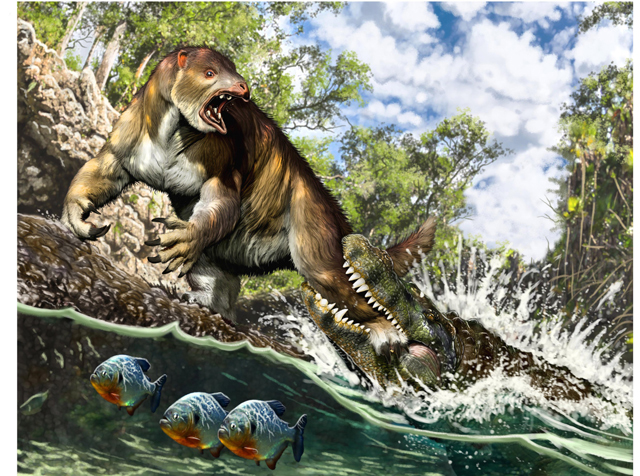
A ground sloth (Pseudoprepotherium) attacked by the giant South American caiman Purussaurus.  In total 46 toothmarks were identified on the 13 million-year-old tibia bone from the ground sloth.

Picture credit: Jorge A. González

Attacked by a Juvenile Purussaurus

Thirteen million years ago, South America was an island continent.  There was no isthmus joining the landmass to North America and therefore no opportunity for placental carnivores (Order Carnivora), to enter South America.  There were terrestrial predators, such as pouched mammals from the marsupial lineage (sparassodonts) and three-metre-high terror birds (phorusrhacids).  Competing with these creatures for the title of most feared predator was the prehistoric caiman Purussaurus neivensis and its close relatives.

Writing in “Biology Letters”, palaeontologist Rodolfo Salas-Gismondi from Cayetano Heredia University (Peru), along with co-author François Pujos conclude that the bitemarks on a tibia found during field work in north-eastern Peru represent predation by a four-metre-long, juvenile Purussaurus.

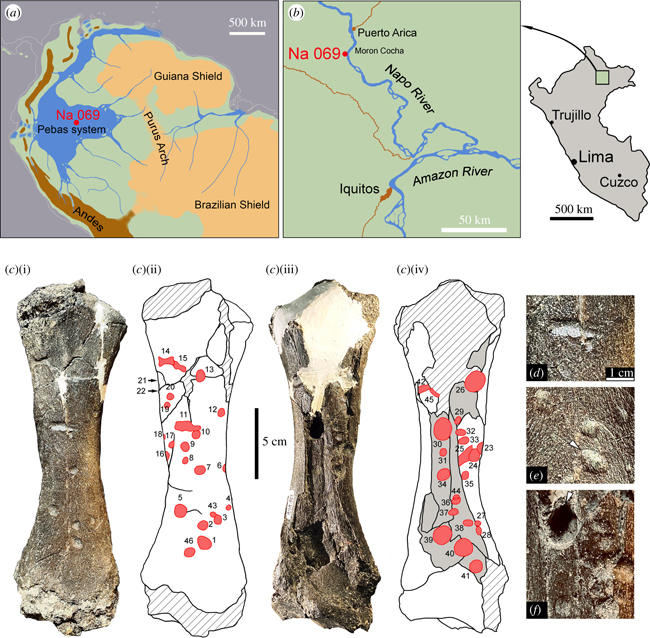
The Location of the Fossil Find and Views of the Damaged Tibia

Purussaurus attacked ground sloth.
The location of the fossil tibia find in north-eastern Peru.  Close-up views of the toothmarks on the tibia and line drawings.

Picture credit: Salas-Gismondi and François Pujos (Biology Letters)

The picture (above), shows the  Pebas Mega-Wetland System around 13 million years ago (a).  Na069 represents the bonebed where the tibia was found and (b) shows this bonebed location on the Napo River in north-eastern Peru.   The left tibia of the ground sloth is shown in anterior (c i) and posterior (c ii) views with accompanying line drawings.  Photographs (d-f) highlight individual toothmarks and punctures.  The red dots map the bitemarks.

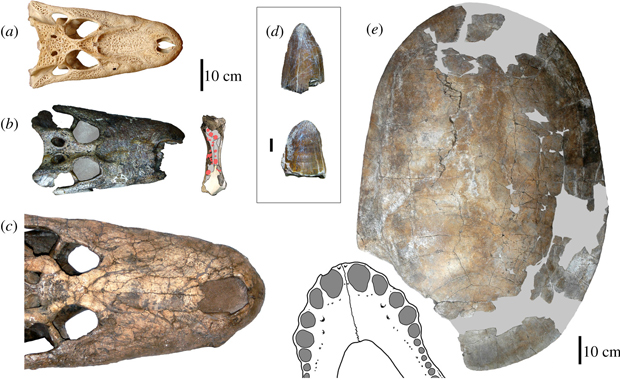
Extant and Extinct Crocodilian Skulls Compared Along with Purussaurus Teeth and Damaged Turtle Shell 

Crocodilian skulls and bitemark damage.
The skull of an adult black caiman compared to a juvenile Purussaurus neivensis, the bite-marked tibia and the skull of a fully grown P. neivensis along with turtle shell showing bitemark.

Picture credit: Salas-Gismondi and François Pujos (Biology Letters)

The picture (above) shows dorsal views of an adult extant black caiman (Melanosuchus niger) skull (a) compared with the skull of a juvenile Purussaurus neivensis (b), facing the damaged ground sloth tibia.  The skull of an adult P. neivensis (c) and teeth (d).  The shell of the prehistoric turtle Podocnemis with a portion of the carapace missing attributed to a bite from a huge Purussaurus brasiliensis (tip of jaw in line drawing).

A Substantial Meal for a 4-metre Crocodilian

The interpretation of the damaged tibia as evidence of predation from Purussaurus neivensis provides a rare insight into prehistoric crocodilian/prey behaviour.  It suggests that prior to reaching adult size, young individuals fed upon terrestrial mammals about the size of a capybara.  The ground sloth is estimated to have weighed around 78 kilograms that’s the about the same as an adult human male.  If a young Purussaurus could take down an sloth weighing as much as a man, it speaks volumes for that person’s chances if they ever would have met a fully grown Purussaurus.

To read an article commenting on contenders for the largest crocodile known to science: Which was the Largest Crocodilian of All Time?

Ancient Purussaurus from Venezuela had unique adaptations to help it move: Ancient Crocodilian Evolved Unique Specialisations Due to its Size.

Prehistoric crocodilians from Peru: Peruvian Paradise for Prehistoric Crocodiles.

The scientific paper: “Predation of the giant Miocene caiman Purussaurus on a mylodontid ground sloth in the wetlands of proto-Amazonia” by François Pujos and Rodolfo Salas-Gismondi published in Biology Letters.

The Everything Dinosaur website: Everything Dinosaur.
29 08, 2020

New Study Unravels the Evolution of the Mammalian Middle Ear?

By |2024-03-14T07:59:54+00:00August 29th, 2020|Categories: Adobe CS5, Dinosaur and Prehistoric Animal News Stories, Main Page, Palaeontological articles, Photos/Pictures of Fossils|0 Comments

Newly Described Multituberculate Mammal Provides Clues to Middle Ear Evolution

A team of international scientists from the Chinese Academy of Sciences, the American Museum of Natural History (New York) and the Beipiao Pterosaur Museum of China, have described a new species of multituberculate mammal that once roamed and climbed in the forests of north-eastern China during the Early Cretaceous.  The small creature has been named Sinobaatar pani and its delicate middle ear bones have been preserved providing researchers with an opportunity to study the evolutionary development of hearing.

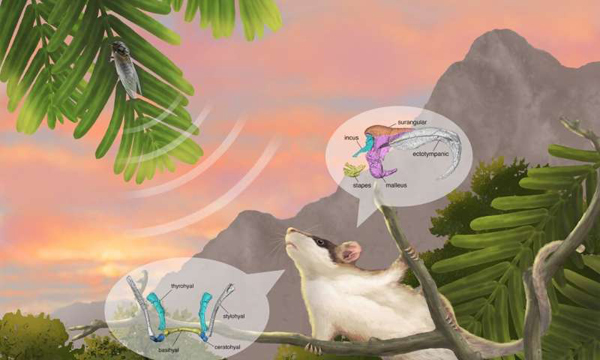
A Life Reconstruction of the Small Multituberculate Mammal S. pani

 A life reconstruction of Sinobaatar pani.
Newly described multituberculate mammal provides clues to middle ear evolution.  A life reconstruction of Sinobaatar pani.

Picture credit: Institute of Vertebrate Palaeontology and Palaeoanthropology (IVPP)

How Do Mammals Hear?

The terrestrial placental mammal ear can be divided into three sections:

  1. Outer ear – collects and directs sound via the ear flap (pinna) and the outer ear canal which ends in the eardrum (tympanic membrane).
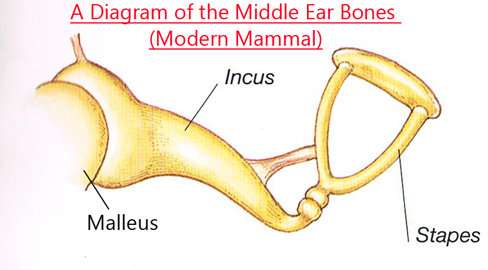
  2. Middle ear – which filters and amplifies sound waves directing them to the inner ear.  The middle ear contains three, delicate and tiny bones (ossicles), the anvil, hammer and the stapes (incus, malleus and stirrup).
  3. Inner ear – consisting of the cochlea (organ for hearing) and the vestibular system (associated with balance).

The Inner Bones of a Model Mammal

Diagram of the middle ear of a modern mammal.
The three middle ear bones of a modern mammal.  The three tiny bones are highlighted, these transfer vibrations from the eardrum to the inner ear, where the sound waves are changed into electrical signals by the cochlea which are then deciphered by the brain.  Picture credit: Everything Dinosaur.

Picture credit: Everything Dinosaur

It is the inner ear bones that act as a bridge between the eardrum and the oval window which is the opening to inner ear.  The cochlea, which is a hollow, spiral shaped bone transduces the sound waves into electrical signals (neural impulses), that are deciphered by the brain.

Sinobaatar pani and Middle Ear Evolution

Scientists believe that bones that were once part of the reptilian jaw slowly evolved into the three bones that are now found in the middle ear.  A joint research team led by Dr Mao Fangyuan from the Institute of Vertebrate Palaeontology and Palaeoanthropology (IVPP) of the Chinese Academy of Sciences and Professor Meng Jin from the American Museum of Natural History were able to model the delicate middle ear bones of S. pani by using computerised tomography to access and view the fossils whilst they were still surrounded by matrix.

The powerful, rock-penetrating X-rays allowed the scientists to construct three-dimensional computer models of the malleus, incus and the stapes and to study their shape.

The images generated, permitted the comparing of the tiny inner ear bones of the Early Cretaceous multituberculate with the embryos of different types of living mammal (placental, marsupial and monotreme).

The Ancestral Phenotype of the Mammalian Middle Ear

Dr Mao explained that her colleagues were able to examine and assess the ancestral phenotype of the mammalian middle ear.  The researchers recognised that the three main Mesozoic mammalian groups (multituberculates, eutriconodontans and symmetrodontans) share a similar middle ear structure between the incus and malleus, which they termed the “braced hinge joint”.  Although they acknowledged that the middle ear may have evolved independently in several mammalian groups, they proposed that the braced hinge joint could represent a critical feature of the ancestral phenotype of the mammalian middle ear.

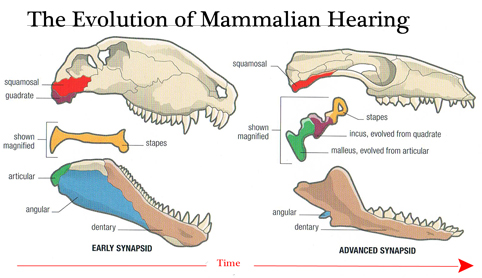
The Evolution of Mammalian Hearing

Evolution of the mammalian middle ear.
The evolution of the mammalian middle ear.  The skull and jaw of an early synapsid (pelycosaur) compared to the skull and jaw of a later synapsid, the evolution of the three middle ear bones.

Dr Mao commented:

“There are two basic patterns of the middle ear in living mammals, represented by monotremes and therians [placentals and marsupials], respectively.  In the former, the middle ear is characterised by an “abutting contact” between the incus and malleus, which is distinct from the one in therian mammals where the incus-malleus articulation is saddle-shaped.”

Sinobaatar pani Provides Clues

The abutting pattern in monotremes and the saddle-shaped joint in therians may well be derived from the braced hinge joint linking the incus and malleus as observed in Mesozoic mammals.  At the very least, these fossil forms have narrowed the morphological gap between the middle ear of protomammals, formed by the postdentary bones lodged in the lower jaw, to the middle ear of extant mammals.  The researchers proposed that the surangular bone, which is another postdentary bone in protomammals, persisted in Mesozoic mammals; its fate in living mammals remains uncertain.

Writing in the National Science Review, the researchers demonstrate that middle ear morphologies in Mesozoic mammals represent different evolutionary stages with Sinobaatar showing an advanced inner ear configuration.  Furthermore, the evolutionary changes recorded in the Mesozoic mammals are largely consistent with the way the middle ear bones develop as living mammals grow, supporting the relationship between evolution and development.

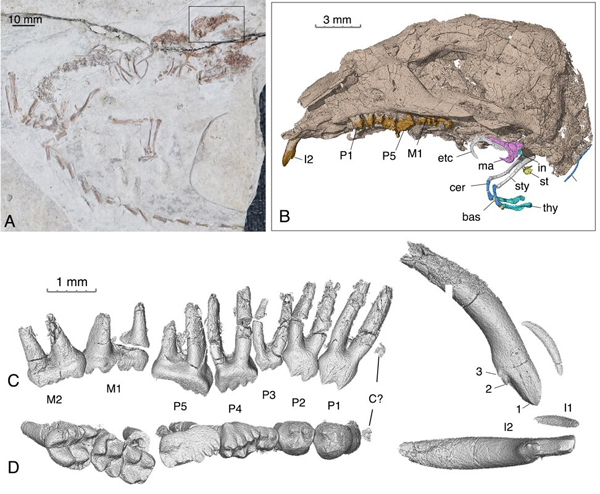
The Holotype of S. pani and Three-dimensional Skull and Teeth Images

Sinobaatar pani holotype material.
The holotype specimen of Sinobaatar pani (BPMC 0051) in the matrix (A) the black rectangle shows the area that has been CT-rendered to show the three-dimensional skull (B).  Left upper dentition in (C) lingual and (D) occlusal views.

Picture credit: Institute of Vertebrate Palaeontology and Palaeoanthropology (IVPP)

Everything Dinosaur acknowledges the assistance of a press release from the Chinese Academy of Sciences in the compilation of this article.

The scientific paper: “Exploring ancestral phenotypes and evolutionary development of the mammalian middle ear based on Early Cretaceous Jehol mammals” by Fangyuan Mao, Cunyu Liu, Morgan Hill Chase, Andrew K Smith and Jin Meng published in National Science Review.

The Everything Dinosaur website: Everything Dinosaur.
Go to Top