All about dinosaurs, fossils and prehistoric animals by Everything Dinosaur team members.

Pictures of fossils, fossil hunting trips, fossil sites and photographs relating to fossil hunting and fossil finds.

10 05, 2022

Pregnant Ichthyosaur Airlifted to Safety

By |2024-12-30T14:55:15+00:00May 10th, 2022|Categories: Adobe CS5, Dinosaur and Prehistoric Animal News Stories, Dinosaur Fans, Main Page, Photos/Pictures of Fossils|0 Comments

As the glaciers that comprise the Southern Patagonian Ice Field in Chile retreat, some of the rocks exposed have revealed an astonishing array of ichthyosaur fossils. A resilient and dedicated team of scientists have been working to map this hugely significant site and to extract the marine reptile fossil material so that these remarkable specimens can be studied in more detail.

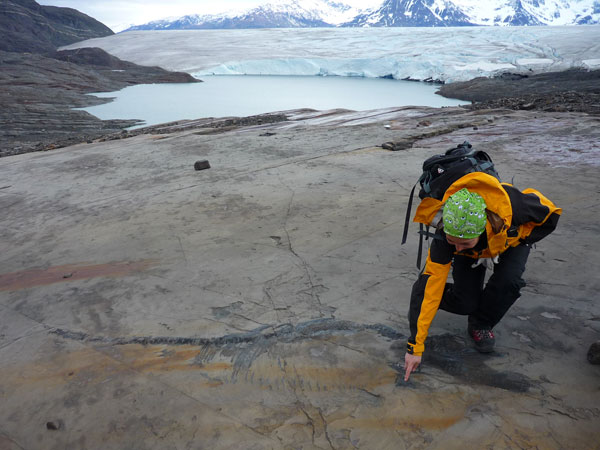
Exposed ichthyosaur specimen revealed by a retreating glacier.
Dr Judith Pardo-Pérez (University of Magallanes), shows the ichthyosaur specimen exposed by the retreating Tyndall Glacier. Picture credit: Alejandra Zúñiga.

Picture credit: Alejandra Zúñiga

Finding and Rescuing “Fiona” the Pregnant Ichthyosaur

An expedition to the remote Tyndall Glacier located in the Torres del Paine National Park, led by Dr Judith Pardo-Pérez from the University of Magallanes (Punta Arenas, southern Chile), has recovered the country’s first complete ichthyosaur fossil. Nicknamed “Fiona” the four-metre-long specimen represents the remains of a pregnant female, complete with several ichthyosaur embryos.

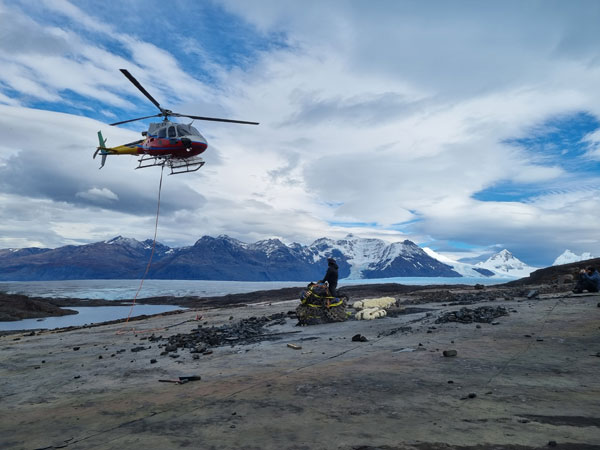
“Fiona” was discovered in 2009, during an earlier expedition to this remote area of Chilean Patagonia. A team of dedicated researchers which included Jonatan Kaluza from Fundación de Historia Natural Félix de Azara and CONICET (Argentina), biologist and palaeontological excavator Héctor Ortiz from the Chilean Antarctic Institute and the University of Chile and renowned ichthyosaur expert Dr Dean Lomax (Visiting Scientist at The University of Manchester), braved the harsh conditions in March and April to ensure the safe removal of the specimen. The intact female ichthyosaur remains were airlifted using a helicopter. It is hoped that further analysis of this remarkable specimen will confirm it as a new ichthyosaur genus.

Airlifting an ichthyosaur fossil.
A helicopter prepares to airlift the pregnant ichthyosaur specimen. Picture credit: The University of Manchester.

Picture credit: The University of Manchester

The First Female Palaeontologist to Lead a Major Expedition to Patagonia

Dr Judith Pardo-Pérez has visited the Tyndall fossil site more than ten times since the initial discovery in 1997 and completed her PhD on the ichthyosaurs found in the area. Thanks to funding from the Chilean National Agency for Research and Development (ANID), a team of top scientists could be put together to allow the fossils preserved in an ancient Cretaceous seabed to be studied in detail.

Dr Pardo-Pérez, is the first female palaeontologist to lead a major expedition in Patagonia.

Team members at the Tyndall Glacier Site (Chile)
Part of the Tyndall Ichthyosaur Team discuss excavating a section of a fossil specimen. Picture credit: The University of Manchester.

Picture credit: The University of Manchester

Collecting these hugely important marine reptile fossils, was no easy task. The Tyndall Glacier site could only be reached by a 10-hour hike or horse ride and the team had to endure difficult weather conditions including high winds and snowstorms whilst excavating the fossils from the extremely hard sediment.

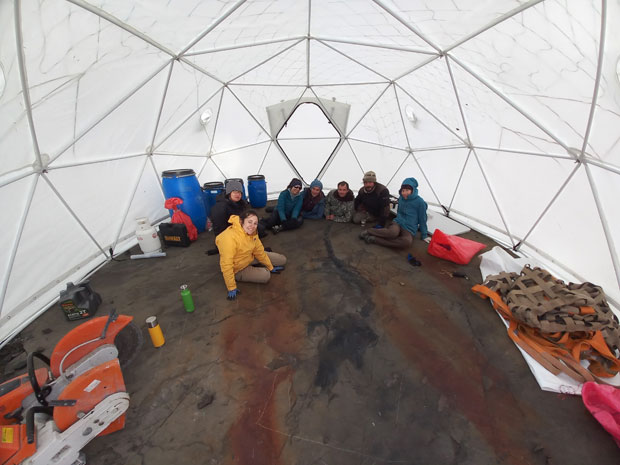
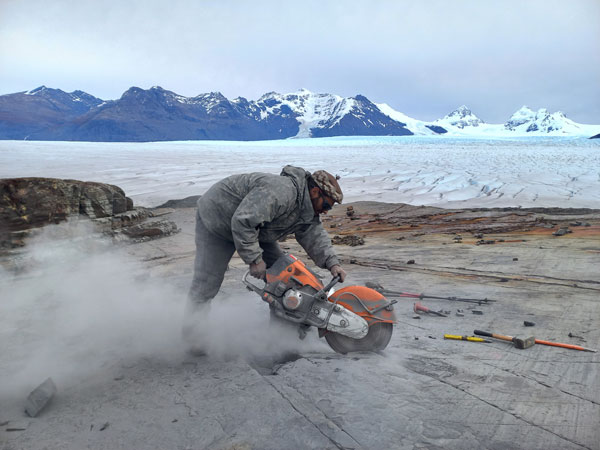
To combat the 90 kph winds, heavy rain and snow, a hangar was built over “Fiona” so that the team could continue to work despite the harsh weather. Circular saws and heavy-duty excavation tools were used to free the fossils from the bedrock.

A hanger erected over the ichthyosaur specimen.
A hanger was erected over the 4-metre-long ichthyosaur fossil so the scientists could continue working on the specimen despite the extreme weather conditions. Picture credit: The University of Manchester.

Picture credit: The University of Manchester

The Most Abundant and Best-preserved Cretaceous Ichthyosaur Deposit Known

Despite the constant threat of pumas, the team have ensured that this exceptional female specimen has been made available for further analysis and study. It is the only known specimen of a pregnant female of Valanginian-Hauterivian age (between 129 and 139 million years old from the Early Cretaceous).

Commenting on the importance of the specimen, Dr Pardo-Perez Pérez stated:

“At four metres long, complete, and with embryos in gestation, the excavation will help to provide information on its species, on the palaeobiology of embryonic development, and on a disease that affected it during its lifetime.”

In addition to “Fiona” a further twenty-three new ichthyosaur specimens were discovered by the expedition team, making the Tyndall Glacier site perhaps the most abundant and best-preserved early Cretaceous ichthyosaur deposit in the world.

Examining an Ichthyosaur Skull
Dr Judith Pardo-Pérez and Dr Dean Lomax examining the best-preserved skull of an ichthyosaur found at the Tyndall Glacier site. Whilst assisting on-site, Dr Lomax found new specimens including the skull of a juvenile ichthyosaur. Picture credit: The University of Manchester.

Picture credit: The University of Manchester

An Ichthyosaur Graveyard

The fossils consist of adults, juveniles and very young ichthyosaurs, they can provide scientists with information on breeding behaviour as well as helping to plot the radiation of new ichthyosaur genera following the end-Jurassic extinction event.

Dr Lomax explained:

“The fact that these incredible ichthyosaurs are so well preserved in an extreme environment, revealed by a retreating glacier, is unlike anywhere else in the world. The considerable number of ichthyosaurs found in the area, including complete skeletons of adults, juveniles, and new-borns provides a unique window into the past. The international collaboration helps to share this exceptional ichthyosaur graveyard with the world and, to a large extent, to promote science.”

Cutting out an ichthyosaur specimen
Jonatan Kuluza, palaeontological technician at the Fundación de Historia Natural Félix de Azara and CONICET (Argentina), uses a circular saw to cut out an ichthyosaur specimen. Picture credit: The University of Manchester.

Picture credit: The University of Manchester

Dr Lomax added:

“The weather was so extreme that we could not get to the ichthyosaur site every day and had to remain in camp. On those days when the team could reach the site, they documented the ichthyosaurs and other fossils and discovered new specimens. Amazingly, on average, two ichthyosaurs were found every day.”

Protecting and Preserving the Remaining Specimens

The female ichthyosaur nicknamed “Fiona”, will be prepared and studied at the Río Seco Natural History Museum in Punta Arenas. It is hoped that the beautifully preserved specimen will go on public display.

The priority for Dr Pardo-Pérez and her collaborators is to try to preserve as many specimens as possible. The remoteness of the site and the difficult working conditions will hamper any attempts to preserve and protect these remarkable specimens.

Outlining some of the problems facing the team, the doctor stated:

“We have almost a hundred ichthyosaurs in the Tyndall Glacier fossil deposit and many of them, unfortunately, will never be excavated, due to the difficulty of access, being in risk areas [cliff edge], and lack of funds. The ichthyosaurs that will not be excavated need protection and consolidation in situ, as the erosion to which they are being subjected on a daily basis is destroying them.”

Everything Dinosaur acknowledges the assistance of media release from The University of Manchester in the compilation of this article.

The award-winning Everything Dinosaur website: Prehistoric Animal Models.

6 05, 2022

New Species of Long-tailed Marine Reptile Described

By |2024-12-30T14:30:27+00:00May 6th, 2022|Categories: Adobe CS5, Dinosaur and Prehistoric Animal News Stories, Main Page, Palaeontological articles, Photos/Pictures of Fossils|0 Comments

A new species of Triassic marine reptile has been described following the discovery of superbly preserved fossils in Yunnan Province (south-western China). Named Honghesaurus longicaudalis it is a member of the Pachypleurosauroidea and it possessed the longest tail of any known pachypleurosaur.

Honghesaurus longicaudalis

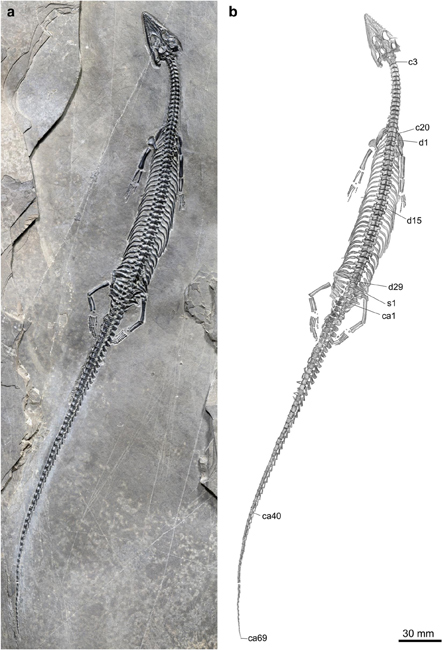
The holotype fossil (IVPP V30380) of the newly described Honghesaurus longicaudalis. Photo (a) and line-drawing (b) of whole specimen. c, cervical vertebra; ca, caudal vertebra; d, dorsal vertebra; s, sacral vertebra. Picture credit: Xu et al.

Picture credit: Xu et al

Writing in the academic journal “Scientific Reports”, the researchers from the Chinese Academy of Sciences, in collaboration with colleagues from the Zhejiang Museum of Natural History and Guizhou University, describe a complete skeleton in the collection of the Institute of Vertebrate Palaeontology and Palaeoanthropology, Chinese Academy of Sciences (specimen number IVPP V30380). The stunning fossil material comes from marine deposits associated with the Guanling Formation and it is estimated to be around 244 million years of age (Anisian stage of the Middle Triassic).

The Tale of a Very Long Tail

Remarkably, the tail of H. longicaudalis contains 69 caudal vertebrae, far more than any other known pachypleurosaur, other pachypleurosaurs commonly have no more than 58 caudal vertebrae. Humans in comparison have just 33 vertebrae in their skeleton. The researchers conclude that this extremely long tail (making up more than fifty percent of the entire body length), in combination with the animal’s long trunk made Honghesaurus extremely manoeuvrable in water. The scientists also speculate that the exceptionally long tail and body helped this marine reptile to conserve energy as it swam.

Skull and mandible of Honghesaurus longicaudalis.

Skull and mandible of Honghesaurus longicaudalis (IVPP V30380). Photo before (a) and after (b) dusted with ammonium chloride. (c) Line- drawing. (d) Reconstruction in dorsal view. an, angular; ar, articular; at, atlas; ax, axis; c, cervical vertebra; den, dentary; en, external naris; eo, exoccipital; f, frontal; j, jugal; m, maxilla; n, nasal; op, opisthotic; p, parietal; pat, proatlas; pm, premaxilla; po, postorbital; pof, postfrontal; prf, prefrontal; pt, pterygoid; q, quadrate; sa, surangular; so, supraoccipital; sq, squamosal; stf, supratemporal fossa. Picture credit: Xu et al.

Picture credit: Xu et al

The Dispersal of the Pachypleurosaurs

The holotype and currently only known specimen of H. longicaudalis (IVPP V30380) measures 47.1 cm in length. Most pachypleurosaurs were of a similar size although phylogenetic analysis suggests that Honghesaurus was closely related to the much larger Wumengosaurus delicatomandibularis, which had an estimated body length of 1.3 metres.

Pachypleurosaurs are regarded as basal members of the Superorder Sauropterygia, which includes placodonts and the plesiosaurs. The research team postulate that the discovery of Honghesaurus demonstrates the diverse morphology of the Pachypleurosauridae and lends weight to the idea that these marine reptiles originated in Europe and dispersed along the Tethys Ocean in a westerly direction giving rise to new forms in the eastern Tethys Ocean.

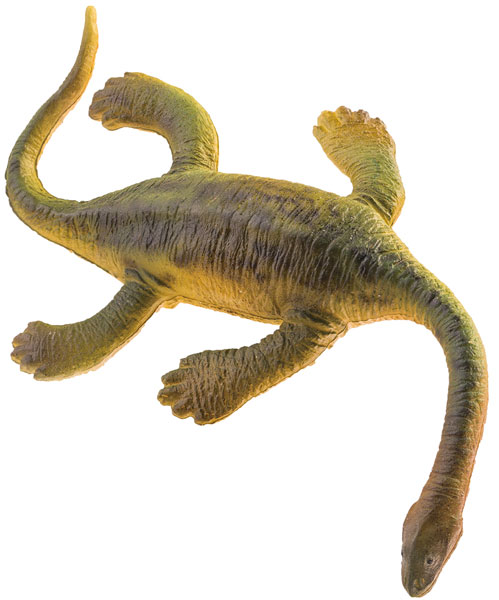
Keichousaurus life reconstruction.

The best-known of all the pachypleurosaurs is Keichousaurus.  It is also known from south-western China although from geologically younger deposits than the strata that yielded the single specimen of Honghesaurus.

The picture (above) shows a PNSO Keichousaurus model.  To view the range of PNSO prehistoric animal models: PNSO Age of Dinosaurs Figures.

The scientific paper: “A long-tailed marine reptile from China provides new insights into the Middle Triassic pachypleurosaur radiation” by Guang-Hui Xu, Yi Ren, Li-Jun Zhao, Jun-Ling Liao and Dong-Hao Feng published in Scientific Reports.

5 05, 2022

Admiring Remarkable Horsetails

By |2024-12-30T14:21:51+00:00May 5th, 2022|Categories: Adobe CS5, Dinosaur Fans, Main Page, Photos, Photos/Pictures of Fossils|0 Comments

Horsetails (sphenopsids) continue to thrive although their Carboniferous heyday is long behind them. Once a much more extensive group, these vascular plants, believed by many palaeobotanists to be closely related to ancestral ferns, are now represented by about twenty species, all contained in the genus Equisetum.

Admiring Horsetails – One of Natures Great Survivors

Horsetails
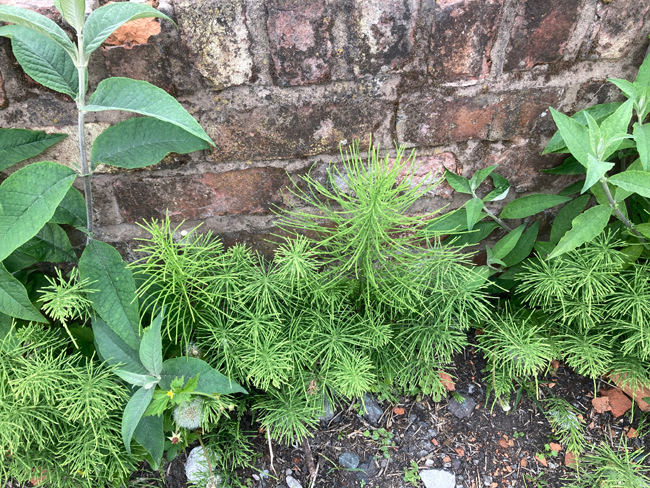
Horsetails (Equisetum) continue to thrive as they are able to grow in areas where other plants would find it difficult to get a foothold. Often regarded as weeds, these tough little plants are essentially living fossils, as the earliest examples of the genus Equisetum date from the Early Jurassic of South America.  Picture credit: Everything Dinosaur.

Picture credit: Everything Dinosaur

The Everything Dinosaur website: Dinosaur Toys.

A Living Fossil

When team members at Everything Dinosaur see a clump of horsetails, often growing on waste ground we stop to admire them. These tough little plants deserve respect. After all, they are essentially a living fossil, the oldest fossil remains of modern horsetails (genus Equisetum), date from approximately 190 to 182 million years ago (early Pliensbachian to early Toarcian), represented by Equisetum dimorphum from the Early Jurassic of South America (Chubut Province, Argentina).

Horsetail fossils - Equisetum dimorphum.
Photographs of Equisetum dimorphum sp. nov. from the Lower Jurassic of Chubut Province, Argentina. 1-2. Part and counterpart of a strobilus showing the hexagonal sporangiophores and the long leaves of MPEF-Pb 5894a and MPEF-Pb 5894b; 3. Detailed inner view of 1 showing oblong sporangia of MPEF-Pb 5894a; 4. Isolated external cast of sporangiophore showing central umbo of MPEF-Pb 6477a. Abbreviations: le, leaves; s, sporangia. Scale bars 1-2 = 3mm; 3 = 1 mm; 4 = 0.5 mm. Picture credit: Elgorriaga et al.

Picture credit: Elgorriaga et al

For models and replicas of prehistoric plants and dinosaurs: CollectA Age of Dinosaurs Popular Figures.

3 05, 2022

Getting your Claws into Therizinosaurs

By |2023-03-07T21:59:30+00:00May 3rd, 2022|Categories: Adobe CS5, Dinosaur and Prehistoric Animal News Stories, Dinosaur Fans, Main Page, Palaeontological articles, Photos/Pictures of Fossils|0 Comments

Scientists have named a new species of therizinosaur based on fragmentary remains found on the Japanese island of Hokkaido. The dinosaur has been named Paralitherizinosaurus japonicus, it is the first recovered from Asian marine deposits and the third example of a therizinosaur to be found in Japan.

The fossil material, recovered from the lower Campanian Osoushinai Formation near to the town of Nakagawa in the Hokkaido Prefecture, was previously identified as a maniraptoran theropod dinosaur, possibly therizinosaur, but its taxonomic status remained uncertain. A group of scientists including Yoshitsugu Kobayashi and Anthony R. Fiorillo from the Hokkaido University Museum re-examined the fossils and erected a new taxon confirming the fossil material did represent a Late Cretaceous member of the Therizinosauridae.

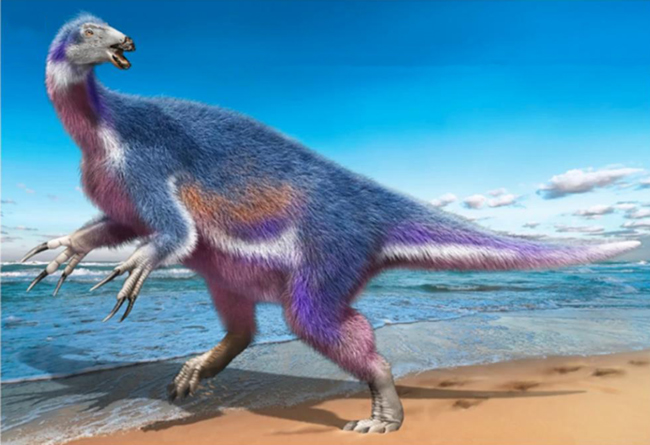
Paralitherizinosaurus japonicus life reconstruction
A life reconstruction of the Late Cretaceous, Japanese therizinosaur Paralitherizinosaurus japonicus. Picture credit: Masato Hattori.

Evolution of Claw Shape in the Therizinosauridae

Writing in the academic journal “Scientific Reports”, the researchers reassessed the fossil material consisting of a single vertebra plus bones and claws (unguals) from the right hand. As well as concluding that the fossils represent a therizinosaur, they confirmed that it is the geologically youngest therizinosaur known from Japan described to date.

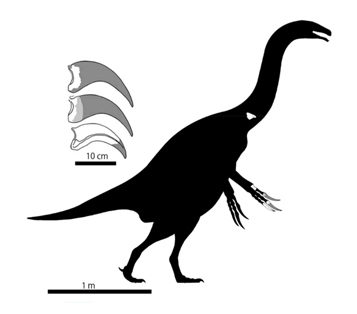
Paralitherizinosaurus silhouette
Paralitherizinosaurus japonicus silhouette showing estimate of body size and position of known skeletal elements. The fossilised claw elements shown in close view with known material in white. Picture credit: Genya Masukawa.

Important Implications for Claw (Ungual) Evolution in the Therizinosauridae

The scientists compared the shape of the hand claws from Paralitherizinosaurus japonicus with the claws from geologically older therizinosaurs and they postulated that that primitive therizinosaurs had claws with generalist functionalities and that the claws of more derived, later therizinosaurs such as P. japonicus were more suited to the hook-and-pull feeding function. Hook-and-pull feeding involves the use of the claws to help gather vegetation and bring it closer to the mouth.

What’s in a Name?

The fossils were found in a concretion associated with the Campanian-aged Osoushinai Formation of the Yezo Group on Hokkaido Island. The Yezo Group mostly consists of marine deposits and many vertebrate fossils such as plesiosaurs, sharks, mosasaurs and turtles have been discovered. Fragmentary dinosaur fossils are also associated with these strata including hadrosaurids, an armoured dinosaur (nodosaurid) and a potential tyrannosaur. A therizinosaur taxon can now be added to this Late Cretaceous dinosaur biota.

PNSO Qingge the Therizinosaurus
A typical therizinosaur dinosaur model (PNSO).

To view replicas of feathered theropods including therizinosaurus (whilst stocks last): PNSO Age of Dinosaurs Figures.

The discovery of the bones and claw elements in marine deposits helped to inspire this dinosaur’s scientific name. The genus name translates as “scythe reptile by the sea”, whilst the species name honours Japan.

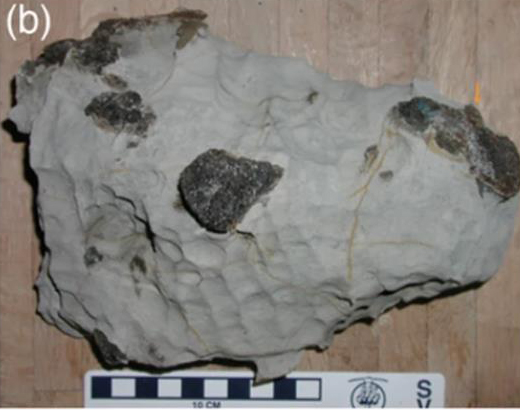
Paralitherizinosaurus japonicus fossils.
The concretion that contained the fragmentary therizinosaur fossil material prior to preparation. Picture credit: Kobayashi et al.

The scientific paper: “New therizinosaurid dinosaur from the marine Osoushinai Formation (Upper Cretaceous, Japan) provides insight for function and evolution of therizinosaur claws” by Yoshitsugu Kobayashi, Ryuji Takasaki, Anthony R. Fiorillo, Tsogtbaatar Chinzorig and Yoshinori Hikida published in Scientific Reports.

28 04, 2022

A New, Giant Megaraptorid from South America is Described

By |2024-12-30T10:01:11+00:00April 28th, 2022|Categories: Adobe CS5, Dinosaur and Prehistoric Animal News Stories, Dinosaur Fans, Main Page, Palaeontological articles, Photos/Pictures of Fossils|0 Comments

Fragmentary bones excavated from Santa Cruz Province, Patagonia (Argentina), have revealed the presence of a super-sized megaraptorid theropod in the Late Cretaceous (Maastrichtian faunal stage). The new dinosaur, named Maip macrothorax is estimated to have been at least 9.5 metres long. It represents the biggest member of the Megaraptoridae described to date and its discovery lends support to the theory that these types of dinosaurs were not members of the Allosauria clade, but they were coelurosaurs and therefore related to the dinosaur lineage that gave rise to the birds.

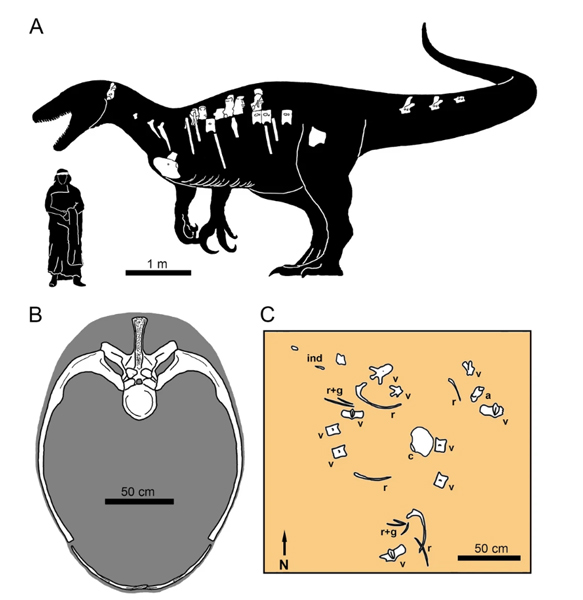
Maip macrothorax.

Silhouette of Maip macrothorax showing the preserved bones in white (A). Reconstruction of the thoracic cavity of Maip (B) at the level of dorsal vertebra 6 (D6). Drawing of the excavation of Maip showing the original disposition of the bones (C). Abbreviations: a, axis; c, coracoid; ind, indeterminate bone; g, gastralia; r, rib; v, vertebrae. Picture credit: Rolando et al. Note scale bar in (A) = 1 metre, and (B,C) 50 cm.

Picture credit: Rolando et al

The fossil material was collected from exposures of the Chorrillo Formation approximately eighteen miles southwest of the city of El Calafate (southwestern Santa Cruz Province, Patagonia, Argentina).

The “Shadow of the Death” which “Kills with Cold Wind”

The Megaraptora clade are mostly known from fragmentary and very incomplete specimens. The fossils of Maip macrothorax (pronounced my-eep mac-row-thor-ax), although representing only a small portion of the overall skeleton, consist of a single cervical vertebra (C2 the axis), several dorsal vertebrae, ribs, the left coracoid, a partial toe bone, fragments of the scapula and caudal vertebrae.

By studying these bones the researchers, that included Alexis M. Aranciaga Rolando from the Museo Argentino de Ciencias Naturales “Bernardino Rivadavia” (Buenos Aires, Argentina) and Makoto Manabe from the National Museum of Nature and Science (Japan), postulate that the Megaraptora are not archaic members of the Allosauroidea but members of the Coelurosauria clade, that group of theropods more closely related to birds than they are to other members of the Avetheropoda lineage.

Maip macrothorax

The genus name is from the native Aónikenk people of Patagonia (known as the Tehuelche in western culture). Maip is an evil spirit said to roam the Andes and its name means “the shadow of death” which “kills with cold wind”. The specific name derives from the Latin for big thorax. The rib bones indicate that this dinosaur was deep chested with a large thoracic cavity more than 1.2 metres in width.

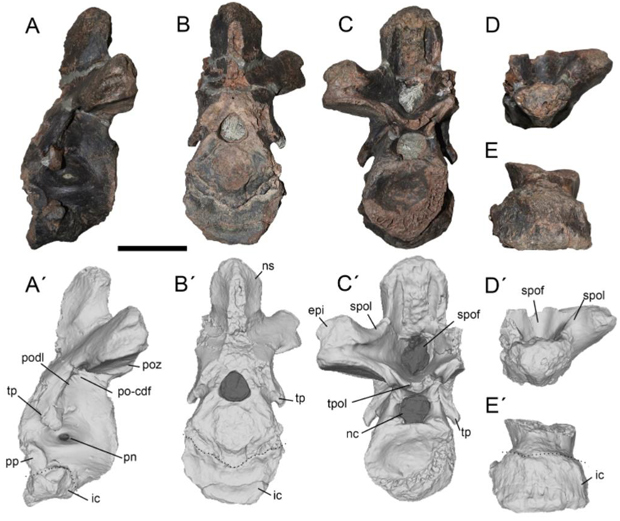
Maip macrothorax axis bone (C2)

The second neck bone of Maip macrothorax (axis – C2) shown in lateral (A), anterior (B), posterior (C) and dorsal (D) with accompanying line drawings. Note scale bar = 5 cm. Picture credit: Rolando et al.

Picture credit: Rolando et al

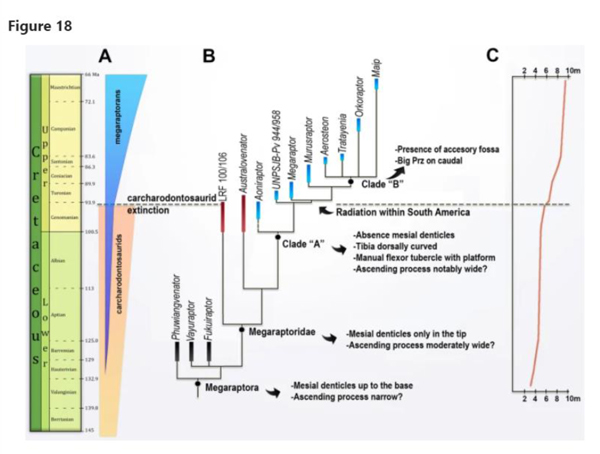
The researchers propose that with the extinction of the carcharodontosaurids, many of which were apex predators on the southern continents, the megaraptorids evolved becoming larger, heavier and more robust, eventually filling the niche of top predator in many parts of the Southern Hemisphere during the Late Cretaceous.

Evolutionary trends of the Megaraptora.

Evolutionary trends of the Megaraptora. Evolutionary trends of Megaraptora. Temporal scale and bars depicting currently known temporal distributions of Megaraptora and Carcharodontosauridae (A). Time-calibrated phylogeny of megaraptoran taxa (B), showing most relevant genera from Asia (black bars), Australia (red bars) and South America (blue bars). Main synapomorphies supporting each node are indicated by arrows. Tree topology follows the results of the present work. Curve showing the increasing in average body size of megaraptorans during Barremian faunal stage through to the Maastrichtian (C). Picture credit: Rolando et al.

Picture credit: Rolando et al

The Rise of the Megaraptorids

Around 94 million years ago (Cenomanian faunal stage of the Late Cretaceous), there was a global extinction event which led to the demise of the Carcharodontosauridae. As far as Everything Dinosaur team members are aware, there are no reliable fossil records for the presence of carcharodontosaurids in South America beyond the Turonian faunal stage (the stage that followed the Cenomanian). An absence of apex predators permitted the megaraptorids and the abelisaurids to evolve to fill this niche in the Southern Hemisphere, whilst the tyrannosaurids become bigger and occupied the apex predator role in Asia and North America.

Maip macrothorax estimated at around 9.5 metres in length, lived some sixteen million years after the next largest megaraptorid (Aerosteon – A. riocoloradense). The body size of megaraptorids during the Early Cretaceous when the carcharodontosaurids still roamed seems to have been limited to around six metres in length, suggesting that these theropods were secondary predators. However, with the extinction of the carcharodontosaurids, body size in the Megaraptoridae increased and by the very end of the Cretaceous (Maastrichtian faunal stage), a body length in excess of ten metres seems plausible.

To read the Everything Dinosaur blog post that reported the discovery of these bones in 2020: Scientists Discover Giant Megaraptor.

Helping to Resolve the Phylogeny of these Enigmatic Theropods

Although the bones only represent a small part of the total skeleton and no cranial material has been identified, Maip macrothorax is the most informative megaraptoran known from the Maastrichtian stage. Phylogenetic analysis has placed this new taxon together with other South American megaraptorans in a monophyletic clade (they shared a single, common ancestor), whereas Australian and Asian members constitute successive stem groups.

Roaming Patagonia 80 million years ago

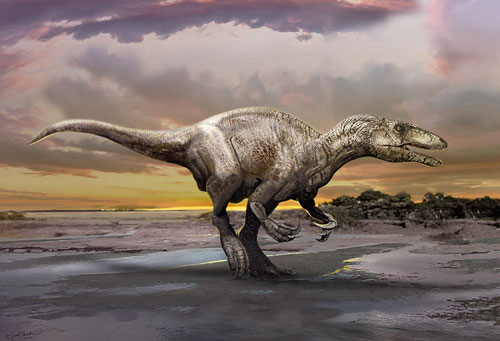
A leggy, Late Cretaceous carnivore (Murusraptor).  Picture credit: Jan Slovak (University of Alberta).

Picture credit: Jan Sovak (University of Alberta).

For models and replicas of theropods and other prehistoric animals: Wild Safari Prehistoric World Models and Figures.

The researchers propose that the South American megaraptorids differ from more basal megaraptorans such as Fukuiraptor from Japan and Australovenator from Queensland, Australia in several anatomical features and the South American lineage evolved into much bigger, more robust and powerful predators.

The scientific paper: “A large Megaraptoridae (Theropoda: Coelurosauria) from Upper Cretaceous (Maastrichtian) of Patagonia, Argentina” by Alexis M. Aranciaga Rolando, Matias J. Motta, Federico L. Agnolín, Makoto Manabe, Takanobu Tsuihiji and Fernando E. Novas published in Scientific Reports.

The Everything Dinosaur website: Dinosaur Toys.

21 04, 2022

The Oldest Mineralised Bryozoan? A New Scientific Paper

By |2024-12-30T08:24:49+00:00April 21st, 2022|Categories: Adobe CS5, Dinosaur and Prehistoric Animal News Stories, Main Page, Palaeontological articles, Photos/Pictures of Fossils|0 Comments

Scientists from John Hopkins University (Baltimore, Maryland), Smith College (Northampton, Massachusetts) along with bryozoan expert Paul Taylor of the London Natural History Museum and another collaborator have published a paper in “Science Advances” reporting a possible earliest occurrence of palaeostomate bryozoans.

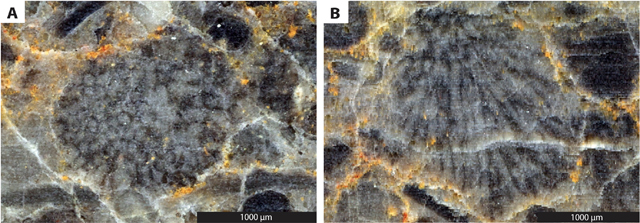
Cut slabs of bryomorph fossils from the Harkless Formation

Cut slabs of bryomorph fossils from the Harkless Formation (Gold Point, Nevada). Cross-sectional view showing round individual tubes (A). Longitudinal cut through organism showing growth form (B). Picture credit: Note scale equals 1,000 microns. Pruss et al.

Picture credit: Pruss et al

Fossils from the Harkless Formation (Nevada) – A Mineralised Bryozoan

Recently, Everything Dinosaur published a blog post about a scientific paper that came out late last year (October 2021), the study reported upon the identification a soft-bodied bryozoan Protomelission gatehousei from Early Cambrian strata: Early Cambrian Origin for the Bryozoa. The oldest previously accepted skeletal bryozoans occur in Lower Ordovician deposits, however, these researchers suggest that fossils found in strata from the Harkless Formation (Nevada, USA) are also bryozoans. The fossils show a radiating form preserved in limestone deposited during the Cambrian. If these fossils also represent bryozoans, they have a hard, mineralised skeleton.

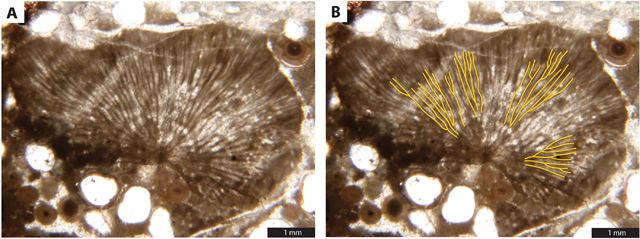
Thin section images of a single bryomorph organism from the Harkless Formation (Nevada).

Thin section images of a single bryomorph organism from the Harkless Formation (Nevada). General fossil view (A). Sketches of the branching of daughter tubes from parent tubes (B). Note the formation of distinct skeletal walls from the parent during budding. Note scale bar equals 1 mm. Picture credit: Pruss et al.

Picture credit: Pruss et al

All Skeletal Marine Invertebrate Phyla Appeared During the Cambrian Explosion

Previously, it had been thought that all skeletal marine invertebrate phyla appeared during the Cambrian explosion, except for Bryozoa with mineralised skeletons which were known from fossils dating from the Early Ordovician. If the small fossils identified in thin cross sections of Harkless Formation limestone are examples of bryozoans with a hard skeleton, then this evidence, in addition to the recent paper on the soft-bodied Cambrian bryozoan Protomelission (P. gatehousei), suggests an Early Cambrian origin for the Bryozoa and provides evidence to support the hypothesis that all types of skeletal marine invertebrate phyla evolved during the Cambrian.

If the Nevada fossils are confirmed as bryozoans, the appearance of a mineralised skeleton in this phylum would be pushed back by some 30 million years.

The scientific paper: “The oldest mineralized bryozoan? A possible palaeostomate in the lower Cambrian of Nevada, USA” by Sara B. Pruss, Lexie Leeser, Emily F. Smith, Andrey Yu. Zhuravlev and Paul D. Taylor published in Science Advances.

The Everything Dinosaur website:Prehistoric Animal Figures and Models.

17 04, 2022

Early Cambrian Origin for the Bryozoa According to New Study

By |2024-12-30T06:35:27+00:00April 17th, 2022|Categories: Adobe CS5, Dinosaur and Prehistoric Animal News Stories, Main Page, Palaeontological articles, Photos/Pictures of Fossils|0 Comments

Bryozoans, also referred to as the Polyzoa, are an ancient phylum of tiny aquatic invertebrate animals that mostly live in colonies. Normally marine, but some species do live in freshwater, they have a protective exoskeleton made from calcium carbonate. They have a special feeding appendage called a lophophore, which resembles a crown of tentacles used for filter feeding.

Bryozoan fossils are abundant and geographically widespread and the presence of six major orders of bryozoans in Lower Ordovician strata strongly indicated that these organisms evolved during the Cambrian, however, fossil evidence was lacking. Late last year (2021), a team of researchers published a paper in the academic journal “Nature” describing a new genus of soft-bodied bryozoan from the Early Cambrian of Australia and southern China. Named Protomelission gatehousei, its fossils confirm a Cambrian origin for these important aquatic organisms.

Bryozoan fossil from the Early Cambrian.

Protomelission gatehousei from the Cambrian Wirrealpa Limestone, South Australia. Picture credit: Zhang et al.

Picture credit: Zhang et al

A Basal Member of the Bryozoa

The researchers from Macquarie University (Sydney, Australia), the Northwest University (Xi’an, China), the London Natural History Museum, the University of Missouri, the Nanjing Institute of Geology and Palaeontology (Nanjing, China) as well as the Swedish Museum of Natural History (Stockholm, Sweden), describe this new genus as a basal member of the order.

The discovery of a stem bryozoan from rocks dating from the Cambrian narrows the origination gap that previously existed between the known fossil record and independent molecular clock estimates. The researchers state that this fossil discovery pushes back the fossil record of the Bryozoa by approximately thirty-five million years.

Protomelission gatehousei confirms that the colonial body plan of the Bryozoa originated in the Early Cambrian. It also reconciles the fossil record with molecular clock estimations of an Early Cambrian origination and subsequent Ordovician radiation of Bryozoa following the acquisition of a carbonate skeleton.

Bryozoan fossil from the Ordovician.

Fossils of a branching bryozoan colony from the Ordovician. The presence of six major orders of bryozoans in lower Ordovician rocks strongly suggests a Cambrian origin for the largest and most diverse lophophorate phylum but the fossil evidence had been lacking. A newly published paper describes Protomelission gatehousei from the Early Cambrian of Australia and southern China and confirms a Cambrian origin for these important aquatic organisms.

Whilst the Cambrian and Ordovician forms are extinct, modern bryozoans are an important constituent of modern-day marine fauna.

The scientific paper: “Fossil evidence unveils an early Cambrian origin for Bryozoa” by Zhiliang Zhang, Zhifei Zhang, Junye Ma, Paul D. Taylor, Luke C. Strotz, Sarah M. Jacquet, Christian B. Skovsted, Feiyang Chen, Jian Han and Glenn A. Brock published in Nature.

16 04, 2022

A Juvenile Diamantinasaurus – Australia’s Smallest Sauropod Found to Date

By |2023-07-04T07:21:38+01:00April 16th, 2022|Categories: Adobe CS5, Dinosaur and Prehistoric Animal News Stories, Dinosaur Fans, Main Page, Palaeontological articles, Photos/Pictures of Fossils|0 Comments

A scientific paper has just been published describing the fossilised remains of a juvenile titanosaur from the Winton Formation of Queensland, Australia. The specimen has been assigned to the Diamantinasaurus taxon (D. matildae) and it represents the smallest sauropod described from fossils found in Australia to date.

Reconstructed skeleton of the juvenile Diamantinasaurus (D. matildae) compared to a human skeleton.
A model of the reconstructed skeleton of the juvenile Diamantinasaurus (D. matildae) compared to a human skeleton. The young dinosaur is estimated to have weighed around 4.2 Tonnes. Picture credit: Australian Age of Dinosaurs Museum.

About Ten Percent of the Skeleton Recovered

The fossils were discovered on Elderslie Station land which lies some 35 miles northwest of the town of Winton (Queensland). Landowners noticed fragments of a femur and dorsal ribs exposed on the surface (2012). Staff from the Australian Age of Dinosaurs Museum along with volunteers excavated the site and found the remainder of the fossil material representing about 10% of the total skeleton about a metre below the surface.

The postcranial material consists of cervical ribs, three incomplete dorsal vertebrae, sacral vertebrae and limb bones.

Views of the juvenile Diamantinasaurus fossils (AODF 663) a right humerus and right manual ungual with accompanying digital models.
Views of the juvenile Diamantinasaurus fossils (AODF 663) a right humerus and right manual ungual with accompanying digital models. Right humerus photographs in A, dorsal, B, anterior, C, ventral, D, medial, E, posterior, F, lateral views. Right humerus digital models in G, dorsal, H, anterior, I, ventral, J, medial, K, posterior, L, lateral views. The right manual ungual in M, proximal, N, dorsal, O, anterior, P, ventral, Q, posterior views. Right manual ungual digital models in R, proximal, S, dorsal, T, anterior, U, ventral, and V, posterior views. Note scale bar for humerus equals 10 cm and for the manual ungual 5 cm. Picture credit: Rigby et al.

A Young Titanosaur from the Late Cretaceous

Although age estimates for the Winton Formation vary, it has been informally divided into lower and upper members, with the Diamantinasaurus material coming from the “upper” portion which is regarded as Cenomanian to potentially the lowermost Turonian stages of the Late Cretaceous (approximately 95-89 million years ago).

The study of the juvenile titanosaur was led by Museum Research Associate Samantha Rigby who is undertaking a Master of Science (Research) at Swinburne University of Technology (Victoria, Australia), under the supervision of Dr Stephen Poropat who was one of the co-authors of the scientific paper published in the Journal of Vertebrate Palaeontology. Each bone from the specimen was scanned to create three-dimensional models to digitally compare them with other sauropod remains.

This comparison suggests the small specimen belongs to the Diamantinasaurus taxon though with juvenile characteristics, vertebrae which are unfused, minimal muscle scarring on the bones, smooth bone texture and marked proportional bone size differences when compared to adult titanosaur material.

Diamantinasaurus dorsal vertebrae and digital models.
Diamantinasaurus juvenile dorsal vertebrae with digital models. Dorsal vertebra photographs in A, dorsal, B, right lateral, C, anterior, D, left lateral, E, posterior views. Dorsal vertebra digital models in F, dorsal, G, right lateral, H, anterior, I, left lateral, J, posterior views. Note scale bar equals 10 cm. Picture credit: Rigby et al.

Allometric Growth

The fossil specimen (AODF 663) nicknamed “Oliver” is only the third specimen to be referred to the taxon Diamantinasaurus matildae. D. matildae was formally named and described in 2009: A Trio of New Dinosaurs from Down Under. The research team found that the bones of this small titanosaur grew allometrically, meaning that its bones changed shape and different parts of its body grew at different rates.

The limb bones are also narrower in width when compared to other Diamantinasaurus limb bones from older individuals. This suggests that as this titanosaur grew its limb bones became thicker and more robust to help support its enormous bulk.

A Juvenile Diamantinasaurus

Fossils of juvenile titanosaurs are rare and it is hoped that “Oliver” will provide important insights into the ontogeny of titanosaurs.

Everything Dinosaur acknowledges the assistance of a media release from the Australian Age of Dinosaurs Museum in the compilation of this article.

The scientific paper: “A juvenile Diamantinasaurus matildae (Dinosauria: Titanosauria) from the Upper Cretaceous Winton Formation of Queensland, Australia, with implications for sauropod ontogeny” by Samantha L. Rigby, Stephen F. Poropat, Philip D. Mannion, Adele H. Pentland, Trish Sloan, Steven J. Rumbold, Carlin B. Webster and David A. Elliott published in the Journal of Vertebrate Paleontology.

Visit the Everything Dinosaur website: Everything Dinosaur.

15 04, 2022

Juvenile Gorgosaurus Skulls Shed Light on Tyrannosaurid Growth Patterns

By |2024-12-29T22:41:08+00:00April 15th, 2022|Categories: Adobe CS5, Dinosaur and Prehistoric Animal News Stories, Dinosaur Fans, Main Page, Palaeontological articles, Photos/Pictures of Fossils|1 Comment

Researchers have described two beautifully preserved skulls of juvenile Gorgosaurus dinosaurs (G. libratus). The articulated specimens have enabled the scientists to build up a comprehensive picture of how these tyrannosaurids changed as they grew. Gorgosaurus and the much bigger, later tyrannosaurid T. rex exhibit similar changes in their skulls as they grow. This study will help palaeontologists to decipher tyrannosaur material and to determine the identity of previously misidentified specimens. It should also provide more evidence to help resolve the Nanotyrannus/T. rex debate.

Lateral views of juvenile Gorgosaurus skulls.

Skulls of the two new juvenile Gorgosaurus libratus specimens in lateral view. A, TMP 2009.12.14; B, TMP 2016.14.1. Note scale bar equals 10 cm. Picture credit: Voris et al.

Picture credit: Voris et al

Gorgosaurus libratus

Named and described in 1914 (Lambe), Gorgosaurus is known from dozens of fossil specimens found in the upper Campanian Dinosaur Park Formation of Alberta and Judith River Formation of Montana. It is one of the best sampled and researched of all the Late Cretaceous tyrannosaurs, but juvenile material is rare. The recent discovery of additional juvenile Gorgosaurus libratus specimens from the Dinosaur Park Formation, including two well-preserved skeletons with articulated skulls, provided researchers which include Jared Voris and Darla Zelenitsky (University of Calgary), along with collaborators from the University of Ohio, the University of Alberta and the Royal Tyrrell Museum, an opportunity to develop a map outlining how this dinosaur changed as it grew and matured.

Juvenile and adult Gorgosaurus skulls compared.

Illustrations of juvenile (left) and adult (right) skulls of Gorgosaurus in lateral (top) and dorsal views (bottom). Arrows and numbers indicate ontogenetically invariant autapomorphies of Albertosaurinae and Gorgosaurus as per emended diagnosis. Juvenile illustration based on TMP 2016.14.1 (lateral) and TMP 2009.12.14 (dorsal), adult illustration based on UALVP 10. Picture credit: Voris et al.

Picture credit: Voris et al

Sorting out Daspletosaurus Specimens

The research team, which also included Professor Phil Currie (University of Alberta), found that although the skulls of tyrannosaurs changed dramatically as they grew, several taxonomically informative traits remain present regardless of the age of the animal. This means that palaeontologists can use this information to determine which taxon is represented by juvenile fossil material.

Thanks to this research, two specimens previously identified as examples of immature Daspletosaurus individuals (coeval with Gorgosaurus) are instead confirmed as Gorgosaurus.

Gorgosaurus dentaries compared

Left dentaries in lateral view of A, small juvenile (TMP 1994.12.155); B, juvenile (TMP 2016.14.1); C, subadult (TMP 1991.36.500); D, young adult (ROM 1247); and E, adult (TMP 1967.9.164) specimens of Gorgosaurus libratus. Note the development of the autapomorphic dorsoventral expansion in the posterior region of the bone through ontogeny. Scale bar equals 10 cm. Picture credit: Voris et al.

Picture credit: Voris et al

Comparisons with Tyrannosaurus rex

The team also found that both Gorgosaurus and T. rex underwent similar anatomical changes over their lifespans, but at different times. The changes started later in Tyrannosaurus rex and occurred over a longer time interval, resulting in a larger size and longer lifespan for T. rex when compared to Gorgosaurus.

Comparing the growth stages of Gorgosaurus libratus and T. rex.

Comparison of the growth series of Gorgosaurus libratus (top) and Tyrannosaurus rex (bottom), demonstrating similar ontogenetic stages (and morphologies) occurring at similar relative size (percent of largest specimen skull length) but different body sizes and biological ages. Picture credit: Voris et al.

Picture credit: Voris et al

Implications for Nanotyrannus

Having identified a series of anatomical traits that can be relied upon to permit palaeontologists to confidently assign juvenile tyrannosaur skull fossils to a specific taxon, this allows some specimens considered small or “dwarf” forms such as Nanotyrannus (N. lancensis) to be revisited. Some of these specimens may have been misidentified, since key characteristics may not have developed in young individuals before death, but this new data set would allow closer scrutiny of the fossil material.

PNSO Nanotyrannus dinosaur model.

The new for 2021 PNSO Nanotyrannus dinosaur model.

The picture (above) shows a model of a Nanotyrannus by PNSO.

To view the range of PNSO prehistoric animal figures in stock: PNSO Prehistoric Animal Models.

The scientific paper: “Two exceptionally preserved juvenile specimens of Gorgosaurus libratus (Tyrannosauridae, Albertosaurinae) provide new insight into the timing of ontogenetic changes in tyrannosaurids” by Jared T. Voris, Darla K. Zelenitsky, François Therrien, Ryan C. Ridgely, Philip J. Currie and Lawrence M. Witmer published in the Journal of Vertebrate Paleontology.

Visit the award-winning Everything Dinosaur website: Dinosaur Toys.

14 04, 2022

An Important Update – Assessment Reports “Minor” Damage to Mill Canyon Track Site

By |2024-12-29T18:33:31+00:00April 14th, 2022|Categories: Adobe CS5, Dinosaur and Prehistoric Animal News Stories, Dinosaur Fans, Main Page, Palaeontological articles, Photos/Pictures of Fossils|0 Comments

An assessment of the Mill Canyon dinosaur track site north of Moab in Grand County, Utah by Bureau of Land Management regional palaeontologist Brent Breithaupt confirms that damage was caused to the Early Cretaceous tracks and trace fossils by a construction crew, but the damage is described as “minor”.

Dinosaur trackway.

Trace fossils (dinosaur footprints) preserved at Moab (Utah). Picture credit: Bureau of Land Management.

Picture credit: Bureau of Land Management

Essential Repairs and Maintenance at an Important Fossil Site

The site, which covers approximately 2.3 acres contains over 200 tracks and other trace fossils recording activity around a body of water at an Early Cretaceous lake (approximately 112 million years ago). A construction crew had been employed to undertake repairs and improvements to the site including the replacement of boardwalks. Members of the public became aware of the maintenance work and reported possible damage to the fossils caused by the construction crew.

Everything Dinosaur published a blog article on reports of the damage caused by Bureau of Land Management contractors: Dinosaur Tracksite Damaged and having had concerns raised about damage to the site, it was decided to conduct an assessment of the area in order to find the best way to protect the fossils whilst still permitting public access.

This Damage to the Track Site Should Not Have Occurred

The assessment concluded that the overall damage was minor. Even so, Brent Breithaupt wrote in the report that:

“This damage should not have occurred”.

The regional palaeontologist added, that if the project had not been stopped:

“It is likely that much greater damage would have occurred with increased construction activities”.

As the Bureau of Land Management failed to consult palaeontologists on the maintenance plans, crews did not know which areas of the site to avoid. The incident was described in the report as “unfortunate” and the damage “could have been avoided”.

Mill Canyon tracksite.

At least six different dinosaur tracks have been deciphered at Moab (Utah). Picture credit: Bureau of Land Management.

After the report was released, the Bureau of Land Management has confirmed that an additional environmental assessment would be undertaken, the public would be consulted and palaeontologists involved in future work at the location to supervise activities. The Bureau of Land Management reported that it “remains committed to protecting plant and animal fossils on our public lands”.

The Everything Dinosaur website: Dinosaur Toys.

Go to Top