All about dinosaurs, fossils and prehistoric animals by Everything Dinosaur team members.

Pictures of fossils, fossil hunting trips, fossil sites and photographs relating to fossil hunting and fossil finds.

18 06, 2022

When is a Jaw Not a Jaw? That’s a Great Question!

By |2025-01-06T17:49:02+00:00June 18th, 2022|Categories: Adobe CS5, Dinosaur Fans, Main Page, Photos/Pictures of Fossils, Teaching|0 Comments

The fossil record is rich and diverse however, it only represents a tiny fraction of all the life that has ever existed on Earth. In addition, some fossils can be easily confused and misinterpreted, for example, we recall an incident that occurred when visiting the National Museum Cardiff (Wales). We overhead a conversation in the Evolution of Wales gallery, a mother was pointing out a dinosaur jaw fossil to her children.

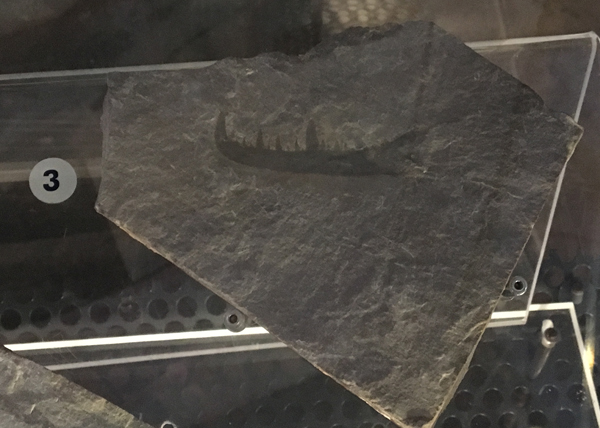
The object was not the fossilised remains of a dinosaur, this was not a jaw at all, but the preserved remains in lateral view of the claw of a large sea scorpion (eurypterid).

A sea scorpion claw

A stunning fossil of a sea scorpion (eurypterid) claw housed at the National Museum Cardiff (Wales) photographed in 2019 when team members at Everything Dinosaur visited. Picture credit: Everything Dinosaur.

Picture credit: Everything Dinosaur

We can understand how the confusion arose, the fossilised claw does resemble a jaw. The fossil exhibit featuring several examples of Palaeozoic invertebrates was clearly labelled and the gallery layout guides readers from the Big Bang to the present day in chronological order. There are plenty of helpful panels providing information and explanations, all helping to educate and inform.

One of the children corrected the grown-up, pointing out that the dinosaurs lived in the Mesozoic.

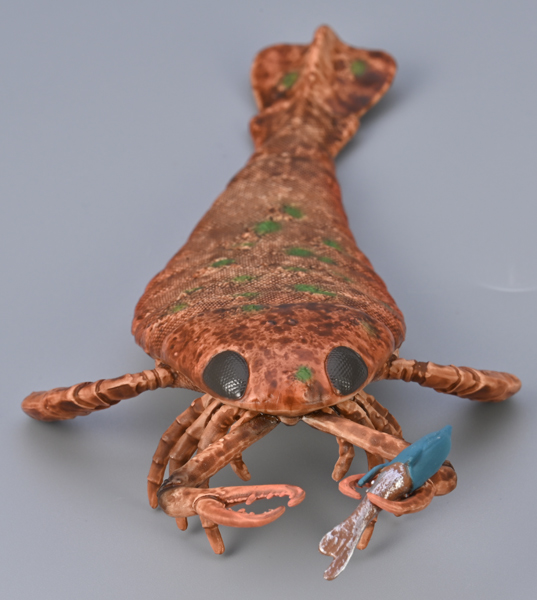
The CollectA Deluxe 1:20 scale Jaekelopterus with prey.

CollectA have announced that they will be adding a replica of a sea scorpion to their scale model range. The Jaekelopterus figure is holding a jawless fish in its huge claw (chelicera).

To view the CollectA scale models available from Everything Dinosaur: CollectA Deluxe Prehistoric Life Models.

We shared a smile and moved on to view some of the other amazing exhibits housed in this excellent museum.

To read about the discovery of a giant sea scorpion (Terropterus xiushanensis) from China: Giant Sea Scorpion from China.

The Everything Dinosaur website: Dinosaur Toys.

17 06, 2022

Rare Titanosaur Egg Suggests Close Links to Bird Reproductive Strategy

By |2025-01-06T15:58:29+00:00June 17th, 2022|Categories: Adobe CS5, Dinosaur and Prehistoric Animal News Stories, Dinosaur Fans, Main Page, Palaeontological articles, Photos/Pictures of Fossils|0 Comments

The discovery of a titanosaurid egg, preserved inside another titanosaur egg (ovum-in-ovo) adds weight to the theory that dinosaurs had a reproduction strategy very similar to birds. This discovery opens up the possibility that dinosaurs laid their eggs sequentially like birds, whereas other reptiles tend to lay eggs simultaneously as a clutch.

The researchers from the University of Delhi in collaboration with a colleague from the Higher Secondary School (Dhar District, Madhya Pradesh), documented the contents of a titanosaur nest discovered in Upper Cretaceous deposits (Maastrichtian stage) from the Lameta Formation exposed in the lower Narmada valley. The Lameta Formation is famous for its titanosaur nest fossils, hundreds of individual nests have been recorded. The titanosaur nest which records a rare example of an abnormal egg is known as P7, it is one of fifty-two titanosaur nests that have been mapped around the village of Padlya.

Photograph of titanosaur next P7 and explanatory diagram.

In-situ field photograph and explanatory drawing of the outcrop showing the titanosaur nest P7 and its eggs and eggshell fragments. Captions A to O indicate eggs and eggshell locations. Picture credit: Dhiman et al.

Picture credit: Dhiman et al

Titanosaur Nest P7

The titanosaur nest P7 preserves eleven large, round eggs which are placed in a circular arrangement entombed within a block of sandy limestone. Not all the eggs are entire, some of the eggshell is missing. They could represent broken shells after the eggs hatched or the missing shell elements may have been eroded away.

One egg (egg C) records unusual pathology. Two partially broken, circular eggshell outlines are preserved, with a prominent crescent-shaped gap between the two eggshells present in the top right corner (see line drawing). Egg C has been interpreted as an example of an abnormal egg, one egg containing another egg within it. This type of egg pathology is termed ovum-in-ovo and this is the first time this has been reported in a dinosaur. Ovum-in-ovo eggs are found in birds but no such egg pathology has been reported in a reptile (living or extinct). This discovery suggests that titanosaurids had a reproductive system similar to that of birds.

Ovum-in-ovo fossilised titanosaur egg

In-situ field photograph (a) of the ovum-in-ovo egg (egg number C) from the Upper Cretaceous Lameta Formation (Dhar District, India) with explanatory line drawing (b). Two partially broken, circular eggshell outlines can be seen with broken eggshell fragments also preserved. With ovum-in-ovo egg pathology a crescent-shaped gap is characteristically present in the upper right part of the egg. Picture credit: Dhiman et al

Picture credit: Dhiman et al

Different Types of Egg Pathology

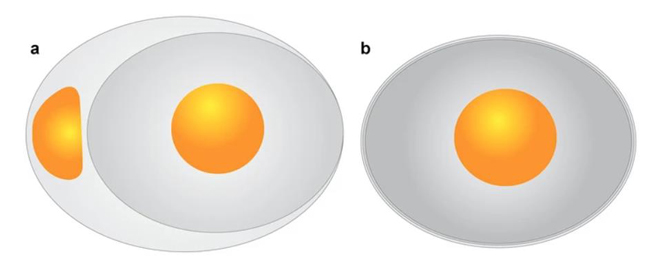
Abnormal egg formation has been documented in many types of amniote (undergoing foetal or embryonic development within a protective membrane, the amnion), such as turtles, dinosaurs and birds. Two main examples of egg pathology are known. There is a condition where one egg forms within another egg (ovum-in-ovo) and a second condition in which multi-shelled eggs are formed, essentially the formation of a second eggshell layer beside the primary eggshell.

Unusual pathologies in amniote eggs.

Unusual pathologies in amniote eggs. Ovum-in-ovo (a) an egg within an egg, characterised by the presence of two yolks. Multi-shelled egg (b) with two or more eggshell layers surrounding a single yolk. Picture credit: Dhiman et al (after Carpenter).

Picture credit: Dhiman et al (after Carpenter)

If Egg C represents an example of ovum-in-ovo egg laying in a dinosaur, then this egg deformity will only have been recorded in the Dinosauria and birds, suggesting similar reproductive biology. In birds, when an egg is fully formed it is pushed into the cloaca to be laid one-by-one.

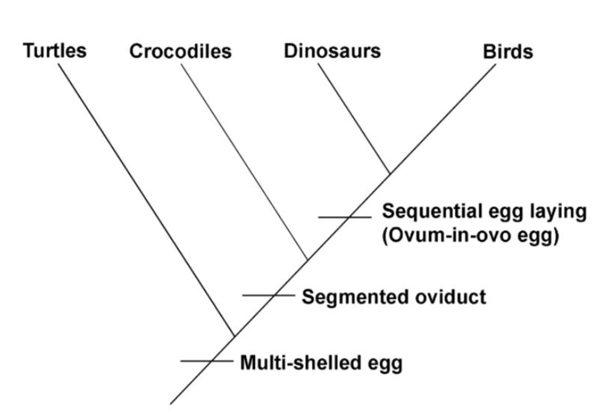
Eggs are not laid as clutch, but egg laying can take place sequentially over several days. In birds such as hens (Galliformes), egg laying can be suspended if conditions are unfavourable. However, crocodiles and turtles tend to lay all their eggs at the same time, as a single clutch. Both turtles and crocodiles have two oviducts, but crocodiles are more derived than turtles possessing a segmented oviduct and share this derived trait with the birds.

The structure of the oviduct dictates the sort of egg abnormalities that can occur. The ovum-in-ovo pathology as observed in the titanosaur eggs has led the researchers to hypothesise that titanosaurs possessed a segmented oviduct similar to birds and crocodiles, but unlike crocodilians they were capable of laying eggs sequentially.

Titanosaur sequential egg laying.

Inferred cladogram showing divergence of dinosaurs from crocodiles on the basis of sequential egg laying. Picture credit: Dhiman et al.

Picture credit: Dhiman et al.

Building up a Picture of Titanosaurid Reproductive Strategy

Turtles, crocodiles, dinosaurs and birds all share the common trait of having multi-shelled eggs. Both turtles and crocodiles have two oviducts, but crocodiles are more derived than turtles in that they possess a segmented oviduct, a characteristic that they share with birds.

This new study suggests that at least one type of dinosaur (titanosaurids) had an oviduct anatomy and biology similar to modern birds. Titanosaurs may have been capable of laying eggs sequentially, just like birds.

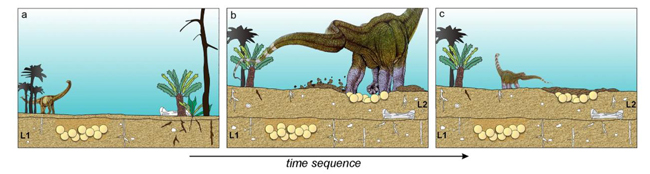
Palaeontologists are building up a detailed picture of titanosaur reproductive behaviour. These sauropods had favoured nesting sites, which they returned to, they nested in colonies, excavated nests and covered the nests to incubate the eggs and they may have laid their eggs not as a single clutch but sequentially over several days.

Brazilian titanosaur nesting site

The titanosaur egg fossils were found in two distinct layers (L1 and L2) approximately two metres apart. This suggests that this area was a preferred nesting site for titanosaurs. This is the first confirmed dinosaur nesting area found in Brazil. The eggs attributed to titanosaurs also represent the most northerly titanosaurian nesting site known from South America. The discovery of nests located at different levels indicates that titanosaurs returned regularly to preferred nesting areas. Picture credit: Fiorelli et al.

Picture credit: Fiorelli et al

Safari Ltd recently introduced a model of a titanosaur (Patagotitan). To view this figure and the other models in the Wild Safari Prehistoric World range: Wild Safari Prehistoric World.

The scientific report: “First ovum-in-ovo pathological titanosaurid egg throws light on the reproductive biology of sauropod dinosaurs” by Harsha Dhiman, Vishal Verma & Guntupalli V. R. Prasad published in Scientific Reports.

The award-winning Everything Dinosaur website: Dinosaur Figures.

14 06, 2022

Dinosaurs had “Belly Buttons” According to New Research

By |2025-01-06T09:58:56+00:00June 14th, 2022|Categories: Adobe CS5, Dinosaur Fans, Main Page, Palaeontological articles, Photos/Pictures of Fossils|0 Comments

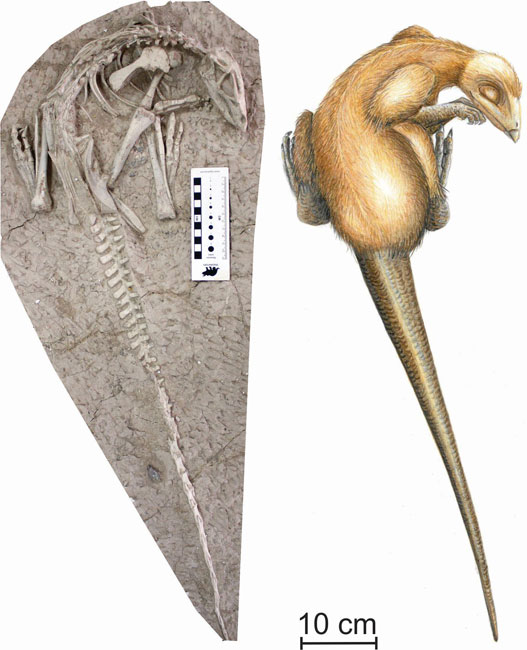
Researchers have identified the oldest preserved umbilical scar (umbilicus) in the fossilised remains of a dinosaur (Psittacosaurus). The equivalent of our “belly button”, this is the first dinosaur specimen to demonstrate an umbilical scar.

Psittacosaurus had a belly button

A life reconstruction of a resting Psittacosaurus. The umbilical scar is highlighted. Picture credit: Jagged Fang Designs.

Picture credit: Jagged Fang Designs

The “Belly Button” in Placental Mammals

Placental mammals such as humans (Homo sapiens) have an umbilical cord that connects the growing embryo to the placenta. It provides a supply line for nutrients, gaseous exchange and the removal of waste products. Our “belly button”, the navel, is the scar that is left when the last fragment of the umbilical detaches from the baby shortly after the cord has been cut.

Reptiles and living avian dinosaurs (birds) do not have a true umbilical cord. However, whilst inside the egg, the embryo’s abdomen is connected to the yolk sac, which provides the developing embryo with a food source. The umbilical scar (umbilicus), appears when the embryo detaches from the yolk sac and other membranes.

In most living reptiles and birds this umbilical scar persists for only a few days, although in some genera the scar can persist and be found in adult animals, the Rock pigeon (Columba livia) for example. Scales on the bellies of snakes, lizards and crocodilians often preserve faint traces of the umbilicus, it being marked by a subtle change in scale morphology and alignment.

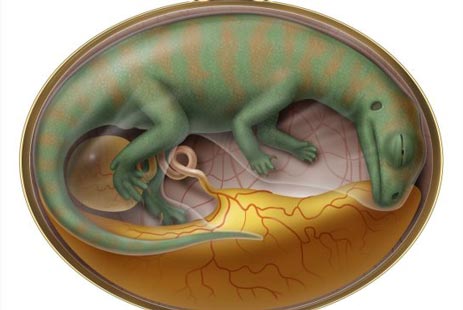
The embryo of a Lufengosaurus

An image of a Lufengosaurus embryo. An umbilical scar has been identified in a Psittacosaurus specimen.  Picture credit: D. Mazierski.

Picture credit: D. Mazierski

The Remarkable Senckenberg Psittacosaurus

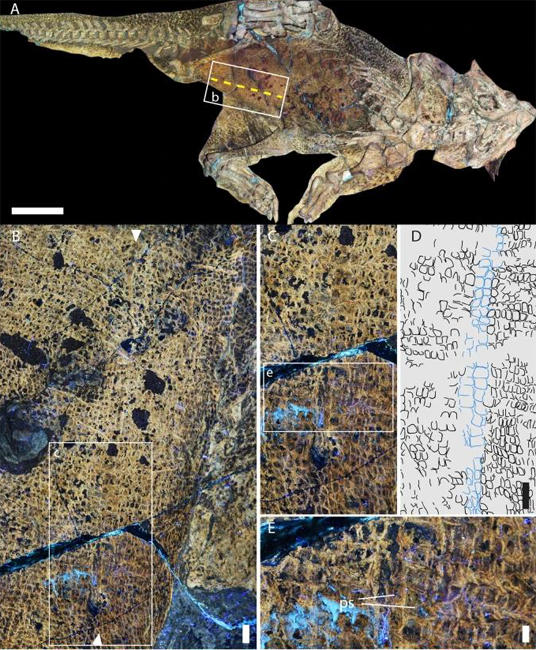
The researchers who included Dr Phil Bell (University of New England, New South Wales, Australia) and Dr Michael Pittman (The Chinese University of Hong Kong), subjected the superbly-preserved Senckenberg Psittacosaurus specimen (SMF R 4970) to examination under laser-stimulated fluorescence (LSF). Using this imaging technique, the team were able to identify the umbilical scar as a midline structure outlined by a row of paired scales on the abdomen.

Senckenberg specimen of Psittacosaurus reveals umbilical scar

Umbilical scar in Psittacosaurus SMF R 4970 under LSF. A Cropped image of Psittacosaurus sp. (SMF R 4970) showing just the skeleton and soft tissue outlines, with the umbilical scar highlighted by the dashed yellow line. B Close up of boxed region in (A) with the maximal anteroposterior extent of the umbilical scar indicated by arrowheads. Wrinkling forming irregular wavy creases in the integument can be seen on the far right on this image where the abdomen meets the inner thigh; C, D Close up of boxed region in (B) showing paired quadrangular scales (blue outline in D) delimiting the umbilicus. Transverse banding is visible in the remaining abdominal scales (black outlines in D). E Close up of paired quadrangular scales (ps). A clear line of interstitial tissue, delimiting the former scar, can be seen between the paired scales. Anterior is towards the top in (B–E). Scale bars equal 5 mm (B–D) and 2 mm (E). Picture credit: Bell et al.

Picture credit: Bell et al

Soft Tissue Preservation

The remarkable Senckenberg Psittacosaurus specimen preserves extensive soft tissues including skin, it has provided palaeontologists with a rare insight into the integumentary covering of an early member of the horned dinosaur lineage. The skeleton is so precious that no form of destructive bone histology was permitted, but by measuring the length of the thighbones (femora) of this fossil and comparing these measurements to the length of the thigh bones from other Psittacosaurus fossils, which had been subjected to ontogenetic study, the researchers concluded that the Senckenberg specimen was close to being sexually mature.

This suggests that the umbilicus was probably retained in psittacosaurids throughout their lives.

Whilst this is the first, definitive proof of an umbilical scar in the Dinosauria, it is not possible to infer from this study whether all dinosaurs retained the umbilicus into adulthood.

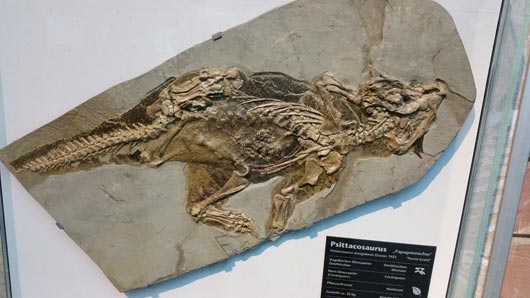
A Psittacosaurus fossil.

Psittacosaurus fossils on display at the Senckenberg Naturmuseum (Frankfurt). Picture credit: Everything Dinosaur.

Picture credit: Everything Dinosaur

The Everything Dinosaur website: Prehistoric Animal Models and Toys.

A Legal Debate Surrounding SMF R 4970

The Psittacosaurus sp. specimen (SMF R 4970) is on public display in the Dinosaurs Unlimited permanent exhibition at the Senckenberg Research Institute and Natural History Museum Frankfurt, Frankfurt, Germany. Team members at Everything Dinosaur have had the opportunity to view this remarkable fossil.

The legal ownership of this fossil is disputed and there have been attempts to have this specimen repatriated to China.

The scientific paper: “Oldest preserved umbilical scar reveals dinosaurs had “belly buttons” by Phil R. Bell, Christophe Hendrickx, Michael Pittman and Thomas G. Kaye published in BMC Biology.

13 06, 2022

Abelisaurids Lived Alongside Spinosaurus According to New Study

By |2025-01-06T09:41:01+00:00June 13th, 2022|Categories: Adobe CS5, Dinosaur and Prehistoric Animal News Stories, Dinosaur Fans, Main Page, Palaeontological articles, Photos/Pictures of Fossils|0 Comments

Last week, the discovery of the fossilised bones of a huge spinosaurid from the Isle of Wight was reported*. This giant theropod, with an estimated length of around ten metres, could be the biggest meat-eating dinosaur described from European fossils, but the largest theropod known to science is thought to be Spinosaurus aegyptiacus, which was first reported from the Bahariya Formation of Egypt.

Spinosaurus had plenty of company, several large theropods have been named and described from fossils from the Upper Cretaceous (Cenomanian), Bahariya Oasis, Western Desert of Egypt and a newly published paper confirms the presence of abelisaurids in this ancient ecosystem too.

Theropod dominated Bahariya Formation palaeoecosystem.

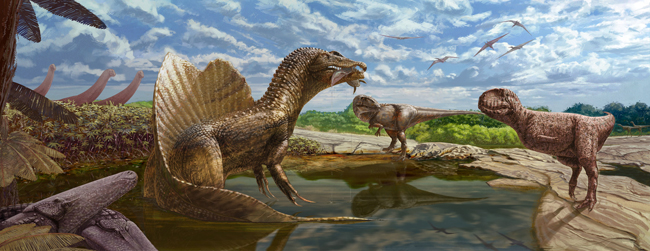
Reconstruction of the palaeoecosystem of the Upper Cretaceous (Cenomanian) Bahariya Formation of the Bahariya Oasis, Western Desert of Egypt. A single neck bone proves the presence of abelisaurids in the ecosystem. Picture credit: Andrew McAfee, Carnegie Museum of Natural History.

Picture credit: Andrew McAfee, Carnegie Museum of Natural History

Cervical Vertebra Fossil Discovery

A 2016 expedition led by researchers from the Mansoura University Vertebrate Palaeontology Centre, (Mansoura, Egypt), unearthed a single neck bone (10th cervical vertebra), a formal description of this specimen (MUVP 477) has been published in Royal Society Open Science.

Neck bone of an abelisaurid (Bahariya Formation)

Tenth cervical vertebra of Abelisauridae indet. (MUVP 477) in cranial (a), caudal (b), left lateral (c), right dorsolateral (d), ventral (e) and dorsal (f) views. Note scale bar = 5 cm. Picture credit: Salem et al.

Picture credit: Salem et al

Similar to the Cervical Vertebrae of Majungasaurus and Carnotaurus (Abelisaurids)

The neckbone is strikingly similar to the cervical vertebrae of Majungasaurus from the Late Cretaceous of Madagascar and the cervical vertebrae of Carnotaurus, fossils of which are associated with Upper Cretaceous deposits of Argentina. Phylogenetic analysis places the Bahariya Formation specimen within the Abelisauridae, but the absence of any further fossil material has restricted the taxonomic classification to the family level (a similar taxonomic position to that of the “White Rock spinosaurid” described from fragmentary bones found on the Isle of Wight).

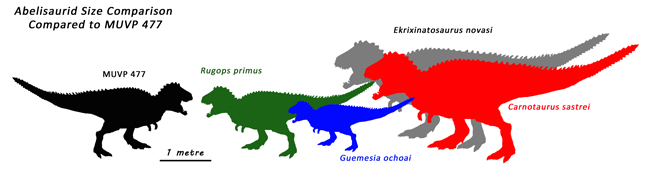
Based on measurements of the cervical vertebra the Bahariya Formation abelisaurid is estimated to have had a body length of between 5.3 and 6.3 metres, indicating that this fossil represents a mid-sized member of the Abelisauridae with a body size similar to Rugops, Majungasaurus, Viavenator and Xenotarsosaurus bonapartei.

Abelisaurid size Comparison

Abelisaurid size comparison. The Bahariya Formation abelisaurid is described as mid-sized member of the Abelisauridae with a body length estimated to be 5.3 to 6.3 metres long. Picture credit: Everything Dinosaur.

Picture credit: Everything Dinosaur

The First Definitive Proof of Abelisaurids and the Oldest from North-eastern Africa

Specimen number MUVP 477 is not only the first definitive proof of the presence of abelisaurids with the Bahariya Formation biota, but with an estimated age of approximately 98 million years, this fossil is also the oldest record of the Abelisauria clade in Egypt and north-eastern Africa generally.

Providing a Key for the Carnegie Museum of Natural History Life Reconstruction

Theropod dominated Bahariya Formation palaeoecosystem.

Reconstruction of the palaeoecosystem of the Upper Cretaceous (Cenomanian) Bahariya Formation of the Bahariya Oasis, Western Desert of Egypt. The early Late Cretaceous of north-eastern Africa was a dangerous place with several different types of predatory dinosaur present in the ecosystem. Picture credit: Andrew McAfee, Carnegie Museum of Natural History.

Picture credit: Andrew McAfee, Carnegie Museum of Natural History

The stunning prehistoric scene (Andrew McAfee/Carnegie Museum of Natural History) shows, the mid-sized abelisaurid (far right) confronting the giant theropod Spinosaurus aegyptiacus which is holding a dipnoan (lungfish) Retodus tuberculatus in its jaws.

The large carcharodontosaurid Carcharodontosaurus saharicus can be seen in the centre background. Two stomatosuchid crocodyliforms (Stomatosuchus inermis) can be seen on the far left, whilst in the background a trio of Paralititan stromeri walk by. A pair of bahariasaurids are located just behind the tail of the abelisaurid whilst a flock of pterosaurs soar overhead. The vegetation is dominated by the mangrove-like tree fern Weichselia reticulata.

Niche Partitioning

The presence of so many large predators in the biota suggests that the Bahariya Formation ecosystem was extremely rich, even so, it is likely that the different types of theropod exhibited niche-partitioning, with coeval genera exploiting different resources.

*To read our article on the “White Rock spinosaurid”: Super-sized Carnivorous Dinosaur from the Isle of Wight.

The scientific paper: “First definitive record of Abelisauridae (Theropoda: Ceratosauria) from the Cretaceous Bahariya Formation, Bahariya Oasis, Western Desert of Egypt” by Belal S. Salem, Matthew C. Lamanna, Patrick M. O’Connor, Gamal M. El-Qot, Fatma Shaker, Wael A. Thabet, Sanaa El-Sayed and Hesham M. Sallam published by Royal Society Open Science.

The award-winning Everything Dinosaur website: Dinosaur Models and Toys.

8 06, 2022

Remarkable Australian Pterosaur Fossils Reveal Crocodiles Dined on Flying Reptiles

By |2025-01-05T21:24:40+00:00June 8th, 2022|Categories: Adobe CS5, Dinosaur and Prehistoric Animal News Stories, Dinosaur Fans, Main Page, Palaeontological articles, Photos/Pictures of Fossils|0 Comments

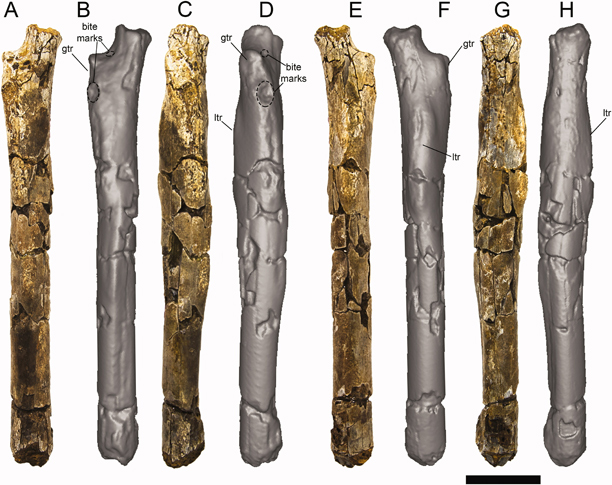
Scientists have identified two partial pterosaur thigh bones that despite one being at least ten million years older than the other, have been identified as belonging to the same type of flying reptile (Anhangueria). Furthermore, one of the bones preserves a potential bite mark tentatively attributed to a crocodilian.

Pterosaur femur

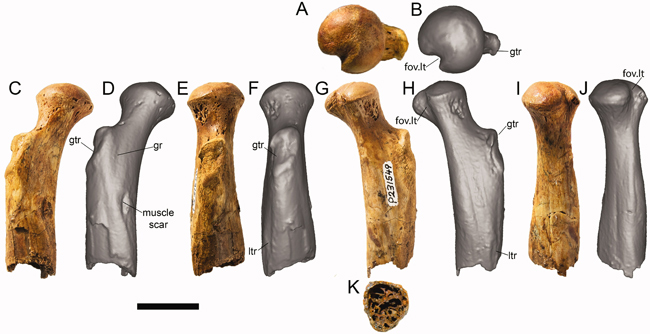
Anhangueria indet. partial right femur from the Toolebuc Formation (NMV P231549): A, B, proximal; C, D, posterior; E, F, dorsal; G, H, anterior; I, J, ventral and K, distal views. A, C, E, G, I and K are photographs; B, D, F, H and J are 3D renders derived from surface scan data. Scale bar = 2 cm. Picture credit: Pentland et al.

Picture credit: Pentland et al

Two Rare Australian Pterosaur Fossils

The researchers who include famous Australian vertebrate palaeontologists Patricia Vickers-Rich and Thomas Rich report that the two bones although found over 200 miles apart, both come from pterosaurs from the same pterosaur clade (Anhangueria).

Specimen number NMV P231549 was collected in 1991 at Slashers Creek Station, southeast of the small town of Boulia (Queensland), from Toolebuc Formation deposits (middle to upper Albian) and is believed to be at least 100 million years old.

Specimen number AODF 2297 was found in 2004 at Belmont Station, around 35 miles northeast of the town of Winton in Queensland. It came from deposits associated with the “upper” Winton Formation (Cenomanian-lowermost Turonian stage of the Late Cretaceous). It is estimated to be around 10 million years younger.

Anhangueria femor from the Winton Formation.

Anhangueria indet. partial left femur from the Winton Formation (AODF 2297): A, B, posterior; C, D, dorsal; E, F, anterior; and G, H, ventral views. A, C, E and G are photographs; B, D, F and H are 3D renders derived from surface scan data. Scale bar = 2 cm. Picture credit: Pentland et al.

Picture credit: Pentland et al

Although pterosaur fossils are exceptionally rare in Australia and most specimens are extremely fragmentary, their three-dimensional preservation has enabled palaeontologists to learn a great deal about the type of pterosaurs that ranged over this part of Gondwana during the Cretaceous.

Lead author of the scientific paper describing these pterosaur bones, Adele Pentland (PhD student at Swinburne University, Melbourne, Victoria), was also the lead author of another scientific paper published in 2019 which described another anhanguerid pterosaur Ferrodraco lentoni.

To read more about F. lentoni: The Most Complete Pterosaur Specimen Found in Australia to Date.

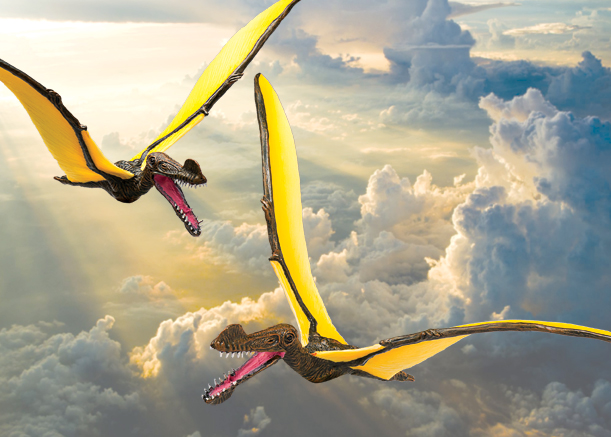
Mojo Fun Tropeognathus.

A pair of Mojo Fun Tropeognathus pterosaurs.

The picture (above) shows two Tropeognathus pterosaurs, soaring high in the sky.  These pterosaurs are typical of the Anhangueridae. The models are from the Mojo Fun series.

To view the range of Mojo Fun figures available from Everything Dinosaur: Mojo Fun Prehistoric Animal Figures.

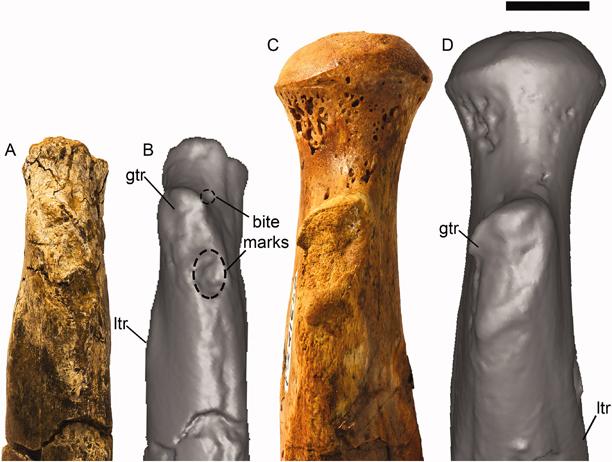
The Winton Formation fossil preserves a potential bite mark, that the researchers have tentatively proposed was made by a crocodylomorph. It is not known whether this feeding trace represents predation or post-mortem scavenging.

Comparing the two pterosaur femori.

Comparisons between greater trochanters of the Toolebuc Formation (NMV P231549) and Winton Formation (AODF 2297) pterosaur femora. AODF 2297 in A, B, dorsal view. NMV P231549 in C, D, dorsal view. A and C are photographs; B and D are 3D renders derived from surface scan data. Picture credit: Pentland et al.

Picture credit: Pentland et al

The scientists conclude that these new pterosaur fossils are a valuable addition to the meagre list of pterosaur specimens found in Australia and attest to the cosmopolitan distribution of anhanguerians during the Early and early Late Cretaceous.

The scientific paper: “New anhanguerian pterosaur remains from the Lower Cretaceous of Queensland, Australia” by Adele H. Pentland, Stephen F. Poropat, Matt A. White, Samantha L. Rigby, Patricia Vickers-Rich, Thomas H. Rich and David A. Elliott published in Alcheringa: An Australian Journal of Palaeontology.

5 06, 2022

A New Short-snouted Troodontid – Papiliovenator

By |2023-08-30T20:25:05+01:00June 5th, 2022|Categories: Adobe CS5, Dinosaur and Prehistoric Animal News Stories, Dinosaur Fans, Main Page, Palaeontological articles, Photos/Pictures of Fossils|0 Comments

A new species of short-snouted troodontid has been named and described based on fossils found in the Upper Cretaceous Wulansuhai Formation at Bayan Manduhu, Inner Mongolia. This little dinosaur has been named Papiliovenator neimengguensis.

Everything Dinosaur team members have been busy updating readers about new dinosaurs named and described this year (see below*), the formal scientific paper announcing this new troodontid was published earlier in the spring, but information about the fossils attributed as the holotype material had been circulating for some time.

Papiliovenator neimengguensis Skull
The short-snouted skull of Papiliovenator neimengguensis in lateral view. Picture credit: Pei et al.

Named From Strangely Shaped Dorsal Vertebrae

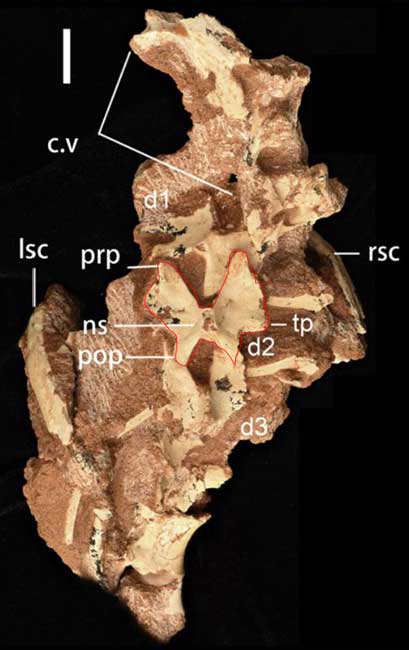
Known from a nearly complete skull and fragmentary, semi-articulated postcranial material thought to represent a single, individual animal, Papiliovenator means “butterfly hunter”. This little carnivore, which was less than a metre long, might well have hunted butterflies and other members of the Lepidoptera, but the derivation of the genus name does not reflect this dinosaur’s diet. Instead, it was the unusual shape of the neural arches associated with the two dorsal vertebrae closest to the neck of this dinosaur that inspired the genus name. When viewed from above (dorsal view), these neural arches are butterfly-shaped.

Papiliovenator neimengguensis fossil bones.
Papiliovenator neimengguensis fossil bones. A view of the articulated dorsal vertebrae with the distinctive butterfly-shaped, broad neural arches of the anteriormost dorsal vertebrae when viewed from the top down (dorsal view). The neural arch has been outlined in red. Picture credit: Pei et al with additional annotation by Everything Dinosaur.

Unusual for a Late Cretaceous Troodontid

The researchers report that Papiliovenator was unusual among Late Cretaceous troodontids in having a fairly deep, short-snouted skull. This skull shape is seen in geologically older troodontids known from the Early Cretaceous. Most other Late Cretaceous troodontids have long, low snouts, except for the smaller Almas ukhaa from the Campanian-aged Djadochta Formation of Mongolia. Coincidently, Rui Pei of the Chinese Academy of Sciences was the lead author of the scientific paper naming and describing A. ukhaa (Pei et al, 2017). Rui Pei is the lead author of the paper describing Papiliovenator.

*To read about a new basal iguanodontian from southern China: Napaisaurus guangxiensis.

*A new alvarezsaurid taxon from Uzbekistan: Dzharaonyx eski Old Dzharakuduk Claw.

*A new therizinosaur from the Japanese island of Hokkaido: Paralitherizinosaurus japonicus.

The fossils are thought to represent a sub-adult animal. The discovery of Papiliovenator neimengguensis allows for an improved understanding of troodontid anatomy, as well as helping to highlight the regional variation of troodontids from the Upper Cretaceous of the Gobi Basin.

The scientific paper: “A new troodontid from the Upper Cretaceous Gobi Basin of inner Mongolia, China” by Rui Pei, Yuying Qin, Aishu Wen, Qi Zhao, Zhe Wang, Zhanmin Liu, Weilesi Guo, Po Liu, Weiming Ye, Lanyun Wang, Zhigang Yin, Ruiming Dai and Xing Xu published in Cretaceous Research.

Visit the Everything Dinosaur website: Everything Dinosaur.

31 05, 2022

Scientists are Fascinated with the Extinction of Megalodon

By |2024-12-31T11:46:32+00:00May 31st, 2022|Categories: Adobe CS5, Dinosaur and Prehistoric Animal News Stories, Main Page, Photos/Pictures of Fossils|0 Comments

The extinction of Megalodon more appropriately termed Otodus megalodon, regarded as the largest hypercarnivorous shark that has ever existed has been the subject of numerous scientific papers. Newly published research suggests that competition for food and space with the Great White Shark (C. carcharias) and possibly other large taxa such as hypercarnivorous toothed whales could have played a role in the giant fish’s extinction.

Brilliant artwork on the PNSO Megalodon model cover sleeve.

The amazing, colourful sleeve artwork on the PNSO Megalodon figure. Several scientific papers have explored the potential reasons for the demise and extinction of Otodus megalodon – regarded as the largest hypercarnivorous shark known to science.

Zinc Isotope Analysis from Teeth

The diet of extinct animals can hold clues to their lifestyle, behaviour, evolution and ultimately their extinction. However, studying an animal’s diet after millions of years is difficult due to the poor preservation of chemical dietary indicators in organic material. An international team of scientists led by the Max Planck Institute for Evolutionary Anthropology (Leipzig, Germany), used a new technique, analysing zinc isotopes preserved in the mineralised tooth enamel to assess how far up the food chain Otodus megalodon was placed in comparison to the extant Great White Shark.

Tooth comparison Megalodon and Great White Shark

A tooth from extinct early Pliocene Otodus megalodon (left) compared with a tooth (right) from a modern Great White Shark (C. carcharias). Picture credit: Max Planck Institute for Evolutionary Anthropology.

Picture credit: Max Planck Institute for Evolutionary Anthropology

More Reliable than Nitrogen Isotope Analysis of Tooth Collagen

Nitrogen analysis of tooth collagen, a protein-based component of tooth dentine, has been used to establish the degree of animal matter consumed in a diet. However, in fossils collagen is generally not preserved so an analysis of zinc isotopes associated with the highly mineralised tooth enameloid may prove to be a more reliable indicator of the diet of long extinct animals.

Lead author of the study, published in “Nature Communications”, Dr Jeremy McCormack (Max Planck Institute for Evolutionary Anthropology) stated:

“On the timescales we investigate, collagen is not preserved, and traditional nitrogen isotope analysis is therefore not possible.”

The isotope ratios in O. megalodon teeth from the Pliocene were studied along with earlier Miocene “megatooth” taxa such as Otodus chubutensis. Modern contemporaneous shark species such as C. carcharias were analysed to provide a comparison. The researchers identified similar zinc isotope signatures in extinct as well as their modern analogous taxa.

Megalodon Occupied the Same Niche as Great White Sharks

The researchers concluded that super-sized sharks such as Otodus megalodon occupied the same niche in the ecosystem as the extant Great White Shark (Carcharodon carcharias). This suggests that when these two taxa were contemporaneous, they would have competed for the same resources.

This competition may have played a role in the demise and eventual extinction of Megalodon.

CollectA Deluxe Megalodon shark model.

The CollectA 1:60 scale Megalodon shark model. The extinction of Otodus megalodon could have been caused by multiple, compounding environmental and ecological factors including climate change and thermal limitations, the collapse of prey populations and resource competition with Carcharodon carcharias.

The picture (above) shows a CollectA Deluxe Otodus megalodon shark model.  It is a detailed prehistoric animal figure.

To view the range of CollectA Deluxe scale models: CollectA Deluxe Scale Models.

The extinction of Otodus megalodon could have had multiple causes. For example, environmental and ecological factors including climate change and dramatic cooling of the seas resulting in a restriction of the habitat of O. megalodon. In addition, the collapse of prey populations along with resource competition from Carcharodon carcharias could have put the prehistoric sharks under increasing pressure.

This study did not examine the potential impact on O. megalodon through competition from toothed whales (carnivorous odontocetes). If zinc isotope analysis proves to be a reliable methodology for analysing the diets of long extinct creatures, then this technique could be used to examine the impact of toothed whales on Megalodon populations.

Everything Dinosaur acknowledges the assistance of a media release from the Max Planck Institute for Evolutionary Anthropology in the compilation of this article.

The scientific paper: “Trophic position of Otodus megalodon and great white sharks through time revealed by zinc isotopes” by Jeremy McCormack, Michael L. Griffiths, Sora L. Kim, Kenshu Shimada, Molly Karnes, Harry Maisch, Sarah Pederzani, Nicolas Bourgon, Klervia Jaouen, Martin A. Becker, Niels Jöns, Guy Sisma-Ventura, Nicolas Straube, Jürgen Pollerspöck, Jean-Jacques Hublin, Robert A. Eagle and Thomas Tütken published in Nature Communications.

The award-winning Everything Dinosaur website: Prehistoric Animal Models and Toys.

27 05, 2022

A Basal Iguanodontian from Southern China

By |2024-12-31T10:46:40+00:00May 27th, 2022|Categories: Adobe CS5, Dinosaur and Prehistoric Animal News Stories, Dinosaur Fans, Main Page, Photos/Pictures of Fossils|0 Comments

Scientists have named and described a new genus of basal iguanodontian from the Xinlong Formation of southern China. The dinosaur has been named Napaisaurus guangxiensis. It is the first, basal iguanodontian taxa described from southern China.

Napaisaurus guangxiensis fossil material.

Holotype fossil material of Napaisaurus (N. guangxiensis) is a right ilium and ischium found in 2020. It is the first, basal iguanodontian taxa from southern China. Picture credit: Ji and Zhang.

Picture credit: Ji and Zhang

Fossils Found in 2020

Partial hip bones (a right ilium and a right ischium) from a single individual animal were discovered in 2020 from excavations undertaken in strata associated with the Aptian-aged, Xinlong Formation of Napai Basin, Fusui County, Guangxi Zhuang Autonomous Region, South China. The dinosaur’s name translates as Napai Basin lizard from Guangxi and its discovery adds to the dinosaur biota (sauropods, spinosaurids and carcharodontosaurids) associated with the Xinlong Formation.

Team members at Everything Dinosaur, estimate that based on the partial hip bones, the Napaisaurus specimen would have been around four metres in length.

Scale drawing of Napaisaurus

A scale drawing of Napaisaurus guangxiensis. This basal iguanodontian is estimated to be around four metres in length. Picture credit: Everything Dinosaur.

Picture credit: Everything Dinosaur

Comparing Dinosaur Biotas from China and North-eastern Thailand

The official journal publication announcing the discovery of this new Early Cretaceous herbivore was published earlier this year, but it was made available on-line in 2021.

The fossils permit an iguanodontian to be added to the dinosaur biota associated with the Xinlong Formation and it provides important evidence helping palaeontologists to better understand the relationship between the Lower Cretaceous fossils of the Napai Basin (Xinlong Formation) and those associated with contemporaneous deposits from northern China and the Khorat Group of north-eastern Thailand. Specifically, the naming of Napaisaurus adds a definitive iguanodontian to the Xinlong Formation biota, thus permitting a more detailed comparison with the ornithischian dinosaurs associated with the Aptian-aged Khok Kruat Formation (the uppermost member of the Khorat Group), from which several iguanodontian ornithopods have been described (Ratchasimasaurus, Siamodon, Sirindhorna).

The scientific paper: “First new genus and species of basal iguanodontian dinosaur (Ornithischia: Ornithopoda) from southern China” by S. Ji and P. Zhang published in Acta Geoscientica Sinica.

The award-winning Everything Dinosaur website: Dinosaur and Prehistoric Animal Models.

25 05, 2022

Argentina’s Amazing “Dragon of Death” is Described

By |2024-12-31T10:19:52+00:00May 25th, 2022|Categories: Adobe CS5, Dinosaur and Prehistoric Animal News Stories, Dinosaur Fans, Main Page, Palaeontological articles, Photos/Pictures of Fossils|0 Comments

Researchers have named the largest pterosaur found to date in South America. The giant Thanatosdrakon (T. amaru) is estimated to have had a wingspan of around nine metres and it would have stood as tall as a giraffe.

Writing in the academic journal “Cretaceous Research”, the scientists, have assigned Thanatosdrakon to the Azhdarchidae family of pterosaurs and postulate that it was closely related to the slightly larger and geologically younger Quetzalcoatlus, fossils of which are known from North America.

Left humerus of Thanatosdrakon

The paratype fossil a giant left humerus (UNCUYO-LD 350) is carefully cleaned at the dig site. Picture credit: Reuters/ICB-CONICET/UNCUYO.

Picture credit: Reuters/ICB-CONICET/UNCUYO

One of the Largest Flying Vertebrates Known

The fossil material, thought to represent two individual pterosaurs was found in the upper-most levels of the Plottier Formation (upper Coniacian–lower Santonian, Neuquén Basin), Mendoza, western Argentina. The researchers, who include CONICET* researcher Dr Leonardo Ortiz David, Dr Bernardo González Riga, director of the Laboratory and Museum of Dinosaurs of the Faculty of Exact and Natural Sciences and world-renowned pterosaur expert Dr Alexander Kellner (Director of the National Museum of Rio de Janeiro, Brazil), estimate that Thanatosdrakon lived around 86 million years ago. Based on the single, huge left humerus of the paratype (UNCUYO-LD 350), a wingspan of around 9 metres is proposed, making Thanatosdrakon amaru one of the largest flying vertebrates known to science.

Thanatosdrakon Size Comparison

Comparing the estimated wingspans of the paratype and holotype fossil material associated with Thanatosdrakon amaru with large, extant birds. Picture credit: ICB-CONICET/UNCUYO.

Picture credit: Reuters/ICB-CONICET/UNCUYO

Exceptionally Preserved Fossils

A civil construction project had uncovered some of the fossils. A field team was despatched to map the site and to recover the exceptionally well-preserved bones. The fossil material consists of vertebrae and bones from the limbs. As the larger humerus was found in close proximity to the other fossils, the scientists have speculated that this huge animal was social and probably lived in flocks.

Thanatosdrakon is the oldest taxon of the clade Quetzalcoatlinae so far described. As the strata containing the fossil bones represent deposition in a floodplain environment with ephemeral meandering streams and rivers, the researchers conclude that like the much later Quetzalcoatlus, Thanatosdrakon inhabited continental, inland areas.

Thanatosdrakon skeletal material.

Skeletal reconstructions of Thanatosdrakon amaru. The holotype fossil material (UNCUYO-LD 307) and the left humerus paratype (UNCUYO-LD 350). Picture credit: ICB-CONICET/UNCUYO.

Picture credit: Reuters/ICB-CONICET/UNCUYO

Important Information on Azhdarchid Anatomy

The fossils are not distorted or flattened to any great degree. Their three-dimensional preservation will help the researchers to learn more about the anatomy of giant pterosaurs. In addition, some of the fossil bones such as the dorsosacral vertebrae and caudal vertebra along with the notarium (the structure formed by fusion of the dorsal vertebrae, seen in pterosaurs and birds), have never been described in giant azhdarchids. The researchers expect that further study of these bones will provide important information on azhdarchid anatomy.  Hopefully, new fossil finds will provide more information on the Azhdarchidae.

The “Dragon of Death”

This large pterosaur probably hunted on the ground, perhaps stalking prey in a similar manner to the marabou stork (Leptoptilos crumenifer) which is found in sub-Saharan Africa. The genus name is derived from the Greek words thanatos which means death and drakon (dragon). The species name honours the Inca winged serpent (Amaru).

CONICET* (Consejo Nacional de Investigaciones Científicas y Técnicas [National Council for Scientific and Technical Research of Argentina]).

The scientific paper: “Thanatosdrakon amaru, gen. et sp. nov., a giant azhdarchid pterosaur from the Upper Cretaceous of Argentina” by Leonardo D. Ortiz David, Bernardo J. González Riga and Alexander W. A. Kellner published in the journal Cretaceous Research.

22 05, 2022

The Remarkable Dzharaonyx eski – “Old Dzharakuduk Claw”

By |2024-12-31T09:51:14+00:00May 22nd, 2022|Categories: Dinosaur and Prehistoric Animal News Stories, Dinosaur Fans, Main Page, Palaeontological articles, Photos/Pictures of Fossils|0 Comments

Earlier this spring, a new taxon of alvarezsaurid theropod was described from well-preserved, postcranial remains found in Uzbekistan. The little dinosaur, measuring less than half a metre long, has been named Dzharaonyx eski, which translates as “old Dzharakuduk claw”.

Dzharaonyx eski scale drawing.

The cat-sized alvarezsaurid theropod Dzharaonyx eski from the Late Cretaceous of Uzbekistan. It is regarded as the geologically oldest member of the Parvicursorinae.

From the Bissekty Formation

Writing in the academic “Journal of Vertebrate Paleontology”, the researchers, including Hans-Dieter Sues (Department of Paleobiology, National Museum of Natural History, Smithsonian Institution, Washington, D.C.), describe this cat-sized theropod based on bones from the spine including dorsal and caudal vertebrae, limb bones, parts of the pelvis and bones from the hand including the iconic, robust alvarezsaurid claws.

Dzharaonyx claw fossils.

Dzharaonyx eski a new taxon of alvarezsaurid from the Late Cretaceous of Uzbekistan. Picture credit: Averianov and Sues.

Picture credit: Averianov and Sues

The fossils come from the Bissekty Formation (Upper Cretaceous, Turonian faunal stage) and D. eski is estimated to have lived around 91-92 million years ago. The dinosaur was named after the type locality (Dzharakuduk in south-central Uzbekistan). The species name “eski” is derived from the Uzbek word for “old”.

Pronounced Zar-ah-ra-on-niks es-key, a phylogenetic analysis of this newly described taxon places it within the alvarezsaurid subfamily the Parvicursorinae alongside other Asian members of the Alvarezsauridae such as Parvicursor (P. remotus) and Qiupanykus (Q. zhangi). Dzharaonyx eski is the oldest member of the Parvicursorinae known to science, it having lived at least 10 million years earlier than related species, fossils of which are confined to the Campanian and Maastrichtian faunal stages of the Late Cretaceous.

Remarkable Alvarezsaurids

Alvarezsaurids were highly specialised theropods, with a single, powerful hand claw adapted for tearing and digging. It is thought that these small maniraptoran dinosaurs fed on colonial insects such as termites.

The Alvarezsauridae family was erected in 1991 (Bonaparte). These long-legged theropods were once thought to be a lineage of flightless birds. Most palaeontologists consider them to be an early diverging branch of the Maniraptora. These dinosaurs tend to be both geographically and temporally widespread.

To read a blog post from 2021 about research into the evolution of the Alvarezsauridae: Miniature Alvarezsauroids Under the Spotlight.

Recently, another Asian member of the Parvicursorinae was described from partial, postcranial material from the Upper Cretaceous (Campanian) Barungoyot Formation in Mongolia. The alvarezsaurid has been named Ondogurvel alifanovi.

Mike from Everything Dinosaur commented:

“Dzharaonyx is a remarkable fossil discovery. It lived during the Turonian faunal stage of the Cretaceous. We look forward to more dinosaur discoveries from the famous Bissekty Formation.”

The scientific paper: “New material and diagnosis of a new taxon of alvarezsaurid (Dinosauria, Theropoda) from the Upper Cretaceous Bissekty Formation of Uzbekistan” by Alexander O. Averianov and Hans-Dieter Sues published in the Journal of Vertebrate Paleontology.

The award-wining Everything Dinosaur website: Prehistoric Animal Models and Toys.

Go to Top