Our thanks to model collector and keen bird watcher Elizabeth who sent into Everything Dinosaur a fantastic photograph of a Kingfisher with its lunch. The lack of rainfall in most areas of the UK in recent months has led to water levels in rivers and lakes dropping. This has concentrated fish (the preferred prey of the Kingfisher), into ever decreasing pools and fish-eaters such as the beautiful Kingfisher have been taking advantage of the easier access to prey.
The “King of the River” one of the most spectacular of Britain’s birds – a close-up view of the beautiful plumage of a Kingfisher (Alcedo atthis). Picture credit: Elizabeth.
The drought could have long-term implications for local Kingfisher populations, particularly if ponds and other water sources dry up. Team members at Everything Dinosaur do occasionally catch the glimpse of a pair of iridescent wings, or a splash of orange colour, as they walk along the canal and the river on their way to work. There are Kingfishers in our neighbourhood, but these short-lived birds are notoriously difficult to spot.
Our thanks to Elizabeth for sending in her superb photograph. We think this might be a male. Female Kingfishers have an orange/pinkish tinge to their lower beak. In contrast, the males tend to have black beaks. A tip to help you remember the difference between male and female Kingfishers is to think of the female birds wearing pink lipstick on their lower mandibles.
It is a superb, close-up view of one of our country’s most colourful birds.
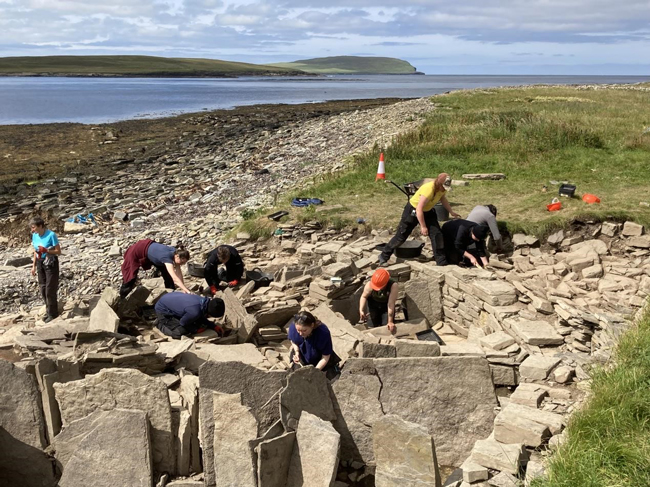
Dedicated and enthusiastic field team members led by Dr Julie Bond (University of Bradford) are battling time and tides to document an Iron Age settlement and other important archaeological finds before the elements take their toll.
Dedicated and Enthusiastic Archaeologists
Dr Bond with her colleagues and students studying Archaeological and Forensic Sciences are battling against erosion to uncover artefacts and document the site located on the island of Rousay in the Orkneys (Scotland).
Field workers battle to protect the Iron Age settlement on the Scottish island of Rousay, Orkney. Picture credit: The University of Bradford.
A Large Iron Age Settlement
The site, located at the Knowe of Swandro, on the west coast of Rousay has been occupied from around 1000BC to AD1200. As well as the Iron Age roundhouses, there are the remains of Pict buildings, a Viking settlement and a Norse Long Hall, all of which are threatened by coastal erosion.
The area is considered to be one of the most important locations for documenting the history of Scandinavian settlers in the British Isles.
Honorary Researcher, Dr Steve Dockrill warned that this project is a race against tides and time. Nature will win in the end, but the hardworking team are determined to map and document the site and collect artefacts to preserve evidence of human habitation.
Dr Dockrill stated:
“A substantial Iron Age roundhouse, which forms the focus of a village-like settlement is being eroded by the sea. The large roundhouse had been lived in by generations for a millennium or more, and shows signs of a number of building events modifying the structure.”
Coastal Erosion
Coastal erosion, accelerated by rising sea levels is an increasing threat to sites such as these. The Knowe of Swandro location is providing archaeologists with a unique opportunity to explore the construction of the roundhouse and surrounding buildings.
Dr Dockrill added:
“The site is rich in cultural material and evidence for the use of land and sea in terms of agriculture and fishing. This site is being destroyed by the sea. Over a third of the roundhouse has been lost to coastal erosion. Despite this we are uncovering new evidence for life in the Iron Age and are using the latest technology to record the archaeological evidence before it vanishes”
The University of Bradford-led excavation is working in partnership with the Swandro Orkney Coastal Archaeology Trust, to investigate the site. The Swandro Orkney Coastal Archaeology Trust relies on public donations to fund its work and has HRH Prince Charles as its patron.
To date, the dedicated team have found bone tools, jewellery, shards of pottery and a late Roman coin. A rare Iron Age glass bead has also been uncovered, this could have been part of a piece of jewellery or perhaps a gaming piece.
Students from the University of Bradford on the Archaeological and Forensic Sciences course travel to the Orkneys to gain practical work experience.
Student Michal Szedzielorz commented:
“This is an amazing experience. I have learnt more in 6 weeks than I ever expected. I have learnt so many new practical skills and a better understanding of archaeology.”
A spokesperson from Everything Dinosaur commented:
“Whilst the actions of waves and tides can reveal archaeological and palaeontological treasures, these same forces can destroy, and we wish all the field team members every success with their endeavours.”
Everything Dinosaur acknowledges the assistance of a media release from the University of Bradford in the compilation of this article.
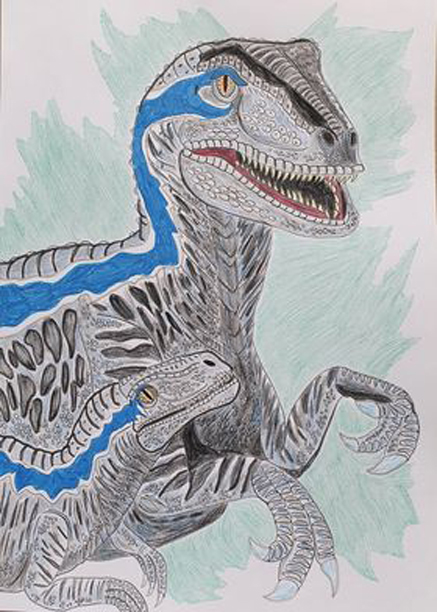
Our thanks to talented, young artist Caldey who sent into Everything Dinosaur an illustration of a mother and baby Velociraptor inspired by the recent film “Jurassic World Dominion”. The skilfully produced drawing features Blue and her offspring Beta from the latest and potentially the last movie in the “Jurassic Park/Jurassic World” franchise.
The beautiful illustration of a pair of “raptors”. The drawing was inspired by the recent (June 2022) movie “Jurassic World Dominion”. The adult Velociraptor Blue and her offspring Beta. Picture credit: Caldey.
A “Raptor” Legacy
Dinosaurs, marine reptiles and pterosaurs roam freely, and human/dinosaur interactions result in inevitable fatalities. The authorities strive to monitor the movements of the genetically engineered prehistoric animals. Blue, one of the Velociraptors trained by Chris Pratt’s character Owen Grady in previous incarnations of the franchise, resides in the Sierra Nevada Mountains, where Owen earns a living helping to capture and relocate stray dinosaurs. Owen discovers that Blue has a juvenile “raptor” with her, this is an asexually reproduced hatchling. The baby Velociraptor is named Beta by Maisie Lockwood (played by Isabella Sermon).
Whilst many different types of prehistoric animal have been depicted in the films, no dinosaur has had as much screen time dedicated to it as the iconic “raptors” which have featured in all the films in the “Jurassic Park/Jurassic World” genre.
A site safety notice at our local cinema spotted at the entrance as team members went to see “Jurassic World Dominion”.
Velociraptor Mother and Baby
A spokesperson from Everything Dinosaur thanked Caldey for her drawing and commented:
“Caldey’s choice of the Velociraptor pair for her illustration is fitting. These dinosaurs have featured in all six of the movies associated with this franchise. It is a wonderful drawing of Blue and Beta”.
Fans of dinosaurs like to collect scale models, and there is one scale model on show at the Titus T. rex is King exhibition at Wollaton Hall Nottinghamshire, which puts any model collection into perspective.
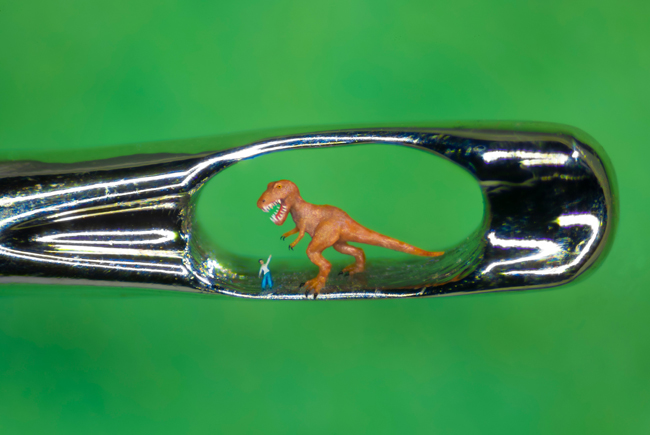
Internationally renowned micro-sculpturist, Dr Willard Wigan MBE, has created and installed a new extraordinary micro-sculpture of a perfectly formed Tyrannosaurus rex, measuring just 0.5 mm in length.
This amazing figure is so small, it sits comfortably within the eye of a needle.
The remarkable microscopic Titus the T. rex sculpted by Dr Willard Wigan MBE. The T. rex model measures 0.5 mm in length and it sits within the eye of a needle. Picture credit: Wollaton Hall/Dr Willard Wigan.
Celebrating the First-year Anniversary of this World-exclusive Event
The “microsaur” has been installed to mark the first-year anniversary of the opening of the Titus T. rex is King exhibition. Based on the estimated size for an adult T. rex at around 13 metres, the tiny “tyrant lizard king”, complete with fearsome teeth and sharp claws is approximately in 1/26,000th scale.
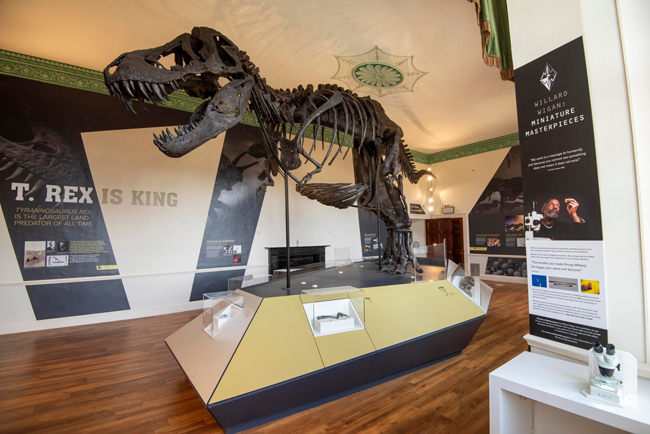
Now the very tiniest micro-depiction, and, Titus, the first real Tyrannosaurus rex to be exhibited in England for over a century, stand side by side. Titus the T. rex, demonstrates the immense power and impact of this king of the dinosaurs, while Willard Wigan’s creation presents the smallest, but no less powerful.
Dr Willard Wigan commented:
“It is a real honour to be exhibiting one of my sculptures alongside the breath-taking Titus T. rex exhibition. Wollaton Hall Natural History Museum is renowned for being home to rare specimens from across the globe, including Titus himself, which made it the perfect home for my T. rex sculpture.”
Titus the T. rex and the Willard Wigan miniature masterpieces exhibit at Wollaton Hall. Everything Dinosaur team members estimate that the 0.5 mm long T. rex sculpture is in approximately 1:26,000 scale! Picture credit: Wollaton Hall.
A Message to Humanity
Through his incredible sculptures, Dr Wigan is sending a message to humanity – just because you cannot see something does not mean that it does not exist. In palaeontology, including the study of the Dinosauria, a similar metaphor can be demonstrated in the concept of “ghost lineages”. A hypothesis that an animal would have existed in the past, but no fossils to prove its existence have been found, but fossils of related genera imply that it did exist.
Titus the T. rex is King Exhibition
Titus the T. rex is King opened in July 2021, to international acclaim. Over 70,000 visitors have already met Titus and engaged with the bespoke interactive exhibition designed around the remarkable skeletal mount.
Rachael Evans (Museums Development Manager at Nottingham City Museums and Galleries at Wollaton Hall), one of the UK’s most important Natural History Museums, added:
“It is an astonishing moment for us. We will have one the largest dinosaurs ever exhibited in the UK on display alongside one of the smallest. The T. rex that has been introduced to the exhibition is 0.5mm in size, with miniscule teeth made from glass. Since new information about the T. rex has been researched and made available, Willard has remodelled the sculpture to be as accurate as possible in his depiction. We can’t wait to see our visitors’ reaction to this new addition.”
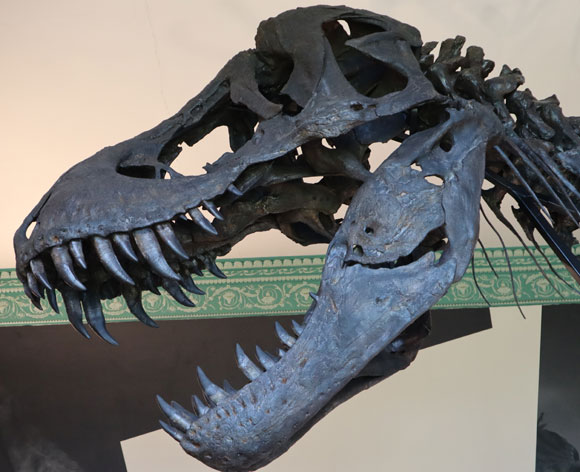
The skull of the T. rex exhibit on display at Wollaton Hall until August 2022.
Exhibition Details
Tickets for TITUS T. REX IS KING are on sale now, set at £13.00 for an adult, £8.75 for a child (under 16 years), students and concessions, £34.00 for a family ticket (2 adults and 2 children under 16 years) and under 3s and carers have no entry fees to pay. Car parking charges apply.
Everything Dinosaur acknowledges the assistance of a press release from Wollaton Hall in the compilation of this article.
Hot weather can increase the risk of landslides and rockfalls, visitors to the seaside trying to avoid the extreme heat are advised to stay away from the cliffs.
For many parts of England, Monday and Tuesday (18th and 19th of July 2022), red extreme heat warnings have been issued. Such alerts have never been issued for the UK before. Temperatures could reach as high as 40 degrees Celsius (104 Fahrenheit), although this system of alerts was only introduced last year (2021). The risk of a landslide can increase in hot weather, visitors to the beach should take care to avoid areas where there are cliffs.
A significant rock fall at Stonebarrow Hill (Dorset).Extreme heat can cause cliffs to become unstable and collapse. Visitors to the seaside in search of relief from the hot weather are advised to avoid cliffs due to the increased risk of landslides and rock falls. Picture credit: Brandon Lennon.
Rock Fall and Landslide Risk
In very hot weather, the risk of landslides and rock falls increases. The heating up and then cooling of rocks can increase the instability of the rock face and this can lead to a collapse. The risk of landslides after heavy rain has been widely documented. Saturated, unstable ground can collapse, however, extreme daytime temperatures can also increase the risk of landslides and rock falls.
A spokesperson from Everything Dinosaur commented:
“We do advise visitors to places such as the “Jurassic Coast” and the north coast of Yorkshire to heed the warnings about unstable cliffs. The very hot weather is likely to lead to packed beaches and we urge everyone to stay away from dangerous areas.”
Landslides are common around some parts of the British coastline. Tragically, some incidents cause fatalities. In 2012, a woman was killed when she was caught in a massive landslide at Bridport (Dorset).
We urge seaside visitors to follow local advice and to avoid straying too close to the cliffs and the cliff edge when walking above the beach area.
The fossils of an ancient amphibian found on the Isle of Skye (Scotland), are helping scientists to better understand the evolutionary development of salamanders. Writing in the academic journal “The Proceedings of the National Academy of Sciences” (PNAS), the researchers suggest that the fossils represent the oldest salamander fossil found to date in Europe.
A Scottish Stem Salamander
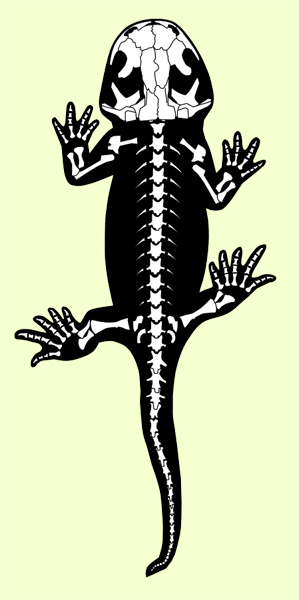
A skeletal reconstruction of the stem salamander Marmorerpeton wakei (dorsal view). Picture credit: Jones et al.
Marmorerpeton wakei
The stem Salamander genus Marmorerpeton was named and described in 1988, but detailed analysis of the Isle of Skye fossil material, including CT scans demonstrated that this was a new species, which has been named Marmorerpeton wakei. The species name honours the late Professor David Wake, who was a world-renowned authority on early salamander evolution.
Lead author of the study, Dr Marc Jones (University College London, Cell and Developmental Biology), commented:
“The fossil is definitely a salamander but unlike anything alive today. It highlights the importance of the fossil record for preserving combinations of anatomical features that do not exist in any living animal.”
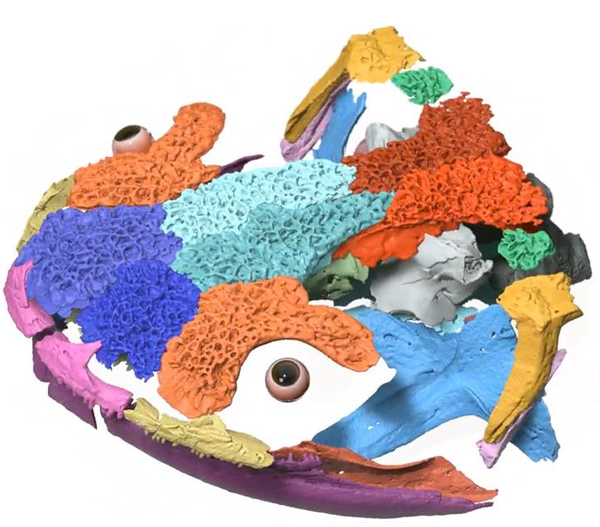
The anatomical features of the new Scottish fossils of Marmorerpeton wakei were only revealed thanks to the detailed CT scans and subsequent computer-generated models. This scanning technology provides a powerful and non-destructive tool for revealing fine details on fossil bones. One specimen, collected in 2016, was found to be part of a specimen collected in 1971 but left undescribed until now.
A three-dimensional image showing the skull bones of Marmorerpeton wakei. Following detailed CT scans of the fossil material a computer programme was used to interpret the data and reconstruct the skull. Picture credit: Jones et al.
Middle Jurassic Salamander
The fossils are thought to be around 166 million years old (Middle Jurassic) and although the Marmorerpeton genus was first described over 30 years ago, the material analysed in this new paper has permitted the researchers to build up a more complete picture of this 20-centimetre-long amphibian.
Marmorerpeton wakei had a wide but shallow frog-like head with powerful jaws and distinctive, prominent, bony projections behind its eyes. The skull roof bones show that it was ornamented like that of a crocodile or a temnospondyl, distinguishing it from extant salamanders. The limb bones and deep tail of Marmorerpeton wakei suggest this animal was aquatic, perhaps using its wide jaws to catch prey by suction feeding, similar to the lifestyle seen in the modern Hellbender salamander (Cryptobranchus alleganiensis) of North America.
The bony bumps behind the orbit are unusual and Dr Jones commented:
“The big bony projections behind the eye were a bit unexpected but smaller projections do exist in fossil salamanders from slightly younger rocks. Their purpose remains unknown.”
The early evolution of salamanders is poorly understood, their small and delicate bones are rarely preserved as fossils. This research also included a detailed survey of modern salamander anatomy which informed the subsequent analyses.
The Karaurus Genus
Several previous studies of Mesozoic salamanders have relied on fossils from the Late Jurassic, found in Kazakhstan, assigned to the genus Karaurus. As the Marmorerpeton fossils are older, they help to provide an improved understanding of how early salamanders evolved.
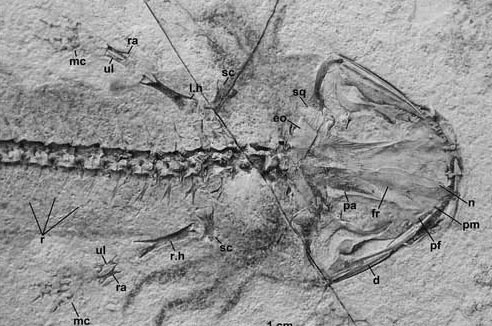
Even the fine gills have been preserved, a delicate salamander fossil from China. Picture credit: Chinese Academy of Sciences/Journal of Vertebrate Palaeontology.
Senior-author Professor Susan Evans (University College London Cell and Developmental Biology), who first described Marmorerpeton in 1988 explained:
“The origin and early history of modern amphibian groups remains mysterious and new fossils like this one are key to developing a better understanding of amphibian evolution. In theory, the Skye salamander should give us a clue as to what the ancestors of modern salamanders looked like. However, it could be that they are a highly specialised off-shoot.”
The scientific paper: “Middle Jurassic fossils document an early stage in salamander evolution” by Marc E. H. Jones, Roger B. J. Benson, Pavel Skutschas, Lucy Hill, Elsa Panciroli, Armin D. Schmitt, Stig A. Walsh and Susan E. Evans published in The Proceedings of the National Academy of Sciences (PNAS).
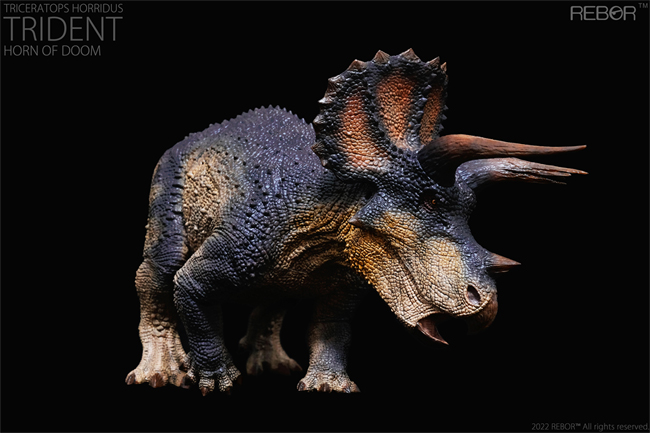
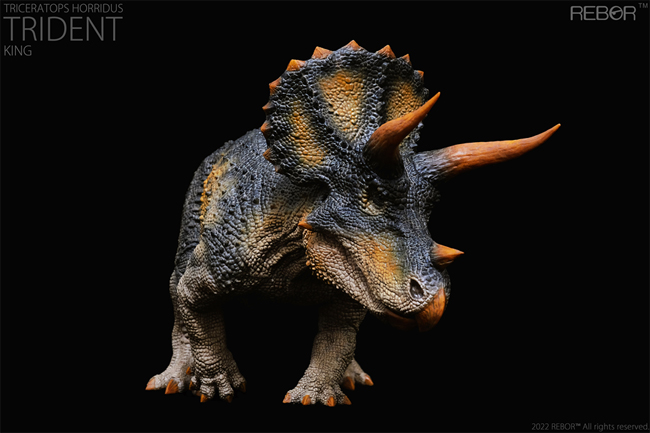
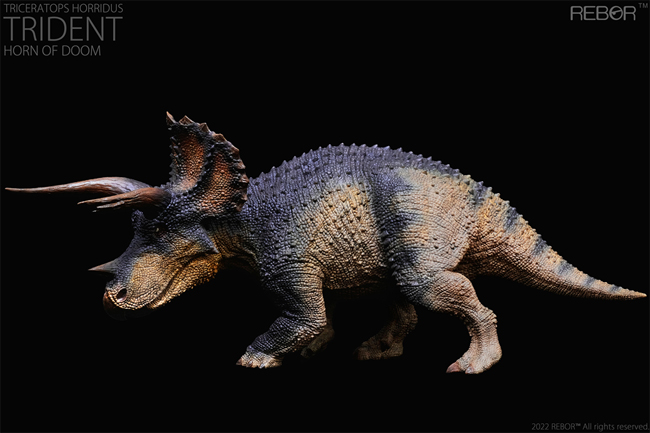
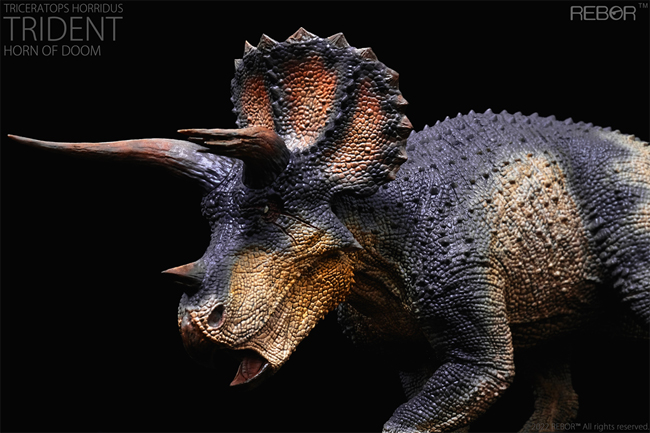
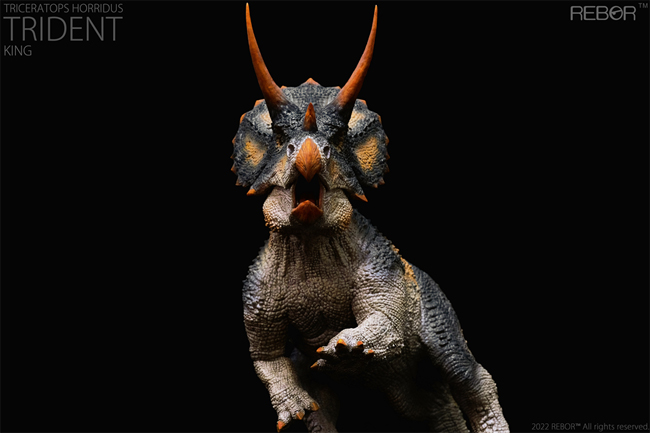
Everything Dinosaur will be stocking both the new Rebor male Triceratops “Trident” models. The Rebor male Triceratops “Trident” king and the Rebor male Triceratops “Trident” horn of doom are expected to be in stock towards the end of the year (2022).
Rebor male Triceratops horridus “Trident” Horn of Doom.
In addition, there is the Rebor “Trident” king Triceratops figure.
Rebor 1:35 Alpha Male Triceratops horridus “Trident” King version.
Rebor 1:35 Alpha Male Triceratops horridus “Trident” Horn of Doom
There had been rumours circulating that Rebor intended to introduce another Triceratops figure, a replica of a living animal after the company introduced the “Fallen Queen” model which was originally introduced back in 2015.
Rebor male Triceratops horridus Trident Horn of Doom. The model is shown in lateral view.
Two species of Triceratops are formally recognised, these two figures are based on the geologically older Triceratops horridus. There will be two colour variants of this 1:35 scale Triceratops, namely:
The Rebor 1:35 Alpha Male Triceratops horridus “Trident” Horn of Doom version.
The Rebor 1:35 Alpha Male Triceratops horridus “Trident” King version.
A remarkable Triceratops figure. The Rebor male Triceratops horridus Trident Horn of Doom.
Customers can email Everything Dinosaur and request to join the company’s priority notification list so that they can be contacted as soon as these splendid horned dinosaur models come into stock.
The Rebor male Triceratops horridus “Trident” Horn of Doom. Picture credit: Everything Dinosaur.
Picture credit: Everything Dinosaur
Rebor 1:35 Alpha Male Triceratops horridus “Trident” King Version
Each figure measures approximately 32 cm long and stands around 12 cm tall. A spokesperson from Everything Dinosaur commented:
“We will be stocking both the Rebor male Triceratops Trident King and the Rebor male Triceratops Trident Horn of Doom. These figures will be made over the summer and shipped sometime in the autumn. We expect to have them in stock at Everything Dinosaur around the end of quarter 3 or perhaps the start of quarter 4.”
For prehistoric animal models and figures, visit the Everything Dinosaur website: Dinosaur Models.
Rebor male Triceratops horridus.
Rebor male Triceratops horridus (anterior view).
Join Everything Dinosaur’s Priority Notification Email List
With Everything Dinosaur there is no need to pre-order, there is no deposit to pay. Customers can simply email and request that they join the company’s no obligation priority notification list.
The Rebor 1:35 Alpha Male Triceratops horridus “Trident” King version. Picture credit: Everything Dinosaur.
To join the priority notification list for these amazing figures, just email Everything Dinosaur remembering to let us know which dinosaur model(s) you want.
“Jurassic World Dominion” was released in UK cinemas on June 10th (2022), Everything Dinosaur team members were able to take time away from their busy schedule to watch the film yesterday (June 22nd). The film reunites many of the characters from the original “Jurassic Park” movie and there are several new prehistoric animals, recreated by a combination of animatronics and computer-generated images (CGI).
The film’s release had been delayed due to the global pandemic, but dinosaur aficionados and fans of the earlier movies have had the chance to see, what has been billed as the final instalment of the franchise.
Ultimately, T. rex is the star of the latest instalment in the “Jurassic Park/Jurassic World” franchise despite the appearance of numerous theropods including for the first time, Therizinosaurus and Giganotosaurus. Picture credit: Universal Studios.
Picture credit: Universal Studios
Pyroraptor, Giganotosaurus, Quetzalcoatlus and Therizinosaurus
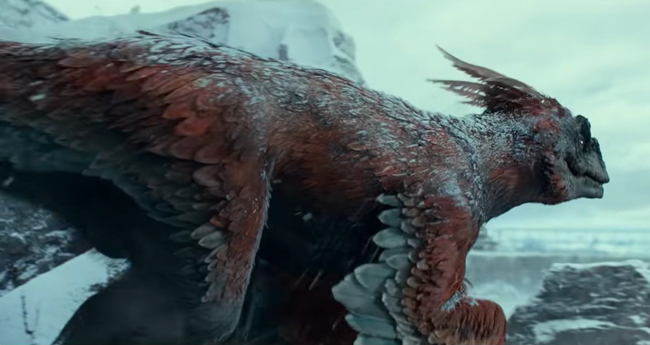
Lots of new prehistoric animals are featured, dinosaurs such as Giganotosaurus, Dreadnoughtus, Therizinosaurus, Atrociraptor and Pyroraptor. Some of these dinosaurs have been given feathers, perhaps a nod to criticisms of the integuments of the “raptors” seen in early incarnations of the franchise.
The feathered Pyroraptor from film “Jurassic World Dominion”. Picture credit: Universal Studios.
Picture credit: Universal Studios
Without giving away too many spoilers, the giant pterosaur Quetzalcoatlus and the sail-finned synapsid Dimetrodon also appear.
The film has garnered mix reviews from the critics, but movie-goes have been more generous with their praise. The film is currently showing a rating of 77% on the Rotten Tomatoes website. “Jurassic World Dominion” has certainly done very well at the box office. Earlier this week, global ticket sales passed the $600 million USD mark.
Paying Tribute to Earlier Films
“Jurassic World Dominion” might be a bit of chimera of a movie (reminiscent of the prehistoric animals with their genomes sourced from a variety of creatures). There are scenes that parody James Bond, Indiana Jones and “Taken” and whilst regarded by many as a “light, enjoyable romp”, fans of the franchise will have noted the numerous tributes paid to earlier films in this series.
Our particular favourite was when the character Ellie Sattler, played by Laura Dern, takes off her sunglasses in astonishment at what she is seeing, reflecting a similar scene from “Jurassic Park” that marks the first time the scientists see a dinosaur.
Is the Film Franchise Extinct?
With a running time of 2 hours and 27 minutes, this is the longest film in the “Jurassic Park/Jurassic World” franchise. Despite being billed as the final instalment and supposed to bring closure, team members at Everything Dinosaur suspect that, with it having made four times its estimated budget in ticket sales thus far, the commercial appeal of dinosaurs might result in a resurrection.
Just like the avian dinosaurs, this film franchise might not be extinct…
A site safety notice at our local cinema spotted at the entrance as team members went to see “Jurassic World Dominion”. Picture credit: Everything Dinosaur.
Picture credit: Everything Dinosaur
Team members who saw the film were amused by the “T. rex” signage.
Visit the award-winning Everything Dinosaur website: Dinosaur Toys.
A study published in the journal Ocean and Coastal Management predicts that rising sea levels threaten 200,000 properties in England. Sea levels have changed before and a new research programme instigated by scientists at the University of Bradford is setting out to map Ice Age settlements that have been swallowed by the sea.
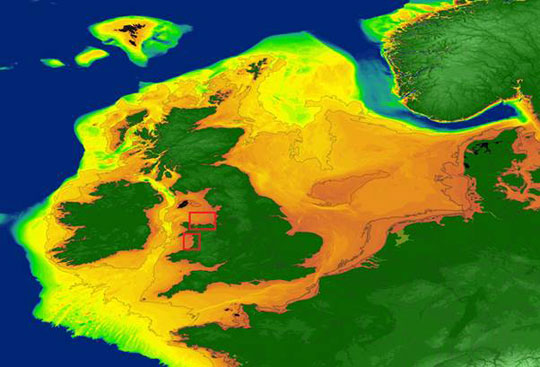
Approximate maximum extent of marine palaeolandscapes off the Irish and British coasts (survey areas in red). Picture credit: University of Bradford.
Picture credit: University of Bradford.
Searching for Human Settlements
The archaeological study, the first of its kind in the world, is being led by Dr Simon Fitch, a geoarchaeologist at the University of Bradford. It will entail the use of unmanned underwater drones and advanced three-dimensional seismic sensors to map coastlines as they looked between 20,000 BCE and 10,000 BCE (BCE – Before the Common Era).
During the later stages of the Palaeolithic, sea levels were between 120 metres to 40 metres lower than they are today, the British Isles was still connected to the European mainland and much of the area we now refer to as the North Sea was land (Doggerland). This project aims to find evidence of human occupation in areas which are now underwater.
Dr Simon Fitch is a geoarchaeologist who has a long interest in the study of all aspects of submerged landscapes. Picture credit: University of Bradford.
Picture credit: University of Bradford
The “Life on the Edge” Project
The five-year project entitled “Life on the Edge” has received funding from several sources including the use of a vessel provided by the Flanders Marine Institute.
Commenting on the significance of this study, Dr Fitch stated:
“Our knowledge of the submerged coastal zones of the Late Palaeolithic is essentially non-existent and we have little to no knowledge on the settlement of these areas. This project will represent the first serious attempt to record these landscapes and understand the communities who lived on the edge of the continents.”
Ice Age Settlements
During the last glacial period, humans occupied the extensive plains that linked the British Isles to the European mainland. It is likely that there were many settlements and this project sets out to map the unexplored record of coastal occupation with the focus on three locations the coast of Scotland, Belgium and the continental shelf of Croatia.
Whilst looking backwards into human history, this research also has important implications for the future of humanity. The study will examine how people adapted to the challenges of sea levels and climate change – issues that threaten humanity today.
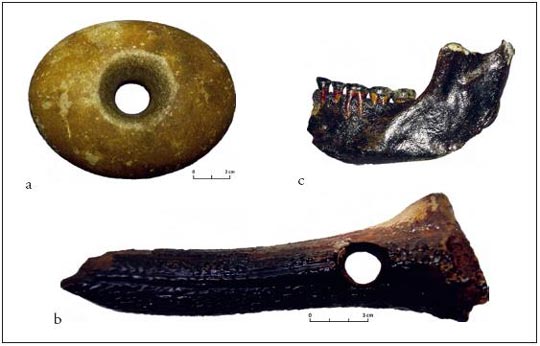
Brown Bank artefacts – A selection of prehistoric artefacts from Brown Bank collected by Dr Dick Mol polished stone axe mace head; b) perforated deer antler socketed adze axe head; c) human mandible, without scale from (Peeters 2011). Picture credit: University of Bradford.
Picture credit: University of Bradford
Dr Fitch added:
“It is not hyperbole to say this is ground-breaking. This survey will provide significant advances in scientific understanding and the results will be of global importance, as it will vastly improve the methodologies available to investigate the vast inundated prehistoric landscapes that can be found around the world.”
Everything Dinosaur acknowledges the assistance of a press release from the University of Bradford in the compilation of this article.
A few days ago (3rd of June, 2022), we published a blog post about a new species of ancestral giraffe (Discokeryx xiezhi) that had been described from fossils found in Miocene strata in the Junggar Basin in north-western China (Xinjiang Uygur Autonomous Region).
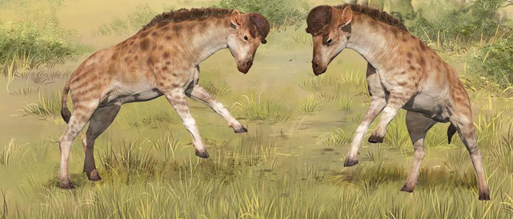
The recently described Miocene Discokeryx xiezhi. Two males indulge in a head-butting contest. Picture credit: Wang Yu and Guo Xiaocong.
Picture credit: Wang Yu and Guo Xiaocong
The researchers, writing in the academic journal “Science” had compared the prevalence of head ornamentation amongst giraffomorphs (those animals within the Giraffidae family and their ancestors) to other types of ruminant within the Pecora. They concluded that those animals on the branch of ruminants leading to the extant giraffes evolved more types of headgear than other pecoran groups. The driver for this evolution, was not selective browsing as previously thought, but the variety of headgear had, in part come about due to intensive sexual selection linked to various male combat styles – head-butting, neck banging etc.
Team members at Everything Dinosaur were not familiar with the Pecora and what types of ruminant within the Artiodactyla (even-toed, hoofed mammals) would be described as pecorans. So, we thought we would dedicate this blog post to providing a definition.
The order Artiodactyla is the most diverse and abundant group of large mammals on planet Earth. The Artiodactyla consists of the Whippomorpha (hippos), pigs (Suidae), Tayassuidae (peccaries and their relatives), the whales (Cetacea), Tylopods (camels, llamas and their relatives) as well as all the ruminants.
The biggest component of the Artiodactyla is the Ruminantia which are characterised by their four-chambered stomachs. Over eighty-five percent of all the artiodactyls are ruminants. Molecular studies have helped scientists to better understand the evolutionary relationships between the many families that make up this very large and diverse group of mammals. Although the exact taxonomy of this group is still uncertain, attempts have been made to clarify the evolutionary relationships between the different types of ruminant – hence the creation of the infraorder Pecora.
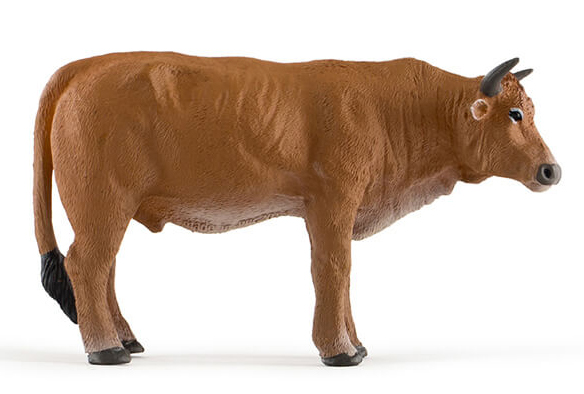
Of the 280 species of artiodactyls today, around half of these species are bovines (Bovidae) – cows, sheep, goats, antelopes and their close relatives.
Most scientists define the Pecora as artiodactyls with a ruminant digestive system. Specifically, those ruminants that possess cranial ornamentation either horns, antlers, bony structures (ossicones) or pronghorns, although Musk deer and their relatives lack cranial ornamentation but are still defined as pecorans.